Search Results: "tar"

7 September 2012

Andrew Pollock: [life] Sarah Pollock, BBus

Sarah is back in Australia attending the graduation ceremony for her Bachelor of Business degree, at the University of Southern Queensland, an Australia University that specialises in distance education. To say I'm immensely proud of her achievement is putting it lightly. Consider for a moment all of the challenges she has had to face in the past 6 years since she started it: Me, I'd fail at "studying remotely". Heck, I've had two stabs at a Bachelor of Information Technology on campus, and what do I have to show for it? No, I'm so very very proud of her for sticking at it, and doing so very well (she twice received the Dean's Award for having a high GPA for the semester). She decided to embark on a business degree after having a really hard time finding meaningful work when we moved to the US. She had been working in business project management for the Australian Federal Government (and really enjoying the work) before we moved, and couldn't find any project management that wasn't high-tech, which wasn't really her thing, and everything wanted a degree. She briefly contracted at VMWare, in a marketing position, and Google, in a Security Vulnerability Management role, but neither of these were really up her alley, so to speak. So she went "bugger it" and enrolled in the degree. Ironically, mid-way through the course, she decided that nursing was more what she wanted to do, so she has also gone out and done short courses in health care. She has been licensed as a Certified Nurse Assistant and also a Phlebotomist, but never worked as either. She's just started an Emergency Medical Technician course at Mission College, and is keen to try and work in that field for a little while before starting on a post-graduate Nursing degree in Australia. Sarah had indicated to me that she'd really love to go back for the on-campus graduation ceremony, since she's barely set foot on campus in the six years she's been studying at the university. I thought that was an excellent idea, so I sprang for a Business Class flight back for just her, and am staying behind to look after Zoe. It's only a flying visit. She departed Wednesday night, returns on Monday. As I write, she's probably at the ceremony right now. Normally it would take 6 years to complete a degree externally, assuming two subjects a semester for 12 semesters. She's obviously had to take a few semesters off here and there because of some of the aforementioned challenges. To still finish the degree in 6 years, she's had to plow through the "summer" break (I say "summer" because it's during the Northern Hemisphere winter) and use the accelerated "summer semester", also known as "semester 3" to do an additional subject. That's meant that summers over here have been her shorter winter break. This summer has been the first summer where she hasn't had to worry about studying, and it's been really wonderful to be a whole family again for an extended period of time, and we've had a jam packed summer as a result. We bought a tent and did a small amount of camping. We've had weekends away with friends. We've been to Raging Waters. We've been to Disneyland (granted that was in between final exams). It's been go go go. So now that summer is almost over, I'm looking forward to the pace slowing down a bit more and things returning to "normal" (well the new "normal" is Sarah doing her EMT class a couple of nights a week until December). She's only just started, but she's really loving the on-campus aspect of it. I'm also looking forward to getting a bit more "me" time. Since Zoe was born, I have sacrificed my personal time to facilitate Sarah's study. I haven't had much time to tinker and I've barely had time for Debian. I'm looking forward to trying to carve out a few hours a week for some of both, plus a bit of reading.

6 September 2012

Joey Hess: UPS farce

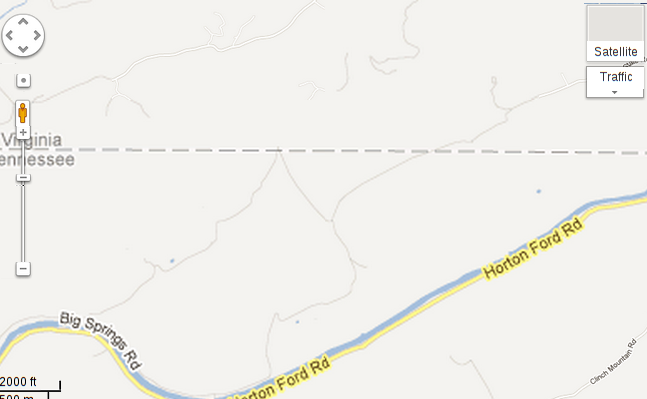
This is not the kind of place I live, though I don't mind a visit. Errol looking out over Salsalito and the Bay I'm not bothered by a more rural life, I thrive on peace and quiet, and am not bothered by needing to haul my water, split firewood, or spend an hour just mowing my driveway. I bought a GPS the other day, and it doesn't know where my driveway is..
or where the road leading to my driveway is..
or even about the highway leading to that road!
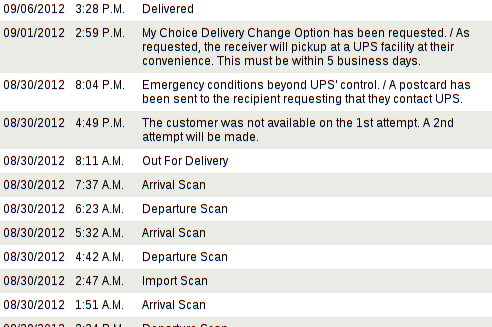
not many roads on this map.. The only thing that really bothers me about living here off the map is that I'm in the middle of a food desert too. The nearest semi-decent grocery store and produce market are 40 minutes away. There's one restaurant worth eating at, and while a very congenial place to eat rustic food while watching the river flow by, it serves almost no vegetables. Adding to the problem, my fridge is a rather expensive propane model, which is about half a normal size, and has no freezer. Managing a healthy meal plan is a constant struggle, though I do have time to cook, at least, thanks to not having the kind of commute that is typical around here. Well, the food desert was my only real problem. Now I can add to that the UPS emergency. A week ago, a package left Shenzen China for here. It quickly passed through Anchorage Alaska, and with a few days had arrived an hour and a half from here. Getting it here has taken the whole rest of the week.
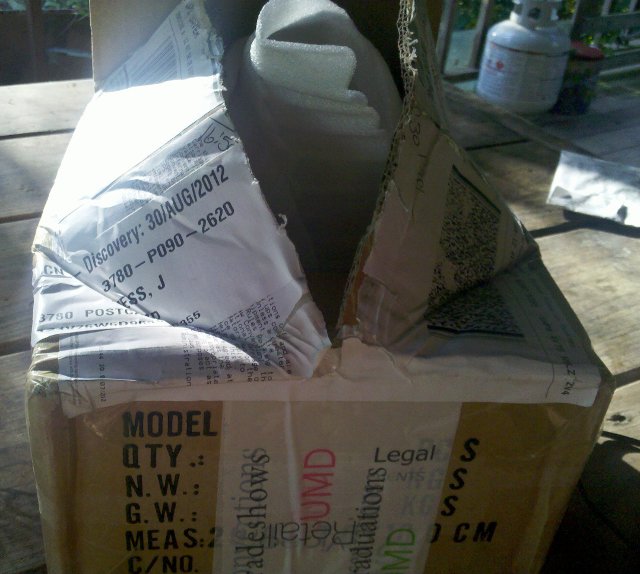
I only knew UPS attempted delivery because a neighbor told me. Seems they took one look at my driveway and turned around. They never tried again, and they didn't bother to leave a note on the mailbox, or anything. Now, the US postal service is happy to drive up this driveway; they drive a sensible 4x4 around here. I think DHL and Fedex have been here too. (Contrary to John Goerzen's experiences) My compact car is not bothered by my driveway either... But UPS's brand involves large brown trucks, even where inappropriate, and damage to them from such things as low-hanging branches apparently comes out of the driver's paycheck. And while normally UPS leaves small things in my mailbox, or with a neighbor, this was an important package from China, and it needed a signature. But really, a post card? "emergency"?! So, I bought the GPS to find UPS, because my package was in an industrial park in some town I've never been to. And on Tuesday I was within an hour of there and swung by. And it was closed. UPS's website had not mentioned this; other businesses are open the day after Memorial day. That turned out to be a really annoying day all around. When I got home, after a night away, I found my fridge's fire had blown out, and nearly all my food was only fit for the dog. Today I went out to try again (and buy groceries). When I reached the UPS depot.. it was closed! Until 3 pm. At this point I felt this story was reaching full-on farce. After cooling my heels in a library for three hours, I was finally able to open the most over-packed package I've probably ever seen. My kickstarter reward sample looks good.. I'll be ordering a lot more, but not to this address. As a coda to the UPS farce, arriving home today I checked my mailbox, and found the UPS postcard had finally arrived. It included mention of the 3 pm opening time, and noted that I had until tomorrow before they'd return my package to China. The coda to the coda is that on my way home from this second annoying day delivered courtesy of UPS, I stumbled on a restaurant overlooking a waterfall, just outside the town where I get my groceries. It serves food that satisfies both my Cajun and healthy cravings. Now I just need a larger fridge..

5 September 2012

Raphaël Hertzog: My Debian Activities in August 2012

This is my monthly summary of my Debian related activities. If you re among the people who made a donation to support my work (88.41 , thanks everybody!), then you can learn how I spent your money. Otherwise it s just an interesting status update on my various projects. This month has again been a short one since I have mostly been in vacation during the last 2 weeks. Dpkg Things are relatively quiet during the freeze. I only took care of fixing 3 bugs: a regression of 3.0 (quilt) (#683547), a segfault of dpkg-query -W -f (commit) and a bad auto-completion for French users (#685863). Testing the upgrade to wheezy We got several reports of wheezy upgrade that failed because dpkg ran the trigger while the dependencies of the package with pending triggers are not satisfied. Unfortunately fixing this in dpkg is not without problems (see #671711 for details) so Guillem decided to defer this fix for Jessie. My suggestion of an intermediary solution has fallen in limbo. Instead we now have to find solutions for each case where this can fail (example of failure: 680626). Another way to avoid those errors is to ensure that triggers are run as late as possible. We can improve this in multiple ways. The first way is to modify most triggers so that they use the interest-noawait directive. In that case, the packages activating the trigger will be immediately marked as configured (instead of triggers-awaited ) and the trigger will thus not need to be run as part of further dependency solving logic. But as of today, there s no package using this new feature yet despite a nudge on debian-devel-announce. :-( The second way is to modify APT to use dpkg no-triggers, and to let the trigger processing for the end (with a last dpkg configure -a call). I requested this early in the wheezy timeframe but for various reasons, the APT maintainers did not act on it. I pinged them again in #626599 but it s now too late for wheezy. I find this a bit sad because I have been using those options for the entire wheezy cycle and it worked fine for me (and I used them for a dist-upgrade on my wife s laptop too). It would have been good to have all this in place for wheezy so that we don t have to suffer from the same problems during the jessie upgrade, but unless someone steps up to steer those changes, it seems unlikely to happen. Instead, we re back to finding klumsy work-arounds in individual packages. Packaging I prepared security updates for python-django (1.4.1 for unstable,
1.2.3-3+squeeze3 for stable). I packaged a new upstream version for cpputest (3.2-1). I reviewed ledgersmb 1.3.21-1 prepared by Robert James Clay and asked him to prepare another version with further fixes. I released nautilus-dropbox 1.4.0-2 with supplementary changes of my own to support https_proxy and to display better diagnostic information when the download fails. With the help of Paul van der Vlis and Michael Ziegler, we did what was required to be able to migrate python-django-registration 0.8 to Wheezy even though it s a new upstream version with backwards incompatible changes. Thanks to Adam D. Barratt who unblocked the package, we now have the right version in Wheezy despite the fact that I missed the freeze deadline. Debian France Julien Cristau reminded the board of Debian France that we have to elect officers (President, Secretary, Treasurer) as the current officers have withdrawn. I was somewhat afraid that nobody would take over so I pinged each member to try to get new volunteers. We now have volunteers (me, Julien Danjou and Sylvestre Ledru) and we re waiting until Julien finds some time to run the election. Misc With the help of DSA, I setup antispam rules for the owner@packages.qa.debian.org alias because I was getting tired by the amount of spam. In the process, they asked me to write a wiki page for dsa.debian.org to document everything so that they can refer to it for future queries. I did it but it looks like that they did not apply my patch yet. I also tested an upstream patch for gnome-keyring (see bugzilla #681081) that reintroduces the support of forgetting GPG passphrases after a specified amount of time. Thanks See you next month for a new summary of my activities.

No comment Liked this article? Click here. My blog is Flattr-enabled.

Tanguy Ortolo: Datalove USB drives to reform European copyright

La Quadrature du Net is a European advocacy group that has been created to defend our rights and freedoms on the Internet against the continuous political threats driven by major corporations, such as the recent ACTA. After the recent citizen victories against these monsters, it is time to take the initiative and advocate for a reform of the copyright system which has become inappropriate with the omnipresence of copy-based systems.A USB stick, etched with a heart smiley <3 To this end, la Quadrature will give each Member of the European Parliament a customized USB drive, preloaded with a set of elements for a copyright reform, and with an anthology of free cultural works. To fund that campaign, la Quadrature is asking for everyone's help, by the means of an Ulule campaign (Ulule is a crowd-funding platform similar to Kickstarter). This initiative is noteworthy by at least two aspects: If, like me, you are tired of the continuous attacks from the major corporations of mass entertainment, in addition to not helping them by buying their crap, you can now participate in this first counter-attack. This will probably not end the war, so I hope there will be more offensive actions from the citizen group!

Russ Allbery: Reacting to excitement

I've been slowly noticing, over a number of years now, a place where I don't react to other people the way that I want to. I've been stumbling over defensive reactions that I didn't realize I had. These are a few rules of thumb that I'm formulating for myself to try to improve that, and I thought it might help to write them down. And maybe they'll be meaningful for someone else.
  1. Things people are excited about are probably exciting. If I don't find them exciting, that's probably because I don't know enough about them to understand why they're exciting. Or perhaps I have a different mindset, and therefore the exciting parts don't connect with me. Both of those are okay! There are way more things to learn about than I will ever possibly have time to learn, and I don't have to get excited about everything other people are excited about. But, equally, just because I'm not excited doesn't mean that the thing is not exciting.
  2. My misplaced sense of obligation should not be someone else's buzzkill. This requires a bit of unpacking, since I only intermittantly realize that I'm doing this. But (partly for cultural reasons, partly due to natural inclinations) I've always felt a strong sense of obligation to "keep up" with things. To know a lot about a lot of topics. And one of the things I've realized is that my brain occasionally twists an interest in knowing lots about the world into a sense of obligation to "stay current" and know something about everything important, at least within my vague field of expertise. And usually that part of my brain has a very expansive notion of field of expertise; all of software development, for example, which is, when I pull it out into the light, ridiculously broad. This then sparks one of the standard failure modes of human cognition. I have an unrealistic expectation of myself. I fail to meet that expectation. This makes me feel guilty and stressed. At that point, my brain starts trying to find targets for me to displace negative feelings onto, and that generally ends up being the next person who is excited about something new that I don't know anything about but feel like I should. This is all very interesting psychologically, in the abstract. However, the concrete result is that I sometimes get all snarky and negative about something that someone else is excited about because it happens to be the moment I hit overload, or because I didn't want to hear about another thing that I feel like I should know more about. And that, in turn, can be either confrontational or discouraging to someone who is legitimately excited (and may rarely get the chance to be excited). And that's not the person I want to be.
  3. It's okay not to have an opinion. Seriously, it's okay. The world is full of stuff, far more stuff than any one person can know anything about. It's okay not to go read about everything people say is exciting. It's okay not to know about something new. It's okay to focus on the things I'm already doing. Really. What's not okay is to make up an opinion about something I know nothing about just so that I can feel better about myself by having an opinion. Particularly since that opinion formed under those circumstances tends to be negative, despite the fact that I have no actual basis for having any opinion at all. I need to practice just quietly not having an opinion. No one else needs to know about my lack of opinion.
  4. Before bristling at imposition, be sure someone is actually imposing. I frequently leap to the conclusion that, when someone raises a topic, they want me to do something about it. It's a gut emotional reaction, I think in part because the emotional part of my brain likes to make everything about me. Intellectually, if I can engage that part of my brain, it's often obvious that it's not about me, or that they're not asking me to do anything. Often, when someone brings something up, they just want to tell someone else about it, or make me aware of it. If I've listened to, or read, all the sentences and understood then, then congratulations! I've done everything that I needed to do and was expected to do and need not feel any further obligation. Even if something further needs to be done, it doesn't necessarily need to be done by me. I'm very protective of my time and available resources because I almost always feel overwhelmed by all the things that I want to work on. This does not entitle me to snap at random people who are being excited around me on the grounds that they're trying to put more obligations on me. They're probably not. If it becomes clear that they really want me to do something I don't have time to do, I can politely decline, but if I just shut up and listen for longer, usually that's not the case at all.
(Please note that this is not prompted by any current discussion happening anywhere, and paticularly not by anything in Debian. Insofar as it was prompted by anything, it was by a throwaway comment in an unrelated private discussion. It's just something that gelled enough to write down while I was walking home from work.)

4 September 2012

Gunnar Wolf: Electronic voting in Panama: Slower, more expensive, more uncertainty... Goodbye!

Panama just underwent a nasty e-voting exercise: Electronic-mediated elections were held for the committee of the PRD party. It sounds simple - Even trivial! There were only 4100 authorized voters, it was geographically trivial (all set inside a stadium)... But it blew up in smoke. I won't reiterate all what happened, I'll rather direct you to our project's (the e-voting observatorium) page: News regarding Panama (for those coming from the future, search starting at 2012-08-27 and yes, it's all in Spanish, but there are free-as-in-beer translation services. Many e-vote proponents/sellers/pushers were very eagerly waiting for this election to brag about one more success... So much that they could not just ignore it, and started rationalizing it away. Anyway, while feeding the observatorium, I came across this opinion-article in the Voto Digital website, which makes quite a bit of pro-e-voting noise. I replied to it, and I think my analysis is worth sharing also with you:
So, lets make some simple numbers, rounding the numbers: The PRD vote in Panama was done for a universe of 4100 voters. It took 10 hours (instead of the planned 4), so 410 people were processed every hour. There were 40 voting (electronic) booths, so each processed 10 people per hour. This means, each person spent 6 minutes by the booth. A manual vote in this fashion is highly parallelizable: Each of the voters can be given ballots with anticipation, or many of them cna be allowed in to be given the ballots in situ (depending on the electoral scheme employed). The contention time is the time it takes to each voter to get near the booth and deposit his ballot (either folded or in an envelope) - And it will very rarely be more than a couple of seconds. So, given that using electronic booths parallelism cannot grow (there is a fixed number of machines) and the queues grew wildly, with traditional voting it would have surely fitted in the expected four hours (they were expected, also, based on their past experiences). As for counting, that's the slowest part of manual voting, it's also highly parallelizable: If each of the 40 booths has slightly over 100 ballots, the party personnel can easily count them in under 30 minutes. Capture and aggregation for the 40 partial results would take an extra 10 minutes, even being generous. Manual voting would have saved them around five hours, without demanding additional resources (and being thus much more economical than having to buy 40 specific-purpose computers). And as an additional advantage, the physical and tangible vote proofs would remain, in case they were ever again needed.

Thomas Koch: leaving facebook

I've never really used facebook so it's not too hard for me to delete my account there. The only thing that's a pity is that I found (or others found me) many people that I once met and which I'd love to meet again once. So I'll go through my facebook contacts list and will try to copy all contact data especially the email adresses and plan to write emails to everybody every quarter or half a year about happenings in our lifes. I'd be glad to receive such emails from others too! They'll surely be read more carefully then my facebook timeline!

This gets me to another point: I still don't have a satisfying free (as in freedom) solution to manage my contacts across devices and available on my web server. The same for image galleries. So I can understand how convenient facebook for many people is. Still facebook is evil and it's an important and ongoing project to provide a better alternative.

It'll be harder for me to leave Twitter. This one comes next. If people would just switch to the free and privacy aware alternative identi.ca...

And then I've to finally provide a better alternative for my family to share baby pictures then Google Plus... Leaving Xing and Linkedin also doesn't worry me, I just have to collect the addresses of my important contacts there. Not so pressing is to leave Couchsurfing for bewelcome.org.

So if you want to hear news from me just pass by www.koch.ro from time to time or put my blogs feed into your feed reader. I'll also keep my identi.ca account.

update: One tiny example of facebooks evilness is, that they don't show me your real email address (anymore). They only show me an @facebook address. So if I don't know your real email address from any other source, I would not be able to send you messages without sending it over facebooks servers. I read that you can change the email address shown back to your real email address somewhere in the options.

3 September 2012

Rog rio Brito: Trying out AdSense

I have been having quite costly experiments with (embeded) hardware in the last few weeks/months. To cover at least part of the expenses, I am trying out to use Google's AdSense with my blog. I plan on blogging more frequently with the results of the experiments, but it will take me a few days, as I want to offer people only the "meat" of what I actually did, pointing out some pitfalls that made me waste a lot of time. Anyway, back to AdSense, one interesting thing about trying it is that I applied to be part of the program for 3 or 4 times late in August and, due to unspecified reasons, my application was rejected for "not complying with their policies". I read the policies from left to side, from up and down and nowhere I saw anything that my blog infringed. This morning, I tried once again and I'm now in a sort of "probation period" for AdSense, which is progress I think. So far, I only put one advertisement at the top of my pages, but I am curious to know how "targeted" those ads would be to a blog that has articles that were written more than a decade ago, with posts in at least two languages. I guess that this is a weaker version of what Rapha l Hertzog is trying to do with his funding campaigns, except that I only expect to cover the costs of my hardware (even if I am skeptical that I will actually manage to reach that point of self-sufficiency).

Gunnar Wolf: WikiLovesMonuments wants *you* (and me!)

What, haven't you heard about the WikiLovesMonuments photo contest around cultural heritage? Copying from its web page,
Wiki Loves Monuments is an international photo contest around cultural heritage monuments in September. Starting from the Netherlands in 2010 and organized on a European level in 2011, we go global in 2012!
I heard about this initiative in Iv n Mart nez's Wikimedia talk at COSIT 2012, held last week in Coatzacoalcos, Veracruz (I intend to write a bit more regarding COSIT later on). I loved the idea, and intend to participate Not because I take great pictures (I don't, and I usually take them using my aging phone, which gives decent results but nothing beyond that), but because I love to move by bike in the city, and it's one of the best ways to roll in front of some of them. But more on me later Back to the topic! WikiLovesMonuments aims to improve on Wikimedia's (the organization behind Wikipedia and several other Free Culture reference projects) coverage of important landmarks all over the world. To do so, they are offering a trip to attend WikiMania 2013 in Hong Kong to the first place winner, and other "photography-related" prizes to the other winners. So, back to me: My motivation to enter the contest is to help Wikimedia. I know my shots won't be top-notch (although they will be the best I can do). I enjoy biking in my city, and often go not too far from many of the listed monuments. I am amazed at the number of monuments still pending in my area (of course, it's not by mistake this is called "La ciudad de los palacios", The city of the palaces) Surely some of the readers of this post will have (or will find easy to take) some photos to add. Of course, I'll try to focus on the missing monuments, but if you are a good photographer, you might want to submit a better version for a monument that's already there. So, some pointers, from what's closest to what's farthest from me: At least for Mexico, the listings are taken from the National Institute for Anthropology and History (INAH)'s Public registry of archaeological zones and monuments. So, I cannot wait to start my biking session today to get some good end-of-summer evening sun and get some pictures taken! :-D

Martin Pitt: PyGObject 3.3.91 released

I just released PyGObject 3.3.91, for GNOME 3.5.91. The big new feature in this release (thanks to the release team for granting an exception) is Simon Feltman s new Signal helper class, which makes defining custom signals a whole lot simpler and more obvious. In the past, you had to do
 class C(GObject.GObject):
    __gsignals__ =  
        'my_signal': (GObject.SIGNAL_RUN_FIRST, GObject.TYPE_NONE,
                      (GObject.TYPE_INT,))
     
    def do_my_signal(self, arg):
        print("my_signal called with %i" % arg)
whereas now this looks like
class C(GObject.GObject):
    @GObject.Signal(arg_types=(int,))
    def my_signal(self, arg):
        print("my_signal called with %i" % arg)
or even more elegantly when using Python 3 and its new type annotations:
class C(GObject.GObject):
    @GObject.Signal
    def my_signal(self, arg:int):
        print("my_signal called with %i" % arg)
Check out the updated example and docstring for other ways how to use it. Overrides can now be in a directory different from the one that pygobject installs itself into. These overrides need to put this into their __init__.py at the top:
from pkgutil import extend_path
__path__ = extend_path(__path__, __name__)
and put themselves somewhere into the default PYTHONPATH. This should make it a lot easier for library packages to ship their own overrides for Python. This new version also comes with a couple of new overrides and bug fixes. See the detailled list of changes below. Thanks to all contributors!

Paul Tagliamonte: tmperamental - check for wild /tmp calls

tmperamental found either on git.d.o, or github is a library to be LD_PRELOAD-ed, and help check for use of hardcoded /tmp. The idea is to get TMPDIR and friends, and preload tmperamental, which will call non-zero exit when an app does stuff in /tmp. It s a big hack, so if you feel like making it even better, send in patches :)

Lars Wirzenius: New format to replace tar: some notes

During lunch the other day, I discussed the shortcomings of the tar file format with friend and co-worker Daniel. The tar file format has a lot of legacy by now, and it's not quite up to date with the latest developments in file systems, such as extended attributes. This makes tar badly suited for things such as backups and other situations where precise reproduction of the input data matters. There are several variants of the tar file format, and various more or less standard extensions to it. GNU tar, for example, added support for pathnames longer than 100 bytes many years ago, and it is now commonly supported. Other problems in the tar file format: This led us to discuss the possibility of a new file format. We had a bit of fun exploring the solution space for a while. However, almost all use of tar these days is for distributing sets of files, where the filename and basic set of file permissions is enough. In other words, for things such as source code, tar is just fine. The archives are small enough, and the other limitations are rarely a problem, but the pain of switching to a new format would be great. Thus, with some reluctance, we concluded that a new format would be a waste of time. But I thought I'd write this up anyway, in case one of my readers wants to start working on this.

Joachim Breitner: A copying garbage collector animated

Next weekend I will hold an advanced Haskell talk at the Meta Rhein-Main ChaosDays in Darmstadt. It will mostly be a guided tour through the main memory of a running Haskell program, showing how things are represented and how they change over time. For this I cannot avoid to touch the issue of garbage collection, so I created a short animation:
<video align="center" controls="true" height="500" poster="http://darcs.nomeata.de/talk-mrmcd12-haskell-bytes/GC.png" src="http://darcs.nomeata.de/talk-mrmcd12-haskell-bytes/GC.webm" tabindex="0" width="800"> Your browser does not seem to support WebM videos. Try the YouTube link below. </video>
(If you do not see it above, then you can try on YouTube.) It is created with Synfig, feel free to use the sources. It seems that Synfig, although it has some features that allow you to link position in various objects, or calculate with them, is not really meant for programmers. Take the arrows: They are all quite similar, and defined by starting point, end point, and how much the initial segment sticks out to the right. I could even create them so that when I move the first or last point, the rest adjusts automatically. So one would expect that I can combine these shapes in one re-usable object that has these three values as parameters, but unfortunately, that is not the case. I guess next time I want to animate something as structured as this, I use either tikz (and generate one page per frame, convert them to an image and then to a video) or a Haskell library like gloss or diagrams. Update: I made some minor improvements to the video. Youtube does not allow me to change the video, so you ll see the new version only here.

Flattr this post

2 September 2012

Jose Luis Rivas Contreras: Finally a workaround for htop drawing issue inside tmux!

I was tired that htop didn t showed up the info as is, and started to google about it. Aparently there s an issue with the drawing stuff for bold and not-bold fonts, and most workarounds consists on making htop showing things on black and white. Then, lazyness came to my mind and used:
TERM=screen htop
Wala! It worked, and showed htop with colors! 12 colors of course, but I don t need more!! So after that I just echoed that line to my ~/.bash_aliases and is pretty much done for a while, at least for me. It works!

Gregor Herrmann: RC bugs 2012/35

not my Best RCBW Week Ever. anyway, here's what I've done:

Emanuele Rocca: Story of a bug in Ubuntu

Some months ago I have run into a pretty interesting bug while working on a Ubuntu-based remote desktop system. The whole OS was installed on a server somewhere and users could access their desktop remotely. Some call this stuff Desktop-as-a-Service. The operating system we chose was Ubuntu Oneiric (11.10) and the remote access part was implemented with x2go, which uses nxagent to provide NX transport of X sessions. Users could access their Ubuntu machines remotely, with sound, video, youtube, and all you would expect from a desktop machine. The whole thing was working quite well. Now, as I said that was in May. Ubuntu 12.04 LTS was available, and the choice of upgrading to it sounded pretty much obvious. So we upgraded our test system to Precise and everything seemed to work smoothly. Till we tried to open a PDF document, actually. It took evince about 50 seconds to display a relatively small document. Same story with images opened with the default image viewer, eog. The fix delivered to our users was simple: we have set shotwell-viewer as the default image viewer, and epdfview as the default PDF viewer. Everybody happy. In the meantime, obviously, I was interested in this issue so I ve tried to run run evince from a terminal, getting the following output:
(evince:15833): GRIP-WARNING **: Failed to initialize gesture manager.
Funny. On another test system running Debian Sid (unstable) everything was working smoothly. The diff between Ubuntu s version of evince and Debian s is a 6MB monster. Among other changes, I noticed that Ubuntu s version build-depends on libgrip-dev, which depends on libutouch-geis. Multitouch stuff. Why should multitouch support break my remote session? So on May the 10th I filed a bug on launchpad. How this issue got handled is in my opinion one of the many fine examples of the inherent superiority of free software, coupled with a we won t hide problems mindset. For an example of how bad is the proprietary approach, just check a random bug in Adobe s bug tracking system. But let s go back to the evince bug. Other users reported that their VNC sessions were also affected by the same problem. After a few days it was clear that the culprit was utouch-geis, and a patch appeared. Unfortunately it did not actually address the issue. Somebody else reported that RDP sessions were broken too. At the beginning of June Precise was still affected. Finally, on August the 6th a working patch was submitted by Bradley M. Froehle and included by Chase Douglas (thank you guys). End of August, fixed version of geis accepted into precise-updates, case closed. Now for some considerations. The problem was clearly of a certain importance. A Long Term Support, stable version of Ubuntu shipped with broken PDF and image viewing functionalities. It got fixed properly, even though 3 good months are quite a long time for such a bug to get solved. However, the issue only affected a pretty limited number of users, also certainly not Ubuntu s main target audience. This bug never affected Debian, simply because utouch-geis has not made its way into the archive yet. It takes longer to make changes like this in Debian, but for some categories of users stability is more important than new, cool features. Choice is a good thing.

Erich Schubert: ELKI call for contributions

ELKI is a data mining software project that I have been working on for the last years as part of my PhD research. It is open source (AGPL-3 licensed) and avilable as both a Debian package and Ubuntu package in the official repositories. So a simple aptitude install elki should get you going and give you a menu entry for ELKI. These packages come with the scripts elki to launch the MiniGUI and elki-cli to run from command line. The key feature that sets ELKI apart from existing open source tools used in data mining (e.g. Weka and R) is that it has support for index structures to speed up algorithms, and a very modular architecture that allows various combinations of data types, distance functions, index structures and algorithms. When looking for performance regressions and optimization potential in ELKI, I recently ran some benchmarks on a data set with 110250 images described by 8 dimensional color histograms. This is a decently sized dataset: it takes long enough (usually in the range of 1-10 minutes) to measure true hotspots. When including Weka and R in the comarison I was quite surprised: our k-means implementation runs at the same speed as Rs implementation in C (and around twice that of the more flexible "flexclus" version). For some of the key agorithms (DBSCAN, OPTICS, LOF) we are an order of magnitude faster than Weka and R, and adding index support speeds up the computation by another factor of 5-10x. In the most extreme case - DBSCAN in Weka vs. DBSCAN with R-tree in ELKI - the speedup was a factor of 330x, or 2 minutes (ELKI) as opposed to 11 hours (Weka).
The reason why I was suprised is that I expected ELKI to perform much worse. It is written in Java (as opposed to R's kmeans, which is in C), uses a very flexible architecture which for example does not assume distances to be of type double and just has a lot of glue code inbetween. However, obviously, the Java Hotspot compiler actually lives up to its expectations and manages to inline the whole distance computations into k-means, and then compiles it at a level comparable to C. R executes vectorized operations quite fast, but on non-native code as in the LOF example it can become quite slow, too. (I would not take Weka as reference, in particular with DBSCAN and OPTICS there seems to be something seriously broken. Judging from a quick look at it, the OPTICS implementation actually is not even complete, and both implementations actually copy all data out of Weka into a custom linear database, process it there, then feed back the result into Weka. They should just drop that "extension" altogether. The much newer and Weka-like LOF module is much more comparable.) Note that we also have a different focus than Weka. Weka is really popular for machine learning, in particular for classification. In ELKI, we do not have a single classification algorithm because there is Weka for that. Instead, ELKI focuses on cluster analysis and outlier detection. And ELKI has a lot of algorithms in this domain, I dare to say the largest collection. In particular, they are all in the same framework, so they can be easily compared. R does of course have an impressive collection in CRAN, but in the end they do not really fit together. Anyway, ELKI is a cool research project. It keeps on growing, we have a number of students writing extensions as part of their thesis. It has been extremely helpful for me in my own research, as I could quickly prototype some algorithms, then try different combinations and use my existing evaluation and benchmarking. You need some time to get started (largely because of the modular architecture, Java generics and such hurdles), but then it is a very powerful research tool. But there are just many more algorithms, published sometime, somewhere, but barely with source code available. We'd love to get all these published algorithms into ELKI, so researchers can try them out. And enhance them. And use them for their actual data. So far, ELKI was mostly used for algorithmic research, but it's starting to move out into the "real" world. More and more people that are not computer scientists start using ELKI to analyze their data. Because it has algorithms that no other tools have. I tried to get ELKI into the "Google Summer of Code", but it was not accepted. But I'd really like to see it gain more traction outside the university world. There are a number of cool projects associated with ELKI that I will not be able to do myself the next years, unfortunately. If you are a researcher in cluster analysis or outlier detection, consider contributing your algorithms to ELKI. Spend some time optimizing them, adding some documentation. Because, if ELKI keeps on growing and gaining popularity, it will be the future benchmark platform. And this can give you citations, which are somewhat the currency of science these days. Algorithms available in the major toolkits just do get cited more, because people compare to them. See this list for an overview of work cited by ELKI - scientific work that we reimplemented at least to some extend for ELKI. It is one of the services that we provide with ELKI for researchers: not only the algorithm, but also the appropriate citation.

1 September 2012

Tanguy Ortolo: XMPPloit explained

XMPPloit is an exploit tool for a so-called flaw in the XMPP protocol. It has been published recently under the GPLv3 license, and has received much comment. However, it does not seem anybody took the time to study this attack and explain it. Goals XMPPloit is designed to serve as a transparent man-in-the-middle between an XMPP client and its XMPP server, in order to force the client not to encrypt its communications, so that it is possible to read them and modify them on-the-fly. That allows to force the client to use a clear text authentication mechanism, to display its login and password, and to modify any message it sends or receives.
XMPP logo
Mode of operation If you were expecting a tricky, undetectable attack against the XMPP protocol itself, you will be disappointed. This attack could not be simpler:
  1. In XMPP, the clients opens a connection to the server as plain text. In this case, with the attacker between them.
  2. The server offers the STARTTLS extension. The attacker blocks it, that is, does not transmit this offer to the client, so the connection stays in plain text.
  3. The client authenticate over the plain text connection.
Comments In fact, this is only an exploit against design flaws of some XMPP clients that would not warn the user that they are about to send their credentials on a clear text channel. Actually, the protocol most vulnerable to this type of attack is HTTP. Many websites that identify their users are made available over clear text HTTP, with an automatic redirection to HTTPS. Unless they use HSTS, this redirection can be blocked by an attacker without being noticed by most users. And, contrary to XMPP, not warn the user of an insecure login is not the fact of some broken clients, but of all the available browsers. I repeat: not a single browser will currently tell the user: Hey, you are about to transmit a password in clear, it could be intercepted! . Yes, there are browser that warn their users this way the first time: Hey, you are about to transmit your answers to a form in clear! Do you wish to do that, and do you want me to warn you next time? but this not quite the same, and it is just badly designed and in practice neither useful nor usable so everybody disables that.

31 August 2012

Roland Mas: Integrating FWbuilder with fail2ban and port-knocking

This article documents how I'm currently building my firewalls. It builds on netfilter-based-port-knocking, and tries to integrate several components of a firewall as gracefully as possible. For some context: I'm getting involved with servers where the firewall policy goes beyond a handful of SSH from my home and my other servers rules. There are many different network streams that need to be policed, some of them are common across several (potentially many) servers, and so on. So I'm gradually giving up on my hand-made scripts, and trying out higher-level tools. I settled on FWbuilder, which seems nice. However, it only allows static policies, and I still want to keep dynamic policies such as what fail2ban provides, as well as my own port-knocking system. The problem I had was that fail2ban isn't really made to play nice as part of a complex firewalling setup, my port-knocking system was too tightly integrated within my firewall script, and FWbuilder wasn't too flexible when it came to delegating part of the firewall policy to something external. Fortunately, this was only a perceived problem (or a real problem in my understanding), because it is actually possible to have all three blocks playing nicely together. More context: as usual, I'm focusing on Debian-like systems. More precisely, on those with a Linux kernel; it may be that FreeBSD's firewalling subsystem has a feature comparable to Linux's recent module, but I don't know. Let's start with FWbuilder. This is not the place for a manual, the official documentation is rather complete. I'll assume you have defined most relevant blocks in there: firewall, hosts, IP addresses, services, and so on. You define your static policy with the standard rules. From then on, we want to integrate the external tools for dynamic rules. Step 1: Integrating fail2ban We want fail2ban to have its own playground, so that it doesn't overwrite anything in the standard policy. The trick is to define a new policy rule set named fail2ban. Leave it empty in FWbuilder. So far so good, but fail2ban (the daemon) still operates on the INPUT chain in the firewall, and could therefore still mangle the static rules. Fortunately, starting with fail2ban 0.8.5 (available from Debian Wheezy, or in the backports for Squeeze), you can define what chain to operate on: with a configuration item such as chain = fail2ban, fail2ban (the daemon) will now only add its rules to fail2ban (the firewall chain), and won't be able do damage the other chains. The missing part is to send some of the traffic to it using the standard policy: i defined a rule sending the incoming SSH connections to the fail2ban policy ( branching in FWbuilder jargon). Voil : the static policy delegates part of the decision-making to a sub-policy controlled by the fail2ban daemon. Step 2: Integrating port-knocking This is a bit trickier, but we'll use a similar method. First, the traffic used for port-knocking needs to be directed to the chain that does the listening. Define a policy rule set named portknocking, and leave it empty in FWbuilder. It'll be used by the dynamic rules to track progression of source IP addresses through the port-knocking sequence, so you'll need to send ( branch ) incoming traffic there, probably after the rules allowing incoming connections from known hosts. The dynamic part of this will only concern the refreshing of this listening chain , which we assume will do its work and mark IP addresses with PK_ESTABLISHED once the sequence is completed. What we do with these marked IP addresses will still be defined within the FWbuilder policy. We're going to need some complex rules since we want to filter according to this PK_ESTABLISHED bit and according to destination port, for instance; unfortunately FWbuilder doesn't allow combining filter criteria with and, so we define a new policy rule set called accept_if_pk_ok. This ruleset has two rules: the second is an ACCEPT and should be easy to understand. The first rule needs to ensure the ACCEPT is only reached for connections coming from PK_ESTABLISHED addresses, so it's going to be a bit tricky. (Explanation: the first rule matches packets coming from IP addresses not marked as PK_ESTABLISHED, and returns them to the calling policy. Packets remaining after this rule are those coming from the appropriate addresses, and they go on to the ACCEPT. We could have had the first rule match on IP addresses that are marked, and branch to yet another ruleset with the ACCEPT part, but that would make it harder to read, I feel.) Now let's get back to the main policy and add rules concerning what kind of traffic we want to allow once the port-knocking sequence completed. For instance, we define a rule matching on the SSH service , where the action is to branch to accept_if_pk_ok. When an incoming packet tries to establish a connection to the SSH port, it's passed to the accept_if_pk_ok ruleset. If it comes from the same IP as a recent port-knocking sequence, it goes on to be ACCEPTed. If not, it returns to the main policy. Maybe static rules further on will allow it to go through. Step 3: tying it all together Now that we have all the pieces, the rest is plumbing. With this setup, at boot time, the $hostname.fw script creates the static policy and the extra playgrounds; then the port-knocking script implements the listening for the magic sequence; then fail2ban inserts its own rules. And there we are: three different parts for the firewall policy, all integrating nicely. Mission accomplished! Note: (Mostly copy-and-pasted from the previous article) This article is deliberately short on details and ready-to-run scripts. Firstly because firewall scripts vary wildly so any script would have to be adapted anyway, but mostly because security is best handled with one's brain switched on. Fiddling with a firewall can easily open gaping holes or lock everyone out. So please make sure you understand what goes on before blindly pasting stuff into your own setup. Some bits are left as an exercise to the reader.

Paul Tagliamonte: A bit more on DPU

DPU, as I ve mentioned casually, is a testing framework for Debian tools. I ll expand a bit more about what DPU does, what it s going to be used for, and how it can help you (yes, you!) create tools to work with Debian packages. Firstly, DPU is a test framework. It s sole purpose is only to run tests, and give each test a pass / fail grade. The test syntax will be as declarative and simple as one can keep such things, and tries to do the right thing(tm). It s not currently stable, but it s getting there. DPU aims to replace Lintian s test suite, and clean up the tests to make them a bit more declarative, and less hackish. At it s core, DPU uses a templating system (using Jinja2) to render out a policy-perfect Debian source directory, including (if needed) any number of fake Upstream files, such as Hello World! in Shell (for arch:all), in C (for arch:any), and so forth. DPU tests mangle (slightly) the files before a run simple stuff like removing a manpage, or adding a file where it shouldn t be. After the builder builds the package (with any of the global or test-local builders), any number of checkers (again, global or local) are run, and output compared. This is the part that s currently undergoing work, but the basics are alive, and an example test directory is on my github. Everything s in Python, and new contributors are welcome!

Next.

Previous.