Search Results: "sto"

17 February 2011

Christoph Berg: Heartbeat and bind9

Using a virtual IP managed by heartbeat is a nice way to work around the slow fallback behavior with multiple nameservers in /etc/hosts. But unlike ntpd, bind9 doesn't automatically listen on new IPs on the system. Here's a cute hack to fix that:
# cat /etc/ha.d/haresources
server01 bind9release IPaddr::10.0.0.3 bind9takeover
# cat /etc/ha.d/resource.d/bind9release
#!/bin/sh
# when giving up resources, reload bind9
case $1 in
        stop) /etc/init.d/bind9 reload ;;
esac
exit 0
# cat /etc/ha.d/resource.d/bind9takeover
#!/bin/sh
# on takeover, reload bind9
case $1 in
        start) /etc/init.d/bind9 reload ;;
esac
exit 0

David Welton: Random github idea: show pull requests on the network

Another day, another "which ^(&^%*&*^&()* version should I use?!" with github: https://github.com/gramos/easy-fckeditor/network Github is nice, but very, very often all the forks are the very model of a modern major paradox of choice. Which one should I use? Which one is best? Do the forks exist because 1) the original author stopped bothering? 2) because the forkers just wanted to be 'cool' and have their own fork? 3) because the forkers don't have a clue about open source and don't attempt to submit their patches back? Who the hell knows, in most cases. This is frustrating. I had a random idea that might help some: if the 'network' view were able to show you, at a glance, the amount of interaction between different forks: pull requests accepted and rejected. At least we'd get an idea of what sort of community is forming around the project, and also have an idea whether the forkers and/or the authors are good open source citizens or not. Of course, as my friend Salvatore says, "pull requests are not conversations", but it's better than nothing.

Cyril Brulebois: Debian XSF News #5

Time for a fifth Debian XSF News issue!

16 February 2011

Steve Kemp: Upgrading from Lenny to Squeeze

Rather than waiting for a few months, as I typically do, I decided to be brave and upgrade my main virtual machine from Lenny to Squeeze. That host runs QPSMTPD, Apache, thttpd, and my blogspam server; nothing too complex or atypical. The upgrade was mostly painless; I was interrupted several times by debconf asking me if I wished to replace configuration files I'd modified, but otherwise there were only two significant messages in the process:
crm114
crm114 warned me that its spam database and/or configuration files had changed and would most likely result in brokenness, post-upgrade, and I should do something to stop avoiding lost mail. Happily this was expected.
sysv-rc
It transpired I had a couple of local init scripts which didn't have dependency information succesfully encoded into them; so I couldn't migrate to dependency-based bootup. Given that this server gets a reboot maybe once every six months that wasn't really worth telling me about; but nevermind. No harm done.
That aside there were no major surprises; all services seemed to start normally and my use of locally-compiled backports meant that custom services largely upgraded in a clean fashion. The only exception was my patched copy of mutt which was replaced unexpectedly. That meant my lovely mutt-sidebar was horribly full of mailboxes, rather than showing only new messages. I created a hasty backported mutt package for Squeeze and made it available. (This patch a) enables the side-bar, and b) allows you to toggle between the display of all mailboxes and those with only new mail in them. It is buggy if you're using IMAP; but works for me. I would not choose to live without it.) Now that I've had a quick scan over the machine the only other significant change was an upgrade of the mercurial revision control system, the updated templates broke my custom look & feel and also required some Apache mod_rewrite updates to allow simple clones via HTTP. (e.g. "hg clone http://asql.repository.steve.org.uk/"). So in conclusion: ObQuote - "Hmm, upgrades " - The Matrix Reloaded (shudder).

David Welton: The UnderPerformingStocks.com sale - halfway in

A few weeks ago, I had an "out-there" idea to try creating and selling a site at the same time. So far, it's not exactly raking in a major amount of cash: www.underperformingstocks.com is For Sale on Flippa! At $100 with a couple of bids, it doesn't look like I'll be able to retire on it! That said, I haven't spent a great deal of time on it, and part of the idea of the experiment was to limit the amount of time the 'new idea' would distract me from other things. I did hope to receive a few more "audience requests" in terms of what to build on Flippa.com, though. Hopefully, things will heat up a bit during the final two weeks of the auction, but I don't think "flipping" web sites is really a business I want to be in. It's been fun to see how much you can build with how little, though, what with all the widgets and API's out there these days. Since I'm a coder at heart, I also released some Ruby code that utlizes Google's stock screener API: https://github.com/davidw/google-screener - it's under the Apache license, and is kind of neat to play around with, I think, and is what I use to fetch information for the site.

Michal Čihař: SF.net has back git email notifications

As I have complained quite loudly in this blog, I think it's fair to post a status update again. Yesterday the emails started suddenly to work. So the major reason for my complains is gone. What I still don't like that this issue was not at all communicated to project admins. It stopped to work, what was sort of announced in blog post. It started to work again without any announcement and last status update in blog still claims they do not work. At least for direct question, we've received reply that they have intentionally re-enabled this service.

Filed under: English Phpmyadmin 0 comments Flattr this!

Kartik Mistry: Nexenta is hiring!

* It is always fantastic being with Kernel, Device Drivers, File Systems and Network Protocol and yeah, Illumos, NCP and NexentaStor! So, if you re around or in St. Petersburg, Krasnodar or Northen Boston (or even somewhere else too) read below :) we re hiring! From, John Goerzen s recent post,
Oh, and if you d like to work for us, you should probably be sending me an email. No, I m not going to list the address here on this blog post. If you can t figure it out, I don t want to hear from you

Gunnar Wolf: Responsible biking: We are not exempt from the traffic rules!

As you know, I very often advocate using the bycicle as the main means of transportation in Mexico City. The city is very apt for biking through it, and contrary to the fears of mostly everybody, the city is neither aggressive nor as dangerous as people say. However, I have seen cyclists which seem to be looking for the best ways to be hit by a car, or to hit a pedestrian. Yesterday, I read this note in La Jornada: The local Environment Secretary calls cyclists to respect vial regulations. Many cyclists assume they are a special case of pedestrians, and zig-zag as they please between the road and the walkway, or just stay in the walkway. That is dangerous, both to pedestrians and to themselves. You might find children, elderly or motion-challenged people on your way. Also, not only will pedestrians only expect other people in the walkway, moving at their pace or slightly more, but cars will also not expect somebody moving at 10-20Km/h. A car driver pulling out of his garage, or crossing a street, will not have enough warning when he sees you, and you are very likely to end up in an accident. Since ~5 years ago, Mexico City is growing a grid of Metrob s and confined troleb s cero emisiones (trolleybus) lanes. Many cyclists use those lanes That is VERY dangerous. Public transport vehicles are large, have a lot of inertia, and will take longer to react to finding you ahead of them. Besides, they can go way faster than a regular bike (~60Km/h for metrob s, ~40Km/h for troleb s), and have to stop every couple of blocks. So, you will be uncomfortable if trailing them, and you will be a liability to ~100 people if you go ahead of them. Besides, it is illegal to drive in the confined lanes if you are not a public, semimassive transport vehicle! Surprisingly many people have argued they prefer riding their bicycles against the traffic I think they prefer staring at Death into its blue, glowing eyes (or into its long, thin whiskers)... By far, most cars that hit a bicycle do so from the side, when crossing a road. And if you arrive at a crossing from the wrong way, the way a driver does not expect you, don't expect the driver to be aware of you. Also, in the much less likely event of a car running into you, would it be better to be hit at 80Km/h (60Km/h of the car plus 20Km/h of your own speed on a full frontal crash), or at 40Km/h (substracting instead of adding)? Yes, some people say that looking at the car will allow you to maneuver How far in advance would you know a car coming from the front will hit you? One second? That's 22 meters at 80Km/h (again, if you realize the 60Km/h car is heading straight to you, at 20Km/h). Too short notice for you to do anything Any maneuver will most likely end in an accident. And the driver would not be so much to blame, as he would not be anticipating you riding against the traffic. Make sure you get seen. By night, always use proper lights (red on the back, white on the front, and reflective material to the sides). Day or night, wear bright, reflective clothes (or over-clothes material). Act in a predictable fashion. Remember you are riding a vehicle and are subject to the same rules any driver is A cyclist is not exempt from driving correctly! Do not jump red lights. Never ride on the walkway. Do your best to enjoy the ride. And ride. Yes, ride, take the streets, enjoy the streets. But don't attempt to drive the traffic out of it The streets belong to us all, and we can all share them. PS I also saw this note in the same paper: Sunday Rides in "Campo Militar N mero Uno". The main military field was open as a park this weekend! I have to make sure it is regularly open I am definitively going there!

15 February 2011

Wouter Verhelst: "Please send a patch"

On the gripping hand, Matthew, notice that patches written by someone utterly unfamiliar with the code in question aren't always welcome. While some people don't mind spending several days on something that may or may not be accepted to begin with, it's important to realize that talking about wishlist items before even thinking about possibly writing a patch is more likely to result in the desired behaviour than writing and submitting patches in a fire-and-forget manner. In that light, there are cases where 'please send a patch' can be quite demotivating, and it makes sense as a developer to engage in a discussion about a wishlist item, even if you're not immediately interested in implementing said feature yourself. Such a discussion could lead to either you implementing it, or someone else implementing it, or the other person finally understanding that your vision for the software in question doesn't match theirs, and that they should just find something else to spend their time on. I guess the moral of the story is: as a user with a wishlist item, you should talk to developers, let them know what you think is important, and be prepared to write a patch yourself if needs be and you have the skill. As a developer, you shouldn't interpret every wishlist request as a question to 'please please please implement my pet feature', but as an opportunity to reconsider your views, and possibly implement some nice new feature that you hadn't thought about originally but which you think might be nice, too. If people reply with 'please provide a patch' to each and every wishlist request, they're stupid; even more so than users who think they have anything to demand.

14 February 2011

Gunnar Wolf: Subsidizing private education?

Hrmh... I am listening to a local news radio station. Of course, what I am about to write lacks information and insight but it follows a conversation I have had with several groups of friends. Our de-facto president has decreed that the tuition for private schools will be deducted from the Impuesto sobre la renta (revenue/profit tax) up to a given tuition level (IIRC up to MX$2000 a month per child per school). The interviewed subsecretary said they expect this deduction will reach MX$13,000 million, around US$1,000 million. This is, about a third of what is assigned to the National University (UNAM). At a first sight, this sounds good. However, I just thought about a discussion I have had with many friends. This money the government will hand back to the taxpayers has to be cut from somewhere (after all, we are not in a country with huge superavit or anything like that). Why does this sound unfair ot me? Because it benefits the few in perjudice of the many. I did a quick search, and found this work based on numbers published by INEGI ten years ago: According to the last table, the money spent on private education was between 5% and 10% of that spent on public education Of course, it is almost impossible to infer the number of students from this alone. I know I could find authoritative data on this regard by searching a bit more, but after all I don't want to spend all (work!) evening on a blog post unless it creates some discussion. Lets say, just for the sake of the exercise, that this means that ~3% of the country's students learn in a private school. In Mexico, the quality of the basic public education (primary/secondary, ages 6 to 18) has fallen hugely in the last decades. Even when I was to school (but not when my parents), the first subjective sign that a family had broken the low-income barrier is that they were finally able to send their children to private schools. Because, no matter how bad they are, public schools are perceived to be worse. Of course, I was among the "lucky" ones to be in a private school. Higher education (universitary level) is still way better ranged. Anyway... I want to get this post over with. Why do I oppose this subsidies/tax devolution? Because it will lead to widen the difference between private and public education. And because it will be benefical only for medium-high and high classes People who are formaly employed (as I am) do not present a tax declaration, so we won't get any deductions. Between and of the country's economically active population work informally (from selling in the street to covering up huge transactions in large locals). Most of the population don't (directly) pay "impuesto sobre la renta", and will not get the benefit of this subsidy. This money has to be taken from other sources in order to be given to private education. If the government wants to improve the education for everybody, why not assign it to the public sector? To specific areas in the public sector, if they don't want to hand it over to the (yes, very, incredibly) corrupt SNTE (National Union of Education Workers)?

John Goerzen: How do you hire programmers and sysadmins? How should employers evaluate you?

Reading job listings for any sort of IT job is depressing. It s been quite some time since I ve had to do that, but how many times have you seen something like this: I could go on and on. As a job seeker, that sort of thing is fundamentally devaluing to someone who has strengths in being adaptable and quickly learning new tools, languages, or even entire environments. As an employer, it sends a message that you re not interested in more than a surface look at someone s strengths, and probably don t care to hire the best and the brightest. After all, would you turn away a rockstar programmer simply because he or she had been writing filesystem code in C the last 3 years instead of the latest whizbang Java web widget that will probably be obsolete in a year and unsupported in two? I am quite certain that there are plenty of managers that do. Even if you are a company large enough to have an entire team of people that do nothing but work on that whizbang app, don t you still want the best you can find, realizing that some of the best people to work on that app may not have even heard of it yet? (And that when the app goes obsolete in 5 years, you d rather not have to lay off a large team of single-skill people) Some of you may know that I work in IT at a manufacturing company. We have a small IT team here, about seven people, and are a heavy Debian shop. And we have a vacancy open up in our development/Linux admin group. I m the manager of that group, which is why I m thinking about this right now. We re too small for single-subject specialists to make sense, yet we re big enough to appreciate skill, experience, flexibility, and rigor. Consequently, when the occasion arises for me to look for new employees, I don t prepare a laundry list of things we use in-house and would like experience with. The list of almost-required things generally begins with Linux and ends with experienced , and has nothing else in between. In other words, I d like it if I don t have to explain to you what a symlink or a hardlink is, but I d be willing to do so if I think you d internalize it quickly. On the experienced side, it would be nice if you already have a well-developed sense of fear at running rm when you re root, or have designed a storage infrastructure for a network before, or are paranoid about security. But again, if people can pick up those traits on the job, we are usually still interested. If learning how to package up software for Debian, fix bugs in software you ve never seen in a language you ve never heard of, raise good questions about things you may not have lots of experience with, and write documentation for it all on a wiki sounds like fun, then that s probably the kind of person I want, even if you ve never used our particular tools before. If I were to judge based on the stuff I normally see in job postings, I guess you might conclude I m nuts. I don t think I am, but then again I m also the only person I know that formats his own resume in hand-crafted LaTeX. What do you all think? The next question is: how should one evaluate candidates given this sort of philosophy? I m not a fan of canned tests, or even whiteboard tests that tend to be some sort of canned topic that may test the applicant s specific knowledge base more than overall skill and flexibility. Similarly, as an applicant in years past, I ve struggled with how to present the I ve never used $LANGUAGE, but I know I could pick it up quickly and do it very well vibe. To certain people, that might sound like BS. To the more geeky managers, perhaps it sounds like what they want. We ve built a fairly diverse team on the back of this approach, and it s worked out well for us so far. I m interested to hear your thoughts. Oh, and if you d like to work for us, you should probably be sending me an email. No, I m not going to list the address here on this blog post. If you can t figure it out, I don t want to hear from you <grin>

Nikita Youshchenko: Lost n900

This is a wonderful beginning of the week. I ve lost my n900. Most likely, case was not properly mounted on my belt today, and fell down at some point. Chance to get device back is near-zero. It does not respond to calls to itself ( off or out of network coverage ) so likely somebody found it, and turned it off and/or replaced SIM, etc. I ve used it for more than a year. It had lots of customizations, large chat logs, and lots of other data. And it was tightly integrated into my day-to-day life.
Some backups are available but not very recent. And not sure that these backups could be used to recover things into other device and, given all those recent news about Nokia, it is definitely unwise to buy a new n900, as well as any other Nokia device. This blog will unlikely get any more n900-related posts. I m quite frustrated, and can t do anything useful already for several hours :( .

Rapha&#235;l Hertzog: Debian Cleanup Tip #3: get rid of third-party packages

Last week, we learned how to get rid of obsolete packages. This time, we re going to learn how to bring back your computer to a state close to a pure Ubuntu/Debian installation. Thanks to the power of APT, it s easy to add new external repositories and install supplementary software. Unfortunately some of those are not very well maintained. They might contain crappy packages or they might simply not be updated. An external package which was initially working well, can become a burden on system maintenance because it will be interfering with regular updates (for example by requiring a package that should be removed in newer versions of the system). So my goal for today is to teach you how to identify the packages on your system that are not coming from Debian or Ubuntu. So that you can go through them from time to time and keep only those that you really need. Obsolete packages are a subset of those, but I ll leave them alone. We took care of them last week. Each (well-formed) APT repository comes with a Release file describing it (example). They provide some values that can be used by APT to identify packages contained in the repository. All official Debian repositories are documented with Origin=Debian (and Origin=Ubuntu for Ubuntu). You can verify the origin value associated to each repository (if any) in the output of apt-cache policy:
[...]
 500 http://ftp.debian.org/debian/ lenny/main i386 Packages
     release v=5.0.8,o=Debian,a=stable,n=lenny,l=Debian,c=main
     origin ftp.debian.org
[...]
From there on, we can simply ask aptitude to compute a list of packages which are both installed and not available in an official Debian repository:
$ aptitude search '?narrow(?installed, !?origin(Debian))!?obsolete'
or
$ aptitude search '~S ~i !~ODebian !~o'
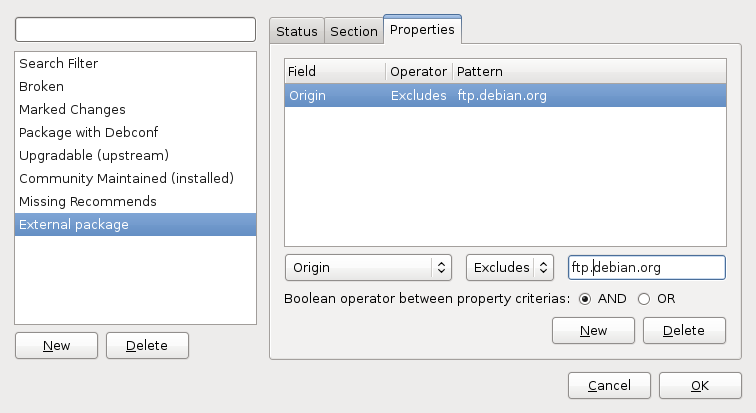
You can replace search with purge or remove if you want to get rid of all the packages listed. But you re more likely to want to remove only a subset of carefully chosen packages you re probably still using some of the software that you installed from external repositories. With synaptic, you can also browse the content of each repository. Click on the Origin button and you have a list of repositories. You can go through the non-Debian repositories and look which packages are installed and up-to-date. But you can do better, you can create a custom view. Click on the menu entry Settings > Filter . Click on New to create a new filter and name it External packages . Unselect everything in the Status tab and keep only Installed . Go in the Properties tab and here add a new entry Origin Excludes ftp.debian.org . In fact you must replace ftp.debian.org with the hostname of your Debian/Ubuntu mirror. The one that appears on the origin line in the output of apt-cache policy (see the excerpt quoted above in this article). Note that the term Origin is used to refer to two different things, a field in the release file but also the name of the host for an APT repository. It s a bit confusing if you don t pay attention. Close the filters window with OK. You now have a new listing of External packages under the Custom Filters screen. You can see which packages are installed and up-to-date and decide whether you really want to keep it. If the package is also provided by Debian/Ubuntu and you want to go back to the version provided by your distribution, you can use the Package > Force version menu entry.
Click here to subscribe to my free newsletter and get my monthly analysis on what s going on in Debian and Ubuntu. Or just follow along via the RSS feed, Identi.ca, Twitter or Facebook.

8 comments Liked this article? Click here. My blog is Flattr-enabled.

John Goerzen: Lots of Snow, Being Stuck, and Fun

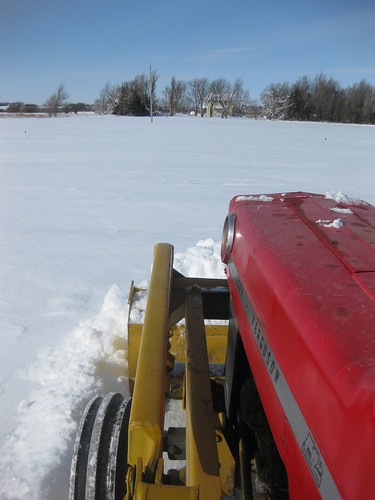
Those of you that watch my twitter know that we got dumped on with snow recently. The final estimate reported by local papers is 17 to 19 inches. IMG_5301.JPG That s my car. You might understand why I went home at 1PM Tuesday and worked from home the rest of the afternoon. The county didn t get the roads opened until 5:30PM Wednesday, so we were stuck. Terah s dad kindly opened the driveway for us though. Without that, we wouldn t have even known where it was. marla-IMG_4180.JPG Jacob and Oliver loved playing in the snow. It was a HUGE hit for them. Both of them hated to go back inside when it was time. Oliver had trouble walking, or even standing up, but that didn t stop him from begging for more every chance he got. IMG_5345.JPG On Saturday, I took Jacob outside to play. We had in mind building a snow tunnel. We went to one of the big piles of snow left by the tractor after our driveway was cleared, and I dug out a space underneath it that Jacob could crawl through. He got a little scoop (he insisted on calling it my shovel ) and helped dig too. He had a great time with it. He was very anxious to go inside, and it probably didn t help his eagerness that the cats could freely walk through it long before he could. They were around and taking a great interest in the proceedings. One of then stretched out on my back while I was stretched out pulling snow out from the pile. Finally Jacob got to go through. He had a little trouble because it wasn t tall enough for him to crawl like he usually does (though still plenty big for him to get through with lots of room to spare), but he came out beaming. I then went and got the camera and got some photos of his second trip through. IMG_5424.JPG You d think that this might be the highlight of a 4-year-old s snow excursion. And given his excitement, you might be very convinced of that. But you d be wrong. What Jacob really wanted was a snow train. So I drew some train track-sized lines in the snow with my shovel. Then I was supposed to draw a train engine. He had been planning this for hours before we even went outside, and I knew very well what was supposed to go on the engine: a snowball for a headlight. We then added passenger cars and a coal car, because apparently that s what you do with snow trains. And the result: IMG_5445.JPG When we went inside, Terah asked Jacob about his snow experience. Jacob was very happy, until she asked him if his snow train was a real train or a drawing of a train. Then he became very sad when he said it was a drawing of a train, and decided it was not what he wanted AT ALL. So today we went out again. This time I built a snow train that stands up, complete with snowballs for wheels. I asked him if it was right, and he kept saying, No, I want a REAL train. Finally I asked him what the difference between a real snow train and this one was. Apparently a real train would be on tracks, move around, make noise, and take us places. Fortunately he didn t dwell too long when I explained I couldn t build one of those. And then today s highlight was writing JACOB in the snow. He had started by drawing larger and larger J letters with his arm, and finally asked me to make one. I made footprints in the shape of a very large J, which he loved. He had me make another one, and then the rest of the letters in his name.

13 February 2011

Steve McIntyre: Dad ill again

A few years ago, I mentioned my dad's fight with cancer. He survived that, and has carried on for several more years since. He had a replacement hip fitted last year to improve his mobility, and was looking set to enjoy a good long retirement. Until... Just before Christmas symptoms suggested that the cancer had returned, and with a vengeance. Tests confirmed it. We were hoping that Dad would fight on and win through again this time, and I was looking forwards to him being at my wedding this September. But there have been a lot of unexpected complications this time and it's just not going to happen. I spoke to him last on Tuesday this week, but he was delirious at the time. He hasn't really been conscious in any meaningful way since. I'm composing this message in the hospital in Southport where I'm now waiting for my dad to die. We've been told by his doctors that it's not going to be long now, but they said that on Wednesday too. My dad has always been stubborn, always a fighter; we know that this is a fight he can't win, but that isn't stopping him from trying his hardest. At least he's being kept comfortable for his last few days, with plenty of strong painkillers on hand when needed. Please let it end soon.

Andrew Pollock: [life] Zoe at nine months

(The requisite "I have no time any more, it's 10 days late") It certainly feels like 3 months has passed since I last reflected on her development. It feels like forever. As usual, we've managed to do a fair bit in 3 months. She's doing very well. Growing nicely. Still around the 25th percentile for weight, but now up to the 50th percentile for height. We just had to upgrade her from an infant car seat to a "big kid" car seat, because she was maxing it out on height, not weight. She seems to have handled the transition okay, but we haven't done any long car trips since making the change. She's now sitting really well, and pulling herself up into a standing position. She's cruising around on furniture a bit (and sporting various bruises to show for it). She started crawling at six and a half months, and now there's no stopping her. She's into everything. No more teeth have appeared yet. Her top teeth have been looking like they want to do something for ages. I think, given a recent uptick in fussiness, their appearance may be imminent. On the food front, she's eating all sorts of things. We've got a few infant/toddler cookbooks, so we still are predominantly feeding her either a combination of pureed fruits and vegetables, or a few pureed dishes that I've prepared (mainly vegetable stews or risotto). She also enjoys bread, toast and has taken to Vegemite on toast, like a good little Aussie. The other night we ate out at our local Italian restaurant, and she had some garlic bread and some penne pasta with marinara sauce. She's definitely enjoying finger food. We went back to Australia for a couple of weeks recently, and she handled the flights extremely well, and had an absolute ball back in Australia. She'd just started sleeping through the night a few times before we left for the trip, and didn't sleep as well while we were in Australia, but got back into the swing of things in under a week of getting back to the US. She's so much fun at this age. She laughs, she plays. She gets so excited when I get home from work in the evenings. I love her and being a Dad so much. Zoe at 9 months

12 February 2011

Michal &#268;iha&#345;: More on sf.net git notifications

As I've already written, SourceForge.Net has limited things which you can do on git/mercurial servers and one of the things they have prohibited is sending emails. This is one of few things which almost every projects uses so it has brought quite obvious reaction, people are reporting bugs that it stopped to working. The major reason for reporting bug is that this change was not at all communicated to users (nor users nor project admins), so it was just a surprise and every body expects bug and not this kind of reply. As I don't have way to reopen the ticket, I had to open another one, that the documentation is wrong and I hope the reply will be slightly better. SF.net, if you still don't believe people used this feature quite a lot, just look at number of bug reports you have in your tracker right now...

Filed under: English Phpmyadmin 0 comments Flattr this!

Evgeni Golov: Privacy-over-IP does not exist

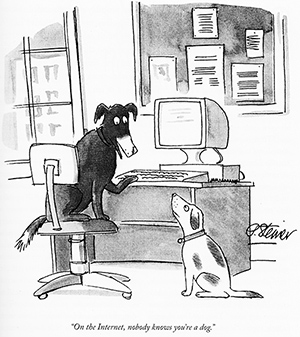
Did not exist.Will never exist.There was quite a lot of buzz about privacy with that new IPv6 thingy. Some say it is bad, as you will have a static address. Some say the privacy extensions will fix everything. I say: lemme rant ;)First of all, that was the internet, when I started using it back in 1999:

 [  New Yorker Magazine, March 1993] On the Internet nobody knows that you are a dog'
[ New Yorker Magazine, March 1993] On the Internet nobody knows that you are a dog And that s the internet today:

robcottingham.ca - How the hell does Facebook know I'm a dog?
[ robcottingham.ca] How the hell does Facebook know I m a dog?

Well, I d say that s not correct. Even in 1999 facebook could know you are a dog (if you ignore the fact, that there was no facebook in 1999), it s just noone really cared about it. But let s start from the beginning :)An IP-address is a 32-bit integer

An IP-address is technically a 32-bit integer, formatted into 4 8-bit parts (you can read more about IPv4 at Wikipedia), which makes a total of 4,294,967,296 possible IP-addresses. Your ISP has a range in this address-space it can give to its customers (you). My ISP (Unitymedia) owns about 300,000 IP-addresses (based on the RIPE database), which is about 0.007% of the whole address-space. If you look at the RIPE page, you see two common netname prefixes (DE-KNRW and DE-IESY-HFC) which match two regions of Germany where my ISP has its customers (Unitymedia is a merge of ish and iesy). What does that mean? It means one can map a Unitymedia customer into one of these regions, even if he would change his IP-address (Unitymedia uses DHCP with high lease-times, so this does not happen actually). It does not map the customer to a dog yet, but I bet real GeoIP databases can map them correctly to a city (I didn t try much, but this site suggests it works: http://www.ip-adress.com/?lc=en at least they map me correctly to Duesseldorf).Dynamic IP-addresses do not improve privacy

Given the above facts, even if Unitymedia would give me a new IP-address every X hours (many DSL-providers have X=24), it is still possible to map me into a set of about 150,000 users (here user means customer, there still may be multiple computers connected via the same line). I would even go further and say the set is much smaller, as I think I am not able to get every free IP-address from DE-KNRW-*, as these should be bound to cities/regions (GeoIP databases exist, you rememember?) and I do not move with my line.Routers and reverse DNS kill privacy

Currently, my IP-address is 62.143.232.104, which has a reverse DNS entry ip-62-143-232-104.unitymediagroup.de and does not say anything about me or my location, besides of the obvious Unitymedia customer . But look at the traceroute:

4  7111A-MX960-01-ae5.frankfurt.unity-media.net (80.81.192.181)
5  13NOC-MX960-01-ae8.kerpen.unity-media.net (80.69.107.26)
6  1411G-MX960-01-ae9.neuss.unity-media.net (80.69.107.2)
7  1411J-MX960-01-ae1.bilk.unity-media.net (80.69.107.70)
8  PH-1411J-uBR10k-06-Te-1-2-0.bilk.unity-media.net (80.69.102.106)
Frankfurt is about 250km from here, Kerpen about 60, Neuss about 10 and Bilk is a part of the city I live in, about 4km away from my home. I guess you get the idea :)Browsers kill privacy tooDo I have to say more than a link to https://panopticlick.eff.org/? My Chromium scores one in 1,400,000. How much IP-addresses did I have to hide in again?We are at the dog level now, dogs use BoneOS with FireBark, not Linux with Chromium :)IPv6 kills cute kittensOh, and privacy, because with IPv6, there are 2^128 IPv6-addresses out there, of which your provider will maybe own a /32 (2^96 addresses) and give you a /48 (2^80 addresses) or (more likely) /64 (2^64 addresses). Then you enable the great IPv6 privacy extensions (RFC4941) and happily hide in your own assigned subnet, still being a customer of your ISP, still living in the same city and using your old browser It s just about mapping subnets instead of individual IP-addresses then. And we can t get lower as the dog levelPeople can annoy meI did not write all this to teach you, you can do yourself with Wikipedia and RFCs. There is a person out there, who thinks using a random name, mail address and twitter account could fool me into thinking that s a new, yet unknown, person to me. Well, I am not stupid, sorry. When you comment on my blog, your IP-address is logged, when I approve the comment, I often look at the reverse DNS and the whois entry of that IP-address (sorry, I AM paranoid). I even might check my webserver logs (or Piwik) where did you come from (Google etc), writing accidentally in your comment does not help :) Also, if you are trying to fool me, don t use your own computer, running Windows 7 and Firefox which I installed. Oh, and probably do not use your home line which I used to login into my admin-area using my unique Chromium ;)Sorry Hanna Lena, the chicken has just eaten her own eggs And yes, one can track down a single person on this big thing called internet, IPv6 will not change this (in any direction).

Joey Hess: d-i is ten

I just realized that the Debian Installer is ten years old! It actually got started ten years ago last summer, but now is also an apt anniversary -- ten years ago, I successfully booted d-i for the first time. It's amazing that d-i has been around as long as Debian Developers who have "been with the project longer than most". (Many of whom have been long-time contributors to d-i themselves.) Astonishing that my basic design has held up and remains relevant. And every time I boot up the Debian kFreeBSD installer, or run the graphical installer, or hear someone raving about how easy Ubuntu was for them to install (and know d-i was underneath), I'm amazed at the places people have taken d-i. The code has recently moved to git. As changes like ext4 by default start to flow in to d-i, with Wheezy development starting up, I hope to see more people enticed into working on d-i. Anyone can do like Matthew Palmer has done with netcfg -- pick a component of d-i that interests you, check out its git repository, and take it from being reasonably well team-maintained to awesomely you-maintained. In five or ten years Matthew will be able to look back at all the people who have used d-i to install over IPv6, and on WPA wireless, and with his other netcfg improvements. Trust me, it's a great feeling. Previously: d-i retrospective (better written than the above & well worth a re-read)

Wouter Verhelst: Ten years of Debian

My first ever Linux installation was done in the late nineties 1998 or thereabouts but was a RedHat 4.5 installation rather than a Debian one. The reason for that was fairly simple: the Infomagick sixpack CD set that I'd bought contained RedHat, Debian, and Slackware, but the RedHat installation was the only one that could be installed directly from CD the other two required me to write floppies and boot from those to start the installation, and I wasn't very fond of that idea. It was only a few years and a few broken RedHat upgrades later that I saw the light and considered trying out this Debian thing that some of my classmates were talking about. The fact that I'd just bought my own computer (rather than having to compete for time with my siblings on my parents' computer) was a good reason to do a fresh Linux installation. I'd been planning to install Linux From Scratch, but as what was still known as the LFS HOWTO told me you'd need a working Linux installation to do that, I considered my options. Since I'd developed a strong dislike of RedHat, I wasn't interested in doing another RedHat anymore. So, I downloaded the most recent version of Debian at the time (Potato Test Cycle III), wrote it to a CD, and installed. I've probably still got the CD lying around somewhere. A few months later, I found these "Linux Gazette" packages in the archive, with the latest packaged issue being 47, but the latest upstream version being much higher. Trying to figure out what was going on, I mailed the maintainer, Adrian Bridgett, who encouraged me to take over maintenance. Thus began my life of actively contributing to Open Source software. In November 2000, I applied to become a Debian Developer. In January 2001, Martin Michlmayr was assigned to be my AM. And in early February 2001, now just over ten years ago, I'd become a Debian Developer. Yes, that was fast, and no, I probably wasn't really ready yet, at the time. Originally, I only cared much about these Linux Gazette packages. But, as time went on, I started looking around, too. A friend passed me an old Macintosh Centris 610. As I tried to install Debian on it, I found that it didn't actually run very well. This turned out to be due to it having a broken 68LC040 processor, so I bought me another m68k-based mac, one with a full 68040 processor (a Centris 650). Thus I became involved in the m68k port and buildd maintenance. As these old machines came with 80MB or 250MB SCSI hard disks of which I had none laying around, and a then-recent Debian installation had minimum requirements of about 200MB, I was in need of network storage to be able to do anything useful with the mac. NFS didn't work as expected; the RTC implementation on m68k mac hardware was reverse engineered and didn't work too well at the time, which meant that the clock would run slower if the machine was under load, and that in turn would mean that make would get confused about timestamps, since they would suddenly appear to originate from the future (in NFS, it's the server that assigns time stamps, not the client). There was a simple solution, however; Pavel Macheck had written this neat 'Network Block Device', which would let the client do its own filesystem on network storage. Only it wasn't packaged; but then, that was easy to fix. Thus I started maintaining the single piece of software that I've worked the most on, to date. A few years later, Pavel lost interest in maintaining NBD, and handed over upstream maintenance to me and maintenance of the kernel side to Paul Clements. Thus began my life in upstream work. And while I originally joined Debian with the intent of using it as a learning experience and stepping stone on my way to more "important" free software, I found that it wasn't as satisfying as was my work for Debian. Over the years, there's been this duality where I've felt like I was doing too much and not enough at the same time. Too much, because the things I was doing would eat up much of my spare time, leaving little time left for other hobbies. Not enough, because I witnessed other people doing much more for Debian than I did, and I wanted to make a difference. As the years passed by, many things have changed. Not only in Debian, but also besides it. I became an independent contractor, focusing mostly on supporting people in using Debian (although I support them with other distributions, too). The importance of a port went from 'something which these weird porter people are doing, and that we should probably help them with if it doesn't work, but is their problem really' to 'something that I really really really have to make sure works for my packages', and back for the port that I cared about most. After several years of trying, I finally managed to explain to my parents what this Debian thing is, why it matters, and what my role in the whole thing is. We did a few releases, some taking longer than I would've liked. People joined the project, and left again. Some of my friends died. My fame in the project rose, even though I wasn't aware of it initially; and thus I was rather surprised when someone asked me whether I was "the Wouter Verhelst" at a key signing party. Recently, I've started looking back, and considered the things which Debian has meant to me. Ten years ago, I was 22, still in college, and had way too much spare time on my hands. I'd recently gotten my first Internet installation, and all these online communities were very new to me. Yes, that was all probably rather late. Debian has changed my life in many ways; it has allowed me to meet various kinds of people, both online and in meatspace. I've been to Helsinki, Edinburgh, Mar del Plata, C ceres, and New York City, places that I might otherwise not have visited. Each of these trips was an incredible experience that I have fond memories of; and while the most fond ones originate from Helsinki, I cherish the memories of each of these trips as some of the best trips I've ever done. Working on Debian has forced me to learn about the inner workings of a Linux-based system, which is knowledge that has helped me tremendously professionally, too. And finally, working on Debian has given me a unique perspective on this whole FOSS community, which has helped shape my ethics and my view of the world. While I believe that I would've subscribed to most of that ideology at any rate, I'm not sure that the details of my beliefs and understanding would've been exactly the same. And while I don't agree on every position that the project subscribes to as a whole, I do believe that the philosophies that lie at the core of this project contain just the right mix of pragmatism and ideology that makes it possible for our project to thrive in a changing world of not only a growing group of people who subscribe unconditionally to the free software ideals, but also business people who care mostly about money. Over the years, somehow I moved from "one of the recent batch of new Debian Developers" to "someone who's been with the project longer than most". It still feels weird to see people shut up because you've built up a reputation in some area, and you give your gut opinion on some subject without researching it too much. I try not to let that happen too often. Today, ten years and just over a week ago, my life as a Debian Developer started, and it would change the way I looked at the world, the things I would do in my spare time, and the people I would meet. I wouldn't have it any other way. Thanks, Debian, for what's been a blast; may the next ten years be as inspiring to me and everyone as the past ten!

Next.

Previous.