Search Results: "mak"

7 January 2012

Stefano Zacchiroli: debian donations-fu

The end of the year is a period of time during which many people sit down and decide to donate some money to initiatives that pursue the public good. I have that habit myself. At the end of 2011 I've decided to donate to Wikipedia, as I consider Wikipedia to be one of the greatest achievements of humanity and I see a lot of value in keeping it running on a purely non-profit basis. (Not to mention that it's already quite annoying to see Jimbo's banners one month per year, go figure what would happen if those banners would suddenly turn into permanent advertisement banners!) You may wonder why I haven't donated to Debian, given my involvement in the project. In fact, that involvement is precisely why I didn't donate to Debian: there is some sort of sanity in keeping a distinction between causes to which I donate my spare time (the case of Debian) and those to which I donate money (the case of Wikipedia), and I like to keep that distinction. As DPL, I've the luxury of being cc:-ed on Debian donation notifications that flow through SPI, and I can also check the flow of donations to other Debian trusted organizations. This year, I've been particularly impressed by the high flow of Debian donations during the end of the year. Thank you, donors, it is thanks to your generosity that we keep many Debian activities going. Using the money people like you regularly donate to Debian we: On a more political note, I'm happy to observe that Debian incomes come almost entirely from private citizens. We do have big corporate sponsors, but their contributions tend to be concentrated as specifically earmarked donations for our annual conference. This is good for them, because they get the fancy banners on the DebConf website and at the conference. But it is also good for Debian, because a donation-based economy (as Debian's, with DebConf exception) is less likely to be influenced by the whims of a few big donors. But with (great) donations comes (great) responsibility. In particular, it comes the need of budget transparency. You can't go out soliciting donations and simply say "thanks, your contribution is appreciated". You need to show donors how their money are used, so that they can judge whether they made the right choice in donating to you or not. Whether they will donate again in the future or not granting long term sustainability to your project usually depends on that. So, if you have donated to Debian or are considering doing so in the future, here are a few of places where you can check what we have been doing with donated money: Albeit quite detailed, the above is not enough: we should do better on the transparency of Debian budget. For one thing, the above is too scattered: budget transparency should not depend on (potential) donors mixing and matching too many sources of information. Further more, the above is not even complete: SPI is not the only Debian trusted organization, and the accessibility of information about Debian budgets hosted at other organizations varies quite a bit. We've been working on improving this for the past year or so: we're not there yet, but I'm positive we can have detailed and comprehensive budgets encompassing all Debian trusted organizations published in the coming months . Why has it taken so long and what could possibly be so difficult about it? I think the cause of the delay is twofold:
  1. The disperse nature of Debian adds some difficulties to regular accounting challenges. Contrary to other FOSS projects I'm aware of, we've many different trusted organizations, each one with its own different way of reporting things. The advantage of such a setup is that we can often avoid the costs of money transfers around the world, costs in which we'd incur had we a single organization holding our assets, say, in the US. Still, having too many organizations is counterproductive. This is why for the past 1.5 years I've been working on consolidating our money assets into as few budgets as possible (avoiding, for instance, to use more than one organization per currency).
  2. We tend to be good at recruiting packaging geeks, but not so good at recruiting other kinds of geeks: budget geeks, artwork geeks, journalist geeks, management geeks, etc. But it is upon those other kinds of "geekness" that many activities of "standard" Debian geeks depend. For example: if you want to have a steady flow of new project members, you need to communicate effectively Debian values and make some buzz around them, so that you could hope they get to the right ears. If you want to organize sprints for maintainers to work together you need money donations, and to solicit donations you need a transparent budget. Etc. In the specific case of accounting, we're now lucky enough to have found "standard" Debian geeks who also have a passion for accounting and auditing; but that appaears to be, essentially, a coincidence. If we don't fix the more general problem, I believe our difficulties in recruiting "non-standard" Debian geeks might hurt us quite a bit in the long run.

Steve Kemp: Review of the Panasonic Lumix FS-16 camera

Recently I've been wanting to replace my old point and shoot camera, a Canon PowerShot A620. I've got a pair of DLSR cameras and I do frequently carry one of them out with me, but there are undoubtedly occasions where I'd rather not bother, or where I find myself wanting to take a picture without having one to hand. Unfortunately the PowerShot is pretty large itself, although significantly less so than the DSLRS I possess. (I cannot remember the last time I used the PowerShot outside my flat, that is how rarely it goes outdoors). The PowerShot has been a good camera to me for many years and the three features I liked the most: Picking a replacement camera, even with the help of fine comparison websites like snapsort.com is hard. Cameras have moved on and "improved" a lot over the last few years - to the extent that finding one with a built-in viewfinder is hard. Finding one with a built-in viewfinder and running on easily replaceable batteries was virtually impossible. Eventually I settled on the Panasonic Lumix FS16, which omits both: The way that you use the LCD or viewfinder differs pretty significantly, but the LCD wasn't as bad as I'd feared:

ViewFinder
You hold the camera to your eye, and press the appropriate buttons.
LCD
You typically hold the camera at arms length, which means you're prone to shaking your hands/arms and getting blurry shots. Because you're holding the camera relatively far away from your eyes if you have the sun at your back you're liable to need to squint.
The LCD on the Lumix FS-16 isn't amazing, but neither is it horrific and it is better than expected in dark locations. So after a week what do I think? On the whole it is a fine camera, better than the PowerShot in many ways, and while it has draw-backs none are deal-breakers:
Size
The best camera is one you have with you; on that basis this camera is a clear win being smaller, lighter, and more compact than the Canon. I've taken this camera with me, randomly, to several places and returned with useful and interesting images.
Low Light
Low light performance is pretty poor. With only one manual control you see noise if you're shooting in gloomy pubs, and outdoors. With the flash you can get acceptable pictures if you're careful - but its a tricky thing to get right. (To update this a little: Outdoors at night? No. In a pub with poor lighting you'll be alright.)
Manual Controls
The camera features precisely two manual controls:
  • "Flash on" vs. "Flash off".
  • ISO can be changed from: Auto, 100, 200, 400, 800, 1200 and 1600.
There is no notion of shutter speed, nor is there any ability to change the aperture size. (Though both these values are displayed on the screen as you take a picture I wonder why? As you can't change anything you can't use the information in any useful fashion, and presumably a non-camera-person wouldn't understand what these numbers represent.) The lack of these two controls is a little galling, but pretty common for the low-end P&S cameras.
Video Recording
There is no external MIC so sounds aren't great, but they're not horrible either. Video recordings are limited to the smaller of 8 minutes or 2Gb. So no long films, but short ones look fine. Just be aware that once you start recording focus won't change, nor will zooming work. Compared to the canon the quality is improved; but the Canon allowed you to (optically) zoom whilst recording. Here you can only zoom with your feet.
Recharging Time
When I received the camera it took about an hour to charge. The battery life seems reasonable - the level is 2/3 a week later and I've been shooting, reviewing, and deleting regularly. (Note: I never use USB to transfer pictures, I always remove the card and plug it into my PC. Whether this makes a difference to battery life I don't know.)
Controls
Physical controls are reasonable. There is a mechanical slide-switch to turn on/off. I like that, as it is less prone to being knocked by keys, change, etc. There is also a physical slide-switch to change from "shoot" to "review current images/videos". (Same as my Canon) I think this is a mistake, and don't see why it can't be a soft-button.
Full Auto
There are several modes available in the camera (remember the caveat about lack of aperture/shutter speed) I've been using both full-auto and manual modes, and both are good. Full auto would suit most people - it has clever face-tracking.
Focusing Speed
As expected this is not stellar. Walking to the corner shop the other lunchtime I found a cat in the road, I talked to her and she rubbed herself against my ankles. Could I focus fast enough to catch her looking up at me? No. For static scenes, and candid shots of people it'll suffice. For fast action and moving children probably not a chance.
On balance, the upgrade was worthwhile. ObQuote: "I don't mean to lecture and I don't mean to preach. And I know I'm not your father..." - Spider-Man

Christian Perrier: [life] [running] 2011 summary

That time of the year comes where I summarize my running activities. It's now 4.5 years that I resumed running, after nearly 10 years without active sports. Apparently, things continue to improve, though I'm logically reaching my limits in some way. I finally missed the 2500km mark by 14 kilometers, mostly because of a cold I had during the last 2 days of the year. The grand total is thus 2486 kilometers run, in 237 hours (9 days 21hours), at about 10.5km/h. The climbed height difference is 27700 meters, so about three times the altitude of Mount Sagarmatha..:-) This was achieved in 294 "activities". That seems to be a lot (nearly 1 activity per day): indeed, there are days where I have up to 4 activities, when I run to/back work, which means two runs in the morning (3+4km) and two in the evening. If I count the number of days where I had at least one running activity, this lowers to 181. In short, I ran about every 2 days. Indeed, along the year, the biggest timeframe between two runs has been 7 days. In short, I ran at least once every week during this year. The most active month was July with 272km and the less active was September with 163.5. When counted by distance, this summarizes to: When it comes at results, I ran 8 official races during the year : two "ultra" races (70km Le Puy-Firminy in November, by night and 55km Paris Ecotrail), two marathons (Paris, two weeks after Ecotrail, and Berlin in September), one 35km trail race (Trail des Cerfs in May), two half-marathons and one 12km cross-country race in my hometown. The seasons "peaks" were clearly the Ecotrail+Paris Marathon succession in March/April, the Berlin marathon in September and my longest race ever in November. Most were as successful as I expected, except maybe Berlin marathon, were I was secretly hoping to break my record (indeed, I can still be proud of running in the same race than Patrick Makau breaking the world record in 2h03'38"). An injured ankle unfortunately prevented me to prepare it as serously as I was hoping. This year was indeed the first year where I was trying to go beyond the marathon distance as another challenge. And, believe me, ultra distances are really fun (yes, running 9 hours by night *is* fun!). Indeed, I only regret not breaking one of my best times (either half-marathon or marathon). I'll try to do that in 2012. How about next^W this year? Well, my goals are currently being secured: Busy program....I cross fingers for no injury to come and disturb all this.

Christian Perrier: Towards 100% in wheezy for debconf translations

This article could become one of my recurring "let's make noise about translators work" articles. You've been warned. In Squeeze, a few languages reached full completion of debconf strings, those "questions" that are asked during packages installation or upgrades. This can be followed here (for unstable: we don't have an online status page for testing).. Many of you, particularly those who aren't bored at reading me, know that I like pushing this friendly "competition" as a good way to encourage progress in localization of that part of Debian. As of now, we have really good and active teams that are able to maintain a great completion in this. Several of them are likely to reach full 100% completion for wheezy. Let's look at the current status: I hope this maybe gave you the idea of joining these efforts. Please pop up on one of the i18n mailing lists if you're interested, and if you don't know where to start, then debian-i18n< is what you're looking for. See you soon!

Craig Small: rpath bites me again

Debian OpenLogo

Image via Wikipedia

It s funny, in bad way, when certain sorts of bugs come back to bite you. People may remember the fun debian had with rpath issues around in the late 90s where some binaries wanted to set the path of where their libraries were located. After much contraversy the consensus was at least in Debian (with some specific exceptions) RPATH is bad and don t use it. I lived through that fun and remember hacking libtool or autoconf or some such file. The horror of those times came back to haunt me today while working on procps 3.3.2 packages. lintian was suddenly complaining that binary-or-shlib-defines-rpath for all my binaries. I ve not seen rpath set for many years and as I m also part of the upstream and never saw it set there it took me a while to work out what was going on. Certainly, my binaries were setting the RPATH, it wasn t lintian getting the wrong idea. You can see this with objdump myfile grep RPATH. If you get a hit, you got RPATH set, an empty result means no RPATH. libtool was definitely setting the rpath, with
cc -Iproc -g -O2 -o \$progdir/\$file pmap.o  ./proc/.libs/libprocps.so \
 -Wl,-rpath -Wl,/home/csmall/debian/procps/procps/proc/.libs \
 -Wl,-rpath -Wl,//usr/lib/x86_64-linux-gnu
That s not one rpath setting but two, for double insult. Configure flags such as disable-rpath wouldn t work. I flicked back to a pure upstream archive and there was no rpath there in either the compile flags or objdump. There was obviously some sort of side-effect going on. The problem, after much testing, was in the debian/rules file:
        ./configure \
          --build=$(DEB_BUILD_GNU_TYPE) \
          --enable-watch8bit --enable-w-from \
          --prefix=/ \
          --mandir=\$$ prefix /usr/share/man  \
          --libdir=\$$ prefix /usr/lib/$(DEB_HOST_MULTIARCH)
The problem is above, and all it was was a / . libtool does some checking to see if the library directory exists and if it doesn t silently turns on rpath. It s not smart enough to know that //usr/lib/x86_64-linux-gnu is the same as /usr/lib/x86_64-linux-gnu and so it enables rpath. Removing the slash before the usr fixed the problem. I d say this is bad behavour on libtools part. It should know that / is // or all the other alternative ways of specifying paths. Hopefully this post will stop someone else wasting their time like I did.

6 January 2012

Mark Brown: regmap updates in 3.2

Version 3.1 of the Linux kernel was the first release to include regmap support and only included a bare minimum of features in order to ease review so version 3.2 has been a pretty big one for regmap development with some pretty major features being built on top of the core code.

Matthew Garrett: Firmware bugs considered enraging

Part of our work to make it possible to use UEFI Secure Boot on Linux has been to improve our EFI variable support code. Right now this has a hardcoded assumption that variables are 1024 bytes or smaller, which was true in pre-1.0 versions of the EFI spec. Modern implementations allow the maximum variable size to be determined by the hardware, and with implementations using large key sizes and hashes 1024 bytes isn't really going to cut it. My first attempt at this was a little ugly but also fell foul of the fact that sysfs only allows writes of up to the size of a page - so 4KB on most of the platforms we're caring about. So I've now reimplemented it as a filesystem[1], which is trickier but avoids this problem nicely.

Things were almost working fine - I could read variables of arbitrary sizes, and I could write to existing variables. I was just finishing hooking up new variable creation, but in the process accidentally set the contents of the Boot0002 variable to 0xffffffff 0xffffffff 0x00000000. Boot* variables provide the UEFI firmware with the different configured boot devices on the system - they can point either at a raw device or at a bootloader on a device, and they can do so using various different namespaces. They have a defined format, as documented in chapter 9 of the UEFI spec. At boot time the boot manager reads the variables and attempts to boot from them in a configured order as found in the BootOrder variable.

Now, obviously, 0xffffffff 0x00000000 is unlikely to conform to the specification. And when I rebooted the machine, it gave me a flashing cursor and did nothing. Fair enough - I should be able to choose another boot path from the boot manager. Except the boot manager behaves identically, and I get a flashing cursor and nothing else.

I reported this to the EDK2 development list, and Andrew Fish (who invented EFI back in the 90s) pointed me at the code that's probably responsible. It's in the BDS (Boot Device Selection) library that's part of the UEFI reference implementation from Intel, and you can find it here. The relevant function is BdsLibVariableToOption, which is as follows (with irrelevant bits elided):
BdsLibVariableToOption (
  IN OUT LIST_ENTRY                   *BdsCommonOptionList,
  IN  CHAR16                          *VariableName
  )
 
  UINT16                    FilePathSize;
  UINT8                     *Variable;
  UINT8                     *TempPtr;
  UINTN                     VariableSize;
  VOID                      *LoadOptions;
  UINT32                    LoadOptionsSize;
  CHAR16                    *Description;
  //
  // Read the variable. We will never free this data.
  //
  Variable = BdsLibGetVariableAndSize (
              VariableName,
              &gEfiGlobalVariableGuid,
              &VariableSize
              );
  if (Variable == NULL)  
    return NULL;
   
So so far so good - we read the variable from flash and put it in Variable, Variable is now 0xffffffff 0xffffffff 0x00000000. If it hadn't existed we'd have skipped over and continued. VariableSize is 12.
  //
  // Get the option attribute
  //
  TempPtr   =  Variable;
  Attribute =  *(UINT32 *) Variable;
  TempPtr   += sizeof (UINT32);
Attribute is now 0xffffffff and TempPtr points to Variable + 4.
  //
  // Get the option's device path size
  //
  FilePathSize =  *(UINT16 *) TempPtr;
  TempPtr      += sizeof (UINT16);
FilePathSize is 0xffff, TempPtr points to Variable + 6.
  //
  // Get the option's description string size
  //
  TempPtr     += StrSize ((CHAR16 *) TempPtr);
TempPtr points to 0xffff 0x0000, so StrSize (which is basically strlen) will be 4. TempPtr now points to Variable + 10.
  //
  // Get the option's device path
  //
  DevicePath =  (EFI_DEVICE_PATH_PROTOCOL *) TempPtr;
  TempPtr    += FilePathSize;
TempPtr now points to Variable + 65545 (FilePathSize is 0xffff).
  LoadOptions     = TempPtr;
  LoadOptionsSize = (UINT32) (VariableSize - (UINTN) (TempPtr - Variable));
LoadOptionsSize is now 12 - (Variable + 65545 - Variable), or 12 - 65545, or -65533. But it's cast to an unsigned 32 bit integer, so it's actually 4294901763.
  Option->LoadOptions = AllocateZeroPool (LoadOptionsSize);
  ASSERT(Option->LoadOptions != NULL);
We attempt to allocate just under 4GB of RAM. This probably fails - if it does the boot manager exits. This probably means game over. But if it somehow succeeds:
CopyMem (Option->LoadOptions, LoadOptions, LoadOptionsSize);
we then proceed to read almost 4GB of content from uninitialised addresses, and since Variable was probably allocated below 4GB that almost certainly includes all of your PCI space (which is typically still below 4GB) and bits of your hardware probably generate very unhappy signals on the bus and you lose anyway.

So now I have a machine that won't boot, and the clear CMOS jumper doesn't clear the flash contents so I have no idea how to recover from it. And because this code is present in the Intel reference implementation, doing the same thing on most other UEFI machines would probably have the same outcome. Thankfully, it's not something people are likely to do by accident - using any of the standard interfaces will always generate a valid entry, so you could only trigger this when modifying variables by hand. But now I need to set up another test machine.

[1] All code in Linux will evolve until the point where it's implemented as a filesystem.

comment count unavailable comments

Mirco Bauer: Smuxi 0.8.9 "One Giant Leap" Release

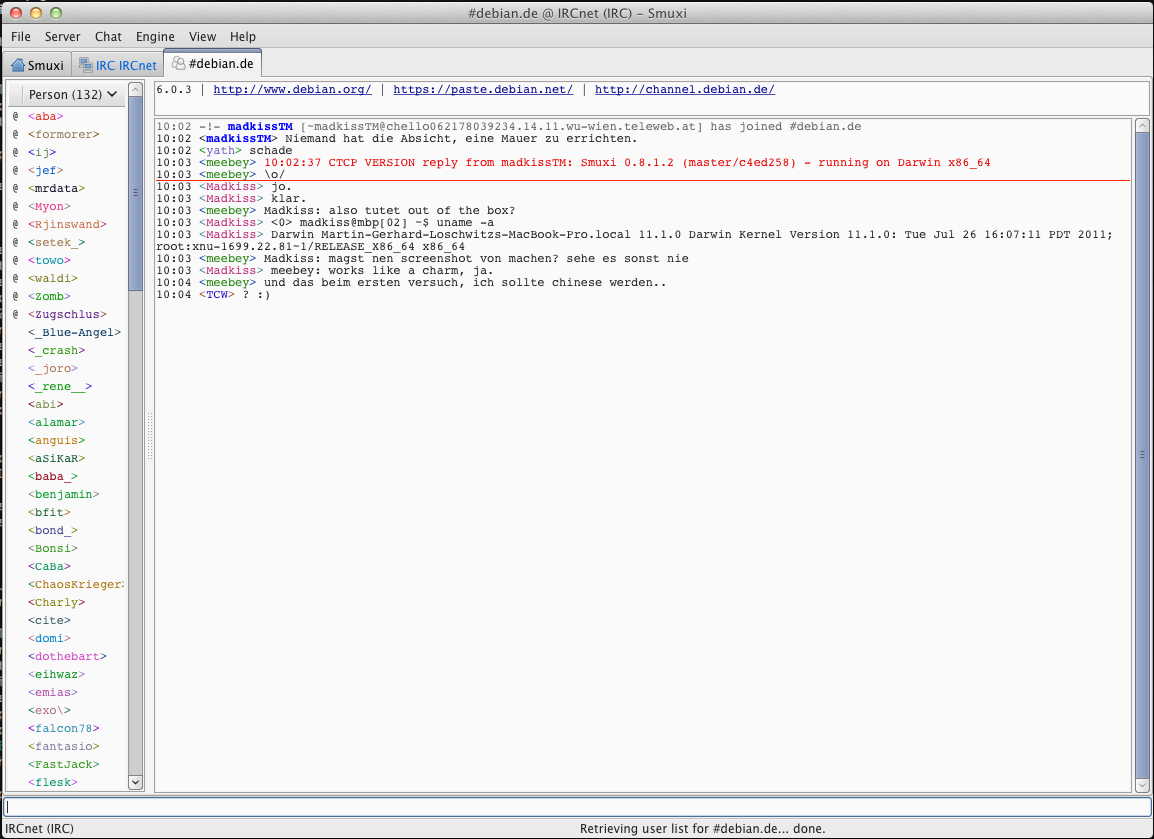
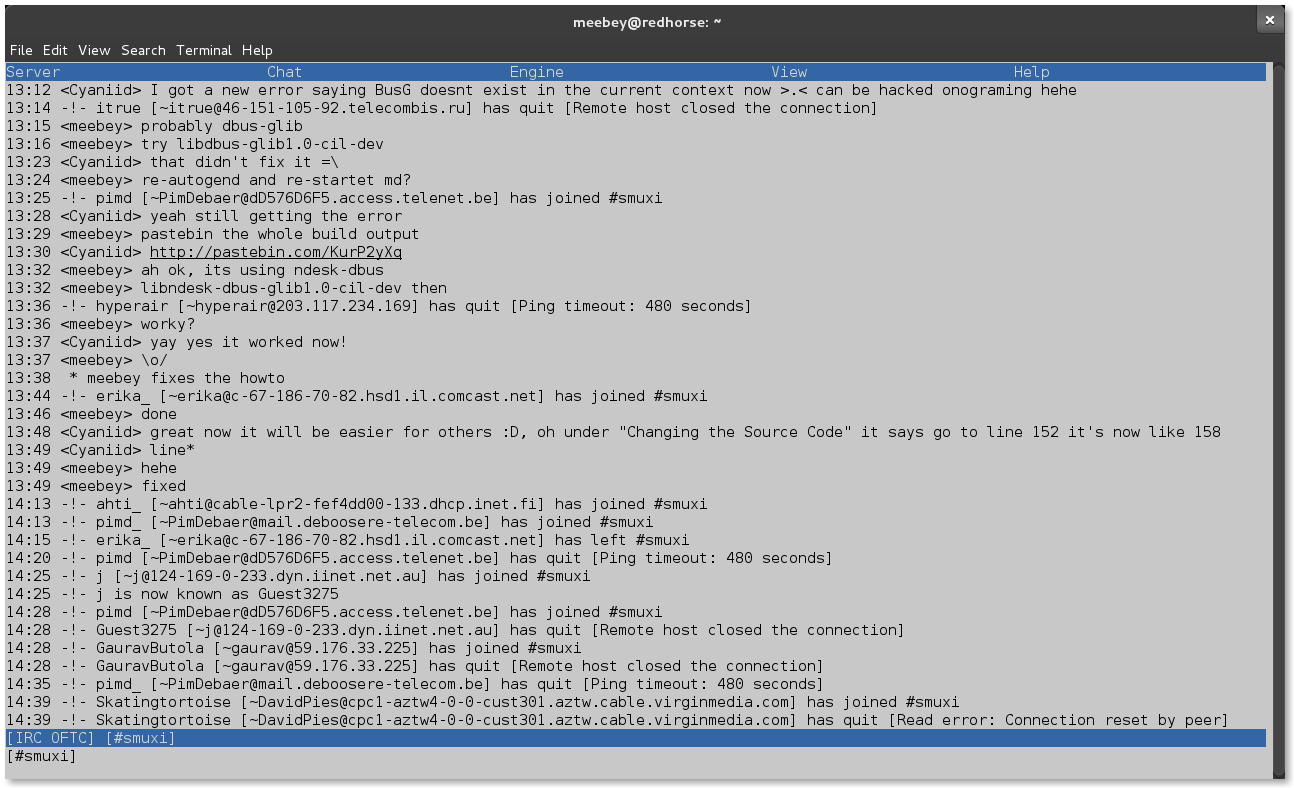
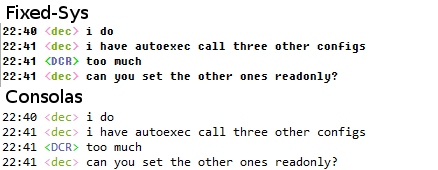
Just in time for 2012 I am very pleased to announce Smuxi 0.8.9 codenamed "One Giant Leap". During the development 56 bug reports and 33 feature requests in 593 commits were worked on making this release a major milestone of the Smuxi project. At the Chaos Communication Congress (28C3) in Berlin I was doing the final development sprint to get 0.8.9 done, which was a very intensive and refreshing experience. Here are the highlights of this release: Development Builds / Rolling Releases After the 0.8 release it became clear that a continious and short development -> test cycle is important to keep the project going quickly. At some point I have received requests if the project is dead while it was more active than ever. The lack of new releases (for about 15 months) lead to this wrong impression. Thus Smuxi can be obtained from development builds now. This includes daily builds for Debian (Squeeze, Wheezy, Sid), Ubuntu (Lucid, Maverick, Natty, Oneiric, Precise) and Windows. Thanks goes to Hannes Tismer for providing the Windows autobuilder and to Canonical for the PPA autobuilder. We invite everyone to use these daily builds to keep track of the latest development of Smuxi. Issues and regressions are fixed in a very short period (usually the same day). Thanks to our users who ran development builds and reported issues which led to many bug fixes prior to this release. On the other hand one of my New Year's resolutions are to "release early, release often" So there should be no nerd left behind... Screenshot of Smuxi 0.8.9 on Mac OS X Mac OS X support With the help of Steven McGrath (Steve[cug]) who created the initial Mac OS X installer for Smuxi we now have official support for Mac OS X. The download page contains the instructions how to obtain and install Smuxi on Mac OS X. This makes the 4th platform where Smuxi can be used on besides Windows, Linux and *BSD. For now Smuxi 0.8.9 doesn't feel as native as it could as it relies on the GTK+ port. We are looking into enhancing the experience though, just stay tuned. Chat History on Disk (Beta) The most exciting feature in this release I think are the "persistent message buffers". With this feature I could solve one of the biggest drawbacks IRC ever had: IRC does not retain any messages you have sent or received. All messages are only relayed to all users. The issue is that if you close your IRC client or even just leave a channel, all your received messages are gone. One workaround in most clients was to create text log files which then contains the chat history, but it is annoying and not user-friendly to open some text file somewhere from your disk to read the history outside of your IRC client. Now with Smuxi 0.8.9 you no longer have this issue, all chat history gets automatically written and read to a message database when you start Smuxi, join channels or open queries! As this feature is not fully stable yet it is not enabled by default. If you want to try it go to: File -> Preferences -> Interface and change "Persistency Type" from "Volatile" to "Persistent", hit OK and restart Smuxi. Now all messages are saved into the database and will automatically be shown. Click here for a screencast of this feature Jabber / XMPP Support (Beta) You probably have friends not on IRC and Twitter, say on Jabber, gTalk or Facebook? This is where the new XMPP engine of Smuxi comes into play. You can send and receive messages to/from them now! The implementation is far from complete, though. It has no buddy list for example and needs only to be treated as a technical preview of what will be coming in future Smuxi releases. Click here for a screencast of this feature Screenshot of Smuxi's Text Interface Text Interface (Alpha) This is the first release that contains a text frontend based on the STFL library. STFL is a library that uses ncurses to draw text based user interface using a markup language (like Glade for GTK+). This frontend is in early alpha state and lacks a lot of interface features and likes to crash. It is still included to attract potential developers who want to enhance this frontend. The frontend can be enabled by passing --enable-frontend-stfl to the configure script and then by executing smuxi-frontend-stfl. NetworkManager Support Everyone with a laptop knows how annoying it can be to suspend and resume when network based applications suddenly go crazy because they have lost the connection and either spew errors or take forever to get back in shape. Smuxi will now detect the network state right away with the help of the new Network Manager support. It automatically reconnects when needed right away for you. Next Generation Internet Support You can now connect to IRC servers using the IPv6 protocol Enhanced Find Group Chat Support Users had real issues to find out how to search for channels, thus Bianca Mix added a neat feature. The /list command will now simply open the Find Group Chat dialog for you. This way everyone used to IRC will find it in no time. Searching for channels on freenode wasn't working correctly, this is now fixed. Smuxi also supports the SAFELIST feature of the IRC protocol now which allows to retrieve a full channel list and do client side search which makes consecutive searches much faster. Enhanced Windows Experience For a long time you could not use Smuxi with the latest GTK# version of 2.12.10 on Windows. The issue was that Smuxi relied on SVG support which 2.12.10 no longer had. Smuxi is no longer using SVG instead it uses pre-scaled PNG images thus it works just fine with GTK# 2.12.10 on Windows now. At the same time the issue that the maximized state of the main window was left when restoring from task bar is fixed with GTK# 2.12.10. Screenshot of Fixed-Sys vs Consolas font Smuxi used by default the FixedSys font on Windows to give it the typical IRC look most people are used to. Since Windows Vista there is a better console-like font available called Consolas. Smuxi will now use the Consolas font instead on Windows Vista or later. Another important enhancement is that Smuxi no longer has issues with multiple GTK+ installs on the same computer, which was getting more common with more popular ported GTK+ applications such as GIMP or Pidgin. SSL for IRC fixed IRC with SSL was only working with the default port of 6697. Thanks to Jo Shields now any port can be used with SSL. Crash Related Issues Desktop notifications could crash Smuxi in case of errors related to the notification system or an absent notification daemon. There was a chance that the crash dialog simply disappeared which made reporting bugs more difficult no longer happens. Rapid use of ctrl+w, /window close (Jimmie Elvenmark) and opening the Find Group Chat dialog on the Smuxi tab do no longer crash. Also number-only network names, /network switch freenode and GTK+ install without SVG support no longer lead into a crash. Enhanced Notice Handling Notices will no longer open query tabs for you instead it will show them on tabs you share with the person who sent it with the server tab as fallback. This also avoids ChanServ, NickServ and spammy IRCop tabs. Twitter fixes Twitter made some changes to their API which broke the Twitter support of Smuxi 0.8. This was taken care of and also a few other issues were solved allowing Smuxi 0.8.9 to work smoothly with Twitter again. Extended Keybindings Smuxi allows now to use the ctrl+tab / ctrl+shift+tab and ctrl+n / ctrl+p keys to switch tabs. The keybindings still work even with a hidden menu bar now. Smuxi Server specific highlights More interactive and much faster synchronization When connecting to a smuxi-server you had to wait till Smuxi finished the synchronization before you could use the interface. Also you could not tell how far the synchronization was and just had to wait till it was completed. With Smuxi 0.8.9 the connect just takes a few seconds and all chats are synchronized in the background with a progress bar so you can use the interface from the first moment on and know how far it is. The speed how much it takes to synchronize all chats also reduced drastictly by 400%! Click here for a screencast of this feature More background communication When using a smuxi-server the interface sometimes had load times like when opening the preferences or when using the nickname completion (Andrew Kannan). These operations are done in the background and no longer blocks the interface. Also when the communication is lost to the smuxi-server the frontend will now automatically reconnect to it in the background. Low Bandwidth Mode When it comes to mobile internet connectivity such as UMTS/HSDPA, Edge and GRPS it can be a real pain to connect to the smuxi-server as it has to transfer all the messages over that. If you just want to ask someone you know then you don't need any old messages to do that. With the "Low Bandwidth Mode" you can now connect to the smuxi-server without loading old messages which makes the connect very quick. You find this option in the engine connect dialog. Stable Protocol Initially I didn't plan to make the protocol of Smuxi stable before the 0.9 release, but as it turned out the 0.8 protocol was good enough to still use it and for that reason Smuxi 0.8.9 is still compatible with 0.8. The 0.8 protocol will see no breakages, instead the next protocol will be on-top or opt-in of the current one. This means future Smuxi versions stay compatible with it. Shutdown Command You can now shutdown the smuxi-server if you like using the /shutdown command. It it safe to use the command, it will do a clean shutdown sequence for you. For example it makes sure all messages are written to disk in the case of enabled persistent message buffers. If you have your smuxi-server daemon monitored (e.g. with runit) it can also automatically be restarted and upgraded this way. Built-in SSH Keyfile Support It is no longer needed to fiddle with the .ssh/config file or pagent to get SSH key authorization working. You can now simply tell Smuxi which SSH keyfile you want to use to connect to your smuxi-server. Updated Translations
  • Catalan (Siegfried-Angel Gevatter Pujals)
  • Danish (Joe Hansen)
  • Finnish (Kalle Kaitala)
  • French (Cl ment Bourgeois)
  • German (Bianca Mix)
  • Italian (Vincenzo Campanella)
  • Portuguese (Americo Monteiro)
  • Spanish (Castilian) (Ricardo A. Hermosilla Carrillo)
New Translations
  • Chinese Simp (Dean Lee)
  • Slovak (Tom Vadina)
  • Swedish (Jimmie Elvenmark)
  • partially Russian (Aleksandr P)
  • partially Turkish (Umut Albayrak)
  • partially Urdu (makki)
Contributors Contributors to this release are the following people:
  • Mirco Bauer (497 commits)
  • Tuukka Hastrup (10 commits)
  • Bianca Mix (10 commits, translations)
  • Cl ment Bourgeois (8 commits, translations)
  • Andrius Bentkus (5 commits)
  • Carlos Mart n Nieto (3 commits)
  • Jimmie Elvenmark (3 commits, translations)
  • Hannes Tismer (1 commit)
  • Jonathan Pryor (1 commit)
  • Jo Shields (1 commit)
  • Siegfried-Angel Gevatter Pujals (translations)
  • Dean Lee (translations)
  • Aleksandr P (translations)
  • Americo Monteiro (translations)
  • Andrew Kannan (translations)
  • Joe Hansen (translations)
  • Kalle Kaitala (translations)
  • makki (translations)
  • Ricardo A. Hermosilla Carrillo (translations)
  • Tom Vadina (translations)
  • Umut Albayrak (translations)
  • Vincenzo Campanella (translations)
Thank you very much for your contributions to Smuxi! After reading this whole pile of text, head over here and grab this smexy stuff!
Posted Sun Jan 1 22:58:29 2012

Niels Thykier: Britney in 5 minutes

About 26-28 hours ago in #debian-release on IRC:
<nthykier> damn, a britney run in 5 minutes
<adsb> they happen
<adsb> you've been spoilt by never seeing b1 at her "finest" *cough*
<aba> you mean, running for more than a day?
<Ganneff> adsb wants night-long runs?
<aba> I can remember runs where we had to block certain packages to
      make sure the run could actually end *sometimes*
<adsb> I'm quite happy with just the memory of that sort of run,
       thanks :P
<nthykier> I don't mind being spoiled if it stays at 5 minutes :P
I took the liberty of collecting the resulting data for the Britney test suite. In its reduced state[1] in runs in 30 seconds on my machine. It is already my favourite live data sample in the test suite. :D [1] Only i386 and amd64 are considered, manual hints are ignored etc.

5 January 2012

Ryan Kavanagh: mutt-fetchbug: fetch BTS bug reports from mutt

I've been a longtime mutt user, but have gotten somewhat annoyed of having to open a new terminal when I want to read or reply to a Debian bug with mutt (using 'bts show 123456'). How nice it would be to be able to fetch a bug report from within mutt! And so, ladies and gentlemen, I present to you mutt-fetchbug. It's extensively based on Zack's mutt-notmuch script (a nice interface between mutt and notmuch for searching mail, I highly recommend it). By adding a line like the following to your ~/.muttrc, you can simply press "F7" and enter a bug number from your mutt index in order to fetch and display a bug report's mbox file:
    macro index <f7> \
        "<enter-command>unset wait_key<enter><shell-escape>~/bin/mutt-fetchbug --prompt search<enter><change-folder-readonly>~/.cache/mutt_btsresults<enter><enter-command>set wait_key<enter>" \
        "fetch bug(s) (using bts show)"
The above presupposes you've downloaded mutt-fetchbug and placed it with executable permissions in ~/bin. Those interested in making improvements or extending mutt-fetchbug are more than welcome to do so, it's licensed under the GPLv3+. It can be fetched from my git branch. Update: Fixed the broken link to mutt-fetchbug, thanks Christian for the heads up.

Patrick Schoenfeld: Bringing GVFS to a good use

One of the GNOME features I really liked since the beginning of my GNOME usage is the ability to mount various network file system by a few clicks and keystrokes. It enables me to quickly access NFS shares or files via SFTP. But so far these mounts weren't actually mounts in a classical sense, so they were only rudimentary useful.

As a user who often works with terminals I was always halfway happy with that feature and halfway not:

- Applications have to be aware and enabled to make use of that feature, so its often neccessary to workaround problems (e.g. movie players not able to open a file on a share)
- No shell access to files

Previously this GNOME feature was realised with an abstraction layer called GNOME VFS, which all applications needed to use if they wanted to provide access to the "virtual mounts". It did no efforts to actually re-use common mechanisms of Un*x-like systems, like mount points. So it were doomed to fail at certain degrees.

Today GNOME uses a new mechanism, called GVFS. Its realized by a shared library and daemon components communicating over DBUS. At first glance it does not seem to change anything, so I was rather disappointed. But then I heard rumors, that Ubuntu was actually making these mounts available in a special mount point in ~/.gvfs.
My Debian GNOME installation were not.

So I investigated a bit and found evidence about a daemon called gvfs-fuse-daemon, which eventually is handling that. After that I figured this daemon to be in a package called gvfs-fuse and learned that installing it and restarting my GNOME session is actually all needed to do.
Now getting shell access to my GNOME "Connect to server" mounts is actually possible, which makes these mounts really useful after all. Only thing to find out is, if e.g. the video player example now works from Nautilus. But if it doesn't I'm still able to use it via a shell.

The solution is quiet obvious, on the one side. But totally non-obvious on the other.

A common user eventually will not find that solutin without aid. After all the package name does not really suggest what the package is used for, since its referring to technologies instead of the problem it solves. Which is understandable. What I don't understand is, why this package is not a dependency of the gnome meta package. But I haven't yet asked the maintainer, so I cannot really blame anybody.

However: Now GVFS is actually useful.

Russell Coker: DRBD Benchmarking

I ve got some performance problems with a mail server that s using DRBD so I ve done some benchmark tests to try and improve things. I used Postal for testing delivery to an LMTP server [1]. The version of Postal I released a few days ago had a bug that made LMTP not work, I ll release a new version to fix that next time I work on Postal or when someone sends me a request for LMTP support (so far no-one has asked for LMTP support so I presume that most users don t mind that it s not yet working). The local spool on my test server is managed by Dovecot, the Dovecot delivery agent stores the mail and the Dovecot POP and IMAP servers provide user access. For delivery I m using the LMTP server I wrote which has been almost ready for GPL release for a couple of years. All I need to write is a command-line parser to support delivery options for different local delivery agents. Currently my LMTP server is hard-coded to run /usr/lib/dovecot/deliver and has it s parameters hard-coded too. As an aside if someone would like to contribute some GPL C/C++ code to convert a string like /usr/lib/dovecot/deliver -e -f %from% -d %to% -n into something that will populate an argv array for execvp() then that would be really appreciated. Authentication is to a MySQL server running on a fast P4 system. The MySQL server was never at any fraction of it s CPU or disk IO capacity so using a different authentication system probably wouldn t have given different results. I used MySQL because it s what I m using in production. Apart from my LMTP server and the new version of Postal all software involved in the testing is from Debian/Squeeze. The Tests All tests were done on a 20G IDE disk. I started testing with a Pentium-4 1.5GHz system with 768M of RAM but then moved to a Pentium-4 2.8GHz system with 1G of RAM when I found CPU time to be a bottleneck with barrier=0. All test results are for the average number of messages delivered per minute for a 19 minute test run where the first minute s results are discarded. The delivery process used 12 threads to deliver mail.
P4-1.5 p4-2.8
Default Ext4 1468 1663
Ext4 max_batch_time=30000 1385 1656
Ext4 barrier=0 1997 2875
Ext4 on DRBD no secondary 1810 2409
When doing the above tests the 1.5GHz system was using 100% CPU time when the filesystem was mounted with barrier=0, about half of that was for system (although I didn t make notes at the time). So the testing on the 1.5GHz system showed that increasing the Ext4 max_batch_time number doesn t give a benefit for a single disk, that mounting with barrier=0 gives a significant performance benefit, and that using DRBD in disconnected mode gives a good performance benefit through forcing barrier=0. As an aside I wonder why they didn t support barriers on DRBD given all the other features that they have for preserving data integrity. The tests with the 2.8GHz system demonstrate the performance benefits of having adequate CPU power, as an aside I hope that Ext4 is optimised for multi-core CPUs because if a 20G IDE disk needs a 2.8GHz P4 then modern RAID arrays probably require more CPU power than a single core can provide. It s also interesting to note that a degraded DRBD device (where the secondary has never been enabled) only gives 84% of the performance of /dev/sda4 when mounted with barrier=0.
p4-2.8
Default Ext4 1663
Ext4 max_batch_time=30000 1656
Ext4 min_batch_time=15000,max_batch_time=30000 1626
Ext4 max_batch_time=0 1625
Ext4 barrier=0 2875
Ext4 on DRBD no secondary 2409
Ext4 on DRBD connected C 1575
Ext4 on DRBD connected B 1428
Ext4 on DRBD connected A 1284
Of all the options for batch times that I tried it seemed that every change decreased the performance slightly but as the greatest decrease in performance was only slightly more than 2% it doesn t matter much. One thing that really surprised me was the test results from different replication protocols. The DRBD replication protocols are documented here [2]. Protocol C is fully synchronous a write request doesn t complete until the remote node has it on disk. Protocol B is memory synchronous, the write is complete when it s on a local disk and in RAM on the other node. Protocol A is fully asynchronous, a write is complete when it s on a local disk. I had expected protocol A to give the best performance as it has lower latency for critical write operations and for protocol C to be the worst. My theory is that DRBD has a performance bug for the protocols that the developers don t recommend. One other thing I can t explain is that according to iostat the data partition on the secondary DRBD node had almost 1% more sectors written than the primary and the number of writes was more than 1% greater on the secondary. I had hoped that with protocol A the writes would be combined on the secondary node to give a lower disk IO load. I filed Debian bug report #654206 about the kernel not exposing the correct value for max_batch_time. The fact that no-one else has reported that bug (which is in kernels from at least 2.6.32 to 3.1.0) is an indication that not many people have found it useful. Conclusions When using DRBD use protocol C as it gives better integrity and better performance. Significant CPU power is apparently required for modern filesystems. The fact that a Maxtor 20G 7200rpm IDE disk [3] can t be driven at full speed by a 1.5GHz P4 was a surprise to me. DRBD significantly reduces performance when compared to a plain disk mounted with barrier=0 (for a fair comparison). The best that DRBD could do in my tests was 55% of native performance when connected and 84% of native performance when disconnected. When comparing a cluster of cheap machines running DRBD on RAID-1 arrays to a single system running RAID-6 with redundant PSUs etc the performance loss from DRBD is a serious problem that can push the economic benefit back towards the single system. Next I will benchmark DRBD on RAID-1 and test the performance hit of using bitmaps with Linux software RAID-1. If anyone knows how to make a HTML table look good then please let me know. It seems that the new blog theme that I m using prevents borders. Update: I mentioned my Debian bug report about the mount option and the fact that it s all on Debian/Squeeze. Related posts:
  1. I need an LMTP server I am working on a system where a front-end mail...
  2. Some Notes on DRBD DRBD is a system for replicating a block device across...
  3. paper about ZCAV This paper by Rodney Van Meter about ZCAV (Zoned Constant...

Jaldhar Vyas: Jeopardy!: The Post-Mortem

By now hopefully you got a chance to see my Jeopardy! episode so it won't be much of a spoiler to mention that I didn't win. It went like this. I flew into LA on the night of October 31st. The taping was to take place on the next two days. Jeopardy! tapes two weeks of shows, two days a week for a total of 10 episodes. Contestants are randomly chosen for one of those 10 episodes but you don't find out which one you will be on until the last minute. Randomness and secrecy have become become a big part of the production process in games since the quiz show scandals of the 1950s. (Interesting fact: it is a Federal felony to tamper with a TV game show.) There were a group of just under 20 0f us altogether waiting to go on. All very nice people. Here in the New York area one tends to equate very intelligent people with "Type A" personalities but we got on well together. Interspersed between the tapings, we had short practice sessions to familiarize ourselves with the studio setup and this is where I first started getting a little apprehensive. Jeopardy! is not just about general knowledge, there is a physical element too in that you have to buzz in by pressing a button on a stick which is wired up to some producers console. You can't buzz in before Alex has finished reading the question and obviously you can't buzz in if someone is already answering the question. If you buzz at the wrong time, your buzzer locks for 0.75 seconds so just jamming your finger on the button. I didn't even get that far as on the entire first day I failed to buzz in at all despite changing hands, changing grip different ways and other strategies. I was pretty despondent by the second day but then miraculously I managed to get the hang of it. So when I was finally selected (for the 3rd game of that day.) I was back to my usual cool self. I was up against Dave Leach and Nicholas Campiz who were returning after having tied in the previous game. And the game did start well enough. Oh one thing you may notice is that Alex mispronounces my name Jaldhal. I knew he did that once or twice and even mentioned it to a producer but it was only viewing the episode right now that I see he does it consistently. I assumed such things would be fixed up in post-editting but I guess not. Oh well, after living in this country for so many years I've learned to be happy whenever two consonants are more or less in the right place. This particular mispronunciation is actually fairly common, even Indian people have been known to make it. The alternative theory is that Alex couldn't read my horrible handwriting which is also plausible. Anyway, I digress. I started off fairly well. My first mistake was in a category about alcoholic drinks. I answered vermouth when the correct response was gin. In my defense I'm a strict teetoler so none of these words mean anything to me. I also earned the disapproval of my superhero fan son by mistaking Dr. Strange for Dr. Doom. I did get the one about Spiderman villain Dr. Octopus so that mollified him somewhat. The highlight of my evening was strangely enough in a category about books of the Bible. I got a Daily Double. It was a risky move but I have always wanted to make a "true" daily double so I threw caution to the winds and wagered everything I had. To my surprise as much as anyones, got the answer right doubling my score. I was in a pretty good position for the Double Jeopardy but thats when Dave started dominating. If you haven't been watching previous games, Dave Leach is arguably the best player this season. Not only is he smart but he is almost supernaturally fast on the buzzer. You can't see because I kept my hands behind the podium but I again and again I would desperately try to ring in on a question I knew the answer to only to be beaten to the punch by Dave. This caused me to start getting a bit reckless and answering questions where I was less than certain which cost me dearly. One particularly dumb mistake was in a category where all the answers were supposed to start with the letter g. I said compass when I should said gyrocompass but actually I should have left that category alone entirely. By the time Final Jeopardy came around winning was no longer an option as Dave was too far in the lead. I was slightly ahead of Nicholas in 2nd place. This is where I again made a strategic error. My original plan to bet nothing in Final Jeopardy but the category was "1930s Novels" and I liked my chances. The clue was read out and it involved an anti-war novel whose author was blacklisted. I was elated. It had to be "All Quiet on the Western Front" right? The blacklist bit gave me pause as the author Erich Maria Remarque was German and this was obviously a reference to the anti-Communist blacklist in the 1950s USA. But somehow I remembered that he had spent the end of his life in Hollywood or maybe I just convinced myself that it was plausible. Evidently my thought process wasn't too crazy because all three of us came up with the same answer. All three of us were wrong. The correct answer was "Johnny Got His Gun" by Daltan Trumbo. In hindsight I knew this but it illustrates the strange ways the mind works. I knew because the video for Metallicas song "One" from "...And Justice for All" is based on the film adaptation of this book. However in a previous orientation session the lady who is the contestant coordinator for Jeopardy! had mentioned AQOTHWF as anexample of something and this got stuck in my brain crowding out the previously known fact. So when all was said and done I ended up in 3rd place. (I bet big whereas Nicholas was more conservative.) Oh well. Despite not winning I had a blast. I fulfilled my dream of appearing on Jeopardy! I met Alex Trebek. (And I should be receiving an autographed picture of us together soon.) My witty banter was sufficiently witty. I made enough money to cover my travel expenses and still have a nice amount left. And I got to meet lots of interesting and wonderful people. So I'm satisfied.

4 January 2012

Bartosz Fe&#324;ski: Brute force attack against Wifi Protected Setup

Probably most of you already heard about weakness in Wifi Protected Setup discovered recently.
Using it you can reduce PIN authentication probes from 100000000 to only 11000 making brute force attack possible and reveal password to network in about 4 hours (usually even sooner). Most AccessPoints are vulnerable thus with this attack you can brute-force almost any network around. Doesn t matter if it uses WPA/WPA2 nor which method PSK/Radius. It only needs to be WPS enabled and most of APs are. I ve just packaged reaver-wps tool for Debian (I m also an author of its ArchLinux PKGBUILD) and it s now waiting in new queue. If you want to try it before it enters unstable I put it also on my people.debian.org account.
After installing it all you have to do is enable monitor mode in your wifi card (you need aircrack-ng package for that):
airmon-ng start wlan0
Then start attack:
reaver -i mon0 -b xx:xx:xx:xx:xx:xx -vv
Of course name of interfaces may differ as their depend on your wifi driver. After -b switch you have to enter BSSID of the target AP. That s all. Happy ha^Wcracking ;) I wonder if it really enter Debian archive, cause it s shipped with several libraries already included in Debian. Mainly Linux Wireless Extensions library, and some part of wpa-supplicant package (this are at least slightly modified). In fact there are chances that reaver will became the part of the aircrack-ng suite (they discuss it already), but that won t happen soon, so it still would be great to have this package in Debian.

Jon Dowland: Ready Player One

I recently completed "Ready Player One", Ernest Cline's debut novel. It's a Sci-Fi fan-service novel that explores a dystopian future (yes, another one) where the majority of the populace hide inside a VR environment to escape their "real" lives. The sole-genius who authored the VR software hid a series of easter eggs inside, in the form of challenges relating to pop-culture and video game trivia circa the 80s. He constructs his will such that whoever first completes the challenges inherits the mega-bucks company who control the VR simulation. Mike Hoye has an excellent summary:
Ready Player One is a nerdculture bender of a book, about as hard to hate while you re in the middle of it as it is to love in hindsight; it s young adult literature for people who were born in the late seventies and haven t really grown up yet. Of which I am apparently one, it has become clear, but you re still left with the sense that you re reading a Cory Doctorow book whose discerning virtue is that the lead isn t a thinly-veiled Cory Doctorow. Which is a huge, huge improvement, make no mistake, but it s stills relentless, pandering fanservice.
(Whilst you are over on Mike's website you should really read this excellent piece on libraries and publishers.) Despite the points above, I enjoyed the book. My biggest complaint was that the ending was quite abrupt. Quite often when I read a story which is essentially about a journey, I am disappointed if the story ends when the journey does. I hope I am not spoiling too much here by revealing that someone eventually solves the riddles and inherits essentially the earth. But what do they do with it? What impact do they make on the miserable world, described only briefly in sparse passages dotted around the bulk of the text detailing the VR one? During the book, the characters opine on what to do with the fortune, but we never see that come to fruition. Perhaps in a sequel.

Matthew Garrett: The economic incentive to violate the GPL

My post yesterday on how Google gains financial benefit from vendor GPL violations contained an assertion that some people have questioned - namely, "unscrupulous hardware vendors save money by ignoring their GPL obligations". And, to be fair, as written it's true but not entirely convincing. So instead, let's consider "unscrupulous hardware vendors have economic incentives to ignore their GPL obligations".

The direct act of compliance costs money
Complying with the GPL means having the source code that built the binaries you ship. This is easy if your workflow involves putting source in at one end and getting binaries out at the other, but getting to that workflow means having a certain degree of engineering rigour. If your current build process involves mixing a bunch of known good binaries you got from somewhere but you can't remember where with a hacked up source tree that exists on someone's hard drive and then pushing all of these into a tool that only runs on Windows ME, before taking the resulting image and replacing chunks of it by hand, compliance is effectively impossible.

We all know that this is against all kinds of best practices and probably causes so many problems that it's more expensive in the long term, but retooling and hiring someone to oversee all of this takes time and money, and given the margins on many of these devices that's probably enough to make you uncompetitive for a couple of product cycles. Maybe you'll be in a better position afterwards, but you don't know that there'll be an afterwards.

Suppliers who don't provide you with the source code may be cheaper than those who do
You can't be in compliance if you don't have the source code in the first place. The same arguments that apply to the hardware vendors also apply to the people selling you your chips, so there's also an economic incentive for them to avoid complying. And there's an obvious incentive for you to choose the cheaper chipset, even if they don't comply.

Getting the source may cost money
Buying a chipset doesn't necessarily get you the software that makes it work - several silicon vendors will charge you for the SDK. But many of these devices are effectively reference platforms, so are basically identical from a hardware perspective. So if one of your competitors paid for the SDK, you can just dump the binaries off their machine, flash them onto your own boards and save yourself a decent amount of money. You obviously don't get the source, and nor do you have the standing to insist that the vendor whose binaries you misappropriated give you the source.

In the absence of enforcement, GPL compliance only works if it's the norm
Let's imagine two companies, A and B. Both build a tablet device, and buy the full SDK including source code. Both find a bunch of bugs in the vendor SDK and fix a different subset of them. They ship. A provides source code. B doesn't. B can now take A's bugfixes and incorporate them, resulting in a more compelling product without any significant extra cost. You now have two products that can sell for the same price, but B's is better. A would need to prove that B copied their bugfixes rather than simply fixing them themselves , which probably isn't going to happen.

In a larger market, if B is the only vendor who does this then their advantage isn't large - some of A's work is misappropriated by B, but A does benefit from the engineering work contributed by C, D, E, F and G. A combination of social pressure and legal threats may bring B into compliance. But if infringement is the norm, A has no incentive at all to release the source - by doing so they'll be helping not only B, but also C, D, E, F and G. Everyone undercuts A and they go out of business quite quickly.

Moral: In the absence of enforcement, if everyone else is infringing, a single company who complies is at a disadvantage.

If compliance cost nothing then everyone would do it
You can argue that cheap tablets from China are infringing simply because nobody knows better. But what's HTC's excuse? They've clearly decided that there's a benefit in holding back their source code releases[1], balancing this against the risk of being sued. They know full well what they're doing. If compliance was free they'd ship the source at the same time as they shipped the binaries. Other significant vendors are also fully aware of their obligations but choose to ignore them anyway.

Summary
There are economic incentives to infringe the GPL, and therefore (all else being equal) an infringing device can be sold for less money. All else being equal, a cheaper device will sell more units. More sales means more devices selling adverts for Google. Google makes more money because Android vendors infringe the GPL.

Edited to add:

But don't just take my word for it - Jean-Baptiste Queru says the same here (search for "scrubbing" - is there any way to link directly to a Google plus comment?)

[1] The usual argument is "We will release the source code within 120 days", implying that it's a process that takes time and we should just be patient. Every single time I've started making threatening noises, the source has appeared within a week.

comment count unavailable comments

Michal &#268;iha&#345;: uTidyLib dead?

uTidyLib is definitely something you would call a dead project - no new release for seven years, dozens of open bugs and submitted patches and no active development. On the other side it is still used by several packages in Debian, thus worth maintaining. This is also reason, why there are few crucial patches in Debian repository to make it work (for example on 64-bit architectures). While googling whether there is something new going on with uTidyLib, I've noticed two efforts. One is PyTidyLib, a complete reimplementation, which provides different API and thus does not seem to be used anywhere yet. Another (well almost two years old, but I did not look earlier) effort is to fork in on Github and make it work with MacOS X. Okay, when somebody took the "effort", lets try to merge Debian patches there, hopefully there will be a release sometimes. So here is the pull request. Update: I've just learned, there is another fork going on - https://github.com/lachlan-00/utidylib2

Filed under: Debian English 0 comments Flattr this!

Russell Coker: Autism and a Child Beauty Contest

Fenella Wagener wrote an article for the Herald Sun about an Autistic girl who won the best personality award from the controversial new Australian children s beauty pageant [1]. The girl s mother is complaining that an Autistic girl shouldn t win a prize for personality and is critizing the pageant organisers. A beauty contest involves queuing, being quiet, appearing on stage, wearing cosmetics and unusual/uncomfortable clothes. It probably also involves having someone else assist with dressing and applying cosmetics (being touched by another person). These are all things which tend to be difficult or impossible for Autistic kids. So any girl who can get on stage wearing make-up can probably do whatever is required to avoid being obviously excluded from a personality prize. As any such prize has to be largely subjective I don t think it would ever be possible to prove that someone was the correct choice for the winner, it would merely be possible to prove that some candidates excluded themselves. But whether the girl deserved to win isn t the real issue here. I think that beauty pageants should be restricted to adults, merely entering a child in such a contest is bad enough, but making nasty public statements about a child is horrible. If other children made a Facebook page claiming that the girl in question didn t deserve to win a best personality prize it would probably be reported as cyber-bullying. I don t think that publishing the name or photo of the girl in question is in the public interest either. Many news sites that have picked up the story have shown the same lack of journalistic ethics so now the girl has some high traffic sites with her name linked to this story, it seems unlikely that anything good she might do in the near future will get a higher ranking for her name in search engines. So any time she searches for her name on Google (which most people do regularly) she will be reminded that her mother thinks she has some sort of defective personality because she is Autistic. High school is generally bad for almost everyone on the Autism Spectrum. Presumably any parent who would abuse their child by allowing such an article to be published would also send them to a regular school (as opposed to Home Schooling which is probably the only good option for Autistic kids in Australia). I m sure that the standard practice at every high school nowadays is that the kids all use Google to discover things to tease each other about. So in a few years the Herald Sun article will probably be the basis of a high school bullying campaign. The girl in question is only 9, so she s got another 6 or 7 years before she can legally leave her mother. In Australia 16 is the minimum legal age to live without parents and the police won t forcibly return runaway children who are almost 16. The Journalistic Code of Ethics Here is a link to the Australian Media Alliance code of Journalistic Ethics [2]. Section 8 includes Never exploit a person s vulnerability or ignorance of media practice . I think that publishing the name and photograph of a 9yo girl in a way that is likely to lead to bullying in a few years is a clear example of exploiting a vulnerable person. The code of ethics has a guidance clause which says Only substantial advancement of the public interest or risk of substantial harm to people allows any standard to be overridden . Even if it was a proven fact that a beauty pageant was issuing awards to unqualified children there would not be any substantial advancement of the public interest in publishing that. Beauty Contests are Evil The Australian has an article about the same beauty contest by Caroline Overington which quotes adolescent and child psychotherapist Collett Smart calling for government intervention [3]. Catherine Manning has written a good article explaining some of the reasons for opposing child beauty pageants [4]. The American Psychological Association has published a report on the Sexualization of Girls [5], they have lots of references to psychological research which gives a variety of reasons for opposing child beauty contests. IMHO each of the reasons alone should be sufficient to convince people that child beauty pageants are bad. Finally the pictures of contestants who are less than 10yo but made up to look like they are 20+ are rather disturbing. Related posts:
  1. Child Abuse and Censorship In Australia we are currently in the middle of a...
  2. Autism Awareness and the Free Software Community It s Autism Awareness Month April is Autism Awareness month, there...
  3. Autism, Food, etc James Purser wrote Stop Using Autism to Push Your Own...

Matthew Garrett: Android, GPL violations and Google

A bit over a year ago, I wrote about how an incredible number of Android tablets on the market were in violation of the terms of the GPL. I've had rather a lot else to do since then so it's now awfully out of date - but taking a quick browse through the current stack of cheaper devices indicates that things aren't all that much better. We've got source code for some chipsets that were missing it before, but to compensate we've got a whole bunch of new hardware that's entirely lacking. It's all pretty poor, really.

At the time, I wrote the following:

"(Side note: People sometimes ask why Google aren't doing more to prevent infringing devices. For the vast majority of these cases, Google's sole contribution has been to put Android source code on a public website. Red Hat own more of the infringing code than Google do. There's no real reason why Google should be the ones taking the lead role here, and there's fairly sound business reasons why it's not in their interest to do so)"

Factually speaking, nothing's changed. Each of these devices contains code owned by Google, and Google could absolutely take legal action against the vendors. Equally, so could Red Hat, Intel, Nokia and dozens of other companies who hold copyright on portions of the code carried on these devices, and so could thousands of individuals around the world. Nobody's obliged to enforce their copyrights, and in the absence of anyone else doing so it's unreasonable to insist that Google should do it.

However.

Google gives Android away. This seems like an odd thing for them to do, given that it's a significant engineering effort and costs a lot of money to produce. But remember what Android brings to Google - it's a platform with a well-integrated mechanism for distributing advertising to users. Scanning the market shows a huge number of ad-supported apps, and Google's getting money for every single one of those that gets shown. The more Android devices, the bigger the market for apps - and the wider their advertising reach.

In other words: unscrupulous hardware vendors save money by ignoring their GPL obligations. This lets them appeal on price, increasing the number of Android devices in use and increasing Google's profits. Google makes money off other people's violation of the GPL.

Could Google do anything to stop this? Yes. They could sue for copyright infringement, but that kind of thing's time consuming and awkward and any argument about the GPL always seems to end up as a big argument involving conspiracy theories. Instead, Google could attach some extra conditions to the Android trademark. Requiring that the trademark only be attached to GPL-compliant products ought to allow Google to take advantage of the existing well-tested mechanisms for seizing counterfeit goods, providing a direct economic incentive for companies to come into compliance. For added marks, they could restrict the adwords code to devices that use the trademark - if the vendor removes the trademark, applications depending on the adwords functionality would refuse to run and Google wouldn't make money off the infringing hardware.

Or, of course, they could just carry on making extra money as a result of vendors denying users the freedoms granted by the copyright holders. Although that sounds kind of evil to me.

Edit: You probably also want to read the followup post here.

comment count unavailable comments

3 January 2012

Matthew Garrett: TVs are all awful

A discussion a couple of days ago about DPI detection (which is best summarised by this and this and I am not having this discussion again) made me remember a chain of other awful things about consumer displays and EDID and there not being enough gin in the world, and reading various bits of the internet and wikipedia seemed to indicate that almost everybody who's written about this has issues with either (a) technology or (b) English, so I might as well write something.

The first problem is unique (I hope) to 720p LCD TVs. 720p is an HD broadcast standard that's defined as having a resolution of 1280x720. A 720p TV is able to display that image without any downscaling. So, naively, you'd expect them to have 1280x720 displays. Now obviously I wouldn't bother mentioning this unless there was some kind of hilarious insanity involved, so you'll be entirely unsurprised when I tell you that most actually have 1366x768 displays. So your 720p content has to be upscaled to fill the screen anyway, but given that you'd have to do the same for displaying 720p content on a 1920x1080 device this isn't the worst thing ever in the world. No, it's more subtle than that.

EDID is a standard for a blob of data that allows a display device to express its capabilities to a video source in order to ensure that an appropriate mode is negotiated. It allows resolutions to be expressed in a bunch of ways - you can set a bunch of bits to indicate which standard modes you support (1366x768 is not one of these standard modes), you can express the standard timing resolution (the horizontal resolution divided by 8, followed by an aspect ratio) and you can express a detailed timing block (a full description of a supported resolution).

1366/8 = 170.75. Hm.

Ok, so 1366x768 can't be expressed in the standard timing resolution block. The closest you can provide for the horizontal resolution is either 1360 or 1368. You also can't supply a vertical resolution - all you can do is say that it's a 16:9 mode. For 1360, that ends up being 765. For 1368, that ends up being 769.

It's ok, though, because you can just put this in the detailed timing block, except it turns out that basically no TVs do, probably because the people making them are the ones who've taken all the gin.

So what we end up with is a bunch of hardware that people assume is 1280x720, but is actually 1366x768, except they're telling your computer that they're either 1360x765 or 1368x769. And you're probably running an OS that's doing sub-pixel anti-aliasing, which requires that the hardware be able to address the pixels directly which is obviously difficult if you think the screen is one size and actually it's another. Thankfully Linux takes care of you here, and this code makes everything ok. Phew, eh?

But ha ha, no, it's worse than that. And the rest applies to 1080p ones as well.

Back in the old days when TV signals were analogue and got turned into a picture by a bunch of magnets waving a beam of electrons about all over the place, it was impossible to guarantee that all TV sets were adjusted correctly and so you couldn't assume that the edges of a picture would actually be visible to the viewer. In order to put text on screen without risking bits of it being lost, you had to steer clear of the edges. Over time this became roughly standardised and the areas of the signal that weren't expected to be displayed were called overscan. Now, of course, we're in a mostly digital world and such things can be ignored, except that when digital TVs first appeared they were mostly used to watch analogue signals so still needed to overscan because otherwise you'd have the titles floating weirdly in the middle of the screen rather than towards the edges, and so because it's never possible to kill technology that's escaped into the wild we're stuck with it.

tl;dr - Your 1920x1080 TV takes a 1920x1080 signal, chops the edges off it and then stretches the rest to fit the screen because of decisions made in the 1930s.

So you plug your computer into a TV and even though you know what the resolution really is you still don't get to address the individual pixels. Even worse, the edges of your screen are missing.

The best thing about overscan is that it's not rigorously standardised - different broadcast bodies have different recommendations, but you're then still at the mercy of what your TV vendor decided to implement. So what usually happens is that graphics vendors have some way in their drivers to compensate for overscan, which involves you manually setting the degree of overscan that your TV provides. This works very simply - you take your 1920x1080 framebuffer and draw different sized black borders until the edge of your desktop lines up with the edge of your TV. The best bit about this is that while you're still scanning out a 1920x1080 mode, your desktop has now shrunk to something more like 1728x972 and your TV is then scaling it back up to 1920x1080. Once again, you lose.

The HDMI spec actually defines an extension block for EDID that indicates whether the display will overscan or not, but doesn't provide any way to work out how much it'll overscan. We haven't seen many of those in the wild. It's also possible to send an HDMI information frame that indicates whether or not the video source is expecting to be overscanned or not, but (a) we don't do that and (b) it'll probably be ignored even if we did, because who ever tests this stuff. The HDMI spec also says that the default behaviour for 1920x1080 (but not 1366x768) should be to assume overscan. Charming.

The best thing about all of this is that the same TV will often have different behaviour depending on whether you connect via DVI or HDMI, but some TVs will still overscan DVI. Some TVs have options in the menu to disable overscan and others don't. Some monitors will overscan if you feed them an HD resolution over HDMI, so if you have HD content and don't want to lose the edges then your hardware needs to scale it down and let the display scale it back up again. It's all awful. I recommend you drink until everything's already blurry and then none of this will matter.

comment count unavailable comments

Next.

Previous.