Search Results: "cas"

22 July 2008

Andrew Pollock: [tech] Looking for a new colo for my server

Unfortunately the free ride I've had for the last oh, gee, it must be something like four years, is coming to an end, so I have to find somewhere else to co-locate daedalus. Thanks Ben, you've saved me a packet! The first step is to figure out roughly how much traffic this thing is doing. Fortunately I've been running Argus on it for donkey's ages, so I should be able to figure that part out. Then I have to find a colo facility, (preferably in Brisbane, to avoid too much dicking about with moving the hardware), which won't charge me an arm and a leg for traffic. I'd prefer a flat monthly fee if possible. I also need to do some soul searching to decide if it's even worthwhile continuing to keep a physical server. I could move my mail to Google Apps, the photos to Picasa, but I kind of like my blog the way it is. I spent a non-trivial amount of money of daedalus about 3 years ago. It's a grunty server. It seems something of a shame to get rid of it, but I could potentially get a virtual server a lot more cheaply. The other option would be to try and generate sufficient income with it to cover its costs, but that has all sorts of tax implications, not to mention having to maintain a service level agreement. I really don't have the time or inclination to be doing all of that on the side. All stuff to think about. I have an amorphous month to move my server, so if anyone out there has suggestions on a colo provider in Brisbane, please drop me a line.

Jan Wagner: Alien 2.0 released

In case you missed it, alien 2.0 was final released (5 weeks ago).
alien alien2

Randall Donald: Frazzled

This past weekend was tiresome and this week will be more of the same. See, I moved yesterday to our new house. We have much unpacking to do and sleep to catch up on. Add to that that we don't have cable or Internet yet, I have to pick up my car from the shop, go to work, clean the old house and keep feeding the alpacas that aren't moved yet. Oh and Debian will be freezing this week sometime and my NVIDIA team still has a lot of work to do. NMU's are appreciated. Sigh.

MJ Ray: LugRadio Live Event Review


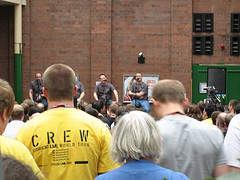
LUGRadioLive 2008 by sheilaellen (cc-by-2.0) This weekend, I learnt lots of things while at LugRadio Live in Wolverhampton. One thing was the surprising delay between posting something on this site and it actually appearing in the feed on my mobile phone. Another is that I can’t post to my new blog hosting from my mobile phone, which I’ll debug Real Soon Now. So, this is a bit later than when I first wrote it and it’s now one post instead of seven or so… Thanks to some unexplained delay travelling through Birmingham, I walked into LugRadio Live during the Introduction. The venue was generally pretty good, but the stage obstructed the entrance the acoustics in the atrium only seemed to work for the four gents. No idea what they said: I got past the stage into the audience and it finished almost immediately. For the first talk session, I went to see Rufus Pollock of Open Knowledge Foundation introduce a plan for the Comprehensive Knowledge Archive Network. Seems like a good idea. I’ve tons of questions, but I can’t quite get them into words, I don’t know when I’ll have time for this and I’m not sure they really matter anyway. I think I’ll mention CKAN to some librarians anyway and see what they make of it. I expected Emma Jane Hogbin’s “Form an orderly queue, ladies” to start an argument with the usual chix silliness but I was pleasantly surprised by how reasonable the advice was. In fact, the speaker also criticised the “chix” movements, although it appeared she participates in some women-only clubs, so not a 100% win for equality there. Sadly, much of the talk has been overshadowed in my mind by the memory of a giant furry racoon walking in unexpectedly, so I’ll probably grab the video of the LRL-USA version sometime soon. James Hooker’s talk titled “Taming the dragons — entrepreneurship and VCs” launched venturex as described on his own site already (along with more talk descriptions). It was an interesting demo, but it requires hackers to sell some votes in their companies to Venture Capitalists, which I believe is a bad thing for free software developers to do. We need to look more at a form of social entrepreneurism.</soapbox> I tried to ask a question, but the terrible atrium acoustics did funny things with my not-so-good hearing and I lost my way somewhat. At the end of that talk, I got chatting to an interesting web developer from Leicester who also forsook The Gong-a-Thong Lightbulb Talk Extravaganza and headed up to the Lightning Stage for Robert Collins and the Bzr talk. As well as some glimpses of how it’s changed since forking from tla, it was interesting to see a real (imperfect) demo and a non-Emacs version control GUI. The web interface for casual users to submit patches sounded very interesting and I also learned that some people pronounce “svn” like “Sven”. Most things that Robert thought were benefits sounded like drawbacks to me, so I’ll stay with git for now. Steve Lamb’s Green IT talk was the last presentation I saw. This talk really disappointed me because it seemed to be skewed towards the corporate governance nonsense instead of seeing Green IT as a vital pragmatic step, mentioning points I’d seen put more clearly elsewhere, as well as advertising Vista virtualisation and some panoramic webcam from Microsoft (who employ him) that doesn’t work with any free software, according to a deserved verbal shoe-ing in the Q+A. Only thing I remember that seems useful: charging from USB is more efficient than using wallwarts. Is that right? Finally, the main event: LugRadio Live and Unleashed. It opened with the shock announcement that LRL will continue into 2009, as announced elsewhere already. The rest of the madness will presumably appear online shortly and I don’t remember it well enough to do it justice… A tech conference crossed with a rocking gig by the strangest boyband ever, with a cheerleading racoon and some very cool people. I’ll try to be at LRL 2009. Will you be there? Were you at LRL this last weekend?

21 July 2008

Clint Adams:

This is the night of second-hand thoughts. Oh, the shame. I'm gonna do this in mostly-chronological order. Mostly. I vaguely remember the first great meal I had in Paris. I got off the plane, went through immigration and customs, hopped on the RER, got out and dragged my suitcase to Le Chat Gripp . I walked through the door in my T-shirt and jeans, and said well, I don't remember what I said, but I ended up getting a table and ordering the tasting menu. I don't remember very much about the food, but I remember that the waiter had to wake me up between courses. I've kinda had a thing for tasting menus ever since. Tonight I made a reservation at a fine dining establishment that was advertised as having a couple of tasting menus. I wasn't going to commit myself to a tasting menu, but there was a good chance I would find it irresistable. I timed my departure pretty well, and after walking the 2.5 miles to the restaurant, I was only a couple minutes early. Now the funny thing about this is I did not happen to notice that I had entered Molecular Gastronomy Hut. The signs outside did not say Molecular Gastronomy Hut, neither in cuneiform, hieroglyphs, nor any language I could read. The menu did not advertise the fact that this was Molecular Gastronomy Hut. Had I known that this was Molecular Gastronomy Hut, I would have not ordered the tasting menu, especially since I was not hungry and should probably have not even eaten a whole course. Had I known that the wine pairings would only include two reds, I wouldn't have ordered those either. Normally I expect wine pairings to include a white. It's the thing to do; it adds contrast. You drink it and get it over with and then you enjoy the rest of your meal. This had at least three whites and one ros . Mother of God. For the moment, though, I had no foreknowledge of the wines, and was was entranced by the knives, which were twisted such that if the handle was lying flat on the table, the blade stood vertically. Not only was this incredibly distracting, it seemed to have some practical value; if there were foodstuffs on your knife, they would remain elevated and not touch the tablecloth. Anyway, the food comes out, course by course, wine by wine. I wonder if Richard from Top Chef is hiding back in the kitchen. There are random foams and gastriques lying conspicuously on my plates. My second course had a lemon sorbet sitting on top of various types of vegetable matter. My third course involved arthropods. Ever wonder what to pair with fried arthropod? That's right, ros . My fourth course was actually tasty, much to my surprise. It was a pumpkin flower cappuccino. It is hubris to call it cappuccino, but they did and I am going to maintain the tradition. It tasted like warm infused buttery goodness, even though I was picking insect legs out of my mouth while drinking it. You may or may not be surprised to learn that the lemon sorbet made a reappearance in a later course. The waiter recommended mixing it with the other ingredients. Tom Colicchio was hiding in the back of my head asking why, if it was meant to be mixed, wouldn't they serve it mixed. I am forced to agree. The only other thing worth having was the cheese plate. It was populated with cheese I had never had before, and fruit concoctions to go with each. Most of the cheese were nothing special, but one was orgasmic. No, I'm not going to tell you what it was. Oh, all right, it was the middle one. One hundred fifty-six courses later, I was asked if I wanted any coffee. I didn't really want caffeine, but as I didn't want to sabotage the experience, I acquiesced and consented to an espresso. I'm not sure how I was understood, as by this time I had stopped speaking the local language and was presently shouting about bacon-burger dogs, the Huxtables, and Freebird. Then after coffee and being ignored, I asked for the check. Surprise, surprise: there was an additional dessert course to go. Didn't I look foolish? The bill came out to about half the country's GDP. The last time I had seen that many digits was when a bunch of hipsters tried to calculate while spaz-dancing to Fischerspooner and playing Space Channel Five. I wondered how it must feel for one of those guys who decides to order all kinds of extravagant room service in a luxury hotel right before committing suicide. After I paid, which seemed to confuse them a bit, they offered to call me a cab. I refused politely several times. I don't like cabs to begin with, aside from the whole plutocrat-fatcat I-might-as-well-get-a-maid-and-a-butler-and-a-valet feel to them, and the practical aspects of the drivers being douchebags. I had just spent a ridiculous amount of money on food that wasn't worth it, and I saw no reason to add insult to injury by paying for a taxi. It could probably have been $10 or $15 more. Mother of Christ. So I walked. It was only four or so miles to my bed, and I passed the time by singing songs of cormorants and racial disharmony and seventeen-year-old prostitutes and the time the Rescue Rangers got sentenced to maximum-security prison. All in all it was a terribly unpleasant contrast to the happy song about alfajores I was singing before dinner. Mmm alfajores.

Martin Michlmayr: Daily installer image available for QNAP TS-109, TS-209 and TS-409

Daily installer images are now available for the QNAP TS-109, TS-209 and TS-409. This means that complete installations of Debian testing are possible now. You can consider the daily image as a beta release of RC1 of the debian-installer for Debian lenny. It should only be used by experienced users and only if you can make a serial console in case something goes wrong. As the name suggests, the daily images change on a daily basis and they install Debian testing which also changes on a daily basis (although testing should be fairly stable since we're close to the freeze of testing in preparation for the release of Debian lenny). If you install Debian with these installer images, please send an installation report to debian-boot send an email to me so I can let you know in case there are any important news you should be aware of. There is a web site now with complete installation instructions and other information about Debian on QNAP Turbo Station. If you have any questions or suggestions, please let me know.

Matthew Garrett: The fallacy of the completely inclusive community

Emma Jane Hogbin gave a presentation on the gender gap in free software at Lugradio Live this weekend. One of the central messages was that a great deal of how to avoid putting women off computing can be distilled down to "Don't be a dick". This ties in well with Mako's restatement of the Ubuntu code of conduct as "Be excellent to each other" (a wonderful phrasing which demonstrates that Bill and Ted's Excellent Adventure is the most philosophically worthwhile film that Keanu Reeves has ever appeared in, and certainly not The fucking Matrix) and led to my 5 minute rant on why I hate the Linux community slightly later in the day, but does leave a certain problem. What standards are used to define whether given behaviour is dickish or not? The comments here show that there's disagreement even within a single sub-community of the larger free software world. Ben suggests that the reaction to perceived inappropriate behaviour is perhaps even more discouraging than the original behaviour, suggesting that bitching about things that offend you is dickish behaviour in and of itself. How do we decide whether someone is being a dick or helping the community? Is lack of tolerance a form of exclusionary behaviour?

This topic is actually one of the issues discussed in the Geek Social Fallacies, but here's a nice easy example. Would tolerating planet posts encouraging the eradication of the Jewish population be inclusive or exclusive? I suspect that most people would agree that it wouldn't be acceptable behaviour, which leads us to the next question. Why? There's two obvious arguments here. The first is that at a community level we have some form of rough moral consensus that advocating genocide is Just Wrong, and so criticising Nazis is obviously the right thing to do. The second argument is more pragmatic than philosophical - alienating millions of people in order to avoid alienating hate groups could be considered to reduce our potential contributor base in an unfortunate way.

I'm a fan of the second argument. The example I gave is emotive and relatively recent history has resulted in people tending to be pretty uniform in considering genocide to be a bad thing, but many other cases aren't clear cut. What I consider to be objectification of women is seen by others as appreciation of natural beauty. What I think of as sexist jokes are perceived by others as acceptable humour. When I advocate intolerance of certain behaviour, people are going to see me not having enough tolerance. So we end up in a situation where people make the "We should all just get along and be tolerant of each other" argument, which sounds fine but is fundamentally flawed in one significant way.

Advocating tolerance excludes the intolerant.

The reason people fail to see this is that it doesn't sound like a flaw. If you ask people whether we need to support intolerance, the immediate answer is probably no. But by advocating exclusion of intolerance, you're excluding all those who have good reasons to be intolerant. You're excluding the women who don't want to feel that the community sees them as a pair of breasts attached to some legs. You're excluding the ethnic groups who would prefer to avoid racist slurs or ethnic stereotyping. Telling anti-fascism protestors that they're being intolerant isn't likely to endear you to them. Advocating tolerance is telling the intolerant that they're wrong and should just deal with whatever it is that makes them unhappy.

So, ironically, tolerating certain types of intolerance is probably required in order to avoid alienating many potential contributors. That means some way of deciding what kinds of behaviour are acceptable and which are unacceptable. In the absence of either pre-existing community consensus or some philosophical breakthrough that allows unambiguous determination of the "rightness" of a given action, I'm going to suggest that we look at it from a pragmatic viewpoint. How many potential contributors do we discourage by criticising a certain type of behaviour? How many do we discourage by tolerating it?

The fallacy of the completely inclusive community is the idea that it includes everyone. The reality is that a certain level of social exclusion is required in order to include a wider range of people. So don't criticise people purely for criticising someone else's behaviour - make an argument for why that behaviour benefits the community. And when you see behaviour that you think discourages others, call people on it. Even if nobody's behaviour changes as a result, you're sending a signal that not everyone in the community agrees. Sometimes all people want is to know that there'll be some people on their side.

But, above all, try not to be a dick.

20 July 2008

Russell Coker: Review of the EeePC 701

I have just bought a EeePC 701 [1], I chose the old model because it’s significantly smaller than the 90x series and a bit lighter too and it had Linux pre-loaded. Also it was going cheap, while I am not paying for it I give the same attention to saving my clients’ money as to saving my own. I ruled out everything that was heavier or larger than an EeePC 901 and everything that cost more than $700. That left only the Linux version of the EeePC 901 (which I couldn’t find on sale) and the EeePC 701 as my options. I also excluded the EeePC 900 because it is bigger and heavier than the 701 but has the same CPU (and therefore can’t run Xen). In terms of it’s prime purpose (a SSH client) 96*22 characters is the size of a konsole screen with the default (medium) font size when the window is maximised, that is 5% more characters than the standard terminal size of 80*25 but the smaller number of lines is a problem. When using the small font I can get 129*29 which I find quite comfortable to read (it would be impossible for me to read withut glasses - which means having almost average vision for someone in their 30’s). Then I can get 129*31 if I dismiss the tool bar at the bottom of the screen and could probably get another couple of rows if I removed the tabs that Konsole uses to switch between sessions. That would only be viable if using screen extensively as a single session without the ability to switch between programs is not particularly useful (I don’t think that ALT-TAB is adequate for switching between terminal sessions). When running Debian I can get 130*32 with the same font due to smaller window controls, but I’ll write more about converting to Debian in another post. Note that while the OS that ships with the Linux based EeePC machines is based on Debian, it is heavily customised and has some notable differences from a typical Debian install. It has some proprietary software, and uses unionfs for the root and /home filesystems. The first issue is that Console (the KDE terminal program) can only be accessed from the file manager (via the tools menu or ^t), the machine clearly doesn’t have defaults for someone like me. In principle it’s a multi-user system that can be fully customised, but in practice it’s configured as a single-user machine. Once you have a Console window open you can run “su -” and the root password is the password for the “user” account. I wonder whether I could get more than 42 rows or more than 140 columns of text that is readable. If so then I could have two console windows fully displayed on screen. The screen is bright and clear, this is essential as the number of pixels per character is going to be low for any reasonable amount of text to be displayed on screen. The password that you set when you first use the machine also works for “su -” (in fact that is the only real use as I expect that almost everyone will choose the automatic login option). The display comprises a significant portion of the weight, if the screen is fully open (about 150 degrees) then it will tip over. Even when the screen is not as far open it will tip due to bumps if resting on your lap on a tram. It’s a pity that the screen is connected at the very back of the base, if the attachment point was a bit closer then it would balance better and also be easy to hold with one hand. The depth of the machine combined with the angle at the back makes it impossible for me to get a good one-handed grip from the base, so typing while standing on a moving tram or bus will be extremely difficult (unlike my iPaQ which I can use at full speed on any form of public transport). Inidentally it would be good if there was an attachment point for a wrist-strap, every camera and most mobile phones have them so it would be good to have the same safety feature in a laptop to facilitate use on public transport. Another reason for not using it as a PDA is the fact that it takes about 7 seconds to resume after hibernating (when the lid is closed). The PSU is almost as small as that of a mobile phone! This is a major benefit as in the past I have often stored a Thinkpad PSU at a client site for 9-5 jobs as it is heavy enough that I didn’t want to carry it on public transport. The EeePC PSU is light enough that it won’t be unpleasant to carry, and small enough to fit easily into a jacket pocket. The OS installation is very well done for the basics. It’s easy to launch applications and there is a good selection of educational programs (including the periodic table, planetarium, typing, letters, and hangman, drawing, and a link to www.skoool.com). It’s a pity that they organised the folders according to the area rather than the age, but generally the OS is very well done. Most of the reviews focus on the speed of the CPU, the RAM expansion options, etc, but miss the fact that it is a really nice machine for using as-is. It is a much better machine for teaching children than any of the machines I’ve seen which are sold specifically for children (see my previous post about an awful computer for kids [2]). I believe that you could give an EeePC to any 3yo and have them doing something useful in a matter of minutes! The ability to freely install new software should not be overlooked when considering a computer for children to use. Someone who buys one now could use it for a few years as an ssh client and then reinstall the original OS and give it to a child as an educational toy. It has a program to create OGG video files from it’s built-in camera and mic, at this moment it’s the only device I own that can create OGG files (this is a good thing). OGG compression takes a really long time, the Atom CPU in the 901 and 1000x series would be good for this. It’s a pity that the microphone is directly below the mouse buttons, it clearly records the mouse click used to finish recording. The version of mplayer which is installed to play OGG files can also play FLV files downloaded from youtube with youtube-dl (althrough the file association is not set). When I tried to play a MP4 file from ted.com it only gave audio (the video works on a full Debian/Etch installation). There is a full set of office software, OpenOffice.org, Thunderbird email client, and all the other stuff you might expect. I find that the biggest problem for using it is the size of the keyboard, I don’t think I’ll ever be able to touch-type properly on it. Not only are the keys small but the positions of non-alphabetical keys are slightly different from most keyboards. Another problem is that the space-bar needs to be pressed near the centre, I usually like to press near the end but that doesn’t work. Those issues are all trade-offs of the small size. My T series Thinkpad is reasonably portable and has a great keyboard so I have the serious typing while travelling angle covered. One real mistake in the keyboard design is the lack of a LED to indicate whether caps-lock is enabled (there are four status LEDs, adding number five couldn’t be that expensive), this is a real problem when using the vi editor (which uses letters as editor commands and is case-sensitive). It will also occasionally cause problems when entering passwords. There is a caps-lock indicator on screen, but that is in the toolbar at the bottom of the scren (which I like to dismiss to gain an extra two lines of text). It would be good if I could display the status of the caps and num lock keys in the right side of the title-bar of the active window (the only bit of unused space on the screen). The cooling fan makes an annoying buzz. It’s significantly louder than Thinkpads which dissipate a lot more heat. The other problems are all software, which is OK as I plan to reinstall it. Firstly it is using Debian and shipped with the broken openssl library. There is a GUI for installing upgrades, but it recommends rebooting after installing each one! Naturally I didn’t choose to reboot, I installed the security update #1. Then I clicked on the button to install a BIOS update. It told me that it had to reboot to apply the update and gave only one button (OK), I tried closing the window but it rebooted anyway (fortunately the vi swap file allowed me to recover this post - which I am entirely writing on the EeePC). Aftere booting up again I discovered that the libssl bug still wasn’t fixed and that there was a second udate to apply! Why can’t they have a “apply all updates” button and also have it not automatically reboot? This must be the only Debian-based distribution that forces Windows-style reboots. But that said, while they made some mistakes in their software it generally provides a good user experience

19 July 2008

Luciano Bello: Exploiting DSA-1571: How to break PFS in SSL with EDH

( I love acronyms :-D )

At this point, all of you should know and see how the H D Moore s toys work. Those toys attack SSH public-key authentication using clone keys and online brute force.

Furthermore, many of you know that there are other effects produced by a biased PRNG besides this one.

Strangely, I could not find more of those toys exploiting these aspects. So, I would like to show you a Wireshark patch which attacks Perfect Forward Secrecy (PFS) provided by Ephemeral Diffie Hellman (EDH).
Introduction to EDHLet s put it in plain words (if you know what we are talking about, ignore this and jump to the next heading):
In an insecure communications channel the parties agree a common key to cipher their dialog. This is what happens in SSL (in most of the cases, depending on the cipher suite):
The exploit If an eavesdropper can explore the complete private key space (the all possible numbers for Xc or Xs), he/she will be able to get access to the shared secret. With it all the communication can be deciphered. That s what this patch can do.

A Wireshark with this patch and a list of possible private keys will try to brute force the share secret. If one of the parties is using the vulnerable OpenSSL package the communication is totally insecure and will be decrypted.


The patch was submitted in order to be committed on the Wireshark trunk. There you can find the patch against the on-develop source revision 25765.
Issues that can be improvedWe (the other developers and myself) detected few things to be improved. But we will do nothing for them. So, if you want to contribute with some code, start from these items and submit the patches to the Wireshark s bugzilla:CreditsPaolo Abeni <paolo.abeni at email.it>
Luciano Bello <luciano at debian.org>
Maximiliano Bertacchini <mbertacchini at citefa.gov.ar>

This work was partially supported by Si6 Labs at CITEFA, Argentina.

UPDATE Jul. 21st: See more and updated info here, especially this.

Luciano Bello: Exploiting DSA-1571: How to break PFS in SSL with EDH

( I love acronyms :-D )

At this point, all of you should know and see how the H D Moore s toys work. Those toys attack SSH public-key authentication using clone keys and online brute force.

Furthermore, many of you know that there are other effects produced by a biased PRNG besides this one.

Strangely, I could not find more of those toys exploiting these aspects. So, I would like to show you a Wireshark patch which attacks Perfect Forward Secrecy (PFS) provided by Ephemeral Diffie Hellman (EDH).
Introduction to EDHLet s put it in plain words (if you know what we are talking about, ignore this and jump to the next tittle):
In an insecure communications channel the parties agree a common key to cipher their dialog. This is what happens in SSL (in most of the cases, depending on the cipher suite):
The exploit If an eavesdropper can explore the complete private key space (the all possible numbers for Xc or Xs), he/she will be able to get access to the share secret. With it all the communication can be deciphered. That s what this patch can do.

A Wireshark with this patch and a list of possible private keys will try to brute force the share secret. If one of the parties is using the vulnerable OpenSSL package the communication is totally insecure and will be decrypted.


The patch was submitted in order to be committed on the Wireshark trunk. There you can find the patch against the on-develop source revision 25765.
Issues that can be improvedWe (the other developers and myself) detected few things to be improved. But we will do nothing for them. So, If you want to contribute with some code, start from these items and submit the patches to the Wireshark s bugzilla:CreditsPaolo Abeni <paolo.abeni at email.it>
Luciano Bello <luciano at debian.org>
Maximiliano Bertacchini <mbertacchini at citefa.gov.ar>

This work was partially supported by Si6 Labs at CITEFA, Argentina.

Christian Perrier: D-I (and related stuff) l10n completion

Now that D-I beta2 has been released, the next release of D-I *will* very certainly be called a "Release Candidate" and be the final release used in Lenny. So, it's time for our translators to put their work in shape and we have 61 supported languages so far. In short, expect being nagged by /me quite often in the upcoming two months. The current status is: Of course, I expect these to raise up significantly. I posted new calls for updates this week-ed, in the hope people are not tired of /bubulle nagging them constantly. Please note that Level 1 partial completion (the first two "sublevels") is a requirement for a language to be activated in D-I. As of now, we "only" have about 40 languages in that case.

Bastian Venthur: Rng 1.0 in unstable

I’ve finished the porting of rng from qt3 to qt4 and uploaded it to unstable. It has some minor regressions compared to the qt3 version, like the localization of the qt4 widgets which isn’t working yet and that the column which sorts the table isn’t saved and restored properly on startup, but it closes many other bugs and it doesn’t crash anymore. The new version doesn’t bring so much new features so far, but since it’s using much of the stuff which came with QT4, like the QTableModel and the QWebView, it runs much faster in many cases, e.g. when sorting or filtering the table. Ah, and last but but not least: thanks to WebKit rng even passes acid1 and acid2. Doesn’t yet pass acid3 but I guess someone is already working on it :) rng passing acid2

17 July 2008

Russell Coker: Pollution and Servers

There is a lot of interest in making organisations “green” nowadays. One issue is how to make the IT industry green. People are talking about buying “offsets” for CO2 production, but the concern is that some of the offset schemes are fraudulent. Of course the best thing to do is to minimise the use of dirty power as much as possible. Of course the first thing to do is to pay for “green power” (if available) and if possible install solar PV systems on building roofs. While the roof space of a modern server room would only supply a small amount of the electricity needed (maybe less than needed to power the cooling) every little bit helps. The roof space of an office building can supply a significant portion of the electricity needs, two years ago Google started work on instralling Solar PV panels on the roof of the “Googleplex” [1] with the aim of supplying 30% of the building’s power needs. For desktop machines a significant amount of power can be saved if they are turned off overnight. For typical office work the desktop machines should be idle most of the time, so if the machine is turned off outside business hours then it will use something close to 45/168 of the power that it might otherwise use. Of course this requires that the OS support hibernation (which isn’t supported well enough in Linux for me to want to use it) or that applications can be easily stopped and restarted so that the system can be booted every morning. One particular corner case is that instant-messaging systems need to be server based with an architecture that supports storing messages on the server (as Jabber does [2]) rather than requiring that users stay connected (as IRC does). Of course there are a variety of programs to proxy the IRC protocol and using screen on a server to maintain a persistent IRC presence is popular among technical users (for a while I used that at a client site so that I could hibernate the PowerMac I had on my desktop when I left the office). It seems that most recent machines have BIOS support for booting at a pre-set time. This would allow the sys-admin to configure the desktop machines to boot at 8:00AM on every day that the office is open. That way most employees will arrive at work to find that their computer is already booted up and waiting for them. We have to keep in mind the fact that when comparing the minimum pay (about $13 per hour in Australia) with the typical electricity costs ($0.14 per KWh - which means that a desktop computer might use $0.14 of electricity per day) there is no chance of saving money if employee time is wasted. While companies are prepared to lose some money in the process of going green, they want to minimise that loss as much as possible. The LessWatts.org project dedicated to saving energy on Linux systems reports that Gigabit Ethernet uses about 2W more power than 100baseT on the same adapter [3]. It seems most likely that similar savings can be achieved from other operating systems and also from other network hardware. So I expect that using 100baseT speed would not only save about 2W at the desktop end, but it would also save about 2W at the switch in the server-room and maybe 1W in cooling as well. If you have a 1RU switch with 24 Gig-E ports then that could save 48W if the entire switch ran at 100baseT speed, compared to a modern 1RU server which might take a minimum of 200W that isn’t very significant. The choice of server is going to be quite critical to power use, it seems that all vendors are producing machines that consume less power (if only so that they can get more servers installed without adding more air-conditioning), so some effort in assessing power use before purchase could produce some good savings. When it comes time to decommission old servers it is a good idea to measure the power use and decommission the most power hungry ones first whenever convenient. I am not running any P4 systems 24*7 but have a bunch of P3 systems running as servers, this saves me about 40W per machine. It’s usually the case that the idle power is a significant portion of the maximum power use. In the small amount of testing I’ve done I’ve never been able to find a case where idle power was less than 50% of the maximum power - of course if I spun-down a large number of disks when idling this might not be the case. So if you can use one virtual server that’s mostly busy instead of a number of mostly idle servers then you can save significant amounts of power. Before I started using Xen I had quite a number of test and development machines and often left some running idle for weeks (if I was interrupted in the middle of a debugging session it might take some time to get back to it). Now if one of my Xen DomU’s doesn’t get used for a few weeks it uses little electricity that wouldn’t otherwise be used. It is also possible to suspend Xen DomU’s to disk when they are not being used, but I haven’t tried going that far. Xen has a reputation for preventing the use of power saving features in hardware. For a workstation this may be a problem, but for a server that is actually getting used most of the time it should not be an issue. KVM development is apparently making good progress, and KVM does not suffer from any such problems. Of course the down-side to KVM is that it requires an AMD64 (or Intel clone) system with hardware virtualisation, and such systems often aren’t the most energy efficient. A P3 system running Xen will use significantly less power than a Pentium-D running KVM - server consolidation on a P3 server really saves power! I am unsure of the energy benefits of thin-client computing. I suspect that thin clients can save some energy as the clients take ~30W instead of ~100W so even if a server for a dozen users takes 400W there will still be a net benefit. One of my clients does a lot of thin-client work so I’ll have to measure the electricity use of their systems. Disks take a significant amount of power. For a desktop system they can be hibernated at times (an office machine can be configured such that the disks can spin-down during a lunch break). This can save 7W per disk (the exact amount depends on the type of disk and the efficiency of the PSU - (see the Compaq SFF P3 results and the HP/Compaq Celeron 2.4GHz on my computer power use page [4]). Network booting of diskless workstations could save 7W for the disk (and also reduce the noise which makes the users happy) but would drive the need for Gigabit Ethernet which then wastes 4W per machine (2W at each end of the Ethernet cable). Recently I’ve been reading about the NetApp devices [5]. By all accounts the advanced features of the NetApp devices (which includes their algorithms for the use of NVRAM as write-back cache and the filesystem journaling which allows most writes to be full stripes of the RAID) allow them to deliver performance that is significantly greater than a basic RAID array with a typical filesystem. It seems to me that there is the possibility of using a small number of disks in a NetApp device to replace a larger number of disks that are directly connected to hosts. Therefore use of NetApp devices could save electricity. Tele-commuting has the potential to save significant amounts of energy in employee travel. A good instant-messaging system such as Jabber could assist tele-commuters (it seems that a Jabber server is required for saving energy in a modern corporate environment). Have I missed any ways that sys-admins can be involved in saving energy use in a corporation? Update: Albert pointed out that SSD (Solid State Disks) can save some power. They also reduce the noise of the machine both by removing one moving part and by reducing heat (and therefore operation of the cooling fan). They are smaller than hard disks, but are large enough for an OS to boot from (some companies deliberately only use a small portion of the hard drives in desktop machines to save space on backup tapes). It’s strange that I forgot to mention this as I’m about to buy a laptop with SSD.

Gunnar Wolf: Kept silent for a week...

Last week (July 7-13) was basically hell on Earth, for me and for the group that somehow got the name Cabras locas, of which I am part since I joined the National Pedagogical University, where I worked full-time 2003-2005.
It was, yes, the first of my officially three weeks of Summer holiday at IIEc-UNAM, so no problems here. So, why hell on Earth? Because we were in charge basically of anything related with information flow, retrieval and manipulation at the 11th International Congress on Mathematical Education, in Monterrey.
What we thought would basically be one or two days of hard work followed by six days of relaxed vacations (we had even planned to have an internal seminar, showing off the shiny stuff each of us is working on) became... A mind-boggling eight day experience where we worked over 12 hours a day on being human replacements for Google, SQL engines, full-text parsers, report generators, printer watchdogs, and in general lines, just a bunch of unhappy firemen, ready to be called off for whatever task was necessary.
We did have, of course, several calm periods every now and then. We even had to learn how to look busy while doing something compeltely unrelated (that would explain, for example, a couple of low-hanging bugs I fixed for Debian, or some dozens of lines of code I could get off my head).
But my advice for whoever reads this: Don't trust people with long database-handling experience. Specially when they insist that hand-capturing a thousand registers is preferrable (i.e. less error-prone) than parsing three separate databases and discarding duplicates. And, of course, specially when this person is your boss, which is enough of an argument to have it his way.

Thijs Kinkhorst: FEE error on Nikon DSLR - fixed

Recently my Nikon D70s, when using a new Sigma lens, displayed the following error in the aperture display: fEE. As it took me some time to find out the cause and fix it, I'll explain it here perhaps for the benefit of others. What does it mean? Some lenses require that the aperture is set to smallest when they are connected to the body (the largest f-number; this is usually coloured orange). fEE is indicated when the lens is connected wrongly and the camera refuses to operate until the lens is reconnected. lensbody If like me you still get the fEE even though you've connected the lens correctly, then obviously something is broken. The camera "knows" whether the aperture ring is set to the right value due to a notch on the lens (rightmost picture) and a switch on the body ("EE Servo Coupling Post", left picture). In my case the switch on the body had broken off. You can of course send your camera in for repair, but for me it was easily repaired by sticking a hairpin in the switch. A little piece of plastic and some superglue could work as well.

Stefano Zacchiroli: paper about mancoosi at debconf8

Mancoosi paper for DebConf8 now available As previously announced, I'll be attending DebConf this year, as I did for the past 3 years. Beside the usual projects and ideas one carries with himself on his way to a DebConf, this time I will also be there to present part of my everyday work in the Mancoosi project. Very briefly (and a bit too simplistic) Mancoosi is working on pushing forward the research and technology needed to deliver better package managers to the users of open source software distributions. The project presentation event proposed by me and Ralf Treinen has been accepted in the DebConf main track. The presentation will discuss what the former EDOS project did, what Mancoosi is doing right now, trying to focus on their relationships with Debian. In case you are interested I suggest to attend the talk which will be delivered by yours truly (what else can I suggest? :) ) In the meantime, the accompanying paper is now available, you can take a sneak peek if you are interested in knowing more about Mancoosi right ahead. The paper is available in .pdf format from both my homepage and from the Pentabarf event page as an attachment (the latter, as all Pentabarf events, needs login for reasons that I still fail to understand ...). Download

16 July 2008

Eddy Petri&#537;or: OH MY GOD!

This can't be true! How can someone trust such a key?

Does anybody have a reasonable explanation for such an abomination?


Update: It seems it is unclear to some people what is the problem with this key. There are multiple identities (apparently different people) for the same key. So, in layman's terms, multiple different people are using exactly the same key to certify their identity.

I really don't understand how this could work in real life. Maybe is a case of misunderstanding what gpg is about?

Stefano Zacchiroli: updating w3-recs

revamping w3-recs: new specs, misc improvements After quite a lot from my initial adoption, I've spent some time to update w3-recs. Beside the long overdue update of shipped recommendations (quite a few new specification was released, mostly related to SPARQL, but a few more have been edited, including CSS 1 and 2), I've also uploaded some pending improvements. A couple of bug fixes were about dangling links and registration of recommendations with the GNOME devhelp stuff. Additionally, I've also moved all the documents registered with doc-base under the new Help/Standards section of doc-base, which seems to be fit for W3C Recommendations. Apparently we have finally managed to have a proper section tree for doc-base, the decoupling of that tree from the Debian menu one will not be missed (at least not by me). During the process I've also discovered a (recent?) change in debhelper semantics. Thus far I used to have broken doc-base document IDs in w3-recs, as they contained uppercase letters, which are prohibited according to /usr/share/doc/doc-base/doc-base.txt.gz. My fault, I concur, but in the past the documents got installed anyhow without any problem. On the contrary, with the latest debhelper all documents got written to the very same file, apparently stripping away the part of their names which do not match the used lowercase regular expression. Well, not too bad, I fixed one more bug, but with a warning fixing that would have been quicker. Also, /me wonders, if everything (but package build :-) ) worked properly with uppercase document IDs, why the heck one should forbid them in the doc-base specification?

Wouter Verhelst: No more 'government'

So apparently the Belgian 'government' has failed to meet its deadline; and as a result, the prime minister has handed in the 'government's resignation to the King. I say 'government', because these people have been doing quite a lot of things—all except governing... I must say I can't be surprised. I never liked Leterme; not before the elections, and not after. Now that more than a year has passed since his winning the elections, they have managed to accomplish exactly nothing. Well, that's not exactly true. There's a pattern here: And even after that horrible track record, CD&V/N-VA is still not willing to put Leterme aside as a candidate for the prime ministry. Now I'm sure some people will tell me that Leterme did indeed, accomplish something, such as the budget agreement of a few days ago. Well, here's a news flash: if you want to get a government set up, then not accomplishing that is pretty critical; something routine and simple as a budget is hardly noteworthy, then. The one thing I do not understand, have never understood, and will not ever understand, is why the larger parties in Belgium feel so compelled to create "cartels" with small extremist fringe parties. They all fell into that trap; VLD (liberals) with Vivant (economic strangelings); CD&V (catholic democrats) with N-VA (flemish nationalists), and SP.A (socialists) with Spirit (left-wing something). I have no trouble understanding why the fringe parties want to do this (gives them power where occasionally they wouldn't have any), but the large parties? It only causes trouble (as the CD&V/N-VA cartel has now proven beyond any doubt); and I seriously doubt it causes them a net win in votes. I could say that some other things about the past deb cle also puzzle me, such as the insistence of some people to get an unconditional split of BHV, thereby destroying all chances of even remotely reaching a compromise; but given the idiocy explained in the previous paragraph, I should hardly be surprised. Sigh. I wish I had some decent politicians in this country; but the people I voted for lost seriously, and were not part of the negotiations. I guess that should mean I have to say: told you so; but then, that's not very productive either. Here's for hoping they can still find some way out of this mess...

15 July 2008

David Welton: Misquoted

Well, to be charitable, it was a bit late and so perhaps what I said came out wrong, but in this article: http://www.theregister.co.uk/2008/07/14/android_developer_unrest/ I'm quoted as saying the problem is with "upper management", which I don't really believe to be the case, going by snippets of conversations and things I've read. Frankly, at this point in time, I have no idea why Google can't talk about Android. Also, I had several other positive things to say to the reporter, but I guess the 'focus' of the piece was about the problems that Android is currently experiencing. Notwithstanding the recent weirdness, I'm quite happy that someone with a lot of money and muscle is going to be backing an open source mobile phone system, and hope that the current troubles are merely a small speed bump.

Next.

Previous.