Search Results: "will"

3 September 2012

Gunnar Wolf: WikiLovesMonuments wants *you* (and me!)

What, haven't you heard about the WikiLovesMonuments photo contest around cultural heritage? Copying from its web page,
Wiki Loves Monuments is an international photo contest around cultural heritage monuments in September. Starting from the Netherlands in 2010 and organized on a European level in 2011, we go global in 2012!
I heard about this initiative in Iv n Mart nez's Wikimedia talk at COSIT 2012, held last week in Coatzacoalcos, Veracruz (I intend to write a bit more regarding COSIT later on). I loved the idea, and intend to participate Not because I take great pictures (I don't, and I usually take them using my aging phone, which gives decent results but nothing beyond that), but because I love to move by bike in the city, and it's one of the best ways to roll in front of some of them. But more on me later Back to the topic! WikiLovesMonuments aims to improve on Wikimedia's (the organization behind Wikipedia and several other Free Culture reference projects) coverage of important landmarks all over the world. To do so, they are offering a trip to attend WikiMania 2013 in Hong Kong to the first place winner, and other "photography-related" prizes to the other winners. So, back to me: My motivation to enter the contest is to help Wikimedia. I know my shots won't be top-notch (although they will be the best I can do). I enjoy biking in my city, and often go not too far from many of the listed monuments. I am amazed at the number of monuments still pending in my area (of course, it's not by mistake this is called "La ciudad de los palacios", The city of the palaces) Surely some of the readers of this post will have (or will find easy to take) some photos to add. Of course, I'll try to focus on the missing monuments, but if you are a good photographer, you might want to submit a better version for a monument that's already there. So, some pointers, from what's closest to what's farthest from me: At least for Mexico, the listings are taken from the National Institute for Anthropology and History (INAH)'s Public registry of archaeological zones and monuments. So, I cannot wait to start my biking session today to get some good end-of-summer evening sun and get some pictures taken! :-D

Paul Tagliamonte: tmperamental - check for wild /tmp calls

tmperamental found either on git.d.o, or github is a library to be LD_PRELOAD-ed, and help check for use of hardcoded /tmp. The idea is to get TMPDIR and friends, and preload tmperamental, which will call non-zero exit when an app does stuff in /tmp. It s a big hack, so if you feel like making it even better, send in patches :)

Philipp Kern: IPv6 support in debian-installer

I tried to continue netcfg's journey to support IPv6 in debian-installer. Matt Palmer wrote a large patch set many moons ago (kudos!) and Colin Watson polished it and included it into Ubuntu. The reason for it not being merged into Debian first was ifupdown. Version 0.7 finally supports IPv6 and only entered Debian unstable by the end of May. Due to a bunch of changes to netcfg, one reason being a Summer of Code project on it, I had to forward-port those 50 patches and add two bug fixes on top. Hence it's possible that I introduced some breakage, even if the result works well for me (apart from one DHCPv6 oddity that cannot be seen from within KVM). The tree can be found in the people/pkern/ipv6 branch. I was unable to check if Ubuntu has introduced any additional patches on top of the old patch set, as I'm not used enough to bzr.

This mini.iso (detached signature) netinst image contains a debian-installer current as of today and two additional patched udebs: netcfg with the aforementioned IPv6 patch set and busybox with ping6 enabled. I'd appreciate if you could go and test it in one (or more) of the following environments: IPv4-only (DHCPv4 / static), wireless (IPv4 / IPv6 as desired, there has been some refactoring), stateless IPv6 autoconfiguration (it even supports RDNSS and DNSSL), stateless IPv6 autoconfiguration with stateless DHCPv6, and stateful DHCPv6. It will try to configure dual stack if possible. Please note that many Debian mirrors are not yet IPv6-enabled. Even prominent ftp.CC.debian.org hosts like ftp.de.debian.org still do not support it. So you'll have to pick one carefully if you want to try IPv6-only installation. (Which worked for me!)

If you have any feedback for me, please leave it here as a comment or mail me at pkern@d.o. Thanks!

Joachim Breitner: A copying garbage collector animated

Next weekend I will hold an advanced Haskell talk at the Meta Rhein-Main ChaosDays in Darmstadt. It will mostly be a guided tour through the main memory of a running Haskell program, showing how things are represented and how they change over time. For this I cannot avoid to touch the issue of garbage collection, so I created a short animation:
<video align="center" controls="true" height="500" poster="http://darcs.nomeata.de/talk-mrmcd12-haskell-bytes/GC.png" src="http://darcs.nomeata.de/talk-mrmcd12-haskell-bytes/GC.webm" tabindex="0" width="800"> Your browser does not seem to support WebM videos. Try the YouTube link below. </video>
(If you do not see it above, then you can try on YouTube.) It is created with Synfig, feel free to use the sources. It seems that Synfig, although it has some features that allow you to link position in various objects, or calculate with them, is not really meant for programmers. Take the arrows: They are all quite similar, and defined by starting point, end point, and how much the initial segment sticks out to the right. I could even create them so that when I move the first or last point, the rest adjusts automatically. So one would expect that I can combine these shapes in one re-usable object that has these three values as parameters, but unfortunately, that is not the case. I guess next time I want to animate something as structured as this, I use either tikz (and generate one page per frame, convert them to an image and then to a video) or a Haskell library like gloss or diagrams. Update: I made some minor improvements to the video. Youtube does not allow me to change the video, so you ll see the new version only here.

Flattr this post

2 September 2012

Dirk Eddelbuettel: Faster creation of binomial matrices

Scott Chamberlain blogged about faster creation of binomial matrices the other day, and even referred to our RcppArmadillo package as a possible solution (though claiming he didn't get it to work, tst tst -- that is what the rcpp-devel list is here to help with). The post also fell short of a good aggregated timing comparison for which we love the rbenchmark package. So in order to rectify this, and to see what we can do here with Rcpp, a quick post revisiting the issue. As preliminaries, we need to load three packages: inline to create compiled code on the fly (which, I should mention, is also used together with Rcpp by the Stan / RStan MCMC sampler which is creating some buzz this week), the compiler package included with R to create byte-compiled code and lastly the aforementioned rbenchmark package to do the timings. We also set row and column dimension, and set them a little higher than the original example to actually have something measurable:
library(inline)
library(compiler)
library(rbenchmark)
n <- 500
k <- 100
The first suggestion was the one by Scott himself. We will wrap this one, and all the following ones, in a function so that all approaches are comparable as being in a function of two dimension arguments:
scott <- function(N, K)  
    mm <- matrix(0, N, K)
    apply(mm, c(1, 2), function(x) sample(c(0, 1), 1))
 
scottComp <- cmpfun(scott)
We also immediatly compute a byte-compiled version (just because we now can) to see if this helps at all with the code. As there are no (explicit !) loops, we do not expect a big pickup. Scott's function works, but sweeps the sample() function across all rows and columns which is probably going to be (relatively) expensive. Next is the first improvement suggested to Scott which came from Ted Hart.
ted <- function(N, K)  
    matrix(rbinom(N * K, 1, 0.5), ncol = K, nrow = N)
 
This is quite a bit smarter as it vectorises the approach, generating N times K elements at once which are then reshaped into a matrix. Another suggestion came from David Smith as well as Rafael Maia. We rewrite it slightly to make it a function with two arguments for the desired dimensions:
david <- function(m, n)  
    matrix(sample(0:1, m * n, replace = TRUE), m, n)
 
This is very clever as it uses sample() over zero and one rather than making (expensive) draws from random number generator. Next we have a version from Luis Apiolaza:
luis <- function(m, n)  
     round(matrix(runif(m * n), m, n))
 
It draws from a random uniform and rounds to zero and one, rather than deploying the binomial. Then we have the version using RcppArmadillo hinted at by Scott, but with actual arguments and a correction for row/column dimensions. Thanks to inline we can write the C++ code as an R character string; inline takes care of everything and we end up with C++-based solution directly callable from R:
arma <- cxxfunction(signature(ns="integer", ks="integer"), plugin = "RcppArmadillo", body='
   int n = Rcpp::as<int>(ns);
   int k = Rcpp::as<int>(ks);
   return wrap(arma::randu(n, k));
')
This works, and is pretty fast. The only problem is that it answers the wrong question as it returns U(0,1) draws and not binomials. We need to truncate or round. So a corrected version is
armaFloor <- cxxfunction(signature(ns="integer", ks="integer"), plugin = "RcppArmadillo", body='
   int n = Rcpp::as<int>(ns);
   int k = Rcpp::as<int>(ks);
   return wrap(arma::floor(arma::randu(n, k) + 0.5));
')
which uses the the old rounding approximation of adding 1/2 before truncating. With Armadillo in the picture, we do wonder how Rcpp sugar would do. Rcpp sugar, described in one of the eight vignettes of the Rcpp package, is using template meta-programming to provide R-like expressiveness (aka "syntactic sugar") at the C++ level. In particular, it gives access to R's RNG functions using the exact same RNGs as R making the results directly substitutable (whereas Armadillo uses its own RNG).
sugar <- cxxfunction(signature(ns="integer", ks="integer"), plugin = "Rcpp", body='
   int n = Rcpp::as<int>(ns);
   int k = Rcpp::as<int>(ks);
   Rcpp::RNGScope tmp;
   Rcpp::NumericVector draws = Rcpp::runif(n*k);
   return Rcpp::NumericMatrix(n, k, draws.begin());
')
Here Rcpp::RNGScope deals with setting/resetting the R RNG state. This draws a vector of N time K uniforms similar to Luis' function -- and just like Luis' R function does so without looping -- and then shapes a matrix of dimension N by K from it. And it does of course have the same problem as the RcppArmadillo approach earlier and we can use the same solution:
sugarFloor <- cxxfunction(signature(ns="integer", ks="integer"), plugin = "Rcpp", body='
   int n = Rcpp::as<int>(ns);
   int k = Rcpp::as<int>(ks);
   Rcpp::RNGScope tmp;
   Rcpp::NumericVector draws = Rcpp::floor(Rcpp::runif(n*k)+0.5);
   return Rcpp::NumericMatrix(n, k, draws.begin());
')
Now that we have all the pieces in place, we can compare:
res <- benchmark(scott(n, k), scottComp(n,k),
                 ted(n, k), david(n, k), luis(n, k),
                 arma(n, k), sugar(n,k),
                 armaFloor(n, k), sugarFloor(n, k),
                 order="relative", replications=100)
print(res[,1:4])
With all the above code example in a small R script we call via littler, we get
edd@max:~/svn/rcpp/pkg$ r /tmp/scott.r 
Loading required package: methods
              test replications elapsed   relative
7      sugar(n, k)          100   0.072   1.000000
9 sugarFloor(n, k)          100   0.088   1.222222
6       arma(n, k)          100   0.126   1.750000
4      david(n, k)          100   0.136   1.888889
8  armaFloor(n, k)          100   0.138   1.916667
3        ted(n, k)          100   0.384   5.333333
5       luis(n, k)          100   0.410   5.694444
1      scott(n, k)          100  33.045 458.958333
2  scottComp(n, k)          100  33.767 468.986111
We can see several takeaways: Thanks to Scott and everybody for suggesting this interesting problem. Trying the rbinom() Rcpp sugar function, or implementing sample() at the C++ level is, as the saying goes, left as an exercise to the reader.

Benjamin Mako Hill: Open Brands

In late July, the Awesome Foundations invited me to participate in an interesting conversation about open brands at their conference. Awesome is a young collection of organizations struggling with the idea of if, and how, they want to try to control who gets call themselves Awesome. I was asked to talk about how the free software community approaches the issue. Guidance from free software is surprisingly unclear. I have watched and participated in struggles over issues of branding in every successful free software project I've worked in. Many years ago, Greg Pomerantz and I wrote a draft trademark policy for the Debian distribution over a couple beers. Over the last year, I've been working with Debian Project Leader Stefano Zacchiroli and lawyers at the Software Freedom Law Center to help draft a trademark policy for the Debian project. Through that process, I've come up with three principles which I think lead to more clear discussion about whether a free culture or free software should register a trademark and, if they do, how they should think about licensing it. I've listed those principles below in order of importance. 1. We want people to use our brands. Conversation about trademarks seem to turn into an exercise in imagining all the horrible ways in which a brand might be misused. This is silly and wrong. It is worth being extremely clear on this point: Our problem is not that people will misuse our brands. Our problem is that not enough people will use them at all. The most important goal of a trademark policy should be to make legitimate use possible and easy. We want people to make t-shirts with our logos. We want people to write books about our products. We want people to create user groups and hold conferences. We want people to use, talk about, and promote our projects both commercially and non-commercially. Trademarks will limit the diffusion of our brand and, in that way, will hurt our projects. Sometimes, after carefully considering these drawbacks, we think the trade-off is worth making. And sometimes it is. However, projects are generally overly risk averse and, as a result, almost always err on the side of too much control. I am confident that free software and free culture projects' desire to control their brands has done more damage than all brand misuse put together. 2. We want our projects to be able to evolve. The creation of a trademark puts legal power to control a brand in the hands of an individual, firm, or a non-profit. Although it might not seem like such a big deal, this power is, fundamentally, the ability to determine what a project is and is not. By doing this, it creates a single point of failure and a new position of authority and, in that process, limits projects' ability to shift and grow organically over time. I've heard that in US politics, there is no trademark for the terms Republican or Democrat and that you do not need permission to create an organization that claims to be part of either party. And that does not mean that everybody is confused. Through social and organizational structures, it is clear who is in, who is out, and who is on the fringes. More importantly, this structure allows for new branches and groups outside of the orthodoxy to grow and develop on the margins. Both parties have been around since the nineteenth century, have swapped places on the political spectrum on a large number of issues, and have played host to major internal ideological disagreements. Almost any organization should aspire to such longevity, internal debate, and flexibility. 3. We should not confuse our communities. Although they are often abused, trademarks are fundamentally pro-consumer. The point of legally protected brands is to help consumers from being confused as the source of a product or service. Users might love software from the Debian project, or might hate it, but it's nice for them to be able to know that they're getting "Debian Quality" when they download a distribution. Of course, legally protected trademarks aren't the only way to ensure this. Domains names, internal policies, and laws against fraud and misrepresentation all serve this purpose as well. The Open Source Initiative applied for a trademark on the term open source and had their application rejected. The lack of a registered trademark has not kept folks from policing use of the term. Folks try to call their stuff "open source" when it is not and are kept in line by a community of folks who know better. And since lawyers are rarely involved, it is hardly clear that a registered trademark would help in the vast majority of these these situations. It is also the case that most free software/culture organizations lack the money, lawyers, or time, to enforce trademarks in any case. Keeping your communities of users and developers clear on what is, and what isn't, your product and your project is deeply important. But how we choose to do this is something we should never take for granted.

Erich Schubert: ELKI call for contributions

ELKI is a data mining software project that I have been working on for the last years as part of my PhD research. It is open source (AGPL-3 licensed) and avilable as both a Debian package and Ubuntu package in the official repositories. So a simple aptitude install elki should get you going and give you a menu entry for ELKI. These packages come with the scripts elki to launch the MiniGUI and elki-cli to run from command line. The key feature that sets ELKI apart from existing open source tools used in data mining (e.g. Weka and R) is that it has support for index structures to speed up algorithms, and a very modular architecture that allows various combinations of data types, distance functions, index structures and algorithms. When looking for performance regressions and optimization potential in ELKI, I recently ran some benchmarks on a data set with 110250 images described by 8 dimensional color histograms. This is a decently sized dataset: it takes long enough (usually in the range of 1-10 minutes) to measure true hotspots. When including Weka and R in the comarison I was quite surprised: our k-means implementation runs at the same speed as Rs implementation in C (and around twice that of the more flexible "flexclus" version). For some of the key agorithms (DBSCAN, OPTICS, LOF) we are an order of magnitude faster than Weka and R, and adding index support speeds up the computation by another factor of 5-10x. In the most extreme case - DBSCAN in Weka vs. DBSCAN with R-tree in ELKI - the speedup was a factor of 330x, or 2 minutes (ELKI) as opposed to 11 hours (Weka).
The reason why I was suprised is that I expected ELKI to perform much worse. It is written in Java (as opposed to R's kmeans, which is in C), uses a very flexible architecture which for example does not assume distances to be of type double and just has a lot of glue code inbetween. However, obviously, the Java Hotspot compiler actually lives up to its expectations and manages to inline the whole distance computations into k-means, and then compiles it at a level comparable to C. R executes vectorized operations quite fast, but on non-native code as in the LOF example it can become quite slow, too. (I would not take Weka as reference, in particular with DBSCAN and OPTICS there seems to be something seriously broken. Judging from a quick look at it, the OPTICS implementation actually is not even complete, and both implementations actually copy all data out of Weka into a custom linear database, process it there, then feed back the result into Weka. They should just drop that "extension" altogether. The much newer and Weka-like LOF module is much more comparable.) Note that we also have a different focus than Weka. Weka is really popular for machine learning, in particular for classification. In ELKI, we do not have a single classification algorithm because there is Weka for that. Instead, ELKI focuses on cluster analysis and outlier detection. And ELKI has a lot of algorithms in this domain, I dare to say the largest collection. In particular, they are all in the same framework, so they can be easily compared. R does of course have an impressive collection in CRAN, but in the end they do not really fit together. Anyway, ELKI is a cool research project. It keeps on growing, we have a number of students writing extensions as part of their thesis. It has been extremely helpful for me in my own research, as I could quickly prototype some algorithms, then try different combinations and use my existing evaluation and benchmarking. You need some time to get started (largely because of the modular architecture, Java generics and such hurdles), but then it is a very powerful research tool. But there are just many more algorithms, published sometime, somewhere, but barely with source code available. We'd love to get all these published algorithms into ELKI, so researchers can try them out. And enhance them. And use them for their actual data. So far, ELKI was mostly used for algorithmic research, but it's starting to move out into the "real" world. More and more people that are not computer scientists start using ELKI to analyze their data. Because it has algorithms that no other tools have. I tried to get ELKI into the "Google Summer of Code", but it was not accepted. But I'd really like to see it gain more traction outside the university world. There are a number of cool projects associated with ELKI that I will not be able to do myself the next years, unfortunately. If you are a researcher in cluster analysis or outlier detection, consider contributing your algorithms to ELKI. Spend some time optimizing them, adding some documentation. Because, if ELKI keeps on growing and gaining popularity, it will be the future benchmark platform. And this can give you citations, which are somewhat the currency of science these days. Algorithms available in the major toolkits just do get cited more, because people compare to them. See this list for an overview of work cited by ELKI - scientific work that we reimplemented at least to some extend for ELKI. It is one of the services that we provide with ELKI for researchers: not only the algorithm, but also the appropriate citation.

1 September 2012

Lars Wirzenius: Dabbling in diplomacy

For about the past three months I've been conducting a small experiment. When I've seen people misbehave on the Debian development mailing list, I've sent a private e-mail to them suggesting they should avoid some specific behavior, in the hope of getting them to stop. My success has been varied. A few have thanked me, and changed their behavior. A couple have taken offense. Some have ignored me. I've noticed a correlation between how much effort I put into the letter and how successful it. Broadly speaking, if I send anything earlier than the sixth version, it fails. Getting the message exactly right is not easy, for me, and takes quite some effort and time. I'm happy about my successes, but on the whole, I fear my experiment is a failure. It's too much effort to do this in the long term, and it's too chancy. Someone else might be able to do it better, but this is not something I can keep on doing. I think we need some better solution to keep discussions in Debian on track and not have them blow up. We have a systemic problem where contentious issues, such as choice of init system, is quite hard for us to deal with. We're also not very good at dealing with situations where a few individuals are dominating the discussion by being loud, insistent, and unwilling to budge or to give any credence to opposing views. I don't know what to do about that, but we clearly need social and possibly technical tools for this.

Tanguy Ortolo: XMPPloit explained

XMPPloit is an exploit tool for a so-called flaw in the XMPP protocol. It has been published recently under the GPLv3 license, and has received much comment. However, it does not seem anybody took the time to study this attack and explain it. Goals XMPPloit is designed to serve as a transparent man-in-the-middle between an XMPP client and its XMPP server, in order to force the client not to encrypt its communications, so that it is possible to read them and modify them on-the-fly. That allows to force the client to use a clear text authentication mechanism, to display its login and password, and to modify any message it sends or receives.
XMPP logo
Mode of operation If you were expecting a tricky, undetectable attack against the XMPP protocol itself, you will be disappointed. This attack could not be simpler:
  1. In XMPP, the clients opens a connection to the server as plain text. In this case, with the attacker between them.
  2. The server offers the STARTTLS extension. The attacker blocks it, that is, does not transmit this offer to the client, so the connection stays in plain text.
  3. The client authenticate over the plain text connection.
Comments In fact, this is only an exploit against design flaws of some XMPP clients that would not warn the user that they are about to send their credentials on a clear text channel. Actually, the protocol most vulnerable to this type of attack is HTTP. Many websites that identify their users are made available over clear text HTTP, with an automatic redirection to HTTPS. Unless they use HSTS, this redirection can be blocked by an attacker without being noticed by most users. And, contrary to XMPP, not warn the user of an insecure login is not the fact of some broken clients, but of all the available browsers. I repeat: not a single browser will currently tell the user: Hey, you are about to transmit a password in clear, it could be intercepted! . Yes, there are browser that warn their users this way the first time: Hey, you are about to transmit your answers to a form in clear! Do you wish to do that, and do you want me to warn you next time? but this not quite the same, and it is just badly designed and in practice neither useful nor usable so everybody disables that.

31 August 2012

Roland Mas: Integrating FWbuilder with fail2ban and port-knocking

This article documents how I'm currently building my firewalls. It builds on netfilter-based-port-knocking, and tries to integrate several components of a firewall as gracefully as possible. For some context: I'm getting involved with servers where the firewall policy goes beyond a handful of SSH from my home and my other servers rules. There are many different network streams that need to be policed, some of them are common across several (potentially many) servers, and so on. So I'm gradually giving up on my hand-made scripts, and trying out higher-level tools. I settled on FWbuilder, which seems nice. However, it only allows static policies, and I still want to keep dynamic policies such as what fail2ban provides, as well as my own port-knocking system. The problem I had was that fail2ban isn't really made to play nice as part of a complex firewalling setup, my port-knocking system was too tightly integrated within my firewall script, and FWbuilder wasn't too flexible when it came to delegating part of the firewall policy to something external. Fortunately, this was only a perceived problem (or a real problem in my understanding), because it is actually possible to have all three blocks playing nicely together. More context: as usual, I'm focusing on Debian-like systems. More precisely, on those with a Linux kernel; it may be that FreeBSD's firewalling subsystem has a feature comparable to Linux's recent module, but I don't know. Let's start with FWbuilder. This is not the place for a manual, the official documentation is rather complete. I'll assume you have defined most relevant blocks in there: firewall, hosts, IP addresses, services, and so on. You define your static policy with the standard rules. From then on, we want to integrate the external tools for dynamic rules. Step 1: Integrating fail2ban We want fail2ban to have its own playground, so that it doesn't overwrite anything in the standard policy. The trick is to define a new policy rule set named fail2ban. Leave it empty in FWbuilder. So far so good, but fail2ban (the daemon) still operates on the INPUT chain in the firewall, and could therefore still mangle the static rules. Fortunately, starting with fail2ban 0.8.5 (available from Debian Wheezy, or in the backports for Squeeze), you can define what chain to operate on: with a configuration item such as chain = fail2ban, fail2ban (the daemon) will now only add its rules to fail2ban (the firewall chain), and won't be able do damage the other chains. The missing part is to send some of the traffic to it using the standard policy: i defined a rule sending the incoming SSH connections to the fail2ban policy ( branching in FWbuilder jargon). Voil : the static policy delegates part of the decision-making to a sub-policy controlled by the fail2ban daemon. Step 2: Integrating port-knocking This is a bit trickier, but we'll use a similar method. First, the traffic used for port-knocking needs to be directed to the chain that does the listening. Define a policy rule set named portknocking, and leave it empty in FWbuilder. It'll be used by the dynamic rules to track progression of source IP addresses through the port-knocking sequence, so you'll need to send ( branch ) incoming traffic there, probably after the rules allowing incoming connections from known hosts. The dynamic part of this will only concern the refreshing of this listening chain , which we assume will do its work and mark IP addresses with PK_ESTABLISHED once the sequence is completed. What we do with these marked IP addresses will still be defined within the FWbuilder policy. We're going to need some complex rules since we want to filter according to this PK_ESTABLISHED bit and according to destination port, for instance; unfortunately FWbuilder doesn't allow combining filter criteria with and, so we define a new policy rule set called accept_if_pk_ok. This ruleset has two rules: the second is an ACCEPT and should be easy to understand. The first rule needs to ensure the ACCEPT is only reached for connections coming from PK_ESTABLISHED addresses, so it's going to be a bit tricky. (Explanation: the first rule matches packets coming from IP addresses not marked as PK_ESTABLISHED, and returns them to the calling policy. Packets remaining after this rule are those coming from the appropriate addresses, and they go on to the ACCEPT. We could have had the first rule match on IP addresses that are marked, and branch to yet another ruleset with the ACCEPT part, but that would make it harder to read, I feel.) Now let's get back to the main policy and add rules concerning what kind of traffic we want to allow once the port-knocking sequence completed. For instance, we define a rule matching on the SSH service , where the action is to branch to accept_if_pk_ok. When an incoming packet tries to establish a connection to the SSH port, it's passed to the accept_if_pk_ok ruleset. If it comes from the same IP as a recent port-knocking sequence, it goes on to be ACCEPTed. If not, it returns to the main policy. Maybe static rules further on will allow it to go through. Step 3: tying it all together Now that we have all the pieces, the rest is plumbing. With this setup, at boot time, the $hostname.fw script creates the static policy and the extra playgrounds; then the port-knocking script implements the listening for the magic sequence; then fail2ban inserts its own rules. And there we are: three different parts for the firewall policy, all integrating nicely. Mission accomplished! Note: (Mostly copy-and-pasted from the previous article) This article is deliberately short on details and ready-to-run scripts. Firstly because firewall scripts vary wildly so any script would have to be adapted anyway, but mostly because security is best handled with one's brain switched on. Fiddling with a firewall can easily open gaping holes or lock everyone out. So please make sure you understand what goes on before blindly pasting stuff into your own setup. Some bits are left as an exercise to the reader.

Paul Tagliamonte: A bit more on DPU

DPU, as I ve mentioned casually, is a testing framework for Debian tools. I ll expand a bit more about what DPU does, what it s going to be used for, and how it can help you (yes, you!) create tools to work with Debian packages. Firstly, DPU is a test framework. It s sole purpose is only to run tests, and give each test a pass / fail grade. The test syntax will be as declarative and simple as one can keep such things, and tries to do the right thing(tm). It s not currently stable, but it s getting there. DPU aims to replace Lintian s test suite, and clean up the tests to make them a bit more declarative, and less hackish. At it s core, DPU uses a templating system (using Jinja2) to render out a policy-perfect Debian source directory, including (if needed) any number of fake Upstream files, such as Hello World! in Shell (for arch:all), in C (for arch:any), and so forth. DPU tests mangle (slightly) the files before a run simple stuff like removing a manpage, or adding a file where it shouldn t be. After the builder builds the package (with any of the global or test-local builders), any number of checkers (again, global or local) are run, and output compared. This is the part that s currently undergoing work, but the basics are alive, and an example test directory is on my github. Everything s in Python, and new contributors are welcome!

30 August 2012

Erich Schubert: Finding packages for deinstallation

On my netbook, I try to keep the amount of installed software limited. Aptitudes "automatically installed" markers are very helpful here, since they allow you to differentiate between packages that were deliberately installed and packages that were manually marked for installation. I quite often browse through the list of installed packages and recheck those that are not marked as "A".
However, packages that are "suggested" by some other package (but not "required") will be kept even when marked as automatically. This is quite sensible: when you deinstall the package that "suggested" them, they will be removed. So this is nice for having optional software also automatically removed.
However sometimes you need the core package but not this optional functionality. Aptitude can help you there, too. Here's an aptitude filter I used to find some packages for removal:
!?reverse-depends(~i) ~M !?essential
It will display only packages with no direct dependency from another installed package and that are marked as automatically installed (so they must be kept installed because of a weaker dependency.
Some examples of "suggested but not required" packages:
  • Accessibility extensions of Gnome
  • Spelling dictionaries
  • Optional functionality / extensions
Depending on your requirements, you might want to keep some of these and remove others.

Here is also a filter to find packages that you can put on "automatically installed":
~i !~M ?reverse-depends(~i) !?essential
This will catch "installed but not automatically installed packages, that another installed package depends on". Note that you should not blindly put all of these to "automatic" mode. For example "logrotate" depends on "cron anacron fcron". If you have both cron and anacron installed, aptitude will consider anacron to be unnecessary (it is - on a system with 24h uptime). So review this list, and see what happens when you set packages to "A", and reconsider your intentions. If it is a software you want for sure, leave it on manual.

29 August 2012

Julien Danjou: Gnus notifications

Today, I've merged my Gnus notifications module inside Gnus git repository. This way, it will be available for everybody in Emacs 24.2. gnus-notifications example This module allows you to be notified via notifications-notify (the Emacs implementation of the Freedesktop desktop notifications) on new messages received in Gnus. It can also retrieves contacts photo via gravatar.el and google-contacts.el to include them in the notification. To enable it in Emacs > 24.1, you just have to add the following line to your Gnus configuration file:
(add-hook 'gnus-after-getting-new-news-hook 'gnus-notifications)
If you want to download it and use it stand-alone for a previous Emacs version, you can fetch the latest file revision and load it before adding the previously given line.

Olivier Berger: Debian Package Tracking System now produces RDF description of source packages

Here s a second post on the subject of RDF descriptions for Debian source packages (see the previous post for some context). From now on, the Debian Package Tracking System (PTS) will produce, alongside HTML pages meant for humans, RDF pages meant for Linked Data / Semantic Web aware applications. Every Debian source package, which used to have an HTML page like http://packages.qa.debian.org/packagename now has a corresponding RDF/XML document available provided that the application/rdf+xml content-type is required (the HTTP client being redirected to the proper HTML or RDF document).

The main objective is to try and produce (closest as possible from the source, at debian.org) an authoritative description of Debian s packages in an interoperable format (RDF using the ADMS.SW 1.0 ontology). Thus, each package in Debian can be identified on the Semantic Web with a unique URI like http://packages.qa.debian.org/apache2, which is dereferenceable as RDF. Here s a graph representing the resources included in http://packages.qa.debian.org/apache2 (click on the image to load it) :
You can see an example of such an RDF representation for the apache2 source package in trying (with the raptor2-utils package installed):

$ rapper -o turtle http://packages.qa.debian.org/apache2
If you prefer more visual/navigatable versions, use one of the Linked Data browsers referenced in wikipedia or see the output of the W3C RDF validator. For more details about the underlying format see a raw RDF/XML dump :

$ curl -L -v -H 'Accept: application/rdf+xml' http://packages.qa.debian.org/apache2
Any Semantic Web application can then reference that resource, which becomes part of the Linked Open Data cloud. There are probably lots of uses that could emerge from this, but the immediate I can think of is the matching of Debian packages with other packages/projects (upstream, downstream, other dists) in an interoperable way (see other projects like distromatch, etc.). At the moment, the doap:homepage of the upstream SoftwareProject resources generated by the PTS can be such a simple matching key (it s actually much more complex than that, but will be the topic of further efforts). AFAICT, this is the first large deployment of an ADMS.SW 1.0 implementation. On my machine, I ve counted almost 1.5 million triples generated. Stay tuned for more installments on similar topics.

28 August 2012

Russell Coker: SSD for a Workstation

SSDs have been dropping in price recently so I just bought four Intel 120G devices for $115 each. I installed the first one for my mother in law who had been complaining about system performance. Her system boot time went from 90 seconds to 20 seconds and a KDE login went from about 35 seconds to about 10 seconds. The real problem that she had reported was occasional excessive application delay, while it wasn t possible to diagnose that properly I think it was a combination of her MUA doing synchronous writes while other programs such as Chromium were doing things. To avoid the possibility of a CPU performance problem I replaced her 1.8GHz E4300 system with a 2.66GHz E7300 that I got from a junk pile (it s amazing what s discarded nowadays). I also installed a SSD in my own workstation (a 2.4GHz E4600). The boot time went down from 45s on Ext4 without an encrypted root to 27s with root on BTRFS including the time taken to enter the encryption password (maybe about 23s excluding my typing time). The improvement wasn t as great, but that s because my workstation does some things on bootup that aren t dependent on disk IO such as enabling a bridge with STP (making every workstation a bridge is quieter than using switches). KDE login went from about 27s to about 12s and the time taken to start Chromium and have it be usable (rather than blocking on disk IO) went from 30 seconds to an almost instant response (maybe a few seconds)! Tests on another system indicates that Chromium startup could be improved a lot by purging history, but I don t want to do that. It s unfortunate that Chromium only supports deleting recent history (to remove incriminating entries) but doesn t support deleting ancient history that just isn t useful. I didn t try to seriously benchmark the SSD (changing from Ext4 to BTRFS on my system would significantly reduce the accuracy of the results), I have plans for doing that on more important workloads in the near future. For the moment the most casual tests have shown a significant performance benefit so it s clear that an SSD is the correct storage option for any new workstation which doesn t need more than 120G of storage space. $115 for SSD vs $35 for HDD is a fairly easy choice for a new system. For larger storage the price of hard drives increases more slowly than that of SSD. In spite of the performance benefits I doubt that I will gain a real benefit from this in the next year. The time taken to install the SSD equates to dozens of boot cycles which given a typical workstation uptime in excess of a month is unlikely to happen soon. One minor benefit is that deleting messages in Kmail is an instant operation which saves a little annoyance and there will be other occasional benefits. One significant extra benefit is that an SSD is quiet and dissipates less heat which might allow the system cooling fans to run more slowly. As noisy computers annoy me an SSD is a luxury feature. Also it s good to test new technologies that my clients may need. The next thing on my todo list is to do some tests of ZFS with SSD for L2ARC and ZIL. Related posts:
  1. How I Partition Disks Having had a number of hard drives fail over the...
  2. Xen and Swap The way Xen works is that the RAM used by...
  3. big and cheap USB flash devices It s often the case with technology that serious changes occur...

Theppitak Karoonboonyanan: Pango-HarfBuzz Merge and The Effects on Thai Module

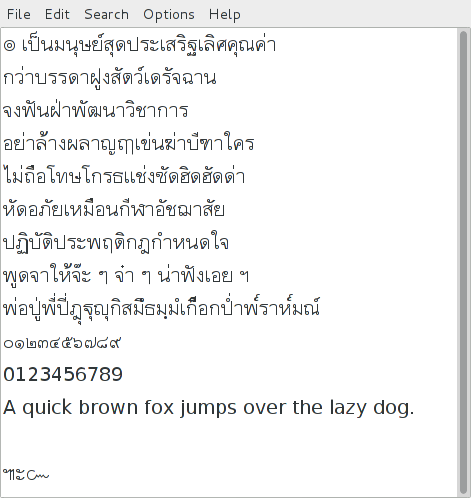
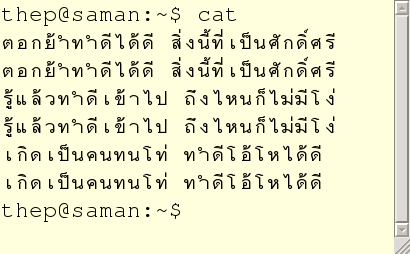
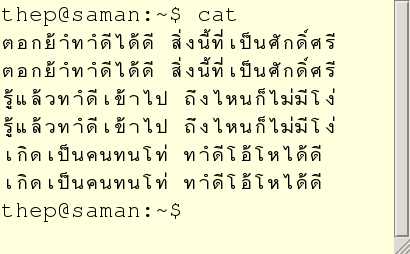
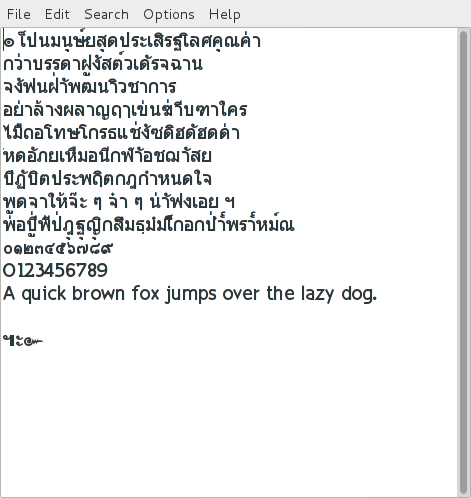
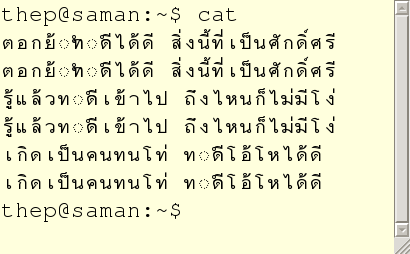
One major change in GNOME 3.6 is Pango s shaper engines replacement with HarfBuzz. Only language engines (for word break analysis, for example) are retained. So, I m checking how this affects Thai/Lao rendering and what to do next. Over all, Behdad has put a good effort to make it right. Most Uniscribe behaviors have been achieved for compatibility. He even cares enough to cover some widespread Thai fonts in which the language tag 'latn' is used instead of 'thai', as seen in Mozilla #719366. Unfortunately, this font set has been declared as standard fonts in official documents. The workaround seems inevitable. Supported Fonts In my experiments with some existing Thai OpenType fonts, the new Pango still renders well without regression. Loma font from fonts-tlwg (glyph positioning with GPOS, rearrangement with GSUB): Loma on new Pango Arundina Sans font from Fonts-SIPA-Arundina (positioning by substitution, only GSUB, no GPOS): Arundina Sans on new Pango But for legacy fonts without OpenType features, it renders badly: Non-OpenType on new Pango In addition, according to Behdad, PUA glyphs in legacy fonts are not supported yet. This means there will be regression on fonts designed for Windows XP or below. But modern fonts designed for Windows 7 should be fine. Changes on Bugs The engine replacement from scratch certainly affects existing bugs. Some become obsolete, some still remain. Here are the summary for Thai/Lao engine, as resolved upstream: Closed bugs: Questionable bugs: Remaining bugs:
Martin Pitt: PostgreSQL 9.2 RC1 available for testing

The unstoppable PostgreSQL team just announced the first release candidate of 9.2, with several bug fixes since the Beta 4. If you haven t tested 9.2 yet, now is the time! Remember that you can run a copy of your 8.4 or 9.2 cluster in parallel for testing with pg_upgradecluster. If you use Debian, 9.2rc1 will be available in experimental in a few hours. For Ubuntu, you can get packages for all supported releases from my PostgreSQL backports PPA as usual. Enjoy!

Bdale Garbee: FreedomBox 0.1

FreedomBox 0.1 Ian Sullivan posted a release announcement today regarding the first FreedomBox public release, which we're calling 0.1. This release is, frankly, long overdue. Getting here has been harder and taken much longer than any of us intended. Fortunately, now that we've reached this milestone, I believe that making regular progress towards the vision we have for a "1.0" release will get easier. FreedomBox is far from the only thing that I'll be working on after my upcoming early retirement from HP, but hopefully I will succeed in putting far more time towards the project soon than I have been able to in the past.

27 August 2012

Simon Josefsson: Using OATH Toolkit with Dropbox

Today there was an announcement that Dropbox supports two-factor authentication. On their page with detailed instructions there is (at the bottom) a link to the man page of the OATH Toolkit command line utility oathtool. OATH Toolkit is available in Ubuntu 12.04 and Debian Wheezy. (Note that the 1.10.4 version in Ubuntu does not support the base32 features.) There is not a lot of details in the documentation on Dropbox s site on how to use oathtool, but I have experimented a bit with the setup and I d like to share my findings. I assume you are somewhat familiar with the OATH Toolkit; if not I suggest reading my earlier introduction to OATH Toolkit. To use OATH Toolkit s command line utility to generate OTPs that are accepted by Dropbox, here is how you proceed. When you enable two-factor authentication on Dropbox s site, you must select Use a mobile app and on the next screen with the QR code image, click the enter your secret key manually link. You will then be presented with a code that looks like this: gr6d 5br7 25s6 vnck v4vl hlao re Now this code is actually space-delimitted base32 encoded data, without any padding. Since version 1.12.0, oathtool can read base32 encoded keys. However, parsing the raw string fails, so to make it work, you need to remove the spaces and add padding characters. I have yet to see any documentation on the Dropbox implementation, but I assume they always generate 16 binary octets that are base32 encoded into 26 characters like the codes that I have seen. The code is the cryptographic key used for the HMAC-SHA1 computation described in the RFC 6238 that specify OATH TOTP. If you study the base32 encoding you discover that 26 characters needs six pad characters. So converted into proper base32, the string would be gr6d5br725s6vnckv4vlhlaore======. Now generating OTPs are easy, see below.
jas@latte:~$ oathtool --verbose --totp --base32 "gr6d5br725s6vnckv4vlhlaore======"
Hex secret: 347c3e863fd765eab44aaf2ab3ac0e89
Base32 secret: GR6D5BR725S6VNCKV4VLHLAORE======
Digits: 6
Window size: 0
Step size (seconds): 30
Start time: 1970-01-01 00:00:00 UTC (0)
Current time: 2012-08-27 21:22:54 UTC (1346102574)
Counter: 0x2ACA9C5 (44870085)
125860
jas@latte:~$
Dropbox s implementation is robust in that it requests a valid OTP from me, generated using the secret they just displayed, before proceeding. This verifies that the user was able to import the key correctly, and that the users OATH TOTP implementation appears to work. If I type in the OTP generated from oathtool this way, it allowed me to enable two-factor authentication and I agreed. From that point, signing into the Dropbox service will require an OTP. I invoke the tool, using the same arguments as above, and the tool will use the current time to compute a fresh OTP. Reflecting on how things could work smoother, I suppose oathtool could be more permissive when it performs the base32 decoding so that the user doesn t have to fix the base32 spacing/padding manually. I ll consider this for future releases.

flattr this!

Andrew Cater: Ken Starks - immediate need for help is over for the moment - but

From Ken Starks, of Helios Project / Reglue

From the desk of just-so-you-know.....

Thomas Knight and I have agreed that the fund drive to aid in paying for necessary surgery for me should be halted. I will do a full blog about this entire effort this Monday but suffice it to say, you have donated more than enough to take care of my immediate needs and those down the road. Asking for anything more would be taking advantage of a loving and generous community. While it is far from adequate, the only thing I can offer you is my eternal thanks. It just seems so....small of a thing to give in return.

They will not stop the Indiegogo campaign until it reaches its time limit unfortunately so that will remain in effect for the next 30-some hours. Please do not donate anything further as I have more than enough to cover my expenses. I will explain more about that on my blog Monday.

If you helped spread the word about this campaign, please pass this posting along with the same intensity. I would deeply appreciate it.

See also now: update from Ken:

http://linuxlock.blogspot.co.uk/2012/08/of-roller-coasters-cancer-and-linux.html
==

Donations for Ken himself may be over: the work of Helios/Reglue still remains good, important and useful - the world benefits for investment in education. I would urge that this is still a worthwhile charity to contribute to as you get Linux into the hands of young people and the disadvantaged who can then USE it.

Next.

Previous.