Search Results: "tim"

2 December 2013

Tim Retout: How not to parse search queries

While I remember, I have uploaded the slides from my talk about Solr and Perl at the London Perl Workshop. This talk was inspired by having seen and contributed to at least five different sets of Solr search code at my current job, all of which (I now believe) were doing it wrong. I distilled this hard-won knowledge into a 20 minute talk, which - funny story - I actually delivered twice to work around a cock-up in the printed schedule. I don't believe any video was successfully taken, but I may be proved wrong later. I have also uploaded the Parse::Yapp grammar mentioned in the talk. In case you don't have time to read the slides, the right way to present Solr via Perl is to use the 'edismax' parser, and write your code a bit like this:
my $solr = WebService::Solr->new($url);
my $s = $query->param('q');
# WebService::Solr::Query objects are useful for
# 'fq' params, but avoid them for main 'q' param.
my $options =  
 fq => [WebService::Solr::Query->new(...)];
 ;
$solr->search($s, \%options);
The key thing here is not to put any complicated parsing code in between the user and Solr. Avoid Search::QueryParser at all costs.

Tim Retout: Questhub.io

At the London Perl Workshop last Saturday, one of the lightning talks was about Questhub.io, formerly known as "play-perl.org". It's social gamification for your task list, or something like that. Buzzword-tastic! But most importantly, there seems to be a nice community of programming types to procrastinate with you on your quests. This means I can finally get to work refuting lamby's prediction about gamification of Debian development! Tasks are referred to as "Quests", and are pursued in themed "Realms", for that World of Warcraft feeling. For example, there's a "Perl" realm, and a "Lisp" realm, and a "Haskell" realm, but also non-programming realms like "Fitness" and "Japanese". Of course, part of me now wants to construct a federated version which can be self-hosted. :) Another downside of questhub currently is the lack of SSL support - your session cookies are sent in plain text. I hope this changes soon.

Thorsten Glaser: Neo900

I ve did something I surely will (financially) regret, next year, and designated the Neo900 to be the successor to my PocketPC, due to the latter having only 64 MiB RAM and Geocaching applications being quite hungry. It s got a lovely hardware keyboard, a pen display like the PocketPC (as opposed to the wishy-washy displays that Android and iPhone have), not only GPS but also GLONASS, fully free software with mostly free firmware (I m okay with that, mostly), a Ctrl key (useful in ssh and locally and my text editor; ^I is Tab, so it s useful in shell, too), WLAN, UMTS (I don t think I need LTE and would rather it have the more RAM), USB host (OTG), and lots of other nice features. In short, it s a tinkerable device: one I can not only hack at, but also hack on. Since I use a dumbphone for mobile phone anyway (pro: separate battery from the toy PocketPC/Smartphone we re talking two+ weeks of battery time when using it here, and easier use and less bugs, and a reliable fallback when I tinker too much ), this is perfect for me. I m reposting this in the wlog mostly because it s an interesting technical and OSS project, and because if 1000 people want one it will get less expensive for all of us (while here shameless plug any sponsors willing to contribute some EUR so I don t ruin myself with this, in exchange for services of some kind?). I ll probably run Debian on it (unless it goes systemd), maybe in a chroot if the native OS has functionality needed that I can t simply put into packages; they say Maemo has much better power management, but considering most use will have GPS, GLONASS and backlight on, battery isn t going to last long anyway or maybe even native I ve been wanting to know what this freesmartphone stuff my m68k (Atari VM) buildd has been happily compiling, anyway and some sort of Geocaching application (ideally a cross between something online, CacheWolf and an offline OSM (with most of Europe, but uninteresting tags stripped) and possibly access to the GS Live API but nevertheless supporting TC, NC, OC, gpsgames too), and my usual mksh(1), GNU screen, jupp(1), lynx(1), ssh(1) toolchain.) Delivery is expected for mid to end of 2014, but once it s there I ll keep you informed

Roland Mas: Rsyncing a BackupPC storage pool, efficiently

BackupPC is a pretty good backup system. Its configuration is rather flexible, it has nice expiry policies, and it can store duplicated file contents only once (for files that are shared across hosts or don't change in time) within a compressed pool of data. However, it doesn't do much to help pushing the data to off-site storage, or at least not very efficiently. So if you have a BackupPC instance running on a Raspberry Pi or a plug computer at home, it's a bit tricky to protect your data against loss due to burglary or home fire. The obvious solution would be to rsync the storage pool to a remote site. However, the current pooling system relies heavily on hardlinks, and rsync is notoriously inefficient with those. In the home backup server scenario, this means that even if the computer is more powerful than a Pi and can handle the memory requirements of rsync, you'll often end up transferring way too much data. So, since the obvious solution doesn't work straight away, what do we do? Why, we fix it, of course. With a little look into the storage pool, we notice that the bulk of the data is stored in files with an abstract name (related to the contents) within a $prefix/pool directory; the files with concrete names looking much like their original are stored within $prefix/pc, and they're actually the same files because they're hardlinks. Knowing this (that rsync doesn't), we can make a smarter replication tool, by
  1. pushing only the pool with standard rsync;
  2. storing locally, and recreating remotely, the structure of hardlinks;
  3. pushing everything again with standard rsync.
Steps 1 and 3 are simple invocations of rsync -aH; step 2 can be implemented using the following two scripts. Run store-hardlinks.pl locally, push the links file, then run restore-hardlinks.pl on the remote server. This will ensure that files already present in the pool are also hardlinked in their natural location. store-hardlinks.pl:
#! /usr/bin/perl -w
use strict;
use Storable qw(nstore);
use File::Find;
use vars qw/$prefix $poolpath $pcpath %i2cpool %todo $store/;
$prefix = '/var/lib/backuppc';
$poolpath = '$prefix/cpool';
$pcpath = '$prefix/pc';
$store = '$prefix/links';
# for the convenience of &wanted calls, including -eval statements:
use vars qw/*name *dir *prune/;
*name   = *File::Find::name;
*dir    = *File::Find::dir;
*prune  = *File::Find::prune;
# Scan pool
File::Find::find( wanted => \&wanted_pool , $poolpath);
# Scan PC dirs
File::Find::find( wanted => \&wanted_pc , $pcpath);
nstore \%todo, $store;
exit;
sub wanted_pc  
    my ($dev,$ino,$mode,$nlink,$uid,$gid);
    (($dev,$ino,$mode,$nlink,$uid,$gid) = lstat($_)) &&
      -f _ &&
      ($nlink > 1) &&
      do  
      $name =~ s,$pcpath/,,;
      if (defined $i2cpool $ino )  
      $todo $name  = $i2cpool $ino ;


sub wanted_pool  
    my ($dev,$ino,$mode,$nlink,$uid,$gid);
    (($dev,$ino,$mode,$nlink,$uid,$gid) = lstat($_)) &&
      -f _ &&
      ($nlink > 1) &&
      do  
      $name =~ s,$poolpath/,,;
      $i2cpool $ino  = $name;
     
 
restore-hardlinks.pl:
#! /usr/bin/perl -w
use strict;
use Storable;
use File::Path qw/make_path/;
use vars qw/$prefix $poolpath $pcpath %todo $store/;
$prefix = '/srv/backuppc-mirror';
$poolpath = "$prefix/cpool";
$pcpath = "$prefix/pc";
$store = "$prefix/links";
%todo = % retrieve ($store) ;
my ($dev,$ino,$mode,$nlink,$uid,$gid);
foreach my $src (keys %todo)  
    my $inode;
    my $dest = $todo $src ;
    my $dpath = "$poolpath/$dest";
    my $spath = "$pcpath/$src";
    my $sdir = $spath;
    $sdir =~ s,/[^/]*?$,,;
    make_path ($sdir);
    next unless -e $dpath;
    if (! -e $spath)  
      link $dpath, $spath;
      next;
     
    (($dev,$ino,$mode,$nlink,$uid,$gid) = lstat($spath));
    $inode = $ino;
    (($dev,$ino,$mode,$nlink,$uid,$gid) = lstat($dpath));
    if ($ino != $inode)  
      unlink $spath;
      link $dpath, $spath;
     
 
The initial transfer can still take forever if the pool is large (and if you're pushing it through the small end of an ADSL link ), but at least the files are only transferred once. Note: This is only useful for current versions of BackupPC. Apparently BackupPC 4 will have a different pooling system without hardlinks, and the following hack will no longer be required. For now, though, here it is.

Ben Hutchings: Upgrading from Android 2.3 'Gingerbread' to 4.3 'Jelly Bean'

Replacing my phone My first Android phone was a ZTE Blade (sold as Orange San Francisco here in the UK). It originally shipped with Android 2.1 but was upgradable to 2.3 thanks to CyanogenMod (or other unofficial mods). However there's little sign of an upgrade to 4.x; the apps I want to use are pushing the limits of its CPU, RAM and internal storage; and I've never got very good at typing on a soft keyboard. So it seemed like time to get a newer phone with a hard keyboard (and still with a SD slot). After a little research with the CyanogenMod compatibility list and some time looking at reviews, I settled on the Samsung Galaxy S Relay 4G, which was exclusive to T-Mobile USA but is being resold through eBay. It shipped with Android 4.0 but I immediately installed CyanogenMod 10.2 (Android 4.3). This was a bit of an adventure as I bought the Blade with CM already installed and wasn't familiar with the multiple steps that were necessary. Copying my data The last step, and the real subject of this entry, was to move my data across. Much of this was on a SD card which I could simply plug into the Relay. The internal files had to be backed up onto this card and then restored, using the recovery environment (ClockworkMod) on each phone. After rebooting the Relay into the full Android system, my apps and settings were mostly present but I was immediately confronted with a series of error dialogs reporting that 'Unfortunately, Dialler has stopped' - and the same for 'Clock' and 'the process android.process.acore' (whatever that is). What went wrong There are thankfully more detailed error logs in the filesystem, under /data/system/dropbox (this is for logging at the Java level; if a process is terminated by a fatal signal it's logged to /data/tombstones). There are several ways to get at them, but I used recovery mode and adb to get a root shell where I could easily read and write files as necessary. The Contacts (aka People) database upgrade fails with an SQLiteException, apparently because it doesn't account for upgrading from the schema used in 2.3:
Process: android.process.acore
Flags: 0x883e45
Package: com.android.providers.applications v18 (4.3.1-f963020e38)
Package: com.android.providers.contacts v18 (4.3.1-f963020e38)
Package: com.android.providers.userdictionary v18 (4.3.1-f963020e38)
Build: samsung/apexqtmo/apexqtmo:4.1.2/JZO54K/T699UVBMC5:user/release-keys
android.database.sqlite.SQLiteException: no such column: phonebook_label (code 1): , while compiling: UPDATE raw_contacts SET display_name_source=?,display_name=?,display_name_alt=?,phonetic_name=?,phonetic_name_style=?,sort_key=?,phonebook_label=?,phonebook_bucket=?,sort_key_alt=?,phonebook_label_alt=?,phonebook_bucket_alt=? WHERE _id=?
...
        at com.android.providers.contacts.ContactsDatabaseHelper.updateRawContactDisplayName(ContactsDatabaseHelper.java:5344)
        at com.android.providers.contacts.ContactsDatabaseHelper.upgradeToVersion504(ContactsDatabaseHelper.java:3580)
        at com.android.providers.contacts.ContactsDatabaseHelper.onUpgrade(ContactsDatabaseHelper.java:2261)
...
Clock fails somewhat similarly though it apparently didn't try to upgrade:
Process: com.android.deskclock
Flags: 0xc8be45
Package: com.android.deskclock v203 (2.0.3)
Build: samsung/apexqtmo/apexqtmo:4.1.2/JZO54K/T699UVBMC5:user/release-keys
android.database.sqlite.SQLiteException: no such column: incvol (code 1): , while compiling: SELECT _id, hour, minutes, daysofweek, alarmtime, enabled, vibrate, message, alert, incvol, profile FROM alarms WHERE (enabled=1)
...
        at com.android.deskclock.AlarmProvider.query(AlarmProvider.java:73)
        at android.content.ContentProvider.query(ContentProvider.java:744)
        at android.content.ContentProvider$Transport.query(ContentProvider.java:199)
        at android.content.ContentResolver.query(ContentResolver.java:414)
        at android.content.ContentResolver.query(ContentResolver.java:357)
        at com.android.deskclock.Alarms.getFilteredAlarmsCursor(Alarms.java:165)
        at com.android.deskclock.Alarms.calculateNextAlert(Alarms.java:344)
        at com.android.deskclock.Alarms.setNextAlert(Alarms.java:417)
        at com.android.deskclock.Alarms.saveSnoozeAlert(Alarms.java:510)
        at com.android.deskclock.AlarmInitReceiver$1.run(AlarmInitReceiver.java:49)
...
The media player fails with a NullPointerException:
Process: com.andrew.apollo:main
Flags: 0x98be65
Package: com.andrew.apollo v2 (1.1)
Build: samsung/apexqtmo/apexqtmo:4.1.2/JZO54K/T699UVBMC5:user/release-keys
java.lang.NullPointerException
        at com.andrew.apollo.MusicPlaybackService.stop(MusicPlaybackService.java:878)
        at com.andrew.apollo.MusicPlaybackService.openCurrentAndMaybeNext(MusicPlaybackService.java:1048)
        at com.andrew.apollo.MusicPlaybackService.openCurrentAndNext(MusicPlaybackService.java:1031)
        at com.andrew.apollo.MusicPlaybackService.access$1500(MusicPlaybackService.java:74)
        at com.andrew.apollo.MusicPlaybackService$MusicPlayerHandler.handleMessage(MusicPlaybackService.java:2337)
        at android.os.Handler.dispatchMessage(Handler.java:99)
        at android.os.Looper.loop(Looper.java:137)
        at android.os.HandlerThread.run(HandlerThread.java:61)
Fixing the problem Maybe I could have worked out how to upgrade the relevant databases myself, but I went for simpler solutions. The clock settings are easy to re-enter and most of the media player state is regenerated by scanning files on the SD card. So I just deleted those on the Relay:
  rm -rf /data/data/com.android.deskclock
  rm -rf /data/data/com.android.providers.media
The contacts were what I really cared about, and there are actually specific menu items in Contacts to export and import those (using VCF format), side-stepping the database upgrade. So I did:
  1. Insert SD card in Blade
  2. Open Contacts and export to VCF (I forget where this is in the menus but it was easy to find)
  3. Remove broken Contacts database on Relay:
    rm -rf /data/data/com.android.providers.contacts
  4. Insert SD card in Relay
  5. Move exported contacts to internal storage:
    mv /storage/sdcard1/*.vcf /storage/emulated/legacy
  6. Open People and tap the menu key, 'Import/export', 'Import from storage', then the filename
This may not include all data, and in particular it doesn't seem to include attached photos. But that was good enough for me.

1 December 2013

Raphaël Hertzog: My Free Software Activities in November 2013

This is my monthly summary of my free software related activities. If you re among the people who made a donation to support my work (44.52 , thanks everybody!), then you can learn how I spent your money. Otherwise it s just an interesting status update on my various projects. The Debian Administrator s Handbook Wheezy update completed. Roland and I completed the update of the Debian Administrator s Handbook for Debian 7 Wheezy. We still have some proofreading work to do but you can already enjoy the result here: http://debian-handbook.info/browse/wheezy/ Feel free to report back any problem that you discover. You can also submit us patches ready to apply if you want to go one step further. Publican contributions. The book is generated with publican and I maintain its Debian package. This month I got a release critical bug because it stopped working it turns out that the problem lied in libxml-treebuilder-perl and I thus reassigned #728885 while providing a tentative patch to the upstream author. After a few days without action from the pkg-perl team, and after having received a FTBFS bug on debian-handbook (of course publican was broken in unstable!), I prepared a fixed package myself and I uploaded it (I m still part of the pkg-perl team although I m inactive). Since I used publican heavily this month, I filed two tickets in its bugzilla. I requested a new feature in #1034836 (the possibility to keep around the former string for fuzzy strings to update), and I reported a problem with the handling of \n in PO files in #1036150. Debian France Galette update. I updated the galette package and its paypal plugin, and I deployed those on france.debian.net. It had some fixes for the reminder mails sent to members. Bylaws update. I also resumed my work on preparing new bylaws for Debian France. Sylvestre Ledru came up with a draft (with the help of a lawyer) a few months ago and I m reviewing/improving them now. The main goal is to clarify that Debian France is meant to be a Trusted Organization for the Debian project. Debian France Shop. We had the idea since a few months already but Sylvestre did the leg work to open a Debian France shop with the help of EnVenteLibre. I asked our members to prepare some CSS that better match the Debian colors and this should be fixed in a few days. The first goodies will also start to appear shortly, just in time for Christmas! Misc Debian work Distro Tracker. In the continuation of the Google Summer of Code, I asked the DSA team to setup a new virtual machine to host tracker.debian.org, an instance of Distro Tracker, the rewritten Package Tracking System. They have done their part of the job (except the mail setup), it s now waiting on me to find some time to complete some cleanups and deploy the thing. WordPress. I packaged wordpress 3.7.1 and sent a call for help on debian-mentors. I got 3 replies, I gave them some initial direction but I haven t heard back anything since. WordPress 3.8 is expected in a few days, hopefully one of the new volunteers will take care of preparing the next update. Dpkg regressions. I haven t done anything for multiple months but at least I keep running the git version of dpkg and I detected two regressions. Good to have them squashed before the upcoming 1.17.2 upload to unstable. PTS fix. I fixed some warnings that the PTS code started generating since the upgrade of its host to wheezy. They were generating some annoying backscatter mails to users of the pts@qa.debian.org bot. Ruby security update. I helped the ruby team to prepare the required security updates of ruby1.8 and ruby1.9.1 (see #730178 and #730189). This work was sponsored by Kali/Offensive Security. Smartcard setup. I bought 2 OpenPGP smartcards with a reader and I moved all my private keys on those devices (one card with the master key for signature/certification to be kept at home, one card for daily/mobile usage with the subkeys for encryption/signature/authentication). My laptop s harddrive doesn t contain any private key anymore. I have kept the required offline backup in a safe place, but in the end, my private keys are much harder to steal. I should write down my findings in another article Thanks See you next month for a new summary of my activities.

2 comments Liked this article? Click here. My blog is Flattr-enabled.

30 November 2013

Gunnar Wolf: On errors in exams - Short rant

Blogging from a phone... first time ever. I don't want to forget some specifics for this :) I have just completed an exam to try to enter a postgraduate program (I'll talk more about it once it becomes real ). The exam is administered by CENEVAL, the same evaluation agency Where I presented my graduation equivalency exam some years ago - Only this exam is for all of the postgraduate studies on many national universities and is thus basically just a psychometric test. The exam had 162 questions, all to be filled in a optical reader sheet, on five subjects: mathematical reasoning, Spanish grammar and comprehension, Project management, Computers and technology, And English reading and understanding. It was all in all a fun exam to take, mostly due to the math reasoning part. But... on the Subject I Know I am an expert, I have to complain (and intend to find a easy to do so formally). First, I spotted two absolute mistakes (and answered based on What I knew others would, but knowing the answer is wrong technically). One was a subtlety, on how and why have hard drives should be defragmented (and part of my quip is that it's an obsolete habit, but besides, the answers were all erroneous), but a second one was... just wrong. It asked on what should not be part of an "Internet link" (can only guess they meant An URL). The 4 options were valid parts of a URL - including one very seldom used by most people, but very often by many of us: the @ sign. Anyway, answered it, but my other main gripe is that most of the section was in specific use of Office software. Not only In Office-like, which would be bad enough to begin with, but on specific ways of using Mainly Excel And PowerPoint. Syntax issues, or the name of the menu under which to look for specific functions.

Anyway, I will wait the stipulated 10 days for the exam to be rated, but will anyway look die a way to contact the very opaque and secretive CENEVAL. Not to demand to be better treated, but to try to correct those known mistakes and errors.

Lars Wirzenius: Obnam 1.6.1 (backup software) and larch 1.20131130 (B-tree) releases: serious bug fixes

Backups are fun and exciting! Restores are exciting, in a terrifying and stressful way. Fixing serious bugs is gratifying, in a depressing way. I am glad to announce two software releases: Obnam version 1.6.1 and larch version 1.20131130. Obnam is my backup application, larch is a Python copy-on-write B-tree implementation that Obnam uses. I've uploaded the new versions to Debian unstable and to my own apt repository at [code.liw.fi] (also for wheezy). (I don't have the energy to upload to Debian backports: help is welcome there.) These are mainly bug fix releases, and minor improvements. The larch release fixes serious problems, and everyone should be upgrading. NEWS for larch: NEWS for Obnam (combining versions 1.6 and 1.6.1, both released today): Bug fixes:

Dirk Eddelbuettel: RcppCNPy 0.2.2

Right on the heels of release 0.2.1 of RcppCNPy, a new version 0.2.2 is now on CRAN. RcppCNPy uses the CNPY library by Carl Rogers to provide R with easy read and write access to NumPy files. The reason for the new version that I had experimented with a different way to test endianness (as needed for the NumPy file headers) but accidentally sent an interim tarball to CRAN which still wanted to include endian.h promptly breaking Windows builds. So now we do something even simpler and just rely on the (even more complete) test for endianness when R is built, which prevents all sorts of complications for us and builds everywhere (with thanks to Brian Ripley for the suggestion). While we were at it, we also added a new unit test. Full changes are listed below.
Changes in version 0.2.2 (2013-11-29)
  • Switched to using the result from the compile-time configuration for R to determine big or little endian (as needed for the NPy headers)
  • Added a new test (and test validation result file) for a complete save-reload cycle and comparison
CRANberries also provides a diffstat report for 0.2.2 relative to 0.2.1. As always, feedback is welcome and the rcpp-devel mailing list off the R-Forge page for Rcpp is the best place to start a discussion.

This post by Dirk Eddelbuettel originated on his Thinking inside the box blog. Please report excessive re-aggregation in third-party for-profit settings.

29 November 2013

Philipp Kern: On PDiffs Usefulness for Stable

Axel just said that PDiffs are really useful for stable because it changes seldom. The truth is that there are no PDiffs for stable. I consider this a bug because you need to download a huge blob on every point release even though only few stanzas changed.

The real problem of PDiffs is the count that needs to be applied. We run "dinstall" much more often now than we used to and we cannot currently skip diffs in the middle when looking at a dak-maintained repository. It would be more useful if you could fetch a single diff from some revision to the current state and apply this instead of those (download, apply, hash check)+ cycles. 56 available index diffs are also not particularly helpful in this regard. They cover 14 days with four dinstalls each, but it takes a very long time to apply them, even on modern machines.

I know that there was ongoing work improving PDiffs that wanted to use git to generate the intermediate diffs. The current algorithm used in dak does not require old versions except one to be kept, but keeping everything is the far other end of the spectrum where you have a git repository that potentially gets huge unless you rewrite it. It should be possible to just implement a rolling ring buffer of Packages files to diff against, reprepro already generates the PDiffs in the right way, the Index format is flexible enough to support this. So someone would just need to make that bit of work in dak.

Tanguy Ortolo: Mutt: encrypt all messages sent to known PGP users

GnuPG logo This is one thing I have wanted to do for a long time: configure Mutt to encrypt all messages sent to addresses for which I have a valid public key. Well, here is an awk-based script to generate that configuration. (Yes, I know, a similar script was already written. But I did not see it at first, and I find mine more readable. :-) )Code
#! /bin/sh
set -e
# Specific hooks set global configuration values for Mutt, which are not
# reset for new messages, so a default hook is needed to set the default
# value (do not try encrypting all messages).
printf "send-hook . unset crypt_autoencrypt\n\n"
cat <<EOF
# This group contains all known PGP users, and can be used to define
# hooks, for instance to encrypt all messages sent to PGP users, or to
# add a specific signature to promote PGP usage to non-PGP users.
EOF
# Generate a machine-readable list of known keys
gpg2 --batch --with-colons --list-keys \
      awk -- '
        BEGIN  
            FS = ":"
            # A flag that indicates whether or not we are in a public
            # key with usable encryption capability
            usable = 0
         
        # Detect beginning of public keys with usable encryption
        # capability
        $1 == "pub" && $12 ~ /E/   usable = 1  
        # Detect beginning of public keys without usable encryption
        # capability
        $1 == "pub" && $12 !~ /E/   usable = 0  
        
        # Only consider user IDs from public keys with usable encryption
        # capability and with regular, marginal, full or ultimate
        # validity (n, m, f or u in the second field)
        usable && $1 == "uid" && $2 ~ /[nmfu]/ && $10 ~ /@/  
            # Remove everything before and after the email address in
            # brackets
            sub(/^[^<]*</, "", $10)
            sub(/>[^>]*$/, "", $10)
            # Finally print the email address
            print $10
         ' \
      sort -u \
       
        # Group addresses by ten to reduce the number of Mutt commands
        finished=0
        while [ $finished -ne 1 ]
        do
            addresses=""
            for i in 0 1 2 3 4 5 6 7 8 9
            do
                if read address
                then
                    addresses="$addresses $address"
                else
                    finished=1
                    break
                fi
            done
            # Add PGP users' addresses to a pgp-users group
            printf "group -group pgp-users -addr %s\n" \
                "$addresses"
        done
     
# Build a hook to try encrypting messages sent to PGP users
printf "\n# Encrypt all messages sent to known PGP users\n"
printf "send-hook \"%%C pgp-users\" set crypt_autoencrypt\n" \
printf "\n# Add a specific signature to promote PGP usage to non-PGP users\n"
printf "#send-hook \"!%%C pgp-users\" set signature=~/.signature.use-pgp\n"
Usage Script usage This script generates uses GnuPG to print a list of all known keys, takes only valid ones, and uses them to build a series of configuration instructions for Mutt, that define hooks that are triggered when you write a message to them. This configuration has to be written to your Mutt configuration file:
$ bin/gen-pgp-hooks.sh >> ~/.muttrc
Or better (far better, in fact), to a dedicated configuration file you will refer to in your main one:
$ bin/gen-pgp-hooks.sh > ~/.muttrc.crypt-recipients
$ echo "source ~/.muttrc.crypt-recipients" >> ~/.muttrc
You may want to adapt this script to it directly writes to that file rather than having to redirect it. Also, remember to run it when you refresh your public keyring or add new keys to it. Mutt usage These hooks will make Mutt try to encrypt all messages you send to at least one known PGP user. That means it will try it even for messages you send to a PGP user and to non-PGP ones. In these cases, it will not find keys for all the recipient, and ask you which key to use; as you have none, you will have to quit that prompt by typing ^G, and manually disable encryption by accessing the PGP options menu with the key p.

Keith Packard: Black Friday 2013

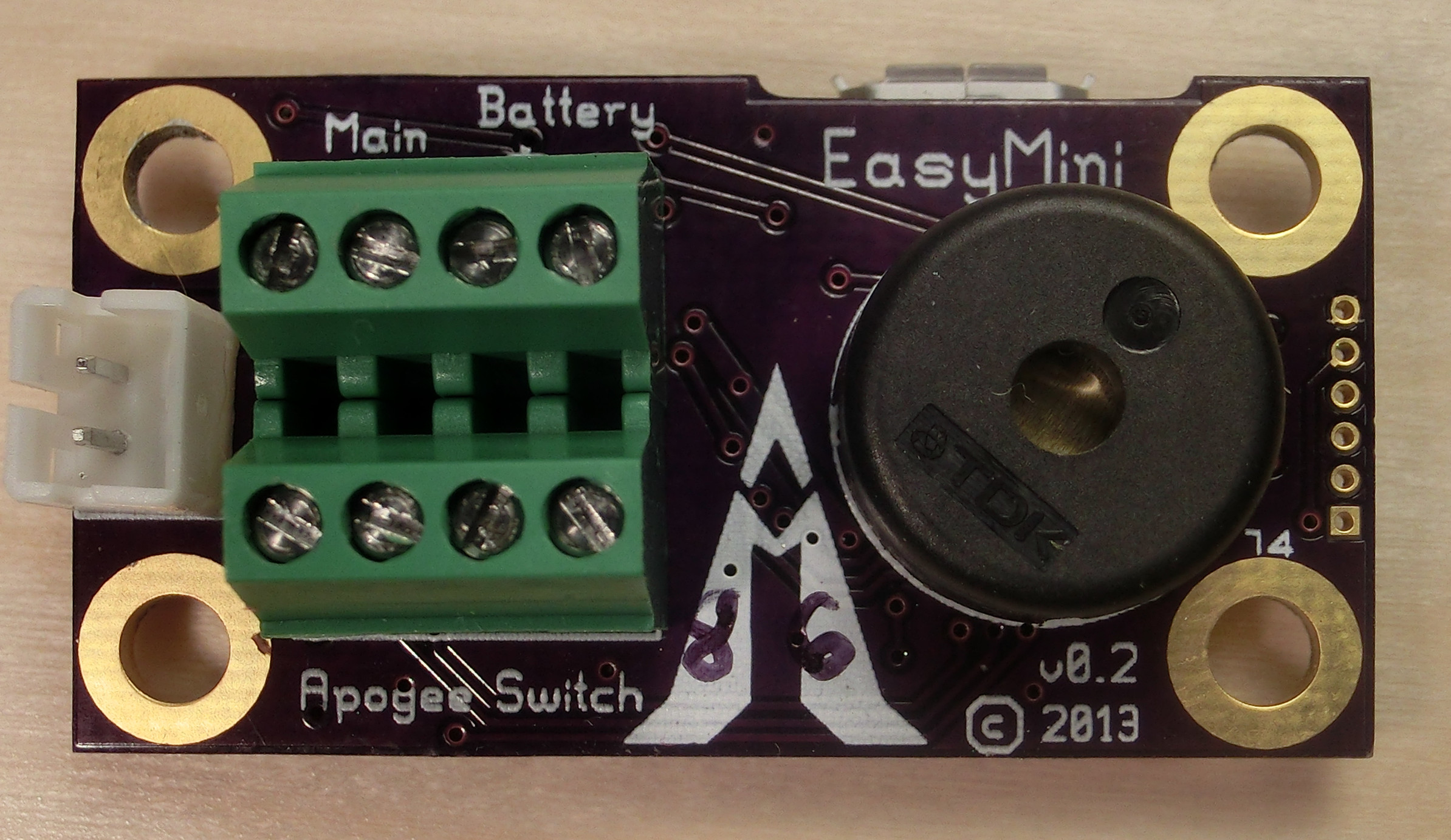
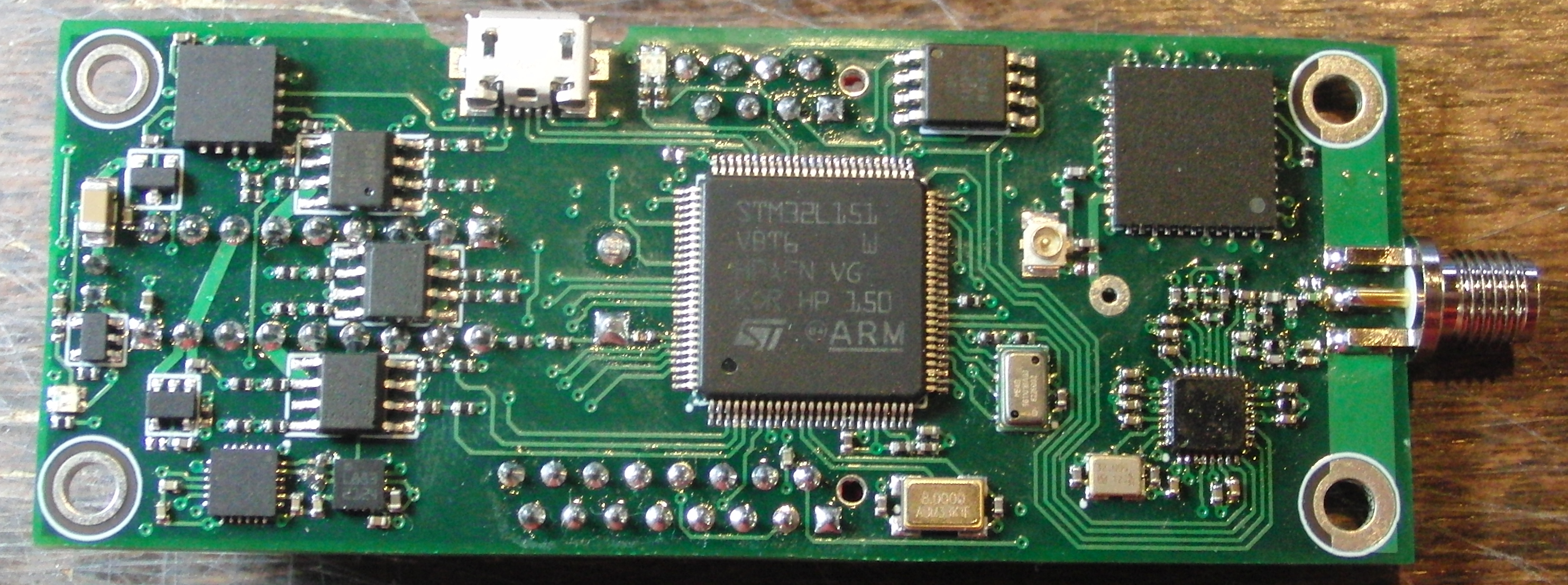
Back on Black (Friday) Event Altus Metrum is pleased to announce our Back on Black (Friday) event! For the first time since the Black Forest fire in June, we re re-opening our web store this weekend with a host of new and classic Altus Metrum products, including a special pre-order discount on our latest-and-greatest flight computer design, TeleMega. This weekend only, Friday, 29 November 2013 through Monday, 2 December, 2013, the first 40 TeleMega direct orders placed through our web store will receive a special $50 pre-order discount (regular $400, now only $350!). TeleMega is an advanced flight computer with 9-axis IMU, 6 pyro channels, uBlox Max 7Q GPS and 40mW telemetry system. We designed TeleMega to be the ideal flight computer for sustainers and other complex projects. TeleMega production is currently in process, and we expect to be ready to ship in mid-December. Pre-order now and we won t charge you until we ship. Learn more about TeleMega at: http://altusmetrum.org/TeleMega/ We are also pleased to announce that TeleBT is back in stock. Priced at $150, TeleBT is our latest ground station that connects to your laptop over USB or your Android device over BlueTooth. Learn more about TeleBT at http://altusmetrum.org/TeleBT/ Another new product we re thrilled to announce is EasyMini! Priced at only $80, EasyMini is a two-channel flight computer with built-in data logging and USB data download. Like our more advanced flight computers, EasyMini is loaded with sophisticated electronics and firmware, designed to be very simple to use yet capable enough for high performance airframes. Perfect as a first flight computer, EasyMini is also great as a backup deployment controller in complext projects. Learn more about EasyMini at: http://altusmetrum.org/EasyMini/ Also in stock for immediate shipment is MicroPeak, our 1.9 gram recording altimeter available for $50. The MicroPeak USB adapter, also $50, has been improved to make data downloading a snap. Read more about these at: http://altusmetrum.org/MicroPeak http://altusmetrum.org/MicroPeakUSB You can learn more about these and all our other Altus Metrum products at http://altusmetrum.org. The special discount on TeleMega pre-orders is available only on orders placed directly through Bdale s web store at http://shop.gag.com Thank you all for your support of Altus Metrum during 2013. It s been a rough year, but we re having a great time updating our existing products and designing new stuff! We look forward to returning products like TeleMetrum and TeleMini to the market soon, and plan to introduce even more new products soon.
Axel Beckert: PDiffs are still useful

probably just not as default. I do agree with Richi and with Michael that disabling PDiffs by default gives the big majority of Debian Testing or Unstable users a speedier package list update. I m though not sure, if disabling PDiffs by default would Additionally I want to remind you that PDiffs per se are nothing bad and should be continued to be supported: So yes, disabling PDiffs by default is probably ok, but the feature must be kept available for those who haven t 100 MBit/s fibre connection into their homes or are sitting just one hop away from the next Debian mirror (like me at work :-). Oh, and btw., for the very same reasons I m also a big fan of debdelta which is approximately the same as PDiffs, just not for package lists but for binary packages. Using debdelta I was able to speed up my download rates over EDGE to up to virtual 100 kB/s, i.e. by factor four (depending on the packages). Just imagine a LibreOffice minor update at 15 kB/s average download rate. ;-) And all these experiences were not made with a high-performance CPU but with the approximately 5 year old Intel Atom processor of my ASUS EeePC 900A. So I used PDiffs and debdelta even despite having a slight performance penalty on applying the diffs and deltas.

28 November 2013

Craig Small: XBMC with MythTv

I have had MythTV running on my server for quite some time. Once I got past the weird problems you often have with the local ABC channel, it has worked very well. One tip, put the recordings into their own partition. MythTV will happily fill it and deleting files only marks them for deletion. This makes perfect sense when it has its own partition but is annoying otherwise. Until recently, the frontend on the television in the living room was a DVD player that spoke DLNA. This worked ok, but was very basic. The recordings were just a list with no graphics or details. Something better had to go here and it has; XBMC. A small (size of a paperback) PC later and we have XBMC running and doesn t it look pretty! The cute thing was it merged my DVD images and my recordings into one, so it didn t matter where the movie came from, it looks the same. It even understands MythTV advertising marks and skips them, all is good. Except, no sound. This is where a combination of my Google skills and XBMC s documentation failed. The documentation either says switch to HDMI output or go through a very long and involved process to get the sound card working. The tests on the command line failed and I thought I was going to be in for that long and involved process fixing alsa. Then in another part of the menus I saw you had Basic, Advanced, Expert levels and wondered what that did? It gave me more things to tweak in the menus. Perhaps that might fix my HDMI sound problem? Going into the System setup and then audio and then switching to a higher level of menu (it s on the left) suddenly I have a screen and a half of options and a few seconds later, sound! So if you are searching for NVIDIA and HDMI and sound, first turn on the advanced menu items and try setting that, it might be all you need (despite what Google and documentation says). One other thing, the C or I button on a remote could be called Guide . It is on mine. Also, SMB shares give a much better result than DLNA ones because SMB all the images and info are done on XBMC and it doesn t do the same for DLNA.

Debian Med: Bits from Debian Med team (by Andreas Tille)

Some of these bits are a bit outdated but there is no point in hiding this information just because it is old. FOSDEM talkAndreas Tille had a talk at FOSDEM which is also Video recorded. A quite similar but updated talk was held at DebConf 13 (see below). Jabber interview by reporter from IndiaThere was an interesting interview between Rajeev Nair and Andreas Tille at So, 17.02.2013 Rajeev Nair is Business head of an health care journal in India held via jabber. Since this might serve as some nice FAQ about Debian Med here is a complete log of this interview (permission to publish it was granted). Article about Debian MedAs a consequence of the interview above the Debian Med team has assembled an article which was originally intended to be published in the Health Cafe journal but somehow this never happened. So we ended up with a nice article targeting at interested readers about Free Software in medicine with not necessarily informatics background. Since the article is considered to be of good quality and has consumed some time of several team members we are seeking for ideas for relevant places where to publish it. It is available as PDFas well as in SVN. Yearly sprint of Debian Med teamThis year we had our third sprint of the Debian Med team and all participants consider it a great success again. The sprint was in end of February and the individual reports are linked from the according wiki page. Since Andreas Tille was able to prove the nice effect of having face to face meetings in Debian teams in the team metrics graphs presented in his talks at DebConf (see below) we will keep on with this good tradition. The next sprint is scheduled for Friday 31st January until Sunday 2nd February in Stonehaven near Aberdeen. If you are interested to meet the people behind Debian Med and want to join us in developing packages which are helpful in health care and bioinformatics you are invited to join us. DebConf 13 in VaumarcusAndreas Tille had two talks with specific influence to Debian Med development(Debian Med as a success story for other Blends, How to attract new developers for your team (MoM, SoB). For those who want to read a full (and lengthy) report about DebConf 13 by Andreas Tille this is online in this blog article. Codefest of the Open Bioinformatics FoundationIvo Maintz and Steffen M ller organised the Codefest of the Open Bioinformatics Foundation in Berlin. About 40 contributors from all over the world attended, connecting the Debian community strongly with upstream. The event triggered a joint paper of participants to Sprints, Codefests and Hackathons alike, presented at the Nettab conference on Semantic, Social, and Mobile Applications for Bioinformatics and Biomedical Laboratories in Venice. Reupload unattended packagesAndreas Tille has mentored the GSoC student Emmanouil Kiagias and as a byproduct some Blends metadata were now kept in UDD. This has inspired some new tools and one of this was an UDD query to return all packages in the interest of the Blend ordered by date when they were uploaded. It has shown that there were packages hanging around in the package pool since five years. So some effort was done to check those packages which were not necessarily "buggy" according to BTS entries and so we were able to fix the following issues in about 20-30 packages: Since it was impressive how many things that deserve fixing are hidden in such long unattended packages it is recommended also to other teams to spend some time into these. The UDD query can be easily tweaked for a team maintainer address. Debian Med Bug Squashing Advent Calendar 2013The Debian Med team will again do the Bug Squashing Advent Calendar. Feel free to join us in our bug squashing effort where we close bugs while other people are opening doors. :-) Kind regards and see you at Debian Med sprint
Andreas.

27 November 2013

Steinar H. Gunderson: Stockfish

The open-source chess program Stockfish recently climbed to the top of the TCEC rating lists. Even though it does not seem likely to win the actual TCEC tournament (it is 15.5 11.5 down in the 48-game superfinal against Komodo, a closed-source commercial program, after winning 4, losing 8 and drawing 15), this is a tremendeous achievement. This is not only because it is highly unusual that the strongest chess program is open-source (it's naturally hard to keep a competitive edge when everybody can see your secrets!), but also because it is a mere 9000 lines of C++ code. (This is without a GUI; it interfaces through a standardized protocol known as UCI.) In comparison, Crafty, a far weaker open-source program, is about four times that, GNU Chess is above 40000, and I seem to recall that the Deep Blue program was something like 65000 lines (in addition to, of course, all the code for the ASIC chess chips it contained, and stood for the majority of its chess strength!). So, the development team is really to be commended. It should also be said that TCEC is testing the latest beta versions of most of these engines and while Stockfish is developed in the open, on GitHub, the latest versions of e.g. Komodo and Houdini are private. (This is probably one of the reasons why Stockfish is slightly lower on e.g. the CCRL list, which also computes chess program rating lists by playing games between them.) Now, why does anyone care? Only a very small handful of players would be able to score even a draw against any of these programs in a 10-game match, so does it really matter which one we choose? Or is this some obscure pissing contest? The answer, of course, is that these engines are not primarily useful for competitive play; they are useful for analysis. Almost any player, right down from beginners to the very top players, can benefit from having someone stronger than them look at their games (or others' games!) and say where things went wrong. (Somehow analyzing losses always seem more instructive than analyzing wins. Nobody ever got better by winning, as the saying goes.) And the better a program is at playing chess, the more likely is its analysis to be correct. Of course, for the weaker players, a chess coach is likely to produce much more understandable guidance ( this creates a weak square on c7 is much more palatable than after these 18 moves here, white is 0.48 pawns stronger than you, so this was a bad move , and engines produce the latter sort of output), but they are always available, incredibly strong, and cost much less than a coach. :-) They also add a lot to the otherwise quite hard-to-comprehend activity of watching high-level human players; while the computers do not understand every kind of position equally well, they at least provide some sort of objective verdict on which player has the upper hand, something which can be really hard to discern unless you have very strong players around for commentary. So, in trying to improve my skills a bit, I've been analyzing my games with engines for a while, and recently I've switched from Rybka to Stockfish. (Rybka, a closed-source program, used to be the clear leader of the pack, but after a huge amount of drama involving accusations of who has copied code from who, it seems no longer to be actively developed, and Stockfish is now somewhat stronger.) This, unfortunately, brings me to the things I don't like too much about Stockfish; it seems to behave more erratically than Rybka did in interactive analysis mode. Its score jumps a lot more around when I move something (worse at remember the analysis from the previous position?), and sometimes, it changes its mind a lot when I move back and forth between moves maybe the huge selectivity that makes chess engines so strong these days also make them behave less usefully when only looking at a move for a few seconds. So, even though Stockfish is a fantastic chess engine, and will only get better in the future, maybe I'll go back to Rybka at some point. But then again, maybe I should then check out Komodo or any of the other engines out there or maybe talk to someone who actually knows chess, that would help a lot, too =)

Timo Jyrinki: Workaround for setting Full RGB when Intel driver's Automatic setting does not work

Background I upgraded from Linux 3.8 to 3.11 among with newer Mesa, X.Org and Intel driver recently and I found a small workaround was needed because of upstream changes.

The upstream change was the Add "Automatic" mode for "Broadcast RGB" property, and defaulting to the Automatic. This is a sensible default, since many (most?) TVs default to the more limited 16-235, and continuing to default to Full from the driver side would mean wrong colors on the TV. I've set my screen to support the full 0-255 range available to not cut the amount of available shades of colors down.

Unfortunately it seems the Automatic setting does not work for my HDMI input, ie blacks become grey since the driver still outputs the more limited range. Maybe there could be something to improve on the driver side, but I'd guess it's more about my 2008 Sony TV actually having a mode that the standard suggests limited range for. I remember the TV did default to limited range, so maybe the EDID data from TV does not change when setting the RGB range to Full.

I hope the Automatic setting works to offer full range on newer screens and the modes they have, but that's probably up to the manufacturers and standards.

Below is an illustration of the correct setting on my Haswell CPU. When the Broadcast RGB is left to its default Automatic setting, the above image is displayed. When set to Full, the image below with deeper blacks is seen instead. I used manual settings on my camera so it's the same exposure.


Workaround For me the workaround has evolved to the following so far. Create a /etc/X11/Xsession.d/95fullrgb file:

if [ "$(/usr/bin/xrandr -q --prop   grep 'Broadcast RGB: Full'   wc -l)" = "0" ] ; then
/usr/bin/xrandr --output HDMI3 --set "Broadcast RGB" "Full"
fi
And since I'm using lightdm, adding the following to /etc/lightdm/lightdm.conf means the flicker only happens once during bootup:

display-setup-script=/etc/X11/Xsession.d/95fullrgb

Important: when using the LightDM setting, enable executable bits (chmod +x) to /etc/X11/Xsession.d/95fullrgb for it to work. Obviously also check your output, for me it was HDMI3.

If there is no situation where it'd set back to "Limited 16:235" setting on its own, the display manager script should be enough and having it in /etc/X11/Xsession.d is redundant and slows login time down. I think for me it maybe went from 2 seconds to 3 seconds since executing xrandr query is not cheap.
Misc Note that unrelated to Full range usage, the Limited range at the moment behaves incorrectly on Haswell until the patch in bug #71769 is accepted. That means, the blacks are grey in Limited mode even if the screen is also set to Limited.

I'd prefer there would be a kernel parameter for the Broadcast RGB setting, although my Haswell machine does boot so fast I don't get to see too many seconds of wrong colors...

26 November 2013

Daniel Pocock: Real-time streaming market data with free software

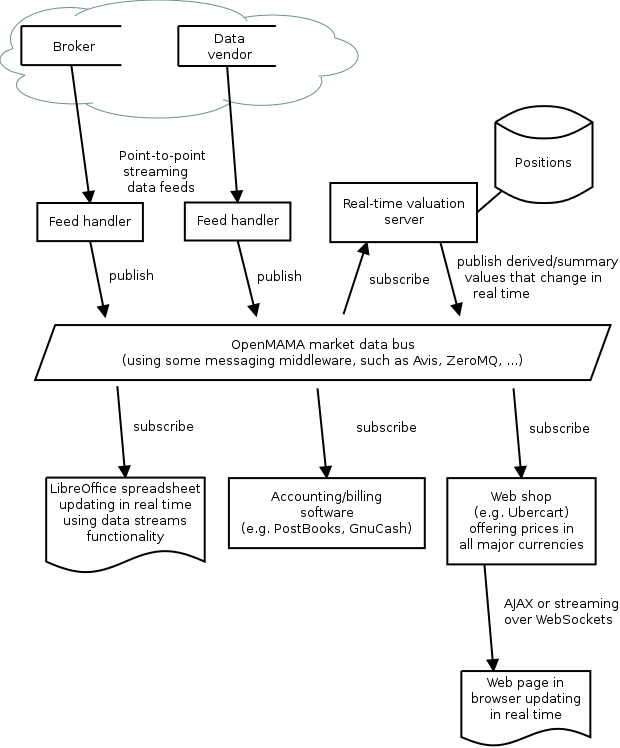
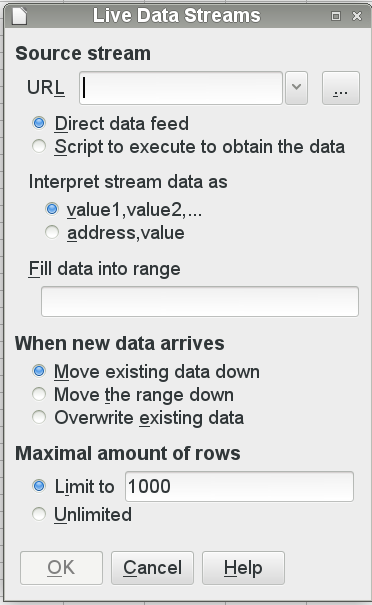
Here is an overview of the real-time market data architecture based on OpenMAMA: All these components may be running on a single host or they may be distributed across different servers and workstations in a LAN. The OpenMAMA market data bus ties them together. External data sources These are external sources of data. These could be currency trading firms, stock brokers, bullion dealers or even Bitcoin exchanges. Some exchanges don't provide data services directly to the general public and they distribute their price data through third-party data vendors such as Reuters and Bloomberg. Feed handlers The feed handlers manage the connections to external data sources. These are typically daemon processes that implement the wire protocols used by the external vendors for transmitting data over the public internet or a leased line. They typically use a point-to-point topology such as TCP connections. The feed handlers publish the data into the market data bus. In practice, the feed handler may be a proprietary application provided by the data vendor or it may simply be a Python script that fetches exchange rates from a URL every five minutes. OpenMAMA The market data bus is a distributed framework that is accessible to all of the local servers and workstations in the LAN. At the lowest level a messaging middleware solution is used to transport the data. The Avis Event Router is a free middleware. There is upcoming support for Apache QPID as well. Some commcercial middleware is supported too - here is the full list OpenMAMA does not provide a daemon or server process of its own. It is a set of libraries that operate on top of the middleware transport. In very general terms, the OpenMAMA libraries let applications publish messages (such as price ticks) or subscribe to receive the messages published by other applications. Spreadsheet application (for example, LibreOffice) LibreOffice is introducing a new data import feature for streaming time series data. This appears to provide a useful integration point for OpenMAMA and discussion is taking place in the development community. The spreadsheet can operate in various ways. A simple application may simply poll the currency prices when the spreadsheet is opened or refreshed. A more demanding application may see the spreadsheet come alive, recalculating all cells on every tick from the data vendor (several times per second). This latter scenario is more common in dealing rooms and hedge funds. Accounting/billing software There are many free accounting applications today, including PostBooks and GnuCash and some more heavyweight solutions like Adempiere and OpenERP. In a world where credit cards and the world wide web have made international trade an everyday activity, many people are using this software to track expenses and accounts in more than one currency. For example, a British business may be paying some suppliers in Euros and a Canadian may be charging some customers in US dollars. A Swiss person may be keeping some of their savings in gold bullion in the vault of one of their world reknowned Swiss banks. A common requirement for all of these users is the balance sheet. Using real-time market data sources, the balance sheet can be refreshed at any time from the live market prices. A home user may just find it convenient that they can open the balance sheet and always see their net worth immediately without having to manually cut and paste the currency prices from a web page. A business user operating in a competitive industry with low margins may be checking the balance sheet several times per day to ensure they remain solvent and profitable. Web shops Many web shops now offer the customers the convenience of viewing prices in their own currency. It is important to make sure these prices are accurate, especially when dealing with volatile currencies or when the products have a low profit margin. The web application server can receive the market data price ticks just like any other application in the network. Using this data, it can insert live prices into the pages as they are generated. If the currencies are particularly volatile, the web application could stream the prices to the browser using WebSockets and a JavaScript client embedded in the page would update the price field in real time. In fact, this web-based streaming price update mechanism is exactly how many online financial trading services offer live market prices to their customers. Real-time valuation server In a large organisation there may be many users looking at the same values. For example, in a trading desk, many users may need to see the desk's overall position in each market. In a busy web shop, many concurrent users may need to see the prices of common products. Rather than recalculating these values for each user in parallel, a common solution involves setting up a server to receive raw values (such as currency prices) from the data feed, calculate values needed by local users and then broadcast those values over the market data bus. How applications can integrate with real-time market data Here are some steps for getting started:
Daniel Pocock: Real-time streaming market data with free software

Here is an overview of the real-time market data architecture based on OpenMAMA: All these components may be running on a single host or they may be distributed across different servers and workstations in a LAN. The OpenMAMA market data bus ties them together. External data sources These are external sources of data. These could be currency trading firms, stock brokers, bullion dealers or even Bitcoin exchanges. Some exchanges don't provide data services directly to the general public and they distribute their price data through third-party data vendors such as Reuters and Bloomberg. Feed handlers The feed handlers manage the connections to external data sources. These are typically daemon processes that implement the wire protocols used by the external vendors for transmitting data over the public internet or a leased line. They typically use a point-to-point topology such as TCP connections. The feed handlers publish the data into the market data bus. In practice, the feed handler may be a proprietary application provided by the data vendor or it may simply be a Python script that fetches exchange rates from a URL every five minutes. OpenMAMA The market data bus is a distributed framework that is accessible to all of the local servers and workstations in the LAN. At the lowest level a messaging middleware solution is used to transport the data. The Avis Event Router is a free middleware. There is upcoming support for Apache QPID as well. Some commcercial middleware is supported too - here is the full list OpenMAMA does not provide a daemon or server process of its own. It is a set of libraries that operate on top of the middleware transport. In very general terms, the OpenMAMA libraries let applications publish messages (such as price ticks) or subscribe to receive the messages published by other applications. Spreadsheet application (for example, LibreOffice) LibreOffice is introducing a new data import feature for streaming time series data. This appears to provide a useful integration point for OpenMAMA and discussion is taking place in the development community. The spreadsheet can operate in various ways. A simple application may simply poll the currency prices when the spreadsheet is opened or refreshed. A more demanding application may see the spreadsheet come alive, recalculating all cells on every tick from the data vendor (several times per second). This latter scenario is more common in dealing rooms and hedge funds. Accounting/billing software There are many free accounting applications today, including PostBooks and GnuCash and some more heavyweight solutions like Adempiere and OpenERP. In a world where credit cards and the world wide web have made international trade an everyday activity, many people are using this software to track expenses and accounts in more than one currency. For example, a British business may be paying some suppliers in Euros and a Canadian may be charging some customers in US dollars. A Swiss person may be keeping some of their savings in gold bullion in the vault of one of their world reknowned Swiss banks. A common requirement for all of these users is the balance sheet. Using real-time market data sources, the balance sheet can be refreshed at any time from the live market prices. A home user may just find it convenient that they can open the balance sheet and always see their net worth immediately without having to manually cut and paste the currency prices from a web page. A business user operating in a competitive industry with low margins may be checking the balance sheet several times per day to ensure they remain solvent and profitable. Web shops Many web shops now offer the customers the convenience of viewing prices in their own currency. It is important to make sure these prices are accurate, especially when dealing with volatile currencies or when the products have a low profit margin. The web application server can receive the market data price ticks just like any other application in the network. Using this data, it can insert live prices into the pages as they are generated. If the currencies are particularly volatile, the web application could stream the prices to the browser using WebSockets and a JavaScript client embedded in the page would update the price field in real time. In fact, this web-based streaming price update mechanism is exactly how many online financial trading services offer live market prices to their customers. Real-time valuation server In a large organisation there may be many users looking at the same values. For example, in a trading desk, many users may need to see the desk's overall position in each market. In a busy web shop, many concurrent users may need to see the prices of common products. Rather than recalculating these values for each user in parallel, a common solution involves setting up a server to receive raw values (such as currency prices) from the data feed, calculate values needed by local users and then broadcast those values over the market data bus. How applications can integrate with real-time market data Here are some steps for getting started:

Axel Beckert: Showing packages newer than in archive with aptitude

I happens quite often that I install a manually built, newer version of some package on a machine. Occassionally I forget to remove it or to downgrade it to the version in the APT repo.
$ apt-show-versions   fgrep newer
easily finds those packages. But usually when doing such a check, I want this list of packages in my aptitude TUI to have a look at the other versions of that package and to take actions. And I don t want to manually search for each of the package manually. This can be done with the following one-liner :
# aptitude -o "Aptitude::Pkg-Display-Limit=(  apt-show-versions   fgrep newer   awk -F '[ :]' ' printf "~n ^"$1"$   " '   sed -e 's/  *$//'  )"
It uses apt-show-version s output, searches for the right packages, takes the first column and transforms it into an aptitude search pattern matching all packages whose name is exactly one of the listed packages. But this solution is quite ugly and slow. So I wondered if this is also doable with pure aptitude search patterns which likely would also be faster. And after some playing around I found the following working aptitude search term:
~i ?any-version(!~O.) !~U !~o
This matches all packages which which are installed and which have a version which has no origin, i.e. no associated APT repository. Since this also matches all hold packages as well as all packages not available in any archive, I use !~U !~o to exclude those packages from that list again. Since nobody can remember that nor wants to type that everytime needed, I added the following alias to my setup:
alias aptitude-newer-than-in-archive='aptitude -o "Aptitude::Pkg-Display-Limit=~i ?any-version(!~O.) !~U !~o"'
Only caveat so far: It seems to also match packages from APT repos which haven t set an Origin . This should not happen with any Debian or Ubuntu APT repository, but seems to happen occasionally with privately run APT repositories. And using ~A instead of ~O, i.e. ~i ?any-version(!~A.), does not work for this case either, despite it matches installed packages of which versions not in any available archive exist. But unfortunately aptitude seems to remember in some way if a package was in some archive in the past, so this only shows packages installed with dpkg -i, but not packages removed from e.g. unstable but with older versions still being available in stable.

Next.

Previous.