Search Results: "mak"

15 January 2012

Kai Wasserb ch: Note about building Wine 1.3.37 onwards from source

I just uploaded my unofficial wine-unstable packages to dev.carbon-project.org (I skipped 1.3.36 over the holiday period). These new packages come with an important and often-requested change: they use GCC 4.5 to build the binaries, this works around an upstream GCC bug, see WineHQ bug report #22053 for further details. Unfortunately that clashes with the recent multi-archification on Debian and can lead to FTBFS in an automated build environment (like pbuilder would set up). The reason is the missing symlink from /usr/include/asm to /usr/include/DEB_BUILD_MULTIARCH/asm which then leads to GCC not finding e.g. errno.h (see #638418 for further details). That gives you the following options to make your build work again: Otherwise you can also use the pre-built binary packages.

14 January 2012

Ben Hutchings: Installing Debian GNU/Linux and Windows dual-boot under UEFI

I thought it was about time to get a faster machine for... well, mostly for compiling kernels faster, but I'm sure I will find other applications for it. I was originally intending to upgrade my laptop (Thinkpad T61, 1.8 GHz Core 2 Duo) but it seems that in the 3 years since I bought it second-hand laptop prices have not dropped in line with Moore's law. So instead I decided to upgrade (well, replace most of) a desktop PC. The last time I got a new desktop at home was in 2002. It has an Athlon XP, PATA drives and a huge CRT monitor. It has had some upgrades since then (DVD writer, more RAM, slightly faster CPU, replacement fan and PSU). Obviously it was time to replace motherboard, CPU and RAM. Not so obviously, the PSU needed changing again as modern CPUs apparently need more 12V electrons (?!). The DVD writer was salvageable via a USB adapter and its local HD is currently a laptop drive (the only spare SATA HD I had). The monitor is of course reusable, though the firmware setup program doesn't entirely agree with it. Windows Yes, I do sometimes run Windows. It's for games, and also seems to be needed for streaming video with stupid DRM. On the assumption that Windows is less likely to play nice with an existing installation, I tried installing it first. The firmware appear to allow me to boot the DVD in either BIOS or UEFI mode, so I selected the UEFI option. This worked so far as loading the initramfs (or whatever the Windows equivalent is) but then Windows was lacking a driver to access the DVD. This stumped me for a day or so until I realised I had plugged the drive into a USB 3 (XHCI) port. Apparently Windows 7 SP1 still doesn't include an XHCI driver in the installer (but neither does Debian 6.0.3 - we should fix that). The installation was mostly uneventful after this. The Windows installer includes a reasonably capable partition editor. Debian Installation of files was entirely uneventful. The installer correctly detected the GPT (GUID partition table) created by Windows. However, it was not able to install a boot loader. Currently it only includes support for the LILO and GRUB-PC boot loaders that run under BIOS. After much experimentation and cursing, I found instructions for installing Debian Squeeze on XServe 3.1 by Jan Peter Alexander Rajagukguk, which put me on the right track. It seems that the grub-install script for GRUB-EFI in squeeze (and maybe other parts of the package) doesn't actually work. However. JP's direction to build GRUB from source is no longer necessary. Here's what I did (minus the mis-steps):
  1. Boot the installer in rescue mode and open a shell on the installed system:
    # # We start in dash, so switch to bash.
    # exec bash
    # mkdir -p /boot/efi
    # # Mount the EFI boot partition by UUID.
    # # It's probably called sda1 now, but is subject to change.
    # ls -l /dev/disk/by-uuid
    ...
    # echo >>/etc/fstab 'UUID=efi-boot-uuid /boot/efi vfat defaults 0 0'
    # mount /boot/efi
    # # Enable unstable sources, but use stable by default
    # echo >>/etc/apt/apt.conf 'APT::Default-Release "squeeze";'
    # echo >>/etc/apt/sources.list 'deb http://cdn.debian.net/debian/ sid main'
    # apt-get update
    ...
    # # Install unstable grub-efi-amd64
    # apt-get install -t unstable grub-efi-amd64
    ...
    # # Install GRUB to the EFI partition.  The '--removable' options
    # # inhibits setting EFI variables, which won't work because we booted
    # # through BIOS emulation.  Instead, it installs as the default boot
    # # loader.
    # grub-install --bootloader-id=GRUB --removable
    # # On the AMI/ASUS firmware, you cannot select a new bootloader
    # # directly but can invoke a 'shell'.  So I made GRUB the shell:
    # cp /boot/efi/boot/grub/grub.efi /boot/efi/shellx64.efi
    # exit
    
  2. Reboot and select GRUB as the boot loader if necessary. In my case I had to enter the setup program and select 'EFI shell'. Debian should now boot from the hard drive.
  3. Add a non-volatile boot option for GRUB (and make it the default):
    # apt-get install efibootmgr
    ...
    # modprobe efivars
    # efibootmgr -c -l '\efi\grub\grubx64.efi' -L GRUB
    

Ben Hutchings: IGMP denial of service in Linux (CVE-2012-0207)

The bug report Simon McVittie reported in Debian bug #654876 that his laptop running Linux 3.0 or 3.1 would sometimes crash (panic) while idle. He initially suspected a driver bug, but the screen did not show any information about where the original fault occurred. However, using netconsole, he was able to capture a full log of the crash. This showed that a packet received through the wireless interface was being processed by IGMP, which then divided by zero. IGMP IGMP is part of the IPv4 protocol suite, supporting multicast routing. Every multicast address corresponds to a dynamic set of hosts, called a multicast group. Multicast routers can send query messages asking which hosts belong to which groups, and hosts using multicast report back at intervals. Routers can then limit forwarding of multicast packets to the interfaces where the group has members. More sophisticated switches can also snoop IGMP and use it to limit their multicast forwarding. There are unfortunately three different versions with semi-compatible message formats. In version 1, the maximum reporting interval (Max Response Time) is fixed as 10 seconds, but from version 2 it is specified in query messages. The Linux IGMP implementation supports all three versions. It distinguishes query messages as specified in RFC 3376 section 7.1: v3 messages are longer than v1 or v2; v2 messages have a non-zero Max Response Time whereas v1 messages always have zero. It is possible to force use of a specific protocol version, but normally if there are multiple multicast routers using different protocol versions it will respond according to the earliest protocol version in use so that all routers can understand its responses. Source and fix for the bug Linux 2.6.36 included two fixes to the version selection logic. Unfortunately, the second of these introduced the bug in question. While v2 query messages cannot possibly have zero Max Response Time (as that would make them v1), v3 query messages can. What this means is unspecified, but the Linux IGMP code previously treated it as the minimum valid value of 1/10 second. But in the case where a v3 query is received and a v2 query has also recently been received, this is no longer done. This results in a reporting interval of 0 seconds and a division by zero when deciding the initial random delay. The fix for this is pretty obvious. It is included in Linux 3.0.17, 3.1.9, 3.2.1, and the Debian package version 3.1.8-2. Security impact This is easily exploitable for denial of service within a local network. Linux does not check the destination address of IGMP queries, so it may also be possible to attack a target through its unicast address from several hops away. The attacker only needs to send a single IGMPv2 query followed by a single IGMPv3 query with zero Max Response Time. All systems running Linux 2.6.36 or later (up to the above fixed versions) with any active IPv4 multicast listeners (other than for the 'all hosts' address) are vulnerable.

Lior Kaplan: Israel to recognize software patents

The Israeli patent registrar have reverted previous ruling regarding patents on software and published a draft for the procedures to accept such patents. The procedures are open to public comments for the next 30 days. Two years ago the patent registrar have started to consider revising the the issue and got many position papers (e.g. Hamakor s papter). At the end he decided not to accept patents on software. De facto, at least one such patent (US patent 7,596,609) was accepted to be valid in Israel after that ruling. Now that the rulings is reverted, I guess will see many more software patents granted here. I wonder about the implications on the local software market hopefully it won t stagnate due to patent wars such as the ones we see every now and then in the US.
Filed under: Software Patents

Christian Perrier: Aptitude revival

Maybe many people have missed this: Aptitude package manager is undergoing a revival. Two fellows, Daniel Hartwig and Manuel A. Fernandez Montecelo, started triaging bugs and preparing a possible new version. Daniel Burrows, who maintained it for years (and did a really good job in this, given the high exposure of aptitude, which happened to be the recommended package managers during a few years), has currently less free time for doing the work. So, this is really great to see people motivated in taking the job over. In case you want to help, please joing the "aptitude-devel" mailing list on lists.alioth.debian.org. There is an Alioth project but Daniel is currently the only administrator. I might ask for admin privileges so that I can validate new team members. Of course, I personnally can't do much in this (C++ programming, coding, ah ah ah...things that are black magic for me), except my usual help for i18n/l10n. But, at minimum, I can make noise about this effort to encourage the volunteers who commit themselves to revive the project. And, I can certainly help by sponsoring their work (none of them is DD as of now) even if I am not skilled enough to review everything. I don't want to see good work wasted because people insist on nitpicking each and every commit line before "approving" it (any idea what I'm talking about, here? :-)).

13 January 2012

Jon Dowland: vi

As seen on reddit: an old Bill Joy quote often banded about as part of the (largely synthetic) vi-vs.-emacs holy war starts as follows:
vi was written for a world that doesn't exist anymore
The context of that quote is:
I was trying to make it usable over a 300 baud modem. That's also the reason you have all these funny commands. It just barely worked to use a screen editor over a modem. It was just barely fast enough. 9600 baud is faster than you can read. 1200 baud is way slower. So the editor was optimized so that you could edit and feel productive when it was painting slower than you could think.
(source: the register). Furthermore:
unless you decide to get a satellite phone and use it to connect to the Net at 2400 baud, in which case you'll realize that the Net is not usable at 2400 baud.
You don't need anything as esoteric as a satellite phone: a cellular mobile phone will suffice. I've no idea what the effective/equivalent baud rate of GPRS is (or EDGE), but I have a new-found appreciation for vi's design goals having tried to run an SSH session over such a connection.

Raphaël Hertzog: People Behind Debian: Steve McIntyre, debian-cd maintainer, former Debian Project Leader

Steve McIntyre has been contributing to Debian since 1996, 2 years before I joined! But I quickly stumbled upon Steve: in 1999, he was struggling with getting his debian-cd script to produce 2 ISO images (it was the first time that Debian did no longer fit on a single CD), I helped him by rewriting debian-cd with a robust system to split packages on as many ISO images as required. I remember those times very well because Steve was very supportive of my efforts and it was a real pleasure to get this done. His friendly nature probably also explains why he got elected Debian Project Leader twice! Anyway, enough history, check out his interview to learn more about the great work he s doing nowadays. My questions are in bold, the rest is by Steve. Raphael: Who are you? Steve: I m a professional software engineer, 37, living in Cambridge (England) with my new wife Jo. I studied for the EIST degree at the University of Cambridge, then (like many people here, it seems) I just forgot to go home again afterwards and settled here. I spent more of my study time playing with Linux than working on my degree, so I guess I m lucky that it worked and I found a career in that area! Raphael: How did you start contributing to Debian? Steve: During my time in college, I started hacking on software in my free time, using Slackware as my first Linux distribution from the middle of 1994. After encountering more and more problems with Slackware, I was encouraged by a number of friends to make the jump over to Debian and in October 1996 I did. The installation process back then was much harder than anything people see today, but after a long weekend I finally had my Debian system up and running. I was already one of the main upstream developers for the Mikmod music player at that time, so that very same weekend I applied to be a DD so I could maintain it in Debian too. Back then, the NM process was much simpler: I just mailed a key to Bruce and he set me up with an account almost immediately! I then found that Joey Hess had beaten me to it and already packaged Mikmod. Grrr! :-) Raphael: What s your biggest achievement within Debian? Steve: Without a doubt, my proudest achievement within Debian is being elected Project Leader for 2 years by the other developers. It s a great feeling to have earned the trust of your friends and peers, and also a great responsibility to go and help Debian where needed: talking to the press about Debian, assisting wherever problems crop up, etc. The DPL job is certainly a lot of hard work, and I have nothing but respect for anybody who volunteers for it.
It s a great feeling to have earned the trust of your friends and peers.
Elsewhere, I ve been leading the Debian CD team for years too, both doing most of the maintenance of the debian-cd package and producing and testing the regular installation CDs and DVDs that we ship to the world. Again, this is a time-consuming job but it needs doing and it s worthwhile. Raphael: You re currently employed by ARM. What are you working on and are they supportive of your Debian involvement? Steve: The situation within ARM is very interesting; I m employed in PDSW (Processor Division, SoftWare), a new group founded just a couple of years back to help improve the state of software on ARM. Most of the people in the group are working on Free Software at this stage (e.g. toolchains, browsers, Linux kernel), which is lovely. Some of the engineers have also been seconded into a new non-profit company Linaro, which is a collaboration between ARM and a number of other companies investing in core Linux software and tools for ARM-based CPUs. I m one of the ARM engineers in Linaro, and I m a Technical Architect in the Office of the CTO. My role includes looking at future projects for Linaro to help with (e.g. ARM servers), but for the last few months I ve been concentrating on the new armhf architecture in Debian, Ubuntu and elsewhere. armhf is a new architecture in Debian and Ubuntu terms, but it s not strictly a new type of hardware. Instead, it s a new ABI. We have two reasons for doing this work:
  1. It targets the latest version of 32-bit ARM CPUs (v7) and makes better use of the hardware, for better performance. Compare targetting i686 instead of i386, for example. We ll still support the older armel port for the foreseeable future for users with older hardware that can t run armhf.
  2. More importantly: we are standardising on the ABI / compiler options / hardware support for future users.
In the past, there has been a huge amount of specialisation (aka fragmentation) in the ARM Linux environment, and that worked OK for specialised devices that only ever ran the software shipped with them. ARM CPUs are now becoming more and more mainstream, so people will expect to be able to install generic software on their machines. That gives a requirement for a standard base platform, and armhf (arm-linux-gnueabihf in GNU triplet terms) is that standard that we are pushing in the community. Debian, Ubuntu, Fedora, Suse and others are all going to use this, making compatibility possible. I ve been working with a small team of people to make armhf happen, helping where needed: putting together build machines; patching Debian packages directly; discussing and fixing toolchain issues with Ubuntu folks; agreeing ABI specifications with people from Fedora; advising people from other distros bootstrapping their new ARM ports. ARM and Linaro are very supportive of this work, and it s been lovely being sponsored to work directly on Free Software like this. It s work that will directly benefit ARM and its partners (of course!), but it s also helping out more generally too: Debian QA work, cross-build support, bootstrapping efforts, multi-arch. More and more of the ARM market is driven by Free Software, and companies are acknowledging that. I should probably also mention that we re hiring ! :-) Raphael: What are your plans for Debian Wheezy? Steve: There are three main tracks here. Obviously, I m interested in seeing armhf release with Wheezy. We ve just been added to Testing last weekend, so that s going well. We ve got over 90% of the archive built now, and we re mopping up the remaining issues. I m the primary maintainer of cdrkit at this point, but I d prefer to have it go away. Xorriso and the associated software in libisoburn is almost capable of replacing all the aging cdrtools-derived software that we have in Debian, The only missing feature that I m aware of is creating the HFS hybrid filesystems that we use for installations on Mac systems. I ve been talking with the upstream folks about this for some time already, and I m hoping we can finish this soon enough that we can get it into Wheezy. Finally, I ve got the ever-growing wishlist of things for debian-cd. We ve got the beginnings of an automated test suite that Mart n Ferrari has written, but it needs integrating and improving. I want to help get regular weekly/daily/release debian-live builds running on the main CD build machine. There s work needed if we want to make good installation media for the new multi-arch world, too. The Emdebian people are asking for help making CD images The list goes on :-) Raphael: The ARM community seems to be very interested in multi-arch. Can you explain why? Steve: There are a number of reasons for ARM people to be interested in multi-arch; two really stand out for me:
This is potentially the killer app for multi-arch: simply install the libraries for the target architecture [ ], install a simple cross-gcc package [ ] and you re all set.
Raphael: What s the biggest problem of Debian? Steve: For me, Debian s biggest problem has been the same for a long time: we are forever short of enough people to do the work that we re trying to do. That might sound like a weird thing to claim when Debian is one of the largest Free Software projects on the planet, but it s more a statement of just how huge our goals are. Many of the largest things in Debian are developed or controlled by very small teams working very hard, and there s always a risk of losing people due to burnout in those situations.
We are forever short of enough people to do the work that we re trying to do.
Some of the tasks that should be easy given our large membership (e.g. large-scale packaging transitions) can often instead take a very long time. We are fortunate to have more people wanting to join in Debian s work all the time, but we also need to be careful to keep on promoting what we re doing and recruiting new contributors, encouraging them to get more and more involved in core work. Debian gets ever bigger in terms of the size and the number of packages we distribute; we re not currently matching that growth rate elsewhere. Raphael: What motivates you to continue to contribute year after year? Steve: This one is much easier to answer! The thing that first attracted me to Debian was the fact that I could help to develop it, help to decide how things could and should be done within it. Instead of being forced to accept what some corporation decided I could do with my computer, I could change the software to suit my needs and preferences. Alongside that, I could get involved with a strong community of similar people all over the world, all with their own strong opinions about how software should work. I joined in and found it was great fun and very rewarding. That hasn t changed for me in the intervening years, and that s why I m still around. I work on Debian because it helps me to get the OS that I want to use. It seems that lots of people around the world find it useful too, and that s awesome. :-) Raphael: Do you believe that Stefano Zacchiroli will be the first DPL who managed to stay 3 consecutive years on the seat? Would you like him to candidate again? Steve: To be honest, I would be very surprised if Zack stood again for DPL this year. He told me himself that he wasn t planning on it, and I can understand that decision. He s been an awesome DPL in my opinion, and I m glad that he took the job. But: it is also a very difficult and time-consuming task that would be enough to wear down anybody. If Zack does decide to stand again, I would support him 100%. But I know that we also have lots of other good people in Debian who would be ready to take up the challenge next. Raphael: Is there someone in Debian that you admire for their contributions? Steve: There are lots of people I admire in Debian, so many so that I almost don t want to list individuals here for fear of missing people out. But :-) Bdale Garbee has been an inspiration to many of us, for many years. He s technically excellent, a great friend to many of us, an endless source of sage advice and (last but not least) he has some wonderful stories to tell about his experiences over the years. On top of that, he s just cool. :-) Christian Perrier is another exceptional developer, in my eyes he s great at co-ordinating people in translations, working tirelessly to make this very important part of Debian work better and better with every release. He s also a really nice guy and we all love him. I also have to mention Joey Hess here, whether he likes it or not. *grin* He s been responsible for so many good things in Debian over the years, even if he did steal my first package Finally, the teams of people who make sure that Debian is always working: the security team and DSA. The rest of us can choose to take time off from Debian to go and do other things, but these people need to cover things every day. That s a major responsibility, and I salute them for taking on that challenge.
Thank you to Steve for the time spent answering my questions. I hope you enjoyed reading his answers as I did. Note that you can find older interviews on http://wiki.debian.org/PeopleBehindDebian.

Subscribe to my newsletter to get my monthly summary of the Debian/Ubuntu news and to not miss further interviews. You can also follow along on Identi.ca, Google+, Twitter and Facebook.

One comment Liked this article? Click here. My blog is Flattr-enabled.

C.J. Adams-Collier: The Very Model of a Poster to CLPM

So, in 2002 I attended my first SPUG meeting. Also in attendance were Randal, Tim, J.P. (I think) and quite a few of the other usual suspects. The guest speaker was the inestimable Dr. Damian Conway. This night might be the single most important event in my career as a builder of the internets. I was already set in my ways regarding my operating system, and I knew enough perl to get by, but I wasn t in touch with any users groups until then. The crown jewel of the night was Damian s recital in full of his poem, I Am The Very Model of A Poster To CLPM (sung to the tune of that song from Pirates of Penzance). I must admit that I d never heard of CLPM and that it all sounded like gobble-de-gook at the time. If I recall correctly, this happened just after he took about 10 minutes to teach us all to pronounce the name of then-Pumpking, Jarkko Hietaniemi. This was the same year that the following video was made <iframe allowfullscreen="allowfullscreen" frameborder="0" height="315" src="http://www.youtube.com/embed/XkU_GQVOCqo" width="420"></iframe> With that in mind, there s one more thing I need to share with you before disclosing the lyrics. This piece was developed during a time when it was common for members of the perl community to flame one another on news feeds, take their anger and frustration out on newbies and generally be the bane of most of the internet. I like to think that it helped to shape me into a kinder, gentler perl programmer, debian user and general netizen over the years. I would also like to think that it will do the same for future members of our communities. And so, without further ado, Damian Conway s
I Am The Very Model of a Poster to CLPM Now everything I need to know about the Perl community
I learned in kindergarten when I was a little lad of three
And in these next few minutes I ll relate those five apothegm
For I am the very model of a poster to c.l.p.m. The first truism I was ever taught upon my mother s knee
Was that our dad s a better dad than their s could ever hope to be.
His name is Larry Wall, and that s determinism nom native
Since of the mural attributes he demonstrates proof positive. He s eight feet tall and ten feet wide; of granite-like solidity.
He wards us from the serpent s tabs and coffee bean s stupidity.
He guards us from that Gallic tower s B&D urbanity,
And makes sure we don t see sharp code that might cut loose our sanity. He watches over each of us, like Odin of the Norse belief
The stern All-Father figure and, at times, the comical relief.
So, if you vaunt our patriarch s supreme linguistic acumen,
You are a model sychophantic poster to c.l.p.m. The second tenet that I learned concerns, of course, the fairer sex
And why they are in short supply, while geek-boy JAPHs are multiplex.
As every schoolboy knows each conversation has single aim:
To raise one s own significance, whilst razing others down in flame. And thus good men and true who hold this principle as sacrosanct
Will all pursue beligerence as though they were from Mars. Or tanked.
It is the tenor of your newgroup posts that she from Venus flies:
Because most threads devolve into comparisons of ..meanness, guys. When every post affronts their own collaborative sorority
It must exasperate them, for it renders the majority
Of female Perl geeks absent, till we re forced to rename blonde Dutch men
To act as female models of a poster to c.l.p.m. The third grand aphorism that was drummed into my youthful head
Was: if you can t say something nice about someone, you should instead
Say every nasty thing you can impart, imagine, or invent
In any public forum that it happens you should both frequent. This goes especially for the young, and new, and shy, and innocent.
To flame a newbie is a joy, t will make you feel omnipotent.
To watch them squirm and bleat and bleed and scurry back into their hole,
The surge of ecstasy it brings is worth the way it eats your soul. So never hesitate to turn the wrath of your vocabul ry
Upon the hapless supplicant for Perl epistomology
And if you flame each FAQ, and every question that s beneath you then
You ll be the very model of curmudg nly R.T.F.M. The next point I should like to make s the obverse of the previous
For while it s true that to be newbie is a sin most grieveous
It ain t as bad as being old and greyed and staid and tedious
And sitting at the keys all day dispensing thoughts invidious. What right have you to tell me not to ask about my CGI???
I thought that Perl was all about website development, and I
Expect that you d extend to me the simple human courtesy
Of dropping everything so you can do this homework now for me. The Internet exists so I need never read the manual
And so my inane questioning can form a stream continual
While pleading for an email since I never read this group, as well
As posting them in jeopardy, in caps, and in HTML. The rule I learned in kinder that explains where this approach springs from
Is fundamental to a certain class of Gen-X hackerdom
The single principle that guides their Internet activity
Is: me, me, me, me, me, me, me, me, me, me, me, me, me, me, ME! So if you are prepared to treat the Net as your god-given right
And suck the newsgroups dry like some goodwill-devouring parasite
And use them as a help-desk and a perldoc substitute, well then
You are the very model clueless poster to c.l.p.m. The final precept that my pre-school inculcated in my head
Is one I would commend as antithetical to all I ve said.
It is a noble concept that once used to garner more elan
The idea that, when I grow up ..I want to be a fireman. The fire-fighter s job s to help, despite the inconvenience
And spare the inexperienced the cost of their own ignorance
And put out fires when the flames ignite the common living space
And through it all maintain an air of competence and skill and grace. And this, my friends, I recommend to all of our community
That rather than a careless match or carefully lit incendiary
You spray out knowledge, patience, and a gentle stream of good advice
And save the newbies from themselves, and oldies from their prejudice. And be yea more as Larry is, a fire-Wall against the threat
Of ignorance and arrogance, with both of which we re still beset.
For if you choose to help your fellow JAPHs instead of scorching them,
You ll be the next burnt offering we spit-roast on c.l.p.m. ;-) [edit]

Dirk Eddelbuettel: RInside 0.2.6

A new version of RInside, now at 0.2.6, is now available via CRAN. RInside provides a set of convenience classes which facilitate embedding of R inside of C++ applications and programs, using the classes and functions provided by the Rcpp R and C++ integration package. This release has an additional fix for the Windows use case, adds cmake support files for the examples, switches to using the same RNG initialization of time and process id that R uses, and other minor fixes. All changes since the last release are summarized below:
2012-01-11  Dirk Eddelbuettel  <edd>
        * DESCRIPTION: Release 0.2.6
        * DESCRIPTION: Updated Description: text 
2012-01-08  Dirk Eddelbuettel  <edd>
        * src/RInside.cpp: Correct console writer on Windows to not use
        Rprintf (with thanks to both James Bates and John Brzustowski)
        * src/RInside.cpp: Update RNG seeding to same scheme now used by
        R which blends both (millisecond) time and process id
        * src/RInside.cpp: Replace fprintf(stderr,...) with Rf_error(...)
        * src/setenv/setenv.c: Idem
        
        * inst/examples/*: Added CMake build support for all example
        directories kindly provided by Peter Aberline; this helps when coding
        inside of IDEs such as Eclipse, KDevelop or Code::Blocks
        * inst/examples/standard/Makefile.win: Allow for an R_ARCH variable
        to be set to enforce either i386 or x64 builds
CRANberries also provides a short report with changes from the previous release. More information is on the RInside page. Questions, comments etc should go to the rcpp-devel mailing list off the Rcpp R-Forge page.

11 January 2012

Jon Dowland: The Silent Land

I've just finished reading Graham Joyce's haunting The Silent Land: an atmospheric and moving love story set in an Alpine ski resort. Husband and Wife Jake and Zoe head out to the slopes early one morning and are caught in an avalanche. They survive, narrowly, but upon returning to the resort, everything has changed Anyone who has read any quantity of SF or fantasy will probably make an early guess at what's going on, and you'd most likely get it wrong. Even if you know where you're going, the journey is often the point, rather than the destination, and this journey is pretty gripping. I do most of my reading on the train to and from work. I often listen to music when I'm reading and I try to choose things which aren't going to distract my attention from the book too much. Film soundtracks are good; so is classical; so is a lot of Eno's work. For this book I mostly listened to the score from the latest film version of The Girl with the Dragon Tattoo, by Trent Reznor and Atticus Ross. Clocking in at only seven minutes shy of three hours, this is a haunting score that evokes a cold, isolated Swedish winter, and thematically matched the book perfectly. The score is a little less accessible than their previous work, but is rewarding on repeat listen. You can get a free 6-track sampler at the website linked above.

Craig Small: MediaServer with Rygel

Rygel XVI

Image by Cayusa via Flickr

Like a lot of people, I have one of those set-top TV boxes that can record TV shows at set times. I made sure that I could get at the files (using a FTP server in this case) and that the files were some sort of common standard (MPEG 4 TS). I also have a bunch of mp3 music files. That s fine when I m on the desktop because the files are local. I wanted to make these available to anyone in the household. DLNA seemed to be a reasonably OK way of doing this, the problem was, how to get it working in Linux? A lot of the problem is that it is hard to find a DLNA only server. Sure MythTV could do it, but it needs a tv tuner or a lot of fiddling around. XMBC can also do it, but it needs to be running a GUI. I even tried mediatomb but could not get the thing to compile as the library calls to mozjs were all using deprecated functions. I just wanted a daemon that served stuff, nothing more; no fancy ui, no need for X just file serving goodness. Rygel is almost that. You could say it is a user server much like a torrent client/server. The nice thing is you can fiddle around with rygel so it becomes close to a real server. This is how I did it. First, I made a rygel user with a home directory, but disabled login. I don t like programs running root if they don t need it and rygel doesn t need it. The home directory needs to be writeable to the rygel user too otherwise the program doesn t work too well. I use /var/local/rygel as its home. For the configuration, copy /etc/rygel.conf to ~rygel/.config/rygel.conf This is the configuration file for rygel. I disabled all of the modules except MediaExport. Make sure you disable Tracker otherwise MediaExport will not work. Tracker is only useful for real users who are logged in and have dbus etc going which this user is certainly not. I made a simple rygeld file in /usr/local/sbin which basically starts the program, forks and grabs the PID to write to a pidfile. This mean it was easier to track the program in the init scripts.
#!/bin/sh
#
# Rygel daemon handling
RYGEL='/usr/bin/rygel'
RYGEL_ARGS=''
su -s /bin/sh -c "nohup $RYGEL $RYGEL_ARGS &gt; /var/local/rygel/rygel.log 2&gt;&amp;1 &amp;"
rygel
EXIT_CODE=$?
if [ $EXIT_CODE != 0 ] ; then
        return $EXIT_CODE
fi
PGROUP= ps --no-headers -o pgrp $$ 
PID= pgrep -g $PGROUP -f $RYGEL 
echo $PID &gt; /var/run/rygel.pid
exit 0
In case you were wondering, the pgrp finds the program group so the pgrep finds the right rygel process that has the same program group as the starting shell. The init script is a standard init script except the exec flag checks for /usr/bin/rygel but the start line starts /usr/local/sbin/rygeld This is because we want to kill the real rygel process but start it with the script. This setup works rather well. You do get some messages in the logfile about dbus not working but it is harmless. I tried disabling the mpris and external plugins but no matter what flag or configuration file option I tried, they would always try to start and fail with no dbus. Rygel is a a reasonably light-weight way of serving media to your home network. It idles 200 MB virtual with 16MB resident and when idle uses almost no CPU.

10 January 2012

John Goerzen: Social Overload

I m finding social media is becoming a bit annoying. I enjoy using it to keep in touch with all sorts of people, but my problem is the proliferation of services that don t integrate well with each other. Right now, I have: So my problems are:
  1. Posting things multiple places. I currently can post on identi.ca, which automatically posts to twitter, which automatically posts to Facebook. But then I d still have to post to Google+, assuming it s something that I d like to share with both my Facebook friends and my Google+ circles it usually is.
  2. The situation is even worse for re-tweeting/re-sharing other people s posts. That is barely possible between platforms and usually involves cutting and pasting. Though this is somewhat more rare.
  3. It s probably possible to make my blog posts automatically generate a tweet, but not to automatically generate a G+ post.
All the hassle of posting things multiple places leads me to just not bother at all some of the time, which is annoying too. There are some tools that would take G+ content and put it on Twitter, but without a character counter on G+, I don t think this would be useful. Anyone else having similar issues? How are you coping?

Michal &#268;iha&#345;: Flattr losing it's momentum?

From what I can see on both my personal Flattr account (where was never really much going on) and on (more attractive) phpMyAdmin's profile, the amount of people using Flattr there goes down there every month. There was definitely big momentum when it has been introduced, many geeks saw it as great opportunity for making micro payments work. Maybe people who started to use it at beginning are slowly abandoning it (what is true for me as well) and new ones simply don't come that much or whatever else. Anyway I definitely don't have the big picture to see whether is global trend or just my project is more unlucky...

Filed under: English Phpmyadmin 9 comments Flattr this!

9 January 2012

Craig Small

Following up from the upstream release of a new procps, the debian packages have also been updated. This upload has a significant change in that, I hope, procps is now multi-arch compliant. To make this happen, the libprocps library is now in it s own package, separate from the binaries. It also means that if you have programs not from procps that link to this library they are now broken. I put in a Breaks: line for the three I know about which will need a recompile with a small tweak in the control file and linked statements. As suggested in the multi arch wiki page, I tested the libprocps0-dev package by compiling something against it, in this case another Debian package xmem. Doing this was very useful for teasing out some bugs on the dev package itself that did not appear while linking the library to the procps binaries. In short, the new procps has a lot fewer patches than the old ones and the next version will have less as I have already included the current changes into the upstream git repository. The main differences are now The three are really bugs, especially the last, which is why the patches will disappear next release.

Craig Small: procps 3.32 Debian packages

Following up from the upstream release of a new procps, the debian packages have also been updated. This upload has a significant change in that, I hope, procps is now multi-arch compliant. To make this happen, the libprocps library is now in it s own package, separate from the binaries. It also means that if you have programs not from procps that link to this library they are now broken. I put in a Breaks: line for the three I know about (xmem, guymager and open-vm-tools) which will need a recompile with a small tweak in the control file and linked statements. As suggested in the multi arch implementation wiki page, I tested the libprocps0-dev package by compiling something against it, in this case another Debian package xmem. Doing this was very useful for teasing out some bugs on the dev package itself that did not appear while linking the library to the procps binaries. In short, the new procps has a lot fewer patches than the old ones and the next version will have less as I have already included the current changes into the upstream git repository. The main differences are now The three are really bugs, especially the last, which is why the patches will disappear next release.

Eddy Petri&#537;or: Another Windows tip - How to store cvspass login for CVSNT

Since I am currently working on a Windows machine at work I am looking for ways to make this thing work in a sane way. The latest insane thing is the fact that I wasn't able to log on a CVS server at work from WinCVS (which uses CVSNT) with my regular credentials, while the cached password in Cygwin did work with the Cygwin CVS.

So the obvious fix was to copy the .cvspass file from cygwin to whereever CVSNT kept its cvspass file. Well, it isn't that easy, since CVSNT keeps such passwords in the Windows registry. But since I had no previous logins with CVSNT, I didn't knew what to put in the registry.

I found really easily that the key is under HKEY_CURRENT_USER\Software\cvsnt\cvspass, but how do I save it? Looking at the line in my cygwin .cvspass I saw the line had the format:

/1 :pserver:username@our.cvs.server.net:/u S()meh4s'h00

I finally found out that I have to create a string value with the name ":pserver:username@our.cvs.server.net:/u" and the value data that hash "S()meh4s'h00" and plainly ignore the first field.


Stay tuned. The next article will be about what's common between Windows 7 and GNOME 3 / gnome-shell, since I upgraded my home laptop to wheezy (I really wanted to use pitivi 0.15), and my desktop at work to Windows 7.

Steve McIntyre: Armhf buildds and status in Debian

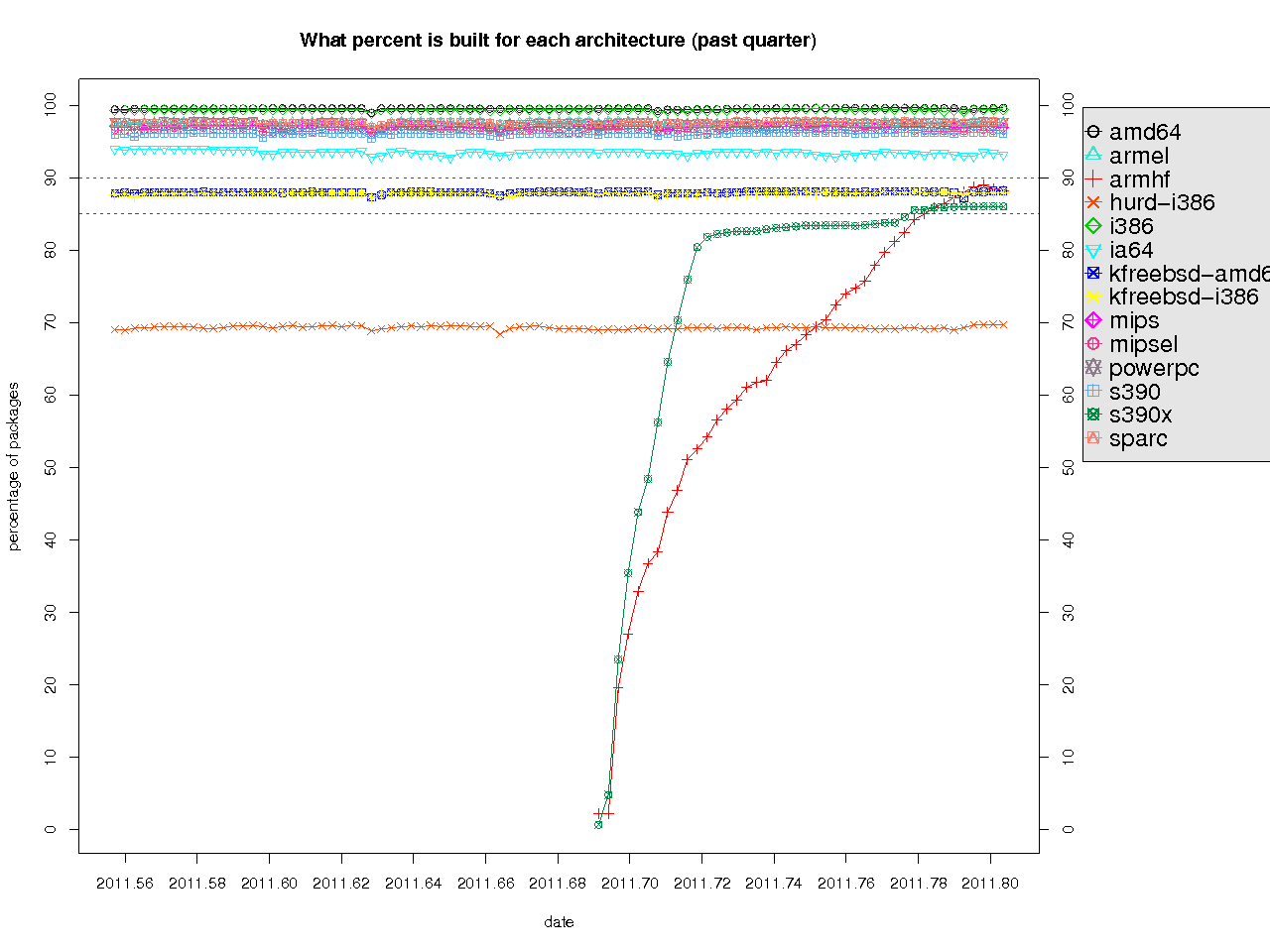
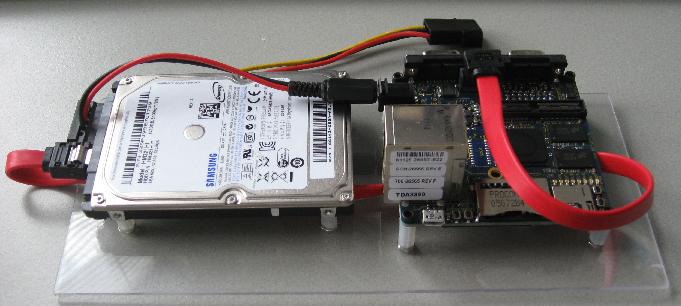
Current status Back in September, I wrote about the machines that I set up to help bootstrap the new armhf port in Debian. Basing on Konstantinos' huge efforts in bringing up the new "architecture" in debian-ports, we started importing armhf into the main Debian archive on the 24th of November. Since then, those builders have been churning away night and day to build the huge collection of software that makes up the Debian archive. The current state can be seen on the armhf buildd status page, and there's a nice graph showing how quickly we've managed to run from 0 to over 90% of the archive here. (Click on the image for a larger version, or visit https://buildd.debian.org/stats/ for other versions. We overtook hurd-i386 quickly and are now ahead of the kfreebsd-* architectures. armhf bootstrap graph We've recently brought 3 more similar build machines online (hildegard, howells and hummel), again sponsored by the nice folks at Linaro but now hosted at the York NeuroImaging Centre at the University of York. This gives us both more build horsepower to keep up with building more different bits of Debian (experimental, updates etc.) and more redundancy in case of problems. We now have the vast majority of the archive built, and now a number of us are concentrating on fixing the remaining issues: language bootstraps and bugs. Also, on the 7th of January we were just added into testing, the next step on our path for inclusion as a Debian release architecture. Setting up the machines A lot of people have been asking me about the physical setup I showed in my last blog about these machines, so here's more details for those who are interested. Mount the 6 boards into the mini-rack, connect up the Molex power connectors to each board, attach ethernet cables and turn it all on! Each board comes with a micro-SD card containing uboot and an Ubuntu installation. I've configured uboot to boot off the hard drive directly, but leaving configuration available to use the Ubuntu on the micro-SD as a simple rescue system should the need arise. The Quickstart boards are not ideal physically for two reasons: the lack of SATA power, plus you need to push a power button on each board to boot it - they don't boot automatically the moment power is applied. However, they're quite inexpensive little machines and have done a great job of building the Debian archive so far! The ideal machines for us would also include more RAM at this point. CPU on these is adequate, but the larger C++ packages (yay webkit!) use a huge amount of memory at link time. Linking in swap is not the best thing, performance-wise... :-( UPDATE 2012-01-12: Ian tells me that the newer Quickstart-R boards apparently have a different power controller; these now boot up straight away without needing you to push a button. That sounds useful.

Blars Blarson: makers

Makers by Cory Doctorow (and Chiriaco Summit again) OpenStreetmap Link Tonight I'm staying at the free camping area behind the General Patton Museum at Chiriaco Summit. Not a lot has changed since the last time I stayed here. There is one other RV here as well. The picture is taken from the tank garden, with my RV in the free camping area behind. Makers is a SF novel set in the fairly near future. It is available in ebook form free from the author's web site or if you prefer you can buy the paper edition from a bookstore. I found the first portion one of the most believable near-future with a significant change I have read. (The boogie-woogie Elmo dolls that run Linux and didn't sell were a cute touch.) While the technology involved might seem the same as the typical techno-babble seen in mass-market SF to someone not in the computer industry, it is actually plausible and the details are correct. The later parts of the novel are less believable, but still internally consistent. Overall, I found this a good but not great read.

8 January 2012

Russell Coker: My First Cruise

A few weeks ago I went on my first cruise, from Sydney to Melbourne on the Dawn Princess. VacationsToGo.com (a discount cruise/resort web site) has a review of the Dawn Princess [1], they give it 4 stars out of a possible 6. The 6 star ships seem to have discount rates in excess of $500 per day per person, much more than I would pay. The per-person rate is based on two people sharing a cabin, it seems that most cabins can be configured as a double bed or twin singles. If there is only one person in a cabin then they pay almost double the normal rate. It seems that most cruise ships have some support for cabins with more than two people (at a discount rate), but the cabins which support that apparently sell out early and don t seem to be available when booking a cheap last-minute deal over the Internet. So if you want a cheap cruise then you need to have an even number of people in your party. The cruise I took was two nights and cost $238 per person, it was advertised at something like $220 but then there are extra fees when you book (which seems to be the standard practice). The Value of Cruises To book a hotel room that is reasonably comfortable (4 star) in Melbourne or Sydney you need to spend more than $100 per night for a two person room if using Wotif.com. The list price of a 4 star hotel room for two people in a central city area can be well over $300 per night. So the cost for a cruise is in the range of city hotel prices. The Main Dining Room (MDR) has a quality of food and service that compares well with city restaurants. The food and service in the Dawn Princess MDR wasn t quite as good as Walter s Wine Bar (one of my favorite restaurants). But Walter s costs about $90 for a four course meal. The Dawn Princess MDR has a standard 5 course meal (with a small number of options for each course) and for no extra charge you can order extra serves. When you make it a 7 course meal the value increases. I really doubt that I could find any restaurant in Melbourne or Sydney that would serve a comparable meal for $119. You could consider a cruise to be either paying for accommodation and getting everything else for free or to be paying for fine dining in the evening and getting everything else for free. Getting both for the price of one (along with entertainment etc) is a great deal! I can recommend a cruise as a good holiday which is rather cheap if you do it right. That is if you want to spend lots of time swimming and eating quality food. How Cruise Companies Make Money There are economies of scale in running a restaurant, so having the MDR packed every night makes it a much more economic operation than a typical restaurant which has quiet nights. But the expenses in providing the services (which involves a crew that is usually almost half the number of passengers) are considerable. Paying $119 per night might cover half the wages of an average crew member but not much more. The casino is one way that the cruise companies make money. I can understand that someone taking a luxury vacation might feel inclined to play blackjack or something else that seems sophisticated. But playing poker machines on a cruise ship is rather sad not that I m complaining, I m happy for other people to subsidise my holidays! Alcohol is rather expensive on board. Some cruise companies allow each passenger to take one bottle of wine and some passengers try to smuggle liquor on board. On the forums some passengers report that they budget to spend $1000 per week on alcohol! If I wanted a holiday that involved drinking that much I d book a hotel at the beach, mix up a thermos full of a good cocktail in my hotel room, and then take my own deck-chair to the beach. It seems that the cruise companies specialise in extracting extra money from passengers (I don t think that my experience with the Dawn Princess is unusual in any way). Possibly the people who pay $1000 per night or more for a cruise don t get the nickel-and-dime treatment, but for affordable cruises I think it s standard. You have to be in the habit of asking the price whenever something is offered and be aware of social pressure to spend money. When I boarded the Dawn Princess there was a queue, which I joined as everyone did. It turned out that the queue was to get a lanyard for holding the key-card (which opens the cabin door and is used for payment). After giving me the lanyard they then told me that it cost $7.95 so I gave it back. Next time I ll take a lanyard from some computer conference and use it to hold the key-card, it s handy to have a lanyard but I don t want to pay $7.95. Finally some things are free at some times but not at others, fruit juice is free at the breakfast buffet but expensive at the lunch buffet. Coffee at the MDR is expensive but it was being served for free at a cafe on deck. How to have a Cheap Cruise VacationsToGo.com is the best discount cruise site I ve found so far [2]. Unfortunately they don t support searching on price, average daily price, or on a customised number of days (I can search for 7 days but not 7 or less). For one of the cheaper vessels it seems that anything less than $120 per night is a good deal and there are occasional deals as low as $70 per night. Princess cruises allows each passenger to bring one bottle of wine on board. If you drink that in your cabin (to avoid corkage fees) then that can save some money on drinks. RumRunnerFlasks.com sells plastic vessels for smuggling liquor on board cruise ships [3]. I wouldn t use one myself but many travelers recommend them highly. Chocolate and other snack foods are quite expensive on board and there are no restrictions on bringing your own, so the cheap options are to bring your own snack food or to snack from the buffet (which is usually open 24*7). Non-alcoholic drinks can be expensive but you can bring your own and use the fridge in your cabin to store it, but you have to bring cans or pressurised bottles so it doesn t look like you are smuggling liquor on board. Generally try not to pay for anything on board, there s enough free stuff if you make good choices. Princess offers free on-board credit (money for buying various stuff on-board) for any cruise that you book while on a cruise. The OBC starts at $25 per person and goes as high as $150 per person depending on how expensive the cruise is. Generally booking cruises while on-board is a bad idea as you can t do Internet searches. But as Princess apparently doesn t allow people outside the US to book through a travel agent and as they only require a refundable deposit that is not specific to any particular cruise there seems no down-side. In retrospect I should have given them a $200 on the off chance that I ll book another cruise with them some time in the next four years. Princess provide a book of discount vouchers in every cabin, mostly this is a guide to what is most profitable for them and thus what you should avoid if you want a cheap holiday. But there are some things that could be useful such as a free thermos cup with any cup of coffee if you buy coffee then you might as well get the free cup. Also they have some free contests that might be worth entering. Entertainment It s standard practice to have theatrical shows on board, some sort of musical is standard and common options include a magic show and comedy (it really depends on which cruise you take). On the Dawn Princess the second seating for dinner started at 8PM (the time apparently varies depending on the cruise schedule) which was the same time as the first show of the evening. I get the impression that this sort of schedule is common so if you want to see two shows in one night then you need to have the early seating for dinner. The cruise that I took lasted two nights and had two shows (a singing/dancing show and a magic show), so it was possible to have the late seating for dinner and still see all the main entertainment unless you wanted to see one show twice. From reading the CruiseCritic.com forum [4] I get the impression that the first seating for dinner is the most popular. On some cruises it s easy to switch from first to second seating but not always possible to switch from second to first. Therefore the best strategy seems to be to book the first seating. Things to do Before Booking a Cruise Read the CruiseCritic.com forum for information about almost everything. Compare prices for a wide variety of cruises to get a feel for what the best deals are. While $100 per night is a great deal for the type of cruise that interests me and is in my region it may not be a good match for the cruises that interest you. Read overview summaries of cruise lines that operate in your area. Some cruise lines cater for particular age groups and interests and are thus unappealing to some people EG anyone who doesn t have children probably won t be interested in Disney cruises. Read reviews of the ships, there is usually a great variation between different ships run by one line. One factor is when the ships have been upgraded with recently developed luxury features. Determine what things need to be booked in advance. Some entertainment options on board support a limited number of people and get booked out early. For example if you want to use the VR golf simulator on the Dawn Princess you should probably check in early and make a reservation as soon as you are on board. The forums are good for determining what needs to be booked early. Also see my post about booking a cruise and some general discussion of cruise related things [5]. Related posts:
  1. Cruises It seems that in theory cruises can make for quite...
  2. Combat Wasps One of the many interesting ideas in Peter F. Hamilton s...
  3. Victoria Hotel Melbourne I have just stayed at the Victoria Hotel Melbourne. I...

Russ Allbery: Debian and popularity

In the course of a discussion on debian-project, statistics about how many computers run Debian came up. This is a metric that always bothers me a little, and this time I tried to say something about why. It feels like a comment that should have an independent existence outside of that thread, so I'll post it here as well. One of the delightful things about Debian is that the project consists of a group of people who are working together to create something that, primarily, we all want to use. Making it usable for everyone else as well is, of course, a wonderful goal and something that many of us care a lot about. But I think it's important not to lose sight of the fact that world-wide adoption on the order of Windows is not a requirement for the Debian project to be a success. Debian is successful every time I boot a system and it's running Debian, every time Debian solves my problems, every time I can fix something I ran into because it's Debian and I can help make it better. It's fun if I can get more people to use Debian, and it's important to have an influx of new blood and new ideas to keep Debian fresh and responsive, but that's about keeping Debian successful, not about making Debian successful. If we have enough developers to maintain and improve Debian even at the rate that we're maintaining and improving Debian today, to me that's a success, and I don't really care whether the percentage of Debian users in the broader computing context ever moves off of 0.02%. One of the great things about free software is that we're not a business: we don't live or die by market share, we aren't going to get bought out by someone else if we don't become a big enough fish, and we don't have to grow 10% a year or implode. It would certainly be nice to attract more people and more users and improve even faster, and I certainly wouldn't want to stand in the way of that, but it's not part of my metric of success.

Next.

Previous.