Search Results: "ina"

27 May 2012

Ingo Juergensmann: DaviCal and Addressbook Sync

After exchanging my rusted Nokia N97 against an iPhone I was in need to setup calendar and addressbook syncing again. Addressbook syncing wasn't possible with N97 anyways, or I haven't found out how to do it. Previously I synced my N97 by using iSync, but iSync doesn't sync anymore with iPhone, although iPhone now syncs with iTunes. Weird? Yes. But that's how it works. The iPhone syncs now via WLAN instead of Bluetooth, which is an improvement, but I don't really want to fire up iTunes everytime I want to sync my calendar or addressbook. And using iCloud is really not an option as well, because of privacy concerns. I'm a big fan of selfhosting and already have a running DaviCal instance running on my server. DaviCal is a great piece of software from Debian maintainer Andrew McMillan, who is doing a survey on Davical, so there's, of course, a Debian package for it. Anyway, one problem with OSX and addressbook sync via carddav is that it is not working out of the box with Addressbook.app on OSX, although the documentation in the DaviCal wiki is quite useful. When you try to enter a new account in Addressbook.app the sync will not work. The solution can be found on the private blog of Harald Nikolisin, which is in German. He writes (German, English translation follows)
Mac OS X Adressbuch anschliessen
Oh ja wenn man mittels SSL drauzugreift, dann gibts Probleme.
Im der Applikation Adressbuch kann man zwar ein CardDAV Account anlegen bei dem man die Authorisierungsdaten und den kompletten Serverpfad (s.o.) eingeben kann, man l uft aber immer auf eine Fehlermeldung hinaus.
Die L sung ist, zweimal Create anzuklicken um den fehlerhaften Account anzulegen. Dann editiert man manuell folgende Datei: ~/Library/Application Support/AddressBook/Sources/UNIQUE-ID/Configuration.plist
Dort tr gt man unter Server String die komplette URL ein.
https://SERVERNAME/davical/caldav.php/USERNAME/contacts
Am besten modifiziert man noch das Feld HaveWriteAccess auf den Wert auf 1
English translation: 
Connecting Mac OS X addressbook
Oh, yes - there are problems when accessing via SSL.
In Addressbook.app you can add a CardDAV account where you can define authentication and 
server path, but you'll always get an error message.
The solution is to click twice on "Create" in order to create the faulty entry.
Then you can edit the following file:
~/Library/Application Support/AddressBook/Sources/UNIQUE-ID/Configuration.plist
There you enter your complete URL under Server String.
https://SERVERNAME/davical/caldav.php/USERNAME/contacts 
It's best to modify the field HaveWriteAccess to the value "1"
After following this advice my Addressbook.app did successfully stored the contacts into DaviCals CardDAV from where I can sync with my iPhone. Maybe Andrew want to include this to the DaviCal wiki, maybe I'll do this myself by registering in the Wiki for that purpose... Oh, and I forgot: Using the Roundcube plugin from graviox is working nice as well with DaviCals CardDAV!
Kategorie:

Lars Wirzenius: Larch 1.20120527 (Python B-tree library)

It has been a long time since I announced a version of Larch on my blog: about 14 months. A fair bit has happened since then: see the NEWS file for details. Below is the snippet for today's release. This is an implementation of particular kind of B-tree, based on research by Ohad Rodeh. See "B-trees, Shadowing, and Clones" (copied here with permission of author) for details on the data structure. This is the same data structure that btrfs uses. Note that my implementation is independent from the btrfs one, and might differ from what the paper describes. The distinctive feature of this B-tree is that a node is never modified (sort-of). Instead, all updates are done by copy-on-write. Among other things, this makes it easy to clone a tree, and modify only the clone, while other processes access the original tree. This is utterly wonderful for my backup application, and that's the reason I wrote larch in the first place. See the home page and README for more information; the API docs may be amusingly sparse. Version 1.20120527, released 2012-05-27

26 May 2012

Petter Reinholdtsen: The cost of ODF and OOXML

I just come across a blog post from Glyn Moody reporting the claimed cost from Microsoft on requiring ODF to be used by the UK government. I just sent him an email to let him know that his assumption are most likely wrong. Sharing it here in case some of my blog readers have seem the same numbers float around in the UK.
Hi. I just noted your http://blogs.computerworlduk.com/open-enterprise/2012/04/does-microsoft-office-lock-in-cost-the-uk-government-500-million/index.htm comment:
"They're all in Danish, not unreasonably, but even with the help of Google Translate I can't find any figures about the savings of "moving to a flexible two standard" as claimed by the Microsoft email. But I assume it is backed up somewhere, so let's take it, and the 500 million figure for the UK, on trust."
I can tell you that the Danish reports are inflated. I believe it is the same reports that were used in the Norwegian debate around 2007, and Gisle Hannemyr (a well known IT commentator in Norway) had a look at the content. In short, the reason it is claimed that using ODF will be so costly, is based on the assumption that this mean every existing document need to be converted from one of the MS Office formats to ODF, transferred to the receiver, and converted back from ODF to one of the MS Office formats, and that the conversion will cost 10 minutes of work time for both the sender and the receiver. In reality the sender would have a tool capable of saving to ODF, and the receiver would have a tool capable of reading it, and the time spent would at most be a few seconds for saving and loading, not 20 minutes of wasted effort. Microsoft claimed all these costs were saved by allowing people to transfer the original files from MS Office instead of spending 10 minutes converting to ODF. :) See http://hannemyr.com/no/ms12_vl02.php and http://hannemyr.com/no/ms12.php for background information. Norwegian only, sorry. :)

Tanguy Ortolo: Fun with spammers

Email spam is a plague, but sometimes there is at least on category of spammers it is easy to have fun with: naive manual spammers. People that try to do more or less legal business, using Internet in an illegitimate way, for instance (this is a real example, including the spammer's address: spamming bots, please use it ;-) !): Reporting Well, in that case it may or may not be a scam, but even if it is not a criminal activity such as selling fake drugs, it is not a very honest business. Anyway, that lady is using her Google account to send her crap, so neutralizing her is quite easy:
  1. checking that it really comes from Google Mail, using DKIM or SPF;
  2. writing to Google, reporting that spam (and, in that specific case, the abuse they are offering to commit on Google +1);
  3. optional, do not do that with scammers: replying to the spammer explaining that this is spamming, that you reported it and that she can expect to loose her Google account and everything on it.
That should work with any good email provider, that is, any provider that listens to complaints at <abuse@> and takes action on them. For what I have seen, Google and Yahoo! are, but fossils such as traditional national telephonists are not. If the message headers allow you to identify it, you can also report the abuse to the spammer's network operator if it is a good one (this is rarely the case). Consequences With a bit of luck, that can seriously damage the business of the spammer, and if he was really careless (e.g. storing important documents on the same Google account with no local backup), cause serious trouble in his personal stuff. If you replied to the spammer, you can get fun answers such as (these are taken from real examples I got): Conclusion This is too complicated to be done for each spam of course, but it is worth doing for spam messages that are not catch by one's antispam. And the rules for email marketing are well known: only write to people that explicitly allowed you to do so, full stop, so there is no reason to show any mercy for a spammer.

25 May 2012

Matthew Garrett: Fedora 17 and Mac support

Fedora 17 will be shipping next week. It's got a bunch of new features, none of which I contributed to in the slightest. What I did work on was improving our support for installation on x86 Apple hardware. There's still a few shortcomings in this so it's not an announced or supported feature, but it's sufficient progress that it's worth writing about.

There's a few ways that Apple platforms differs from normal PC hardware. The first is that Apples are very much intended to be EFI first and BIOS second, while that's still not really true for commodity PC hardware. Apple launched Boot Camp shortly after they started shipping x86 Macs (and shortly after I'd got Ubuntu running on one for the first time[1]) but the focus of Boot Camp has always been to be good enough to boot Windows and not much else[2]. The other is the integration with the boot environment. You can boot Linux easily enough by setting the standard EFI boot variables, but if you ever boot back into OS X it's easy to trigger deletion of those. There's then no straightforward way of resetting them, and you're left having to recover your installation.

The other difficult bit has been actually starting the installer at all. If you're happy to use BIOS emulation than this can be done without too much misery, but you're then left with dealing with Apple's custom synchronised GPT/MBR. More modern Macs will boot via the standard EFI mechanisms, but there's a range of problems that can be caused that way. Fedora 17 is the first Linux distribution to ship install media that will EFI boot a Mac when either written to optical media or a USB stick[3]. Put the install media in your system and then either select it in the OS X Startup Disk preferences menu and reboot, or reboot and hold down the alt key. In the latter case there'll be a nice Fedora logo. Click on it and it'll boot.

The biggest difference between Apple hardware and anyone else is that we'd normally put the bootloader in a FAT partition that's shared with any other installed operating systems. That does actually work on Apples, but then you run into the earlier point I mentioned. The Apple startup picker that you get by holding down the alt key doesn't pay any attention to the standard EFI boot variables, so it won't show a FAT partition merely because it's got an EFI bootloader on it. The same is true of the OS X Startup Disk preferences. The best way to get a drive to appear in the menu is to make it look like an OS X drive.

This was problematic in a few ways, due to the requirement for an OS X drive to be HFS+. The first was that we didn't have any support for that in our installer, so work had to be done there. The second was that the state of HFS+ was woefully poor in Linux[4]. Linux will refuse to write to an HFS+ filesystem if it hasn't been cleanly unmounted or fscked, and since we can't rely on everyone always shutting their machine down cleanly that means a working fsck.hfsplus. In theory we were shipping one of those. In practice, it reliably segfaulted on 64-bit systems[5]. So I had to package the latest version of Apple's code, and doing that involved dealing with the fact that Apple now use blocks almost as much as Grub 2 uses nested functions, and that meant using Clang and that meant dealing with a bug where Clang segfaulted if it had been built with gcc 4.7[6], but finally once all of those yaks had been shaven we could trust our filesystem.

Of course, more problems existed. You can't just drop a bootloader onto an HFS+ partition and expect it to work. You need to write its inode value into the superblock. Trivial, except that if you do this from userspace then the kernel kindly overwrites your update when you unmount the disk and it updates the superblock. That required a mechanism for updating that data via the kernel, which meant adding an ioctl. This would have been fine, except the OS X Startup Disk preference looks for a bootloader in a location other than where Fedora installs it. Changing our bootloader install path wasn't a great option, so the easiest thing to do was just to link them together. Except HFS+ doesn't really support hardlinks. When you hardlink something the original file gets moved into a magic directory in the filesystem root and the links are special files that refer to it. And it turns out that it's not actually the inode that the firmware wants when finding the bootloader, it's the catalogue ID, and these aren't the same when hardlinks are involved. So, another kernel patch.

All that was left for the boot partition then was adding an icon and a drive label. We already had code for generating the icon, and the drive label wasn't that difficult. Hurrah!

Ok, so we can construct a filesystem that (a) appears in the bootpicker, and (b) appears in the OS X Startup Disk preferences. We can even put a bootloader on it. This led to the next problem. The bootloader started without any trouble. But the bootloader couldn't read any files off the boot partition, including its configuration. This should have been obvious with hindsight - the problem was simply that grub legacy[7] doesn't support HFS+. Writing an HFS+ driver seemed like an excessive amount of work, especially since the firmware already supported reading HFS+, so instead I wrote a simple grub filesystem driver that uses the UEFI interfaces to read files.

A working bootloader! One more problem there. grub looks in its startup directory to find its configuration file. We have two "copies" of grub hardlinked to each other, each looking in a different directory for configuration. Hardlinking the config files together worked fine, except that most tools that update config files have this irritating habit of writing to a temporary file and moving that over the original, thus breaking the hardlink. Easily solved by using a symlink instead, except that the UEFI filesystem semantics don't really support symlinks because UEFI only really envisaged using FAT. If you use Apple's UEFI HFS+ driver to open a symlink, you get a short file containing the target path of the symlink. Rather less than ideal, and a rather gross hack to cope with it.

All set now, other than a bug in some older Mac firmware where read would return BUFFER_TOO_SMALL without returning the real buffersize and the odd way that Apple treat CDs. Oh, and a bug in Apple's Broadcom wifi driver that could overwrite the kernel, and case-sensitivity, something that obviously isn't something you often hit on UEFI when all you usually see is FAT.

Kernel-side, we had a couple of things. Obviously there the bugs I'd mentioned in the past, but those had already been dealt with. New issues included the fact that we were frequently picking the wrong framebuffer address, especially on machines with multiple GPUs. Fixed now, along with another issue where we'd sometimes get confused by models with different GPU configurations. And at that point, most of the implementation work was done.

Of course, there was also the work of integrating this into the tools that we use to generate our install media, and I'd like to thank Will Woods, Brian Lane and Dennis Gilmore for the work they put into that, along with anyone I've forgotten. Tom Calloway handled getting the device label graphics generated right before deadline. A cast of thousands helped with testing.

So why did I mention shortcomings? First, this only works on machines with 64-bit firmware. Early 64-bit Apples still had 32-bit firmware. In theory we can support that case - in practice it's a moderate amount of writing, including some mildly awkward kernel code. But anything later than mid-2007 should have 64-bit firmware, so it's not a massive concern. Second, we seem to have fairly significant trouble with Radeon hardware on a lot of Macs. We fixed one bug there, but something's still going wrong in setup and you'll frequently end up with a black screen. And thirdly, I'm sure there's some other machines that still don't work for (as yet) undetermined reasons.

With luck we'll get these things dealt with by Fedora 18. But even with these flaws, Fedora 17 will work fine on a lot of Apple hardware, and testing it is as simple as downloading and booting a live image. Bugs go in the usual place.

[1] Note my charming belief that the Ubuntu installer would fully support this hardware via EFI in the near future. 6 years ago. It still doesn't.
[2] This can be fairly easily seen from little things like the name "Windows" being hardcoded into every UI that sees a Boot Camp drive.
[3] I cover this in more depth here
[4] To be fair, it mostly still is - there's plenty of work to be done there.
[5] Approximately nobody had noticed this, which is all kinds of unreassuring.
[6] Thanks to Kalev Lember for dealing with that
[7] Still the EFI bootloader in Fedora 17. We've already swapped Fedora 18 over to grub 2.

comment count unavailable comments

Paul Tagliamonte: playing with non-lintian lintian checks

Crazy title, I know. Over the past $WHILE, I ve found myself checking for the same things. Some of these are fit for inclusion into lintian it s self others, not so much. Here s a rundown on what my lintian wrapper (tragically also called lintian and just higher up on my $PATH. I know it s a hack.) Since I only use lintian on .changes files - it pre-processes for some information that is stuffed in the changes. The first step is to get all the bugs that the package closes. It then takes these bugs, and queries the BTS to see what package they re filed against. If the bug is filed against a different bug then the package s source, it ll emit a warning. It has a greylist for stuff like WNPP . This will fail if something s filed against it s binary package rather then it s source :) Next, the wrapper will get other info from the changes. It checks if the suite is in the blacklist ( UNRELEASED , and testing , (stable for me as well, since I don t usually deal with SRUs often)). It ll also check for the changed-by and maintainer, ensuring they re the same. This will fail for co-maint d packages. If you ve not guessed by now, this system relies on false-positives :) Nextly, if there are .debs in the Files, it ll go through and check the control of each. It ll print out a stanza with the short-description inside a template, to see if the description works . After that, it ll attempt to make HTTP requests to the Homepage (and eventually URLs in the description and VCS-Browse) If the package has python in the source name anywhere, or in any of it s binary packages, it ll trigger jwilk s lintian4python over the source as well. After this, it passes through to regular lintian. Oh, and it colorizes all the output :) Here is a (mostly lint-free) package: As you can see, it s very (very) verbose, but i d rather cross stuff off a checklist then worry about something being off. Anyway, it s a work in progress. Not even a serious one, at that. It s a bunch of hacks put together, so I can t really endorse anyone else using this stuff. If you feel crazy enough to do so, all the tools are found on my dot-bin repo on GitHub

24 May 2012

Vincent Sanders: Interrupt Service Routines

Something a little low level for this post. I have been asked recently how to "test" for the maximum duration of an Interrupt Service Routine (ISR) in Linux

To do this I probably ought to explain what the heck an ISR is!

A CPU executes one instruction after another and runs your programs. However early in the history of the electronic computer it soon became apparent that sometimes there were events happening, generally caused by a hardware peripheral, that required some other code to be executed without having to wait for the running program to check for the event.

This could have been solved by having a second processor to look after those exceptional events but that would have been expensive, difficult to synchronize and the designers took the view that there was a perfectly good processor already sat there just running some users program. This Interruption in the code flow became known as, well, an Interrupt (and the other approach as polling).

The hardware for supporting interrupts started out very simply, the processor would complete execution of the current instruction and when the Program Counter (PC) was about to be incremented if an Interrupt ReQest (IRQ) was pending the PC would be stored somewhere (often a "special" IRQ stack or register) and then execution started at some fixed address.

The interrupting event would be dealt with by some code and execution returned to the original program without it ever knowing the CPU just wandered off to do something else. The code that deals with the interrupt is known as the Interrupt Service Routine (ISR).

Now I have glossed over a lot of issues here (sufficient to say there are a huge number of details in which to hide the devil) but the model is good enough for my purpose. A modern CPU has a extraordinarily complex system of IRQ controllers to deal with numerous peripherals requesting the CPU stop what its doing and look after something else.

This system of controllers will ultimately cause program execution to be delivered to an ISR for that device. If we were living in the old single thread of execution world we could measure how long execution remains within an ISR, perhaps by using a physical I/O line as a semaphore and an external oscilloscope to monitor the line.

You may well ask "Why measure this?" well historically while the ISR was running nothing else could interrupt it executing which meant even if there was an event that was more important it would not get the CPU until the first ISR was complete. This was known as IRQ latency which was undesirable if you were doing something that required an IRQ to be serviced in a timely manner (like playing audio)

This is no longer how things are done while the top half runs with IRQ disabled many are threaded interrupt handlers and are preemptable (I.e. can be interrupted themselves) which leads to the first issue with measuring ISR time in that the ISR may be executed in multiple chunks if something more important interrupts. Indeed it may appear an ISR has taken many times longer one time than another because the CPU has been off servicing multiple other IRQ.

Then we have the issue that Linux kernel drivers often do as little as possible within their ISR, often only as much as is required to clear the physical interrupt line. Processing is then continued in a "bottom half" handler this leads to ISR which take practically no time to execute but processing is still being caused elsewhere in the system.

The next issue is the world is not uniprocessor any more, how many processors does a machine have these days? even a small ARM SoC can often have two or even four cores. This makes our timing harder because it is now possible to be servicing multiple interrupts from a single peripheral on separate cores at the same time!

In summary measuring ISR execution time is not terribly enlightening and almost certainly not what you are interested in. The actual question is much more likely that you really want to be examining something that the ISR time was an historical proxy for like IRQ latency or system overheads in locking.

Sylvestre Ledru: llvm & clang 3.1 in Debian unstable + GSoC

Released a few days ago, I am happy to announce that LLVM and clang 3.1 are already available in the Debian archive in Unstable. RC versions were already available for the last few weeks in Debian experimental. They are very likely to be part of wheezy.
We will soon try a new rebuild of the Debian archive with the version 3.1. Talking about clang, a couple of months ago, I proposed a GSoC project to extend the Debian infrastructure in order to use clang instead gcc to build Debian packages. The goal is not to replace gcc but it is more about building packages with a new compiler. With Paul Tagliamonte as co-mentor, Alexander Pashaliyski is going to work during the summer on this subject. The final deliverables should be: For now, Alexander is working on an installation of the wanna-build and buildd services in order to have a dedicated testing environment.

Richard Hartmann: Public service announcement

This will be a repost for anyone subscribed to Planet Debian, sorry. In case you have not heard about git-annex yet and you care about syncing, tracking, and managing your private or public files, go click the link; it's OK, I will wait. The use cases sound intriguing, don't they? But unless you are comfortable with a shell and git, don't bother using it; pain is inevitable. joeyh announced a kickstarter project to make git-annex more user friendly, support automated adding and syncing of files, and a web front-end. Notwithstanding the cut that kickstarter and amazon payments will take and the inherent questions that are being raised by paying for FLOSS, this is a very worthwhile endeavour to support. PS: Yes, this feels a tad circle-jerky inasmuch joeyh's post links to my blog; I would have linked to his post anyway, though. If anything, this made me think twice about posting this here. PPS: Yes, I will continue writing my Trans-Siberian series even though I am home already. Air China decided to keep me in China longer than planned, real life is busy, and, truth be told, Diablo 3 came out. The second Mongolian post is half-way finished, at least.

23 May 2012

Joey Hess: kickstarter for git-annex assistant

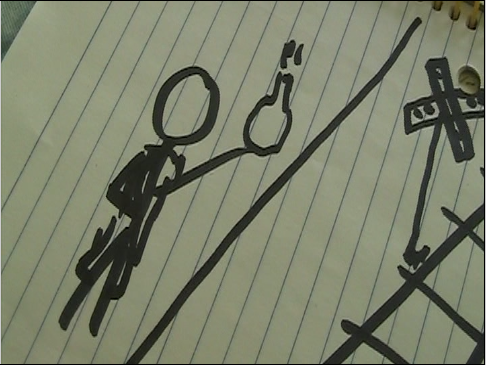
I'm doing a Kickstarter! The plan is to take git-annex and use it as the foundation to build a DropBox-like application, that can be used without any knowledge of git. The other part of the plan is for me to get through the summer with my finances intact. :) kickstarter My Kickstarter page explains in more detail, but the basic idea is to make git-annex watch a directory, with inotify, and automatically add and sync files placed there. Then build a local web app to control and configure it. I have a working prototype of the inotify part already; getting the distributed syncronisation to work well will be a major challenge; and overall it's going to be a challanging but I think very achievable project. One thing I'm really excited about is the potential of Kickstarter to connect me with a diverse group of potential users, who are interested enough in a distributed and autonomous equivilant to DropBox to fund my project. Because, with luck, their involvement won't stop at giving some money, but will extend to actually using what I'm developing, and giving me feedback on it. I hope this will widen the sphere of git-annex users, beyond the current very technically inclined crowd. It's awesome to have users doing things like taking git-annex on the transiberian railroad to help manage all their photos, and others using it to store scientific data ... but getting more regular folks using git, even if they don't know about it, is something I'm very interested in. xkcd-esque drawing BTW, I was surprised how much I got into doing the video for the Kickstarter. Using xkcd-style drawings used to explain technical concepts is a medium I enjoy working in. My own git-annex is stuffed with 17 gigabytes of video clips -- 99 separate takes! -- that boiled down to a 2 minute video. Anyway, please consider backing me if you can, and more importantly, do anything you can to help spread the word. Thanks!

Christian Perrier: 2012 update 23 for Debian Installer localization

Status for D-I level 1 (core D-I files): Status for D-I level 2 (packages that have localized material that may appear during default installs, such as iso-codes, tasksel, etc.): Status for D-I level 3 (packages that have localized material that may appear during non-default installs, such as win32-loader) Full 100% completeness (hall of fame) for 26 languages: Asturian, Belarusian, Bulgarian, Catalan, Czech, Danish, German, Esperanto, Spanish, Persian, French, Hebrew, Indonesian, Italian, Japanese, Kazakh, Khmer, Dutch, Polish, Portuguese, Russian, Slovak, Slovenian, Swedish, Turkish, Simplified Chinese

Craig Small: procps-ng 3.3.3 released

top

Top in colour mode

This weekend procps-ng version 3.3.3 was tagged and released for distribution. There have been many patches and fixes involved in this release as we move from an unchanging static sort of code into something that is easier to maintain and build on various architectures. The good thing is I m down to 1 or 2 patches in the debian archive which is a big change from the 30 or 40-odd I used to carry. For the sole metric of getting that number down, the project fork has been a success. There were some post-release bugs I found and these were more to do with the various options turned on or off rather than what you d see if you did the basic ./configure && make. One of them was how the version numbers are defined in git, but would only appear if certain files were older than others (such as aclocal.m4 versus config.h.in) Others were when certain features were turned on. The make check doesn t see all of this because it uses the default configure flags. One annoying thing of the autotools is conditionally installing man pages. This is where you don t or cannot compile a binary so you don t install the corresponding man page. The automake documentation is of course obscure about this but I cannot see a way of distributing only a man page, so we have this fiddle where a file goes into distmanMANS or EXTRA_DIST depending. Interestingly, there has been some bike-shedding around Fedora-land (see the link below) regarding the name procps-ng versus procps. Debian is lucky that we do have different upstream and package names (though not ideal) so apt-get install procps still gives you procps. There also has been discussion about merging procps-ng into util-linux whichin the short-term won t be happening.

22 May 2012

Mark Brown: ASoC updates in 3.4

Linux version 3.4 has been released. This was a very active release for ASoC in framework terms, in addition to the usual bug fixes and so on there were a large number of framework enhancements though most are fairly small or are laying the groundwork for more user visible features like dynamic PCM.

Gunnar Wolf: e-voting: Bad when it's near, worse when it's far.

Note: All of the information linked to from this post is in Spanish and related to Mexico Part of it will be translatable via automated means, some will not. Sorry, that's what I have, and it's too much text to invest the effort to hand-translate
I have been following the development of the different e-vote modalities in Mexico for several years already, although I have only managed to do so methodically in the last half year or so. If you are interested in my line of reasoning as to why I completely oppose e-voting, you can look at the short article I published in 2010 or the slightly longer and more updated version published in our book in 2011. Currently, in Mexico there are two different venues of e-vote that are being pushed: Bad and worse. The bad one will be carried out for about 10% of the population of the state of Jalisco and somewhat less for the state of Coahuila (Distrito Federal was also to be in this list, but the contract was cancelled due to the provider company delivering booths with too many problems and unable to deliver in the due time). The worse one is, fortunately, likely to have the least impact. Why? Because it regards votes cast by Distrito Federal residents (the capital entity, where part of Mexico City is located) living abroad. And it will have less impact because of the amount of the population registered for it: We are about 9 million residents in DF, and in the last election (first time IIRC there was the right to vote from abroad) there were only about 10,000 people registered for casting a (enveloped and sent by post) vote. Even if this year we the campaign for this was better (and I'm not yet sure about it), the number of voters will not be enough to make a dent on the results. I'm not going into details as to why it is bad in this post I requested information from the DF Electoral Institute (IEDF) with academic interest, to try to find more information about it, and I want to share my results with you and, of course, to request for your input on how to continue with this. On May 3rd, I sent the following request (this I am translating to English :) You can look at the receipt for the request for the original redaction) to the official contact address, oficinadeinformacionpublica@iedf.org.mx: Of course, I wasn't very optimistic when receiving this information. Still, I have to share my results: My information request was largely denied:
( )
III. The divulgation of this information harms the interest it protects
Given that, were it to be divulged it would affect the informatic security of the refered system. Anyway, we have to point out that said systems have enough measures and security provisions, so that the citizen can emit his vote in a universal, free, secret and direct way.
IV. The damage that can be produced by making this information public is larger than the public interest to know it
This is so because making this information public puts at risk the correct development of the Internet-based voting, because were the technical, purpose-specific information be made public, it could be misused to carry out informatic attacks.
It is also important to mention that a confidentiality agreement was signed with the company that developed said systems.
( )
VI. The time for the information to be reserved
It will be seven years starting at the present resolution, this information will be made public when the reserve period is over or when the target is reached, except for the confidemtial information that it could contain. ( )
In case some other person is interested in following this information, the other two points were answered, and I'll try to get some relevant information from it: So, I don't have any real conclusions yet. I'm just reporting how work is unfolding. Tomorrow evening (Wednesday May 23) I'll give a talk on the "e-voting in Mexico 2012" subject in Congreso Internacional de Software Libre in Zacatecas, Mexico. I'll talk on the situation on this and the other topics I have been able to work on.
AttachmentSize
Receipt of my information request11.64 KB
Transparency Committee resolution354.66 KB
Information request answered by UTCSTyPDP (IEDF)85.75 KB

Russell Coker: Another USB Flash Failure

I previously wrote about a failure of a USB flash device in my Internet gateway [1]. I have since had another failure in the same system, so both the original 4G devices are now dead. That s two dead devices in 10 weeks. It could be that the USB devices that I got for free at an exhibition were just really cheap, I m sure that they weren t expecting them to be used in that way. The devices from the same batch which are used for their intended purpose (sneaker-net file sharing) are still working well. But in any case I m not going to resume this experiment until warmer weather. At this time of year some extra heat dissipation from computer gear in my home is more like a feature and less like a bug. The second USB device to fail appeared to have it s failure in the Ext4 journal (the errors were reported at around sector 2000), I didn t keep a record of the problem with the first device, but from memory I think it was much the same. Rumor has it that cheap flash storage devices don t implement wear-levelling to avoid patent infringement. If that rumor is correct then any filesystem that uses a fixed journal in the same way as Ext3/4 is probably unsuitable for any serious use on such devices, while a filesystem based on Copy On Write will probably perform better. In Spring I ll try using BTRFS on cheap USB flash devices and see if that works better. I have another spare device from the same batch to test so I can eliminate hardware differences. I can t do enough tests to be a good statistical sample, but if a device lasts from Spring to Autumn using BTRFS with the same use that caused failures with Ext4 in a few weeks then I will consider it a strong indication that BTRFS is better than Ext3/4 for such uses. For the next 5 months or so I ll be using a hard drive in my Internet gateway system again. Related posts:
  1. Flash Storage Update Last month I wrote about using USB flash storage devices...
  2. flash for main storage I was in a discussion about flash on a closed...
  3. USB Flash Storage For some years I have had my Internet gateway/firewall system...

Matthew Garrett: I've been a terrible person (and so have most of you)

John Scalzi recently wrote a piece on straight white male privilege. If you haven't read it already, go and do so. No rush. I'll wait.

So. Some facts:

(If you disagree with any of these then that's absolutely your right. You're wrong, but that's ok. But please do me a favour and stop reading here. Otherwise you'll just get angry and then you'll write something ill-tempered and still wrong in the comments and then I'll have to delete it and why not just save everybody the time and effort and go and eat ice cream or something instead)

I know I've said this before, but inappropriate and marginalising behaviour is rife in our community, and at all levels of our community. There's the time an open source evangelist just flat out told a woman that her experiences didn't match his so she must be an outlier. There's the time a leading kernel developer said that most rape statistics were basically made up. There's the time that I said the most useful thing Debian could do with its money would be to buy prostitutes for its developers, simultaneously sexualising the discussion, implying that Debian developers were all straight men and casting sex workers as property. These aren't the exceptions. It's endemic. Almost all of us have been part of the problem, and in doing so we've contributed to an environment that has at best driven away capable contributors. You probably don't want to know what it's done at worst.

But what people have done in the past isn't important. What's important is how we behave in the future. If you're not angry about social injustice like this then you're doing it wrong. If you're reading this then there's a pretty high probability that you're a white male. So, it's great that you're angry. You should be! As a straight white male born into a fairly well-off family, a native English speaker in an English speaking country, I have plenty of time to be angry before going back to my nice apartment and living my almost entirely discrimination-free life. So if it makes me angry, I have absolutely no way of comprehending how angry it must make the people who actually have to live with this shit on a daily basis.


(Were tampon mouse able to form and express coherent thoughts, tampon mouse would not put up with this shit)

The point isn't to be smugly self aware of our own shortcomings and the shortcomings of others. The point is to actually do something about it. If you're not already devoting some amount of your resources to improving fairness in the world, then why not? It doesn't have to be about women in technology - if you're already donating to charity or helping out at schools or engaging in local politics or any of the countless other ways an individual can help make the world a better place, large or small, then keep on doing that. But do consider that many of us have done things in the past that contributed to the alienation of an astounding number of potential community members, and if you can then please do do something to make up for it. It might be donating to groups like The Ada Initiative. It might be mentoring students for projects like the GNOME Outreach Program for Women, or working to create similar programs. Even just making our communities less toxic by pointing out unacceptable behaviour when you see it makes a huge difference.

But most importantly, be aware that it was people like me who were responsible for this problem in the first place and people like me who need to take responsibility for solving it. We can't demand the victims do that for us.

comment count unavailable comments

21 May 2012

Thomas Goirand: Unit tests for PHP: PHPUnit

PHPUnit, according to its PTS, has been in Debian since 2009. But it was orphaned, and nobody took care of it for a while. That is until few weeks ago, Luis Uribe started to work on it. Since he isn t a DD, and that I take care of, I believe, about half of the all the PHP PEAR packages in Debian, I started working with him on re-doing the work of packaging PHPUnit for Debian. Previously, the old version was quite wrong, with missing dependencies, and not really working, what a shame PHPUnit 3.6 has been in Debian SID for 3 days now. And it s working well. I m now adding runs of unit testings from upstream packages at build time (of course, only if DEB_BUILD_OPTIONS doesn t contains nocheck , as per the policy). All together, it s been quite some fun to hack this, and I m quite happy of the results, even though there s still a lot of work remaining. PHP itself is running unit tests at build time. And not just a few: more than 11000 of them. The only small issue, is that they are totally outdated. Over the time, the vardump() function has evolved, and doesn t print things the same way. One may say that it prints things in a nicer way, but as a result, many of the tests that were suppose to work, actually fails because of these differences in vardump() over time. So I started working on fixing some of the tests. It s most of the time very easy to fix, but it takes a long time to fix all these small unit tests. So far, I ve been able to fix most of what s in the tests/, Zend/tests (more than 161 tests fixed), and the beginning of ext/*/tests: for the moment: bcmath, bz2, calendar, curl, date, dba, dom, ereg, and a part of exif, which for the moment represent 214 fixed tests, and I ll try to do more fixes when I have time. I hope to send the patches upstream soon. The final goal is of course to have the build of PHP to fail if unit tests are failing as well. For the moment, unit tests do run at build time, but the build don t care of the results, which I think is stupid (it s wasting CPU cycles for no reasons, IMO). If you maintain some PEAR packages, I would welcome you to first join the PKG-PEAR team on Alioth, and team maintain your packages, switch over to pkg-php-tools and dh 8 auto-sequencer, and to follow the PKG-PHP-PEAR packaging guide lines so that we have consistency in the archive. And of course, run unit testings, by doing a build-depends on phpunit (>= 3.6). Note that unit testings in PEAR packages are tracked on the Debian wiki. This post is also a call for help, because I feel quite alone doing this work of packaging PEAR packages, which many PHP applications depend on (think about roundcube, horde, extplorer, and many more). Other teams are doing very well, like the Perl team, and there s no reason why Debian wouldn t maintain PHP libraries as well as the ones for Perl.

Johannes Schauer: sisyphus wins ICRA 2012 VMAC

Sisyphus is a piece of software that I wrote as a member of a team from Jacobs University led by Prof. Dr. Andreas N chter. It managed to place our team first in this year's IEEE ICRA 2012 Virtual Manufacturing Automation Competition in all three rounds. The goal was, to stack a given set of boxes of different length, height and width on a pallet in a way that achieved optimal volume utilization, center of mass and interlock of the boxes. Besides the cartesian placement of a box on the pallet, the only other degree of freedom was a 90 rotation of the box around a vertical axis. Since the arrangement of boxes into a three dimensional container is NP hard (three dimensional orthogonal knapsack), I decided for a heuristic for an approximate solution. The premise is, that there are many boxes of equal height which was the case in the test cases that were available from the 2011 VMAC. Given this premise, my heuristic was, to arrange the boxes into layers of equal height and then stack these layers on top of each other. A set of boxes that would be left over or too little from the start to form its own full layer, would then be stacked on the top of the completed layers. There is a video of how this looked like. My code is now online on github and it even documented for everybody who is not me (or a potential future me of course). This blog post is about the "interesting" parts of sisyphus. You can read about the overall workings of it in the project's README. Python dict to XML and XML to Python dict The evaluation program for the challenge is reading XML files and the pallet size and the list of articles with their sizes are also given in XML format. So I had to have a way to easily read article information from XML and to easily dump my data into XML format. Luckily, all the XML involved was not making use of XML attributes at all, so the only children a node had, where other nodes. Thus, the whole XML file could be represented as an XML dictionary with keys being tagnames and the values being other dictionaries or lists or strings or integers. The code doing that uses xml.etree.ElementTree and turns out to be very simple:
from xml.etree import ElementTree

def xmltodict(element):
def xmltodict_handler(parent_element):
result = dict()
for element in parent_element:
if len(element):
obj = xmltodict_handler(element)
else:
obj = element.text
if result.get(element.tag):
if hasattr(result[element.tag], "append"):
result[element.tag].append(obj)
else:
result[element.tag] = [result[element.tag], obj]
else:
result[element.tag] = obj
return result
return element.tag: xmltodict_handler(element)

def dicttoxml(element):
def dicttoxml_handler(result, key, value):
if isinstance(value, list):
for e in value:
dicttoxml_handler(result, key, e)
elif isinstance(value, basestring):
elem = ElementTree.Element(key)
elem.text = value
result.append(elem)
elif isinstance(value, int) or isinstance(value, float):
elem = ElementTree.Element(key)
elem.text = str(value)
result.append(elem)
elif value is None:
result.append(ElementTree.Element(key))
else:
res = ElementTree.Element(key)
for k, v in value.items():
dicttoxml_handler(res, k, v)
result.append(res)
result = ElementTree.Element(element.keys()[0])
for key, value in element[element.keys()[0]].items():
dicttoxml_handler(result, key, value)
return result

def xmlfiletodict(filename):
return xmltodict(ElementTree.parse(filename).getroot())

def dicttoxmlfile(element, filename):
ElementTree.ElementTree(dicttoxml(element)).write(filename)

def xmlstringtodict(xmlstring):
return xmltodict(ElementTree.fromstring(xmlstring))

def dicttoxmlstring(element):
return ElementTree.tostring(dicttoxml(element))
Lets try this out:
>>> from util import xmlstringtodict, dicttoxmlstring
>>> xmlstring = "<foo><bar>foobar</bar><baz><a>1</a><a>2</a></baz></foo>"
>>> xmldict = xmlstringtodict(xmlstring)
>>> print xmldict
 'foo':  'baz':  'a': ['1', '2'] , 'bar': 'foobar' 
>>> dicttoxmlstring(xmldict)
'<foo><baz><a>1</a><a>2</a></baz><bar>foobar</bar></foo>'
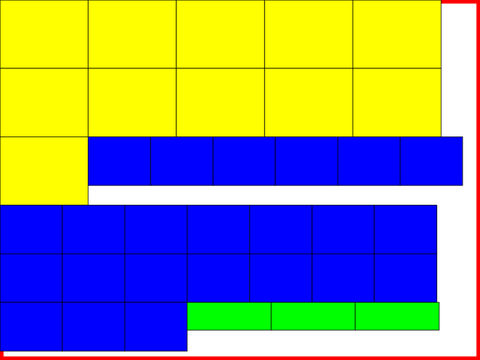
The dict container doesnt preserve order, but as XML doesnt require that, this is also not an issue. Arranging items in layers When it was decided, that I wanted to take the layered approach, it boiled down the 3D knapsack problem to a 2D knapsack problem. The problem statement now was: how to best fit small rectangles into a big rectangle? I decided for a simple and fast approach as it is explained in Jake Gordon's blog article. There is a demo of his code and should the site vanish from the net, the code is on github. This solution seemed to generate results that were "good enough" while simple to implement and fast to execute. If you look very hard, you can still see some design similarities between my arrange_spread.py and his packer.js code. Jake Gordon got his idea from Jim Scott who wrote an article of arranging randomly sized lightmaps into a bigger texture. There is also an ActiveState Code recipe from 2005 which looks very similar to the code by Jake Gordon. The posts of Jake Gordon and Jim Scott explain the solution well, so that I dont have to repeat it. Should the above resources go offline, I made backups of them here and here. There is also a backup of the ActiveState piece here. Spreading items out The algorithm above would cram all rectangles into a top-left position. As a result, there would mostly be space at the bottom and left edge of the available pallet surface. This is bad for two reasons:
  1. the mass is distributed unequally
  2. articles on the layer above at the bottom or left edge, are prone to overhang too much so that they tumble down
Instead all articles should be spread over the available pallet area, creating small gaps between them instead big spaces at the pallet borders. Since articles were of different size, it was not clear to me from the start what "equal distribution" would even mean because it was obvious that it was not as simple as making the space between all rectangles equal. The spacing had to be different between them to accommodate for differently sized boxes. The solution I came up with, made use of the tree structure, that was built by the algorithm that arranged the rectangles in the first place. The idea is, to spread articles vertically first, recursively starting with the deepest nodes and spreading them out in their parent rectangle. And then spreading them horizontally, spreading the upper nodes first, recursively resizing and spreading child nodes. The whole recursion idea created problems of its own. One of the nicest recursive beauty is the following function:
def get_max_horiz_nodes(node):
if node is None or not node['article']:
return [], []
elif node['down'] and node['down']['article']:
rightbranch, sr = get_max_horiz_nodes(node['right'])
rightbranch = [node] + rightbranch
downbranch, sd = get_max_horiz_nodes(node['down'])
ar = rightbranch[len(rightbranch)-1]['article']
ad = downbranch[len(downbranch)-1]['article']
if ar['x']+ar['width'] > ad['x']+ad['width']:
return rightbranch, sr+[downbranch[0]]
else:
return downbranch, sd+[rightbranch[0]]
else:
rightbranch, short = get_max_horiz_nodes(node['right'])
return [node] + rightbranch, short
get_max_horiz_nodes() traverses all branches of the tree that node has below itself and returns a tuple containing the list of nodes that form the branch that stretches out widest plus the list of nodes that are in the other branches (which are shorter than the widest). Another interesting problem was, how to decide on the gap between articles. This was interesting because the number resulting of the subtraction of the available length (or width) and the sum of the articles lengths (or widths), was mostly not divisible by the amount of gaps without leaving a rest. So there had to be an algorithm that gives me a list of integers, neither of them differing by more than one to any other, that when summed up, would give me the total amount of empty space. Or in other words: how to divide a number m into n integer pieces such that each of those integers doesnt differ more than 1 from any other. Surprisingly, generating this list doesnt contain any complex loop constructs:
>>> m = 108 # total amount
>>> n = 7 # number of pieces
>>> d,e = divmod(m, n)
>>> pieces = (e)*[(d+1)]+(n-e)*[d]
>>> print pieces
[16, 16, 16, 15, 15, 15, 15]
>>> sum(pieces) == m
True
>>> len(pieces) == n
True
You can test out the algorithms that arrange rectangles and spread them out by cloning the git and then running:
PYTHONPATH=. python legacy/arrange_spread.py
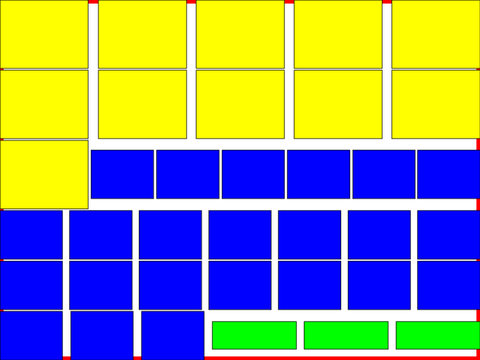
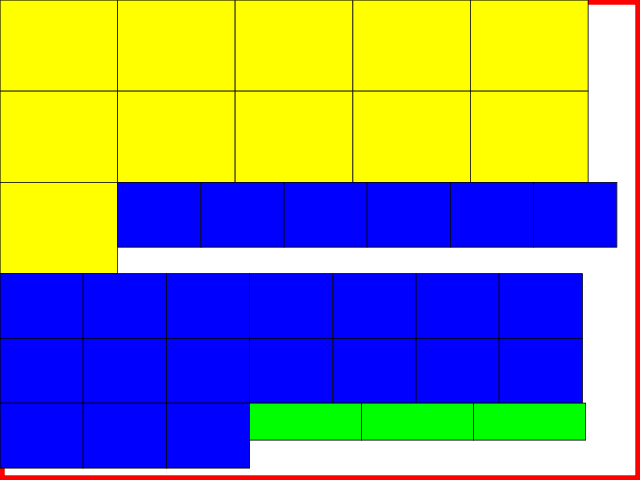
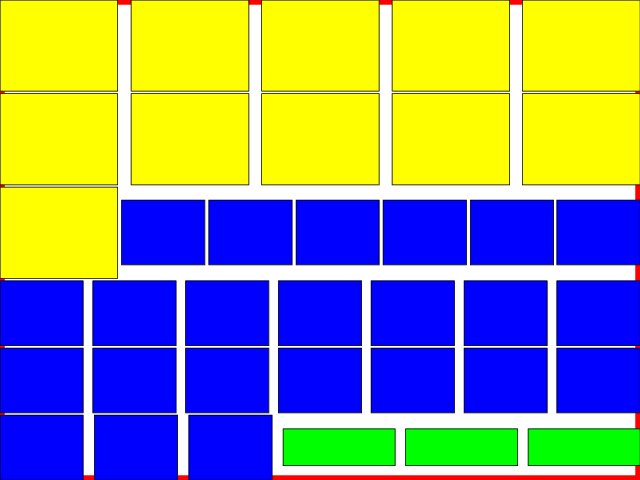
The results will be svg files test1.svg and test2.svg, the latter showing the spread-out result. Here is an example how the output looks like (without the red border which is drawn to mark the pallet border): arrange_spread2.py contains an adaption of arrange_spread.py for the actual problem. Permutations without known length When creating a layer out of articles of same height, then there are four strategies that I can choose from. It is four because there are two methods that I can either use or not. I can rotate the article by 90 per default or not and I can rotate the pallet or not. So every time that I build a new layer, there are those four options. Depending on which strategy I choose, there is a different amount of possible leftover articles that did not fit into any layer. The amount is different because each strategy is more or less efficient. To try out all combinations of possible layer arrangements, I have to walk through a tree where at each node I branch four times for each individual strategy. Individual neighboring nodes might be the same but this outcome is unlikely due to the path leading to those neighboring nodes being different. To simplify, lets name the four possible strategies for each layers 0, 1, 2 and 3. I now want an algorithm that enumerates through all possible permutations of those four numbers for "some" length. This is similar to counting. And the itertools module comes with the product() method that nearly does what I want. For example, should I know that my tree does not become deeper than 8 (read: no more than eight layers will be built), then I can just run:
>>> for i in itertools.product([0,1,2,3], repeat=8):
...     print i
...
(0,0,0,0,0,0,0,0)
(0,0,0,0,0,0,0,1)
(0,0,0,0,0,0,0,2)
(0,0,0,0,0,0,0,3)
(0,0,0,0,0,0,1,0)
(0,0,0,0,0,0,1,1)
(0,0,0,0,0,0,1,2)
(0,0,0,0,0,0,1,3)
This would work if the number of layers created with each strategy was the same. But as each strategy behaves differently depending on the input, it cannot be known before actually trying out a sequence of strategies, how many layers it will yield. The strategy (0,0,0,0,0,0,0,0) might create 7 layers, resulting in (0,0,0,0,0,0,0,1), (0,0,0,0,0,0,0,2) and (0,0,0,0,0,0,0,3) yielding the same output as only the first 7 strategies count. This would create duplicates which I should not waste cpu cycles on later. It might also be that (0,0,0,0,0,0,1,0) turns out to be a combination of strategies that creates more than 8 layers in which case the whole thing fails. So what I need is a generator, that gives me a new strategy depending on how often it is asked for one. It should dynamically extend the tree of possible permutations to accommodate for any size. Since the tree will become humongous (4^11 = 4194304), already traversed nodes should automatically be cleaned so that only the nodes that make the current list of strategies stays in memory at any point in time. This sounded all complicated which made me even more surprised by how simple the solution was in the end. Here a version of the algorithm that could easily be ported to C:
class Tree:
def __init__(self, branch_factor):
self.branch_factor = branch_factor
self.root = "value": None, "parent": None, "children": []
self.current = self.root

def next(self):
if not self.current["children"]:
self.current["children"] = [ "value":val, "parent":self.current, "children":[] for val in range(self.branch_factor)]
self.current = self.current["children"][0]
return self.current["value"]

def reset(self):
if self.current["parent"]:
self.current["parent"]["children"].pop(0)
else:
return False
if self.current["parent"]["children"]:
self.current = self.root
return True
else:
self.current = self.current["parent"]
return self.reset()

def __str__(self):
return str(self.root)
It would be used like this:
>>> tree = Tree(4)
>>> print tree.next(), tree.next(), tree.next()
>>> while tree.reset():
...     print tree.next(), tree.next(), tree.next()
Which would be equivalent to calling itertools.product([1,2,3,4], 3). The special part is, that in each iteration of the loop I can call tree.next() an arbitrary amount of times, just how much it is needed. Whenever I cannot generate an additional layer anymore, I can call tree.reset() to start a new permutation. For my code I used a python specific version which is a generator:
def product_varlength(branch_factor):
root = "value": None, "parent": None, "children": []
current = root
while True:
if not current["children"]:
current["children"] = [ "value":val, "parent":current, "children":[] for val in range(branch_factor)]
current = current["children"][0]
if (yield current["value"]):
while True:
if current["parent"]:
current["parent"]["children"].pop(0)
else:
return
if current["parent"]["children"]:
current = root
break
else:
current = current["parent"]
It is used like this:
it = product_varlength(4)
print it.next(), it.send(False), it.send(False)
while True:
    print it.send(True), it.send(False), it.send(False)
Again, the expression in the loop can have any number of it.send(False). The first it.send(True) tells the generator to do a reset.

20 May 2012

Gregor Herrmann: RC bugs 2012/20

I was on vacations for a few days last week, therefor my list of RC bugs is a bit shorter this time. thanks again to everyone who sent patches to the BTS that I could just use.

Ana Beatriz Guerrero Lopez: long due TO-DO item: removal of Qt3 from Debian

A couple of weeks ago was the first anniversary of orphaning Qt3 in Debian, see bug 625502. In this year, Qt3 has got a few QA uploads with the most relevant change being support to multiarch. And, more importantly, nobody seemed to care enough to step into maintaining it. In the last days, I have taken a look into how much needed to be done to remove Qt3 and there were slightly more than 50 packages depending directly or indirectly from Qt3. A removal from Wheezy seemed doable given that removing packages is never a problem during the Debian freeze ;-)
All the packages affected have a bug opened since more than one year and half ago and I have pinged all the bugs with some maintainers responding quick (thanks!). I also filed some removals for packages that were clearly unmaintained and didn t seem worth keeping, with ftp-masters responding quick too (Thanks!). And finally, a couple of QA upload for orphaned software that were still useful without Qt3. There is a wiki page tracking the status of the removal if you are curious:
http://wiki.debian.org/qt3-x11-freeRemoval If in the future, you are reading this and you need Qt3 in Wheezy, you can fetch it from Debian snapshots.

Next.

Previous.