Search Results: "ag"

30 March 2016

Ian Wienand: Durable photo workflow

Ever since my kids were born I have accumulated thousands of digital happy-snaps and I have finally gotten to a point where I'm quite happy with my work-flow. I have always been extremely dubious of using any sort of external all-in-one solution to managing my photos; so many things seem to shut-down, cease development or disappear, all leaving you to have to figure out how to migrate to the next latest thing (e.g. Picasa shutting down). So while there is nothing complicated or even generic about them, there are a few things in my photo-scripts repo that might help others who like to keep a self-contained archive. Firstly I have a simple script to copy the latest photos from the SD card (i.e. those new since the last copy -- this is obviously very camera specific). I then split by date so I have a simple flat directory layout with each week's photos in it. With the price of SD cards and my rate of filling them up, I don't even bother wiping them at this point, but just keep them in the safe as a backup. For some reason I have a bit of a thing about geotagging all the photos so I know where I took them. Certainly some cameras do this today, but mine does not. I have a two-progned approach; I have a geotag script and then a small website easygeotag.info which quickly lets met translate a point on Google maps to exiv2 command-line syntax. Since I take a lot of photos in the same place, the script can store points by name in a small file sourced by the script. Adding comments to the photos is done with perhaps the lesser-known cousin of EXIF -- IPTC. Some time ago I wrote python bindings for libiptcdata and it has been working just fine ever since. Debian's python-iptcdata comes with a inbuilt script to set title and caption, which is easily wrapped. What I like about this is that my photos are in a simple directory layout, with all metadata embedded within the actual image files in very standarised formats that should be readable by anywhere I choose to host them. For sharing, I then upload to Flickr. I used to have a command-line script for this, but have found the web uploader works even better these days. It reads the IPTC data for titles and comments, and gets the geotag info for nice map displays. I manually coralle them into albums, and the Flickr "guest pass" is perfect for then sharing albums to friends and family without making them jump through hoops to register on a site to get access to the photos, or worse, host them myself. I consider Flickr a cache, because (even though I pay) I expect it to shut-down or turn evil at any time. Interestingly, their AI tagging is often quite accurate, and I imagine will only get better. This is nice extra metadata that you don't have to spend time on yourself. The last piece has always been the "hit by a bus" component of all this. Can anyone figure out access to all these photos if I suddenly disappear? I've tried many things here -- at one point I was using rdiff-backup to sync encrypted bundles up to AWS for example; but I very clearly found the problem in that when I forgot the keep the key safe and couldn't unencrypt any of my backups (let alone anyone else figuring all this out). Finally Google Nearline seems to be just what I want. It's off-site, redundant and the price is right; but more importantly I can very easily give access to the backup bucket to anyone with a Google address, who can then just hit a website to download the originals from the bucket (I left the link with my other "hit by a bus" bits and pieces). Of course what they then do with this data is their problem, but at least I feel like they have a chance. This even has an rsync like interface in the client, so I can quickly upload the new stuff from my home NAS (where I keep the photos in a RAID0). I've been doing this now for 350 weeks and have worked through some 25,000 photos. I used to get an album up every week, but as the kids get older and we're closer to family I now do it in batches about once a month. I do wonder if my kids will ever be interested in tagged and commented photos with pretty much their exact location from their childhood ... I doubt it, but it's nice to feel like I have a good chance of still having them if they do.

Niels Thykier: Easter patching of Britney

I decided to take a couple of days of vacation next to Easter and obviously ended up with tons of time. I ended up channelling most of the (productive) time into improving Britney. In raw results: The most exciting items in the patch series are probably: Once reviewed, these will be merged into master and we will have versioned provides support (in Britney).:)
Filed under: Debian, Release-Team

Mike Gabriel: Pushing X.org Git repos to Github et al.

TL;DR; If you want to know why cloning several of the X.org repositories to Github or GitLab instances fails and how this can be worked around, you may want to continue reading. Why we stumbled over this issue... As a joint effort of the Arctica Project, TheQVD and X2Go, Ulrich Sibiller and I are currently preparing a build workflow for the nxagent X-server (version 3) [1] that allows building nxagent against the modular X.org 7.0 (using autoconf and automake) rather than the monolithic build workflow of X.org 6.9 (using ancient imake). Our goal is to rewind all X.org components required for building nxagent back to a state where nxagent successfully builds and runs. Then we will go through various, (probably) monthly cycles of Our first hurdle... After Ulrich now has a functioning nxagent-against-X.org-7.0-workflow locally, we want to get everything into the Arctica Project's Github namespace. Which fails...
[mike@minobo xorg.upstream]$ git clone https://anongit.freedesktop.org/git/xorg/lib/libX11.git
Cloning into 'libX11'...
remote: Counting objects: 18520, done.
remote: Compressing objects: 100% (3441/3441), done.
remote: Total 18520 (delta 15094), reused 18325 (delta 14954)
Receiving objects: 100% (18520/18520), 5.98 MiB   549.00 KiB/s, done.
Resolving deltas: 100% (15094/15094), done.
Checking connectivity... done.
[mike@minobo xorg.upstream]$ cd libX11/
[mike@minobo libX11 (master)]$ git remote rename origin upstream 
[mike@minobo libX11 (master)]$ git remote add origin git@github.com:ArcticaProject/libX11.git
[mike@minobo libX11 (master)]$ git push --mirror origin 
Counting objects: 18520, done.
Delta compression using up to 4 threads.
Compressing objects: 100% (3301/3301), done.
remote: error: object 70d5e4d45dd7bf1e05b099cb5a4dd529344084f0: missingSpaceBeforeDate: invalid author/committer line - missing space before date
remote: fatal: Error in object
error: pack-objects died of signal 13
error: failed to push some refs to 'git@github.com:ArcticaProject/libX11.git'
This issue should be a known issue at X.org / Mesa upstream [2]. The underlying problem occurs with Git 2.5 and above... If you run git-fsck from Git (>= 2.5) against several of the X.org Git repositories, you will stumble over the above issue. For libX11.git, we see these errors reported when running git-fsck from current Debian unstable:
mike@sid:~/xorg/libX11.git$ git fsck 
Checking object directories: 100% (256/256), done.
error in tag 70d5e4d45dd7bf1e05b099cb5a4dd529344084f0: missingSpaceBeforeDate: invalid author/committer line - missing space before date
error in tag a3bfe698090a5d41f1e9acb1b57a049085d6b04e: missingSpaceBeforeDate: invalid author/committer line - missing space before date
error in tag c1fc8c9aec1bc92d03d08d5e986dd40b194a7a3e: missingSpaceBeforeDate: invalid author/committer line - missing space before date
error in tag d4c27f7e7d8e2ea32418f341ad85c33f3b76862d: missingSpaceBeforeDate: invalid author/committer line - missing space before date
error in tag 79780379aee21bf4d4bcb046a3b54774893ea6b1: missingSpaceBeforeDate: invalid author/committer line - missing space before date
error in tag a638de80ec20dc1de625cd323ed19a6646fecf2e: missingSpaceBeforeDate: invalid author/committer line - missing space before date
error in tag f6a6414e4e52a971a35fd118c350567e2383d034: missingSpaceBeforeDate: invalid author/committer line - missing space before date
error in tag b5c6810e21be2e7ccfac8f0539d46bf75dbe50a0: missingSpaceBeforeDate: invalid author/committer line - missing space before date
error in tag 86cec9d20428cc190ec7278a0abe481b180288ac: missingSpaceBeforeDate: invalid author/committer line - missing space before date
error in tag ac912988091574790c7cffbbc2c60b8c59f8fcef: missingSpaceBeforeDate: invalid author/committer line - missing space before date
error in tag 2d01674092951cd3284b3b099978b2436ea468ad: missingSpaceBeforeDate: invalid author/committer line - missing space before date
error in tag 922d0534154668918eaa09a36cc5cd53fc6b71b7: missingSpaceBeforeDate: invalid author/committer line - missing space before date
error in tag 8ef91b9cc0a4a7b0361f6b40b3f735221c8272cb: missingSpaceBeforeDate: invalid author/committer line - missing space before date
error in tag 1516173727005a87aa501e1ad708d72e6ae6e753: missingSpaceBeforeDate: invalid author/committer line - missing space before date
error in tag 77c9e63a3abff1593ccbed249b2c3ae7f68e1833: missingSpaceBeforeDate: invalid author/committer line - missing space before date
error in tag 58044c7087137ce2b521297dbb31934ccaedc94e: missingSpaceBeforeDate: invalid author/committer line - missing space before date
error in tag 2e0d061c6830891dcc856a04aac900e5bb6d0779: missingSpaceBeforeDate: invalid author/committer line - missing space before date
error in tag 2f58c7cc4cbf3d30927f6301039b6bf018ed38fd: missingSpaceBeforeDate: invalid author/committer line - missing space before date
error in tag 77fc2e1e26019c3ba92275d249fe1979570255d2: missingSpaceBeforeDate: invalid author/committer line - missing space before date
error in tag 9b2e06fa262f23dbcbbccd42be6477e08a452268: missingSpaceBeforeDate: invalid author/committer line - missing space before date
error in tag 7f99410bb9cc9f7cbbc2d43d8ad044771a6eec0a: missingSpaceBeforeDate: invalid author/committer line - missing space before date
error in tag 99b59b83f126b4abb9da89f577a5b8147d543c25: missingSpaceBeforeDate: invalid author/committer line - missing space before date
error in tag 97170c33f99761acd932f968e21d6d7664e7ba80: missingSpaceBeforeDate: invalid author/committer line - missing space before date
error in tag b39966d452127c992987d082f69321f950ae4c39: missingSpaceBeforeDate: invalid author/committer line - missing space before date
error in tag 05e20c3bd8ac6b7e873607db73894486a4ac0519: missingSpaceBeforeDate: invalid author/committer line - missing space before date
error in tag f478497b5a3e9d6b92237e0f408c9f0f18108f52: missingSpaceBeforeDate: invalid author/committer line - missing space before date
error in tag c5ed936f28ce70c8932e33d67a6e06d140e35ba8: missingSpaceBeforeDate: invalid author/committer line - missing space before date
error in tag 2b6beba295a6ff997dfe15a732c95ae6577fa735: missingSpaceBeforeDate: invalid author/committer line - missing space before date
error in tag 32edbb1e9c5b7d1c6f8639dab85e5368d303df7f: missingSpaceBeforeDate: invalid author/committer line - missing space before date
error in tag 490fbe2afb9ffc7057c0eb150f7cdd4d4fa8686c: missingSpaceBeforeDate: invalid author/committer line - missing space before date
error in tag fc605ac48bd7d675d6d04162a0f3bfebe27f2037: missingSpaceBeforeDate: invalid author/committer line - missing space before date
error in tag 6289ecc26d1d505f395c59da744a9354d7aad2a2: missingSpaceBeforeDate: invalid author/committer line - missing space before date
error in tag 8c9c30dac72aebd1a2c31a55a47c0ac11bc328db: missingSpaceBeforeDate: invalid author/committer line - missing space before date
error in tag 3b7aa57994924be0dad693e837559d9ee900299c: missingSpaceBeforeDate: invalid author/committer line - missing space before date
error in tag b02ad9a8ec96e3c1027ca71289aeef5b8748e17e: missingSpaceBeforeDate: invalid author/committer line - missing space before date
error in tag 4402ab1a86226a9cd0ce84fb8147b1c4958c684d: missingSpaceBeforeDate: invalid author/committer line - missing space before date
error in tag bb02b4fbde316644c771d28d5edeeb9b213a6d6a: missingSpaceBeforeDate: invalid author/committer line - missing space before date
error in tag 95b6462c70213b562c9d2b8726eda706edc9c456: missingSpaceBeforeDate: invalid author/committer line - missing space before date
error in tag a99fea43ad53907623f269942c55237c238645e0: missingSpaceBeforeDate: invalid author/committer line - missing space before date
error in tag 0c417ce98a6cf927ce7a1359b198b2bb746c707e: missingSpaceBeforeDate: invalid author/committer line - missing space before date
error in tag ce3ff6b102f360fc9dcd3a85361f44da054de0b1: missingSpaceBeforeDate: invalid author/committer line - missing space before date
error in tag 2fb7b16b38a365c5009bd170d4463634c1f3de26: missingSpaceBeforeDate: invalid author/committer line - missing space before date
error in tag 95570f484bfde5fc2ed8548cb17b87d8114a2866: missingSpaceBeforeDate: invalid author/committer line - missing space before date
error in tag d6e5895c104cfe0d135494a605013dd2910a93a1: missingSpaceBeforeDate: invalid author/committer line - missing space before date
error in tag 49be7144523c4a56afcb389a9aa021d167710d2c: missingSpaceBeforeDate: invalid author/committer line - missing space before date
error in tag 020353d1b982ac938d229039ca13bfea5793fcd9: missingSpaceBeforeDate: invalid author/committer line - missing space before date
error in tag 991792d4f8477ab65ad4d8a0245c9a3bbb1f0294: missingSpaceBeforeDate: invalid author/committer line - missing space before date
error in tag e8037555efe299a7143370b485f754f6b08ffac7: missingSpaceBeforeDate: invalid author/committer line - missing space before date
error in tag 4fdc8e36a5022f3e32d5567305d8e9cde4011f1a: missingSpaceBeforeDate: invalid author/committer line - missing space before date
error in tag 9c93a19a76163328e30a7306bb0babe3175fb9a2: missingSpaceBeforeDate: invalid author/committer line - missing space before date
error in tag 9f90bf4424250f80340b3e2803d343c74d2adb0b: missingSpaceBeforeDate: invalid author/committer line - missing space before date
error in tag 2e7a8c7974777e3e869de9013025dc3f61633e1e: missingSpaceBeforeDate: invalid author/committer line - missing space before date
error in tag 59b7c06da2a64d72668394e9239e3dfe8a5cff59: missingSpaceBeforeDate: invalid author/committer line - missing space before date
error in tag 0263c4f684faa9a5126a0db524d5d35be7277e52: missingSpaceBeforeDate: invalid author/committer line - missing space before date
error in tag 1514e654c1a9b346cbfca5a81f6d331f106242aa: missingSpaceBeforeDate: invalid author/committer line - missing space before date
error in tag 6aa83ec3d1d82ee332cedcf4e99d3cbd56e73edd: missingSpaceBeforeDate: invalid author/committer line - missing space before date
Checking objects: 100% (18523/18523), done.
What actually is going wrong here... When looking at one of those tags (luckily, only tags are affected), we see that something's not ok with the date string of the tag (I am not a Git plumber, so sorry for being superficial here):
mike@sid:~/xorg/libX11.git$ git show 2fb7b16b38a365c5009bd170d4463634c1f3de26
tag XORG-RELEASE-1-TM-MERGE
Tagger: Alan Coopersmith 
Date:   Thu Jan 1 00:00:00 1970 +0000
        ^^^^^^^^^^^^^^^^^^^^^^^^^^^^^
commit 84adc60cae8e944777563501dd633622a28bdb3b
Author: Alan Coopersmith 
Date:   Sat Mar 27 07:08:16 2004 +0000
    Fix typo (IsModiferKey should be IsModifierKey)
[... not quoting the diff for the above commit ...]
How to work around that issue... We then got the idea that we could redo those tags with the date string derived from the commit that this tag points at. This can be scripted (credits go to an unnamed person in Ulrich's surrounding!!!):
mike@sid:~/xorg/libX11$ cat repair.sh
#!/bin/bash
set -x
git fsck 2>&1   tee git-fsck.log   grep "error in tag"   sed -r -e 's/error in tag ([0-9a-f]+):.*/\1/p'   while read broken; do
         echo $broken
         commit=$(git rev-parse $ broken ^ commit )
         tag=$(git cat-file tag $broken   sed -n 's/^tag //p')
         tag_msg=$(git cat-file tag $broken   sed -n '/^$/,$p'   tail -n +2)
         export GIT_COMMITTER_NAME="$(git log -1 --format='%cn' $commit)"
         export GIT_COMMITTER_EMAIL="$(git log -1 --format='%ce' $commit)"
         export GIT_COMMITTER_DATE="$(git log -1 --format='%cD' $commit)"
         git tag -a -f -m "$tag_msg" $tag $commit
done
# drop all old content...
git reflog expire --expire=all --all
git gc --prune=all
# no more errors should be reported...
git fsck
Copy this repair.sh into the Git repo itself and let the script walk over your tags. After this script has been applied you can push the X.org Git repo with broken tags redone to Git hosters like Github or GitLab. light+love,
Mike [1] https://github.com/ArcticaProject/nx-libs
[2] https://lists.freedesktop.org/archives/mesa-dev/2016-February/106268.html

Bits from Debian: DebConf16 welcomes its first nine sponsors!

DebConf16 logo DebConf16 will take place in Cape Town, South Africa in July 2016. We strive to provide an intense working environment and enable good progress for Debian and for Free Software in general. We extend an invitation to everyone to join us and to support this event. As a volunteer-run non-profit conference, we depend on our sponsors. Nine companies have already committed to sponsor DebConf16! Let's introduce them: Our first Platinum sponsor is Hewlett Packard Enterprise (HPE). HPE is one of the largest computer companies in the world, providing a wide range of products and services, such as servers, storage, networking, consulting and support, software, and financial services. HPE is also a development partner of Debian, and provides hardware for port development, Debian mirrors, and other Debian services (hardware donations are listed in the Debian machines page). Our first Gold sponsor is Valve, a company developing games, social entertainment platform, and game engine technologies. Our second Gold sponsor is Google, the technology company specialized in Internet-related services as online advertising and search engine. Rusbitech (developers of the Astra Linux Debian derivative), credativ (a service-oriented company focusing on open-source software and also a Debian development partner), Catalyst (a company offering IT solutions using open source software), the Bern University of Applied Sciences (with over 7,000 students enrolled, located in the Swiss capital), and Texas Instruments (the global semiconductor company) are our four Silver sponsors. And last but not least, the open source company Univention has agreed to support us as Bronze-level. Become a sponsor too! Would you like to become a sponsor? Do you know of or work in a company or organization that may consider sponsorship? Please have a look at our sponsorship brochure (or a summarized flyer), in which we outline all the details and describe the sponsor benefits. For further details, feel free to contact us through sponsors@debconf.org, and visit the DebConf16 website at https://debconf16.debconf.org.

Julien Danjou: The OpenStack Schizophrenia

When I started contributing to OpenStack, almost five years ago, it was a small ecosystem. There were no foundation, a handful of projects and you could understand the code base in a few days. Fast forward 2016, and it is a totally different beast. The project grew to no less than 54 teams, each team providing one or more deliverable. For example, the Nova and Swift team each one produces one service and its client, whereas the Telemetry team produces 3 services and 3 different clients. In 5 years, OpenStack went to a few IaaS projects, to 54 different teams tackling different areas related to cloud computing. Once upon a time, OpenStack was all about starting some virtual machines on a network, backed by images and volumes. Nowadays, it's also about orchestrating your network deployment over containers, while managing your application life-cycle using a database service, everything being metered and billed for. This exponential growth has been made possible with the decision of the OpenStack Technical Committee to open the gates with the project structure reform voted at the end of 2014. This amendment suppresses the old OpenStack model of "integrated projects" (i.e. Nova, Glance, Swift ). The big tent, as it's called, allowed OpenStack to land new projects every month, growing from the 20 project teams of December 2014 to the 54 we have today multiplying the number of projects by 2.7 in a little more than a year. Amazing growth, right? And this was clearly a good change. I sat at the Technical Committee in 2013, when projects were trying to apply to be "integrated", after Ceilometer and Heat were. It was painful to see how the Technical Committee was trying to assess whether new projects should be brought in or not. But what I notice these days, is how OpenStack is still stuck between its old and new models. On one side, it accepted a lot of new teams, but on the other side, many are considered as second-class citizens. Efforts are made to continue to build an OpenStack project that does not exist anymore. For example, there is a team trying to define what's OpenStack core, named DefCore. That is looking to define which projects are, somehow, actually OpenStack. This leads to weird situations, such as having non-DefCore projects seeing their doc rejected from installation guides. Again, I reiterated my proposal to publish documentation as part of each project code to solve that dishonest situation and put everything on a level playing field Some cross-projects specs are also pushed without implication of all OpenStack projects. For example, The deprecate-cli spec which proposes to deprecate command-line interface tools proposed by each project had a lot of sense in the old OpenStack sense, where the goal was to build a unified and ubiquitous cloud platform. But when you now have tens of projects with largely different scopes, this start making less sense. Still, this spec was merged by the OpenStack Technical Committee this cycle. Keystone is the first project to proudly force users to rely on openstack-client, removing its old keystone command line tool. I find it odd to push that specs when it's pretty clear that some projects (e.g. Swift, Gnocchi ) have no intention to go down that path. Unfortunately, most specs pushed by the Technical Committee are in the realm of wishful thinking. It somehow makes sense, since only a few of the members are actively contributing to OpenStack projects, and they can't by themselves implement all of that magically. But OpenStack is no exception in the free software world and remains a do-ocracy. There is good cross-project content in OpenStack, such as the API working group. While the work done should probably not be OpenStack specific, there's a lot that teams have learned by building various HTTP REST API with different frameworks. Compiling this knowledge and offering it as a guidance to various teams is a great help. My fellow developer Chris Dent wrote a post about what he would do on the Technical Committee. In this article, he points to a lot of the shortcomings I described here, and his confusion between OpenStack being a product or being a kit is quite understandable. Indeed, the message broadcasted by OpenStack is still very confusing after the big tent openness. There's no enough user experience improvement being done. The OpenStack Technical Committee election is opened for April 2016, and from what I read so far, many candidates are proposing to now clean up the big tent, kicking out projects that do not match certain criteria anymore. This is probably a good idea, there is some inactive project laying around. But I don't think that will be enough to solve the identity crisis that OpenStack is experiencing. So this is why, once again this cycle, I will throw my hat in the ring and submit my candidacy for OpenStack Technical Committee.

Colin Watson: Re-signing PPAs

Julian has written about their efforts to strengthen security in APT, and shortly before that notified us that Launchpad s signatures on PPAs use weak SHA-1 digests. Unfortunately we hadn t noticed that before; GnuPG s defaults tend to result in weak digests unless carefully tweaked, which is a shame. I started on the necessary fixes for this immediately we heard of the problem, but it s taken a little while to get everything in place, and I thought I d explain why since some of the problems uncovered are interesting in their own right. Firstly, there was the relatively trivial matter of using SHA-512 digests on new signatures. This was mostly a matter of adjusting our configuration, although writing the test was a bit tricky since PyGPGME isn t as helpful as it could be. (Simpler repository implementations that call gpg from the command line should probably just add the --digest-algo SHA512 option instead of imitating this.) After getting that in place, any change to a suite in a PPA will result in it being re-signed with SHA-512, which is good as far as it goes, but we also want to re-sign PPAs that haven t been modified. Launchpad hosts more than 50000 active PPAs, though, a significant percentage of which include packages for sufficiently recent Ubuntu releases that we d want to re-sign them for this. We can t expect everyone to push new uploads, and we need to run this through at least some part of our usual publication machinery rather than just writing a hacky shell script to do the job (which would have no idea which keys to sign with, to start with); but forcing full reprocessing of all those PPAs would take a prohibitively long time, and at the moment we need to interrupt normal PPA publication to do this kind of work. I therefore had to spend some quality time working out how to make things go fast enough. The first couple of changes (1, 2) were to add options to our publisher script to let us run just the one step we need in careful mode: that is, forcibly re-run the Release file processing step even if it thinks nothing has changed, and entirely disable the other steps such as generating Packages and Sources files. Then last week I finally got around to timing things on one of our staging systems so that we could estimate how long a full run would take. It was taking a little over two seconds per archive, which meant that if we were to re-sign all published PPAs then that would take more than 33 hours! Obviously this wasn t viable; even just re-signing xenial would be prohibitively slow. The next question was where all that time was going. I thought perhaps that the actual signing might be slow for some reason, but it was taking about half a second per archive: not great, but not enough to account for most of the slowness. The main part of the delay was in fact when we committed the database transaction after processing each archive, but not in the actual PostgreSQL commit, rather in the ORM invalidate method called to prepare for a commit. Launchpad uses the excellent Storm for all of its database interactions. One property of this ORM (and possibly of others; I ll cheerfully admit to not having spent much time with other ORMs) is that it uses a WeakValueDictionary to keep track of the objects it s populated with database results. Before it commits a transaction, it iterates over all those alive objects to note that if they re used in future then information needs to be reloaded from the database first. Usually this is a very good thing: it saves us from having to think too hard about data consistency at the application layer. But in this case, one of the things we did at the start of the publisher script was:
def getPPAs(self, distribution):
    """Find private package archives for the selected distribution."""
    if (self.isCareful(self.options.careful_publishing) or
            self.options.include_non_pending):
        return distribution.getAllPPAs()
    else:
        return distribution.getPendingPublicationPPAs()
def getTargetArchives(self, distribution):
    """Find the archive(s) selected by the script's options."""
    if self.options.partner:
        return [distribution.getArchiveByComponent('partner')]
    elif self.options.ppa:
        return filter(is_ppa_public, self.getPPAs(distribution))
    elif self.options.private_ppa:
        return filter(is_ppa_private, self.getPPAs(distribution))
    elif self.options.copy_archive:
        return self.getCopyArchives(distribution)
    else:
        return [distribution.main_archive]
That innocuous-looking filter means that we do all the public/private filtering of PPAs up-front and return a list of all the PPAs we intend to operate on. This means that all those objects are alive as far as Storm is concerned and need to be considered for invalidation on every commit, and the time required for that stacks up when many thousands of objects are involved: this is essentially accidentally quadratic behaviour, because all archives are considered when committing changes to each archive in turn. Normally this isn t too bad because only a few hundred PPAs need to be processed in any given run; but if we re running in a mode where we re processing all PPAs rather than just ones that are pending publication, then suddenly this balloons to the point where it takes a couple of seconds. The fix is very simple, using an iterator instead so that we don t need to keep all the objects alive:
from itertools import ifilter
def getTargetArchives(self, distribution):
    """Find the archive(s) selected by the script's options."""
    if self.options.partner:
        return [distribution.getArchiveByComponent('partner')]
    elif self.options.ppa:
        return ifilter(is_ppa_public, self.getPPAs(distribution))
    elif self.options.private_ppa:
        return ifilter(is_ppa_private, self.getPPAs(distribution))
    elif self.options.copy_archive:
        return self.getCopyArchives(distribution)
    else:
        return [distribution.main_archive]
After that, I turned to that half a second for signing. A good chunk of that was accounted for by the signContent method taking a fingerprint rather than a key, despite the fact that we normally already had the key in hand; this caused us to have to ask GPGME to reload the key, which requires two subprocess calls. Converting this to take a key rather than a fingerprint gets the per-archive time down to about a quarter of a second on our staging system, about eight times faster than where we started. Using this, we ve now re-signed all xenial Release files in PPAs using SHA-512 digests. On production, this took about 80 minutes to iterate over around 70000 archives, of which 1761 were modified. Most of the time appears to have been spent skipping over unmodified archives; even a few hundredths of a second per archive adds up quickly there. The remaining time comes out to around 0.4 seconds per modified archive. There s certainly still room for speeding this up a bit. We wouldn t want to do this procedure every day, but it s acceptable for occasional tasks like this. I expect that we ll similarly re-sign wily, vivid, and trusty Release files soon in the same way.

NOKUBI Takatsugu: GAME-ON the historical videogame exhibition

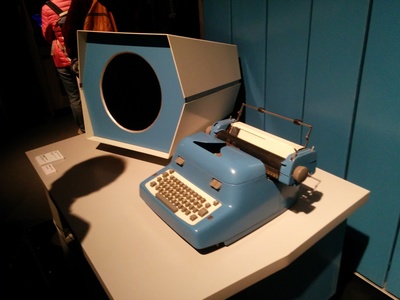
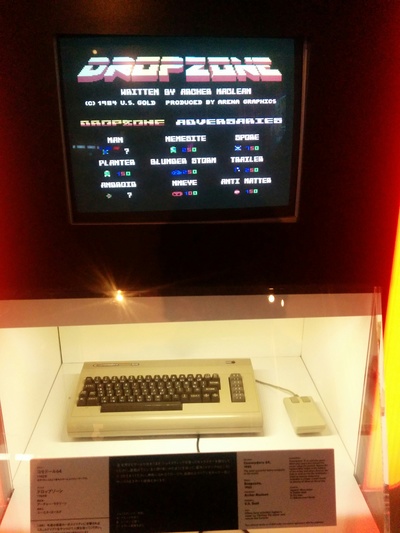
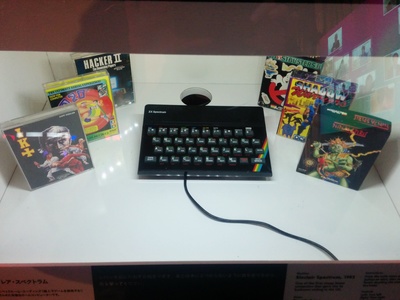
I attended GAME-ON last weedkend at Miraikan, The National Museum of Emerging Science and Innovation in Tokyo. There are many historical videogame hardware and software, and the bland-new PSVR exibition. DEC PDP-1 DisplayI can see the real DEC PDP-1 hardware. Unfortunately it is only haredware, not worked. And also PONG is exibited.
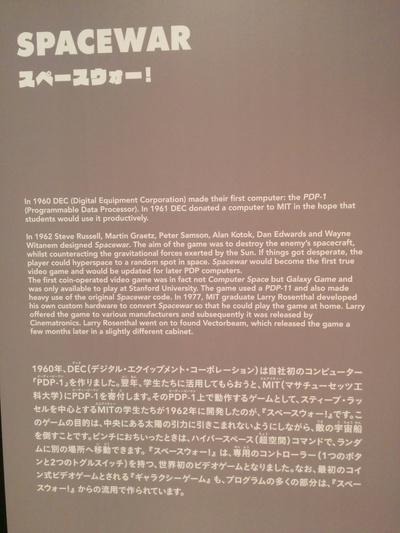
SPACEWAR description

SPACEWAR description

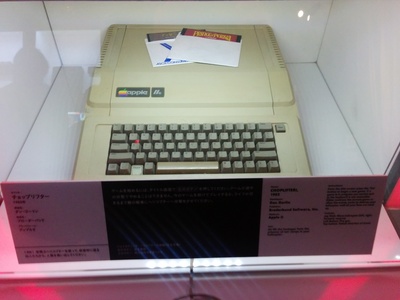
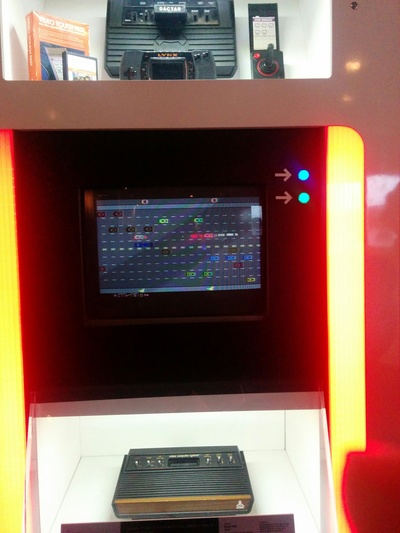
There are many old hardware Atari 2600, Commodore 64, Spectrum, and so on. Apple IIe Atari 2600/VCS Commodore 64 Spectrum Almost exhibition with English description, and officials can talk English, if you feel interested, go Miraikan until 30th May.

Patrick Matth i: Current jessie-backports packaging work in march

Hey, I have uploaded some new already accepted packages to jessie-backports: I hope you enjoy the current versions in Debian 8. :-)

29 March 2016

Michal Čihař: Weekly phpMyAdmin contributions 2016-W12

Last week we've finally released phpMyAdmin 4.6.0. That also means that 4.5.5 is out of maintenance now (however 4.4.15 and 4.0.10 are still supported if you're stuck with older PHP or MySQL versions for some reason). The biggest focus was spent on handling incoming issues and checking if they are still present in 4.6.0 what in most cases proven not to be true. Handled issues:

Filed under: English phpMyAdmin 0 comments

Rog rio Brito: Partially switching to Chromium

In the interest of being as brief as possible (just ask for details if you want to know more or if you think that it would help), I have started, against my preferences, to start using chromium from Debian instead of Firefox (aka, Iceweasel). The reason? I have a slow computer (a Core 2 Duo T7250). My main computer. My workhorse. There are some sites that even with an empty profile and a vanilla Firefox build right from Mozilla Foundation cause Firefox to generate a very heavy CPU load. I briefly reported this via Twitter to one (but not the only!) of the sites in question and to Firefox Site Compatibility. What do I see? Many CSS and redraw events (thanks to Firefox's profiling tools). In fact, as many events that Firefox alone is able to completely take over 1 (of the 2) cores that I have, with just that single tab open. I don't see those problems with Chromium, unfortunately (or, at least, they are not that perceptible to my computer's CPU). So, before I go on and formally file a bug report, I would love to confirm if other people see the same problems that I am seeing. Do you also see something similar? Your input is highly welcome!

28 March 2016

Rhonda D'Vine: Ich bin was ich bin

As my readers probably are well aware, I wrote my transgender coming out poem Mermaids over 10 years ago, to make it clear to people how I define, what I am and how I would hope they could accept me. I did put it publicly into my blog so I could point people to it. And I still do so regularly. It still comes from the bottom of my heart. And I am very happy that I got the chance to present it in a Poetry Slam last year, it was even recorded and uploaded to YouTube. There is just one thing that I was also told over the time every now and then by some people that I would have liked to understand what's going on: Why is it in English, my English isn't that good. My usual response was along the lines of that the events that triggered me writing it were in an international context and I wanted to make sure that they understood what I wrote. At that time I didn't realize that I am cutting out a different group of people from being able to understand what's going on inside me. So this year there was a similar event: the Flawless Poetry Slam which touched the topics of Feminist? Queer? Gender? Rolemodels? - Let's talk about it. I took that as motivation to finally write another text on the topic, and this time in German. Unfortunately though I wasn't able to present it that evening, I wasn't drawn for the lineup. But, I was told that there was another slam going on just last wednesday, so I went there ... and made it onto the stage! And this is the text that I presented there. I am uncertain how well online translators work for you, but I hope you get the core points if you don't understand German:
Ich bin was ich bin
F nf Worte mit wahrem Sinn:
Ich bin was ich bin Du denkst: "Mann im Rock?
Das ist ja wohl l cherlich,
der ist sicher schwul." "Fingernagellack?
Na da schau ich nicht mehr hin,
wer will das schon seh'n." Jedoch liegst du falsch,
Mit all deinen Punkten, denn:
Ich bin was ich bin. Ich bin Transgender
Und erlebe mich selber,
ich bin eine Frau. "Haha, eine Frau?
Wem willst du das weismachen?
Heb mal den Rock hoch!" Und wie ist's bei dir?
Was ist zwischen den Beinen?
Geht mich das nichts an? Warum fragst du mich?
Da ist's dann in Ordnung?
Oder vielleicht nicht? Ich bin was ich bin
F nf Worte mit ernstem Sinn:
Ich bin was ich bin Ich steh weiblich hier
Und das hier ist mein K rper
Mein Geschlecht ist's auch Oberfl chlichkeit
Das ist mein gr tes Problem
Schl gt mir entgegen Wenn ich mich ffne
Verst ndnis fast berall
Es wird akzeptiert Doch gelegentlich
und das schmerzt mich am meisten
sagt doch mal wer "er" Von Fremden? Egal
Doch hab ich mich ge ffnet
Ist es eine Qual "Ich seh dich als Mann"
Da ist, was es transportiert
Akzeptanz? Dahin Meine Pronomen
Wenn ihr ber mich redet
sind sie, ihr, ihres Ich leb was ich leb
F nf Worte mit tiefem Sinn:
Ich bin was ich bin "Doch, wie der erst spricht!
Ich meinte, wie sie denn spricht!
Das ist nicht normal." Ich schreib hier Haikus:
Japanische Gedichtsform
Mit fixem Versmars Sind f nf, sieben, f nf
Silben in jeder Zeile
Haikus sind simpel Probier es mal aus
Transportier eine Message
Es macht auch viel Spa Wortwahl ist wichtig
Ein guter Thesaurus hilft
Sei kurz und pr gnant Ich sag was ich sag
F nf Worte mit klugem Sinn:
Ich bin was ich bin Doch ich schweife ab
Verst ndnis fast berall?
Wird es akzeptiert? Erstaunlicherweise
Doch ich bin auch was and'res
Und hier geht's bergab Eine Sache gibt's
Die erw h'n ich besser nicht
f r die steck ich ein "Deshalb bin ich hier"
So der Titel eines Lieds
verfasst von Thomas D "Wenn ich erkl re
warum ich mich wie ern hr"
So weit komm ich nicht Man erw hnt Vegan
Die Intoleranz ist da
Man ist unten durch "Mangelerscheinung!"
"Das Essen meines Essens!"
Akzeptanz ade Hab 'ne Theorie:
Vegan sein: 'ne Entscheidung
Transgender sein nicht Mensch f hlt sich dann schlecht
dass bei sich selbst die Kraft fehlt
und greift damit an "Ich k nnte das nicht"
Ich verurteile dich nicht
Iss doch was du willst Ich zwing es nicht auf
Aber R cksicht w r schon fein
Statt nur Hohn und Schm h Ich ess was ich ess
F nf Worte zum nachdenken:
Ich bin was ich bin
Hope you get the idea. The audience definitely liked it, the jury wasn't so much on board but that's fine, it's five random people and it's mostly for fun anyway. Later that night though some things happened that didn't make me feel so comfortable anymore. I went to the loo, waiting in line with the other ladies, a bit later the waitress came along telling me "the men's room is over there". I told her that I'm aware of that and thanked her, which got her confused and said something along the lines of "so you are both, or what?" but went away after that. Her tone and response wasn't really giving me much comfort, though none of the other ladies in the line did look strangely.
But the most disturbing event after that was to find out about North Carolina signed the bathroom bill making it illegal for trans people to use the bathroom for their gender and insisting on using the one for the gender they were assigned at birth. So men like James Sheffield are now forced to go to the lady's restroom, or face getting arrested. Brave new world. :/ So, enjoy the text and don't get too wound up by stupid laws and hope for time to fix people's discriminatory minds for fixing issues that already are regulated: Assaults are assaults and are already banned. Arguing with people might get assaulted and thus discriminating trans people is totally missing the point, by miles.

/personal permanent link Comments: 2 Flattr this

Lucy Wayland: Stuffed Butternut Squash

This is a fusion recipe from a rather bland just stuff it with ricotta recipe I saw, David Scott s The Peniless Vegetarian , and my own mutations on those themes. I can t give you exact quantities, just make a little more than you will make the hollowed mound (grin), and the rest will make an excellent pasta sauce. Ingredients For an average sized butternut squash, you will need:
1 onion (I prefer red)
3 cloves of garlic
1 capsicum pepper (I prefer green, my ex- preferred red)
Some red lentils
Optional green or brown lentils for texture and flavour. I used some puy
The lentil quantity is hard to estimate, but I ratio 4 red to 1 optional.
Roughly one handful of chopped mushrooms i.e. when chopped, it is one handful
1 tin tinned tomatoes
Some tomato puree
A generous amout of garam masala garam masala is what brings out the flavout in lentils
Some paprike
Optional chilli if using chilli, I recommend fresh of course.
Optional Balsamic vinegar
Optional Marmite Preperation of the Squash
1. Cut the butternut squash in half, length ways. This is very hard, you will need a good large knife, and may require you jumping up and down into the air. This is the second most hard of the procedure. 2. For each half, scoop out the seeds, and pare back the bowl till it is no longer overly fibrous. Discard this, or find a use for the seeds. 3. For each half, scoop a channel of the softer flesh up from the baisin up near the top. This has to be done by feel, is hard and thankless work. Also experimentation required. Reserve this flesh. Preperation of the Filling This is just basically a nice lentil sauce that can be used with pasta, rice, toast etc. Important: this is not a stir fry, but a largish, heavy bottom pan is recommended. 1. Finely peel then chopp the onions and the garlic. Chopp the chillis if used (I am a chilli gal). Please observe Chilli Protocol[0] 2. Wash and chop the pepper and mushrooms. Not finely diced, but not crudite-sized slices. Remember that peppers shrivel down a little, mushrooms a lot. 3. Start frying the onions for a while in some oil (I prefer olive, but others are acceptible), until they just about to go translucent. Then add the garlic and optional chillis until the garlic is just cooking nicely. 4. Add the spices, turn over until all the containts of the pan are covered, and cook for another 30 seconds or so. Then add the tinned tomato, and then add half a can of cold water water which rinsed the tin out with. Stir this around, and make sure it is now at just at a simmer or pre-simmer. 5. Add the lentils. You want 0.5-1 cm of water above the lentils when you have added and stirred. Let these cook and expand for about 5 mins, stirring all the while, all the lentils will stick to the bottom. 6. Add the pepper, mushroom, reserved squash flesh, and optional dash of balsamic vinegar, and half a tea spoon of marmite. Cook and stir until the pepper goes soft. This is the hard part. Add boiling water if really too thick, or some tomato puree if too thin. There is no hard science to this, you want at the end of 10 minutes or so something resembling the thickness in texture of a stiff bolognaise sauce. Assembly
1. Have a baking tray. Whether you prefer to grease, line with foil, or line with baking parchment is up to you. I prefer baking parchment. 2. Stuff those two halves of butternut squash with that sauce you made. It should make a mound of about 1cm about the level. If you feel extravagent, and are not vegan, sprinkle a little grated cheese on top. 3. Place in a pre-heated oven of 200oC. Cooking time should be about 20 mins, but larger ones take longer. The acid test is to briefly take them out, and prod the lower side with a fork. It should go through the skin with little resistance. When ready, serve. It s really a dish in itself, but some people might like a bit of salad, or maybe a light green risotto.

Andreas Metzler: exim4 stable update - testing requested

I have prepared an update for exim4, targeted at stable and would appreciate some testing / second eyes. https://people.debian.org/~ametzler/exim-dsa/
git repo on alioth Changes: Please send your feedback to ametzler(at)debian.org or exim4(at)packages.debian.org.

Lars Wirzenius: Obnam user survey, 2016

In January and February of 2016 I ran an Obnam user survey. I'm not a statistician, but here is my analysis of the results. Executive summary: Obnam is slow, buggy, and the name is bad. But they'd like to buy stickers and t-shirts. Method I wrote up a long list of questions about things I felt were of interest to me. I used Google Forms to collect responses, and exported them as a CSV file, and analysed based on that. I used Google Forms, even though it is not free software, as it was the easiest service I got to work that also seemed it'd be nice for people to use. I could have run the survey using Ikiwiki, but it wouldn't have been nearly as nice. I could have found and hosted some free software for this, but that would have been much more work. Most questions had free form text responses, and this was both good and bad. It was good, because many of the responses included things I could never have expected. It was bad, because it took me a lot more time and effort to process those. I think next time I'll keep the number of free text responses down. For some of the questions, I hand-processed the responses to a more or less systematic form, in order to count things with a bit of code. For others, I did not, and show the full list of responses (I'm lazy, we don't need a survey to determine that). The responses See http://code.liw.fi/obnam/survey-2016.html for the responses, after hand-processing. For the questions for which it makes sense, a script has tabulated the various responses and calculated percentages. I haven't produced graphs, as I don't know how to do that easily. (Maybe next time I'll enlist the help of statisticians.) Conclusions

Joey Hess: type safe multi-OS Propellor

Propellor was recently ported to FreeBSD, by Evan Cofsky. This new feature led me down a two week long rabbit hole to make it type safe. In particular, Propellor needed to be taught that some properties work on Debian, others on FreeBSD, and others on both. The user shouldn't need to worry about making a mistake like this; the type checker should tell them they're asking for something that can't fly.

-- Is this a Debian or a FreeBSD host? I can't remember, let's use both package managers!
host "example.com" $ props
    & aptUpgraded
    & pkgUpgraded
As of propellor 3.0.0 (in git now; to be released soon), the type checker will catch such mistakes. Also, it's really easy to combine two OS-specific properties into a property that supports both OS's:
upgraded = aptUpgraded  pickOS  pkgUpgraded
type level lists and functions The magick making this work is type-level lists. A property has a metatypes list as part of its type. (So called because it's additional types describing the type, and I couldn't find a better name.) This list can contain one or more OS's targeted by the property:
aptUpgraded :: Property (MetaTypes '[ 'Targeting 'OSDebian, 'Targeting 'OSBuntish ])
pkgUpgraded :: Property (MetaTypes '[ 'Targeting 'OSFreeBSD ])
In Haskell type-level lists and other DataKinds are indicated by the ' if you have not seen that before. There are some convenience aliases and type operators, which let the same types be expressed more cleanly:
aptUpgraded :: Property (Debian + Buntish)
pkgUpgraded :: Property FreeBSD
Whenever two properties are combined, their metatypes are combined using a type-level function. Combining aptUpgraded and pkgUpgraded will yield a metatypes that targets no OS's, since they have none in common. So will fail to type check. My implementation of the metatypes lists is hundreds of lines of code, consisting entirely of types and type families. It includes a basic implementation of singletons, and is portable back to ghc 7.6 to support Debian stable. While it takes some contortions to support such an old version of ghc, it's pretty awesome that the ghc in Debian stable supports this stuff. extending beyond targeted OS's Before this change, Propellor's Property type had already been slightly refined, tagging them with HasInfo or NoInfo, as described in making propellor safer with GADTs and type families. I needed to keep that HasInfo in the type of properties. But, it seemed unnecessary verbose to have types like Property NoInfo Debian. Especially if I want to add even more information to Property types later. Property NoInfo Debian NoPortsOpen would be a real mouthful to need to write for every property. Luckily I now have this handy type-level list. So, I can shove more types into it, so Property (HasInfo + Debian) is used where necessary, and Property Debian can be used everywhere else. Since I can add more types to the type-level list, without affecting other properties, I expect to be able to implement type-level port conflict detection next. Should be fairly easy to do without changing the API except for properties that use ports. singletons As shown here, pickOS makes a property that decides which of two properties to use based on the host's OS.
aptUpgraded :: Property DebianLike
aptUpgraded = property "apt upgraded" (apt "upgrade"  requires  apt "update")
pkgUpgraded :: Property FreeBSD
pkgUpgraded = property "pkg upgraded" (pkg "upgrade")
    
upgraded :: Property UnixLike
upgraded = (aptUpgraded  pickOS  pkgUpgraded)
     describe  "OS upgraded"
Any number of OS's can be chained this way, to build a property that is super-portable out of simple little non-portable properties. This is a sweet combinator! Singletons are types that are inhabited by a single value. This lets the value be inferred from the type, which came in handy in building the pickOS property combinator. Its implementation needs to be able to look at each of the properties at runtime, to compare the OS's they target with the actial OS of the host. That's done by stashing a target list value inside a property. The target list value is inferred from the type of the property, thanks to singletons, and so does not need to be passed in to property. That saves keyboard time and avoids mistakes. is it worth it? It's important to consider whether more complicated types are a net benefit. Of course, opinions vary widely on that question in general! But let's consider it in light of my main goals for Propellor:
  1. Help save the user from pushing a broken configuration to their machines at a time when they're down in the trenches dealing with some urgent problem at 3 am.
  2. Advance the state of the art in configuration management by taking advantage of the state of the art in strongly typed haskell.
This change definitely meets both criteria. But there is a tradeoff; it got a little bit harder to write new propellor properties. Not only do new properties need to have their type set to target appropriate systems, but the more polymorphic code is, the more likely the type checker can't figure out all the types without some help. A simple example of this problem is as follows.
foo :: Property UnixLike
foo = p  requires  bar
  where
    p = property "foo" $ do
        ...
The type checker will complain that "The type variable metatypes1 is ambiguous". Problem is that it can't infer the type of p because many different types could be combined with the bar property and all would yield a Property UnixLike. The solution is simply to add a type signature like p :: Property UnixLike Since this only affects creating new properties, and not combining existing properties (which have known types), it seems like a reasonable tradeoff. things to improve later There are a few warts that I'm willing to live with for now... Currently, Property (HasInfo + Debian) is different than Property (Debian + HasInfo), but they should really be considered to be the same type. That is, I need type-level sets, not lists. While there's a type level sets library for hackage, it still seems to require a specific order of the set items when writing down a type signature. Also, using ensureProperty, which runs one property inside the action of another property, got complicated by the need to pass it a type witness.
foo = Property Debian
foo = property' $ \witness -> do
    ensureProperty witness (aptInstall "foo")
That witness is used to type check that the inner property targets every OS that the outer property targets. I think it might be possible to store the witness in the monad, and have ensureProperty read it, but it might complicate the type of the monad too much, since it would have to be parameterized on the type of the witness. Oh no, I mentioned monads. While type level lists and type functions and generally bending the type checker to my will is all well and good, I know most readers stop reading at "monad". So, I'll stop writing. ;) thanks Thanks to David Miani who answered my first tentative question with a big hunk of example code that got me on the right track. Also to many other people who answered increasingly esoteric Haskell type system questions. Also thanks to the Shuttleworth foundation, which funded this work by way of a Flash Grant.

27 March 2016

Lunar: Reproducible builds: week 48 in Stretch cycle

What happened in the reproducible builds effort between March 20th and March 26th:

Toolchain fixes
  • Sebastian Ramacher uploaded breathe/4.2.0-1 which makes its output deterministic. Original patch by Chris Lamb, merged uptream.
  • Rafael Laboissiere uploaded octave/4.0.1-1 which allows packages to be built in place and avoid unreproducible builds due to temporary build directories appearing in the .oct files.
Daniel Kahn Gillmor worked on removing build path from build symbols submitting a patch adding -fdebug-prefix-map to clang to match GCC, another patch against gcc-5 to backport the removal of -fdebug-prefix-map from DW_AT_producer, and finally by proposing the addition of a normalizedebugpath to the reproducible feature set of dpkg-buildflags that would use -fdebug-prefix-map to replace the current directory with . using -fdebug-prefix-map. As succesful result of lobbying at LibrePlanet 2016, the --clamp-mtime option will be featured in the next Tar release. This option is likely to be used by dpkg-deb to implement deterministic mtimes for packaged files.

Packages fixed The following packages have become reproducible due to changes in their build dependencies: augeas, gmtkbabel, ktikz, octave-control, octave-general, octave-image, octave-ltfat, octave-miscellaneous, octave-mpi, octave-nurbs, octave-octcdf, octave-sockets, octave-strings, openlayers, python-structlog, signond. The following packages became reproducible after getting fixed: Some uploads fixed some reproducibility issues, but not all of them: Patches submitted which have not made their way to the archive yet:
  • #818742 on milkytracker by Reiner Herrmann: sorts the list of source files.
  • #818752 on tcl8.4 by Reiner Herrmann: sort source files using C locale.
  • #818753 on tk8.6 by Reiner Herrmann: sort source files using C locale.
  • #818754 on tk8.5 by Reiner Herrmann: sort source files using C locale.
  • #818755 on tk8.4 by Reiner Herrmann: sort source files using C locale.
  • #818952 on marionnet by ceridwen: dummy out build date and uname to make build reproducible.
  • #819334 on avahi by Reiner Herrmann: ship upstream changelog instead of the one generated by gettextize (although duplicate of #804141 by Santiago Vila).

tests.reproducible-builds.org i386 build nodes have been setup by converting 2 of the 4 amd64 nodes to i386. (h01ger)

Package reviews 92 reviews have been removed, 66 added and 31 updated in the previous week. New issues: timestamps_generated_by_xbean_spring, timestamps_generated_by_mangosdk_spiprocessor. Chris Lamb filed 7 FTBFS bugs.

Misc. On March 20th, Chris Lamb gave a talk at FOSSASIA 2016 in Singapore. The very same day, but a few timezones apart, h01ger did a presentation at LibrePlanet 2016 in Cambridge, Massachusetts. Seven GSoC/Outreachy applications were made by potential interns to work on various aspects of the reproducible builds effort. On top of interacting with several applicants, prospective mentors gathered to review the applications. Huge thanks to Linda Naeun Lee for the new hackergotchi visible on Planet Debian.

Bits from Debian: Debian Project Leader elections 2016

It's that time of year again for the Debian Project: the elections of its Project Leader! Neil McGovern who has held the office for the last year will not be seeking reelection. Debian Developers will have to choose between voting for the only candidate running Mehdi Dogguy or None Of The Above. If None Of The Above wins the election then the election procedure is repeated, many times if necessary. Mehdi Dogguy was a candidate for the DPL position last year, finishing second with a close amount of votes to the winner Neil McGovern. We are in the middle of the campaigning period that will last until April 2nd. The candidate and Debian contributors are expected to engage in debates and discussions on the debian-vote mailing list. The voting period starts on April 3rd, and during the following two weeks, Debian Developers will vote to choose the person who will guide the project for one year. The results will be published on April 17th with the term for new the project leader starting immediately that same day.

Chris Lamb: Generating dynamic Python tests using metaclasses

One common testing anti-pattern is a single testcase that loops over multiple yet independent inputs:
from django.test import TestCase
class MyTests(TestCase):
    def test_all(self):
        for x in (
            'foo',
            'bar',
            'baz',
            # etc.
        ):
            self.assertEqual(test(x), None)

Whilst this code style typically occurs in an honourable attempt to avoid a DRY violation, these tests:
  1. Can only report the first failure
  2. Prevent individual inputs from being tested independently
  3. Are typically slower than their neighbours, or a performance hotspot generally
  4. Do not allow for parallel computation, a feature recently added to Django 1.9

(Note that whilst foo, bar, etc. are defined statically above for simplicity, the values could be determined dynamically by, for example, iterating over the filesystem.)
If you have such tests, consider splitting them out using a metaclass like so:
class MyTestsMeta(type):
    def __new__(cls, name, bases, attrs):
        for x in (
            'foo',
            'bar',
            'baz',
        ):
            attrs['test_%s' % x] = cls.gen(x)
        return super(MyTestsMeta, cls).__new__(cls, name, bases, attrs)
    @classmethod
    def gen(cls, x):
        # Return a testcase that tests  x .
        def fn(self):
            self.assertEqual(test(x), None)
        return fn
class MyTests(TestCase):
    __metaclass__ = MyTestsMeta
This has the effect of replacing the single testcase with individual test_foo, test_bar & test_baz testcases. Each test can then be run separately:
$ ./manage.py test myproject.myapp.tests.MyTests.test_baz
Creating test database for alias 'default'...
.
----------------------------------------------------------------------
Ran 1 test in 0.039s
OK
Destroying test database for alias 'default'...
... or we can test them all in parallel:
$ ./manage.py test myproject.myapp.tests.MyTests --parallel
Creating test database for alias 'default'...
.
----------------------------------------------------------------------
Ran 3 tests in 0.065s
OK
Destroying test database for alias 'default'...


You must ensure that the tests have unique names to avoid cases masking each other. In the above example we could simply use the input string itself, but if you have no obvious candidate you could try using Python's enumerate method to generate a unique, if somewhat opaque, suffix:
for idx, x in enumerate((
    'foo',
    'bar',
    'baz',
)):
    attrs['test_%d' % idx] = cls.gen(x)

One alternative approach to a metaclass is to generate the test methods and use setattr, to bind them to the TestCase class. However, using a metaclass:
  1. Is cleaner and/or more "Pythonic"
  2. Avoids a number of subtle pitfalls with parameter binding
  3. Prevents your TestCase class from being polluted with loop variables, etc.
  4. Can be composed or abstracted into reusable testing components


Note that you can still use setUp and all the other unittest.TestCase and django.test.TestCase methods as before:
from .utils import MyBaseTestCase # custom superclass
class MyTestsMeta(type):
    # <snip>
    @classmethod
    def gen(cls, x):
        def fn(self):
            self.assertRedirects(...)
        return fn
class MyTests(MyBaseTestCase):
    __metaclass__ = MyTestsMeta
    def setUp(self):
        super(MyTests, self).setUp()
        # Code here is run before every test
    def test_other(self):
        # Test some other functionality here


UPDATE: Stu Cox asked: Do you even need the metaclass, or could you do this with __new__ straight on the TestCase? Curiously, unittest does not initialise classes in the typical way if you do not explicitly define at least one test_ method.

26 March 2016

Dirk Eddelbuettel: Rcpp 0.12.4: And another one

The fourth update in the 0.12.* series of Rcpp has now arrived on the CRAN network for GNU R, and has just been pushed to Debian as well. This follows four days of idleness in the incoming/ directory: Word is that the tireless CRAN maintainers were traveling and only covering simpler packages. The 0.12.4 release follows the 0.12.0 release from late July, the 0.12.1 release in September, the 0.12.2 release in November, and the 0.12.3 release in January -- making it the eight release at the steady bi-montly release frequency. As before, this release is more of a maintenance release addressing a number of small bugs, nuisances or documentation issues without adding any major new features. Rcpp has become the most popular way of enhancing GNU R with C or C++ code. As of today, 615 packages on CRAN depend on Rcpp for making analytical code go faster and further. That is up by more than sixty packages from the last release in January! As during the last few releases, we have new first-time contributors. Kirill Mueller extended Nullable<> to const objects. James "coatless" Balamuta helped with a much-needed update to the Rcpp FAQ concerning recommendations for OS X installations. Colin Gillespie corrected another (small) vignette issue. Contributions from the rest of the gang as well as by-now regular contributors such as Nathan or Dan are detailed below.

Changes in Rcpp version 0.12.4 (2016-03-22)
  • Changes in Rcpp API:
    • New accessors as() and clone() were added to the Nullable class (Dan in PR #423 closing #421)
    • The Nullable<>::operator SEXP() and Nullable<>::get() now also work for const objects (Kirill Mueller in PR #417).
    • A subsetting error was fixed (Qiang via #432 closing #431).
  • Changes in Rcpp Sugar:
    • Added new Sugar function median() (Nathan in PR #425 closing #424)
    • Added new Sugar function cbind() (Nathan in PR #447 closing #407)
  • Changes in Rcpp Attributes:
    • A plugin for C++14 was added (Dan in PR #427)
  • Changes in Rcpp Documentation:
    • An entry was added to the Rcpp-FAQ vignette describing the required packages for vignette building (#422).
    • Use on OS X was further detailed (James Balamuta in #433 with further review by Bob Rudis).
    • An entry was added concerning the hard-code limit of arguments to some constructor and function (cf #435).
    • The Rcpp-FAQ vignette now contains a table of content.
    • Typos and indentation were corrected in the Rcpp Sugar vignette (#445 by Colin Gillespie).
Thanks to CRANberries, you can also look at a diff to the previous release. As always, even fuller details are on the Rcpp Changelog page and the Rcpp page which also leads to the downloads page, the browseable doxygen docs and zip files of doxygen output for the standard formats. A local directory has source and documentation too. Questions, comments etc should go to the rcpp-devel mailing list off the R-Forge page.

This post by Dirk Eddelbuettel originated on his Thinking inside the box blog. Please report excessive re-aggregation in third-party for-profit settings.

Jonathan McDowell: Dr Stoll: Or how I learned to stop worrying and love the GPL

[I wrote this as part of BelFOSS but I think it s worth posting here.] My Free Software journey starts with The Cuckoo s Egg. Back in the early 90s a family friend suggested I might enjoy reading it. He was right; I was fascinated by the world of interconnected machines it introduced me to. That helped start my involvement in FidoNet, but it also got me interested in Unix. So when I saw a Linux book at the Queen s University bookshop (sadly no longer with us) with a Slackware CD in the back I had to have it. The motivation at this point was to have a low cost version of Unix I could run on the PC hardware I already owned. I had no knowledge of the GNU Project before this point, and as I wasn t a C programmer I had no interest in looking at the source code. I spent some time futzing around with it and that partition (I was dual booting with DOS 6.22) fell into disuse. It wasn t until I d learnt some C and turned up to university, which provided me with an internet connection and others who were either already using Linux or interested in doing so, that I started running a Linux box full time. Once I was doing that I became a lot more interested in the Open Source side of the equation. Rather than running a closed operating system that even the API for wasn t properly specified (or I wouldn t have needed my copy of Undocumented DOS) I had the complete source to both the underlying OS and all the utilities that it was using. For someone doing a computer science degree this was invaluable. Minix may have been the OS discussed in the OS Design module I studied, but Linux was a much more feature complete option that I was running on my desktop and could also peer under the hood of. In my professional career I ve always welcomed the opportunities to work with Open Source. A long time ago I experienced a particularly annoying issue when writing a device driver under QNX. The documentation didn t seem to match the observed behaviour of the subsystem I was interfacing with. However due to licensing issues only a small number of people in the organisation were able to actually look at the QNX source. So I ended up wasting a much more senior engineer s time with queries like I think it s actually doing x, y and z instead of a, b and c; can you confirm? . Instances where I can look directly at the source code myself make me much more productive. Commercial development also started to make me more understanding of the Free Software nature of the code I was running. It wasn t just the ability to look at the code which was useful, but also the fact there was no need to reinvent the wheel. Need a base OS to build an appliance on? Debian ensures that the main component is Free for all usage. No need to worry about rolling your own compilers, base libraries etc. From a commercial perspective that allows you to concentrate on the actual product. And when you hit problems, the source is available and you can potentially fix it yourself or at least more easily find out if there s been a fix for that issue released (being able to see code development in version control systems rather than getting a new upstream release with a whole heap on unrelated fixes in it really helps with that). I had thus progressed from using FLOSS because it was free-as-in-beer, to appreciating the benefits of Open Source in my own learning and employment experiences, to a deeper understanding of the free-as-in-speech benefits that could be gained. However at this point I was still thinking very much from a developer mindset. Even my thoughts about how users can benefit from Free Software were in the context of businesses being able to easily switch suppliers or continue to maintain legacy software because they had the source to their systems available. One of the major factors that has helped me to see beyond this is the expansion of the Internet of Things (IoT). With desktop or server software there is by and large a choice about what to use. This is not the case with appliances. While manufacturers will often produce a few revisions of software for their devices, usually eventually there is a newer and shiny model and the old one is abandoned. This is problematic for many reasons. For example, historically TVs have been long lived devices (I had one I bought second hand that happily lasted me 7+ years). However the smart capabilities of the TV I purchased in 2012 are already of limited usefulness, and LG have moved on to their current models. I have no intention of replacing the device any time soon, so have had to accept it is largely acting as a dumb display. More serious is the lack of security updates. For a TV that doesn t require a network connection to function this is not as important, but the IoT is a trickier proposition. For example Matthew Garrett had an awful experience with some intelligent light bulbs, which effectively circumvented any home network security you might have set up. The manufacturer s defence? No longer manufactured or supported. It s cases like these that have slowly led me to a more complete understanding of the freedom that Free Software truly offers to users. It s not just about cost free/low cost software. It s not just about being able to learn from looking at the source to the programs you are running. It s not even about the freedom to be able to modify the programs that we use. It s about giving users true Freedom to use and modify their devices as they see fit. From this viewpoint it is much easier to understand the protections against Tivoization that were introduced with GPLv3, and better appreciate the argument sometimes made that the GPL offers more freedom than BSD style licenses.

Next.

Previous.