Search Results: "sto"

2 March 2011

Joachim Breitner: Tor exit node shut down by server4you

As mentioned earlier this week, I changed the server for my hoster from server4you to Hetzner. Because the contract for my old server is still running until the 14th of April, I thought I can make some good use of it by running an Tor exit node on it. Tor, The onion router is a world-wide network of server to anonymize network connections, and used for example by freedom-loving people in repressive countries, or by Facebook users in repressively proxied university networks Naturally, such a system is also used by people with lesser motives, and after nearly one week of running the server, some complaints were reaching server4you a honeynet supposedly detected botnet activity from my IP address, another company hired by Paramount Pictures claimed that someone downloaded Iron Man 2 over BitTorrent via my server. These were forwarded to my by server4you, demanding an explanation. I explained that I am running a Tor node, that such things are unavailable, and that neither I nor server4you is going to be held responsible. Nevertheless, they insist that I should stop whatever I am doing (I am not sure if they really understood what tor is), and when I said that I won t, they decided to unilaterally and immediately end my contract by tomorrow. Thus a powerful exit node that might have made life better for Tor users is doing to disappear again. They will not reimburse the advance fee that I had paid in advance and made a non-specific threat about further claims they might have. So server4you was, at least in my case, not only an unreliable and inflexible provider, they also prefer to cut off their customer s server just because of two complaints by third parties. I conclude that this is not a hoster that you should trust important services to. And I am not a unique case: There are reports of similar server shut-downs by server4you (in German).

Ian Wienand: Pyblosxom Recaptcha Plugin

I think maybe the world has moved on from Pyblosxom and, as my logs can attest, spammers seem to have moved on past Recaptcha (even if it is manual). However, maybe there are some other holdouts like myself who will find this plugin useful. In reality, this will do nothing for stopping spam for that I am currently having good luck with Akismet. However, I like that in displaying the captcha it costs the spammers presumably something to crack it so they can even attempt to submit the comment.

Michal Čihař: OpenID in phpMyAdmin

Well not really. The simple reason is that it does not make sense without further integration with other services. However if you want to deploy such solution, you can now base on example script, I've just pushed to our git repository. It is definitely meant only as example, major reason being storing MySQL user names and passwords in clear text in the PHP script.

Filed under: English Phpmyadmin 0 comments Flattr this!

Maximilian Attems: Cross distribution collaboration on longterm 2.6.32 linux-2.6

I'll collect here links to the various linux-2.6 distribution trees based on the longterm release 2.6.32. I won't go into details of bigger external patches (grsec, openvz, rt, xen, ..), which in consequence also aligned themselves on 2.6.32. Important bug fixes usually are connected to some bug report, which may be publicly viewable. So from the patch and changelog entry one can usually assume if a certain patch satisfies the stable criteria and forward it for 2.6.32 longterm inclusion (+ other branches where it might apply). If the patch applies and compiles fine with the Debian tree one can assume that the patch will be fine for upstream 2.6.32 as Debian with small exceptions mostly follows the longterm release: 2.6.32 branch of Debian linux-2.6 (Comment: This is currently only a svn mirror but this bug is worked on for next release). The canonical 2.6.32 linux-2.6 longterm repository is of course on kernel.org maintained by gregkh. Opensuse publishes it's kernel-source on gitorious including all branches and the especially interesting SLE11-SP1 2.6.32 branch. Fedora was following till late Autumn 2.6.32 and the F12 branch has the relevant patches. Ubuntu released 10.04 with 2.6.32 as in a collaborative decision they also based their drm on 2.6.33 (same story as in Debian, thus particularly relevant for us). Oracle had a 2.6.32 that was maintained until Sept 2010 or such. It is already bad that kernel source in Red Hat doesn't really follow upstream 2.6.32 longterm release itself. For 2.6.18 of course no such option existed, but for 2.6.32 this policy already shows a certain snobbery. Red Hat 6.0 Beta at least shipped kernel-2.6.32-37.el6.src.rpm with broken out patches - since then no patch series or git tree to be seen from RH. This strange move got since picked by lwn - RH "obfuscated" kernel source.

Lucas Nussbaum: Banshee and Ubuntu

[ If you haven't heard of this debate yet, you probably want to read Vincent Untz's and Mark Shuttleworth's blog posts. ] Last year, I gave a talk at FOSDEM about Debian and Ubuntu (slides of a slightly updated version). One of my points was that Debian has better values, being a volunteer-driven project where decisions are taken in the open. In contrast, Ubuntu is a project managed and controlled by Canonical, and recent history has shown that Canonical had no problem imposing some decisions to the developers community: first with the inclusion of UbuntuOne, then the switch from Google to Yahoo! to Google as the default search engine, both to increase revenue streams. So one should not be surprised by the Banshee story. I find Mark s justification quite difficult to buy, and similar to Apple s model where 30% of the revenues from the App Store go to Apple, and 70% to the seller of the application. For those wondering how much work was done by Canonical directly on the Banshee package: the banshee package in Ubuntu natty is based on the package currently in Debian experimental. The package is mainly maintained in Debian by an Ubuntu developer not paid by Canonical AFAIK, Chow Loong Jin. There are some differences between the Debian package and the Ubuntu package, which are fairly limited (full diff here) and mainly about enabling UbuntuOne and disabling the other music stores. That patch itself apparently was provided by Jo Shields, who doesn t seem to be a canonical employee. (Feel free to correct me) I think that one of the conclusions to draw from this story is that we now have several proofs that Ubuntu isn t a volunteer-driven project, and that volunteer contributors should really decide whether they are OK with working for free for Canonical, or if their free time would be better spent on other projects where they actually have a chance to influence decisions. From the Debian POV, I m still convinced that we should take the feedback that we receive from Ubuntu in consideration to improve our Debian packages (by looking at patches made by Ubuntu, or at bugs reported in Launchpad). But my motivation for contributing to Ubuntu directly has just diminished a bit more (not that it was very high before).

Steve Kemp: I updated my redis-based filesystem

In July last year I made a brief post about a simple filesystem I'd put together which used Redis for the storage. At that time I thought it was a cute hack, and didn't spend too much time with it. But recently I found a use for it so I cleaned it up, synced up the C client for Redis which I used and generally started to care again. If it is useful you can now find it online: The basic idea is the same as it was before, except I did eventually move to an INODE-like system. Each file/directory entry receives a unique identifier (integer) - and then I store the meta-data in a key based off that name. This means for a file I might have keys, and values,like this:
KeyValue
INODE:1:NAMEThe name of the file (e.g. "passwd").
INODE:1:SIZEThe size of the file (e.g. "1661" )
INODE:1:GIDThe group ID of the file's owner (e.g. "0")
INODE:1:UIDThe user ID of the file's owner (e.g. "0")
INODE:1:MODEThe mode of the file (e.g. 0755)
To store these things I use a Redis "SET" which allows me to easily iterate over all the entries in each directory. ObQuote: "They fuck up, they get beat. We fuck up, they give us pensions. " - The Wire

Sandro Tosi: MySQL master/slave chain

Have you ever needed to create a MySQL databases replication chain like A->B->C where B is slave of A and master of C? Me neither, until yesterday.

Since it took us about an afternoon to make it works (along with our DBAs, so we're not alone ;)) let's share some knowledge.

A very brief recap of how MySQL replication works:

  1. slave I/O thread connects to the master, gets the new information from the binlog files and stores them in the relay log;
  2. slave SQL thread reads the relay log and applies the changes to the slave database, without changing the slave binlog files.
That said, B replicates correctly from A, but C is unable to replicate from B because B doesn't change its binlog files with updates coming from A, because there's no changes done directly on B.

In order to make the chain works, you need to add the parameter log-slave-updates on B configuration: that will reply the changes from relay log to binlog, and so C will see the changes it needs to correctly replicate.

PS: mysqldump --master-data (executed on the slave server against the master) would help you set up the correct information for replication.

Adrian von Bidder: Open Letter to Gianugo Rabellino

Dear Mr. Rabellino, Actions speak louder than words. So stop giving interviews and do your homework. Release documentation without license and patent threats surrounding them (how about all protocols related to Sharepoint and Exchange?) Support stuff like Ogg Theora in HTML 5 for IE and the OpenDocument format in MS Office. Admit that you just bought the OOXML standard and that you can't even implement it yourself. Hand over your patent portfolio to the Open Invention Network. Use your cash reserves to buy Nvidia and then release a proper driver for their GPUs (obviously, I'm talking about a driver for the X window system under appropriate licenses, not a Windows driver.) If you ever are challenged that Microsoft should do something like this, don't come up with lame excuses like I would like to do this but the company won't let me. Either you can move your company or admit defeat and resign instead of pretending to care about relationship to the Free Software communitites. Your company has a long, long history and needs to make good on it. Talking won't change any of this. Being forced to take some (very small) steps towards openness by court decisions won't change any of this. Probably, even being a model citizen for 5 years won't change much because people have long memories, but hey, you worked hard to get this reputation.

1 March 2011

Kai Wasserb ch: Weather Forecasts In A KDE Environment

As Squeeze was just released, some might be on the lookout for a replacement for LiquidWeather++, a SuperKaramba script. Others might just search for the first time for a way to have a weather forecast displayed on their desktop. With my yaWP maintainer hat on, I'd like to recommend yaWP for the job. Why yaWP? Short answer: because it's the best (SCNR). Longer answer: because yaWP is easy to use, yet highly customizable. yaWP can track the forecasts of several cities for you, you can put yaWP on your desktop or in your control bar. You can limit the amount of days displayed (in the control bar mode). It's localized for many languages (if your language isn't among the already existing ones, please consider translating yaWP). yaWP can work with multiple services, is themeable and can display a satellite image for your area. Now, some of you might still (don't ask me why) prefer a different Plasmoid for displaying the weather forecasts. But even those can benefit from yaWP and use one of its three data engines (AccuWeather, Google Weather Service and Weather Underground (Wunderground)), thanks to KDE's Weather Ions. Ok, and how does it look? Please remember, that yaWP can be themed, so the picture below just shows one option of many. A screenshot of yaWP displaying data
Included from screenshots.debian.org (License: GPL2 or later + OpenSSL exception)

Raphaël Hertzog: 5 Free Software To Support With Flattr

Flattr FOSS LogoAnother month and thus another issue of Flattr FOSS. Time flies but Flattr s usage seems to remain relatively strong. I was fearing that people get bored after some time but that does not seem be to the case, my Flattr income does not really drop (it doesn t take off either ;-) ). I get a bit less for dpkg than at the start but a bit more for my blog. Enough babbling, let s go straight to the 5 projects to flattr this month:
  1. Linux Mint (Flattr link) is a Linux distribution based on Debian and Ubuntu that targets home desktop users. I have never tried it (I m too much of an hardcore Debianer) but I ve read several good reviews saying that it works well out of the box with good multimedia support. If you try it out, be sure to pick Linux Mint Debian Edition (LMDE). :-)
  2. Network Block Device (NBD) user-space support tools (Flattr link) is the set of tools to setup a block device whose content is really on a remote server. It requires support of NBD in the kernel of course. The user space tools are maintained by Debian developer Wouter Verhelst.
  3. Tahoe LAFS (Flattr link) is a filesystem that implements a cloud storage. The data are distributed across multiple servers in such a way that it can continue to work even if one of the servers fails.
  4. Gajim (Flattr link) is a full featured and easy to use Jabber client. If you don t need support of multiple instant messaging protocols, this Jabber client might be a good fit for you.
  5. Aur lien Gateau (Flattr link) is a KDE developer who takes one day per week off his work to work on KDE. He seeks support from the community to compensate for the loss of revenue. Much like me, he has a support page with a complete history of the amount of donations received. I can only sympathize with people who try to live true to their passion good luck Aur lien!
This article is part of the Flattr FOSS project.

5 comments Liked this article? Click here. My blog is Flattr-enabled.

28 February 2011

Kai Wasserb ch: On the unofficial wine-unstable packages on dev.carbon-project.org

I've been building unofficial wine-unstable packages for some time now and the amount of people apparently using them has become noticable (not only traffic-wise). Thus the amount of questions send to me has also risen quite a bit. In this post I try to address most of the questions in the hope it'll help people understand my motives for building these packages and potential pit falls for users. First of all: I'll stop building those packages as soon as Debian has a for my purposes recent enough version in the archives. This is expected to happen soon as most/all of the blocking issues should be sorted out now/soon. See e.g. #557783 for some insight into the problems. It might happen after updated packages are in Debian, that I'll build one version or the other occasionally to test a certain patch or version. The bottom line of this is: don't rely on me to provide always the latest packages. (This, by the way, is also explanation enough to the question, whether I'm going to build the "official" (I consider only those entering Debian's archives official) Debian packages for upstream (WineHQ).) Another question, which is seen every now and then in my inbox, is, whether I could add patch xyz to the packages. The answer is no. I maintain those packages for myself and if you want to use them, you're welcome. If you need another patch applied, just download the source package and add the patch with quilt to the series. When a certain version/build doesn't work for you, you can ask me for help, but please don't expect me to handle "doesn't work" reports like I would handle bug reports for my packages. The wine-unstable packages are for myself and if they work for me, that's all I aim for. Before spreading the word about my packages, make sure, you and those who read your post/message/whatever about my packages understand, that it is generally a very bad idea to install third-party packages, even though I'm a Debian Developer. Make also sure everybody understands that only the source package is signed with my key. Please don't download all packages (binary and source), unless you really need all of them. Please pick the ones, you need and just download them. Even though this might sound like begging, which I'm not, it'd be nice, if you could consider donating (via PayPal) something, to help cover the traffic costs. The traffic for just the wine-unstable packages has risen dramatically in the last few months. Thanks! Now, I hope I've answered most questions, if not, feel free to contact me.

Jonathan McDowell: Notes on moving to America

I've been out here for 6 months now. At the point in time I was coming out I was pointed at Andrew Pollock's On bootstrapping oneself in the US. I figure some extra data may be useful for anyone considering the same. I moved from the UK rather than Australia. Banking I sorted out my US banking long before I ever moved here; in fact I kicked the process off shortly after I accepted the move offer. Matthew had recommended the HSBC approach, so I did that. This meant when I arrived I had a credit card, debit card and check book. They also allow me to do really easy online transfers between my US and UK accounts. Mobile phone My mobile phone was something else that was dealt with before the move. I bought a Simple Mobile SIM off eBay. I thought I'd end up moving to a contract once I had a credit record here, but actually the $60/month unlimited tariff seems to be fairly reasonable. Their customer service leaves a lot to be desired, but I've sadly come to expect that from phone companies. I've got a Google Voice account which is the number I've been giving out, so it's easily for me to switch providers (or redirect things to a VOIP setup for when I'm back in the UK, but I've got a writeup to do for that at a later point in time). Finding somewhere to live One of my concerns was that it would be hard to find somewhere to live at short notice without any credit history or SSN. This turned out to be ill founded. Both of the managed apartment complexes I looked at were ok with the fact I'd just moved to the country and seemed used to such a setup. The place I went with is privately leased and was a bit more wary, but after a conversation with my US manager (who'd managed me even when I was in the UK) it was fine. Social Security Number AKA existing as an entity as far as the US is concern. I was told to wait at least 10 working days after entry before even applying for this, or I wouldn't be in the system and it could cause delays. I did so and the card turned up within about a week (I had been told up to 2 weeks). Which was good, because work were having problems figuring out how to pay me without one. You do seem to need the SSN for everything. The only times I can remember needing my National Insurance number in the UK is for new jobs and my E111 application. Driving licence I haven't ended up buying a car here; I pretty much don't need one most of the time and I've signed up to ZipCar for easy short term rentals - they're happy to take a UK licence for sign up. However I figured getting a licence here was a good idea in case I did decide to get a car, and even just for ID (I kept having to point people at the DOB on my UK licence - everywhere here seems to card). Applying for a licence ideally relies an SSN, so I did so a few days after I'd got that. I did the car + motorbike written tests and got my learner's permit. I applied for the car theory test the same day, but the first available slot was about 6 weeks later. During this period I did the CMSP basic RiderCourse, which meant that when I passed the car test I was also fully entitled to ride a motorbike here. Other useful notes As I live in the Bay Area I got myself a ClipperCard - it's like Oyster except without the clever discounts. Works on more agencies though and helps avoid having to sort out change. For broadband I went with Sonic.net - I'm in their ADSL2 coverage area so I'm getting a reasonable 17Mb/s connection. The other options were AT&T ADSL (slower) or Comcast cable (evil). I've had zero problems with Sonic; It Just Works. Also I sort of ended up with a trial run thanks to DebConf10 being in New York. Due to the way timings worked out this took place only a few weeks before my move to SF was scheduled. My banking and phone were already in place by this point, so it allowed me to check both were working ok. They were, and I didn't really expect them not to be, but it was a nice safety net to have for the move proper. Overall the main issue I had was that a lot of things were dependant on other things; get the SSN, get a learner's permit, apply for the practical test, wait for the licence to actually turn up etc. It probably took over 3 months for everything to actually happen and come through in the post. I can tell when I actually started to exist in the system because Capital One being junk mailing me about whether I want a credit card with them...

Russell Coker: Links February 2011

Australia s Department of Finance has mandated that the MS-Office document format should be the standard document format for all agencies [1]. Paul Wayper notes the fact that MS doesn t plan to support it s own standards and suggests ODF, also known as ISO/IEC standard 26300:2006. [2].Psychology Today has an interesting blog post by Marnia Robinson about scientific reasons for avoiding porn addiction [3]. Her post links to a number of other posts on the topic on Psychology Today.Psychology Today has an interesting post by Noam Shpancer titled What Doesn t Kill You Makes You Weaker [4]. It seems to me that the belief to the contrary is due to people rationalising bad things that happened to them, it s not all bad as it made me stronger .Psychology Today has an interesting article by Noam Shpancer about the soldier as hero myth [5]. He argues that soldiers are really just employees, the risk to American soldiers in war zones really isn t that great and that they are just pawns to the military-industrial complex.Anders Ynnerman gave an interesting TED talk about visualising medical data which includes many startling 3D pictures of humans and animals that are being scanned [6]. He describes how this is useful in forensic analysis by the police and in better understanding biological processes.Margarita Manterola gave an interesting Debconf talk titled Making Debian Rule, again , she has some interesting ideas for improving Debian [7]. She is most focussed on social problems and the questions and comments had some interesting ideas. The Center for Non-Violent Communication [8] was mentioned in the questions, apparently their success includes teaching better communication skills to violent criminals, so it seems that they can help with some big problems.Benjamin Mako Hill wrote an interesting article about the ratio of writers to readers on Wikipedia [9]. While he makes some good points I m wondering about the measure of an editor , there have been few months where I have made 5 edits, so I guess I m just a reader. I probably should take more care in logging in when I make changes though, I ve made more than a few small changes from random systems (client sites, Internet cafes, etc) without bothering to login. This would mess up the stats a bit.The Reid Report has an interesting article about Bush being limited in his international travel due to the fact that he has admitted being a war criminal [10].Understanding Prejudice is an interesting article that summarises a lot of psychological research [11]. It gives many ideas for anyone who wants to reduce prejudice.Robin Harris wrote an interesting ZD Net article about vibrations and the impact on disk performance [12]. Apparently it s very common to be able to get more performance from drive arrays if you dampen vibration, previously I believed that unless you had extreme vibration to cause catastrophic problems then nothing would go wrong. But it seems that even smaller amounts of vibration can cause a 30% performance loss or worse! There is work in progress on vibration-damping racks.In a story published in The Australian about the NSW ambulance service being shut down due to a virus, Professor Caelli cites SE Linux as an example of a technology to make computers more virus resistant [13]. Professor Caelli also states that there should be a legal requirement to have backup systems for computers that have such grave consequences if they crash.Sinclair Community College is offering a new class Fundamentals of Linux Security , it includes SE Linux [14].Slate has an interesting article about Pickpockets [15]. Apparently they are becoming extinct in the US as law enforcement has prevented the Fagins from training younger people, and it s only in Eastern Europe that the skills base remains.

27 February 2011

Adnan Hodzic: What s the best Xperia X10 custom ROM?

Everybody hates Xperia When I first got Sony Ericsson Xperia X10 it was running on Android Donut (1.6), my frustrations followed soon after mostly because it was greatly lagging with release of Android 2.1. Finally official 2.1 was released, but troubles didn t stop there, because everybody was waiting for multi-touch support I could go on like this for a very long time. However, to sum it up Sony has no plans of updating X10 anymore, they are releasing brand new phone (Arc) and they are hoping people will pay money to get it after X10 horrors. Even tho 2.1 isn t that old, (31.4% of overall Android users is using it on it), Sony changed its UI to make it look better, but all they actually did is make it look pretty bad + made it abnormally slow. Xperia ROMs From hardware aspect, it s a pretty awesome phone, but from software aspect it waste of nerves. It s obvious that Sony needs to hire more Linux people, because as it seems they have no idea what they are doing. There are of course, 2.2 Froyo and 2.3 Gingerbread straight from Google ROMs, but to be honest phone is only half usable with those. The feeling I get when using these is plain awkward. All these ROMs are stuck on 2.6.29, since as it seems Sony did a very good job protecting its bootloader, what I suggest is to use these for strictly development purposes, and have them dual boot with your working 2.1 2.2.1 Froyo (beta)
http://forum.xda-developers.com/showthread.php?t=917956 Gingerbread 2.3.1 (alpha)
http://forum.xda-developers.com/showthread.php?t=931934 So what is the best ROM? Out of all the ones I tried (and I tried many) it s definitely: kX10 Custom 2.1 SE ROM R2B001
http://forum.xda-developers.com/showthread.php?t=913610 My main argument on what this is the best ROM is because, everything is working, and it s working fast. Author stripped it to the minimum, and what I definitely suggest is that you go with the R2B001 Lite because the Full version comes with too much apps. with it, kinda making this great ROM feel bit bloated. I made a video for you to experience its speed: <iframe allowfullscreen="allowfullscreen" frameborder="0" height="390" src="http://www.youtube.com/embed/8xe0hUx2k28?rel=0" title="YouTube video player" width="480"></iframe> Modifications:
  • 2.1 Generic Firmware (2.1.A.0.435), Rooted with xRecovery, JIT v2, SuperUser, and busybox installed;
  • SuperCircle Battery / Reboot option mod;
  • Ubuntu system fonts with Emoji support (display only)
  • All APKs zipaligned / All non-essential system APKs moved to /data/app for easy uninstall and apps2sd support
build.prop Modifications
  • windowsmgr.max_events_per_sec=260 Makes scrolling smoother
  • wifi.supplicant_scan_interval=180 Slows down the WiFi scan to every 3 minutes, saves battery
  • dalvik.vm.heapsize=26m Optimal heapsize for most X10s
  • mot.proximity.delay=100 Makes the screen off/on proximity sensor more responsive
Surprisingly I m getting much lower score Quadrant score, but also getting a much higher Linpack score: benchmark results of hacked Stock SE 2.1 ROM (2.0.2.A.0.24 root + JIT) Even though, the phone s much much faster. A couple of screenshots, including Linpack/Quadrant benchmark results. Nexus S This is how I m planning to live my remaining days on this phone, if it wasn t for this ROM, I would ve crashed my X10 long time ago. In meantime I m eagerly waiting to put my hands on Nexus S, whose official release we re still waiting for in Europe Thinking Google, please hurry up Smile

26 February 2011

Steve Kemp: IPv6 email

I've been slowly moving towards full IPv6 usage on my main machines for the past few months. My main servers all have IPv6 setup and appropriate DNS records in place. This weekend I configured my mailserver, which is based upon QPSMTPD & exim4, to be available on IPv6 too. Previously it would send mail via IPv6 where appropriate, but only receive mail via IPv4. QPSMTPD I've written about a lot in the past, and indeed I did commercial things with it for a year or two, but in short it is more of an SMTP framework than an actual mailserver. These days I use a small collection of plugins which test incoming mail in various ways, and either: My plugins are pretty simple, but I've made a few changes for the brave new IPv6 world: I reject (+ archive) about 8,000 SPAM messages a day. So far I've seen precisely zero SPAM mails be received via IPv6; though I'm sure that won't last for long! My reject archive looks like this:
steve@steve:~$ tree -d -L 2 /spam/
/spam/
 -- 23
     -- debian-administration.org
     -- mail-scanning.com
     -- steve.org.uk
 -- 24
     -- debian-administration.org
     -- steve.org.uk
 -- 25
     -- debian-administration.org
     -- mail-scanning.com
     -- steve.org.uk
...
 -- 55
     -- debian-administration.org
     -- mail-scanning.com
     -- steve.org.uk
     -- stolen-souls.com
 -- 56
     -- debian-administration.org
     -- steve.org.uk
     -- stolen-souls.com
 -- today -> /spam/56
 -- yesterday -> /spam/55
(Here "N" is the day of the year - Think of this as "date +%j". I rotate such that I keep 32 days of past SPAM mail, for reference/amusement/mistake-catching.) ObQuote: "I am already grown up, I just get older. " - Leon

25 February 2011

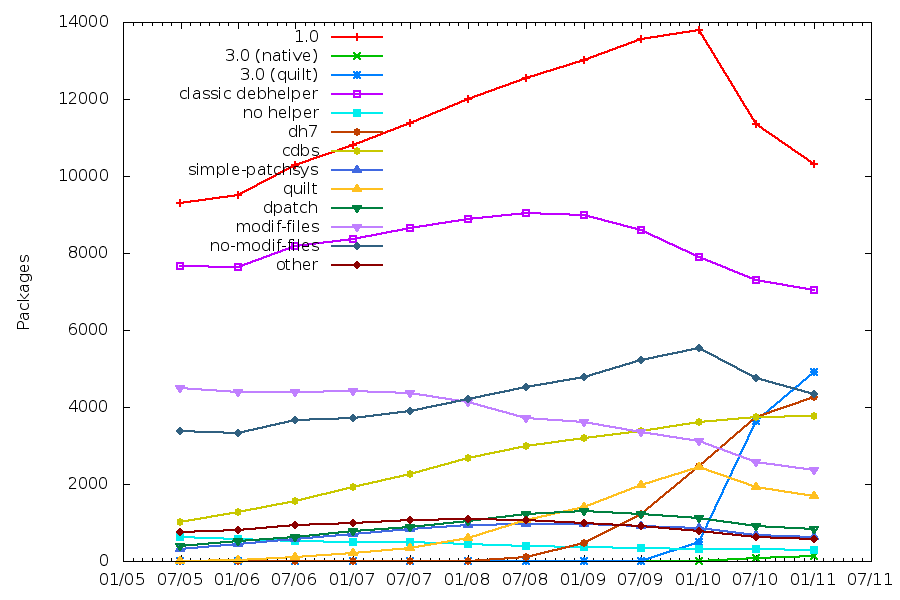
Lucas Nussbaum: Debian is changing

I ve been playing with snapshot.d.o, which is a fantastic resource to look at how Debian has been changing over the years.
Below are some preliminary results about various aspects of source packages: format, packaging helpers, and patch systems.
For clarification: Random comments: If you have other ideas of things to investigate using snapshot.d.o, don t hesitate to ask in comments.

Patrick Schoenfeld: Let me introduce DPKG::Log and dpkg-report

We have customers, which require a report about what we've done during maintenance windows. Usually this includes a report about upgrades, newly installed packages etc. and obviously everything we've done apart from that.
Till now we've prepared them manually. For a greater bunch of systems this is a big PITA, because to be somehow useful you have to collect the data for all systems and after that, prepare a report where you have:

Its also error-prone because humans make mistakes.

Perl to the rescue!
At least the part about generating a report about installed/upgraded/removed packages could be automated, because dpkg writes a well-formed logfile in /var/log/dpkg.log. But I noticed that there appearently is no library specialised at parsing that file. Its not a big deal, because the format of that file is really simple, but a proper library would be nice anyway.
And so I wrote such a library.
It basically takes a logfile, reads it line by line and stores each line parameterized into a generic object.

Its features include:

Based on that, I wrote another library DPKG::Log::Analyse, which takes a log, parses it with DPKG::Log and then extracts the more relevant information such as installed packages, upgraded packages, removed packages etc.

This, in turn, features:
- Info about newly installed packages
- Info about removed packages
- Info about upgraded packages
- Info about packages which got installed and removed again
- Info about packages which stayed halfinstalled or halfconfigured at the end of the logfile (or defined reporting period)


These libraries are already uploaded to CPAN and packaged for Debian.
They passed the NEW queue very quickly and are therefore available for Sid:

http://packages.debian.org/sid/libdpkg-log-perl

As an example use (and for my own use case, as stated above), I wrote dpkg-report, which uses the module and a Template::Toolkit based template to generate a report about what happened in the given logfile.
It currently misses some documentation, but it works somehow like this:

Report for a single host over the full log:
dpkg-report

Report for a single host for the last two days:
dpkg-report --last-two-days

Report for multiple hosts (and logfiles):
The script expects that each log file has the name <systemname>.dpkg.log so that it can guess the hostname from the system and can grab all such log files from a directory if a directory is specified as log-file arguments:</systemname>

dpkg-report --log-file /path/to/logs

This will generate a report about all systems without any merging.

Report for multiple hosts with merging:
dpkg-report --log-file /path/to/logs --merge

This will do the following:
A (fictive) report could look some what like this:

dpkg-Report for all:
------------------------
Newly Installed:
abc
Removed:
foo
Upgraded:
bar (0.99-12 - 1.00-1)

dpkg-Report for test*:
------------------------
Newly Installed:
blub

dpkg-Report for test1:
------------------------
Upgraded:
baz (1.0.0-1 -> 1.0.0-2)

dpkg-Report for test2:
------------------------
Upgraded:
zab (0.9.7 -> 0.9.8)

Currently this report generator is only included in the source package or in the git(hub) repository of the library. I wonder if it makes sense to let the source package build another binary package for it.
But its only a 238 lines perl script with a dependency on the perl library so I'm unsure if it warrants a new binary package. What do others think?

24 February 2011

Pau Garcia i Quiles: Applied for Debian Maintainer, FLOSS workflow works

I have been packaging for Debian for a few years now. My first serious package was Wt back in 2007, but I had been backporting for Ubuntu for at least 2 years already, which means I have been doing .deb packaging for about 5 years (!). Last week I decided it was about time stop nagging my sponsors (Vincent Bernat, Thomas Girard and Sune Vuorela) every time I wanted to update the packages I maintain (witty, ace and libmsn), and I finally started the Debian New Maintainer process. The main reason I had not applied for Debian Maintainer yet was it requires some bureaucracy and, well, I d rather spend my time coding or packaging than doing paperwork :-) I sent my Declaration of Intent and soon after, Thomas and Vincent replied and supported my application with very very nice and kind words. Thank you, guys! I m flattered! :roll: Had I known I would be buttered up so much, I would have certainly applied a long time ago! :-D But you know what is the best part of this? It shows how open source projects take advantage of all the tools and communications channels we have (IRC, mailing lists, sprints, conferences, etc), and make distributed development work very well: here we have a 900-developers project in which two French guys are praising an Spanish guy they have never, ever met face-to-face (only e-mail, occasional IRC, and the most important of all: code review). Meritocracy at its full extent. Have you ever seen that in a traditional 100,000 workers company with hundreds of developers working in a single project?

Sean Finney: git merge -s theirs

...For the cases where, yes, you actually do want it. For the impatient assuming you're in a clean checkout on the tip of your current branch:
git merge -s ours ref-to-be-merged
git diff ref-to-be-merged   git apply -R --index
git commit -F .git/COMMIT_EDITMSG --amend
you can then double check that everything is as you expect with git diff ref-to-be-merged, which should be empty. The longer story It's noted from time to time that git does not have a -s theirs option to complement the -s ours strategy when merging (or, it did, but it was removed long ago, see below). For those not savvy the idea with git merge -s ours is to pretend as though a merge from some other branch has occurred, though the result remains the current branch's contents, unchanged. This is a neat trick that can be used to show that all changes in some branch have been superceded by the current branch, which can help ease merges further down the line as parallel devlopment continues. However, there is no corresponding -s theirs option, which would conversely say that "everything developed up to here is superceded by this other branch". This feature was discussed and discarded by one of the git authors, who instead advised a developer to throw away the previous work and start on a fresh branch:
One big problem "-s theirs" has, compared to the above "reset to origin, discarding or setting aside the failed history" is that your 'master' history that your further development is based on will keep your failed crap in it forever if you did "-s theirs". Hopefully you will become a better programmer over time, and you may eventually have something worth sharing with the world near the tip of your master branch. When that happens, however, you cannot offer your master branch to be pulled by the upstream, as the wider world will not be interested in your earlier mistakes at all.
In what would probably qualify as "most cases", he's right, but sometimes you do want to do this, and not because you have "crap" in your history, but perhaps because you want to change the baseline for development in a public repository where rebasing should be avoided. In debian, for example, it's pretty common for maintainers who use git-buildpackage to build debian packages from git to have two branches: an "upstream" branch and a "debianized" branch. The upstream branch will follow the changes from the upstream project (either by importing tarballs, or by pulling directly from the project's git repo if they also use git), while the debianized branch contains all the packaging related changes as well as any debian-specific changes to the code. In this context, if the upstream project uses git and rebases their history (out of your control), or if they shift development to a different branch, you might want to have a way to merge with their latest changes without rebasing/abandoning your current debian branch. Hence, a "theirs" merge. The author is totally right that the upstream project may be less interested in pulling from such a repository (since they would drag in the entire previous history), and if that's a problem you might need to splinter off the old branch and start a fresh branch instead. But at least for the projects with which I work, I find that it's more likely that pulling is pretty much one way upstream to debian, and that the patches flow back to the upstream project by way of bug trackers, git format-patch sendmail, or quilt patches sitting in the patch-tracker. And if it becomes a problem later you're no worse off, you can still split off a new branch or take some other action. So anyway, I asked Teh Internetz and found a few hits in the right direction, such as this guy at stack overflow, or this guy here. But from an aesthetic point of view I thought their solutions still left some room for improvement--they were both more complicated, involved setting up temporary branches, and I don't know, just weren't pretty on the eyes. So, ending where I started, this is the relatively clean and easy to follow 3 lines I conjured up, which I will give to teh internetz for posterity.
git merge -s ours ref-to-be-merged
git diff ref-to-be-merged   git apply -R --index
git commit -F .git/COMMIT_EDITMSG --amend
Alternatively, if you want to keep the local upstream branches fast-forwardable, a potential compromise is to work with the understanding that for sid/unstable, the upstream branch can from time to time be reset/rebased (based on events that are ultimately out of your control on the upstream project's side). This isn't a big deal and working with that assumption means that it's easy to keep the local upstream branch in a state where it only takes fast-forward updates. However, on the debian branch your less interested in the clean upstream development, and instead want to keep a sane history of the debianization work, so on this branch you still do something like a merge -s theirs (though in this case, you probably want to amend the previous version's ./debian dir back in post-merge). So applying the same approach as above with the slight modification, in practice (assuming you're on the clean tip of the debian unstable branch, that'd be):
git branch -m upstream-unstable upstream-unstable-save
git branch upstream-unstable upstream-remote/master
git merge -s ours upstream-unstable
git diff ref-to-be-merged   git apply -R --index --exclude="debian/*"
git commit -F .git/COMMIT_EDITMSG --amend
PS In spirit, this is a similar approach to what's done by the XSF team, though I would argue that with what I'm describing both the approach and the resulting history are a bit cleaner and easier to follow. Also, thanks to ron, mrvn, jcristau, and nthykier on #debian-devel for some quick reviewing of this.

MJ Ray: Event for creative co-operatives

Last week, I was at this event in Bristol where we heard some interesting stories from other creative co-ops. I think the oldest had been running for about the same length as time as our co-op, but with a bit of a smoother history. The organisers have posted their report on the event. What did surprise me is that it seemed that the other tech co-ops weren t as strong about free and open source software. I felt that the links between co-op values of self-help, self-responsibility, democracy, equality, equity, solidarity, honesty, openness, social responsibility and caring for others and the freedoms to use, study, adapt and share were obvious, but maybe I should try to write them out very clearly?

Next.

Previous.