Search Results: "sto"

14 March 2011

Julien Viard de Galbert: Triage X Bugs of the Week (TXBW18)

Better later than never, I restarted to triage last week, here is the report for it. In the mean time, Cyril has been triaging a lot of bugs see Debian XSF News #7.
But there are still 533 bugs to triage. Mike Hommey recently wrote about graphs for the Debian Bug Tracking System. In particular there is now a per maintainer graph, so here it the X Strike Force bug graph ! (Note: the graph does not filter out some bugs as we do on UDD. The X Strike Force (still) needs you ! You can have a look at the X Strike Force Bug Closing Procedure and check XSF unstable bugs sorted by date.

Raphaël Hertzog: Missing firmware in Debian? Learn how to deal with the problem

You know it already, since Debian 6.0 non-free firmware are no longer provided by a standard Debian installation. This will cause some troubles to users who need them. I m thus going to do a small overview on the topic and teach you what you need to know to deal with the problem. What are firmware and how are they used? From the user s point of view, a firmware is just some data that is needed by some piece of hardware in order to function properly. The driver for that hardware typically loads the firmware on the device as part of its initialization. In the Linux kernel, the drivers are all using a standardized interface (request_firmware) to retrieve the firmware before sending it to the device. Thanks to this standardization, it s possible to either embed the firmware in the kernel or to have it request the firmware from user-space when needed. Debian (like most distributions) has selected the latter option. Thus when the kernel needs a firmware, it sends out a request to user-space. udev is getting the request with the name of the firmware, and in its default configuration (see /lib/udev/rules.d/80-drivers.rules) it executes /lib/udev/firmware.agent in response. Where are firmware stored? firmware.agent is a simple shell script that tries to locate a firmware before sending it back to the kernel through a sysfs entry. It looks into the following directories: Firmware provided by packages are thus usually in /lib/firmware and you can use /usr/local/lib/firmware for manually installed firmware. How do I know whether I need a firmware? First of, you can notice messages from the kernel telling you that it tried to load a firmware but it failed. They look like this:
e100: eth0: e100_request_firmware: Failed to load firmware "e100/d101m_ucode.bin": -2
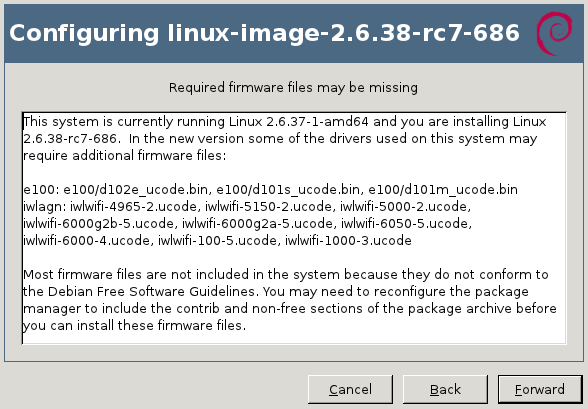
But you might be informed sooner. When you install a new version of the Linux kernel with the official Debian packages, the post-installation script will go through all loaded modules (those listed by lsmod) and it will verify whether this module as provided by the newly installed kernel might require firmware files. This information can be retrieved with modinfo:
$ modinfo -F firmware /lib/modules/2.6.32-5-amd64/kernel/drivers/net/e100.ko
e100/d102e_ucode.bin
e100/d101s_ucode.bin
e100/d101m_ucode.bin
If one (or more) of those firmware is (are) not yet available on the system, you will get a warning message similar to this one:
update-initramfs will also generate a similar warning on the terminal:
update-initramfs: Generating /boot/initrd.img-2.6.32-5-amd64
W: Possible missing firmware /lib/firmware/e100/d102e_ucode.bin for module e100
W: Possible missing firmware /lib/firmware/e100/d101s_ucode.bin for module e100
W: Possible missing firmware /lib/firmware/e100/d101m_ucode.bin for module e100
The Debian installer also detects when you have hardware that might require a missing firmware file. You have the option to supply the missing files on a USB stick (either directly or through the corresponding package). How do I find and install the missing firmware? Now that you have the name of the firmware file that you want, it s relatively easy to identify the package that provides the required file. You can use apt-cache search <filename> because the firmware packages embed the list of firmware files in their description. You can also use apt-file (provided by the package of the same name) or the web interface at packages.debian.org.
$ apt-cache search d101m_ucode.bin
firmware-linux-nonfree - Binary firmware for various drivers in the Linux kernel
$ apt-file search d101m_ucode.bin
firmware-linux-nonfree: /lib/firmware/e100/d101m_ucode.bin
If the above commands return nothing, you probably need to enable the non-free repository in your /etc/apt/sources.list (you can also enable it within synaptic). And you also want to run sudo apt-file update to have the latest information. Now you can install the right package, in the example above it was firmware-linux-nonfree. How do I install all firmware just to be sure I don t miss any? There s no meta-package depending on all firmware packages so there s no easy answer to this question. Furthermore not all firmware packages respect the naming convention firmware-* (there s for example zd1211-firmware). So your best bet is to look up all the packages with a generic search like this one:
$ apt-file --package-only search /lib/firmware/
atmel-firmware
[...]
And then install them all. Are there DVD or CD images with non-free firmware? Yes. Debian provides an unofficial netinst image for i386/amd64/powerpc with the non-free firmware, you can find it here: http://cdimage.debian.org/cdimage/unofficial/non-free/cd-including-firmware/. I provide complete DVD sets with firmware, and Multi-Arch CD/DVD with firmware, it s over there in my DVD shop: http://raphaelhertzog.com/go/debian-cd/ (i386/amd64 only) When using those installation discs, the Debian-installer will be able to find the required firmware immediately. There s no need for you to provide them on a USB stick. Other questions? I think I covered the most important things you have to know about firmware on Debian. But should you still have a question, feel free to share it in the comments so that I can improve this article.
Click here to subscribe to my free newsletter and get my monthly analysis on what s going on in Debian and Ubuntu. Or just follow along via the RSS feed, Identi.ca, Twitter or Facebook.

6 comments Liked this article? Click here. My blog is Flattr-enabled.

13 March 2011

Steve Kemp: A few forks.

Although I promised in my previous entry that I'd made my last mention of the redisfs - replication friendly redis-based filesystem I have to disappoint. Ben Sykes informed me that he'd made a fork of redisfs, called shredisfs. I like forks. Forks are good, and this particular one was very welcome - from the README:
Steve's original managed around 250k per second for writes on my test machine, this version does about 15MB a second writes. ... Read speed on the test machine here now is around 180MB/sec..
Needless to say I "stole" the improvements and rolled them into my original release. Thanks all round to those of you that submitted bug reports, suggestions, and codez. I also had a release out briefly which used zLib to compress the values of keys stored in memory. Unfortunately that lead to a net-slowdown for files which were bigger than a single block - due to the overhead of file-system appends which translated to: "fetch", "compress", "append", and "decompress". Finally on the subject of qpsmtpd, my favourite SMTP-server - the exceptionally talented Matt Sergeant released a proof of concept rewrite in Javascript. Using nodejs this new SMTP server is heavily asynchronous and you can find it online under the name Haraka. Although my javascript-fu is weak I'm very impressed by the codebase out there so far, and I'd expect good things of it in the future. Even if it does use Javascript and not my beloved Perl. Finally I'm a year older. But birthdays aren't important. ObQuote: "Do you wanna know what makes all my candy taste so special? " - Epic Movie.

12 March 2011

Jonathan McDowell: Another 2 wheels

It's my birthday, so a week ago I bought myself a present: Red Brompton M3R folded The office is 4.5 miles from the BART station, so up until now I've been taking a bus. Unfortunately the timings aren't that frequent (every 45-60 minutes). Plus I haven't been doing any exercise since I moved out here. Now it seems to be getting drier I figured it was time to sort out a bike. I wanted something flexible, and have heard nothing but good things from the Brompton owners I know, so that's what I ended up with. I'm very happy with it; despite my lack of recent exercise it's pretty easy to ride. I've actually found it doesn't take any longer than taking the bus, and is sometimes quicker, because I avoid having all of the waiting around for it. I bought it from Warm Planet Bikes, who were incredibly helpful. They had a selection in store that they let me try (and quite a few other models of folding bikes too) and when I made my decision it turned out they could do the customizations I wanted in shop. So rather than me having to order it and wait a month I was able to cycle away that same evening! Full marks to Matt for staying late to sort me out (plus he's a Brompton owner too). Red Brompton M3R

Julien Blache: forked-daapd: v0.13

forked-daapd v0.13 is available! This release has been in the making for a long time, got delayed for a lot of reasons and had its content changed a few times along the way. Nonetheless, it s here now and if all goes to plan at least a couple releases should appear in the coming months, say before the summer. In this release: Thanks to all the contributors that sent bugs and patches for this release! I know development doesn t go quite as fast as some would like, but keep in mind that I m doing this in whatever free time I have and that the public git tree doesn t tell the whole story. There are several parallel feature branches you don t get to see, for instance. Hopefully 0.14 will appear in a few weeks. Tarballs available at http://alioth.debian.org/~jblache/forked-daapd/ ; GPG signatures made with my Debian key F5D65169.

11 March 2011

Eddy Petri&#537;or: HOWTO: Making Windows usable and avoiding accidental sending of mails in Microsoft Outlook

I've changed jobs recently and after 5 years of not having to work with a Windows system I am having all sorts of adaptation-to-Windows problems at the new job.

First I just had to have the usual X-mouse behaviour and so I installed True X-Mouse Gizmo for Windows. This provides focus under mouse, middle click paste after select (not perfect, but it works), right click to push to bottom the window.

Second I had to have a virtual desktop, so I installed Microsoft's Virtual Desktop Manager from the PowerToys page. I tried another virtual desktop manager before using MSVDM, but I found it too clumsy so I switched to MSVDM which I knew from way back when I used Windows the last time. Good, now I can have my applications organised the way I am used to.

UPDATE:
I gave up on MSVDM in favour of Virtual Dimension since I wasn't able to send a particular window to the intended desktop unless I had in the taskbar all apps visible (Shared Desktop option). I might try other suggestions (Virtual Dimension does not have a way to send a window directly to a specific desktop, but just to the neighbours of the current one.)


Third, I had to make Caps Lock work as Ctrl. I just can't go back to an inferior setup. I found information on this page and ended up at this page from where I got a zip file with various registry keys which allow the deactivation of caps, or turning it into another Ctrl.

Fourth, I am used to write with diacritics in Romanian with the secondary layout of the standard (SR 13392:2004), so I rushed to Cristian Secar 's page for the keyboard driver since on XP the Romanian layout is retarded (some history in which some arbitrary German guy decided y and z had to be switched on Romanian keyboards and some other similarly weird stuff). Since the installation, my keyboard behaves according to this layout:


Things started to look well, but I soon was reminded that Outlook is an idiotic mailer since it doesn't require a confirmation on send, not even if you didn't set a subject. And this is problematic since sending the mail is done via Alt+S, so if the current layer is NOT Romanian, when I want to type (s with a comma below), a fairly common character in Romanian words, you end up looking like an idiot on the recipient side since they receive an incomplete mail. Remember, no confirmation AND no default spell checking before send. Yay!

At my second such accidental mail sending (of which the last two were sent to the same person), I decided to see if this can't be fixed. I initially looked for changing the short cut, but I couldn't find it (I might be inept at finding things in Windows, remember, I haven't touched Windows systems in the last 5 years) but I found another workaround and decided it's good enough to share with other people that might hit the problem.

Just setup a delay rule following these steps.
1. Go to Tools....Rules Wizard
2. Click 'New' Rule
3. Select "Check messages after sending"
4. Click Next on "Which conditions you want to Check?" dialog.
5. Press yes to "This Rule will be applied to every message" message box
6. In the "What do you want to do with message?" dialog, Select "Defer delivery by a number of minutes"
7. Select your favourite number of minutes.... I usually select 2 mins.
8. Select Finish. and close the Rules Wizard.

Now everytime you send an email it will sit in your outbox
for specified number of minutes. If you ever wanted to change it, delete it etc, You have sufficient time to do it :)


I used 3 minutes for the delay. At least now I can prevent looking retarded in front of people... more than necessary :D .


Oh, and Windows' clock display is retarded. It shows, by default, the hour and minutes, but there's no way to change that in a sane way. If you want the date, you must hover over the clock and it shows it, but the day of week is missing. Great job! You can see that information, too, but you have to drag the toolbar to be 2 or even 3 rows high (here it requires 2, but I've seen people saying they needed 3) to get that information, too. Great! One has to choose between wasting desktop real estate and having access to useful information. Or you could install an independent application for the clock... retarded. I am not making this shit up.

I hope this helped.

9 March 2011

Rog rio Brito: (Some) Solutions with Chromium

In my previous post, I was pointing out some of my frustrations with Chromium/Chrome. A very kind reader, Timo Juhani Lindfors, gave me answers to many of the problems that I pointed out and got me straight on some issues:
  • I can disable full zoom in Iceweasel (i.e., I only want to zoom the text, not the images). According to Chromium's project BTS, it seems that this will be a WONTFIX bug, despite many people asking for it (and it having a lot of duplicates).
Timo told me that there is an extension called "Font Size Increase" (ID: ombpcpigmndepfckcifdblemkabaoihk) that adds a button on the side of the URL bar that you can click to increase the size of the text, without affecting the size of the images. Highly recommended. Not that I need this one as much as "Font Size Increase", but there is also a "Font Size Decrease" (ID: mpajngnpcmjjeoflljdjpnehcfaldcia) that, as the name implies, decreases the size of the text. It is nice to have this one when you clicked on the button to increase the size of the font one or two times too many.
  • In Iceweasel, I have a way (without resorting to many extensions or hackish solutions) to use the equivalent of Firefox's "View > Page Style > No Style" (i.e., to ignore any CSS sheet that the document author may have specified on the page).
Timo also told me that there is a very cool extension called "Chrome Page Style" (ID: ddpkgkegfklikkmfmneldonhldahhacb) that allows you to alternate between stylesheets provided by the page (see Joey Hess's ikiwiki's CSS Market for an example of that). It also has the possibility of disabling all the CSS'es that a page may have, which, in many cases around the web actually improves the readability of the pages, for many "fancy" things detract from readability, especially if you have poor eyesight. Although I had said that I didn't want to resort to extensions, this was a simple solution enough that made me consider revisit my requirements. I do, though, wonder why some frequently used extensions are not built into the programs from stock.
  • In Iceweasel, I can press Ctrl+Q and make the damn browser quit, instead of me having to use the mouse/trackpad/pointing device. This is probably a lack of my understanding on how to associate key bindings to Chromium, but the problem still stands.
Of course, Timo also set me straight and told me about Ctrl+Shift+Q for that purpose, which I had missed completely.
  • Similarly, when there is only one tab open, pressing Ctrl+W in Chromium does not close the tab (say, presenting me a blank tab or the list of most visited sites), nor it closes the application.
As a poor writing of my part, Ctrl+W does close the tabs. But when there is only one tab present, it doesn't close the window. I'm OK with that, since I now know the way to close the window. Thanks again Timo. Oh, and one point that may not be known by many is that using about:flags in Chrome does something analogue to Firefox's about:config (even with the warning). And tweaking with it you can try to see if you can enable hardware acceleration of some parts of your pages, as present in newer releases of Chromium. So, there I am: way more satisfied than with earlier with Chromium, but still having Firefox/Iceweasel as my primary browser. Good to have two usable browsers now.

8 March 2011

Evgeni Golov: Desktop in a shell: irssi

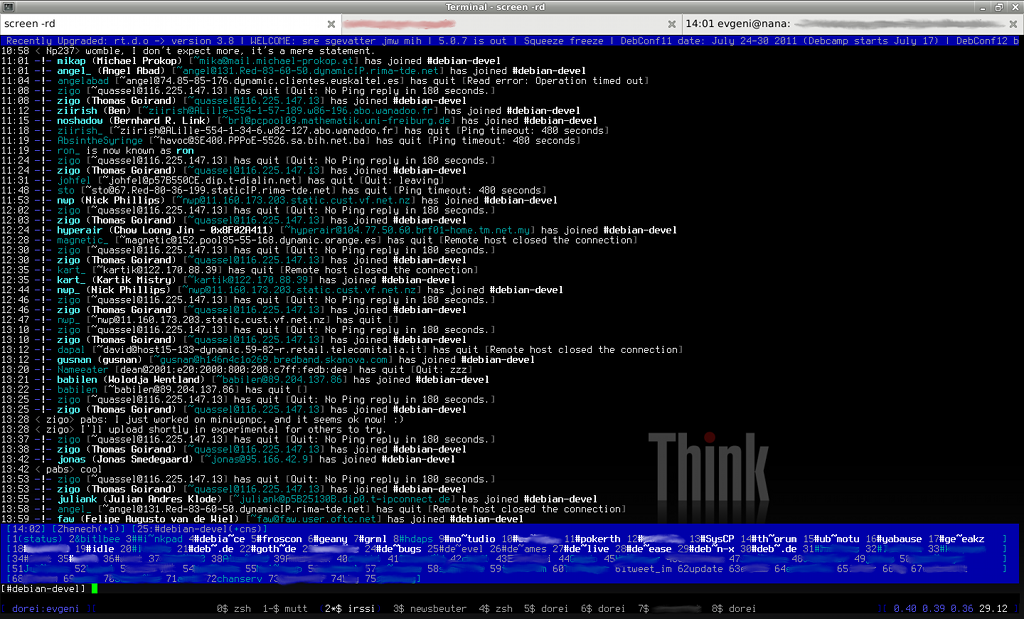
Continuing my series about my desktop in a shell, in this chapter I will present you my irssi setup.Irssi is the most customized part of my setup, using many scripts from the irssi-scripts Debian package and some from the internet , handling 6 irc networks with a total of 34 channels plus JabberXMPP, ICQ, Twitter and identi.ca. My custom irssi settingsI like my conversations to look like Buddy, you rock instead of Buddy: you rock , so:
/set completion_char ,I also like *long highlighted text*, so:
/set emphasis_multiword onHide mIRC and ANSI colors when turned on. This can be used to eliminate angry fruit salad syndrome in some channels. (Quote from irssi.org/documentation/settings, do I have to say more?):
/set hide_colors onWhen talking in more than one channel, it sometimes comes handy to repeat something from the past said in THAT channel, not searching though all:
/set window_history onTell irssi to shutup when away, noone will hear/see the beep anyways:
/set beep_when_away offI want my screen to inform me about new messages, so I need this:
/set bell_beeps onBeep for query text, notices, dcc, dcc text and hilight:
/set beep_msg_level MSGS NOTICES DCC DCCMSGS HILIGHMy used irssi scriptsactive_notice.pl (from irssi-scripts)Show notices in the active window or the corresponding query instead of the status-window.
No further configuration needed.adv_windowlist.pl (from anti.teamidiot.de)Some really smart windowlist, see my previous post about adv_windowlist.pl, I won t explain its features and settings here again.autorealname.pl (from irssi-scripts)Show peoples real-name when they join (my $nick $name memory is poor :()
No further configuration needed.chansort.pl (from irssi-scripts)Automatically sort my channels alphabetically, grouped by network.
Enable via /set chansort_autosort on<Update>kaimi asked me yesterday, whether chansort could ignore the network and just sort ALL channels in alphabetical order. Well, it could not, until yesterday ;) Fetch either the patch against chansort.pl or my chansort-ng.pl and set chansort_ignore_network to ON. You can also set chansort_ignore_windowtype to mix channels and queries if you like to.</Update>hack-whois-in-current-window.pl (from dgl.cx)Display /whois in the current window or the corresponding query instead of the status-window.
No further configuration needed.keepnick.pl (from irssi-scripts)Restore my nick after it is free again (like after a ping timepout).
Set the nick via /keepnick [-net chatnet] [nick]nickserv.pl (from irssi-scripts)Automatically authorize me on networks with NickServ.
Enable by settings services address, nick and password via:
/nickserv addnet freenode NickServ@services.
/nickserv addnick freenode Zhenech mypass
screen_away.pl (from irssi-scripts)Set away when screen is detached.
Will be enabled automatically, but you maybe want to tweak screen_away_message :)seen.pl (from irssi-scripts)Add a /seen nick command to lookup when and where nick was online the last time.
No further configuration needed.trackbar.pl (from irssi-scripts)Draw a line when you switch irssi windows so you can see which part of the conversation you have already seen.
No further configuration needed.BitlBeeI m using BitlBee as my irssi-to-every-im gateway of choice ;) But while it sounds easy, my setup isn t. I am using BitlBee only to connect to jabber.die-welt.net, my Jabber/XMPP server. There I have a pyICQt instance running, to connect to ICQ via Jabber (yes, BitlBee would support that directly, but that would fail on me when I would like to connect from a different Jabber-client). Twitter and identi.ca are handled via Jabber too: identi.ca does support this by themself, for Twitter I use the tweet.im service.
But besides of my strange setup, BitlBee is easy: apt-get install bitlbee, connect irssi to localhost:6667, you will be force-joined to &bitlbee, where you do:
register somepassword
account add Jabber you@jabberserber.example.com jabberpassword
account on 0
and done, you@jabberserver.example.com is online :)The all awaited screenshot (from my last irssi-post):

And the whole ~/.irssi/config: http://files.die-welt.net/irssi-config.txt, read it carefully while waiting for the next post about newsbeuter :)

7 March 2011

John Sullivan: New job

Today was my first day as the new executive director at the Free Software Foundation. I'm really excited about the opportunity to do more at the FSF -- but also sad that I won't have the pleasure of working with Peter Brown any more, as he is moving on to more challenges. Peter's been an amazing mentor and boss to me in the eight years I've been with the FSF, and it's not going to be the same without him. Along with the change in job positions, I have relocated from Seattle back to Boston. This continues to be my personal space, not an official FSF channel -- but this is big personal news for me so I wanted to share :).

Kai Wasserb ch: On building from Source

I've received a few requests to help with failing builds in the past, mainly for packages I maintain (either officially or unofficially). And most of those requests revolve around custom Wine builds. Because this is recurring, I'd like to take the opportunity to write down some general answers which solve most of the problems, so I can point people to this entry. Apart from that, you'll most likely find a lot of answers in the Developer's Reference and the New Maintainers' Guide. Nothing of this is news to Debian Maintainers, but I hope it helps people doing a build for themselves, when they're less experienced.

Matt Zimmerman: Listening to users

In the software community, people hold strong opinions on the subject of listening to users. Some feel that users are an essential source of information for making successful products, as evidenced in the customer development methodology, and seek to involve users deeply in product development. Others believe that users don t know what they want, invoking the quote attributed to Henry Ford, If I d asked customers what they wanted, they would have said a faster horse . Some say that user needs are unknowable except through the lens of a marketplace, where people choose in aggregate which products suit them best, and customers vote with their wallets (anything else is anecdata ). Regular readers will not be surprised that I believe they are all right, but only in certain contexts. The right strategy for involving users in product decisions will depend on factors related to the product itself, the market, and the product development method being used. One of the most important is the life cycle stage of the product: is it a new and rapidly evolving concept, or a mature commodity, or somewhere in between? Simon Wardley explains this well over on his blog, so I won t rehash his points here, but will add a few of my own. If what we re looking for is inspiration for a new product, it s here that Henry Ford was right: users generally won t hand you a complete product vision on a silver platter. They ll frame their input in terms of what they know, and the choices already available to them. However, this doesn t mean that users don t have a role to play in this instance: watching users can be a great source of inspiration. It s the combination of domain knowledge and passionate imagination which triggers the creative spark. Henry Ford applied his engineer s interests to a problem which was evident all around him. If our goal is to test whether a new product is a good fit for its users, there is no substitute for user feedback. We can guess at whether there is a fit, and our intuition may be good, but users are the ultimate judges, and we don t know if we re right or wrong until users evaluate it. So ask them! By engaging in dialogue with individual users, we can learn unexpected things which will help to refine the idea. If we don t find what they think until our new product is released, we risk making something that no one wants. Why wait until it s too late? It can be challenging to extract useful feedback for a product which doesn t yet exist, but this effort is well worth it to avoid wasting much more effort in software engineering. When our objective is to incrementally improve an existing product, individual anecdotes can mislead us. A given change may be an improvement for one user, but a disaster for another. What we want to know is whether the new version is better for the population as a whole, and in this case, we do well to rely on data. There are pitfalls here as well, of course. We need to choose our questions carefully, and realize that users will often resist any change: not because they re stodgy by nature, but because they have to invest effort in adapting to the change. I think of incremental improvement as a joint investment made between product developers and their users, to improve the whole system of people and technology for the better. By choosing the right tool for the job, we can make better decisions, improve faster, and ultimately solve the right problem for our users.

Alexander Reichle-Schmehl: Debian honoured with LNM award for Outstanding Contribution to Free Software

Those who followed the live stream or read our News already knew it: Debian has been honored with the Linux New Media Award in the Categories "Best Open Source Server Distribution" and Outstanding Contribution to Open Source/Linux/Free Software. Especially the second one, considered to be the "kings class" of the LNM awards, is a great honour. While it is called the Linux New Media award, the decision of whom to honor with them isn't done by the company themselves, but by a bigger jury, consisting of over 300 representative community members, developers, journalists and companies. Deciding in a secret vote1. To the best of my knowledge, there's nothing similar. So one can truly say, we weren't awarded by a company, but by the entire Free Software community! Congratulations to everyone involved! For our Outstanding Contribution to Open Source/Linux/Free Software award, we also had the special pleasure, to receive our presentation speech from Karsten Gerloff, president of the Free Software Foundation Europe, who found words, I can hardly explain myself. As it might take some time for the video of the award ceremony to be published and several people already asked for it, you'll find the text of the speech below. Still, you might want to watch the video for a special surprise by Karsten:
I'm here to congratulate the Debian project. Debian has recently taken a nearly unprecedented step, one that many people thought would never come to pass: The project has updated its website design. Today, Debian receives the Linux New Media Award for its outstanding contribution to Free Software. I could hardly think of a more fitting recipient for such an award. Debian is coming of age, literally. In August, the distribution will turn 18. Debian offers great technology. It's stable. Really stable. It's highly flexible, and performs well in lots of different roles. IT supports more different architectures than almost anything else out there. It runs on pretty much anything. The package management is great. It makes a highly complex system of almost 30,000 packages extremely simple to configure and use. Debian started out as a true pioneer. When the project was created in 1993, the whole concept of a distribution wasn't too well established. Ian Murdock announced the project thus:

"Debian Linux is a brand-new kind of Linux distribution. Rather than being developed by one isolated individual or group, as other distributions of Linux have been developed in the past, Debian is being developed openly in the spirit of Linux and GNU. [...] Debian is being carefully and conscientiously put together and will be maintained and supported with similar care." At a recent conference, the current Debian project lead, Stefano Zacchiroli, gave a talk titled Who the bloody hell cares about Debian? Turns out that many people do indeed. Debian is the GNU/Linux distribution that has the most derivatives based on it currently 128, if Distrowatch.com is to be believed: Ubuntu, Knoppix, gNewSense, and many more. And those distributions again have their own derivatives. None of these could function without Debian. Lots of people rely on Debian. That makes it all the more important that Debian is so reliable. The Debian project gives us Free Software that is both rock-solid and exciting. But the greatest thing about Debian is not the fact that it delivers great software. Other distributions do that, too. The big thing about Debian is the *idea* of Debian: The idea that a massive Free Software project can be totally independent. Debian shows how it's possible to build a highly reliable operating system without a formal body. The project has created some pretty complex structures to run itself, as a do-ocracy, based on consensus and running code. This is important. We are currently debating how Free Software projects can best be governed in the long run. How do we make sure that a project's users can always enjoy the freedom they deserve? How can we structure a project in a way that makes it immune to a hostile takeover? Oracle's acquisition of Sun has shown that these are important question. A Free Software license, preferably one like the GPL that protects freedom in the long run, is an important first step. But a Free Software project consists of much more than code. While uncounted people and companies are earning good money with Debian, the Debian project itself can't be bought simply because there is noone you could buy it from. Debian has been doing vendor independence long before it was cool. What I love most about Debian is that like few other big projects, Debian has the idea of freedom at its core. Debian's Free Software guidelines are a central manifesto for software freedom. The Debian Social Contract does not mention a single package or program. But it is without a doubt one of Debian's most important pieces of documentation. In Debian, quality is the focus of everyone's attention. But those who work on the Debian system know that great software is worth nothing without Freedom. With the release of Squeeze, the latest stable version, in February, Debian has taken the important step of offering a completely free kernel, with no binary blobs. This is a first for a major distribution in recent times. Debian is giving its users Freedom by default. And this Freedom for users and developers on a massive scale truly is Debian's outstanding contribution, not just to Free Software, but to the information society. On behalf of the Free Software Foundation Europe, I would like to thank everyone in Debian for their work, and congratulate them on this award. It's well deserved. Keep up the good work!

1: I forgot to mention one small, but important detail: The voting period for the jury ended on December 23, 2010, so long before Squeeze was released. So we can be quite sure, that the Jury didn't followed the Squeeze-Hype with their decision, but really thinks, we did something great :)

Daniel Kahn Gillmor: PHP, MySQL, and SSL?

Is there a way to access a MySQL database over the network from PHP and be confident that As far as i can tell, when using the stock MySQL bindings, setting MYSQL_CLIENT_SSL is purely advisory (i.e. it won't fail if the server doesn't advertise SSL support). This means it won't defend against an active network attacker performing the equivalent of sslstrip. Even if MYSQL_CLIENT_SSL was stronger than an advisory flag, i can't seem to come up with a way to tell PHP's basic MySQL bindings the equivalent of the --ssl-ca flag to the mysql client binary. Without being able to configure this, a "man-in-the-middle" should be able to intercept the connection by offering their own certificate on their endpoint, and otherwise relaying the traffic. A client that does not verify the server's identity would be none the wiser. One option to avoid a MITM attack would be for the server to require client-side certs via the REQUIRE option for a GRANT statement, but the basic MySQL bindings for php don't seem to support that either. PHP's mysqli bindings (MySQL Improved, i think) feature a command called ssl_set() which appears to allow client-side certificate support. But its documentation isn't clear on how it handles an invalid/expired/revoked server certificate (let alone a server that announces that it doesn't support SSL), and it also mentions:
This function does nothing unless OpenSSL support is enabled.
Given that debian MySQL packages don't use OpenSSL because of licensing incompatibilities with the GPL, i'm left wondering if packages built against yaSSL support this feature. And i'm more than a little bit leery that i have no way of telling whether my configuration request succeeded, or whether this function just happily did nothing because the interpreter got re-built with the wrong flags. Shouldn't the function fail explicitly if it cannot meet the user's request? Meanwhile, the PDO bindings for MySQL apparently don't support SSL connections at all. What's going on here? Does no one use MySQL over the network via PHP? Given the number of LAMP-driven data centers, this seems pretty unlikely. Do PHP+MySQL users just not care about privacy or integrity of their data? Or (please let this be the case) have i just somehow missed the obvious documentation? Tags: mysql, php, question, security, ssl, tls

6 March 2011

Tim Retout: Software Architect

I've been promoted - my job title will now be 'Software Architect'. This seems to mean I'll be writing documents rather than code - any higher-level, and I'd need Mark Shuttleworth's spacesuit. Is this a good thing? Anyway, I celebrated by opening my last bottle of Debian wine. <spam>Unfortunately, I can't take up my new role until we have hired a replacement. UK-based developers who know Perl and ideally PostgreSQL might want to look at the job description, although I'd recommend sending your CV and covering letter to me directly. I don't get a referral bonus, it's just that I don't like what that agency does with your carefully-crafted application.</spam> I'd like to thank everyone who maintains LaTeX for their assistance in this matter. In other news, I'm studying a couple of Open University courses part-time - one on software development (i.e. UML), and one on interaction design. They're going well so far - I've had a couple of tutorials, and the first part of an assignment came back with good marks. I've been reading the Lean Software Development books by Mary and Tom Poppendieck. They seem to put Agile development into a 'respectable' historical context of similar improvements in manufacturing, which might be useful for persuading project managers.

5 March 2011

John Goerzen: Visiting Purdue

Terah went to college at Purdue University, and always enjoyed basketball games there. I ve not been much of a sports fan, but have enjoyed watching Purdue games with her on TV. Terah has been wanting to see a game in person for awhile, so a couple of weeks ago, we went. It was a really fun weekend! When we planed the trip, we had no idea that the Purdue-Ohio State game was going to be such a big one. We walked over from the Union Club Hotel where we were staying on the Purdue campus. People were streaming towards Mackey Arena from all directions. Once inside, it was already loud and buzzing people cheering, the band playing. I ve never experienced anything quite so loud. The game started out badly for Purdue; they were down a few points up front. The entire game was a close one, and the crowd sometimes got so loud that nothing else could be heard not even the band or the announcer. When it became clear at the end that Purdue won the game, the people behind me and apparently 12,000 others began screaming at the top of their lungs. My hearing did eventually return to normal. So did my throat, which had gotten rather sore from from cheering myself. This was our first road trip since I got my amateur radio license. I had a lot of fun visiting with people as we drove. I talked to a retired railroad engineer that used to take an amateur radio with him in his locomotive. As he went through a certain town where he had friends he liked to talk with on the radio, he d get their attention by blowing CQ in Morse code with the train s whistle. Some people in Kansas City had us laughing as we passed through. In Missouri, I talked with some farmers and a World War II vet. In Champaign, IL, I visited with a retired Unix systems administrator that had spent decades working with Unix operating systems. Our hotel was connected to the Purdue Memorial Union, a large and historic building. Besides having some ice cream at the Sweet Shop one evening, we also spent a bit of time exploring it. I noticed that the Purdue Amateur Radio Club was having a testing session in there. We walked past once it was underway, and one of the students was not very busy. I introduced myself and asked if we could see their shack. It was neat to see all the equipment some of it quite old in the room that they must have been using for decades. Terah, of course, had ideas for visiting a number of her favorite places while we were there. We visited Arni s and Bruno s, both pizza places. Bruno s happens to be a Swiss pizza place, so much to my surprise, I had Wienerschnitzel there, which was excellent. We ate a (week late) Valentine s dinner at Bistro 501. On our way back, we also chatted with various people on the radio, though not quite as much. We got helpful suggestions for which route to take, and stopped at the excellent Bobby D s Merchant St. BBQ in Emporia, KS for supper. The boys had also enjoyed their weekend with grandparents, but were glad to see us back. They were particularly interested to see a lot of train videos from Youtube with me the next day.

Lars Wirzenius: Kaka

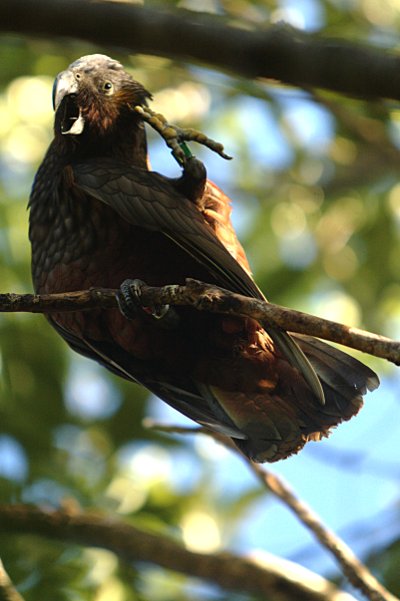
I took this picture seven months ago. I have only just today gotten around to culling photos from that day, and this one stood out. kaka.jpg

4 March 2011

Steve Kemp: A final update on redisfs

I think I'm done with the redis filesystem for the moment. It does everything I need it to do, although I am curious to see how much faster it could go if it were to use non-blocking writes that isn't a major concern. There is only one missing feature I'm planning to play with - and that is the ability to implement snapshots. As a refresher redis is a key+value store, which mostly uses system memory. I've built a simple FUSE filesystem on top of that (now with symlink support!) and so all the file contents, meta-data, and similar is stored in memory. Implementing snapshots could be done by two different routes:
Copying all keys and their values, under a new name.
For example right now, by default, all the filesystem entries in the root directory are stored beneath the key "SKX:/" - where "SKX" is the key prefix. Assume I copy each existing key, and the associated value(s), giving them a new prefix such as "SKX2:" I can mount the filesystem against that prefix - and we've got a point-in-time snapshot.
Serialising all keys & values
Redis has a primitive which allows you to determine the names of keys at runtime. Given that all my filesystem keys have a prefix ("SKX:" by default) it wouldn't be difficult to find them, and serialise them. This would require more effort to re-import and re-mount, but it should be portable across hosts.
Anyway assuming I get this right we'll have a filesystem which is replication-friendly and snapshot-able. A fun combination. ObQuote: "We had been everywhere. We had really seen nothing. " - Lolita

3 March 2011

Kai Wasserb ch: Extending Chronicle

This little blog is created/compiled with Chronicle, coded by Steve Kemp, and one of the cool features is that you can specify a command run before/after your blog gets compiled from the input files. This presents us with one problem and a lot of opportunities. First to the problem: the singular "a command" (from the manual page) might not be enough. Maybe you want to run more than one command. This can be achieved by creating a directory for the commands you want to run before the compilation and one for the commands you want to run after the chronicle run. Then you create a small shell script one directory above and call that from chronicle, the script for the post-run might look like:
#!/bin/sh
set -e
WORKDIR=" dirname $ 0  /post"
find $ WORKDIR  -name "*.sh" -exec " " ";"
This script makes the assumption, that the scripts to run have a .sh suffix and are in a subdirectory named "post". But you can surely adapt this to your needs. Now to one of the oppurtunities this offers: you can now, for example, create static pages, which share the general visual appearance with your blog entries but don't show up in the tags or archive system. I'm using this to generate an imprint for this blog. The script to generate the imprint looks like:
#!/bin/sh
set -e
OUTPUT_PATH= grep output $ HOME /.chroniclerc   cut -d= -f2   tr -d [:blank:] 
sed -ne'/<\?xml version/,/blosxomFirstDayDiv/  /blosxomFirstDayDiv/b;p ' \
        $ OUTPUT_PATH /index.html > $ HOME /tmp/imprint.html
cat  dirname $ 0  /imprint.data >> $ HOME /tmp/imprint.html
echo -e "\n" >> $ HOME /tmp/imprint.html
sed -ne'/imprint_match/,$p' $ OUTPUT_PATH /index.html >> $ HOME /tmp/imprint.html
mv $ HOME /tmp/imprint.html $ OUTPUT_PATH /imprint.html
There are again some assumptions made here, which you'd need to adopt to your setup: Now you have a very powerful system to modify/extend your chronicle-generated blog. I hope you enjoy it as much as I do! A little P.S.: you might want to use version 4.5, as 4.4 had a nasty encoding bug.

Kai Wasserb ch: Extending Chronicle (Updated)

This little blog is created/compiled with Chronicle, coded by Steve Kemp, and one of the cool features is that you can specify a command run before/after your blog gets compiled from the input files. This presents us with one problem and a lot of opportunities. First to the problem: the singular "a command" (from the manual page) might not be enough. Maybe you want to run more than one command. This can be achieved by creating a directory for the commands you want to run before the compilation and one for the commands you want to run after the chronicle run. [UPDATE]Then just add run-parts /path/to/ before,post .d to your .chroniclerc for the pre,post -build configuration entries.[/UPDATE] (Thanks to Steve for pointing the obvious out to me, don't know why I didn't think of run-parts myself.) Now to one of the oppurtunities this offers: you can now, for example, create static pages, which share the general visual appearance with your blog entries but don't show up in the tags or archive system. I'm using this to generate an imprint for this blog. The script to generate the imprint looks like:
#!/bin/sh
set -e
OUTPUT_PATH= grep output $ HOME /.chroniclerc   cut -d= -f2   tr -d [:blank:] 
sed -nre'/<\?xml version/,/blosxomFirstDayDiv/  /blosxomFirstDayDiv/b;p ' \
        $ OUTPUT_PATH /index.html > $ HOME /tmp/imprint.html
cat  dirname $ 0  /imprint.data >> $ HOME /tmp/imprint.html
echo -e "\n" >> $ HOME /tmp/imprint.html
sed -ne'/imprint_match/,$p' $ OUTPUT_PATH /index.html >> $ HOME /tmp/imprint.html
mv $ HOME /tmp/imprint.html $ OUTPUT_PATH /imprint.html
There are again some assumptions made here, which you'd need to adopt to your setup: Now you have a very powerful system to modify/extend your chronicle-generated blog. I hope you enjoy it as much as I do! A little P.S.: you might want to use version 4.5, as 4.4 had a nasty encoding bug.

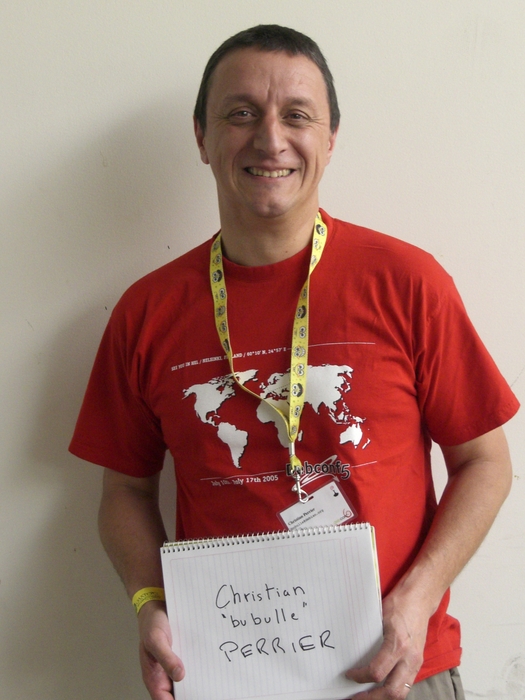
Rapha&#235;l Hertzog: People behind Debian: Christian Perrier, translation coordinator

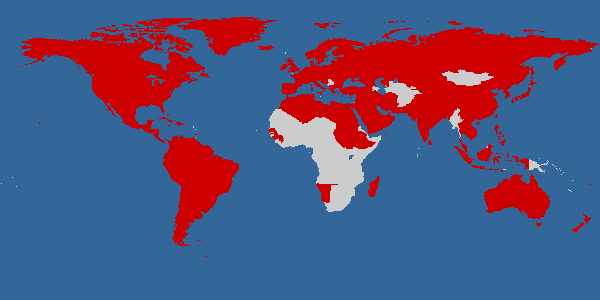
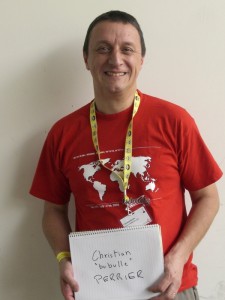
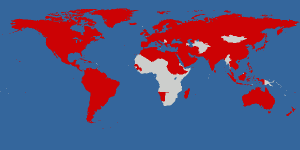
Christian is a figure of Debian, not only because of the tremendous coordination work that he does within the translation project, but also because he s very involved at the social level. He s probably in the top 5 of the persons who attended most often the Debian conference. Christian is a friend (thanks for hosting me so many times when I come to Paris for Debian related events) and I m glad that he accepted to be interviewed. He likes to speak and that shows in the length of his answers :-) but you ll be traveling the world while reading him. My questions are in bold, the rest is by Christian. Who are you? I am a French citizen (which is easy to guess unless you correct my usual mistakes in what follows). I m immensely proud of being married for nearly 26 years with Elizabeth (who deserves a statue from Debian for being so patient with my passion and my dedication to the project). I m also the proud father of 3 wonderful kids , aged 19 to 23. I work as team manager in the Networks and Computers Division of Onera the French Aerospace lab , a public research institute about Aeronautics, Space and Defense. My team provides computer management services for research divisions of Onera, with a specific focus put on individual computing. I entered the world of free software as one of the very first users of Linux in France. Back in the early 1990 s, I happened (though the BBS users communities) to be a friend of several early adopters of Linux and/or BSD386/FreeBSD/NetBSD in France. More specifically, I discovered Linux thanks with my friend Ren Cougnenc (all my free software talks are dedicated to Ren , who passed away in 1996). You re not a programmer, not even a packager. How did you come to Debian? I m definitely not a programmer and I never studied computing (I graduated in Materials Science and worked in that area for a few years after my PhD). However, my daily work always involved computing (I redesigned the creep testing laboratory and its acquisition system all by myself during my thesis research work). An my hobbies often involved playing with home computers, always trying to learn about something new. So, first learning about a new operating system then trying to figure out how to become involved in its development was quite a logical choice. Debian is my distro of choice since it exists. I used Slackware on work machines for a while, but my home server, kheops, first ran Debian 1.1 when I stopped running a BBS on an MS-DOS machine to host a news server. That was back in October 1996. I then happened to be a user, and more specifically a user of genealogy software, also participating very actively in Usenet from this home computer and server, that was running this Debian thing. So, progressively, I joined mailing lists and, being a passionate person, I tried to figure out how I could bring my own little contribution to all this. This is why I became a packager (yes, I am one!) by taking over the geneweb package, which I was using to publish my genealogy research. I applied as DD in January 2001, then got my account in July 2001. My first upload to the Debian archive occurred on August 22nd 2001: that was of course geneweb, which I still maintain. Quite quickly, I became involved in the work on French localization. I have always been a strong supporter of localized software (I even translated a few BBS software back in the early 90 s) as one of the way to bring the power and richness of free software to more users. Localization work lead me to work on the early version of Debian Installer, during those 2003-2005 years where the development of D-I was an incredibly motivating and challenging task, lead by Joey Hess and his inspiring ideas. From user to contributor to leader, I suddenly discovered, around 2004, that I became the coordinator of D-I i18n (internationalization) without even noticing :-) You re the main translation coordinator in Debian. What plans and goals have you set for Debian Wheezy? As always: paint the world in red. Indeed, this is my goal for years. I would like our favorite distro to be able to be used by anyone in the world, whether she speaks English, Northern Sami, Wolof, Uyghur or Secwepemcts n. As a matter of symbol, I use the installer for this. My stance is that one should be able to even install Debian in one s own language. So, for about 7 years, I use D-I as a way to attract new localization contributors. This progress is represented on this page where the world is gradually painted in red as long as the installer supports more languages release after release. The map above tries to illustrate this by painting in red countries when the most spoken language in the country is supported in Debian Installer. However, that map does not give enough reward to many great efforts made to support very different kind of languages. Not only various national languages, but also very different ones: all regional languages of Spain, many of the most spoken languages in India, minority languages such as Uyghur for which an effort is starting, Northern Sami because it is taught in a few schools in Norway, etc., etc. Still, the map gives a good idea of what I would like to see better supported: languages from Africa, several languages in Central Asia. And, as a very very personal goal, I m eagerly waiting for support of Tibetan in Debian Installer, the same way we support its sister language, Dzongkha from Bhutan. For this to happen, we have to make contribution to localization as easy as possible. The very distributed nature of Debian development makes this a challenge, as material to translate (D-I components, debconf screens, native packages, packages descriptions, website, documentation) is very widely spread. A goal, for years, is to set a centralized place where translators could work easily without even knowing about SVN/GIT/BZR or having to report bugs to send their work. The point, however, would be to have this without making compromises on translation quality. So, with peer review, use of thesaurus and translation memory and all such techniques. Tools for this exist: we, for instance, worked with the developers of Pootle to help making it able to cope with the huge amount of material in Debian (think about packages descriptions translations). However, as of now, the glue between such tools and the raw material (that often lies in packages) didn t come. So, currently, translation work in Debian requires a great knowledge of how things are organized, where is the material, how it can be possible to make contribution reach packages, etc. And, as I m technically unable to fulfill the goal of building the infrastructure, I m fulfilling that role of spreading out the knowledge. This is how I can define my coordinator role. Ubuntu uses a web-based tool to make it easy to contribute translations directly in Launchpad. At some point you asked Canonical to make it free software. Launchpad has been freed in the mean time. Have you (re)considered using it? Why not? After all, it more or less fills in the needs I just described. I still don t really figure out how we could have all Debian material gathered in Rosetta/Launchpad .and also how Debian packagers could easily get localized material back from the framework without changing their development processes. I have always tried to stay neutral wrt Ubuntu. As many people now in Debian, I feel like we have reached a good way to achieve our mutual development. When it comes at localization work, the early days where the everything in Rosetta and translates who wants stanza did a lot of harm to several upstream localization projects is, I think, way over. Many people who currently contribute to D-I localization were indeed sent to me by Ubuntu contributors .and by localizing D-I, apt, debconf, package descriptions, etc., they re doing translation work for Ubuntu as well as for Debian. Let s say I m a Debian user and I want to help translate Debian in my language. I can spend 1 hour per week on this activity. What should I do to start? Several language teams use Debian mailing lists to coordinate their work. If you re lucky enough to be a speaker of one of these languages, try joining debian-l10n-<yourlanguage> and follow what s happening there. Don t try to immediately jump in some translation work. First, participate to peer reviews: comment on others translations. Learn about the team s processes, jargon and habits. Then, progressively, start working on a few translations: you may want to start with translations of debconf templates: they are short, often easy to do. That s perfect if you have few time. If no language team exists for your language, try joining debian-i18n and ask about existing effort for your language. I may be able to point you to individuals working on Debian translations (very often along with other free software translation efforts). If I am not, then you have just been named coordinator for your language :-) I may even ask you if you want to work on translating the Debian Installer. What s the biggest problem of Debian? We have no problems, we only have solutions :-) We are maybe facing a growth problem for a few years. Despite the increased welcoming aspects of our processes (Debian Maintainers), Debian is having hard times in growing. The overall number of active contributors is probably stagnating for quite a while. I m still amazed, however, to see how we can cope with that and still be able to release over the years. So, after all, this is maybe not a problem :-) Many people would point communication problems here. I don t. I think that communication inside the Debian project is working fairly well now. Our famous flame wars do of course still happen from time to time, but what large free software project doesn t have flame wars? In many areas, we indeed improved communication very significantly. I want to take as an example the way the release of squeeze has been managed. I think that the release team did, even more this time, a very significant and visible effort to communicate with the entire project. And the release of squeeze has been a great success in that matter. So, there s nearly nothing that frustrates me in Debian. Even when a random developer breaks my beloved 100% completeness of French translations, I m not frustrated for more than 2 minutes. You re known in the Debian community as the organizer of the Cheese & Wine Party during DebConf. Can you tell us what this is about? This is an interesting story about how things build themselves in Debian. It all started in July 2005, before DebConf 5 in Helsinki. Denis Barbier, Nicolas Fran ois and myself agreed to bring at Debconf a few pieces of French cheese as well as 1 or 2 bottles of French wine and share them with some friends. Thus, we settled an informal meeting in the French room where we invited some fellows: from memory, Benjamin Mako Hill, Hannah Wallach, Matt Zimmermann and Moray Allan. All of us fond of smelly cheese, great wine plus some extra p t home-made by Denis in Toulouse. It finally happened that, by word of mouth, a few dozens of other people slowly joined in that French room and turned the whole thing into an improvized party that more or less lasted for the entire night. The tradition was later firmly settled in 2006, first in Debconf 6 in Mexico where I challenged the French DDs to bring as many great cheese as possible, then during the Debian i18n meeting in Extremadura (Sept 2006) where we reached the highest amount of cheese per participant ever. I think that the Creofonte building in Casar de C ceres hasn t fully recovered from it and is still smelling cheese 5 years after. This party later became a real tradition for DebConf, growing over and over each year. I see it as a wonderful way to illustrate the diversity we have in Debian, as well as the mutual enrichment we always felt during DebConfs. My only regret about it is that it became so big over the years that organizing it is always a challenge and I more and more feel pressure to make it successful. However, over the years, I always found incredible help by DebConf participants (including my own son, last year a moment of sharing which we will both remember for years, i think). And, really, in 2010, standing up on a chair, shouting (because the microphone wasn t working) to thank everybody, was the most emotional moment I had at Debconf 10. Is there someone in Debian that you admire for their contributions? So many people. So, just like it happens in many awards ceremonies, I will be very verbose to thank people, sorry in advance for this. The name that comes first is Joey Hess. Joey is someone who has a unique way to perceive what improvements are good for Debian and a very precise and meticulous way to design these improvements. Think about debconf. It is designed for so long now and still reaching its very specific goal. So well designed that it is the entire basis for Joey s other achievement: designing D-I. Moreover, I not only admire Joey for his technical work, but also for his interaction with others. He is not he loudest person around, he doesn t have to .just giving his point in discussion and, guess what? Most of the time, he s right. Someone I would like to name here, also, is Colin Watson. Colin is also someone I worked with for years (the D-I effect, again ) and, here again, the very clever way he works on technical improvements as well as his very friendly way to interact with others just make it. And, how about you, Rapha l? :-) I m really admirative of the way you work on promoting technical work on Debian. Your natural ability to explain things (as good in English as it is in French) and your motivation to share your knowledge are a great benefit for the project. Not to mention the technical achievements you made with Guillem on dpkg of course! Another person I d like to name here is Steve Langasek. We both maintain samba packages for years and collaboration with him has always been a pleasure. Just like Colin, Steve is IMHO a model to follow when it comes at people who work for Canonical while continuing their involvment in Debian. And, indeed, Steve is so patient with my mistakes and stupid questions in samba packaging that he deserves a statue. We re now reaching the end of the year where Stefano Zacchiroli was the Debian Project Leader. And, no offense intended to people who were DPL before him (all of them being people I consider to be friends of mine), I think he did the best term ever. Zack is wonderful in sharing his enthusiasm about Debian and has a unique way to do it. Up to the very end of his term, he has always been working on various aspects of the project and my only hope is that he ll run again (however, I would very well understand that he wants to go back to his hacking activities!). Hat off, Zack!I again have several other people to name in this Bubulle hall of Fame : Don Armstrong, for his constant work on improving Debian BTS, Margarita Manterola as one of the best successes of Debian Women (and the most geeky honeymoon ever), Denis Barbier and Nicolas Fran ois because i18n need really skilled people, Cyril Brulebois and Julien Cristau who kept X.org packaging alive in lenny and squeeze, Otavio Salvador who never gave up on D-I even when we were so few to care about it. I would like to make a special mention for Frans Pop. His loss in 2010 has been a shock for many of us, and particularly me. Frans and I had a similar history in Debian, both mostly working on so-called non technical duties. Frans has been the best release manager for D-I (no offense intended, at all, to Joey or Otavio .I know that both of them share this feeling with me). His very high involvment in his work and the very meticulous way he was doing it lead to great achievements in the installer. The Installation Guide work was also a model and indeed a great example of non technical work that requires as many skills as more classical technical work. So, and even though he was sometimes so picky and, I have to admit, annoying, that explains why I m still feeling sad and, in some way, guilty about Frans loss. One of my goals for wheezy is indeed to complete some things Frans left unachieved. I just found one in bug #564441: I will make this work reach the archive, benefit our users and I know that Frans would have liked that.

Thank you to Christian for the time spent answering my questions. I hope you enjoyed reading his answers as I did. Subscribe to my newsletter to get my monthly summary of the Debian/Ubuntu news and to not miss further interviews. You can also follow along on Identi.ca, Twitter and Facebook.

7 comments Liked this article? Click here. My blog is Flattr-enabled.

Next.

Previous.