Search Results: "mak"

27 January 2012

Raphaël Hertzog: People Behind Debian: Josselin Mouette, founder of the Debian GNOME team

Josselin Mouette is one the leaders of the pkg-gnome team, he takes sound technical decisions and doesn t fear writing code to work-around upstream issues. He deserves kudos for the work he has put into packaging GNOME over the years. He can also be very sarcastic (sometimes he even enjoys participating to flamewars on debian lists), and there are quite a few topics where we have long agreed to disagree. But this kind of diversity is also what makes Debian a so interesting place Read on to learn more about the pkg-gnome team, its plans for Wheezy, Josselin s opinion on the GNOME 3 switch, and much more. Raphael: Who are you? Josselin: I am a 31 years old Linux systems engineer. I started in life with physics, which I studied at the ENS Lyon. I started a thesis on experimental and numerical models for optoelectronics, but when it became clear that research was not for me, I abandoned it and accepted a job at the CEA, which holds the largest computing center in Europe. Working on these machines has been the most awesome job ever (except for it being near Paris). After that I worked a bit on system monitoring technologies. I am married, currently living in Lyon, and working for EDF (the French historical electricity company) on scientific workstations using Debian. EDF is using Debian on more than a thousand workstations and holds the fastest Debian supercomputer in the world (200 Tflops), which makes it another obvious place for Debian developers. Raphael: How did you start contributing to Debian? Josselin: I discovered Debian in 1999 while studying at the ENS, which is one of the biggest nests of Debian developers while being a small place, it is producing almost one Debian developer per year on average. After wondering for a while what it could be useful for, hacking on a slink snapshot made me think that it was for, well, everything except for gaming. Later, in 2002, when I was working on optoelectronics computing codes, I started to package them for Debian in order to make them easier to install, for us as well as other labs over the world. I started the NM process, and it was going smoothly but also going to take time. However, at that moment, the frozen-bubble game went out and made quite some buzz. Since I knew a guy who knew the game s developer, he asked me to package it. The package found 3 sponsors in a very short time and was fast-tracked into the archive at a speed that was unseen before. After which the NM process was completed very quickly. At that time, I was a heavy WindowMaker user, but I didn t like the direction the project was taking (actually, I wonder if there was one). GNOME was starting to become attractive, but its packaging in Debian was very ineffective, with many inconsistent packages maintained by people who didn t ever talk to each other some of them didn t speak English, and some of them didn t talk at all. Together with awesome people, among which Jordi Mallach, Gustavo Noronha Silva, JHM Dassen, Ross Burton and S bastien Bacher, we started the GNOME team in 2003, introducing consistent packaging practices, and initiating synchronized uploads. Releasing a completely integrated GNOME 2.8 in sarge was a considerable achievement; proving (together with the Perl team) that a team was the best way to maintain large package sets changed the way people work on Debian.
Proving [ ] that a team was the best way to maintain large package sets changed the way people work on Debian.
Raphael: You re one of the most active contributors of the team which is packaging GNOME for Debian. What would you suggest to a new contributor who would like to help the team? Josselin: There are several ways to contact the team, but the recommended one has always been IRC. We hang on #debian-gnome on the OFTC network, so just come around and ask for us. The real question is what you want to do in the team. Of course, most new volunteers want to help packaging the latest and greatest version of GNOME into unstable as soon as possible, but unless they already have Debian background, this is not the easiest task. Since there are already people working on this, the big packages are usually waiting on dependencies. I used to direct newcomers towards bug triage, but it is a tedious task and I m now convinced that our huge bug backlog will never be dealt with. The most useful thing to do for newcomers now is probably to find a GNOME or GNOME-related package that needs improvement or is lagging behind, and simply try to work on it. You can also come and fix the bugs you find annoying. Find a patch on the GNOME bugzilla, or cook it yourself, propose it, and if it s worthy enough you ll soon get commit access.
Our huge bug backlog will never be dealt with.
At this point I feel worth mentioning that if no one answers in 10 minutes, it doesn t mean that no one will answer in 2 hours, so please stay on the channel after asking. Raphael: There s been some controversy about GNOME 3 and the direction that the project is taking. What s your personal stance on GNOME 3? And what s the position of the pkg-gnome team? Josselin: The controversy is not new to GNOME 3, but the large-scale changes made with it have put it more prominently. The criticism usually boils down to a few categories:
  1. General lack of configurability
  2. Strange design decisions
  3. Red Hat centric development
  4. Hardware requirements
  5. Change resistance
The lack of configuration options has been an ongoing criticism since GNOME 2.0 has decided to rip off most of them. Of course, when the control center was redesigned again for 3.0, there was a surge of horrified exclamations from people who missed their favorite buttons. On this topic, I fully concur with GNOME developers. The configuration option that is useful for you is not necessarily useful for someone else. Of course, sometimes developers go a bit too far, but the general direction is right. At work, we found that only a minority of users actually configure anything on their desktops: they just want something that works to launch their applications. Apple and Google have sold millions of devices by making them the simplest possible and without any configuration. Design decisions are, on the contrary, individual decisions, and each of them, while having reasons behind it, can be questioned. I remember seeing a lot of complaints when the OK and Cancel buttons were reversed in dialog boxes, something that nobody questions anymore. GNOME Shell is full of such changes; some are easy to get accustomed with, some others just make eyebrows raise. The most obvious example is the user menu in GNOME 3.2, which contains an entry to configure your Google account, but no entry to shutdown the computer. Both decisions were taken independently, each of them with (good or bad) reasons, but the result is simply ridiculous. The default configuration in Debian will contain an extension to make it a bit better, but on the whole we don t intend to diverge from the upstream design, on which a lot of good work has been done.
On the whole we don t intend to diverge from the upstream design, on which a lot of good work has been done.
Point 3 is more complex. Red Hat being the company spending the most on GNOME, it is obvious that their employees work on making things work for their distribution. An example is the recurring discussions about relying on system services that are currently only implemented by systemd. Since there is a lot of (mostly unjustified) resistance against systemd in Debian, and since it won t work on kFreeBSD anyway, someone needs to develop an alternative implementation of these services for upstart and sysvinit. Everything is in place for someone else to do the job but it has to be done, and this can be frustrating. Especially since it can also be hard to integrate changes needed for other distributions . Hardware requirements are mostly a consequence of the previous criticism: there s hardware that most distributions just don t want to bother supporting. We ve seen it in squeeze with the introduction of a hard dependency on PulseAudio. The Debian GNOME team (together with the Gentoo maintainers) made this dependency optional, carrying heavy patches, in order to cover the cases where it does not work. Now that it has gained more maturity, making this effort obsolete, the new tendency is to require 3D acceleration. For various reasons, it is not available to everyone . On this matter, the position of the Debian GNOME team has always been to support as much different configurations as possible with reasonable effort. Thanks to efforts from the incredible Vincent Untz, upstream supports a so-called fallback mode , which is the GNOME panel from 2.x with a lot of its bugs fixed. We intend to support this mode for as long as reasonably possible in Debian, possibly even after upstream ends up dropping it. However, other applications are going to require 3D because GStreamer is moving to clutter too, affecting video playback performance on non-accelerated systems . For epiphany this is not a problem; only embedded video will be affected. But for totem, this is a major issue; because of that we will probably keep totem 3.0 in wheezy. Finally, there is a natural human tendency to dislike change (I have it too), and it applies a lot to desktop users habits. Needless to say a change of such a scale as introducing GNOME Shell can trigger reactions. However, I don t think it is reasonable, because of this resistance, to keep gnome-panel 2.x in Debian. This would be a lot of work on obsolete technology, and would prevent the upcoming removal of a lot of deprecated libraries. This time is much better spent improving gnome-panel 3.x in Debian and keeping the fallback mode great. One of the change that was made in Debian was to make it easier to find, being available as GNOME Classic directly from the login manager, instead of having to find it in an obscure configuration panel. In all cases, I would recommend to actually try GNOME Shell for a few hours before ditching it. I had never been accustomed to a new environment as quickly ever before.
In all cases, I would recommend to actually try GNOME Shell for a few hours before ditching it.
Having seen several of my GDM patches reverted without a warning, I know we are not finished with carrying patches in Debian packages.
Scientific workstations are a non-trivial example, since there is a measurable effect of using 3D in the window manager on heavy 3D applications.
On the other hand, on accelerated systems, this feature should end up improving performance a lot. Raphael: What are your plans for Debian Wheezy? Josselin: The first goal of the GNOME team is, of course, to provide again a great desktop environment to work on. For wheezy it will probably be based on GNOME 3.4. There also needs to be some work on package management interfaces. Upstream bases everything on PackageKit, but it is not as featureful as the aptdaemon Ubuntu technology. If I have time, I would also like to improve HTTP proxy support, since currently it is based on a stack of terrible hacks. Raphael: If you could spend all your time on Debian, what would you work on? Josselin: Obviously I would like to make GNOME in Debian even better. That would imply working on underneath dependencies (what we now like to call plumbing) to make sure everything is working great. This would also imply working more as GNOME upstream to make it more suitable for our needs. I would also work on large-scale improvements on the distribution, like conditional recommends which I d love to see implemented , or automatic build-dependency generation. I would also work on the installer to make it better for desktops machines. The idea is to automatically install language packs, or glues between two packages when both packages are installed. Raphael: What s the biggest problem of Debian? Josselin: The obvious answer is the same as the one most people you interviewed before gave: not enough members in core teams. A lot of developers join Debian to work on a small number of pet packages, and don t necessarily want to be involved with existing teams. It is probably still not obvious enough that the primary way to start contributing to Debian is to join an existing team. But if there is one thing that is preventing Debian from gaining more momentum now, it is a completely different one: the too short support timeframe. 3 years is really not enough for corporate users. One year to migrate from one version to another is too short, and it is not possible to skip a release. It is definitely possible to change that with reasonable effort: the long-term support after 3 years doesn t have to cover the same perimeter as the short-term one. For example, we could upgrade the kernel to the version in the current stable release, and stop fixing all non-remote security holes. The important thing is to cover the most basic needs: companies are ready to take the risk of having less support if it allows skipping a version, but not the risk of having no support at all. And even more important is to say that you do something. Red Hat says they support a release for 10 years, but of course after 5 years the supported perimeter is extremely small.
3 years [of support] is really not enough for corporate users.
Long-term support will not magically fix all problems in Debian, but it will bring more corporate users into the picture. And with corporate users come paid Debian developers, who can work on critical pieces of the system. Debian was built on the synergy between individuals and companies, and in recent years perhaps as a reaction against what happened with Ubuntu we ve kind of forgot the latter. A lot of individuals have joined the project, and they are actively working, for example, on shortening the release cycle, which goes against the interest of professionals. We should embrace again such users and developers, and that means adapting to the current needs of larger entities. Raphael: You re the maintainer of python-support, a packaging helper that was competing with python-central. Both helpers are now deprecated in favor of dh_python2. Does this mean that the situation of Python in Debian is now sane? Or are there remaining problems? Josselin: dh_python2 (and the Python3 version, dh_python3) has a sane enough design. It fixes a lot of issues in python-central and also python-support, at the expense of somehow reduced functionality for developers. However, just like the previous tools, it merely works around design mistakes in the Python interpreter. For example it is not possible to split binary modules, pure-Python modules and byte-compiled modules in different directory trees, like Perl does although PEP 3147 introduces a way to do so. There is still no sane and standardized way to deal with module versions. There is no difference made between the module (which is a part of language semantics) and the file containing it (an information which depends on the implementation). Developers heavily rely on introspection features and make assumptions based on the implementation, that make it impossible to work around problems with module files. Such problems are not restricted to Python. Those who fought against Ruby gems could tell even worse stories. While introducing GObject introspection packages in Debian (they can be used in JavaScript and Python to provide modules based on GObject libraries), I was pleased to see a clear distinction between file and module, but I was again struck by the fact you are not forced to declare API versions in your Python/JS code. In all cases, there is no reliable way to detect runtime dependencies in a given Python or JavaScript file, which leaves the maintainer to declare them by hand, and of course, often be wrong about them. Add to that the fact that most errors cannot be detected before runtime. For all these reasons, and while still being fond of Python for scripts and prototyping, I ve become really skeptical of using purely interpreted languages to write real applications. Some GNOME developers are moving away from Python and JavaScript, mostly towards Vala; I can only approve of that move and hope the same happens to other projects. Raphael: Is there someone in Debian that you admire for their contributions? Of course there is the never-sleeping, never-stopping, Michael Biebl who can upload a whole GNOME release in a single week-end. But there are a lot of awesome people who make Debian something that simply works. I could talk about Cyril Brulebois from the X strike force, Julien Cristau from the release team, Sjoerd Simons for his sound advice and work on plumbing, Luca Falavigna who is so fast at processing NEW, to quote only a few of those I work with frequently. And of course, Jordi and Sam for their humor.
Thank you to Josselin for the time spent answering my questions. I hope you enjoyed reading his answers as I did. Note that you can find older interviews on http://wiki.debian.org/PeopleBehindDebian.

Subscribe to my newsletter to get my monthly summary of the Debian/Ubuntu news and to not miss further interviews. You can also follow along on Identi.ca, Google+, Twitter and Facebook .

8 comments Liked this article? Click here. My blog is Flattr-enabled.

Nikita Youshchenko: Cryptkeeper

Situation: a home Debian-based desktop, used by non-technical family members, without any lock-screen passwords or so to maximize convenience. Need: without making much noise, hide private files from too curious relatives. Solution: aptitude install cryptkeeper.

Lior Kaplan: PHP 5.4 @ Zend

As a Linux integration guy at Zend, most of my time is spent in compiling PHP related code or dealing with the variety of Linux distributions we support. With the coming release for PHP 5.4, we (at Zend) had some interesting stuff going on. As part of the RC phase, I got to check the status of the 50-60 PHP extensions we provide, especially the PECL extensions which have different release cycles than the main PHP. With minor versions, this usually doesn t really matter, but for major versions this means that some extensions need a little bit of love and fixes to work well with the new PHP version. This of course with the help of our developers. The changes are usually one-liners due to a variable type change, or finding commits in the extension s SCM and applying/back-porting it to the current versions (e.g. pecl memcache). Our policy regarding the patches we have, is that they should at least be sent to upstream (a core member or a bug report, e.g. #55703). I think I m in the best position to enforce that patch policy, so in a few recent cases, I found myself asking one of our developers if the patch he sent me was already accepted upstream before willing to take it into the build process (in this case they are used temporarily, till we ll work with the next RC or final release).
While most people build PHP as a final and standalone product, we also test it against ZendServer (or the other way around, depends on your POV). This helps to discover problems related to and implications of the changes done in the major version. During the PHP 5.4 RC cycle (which is still not finished), we had, more than a few times, that an internal problem discovered led to debugging, code reviewing and sending feedback (and patches when relevant) to the PHP project. Providing fixes for the issues found, helps having PHP in a better shape for release. At least for me, that s one of the fun parts of work getting the chance to contribute back to the community (or at least making sure others do, as I don t write the patches myself).

Filed under: PHP

26 January 2012

Guido G nther: git-buildpackage in experimental

I've started uploading snapshots of git-buildpackage to experimental recently. Here's a short list of what changed over the version in wheezy and sid: This blog is flattr enabled.

Ondřej Čertík: When double precision is not enough

I was doing some finite element (FE) calculation and I needed the sum of the lowest 7 eigenvalues of a symmetric matrix (that comes from the FE assembly) to converge to at least 1e-8 accuracy (so that I can check calculation done by some other solver of mine, that calculates the same but doesn't use FE). In reality I wanted the rounded value to 8 decimal digits to be correct, so I really needed 1e-9 accuracy (but it's ok if it is let's say 2e-9, but not ok if it is 9e-9). With my FE solver, I couldn't get it to converge more than to roughly 5e-7 no matter how hard I tried. Now what?

When doing the convergence, I take a good mesh and keep increasing "p" (the polynomial order) until it converges. For my particular problem, it is fully converged for about p=25 (the solver supports the order up to 64). Increasing "p" further will not increase the accuracy anymore, and the accuracy stays at the level 5e-7 for the sum of the lowest 7 eigenvalues. For optimal meshes, it converges at p=25, for not optimal meshes, it converges for higher "p", but in all cases, it doesn't get below 5e-7.

I know from experience, that for simpler problems, the FE solver can easily converge to 1e-10 or more using double precision. So I know it is doable, now the question is what the problem is: there
are a few possible reasons:

When using the same solver for simpler potential, it converged nicely to 1e-10. So this suggests there is no bug in the assembly or solver itself. It is possible that the quadrature is not accurate enough, but again, if it converges for simple problem, it's probably not it. So it seems it is the ill conditioned matrix, that causes this. So I printed the residuals (that I simply calculated in Fortran using the matrix and the eigenvectors returned by LAPACK), and it only showed 1e-9. For simpler problems, it can go to 1e-14 easily. So that must be it. How do we fix it?

Obviously by making the matrix less ill conditioned, which is caused by the mesh for the problem (the ratio of the longest/shortest elements is 1e9) but for my problem I really needed such a mesh. So the other option is to increase the real number accuracy.

In Fortran all real variables are defined as real(dp), where dp is an integer defined at a single place in the project. There are several ways to define it, but it's value is 8 for gfortran and it means double precision.So I increased it to 16 (quadruple precision), recompiled. Now the whole program calculates in quadruple precision (more than 30 significant digits). I had to recompile LAPACK using the "-fdefault-real-8" gfortran option, that promotes all double precision numbers to quadruple precision, and I used the "d" versions (double precision, now promoted to quadruple) of LAPACK routines.

I rerun the calculation ---- and suddenly LAPACK residuals are around 1e-13, and the solver converges to 1e-10 easily (for the sum of the lowest 7 eigenvalues). Problem solved.

Turning my Fortran program to quadruple precision is as easy as changing one variable and recompiling. Turning LAPACK to quadruple precision is easy with a single gfortran flag (LAPACK uses the old f77 syntax for double precision, if it used real(dp), then I would simply change it as for my program). The whole calculation got at least 10x slower with quadruple. The reason is that gfortran runtime uses the libquadmath library, that simulates quadruple precision (as current CPUs only support double precision natively).

I actually discovered a few bugs in my program (typically some constants in older code didn't use the "dp" syntax, but had the double precision hardwired). Fortran warns about all such cases, when the real variables have incompatible precision.

It is amazing how easy it is to work with different precision in Fortran (literally just one change and recompile). How could this be done with C++? This wikipedia page suggests, that "long double" is only 80bit in most cases (quadruple is 128bit), but gcc offers __float128, so it seems I would have to manually change all "double" to "__float128" in the whole C++ program (this could be done with a single "sed" command).

Russ Allbery: Do symbols files make sense for C++?

I also posted this to debian-devel, which is where the discussion will be, but I wanted to post it on my journal as well so that others who may be interested will see it on Planet Debian. For those not familiar with Debian, this concerns the implications of a new feature for how Debian tracks shared library dependencies. I'm currently working on the Policy modification to document (and recommend) use of symbols instead of shlibs, but I'd only personally used symbols with C libraries. Today I decided that I should try adding a symbols file to a C++ library, particularly if I'm going to recommend everyone do it. I tried this exercise with xml-security-c, which is, I think, a reasonably typical C++ library. Not the sort of core C++ library that would sit at the center of the distribution, but a random software package that's in Debian because other things use it. The experience was rather interesting, and I ended up uploading the new version without a symbols file and continuing to just use shlibs. That's for the following reasons:
  1. The generated symbols file was HUGE. Hundreds of lines. This is a marked difference from the typical C symbols file, which is of quite manageable size. Some of that is that the library provides a lot of different classes, but some of it is that C++ just generates a lot of exported symbols. There's no way that I could do what I would do with a C library and understand those symbols, why they're there, and whether they are likely to have changed between revisions.
  2. Generating a reasonable symbols file was a pain. Generating an unreasonable symbols file that just contains all of the mangled symbols is largely mechanical and uninteresting, but that symbols file doesn't seem to me to convey useful information. So I did some scripting to translate the symbols back with c++filt, and add (c++) tags, and then try to understand what I was looking at and figure out whether I should sort the symbols list because the default sort is by mangled name, which is meaningless. This is a rather unappealing process. It's not particularly difficult, but it's very awkward and feels like it's missing vital tools.
  3. The resulting symbols file is incomprehensible to someone without strong knowledge of C++. It's full of opaque entries that don't make sense to the non-C++ programmer, which I suspect is a substantial number of people who package C++ libraries for Debian. I know enough C++ from school that I can evaluate security fixes, make simple patches, and review upstream changes, and I think that's all that should be needed to package things for Debian. But I'm deeply uncomfortable producing a symbols file on my own that contains entries for things that I know nothing about and cannot evaluate when they've last changed, like "non-virtual thunk to FooClass::~FooClass@Base".
  4. Once I had a symbols file that resulted in a successful build and that I could have uploaded, I started thinking about how I was going to maintain it. With a C program, I would change the symbols file versions when the underlying function implementation changes in a way that may not offer eqiuvalence, similar to bumping shlibs. I realized that I was going to have no idea when that happened, and the only way that I would maintain the symbols file would be to either trust upstream to maintain ABI equivalence and therefore only change the symbols file when upstream changes the SONAME, or not trust upstream to maintain ABI equivalence and therefore change all the versions with each new upstream release. That gives me exactly the same semantics as a shlibs file, so what's the point in having a symbols file?
  5. The exported symbols of the library contained many symbols that obviously weren't really from that library, but instead were artifacts of the C++ compilation process, things like instantiations of std::vector. Do those go into the symbols file? Do they change from architecture to architecture? If they disappear again, is that actually an ABI break? How do I know? It's all very mysterious, and while shlibs provides the same semantics as just ignoring this, at least I'm not then including in the package data, generated by me, things that I'm just blindly ignoring.
I came away from this experience thinking that I should revise the Policy amendment to say that symbols files are really for C libraries and for C++ libraries with either a tightly maintained symbol export list or maintained by a C++ expert, and that most C++ library maintainers should just not bother with this and use shlibs, bumping the shlibs version or not based on their impression of how good upstream is at maintaining ABI equivalence. But that feels like a result contrary to what I had previously thought was the intended direction, so I wanted to ask the Debian development community as a whole: am I missing something? Are these symbols files actually useful? Am I missing some trick to make them useful?

25 January 2012

Pietro Abate: new thinkpad x220

This summer my beloved thinkpad x301 died in a cloud of smoke. It was exactly 3 years and 20 days old while my warranty was valid only for 3 years. Now, don't tell me this is a coincidence. Anyway. After about 5 months, I finally managed to convince my employer to get me a new thinkpad, the x220. My specs includes a 128G SSD , 4G of RAM, 2.4Gz processor, camera and fingerprint reader. It's a pity that the x300 series is not in production anymore. They were light, with a solid battery and a large screen. The X1 just don't cut it. Even though it can be consider the successor of the x300, its battery life is just not enough for my needs. On the other hand, the x220 is a very nice machine : the screen is a bit smaller then the X300, but it is light, with a very powerful processor, good battery and it feels very solid. In my opinion lenovo should have packed the new hw of the x220 in the chassis of the x300, maybe with small compromise on the battery life (I got the big battery and I can squeeze almost 7 hs with a single charge) but clearly this was not a good business choice... Installing debian on this laptop is not immediate because none of the official debian installers are shipped with a recent kernel (as in 3.x series). Since with the official debian installer I cannot have neither the driver for the Ethernet card or the driver for the wirelles card, I opted to use a custom installer built by kmuto (http://kmuto.jp/debian/d-i/ ) . Using this installer the ethernet card is recognized immediately and it's easy to proceed with the installation as usual. Another option would have been to add the binary blog for the wireless chip, but apparently the deb installer supports only WEP auth, while all my access point are WPA. I didn't spend too much time on the wireless setup, so it might well be that is indeed possible to install using a WPA access point. Last time I installed a laptop, I used the automatic partition option to have lvm on top of a lucks encrypted partition, only to discover later that the default dimensions of the partitions were a bit too small for me. For example, by default the boot partition is only 256Mb. This is plenty if you want to have only one kernel image installed at each given time, but if you want more then one kernel, memtest and for example a grml rescue iso, it's easy to run out of space. So I proceed to manually partition the disc creating a boot partition of 512M, and using the rest as a luks encrypted device with lvm on top and 3 logical volumes : sys (15G), swap (4G) and home (the rest). For my daily use having 15G on my laptop for /usr, /var, etc should more the enough... Next step was to install the system. Since in recent times I got extremely pissed off with gnome 3, I've decided to dump it completely and go back to awesome. But since awesome all by itself is a bit sad, I paired it up with xfce. Everything works, except the automount, and I'm still trying to figure out how to make it work. Apparently is a consolkit problem... I'll write another post about the xfce4 + awsome setup soon... Today I've also started playing with the finger print reader. It seems working, but I haven't managed yet to use it in conjunction with pam for authentication ... more to come. And... On last closing remark : during the last 5 months I've used a dell latitude e6410 ... Gosh. I feel I'm on anther planet. The keyboard of a thinkpad give you pleasure, not pain, from 2 to 4G of RAM is a big jump and from a conventional HD to a SSD ... well... it seems I'm flyinggggg :) I've the impression my productivity just went up 50% !!! If you work with your laptop everyday get a good laptop. It is well worth the investment ...

24 January 2012

James Morrison: Appengine

I've been working with appengine for a few months now. I've managed to find out the hard way that appcfg.py rollback is useless. I've learned to create a git branch for each refactoring I start on. The git branch also includes a new app version for the branch. When push all my changes to my live site, I upload one last time to the new app. Merge my branch into the master then change the live version from the old one to the new one.

I haven't learned how this work flow translates to having multiple developers. Hopefully, it is simple enough that other people can follow.

I also use make since it's an easy way to automate tasks. I hear redo is good, but for python, I'm not really compiling anything, I'm simply writing shell scripts and make is a great shell script dispatcher.

James Morrison: Make is still my friend


The following is a makefile fragment I seem to start each of my appengine projects with.

GAEPATH = $(HOME)/bin/google_appengine
PORT=8081

PYLINTS = $(wildcard *.py */*.py */*/*.py)
PYLINTFILES = $(patsubst %.py,.%.lint,$(notdir $(PYLINTS)))
PYLINT = $(join $(dir $(PYLINTS)),$(PYLINTFILES))

PYTHONPATH=$(GAEPATH):$(GAEPATH)/lib/yaml/lib:$(GAEPATH)/lib/webob:$(GAEPATH)/lib/django_0_96:.

APP=new-app

run:
$(GAEPATH)/dev_appserver.py ./ --port=$(PORT) --datastore_path=/tmp/$(APP).dev_appserver.datastore


.%.lint: %.py
@PYTHONPATH=$(PYTHONPATH) pychecker --only --no-miximport $?
@touch $@


lint: $(PYLINT)


clean:
-rm $ PYLINT


.PHONY: run lint clean


Sylvain Beucler: OpenGL ES 2.0 using Android NDK

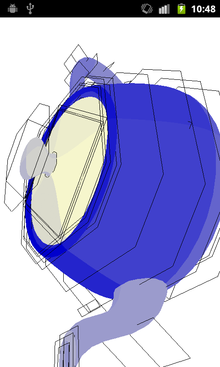
Teapot on Android I got myself a second-hand Samsung Galaxy S at last, and started hacking on it! The very first thing I wanted to try was porting the OpenGL wikibook C++ samples, that we wrote with OpenGL ES 2 in mind. I started writing a minimal GLUT-compatible wrapper to run the samples as-is, using the Android NDK, and I'm making progress :) The Android NDK is getting nicer with Android 2.3, though it still feels less supported than Java apps (e.g. the resize events seem buggy and the keycodes header is incomplete...). Nonetheless, it's nice to be able to write C++ portable apps. You can see how to use the wrapper, and how it works internally, at: http://en.wikibooks.org/wiki/OpenGL_Programming/Installation/Android One of the limitations is that GLES2 is not a true subset of OpenGL 2.1, in particular: I needed to pre-process these differences away, checking on GL_ES_VERSION_2_0 in the C++ source code to define a GLES2 macro in the shaders:
#ifdef GLES2
varying lowp vec4 f_color;
# else
varying vec4 f_color;
#endif
Is there a better way?

Stefano Zacchiroli: hardware sponsorship for Debian Developers

A few days ago Yves-Alexis Perez asked me how many hardware sponsorship request I usually get from Debian Developers, that is how many people ask me to use Debian money to buy material that can improve their work on Debian and indirectly Debian itself. The answer is "too few".
Making it easier for our developers to improve Debian is a worthwhile investment of money donated to Debian. Of course such a use of money should be motivated (i.e. you should be able to justify how the material you're asking for would improve Debian and why it should be Debian paying for it) and transparent (i.e. you should periodically report about what you're doing with material that Debian has bought for you to use). The above two principles are what I've tried to convey in a new section of the sponsoring guidelines wiki page I've been maintaining for a while. Comments and improvements highly welcome! Equally welcome are advocacy messages for hardware sponsoring to other fellow Developers, as suggested by Corsac.

Gunnar Wolf: BugCon friends, are you trying to scare away 50%+ of the target audience?

You are scaring away much more than that. I just came across an invitation for BugCon 2012. BugCon is a Mexican conference devoted to computer security I cannot comment on its level or value because, although it's a topic that has long interested me, I must recognize each day I feel less of an expert, nowadays finding myself at the level of a "sysadmin who tries not to be too dumb for his own job security". Oh, and also because it would be completely off-topic for this post. If you look at Vendetta's (the main organizer) blog post, it will probably give you the impression that the conference is just an excuse for the afterparty: Lets go see some b00bs! Do you think your fellow female hackers will have any interest in joining a bunch of sex-starved, hormone-infested teenagers who only want to pwn a website and grab more pr0n? Do you think females will feel welcome (or even mildly safe) between you? I would not think so. And I also think you are alienating any professional who might have any interest in joining your community, be it as a member, as a mentor, or whatnot. I cannot right now do a coherent post on this topic, but I can reference you to what I have seen (and read) over the last almost 10 years, when the issue was first brought up to our attention. I am very glad to see that, at least in the Free Software area, there has been a real change of mindset. I hope you are in time to think about it and rectify. Oh, and not the description of an incident, but a very interesting and thoughtful take on this: [pdf] Interesting analysis by Hannah Wallach on the numbers and motivations of women in Free Software groups. I don't know if Hannah has published this in article form, but many interesting points can be understood by looking at the presentation. My good friend Vendetta: I don't mean this post (longer than what I originally intended) as a way to say you and the conference you are organizing for the third year (IIRC) already is unprofessional or targetted to pimply teenagers. I know the work you have put in it. I hope you see the points I'm trying to drive You are of course free to have whatever afterparty you have. But, if as the main organizer, you are giving the images of nice chicks at Hooters more weight and relevance than to the conference itself... you are doing yourself a disservice. I hope you can rectify it, and make BugCon attractive to hacker women as well.

23 January 2012

Neil Williams: Emdebian Grip automated dependency resolution

The script isn't fully automated yet, I'm running it manually and watching for errors, but I do now have a simple script (~100 lines of perl) which runs edos-debcheck against each of the supported Emdebian architectures for unstable-grip and picks out those packages which are missing from the subset of packages which Emdebian monitors for Grip.

I was hoping to make these scripts into a normal Debian package but there are some limitations in that the scripts need to assume various pieces of Debian infrastructure. e.g. I started off using rsync to pull in the Packages files (along with Release and Sources) because apt has annoying behaviours with multiple architectures. (Emdebian Grip processes 7 architectures simultaneously on blavet.debian.org). Peter Palfrader kindly arranged for a local mirror to be available and now the entire Packages processing can be done using symlinks. Much, much better.

Actual package movement data comes directly from dak via projectb - something else which makes packaging these scripts for use on non debian.org boxes a bit hard.

Once again, I am indebted to the EDOS team (please, please keep working on edos-debcheck - it hasn't had uploads recently) because I tried to get this working with germinate but failed. (Colin - I'll be looking to borrow some of your time to work out what was going wrong.)

The dependency resolution script now means that I can meet release team requirements that when foo is updated in sid to depend on libbar2 but Emdebian Grip only has libbar1, the scripts will automatically pick up libbar2 and add it to Emdebian Grip. The current sid version gets pulled in and (the theory goes) will migrate into testing-grip as an almost automatically valid candidate. Processing of the dependency can happen within hours of the updated version of foo arriving in Emdebian Grip but as long as it happens within a few days I think everyone will be fine with it.

I've got a sync script too which can periodically run across the entire suite and check for packages which have slipped the net. I'll have to see how often that needs to run but once a week doesn't sound too painful.

Processing for Emdebian Grip is very fast. Most of the time is taken uploading:

2012-01-23 22:24:42 add sid-grip deb main armhf libfltk-images1.3 1.3.0-5em1
2012-01-23 22:24:52 add sid-grip deb main i386 libfltk-images1.3 1.3.0-5em1
2012-01-23 22:25:07 add sid-grip deb main mips libfltk-images1.3 1.3.0-5em1
2012-01-23 22:25:25 add sid-grip deb main powerpc libfltk-images1.3 1.3.0-5em1
2012-01-23 22:26:00 add sid-grip deb main amd64 libstdc++6-4.5-dev 4.5.3-12em1
2012-01-23 22:26:34 add sid-grip deb main armel libstdc++6-4.5-dev 4.5.3-12em1


(It was a lot longer, comparatively, when I was having to rsync and then dget instead of just read from the local filesystem.)

I've also been working on an init script which will gradually work through the subset of packages by order of Priority - approximately what a new architecture (like armhf) would do. Note that Emdebian Grip supports armhf already. The only slight concern is whether the init script needs to be throttled back to not flood the queues with hundreds of uploads an hour (which it could end up doing, at least for the first 24 hours).

Logs of package movements are available: http://www.emdebian.org/grip/logs.php

Packages can be searched too: http://www.emdebian.org/grip/search.php

More on Emdebian Integration on the Debian wiki: http://wiki.debian.org/EmdebianIntegration

Now all I need is a fix for #655919 :-) FTP team?

22 January 2012

Kees Cook: fixing vulnerabilities with systemtap

Recently the upstream Linux kernel released a fix for a serious security vulnerability (CVE-2012-0056) without coordinating with Linux distributions, leaving a window of vulnerability open for end users. Luckily: Still, it s a cross-architecture local root escalation on most common installations. Don t stop reading just because you don t have a local user base attackers can use this to elevate privileges from your user, or from the web server s user, etc. Since there is now a nearly-complete walk-through, the urgency for fixing this is higher. While you re waiting for your distribution s kernel update, you can use systemtap to change your kernel s running behavior. RedHat suggested this, and here s how to do it in Debian and Ubuntu: In this case, the systemtap script is changing the argument containing the size of the write to zero bytes ($count = 0), which effectively closes this vulnerability. UPDATE: here s a systemtap script from Soren that doesn t require the full debug symbols. Sneaky, put can be rather slow since it hooks all writes in the system. :)

2012, Kees Cook. This work is licensed under a Creative Commons Attribution-ShareAlike 3.0 License.
Creative Commons License

Nikita Youshchenko: squeeze + iceweasel backport = no printing in gimp

Looks like installing iceweasel backport packages from

deb http://mozilla.debian.net squeeze-backports iceweasel-release

causes installation of backport of libcairo2 1.10 which breaks printing from GIMP, as described in this ubuntu bug. Does anybody know a fix/workaround? Update: looks like running gimp with LD_LIBRARY_PATH set to directory containing library files from squeeze libcairo2 package (1.8.10-6) workarounds this. But this story makes me think again that bundling libraries with applications is not that bad idea at least for users who need to get things done.

Jon Dowland: bugs

[pic]
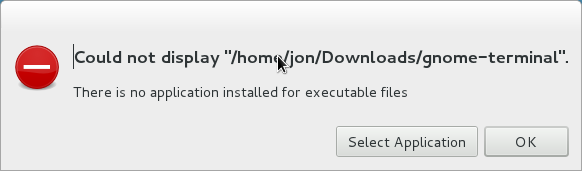
Bugs I've hit in GNOME 3, in the last 5 minutes: I didn't set out to bug-hunt this morning, I'm actually trying to get some work done. Whilst this is a particularly bad case of stacked-bugs, it's unfortunately, pretty representative of what it's like to try and use a Linux desktop at the moment. Every day I go through a similar experience. I've just had to give up and log out and back in again. The shell path bug above has re-surfaced in a new session. Great. I'm waiting on a delayed laptop at work. I'm very tempted to cancel the order and just use a Mac Air instead (we have one spare). It seems I'm walking the inevitable path of F/OSS desktop frustration and the end for many people seems to be the Mac perhaps I should spare myself the pain of the journey. In the mean time, It's bye-bye to GNOME and off to Xfce for me.

21 January 2012

Joey Hess: olduse.net 1982

Hard to believe I've consumed all of 1981's Usenet posts now on olduse.net, and it's been running for 7 months already.
Last night, there was a "very long" post, describing nearly every node on usenet in 1982. There had been a warning about this post the day before, since it would take many sites half an hour to download at 300 baud. It was handily formatted as a shell script, which created per-node files. So, I ran this code nobody has run since 1982. It worked. I got files. I tossed them on the olduse.net wiki, and used some ikiwiki code TOVA contracted me to write just a few months ago, to make clickable links on my usenet map. usenet map The map data was contributed in another post a while back. By 1982, usenet is getting nearly impossible to map with 1982 technology of ascii art. I enjoyed throwing graphviz, git, wikis, and the web at it. So, we have a collaboration across time, me and "Mark" and a lot of people who described their usenet nodes and piles of technology that make creating a mashup easy. Awesome!
I blog about stuff I find on the olduse.net blog. It's an open blog; Koldfront also blogs there, and we welcome other bloggers. Some of the highlights for me have included: As the space shuttle program is winding down, reading the excitement about the first shuttle flights, and the play-by-play coverage of a launch, posted to net.columbia by a high school student borrowing his dad's account. (A usegroup name that's hard to read without remembering its fate). The announcements of the Motorola M68k, the IBM PC, and the CD-ROM. world ipv6 launch Reading the TCP-IP digest, and Postel's plans for launching IPv4 soon, while the world IPv6 launch is being planned now. (The nay-sayers are especially fun to read. Including the guy who was concerned about the address space size, in 1981!) Learning that nethack ascention tales have a history streching back 30 years, to rogue, and that the stories back then had much the same flavor as they do today. Various celebrity sightings. Dennis Ritchie teaching C and Unix. Bill Joy talking vi. RMS talking .. nuclear politics? The general development of usenet. B-news being rolled out, groups proliferating, many first inklings of what will be major problems and developments in 5 or 10 years. A shift in tone is already apparent, by now usenet is not only about announcements, there are already some flames. oldusenet in a period terminal Still 9 years to go!

Andrew Pollock: [debian] Bits from the ISC DHCP Maintainer

I really should write these a bit more often. Wow, I can't believe it was over 4 years ago that I started having occasional face to face meetings with the ISC DHCP folks. The entire ISC DHCP team (of 5) was in town for an all-hands meeting, and Larissa Shapiro, the Product Manager for DHCP (and BIND) suggested it would be a good opportunity for another catch up. Given the current (bad) state of DHCP 4.2 in unstable, I thought this was an excellent idea, and so we all had lunch on Tuesday. I pretty much set the agenda, and it was The general state of 4.2.2 in Debian In a nutshell, it's a bit of a mess. We've got release critical bugs, build failures, the whole cat and kaboodle. It makes me very sad, because 4.2.2 was the first 4.2 series that I had a chance to upload, and I was very excited to do so, because it contains the hotly desired LDAP patches merged upstream. Unfortunately, it's also got the beginnings of the BIND/DHCP merger that's going to be BIND 10, and that is all a bit of a mess. It's directly responsible for the kFreeBSD FTBFS and the introduction of the RFCs, which are both keeping 4.2.2 out of testing. I gave the ISC folks a high-level overview of how Debian development works, and the normal progression of packages from unstable to testing to stable, and the release process and whatnot, and impressed upon them the implications of the current release critical bugs. I also showed them how Ubuntu development fitted into the picture. Finally, I showed them the popcon statistics for DHCP. I think they found it useful. FTBFS issues on kFreeBSD This was a good segue to #643569. The issue is actually with the embedded BIND sources. I'd already forwarded this bug upstream when it first happened, but I don't know what had happened to it. They seemed to act as if this was the first they'd heard of it. I'm hoping that they can get this fixed in 4.2.3, which is due around the end of the quarter. Embedded BIND sources Since we were already talking about an issue caused by the embedded BIND sources, we moved on to talking about #645760 and the existence of the embedded BIND sources in general. It should be pretty straightforward for them to strip the RFCs out of the source. They've already done it in the past for the DHCP sources, so I'm also hopeful that this will get resolved in 4.2.3. The issue of the embedded BIND sources is apparently a bit more complicated, although the day before our meeting, Michael Gilbert filed #643569 and #645760, so I hope that the ISC folks can take a look at these patches and see if it's feasible to adopt them. Patches for GNU/Hurd Finally we talked about #616290, which I know is near and dear to the GNU/Hurd porters' hearts. We probably spent the most time talking about this. The DHCP developers have concerns about accepting a patch for an OS that they do absolutely no testing on, and also questioned the viability of the OS in general. They stressed that they're fairly thin in numbers relative to what they have on their plate to achieve this year, and so pushed back pretty firmly on accepting the current patch. I relayed the frustration that the Hurd folks were having about a lack of dialogue around the patch (most of the interaction has been via an ISC support person). There was actually a bit of a split between the developers, with one of them appreciating that the Hurd was unlikely to go anywhere as a platform without a working DHCP client, so in some regards, they were condemning the platform by taking the position they were taking. They're going to go away and take another look at the patch and try to come back with some actionable feedback on what needs to change to make it more acceptable to them, so we'll see what comes of this. I'm not particularly optimistic that anything acceptable to the GNU/Hurd folks is likely to happen any time soon, but maybe if the patch gets cleaned up a bit more, I'll just bite the bullet and start applying it to the Debian package. BIND 10 One of the guys is more involved in BIND 10 than DHCP, and asked if I could help out with the packaging of a build dependency for BIND 10. It seemed like #578387 was languishing so I offered to pick it up. I've not packaged a library before, mainly because the library packaging guide has scared me off it (I feel I lack the deep C fu that seems necessary), but I figured that this would be a good learning opportunity, so I'm going to dive in.

Steve Kemp: So mega-upload is gone

So the site http://megaupload.com/ has been taken offline, amidst allegations of knowingly conducting in piracy. There are probably a lot of legitimate users who have lost access to their uploaded files, even if they were offsite backups you can imagine a user owning a website which now has a million dead-links. This reminds me of a conversation I overheard on Jon Dowlands blog - the summary is that he'd written a (useful) tool to extract attachments from Maildir folders and was wondering how to store and access those attachments. The upshot seemed to be magical URLs of the form:
  • https://file.example.com/sha1/509c2fe2eba509e93987c3024a74d74583c274bd
The comments covered an alternative which was hash:///sha1/xxxxxxxxxxxxxxxx, which then becomes close to the magnet:// schema. I've not yet thought things through, but I can't help thinking that with the redundency already present in the internet we should be looking at non-server-specific links. Yes there are times right now when you might want to address a specific file on a specific server - but otherwise? Wouldn't it be nice if you could just access a file from "anywhere" which happened to have the right contents? Already my nonporn-but-definitely-adult-site makes its images available as /img/$md5sum.jpg - and similarly the storage at the back-end of my random image upload site uses SHA1 hashes to store the actual files. To make this more complete what we need is something that crawls the internet to find files by hash; then add support in browsers. Obviously this must be async and could introduce timing issues, but fundamentally it seems like a reasonable approach to the problem of a single host going offline. (Consider what happens if imgur.com disappears. All those links would die, yet 99% of the images would still be available somewhere.) I'm tempted to suggest microformat format but I need to consider the matter. Right now I'm going to immediately update my current image hosts to use, at the very least:
 <a href="/foo" rel="sha1:xxxxx md5sum:xxxx">
  <img src="foo.jpg" alt="img name">
 </a>
The unfortunate thing is you cannot have a 'rel="xx"' attribute for an image. So you either have to encode it in the parent link, or add it to the alt attribute which is suboptimal. ObQuote: "Now, they tell me I paid my debt to society." - Oceans Eleven (2001)

20 January 2012

Benjamin Mako Hill: Internet Immortality

Kim Jong-Il is gone. That said, he continues to live on, looking at things, on the popular blog Kim Jong-Il Looking At Things which continues to be updated with new content from the archives. It is now joined by Kim Jong-Un Looking At Things. I think I agree with Jo o Rocha, creator of the original, that the younger Kim seems to be missing some hard-to-pin-down quality that made the original work well.

Next.

Previous.