Search Results: "tb"

15 December 2022

Russell Coker: Pixel 6A

I have just bought a Pixel 6A [1] for my wife. It s one of the latest Google phones that was released almost at the same time as the Pixel 7 series, so if you want to spend a lot of money on a phone that s the latest and greatest then the Pixel 7 and Pixel 7 Pro are the options, but if you want to save some money and don t need something really high end then the Pixel 6A is a good option. The one I bought cost $550 when I bought it from Google which seemed like a good deal when it was advertised as being discounted from $750. Later I discovered that other retailers were selling it for $500 or for $550 when bundled with a Chromecast. Also one of the other retailers was a company that I could get discount gift cards for. So this is the type of item you should really shop around for. It doesn t come with a charger so you don t have the gray-market disadvantage of getting yet another charger that doesn t fit the sockets in your country. The main new feature of this phone is a fingerprint scanner built in to the screen. I don t think this is a good thing, sure it s neat technology to both display pictures and read fingerprints through the same piece of glass but there are benefits to using a different location. Huawei phones with a fingerprint reader at the rear of the phone allow the user to answer calls, drag down the notifications list, and scroll sideways via touching the fingerprint reader. So the Pixel 6A clearly gives less functionality than some Huawei phones in this regard. One major annoyance with the phone is a combination of the phone hardware and Android 13 which gives no back arrow (swipe sideways) and no button to get the task list (swipe upwards at the correct speed from the bottom of the screen). The Android 12 way of swiping up from the bottom of the screen to get buttons for back, task-list, and home-screen is much better IMHO. Hopefully they will release a software update to make this a configuration option. Generally this is a nice phone, but the lack of buttons for back and task-list is annoying. Maybe the lack of buttons is something you can get used to after using it for a while. But millions of people just taking whatever companies like Google offer isn t what I imagined when I first hoped for a large portion of the world using Linux. On PCs we have a choice between KDE, GNOME, and other UIs. It would be nice if we had similar choices on phones.

14 December 2022

Russ Allbery: Review: Contact

Review: Contact, by Carl Sagan
Publisher: Pocket Books
Copyright: 1985
Printing: October 1986
ISBN: 0-671-43422-5
Format: Mass market
Pages: 434
Contact is a standalone first-contact science fiction novel. Carl Sagan (1934 1996) was best known as a non-fiction writer, astronomer, and narrator of the PBS non-fiction program Cosmos. This is his first and only novel. Ellie Arroway is the director of Project Argus, a radio telescope array in the New Mexico desert whose primary mission is SETI: the search for extra-terrestrial intelligence by scanning the skies for unexpected radio signals. Its assignment to SETI is controversial; there are radio astronomy projects waiting, and although 25% of the telescope time is assigned to non-SETI projects, some astronomers think the SETI mission should be scrapped and Argus fully diverted to more useful research. That changes overnight when Argus picks up a signal from Vega, binary pulses representing the sequence of prime numbers. The signal of course doesn't stop when the Earth rotates, so Ellie and her team quickly notify every radio observatory they can get hold of to follow the signal as it passes out of their line of sight. Before long, nearly every country with a radio telescope is involved, and Russian help is particularly vital since they have ship-mounted equipment. The US military and intelligence establishment isn't happy about this and make a few attempts to shove the genie back into the bottle and keep any further discoveries secret, without a lot of success. (Sagan did not anticipate the end of the Cold War, and yet ironically relations with the Russians in his version of the 1990s are warmer by far than they are today. Not that this makes the military types any happier.) For better or worse, making sense of the alien signal becomes a global project. You may be familiar with this book through its 1997 movie adaptation starring Jodie Foster. What I didn't know before reading this book is that it started life as a movie treatment, co-written with Ann Druyan, in 1979. When the movie stalled, Sagan expanded it into a novel. (Given the thanks to Druyan in the author's note, it may not be far wrong to name her as a co-author.) If you've seen the movie, you will have a good idea of what will happen, but the book gives the project a more realistic international scope. Ellie has colleagues carefully selected from all over the world, including for the climactic moment of the story. The biggest problem with Contact as a novel is that Sagan is a non-fiction writer who didn't really know how to write a novel. The long, detailed descriptions of the science and the astronomical equipment fit a certain type of SF story, but the descriptions of the characters, even Ellie, are equally detailed and yet use the same style. The book starts with an account of Ellie's childhood and path into science written like a biography or a magazine profile, not like a novel in which she's the protagonist. The same is true of the other characters: we get characterization of a sort, but the tone ranges from Wikipedia article to long-form essay and never quite feels like a story. Ellie is the most interesting character in the book, partly because the way Sagan writes her is both distant but oddly compelling. Sagan (or perhaps Druyan?) tries hard to show what life is like for a woman born in the middle of the 20th century who is interested in science and I think mostly succeeds, although Ellie's reactions to sexism felt weirdly emotionless. The descriptions of her relationships are even odder and the parts where this book felt the least like a novel, but Sagan does sell some of that tone as reflective of Ellie's personality. She's a scientist, the work is the center of her life, and everything else, even when important, is secondary. It doesn't entirely make the writing style work, but it helps. Sagan does attempt to give Ellie a personal development arc related to her childhood and her relationships with her father and step-father. I thought the conclusion to that was neither believable nor anywhere near as important as Sagan thought it was, which was off-putting. Better were her ongoing arguments with evangelical Christians, one of whom is a close-minded ass and the other of which is a far more interesting character. They felt wedged into this book, and I'm dubious a realistic version of Ellie would have been the person to have those debates, but it's a subject Sagan clearly has deep personal interest in and that shows in how they're written. The other problem with Contact as a novel is that Sagan does not take science fiction seriously as a genre, instead treating it as a way to explore a thought experiment. To a science fiction reader, or at least to this science fiction reader, the interesting bits of this story involve the aliens. Those are not the bits Sagan is interested in. His attention is on how this sort of contact, and project, would affect humanity and human politics. We do get some more traditional science fiction near the end of the book, but Sagan then immediately backs away from it, minimizes that part of the story, and focuses exclusively on the emotional and philosophical implications for humans of his thought experiment. Since I found his philosophical musings about agnosticism and wonder and discovery less interesting than the actual science fiction bits, I found this somewhat annoying. The ending felt a bit more like a cheap trick than a satisfying conclusion. Interestingly, this entire novel is set in an alternate universe, for reasons entirely unexplained (at least that I noticed) in the book. It's set in the late 1990s but was written in 1985, so of course this is an alternate future, but the 1985 of this world still isn't ours. Yuri Gagarin was the first man to set foot on the moon, and the space program and the Cold War developed in subtly different ways. I'm not sure why Sagan made that choice, but it felt to me like he was separating his thought experiment farther from our world to give the ending more plausible deniability. There are, at the time of the novel, permanent orbital colonies for (mostly) rich people, because living in space turns out to greatly extend human lifespans. That gives Sagan an opportunity to wax poetic about the life-altering effects of seeing Earth from space, which in his alternate timeline rapidly sped up nuclear disarmament and made the rich more protective of the planet. This is an old bit of space boosterism that isn't as common these days, mostly because it's become abundantly clear that human psychology doesn't work this way. Sadly, rich sociopaths remain sociopaths even when you send them into space. I was a bit torn between finding Sagan's predictions charmingly hopeful and annoyingly daft. I don't think this novel is very successful as a novel. It's much longer than it needs to be and long parts of it drag. But it's still oddly readable; even knowing the rough shape of the ending in advance, I found it hard to put down once the plot properly kicks into gear about two-thirds of the way through. There's a lot in here that I'd argue with Sagan about, but he's thoughtful and makes a serious attempt to work out the political and scientific ramifications of such a discovery in detail. Despite the dry tone, he does a surprisingly good job capturing the anticipation and excitement of a very expensive and risky scientific experiment. I'm not sure I would recommend this book to anyone, but I'm also the person who found Gregory Benford's Timescape to be boring and tedious, despite its rave reviews as a science fiction novel about the practice of science. If that sort of book is more your jam, you may like Contact better than I did. Rating: 6 out of 10

12 December 2022

Vasudev Kamath: Installing Debian from GRML Live CD

I had bought a Thinkpad E470 laptop back in 2018 which was lying unused for quite some time. Recently when I wanted to use it, I found that the keyboard is not working, especially some keys and after some time the laptop will hang in Lenovo boot screen. I came back to Bangalore almost after 2 years from my hometown (WFH due to Covid) and thought it was the right time to get my laptop back to normal working state. After getting the keyboard replaced I noticed that 1TB HDD is no longer fast enough for my taste!. I've to admit I never thought I would start disliking HDD so quickly thanks to modern SSD based work laptops. So as a second upgrade I got the HDD removed from my laptop and got a 240G SSD. Yeah I know its reduction from my original size but I intend to continue using my old HDD via USB SATA enclosure as an external HDD which can house the extra data which I need to save. So now that I've a SSD I need to install Debian Unstable again on it and this is where I tried something new. My colleague (name redacted on request) suggested to me use GRML live CD and install Debian via debootstrap. And after giving a thought I decided to try this out. Some reason for going ahead with this are listed below
  1. Debian Installer does not support a proper BTRFS based root file system. It just allows btrfs as root but no subvolume support. Also I'm not sure about the luks support with btrfs as root.
  2. I also wanted to give a try to systemd-boot as my laptop is UEFI capable and I've slowly started disliking Grub.
  3. I really hate installing task-kde-desktop (Yeah you read it right, I've switched to be a KDE user for quite some time) which will pull tons of unwanted stuff and bloat. Well it's not just task-kde-desktop but any other task-desktop package does similar and I don't want to have too much of unused stuff and services running.
Disk Preparation As a first step I went to GRML website and downloaded current pre-release. Frankly, I'm using GRML for first time and I was not sure what to expect. When I booted it up I was bit taken a back to see its console based and I did not have a wired lan just a plain wireless dongle (Jiofi device) and was wondering what it will take to connect. But surprisingly curses based UI was pretty much straight forward to allow me to connect to Wifi AP. Another thing was the rescue CD had non-free firmware as the laptop was using ath10k device and needed non-free blobs to operate. Once I got shell prompt in rescue CD first thing I did was to reconfigure console-setup to increase font size which was very very small on default boot. Once that is done I did the following to create a 1G (FAT32) partition for EFI.
parted -a optimal -s /dev/sda mklabel gpt
parted -a optimal -s /dev/sda mkpart primary vfat 0% 1G
parted -a optimal -s /dev/sda set 1 esp on
mkfs.vfat -n boot_disk -F 32 /dev/sda1
So here is what I did: created a 1G vfat type partition and set the esp flag on it. This will be mounted to /boot/efi for systemd-boot. Next I created a single partition on the rest of the available free disk which will be used as the root file system. Next I encrypted the root parition using LUKS and then created the BTRFS file system on top of it.
cryptsetup luksFormat /dev/sda2
cryptsetup luksOpen /dev/sda2 ENC
mkfs.btrfs -L root_disk /dev/mapper/ENC
Next is to create subvolumes in BTRFS. I followed suggestion by colleague and created a top-level @ as subvolume below which created @/home @/var/log @/opt . Also enabled compression with zstd and level of 1 to avoid battery drain. Finally marked the @ as default subvolume to avoid adding it to fstab entry.
mount -o compress=zstd:1 /dev/mapper/ENC /mnt
btrfs subvol create /mnt/@
cd /mnt/@
btrfs subvol create ./home
btrfs subvol create ./opt
mkdir -p var
btrfs subvol create ./var/log
btrfs suvol set-default /mnt/@
Bootstrapping Debian Now that root disk is prepared next step was to bootstrap the root file system. I used debootstrap for this job. One thing I missed here from installer was ability to preseed. I tried looking around to figure out if we can preseed debootstrap but did not find much. If you know the procedure do point it to me.
cd /mnt/
debootstrap --include=dbus,locales,tzdata unstable @/ http://deb.debian.org/debian
Well this just gets a bare minimal installation of Debian I need to install rest of the things post this step manually by chroot into target folder @/. I like the grml-chroot command for chroot purpose, it does most of the job of mounting all required directory like /dev/ /proc /sys etc. But before entering chroot I need to mount the ESP partition we created to /boot/efi so that I can finalize the installation of kernel and systemd-boot.
umount /mnt
mount -o compress=zstd:1 /dev/mapper/ENC /mnt
mkdir -p /mnt/boot/efi
mount /dev/sda1 /mnt/boot/efi
grml-chroot /mnt /bin/bash
I remounted the root subvolume @ directly to /mnt now, remember I made @ as default subvolume before. I also mounted ESP partition with FAT32 file system to /boot/efi. Finally I used grml-chroot to get into chroot of newly bootstrapped file system. Now I will install the kernel and minimal KDE desktop installation and configure locales and time zone data for the new system. I wanted to use dracut instead of default initramfs-tools for initrd. I also need to install cryptsetup and btrfs-progs so I can decrypt and really boot into my new system.
apt-get update
apt-get install linux-image-amd64 dracut openssh-client \
                        kde-plasma-desktop plasma-workspace-wayland \
                        plasma-nm cryptsetup btrfs-progs sudo
Next is setting up crypttab and fstab entries for new system. Following entry is added to fstab
LABEL="root_disk" / btrfs defaults,compress=zstd:1 0 0
And the crypttab entry
ENCRYPTED_ROOT UUID=xxxx none discard,x-initrd.attach
I've not written actual UUID above this is just for the purpose of showing the content of /etc/crypttab. Once these entries are added we need to recreate initrd. I just reconfigured the installed kernel package for retriggerring the recreation of initrd using dracut. .. Reconfiguration was locales is done by editing /etc/locales.gen to uncomment en_US.UTF-8 and writing /etc/timezone with Asia/Kolkata. I used DEBIAN_FRONTEND=noninteractive to avoid another prompt asking for locale and timezone information.
export DEBIAN_FRONTEND=noninteractive
dpkg-reconfigure locales
dpkg-reconfigure tzdata
Added my user using adduser command and also set the root password as well. Added my user to sudo group so I can use sudo to elevate privileges.
Setting up systemd-boot So now basic usable system is ready last part is enabling the systemd-boot configuration as I'm not gonna use grub. I did following to install systemd-boot. Frankly I'm not expert of this it was colleague's suggestion. Before installing the systemd-boot I had to setup kernel command line. This can be done by writing command line to /etc/kernel/cmdline with following contents.
systemd.gpt_auto=no quiet root=LABEL=root_disk
I'm disabling systemd-gpt-generator to avoid race condition between crypttab entry and auto generated entry by systemd. I faced this mainly because of my stupidity of not adding entry root=LABEL=root_disk
apt-get install -y systemd-boot
bootctl install --make-entry-directory=yes --entry-token=machine-id
dpkg-reconfigure linux-image-6.0.0-5-amd64
Finally exit from the chroot and reboot into the freshly installed system. systemd-boot already ships a hook file zz-systemd-boot under /etc/kernel so its pretty much usable without any manual intervention. Previously after kernel installation we had to manually update kernel image in efi partitions using bootctl
Conclussion Though installing from live image is not new and debian-installer also does the same only difference is more control over installation and doing things which is installer is not letting you do (or should I say is not part of default installation?). If properly automated using scripts we can leverage this to do custom installation in large scale environments. I know there is FAI but I've not explored it and felt there is too much to setup for a simple installations with specific requirements. So finally I've a system with Debian which differs from default Debian installation :-). I should thank my colleague for rekindling nerd inside me who had stopped experimenting quite a long time back.

Russ Allbery: Review: The Unbroken

Review: The Unbroken, by C.L. Clark
Series: Magic of the Lost #1
Publisher: Orbit
Copyright: March 2021
ISBN: 0-316-54267-9
Format: Kindle
Pages: 490
The Unbroken is the first book of a projected fantasy trilogy. It is C.L. Clark's first novel. Lieutenant Touraine is one of the Sands, the derogatory name for the Balladairan Colonial Brigade. She, like the others of her squad, are conscript soldiers, kidnapped by the Balladairan Empire from their colonies as children and beaten into "civilized" behavior by Balladairan training. They fought in the Balladairan war against the Taargens. Now, they've been reassigned to El-Wast, capital city of Qaz l, the foremost of the southern colonies. The place where Touraine was born, from which she was taken at the age of five. Balladaire is not France and Qaz l is not Algeria, but the parallels are obvious and strongly implied by the map and the climates. Touraine and her squad are part of the forces accompanying Princess Luca, the crown princess of the Balladairan Empire, who has been sent to take charge of Qaz l and quell a rebellion. Luca's parents died in the Withering, the latest round of a recurrent plague that haunts Balladaire. She is the rightful heir, but her uncle rules as regent and is reluctant to give her the throne. Qaz l is where she is to prove herself. If she can bring the colony in line, she can prove that she's ready to rule: her birthright and her destiny. The Qaz li are uninterested in being part of Luca's grand plan of personal accomplishment. She steps off her ship into an assassination attempt, foiled by Touraine's sharp eyes and quick reactions, which brings the Sand to the princess's attention. Touraine's reward is to be assigned the execution of the captured rebels, one of whom recognizes her and names her mother before he dies. This sets up the core of the plot: Qaz li rebellion against an oppressive colonial empire, Luca's attempt to use the colony as a political stepping stone, and Touraine caught in between. One of the reasons why I am happy to see increased diversity in SFF authors is that the way we tell stories is shaped by our cultural upbringing. I was taught to tell stories about colonialism and rebellion in a specific ideological shape. It's hard to describe briefly, but the core idea is that being under the rule of someone else is unnatural as well as being an injustice. It's a deviation from the way the world should work, something unexpected that is inherently unstable. Once people unite to overthrow their oppressors, eventual success is inevitable; it's not only right or moral, it's the natural path of history. This is what you get when you try to peel the supremacy part away from white supremacy but leave the unshakable self-confidence and bedrock assumption that the universe cares what we think. We were also taught that rebellion is primarily ideological. One may be motivated by personal injustice, but the correct use of that injustice is to subsume it into concepts such as freedom and democracy. Those concepts are more "real" in some foundational sense, more central to the right functioning of the world, than individual circumstance. When the now-dominant group tells stories of long-ago revolution, there is no personal experience of oppression and survival in which to ground the story; instead, it's linked to anticipatory fear in the reader, to the idea that one's privileges could be taken away by a foreign oppressor and that the counter to this threat is ideological unity. Obviously, not every white fantasy author uses this story shape, but the tendency runs deep because we're taught it young. You can see it everywhere in fantasy, from Lord of the Rings to Tigana. The Unbroken uses a much different story shape, and I don't think it's a coincidence that the author is Black. Touraine is not sympathetic to the Qaz li. These are not her people and this is not her life. She went through hell in Balladairan schools, but she won a place, however tenuous. Her personal role model is General Cantic, the Balladairan Blood General who was also one of her instructors. Cantic is hard as nails, unforgiving, unbending, and probably a war criminal, but also the embodiment of a military ethic. She is tough but fair with the conscript soldiers. She doesn't put a stop to their harassment by the regular Balladairan troops, but neither does she let it go too far. Cantic has power, she knows how to keep it, and there is a place for Touraine in Cantic's world. And, critically, that place is not just hers: it's one she shares with her squad. Touraine's primary loyalty is not to Balladaire or to Qaz l. It's to the Sands. Her soldiers are neither one thing nor the other, and they disagree vehemently among themselves about what Qaz l and their other colonial homes should be to them, but they learned together, fought together, and died together. That theme is woven throughout The Unbroken: personal bonds, third and fourth loyalties, and practical ethics of survival that complicate and contradict simple dichotomies of oppressor and oppressed. Touraine is repeatedly offered ideological motives that the protagonist in the typical story shape would adopt. And she repeatedly rejects them for personal bonds: trying to keep her people safe, in a world that is not looking out for them. The consequence is that this book tears Touraine apart. She tries to walk a precarious path between Luca, the Qaz li, Cantic, and the Sands, and she falls off that path a lot. Each time I thought I knew where this book was going, there's another reversal, often brutal. I tend to be a happily-ever-after reader who wants the protagonist to get everything they need, so this isn't my normal fare. The amount of hell that Touraine goes through made for difficult reading, worse because much of it is due to her own mistakes or betrayals. But Clark makes those decisions believable given the impossible position Touraine is in and the lack of role models she has for making other choices. She's set up to fail, and the price of small victories is to have no one understand the decisions that she makes, or to believe her motives. Luca is the other viewpoint character of the book (and yes, this is also a love affair, which complicates both of their loyalties). She is the heroine of a more typical genre fantasy novel: the outsider princess with a physical disability and a razor-sharp mind, ambitious but fair (at least in her own mind), with a trusted bodyguard advisor who also knew her father and a sincere desire to be kinder and more even-handed in her governance of the colony. All of this is real; Luca is a protagonist, and the reader is not being set up to dislike her. But compared to Touraine's grappling with identity, loyalty, and ethics, Luca is never in any real danger, and her concerns start to feel too calculated and superficial. It's hard to be seriously invested in whether Luca proves herself or gets her throne when people are being slaughtered and abused. This, I think, is the best part of this book. Clark tells a traditional ideological fantasy of learning to be a good ruler, but she puts it alongside a much deeper and more complex story of multi-faceted oppression. She has the two protagonists fall in love with each other and challenges them to understand each other, and Luca does not come off well in this comparison. Touraine is frustrated, impulsive, physical, and sometimes has catastrophically poor judgment. Luca is analytical and calculating, and in most ways understands the political dynamics far better than Touraine. We know how this story usually goes: Luca sees Touraine's brilliance and lifts her out of the ranks into a role of importance and influence, which Touraine should reward with loyalty. But Touraine's world is more real, more grounded, and more authentic, and both Touraine and the reader know what Luca could offer is contingent and comes with a higher price than Luca understands. (Incidentally, the cover of The Unbroken, designed by Lauren Panepinto with art by Tommy Arnold, is astonishingly good at capturing both Touraine's character and the overall feeling of the book. Here's a larger version.) The writing is good but uneven. Clark loves reversals, and they did keep me reading, but I think there were too many of them. By the end of the book, the escalation of betrayals and setbacks was more exhausting than exciting, and I'd stopped trusting anything good would last. (Admittedly, this is an accurate reflection of how Touraine felt.) Touraine's inner monologue also gets a bit repetitive when she's thrashing in the jaws of an emotional trap. I think some of this is first-novel problems of over-explaining emotional states and character reasoning, but these problems combine to make the book feel a bit over-long. I'm also not in love with the ending. It's perhaps the one place in the book where I am more cynical about the politics than Clark is, although she does lay the groundwork for it. But this book is also full of places small and large where it goes a different direction than most fantasy and is better for it. I think my favorite small moment is Touraine's quiet refusal to defend herself against certain insinuations. This is such a beautiful bit of characterization; she knows she won't be believed anyway, and refuses to demean herself by trying. I'm not sure I can recommend this book unconditionally, since I think you have to be in the mood for it, but it's one of the most thoughtful and nuanced looks at colonialism and rebellion I can remember seeing in fantasy. I found it frustrating in places, but I'm also still thinking about it. If you're looking for a political fantasy with teeth, you could do a lot worse, although expect to come out the other side a bit battered and bruised. Followed by The Faithless, and I have no idea where Clark is going to go with the second book. I suppose I'll have to read and find out. Content note: In addition to a lot of violence, gore, and death, including significant character death, there's also a major plague. If you're not feeling up to reading about panic caused by contageous illness, proceed with caution. Rating: 7 out of 10

11 December 2022

Vincent Bernat: Akvorado: a flow collector, enricher, and visualizer

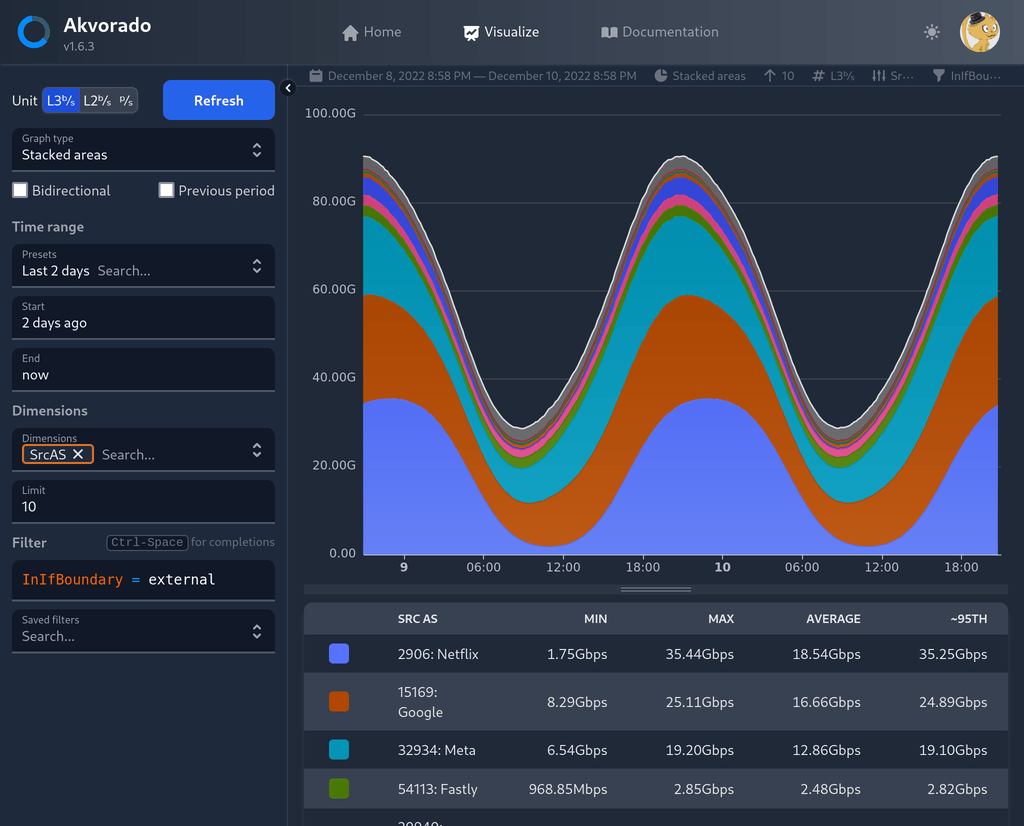
Earlier this year, we released Akvorado, a flow collector, enricher, and visualizer. It receives network flows from your routers using either NetFlow v9, IPFIX, or sFlow. Several pieces of information are added, like GeoIP and interface names. The flows are exported to Apache Kafka, a distributed queue, then stored inside ClickHouse, a column-oriented database. A web frontend is provided to run queries. A live version is available for you to play.
Akvorado web interface displays the result of a simple query using stacked areas
Akvorado s web frontend
Several alternatives exist: Akvorado differentiates itself from these solutions because: The proposed deployment solution relies on Docker Compose to set up Akvorado, Zookeeper, Kafka, and ClickHouse. I hope it should be enough for anyone to get started quickly. Akvorado is performant enough to handle 100 000 flows per second with 64 GB of RAM and 24 vCPU. With 2 TB of disk, you should expect to keep data for a few years. I spent some time writing a fairly complete documentation. It seems redundant to repeat its content in this blog post. There is also a section about its internal design if you are interested in how it is built. I also did a FRnOG presentation earlier this year, and a ClickHouse meetup presentation, which focuses more on how ClickHouse is used. I plan to write more detailed articles on specific aspects of Akvorado. Stay tuned!

  1. While the collector could write directly to the database, the queue buffers flows if the database is unavailable. It also enables you to process flows with another piece of software (like an anti-DDoS system).

Russ Allbery: Review: The Fifth Elephant

Review: The Fifth Elephant, by Terry Pratchett
Series: Discworld #24
Publisher: Harper
Copyright: 2000
Printing: May 2014
ISBN: 0-06-228013-9
Format: Mass market
Pages: 455
The Fifth Elephant is the 24th Discworld and fifth Watch novel, and largely assumes you know who the main characters are. This is not a good place to start. The dwarves are electing a new king. The resulting political conflict is spilling over into the streets of Ankh-Morpork, but that's not the primary problem. First, the replica Scone of Stone, a dwarven artifact used to crown the Low King of the Dwarves, is stolen from the Dwarf Bread Museum. Then, Vimes is dispatched to berwald, ostensibly to negotiate increased fat exports with the new dwarven king. And then Angua disappears, apparently headed towards her childhood home in berwald, which immediately prompts Carrot to resign and head after her. The City Watch is left in the hands of now-promoted Captain Colon. We see lots of Lady Sybil for the first time since Guards! Guards!, and there's a substantial secondary plot with Angua and Carrot and a tertiary plot with Colon making a complete mess of things back home, but this is mostly a Vimes novel. As usual, Vetinari is pushing him outside of his comfort zone, but he's not seriously expecting Vimes to act like an ambassador. He's expecting Vimes to act like a policeman, even though he's way outside his jurisdiction. This time, that means untangling a messy three-sided political situation involving the dwarves, the werewolves, and the vampires. There is some Igor dialogue in this book, but thankfully Pratchett toned it down a lot and it never started to bother me. I do enjoy Pratchett throwing Vimes and his suspicious morality at political problems and watching him go at them sideways. Vimes's definition of crimes is just broad enough to get him fully invested in a problem, but too narrow to give him much patience with the diplomatic maneuvering. It makes him an unpredictable diplomat in a clash of cultures way that's fun to read about. Cheery and Detritus are great traveling companions for this, since both of them also unsettle the dwarves in wildly different ways. I also have to admit that Pratchett is doing more interesting things with the Angua and Carrot relationship than I had feared. In previous books, I was getting tired of their lack of communication and wasn't buying the justifications for it, but I think I finally understand why the communication barriers are there. It's not that Angua refuses to talk to Carrot (although there's still a bit of that going on). It's that Carrot's attitude towards the world is very strange, and gets stranger the closer you are to him. Carrot has always been the character who is too earnest and straightforward and good for Ankh-Morpork and yet somehow makes it work, but Pratchett is doing something even more interesting with the concept of nobility. A sufficiently overwhelming level of heroic ethics becomes almost alien, so contrary to how people normally think that it can make conversations baffling. It's not that Carrot is perfect (sometimes he does very dumb things), it's that his natural behavior follows a set of ethics that humans like to pretend they follow but actually don't and never would entirely. His character should be a boring cliche or an over-the-top parody, and yet he isn't at all. But Carrot's part is mostly a side plot. Even more than Jingo, The Fifth Elephant is establishing Vimes as a force to be reckoned with, even if you take him outside his familiar city. He is in so many ways the opposite of Vetinari, and yet he's a tool that Vetinari is extremely good at using. Colon of course is a total disaster as the head of the Watch, and that's mostly because Colon should never be more than a sergeant, but it's also because even when he's taking the same action as Vimes, he's not doing it for the same reasons or with the same stubborn core of basic morality and loyalty that's under Vimes's suspicious conservatism. The characterization in the Watch novels doesn't seem that subtle or deep at first, but it accumulates over the course of the series in a way that I think is more effective than any of the other story strands. Vetinari, Vimes, and Carrot all represent "right," or at least order, in overlapping stories of right versus wrong, but they do so in radically different ways and with radically different goals. Each time one of them seems ascendant, each time one of their approaches seems more clearly correct, Pratchett throws them at a problem where a different approach is required. It's a great reading experience. This was one of the better Discworld novels even though I found the villains to be a bit tedious and stupid. Recommended. Followed by The Truth in publication order. The next Watch novel is Night Watch. Rating: 8 out of 10

10 December 2022

Simon Josefsson: Trisquel 11 on NV41PZ: First impressions

My NovaCustom NV41PZ laptop arrived a couple of days ago, and today I had some time to install it. You may want to read about my purchasing decision process first. I expected a rough ride to get it to work, given the number of people claiming that modern laptops can t run fully free operating systems. I first tried the Trisquel 10 live DVD and it booted fine including network, but the mouse trackpad did not work. Before investigating it, I noticed a forum thread about Trisquel 11 beta3 images, and being based on Ubuntu 22.04 LTS and has Linux-libre 5.15 it seemed better to start with more modern software. After installing through the live DVD successfully, I realized I didn t like MATE but wanted to keep using GNOME. I reverted back to installing a minimal environment through the netinst image, and manually installed GNOME (apt-get install gnome) since I prefer that over MATE, together with a bunch of other packages. I ve been running it for a couple of hours now, and here is a brief summary of the hardware components that works.
CPUAlder Lake Intel i7-1260P
Memory2x32GB Kingston DDR4 SODIMM 3200MHz
StorageSamsung 980 Pro 2TB NVME
BIOSDasharo Coreboot
GraphicsIntel Xe
Screen (internal)14 1920 1080
Screen (HDMI)Connected to Dell 27 2560 1440
Screen (USB-C)Connected to Dell 27 2560 1440 via Wavlink port extender
WebcamBuiltin 1MP Camera
MicrophoneIntel Alder Lake
KeyboardISO layout, all function keys working
MouseTrackpad, tap clicking and gestures
Ethernet RJ45Realtek RTL8111/8168/8411 with r8169 driver
Memory cardO2 Micro comes up as /dev/mmcblk0
Docking stationWavlink 4xUSB, 2xHDMI, DP, RJ45,
ConnectivityUSB-A, USB-C
AudioIntel Alder Lake
Hardware components and status
So what s not working? Unfortunately, NovaCustom does not offer any WiFi or Bluetooth module that is compatible with Trisquel, so the AX211 (1675x) Wifi/Bluetooth card in it is just dead weight. I imagine it would be possible to get the card to work if non-free firmware is loaded. I don t need Bluetooth right now, and use the Technoetic N-150 USB WiFi dongle when I m not connected to wired network. Compared against my X201, the following factors have improved. I m still unhappy about the following properties with both the NV41PZ and the X201. Hopefully my next laptop will have improved on this further. I hope to be able to resolve the WiFi part by replacing the WiFi module, there appears to be options available but I have not tested them on this laptop yet. Does anyone know of a combined WiFi and Bluetooth M.2 module that would work on Trisquel? While I haven t put the laptop to heavy testing yet, everything that I would expect a laptop to be able to do seems to work fine. Including writing this blog post!

Russ Allbery: Review: Trust

Review: Trust, by Mary Sisson
Series: Trang #2
Publisher: Mary Sisson
Copyright: 2012
Printing: December 2013
ASIN: B0087KQDQ0
Format: Kindle
Pages: 375
Trust is a direct sequel to Trang and should not be read out of order. Both the primary and secondary plot deal with the consequences of the ending of Trang and thus spoil it heavily. After a dodgy and unethical debriefing under mental probe (which took far too long to become relevant to the story) Philippe Trang is back at work as the human diplomat to a space station full of aliens in intergalactic space. At first, interspecies relations have not changed much, but soon Philippe will be drawn farther into the consequences of Trang's dramatic conclusion than he would have expected. And there are other complications: a new group of Special Forces soldiers, an extremely grumpy alien who disapproves of his species' current culture, and the continuing incomprehensible behavior of the Magic Man. I was hoping this series would be a hidden gem of diplomatic SF, a subgenre that I want to exist. Unfortunately, this entry takes a strong turn towards more conventional territory: a Star Trek plot. One of the merits of the first novel is that Trang, and the humans in general, didn't have much power. Humans were meeting aliens as equals or inferiors, and both sides were attempting to understand. Although the humans became central to the plot (probably unavoidable when they're the protagonists), it was somewhat by accident. I was hoping Sisson would lean into that setup, stress the equal footing, and focus on the complex diplomacy. Instead, Trust puts Trang in a position of considerable authority over one of the alien races. Like most Star Trek plots, this book is primarily about mapping strange alien behavior onto human morality to solve the problem of the week. As an entry in that genre, it's... okay. I still like Trang as a character, Sisson does an adequate job showing how weird aliens can be (although mostly by jumbling together extremes of human behavior instead of finding something truly alien), and the opinions of the aliens continue to matter. But I feel like this series is sliding towards making the humans central to everything, and I was not enthused by a plot that requires Trang sort out complex political problems for an entire alien race he knows next to nothing about. This book also adds more viewpoints, giving us several chapters from the perspective of one of Trang's escort soldiers and one from one of the aliens. I liked the alien perspective; it was probably the best chapter of the book. Seeing the human characters from an external perspective was amusing, and I liked how both the humans and the aliens surprised and confused each other. That said, it also felt like a bit of a cheat to tell the reader about the cultural forces at play that Trang was missing. I already thought Trang was being exceptionally dim about the alien gifts he was given, pocketing them without attempting to understand them and then never studying them later. Being shown more things he should have tried to figure out didn't help. You're a diplomat in an extended first contact situation: please have some basic curiosity about what's going on and talk it over with the people around you, rather than treating aliens like children. The soldier perspective adds a secondary plot that was okay but a bit silly, and I'm not sure why Sisson needed to introduce a second perspective to tell it. I think the same secondary plot would have been more interesting if she'd stuck with Trang's perspective and forced him to reconstruct what had been happening when he wasn't paying attention. As is, the plot relied too much on people being stupid and not talking to each other. There was nothing seriously wrong with this book, but it's also not fulfilling the potential of the first book of the series. It felt like okay self-published science fiction; that's not nothing, but there are a lot of books like that, and I wanted diplomatic science fiction that goes somewhere different. I may give the third book a chance, but I'm feeling less enthused now. Followed by Tribulations. Rating: 6 out of 10

9 December 2022

Russell Coker: USB-PD and GaN

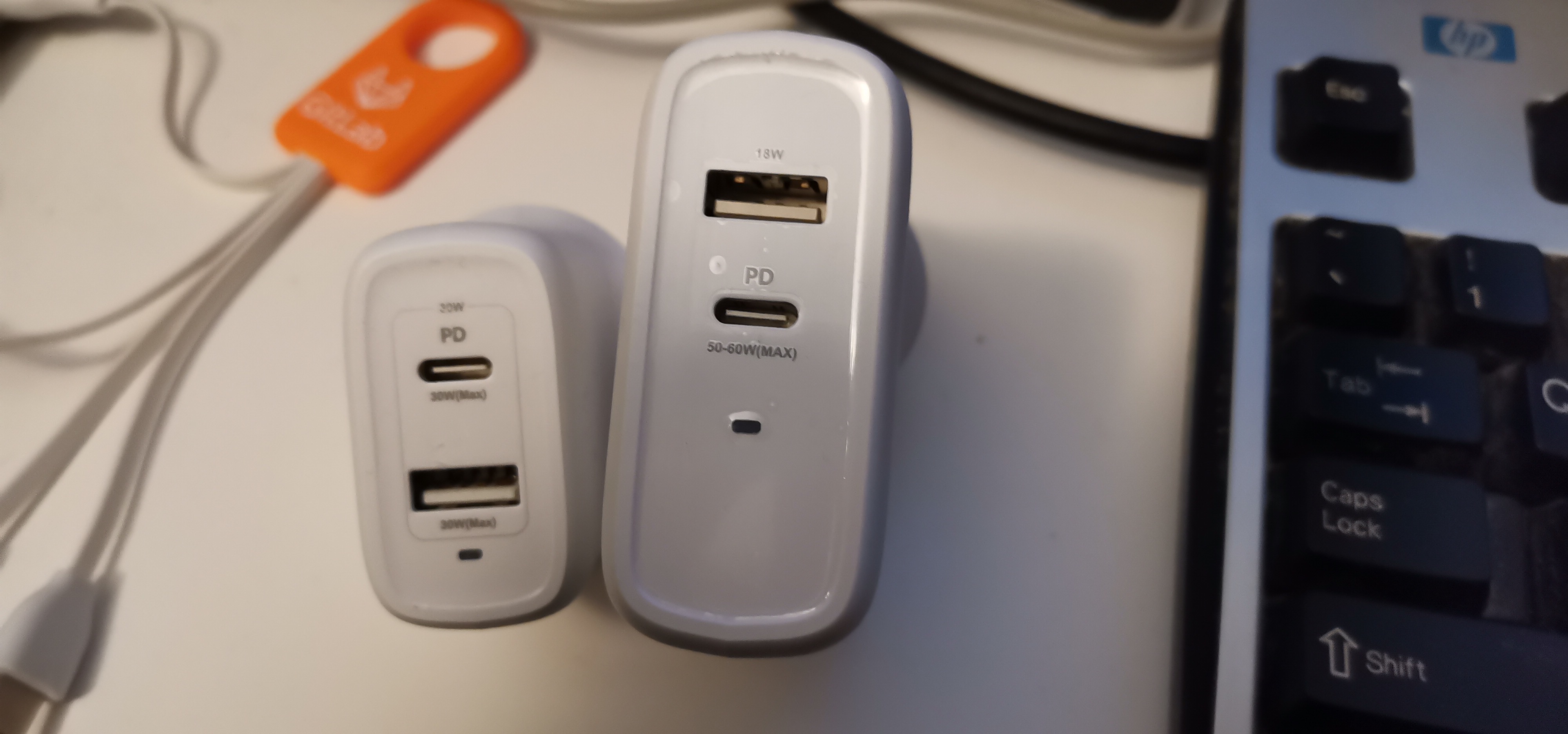
photo of 2 USB-PD chargers A recent development is cheap Gallium Nitride based power supplies that provide better efficiency in a smaller space than other technologies. Kogan recently had a special on such devices so I decided to try them out with my new Thinkpad X1 Carbon Gen 5 [1]. Google searches for power supplies for that Thinkpad included results for 30W PSUs which implies that any 30W USB-C PSU should work. I bought a 30W charger for $10 that can supply 15V/2A or 20V/1.5A on a single USB-C port or 15W on the USB-C port and 15W on the USB-2 port at the same time and expected it to work as a laptop charger. Unfortunately it didn t, I don t know whether the adverts for 30W Thinkpad PSUs were false or whether the claim of the GaN charger I bought being 30W was false, all I know is that the KDE power applet said that the PSU couldn t supply enough power. I then bought a 68W charger for $28 that can supply 20.0V/3.0A on a single USB-C port if the USB-2 port isn t used and 50W on the USB-C port if the USB-2 port is also being used. This worked well which wasn t a great surprise as I had previously run the laptop on 45W PSUs. If I connect a phone to the USB-2 port while the laptop is being charged then the laptop will be briefly cut off, presumably the voltage and current are being renegotiated when that happens. As you can see the 68W charger is significantly larger than the 30W charger, but still small enough to easily fit in a jacket pocket and smaller than a regular laptop charger. One of my uses for this will be to put it in a jacket pocket when I have my laptop in another pocket. Another use will be for charging in my car as the cables from the inverter to convert 12VDC to 240VAC takes enough space. I will probably get a ~50W USB-PD charger that connects to a car cigarette lighter socket when a GaN version of such a charger becomes available.

8 December 2022

Reproducible Builds: Reproducible Builds in November 2022

Welcome to yet another report from the Reproducible Builds project, this time for November 2022. In all of these reports (which we have been publishing regularly since May 2015) we attempt to outline the most important things that we have been up to over the past month. As always, if you interested in contributing to the project, please visit our Contribute page on our website.

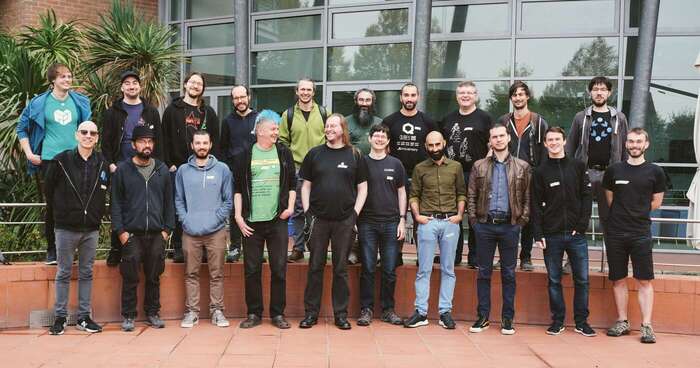
Reproducible Builds Summit 2022 Following-up from last month s report about our recent summit in Venice, Italy, a comprehensive report from the meeting has not been finalised yet watch this space! As a very small preview, however, we can link to several issues that were filed about the website during the summit (#38, #39, #40, #41, #42, #43, etc.) and collectively learned about Software Bill of Materials (SBOM) s and how .buildinfo files can be seen/used as SBOMs. And, no less importantly, the Reproducible Builds t-shirt design has been updated

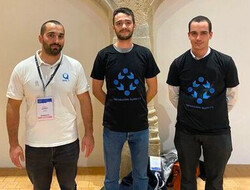
Reproducible Builds at European Cyber Week 2022 During the European Cyber Week 2022, a Capture The Flag (CTF) cybersecurity challenge was created by Fr d ric Pierret on the subject of Reproducible Builds. The challenge consisted in a pedagogical sense based on how to make a software release reproducible. To progress through the challenge issues that affect the reproducibility of build (such as build path, timestamps, file ordering, etc.) were to be fixed in steps in order to get the final flag in order to win the challenge. At the end of the competition, five people succeeded in solving the challenge, all of whom were awarded with a shirt. Fr d ric Pierret intends to create similar challenge in the form of a how to in the Reproducible Builds documentation, but two of the 2022 winners are shown here:

On business adoption and use of reproducible builds Simon Butler announced on the rb-general mailing list that the Software Quality Journal published an article called On business adoption and use of reproducible builds for open and closed source software. This article is an interview-based study which focuses on the adoption and uses of Reproducible Builds in industry, with a focus on investigating the reasons why organisations might not have adopted them:
[ ] industry application of R-Bs appears limited, and we seek to understand whether awareness is low or if significant technical and business reasons prevent wider adoption.
This is achieved through interviews with software practitioners and business managers, and touches on both the business and technical reasons supporting the adoption (or not) of Reproducible Builds. The article also begins with an excellent explanation and literature review, and even introduces a new helpful analogy for reproducible builds:
[Users are] able to perform a bitwise comparison of the two binaries to verify that they are identical and that the distributed binary is indeed built from the source code in the way the provider claims. Applied in this manner, R-Bs function as a canary, a mechanism that indicates when something might be wrong, and offer an improvement in security over running unverified binaries on computer systems.
The full paper is available to download on an open access basis. Elsewhere in academia, Beatriz Michelson Reichert and Rafael R. Obelheiro have published a paper proposing a systematic threat model for a generic software development pipeline identifying possible mitigations for each threat (PDF). Under the Tampering rubric of their paper, various attacks against Continuous Integration (CI) processes:
An attacker may insert a backdoor into a CI or build tool and thus introduce vulnerabilities into the software (resulting in an improper build). To avoid this threat, it is the developer s responsibility to take due care when making use of third-party build tools. Tampered compilers can be mitigated using diversity, as in the diverse double compiling (DDC) technique. Reproducible builds, a recent research topic, can also provide mitigation for this problem. (PDF)

Misc news
On our mailing list this month:

Debian & other Linux distributions Over 50 reviews of Debian packages were added this month, another 48 were updated and almost 30 were removed, all of which adds to our knowledge about identified issues. Two new issue types were added as well. [ ][ ]. Vagrant Cascadian announced on our mailing list another online sprint to help clear the huge backlog of reproducible builds patches submitted by performing NMUs (Non-Maintainer Uploads). The first such sprint took place on September 22nd, but others were held on October 6th and October 20th. There were two additional sprints that occurred in November, however, which resulted in the following progress: Lastly, Roland Clobus posted his latest update of the status of reproducible Debian ISO images on our mailing list. This reports that all major desktops build reproducibly with bullseye, bookworm and sid as well as that no custom patches needed to applied to Debian unstable for this result to occur. During November, however, Roland proposed some modifications to live-setup and the rebuild script has been adjusted to fix the failing Jenkins tests for Debian bullseye [ ][ ].
In other news, Miro Hron ok proposed a change to clamp build modification times to the value of SOURCE_DATE_EPOCH. This was initially suggested and discussed on a devel@ mailing list post but was later written up on the Fedora Wiki as well as being officially proposed to Fedora Engineering Steering Committee (FESCo).

Upstream patches The Reproducible Builds project detects, dissects and attempts to fix as many currently-unreproducible packages as possible. We endeavour to send all of our patches upstream where appropriate. This month, we wrote a large number of such patches, including:

diffoscope diffoscope is our in-depth and content-aware diff utility. Not only can it locate and diagnose reproducibility issues, it can provide human-readable diffs from many kinds of binary formats. This month, Chris Lamb prepared and uploaded versions 226 and 227 to Debian:
  • Support both python3-progressbar and python3-progressbar2, two modules providing the progressbar Python module. [ ]
  • Don t run Python decompiling tests on Python bytecode that file(1) cannot detect yet and Python 3.11 cannot unmarshal. (#1024335)
  • Don t attempt to attach text-only differences notice if there are no differences to begin with. (#1024171)
  • Make sure we recommend apksigcopier. [ ]
  • Tidy generation of os_list. [ ]
  • Make the code clearer around generating the Debian substvars . [ ]
  • Use our assert_diff helper in test_lzip.py. [ ]
  • Drop other copyright notices from lzip.py and test_lzip.py. [ ]
In addition to this, Christopher Baines added lzip support [ ], and FC Stegerman added an optimisation whereby we don t run apktool if no differences are detected before the signing block [ ].
A significant number of changes were made to the Reproducible Builds website and documentation this month, including Chris Lamb ensuring the openEuler logo is correctly visible with a white background [ ], FC Stegerman de-duplicated by email address to avoid listing some contributors twice [ ], Herv Boutemy added Apache Maven to the list of affiliated projects [ ] and boyska updated our Contribute page to remark that the Reproducible Builds presence on salsa.debian.org is not just the Git repository but is also for creating issues [ ][ ]. In addition to all this, however, Holger Levsen made the following changes:
  • Add a number of existing publications [ ][ ] and update metadata for some existing publications as well [ ].
  • Hide draft posts on the website homepage. [ ]
  • Add the Warpforge build tool as a participating project of the summit. [ ]
  • Clarify in the footer that we welcome patches to the website repository. [ ]

Testing framework The Reproducible Builds project operates a comprehensive testing framework at tests.reproducible-builds.org in order to check packages and other artifacts for reproducibility. In October, the following changes were made by Holger Levsen:
  • Improve the generation of meta package sets (used in grouping packages for reporting/statistical purposes) to treat Debian bookworm as equivalent to Debian unstable in this specific case [ ] and to parse the list of packages used in the Debian cloud images [ ][ ][ ].
  • Temporarily allow Frederic to ssh(1) into our snapshot server as the jenkins user. [ ]
  • Keep some reproducible jobs Jenkins logs much longer [ ] (later reverted).
  • Improve the node health checks to detect failures to update the Debian cloud image package set [ ][ ] and to improve prioritisation of some kernel warnings [ ].
  • Always echo any IRC output to Jenkins output as well. [ ]
  • Deal gracefully with problems related to processing the cloud image package set. [ ]
Finally, Roland Clobus continued his work on testing Live Debian images, including adding support for specifying the origin of the Debian installer [ ] and to warn when the image has unmet dependencies in the package list (e.g. due to a transition) [ ].
If you are interested in contributing to the Reproducible Builds project, please visit our Contribute page on our website. You can get in touch with us via:

Shirish Agarwal: Wayland, Hearing aids, Multiverse & Identity

Wayland First up, I read Antoine Beaupr s Wayland to Sway migration with interest. While he said it s done and dusted or something similar, the post shows there s still quite a ways to go. I wouldn t say it s done or whatever till it s integrated so well that a person installs it and doesn t really need to fiddle with config files as an average user. For specific use-cases you may need to, but that should be outside of a normal user (layperson) experience. I have been using mate for a long long time and truth be told been very happy with it. The only thing I found about Wayland on mate is this discussion or rather this entry. The roadmap on Ubuntu Mate is also quite iffy. The Mate Wayland entry on Debian wiki also perhaps need an updation but dunno much as the latest update it shares is 2019 and it s 2022. One thing to note, at least according to Antoine, things should be better as and when it gets integrated even on legacy hardware. I would be interested to know how it would work on old desktops and laptops rather than new or is there some barrier? I, for one would have liked to see or know about why lightdm didn t work on Wayland and if there s support. From what little I know lightdm is much lighter than gdm3 and doesn t require much memory and from what little I have experienced works very well with mate. I have been using it since 2015/16 although the Debian changelog tells me that it has been present since 2011. I was hoping to see if there was a Wayland specific mailing list, something like debian-wayland but apparently there s not :(. Using mate desktop wayland (tried few other variations on the keywords) but search fails to find any meaningful answer :(. FWIW and I don t know the reason why but Archwiki never fails to amaze me. Interestingly, it just says No for mate. I probably would contact upstream in the coming days to know what their plans are and hopefully they will document what their plans are on integrating Wayland in both short-term and long-term with an update, or if there is something more recent they have documented elsewhere, get that update on the Debian wiki so people know. The other interesting thread I read was Russel Coker s Thinkpad X1 Carbon Gen5 entry. I would be in the market in a few months to find/buy a Thinkpad but probably of AMD rather than Intel because part of recent past history with Intel as well as AMD having a bit of an edge over Intel as far as graphics is concerned. I wonder why Russel was looking into Intel and not AMD. Would be interested to know why Intel and not AMD? Any specific reason ???

Hearing Aids I finally bought hearing aids about a couple of weeks back and have been practicing using them. I was able to have quite a few conversations although music is still I m not able to listen clearly but it is still a far cry from before and for the better. I am able to have conversations with people and also reply and they do not have to make that extra effort that they needed to. Make things easier for everybody. The one I bought is at the starting range although the hearing aids go all the way to 8 lakhs for a pair (INR 800,000), the more expensive ones having WiFi, Bluetooth and more channels, it all depends on how much can one afford. And AFAIK there is not a single Indian manufacturer who is known in this business.

One thing I did notice is while the hearing aids are remarkably sturdy if they fall down as they are small, yet you have to be careful of both dust and water . That does makes life a bit difficult as my house and city both gets sand quite a bit everyday. I don t think they made any India-specific changes, if they had, would probably make things better. I haven t yet looked at it, but it may be possible to hack it remotely. There may or may not be security issues involved, probably would try once I ve bit more time am bit more comfortable to try and see what I can find out. If I had bought it before, maybe I would have applied for the Debian event happening in Kerala, if nothing else, would have been to document what happened there in detail.  I probably would have to get a new motherboard for my desktop probably in a year or two as quite a few motherboards also have WiFi (WiFi 6 ?) think on the southbridge. I at least would have a look in new year and know more as to what s been happening. For last at least 2-3 years there has been a rumor which has been confirmed time and again that the Tata Group has been in talks with multiple vendors to set chip fabrication and testing business but to date they haven t been able to find one. They do keep on giving press conferences about the same but that s all they do :(. Just shared the latest one above.

The Long War Terry Pratchett, Stephen Braxter Long Earth Terry Pratchett, Stephen Braxter ISBN13: 9780062067777 Last month there was also a seconds books sale where I was lucky enough to get my hands on the Long War. But before I share about the book itself, I had a discussion with another of my friends and had to re-share part of that conversation. While the gentleman was adamant that non-fiction books are great, my point as always is both are equal. As I shared perhaps on this blog itself, perhaps multiple times, that I had seen a YT video in which a professor shared multiple textbooks of physics and shared how they are wrong and have been wrong and kept them in a specific corner. He took the latest book which he honestly said doesn t have any mistakes as far as he know and yet still kept in that same corner denoting that it is highly possible that future understanding will make the knowledge or understanding we know different. An example of physics in the nano world and how that is different and basically turns our understanding than what we know. Now as far as the book is concerned, remember Michael Crichton s Timeline. Now that book was originally written in the 1960 s while this one was written by both the honorable gentleman in 2013. So almost 50+ years difference between the two books, and that even shows how they think about things. In this book, you no longer need a big machine, but have something called a stepper machine which is say similar to a cellphone, that size and that frame, thickness etc. In this one, the idea of multiverse is also there but done a tad differently. In this, we do not have other humans or copy humans but have multiple earths that may have same or different geography as how evolution happened. None of the multiverse earths have humans but have different species depending on the evolution that happened there. There are something called as trolls but they have a much different meaning and way about them about how most fantasy authors portray trolls. While they are big in this as well, they are as gentle as bears or rabbits. So the whole thing is about real estate and how humans have spread out on multiple earths and the politics therein. Interestingly, the story was trashed or given negative reviews on Goodreads. The sad part is/was that it was written and published in 2013 when perhaps the possibility of war or anything like that was very remote especially in the States, but now we are now in 2022 and just had an insurrection happen and whole lot of Americans are radicalized, whether you see the left or the right depending on your ideology. An American did share few weeks ago how some shares are looking at Proportional Representation and that should make both parties come more towards the center and be a bit more transparent. What was interesting to me is the fact that states have much more rights to do elections and electioneering the way they want rather than a set model which everyone has common which is what happens in India. This also does poke holes into the whole Donald Trump stolen democracy drama but that s a different story altogether. One of the more interesting things I came to know about is that there are 4 books in the long series and this was the second book in itself. I do not want to dwell on the characters themselves as frankly speaking I haven t read all the four books and it would be gross injustice on my part to talk about the characters themselves. Did I enjoy reading the book, for sure. What was interesting and very true of human nature is that even if we have the ability or had the ability to have whole worlds to ourselves, we are bound to mess it up. And in that aspect, I don t think he is too far off the mark. If I had a whole world, wouldn t I try to exploit it to the best or worse of my ability. One of the more interesting topics in the book is the barter system they have thought of that is called as favors. If you are in multiple worlds, then having a currency, even fiat money is of no use and they have to find ways and means to trade with one another. The book also touches a bit on slavery but only just and doesn t really explore it as much as it could have.

Identity Now this has many meanings to it. Couple of weeks ago, saw a transgender meet. For the uninitiated or rather people like me, basically it is about people who are born in one gender but do not identify with it but the other and they express it first through their clothes and expression and the end of the journey perhaps is with having the organs but this may or may not be feasible, as such surgery is expensive and also not available everywhere. After section 377 was repealed few years ago, we do have a third gender on forms as well as have something called a Transgender Act but how much the needle has moved in society is still a question. They were doing a roadshow near my house hence I was able to talk with them with my new hearing aids and while there was lot of traffic was able to understand some of their issues. For e.g. they find it difficult to get houses on rent, but then it is similar for bachelor guys or girls also. One could argue to what degree it is, and that perhaps maybe. Also, there is a myth that they are somehow promiscuous but that I believe is neither here or there. Osho said an average person thinks about the opposite sex every few seconds or a minute. I am sure even Freud would have similar ideas. So, if you look in that way everybody is promiscuous as far as thought is concerned. The other part being opportunity but that again is function of so many other things. Some people are able to attract a lot of people, others might not. And then whether they chose to act on that opportunity or not is another thing altogether. Another word that is or was used is called gender fluid, but that too is iffy as gender fluid may or may not mean transgender. Also, while watching some nature documentary few days/weeks back had come to know that trees have something like 18 odd genders. That just blows me out of the mind and does re-question this whole idea of sexuality and identity to only two which seems somewhat regressive at least to me. If we think humans are part of nature, then we need to be open up perhaps a bit more. But identity as I shared above has more than one meaning. For e.g. citizenship, that one is born in India is even messier to know, understand and define. I had come across this article about couple of months back. Now think about this. Now, there have been studies and surveys about citizenship and it says something like 60% birth registrations are done in metro cities. Now Metro cities are 10 as defined by Indian state. But there are roughly an odd 4k cities in India and probably twice the number of villages and those are conservative numbers as we still don t record things meticulously, maybe due to the Indian oral tradition or just being lazy or both, one part is also that if you document people and villages and towns, then you are also obligated to give them some things as a state and that perhaps is not what the Indian state wants. A small village in India could be anywhere from few hundreds of people to a few thousand. And all the new interventions whether it is PAN, Aadhar has just made holes rather than making things better. They are not inclusive but exclusive. And none of this takes into account Indian character and the way things are done in India. In most households, excluding the celebs (they are in a world of pain altogether when it comes to baby names but then it s big business but that s an entire different saga altogether, so not going to touch that.) I would use or say my individual case as that is and seems to be something which is regular even today. I was given a nickname when I was 3 years old and given a name when I was 5-6 when I was put in school. I also came to know in school few kids who didn t like their names and couple of them cajoled and actually changed their names while they were kids, most of us just stayed with what we got. I do remember sharing about nakushi or something similar a name given to few girls in Maharashtra by their parents and the state intervened and changed their names. But that too is another story in itself. What I find most problematic is that the state seems to be blind, and this seems to be by design rather than a mistake. Couple of years back, Assam did something called NRC (National Register of Citizens) and by the Govt s own account it was a failure of massive proportions. And they still want to bring in CAA, screwing up Assam more. And this is the same Govt. went shown how incorrect it was, blamed it all on the High Court and it s the same Govt. that shopped around for judges to put somebody called Mr. Saibaba (an invalid 90 year adivasi) against whom the Govt. hasn t even a single proof as of date. Apparently, they went to 6 judges who couldn t give what the decision the Govt. wanted. All this info. is in public domain. So the current party ruling, i.e. BJP just wants to make more divisions rather than taking people along as they don t have answers either on economy, inflation or issues that people are facing. One bright light has been Rahul Gandhi who has been doing a padhyatra (walking) from Kanyakumari to Kashmir and has had tremendous success although mainstream media has showed almost nothing what he is doing or why he is doing that. Not only he had people following him, there are and were many who took his example and using the same values of inclusiveness are walking where they can. And this is not to do with just a political party but more with a political thought of inclusiveness, that we are one irrespective of what I believe, eat, wear etc. And that gentleman has been giving press conferences while our dear P.M. even after 8 years doesn t have the guts to do a single press conference. Before closing, I do want to take another aspect, Rahul Gandhi s mother is an Italian or was from Italy before she married. But for BJP she is still Italian. Rishi Sunak, who has become the UK Prime Minister they think of him as Indian and yet he has sworn using the Queen s name. And the same goes for Canada Kumar (Akshay Kumar) and many others. How the right is able to blind and deaf to what it thinks is beyond me. All these people have taken an oath in the name of the Queen and they have to be loyal to her or rather now King Charles III. The disconnect continues.

Russell Coker: Thinkpad X1 Carbon Gen5

Gen1 Since February 2018 I have been using a Thinkpad X1 Carbon Gen1 [1] as my main laptop. Generally I ve been very happy with it, it s small and light, has good performance for web browsing etc, and with my transition to doing all compiles etc on servers it works well. When I wrote my original review I was unhappy with the keyboard, but I got used to that and found it to be reasonably good. The things that I have found as limits on it are the display resolution as 1600*900 isn t that great by modern standards (most phones are a lot higher resolution), the size (slightly too large for the pocket of my Scott e Vest [2] jacket), and the lack of USB-C. Modern laptops can charge via USB-C/Thunderbolt while also doing USB and DisplayPort video over the same cable. USB-C monitors which support charging a laptop over the same cable as used for video input are becoming common (last time I checked the Dell web site for many models of monitor there was a USB-C one that cost about $100 more). I work at a company with lots of USB-C monitors and docks so being able to use my personal laptop with the same displays when on breaks is really handy. A final problem with the Gen1 is that it has a proprietary and unusual connector for the SSD which means that a replacement SSD costs about what I paid for the entire laptop. Ever since the SSD gave a BTRFS checksum error I ve been thinking of replacing it. Choosing a Replacement The Gen5 is the first Thinkpad X1 Carbon to have USB-C. For work I had used a Gen6 which was quite nice [3]. But it didn t seem to offer much over the Gen5. So I started looking for cheap Thinkpad X1 Carbons of Gen5+. A Cheap? Gen5 In July I saw an ebay advert for a Gen5 with FullHD display for $370 or nearest offer, with the downside being that the BIOS password had been lost. I offered $330 and the seller accepted, in retrospect that was unusually cheap and should have been a clue that I needed to do further investigation. It turned out that resetting the BIOS password is unusually difficult as it s in the TPM so the system would only boot Windows. When I learned that I should have sold the laptop to someone who wanted to run Windows and bought another. Instead I followed some instructions on the Internet about entering a wrong password multiple times to get to a password recovery screen, instead the machine locked up entirely and became unusable for windows (so don t do that). Then I looked for ways of fixing the motherboard. The cheapest was $75.25 for a replacement BIOS flash chip that had a BIOS that didn t check the validity of passwords. The aim was to solder that on, set a new password (with any random text being accepted as the old password), then solder the old one back on for normal functionality. It turned out that I m not good at fine soldering, after I had hacked at it a friend diagnosed the chip and motherboard to probably both be damaged (he couldn t get it going). The end solution was that my friend found a replacement motherboard for $170 from China. This gave a total cost of $575.25 for the laptop which is more than the usual price of a Gen6 and more than I expected to pay. In the past when advocating buying second hand or refurbished laptops people would say what happens if you get one that doesn t work properly , the answer to that question is that I paid a lot less than the new cost of $2700+ for a Thinkpad X1 Carbon and got a computer that does everything I need. One of the advantages of getting a cheap laptop is that I won t be so unhappy if I happen to drop it. A Cheap Gen6 After the failed experiment with a replacement BIOS on the Gen5 I was considering selling it for scrap. So I bought a Gen6 from Australian Computer Traders via Amazon for $390 in August. The advert clearly stated that it was for a laptop with USB-C and Thunderbolt (Gen5+ features) but they shipped me a Gen4 that didn t even have USB-C. They eventually refunded me but I will try to avoid buying from them again. Finally Working The laptop I now have has a i5-6300U CPU that rates 3242 on cpubenchmark.net. My Gen1 thinkpad has a i7-3667U CPU that rates 2378 on cpubenchmark.net, note that the cpubenchmark.net people have rescaled their benchmark since my review of the Gen1 in 2018. So according to the benchmarks my latest laptop is about 36% faster for CPU operations. Not much of a difference when comparing systems manufactured in 2012 and 2017! According to the benchmarks a medium to high end recent CPU will be more than 10* faster than the one in my Gen5 laptop, but such a CPU would cost more than my laptop cost. The storage is a 256G NVMe device that can do sustained reads at 900MB/s, that s not even twice as fast as the SSD in my Gen1 laptop although NVMe is designed to perform better for small IO. It has 2*USB-C ports both of which can be used for charging, which is a significant benefit over the Gen6 I had for work in 2018 which only had one. I don t know why Lenovo made Gen6 machines that were lesser than Gen5 in such an important way. It can power my Desklab portable 4K monitor [4] but won t send a DisplayPort signal over the same USB-C cable. I don t know if this is a USB-C cable issue or some problem with the laptop recognising displays. It works nicely with Dell USB-C monitors and docks that power the laptop over the same cable as used for DisplayPort. Also the HDMI port works with 4K monitors, so at worst I could connect my Desklab monitor via a USB-C cable for power and HDMI for data. The inability to change the battery without disassembly is still a problem, but hopefully USB-C connected batteries capable of charging such a laptop will become affordable in the near future and I have had some practice at disassembling this laptop. It still has the Ethernet dongle annoyance, and of course the seller didn t include that. But USB ethernet devices are quite good and I have a few of them. In conclusion it s worth the $575.25 I paid for it and would have been even better value for money if I had been a bit smarter when buying. It meets the initial criteria of USB-C power and display and of fitting in my jacket pocket as well as being slightly better than my old laptop in every other way.

2 December 2022

Paul Wise: FLOSS Activities November 2022

Focus This month I didn't have any particular focus. I just worked on issues in my info bubble.

Changes

Issues

Review

Administration
  • Debian IRC: setup topic/entrymsg to redirect OFTC #debian-jp to the Debian Japan IRC server, cleaned up #debianppc ChanServ metadata
  • Debian wiki: unblock IP addresses, approve domains, approve accounts

Communication

Sponsors The libemail-outlook-message-perl, purple-discord, sptag, celery work was sponsored. All other work was done on a volunteer basis.

30 November 2022

Russell Coker: Links November 2022

Here s the US Senate Statement of Frances Haugen who used to work for Facebook countering misinformation and espionage [1]. She believes that Facebook is capable of dealing with the online radicalisation and promotion of bad things on it s platform but is unwilling to do so for financial reasons. We need strong regulation of Facebook and it probably needs to be broken up. Interesting article from The Atlantic about filtered cigarettes being more unhealthy than unfiltered [2]. Every time I think I know how evil tobacco companies are I get surprised by some new evidence. Cory Doctorow wrote an insightful article about resistance to rubber hose cryptanalysis [3]. Cory Doctorow wrote an interesting article When Automation Becomes Enforcement with a new way of thinking about Snapchat etc [4]. Cory Doctorow wrote an insightful and informative article Big Tech Isn t Stealing News Publishers Content, It s Stealing Their Money [5] which should be read by politicians from all countries that are trying to restrict quoting news on the Internet. Interesting articl;e on Santiago Genoves who could be considered as a pioneer of reality TV for deliberately creating disputes between a group of young men and women on a raft in the Atlantic for 3 months [6]. Matthew Garrett wrote an interesting review of the Freedom Phone, seems that it s not good for privacy and linked to some companies doing weird stuff [7]. Definitely worth reading. Cory Doctorow wrote an interesting and amusing article about backdoors for machine learning [8] Petter Reinholdtsen wrote an informative post on how to make a bootable USB stick image from an ISO file [9]. Apparently Lenovo provides ISO images to update laptops that don t have DVD drives. :( Barry Gander wrote an interesting article about the fall of Rome and the decline of the US [10]. It s a great concern that the US might fail in the same way as Rome. Ethan Siegel wrote an interesting article about Iapetus, a moon of Saturn that is one of the strangest objects in the solar system [11]. Cory Doctorow s article Revenge of the Chickenized Reverse-Centaurs has some good insights into the horrible things that companies like Amazon are doing to their employees and how we can correct that [12]. Charles Stross wrote an insightful blog post about Billionaires [13]. They can t do much for themselves with the extra money beyond about $10m or $100m (EG Steve Jobs was unable to extend his own life much when he had cancer) and their money is trivial when compared to the global economy. They are however effective parasites capable of performing great damage to the country that hosts them. Cory Doctorow has an interesting article about how John Deere is being evil again [14]. This time with potentially catastrophic results.

Utkarsh Gupta: FOSS Activites in November 2022

Here s my (thirty-eighth) monthly but brief update about the activities I ve done in the F/L/OSS world.

Debian
This was my 47th month of actively contributing to Debian. I became a DM in late March 2019 and a DD on Christmas 19! \o/ There s a bunch of things I do, both, technical and non-technical. Here are the things I did this month:

Debian Uploads

Other $things:
  • Sponsoring stuff for non-DDs.
  • Mentoring for newcomers.
  • Moderation of -project mailing list.

Ubuntu
This was my 22nd month of actively contributing to Ubuntu. Now that I joined Canonical to work on Ubuntu full-time, there s a bunch of things I do! \o/ I mostly worked on different things, I guess. I was too lazy to maintain a list of things I worked on so there s no concrete list atm. Maybe I ll get back to this section later or will start to list stuff from the fall, as I was doing before. :D

Debian (E)LTS
Debian Long Term Support (LTS) is a project to extend the lifetime of all Debian stable releases to (at least) 5 years. Debian LTS is not handled by the Debian security team, but by a separate group of volunteers and companies interested in making it a success. And Debian Extended LTS (ELTS) is its sister project, extending support to the stretch and jessie release (+2 years after LTS support). This was my thirty-eighth month as a Debian LTS and twenty-nine month as a Debian ELTS paid contributor.
I worked for 41.00 hours for LTS and 30.25 hours for ELTS.

LTS CVE Fixes and Announcements:

ELTS CVE Fixes and Announcements:
  • Issued ELA 731-1, fixing CVE-2022-39377, for sysstat.
    For Debian 9 stretch, these problems have been fixed in version 11.4.3-2+deb9u1.
    For Debian 8 jessie, these problems have been fixed in version 11.0.1-1+deb8u1.
  • Issued ELA 749-1, fixing CVE-2022-41325, for vlc.
    For Debian 9 stretch, these problems have been fixed in version 3.0.17.4-0+deb9u2.
  • Issued ELA 750-1 for a new upstream version update of clamav.
    For Debian 9 stretch, the package has been updated to version 0.103.7+dfsg-0+deb9u1. For Debian 8 jessie, the package has been updated to version 0.103.7+dfsg-0+deb8u1.
  • Started to look at other set of packages.

Other (E)LTS Work:
  • Front desk duty from 21-11 until 27-11 for both, LTS and ELTS.
  • Triaged jqueryui, open-vm-tools, systemd, ffmpeg, lava, pngcheck, snapd, vlc, g810-led, libpgjava, dropbear, python3.5, python3.4, clamav, systat, postgresql-11, and mariadb-10.1.
  • Marked CVE-2009-1143/open-vm-tools as postponed for buster, stretch and jessie.
  • Marked CVE-2022-45873/systemd as not-affected in stretch and jessie.
  • Marked CVE-2022-396 4,5 /ffmpeg as postponed for buster and stretch.
  • Marked CVE-2022-45061/python3. 4,5 as postponed for stretch and jessie.
  • Marked CVE-2022-31160/jqueryui as not-affected for jessie instead.
  • Noted CVE-2022-45061/python3.4 to be marked as postponed; only things to fix is the armhf FTBFS.
  • Auto EOL d linux, libpgjava, nvidia-graphics-drivers, maradns, chromium, and glance for ELTS.
  • Helped and assisted new contributors joining Freexian (LTS/ELTS/internally).
  • Answered questions (& discussions) on IRC (#debian-lts and #debian-elts) and Matrix.
  • Participated and helped fellow members with their queries via private mail and chat.
  • General and other discussions on LTS private and public mailing list.
  • Attended the monthly meeting held on IRC on November 24th.

Until next time.
:wq for today.

Russ Allbery: Review: The Fed Unbound

Review: The Fed Unbound, by Lev Menand
Publisher: Columbia Global Reports
Copyright: 2022
ISBN: 1-7359137-1-5
Format: Kindle
Pages: 156
The Fed Unbound is a short non-fiction exploration of US Federal Reserve actions to reducing systemic risk caused by shadow banking. Its particular focus is the role of the Fed from the 2008 financial crisis to the present, including the COVID shock, but it includes a history of what Menand calls the "American Monetary Settlement," the political compromise that gave rise to the Federal Reserve. In Menand's view, a central cause of instability in the US financial system (and, given the influence of the dollar system, the world financial system as well) is shadow banking: institutions that act as banks without being insured like banks or subject to bank regulations. A bank, in this definition, is an organization that takes deposits. I'm simplifying somewhat, but what distinguishes a deposit from a security or an investment is that deposits can be withdrawn at any time, or at least on very short notice. When you want to spend the money in your checking account, you don't have to wait for a three-month maturity period or pay an early withdrawal penalty. You simply withdraw the money, with immediate effect. This property is what makes deposits "money," rather than something that you can (but possibly cannot) sell for money, such as stocks or bonds. Most people are familiar with the basic story of how banks work. Essentially no bank simply takes people's money and puts it in a vault until the person wants it again. If that were the case, you would need to pay the bank to store your money. Instead, a bank takes in deposits and then lends some portion of that money out to others. Those loans, for things like cars or houses or credit card spending, come due over time, with interest. The interest rate the bank charges on the loans is much higher than the rate it has to pay on its deposits, and it pockets the difference. The problem with this model, of course, is that the bank doesn't have your money, so if all the depositors go to the bank at the same time and ask for their money, the bank won't be able to repay them and will collapse. (See, for example, the movie It's a Wonderful Life, or Mary Poppins, or any number of other movies or books.) Retail banks are therefore subject to stringent regulations designed to promote public trust and to ensure that traditional banking is a boring (if still lucrative) business. Banks are also normally insured, which in the US means that if they do experience a run, federal regulators will step in, shut down the bank in an orderly fashion, and ensure every depositor gets their money back (at least up to the insurance limit). Alas, if you thought people would settle for boring work that makes a comfortable profit, you don't know the financial industry. Highly-regulated insured deposits are less lucrative than acting like a bank without all of those restrictions and rules and deposit insurance payments. As Menand relates in his brief history of US banking, financial institutions constantly invent new forms of deposits with similar properties but without all the pesky rules: eurodollars (which have nothing to do with the European currency), commercial paper, repo, and many others. These forms of deposits are primarily used by large institutions like corporations. The details vary, but they tend to be prone to the same fundamental instability as bank deposits: if there's a run on the market, there may not be enough liquidity for everyone to withdraw their money at once. Unlike bank deposits, though, there is no insurance, no federal regulator to step in and make depositors whole, and much less regulation to ensure that runs are unlikely. Instead, there's the Federal Reserve, which has increasingly become the bulwark against liquidity crises among shadow banks. This happened in 2008 during the financial crisis (which Menand argues can be seen as a shadow bank run sparked by losses on mortgage securities), and again at a larger scale in 2020 during the initial COVID crisis. Menand is clear that these interventions from the Federal Reserve were necessary. The alternative would have been an uncontrolled collapse of large sections of the financial system, with unknown consequences. But the Fed was not intended to perform those types of interventions. It has no regulatory authority to reform the underlying financial systems to make them safer, remove executives who failed to maintain sufficient liquidity for a crisis, or (as is standard for all traditional US banks) prohibit combining banking and more speculative investment on the same balance sheet. What the Federal Reserve can do, and did, is function as a buyer of last resort, bailing out shadow banks by purchasing assets with newly-created money. This works, in the sense that it averts the immediate crisis, but it creates other distortions. Most importantly, constant Fed intervention doesn't create an incentive to avoid situations that require that intervention; if anything, it encourages more dangerous risk-taking. The above, plus an all-too-brief history of the politics of US banking, is the meat of this book. It's a useful summary, as far as it goes, and I learned a few new things. But I think The Fed Unbound is confused about its audience. This type of high-level summary and capsule history seems most useful for people without an economics background and who haven't been following macroeconomics closely. But Menand doesn't write for that audience. He assumes definitions of words like "deposits" and "money" that are going to be confusing or even incomprehensible to the lay reader. For example, Menand describes ordinary retail banks as creating money, even saying that a bank loans money by simply incrementing the numbers in a customer's deposit account. This is correct in the technical economic definition of money (fractional reserve banking effectively creates new money), but it's going to sound to someone not well-versed in the terminology as if retail banks can create new dollars out of the ether. That power is, of course, reserved for the Federal Reserve, and indeed is largely the point of its existence. Much of this book relies on a very specific definition of money and money supply that will only be familiar to those with economics training. Similarly, the history of the Federal Reserve is interesting but slight, and at no point does Menand explain clearly how the record-keeping between it and retail banks works, or what the Fed's "balance sheet" means in practice. I realize this book isn't trying to give a detailed description or history of the Federal Reserve system, but the most obvious audience is likely to flounder at the level of detail Menand provides. Perhaps, therefore, this book is aimed at an audience already familiar with macroeconomics? But, if so, I'm not sure it says anything new. I follow macroeconomic policy moderately closely and found most of Menand's observations obvious and not very novel. There were tidbits here and there that I hadn't understood, but my time would probably have been better invested in another book. Menand proposes some reforms, but they mostly consist of "Congress should do its job and not create situations where the Federal Reserve has to act without the right infrastructure and political oversight," and, well, yes. It's hard to disagree with that, and it's also hard to see how it will ever happen. It's far too convenient to outsource such problems to central banking, where they are hidden behind financial mechanics that are incomprehensible to the average voter. This is an important topic, but I don't think this is the book to read about it. If you want a clearer and easier-to-understand role of the Federal Reserve in shadow banking crises, read Crashed instead. If you want to learn more about how retail bank regulation works, and hear a strong case for why the same principles should be applied to shadow banks, see Sheila Bair's Bull by the Horns. I'm still looking for a great history and explainer of the Federal Reserve system as a whole, but that is not this book. Rating: 5 out of 10

28 November 2022

Jelmer Vernooij: Detecting Package Transitions

Larger transitions in Debian are usually announced on e.g. debian-devel, but it s harder to track the current status of all transitions. Having done a lot of QA uploads recently, I have on occasion uploaded packages involved in a transition. This can be unhelpful for the people handling the transition, but there s also often not much point in uploading if your uploads are going to get stuck. Talking to one of the release managers at a recent BSP, it was great to find out that the release team actually publish a data dump with which packages are involved in which transitions. Here s the script I use to find out about the transitions the package in my current working directory is involved in:
 1
 2
 3
 4
 5
 6
 7
 8
 9
10
11
12
13
14
15
16
17
18
19
20
21
22
23
24
25
26
#!/usr/bin/python3
from urllib.request import urlopen
import sys
from debian.deb822 import Deb822
import yaml
with open('debian/control', 'r') as f:
    package = Deb822(f)['Source']
with urlopen("https://release.debian.org/transitions/export/packages.yaml") as f:
    data = yaml.safe_load(f)
def find_transitions(data, package):
    for entry in data:
        if entry['name'] != package:
            continue
        return dict(entry['list'])
    return  
transitions = find_transitions(data, package)
print(transitions)
sys.exit(1 if 'ongoing' in transitions.values() else 0)
In practice, the output looks something like this:
$ debcheckout bctoolbox
git clone https://salsa.debian.org/pkg-voip-team/linphone-stack/bctoolbox.git bctoolbox ...
Cloning into 'bctoolbox'...
...
$ cd bctoolbox
$ in-transition.py
 'auto-upperlimit-libbctoolbox1': 'ongoing' 

26 November 2022

Matthew Garrett: Poking a mobile hotspot

I've been playing with an Orbic Speed, a relatively outdated device that only speaks LTE Cat 4, but the towers I can see from here are, uh, not well provisioned so throughput really isn't a concern (and refurbs are $18, so). As usual I'm pretty terrible at just buying devices and using them for their intended purpose, and in this case it has the irritating behaviour that if there's a power cut and the battery runs out it doesn't boot again when power returns, so here's what I've learned so far.

First, it's clearly running Linux (nmap indicates that, as do the headers from the built-in webserver). The login page for the web interface has some text reading "Open Source Notice" that highlights when you move the mouse over it, but that's it - there's code to make the text light up, but it's not actually a link. There's no exposed license notices at all, although there is a copy on the filesystem that doesn't seem to be reachable from anywhere. The notice tells you to email them to receive source code, but doesn't actually provide an email address.

Still! Let's see what else we can figure out. There's no open ports other than the web server, but there is an update utility that includes some interesting components. First, there's a copy of adb, the Android Debug Bridge. That doesn't mean the device is running Android, it's common for embedded devices from various vendors to use a bunch of Android infrastructure (including the bootloader) while having a non-Android userland on top. But this is still slightly surprising, because the device isn't exposing an adb interface over USB. There's also drivers for various Qualcomm endpoints that are, again, not exposed. Running the utility under Windows while the modem is connected results in the modem rebooting and Windows talking about new hardware being detected, and watching the device manager shows a bunch of COM ports being detected and bound by Qualcomm drivers. So, what's it doing?

Sticking the utility into Ghidra and looking for strings that correspond to the output that the tool conveniently leaves in the logs subdirectory shows that after finding a device it calls vendor_device_send_cmd(). This is implemented in a copy of libusb-win32 that, again, has no offer for source code. But it's also easy to drop that into Ghidra and discover thatn vendor_device_send_cmd() is just a wrapper for usb_control_msg(dev,0xc0,0xa0,0,0,NULL,0,1000);. Sending that from Linux results in the device rebooting and suddenly exposing some more USB endpoints, including a functional adb interface. Although, annoyingly, the rndis interface that enables USB tethering via the modem is now missing.

Unfortunately the adb user is unprivileged, but most files on the system are world-readable. data/logs/atfwd.log is especially interesting. This modem has an application processor built into the modem chipset itself, and while the modem implements the Hayes Command Set there's also a mechanism for userland to register that certain AT commands should be pushed up to userland. These are handled by the atfwd_daemon that runs as root, and conveniently logs everything it's up to. This includes having logged all the communications executed when the update tool was run earlier, so let's dig into that.

The system sends a bunch of AT+SYSCMD= commands, each of which is in the form of echo (stuff) >>/usrdata/sec/chipid. Once that's all done, it sends AT+CHIPID, receives a response of CHIPID:PASS, and then AT+SER=3,1, at which point the modem reboots back into the normal mode - adb is gone, but rndis is back. But the logs also reveal that between the CHIPID request and the response is a security check that involves RSA. The logs on the client side show that the text being written to the chipid file is a single block of base64 encoded data. Decoding it just gives apparently random binary. Heading back to Ghidra shows that atfwd_daemon is reading the chipid file and then decrypting it with an RSA key. The key is obtained by calling a series of functions, each of which returns a long base64-encoded string. Decoding each of these gives 1028 bytes of high entropy data, which is then passed to another function that decrypts it using AES CBC using a key of 000102030405060708090a0b0c0d0e0f and an initialization vector of all 0s. This is somewhat weird, since there's 1028 bytes of data and 128 bit AES works on blocks of 16 bytes. The behaviour of OpenSSL is apparently to just pad the data out to a multiple of 16 bytes, but that implies that we're going to end up with a block of garbage at the end. It turns out not to matter - despite the fact that we decrypt 1028 bytes of input only the first 200 bytes mean anything, with the rest just being garbage. Concatenating all of that together gives us a PKCS#8 private key blob in PEM format. Which means we have not only the private key, but also the public key.

So, what's in the encrypted data, and where did it come from in the first place? It turns out to be a JSON blob that contains the IMEI and the serial number of the modem. This is information that can be read from the modem in the first place, so it's not secret. The modem decrypts it, compares the values in the blob to its own values, and if they match sets a flag indicating that validation has succeeeded. But what encrypted it in the first place? It turns out that the json blob is just POSTed to http://pro.w.ifelman.com/api/encrypt and an encrypted blob returned. Of course, the fact that it's being encrypted on the server with the public key and sent to the modem that decrypted with the private key means that having access to the modem gives us the public key as well, which means we can just encrypt our own blobs.

What does that buy us? Digging through the code shows the only case that it seems to matter is when parsing the AT+SER command. The first argument to this is the serial mode to transition to, and the second is whether this should be a temporary transition or a permanent one. Once parsed, these arguments are passed to /sbin/usb/compositions/switch_usb which just writes the mode out to /usrdata/mode.cfg (if permanent) or /usrdata/mode_tmp.cfg (if temporary). On boot, /data/usb/boot_hsusb_composition reads the number from this file and chooses which USB profile to apply. This requires no special permissions, except if the number is 3 - if so, the RSA verification has to be performed first. This is somewhat strange, since mode 9 gives the same rndis functionality as mode 3, but also still leaves the debug and diagnostic interfaces enabled.

So what's the point of all of this? I'm honestly not sure! It doesn't seem like any sort of effective enforcement mechanism (even ignoring the fact that you can just create your own blobs, if you change the IMEI on the device somehow, you can just POST the new values to the server and get back a new blob), so the best I've been able to come up with is to ensure that there's some mapping between IMEI and serial number before the device can be transitioned into production mode during manufacturing.

But, uh, we can just ignore all of this anyway. Remember that AT+SYSCMD= stuff that was writing the data to /usrdata/sec/chipid in the first place? Anything that's passed to AT+SYSCMD is just executed as root. Which means we can just write a new value (including 3) to /usrdata/mode.cfg in the first place, without needing to jump through any of these hoops. Which also means we can just adb push a shell onto there and then use the AT interface to make it suid root, which avoids needing to figure out how to exploit any of the bugs that are just sitting there given it's running a 3.18.48 kernel.

Anyway, I've now got a modem that's got working USB tethering and also exposes a working adb interface, and I've got root on it. Which let me dump the bootloader and discover that it implements fastboot and has an oem off-mode-charge command which solves the problem I wanted to solve of having the device boot when it gets power again. Unfortunately I still need to get into fastboot mode. I haven't found a way to do it through software (adb reboot bootloader doesn't do anything), but this post suggests it's just a matter of grounding a test pad, at which point I should just be able to run fastboot oem off-mode-charge and it'll be all set. But that's a job for tomorrow.

Edit: Got into fastboot mode and ran fastboot oem off-mode-charge 0 but sadly it doesn't actually do anything, so I guess next is going to involve patching the bootloader binary. Since it's signed with a cert titled "General Use Test Key (for testing only)" it apparently doesn't have secure boot enabled, so this should be easy enough.

comment count unavailable comments

24 November 2022

Russ Allbery: Review: Servant Mage

Review: Servant Mage, by Kate Elliott
Publisher: Tordotcom
Copyright: 2022
ISBN: 1-250-76904-3
Format: Kindle
Pages: 165
Servant Mage is a (so far at least) standalone fantasy novella. Fellian is a servant mage, which means that she makes Lamps for the customers of the inn, cleans the privies, and watches her effective owners find ways to put her deeper into indentured servitude. That's the only life permitted by the August Protector to those found to carry the taint of magical talent, caused by (it is said) demons who have bound themselves to their souls. Fellian's effective resistance is limited to giving covert reading lessons. Or was, before she is hired by a handsome man who needs a Lamplighter. A man who has been looking for her specifically, is a magical Adept, and looks suspiciously like a soldier for the despised and overthrown monarchists. A difficulty with writing a story that reverses cliches is that you have to establish the cliches in order to reverse them, which runs the risk that a lot of the story may feel cliched. I fear some of that happened here. Magic, in this world, is divided into elemental spheres, each of which has been restricted to limited and practical tasks by the Liberationists. The new regime searches the population for the mage-gifted and forces them into public service for the good of all (or at least that's how they describe it), with as little education as possible. Fellian was taught to light Lamps, but what she has is fire magic, and she's worked out some additional techniques on her own. The Adept is air, and one of the soldiers with him is earth. If you're guessing that two more elements turn up shortly and something important happens if you get all five of them together, you're perhaps sensing a bit of unoriginality in the magic system. That's not the cliche that's the primary target of this story, though. The current rulers of this country, led by the austere August Protector, are dictatorial anti-monarchists who are happy to force mages into indenture and deny people schooling. Fellian has indeed fallen in with the monarchists, who unsurprisingly are attempting to reverse the revolution. They, unlike the Liberationists, respect mages and are willing to train them, and they would like to recruit Fellian. I won't spoil the details of where Elliott is going with the plot, but it does eventually go somewhere refreshingly different. The path to get there, though, is familiar from any number of fantasy epics that start with a slave with special powers. Servant Mage is more aware of this than most, and Fellian is sharp-tongued and suspicious rather than innocent and trainable, but there are a lot of familiar character tropes and generic fantasy politics. This is the second story (along with the Spiritwalker trilogy) of Elliott's I've read that uses the French Revolution as a political model but fails to provide satisfying political depth. This one is a novella and can therefore be forgiven for not having the time to dive into revolutionary politics, but I wish Elliott would do more with this idea. Here, the anti-monarchists are straight-up villains, and while that's partly setup for more nuance than you might be expecting, it still felt like a waste of the setting. I want the book that tackles the hard social problem of reconciling the chaos and hopefulness of political revolution with magical powers that can be dangerous and oppressive without the structure of tradition. It feels like Elliott keeps edging towards that book but hasn't found the right hook to write it. Instead, we get a solid main character in Fellian, a bunch of supporting characters who mostly register as "okay," some magical set pieces that have all the right elements and yet didn't grab my sense of wonder, and a story that seemed heavily signposted. The conclusion was the best part of the story, but by the time we got there it wasn't as much of a surprise as I wanted it to be. I had this feeling with the Spiritwalker series as well: the pieces making up the story are of good quality, and Elliott's writing is solid, but the narrative magic never quite coheres for me. It's the sort of novella where I finished reading, went "huh," and then was excited to start a new book. I have no idea if there are plans for more stories in this universe, but Servant Mage felt like a prelude to a longer series. If that series does materialize, there are some signs that it could be more satisfying. At the end of the story, Fellian is finally in a place to do something original and different, and I am mildly curious what she might do. Maybe enough to read the next book, if one turns up. Mostly, though, I'm waiting for the sequel to Unconquerable Sun. Next April! Rating: 6 out of 10

19 November 2022

Joerg Jaspert: From QNAP QTS to TrueNAS Scale

History, Setup So for quite some time I have a QNAP TS-873x here, equipped with 8 Western Digital Red 10 TB disks, plus 2 WD Blue 500G M2 SSDs. The QNAP itself has an AMD Embedded R-Series RX-421MD with 4 cores and was equipped with 48G RAM. Initially I had been quite happy, the system is nice. It was fast, it was easy to get to run and the setup of things I wanted was simple enough. All in a web interface that tries to imitate a kind of workstation feeling and also tries to hide that it is actually a webinterface. Natually with that amount of disks I had a RAID6 for the disks, plus RAID1 for the SSDs. And then configured as a big storage pool with the RAID1 as cache. Below the hood QNAP uses MDADM Raid and LVM (if you want, with thin provisioning), in some form of emdedded linux. The interface allows for regular snapshots of your storage with flexible enough schedules to create them, so it all appears pretty good.

QNAP slow Fast forward some time and it gets annoying. First off you really should have regular raid resyncs scheduled, and while you can set priorities on them and have them low priority, they make the whole system feel very sluggish, quite annoying. And sure, power failure (rare, but can happen) means another full resync run. Also, it appears all of the snapshots are always mounted to some /mnt/snapshot/something place (df on the system gets quite unusable). Second, the reboot times. QNAP seems to be affected by the more features, fuck performance virus, and bloat their OS with more and more features while completly ignoring the performance. Everytime they do an upgrade it feels worse. Lately reboot times went up to 10 to 15 minutes - and then it still hadn t started the virtual machines / docker containers one might run on. Another 5 to 10 minutes for those. Opening the file explorer - ages on calculating what to show. Trying to get the storage setup shown? Go get a coffee, but please fetch the beans directly from the plantation, or you are too fast. Annoying it was. And no, no broken disks or fan or anything, it all checks out fine.

Replace QNAPs QTS system So I started looking around what to do. More RAM may help a little bit, but I already had 48G, the system itself appears to only do 64G maximum, so not much chance of it helping enough. Hardware is all fine and working, so software needs to be changed. Sounds hard, but turns out, it is not.

TrueNAS And I found that multiple people replaced the QNAPs own system with a TrueNAS installation and generally had been happy. Looking further I found that TrueNAS has a variant called Scale - which is based on Debian. Doubly good, that, so I went off checking what I may need for it.

Requirements Heck, that was a step back. To install TrueNAS you need an HDMI out and a disk to put it on. The one that QTS uses is too small, so no option.
QNAPs  internal USB disk QNAPs original internal USB drive, DOM
So either use one of the SSDs that played cache (and should do so again in TrueNAS, or get the QNAP original replaced. HDMI out is simple, get a cheap card and put it into one of the two PCIe-4x slots, done. The disk thing looked more complicated, as QNAP uses some internal usb stick thing . Turns out it is just a USB stick that has an 8+1pin connector. Couldn t find anything nice as replacement, but hey, there are 9-pin to USB-A adapters.
9PIN to USB A a 9pin to USB A adapter
With that adapter, one can take some random M2 SSD and an M2-to-USB case, plus some cabling, and voila, we have a nice system disk.
USB 9pin  to USB-A cable connected to Motherboard and some more cable 9pin adapter to USB-A connected with some more cable
Obviously there isn t a good place to put this SSD case and cable, but the QNAP case is large enough to find space and use some cable ties to store it safely. Space enough to get the cable from the side, where the mainboard is to the place I mounted it, so all fine.
Mounted  SSD in external case, also shows the video card Mounted SSD in its external case
The next best M2 SSD was a Western Digital Red with 500G - and while this is WAY too much for TrueNAS, it works. And hey, only using a tiny fraction? Oh so much more cells available internally to use when others break. Or something Together with the Asus card mounted I was able to install TrueNAS. Which is simple, their installer is easy enough to follow, just make sure to select the right disk to put it on.

Preserving data during the move Switching from QNAP QTS to TrueNAS Scale means changing from MDADM Raid with LVM and ext4 on top to ZFS and as such all data on it gets erased. So a backup first is helpful, and I got myself two external Seagate USB Disks of 6TB each - enough for the data I wanted to keep. Copying things all over took ages, especially as the QNAP backup thingie sucks, it was breaking quite often. Also, for some reason I did not investigate, the performance of it was real bad. It started at a maximum of 50MB/s, but the last terabyte of data was copied at MUCH less than that, and so it took much longer than I anticipated. Copying back was slow too, but much less so. Of course reading things usually is faster than writing, with it going around 100MB/s most of the time, which is quite a bit more - still not what USB3 can actually do, but I guess the AMD chip doesn t want to go that fast.

TrueNAS experience The installation went mostly smooth, the only real trouble had been on my side. Turns out that a bad network cable does NOT help the network setup, who would have thought. Other than that it is the usual set of questions you would expect, a reboot, and then some webinterface. And here the differences start. The whole system boots up much faster. Not even a third of the time compared to QTS. One important thing: As TrueNAS scale is Debian based, and hence a linux kernel, it automatically detects and assembles the old RAID arrays that QTS put on. Which TrueNAS can do nothing with, so it helps to manually stop them and wipe the disks. Afterwards I put ZFS on the disks, with a similar setup to what I had before. The spinning rust are the data disks in a RAIDZ2 setup, the two SSDs are added as cache devices. Unlike MDADM, ZFS does not have a long sync process. Also unlike the MDADM/LVM/EXT4 setup from before, ZFS works different. It manages the raid thing but it also does the volume and filesystem parts. Quite different handling, and I m still getting used to it, so no, I won t write some ZFS introduction now.

Features The two systems can not be compared completly, they are having a pretty different target audience. QNAP is more for the user that wants some network storage that offers a ton of extra features easily available via a clickable interface. While TrueNAS appears more oriented to people that want a fast but reliable storage system. TrueNAS does not offer all the extra bloat the QNAP delivers. Still, you have the ability to run virtual machines and it seems it comes with Rancher, so some kubernetes/container ability is there. It lacks essential features like assigning PCI devices to virtual machines, so is not useful right now, but I assume that will come in a future version. I am still exploring it all, but I like what I have right now. Still rebuilding my setup to have all shares exported and used again, but the most important are working already.

Next.

Previous.