Search Results: "tats"

13 August 2010

Alexander Reichle-Schmehl: Release Critical Bug report for Week 32

The unofficial rc bug tracker currently knows about the following bugs:
In Total:448
Affecting Squeeze:329
Squeeze only:108
Remaining to be fixed in Squeeze:221
Of these 221 bugs, the following tags are set:
Pending in Squeeze:24
Patched in Squeeze:43
Duplicates in Squeeze:19
Contrib or non-free in Squeeze:11
Claimed in Squeeze:2
Delayed in Squeeze:8
Can fixed in a security Update:12
Otherwise fixed in Squeeze:21
Ignoring all the above (multiple tags possible), 121 bugs need to be fixed by Debian Contributers to get Debian 6.0 Squeeze released. However, with the view of the Release Managers, 271 need to be dealt with for the release to happen. Please see my older post for an explanation of the different numbers.

12 August 2010

Joey Hess: Flattr stats

Following up on my Flattr FOSS post, the most interesting thing about having my projects on Flattr has been watching their relative popularities in the control panel. It looks something like this, which is done using javascript, so you might need to follow the link to my blog to see it properly. I've been watching debhelper and moreutils keep pace with each other. This is interesting, because moreutils has been highlighted by Flattr FOSS, and debhelper has not. Still, the general level of interest in moreutils continues to suprise me -- and some more utils are lined up to go into it soon! Popcon tells me that alien still has more users than anything except for debhelper; easily 5 to 10 times the users of moreutils or pristine-tar. So alien's low numbers in Flattr are also surprising. I think it might be explained by more developer types than user types following Flattr FOSS right now. Perhaps it will change now that Flattr does not need invites to sign up?

Kartik Mistry: Report from MiniDebConf India 2010

* So, here is late report! Sometime back Praveen started discussion at DebianIndia mailing list about having MiniDebConf kind of conference here in India. MiniDebConfs are generally focused on development rather than at introduction to Debian . But, since this was our first attempt, out focus was more on to introduce Debian to student community and after writing this after 5 days I realize that we ve done good job! Many thanks to Joerg Jaspert for setting up Mini website: http://in2010.mini.debconf.org/ Praveen got bunch of sponsors, many thanks to CDAC and other sponsors for making event happen with testy food and tea that kept me awake. Now what really happened at Pune? My flight was nice. I went to guest house of COEP (the host college, 2nd old engineering college in India) and took some rest and called Praveen. He was already at computer lab and setting up Virtualbox and other things. We had two places hall and lab. Unfortunately, both were at different buildings and subway between them :) I discussed with couple of students and we went to dinner at late night. Pro. Abhijit who was kindly give permission to use lab and college hall was another source of energy. He is handling many FOSS events in college and probably only faculty who encourage students to use and learn FOSS. The Day 1 started with long lines of registration process. As we had around 200 registration, turn out of students were 100% on first day. Hall was almost full. Dr. Shashikumar from CDAC gave nice lecture about contribution which was well received. Praveen and Onkar then took the stage and gave nice introduction about Debian. I met Onkar first time. We had really nice discussion ranging from becoming Ubuntu MOTU to his Powerbook s adapter. After that Vikram took lively session on i18n and l10n in Debian and I took boring session on Contributing to Debian . Yet another boring session from me was Developer Toolbox . Packaging workshop by me at hall made many faces to yawn heavily while Onkar and Praveen handled it nicely at Lab. Main reason for yawning was Wifi and my Macbook s capacity to deal with ndiswrapper and crappy broadcom s drivers. (Note: I should get nice machine.) I met Sham first time. I met Kushal once again and felt energetic again! Day 2 As we expected number was very low compared to Day 1. So, we closed hall and moved entire stuffs to Lab only. Vikram took again nice session on Debian Edu . It was very interactive and I should learn something from his act of presentation. Another nice thing from Day 2 was discussion with BOSS Linux team. Hold on. Lets keep some old woes aside. They are basically doing what their bosses are telling. Developers were clueless about Sending patches to upstream. Their bugzilla had Zorro bug reported. I made promise to follow-up on this and set-up patches from boss at somewhere depending upon their response. That mail is my draft let me finish it by weekend. Pavi and others took video from session. It will be nice if someone will post it somewhere :) We then continued on discussing bugs and packaging area. It was amazing to see Praveen become DM during conference and also to see: upstream, maintainer and sponsor in one room. I really had nice food at dinners. Mango Mastani was nice. Beer was nice. How can I forget discussion with Ramki, Ninad, Pro.Abhijit, Praveen, Pavi and others after dinner? So lets work for MiniDebConf 2011 now!

11 August 2010

Julian Andres Klode: APT2 this time in C

As I wrote a few hours ago on deity@l.d.o (see http://lists.debian.org/deity/2010/08/msg00057.html), APT2 is back again. The first time, I tried Vala; but this time I wrote it in C (with the help of GLib, but no GObject) and the cache uses GVariant instead of an SQLite database. It s really basic at the moment (no solver, package installation/removal), but it will improve. Read operation should be faster than with APT, although writes are slower (this will be fixed by reusing unchanged parts of the cache). See the announcement for further information.
Filed under: APT2

Marco Túlio Gontijo e Silva: Immix on GHC Summer of Code report #11

My project. This post assumes that the reader has read my last post. I ve been trying to find a reasonable method (which computer to use, single user or multi user) to benchmark for some time, and now an e-mail from Simon Marlow calmed me down. He suggests that in this stage it s not necessary to run a long benchmark, but only a short one, that will be enought to have an idea about what each change is causing to performance. For some time I was struggling with the benchmarks to get a reasonable result. I ve started more than once to write a blog post analysing the results I ve got, until in the middle of the post I notice the results are not consistent. This usually happens when there s a big distortion in benchmarks that shouldn t present no change. For instance, in a patch that only changes code that is executed with +RTS -w -RTS, there was a difference of 50% on execution time in default mode, that is, without +RTS -w -RTS. I think that only disabling CPU scaling and running a small number of tests, which make it easier to reproduce a possibly inconsistent result, will be enough to get a good data. I ve made a stack of patches, splitting each part of my work. The stack does not reflect my preferences between the patches, that is, the complete stack applied is not what I think that is the best change to GHC. It s only a set of patches applied linearly, in a way that it s easy to see the impact in performance of each change. The patches are: Don t check for swept blocks in -DS.
The checkHeap function assumed the allocated part of the block contained only alive objects and slops. This was not true for blocks that are collected using mark sweep. The code in this patch skip the test for this kind of blocks.
This patch is only needed to make it possible to run the binary with the parameters +RTS -w -DS -RTS. I ve already explained this patch. I didn t measure the difference in performance before this patch, since it only changes code that is not going to be executed in the benchmarks, since none of them are runned with -DS. Immix: allocate and free memory on lines. This is the main patch with the initial implementation of Immix. As it is the initial implementation, it has it s problems, that will be treated in the following patches. The comparison was done using 3 programs from nofib/gc: fibheaps, fulsom and constraints, as suggested by Simon Marlow. Two tests were made for each version of the compiler code: one using the default GC strategie (copy-collection with mark-compact if there s few heap space left), another one using mark-sweep (or Immix after my changes). When comparing the default GC strategie between before and after this change, the program got 0.4% slower, with the collection of the generation 0 being 0.1% slower and the collection of the generation 1 0.4% slower. Comparing the mark-sweep with Immix, it got 13.7% slower, 15% in GC0 and 7.2% in GC1. The change in memory used is irrelevant. Chose between allocating in line or blocks in todo_block_full The first improvement I ve made is to change the place where the allocation was searching for free lines. Most of the changes were done in the function alloc_for_copy(), in rts/sm/Evac.c. This is bad because this function is called a lot of times, and should be kept fast. So I moved them to ctodo_block_full() in rts/sm/GCUtils.c. It got about 9.9% and 9.6% faster in default and sweep, which makes it 1% faster and 2.8% slower than in the original code. Improvements in sweep() I was bothered that the code I ve written to free memory in lines was messy, and I thought it could be simplified and maybe even turn faster. The general execution time increased 0.4%, but the GC1 time, which is the only one that should be affected, was reduced by 0.6%. In the default GC strategie, there was also a 0.2% increase in time, so I guess this is inside the margin of change. I have to investigate better on this one, but it seems to have improved slightly the performance. Line before inscresing block size. In a conversatio with Simon Marlow, we thought about these two options: one is to search for a line after trying to increase the block size, and that s what I did in Chose between allocating in line or blocks in todo_block_full; the other is trying to search a line first, and just increase the block size if a block (and not a line) was being used for allocation and there is no line available. With this patch I ve changed it to use the second one. Using sweep, the GC time got 0.5% slower, and with default it got 0.1%. rts/sm/Sweep.c: Mark all BF_MEDIUM blocks as BF_FRAGMENTED In my first implementation, the blocks that contain objects bigger than a line (of medium size) are marked with BF_MEDIUM, and are treated as the usual block in mark-sweep: if the block is empty, it s freed; if it s very fragmented, it s marked to be collected using copy-collection. In this patch, instead of making it use the rules of mark-sweep, I just mark it as fragmented and make it be collected by copy-collection. This made the GC0 time be reduced by 3%, but caused an increase of 509.7% in the GC1 time. This was also the first time the memory used was reduced, by 25.4%. The results in the default mode are insignificant. What it seems to me is that the copy-collection code is more efficient with memory usage, but also more slow. Marking objects as BF_FRAGMENTED make this algorithm be used even for full objects. rts/sm/Sweep.c: Don t use 3/4 heuristics to mark as BF_FRAGMENTED The mark-sweep algorithm considered that an object was fragmented if more than 1/4 of the word groups are completely unmarked. I kept using this heuristic, and this change removes it, making more use of the Immix, and less use of copy-collection. This didn t change the memory used, and made the code 10.4% slower in sweep. In default GC mode, there was no relevant difference, as expected. Allocate in lines in minor GCs. In the initial implementation I was only allocating on lines only in major GCs, because I needed the mark stack, which was only available in these kind of allocations. In this change, I created the mark stack on all GCs, and used the allocation on lines. The results for the default mode are insignificant, and the code got 9.0% faster in sweep, using the same memory. Selection I ve made a selection with the presumably better patches, which are: Don t check for swept blocks in -DS, Immix: allocate and free memory on lines, Chose between allocating in line or blocks in todo_block_full, Improvements in sweep() and Allocate in lines in minor GCs. This is an attempt to achieve the best set of patches possible, to see how it improved the original code. Comparing the default strategie for this selection and the original code, it got 3.7% slower. Comparing both sweep, it got 3.9% slower. Comparing the original default with the final sweep, it got 4.2% slower and uses 4.7% more memory. There s a lot of room for improvement, and I m willing to hear suggestions of what I could change in the code to achieve this improvement.
The results are available. Every time I had doubt about a comparison, I d run both versions again to check. This is way there are some backup files. The data presented here is not from all the most recent versions of each measurement, but from the ones that I thought were more similar in conditions.

8 August 2010

Lior Kaplan: I miss meeting the debian people

This year I couldn t attend Debconf, making it the third in a row Debian conference I miss. I watched Aigars group photo carefully to see who do I recognize, and just thought to myself that I just miss too many of the people. Especially ones I met in 2005 and 2006 which were years I had the chance to see some of the members twice a year. I hope to see you all next year!
Filed under: Debian GNU/Linux

6 August 2010

Alexander Reichle-Schmehl: Release Critical Bug report for Week 31

The unofficial rc bug tracker currently knows about the following bugs:
In Total:433
Affecting Squeeze:314
Squeeze only:69
Remaining to be fixed in Squeeze:245
Of these 245 bugs, the following tags are set:
Pending in Squeeze:18
Patched in Squeeze:45
Duplicates in Squeeze:28
Contrib or non-free in Squeeze:10
Claimed in Squeeze:2
Delayed in Squeeze:7
Can fixed in a security Update:9
Otherwise fixed in Squeeze:32
Ignoring all the above (multiple tags possible), 145 bugs need to be fixed by Debian Contributers to get Debian 6.0 Squeeze released. However, with the view of the Release Managers, 220 need to be dealt with for the release to happen. Please see my older post for an explanation of the different numbers.

Andreas Barth: RFH: buildd and multiple builds in parallel

On some machines, we have enough cpus to run more than one build in parallel. However, as of now, this isn't supported by buildd. What needs to be done is to change the following code to have up to n builds happening in parallel (including of getting the next package if there is a free slot).
    while( 1 )  
        $self->check_restart();
        $self->read_config();
        my ( $dist_config, $pkg_ver) = get_next_REDO($self);
        $self->do_build( $dist_config, $pkg_ver) if $pkg_ver;
        next if $pkg_ver;
        ( $dist_config, $pkg_ver) = get_next_WANNABUILD($self);
        $self->do_build( $dist_config, $pkg_ver) if $pkg_ver;
        next if $pkg_ver;
        # sleep a little bit if there was nothing to do this time
            $self->log("Nothing to do -- sleeping " .
                       $self->get_conf('IDLE_SLEEP_TIME') . " seconds\n");
            my $idle_start_time = time;
            sleep( $self->get_conf('IDLE_SLEEP_TIME') );
            my $idle_end_time = time;
            $self->write_stats("idle-time", $idle_end_time - $idle_start_time);
     
Any takers? The full code is available from git://git.debian.org/buildd-tools/sbuild.git in the file lib/Buildd/Daemon.pm (and I'm happy to try out appropriate patches). Update The code above lives in the git branch buildd, and not master. Also, I already have one proposal in my mail.

5 August 2010

Andreas Barth: RFH: buildd and multiple builds in parallel

On some machines, we have enough cpus to run more than one build in parallel. However, as of now, this isn't supported by buildd. What needs to be done is to change the following code to have up to n builds happening in parallel (including of getting the next package if there is a free slot).
    while( 1 )  
        $self->check_restart();
        $self->read_config();
        my ( $dist_config, $pkg_ver) = get_next_REDO($self);
        $self->do_build( $dist_config, $pkg_ver) if $pkg_ver;
        next if $pkg_ver;
        ( $dist_config, $pkg_ver) = get_next_WANNABUILD($self);
        $self->do_build( $dist_config, $pkg_ver) if $pkg_ver;
        next if $pkg_ver;
        # sleep a little bit if there was nothing to do this time
            $self->log("Nothing to do -- sleeping " .
                       $self->get_conf('IDLE_SLEEP_TIME') . " seconds\n");
            my $idle_start_time = time;
            sleep( $self->get_conf('IDLE_SLEEP_TIME') );
            my $idle_end_time = time;
            $self->write_stats("idle-time", $idle_end_time - $idle_start_time);
     
Any takers? The full code is available from git://git.debian.org/buildd-tools/sbuild.git in the file lib/Buildd/Daemon.pm (and I'm happy to try out appropriate patches).

Matt Zimmerman: DebConf 10: Day 3

How We Can Be the Silver Lining of the Cloud (Eben Moglen) Eben s talk was on the same topic as his Internet Society talk in February, which I had downloaded and watched some time ago. He challenges the free software community to develop the software to power the freedom box , a small, efficient and inexpensive personal server. Such a system would put users more in control of their online lives, give them better protection for it under the law, and provide a platform for many new federated services. It sounds like a very interesting project, which I d like to write more about. Statistical Machine Learning Analysis of Debian Mailing Lists (Hanna Wallach) Hanna is bringing together her interests in machine learning and free software by using machine learning techniques to analyze of publicly available data from free software communities. In doing so, she hopes to develop tools for studying the patterns of collaboration, innovation and other behavior in these communities. Her methodology uses statistical topic models, which infer the topic of a document based on the occurrence of topical words, to group Debian mailing list posts by topic. Her example analyzed posts from the debian-project and debian-women mailing lists, inferring a set of topics and categorizing all of the posts according to which topic(s) were represented in them. Using this data, she could plot over time the frequency of discussion of each topic, which revealed interesting patterns. The audience quickly zoned in on practical applications for things like flamewar and troll detection. Debian Derivatives BoF (Matt Zimmerman) I organized this discussion session to share perspectives on Debian derivatives, in particular how we can improve cooperation between derivatives and Debian itself. The room was a bit hard to find, so attendance was relatively small, but this turned out to be a plus. With a smaller group, we were able to get acquainted with each other, and everyone participated. Unsurprisingly, there were many more representatives from Ubuntu than other derivatives, and I was concerned that Ubuntu would dominate the discussion. It did, but I tried to draw out perspectives from other derivatives where possible. On the whole, the tone was positive and constructive. This may be due in part to people self-selecting for the BoF, but I think there is a lot of genuine goodwill between Debian and Ubuntu. Stefano Zacchiroli took notes in Gobby during the session, which I expect he will post somewhere public when he has a chance.

3 August 2010

Tiago Bortoletto Vaz: Live Debconf10

Thanks to Val ssio you can enjoy all this modern web stuff for DC10 :) http://debianart.org/live/

2 August 2010

Matt Zimmerman: DebConf 10: Day 2

Today was the first day of DebConf proper, where all of the sessions were aimed at project participants. Bits from the DPL (Stefano Zacchiroli) Stefano delivered an excellent address to the Debian project. As Project Leader, he offered a perspective on how far Debian has come, raised some of the key questions facing Debian today, and challenged the project to move forward and improve in several important ways. He asked the audience: Is Debian better than other distributions? Is Debian still relevant? Why/how? Having asked this question on identi.ca and Twitter recently, he presented a summary. There was a fairly standard list of technical concerns, but also: He pointed out some areas which we would like to see improve, including: All in all, I thought this was an accurate, timely and inspirational message for the project, and the talk is worth watching for any current or prospective contributor to Debian. Debian Policy BoF (Russ Albery) Russ facilitated a discussion about the Debian policy document itself and the process for managing it. He has recently put in a lot of time working on the backlog (down from 160+ to 120), but this is not sustainable for him, and help is needed. There was a wide-ranging discussion of possible improvements including: There was also some discussion in passing of the long-standing confusion (presumably among people new to the project) with regard to how policy is established. In Debian, best practices are first implemented in packages, then documented in policy (not the reverse). Sometimes, improvements are suggested at the policy level, when they need to start elsewhere. I m not very familiar with how the policy manual is maintained at present, but listening to the discussion, it sounded like it might help to extend the process to include the implementation stage. This would allow standards improvements to be tracked all the way through from concept, to implementation, to documentation. The Java Packaging Nightmare (Torsten Werner) Torsten described the current state of Java packaging in Debian and the general problems involved, including licensing issues, build system challenges (e.g. maven) and dependency management. His slides were information-dense, so I didn t take a lot of notes. His presentation inspired a lively discussion about why upstream developers of Java applications and libraries often do not engage with Debian. Suggested reasons included: Collaboration between Ubuntu and Debian (Jorge Castro) Jorge talked about the connections between Debian and Ubuntu, how people in the projects perceive each other, and how to foster good relationships between developers. He talked about past efforts to quantify collaboration between the projects, but the focus is now on building personal relationships. There were many good questions and comments afterward, and I m looking forward to the Debian derivatives BoF session tomorrow to get into more detail. Tonight is the traditional wine and cheese party. When this tradition started, I was one of just a handful of people in a room with some cheese and paper plates, but it s now a large social gathering with contributions of cheese and wine from around the world. I m looking forward to it.

Matt Zimmerman: DebConf 10: Day 1

This week, I am attending DebConf 10 at Columbia University in New York. The first day of DebConf is known as Debian Day. While most of DebConf is for the benefit of people involved in Debian itself, Debian Day is aimed at a wider audience, and invites the public to learn about, and interact with, the Debian project. These are the talks I attended. Debian Day Opening Plenary (Gabriella Coleman, Hans-Christoph Steiner) Hans-Christoph discussed Debian and free software from a big picture perspective: why software freedom matters, challenging the producer/consumer dichotomy, how the Debian ecosystem hangs together, and so on. Steps to adopting F/OSS in government (Andy Oram) Andy discussed FLOSS adoption in governments, drawing on examples from Peru, the city of Munich, the state of Massachusetts. He covered the reasons why this is valuable, the relationship between government transparency and software freedom, and practical advice for successful adoption and deployment. Pedagogical Freedom (panel, Jonah Bossewitch et al) The panelists discussed the use of technology in education, especially free software, some of the parallels between free software and education, and what these communities could learn from each other. This is a promising topic, though the perspectives seemed to be mostly from the education realm. There is much to be learned on both sides. Google Summer of Code 2010 at Debian (Obey Arthur Liu) This talk covered the student projects for this year s Summer of Code. Most of the students were in attendance, and presented their own work. They ranged from more specialized projects like the Hurd installer, to core infrastructure improvements like multi-arch in APT. Beyond Sharing: Open Source Design (Mushon Zer-Aviv) Mushon gave an excellent talk on open design. This is a subject I ve thought quite a bit about, and Asheesh validated many of my conclusions from a different angle. I ve added a new post to my todo list to go into more detail on this subject. Some points from his talk which resonated with me: How Government can Foster Freedom in Technology (Hon. Gale Brewer) Councillor Brewer paid a visit to DebConf to tell us about the work she is doing on the city council to promote better government through technology. Brewer seems to be a strong advocate of open data, saying essentially that all government data should be public. She summarized a bill to mandate that New York City government data be public, shared in raw form using open standards, and kept up to date. It sounded like a very strong move which would encourage third party innovation around the data. She also discussed the need for greater access to computers and Internet connectivity, particularly in educational settings, and a desire to to have all public hearings and meetings shared online. Why is GNU/Linux Like a Player Piano? (Jon Anderson Hall, Esq.) Jon is a very engaging speaker. He drew parallels between the development of player pianos, reproducing pianos, reed organs, pipe organs and free software. He even tied in Hedi Lamarr s work which led to spread spectrum wireless technology. To be quite honest, I did not find that these analogies taught me much about either free software or player pianos, but nonetheless, I couldn t help but take an interest in what he was saying and how he presented it. DebConf Opening Plenary (Gabriella Coleman) Biella and company explained all the ins and outs of the event: where to go, what to do (and not do), and most importantly, whom to thank for all of it. Now in its 11th year, DebConf is an impressively well-run conference. I m looking forward to the rest of the week!

30 July 2010

Alexander Reichle-Schmehl: Release Critical Bug report for Week 30

The unofficial rc bug tracker currently knows about the following bugs:
In Total:433
Affecting Squeeze:328
Squeeze only:74
Remaining to be fixed in Squeeze:254
Of these 254 bugs, the following tags are set:
Pending in Squeeze:21
Patched in Squeeze:41
Duplicates in Squeeze:20
Contrib or non-free in Squeeze:12
Claimed in Squeeze:0
Delayed in Squeeze:7
Can fixed in a security Update:17
Otherwise fixed in Squeeze:25
Ignoring all the above (multiple tags possible), 150 bugs need to be fixed by Debian Contributers to get Debian 6.0 Squeeze released. However, with the view of the Release Managers, 238 need to be dealt with for the release to happen. Please see my older post for an explanation of the different numbers.

27 July 2010

Tiago Bortoletto Vaz: Live installer (pre-alpha-almost-tested) just released

yeahhhh!!!
otavio
Wow, it even works!
daniel

Daniel and Otavio releasing Debian live installer in Debconf 10


26 July 2010

Matt Zimmerman: Embracing the Web

The web offers a compelling platform for developing modern applications. How can free software benefit more from web technology, and at the same time promote more software freedom on the web? What would the world be like if FLOSS web applications were as plentiful and successful as traditional FLOSS applications are today? Web architecture The web, as a collection of interlinked hypertext documents available on the Internet, has been well established for over a decade. However, the web as an application architecture is only just hitting its stride. With modern tools and frameworks, it s relatively straightforward to build rich applications with browser-oriented frontends and HTTP-accessible backends. This architecture has its limitations, of course: browser compatibility nightmares, limited offline capabilities, network latency, performance challenges, server-side scalability, complicated multimedia story, and so on. Most of these are slowly but surely being addressed or ameliorated as web technology improves. However, for a large class of applications, these limitations are easily outweighed by the advantages: cross-platform support, instantaneous upgrades, global availability, etc. The web enables developers to reach the largest audience of users with the most compelling functionality, and simplifies users lives by giving them immediate access to their digital lives from anywhere. Some web advocates would go so far as to say that if an application can be built for the web, it should be built for the web because it will be more successful. It s no surprise that new web applications are being developed at a staggering rate, and I expect this trend to continue. So what? This trend represents a significant threat, and a corresponding opportunity, to free software. Relatively few web applications are free software, and relatively few free software applications are built for the web. Therefore, the momentum which is leading developers and users to the web is also leading them (further) away from free software. Traditionally, pragmatists have adopted free software applications because they offered immediate gratification: it s much faster and easier to install a free software application than to buy a proprietary one. The SaaS model of web applications offers the same (and better) immediacy, so free software has lost some of its appeal among pragmatists, who instead turn to proprietary web applications. Why install and run a heavyweight client application when you can just click a link? Many web applications perhaps even a majority are built using free software, but are not themselves free. A new generation of developers share an appreciation for free software tools and frameworks, but see little value in sharing their own software. To these developers, free software is something you use, not something you make. Free software cannot afford to ignore the web. Instead, we should embrace the web more completely, more powerfully, and more effectively than proprietary systems do. What would that look like? In my view, a FLOSS client platform which fully embraced the web would: Imagine a world where free web applications are as plentiful and malleable as free native applications are today. Developers would be able to branch, test and submit patches to them. What about Chrome OS? Chrome OS is a step in the right direction, but doesn t yet realize this vision. It s a traditional operating system which is stripped down and focused on running one application (a web browser) very, very well. In some ways, it elevates web applications to first-class status, though its paradigm is still fundamentally that of a web browser. It is not designed for development, but for consuming the web. Developers who want to create and deploy web applications must use a more traditional operating system to do so. It does not put the end user in control. On the contrary, the user is almost entirely dependent on SaaS applications for all of their needs. Although it is constructed using free software, it does not seem to deliver the principles or benefits of software freedom to the web itself. How? Just as free software was bootstrapped on proprietary UNIX, the present-day web is fertile ground for the development of free web applications. The web is based on open standards. There are already excellent web development tools, web application frameworks and server software which are FLOSS. Leading-edge web browsers like Firefox and Chrome/Chromium, where much web innovation is happening today, are already open source. This is a huge head start toward a free web. I think what s missing is a client platform which catalyzes the development and use of FLOSS web applications.

23 July 2010

Luca Falavigna: Lightspark news

Lightspark, the modern and efficient open source Flash player, just landed in experimental! Few days have passed since 0.4.2 release, and thanks to the great packaging efforts made by Didier Raboud, package is ready to be widely tested. Don t expect a fully functional Flash player, though. Some features aren t implemented yet, and it s still buggy, but it looks very promising. Stay tuned for updates!

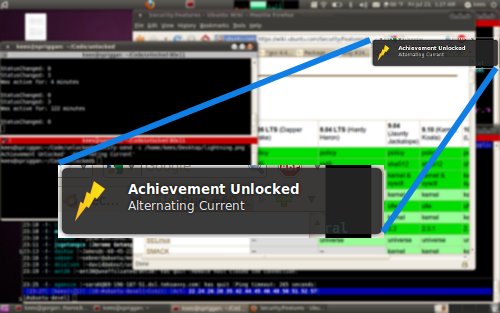
Kees Cook: Achievement Unlocked

I think it would be fun to add an achievement system to the Ubuntu Desktop, like is done on Steam and XBox. The tricky part is tracking various events and finding amusing correlations. For example, if your screen-saver kicks in 40 times in a single 24 hour period, you could earn the Alternating Current achievement, indicating that you re being repeatedly interrupted all day long: achievement unlocked: alternating current There are all kind of things to track and correlate. Miles moved with the mouse, clicks taken, keys pressed, files opened, applications installed, buddies added, IMs received, sent, etc. There are all kinds of achievements that could be designed that could be used to help people discover how to use Ubuntu, or for just plain humor. Achievement Unlocked: Application Deficit Disorder when you uninstall 100 applications you installed in the prior week. I ve been told this might all be very easy to implement with the Gnome Activity Journal (Zeitgeist), but I haven t had a chance to investigate further. UPDATE: I can easily imagine this being tracked in CouchDB, synced between systems via UbuntuOne, and could be linked to any other remote APIs that people could dream up, including Launchpad, Forums, REVU, Identi.ca, etc.

Alexander Reichle-Schmehl: Release Critical Bug report for Week 29

The unofficial rc bug tracker currently knows about the following bugs:
In Total:446
Affecting Squeeze:348
Squeeze only:62
Remaining to be fixed in Squeeze:286
Of these 286 bugs, the following tags are set:
Pending in Squeeze:18
Patched in Squeeze:48
Duplicates in Squeeze:36
Contrib or non-free in Squeeze:12
Claimed in Squeeze:2
Delayed in Squeeze:7
Can fixed in a security Update:23
Otherwise fixed in Squeeze:36
Ignoring all the above (multiple tags possible), 152 bugs need to be fixed by Debian Contributers to get Debian 6.0 Squeeze released. However, with the view of the Release Managers, 250 need to be dealt with for the release to happen. Please see my older post for an explanation of the different numbers.

Robert Collins: Switch

No, not the bzr switch rather the book : http://www.amazon.com/Switch-Change-Things-When-Hard/dp/0385528752 Read it, its solid.

Next.

Previous.