Search Results: "nic"

8 August 2024

Louis-Philippe V ronneau: A Selection of DebConf24 Talks

DebConf24 is now over! I'm very happy I was able to attend this year. If you haven't had time to look at the schedule yet, here is a selection of talks I liked.
What happens if I delete setup.py?: a live demo of upgrading to PEP-518 Python packaging A great talk by Weezel showcasing how easy it is to migrate to PEP-518 for existing Python projects. This is the kind of thing I've been doing a lot when packaging upstream projects that still use setup.py. I encourage you to send this kind of patch upstream, as it makes everyone's life much easier.
Debian on Chromebooks: What's New and What's Next? A talk by Alper Nebi Yasak, who has done great work on running Debian and the Debian Installer on Chromebooks. With Chromebooks being very popular machines in schools, it's nice to see people working on a path to liberate them.
Sequoia PGP, sq, gpg-from-sq, v6 OpenPGP, and Debian I had the chance to see Justus' talk on Sequoia an OpenPGP implementation in Rust at DebConf22 in Kosovo. Back then, the conclusion was that sq wasn't ready for production yet. Well it seems it now is! This in-depth talk goes through the history of the project and its goals. There is also a very good section on the current OpenPGP/LibrePGP schism.
Chameleon - the easy way to try out Sequoia - OpenPGP written in Rust A very short talk by Holger on Chameleon, a tool to make migration to Sequoia easier. TL;DW: apt install gpg-from-sq
Protecting OpenPGP keyservers from certificate flooding Although I used to enjoy signing people's OpenPGP keys, I completely gave up on this practice around 2019 when dkg's key was flooded with bogus certifications and have been refusing to do so since. In this talk, Gunnar talks about his PhD work on fixing this issue and making sure we can eventually restore this important function on keyservers.
Bits from the DPL Bits from the DPL! A DebConf classic.
Linux live patching in Debian Having to reboot servers after kernel upgrades is a hassle, especially with machines that have encrypted disk drives. Although kernel live patching in Debian is still a work in progress, it is encouraging to see people trying to fix this issue.
"I use Debian BTW": fzf, tmux, zoxide and friends A fun talk by Samuel Henrique on little changes and tricks one can make to their setup to make life easier.
Ideas to Move Debian Installer Forward Another in-depth talk by Alper, this time on the Debian Installer and his ideas to try to make it better. I learned a lot about the d-i internals!
Lightning Talks Lighting talks are always fun to watch! This year, the following talks happened:
  1. Customizing your Linux icons
  2. A Free Speech tracker by SFLC.IN
  3. Desktop computing is irrelevant
  4. An introduction to wcurl
  5. Aliasing in dpkg
  6. A DebConf art space
  7. Tiny Tapeout, Fomu, PiCI
  8. Data processing and visualisation in the shell

Is there a role for Debian in the post-open source era? As an economist, I've been interested in Copyright and business models in the Free Software ecosystem for a while. In this talk, Hatta-san and Bruce Perens discuss the idea of alternative licences that are not DFSG-free, like Post-Open.

3 August 2024

Paul Wise: FLOSS Activities July 2024

Focus This month I didn't have any particular focus. I just worked on issues in my info bubble.

Issues
  • Unnecessary deps in zlint

Administration
  • Debian IRC: add an entry message redirecting folks from #debian-ci to #debci

Communication
  • Respond to queries from folks on Debian and other IRC channels.

Sponsors All work was done on a volunteer basis.

2 August 2024

Colin Watson: Free software activity in July 2024

My Debian contributions this month were all sponsored by Freexian. You can also support my work directly via Liberapay. OpenSSH At the start of the month, I uploaded a quick fix (via Salvatore Bonaccorso) for a regression from CVE-2006-5051, found by Qualys; this was because I expected it to take me a bit longer to merge OpenSSH 9.8, which had the full fix. This turned out to be a good guess: it took me until the last day of the month to get the merge done. OpenSSH 9.8 included some substantial changes to split the server into a listener binary and a per-session binary, which required some corresponding changes in the GSS-API key exchange patch. At this point I was very grateful for the GSS-API integration test contributed by Andreas Hasenack a little while ago, because otherwise I might very easily not have noticed my mistake: this patch adds some entries to the key exchange algorithm proposal, and on the server side I d accidentally moved that to after the point where the proposal is sent to the client, which of course meant it didn t work at all. Even with a failing test, it took me quite a while to spot the problem, involving a lot of staring at strace output and comparing debug logs between versions. There are still some regressions to sort out, including a problem with socket activation, and problems in libssh2 and Twisted due to DSA now being disabled at compile-time. Speaking of DSA, I wrote a release note for this change, which is now merged. GCC 14 regressions I fixed a number of build failures with GCC 14, mostly in my older packages: grub (legacy), imaptool, kali, knews, and vigor. autopkgtest I contributed a change to allow maintaining Incus container and VM images in parallel. I use both of these regularly (containers are faster, but some tests need full machine isolation), and the build tools previously didn t handle that very well. I now have a script that just does this regularly to keep my images up to date (although for now I m running this with PATH pointing to autopkgtest from git, since my change hasn t been released yet):

RELEASE=sid autopkgtest-build-incus images:debian/trixie
RELEASE=sid autopkgtest-build-incus --vm images:debian/trixie
Python team I fixed dnsdiag s uninstallability in unstable, and contributed the fix upstream. I reverted python-tenacity to an earlier version due to regressions in a number of OpenStack packages, including octavia and ironic. (This seems to be due to #486 upstream.) I fixed a build failure in python3-simpletal due to Python 3.12 removing the old imp module. I added non-superficial autopkgtests to a number of packages, including httmock, py-macaroon-bakery, python-libnacl, six, and storm. I switched a number of packages to build using PEP 517 rather than calling setup.py directly, including alembic, constantly, hyperlink, isort, khard, python-cpuinfo, and python3-onelogin-saml2. (Much of this was by working through the missing-prerequisite-for-pyproject-backend Lintian tag, but there s still lots to do.) I upgraded frozenlist, ipykernel, isort, langtable, python-exceptiongroup, python-launchpadlib, python-typeguard, pyupgrade, sqlparse, storm, and uncertainties to new upstream versions. In the process, I added myself to Uploaders for isort, since the previous primary uploader has retired. Other odds and ends I applied a suggestion by Chris Hofstaedtler to create /etc/subuid and /etc/subgid in base-passwd, since the login package is no longer essential. I fixed a wireless-tools regression due to iproute2 dropping its (/usr)/sbin/ip compatibility symlink. I applied a suggestion by Petter Reinholdtsen to add AppStream metainfo to pcmciautils.

1 August 2024

Guido G nther: Free Software Activities July 2024

A short status update on what happened on my side last month. Looking at unified push support for Chatty prompted some libcmatrix fixes and Chatty improvements (benefiting other protocols like SMS/MMS as well). The Bluetooth status page in Phosh was a slightly larger change code wise as we also enhanced our common widgets for building status pages, simplifying the Wi-Fi status page and making future status pages simpler. But as usual investigating bugs, reviewing patches (thanks!) and keeping up with the changing world around us is what ate most of the time. Phosh A Wayland Shell for mobile devices Phoc A Wayland compositor for mobile devices libphosh-rs Phosh Rust bindings phosh-osk-stub A on screen keyboard for Phosh phosh-mobile-settings phosh-wallpapers Wallpapers, Sounds and other artwork git-buildpackage Suite to help with Debian packages in Git repositories Whatmaps Tool to find processes mapping shared objects Debian The universal operating system Mobian A Debian derivative for mobile devices Calls PSTN and SIP calls for GNOME Livi Minimalistic video player targeting mobile devices libcall-ui Common user interface parts for call handling in GNOME and Phosh. feedbackd DBus service for haptic/visual/audio feedback Chatty Messaging application for mobile and desktop libcmatrix A matrix client client library Eigenvalue A libcmatrix test client Help Development If you want to support my work see donations. This includes list of hardware we want to improve support for.

31 July 2024

Junichi Uekawa: I've tried Android Element app for matrix first time during Debconf.

I've tried Android Element app for matrix first time during Debconf. It feels good. For me it's a better IRC. I've been using it on my Chromebook and one annoyance is that I haven't found a keyboard shortcut for sending messages. I would have expected shift or ctrl with Enter would send the current message, but so far I have been touching the display to send messages. Can I fix this? Where is the code?

Junichi Uekawa: Joining Debconf, it's been 16 years.

Joining Debconf, it's been 16 years. I feel very different. Back then I didn't understand the need for people who were not directly doing Debian work, now I think I appreciate things more. I don't remember what motivated me to do everything back then. Now I am doing what is necessary for me. Maybe it was back then too.

Jonathan McDowell: Using QEmu for UEFI/TPM testing

This is one of those posts that s more for my own reference than likely to be helpful for others. If you re unlucky it ll have some useful tips for you. If I m lucky then I ll get a bunch of folk pointing out some optimisations. First, what I m trying to achieve. I want a virtual machine environment where I can manually do tests on random kernels, and also various TPM related experiments. So I don t want something as fixed as a libvirt setup. I d like the following: That turns out to be possible, but it took a bunch of trial and error to get there. So I m writing it down. I generally do this on a Fedora based host system (FC40 at present, but this all worked with FC38 + FC39 too), and I run Debian 12 (bookworm) as the guest. At present I m using qemu 8.2.2 and swtpm 0.9.0, both from the FC40 packages. One other issue I spent too long tracking down is that the version of grub 2.06 in bookworm does not manage to pass the TPMEventLog through to the guest kernel properly. The events get measured and the PCRs updated just fine, but /sys/kernel/security/tpm0/binary_bios_measurements doesn t even get created. Using either grub 2.06 from FC40, or the 2.12 backport in bookworm-backports, makes this work just fine. Anyway, for reference, the following is the script I use to start the swtpm, and then qemu. The debugcon line can be dropped if you re not interested in OVMF debug logging. This needs the guest OS to be configured up for a serial console, but avoids the overhead of graphics emulation. As I said at the start, I m open to any hints about other options I should be passing; as long as I get acceptable performance in the guest I care more about reducing host load than optimising for the guest.
#!/bin/sh
BASEDIR=/home/noodles/debian-qemu
if [ ! -S $ BASEDIR /swtpm/swtpm-sock ]; then
    echo Starting swtpm:
    swtpm socket --tpmstate dir=$ BASEDIR /swtpm \
        --tpm2 \
        --ctrl type=unixio,path=$ BASEDIR /swtpm/swtpm-sock &
fi
echo Starting QEMU:
qemu-system-x86_64 -enable-kvm -m 2048 \
    -machine type=q35 \
    -smbios type=1,serial=N00DL35,uuid=fd225315-f72a-4d66-9b16-55363c6c938b \
    -drive if=pflash,format=qcow2,readonly=on,file=/usr/share/edk2/ovmf/OVMF_CODE_4M.qcow2 \
    -drive if=pflash,format=raw,file=$ BASEDIR /OVMF_VARS.fd \
    -global isa-debugcon.iobase=0x402 -debugcon file:$ BASEDIR /debian.ovmf.log \
    -device virtio-blk-pci,drive=drive0,id=virblk0 \
    -drive file=$ BASEDIR /debian-12-efi.qcow2,if=none,id=drive0,discard=on \
    -net nic,model=virtio -net user \
    -chardev socket,id=chrtpm,path=$ BASEDIR /swtpm/swtpm-sock \
    -tpmdev emulator,id=tpm0,chardev=chrtpm \
    -device tpm-tis,tpmdev=tpm0 \
    -display none \
    -nographic \
    -boot menu=on

30 July 2024

Russell Coker: Links July 2024

Interesting Scientific American article about the way that language shapes thought processes and how it was demonstrated in eye tracking experiments with people who have Aboriginal languages as their first language [1]. David Brin wrote an interesting article Do We Really Want Immortality [2]. I disagree with his conclusions about the politics though. Better manufacturing technology should allow decreasing the retirement age while funding schools well. Scientific American has a surprising article about the differences between Chimp and Bonobo parenting [3]. I d never have expected Chimp moms to be protective. Sam Varghese wrote an insightful and informative article about the corruption in Indian politics and the attempts to silence Australian journalist Avani Dias [4]. WorksInProgress has an insightful article about the world s first around the world solo yacht race [5]. It has some interesting ideas about engineering. Htwo has an interesting video about adverts for fake games [6]. It s surprising how they apparently make money from advertising games that don t exist. Elena Hashman wrote an insightful blog post about Chronic Fatigue Syndrome [7]. I hope they make some progress on curing it soon. The fact that it seems similar to long Covid which is quite common suggests that a lot of research will be applied to that sort of thing. Bruce Schneier wrote an insightful blog post about the risks of MS Copilot [8]. Krebs has an interesting article about how Apple does Wifi AP based geo-location and how that can be abused for tracking APs in warzones etc. Bad Apple! [9]. Bruce Schneier wrote an insightful blog post on How AI Will Change Democracy [10]. Charles Stross wrote an amusing and insightful post about MS Recall titled Is Microsoft Trying to Commit Suicide [11]. Bruce Schneier wrote an insightful blog post about seeing the world as a data structure [12]. Luke Miani has an informative YouTube video about eBay scammers selling overprices MacBooks [13]. The Yorkshire Ranter has an insightful article about Ronald Coase and the problems with outsourcing big development contracts as an array of contracts without any overall control [14].

Lukas M rdian: Creating a Netplan enabled system through Debian-Installer

With the work that has been done in the debian-installer/netcfg merge-proposal !9 it is possible to install a standard Debian system, using the normal Debian-Installer (d-i) mini.iso images, that will come pre-installed with Netplan and all network configuration structured in /etc/netplan/. In this write-up, I d like to run you through a list of commands for experiencing the Netplan enabled installation process first-hand. Let s start with preparing a working directory and installing the software dependencies for our virtualized Debian system:
$ mkdir d-i_tmp && cd d-i_tmp
$ apt install ovmf qemu-utils qemu-system-x86
Now let s download the official (daily) mini.iso, linux kernel image and initrd.gz containing the Netplan enablement changes:
$ wget https://d-i.debian.org/daily-images/amd64/daily/netboot/gtk/mini.iso
$ wget https://d-i.debian.org/daily-images/amd64/daily/netboot/gtk/debian-installer/amd64/initrd.gz
$ wget https://d-i.debian.org/daily-images/amd64/daily/netboot/gtk/debian-installer/amd64/linux
Next we ll prepare a VM, by copying the EFI firmware files, preparing some persistent EFIVARs file, to boot from FS0:\EFI\debian\grubx64.efi, and create a virtual disk for our machine:
$ cp /usr/share/OVMF/OVMF_CODE_4M.fd .
$ cp /usr/share/OVMF/OVMF_VARS_4M.fd .
$ qemu-img create -f qcow2 ./data.qcow2 20G
Finally, let s launch the debian-installer using a preseed.cfg file, that will automatically install Netplan (netplan-generator) for us in the target system. A minimal preseed file could look like this:
# Install minimal Netplan generator binary
d-i preseed/late_command string in-target apt-get -y install netplan-generator
For this demo, we re installing the full netplan.io package (incl. the interactive Python CLI), as well as the netplan-generator package and systemd-resolved, to show the full Netplan experience. You can choose the preseed file from a set of different variants to test the different configurations: We re using the linux kernel and initrd.gz here to be able to pass the preseed URL as a parameter to the kernel s cmdline directly. Launching this VM should bring up the official debian-installer in its netboot/gtk form:
$ export U=https://people.ubuntu.com/~slyon/d-i/netplan-preseed+full.cfg
$ qemu-system-x86_64 \
	-M q35 -enable-kvm -cpu host -smp 4 -m 2G \
	-drive if=pflash,format=raw,unit=0,file=OVMF_CODE_4M.fd,readonly=on \
	-drive if=pflash,format=raw,unit=1,file=OVMF_VARS_4M.fd,readonly=off \
	-device qemu-xhci -device usb-kbd -device usb-mouse \
	-vga none -device virtio-gpu-pci \
	-net nic,model=virtio -net user \
	-kernel ./linux -initrd ./initrd.gz -append "url=$U" \
	-hda ./data.qcow2 -cdrom ./mini.iso;
Now you can click through the normal Debian-Installer process, using mostly default settings. Optionally, you could play around with the networking settings, to see how those get translated to /etc/netplan/ in the target system.
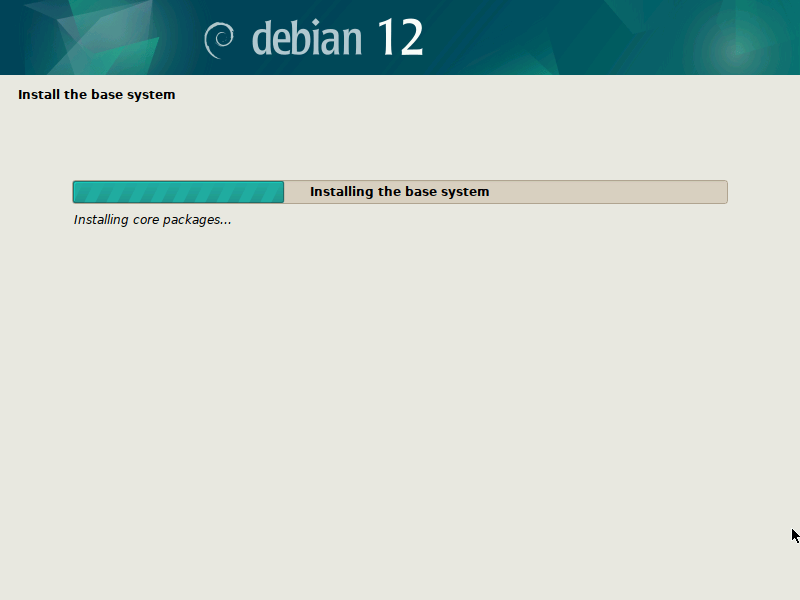
After you confirmed your partitioning changes, the base system gets installed. I suggest not to select any additional components, like desktop environments, to speed up the process.
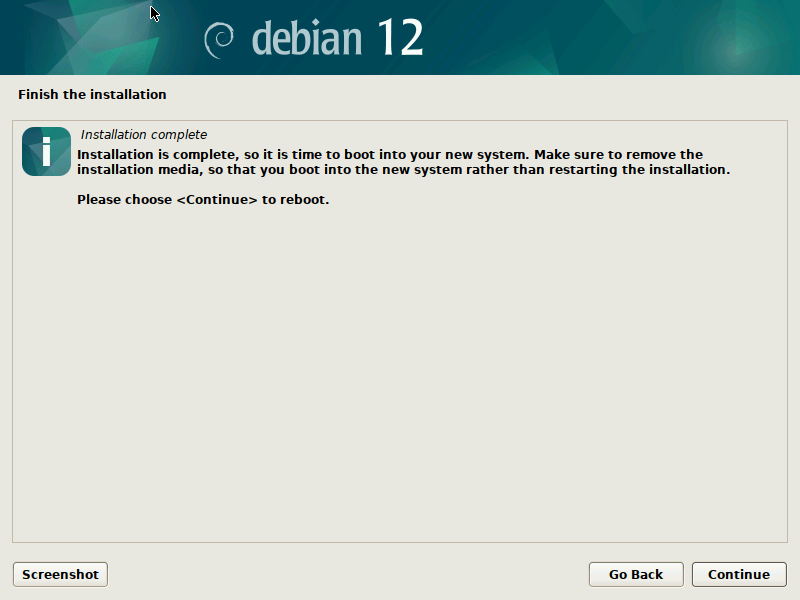
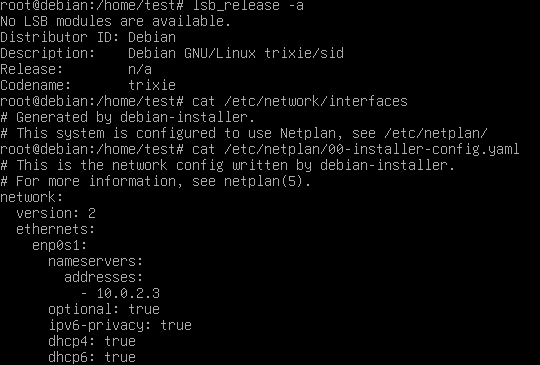
During the final step of the installation (finish-install.d/55netcfg-copy-config) d-i will detect that Netplan was installed in the target system (due to the preseed file provided) and opt to write its network configuration to /etc/netplan/ instead of /etc/network/interfaces or /etc/NetworkManager/system-connections/.
Done! After the installation finished, you can reboot into your virgin Debian Sid/Trixie system. To do that, quit the current Qemu process, by pressing Ctrl+C and make sure to copy over the EFIVARS.fd file that was modified by grub during the installation, so Qemu can find the new system. Then reboot into the new system, not using the mini.iso image any more:
$ cp ./OVMF_VARS_4M.fd ./EFIVARS.fd
$ qemu-system-x86_64 \
        -M q35 -enable-kvm -cpu host -smp 4 -m 2G \
        -drive if=pflash,format=raw,unit=0,file=OVMF_CODE_4M.fd,readonly=on \
        -drive if=pflash,format=raw,unit=1,file=EFIVARS.fd,readonly=off \
        -device qemu-xhci -device usb-kbd -device usb-mouse \
        -vga none -device virtio-gpu-pci \
        -net nic,model=virtio -net user \
        -drive file=./data.qcow2,if=none,format=qcow2,id=disk0 \
        -device virtio-blk-pci,drive=disk0,bootindex=1
        -serial mon:stdio
Finally, you can play around with your Netplan enabled Debian system! As you will find, /etc/network/interfaces exists but is empty, it could still be used (optionally/additionally). Netplan was configured in /etc/netplan/ according to the settings given during the d-i installation process.
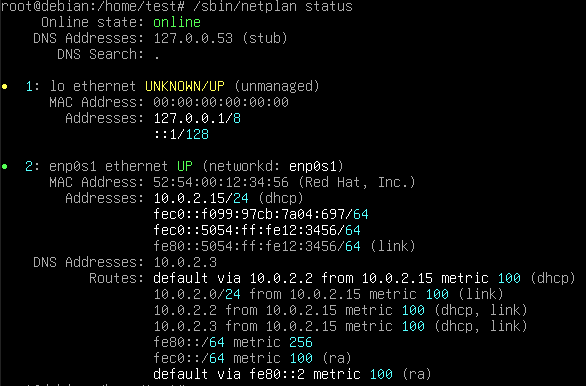
In our case, we also installed the Netplan CLI, so we can play around with some of its features, like netplan status:
Thank you for following along the Netplan enabled Debian installation process and happy hacking! If you want to learn more, find us at GitHub:netplan.

28 July 2024

Vincent Bernat: Crafting endless AS paths in BGP

Combining BGP confederations and AS override can potentially create a BGP routing loop, resulting in an indefinitely expanding AS path. BGP confederation is a technique used to reduce the number of iBGP sessions and improve scalability in large autonomous systems (AS). It divides an AS into sub-ASes. Most eBGP rules apply between sub-ASes, except that next-hop, MED, and local preferences remain unchanged. The AS path length ignores contributions from confederation sub-ASes. BGP confederation is rarely used and BGP route reflection is typically preferred for scaling. AS override is a feature that allows a router to replace the ASN of a neighbor in the AS path of outgoing BGP routes with its own. It s useful when two distinct autonomous systems share the same ASN. However, it interferes with BGP s loop prevention mechanism and should be used cautiously. A safer alternative is the allowas-in directive.1 In the example below, we have four routers in a single confederation, each in its own sub-AS. R0 originates the 2001:db8::1/128 prefix. R1, R2, and R3 forward this prefix to the next router in the loop.
BGP routing loop involving 4 routers: R0 originates a prefix, R1, R2, R3 make it loop using next-hop-self and as-override
BGP routing loop using a confederation
The router configurations are available in a Git repository. They are running Cisco IOS XR. R2 uses the following configuration for BGP:
router bgp 64502
 bgp confederation peers
  64500
  64501
  64503
 !
 bgp confederation identifier 64496
 bgp router-id 1.0.0.2
 address-family ipv6 unicast
 !
 neighbor 2001:db8::2:0
  remote-as 64501
  description R1
  address-family ipv6 unicast
  !
 !
 neighbor 2001:db8::3:1
  remote-as 64503
  advertisement-interval 0
  description R3
  address-family ipv6 unicast
   next-hop-self
   as-override
  !
 !
!
The session with R3 uses both as-override and next-hop-self directives. The latter is only necessary to make the announced prefix valid, as there is no IGP in this example.2 Here s the sequence of events leading to an infinite AS path:
  1. R0 sends the prefix to R1 with AS path (64500).3
  2. R1 selects it as the best path, forwarding it to R2 with AS path (64501 64500).
  3. R2 selects it as the best path, forwarding it to R3 with AS path (64500 64501 64502).
  4. R3 selects it as the best path. It would forward it to R1 with AS path (64503 64502 64501 64500), but due to AS override, it substitutes R1 s ASN with its own, forwarding it with AS path (64503 64502 64503 64500).
  5. R1 accepts the prefix, as its own ASN is not in the AS path. It compares this new prefix with the one from R0. Both (64500) and (64503 64502 64503 64500) have the same length because confederation sub-ASes don t contribute to AS path length. The first tie-breaker is the router ID. R0 s router ID (1.0.0.4) is higher than R3 s (1.0.0.3). The new prefix becomes the best path and is forwarded to R2 with AS path (64501 64503 64501 64503 64500).
  6. R2 receives the new prefix, replacing the old one. It selects it as the best path and forwards it to R3 with AS path (64502 64501 64502 64501 64502 64500).
  7. R3 receives the new prefix, replacing the old one. It selects it as the best path and forwards it to R0 with AS path (64503 64502 64503 64502 64503 64502 64500).
  8. R1 receives the new prefix, replacing the old one. Again, it competes with the prefix from R0, and again the new prefix wins due to the lower router ID. The prefix is forwarded to R2 with AS path (64501 64503 64501 64503 64501 64503 64501 64500).
A few iterations later, R1 views the looping prefix as follows:4
RP/0/RP0/CPU0:R1#show bgp ipv6 u 2001:db8::1/128 bestpath-compare
BGP routing table entry for 2001:db8::1/128
Last Modified: Jul 28 10:23:05.560 for 00:00:00
Paths: (2 available, best #2)
  Path #1: Received by speaker 0
  Not advertised to any peer
  (64500)
    2001:db8::1:0 from 2001:db8::1:0 (1.0.0.4), if-handle 0x00000000
      Origin IGP, metric 0, localpref 100, valid, confed-external
      Received Path ID 0, Local Path ID 0, version 0
      Higher router ID than best path (path #2)
  Path #2: Received by speaker 0
  Advertised IPv6 Unicast paths to peers (in unique update groups):
    2001:db8::2:1
  (64503 64502 64503 64502 64503 64502 64503 64502 64503 64502 64503 64502 64503 64502 64503 64502 64503 64502 64503 64502 64503 64502 64503 64502 64503 64502 64503 64502 64503 64502 64503 64502 64503 64502 64503 64502 64503 64502 64503 64502 64503 64502 64503 64502 64503 64502 64503 64502 64503 64502 64503 64502 64503 64502 64503 64502 64503 64502 64503 64502 64503 64502 64503 64502 64503 64502 64503 64502 64503 64502 64503 64502 64503 64502 64503 64502 64503 64502 64503 64502 64503 64502 64503 64502 64503 64502 64503 64502 64503 64502 64503 64502 64503 64502 64503 64502 64503 64502 64503 64502 64503 64502 64500)
    2001:db8::4:0 from 2001:db8::4:0 (1.0.0.3), if-handle 0x00000000
      Origin IGP, metric 0, localpref 100, valid, confed-external, best, group-best
      Received Path ID 0, Local Path ID 1, version 37
      best of AS 64503, Overall best
There s no upper bound for an AS path, but BGP messages have size limits (4096 bytes per RFC 4271 or 65535 bytes per RFC 8654). At some point, BGP updates can t be generated. On Cisco IOS XR, the BGP process crashes well before reaching this limit.5
The main lessons from this tale are:

  1. When using BGP confederations with Cisco IOS XR, use allowconfedas-in instead. It s available since IOS XR 7.11.
  2. Using BGP confederations is already inadvisable. If you don t use the same IGP for all sub-ASes, you re inviting trouble! However, the scenario described here is also possible with an IGP.
  3. When an AS path segment is composed of ASNs from a confederation, it is displayed between parentheses.
  4. By default, IOS XR paces eBGP updates. This is controlled by the advertisement-interval directive. Its default value is 30 seconds for eBGP peers (even in the same confederation). R1 and R2 set this value to 0, while R3 sets it to 2 seconds. This gives some time to watch the AS path grow.
  5. This is CSCwk15887. It only happens when using as-override on an AS path with a too long AS_CONFED_SEQUENCE. This should be fixed around 24.3.1.

Junichi Uekawa: updating old chroot in sbuild that predates usrmerge.

updating old chroot in sbuild that predates usrmerge. I have been lazy and haven't been updating the chroot; but I no longer could, so had to resolve this issue about usrmerge. There was a file /etc/unsupported-skip-usrmerge-conversion that usrmerge package errored out on; it seemed like it means a mark of not doing usrmerge conversion, because sbuild is a system for autobuilding and staying in split /usr for the duration of the release might be better. I don't fully understand the rationale of the file and effects, but I just deleted it and jumped into merged usr.

27 July 2024

Bits from Debian: DebConf24 welcomes its sponsors!

DebConf24 logo DebConf24, the 25th edition of the Debian conference is taking place in Pukyong National University at Busan, Republic of Korea. Thanks to the hard work of its organizers, it again will be an interesting and fruitful event for attendees. We would like to warmly welcome the sponsors of DebConf24, and introduce them to you. We have three Platinum sponsors. Our Gold sponsors are: Our Silver sponsors are: Bronze sponsors: And finally, our Supporter level sponsors: A special thanks to the Pukyong National University, our Venue Partner and our Network Partners KOREN and KREONET! Thanks to all our sponsors for their support! Their contributions make it possible for a large number of Debian contributors from all over the globe to work together, help and learn from each other in DebConf24.

19 July 2024

Dirk Eddelbuettel: dtts 0.1.3 on CRAN: More Maintenance

Leonardo and I are happy to announce the release of another maintenance release 0.1.3 of our dtts package which has been on CRAN for a good two years now. dtts builds upon our nanotime package as well as the beloved data.table to bring high-performance and high-resolution indexing at the nanosecond level to data frames. dtts aims to offers the time-series indexing versatility of xts (and zoo) to the immense power of data.table while supporting highest nanosecond resolution. This release contains two nice and focussed contributed pull requests. Tomas Kalibera, who as part of R Core looks after everything concerning R on Windows, and then some, needed an adjustment for pending / upcoming R on Windows changes for builds with LLVM which is what Arm-on-Windows uses. We happily obliged: neither Leonardo nor I see much of Windows these decades. (Easy thing to say on a day like today with its crowdstrike hammer falling!) Similarly, Michael Chirico supplied a PR updating one of our tests to an upcoming change at data.table which we are of course happy to support. The short list of changes follows.

Changes in version 0.1.3 (2024-07-18)
  • Windows builds use localtime_s with LLVM (Tomas Kalibera in #16)
  • Tests code has been adjusted for an upstream change in data.table tests for all.equal (Michael Chirico in #18 addressing #17)

Courtesy of my CRANberries, there is also a report with diffstat for this release. Questions, comments, issue tickets can be brought to the GitHub repo. If you like this or other open-source work I do, you can now sponsor me at GitHub.

This post by Dirk Eddelbuettel originated on his Thinking inside the box blog. Please report excessive re-aggregation in third-party for-profit settings.

17 July 2024

Dirk Eddelbuettel: Rcpp 1.0.13 on CRAN: Some Updates

rcpp logo The Rcpp Core Team is once again pleased to announce a new release (now at 1.0.13) of the Rcpp package. It arrived on CRAN earlier today, and has since been uploaded to Debian. Windows and macOS builds should appear at CRAN in the next few days, as will builds in different Linux distribution and of course r2u should catch up tomorrow too. The release was uploaded last week, but not only does Rcpp always gets flagged because of the grandfathered .Call(symbol) but CRAN also found two packages regressing which then required them to take five days to get back to us. One issue was known; another did not reproduce under our tests against over 2800 reverse dependencies leading to the eventual release today. Yay. Checks are good and appreciated, and it does take time by humans to review them. This release continues with the six-months January-July cycle started with release 1.0.5 in July 2020. As a reminder, we do of course make interim snapshot dev or rc releases available via the Rcpp drat repo as well as the r-universe page and repo and strongly encourage their use and testing I run my systems with these versions which tend to work just as well, and are also fully tested against all reverse-dependencies. Rcpp has long established itself as the most popular way of enhancing R with C or C++ code. Right now, 2867 packages on CRAN depend on Rcpp for making analytical code go faster and further, along with 256 in BioConductor. On CRAN, 13.6% of all packages depend (directly) on Rcpp, and 59.9% of all compiled packages do. From the cloud mirror of CRAN (which is but a subset of all CRAN downloads), Rcpp has been downloaded 86.3 million times. The two published papers (also included in the package as preprint vignettes) have, respectively, 1848 (JSS, 2011) and 324 (TAS, 2018) citations, while the the book (Springer useR!, 2013) has another 641. This release is incremental as usual, generally preserving existing capabilities faithfully while smoothing our corners and / or extending slightly, sometimes in response to changing and tightened demands from CRAN or R standards. The move towards a more standardized approach for the C API of R leads to a few changes; Kevin did most of the PRs for this. Andrew Johnsom also provided a very nice PR to update internals taking advantage of variadic templates. The full list below details all changes, their respective PRs and, if applicable, issue tickets. Big thanks from all of us to all contributors!

Changes in Rcpp release version 1.0.13 (2024-07-11)
  • Changes in Rcpp API:
    • Set R_NO_REMAP if not already defined (Dirk in #1296)
    • Add variadic templates to be used instead of generated code (Andrew Johnson in #1303)
    • Count variables were switches to size_t to avoid warnings about conversion-narrowing (Dirk in #1307)
    • Rcpp now avoids the usage of the (non-API) DATAPTR function when accessing the contents of Rcpp Vector objects where possible. (Kevin in #1310)
    • Rcpp now emits an R warning on out-of-bounds Vector accesses. This may become an error in a future Rcpp release. (Kevin in #1310)
    • Switch VECTOR_PTR and STRING_PTR to new API-compliant RO variants (Kevin in #1317 fixing #1316)
  • Changes in Rcpp Deployment:
    • Small updates to the CI test containers have been made (#1304)

Thanks to my CRANberries, you can also look at a diff to the previous release Questions, comments etc should go to the rcpp-devel mailing list off the R-Forge page. Bugs reports are welcome at the GitHub issue tracker as well (where one can also search among open or closed issues). If you like this or other open-source work I do, you can sponsor me at GitHub.

This post by Dirk Eddelbuettel originated on his Thinking inside the box blog. Please report excessive re-aggregation in third-party for-profit settings.

Gunnar Wolf: Script for weather reporting in Waybar

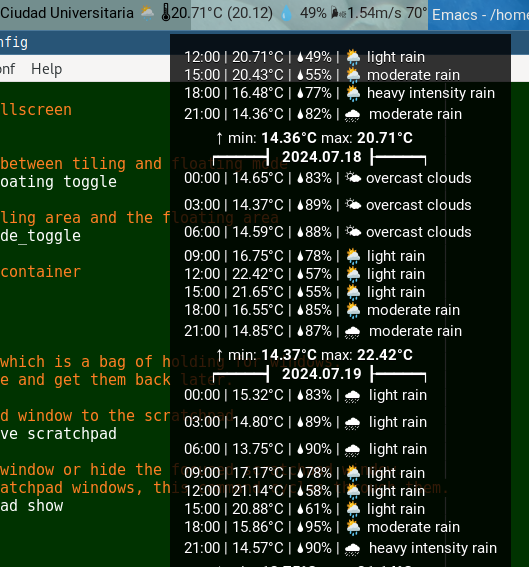
While I was living in Argentina, we (my family) found ourselves checking for weather forecasts almost constantly weather there can be quite unexpected, much more so that here in Mexico. So it took me a bit of tinkering to come up with a couple of simple scripts to show the weather forecast as part of my Waybar setup. I haven t cared to share with anybody, as I believe them to be quite trivial and quite dirty. But today, V ctor was asking for some slightly-related things, so here I go. Please do remember I warned: Dirty. Forecast I am using OpenWeather s open API. I had to register to get an APPID, and it allows me for up to 1,000 API calls per day, more than plenty for my uses, even if I am logged in at my desktops at three different computers (not an uncommon situation). Having that, I set up a file named /etc/get_weather/, that currently reads:
# Home, Mexico City
LAT=19.3364
LONG=-99.1819
# # Home, Paran , Argentina
# LAT=-31.7208
# LONG=-60.5317
# # PKNU, Busan, South Korea
# LAT=35.1339
#LONG=129.1055
APPID=SomeLongRandomStringIAmNotSharing
Then, I have a simple script, /usr/local/bin/get_weather, that fetches the current weather and the forecast, and stores them as /run/weather.json and /run/forecast.json:
#!/usr/bin/bash
CONF_FILE=/etc/get_weather
if [ -e "$CONF_FILE" ]; then
    . "$CONF_FILE"
else
    echo "Configuration file $CONF_FILE not found"
    exit 1
fi
if [ -z "$LAT" -o -z "$LONG" -o -z "$APPID" ]; then
    echo "Configuration file must declare latitude (LAT), longitude (LONG) "
    echo "and app ID (APPID)."
    exit 1
fi
CURRENT=/run/weather.json
FORECAST=/run/forecast.json
wget -q "https://api.openweathermap.org/data/2.5/weather?lat=$ LAT &lon=$ LONG &units=metric&appid=$ APPID " -O "$ CURRENT "
wget -q "https://api.openweathermap.org/data/2.5/forecast?lat=$ LAT &lon=$ LONG &units=metric&appid=$ APPID " -O "$ FORECAST "
This script is called by the corresponding systemd service unit, found at /etc/systemd/system/get_weather.service:
[Unit]
Description=Get the current weather
[Service]
Type=oneshot
ExecStart=/usr/local/bin/get_weather
And it is run every 15 minutes via the following systemd timer unit, /etc/systemd/system/get_weather.timer:
[Unit]
Description=Get the current weather every 15 minutes
[Timer]
OnCalendar=*:00/15:00
Unit=get_weather.service
[Install]
WantedBy=multi-user.target
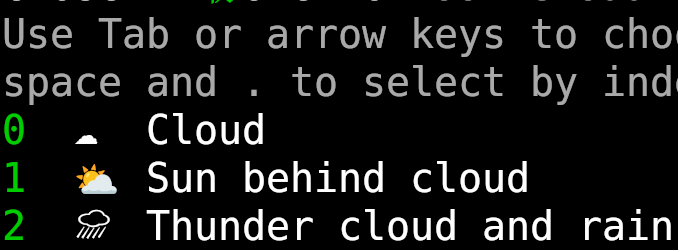
(yes, it runs even if I m not logged in, wasting some of my free API calls but within reason) Then, I declare a "custom/weather" module in the desired position of my ~/.config/waybar/waybar.config, and define it as:
"custom/weather":  
    "exec": "while true;do /home/gwolf/bin/parse_weather.rb;sleep 10; done",
"return-type": "json",
 ,
This script basically morphs a generic weather JSON description into another set of JSON bits that display my weather in the way I prefer to have it displayed as:
#!/usr/bin/ruby
require 'json'
Sources =  :weather => '/run/weather.json',
           :forecast => '/run/forecast.json'
           
Icons =  '01d' => ' ', # d   day
         '01n' => ' ', # n   night
         '02d' => ' ',
         '02n' => ' ',
         '03d' => ' ',
         '03n' => ' ',
         '04d'  => ' ',
         '04n' => ' ',
         '09d' => ' ',
         '10n' =>  '  ',
         '10d' => ' ',
         '13d' => ' ',
         '50d' => ' '
         
ret =  'text': nil, 'tooltip': nil, 'class': 'weather', 'percentage': 100 
# Current weather report: Main text of the module
begin
  weather = JSON.parse(open(Sources[:weather],'r').read)
  loc_name = weather['name']
  icon = Icons[weather['weather'][0]['icon']]   ' ' + f['weather'][0]['icon'] + f['weather'][0]['main']
  temp = weather['main']['temp']
  sens = weather['main']['feels_like']
  hum = weather['main']['humidity']
  wind_vel = weather['wind']['speed']
  wind_dir = weather['wind']['deg']
  portions =  
  portions[:loc] = loc_name
  portions[:temp] = '%s  %2.2f C (%2.2f)' % [icon, temp, sens]
  portions[:hum] = '  %2d%%' % hum
  portions[:wind] = ' %2.2fm/s %d ' % [wind_vel, wind_dir]
  ret['text'] = [:loc, :temp, :hum, :wind].map   p  portions[p] .join(' ')
rescue => err
  ret['text'] = 'Could not process weather file (%s   %s: %s)' % [Sources[:weather], err.class, err.to_s]
end
# Weather prevision for the following hours/days
begin
  cast = []
  forecast = JSON.parse(open(Sources[:forecast], 'r').read)
  min = ''
  max = ''
  day=Time.now.strftime('%Y.%m.%d')
  by_day =  
  forecast['list'].each_with_index do  f,i 
    by_day[day]  = []
    time = Time.at(f['dt'])
    time_lbl = '%02d:%02d' % [time.hour, time.min]
    icon = Icons[f['weather'][0]['icon']]   ' ' + f['weather'][0]['icon'] + f['weather'][0]['main']
    by_day[day] << f['main']['temp']
    if time.hour == 0
      min = '%2.2f' % by_day[day].min
      max = '%2.2f' % by_day[day].max
      cast << '          min: <b>%s C</b> max: <b>%s C</b>' % [min, max]
      day = time.strftime('%Y.%m.%d')
      cast << '        <b>%04d.%02d.%02d</b>  ' %
              [time.year, time.month, time.day]
    end
    cast << '%s   %2.2f C    %2d%%   %s %s' % [time_lbl,
                                                f['main']['temp'],
                                                f['main']['humidity'],
                                                icon,
                                                f['weather'][0]['description']
                                               ]
  end
  cast << '          min: <b>%s</b> C max: <b>%s C</b>' % [min, max]
  ret['tooltip'] = cast.join("\n")
  
rescue => err
  ret['tooltip'] = 'Could not process forecast file (%s   %s)' % [Sources[:forecast], err.class, err.to_s]
end
# Print out the result for Waybar to process
puts ret.to_json
The end result? Nothing too stunning, but definitively something I find useful and even nicely laid out: Screenshot Do note that it seems OpenWeather will return the name of the closest available meteorology station with (most?) recent data for my home, I often get Ciudad Universitaria, but sometimes Coyoac n or even San ngel Inn.

Russell Coker: Samsung Galaxy Note 9 Review

After the VoLTE saga [1] and the problems with battery life on the PinePhonePro [2] (which lasted 4 hours while idle with the screen off in my last test a few weeks ago) I m running a Galaxy Note 9 [3] with the default Samsung OS as my daily driver. I don t think that many people will be rushing out to buy a 2018 phone regardless of my review. For someone who wants a phone of such age (which has decent hardware and a low price) then good options are the Pixel phones which are all supported by LineageOS. I recommend not buying this phone due to the fact that it doesn t have support for VoLTE with LineageOS (and presumably any other non-Samsung Android build) and doesn t have support from any other OS. The One Plus 6/6T has Mobian support [4] as well as LineageOS support and is worth considering. The Note 9 still has capable hardware by today s standards. A 6.4 display is about as big as most people want in their pocket and 2960 1440 resolution in that size (516dpi) is probably as high as most people can see without a magnifying glass. The model I m using has 8G of RAM which is as much as the laptop I was using at the start of this year. I don t think that many people will have things that they actually want to do on a phone which needs more hardware than this. The only hardware feature in new phones which beats this is the large folding screen in some recent phones, but $2500+ (the price of such phones in Australia) is too much IMHO and the second hand market for folding phones is poor due to the apparently high incidence of screens breaking. The Note 9 has the Dex environment for running as a laptop if you connect it to a USB-C dock. It can run nicely with a 4K monitor with USB keyboard and mouse. The UI is very similar to that of older versions of Windows. The Samsung version of Android seems mostly less useful than the stock Google version or the LineageOS version. The Samsung keyboard flags words such as gay as spelling errors and it can t be uninstalled even when you install a better keyboard app. There is a Bixby button on the side of the phone to launch the Bixby voice recognition app which can t be mapped to any useful purpose, The Google keyboard has a voice dictation option which I will try out some time but that s all I desire in terms of voice recognition. There are alerts about Samsung special deals and configuration options including something about signing in to some service and having it donate money to charity, I doubt that any users want such features. Apart from Dex the Samsung Android build is a good advert for LineageOS. The screen has curved sides for no good reason. This makes it more difficult to make a protective phone case as a case can t extend beyond the screen at the sides and therefore if it s dropped and hits an edge (step, table, etc) then the glass can make direct contact with something. Also the curved sides reflect sunlight in all directions, this means that the user has to go to more effort to avoid reflecting the sun into their eyes and that a passenger can more easily reflect sunlight into the eyes of a car driver. It s an impressive engineering feat to make a curved touch-screen but it doesn t do any good for users. The stylus is good as always and the screen is AMOLED so it doesn t waste much power when in dark mode. There is a configuration option to display a clock all the time when the screen is locked because that apparently doesn t use much power. I haven t felt inclined to enable the always on screen but it s a nice feature for those who like such things. The VoLTE implementation is apparently a bit unusual so it s not supported by LineageOS and didn t work on Droidian for the small amount of time that Droidian supported it. Generally this phone is quite nice hardware it s just a pity that it demonstrates all of the downsides to buying a non-Pixel phone.

Gunnar Wolf: Scholarly spam Wulfenia

I just got one of those utterly funny spam messages And yes, I recognize everybody likes building a name for themselves. But some spammers are downright silly. I just got the following mail:
From: Hermine Wolf <hwolf850@gmail.com>
To: me, obviously  
Date: Mon, 15 Jul 2024 22:18:58 -0700
Subject: Make sure that your manuscript gets indexed and showcased in the prestigious Scopus database soon.
Message-ID: <CAEZZb3XCXSc_YOeR7KtnoSK4i3OhD=FH7u+A5xSMsYvhQZojQA@mail.gmail.com>
This message has visual elements included. If they don't display, please   
update your email preferences.
*Dear Esteemed Author,*
Upon careful examination of your recent research articles available online,
we are excited to invite you to submit your latest work to our esteemed    
journal, '*WULFENIA*'. Renowned for upholding high standards of excellence 
in peer-reviewed academic research spanning various fields, our journal is 
committed to promoting innovative ideas and driving advancements in        
theoretical and applied sciences, engineering, natural sciences, and social
sciences. 'WULFENIA' takes pride in its impressive 5-year impact factor of 
*1.000* and is highly respected in prestigious databases including the     
Science Citation Index Expanded (ISI Thomson Reuters), Index Copernicus,   
Elsevier BIOBASE, and BIOSIS Previews.                                     
                                                                           
*Wulfenia submission page:*                                                
[image: research--check.png][image: scrutiny-table-chat.png][image:        
exchange-check.png][image: interaction.png]                                
.                                                                          
Please don't reply to this email                                           
                                                                           
We sincerely value your consideration of 'WULFENIA' as a platform to       
present your scholarly work. We eagerly anticipate receiving your valuable 
contributions.                                                             
*Best regards,*                                                            
Professor Dr. Vienna S. Franz                                              
Scholarly spam Who cares what Wulfenia is about? It s about you, my stupid Wolf cousin!

16 July 2024

Dave Hibberd: What I've been up to in Open Ham Radio - July 2024

I do a lot in free software for ham radio, and Steve at Zero Retries encouraged me to take this email I sent him and translate it into something here. UK Packet Radio Network UKPRN is going nicely, with the Nottingham and South segment really quite impressively interconnected over RF - https://nodes.ukpacketradio.network/packet-network-map.html?rfonly=1 I m excited to see the growth down there! We re sorting out forwarding and routes in Aberdeen too, and working to grow the RF path to Inverness.

14 July 2024

Ravi Dwivedi: Kenya Visa Process

Prior to arrival in Kenya, you need to apply for an Electronic Travel Authorization (eTA) on their website by uploading all the required documents. This system is in place since Jan 2024 after the country abolished the visa system, implementing the eTA portal. The required documents will depend on the purpose of your visit, which in my case, was to attend a conference. Here is the list of documents I submitted for my eTA: Reservation means I didn t book the flights and hotels, but rather reserved them. Additionally, optional means that those documents were not mandatory to submit, but I submitted them in the Other Documents section in order to support my application. After submitting the eTA, I had to make a payment of around 35 US Dollars (approximately 3000 Indian Rupees). It took 40 hours for me to receive an email from Kenya stating that my eTA has been approved, along with an attached PDF, making this one of my smoothest experiences of obtaining travel documents to travel to a country :). An eTA is technically not a visa, but I put the word visa in the title due to familiarity with the term.

12 July 2024

Reproducible Builds: Reproducible Builds in June 2024

Welcome to the June 2024 report from the Reproducible Builds project! In our reports, we outline what we ve been up to over the past month and highlight news items in software supply-chain security more broadly. As always, if you are interested in contributing to the project, please visit our Contribute page on our website. Table of contents:
  1. Next Reproducible Builds Summit dates announced
  2. GNU Guix patch review session for reproducibility
  3. New reproducibility-related academic papers
  4. Misc development news
  5. Website updates
  6. Reproducibility testing framework


Next Reproducible Builds Summit dates announced We are very pleased to announce the upcoming Reproducible Builds Summit, set to take place from September 17th 19th 2024 in Hamburg, Germany. We are thrilled to host the seventh edition of this exciting event, following the success of previous summits in various iconic locations around the world, including Venice, Marrakesh, Paris, Berlin and Athens. Our summits are a unique gathering that brings together attendees from diverse projects, united by a shared vision of advancing the Reproducible Builds effort. During this enriching event, participants will have the opportunity to engage in discussions, establish connections and exchange ideas to drive progress in this vital field. Our aim is to create an inclusive space that fosters collaboration, innovation and problem-solving. If you re interesting in joining us this year, please make sure to read the event page which has more details about the event and location. We are very much looking forward to seeing many readers of these reports there.

GNU Guix patch review session for reproducibility Vagrant Cascadian will be holding a Reproducible Builds session as part of the monthly Guix patch review series on July 11th at 17:00 UTC. These online events are intended to encourage everyone everyone becoming a patch reviewer and the goal of reviewing patches is to help Guix project accept contributions while maintaining our quality standards and learning how to do patch reviews together in a friendly hacking session.

Development news In Debian this month, 4 reviews of Debian packages were added, 11 were updated and 14 were removed this month adding to our knowledge about identified issues. Only one issue types was updated, though, explaining that we don t vary the build path anymore.
On our mailing list this month, Bernhard M. Wiedemann wrote that whilst he had previously collected issues that introduce non-determinism he has now moved on to discuss about mitigations , in the sense of how can we avoid whole categories of problem without patching an infinite number of individual packages . In addition, Janneke Nieuwenhuizen announced the release of two versions of GNU Mes. [ ][ ]
In openSUSE news, Bernhard M. Wiedemann published another report for that distribution.
In NixOS, with the 24.05 release out, it was again validated that our minimal ISO is reproducible by building it on a virtual machine with no access to the binary cache.
What s more, we continued to write patches in order to fix specific reproducibility issues, including Bernhard M. Wiedemann writing three patches (for qutebrowser, samba and systemd), Chris Lamb filing Debian bug #1074214 against the fastfetch package and Arnout Engelen proposing fixes to refind and for the Scala compiler [ .
Lastly, diffoscope is our in-depth and content-aware diff utility that can locate and diagnose reproducibility issues. This month, Chris Lamb uploaded two versions (270 and 271) to Debian, and made the following changes as well:
  • Drop Build-Depends on liblz4-tool in order to fix Debian bug #1072575. [ ]
  • Update tests to support zipdetails version 4.004 that is shipped with Perl 5.40. [ ]

Website updates There were a number of improvements made to our website this month, including Akihiro Suda very helpfully making the <h4> elements more distinguishable from the <h3> level [ ][ ] as well as adding a guide for Dockerfile reproducibility [ ]. In addition Fay Stegerman added two tools, apksigcopier and reproducible-apk-tools, to our Tools page.

Reproducibility testing framework The Reproducible Builds project operates a comprehensive testing framework running primarily at tests.reproducible-builds.org in order to check packages and other artifacts for reproducibility. In June, a number of changes were made by Holger Levsen, including:
  • Marking the virt(32 64)c-armhf nodes as down. [ ]
  • Granting a developer access to the osuosl4 node in order to debug a regression on the ppc64el architecture. [ ]
  • Granting a developer access to the osuosl4 node. [ ][ ]
In addition, Mattia Rizzolo re-aligned the /etc/default/jenkins file with changes performed upstream [ ] and changed how configuration files are handled on the rb-mail1 host. [ ], whilst Vagrant Cascadian documented the failure of the virt32c and virt64c nodes after initial investigation [ ].

If you are interested in contributing to the Reproducible Builds project, please visit our Contribute page on our website. However, you can get in touch with us via:

Next.

Previous.