Stefano Zacchiroli: debian in ubuntu story
Debian in Ubuntu story: bug fixed
The bug
I've
reported has been
fixed.
Thanks to Matthew East, Matthew Nuzum, and all the other
(constructive) collaborators who have followed up in the bug
log.
 In what I can only assume is a case of "graphic design spec gone horribly
wrong", EBay has decided to portray our lovable penguin friend as the
mascot of the online scam artist:
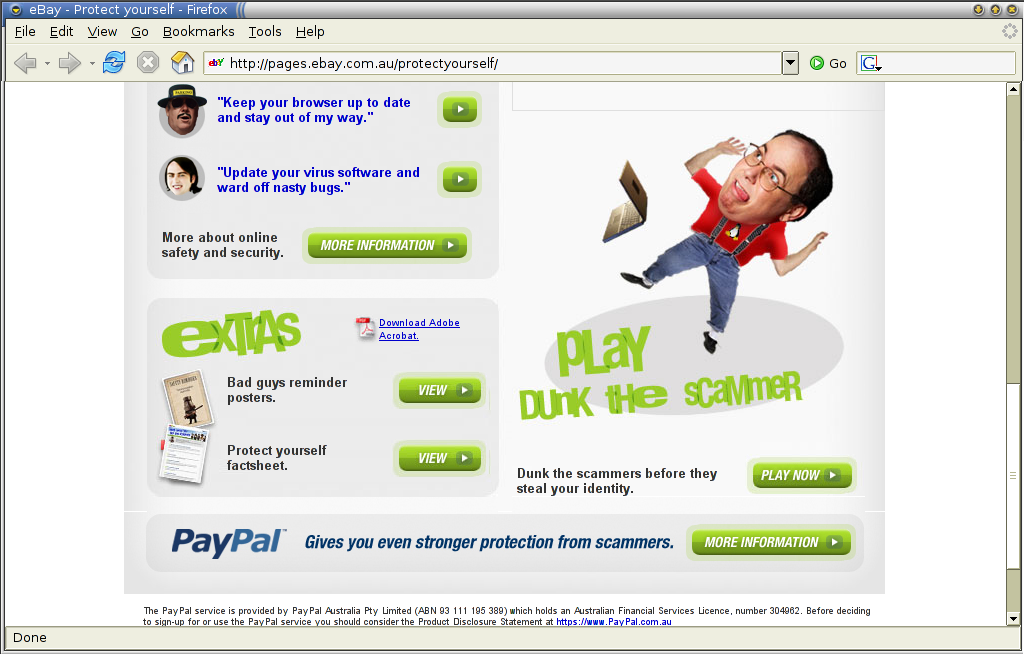 (Click on the image for a full-size version)
Personally, I think the scam artists' best friend is a Windows machine, as
it provides a rich source of untraceable connectivity, but my guess is that
Microsoft has scarier lawyers.
I don't know how long the image has been up there for, but I'd imagine it
won't last long. Linux users may not be that numerous, but we're a noisy
lot. <grin>

 Although I
predicted that I'd be a busy boy with my bushfire brigade on Tuesday, I
wasn't expecting to get our first "Bush Alight" fire call so quickly. But,
yesterday (Wednesday), a few minutes after 1800, off goes the pager, and
off I go to the station.
Thankfully the high winds that had been a major feature of the day had
settled down quite a bit, so it was relatively easy to control and stamp
out (we were back at the station by around 2015) I still found it a little
overwhelming -- "I'm supposed to help Stop This Fire". At a couple of
hectares in size, it wasn't too massive, and it wasn't visually
"spectacular" (like the fires you always see on the news) but still...
given that my only experience of fire in the past has been small campfires
and the occasional bonfire, having an area the size of a football field in
front of you glowing with embers and flaring with small clusters of flames,
it was certainly a very different experience. The heat, the
smoke, the noise (those truck pumps are loud), and the adrenalin,
it's a hell of a mix.
Being that I'm the newest and least experienced crew there, I got given the
unglamourous but important job of controlling traffic, as we had one lane
of the one-each-way 100km/h road closed to give our crews more working
space around the trucks. Let me just say that I now have an infinitely
greater respect for road repair crews, and I think that every person should
do an evening of traffic control with a group of their mates on the road
behind them, so that they know what it feels like outside their
car. Car drivers do the darnedest things.
So, I've popped my bushfire-fighting cherry now, and I'd be more than happy
if there's nothing more impressive than that awaiting me for the rest of
the season.
We're a third of the way through spring, and already we're hitting
temperatures that would be a respectable mid-summer day. Tomorrow has also
been declared a Total Fire Ban day in our area. That's probably nearly
unheard of, especially given the large amount of rain that we've had over
winter.
I think I'm going to be a busy boy this summer. The bush around our town
last had a bushfire through it seven years ago, and there's a regular seven
year cycle of major bushfires. We're due for it. As this is my first
summer as a qualified bush firefighter, I'm a bit twitchy about what the
continued hot, dry weather may bring. Here's hoping it's not too horrific.
(or: Why Everyone Should Learn Some Basic Programming)
I am an organisational disaster area. I just can't remember "event
oriented" information (like "I need to do $foo" or "I need to do $bar at
$time"). I think I've accumulated such a huge collection of technical
trivia that it's taken over the event planning part of my brain --
although, since I've never been able to remember event oriented
information, even before I became a computer geek, it's more likely that I
was just built without that bit of the brain.
So I guess I'm the perfect target market for some sort of external brain
pack (a la "Ratbert the Consultant"). I've tried paper-based organisers
(the mighty Filofax), a few pre-written apps, and I even bought an SL-C3200
Zaurus a while ago (although, to be fair, that was really just for the hack
factor, regardless of what justification I may have given to others at the
time). None have worked, for various reasons. I can't grep paper, and
Other People's Apps bug me because they've got their idea of workflow, and
I've got mine, and when they don't match up (and they never do) I just get
irritated -- not to mention the fact that the ubiquitous relational
database, while wonderful in some ways, does tend to get in the way of
ad-hoc faffing with your data.
But this article is a success story, not a rant (gasp!), so it's safe for
you to assume that I've got something that's working for me.
My method is real simple -- plain text files, managed by vim-outliner and a simple shell
one-liner I've named 'pda', which just runs vim ~/pda/$1.otl. At
the moment I've got a monster todo.otl, which is my world's todo
list, and a deeply underused calendar.otl. I'm also using
vim-outliner to do some project planning, which has been moderately
successful, although I'm a bit freaked out by the idea of trying to manage
a large-scale project using it.
The really, really cool part of this whole shebang, though, is that because
all of my data is (structured) plain text, writing little programs to parse
the data and do funky things with it is dead simple.
For example, in my project outlines, I put estimated, actual, and remaining
times in for all tasks (a la Joel Spolsky's Painless
Software Schedules) so I can keep track of my estimates and where they
differ from reality (because one day I'd like to not Suck at estimating
times, and feedback is the only way I'm going to do that). So, about an
hour's worth of Ruby gave me "estimator", a script that reads all
that data and does a pile of mathematical gubbins about how far over my
estimate I am so far (or under estimate, if that were to ever happen), the
percentage of the project complete (based on the estimates and number of
tasks completed), and things like that.
Similarly, today I wrote a small script (run out of cron in the wee hours
of the morning) to read my calendar and send me an e-mail if I've got
anything in there for today. Since I practically live in mutt, a morning
e-mail is going to be far more effective than my trying to remember to
check my calendar every morning (especially since, at present, I'm not
using the calendar as often as I should, so there's even less motivation to
check it).
This, in my opinion, is why everybody (literally, every single person)
should learn to program at some fairly simple level, like learning to read
and write. By using plain text and small scripts, I've got a workflow that
works for me, and it's cost me less time than I'd spend learning some large
pre-written app and putting all my data into it. Being able to manipulate
data like this is, I think, a fairly important tool in the modern world,
and I don't think it should be left to any sort of priesthood of developers
-- it should be as universal as most countries try to make literacy and
numeracy.
Colin Charles, writing about how "Linux isn't ready for the laptop" (no
link -- I don't link through FeedBurner's shite):
However, I should caution all these companies from even going near Linux with a ten-foot pole. Quite simply, this is because Linux doesn't work. If their product doesn't work as advertised, what are the chances of a customer possibly suing them, for a product that isn't fit for purpose?Puhlease. As Microsoft has convincingly demonstrated over the years, the chances of a consumer suing over non-functional software is zero, even after being shit on from a great height for nearly two decades.
The other day, as I was putting a couple of pages of documentation together
for a company-internal development project, I got this terrible feeling of
malaise about what I was writing. "Why the hell am I bothering writing
this lot? It's a given that nobody's ever going to read it." Why?
Because nobody reads documentation.
Funnily enough, I tend to work the other way, too. While I will often go
looking for help through Google, checking for assistance in structured,
project-produced documentation (manuals, et al) is usually one of the last
things I'll try. Why? Because nobody writes documentation.
Now, given that I feel minimal motivation to write documentation because
nobody reads it, and I don't usually read documentation because nobody
writes it (probably because nobody reads it), an obvious question comes to
mind: did one of these states come first, which then caused the other? Are
we in an ever-deepening spiral of shite docs, the logical end of which is
just giving up and reverting to code reading and experimentation?
Slightly used Leopard
main battle tanks. One owner, always garaged, great for soccer mums
and men with very small penises.
 Matthew Tippett just threw a CD full of AMD/ATI specs to Dave Airlie, approved
for public release with no NDA. I'm now holding one of those CDs as well.
Thanks, AMD.
I'm sitting here at XDS,
and John Bridgman and Matthew Tippett are announcing AMD's open source plans.
In three words: 'specifications without NDA'. 2D very soon, 3D coming when
the legal issues have been taken care of. Specs for the r3xx core will
probably be coming later on down the track.
char const *const keywords[] =


    "foo",

    "bar"

 ;

unsigned int const num_keywords = sizeof keywords / sizeof *keywords;
(for more correctness, use "(&keywords[1] - &keywords[0])" as the divisor), or you can explicitly tell the compiler how many keywords you expect, using
unsigned int const num_keywords = 2;

char const *const keywords[num_keywords] =


    "foo",

    "bar"

 ;
What we lerned in our database courses is true in other places as well: redundant information has a habit of going out-of-sync, so we should avoid it (=> db normalisation), or create a connection between the redundant bits (=> foreign keys).
If X = B [in the java equals() sense], and if Z = D..E, it's no problem, because when the day comes that X and Z are merged to some branch which happens to be the public mainline, and you later pull from that public branch, then X and B will "contend" and merge without conflict, and likewise Z will merge without conflict. It's all the same text. Mission accomplished.If you think this is right, "think about two different patches each adding a new keyword and also changing the line #define NUM_OF_KEYWORDS 17'' to #define NUM_OF_KEYWORDS 18''." (example taken from the darcs manual, because I'm not going to come up with a better example than that).
There seem to be some 30 or 40 voters who really dislike me, but didn't tell me that straight, preferring to be silent then vote me down. Are you cowards, or what?Given this outburst, I'm hardly surprised that people weren't keen on telling Mark upfront that they weren't going to vote for him. (As a disclaimer, I didn't vote in the SPI election, because I don't have a specific opinion on any of the candidiates' suitability for office on the SPI board.)
#!/bin/bash
#created by arnieboy
foo= gksudo -u root -k -m "enter your password for gedit root access" /bin/echo "Do you have root access?"
sudo gedit $NAUTILUS_SCRIPT_SELECTED_URIS
appears to be an attempt to ensure that the user has sudo rights. This
if ps -U root -u root u   grep "dpkg"   grep -v grep;
   then
     killall -9 dpkg
May well leave the system in an inconsistent and unbootable state, andfunction reloadnautilus
killall -9 nautilus
Not actually used anywhere, but could potentially lose usersudo ln -s /usr/lib/libesd.so.0 /usr/lib/libesd.so.1is really not
ln -s /tmp/.esd-1000 /tmp/.esdlooks like it'll only ever work for
sudo sed -i "s/^vboxusers\(.*\):$/vboxusers\1:$AXUSER/" /etc/group- assumes that the system isn't using some sort of user directory
Next.
