Search Results: "gio"

6 April 2011

Jon Dowland: aero

aero snap was one of the launch features of Windows 7 that was quickly copied into other desktop systems (most recently, gnome 3). I've written about it before. Essentially, dragging windows to hot regions of the screen resizes those windows to occupy some area of the screen. To the top: the whole window area (maximize). To the left or right, 50% of the width of the window area, all of the height. This is a pretty useful feature that I wanted to steal for myself. There is a somewhat fragile-looking (but functional) way of achieving this using compiz and some embedded shell scripts which I used for a while, but has several drawbacks: there's no visual indication that resizing will occur; resizing occurs after a time interval and not in response to you releasing the window from its drag; it's therefore very easy to accidentally resize windows (focussing a window adjacent to an edge and parking the mouse pointer in the edge region is sufficient). Aero snap is not without its own shortcomings: whilst having side-by-side windows is great for comparing two documents, you can't arrange two windows top-to-bottom, each occupying half of the vertical height of the screen. This is very useful for working on two spreadsheets. A less interactive but more functional way of achieving this is the grid plugin for compiz and keyboard shortcuts. The grid plugin can be found in the Debian package compiz-fusion-plugins-extra.

31 March 2011

Jordi Mallach: A tale of Trist nia and its Quadrennial Royal Ball

In one of the corners of what is now know as Europa, there was a rich, prosperous and beautiful kingdom known as Trist nia. In the past, not that long ago, it had been a number of smaller kingdoms and caliphates, all with their own cultures, religions and ways of life. Wars, and series of marriages of convenience eventually configured what ended up being the united kingdom of Trist nia. Throughout the years, some of the unified cultures grew and flourished, while others struggled to survive in their ever-shrinking areas of influence. A required introduction Sometimes, the minor cultures would suffer due to oppression coming from the delegates of the King, who would ban any expression of these cultures, as they were seen as a potential threat to the kingdom's stability and unity. For example, just a few decades before the main subject of this tale, the predecessor of the incumbent King took power by force, after crushing everyone who opposed his uprise during a bloody and hard civil war. His reign was ruthless and he imposed draconian laws uppon his people: usage and teaching of the minor languages was banned, and everyone was forced to use the language of the Centr lia region, in public or private. After four decades, the majority of the Tristanian people were sick enough of the situation to consider standing against their fear of the regime and demand freedom, but repression prevailed until the old general died. His place was taken by the King's grandson even if the people had expressed, just before the Great War, that they had had enough kings and demanded a ruler they could choose directly. Of course, the new King seemed a lot nicer than who they had been suffering for ages, so when asked if they accepted the new situation, an overwhelming majority said yes . However, there was a region, Verd lia, where the majority said no . Things were actually more complicated. Verdalians formed a traditional, proud society, and while the years of oppression had undoubtedly weakened it, they had managed to preserve their very unique culture, language and traditions healthy. The Verdal language was really weird to the ears of Centr lians and even other minor cultures of the Kingdom, and erudites struggled to find its real origins, not being able to reach plausible conclusions. Verdanians, as we already know, were a traditional society, living in a land of deep and poorly connected valleys. Little they knew or cared about the complicated matters of Centr lia and other regions. What made them happy was to take care their sheep and cows, keep a good fire in their living room and, every now and then, enjoy one of their log cutting contests. The impositions of the former dictator were too much for them, and some of them started sabotaging, assaulting and killing some of the dictator's soldiers, agents and officers. This was a huge risk at the time; getting caught meant death penalty for sure, and at first, even people from other regions were in favour of these actions. However, this popular support greatly diminished when the new King took the throne, as these minority continued with the killings, while most of the people saw it was no longer justified. The Royal Ball One of the very first measures the young King introduced was to organise the Royal Ball of Trist nia , a major event through which the people of the different regions would be able to elect their delegates to the Crown. Every four years, a Great Ball contest would happen in Centr lia, and the winners would be able to decide by their own on some of the matters that affected their region. Verdanians would send a few teams of dancers, each of which came from different towns or areas. Some Verdanian teams were happy about the King and the new political situation, but other teams weren't so much. And some others, while being simple non-violent dancers, were known to be supporters of the violent minority who kept on harassing, assaulting and even killing in their struggle for freedom of Verd nia . The Verdanian groups aligned with the different culture of Verd nia (including those who were said to support the violent) tended to get a lot more points in the dancing contest, and a majority of the elected delegates were appointed by them, making it easier to pass laws and edicts that favoured protection of their ways, traditions and language. No matter how hard they tried, the dancing groups closer to Centr lia kept losing to the majority. After many years of dance contests, these groups used their closeness to the King's court to pass the Ball Law of Tristanian, that would ban any dancing group which didn't condemn the assaults and killings that kept happening in Verd nia. The unsurprising result was that, with less dancing groups participating in the following Royal Ball, the Verdanian majority was broken and new delegates, friendly of the Centralian officers, were elected. Many people who had been in favour of assaults and killings began to question this strategy, and this political movement's unity started to break. In the end, the dancers decided to part ways with the violent; they wanted to dance in the next ball, and to do so, they wrote a letter to the King, in which they explicitly expressed their rejection of violent ways, and their embracing of dancing as the only means to drive their political agenda. An objective reading of the new Ball Law clearly showed that this was enough: the text only said the requisite for a dancing group was to disavow all kinds of violence. This wasn't really expected in Centr lia, so they started to add new requirements in an attempt to keep this group from the contest: their decisive majority in Verd nia was at stake. The Royal Ball was nearing and registrations for the contest would soon close. The Centralian government first argued that the dancing group should reject the violence coming from the Verdanian extremists in particular. The dancers did it. Then they argued that the dancers were the same people who had been supporting violence in Verd nia for years, and obviously their violence rejection statement was a lie. The dancers struggled to find new dancers who had not been involved in past dances. But it was not enough. They then claimed that this dance group should be quarantined for four years, until they could prove they really were serious about their new non-violent ideas. The dance group made a plea to the Trist nian Supreme Counsel, a group of sixteen experts in law of the Kingdom, and argued that all of these draconian requirements were not part of the law that was being enforced by the King. Their appeal to the elder counselors was in vain, though. They ruled this dancing group was as criminal as the violent minority they had once supported, and should by no means take part in the Royal Ball. As a last, desperate measure, the dancing group reached an agreement with other Verdanian dancers to join forces. They would adopt a new name and new dancing costume colours. Many feared this would only end up in the ban of the other dancing group. Unfortunately, the end of this story has not been written yet, but it will be completed very soon. Only time will tell if things continue being very sad and unfair in Trist nia, or if the dance contest will once again be impartial, with legitimate results.

25 March 2011

Russell Coker: Is Asperger Syndrome a Good Thing?

A meme that keeps going around is that Asperger Syndrome (AS) is somehow universally good. The DSM doesn t list things that are beneficial, so any diagnostic criteria has to be for something that has some serious down-sides even if there are positive aspects to it. Of course on the Internet the debate won t just end there.Positive Aspects of ASThe main positive aspect of AS is intense concentration on topics of Special Interest, if a Special Interest is something that is related to a high paying job (such as computer programming) then that s a really good thing. Of course a Special Interest that isn t related to well paid employment or for which most people get paid little and only a lucky few get paid really well (such as music) isn t going to be a good thing by objective criteria.It seems that most people on the Autism Spectrum have sensory advantages over Neuro-Typical people (NTs). Better vision and hearing are quite common. It s good to be able to notice small and quiet things that most people miss, but that s not a benefit that most people seem to particularly desire. The down-side is that loud sounds and bright lights are more unpleasant and it s easy to be distracted by things that other people won t notice.The desire to give lectures has obvious benefits for any profession where giving lectures is a large part of the work, this is one reason why so many Aspies end up in academic careers. The down-side is that this is usually combined with a lack of ability to recognise when people aren t interested in receiving a lecture.Things can work out quite well for people on the Autism Spectrum who have a special interest that relates to a well paying career, who don t have any problems that prevent them from getting and keeping a job.Neutral Aspects of ASOn forums some Aspies report that they don t want to have friends, presumably their needs for friendship are met by the interaction with other forum members. As far as I can determine they are happy like that. I m sure that such people are a lot happier than people who want friends and don t have any.The incidence of asexuality among Aspies is apparently a lot higher than among the general population (something like 30% vs 1%). This isn t a bad thing for those people (I am not aware of any evidence to suggest that asexuals are less happy than people with average sexual desire), but it is evidence to suggest that Aspies are not the next stage in human evolution.Negative Aspects of ASThe DSM-IV diagnostic criteria for AS has as section C The disturbance causes clinically significant impairment in social, occupational, or other important areas of functioning , in the proposed changes for DSM-V it s merged into Autistic Disorder with section D being Symptoms together limit and impair everyday functioning [1]. These seem like clear disadvantages, it doesn t seem possible to be diagnosed as being on the Autism Spectrum without having some real disadvantage.Autism Spectrum Disorders (ASDs) seem to usually be correlated with Sensory Processing Disorder. Symptoms of SPD can include a lack of tolerance for noise, lights, certain types of clothing, dirt, and lots of other things as well as being physically clumsy. SPD is not in the diagnostic criteria for any ASD but it seems that most people on the Spectrum experience it to some degree and many regard it as the worst down-side of Autism.Spiritual Aspects of ASI ve seen a claim that AS gives them some advantage over NTs in terms of spiritual development. When someone manages to prove that their God exists or whatever other supernatural belief they have is based on fact then I ll consider this possibility.I think it s worth noting however that most religions seem to place some emphasis on humility, that seems to go against claiming that one s neuro-type is genetically predisposed to being successful at religion.ConclusionThere are many positive, neutral, and negative aspects of AS that I didn t list, I only mentioned some of the more common ones. How the positive and negative aspects compare differs on an individual basis, some people seem to be better off by objective criteria. But it seems that the best outcome is to have a different life experience that isn t objectively worse, which usually seems to involve a career in computers, science, engineering, or academia.Really if we were better then the Neuro-Typical people (NTs) would envy us, and I haven t seen much evidence of that. The NTs who do think that AS is a good thing seem to have little knowledge of AS.

Dirk Eddelbuettel: R inside Qt: A simple RInside application

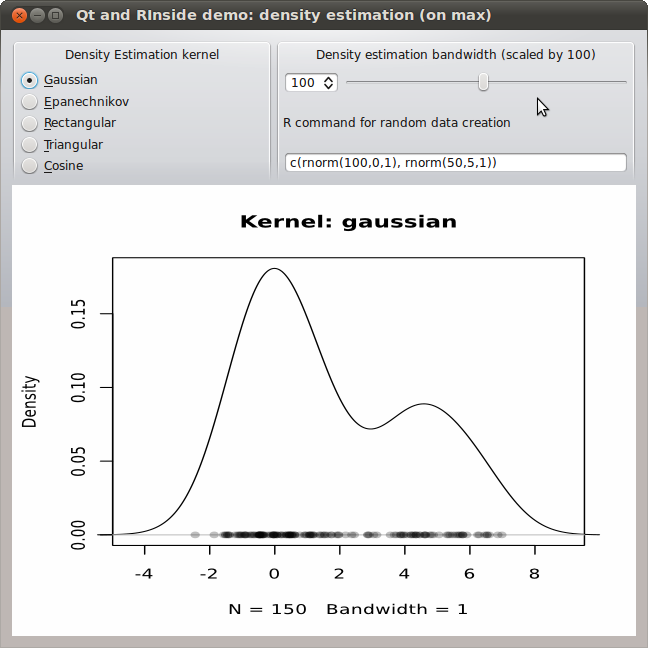
The RInside package makes it pretty simple and straightforward to embed R, the wonderful statistical programming environment and language, inside of a C++ application. This uses both the robust embedding API provided by R itself, and the higher-level abstractions from our Rcpp package. A number of examples are shown on this blog both here and here as well as on the RInside page; and the source package actually contains well over a dozen complete examples which cover anything from simple examples to parallel use via MPI for parallel computing. Beginning users sometimes ask about how to use RInside inside larger projects. And as I had meant to experiment with embedding inside of the powerful Qt framework anyway, I started to dabble a little. A first result is now in the SVN sources of RInside. My starting point was the classic tkdensity demo that comes with R itself. It is a good point of departure as Tcl/Tk makes it very portable---in fact it should run on every platform that runs R---and quite expressive. And having followed some of the GUI experiments around R over the years, I have also seen various re-implementations using different GUI frameworks. And so I am adding mine to this body of work: Example of embedding R via RInside into a Qt C++ application: density estimation for a mixture The problem I addressed first was actual buildability. For the RInside examples, Romain and I provide a Makefile that just works by making calls to R itself to learn about flags for R, Rcpp and RInside such that all required headers and libraries are found. That is actually relatively straightforward (and documented in our vignettes) but a little intimidating at first---which is why a ready-made Makefile is a good thing. Qt of course uses qmake and the .pro files to encode / resolve dependencies. So task one was to map what our Makefile does into its variables. Turns out that wasn't all that hard:
## -*- mode: Makefile; c-indent-level: 4; c-basic-offset: 4;  tab-width: 8; -*-
##
## Qt usage example for RInside, inspired by the standard 'density
## sliders' example for other GUI toolkits
##
## Copyright (C) 2011  Dirk Eddelbuettel and Romain Francois
TEMPLATE =              app
HEADERS =               qtdensity.h 
SOURCES =               qtdensity.cpp main.cpp
QT +=                   svg
## comment this out if you need a different version of R, 
## and set set R_HOME accordingly as an environment variable
R_HOME =                $$system(R RHOME)
## include headers and libraries for R 
RCPPFLAGS =             $$system($$R_HOME/bin/R CMD config --cppflags)
RLDFLAGS =              $$system($$R_HOME/bin/R CMD config --ldflags)
RBLAS =                 $$system($$R_HOME/bin/R CMD config BLAS_LIBS)
RLAPACK =               $$system($$R_HOME/bin/R CMD config LAPACK_LIBS)
## if you need to set an rpath to R itself, also uncomment
#RRPATH =               -Wl,-rpath,$$R_HOME/lib
## include headers and libraries for Rcpp interface classes
RCPPINCL =              $$system($$R_HOME/bin/Rscript -e \'Rcpp:::CxxFlags\(\)\')
RCPPLIBS =              $$system($$R_HOME/bin/Rscript -e \'Rcpp:::LdFlags\(\)\')
## for some reason when building with Qt we get this each time
## so we turn unused parameter warnings off
RCPPWARNING =           -Wno-unused-parameter 
## include headers and libraries for RInside embedding classes
RINSIDEINCL =           $$system($$R_HOME/bin/Rscript -e \'RInside:::CxxFlags\(\)\')
RINSIDELIBS =           $$system($$R_HOME/bin/Rscript -e \'RInside:::LdFlags\(\)\')
## compiler etc settings used in default make rules
QMAKE_CXXFLAGS +=       $$RCPPWARNING $$RCPPFLAGS $$RCPPINCL $$RINSIDEINCL
QMAKE_LFLAGS +=         $$RLDFLAGS $$RBLAS $$RLAPACK $$RCPPLIBS $$RINSIDELIBS
## addition clean targets
QMAKE_CLEAN +=          qtdensity Makefile
The double dollar signs and escaping of parentheses are a little tedious, but hey it works and expands the compiler and linker flags such that everything <emjust works="Works">. The code itself is pretty straightforward too. We instantiate the RInside object as well as the main Qt application object. We then instantiate a new object of class QtDensity that will launch the main widget; it is given a reference to the RInside object.
// -*- mode: C++; c-indent-level: 4; c-basic-offset: 4;  tab-width: 8; -*-
//
// Qt usage example for RInside, inspired by the standard 'density
// sliders' example for other GUI toolkits
//
// Copyright (C) 2011  Dirk Eddelbuettel and Romain Francois
#include <QApplication>
#include "qtdensity.h"
int main(int argc, char *argv[])
 
    RInside R(argc, argv);  		// create an embedded R instance
    QApplication app(argc, argv);
    QtDensity qtdensity(R);
    return app.exec();
 
The definition of the main object is pretty simple: a few private variables, and a few functions to interact with the GUI and get values from the radio buttons, slider or input field---as well as functions to update the chart or re-draw the random variables.
// -*- mode: C++; c-indent-level: 4; c-basic-offset: 4;  tab-width: 8; -*-
//
// Qt usage example for RInside, inspired by the standard 'density
// sliders' example for other GUI toolkits
//
// Copyright (C) 2011  Dirk Eddelbuettel and Romain Francois
#ifndef QTDENSITY_H
#define QTDENSITY_H
#include <RInside.h>
#include <QMainWindow>
#include <QHBoxLayout>
#include <QSlider>
#include <QSpinBox>
#include <QLabel>
#include <QTemporaryFile>
#include <QSvgWidget>
class QtDensity : public QMainWindow
 
    Q_OBJECT
public:
    QtDensity(RInside & R);
private slots:
    void getBandwidth(int bw);
    void getKernel(int kernel);
    void getRandomDataCmd(QString txt);
    void runRandomDataCmd(void);
private:
    void setupDisplay(void);    // standard GUI boilderplate of arranging things
    void plot(void);            // run a density plot in R and update the
    void filterFile(void);      // modify the richer SVG produced by R
    QSvgWidget *m_svg;          // the SVG device
    RInside & m_R;              // reference to the R instance passed to constructor
    QString m_tempfile;         // name of file used by R for plots
    QString m_svgfile;          // another temp file, this time from Qt
    int m_bw, m_kernel;         // parameters used to estimate the density
    QString m_cmd;              // random draw command string
 ;
#endif
Lastly, no big magic in the code either (apart from the standard magic provided by RInside). A bit of standard GUI layouting, and then some functions to pick values from the inputs as well as to compute / update the output. One issue is worth mentioning. The screenshot and code show the second version of this little application. I built a first one using a standard portable network graphics (png) file. That was fine, but not crisp as png is a pixel format so I went back and experimented with scalable vector graphics (svg) instead. One can create svg output with R in a number of ways, one of which is the cairoDevice package by Michael Lawrence (who also wrote RGtk2 and good chunks of Ggobi). Now, it turns out that Qt displays the so-called SVG tiny standard whereas R creates a fuller SVG format. Some discussion with Michael reveals that one can modify the svg file suitably (which is what the function filterFile below does) and it all works. Well: almost. There is a bug (and Michael thinks it is the SVG rendering) in which the density estimate does not get clipped to the plotting region.
// -*- mode: C++; c-indent-level: 4; c-basic-offset: 4;  tab-width: 8; -*-
//
// Qt usage example for RInside, inspired by the standard 'density
// sliders' example for other GUI toolkits -- this time with SVG
//
// Copyright (C) 2011  Dirk Eddelbuettel and Romain Francois
#include <QtGui>
#include "qtdensity.h"
QtDensity::QtDensity(RInside & R) : m_R(R)
 
    m_bw = 100;                 // initial bandwidth, will be scaled by 100 so 1.0
    m_kernel = 0;               // initial kernel: gaussian
    m_cmd = "c(rnorm(100,0,1), rnorm(50,5,1))"; // simple mixture
    m_R["bw"] = m_bw;           // pass bandwidth to R, and have R compute a temp.file name
    m_tempfile = QString::fromStdString(Rcpp::as<std::string>(m_R.parseEval("tfile <- tempfile()")));
    m_svgfile = QString::fromStdString(Rcpp::as<std::string>(m_R.parseEval("sfile <- tempfile()")));
    m_R.parseEvalQ("library(cairoDevice)");
    setupDisplay();
 
void QtDensity::setupDisplay(void)   
    QWidget *window = new QWidget;
    window->setWindowTitle("Qt and RInside demo: density estimation");
    QSpinBox *spinBox = new QSpinBox;
    QSlider *slider = new QSlider(Qt::Horizontal);
    spinBox->setRange(5, 200);
    slider->setRange(5, 200);
    QObject::connect(spinBox, SIGNAL(valueChanged(int)), slider, SLOT(setValue(int)));
    QObject::connect(slider, SIGNAL(valueChanged(int)), spinBox, SLOT(setValue(int)));
    spinBox->setValue(m_bw);
    QObject::connect(spinBox, SIGNAL(valueChanged(int)), this, SLOT(getBandwidth(int)));
    QLabel *cmdLabel = new QLabel("R command for random data creation");
    QLineEdit *cmdEntry = new QLineEdit(m_cmd);
    QObject::connect(cmdEntry,  SIGNAL(textEdited(QString)), this, SLOT(getRandomDataCmd(QString)));
    QObject::connect(cmdEntry,  SIGNAL(editingFinished()), this, SLOT(runRandomDataCmd()));
    QGroupBox *kernelRadioBox = new QGroupBox("Density Estimation kernel");
    QRadioButton *radio1 = new QRadioButton("&Gaussian");
    QRadioButton *radio2 = new QRadioButton("&Epanechnikov");
    QRadioButton *radio3 = new QRadioButton("&Rectangular");
    QRadioButton *radio4 = new QRadioButton("&Triangular");
    QRadioButton *radio5 = new QRadioButton("&Cosine");
    radio1->setChecked(true);
    QVBoxLayout *vbox = new QVBoxLayout;
    vbox->addWidget(radio1);
    vbox->addWidget(radio2);
    vbox->addWidget(radio3);
    vbox->addWidget(radio4);
    vbox->addWidget(radio5);
    kernelRadioBox->setMinimumSize(260,140);
    kernelRadioBox->setMaximumSize(260,140);
    kernelRadioBox->setSizePolicy(QSizePolicy::Fixed, QSizePolicy::Fixed);
    kernelRadioBox->setLayout(vbox);
    QButtonGroup *kernelGroup = new QButtonGroup;
    kernelGroup->addButton(radio1, 0);
    kernelGroup->addButton(radio2, 1);
    kernelGroup->addButton(radio3, 2);
    kernelGroup->addButton(radio4, 3);
    kernelGroup->addButton(radio5, 4);
    QObject::connect(kernelGroup, SIGNAL(buttonClicked(int)), this, SLOT(getKernel(int)));
    m_svg = new QSvgWidget();
    runRandomDataCmd();         // also calls plot()
    QGroupBox *estimationBox = new QGroupBox("Density estimation bandwidth (scaled by 100)");
    QHBoxLayout *spinners = new QHBoxLayout;
    spinners->addWidget(spinBox);
    spinners->addWidget(slider);
    QVBoxLayout *topright = new QVBoxLayout;
    topright->addLayout(spinners);
    topright->addWidget(cmdLabel);
    topright->addWidget(cmdEntry);
    estimationBox->setMinimumSize(360,140);
    estimationBox->setMaximumSize(360,140);
    estimationBox->setSizePolicy(QSizePolicy::Fixed, QSizePolicy::Fixed);
    estimationBox->setLayout(topright);
    QHBoxLayout *upperlayout = new QHBoxLayout;
    upperlayout->addWidget(kernelRadioBox);
    upperlayout->addWidget(estimationBox);
    QHBoxLayout *svglayout = new QHBoxLayout;
    svglayout->addWidget(m_svg);
    QVBoxLayout *outer = new QVBoxLayout;
    outer->addLayout(upperlayout);
    outer->addLayout(svglayout);
    window->setLayout(outer);
    window->show();
 
void QtDensity::plot(void)  
    const char *kernelstrings[] =   "gaussian", "epanechnikov", "rectangular", "triangular", "cosine"  ;
    m_R["bw"] = m_bw;
    m_R["kernel"] = kernelstrings[m_kernel]; // that passes the string to R
    std::string cmd1 = "Cairo(width=6,height=6,pointsize=10,surface='svg',filename=tfile); "
                       "plot(density(y, bw=bw/100, kernel=kernel), xlim=range(y)+c(-2,2), main=\"Kernel: ";
    std::string cmd2 = "\"); points(y, rep(0, length(y)), pch=16, col=rgb(0,0,0,1/4));  dev.off()";
    std::string cmd = cmd1 + kernelstrings[m_kernel] + cmd2; // stick the selected kernel in the middle
    m_R.parseEvalQ(cmd);
    filterFile();               // we need to simplify the svg file for display by Qt 
    m_svg->load(m_svgfile);
 
void QtDensity::getBandwidth(int bw)  
    if (bw != m_bw)  
        m_bw = bw;
        plot();
     
 
void QtDensity::getKernel(int kernel)  
    if (kernel != m_kernel)  
        m_kernel = kernel;
        plot();
     
 
void QtDensity::getRandomDataCmd(QString txt)  
    m_cmd = txt;
 
void QtDensity::runRandomDataCmd(void)  
    std::string cmd = "y <- " + m_cmd.toStdString();
    m_R.parseEvalQ(cmd);
    plot();                     // after each random draw, update plot with estimate
 
void QtDensity::filterFile()  
    // cairoDevice creates richer SVG than Qt can display
    // but per Michaele Lawrence, a simple trick is to s/symbol/g/ which we do here
    QFile infile(m_tempfile);
    infile.open(QFile::ReadOnly);
    QFile outfile(m_svgfile);
    outfile.open(QFile::WriteOnly   QFile::Truncate);
    
    QTextStream in(&infile);
    QTextStream out(&outfile);
    QRegExp rx1("<symbol"); 
    QRegExp rx2("</symbol");    
    while (!in.atEnd())  
        QString line = in.readLine();
        line.replace(rx1, "<g"); // so '<symbol' becomes '<g ...'
        line.replace(rx2, "</g");// and '</symbol becomes '</g'
        out << line << "\n";
     
    infile.close();
    outfile.close();
 
What the little application does is actually somewhat neat for the few lines. One key features is that the generated data can be specified directly by an R expression which allows for mixtures (as shown, and as is the default). With that it easy to see how many points are needed in the second hump to make the estimate multi-modal, and how much of a distance between both centers is needed and so on. Obviously, the effect of the chosen kernel and bandwidth can also be visualized. And with the chart the being a support vector graphics display, we can resize and scale at will and it still looks crisp. The code (for both the simpler png variant and the svg version shown here) is in the SVN repository for RInside and will be in the next release. Special thanks to Michael Lawrence for patiently working through some svg woes with me over a few emails.

Update: Some typos fixed.

Update 2: Two URLs corrected.

18 March 2011

Russell Coker: Some Postfix Scripts for dealing with Outbound Spamming

I ve just written some small scripts to help me manage spam emergencies on a mail server. I ve been doing this thing with a bit of manual effort for a while, but after having done it once from a phone I want to optimise it a bit to reduce painful typing.My observation is that when a system I run is used as an outbound mail relay for spamming I will notice this reasonably quickly by the queues getting big. Some portion of mail that is queued is delayed due to general network issues and anti-spam measures that neither accept nor reject mail cause a typical spam message to be more likely to be queued than a typical non-spam message. So I look for accounts that send large amounts of mail.The biggest mail server I run (and the only one to have an outbound spam problem) is configured to not allow users to fake their sender address (IE use an address from gmail.com or another server) unless they pay extra. So the spam I deal with tends to have a valid origin email address that I can use.Queue CountingThe following command provides a sorted list of the accounts that have the most mail in the queue. This usually means a maximum of 2 or 3 spammers at the end of the list:mailq grep ^[A-F0-9] cut -c 42-80 sort uniq -c sort -n tailThe following function declaration makes the command get-top-sender find the sender with the largest number of queue entries (which has been a spammer every time I ve checked such things) and assign their email address to the environment variable $TOP_SENDER. It has to be a shell function so that the environment variable will be set in the context of the shell and available to child processes.function get-top-sender() TOP_SENDER_LINE=$(mailq grep ^[A-F0-9] cut -c 42-80 sort uniq -c sort -n tail -1) ; export TOP_SENDER=$(echo $TOP_SENDER_LINE cut -f2 -d\ ) ; TOP_COUNT=$(echo $TOP_SENDER_LINE cut -f1 -d\ ); echo "Top Sender is $TOP_SENDER with $TOP_COUNT messages" ; Viewing the QueueThe following script uses the first parameter or the environment variable $TOP_SENDER to specify the user who s mail should be read. In the normal course of events user email won t be read by the sysadmin, but if we are to determine whether a slew of email is spam or not there s no other way. So far I haven t seen a large number of queued messages not be spam, but I expect it ll happen eventually and the user will be happy that I checked it instead of locking their account and deleting all the queued mail. For readers who don t do sysadmin work, this is why we always have entries in the Terms of Service about the possibility of your email being read to fix technical problems or to investigate possible breaches of the ToS from your end.#!/bin/bash
set -e
mkdir -p ~/tmp/$$
cd ~/tmp/$$
if [ "$1" != "" ]; then
TOP_SENDER="$1"
fi
if [ "$TOP_SENDER" = "" ]; then
echo "Specify the sender on the command-line or in \$TOP_SENDER"
exit 1
fi
for n in $(mailq grep ^[A-F0-9].*$TOP_SENDER cut -c 1-10) ; do
FILE=$(echo $n sed -e "s/^\(.\)/\/var\/spool\/postfix\/deferred\/\1\/\1/" -e "s/ .*$//")
if [ -f "$FILE" ]; then
postcat "$FILE" > $n
else
echo "File $FILE missing, probably active"
fi
done
less *
rm -rf ~/tmp/$$Note that this needs to be done with a single less command so that I can terminate it by pressing q and easily go to the next file with :n . It does waste some server resources by running postcat on all queue files relating to the user in question, but that doesn t matter, servers are supposed to be powerful enough to cope with some inefficiency in processing uncommon operations.The Final CommandAfter that I have a script that connects by ssh to all outbound mail relays and deletes bad messages from the queues and then connects to the database server to lock the account that was used for sending the mail. I m not publishing it because it s specific to the servers I run.So when NAGIOS reports that the queue is too large I have one script to find the most likely culprit, one script to view the queued email from that account, and a final script to lock the account and purge the spam.I ve also added a reminder of the command names to /etc/motd as I don t want to be running ls and set on a phone to discover command names that I ve forgotten.Any suggestions for improvements to this will be welcome.

14 March 2011

Erich Schubert: GNOME3 in Debian experimental - python and dconf

As GNOME3 slowly enters Debian experimental, things become a bit ... experimental.
The file manager can be set to still draw icons on the desktop, but that doesn't entirely work yet (it will also open folders as desktop then...)
One machine had lost the keyboard settings. I could not set the fonts I wanted...
There is a tool called dconf-editor that will allow you to manually tweak some settings such as the fonts. But it doesn't seem to have support for value lists yet - and the keyboard mappings setting is a string list.
So here's sample python code to modify such a value:
from gi.repository import Gio
s = Gio.Settings.new("org.gnome.libgnomekbd.keyboard")
s.set_strv("layouts", ["de"])
Update: you could also install the optional libglib2.0-bin and use the gsettings command.

6 March 2011

Yves-Alexis Perez: Update on Xfce 4.8

Since the last post, few things did happen. Basically, it's still not the right time for Debian users to upgrade to Xfce 4.8. We eventually managed to upload the whole desktop part (except the xfce metapackage) to experimental and we did upload some of the goodies too. Licensing issues have been solved so the concerned packages have been uploaded, and we're right now waiting on the three packages sitting in NEW. So you'll need to be a little more patient and kindly wait for our ftp-masters to process the (quite huge) NEW backlog. After that we'll need a bit more time in experimental to test upgrade cases, then we'll do an upload to unstable of the whole desktop part and the whole goodies. Upgrading to xfce4-panel 4.8 means *all* plugins need to be rebuilt too, so that means a huge upgrade and a quite large transition to handle for the release team, so we'll have to schedule the unstable upload with them in order not to break all their plans (yes, we try to be good Debian citizens) So please be patient, but you'll see Xfce 4.8 in unstable in a not too distant future. I'll put an update here when we'll need brave volunteers willing to break their systems by doing upgrade tests. [UPDATE]: garcon, thunar-vfs and tumbler were just accepted into experimental, thanks to our ftp-masters. Now we'll synchronize with release team and upload to unstable when possible.

3 March 2011

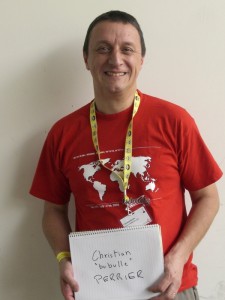
Rapha&#235;l Hertzog: People behind Debian: Christian Perrier, translation coordinator

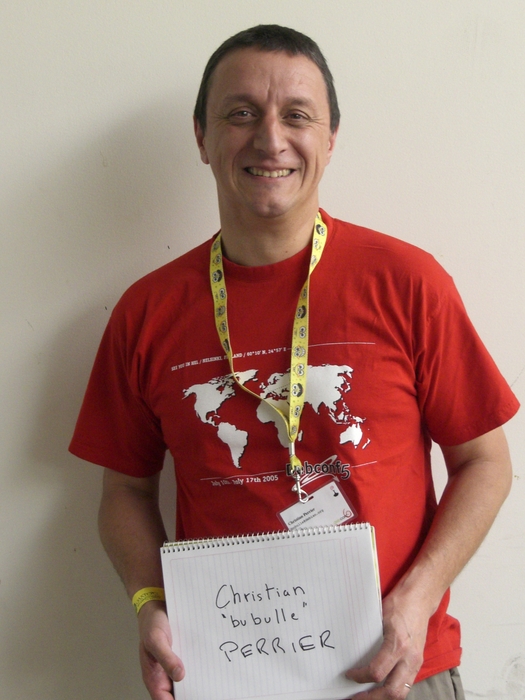
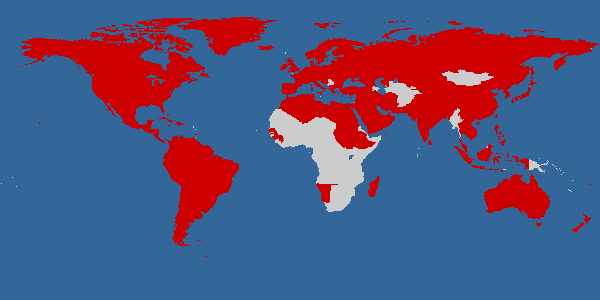
Christian is a figure of Debian, not only because of the tremendous coordination work that he does within the translation project, but also because he s very involved at the social level. He s probably in the top 5 of the persons who attended most often the Debian conference. Christian is a friend (thanks for hosting me so many times when I come to Paris for Debian related events) and I m glad that he accepted to be interviewed. He likes to speak and that shows in the length of his answers :-) but you ll be traveling the world while reading him. My questions are in bold, the rest is by Christian. Who are you? I am a French citizen (which is easy to guess unless you correct my usual mistakes in what follows). I m immensely proud of being married for nearly 26 years with Elizabeth (who deserves a statue from Debian for being so patient with my passion and my dedication to the project). I m also the proud father of 3 wonderful kids , aged 19 to 23. I work as team manager in the Networks and Computers Division of Onera the French Aerospace lab , a public research institute about Aeronautics, Space and Defense. My team provides computer management services for research divisions of Onera, with a specific focus put on individual computing. I entered the world of free software as one of the very first users of Linux in France. Back in the early 1990 s, I happened (though the BBS users communities) to be a friend of several early adopters of Linux and/or BSD386/FreeBSD/NetBSD in France. More specifically, I discovered Linux thanks with my friend Ren Cougnenc (all my free software talks are dedicated to Ren , who passed away in 1996). You re not a programmer, not even a packager. How did you come to Debian? I m definitely not a programmer and I never studied computing (I graduated in Materials Science and worked in that area for a few years after my PhD). However, my daily work always involved computing (I redesigned the creep testing laboratory and its acquisition system all by myself during my thesis research work). An my hobbies often involved playing with home computers, always trying to learn about something new. So, first learning about a new operating system then trying to figure out how to become involved in its development was quite a logical choice. Debian is my distro of choice since it exists. I used Slackware on work machines for a while, but my home server, kheops, first ran Debian 1.1 when I stopped running a BBS on an MS-DOS machine to host a news server. That was back in October 1996. I then happened to be a user, and more specifically a user of genealogy software, also participating very actively in Usenet from this home computer and server, that was running this Debian thing. So, progressively, I joined mailing lists and, being a passionate person, I tried to figure out how I could bring my own little contribution to all this. This is why I became a packager (yes, I am one!) by taking over the geneweb package, which I was using to publish my genealogy research. I applied as DD in January 2001, then got my account in July 2001. My first upload to the Debian archive occurred on August 22nd 2001: that was of course geneweb, which I still maintain. Quite quickly, I became involved in the work on French localization. I have always been a strong supporter of localized software (I even translated a few BBS software back in the early 90 s) as one of the way to bring the power and richness of free software to more users. Localization work lead me to work on the early version of Debian Installer, during those 2003-2005 years where the development of D-I was an incredibly motivating and challenging task, lead by Joey Hess and his inspiring ideas. From user to contributor to leader, I suddenly discovered, around 2004, that I became the coordinator of D-I i18n (internationalization) without even noticing :-) You re the main translation coordinator in Debian. What plans and goals have you set for Debian Wheezy? As always: paint the world in red. Indeed, this is my goal for years. I would like our favorite distro to be able to be used by anyone in the world, whether she speaks English, Northern Sami, Wolof, Uyghur or Secwepemcts n. As a matter of symbol, I use the installer for this. My stance is that one should be able to even install Debian in one s own language. So, for about 7 years, I use D-I as a way to attract new localization contributors. This progress is represented on this page where the world is gradually painted in red as long as the installer supports more languages release after release. The map above tries to illustrate this by painting in red countries when the most spoken language in the country is supported in Debian Installer. However, that map does not give enough reward to many great efforts made to support very different kind of languages. Not only various national languages, but also very different ones: all regional languages of Spain, many of the most spoken languages in India, minority languages such as Uyghur for which an effort is starting, Northern Sami because it is taught in a few schools in Norway, etc., etc. Still, the map gives a good idea of what I would like to see better supported: languages from Africa, several languages in Central Asia. And, as a very very personal goal, I m eagerly waiting for support of Tibetan in Debian Installer, the same way we support its sister language, Dzongkha from Bhutan. For this to happen, we have to make contribution to localization as easy as possible. The very distributed nature of Debian development makes this a challenge, as material to translate (D-I components, debconf screens, native packages, packages descriptions, website, documentation) is very widely spread. A goal, for years, is to set a centralized place where translators could work easily without even knowing about SVN/GIT/BZR or having to report bugs to send their work. The point, however, would be to have this without making compromises on translation quality. So, with peer review, use of thesaurus and translation memory and all such techniques. Tools for this exist: we, for instance, worked with the developers of Pootle to help making it able to cope with the huge amount of material in Debian (think about packages descriptions translations). However, as of now, the glue between such tools and the raw material (that often lies in packages) didn t come. So, currently, translation work in Debian requires a great knowledge of how things are organized, where is the material, how it can be possible to make contribution reach packages, etc. And, as I m technically unable to fulfill the goal of building the infrastructure, I m fulfilling that role of spreading out the knowledge. This is how I can define my coordinator role. Ubuntu uses a web-based tool to make it easy to contribute translations directly in Launchpad. At some point you asked Canonical to make it free software. Launchpad has been freed in the mean time. Have you (re)considered using it? Why not? After all, it more or less fills in the needs I just described. I still don t really figure out how we could have all Debian material gathered in Rosetta/Launchpad .and also how Debian packagers could easily get localized material back from the framework without changing their development processes. I have always tried to stay neutral wrt Ubuntu. As many people now in Debian, I feel like we have reached a good way to achieve our mutual development. When it comes at localization work, the early days where the everything in Rosetta and translates who wants stanza did a lot of harm to several upstream localization projects is, I think, way over. Many people who currently contribute to D-I localization were indeed sent to me by Ubuntu contributors .and by localizing D-I, apt, debconf, package descriptions, etc., they re doing translation work for Ubuntu as well as for Debian. Let s say I m a Debian user and I want to help translate Debian in my language. I can spend 1 hour per week on this activity. What should I do to start? Several language teams use Debian mailing lists to coordinate their work. If you re lucky enough to be a speaker of one of these languages, try joining debian-l10n-<yourlanguage> and follow what s happening there. Don t try to immediately jump in some translation work. First, participate to peer reviews: comment on others translations. Learn about the team s processes, jargon and habits. Then, progressively, start working on a few translations: you may want to start with translations of debconf templates: they are short, often easy to do. That s perfect if you have few time. If no language team exists for your language, try joining debian-i18n and ask about existing effort for your language. I may be able to point you to individuals working on Debian translations (very often along with other free software translation efforts). If I am not, then you have just been named coordinator for your language :-) I may even ask you if you want to work on translating the Debian Installer. What s the biggest problem of Debian? We have no problems, we only have solutions :-) We are maybe facing a growth problem for a few years. Despite the increased welcoming aspects of our processes (Debian Maintainers), Debian is having hard times in growing. The overall number of active contributors is probably stagnating for quite a while. I m still amazed, however, to see how we can cope with that and still be able to release over the years. So, after all, this is maybe not a problem :-) Many people would point communication problems here. I don t. I think that communication inside the Debian project is working fairly well now. Our famous flame wars do of course still happen from time to time, but what large free software project doesn t have flame wars? In many areas, we indeed improved communication very significantly. I want to take as an example the way the release of squeeze has been managed. I think that the release team did, even more this time, a very significant and visible effort to communicate with the entire project. And the release of squeeze has been a great success in that matter. So, there s nearly nothing that frustrates me in Debian. Even when a random developer breaks my beloved 100% completeness of French translations, I m not frustrated for more than 2 minutes. You re known in the Debian community as the organizer of the Cheese & Wine Party during DebConf. Can you tell us what this is about? This is an interesting story about how things build themselves in Debian. It all started in July 2005, before DebConf 5 in Helsinki. Denis Barbier, Nicolas Fran ois and myself agreed to bring at Debconf a few pieces of French cheese as well as 1 or 2 bottles of French wine and share them with some friends. Thus, we settled an informal meeting in the French room where we invited some fellows: from memory, Benjamin Mako Hill, Hannah Wallach, Matt Zimmermann and Moray Allan. All of us fond of smelly cheese, great wine plus some extra p t home-made by Denis in Toulouse. It finally happened that, by word of mouth, a few dozens of other people slowly joined in that French room and turned the whole thing into an improvized party that more or less lasted for the entire night. The tradition was later firmly settled in 2006, first in Debconf 6 in Mexico where I challenged the French DDs to bring as many great cheese as possible, then during the Debian i18n meeting in Extremadura (Sept 2006) where we reached the highest amount of cheese per participant ever. I think that the Creofonte building in Casar de C ceres hasn t fully recovered from it and is still smelling cheese 5 years after. This party later became a real tradition for DebConf, growing over and over each year. I see it as a wonderful way to illustrate the diversity we have in Debian, as well as the mutual enrichment we always felt during DebConfs. My only regret about it is that it became so big over the years that organizing it is always a challenge and I more and more feel pressure to make it successful. However, over the years, I always found incredible help by DebConf participants (including my own son, last year a moment of sharing which we will both remember for years, i think). And, really, in 2010, standing up on a chair, shouting (because the microphone wasn t working) to thank everybody, was the most emotional moment I had at Debconf 10. Is there someone in Debian that you admire for their contributions? So many people. So, just like it happens in many awards ceremonies, I will be very verbose to thank people, sorry in advance for this. The name that comes first is Joey Hess. Joey is someone who has a unique way to perceive what improvements are good for Debian and a very precise and meticulous way to design these improvements. Think about debconf. It is designed for so long now and still reaching its very specific goal. So well designed that it is the entire basis for Joey s other achievement: designing D-I. Moreover, I not only admire Joey for his technical work, but also for his interaction with others. He is not he loudest person around, he doesn t have to .just giving his point in discussion and, guess what? Most of the time, he s right. Someone I would like to name here, also, is Colin Watson. Colin is also someone I worked with for years (the D-I effect, again ) and, here again, the very clever way he works on technical improvements as well as his very friendly way to interact with others just make it. And, how about you, Rapha l? :-) I m really admirative of the way you work on promoting technical work on Debian. Your natural ability to explain things (as good in English as it is in French) and your motivation to share your knowledge are a great benefit for the project. Not to mention the technical achievements you made with Guillem on dpkg of course! Another person I d like to name here is Steve Langasek. We both maintain samba packages for years and collaboration with him has always been a pleasure. Just like Colin, Steve is IMHO a model to follow when it comes at people who work for Canonical while continuing their involvment in Debian. And, indeed, Steve is so patient with my mistakes and stupid questions in samba packaging that he deserves a statue. We re now reaching the end of the year where Stefano Zacchiroli was the Debian Project Leader. And, no offense intended to people who were DPL before him (all of them being people I consider to be friends of mine), I think he did the best term ever. Zack is wonderful in sharing his enthusiasm about Debian and has a unique way to do it. Up to the very end of his term, he has always been working on various aspects of the project and my only hope is that he ll run again (however, I would very well understand that he wants to go back to his hacking activities!). Hat off, Zack!I again have several other people to name in this Bubulle hall of Fame : Don Armstrong, for his constant work on improving Debian BTS, Margarita Manterola as one of the best successes of Debian Women (and the most geeky honeymoon ever), Denis Barbier and Nicolas Fran ois because i18n need really skilled people, Cyril Brulebois and Julien Cristau who kept X.org packaging alive in lenny and squeeze, Otavio Salvador who never gave up on D-I even when we were so few to care about it. I would like to make a special mention for Frans Pop. His loss in 2010 has been a shock for many of us, and particularly me. Frans and I had a similar history in Debian, both mostly working on so-called non technical duties. Frans has been the best release manager for D-I (no offense intended, at all, to Joey or Otavio .I know that both of them share this feeling with me). His very high involvment in his work and the very meticulous way he was doing it lead to great achievements in the installer. The Installation Guide work was also a model and indeed a great example of non technical work that requires as many skills as more classical technical work. So, and even though he was sometimes so picky and, I have to admit, annoying, that explains why I m still feeling sad and, in some way, guilty about Frans loss. One of my goals for wheezy is indeed to complete some things Frans left unachieved. I just found one in bug #564441: I will make this work reach the archive, benefit our users and I know that Frans would have liked that.


Thank you to Christian for the time spent answering my questions. I hope you enjoyed reading his answers as I did. Subscribe to my newsletter to get my monthly summary of the Debian/Ubuntu news and to not miss further interviews. You can also follow along on Identi.ca, Twitter and Facebook.

7 comments Liked this article? Click here. My blog is Flattr-enabled.

26 February 2011

Neil Williams: Why software patents differ from pharmaceutical patents

I was going to make this a comment against Ritesh Raj Sarraf's post about patents and pharmaceuticals but the comment got way too long.

The basic problem is that patents on pharmaceuticals cannot be directly compared to patents on software and the explanation gets a bit involved. It's worse than apples and oranges, it's more like comparing an algorithm to a piece of DNA.

Patented pharmaceuticals must declare the precise chemical formula of the molecule (and a whole lot else besides) before the molecule can be brought to market but the company holding the patent is legally prevented from protecting themselves against slightly different molecules which are blatantly based on the protected molecule. All modification results in a new patentable product, legally separated from the original.

Therefore, the first company to patent a molecule from a new class is instantly joined in the field by other companies who are (obviously) watching the research news channels very carefully. (In their shoes, you would do the same or you go bust.) These companies simply add a flourine ion or change a hydrogen to a hydroxl group or any other number of minor, apparently inconsequential, changes. Changes which, in software, would be deemed a derivative work and would be roughly equivalent to changing a single local variable from a 16bit integer to a 32bit integer in a single function in a single file in the entire codebase. i.e. a trivial bug fix or even a typo.

A molecule with a couple of hundred atoms can have a change affecting one atom and be a completely new patentable item without any risk of the other company being sued for patent infringement, plagiarism, copyright violation (there is no copyright) or any other barrier. It's common to find that molecule foo is joined on the market by a desoxyfoo and a flourofoo etc. with a chlorofoo just around the corner, within months of the class-leader being launched. It can't be compared to software - effectively, every new release gets a new patent which covers the entirety of everything contained in that release, even if 99.999999999% of it is precisely the same as is covered under other several other patents held by extremely litigious competitors.

Modification is simply not prohibited - copying without making any changes whatsoever to the active molecule is prohibited. Changes to the inactive ingredients will be prosecuted - changes to the active ingredient will not. Comparing this with software is likely to drive you insane.

For example, the mere process of packaging an upstream release for a distribution would be patent infringement in pharmaceutical terms - UNLESS you deliberately patch the original source to make an utterly trivial and apparently pointless change. At that point, the upstream completely disown your entire release and you would have to fix every bug yourself - without the original upstream even telling you whether they fixed the same bug themselves, because they aren't ABLE to modify the upstream code without starting a whole new project and they won't tell you why or how they changed things. There is no such thing as an alpha-release of a molecule. Every release is final and no subsequent modification is possible - unless it only affects the inactive ingredients, e.g. by adding a slow release coating. These changes can affect the way that the molecule acts on the test subject / patient but must not change the active ingredient itself in any identifiable way. So the upstream can make a new wrapper (new packaging) but nobody else is allowed to do so until the patent expires. Once the patent expires, every one and their dog is allowed to make identical copies of the active ingredient in their own inactive packaging and these are called generics. Generics still need testing to ensure that the active ingredient truly is the same and that the generic behaves in the same way as the original but this process is cheaper than making a change to the active molecule.

A changed active molecule is an entirely new substance, it gets a new patent and it needs to go through largely the same amount of testing as the patented original but the new company still gets a head start on what the molecule is likely to do and what side-effects (by now noticeable with the class-leader product which is in large scale trials or even on the market) would be harmful to the future usefulness of their new, derivative, molecule. The new company simply jumps onto the bandwagon shouting "I want a piece of that action!" and there is absolutely nothing the original company can do about it, except try to show that their original molecule is better than the new competitors and to try and build a substantial market share before everyone switches to the new derivative. (Prescribers are human and tend therefore to be lazy, so unless there's a reason to change, the class leader will still have substantial share even after several derivatives exist.)

It's an arms race - each company tries to create as many of these potential "me-too" variants as possible in-house, put as many as can be (financially) supported through trials, keep pursuing those which don't have prohibitive side-effects / problems in tests and hope that, at the end, one of their versions will actually turn out to have better effectiveness or fewer side-effects. If not, they just have to market one as "as-effective-and-no-more-harmful-but-CHEAPER-than" the class leader. The majority of "me-too" molecules come under this category - even if the company concerned would try to point to infinitesimal differences in trial data to pretend otherwise. All this with the knowledge that the very hour that the patent expires, a dozen generic manufacturers will flood the market with copies which do not need to recover the massive costs of the original research and are therefore massively cheaper.

How much cheaper? patented molecules may cost 30 for 28 doses on Monday and one generic may cost 3p for 500, another may cost 40p for 10,000 on Tuesday, the day after the patent expiry. Generic houses only need to cover the actual costs of manufacture, not the costs of the original patent etc. and by the time the patent expires, the efforts of the patent holder to generate market share mean that economies of scale become evident. The absolute cheapest isn't necessarily the one who gets the contract either, these things all have expiry dates and all 10,000 have to be sold / supplied from a single location within that date to actually deliver the full savings. So then you get satellite generics who buy in quantities of a few million and pack down into 56 or less so that the total purchased quantity can sit on many shelves instead of just one. It's the same tablet in the end, with the same markings too. All that differs is the marking on the foil and the colour of the cardboard. (Oh and the same foil and colour cardboard can contain tablets with different markings from different manufacturers from one batch to the next, all within the branding of the same repackaging company.)

The original patent-holding company also has an interest in generating their own "me-too" derivatives, sometimes marketed under the name of a company which turns out to be solely owned by the parent of the original company. It can get horribly recursive.
Sometimes, the derivative from the sibling company hits the market before the "true" competitor from a different company - simply because all companies try to have many molecules in development at any one time (because most changed molecules fail in testing) and sometimes they get lucky and come up with two v.similar molecules and have to do something to justify the cost of developing both. That can turn out to be a poisoned chalice rather than two golden geese.

Sometimes, the company fails to get enough variants through testing and the company then gets bought out by a rival - who then gains their research and continues experimenting with other derivative molecules based on the ones already tested and dismissed. The limiting factor is the money.

At this point, I must now declare my cards. I used to be a pharmacist and although I am still entitled to call myself the holder of a Batchelor of Sciences degree in Pharmaceutical Sciences I am most definitely no longer a pharmacist. I therefore defer to my still-registered colleagues in case I've messed up any of the detail here. The above cannot be declared as the opinion of a pharmacist. I am an ex-pharmacist who voluntarily chose to resign his registration to take up full time work as a software developer rather than pay the exorbitant costs of maintaining such registration and all the "proof-of-competency" requirements which such registration requires.

Finally, before you ask, I am very happy to be an ex-pharmacist - my erstwhile colleagues have my ongoing sympathy but no matter how much some of them may beg, they all know that I will not be rejoining them on that side of the dispensary bench if I've got any choice in the matter.

Software is just better. It's all just recycled electrons.

23 February 2011

Russell Coker: Virgin Mobile CRM Upgrade Failure

I ve recently got a new Xperia X10 Android phone for my with with Virgin mobile, it s generally been working OK although I am having some issues [1], I ll write another blog post soon about other problems I ve discovered with the phone and how I ve solved some of the previous ones.I upgraded my wife s phone first because I can t be without Nagios SMS messages if things don t work. So now that things are generally working I want to get myself an Xperia through Virgin (and have my wife s phone get the Nagios SMS in the mean-time). But since last Friday the entire Virgin sales infrastructure has apparently been down. It started with just declining my attempts to purchase a new phone on a separate account, but when I decided to add a second phone to my wife s account the web site told me that they are upgrading their CRM system and it should be fixed on the 22nd of Feb (yesterday). The web site is now saying that I should check back in 2 hours for an update , it s been saying that for a couple of days now.So for most of a week potential Virgin customers have been turned away. It could be that Virgin stores are processing sales on paper, but they offer some significant discounts for web sales the plan I want is a $39 per month plan and I ll get 3 months free for buying on the web. I m not about to visit a store and lose $117! I m sure that many people are losing confidence in Virgin and taking their business elsewhere. I have only just installed the 3G Watchdog free Android app that monitors bandwidth use and automatically turns off 3G when the quota is reached. For the first few days of using the phone which were more data intensive than usual I had no monitoring and no way of using the Virgin web site to discover how much was used. If Virgin bill me extra for data use I ll complain and demand that they alter the bill.This is even worse for pre-paid customers who can t add credit to their account while this happens!Virgin state that they are upgrading the hardware, operating system and database our platform uses to ensure that we can service our Members even better for years to come [2]. I wonder how people get themselves into such a mess. I guess they didn t have a decent test environment to allow testing the upgrade process before doing it on the live data, I can understand a routine small upgrade going wrong and corrupting data in a way that takes some time to resolve. But when everything is upgraded then everything should be tested, and tested before going live! One thing that Virgin could do to regain some credibility is to publish what went wrong and what they learned from it. I would be much more happy to trust my personal data and my business critical phone to a company that learns from it s mistakes and publishes plans on how they do better than one that just does PR.According to Whirlpool they did the same thing on the 25th of January, so they have had two outages of their billing/CRM system in two months! [3]. The Whirlpool thread has discussion about last month s down-time and this month s down-time.On the up-side, Whirlpool user Kevin JD is a Virgin representative who advised customers to send email to telesales@virginmobile.com.au with a contact phone number if they have any issues. It s good to see a company engaging with it s customers.Update: An hour after emailing the URL to this post to Virgin I got a call from a service representative. It wasn t a very productive call as I already knew that their servers are down and they can t do anything. But it s good to know that they are very enthusiastic about making things better. One useful thing that I learned is that my wife s service is probably on a pro-rated bandwidth quota. As she got the phone in the middle of the month we can only do 100M of data transfer not 200M before the end of the month, by my rough calculations I ve downloaded well over 50M of data (maybe as much as 100M) from the Android marketplace. So it might be necessary to negotiate about the bill as soon as their CRM system works.

16 February 2011

Stefano Zacchiroli: in the news - Debian and the FreedomBox

Fellow geeks who have attended FOSDEM this year probably remember Eben Moglen's announcement about the creation of a foundation to support the development of FreedomBox-es. The FreedomBox foundation and its goals have been featured in a New York Times article appeared yesterday, together with a nice Debian mention which points to our wiki. Debian is also prominently present on the (ikiwiki-powered) website of the foundation. Yet another reason why I'm proud of being part of Debian.
(thanks to Faidon for the heads up)

12 February 2011

Evgeni Golov: Privacy-over-IP does not exist

Did not exist.Will never exist.There was quite a lot of buzz about privacy with that new IPv6 thingy. Some say it is bad, as you will have a static address. Some say the privacy extensions will fix everything. I say: lemme rant ;)First of all, that was the internet, when I started using it back in 1999:
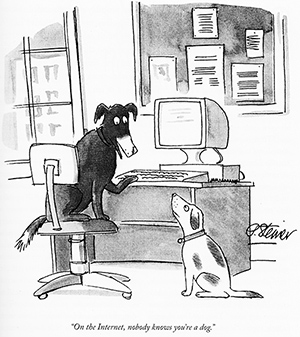

 [  New Yorker Magazine, March 1993] On the Internet nobody knows that you are a dog'
[ New Yorker Magazine, March 1993] On the Internet nobody knows that you are a dog And that s the internet today:

robcottingham.ca - How the hell does Facebook know I'm a dog?
[ robcottingham.ca] How the hell does Facebook know I m a dog?

Well, I d say that s not correct. Even in 1999 facebook could know you are a dog (if you ignore the fact, that there was no facebook in 1999), it s just noone really cared about it. But let s start from the beginning :)An IP-address is a 32-bit integer

An IP-address is technically a 32-bit integer, formatted into 4 8-bit parts (you can read more about IPv4 at Wikipedia), which makes a total of 4,294,967,296 possible IP-addresses. Your ISP has a range in this address-space it can give to its customers (you). My ISP (Unitymedia) owns about 300,000 IP-addresses (based on the RIPE database), which is about 0.007% of the whole address-space. If you look at the RIPE page, you see two common netname prefixes (DE-KNRW and DE-IESY-HFC) which match two regions of Germany where my ISP has its customers (Unitymedia is a merge of ish and iesy). What does that mean? It means one can map a Unitymedia customer into one of these regions, even if he would change his IP-address (Unitymedia uses DHCP with high lease-times, so this does not happen actually). It does not map the customer to a dog yet, but I bet real GeoIP databases can map them correctly to a city (I didn t try much, but this site suggests it works: http://www.ip-adress.com/?lc=en at least they map me correctly to Duesseldorf).Dynamic IP-addresses do not improve privacy

Given the above facts, even if Unitymedia would give me a new IP-address every X hours (many DSL-providers have X=24), it is still possible to map me into a set of about 150,000 users (here user means customer, there still may be multiple computers connected via the same line). I would even go further and say the set is much smaller, as I think I am not able to get every free IP-address from DE-KNRW-*, as these should be bound to cities/regions (GeoIP databases exist, you rememember?) and I do not move with my line.Routers and reverse DNS kill privacy

Currently, my IP-address is 62.143.232.104, which has a reverse DNS entry ip-62-143-232-104.unitymediagroup.de and does not say anything about me or my location, besides of the obvious Unitymedia customer . But look at the traceroute:

4  7111A-MX960-01-ae5.frankfurt.unity-media.net (80.81.192.181)
5  13NOC-MX960-01-ae8.kerpen.unity-media.net (80.69.107.26)
6  1411G-MX960-01-ae9.neuss.unity-media.net (80.69.107.2)
7  1411J-MX960-01-ae1.bilk.unity-media.net (80.69.107.70)
8  PH-1411J-uBR10k-06-Te-1-2-0.bilk.unity-media.net (80.69.102.106)
Frankfurt is about 250km from here, Kerpen about 60, Neuss about 10 and Bilk is a part of the city I live in, about 4km away from my home. I guess you get the idea :)Browsers kill privacy tooDo I have to say more than a link to https://panopticlick.eff.org/? My Chromium scores one in 1,400,000. How much IP-addresses did I have to hide in again?We are at the dog level now, dogs use BoneOS with FireBark, not Linux with Chromium :)IPv6 kills cute kittensOh, and privacy, because with IPv6, there are 2^128 IPv6-addresses out there, of which your provider will maybe own a /32 (2^96 addresses) and give you a /48 (2^80 addresses) or (more likely) /64 (2^64 addresses). Then you enable the great IPv6 privacy extensions (RFC4941) and happily hide in your own assigned subnet, still being a customer of your ISP, still living in the same city and using your old browser It s just about mapping subnets instead of individual IP-addresses then. And we can t get lower as the dog levelPeople can annoy meI did not write all this to teach you, you can do yourself with Wikipedia and RFCs. There is a person out there, who thinks using a random name, mail address and twitter account could fool me into thinking that s a new, yet unknown, person to me. Well, I am not stupid, sorry. When you comment on my blog, your IP-address is logged, when I approve the comment, I often look at the reverse DNS and the whois entry of that IP-address (sorry, I AM paranoid). I even might check my webserver logs (or Piwik) where did you come from (Google etc), writing accidentally in your comment does not help :) Also, if you are trying to fool me, don t use your own computer, running Windows 7 and Firefox which I installed. Oh, and probably do not use your home line which I used to login into my admin-area using my unique Chromium ;)Sorry Hanna Lena, the chicken has just eaten her own eggs And yes, one can track down a single person on this big thing called internet, IPv6 will not change this (in any direction).

7 February 2011

Matt Zimmerman: A diversity statement for Ubuntu

The Ubuntu website states that we aim to make Ubuntu a wonderful place to participate . We developed the Ubuntu Code of Conduct to set a standard for participants to accept each other in the spirit of cooperation, and have improved it over time to state these principles more clearly. It is implicit in our philosophy that these and other Ubuntu values should hold equally true for everyone. I would like to propose that we upgrade this to an explicit statement on behalf of the project. I have spoken with many people who were interested in joining a free software project, but were put off because they felt unwelcome. I know various people who participate in Ubuntu today, but sometimes face difficult social obstacles in order to do so. Going forward, I would like for us, as members of the Ubuntu community, to make the extra effort to accept all kinds of people. This may sound simple, but it can be very difficult to put into practice. People often don t even notice they ve gotten it wrong, until the offended party points it out to them. We need tools and guidance to make this a reality. To that end, I would like to propose a diversity statement for Ubuntu. This draft has already received support from a majority of the Community Council, but I d like to take it a step further. Because I want this to be a commitment that we can all stand behind, I m also calling for support from the community as a whole. Please give this issue your consideration, and let me know in the comments if you can get on board with an official statement like this. The more support we have, the more real this commitment can be. Here s the text. Many thanks to Mary Gardiner, Valerie Aurora and Benjamin Mako Hill for their review and input.
The Ubuntu project welcomes and encourages participation by everyone. We are committed to being a community that everyone feels good about joining. Although we may not be able to satisfy everyone, we will always work to treat everyone well. Standards for behavior in the Ubuntu community are detailed in the Code of Conduct and Leadership Code of Conduct. We expect participants in our community to meet these standards in all their interactions and to help others to do so as well. Whenever any participant has made a mistake, we expect them to take responsibility for it. If someone has been harmed or offended, it is our responsibility to listen carefully and respectfully, and do our best to right the wrong. Although this list cannot be exhaustive, we explicitly honor diversity in age, culture, ethnicity, genotype, gender identity or expression, language, national origin, neurotype, phenotype, political beliefs, profession, race, religion, sexual orientation, socio-economic status, subculture, and technical ability. Some of the ideas and wording for this statement were based on diversity statements from the Python community and Dreamwidth Studios (CC-BY-SA 3.0).

6 February 2011

Kees Cook: fun with game memory

So, I was testing a (closed source) single-player offline game recently and thought this exercise might be fun to document. I didn t want to spend any time actually earning in-game money since I d played it before and I wanted to just skip ahead to other aspects of the game. I was curious how straight-forward adjusting my cash might be. So, noting the in-game bank account number of 219393 and account balance of 3000, I dived right in. First up, what s the memory layout of the heap look like? I looked at the brk and the mmap regions without a mapped library or file, marked with w in the permissions column, from /proc/PID/maps:
0827e000-08282000 rw-p 00000000 00:00 0
0a22e000-0b08a000 rw-p 00000000 00:00 0 [heap]
efa59000-efd00000 rw-p 00000000 00:00 0
efd00000-efd21000 rw-p 00000000 00:00 0
Knowing these, I could use gdb s find command, after attaching to the process:
$ gdb /some/cool/game

(gdb) attach PID

(gdb) find /w 0 0827e000, 0 08282000, 219393
(gdb) find /w 0 0a22e000, 0 0b08a000, 219393
0xaf03d08
0xaf06ca8
No hits in the first region, but I see two hits for the account number value in the second region. Let s start there and see what s near them
(gdb) x/8x 0xaf03d08
0xaf03d08: 0 00035901 0 00000000 0 00000000 0 0af06ce0
0xaf03d18: 0 0af06be0 0 00000059 0 0af03d98 0 0af041e8
(gdb) x/8x 0xaf06ca8
0xaf06ca8: 0 00035901 0 00000bb8 0 00000bb8 0 0820b148
0xaf06cb8: 0 00000001 0 00000000 0 00000000 0 00000000
In that second hit, I see the value 0xBB8, which is 3000, and matches our account balance. Let s see what happens if we just change both of those to add a bit a few orders of magnitude above the current value
(gdb) set var *0xaf06cac = 0 00100bb8
(gdb) set var *0xaf06cb0 = 0 00100bb8
(gdb) x/32x 0xaf06cac
0xaf06cac: 0 00100bb8 0 00100bb8 0 0820b148 0 00000001
(gdb) continue
And presto, clicking on the bank account details in-game shows a huge account balance of 1051576 now. No need to reverse-engineer any saved games, whew.

2 February 2011

Enrico Zini: Gzip streaming in Python (or lack thereof)

Gzip streaming in Python (or lack thereof) Consider this simple Python snippet:
#!/usr/bin/python
import gzip
from urllib import urlopen
zfd = urlopen("http://ftp.debian.org/debian/dists/sid/Contents-udeb.gz")
fd = gzip.GzipFile(fileobj=zfd, mode="r")
for line in fd:
    foobar(line)
It does not work: it turns out GzipFile wants to seek() and tell() on its file object:
$ /tmp/z.py 
Traceback (most recent call last):
  File "/tmp/z.py", line 8, in <module>
    for line in fd:
  File "/usr/lib/python2.6/gzip.py", line 438, in next
    line = self.readline()
  File "/usr/lib/python2.6/gzip.py", line 393, in readline
    c = self.read(readsize)
  File "/usr/lib/python2.6/gzip.py", line 219, in read
    self._read(readsize)
  File "/usr/lib/python2.6/gzip.py", line 247, in _read
    pos = self.fileobj.tell()   # Save current position
AttributeError: addinfourl instance has no attribute 'tell'
Oh dear... this really shouldn't be. Let's look around the internet for details:
Since opener.open returns a file-like object, and you know from the headers that when you read it, you're going to get gzip-compressed data, why not simply pass that file-like object directly to GzipFile? As you read from the GzipFile instance, it will read compressed data from the remote HTTP server and decompress it on the fly. It's a good idea, but unfortunately it doesn't work. Because of the way gzip compression works, GzipFile needs to save its position and move forwards and backwards through the compressed file. This doesn't work when the file is a stream of bytes coming from a remote server; all you can do with it is retrieve bytes one at a time, not move back and forth through the data stream. So the inelegant hack of using StringIO is the best solution: download the compressed data, create a file-like object out of it with StringIO, and then decompress the data from that.
Oh really, so it's a limitation of "the way gzip compression works", and the only way to work around this fundamental design flaw of gzip is to buffer the lot in memory or to a temporary file? [facepalm]
# Apparently, this is not how gzip compression works:
curl http://ftp.debian.org/debian/dists/sid/Contents-udeb.gz   zcat
This is not the first time that, after finding a frustrating spot in core Python things, looking around the internet for extra information has the effect of amplifying my frustration by destroying my expectations of common sense. What is the gzip module doing anyway?
    if self._new_member:
        # If the _new_member flag is set, we have to
        # jump to the next member, if there is one.
        #
        # First, check if we're at the end of the file;
        # if so, it's time to stop; no more members to read.
        pos = self.fileobj.tell()   # Save current position
        self.fileobj.seek(0, 2)     # Seek to end of file
        if pos == self.fileobj.tell():
            raise EOFError, "Reached EOF"
        else:
            self.fileobj.seek( pos ) # Return to original position
        self._init_read()
        self._read_gzip_header()
        self.decompress = zlib.decompressobj(-zlib.MAX_WBITS)
        self._new_member = False
Right, tell() and seek() in order to check if it's reached end of file. Oh dear... So, there's a flaw in the Python standard library, and: I wish core Python documentation started properly documenting Python flaws so that one can code with language limitations in mind, insted of having to rediscover them and their work arounds every time.

26 January 2011

Martin Pitt: Na zdrav PyGI!

(Update: Link to Tomeu s blog post, repost for planet.gnome.org) Last week I was in Prague to attend the GNOME/Python 2011 Hackfest for gobject-introspection, to which Tomeu Vizoso kindly invited me after I started working with PyGI some months ago. It happened at a place called brmlab which was quite the right environment for a bunch of 9 hackers: Some comfy couches and chairs, soldering irons, lots of old TV tubes, chips, and other electronics, a big Pirate flag, really good Wifi, plenty of Club Mate and Coke supplies, and not putting unnecessary effort into mundane things like wallpapers. It was really nice to get to know the upstream experts John (J5) Palmieri and Tomeu Vizoso (check out Tomeu s blog post for his summary and some really nice photos). When sitting together in a room, fully focussing on this area for a full week, it s so much easier to just ask them about something and getting things done and into upstream than on IRC or bugzilla, where you don t know each other personally. I certainly learned a lot this week (and not only how great Czech beer tastes :-) )! So what did I do? Application porting After already having ported four Ubuntu PyGTK applications to GI before (apport, jockey, aptdaemon, and language-selector),
my main goal and occupation during this week was to start porting a bigger PyGTK application. I picked system-config-printer, as it s two magnitudes bigger than the previous projects, exercises quite a lot more of the GTK GI bindings, and thus also exposes a lot more GTK annotation and pygobject bugs. This resulted in a new pygi s-c-p branch which has the first 100 rounds of test, break, fix iterations. It now at least starts, and you can do a number of things with it, but a lot of functionality is still broken. As a kind of finger exercise and also to check for how well pygi-convert works for small projects now, I also ported computer-janitor. This went really well (I had it working after about 30 minutes), and also led me to finally fixing the unicode vs. str mess for GtkTreeView that you got so far with Python 2.x. pygobject and GTK fixes Porting system-config-printer and computer-janitor uncovered a lot of opportunities to improve pygi-convert.sh, a big perl -e kind of script to do the mechanical grunt work of the porting process. It doesn t fix up changed signatures (such as adding missing arguments which were default arguments in PyGTK, or the ubiquitous user_data argument for signal handlers), but at least it gets a lot of namespaces, method, and constant names right. I also fixed three annotation fixes in GTK+. We also collaboratively reviewed and tested Pavel s annotation branch which helped to fix tons of problems, especially after Steve Fr cinaux s excellent reference leak fix, so if you play around with current pygobject git head, you really also have to use the current GTK+ git head. Speaking of which, if you want to port applications and always stay on top of the pygobject/GTK development without having to clutter your package system with make install s of those, it works very well to have this in your ~/.bashrc:
export GI_TYPELIB_PATH=$HOME/projects/gtk/gtk:$HOME/projects/gtk/gdk
export PYTHONPATH=$HOME/projects/pygobject
Better GVariant/GDBus support The GNOME world is moving from the old dbus-glib python bindings to GDBus, which is integrated into GLib. However, dbus-python exposed a really nice and convenient way of doing D-Bus calls, while using GDBus from Python was hideously complicated, especially for nontrivial arguments with empty or nested arrays:
from gi.repository import Gio, GLib
from gi._gi import variant_type_from_string
d = Gio.bus_get_sync(Gio.BusType.SESSION, None)
notify = Gio.DBusProxy.new_sync(d, 0, None, 'org.freedesktop.Notifications',
    '/org/freedesktop/Notifications', 'org.freedesktop.Notifications', None)
vb = GLib.VariantBuilder()
vb.init(variant_type_from_string('r'))
vb.add_value(GLib.Variant('s', 'test'))
vb.add_value(GLib.Variant('u', 1))
vb.add_value(GLib.Variant('s', 'gtk-ok'))
vb.add_value(GLib.Variant('s', 'Hello World!'))
vb.add_value(GLib.Variant('s', 'Subtext'))
# add an empty array
eavb = GLib.VariantBuilder()
eavb.init(variant_type_from_string('as'))
vb.add_value(eavb.end())
# add an empty dict
eavb = GLib.VariantBuilder()
eavb.init(variant_type_from_string('a sv '))
vb.add_value(eavb.end())
vb.add_value(GLib.Variant('i', 10000))
args = vb.end()
result = notify.call_sync('Notify', args, 0, -1, None)
id = result.get_child_value(0).get_uint32()
print id
So I went to making the GLib.Variant constructor work properly with nested types and boxed variants, adding Pythonic GVariant iterators and indexing (so that you can treat GVariant dictionaries/arrays/tuples just like their Python equivalents), and finally a Variant.unpack() method for converting the return value of a D-Bus call back into a native Python data type. This looks a lot friendlier now:
from gi.repository import Gio, GLib
d = Gio.bus_get_sync(Gio.BusType.SESSION, None)
notify = Gio.DBusProxy.new_sync(d, 0, None, 'org.freedesktop.Notifications',
    '/org/freedesktop/Notifications', 'org.freedesktop.Notifications', None)
args = GLib.Variant('(susssasa sv i)', ('test', 1, 'gtk-ok', 'Hello World!',
    'Subtext', [],  , 10000))
result = notify.call_sync('Notify', args, 0, -1, None)
id = result.unpack()[0]
print id
I also prepared another patch in GNOME#640181 which will provide the icing on the cake, i. e. handle the variant building/unpacking transparently and make the explicit call_sync() unnecessary:
from gi.repository import Gio, GLib
d = Gio.bus_get_sync(Gio.BusType.SESSION, None)
notify = Gio.DBusProxy.new_sync(d, 0, None, 'org.freedesktop.Notifications',
    '/org/freedesktop/Notifications', 'org.freedesktop.Notifications', None)
result = notify.Notify('(susssasa sv i)', 'test', 1, 'gtk-ok', 'Hello World!',
            'Subtext', [],  , 10000)
print result[0]
I hope that I can get this reviewed and land this soon. Thanks to our sponsors! Many thanks to the GNOME Foundation and Collabora for sponsoring this event!

20 January 2011

John Goerzen: Research on deduplicating disk-based and cloud backups

Yesterday, I wrote about backing up to the cloud. I specifically was looking at cloud backup services. I ve been looking into various options there, but also various options for disk-based backups. I d like to have both onsite and offsite backups, so both types of backup are needed. Also, it is useful to think about how the two types of backups can be combined with minimal overhead. For the onsite backups, I d want to see:
  1. Preservation of ownership, permissions, etc.
  2. Preservation of symlinks and hardlinks
  3. Space-efficient representation of changes ideally binary deltas or block-level deduplication
  4. Ease of restoring
  5. Support for backing up Linux and Windows machines
Deduplicating Filesystems for Local Storage Although I initially thought of block-level deduplicating file systems as something to use for offsite backups, they could also make an excellent choice for onsite disk-based backups. rsync-based dedup backups One way to use them would be to simply rsync data to them each night. Since copies are essentially free, we could do (or use some optimized version of) cp -r current snapshot/2011-01-20 or some such to save off historic backups. Moreover, we d get dedup both across and within machines. And, many of these can use filesystem-level compression. The real upshot of this is that the entire history of the backups can be browsed as a mounted filesystem. It would be fast and easy to find files, especially when users call about that file that they deleted at some point in the past but they don t remember when, exactly what it was called, or exactly where it was stored. We can do a lot more with find and grep to locate these things than we could do with tools in Bacula (or any other backup program) restore console. Since it is a real mounted filesystem, we could also do fun things like make tarballs of it at will, zip parts up, scp them back to the file server, whatever. We could potentially even give users direct access to their files to restore things they need for themselves. The downside of this approach is that rsync can t store all the permissions unless it s running as root on the system. Wrappers such as rdup around rsync could help with that. Another downside is that there isn t a central scheduling/statistics service. We wouldn t want the backup system to be hammered by 20 servers trying to send it data at once. So there d be an element of rolling our own scripts, though not too bad. I d have preferred not to authorize a backup server with root-level access to dozens of machines, but may be inescapable in this instance. Bacula and dedup The other alternative I thought of system such as Bacula with disk-based volumes . A Bacula volume is normally a tape, but Bacula can just write them to disk files. This lets us use the powerful Bacula scheduling engine, logging service, pre-backup and post-backup jobs, etc. Normally this would be an egregious waste of disk space. Bacula, like most tape-heritage programs, will write out an entire new copy of a file if even one byte changes. I had thought that I could let block-level dedupe reduce the storage size of Bacula volumes, but after looking at the Bacula block format spec, this won t be possible as each block will have timestamps and such in it. The good things about this setup revolve around using the central Bacula director. We need only install bacula-fd on each server to be backed up, and it has a fairly limited set of things it can do. Bacula already has built-in support for defining simple or complicated retention policies. Its director will email us if there is a problem with anything. And its logs and catalog are already extensive and enable us to easily find out things such as how long backups take, how much space they consume, etc. And it backs up Windows machines intelligently and comprehensively in addition to POSIX ones. The downsides are, of course, that we don t have all the features we d get from having the entire history on the filesystem all at once, and far less efficient use of space. Not only that, but recovering from a disaster would require a more extensive bootstrapping process. A hybrid option may be possible: automatically unpacking bacula backups after they ve run onto the local filesystem. Dedupe should ensure this doesn t take additional space if the Bacula blocksize aligns with the filesystem blocksize. This is certainly not a given however. It may also make sense to use Bacula for Windows and rsync/rdup for Linux systems. This seems, however, rather wasteful and useless. Evaluation of deduplicating filesystems I set up and tested three deduplicating filesystems available for Linux: S3QL, SDFS, and zfs-fuse. I did not examine lessfs. I ran a similar set of tests for each:
  1. Copy /usr/bin into the fs with tar -cpf - /usr/bin tar -xvpf - -C /mnt/testfs
  2. Run commands to sync/flush the disk cache. Evaluate time and disk used at this point.
  3. Rerun the tar command, putting the contents into a slightly different path in the test filesystem. This should consume very little additional space since the files will have already been there. This will validate that dedupe works as expected, and provide a hint about its efficiency.
  4. Make a tarball of both directories from the dedup filesystem, writing it to /dev/zero (to test read performance)
I did not attempt to flush read caches during this, but I did flush write caches. The test system has 8GB RAM, 5GB of which was free or in use by a cache. The CPU is a Core2 6420 at 2.13GHz. The filesystems which created files atop an existing filesystem had ext4 mounted noatime beneath them. ZFS was mounted on an LVM LV. I also benchmarked native performance on ext4 as a baseline. The data set consists of 3232 files and 516MB. It contains hardlinks and symlinks. Here are my results. Please note the comments below as SDFS could not accurately complete the test.
Test ext4 S3QL SDFS zfs-fuse
First copy 1.59s 6m20s 2m2s 0m25s
Sync/Flush 8.0s 1m1s 0s 0s
Second copy+sync N/A 0m48s 1m48s 0m24s
Disk usage after 1st copy 516MB 156MB 791MB 201MB
Disk usage after 2nd copy N/A 157MB 823MB 208MB
Make tarball 0.2s 1m1s 2m22s 0m54s
Max RAM usage N/A 150MB 350MB 153MB
Compression none lzma none gzip-2
It should be mentioned that these tests pretty much ruled out SDFS. SDFS doesn t appear to support local compression, and it severely bloated the data store, which was much larger than the original data. Moreover, it permitted any user to create and modify files, even if the permissions bits said that the user couldn t. tar gave many errors unpacking symlinks onto the SDFS filesystem, and du -s on the result threw up errors as well. Besides that, I noted that find found 10 fewer files than in my source data. Between the huge memory consumption, the data integrity concerns, and inefficient disk storage, SDFS is out of the running for this project. S3QL is optimized for storage to S3, though it can also store its files locally or on an sftp server a nice touch. I suspect part of its performance problem stems from being designed for network backends, and using slow compression algorithms. S3QL worked fine, however, and produced no problems. Creating a checkpoint using s3qlcp (faster than cp since it doesn t have to read the data from the store) took 16s. zfs-fuse appears to be the most-used ZFS implementation on Linux at the moment. I set up a 2GB ZFS pool for this test, and set dedupe=on and compress=gzip-2. When I evaluated compression in the past, I hadn t looked at lzjb. I found a blog post comparing lzjb to the gzip options supported by zfs and wound up using gzip-2 for this test. ZFS really shone here. Compared to S3QL, it took 25s instead of over 6 minutes to copy the data over and took only 28% more space. I suspect that if I selected gzip -9 compression it would have been closer both in time and space to S3QL. But creating a ZFS snapshot was nearly instantaneous. Although ZFS-fuse probably doesn t have as many users as ZFS on Solaris, still it is available in Debian, and has a good backing behind it. I feel safer using it than I do using S3QL. So I think ZFS wins this comparison. I spent quite some time testing ZFS snapshots, which are instantaneous. (Incidentally, ZFS-fuse can t mount them directly as documented, so you create a clone of the snapshot and mount that.) They worked out as well as could be hoped. Due to dedupe, even deleting and recreating the entire content of the original filesystem resulted in less than 1MB additional storage used. I also tested creating multiple filesystems in the zpool, and confirmed that dedupe even works between filesystems. Incidentally wow, ZFS has a ton of awesome features. I see why you OpenSolaris people kept looking at us Linux folks with a sneer now. Only our project hasn t been killed by a new corporate overlord, so guess that maybe didn t work out so well for you <grin>. The Cloud Tie-In This discussion leaves another discussion: what to do about offsite backups? Assuming for the moment that I want to back them up over the Internet to some sort of cloud storage facility, there are about 3 options:
  1. Get an Amazon EC2 instance with EBS storage and rsync files to it. Perhaps run ZFS on that thing.
  2. Use a filesystem that can efficiently store data in S3 or Cloud Files (S3QL is the only contender here)
  3. Use a third-party backup product (JungleDisk appears to be the leading option)
There is something to be said for using a different tool for offsite backups if there is some tool-level issue, that could be helpful. One of the nice things about JungleDisk is that bandwidth is free, and disk is the same $0.15/GB-mo that RackSpace normally charges. JungleDisk also does block-level dedup, and has a central management interface. This all spells nice for us. The only remaining question would be whether to just use JungleDisk to back up the backup server, or to put it on each individual machine as well. If it just backs up the backup server, then administrative burdens are lower; we can back everything there up by default and just not worry about it. On the other hand, if there is a problem with our main backups, we could be really stuck. So I d say I m leaning towards ZFS plus some sort of rsync solution and JungleDisk for offsite. I had two people suggest CrashPlan Pro on my blog. It looks interesting, but is a very closed product which makes me nervous. I like using standard tools and formats gives me more peace of mind, control, and recovery options. CrashPlan Pro supports multiple destinations and says that they do cloud hosting, but don t list pricing anywhere. So I ll probably not mess with it. I m still very interested in what comments people may have on all this. Let me know!

16 January 2011

Dirk Eddelbuettel: Plotting overbought / oversold regions in R

The good folks at Bespoke Investment Group frequently show charts of so-called overbought or oversold levels; see e.g. here for the most recent global markets snapshot. Classifying markets as overbought or oversold is a popular heuristic. It starts from computing a rolling smoothed estimate of the prices, usually via a (exponential or standard) moving average over a suitable number of days (where Bespoke uses 50 days, see here). This is typically coupled with a (simple) rolling standard deviation. Overbought and oversold regions are then constructed by taking the smoothed mean plus/minus one and two standard deviations. Doing this is in R is pretty easy thanks to the combination of R's rich base functions and its add-on packages from CRAN. Below is a simply function I wrote a couple of months ago---and I figured I might as well release. It relies on the powerful packages quantmod and TTR by my pals Jeff Ryan and Josh Ulrich, respectively.
## plotOBOS -- displaying overbough/oversold as eg in Bespoke's plots
##
## Copyright (C) 2010 - 2011  Dirk Eddelbuettel
##
## This is free software: you can redistribute it and/or modify it
## under the terms of the GNU General Public License as published by
## the Free Software Foundation, either version 2 of the License, or
## (at your option) any later version.
suppressMessages(library(quantmod))     # for getSymbols(), brings in xts too
suppressMessages(library(TTR))          # for various moving averages
plotOBOS <- function(symbol, n=50, type=c("sma", "ema", "zlema"), years=1, blue=TRUE)  
    today <- Sys.Date()
    X <- getSymbols(symbol, src="yahoo", from=format(today-365*years-2*n), auto.assign=FALSE)
    x <- X[,6]                          # use Adjusted
    type <- match.arg(type)
    xd <- switch(type,                  # compute xd as the central location via selected MA smoother
                 sma = SMA(x,n),
                 ema = EMA(x,n),
                 zlema = ZLEMA(x,n))
    xv <- runSD(x, n)                   # compute xv as the rolling volatility
    strt <- paste(format(today-365*years), "::", sep="")
    x  <- x[strt]                       # subset plotting range using xts' nice functionality
    xd <- xd[strt]
    xv <- xv[strt]
    xyd <- xy.coords(.index(xd),xd[,1]) # xy coordinates for direct plot commands
    xyv <- xy.coords(.index(xv),xv[,1])
    n <- length(xyd$x)
    xx <- xyd$x[c(1,1:n,n:1)]           # for polygon(): from first point to last and back
    if (blue)  
        blues5 <- c("#EFF3FF", "#BDD7E7", "#6BAED6", "#3182BD", "#08519C") # cf brewer.pal(5, "Blues")
        fairlylight <- rgb(189/255, 215/255, 231/255, alpha=0.625) # aka blues5[2]
        verylight <- rgb(239/255, 243/255, 255/255, alpha=0.625) # aka blues5[1]
        dark <- rgb(8/255, 81/255, 156/255, alpha=0.625) # aka blues5[5]
      else  
        fairlylight <- rgb(204/255, 204/255, 204/255, alpha=0.5)         # grays with alpha-blending at 50%
        verylight <- rgb(242/255, 242/255, 242/255, alpha=0.5)
        dark <- 'black'
     
    plot(x, ylim=range(range(xd+2*xv, xd-2*xv, na.rm=TRUE)), main=symbol, col=fairlylight) 		# basic xts plot
    polygon(x=xx, y=c(xyd$y[1]+xyv$y[1], xyd$y+2*xyv$y, rev(xyd$y+xyv$y)), border=NA, col=fairlylight) 	# upper
    polygon(x=xx, y=c(xyd$y[1]-1*xyv$y[1], xyd$y+1*xyv$y, rev(xyd$y-1*xyv$y)), border=NA, col=verylight)# center
    polygon(x=xx, y=c(xyd$y[1]-xyv$y[1], xyd$y-2*xyv$y, rev(xyd$y-xyv$y)), border=NA, col=fairlylight) 	# lower
    lines(xd, lwd=2, col=fairlylight)   # central smooted location
    lines(x, lwd=3, col=dark)           # actual price, thicker
    invisible(NULL)
 
After downloading data and computing the rolling smoothed mean and standard deviation, it really is just a matter of plotting (appropriate) filled polygons. Here I used colors from the neat RColorBrewer package with some alpha blending. Colors can be turned off via an option to the function; ranges, data length and type of smoother can also be picked. To call this in R, simply source the file and the call, say, plotOBOS("^GSPC", years=2) which creates a two-year plot of the SP500 as shown here: Example chart of overbought/oversold levels from plotOBOS() function This shows the market did indeed bounce off the oversold lows nicely on a few occassions in 2009 and 2010 --- but also continued to slide after hitting the condition. Nothing is foolproof, and certainly nothing as simple as this is, so buyer beware. But it may prove useful in conjunction with other tools. The code for the script is here and of course available under GPL 2 or later. I'd be happy to help incorporate it into some other finance package. Lastly, if you read this post this far, also consider our R / Finance conference coming at the end of April.

Edit: Corrected several typos with thanks to Josh.

15 January 2011

Jordi Mallach: Smoke

Last night was the last time I came back from a pub with my clothes stinking due to tobacco smoke. The Spanish congress has finally approved a real anti-smoking law which will ban smoking on public areas, with no exceptions or ways to workaround the ban. Starting on January 2nd, the Spanish state will be a smoke-free region (or mostly, it seems it'll be permitted in open-air events like football stadiums or bullrings, and I don't think that will be a great problem for me, specially the latter). For years, my intolerance to smoke has been increasing and I'm really expectant to see the benefits of this law in my habits. After more than 30 years dealing with smoke around us, it's our turn now. I've been speaking to a few barmans. In general they seem worried this will affect their business, but I can't see how it will. Spain has a big culture for having mid-morning almuerzos in bars, and people are not going to give that up due to not being able to smoke. They will just do it after they get out, not during the coffee, and that's it. The barmans of the two bars I visit most are non-smokers, but have to breath the smoke of hundreds of cigarretes every day, and can't do anything about it. Until tomorrow, when this will end and everyone will have a right to breath better air. I hope this kind of legislation continues to be adopted throughout Europe, because the FOSDEM welcome party is probably the next smoke horror I'll have to face soonish. :)

13 January 2011

Matthew Garrett: EFI implementation bugs

I'm working on improving various bits of Apple hardware support, which includes trying to make EFI booting on Macs more sensible. One of my test machines is an 11" Macbook Air, which is a beautiful piece of hardware. If you want something small and light that's approximately a proper computer rather than a netbook, there's nothing else in the x86 market to touch it. Nothing.

So it's a shame that while Apple employs hardware designers who are absolutely the best in their field, their firmware developers are utterly incompetent. The EFI spec describes a protocol called GOP (Graphics Output Protocol) which allows the operating system to find out things like the screen resolution, framebuffer location and stride. This machine kindly passes everything back correctly, except for stride being wrong. Like, utterly wrong. Implausibly wrong. Obviously, terrifyingly wrong. So wrong that if you trust it, your screen image looks like it's been involved in some sort of awful pasta making accident. But never mind, that's a single line workaround.

But there's far, far worse. EFI has three modes of operation - boot services, runtime services, and runtime services with a virtual memory map. Boot services are, as the name implies, intended to be used by the bootloader. They're contained within memory marked with a type of either BOOT_SERVICES_CODE or BOOT_SERVICES_DATA. Once the bootloader has loaded the OS, just before handing over to it, it calls ExitBootServices() and the firmware is then at liberty to clear those areas of memory. The OS never executes boot services code and can use the memory that was allocated to them.

So then we have runtime services. EFI is, depending on how you want to look at it, either saner or much less sane than traditional BIOS access. The firmware gives you a bunch of function pointers and you then simply call them with native calling convention (this, incidentally, is why it's pretty much impossible to run a 32-bit OS on 64-bit EFI, or a 64-bit OS on a 64-bit system that happens to have 32-bit EFI). To begin with the firmware assumes flat physical mapping, which isn't entirely ideal when you're an OS with virtual address space - so there's a SetVirtualAddressMap() call which lets the OS pass a memory map to the firmware, and from then on everything just works.

Except on this machine. On this machine, you call SetVirtualAddressMap() and the kernel faults because it's just tried to execute code from a region of address space that's marked as non-executable. Closer examination revealed that, yes, this area of address space is marked as RAM and so the kernel's doing the right thing. Except, obviously, the right thing generally doesn't involve crashing the machine at boot time, so there was something else up.

That something else turned out to be SetVirtualAddressMap() calling into boot services code. The boot services code that's not supposed to be touched after ExitBootServices() has been called. The boot services code that's flagged as BOOT_SERVICES_CODE and was therefore mapped as RAM by us because, well, nothing's there any more. The boot services code that we're ignoring exactly as the spec says we should.

So, a quick change to the bootloader to pass us an e820 map[1] that marks the boot services regions as reserved, a quick change to the kernel to mark BOOT_SERVICES_CODE regions as executable and we're in business. Except that when we call SetVariable() to configure the bootloader, the firmware tries to read from an address that's approximately 54TB above anything else.

BlApple.

[1] Oh, yes, despite E820 being an x86 BIOS-specific thing, we use it for the in-kernel representation of the address map under EFI as well. So despite the EFI memory map being available to the kernel, the bootloader has to construct something that looks like an E820 map, losing information in the process. So even though it's been given the E820 map, the kernel has to look through the EFI memory map in order to find the EFI runtime services section in order to mark it executable. This is, arguably, insane, but so is the entirety of EFI so that's ok then.

Next.

Previous.