Search Results: "ghe"

31 August 2012

Roland Mas: Integrating FWbuilder with fail2ban and port-knocking

This article documents how I'm currently building my firewalls. It builds on netfilter-based-port-knocking, and tries to integrate several components of a firewall as gracefully as possible. For some context: I'm getting involved with servers where the firewall policy goes beyond a handful of SSH from my home and my other servers rules. There are many different network streams that need to be policed, some of them are common across several (potentially many) servers, and so on. So I'm gradually giving up on my hand-made scripts, and trying out higher-level tools. I settled on FWbuilder, which seems nice. However, it only allows static policies, and I still want to keep dynamic policies such as what fail2ban provides, as well as my own port-knocking system. The problem I had was that fail2ban isn't really made to play nice as part of a complex firewalling setup, my port-knocking system was too tightly integrated within my firewall script, and FWbuilder wasn't too flexible when it came to delegating part of the firewall policy to something external. Fortunately, this was only a perceived problem (or a real problem in my understanding), because it is actually possible to have all three blocks playing nicely together. More context: as usual, I'm focusing on Debian-like systems. More precisely, on those with a Linux kernel; it may be that FreeBSD's firewalling subsystem has a feature comparable to Linux's recent module, but I don't know. Let's start with FWbuilder. This is not the place for a manual, the official documentation is rather complete. I'll assume you have defined most relevant blocks in there: firewall, hosts, IP addresses, services, and so on. You define your static policy with the standard rules. From then on, we want to integrate the external tools for dynamic rules. Step 1: Integrating fail2ban We want fail2ban to have its own playground, so that it doesn't overwrite anything in the standard policy. The trick is to define a new policy rule set named fail2ban. Leave it empty in FWbuilder. So far so good, but fail2ban (the daemon) still operates on the INPUT chain in the firewall, and could therefore still mangle the static rules. Fortunately, starting with fail2ban 0.8.5 (available from Debian Wheezy, or in the backports for Squeeze), you can define what chain to operate on: with a configuration item such as chain = fail2ban, fail2ban (the daemon) will now only add its rules to fail2ban (the firewall chain), and won't be able do damage the other chains. The missing part is to send some of the traffic to it using the standard policy: i defined a rule sending the incoming SSH connections to the fail2ban policy ( branching in FWbuilder jargon). Voil : the static policy delegates part of the decision-making to a sub-policy controlled by the fail2ban daemon. Step 2: Integrating port-knocking This is a bit trickier, but we'll use a similar method. First, the traffic used for port-knocking needs to be directed to the chain that does the listening. Define a policy rule set named portknocking, and leave it empty in FWbuilder. It'll be used by the dynamic rules to track progression of source IP addresses through the port-knocking sequence, so you'll need to send ( branch ) incoming traffic there, probably after the rules allowing incoming connections from known hosts. The dynamic part of this will only concern the refreshing of this listening chain , which we assume will do its work and mark IP addresses with PK_ESTABLISHED once the sequence is completed. What we do with these marked IP addresses will still be defined within the FWbuilder policy. We're going to need some complex rules since we want to filter according to this PK_ESTABLISHED bit and according to destination port, for instance; unfortunately FWbuilder doesn't allow combining filter criteria with and, so we define a new policy rule set called accept_if_pk_ok. This ruleset has two rules: the second is an ACCEPT and should be easy to understand. The first rule needs to ensure the ACCEPT is only reached for connections coming from PK_ESTABLISHED addresses, so it's going to be a bit tricky. (Explanation: the first rule matches packets coming from IP addresses not marked as PK_ESTABLISHED, and returns them to the calling policy. Packets remaining after this rule are those coming from the appropriate addresses, and they go on to the ACCEPT. We could have had the first rule match on IP addresses that are marked, and branch to yet another ruleset with the ACCEPT part, but that would make it harder to read, I feel.) Now let's get back to the main policy and add rules concerning what kind of traffic we want to allow once the port-knocking sequence completed. For instance, we define a rule matching on the SSH service , where the action is to branch to accept_if_pk_ok. When an incoming packet tries to establish a connection to the SSH port, it's passed to the accept_if_pk_ok ruleset. If it comes from the same IP as a recent port-knocking sequence, it goes on to be ACCEPTed. If not, it returns to the main policy. Maybe static rules further on will allow it to go through. Step 3: tying it all together Now that we have all the pieces, the rest is plumbing. With this setup, at boot time, the $hostname.fw script creates the static policy and the extra playgrounds; then the port-knocking script implements the listening for the magic sequence; then fail2ban inserts its own rules. And there we are: three different parts for the firewall policy, all integrating nicely. Mission accomplished! Note: (Mostly copy-and-pasted from the previous article) This article is deliberately short on details and ready-to-run scripts. Firstly because firewall scripts vary wildly so any script would have to be adapted anyway, but mostly because security is best handled with one's brain switched on. Fiddling with a firewall can easily open gaping holes or lock everyone out. So please make sure you understand what goes on before blindly pasting stuff into your own setup. Some bits are left as an exercise to the reader.

26 August 2012

Andrew Cater: Helios - Ken Starks - appeal for (time-critical) help

For anybody that doesn't know - Ken Starks is the man behind the Helios Project - recycling computers, putting Linux on them, donating them to youngsters and the needy in Austin Texas.

He has a cancer diagnosis but his disability pension is enough to defeat his state provided insurance. Now he himself needs the help of the community.

More details here: http://linuxlock.blogspot.co.uk/2012/08/something-ive-been-putting-off-all-day.html and his partner's post above.

and here: Thomas A. Knight, who is setting up donations.

http://thomasaknight.com/blog.php?id=71

UPDATE:

There is now also a donate button at the Blog of Helios (linuxlock.blogspot.com).

Enough has been raised so far to buy Ken an appropriate monitor - because of the effects of radiotherapy, he's been unable to tolerate using a monitor with backlighting.

One donor has also stepped in to buy a month's drug treatment.

The initial target -US $5000 - has been met but The cost of an operating theatre session is at least US $50,000. All donations continue to be gratefully received.

Should efforts for raising funds for Ken himself be unsuccessful, all surplus funds raised will be ploughed back into the Helios Project (now known as Reglue following a recent merger with another local computer charity).

The Helios Project has been associated with Software in the Public Interest [SPI - also the umbrella organisation supporting Debian] for some years.

UPDATE2 - From Thomas A. Knight's blog referenced above:

By Thomas A. Knight on Sun 19 Aug 2012 07:33:49 am $11,000 so far, and still going strong. The outpouring of support for this is amazing. My most humble thanks to all contributors.

Even though we are still far from our goal, this has been far more successful than I ever thought possible. Thank you.

UPDATE3 - From Ken Starks, Sunday 26 August 2012

The amount of money needed has been raised. Donations to Helios Project/Reglue are welcome, as ever - but Ken's immediate needs are satisfactorily met and he himself doesn't wish to profit further from the community's goodwill. As he says, he can't thank us enough
More news at http://linuxlock.blogspot.com is due on 27/08/2012

25 August 2012

John Goerzen: Voice Keying with bash, sox, and aplay

There are plenty of times where it is nice to have Linux transmit things out a radio. One obvious example is the digital communication modes, where software acts as a sort of modem. A prominent example of this in Debian is fldigi. Sometimes, it is nice to transmit voice instead of a digital signal. This is called voice keying. When operating a contest, for instance, a person might call CQ over and over, with just some brief gaps. Most people that interface a radio with a computer use a sound card interface of some sort. The more modern of these have a simple USB cable that connects to the computer and acts as a USB sound card. So, at a certain level, all that you have to do is play sound out a specific device. But it s not quite so easy, because there is one other wrinkle: you have to engage the radio s transmitter. This is obviously not something that is part of typical sound card APIs. There are all sorts of ways to do it, ranging from dedicated serial or parallel port circuits involving asserting voltage on certain pins, to voice-activated (VOX) circuits. I have used two of these interfaces: the basic Signalink USB and the more powerful RigExpert TI-5. The Signalink USB integrates a VOX circuit and provides cabling to engage the transmitter when VOX is tripped. The TI-5, on the other hand, emulates three USB serial ports, and if you raise RTS on one of them, it will keep the transmitter engaged as long as RTS is high. This is a more accurate and precise approach. VOX-based voice keying with the Signalink USB But let s first look at the Signalink USB case. The problem here is that its VOX circuit is really tuned for digital transmissions, which tend to be either really loud or completely silent. Human speech rises and falls in volume, and it tends to rapidly assert and drop PTT (Push-To-Talk, the name for the control that engages the radio s transmitter) when used with VOX. The solution I hit on was to add a constant, loud tone to the transmitted audio, but one which is outside the range of frequencies that the radio will transmit (which is usually no higher than 3kHz). This can be done using sox and aplay, the ALSA player. Here s my script to call cq with Signalink USB:
#!/bin/bash
# NOTE: use alsamixer and set playback gain to 99
set -e
playcmd ()  
        sox -V0 -m "$1" \
           "  sox -V0 -r 44100 $1 -t wav -c 1 -   synth sine 20000 gain -1" \
            -t wav -   \
           aplay -q  -D default:CARD=CODEC
 
DELAY=$ 1:-1.5 
echo -n "Started at: "
date
STARTTIME= date +%s 
while true; do
        printf "\r"
        echo -n $(( ( date +%s -$STARTTIME) / 60))
        printf "m/$ DELAY s: TRANSMIT"
        playcmd ~/audio/cq/cq.wav
        printf "\r"
        echo -n $(( ( date +%s -$STARTTIME) / 60))
        printf "m/$ DELAY s: off         "
        sleep $DELAY
done
Run this, and it will continuously play your message, with a 1.5s gap in between during which the transmitter is not keyed. The screen will look like this:
Started at: Fri Aug 24 21:17:47 CDT 2012
2m/1.5s: off
The 2m is how long it s been going this time, and the 1.5s shows the configured gap. The sox commands are really two nested ones. The -m causes sox to merge the .wav file in $1 with the 20kHz sine wave being generated, and the entire thing is piped to the ALSA player. Tweaks for RigExpert TI-5 This is actually a much simpler case. We just replace playcmd as follows:
playcmd ()  
        ~/bin/raiserts /dev/ttyUSB1 'aplay -q -D default:CARD=CODEC' < "$1"
 
Where raiserts is a program that simply keeps RTS asserted on the serial port while the given command executes. Here's its source, which I modified a bit from a program I found online:
/* modified from
 * https://www.linuxquestions.org/questions/programming-9/manually-controlling-rts-cts-326590/
 * */
#include <stdio.h>
#include <stdlib.h>
#include <termios.h>
#include <unistd.h>
#include <sys>ioctl.h>
#include <sys< sys="">types.h>
#include <sys>stat.h>
#include <fcntl.h>
static struct termios oldterminfo;
void closeserial(int fd)
 
    tcsetattr(fd, TCSANOW, &oldterminfo);
    if (close(fd) < 0)
        perror("closeserial()");
 
int openserial(char *devicename)
 
    int fd;
    struct termios attr;
    if ((fd = open(devicename, O_RDWR)) == -1)  
        perror("openserial(): open()");
        return 0;
     
    if (tcgetattr(fd, &oldterminfo) == -1)  
        perror("openserial(): tcgetattr()");
        return 0;
     
    attr = oldterminfo;
    attr.c_cflag  = CRTSCTS   CLOCAL;
    attr.c_oflag = 0;
    if (tcflush(fd, TCIOFLUSH) == -1)  
        perror("openserial(): tcflush()");
        return 0;
     
    if (tcsetattr(fd, TCSANOW, &attr) == -1)  
        perror("initserial(): tcsetattr()");
        return 0;
     
    return fd;
 
int setRTS(int fd, int level)
 
    int status;
    if (ioctl(fd, TIOCMGET, &status) == -1)  
        perror("setRTS(): TIOCMGET");
        return 0;
     
    status &= ~TIOCM_DTR;   </sys>* ALWAYS clear DTR */
    if (level)
        status  = TIOCM_RTS;
    else
        status &= ~TIOCM_RTS;
    if (ioctl(fd, TIOCMSET, &status) == -1)  
        perror("setRTS(): TIOCMSET");
        return 0;
     
    return 1;
 
int main(int argc, char *argv[])
 
    int fd, retval;
    char *serialdev;
    if (argc < 3)  
        printf("Syntax: raiserts /dev/ttyname 'command to run while RTS held'\n");
        return 5;
     
    serialdev = argv[1];
    fd = openserial(serialdev);
    if (!fd)  
        fprintf(stderr, "Error while initializing %s.\n", serialdev);
        return 1;
     
    setRTS(fd, 1);
    retval = system(argv[2]);
    setRTS(fd, 0);
    closeserial(fd);
    return retval;
 
This compiles to an executable less than 10K in size. I love it when that happens. So these examples support voice keying both with VOX circuits and with serial-controlled PTT. raiserts.c could be trivially modified to control other serial pins as well, should you have an interface which uses different ones.

15 August 2012

Gintautas Miliauskas: Why Software Engineering Is Not Politics

A recent post by Steve Yegge has made quite a splash. The main thesis of his post is:

Software engineering has its own political axis, ranging from conservative to liberal.

Software engineering, like any other social enterprise, does have a political aspect, but I do not think this thesis is apt. The essential property of politics is that you can not have it both ways. A political problem is a coordination problem, and political decisions by its nature apply for an entire political body. Software engineering as a whole does not have these properties. There is absolutely no reason why any two engineering projects have to follow the same ideals and guidelines. Politics in engineering only appears within boundaries of a project (or, at a slightly higher level, a company), at which point it does not really warrant the name of politics, but rather character traits or personal preferences. If Johnny goes for the puck more often than Louie, that does not really warrant a label of a "liberal".

The fundamental quality that Steve is looking at is actually risk aversiveness, as he noted himself. He should have stopped there. Making that next step of conceptualization in political language does not bring any new insights and just muddles the matter.

It seems that the political labels of "liberal" and "conservative" were picked not for their meaning, but rather for their connotations, as political views are perceived to be 1) very stable, part of a person's self-identity and (therefore) hard to change, 2) inherently polarizing, and 3) difficult or impossible to evaluate objectively. Again, these do not apply to software engineering. For example, probably like many engineers, I am clearly a liberal on personal and small projects, and a conservative on larger and more fundamental ones; so much for the idea of a core identity. As for polarization, it may be prevalent in internet echo chambers, but I have not seen much of that in my professional life, especially when working with experienced engineers. When they do have objections, those objections are grounded in engineering. This leads to the third point, claiming that the approaches can not be compared objectively. This one is the most pernicious of all, because it provides an escape hatch from arguments with substance on what is an engineering decision.

Here is my, admittedly less catchy and impressive, counter thesis: Conservativeness of a software engineering project is an objective decision to be based on circumstances. TL;DR: It depends. (Very original, isn't it?) It is a risk management decision, and those are very tricky, but not subjective.

One thing to note is that the architecture of the system should correspond to the implementation style. Schemaless, heavy on magic, untyped approaches are suited for modular systems where each individual module is of limited complexity, and where the modules are isolated from each other and can recover from failures. The more complex the individual modules (and sometimes the complexity is inherent to the problem), the more benefits from "conservative" techniques. (By the way, this lines up nicely with Steve being liberal and a proponent of service-oriented architectures). If you have the freedom to pick between these two approaches, the decision making does get a bit more ideological. However, neither the "liberal" and "conservative" labels, nor risk averseness by itself is enough for a decision here. Say, if you are developing a service, what is more risky: having a "traditional", monolithic service that is inevitably sensitive to failures and is likely to scale poorly, or a cluster of components that are generally more resistant, but have more complicated aggregate behavior?

Despite the criticisms, I have to give fat credit to Steve. His post was thought-provoking, and it brought attention to the subjective side of engineering, one which is often overlooked. That side should not be left to grow - on the contrary - but the only way to reduce its domain it is to be aware of it. I know I will think twice before making another gut decision where risk averseness plays an important factor.

12 August 2012

John Goerzen: A Verbose, Hands-On Nexus 7 Review

Some of you may have noticed that I am not a concise author. Perhaps that has something to do with the fact that I am not a concise reader. I like facts, details, and lots of them. So as a recent Nexus 7 purchaser, here you go. Genesis I ve long used Android devices, and last year had a company-issued Motorola Xoom, which was the first Google Experience tablet with Honeycomb. That tablet has specs roughly similar to iPads; its 10.1 screen was the same, the 1280 800 screen was better than the iPad available at the time, and its 730g weight identical to the early iPads (though 10% higher than the current iPad). I lost access to it when I changed jobs, and had been without a tablet until recently. Other devices I own are the Galaxy Nexus, sporting a 4.65 screen; and what s now called the Kindle Keyboard, with an eInk screen. I had been somewhat interested in the Kindle Fire, but the closed nature and limited capability of the system kept me away. The Nexus 7 reviews, however, were stunning, as was the price. $200 for a great tablet. I wound up buying the $250 16GB model. But not until after I spent a great deal of time thinking about size. Physical Size My main concern was that the Nexus 7 would be too small to be useful. I had never been particularly pleased with my input speed on the Xoom. I tried to touch type on it, but was just never fast enough to surpass frustratingly slow. I have long been a fast and accurate typist on keyboard; well over 100 words per minute, and it is frustrating when my fingers can t maintain that speed. I figured the situation would be even worse on the Nexus 7, given its smaller size. I also found the Xoom to sometimes feel a little small with the 10 screen, and was concerned about that as well. And finally, 7 doesn t sound all that much larger than 4.65 . However, having actually had the Nexus 7 for a little while now, I m very pleased with the size, and may even prefer it. The 10 tablets are just too big and heavy to comfortably hold in one hand, and I ve realized that part of my Xoom frustration was the fact that I had to set it down and prop it up for anything beyond very brief use. At 340g, the Nexus 7 is less than half the weight of the Xoom or iPad, and it makes a huge difference. While still nowhere near where I d be with a keyboard, two-thumb typing in portrait mode, or even something approaching touch typing in landscape mode, is possible on the Nexus 7. The screen size hasn t been a bother, at all. This may be due to the fact that it s higher resolution (it s 1280 800 like the Xoom, but those pixels are crammed into only 7 ). I think it s also partly due to the fact that the browser in Jelly Bean is significantly better than the one in Honeycomb, and perhaps that websites are better at tablet-friendliness, too. Overall, the Nexus 7 feels a lot farther from the size of a laptop than did the Xoom, and as such is more prone to come with me in lots of situations, I think. It works reasonably well with foldable Bluetooth keyboards, so when thinking about a laptop replacement or alternative, that might be the way I go. A Bluetooth mouse also works with it, though I found it didn t provide near the utility that a BT keyboard does. Display The display is both amazing and disappointing. Browse some photos and some of them will show up in eye-popping clarity. Websites display fine. But the screen can also take on a washed-out appearance at times. I am notoriously picky in my displays, and this bothered me enough that I researched it. Analysis has shown that poor firmware calibration has lead to the compression of highlights, which mirrors what I was seeing. I am mostly used to it by now, but it s a disappointment. Most of the time, though, the screen is excellent. In comparison to my eInk Kindle, however, I don t think any tablet will ever be as good for book reading. The eInk screen truly is easier on the eyes, and the reflection of overhead lights on the Nexus 7 display can be distracting at first. I have had occasional issues with it not registering touches properly. This is always cleared up by touching the power button to put the unit to sleep, then waking it back up. Other Hardware There are three hardware buttons: power and volume up/down. Physically, the device fits my hand well, though I might wish it was a little lighter like my Kindle. Charging is accomplished via high-power 2A micro-USB, and there is, of course, a headphone port. There is no alert LED like my Galaxy Nexus has, and no vibration feature. The speaker is on the back, and the microphones along the left side a position which, it appears, many Nexus 7 cases are blocking. Battery Life I am astonished at how good this device is battery-wise, especially compared to the battery disaster that is the Galaxy Nexus. Google claims the Nexus 7 can survive 8 hours of solid screen-on use, and I don t doubt it. Mine s never gotten low enough to get a solid measurement. Wifi The wifi works well, as far as it goes. The wifi doesn t support 802.11n in 5GHz, which although somewhat common for devices like this, is a bit of a disappointment. Software The big story about the Nexus 7 is Jelly Bean. I had used Honeycomb on the Xoom, and Ice Cream Sandwich on my Galaxy Nexus, so I m familiar with its predecessors. Let s take a look. Project Butter Much has been made of Project Butter, Google s attempt to optimize Android to improve its responsiveness and the smoothness of things like scrolling. I can say they have done quite well. This device is so smooth you don t notice how smooth it is. It wasn t until I had been using it for a bit that I really noticed. That s a job well-done. Chrome The browser in Jelly Bean is now called Chrome. I am not sure if this is just marketing or not. It doesn t really feel all that different from previous versions of the Android browser, and the changes have been along the lines of incremental changes Google has introduced before. One of the very best new features happens when you touch a link that is close to other links on a page. Rather than getting a pretty much random page, Chrome pops up a partial-screen zoom box showing the part of the page near where your finger touched. With everything showing up huge, it is now easy to touch the precise link you want. Do so, and the box goes away, and your page loads. I am amazed at how much improvement this one change brings. Compared to ICS Browser, bookmarks can be brought up quicker, and the tab interface is nicer. All is not perfect in the land of Chrome, however. It contains several regressions from the Ice Cream Sandwich browser. I have two complaints about bookmarks. One is that previous versions of the browser would show thumbnails of sites in the bookmark viewer. This was a nice navigation aid. Chrome shows only favorites icons, if one is available, or a generic icon if not. Also, the bookmarks synced with other Android devices are called, confusingly enough, Desktop Bookmarks now, and require an extra tap to access. I have had occasional trouble with Chrome not wanting to prompt for credentials for servers on my LAN that use HTTP auth. Chrome has also removed the ICS browser s ability to save a page, including all its elements, for offline viewing. Good for things like an airline checkin screen and such. I have no idea why Chrome removed this. I installed the Firefox Beta for Android, which also doesn t have the offline save feature, but it does have a save to PDF feature. Soft Keyboard The on-screen soft keyboard in Jelly Bean is a significant regression from previous versions of Android. My biggest complaint is the lack of visual feedback for keypresses. On earlier versions of Android, when you push a key, you ll see an image of it pop up on the screen, offset a little from the location of the key itself. In JB, all that happens is that the key itself changes colors. Not very helpful, because it is under your finger at the time. This small thing frustrates me to no end. The keyboard in ICS introduced some nice features as well, mainly long-presses as shortcuts to other features. For instance, you can long-press a key on the top row of letters to get numerals without having to switch to the number mode. Similarly, long press the period and you get other common punctuation. The JB keyboard removed both of those features. Thankfully, in the Market, there is an app called Ice Cream Sandwich Keyboard. It appears geared towards people running earlier versions of Android. Sadly, it is also a step up over what we have in JB. Google Now and Voice Recognition The other main headline feature in Jelly Bean is Google Now. The somewhat-competitor to Apple s Siri, Google Now takes a bit of a different approach than Apple. It is said that Siri is better than Google Now at responding to queries, but Google Now is better at predicting what you want to know before you ever ask. I haven t ever used Siri, but I would buy that explanation. Google Now is available with a swipe up from the bottom of the screen, or with a single touch from any Home screen. Bring it up and it shows you current information about what it thinks you need to know. Examples include weather and forecast information, time to get to home or work from your current location, alerts that you need to leave soon to get to a certain place on time, flight schedules, sports scores, etc. Google Now has been mostly a gimmick to me, but that may be because I fall outside its target demographic in significant ways. I live nowhere near a public transportation system, work at home for the most part, haven t flown wince I ve had the Nexus 7, don t follow sports, and already know how long it takes to get places (and when it varies, it s because of muddy roads or harvest neither things that traffic services know about.) The weather widget always seems to show the temperature from a couple of hours ago. It does show the weather in your current location. Well, mostly. I was in Newton, KS one day. I tapped on the icon for more detail. That simply took me to a Google search for weather Newton . Which showed me the weather for Newton, Massachusetts 1600 miles away. Fail. Speech recognition in JB is definitely improved. It is somewhat useful with Google Now. I like being able to simply say set alarm for 30 minutes. And it does it a lot quicker than I could in the interface. It s supposed to be able to let me bring up my contacts in the same way, but it is much more likely to try turning such an attempt into a Google search than an actual display of a contact. It s picky on the precise language used for setting an alarm too; say it slightly differently, and it s another Google search. JB also supports limited offline speech recognition. I say limited because it s a bit strange. I have, for instance, a Remember the Milk widget on my home screen. It has a microphone icon to use to speak a new reminder. Tap it, and you can t use it offline. It also has a button that brings up the on-screen keyboard. Do that, then touch the microphone on the keyboard, and you can use offline recognition. I have no idea how to explain this difference, since both are clearly using Google s engine. The speech recognition is indeed better, and might make it suitable for use instead of a keyboard for composing short texts and such. But it rarely produces even a sentence that I don t have to correct in some way, even now. Conclusion Despite some of its shortcomings, I am very fond of the Nexus 7. It is an excellent device. And at $200-$250, it is an AMAZING device. I am truly impressed with it, and don t regret my purchase at all.

11 August 2012

Russ Allbery: Review: Design Patterns

Review: Design Patterns, by Erich Gamma, et al.
Author: Erich Gamma
Author: Richard Helm
Author: Ralph Johnson
Author: John Vlissides
Publisher: Addison-Wesley
Copyright: 1995
Printing: September 1999
ISBN: 0-201-63361-2
Format: Hardcover
Pages: 374
Design Patterns: Elements of Reusable Object-Oriented Software by the so-called "Gang of Four" (Gamma, Helm, Johnson, and Vlissides) is one of the best-known books ever written about software design, and one of the most widely cited. The language introduced here, including the names of specific design patterns, is still in widespread use in the software field, particularly with object-oriented languages. I've had a copy for years, on the grounds that it's one of those books one should have a copy of, but only recently got around to reading it. The goal of this book is to identify patterns of design that are widely used, and widely useful, for designing object-oriented software. It's specific to the object-oriented model; while some of the patterns could be repurposed for writing OO-style programs in non-OO languages, they are about inheritance, encapsulation, and data hiding and make deep use the facilities of object-oriented design. The patterns are very general, aiming for a description that's more general than any specific domain. They're also high-level, describing techniques and methods for constructing a software system, not algorithms. You couldn't encapsulate the ideas here in a library and just use them; they're ideas about program structure that could be applied to any program with the relevant problem. With the benefit of seventeen years of hindsight, I think the primary impact of this book has been on communication within the field. The ideas in here are not new to this book. Every pattern in Design Patterns was already in use in the industry before it was published; the goal was taxonomy, not innovation. One would not come to Design Patterns to learn how to program, although most introductory texts on object-oriented programming now borrow much of the pattern terminology. Rather, Design Patterns is as influential as it is because it introduced a shared terminology and a rigor around that terminology, allowing writers and programmers to put a name to specific program structures and thus talk about them more clearly. This also allows one to take a step back and see a particular structure in multiple programs, compare and contrast how it's used, and draw some general conclusions about where it would be useful. I have the feeling that the authors originally hoped the book would serve as a toolbox, but I think it's instead become more of a dictionary. The pattern names standardized here are widely used even by people who have never read this book, but I doubt many people regularly turn to this book for ideas for how to structure programs. Design Patterns is divided into two parts: a general introduction to and definition of a software pattern followed by a case study, and then a catalog of patterns. The catalog is divided into creational patterns (patterns for creating objects), structural patterns (patterns for composing objects into larger structures), and behavioral patterns (patterns for interactions between objects). Each pattern in turn follows a very rigid presentation structure consisting of the pattern name and high-level classification, its basic intent, other common names, a scenario that motivates the pattern, comments on the applicability of the pattern, the structure and classes or objects that make up the pattern, how those participants collaborate, how the pattern achieves its goals, comments on implementation issues, sample code, known uses of the pattern in real-world software, and related patterns. As with a dictionary, the authors go to great lengths to keep the structure, terminology, and graphical representations uniform throughout, and the cross-referencing is comprehensive (to the point of mild redundancy). As for the patterns themselves, their success, both as terminology and as useful design elements, varies. Some have become part of the core lexicon of object-oriented programming (Factory Method, Builder, Singleton), sometimes to the point of becoming syntactic elements in modern OO languages (Iterator). These are terms that working programmers use daily. Others aren't quite as widespread, but are immediately recognizable as part of the core toolkit of object-oriented programming (Adapter, Decorator, Proxy, Observer, Strategy, Template Method). In some cases, the technique remains widespread, but the name hasn't caught on (Command, for example, which will be immediately familiar but which I rarely hear called by that name outside of specific uses inside UI toolkits due to ambiguity of terms). Other patterns are abstract enough that it felt like a bit of a reach to assign a name to them (Bridge, Composite, Facade), and I don't think use of those names is common, but the entries are still useful for definitional clarity and for comparing similar approaches with different implications. Only one pattern (Interpreter) struck me as insufficiently generic to warrant recording in a catalog of this type. So far, so good, but the obvious question arises: if you've not already read this book, should you read it? I think the answer to that is debatable. The largest problem with Design Patterns is that it's old. It came late enough in the development of object-oriented programming that it does capture much of the foundation, but OO design has continued to change and grow, and some patterns have either been developed subsequently or have become far more important. For example, Model-View-Controller is conspicuous by its absence, mentioned only in passing in the discussion of the Observer pattern. Any pattern catalog written today would have an extensive discussion. Similarly absent are Inversion of Control and Data Access Object, which are much more central to the day-to-day world of the modern programmer than, say, Memento or Visitor. One could easily go on: Lazy Initialization, Mock Object, Null Object... everyone will have their own list. A related problem is that all the implementation examples are shown in either C++ or Smalltalk (occasionally both). Those were probably the best languages to use at the time, but it's doubtful a modern rewrite would choose them. Smalltalk, in particular, I found nearly incomprehensible for the uninitiated, to the point where I ignored the code and only read the surrounding English description. C++ fares better, but Design Patterns occasionally drifts off into tedious discussions of how to work around C++'s limitations in ways that are irrelevant to the pattern itself and would not be necessary in, say, Java or Python. (This is ameliorated by the fact that C++, unlike Smalltalk, is still in widespread use, so those discussions remain moderately helpful for some readers.) Design Patterns is not, therefore, a very good source for a working knowledge of the most common patterns in use today. It has also become somewhat obsolete via its own success: the concept of a design pattern has become so popular that nearly all introductory texts include at least a basic discussion of design patterns and an introduction to the most notable and useful patterns. I think that's a more comfortable and more efficient way to pick up the basics than reading through this book, which is somewhat dense and which expects from the reader a reasonably good working knowledge of object-oriented programming. And, once you have the basics, MVC, DAO, and similar design patterns are probably more important than the more subtle design patterns presented here. That said, I think the rigor of description and the comparisons and discussions here still have some value. Design Patterns encourages the reader to look at patterns from a higher-level perspective, to think about meta-patterns such as the balance between data hiding and access, or between structure designed for the present purpose and structure that's adaptable to future needs. It's also mildly interesting from a historical standpoint; one can see the inspiration for future language designers in how problems are described here, and see how many of the implementation issues and negative consequences have been corrected or simplified by richer language designs. Overall, I would hesitate to recommend buying this book today, particularly at new textbook prices. But if you're a working object-oriented software designer or programmer, I think it's worth checking out from a library (and, thanks to its influence, any library with a decent software design section will almost certainly have a copy). Read the overall discussion, skim the catalog, and read the discussion of the patterns that strike your interest. It may help provide some additional structure and perspective to how you think about OO design. Rating: 6 out of 10

10 August 2012

Benjamin Mako Hill: A Model of Free Software Success

Last week I helped organize the Open and User Innovation Conference at Harvard Business School. One of many interesting papers presented there was an essay on Institutional Change and Information Production by Fabio Landini from the University of Siena. At the core of the paper is an economic model of the relationship between rights protection and technologies that affects the way that cognitive labor can be divided and aggregated. Although that may sound very abstract (and it is in the paper), it is basically a theory that tries to explain the growth of free software. The old story about free software and free culture (at least among economists and many other academics) is that the movements surged to prominence over the last decade because improvements in communication technology made new forms of mass-collaboration -- like GNU/Linux and Wikipedia -- possible. "Possible", for these types of models, usually means profit-maximizing for rational, profit-seeking, actors like capitalist firms. You can basically think of these attempts as trying to explain why open source claims that free licensing leads to "better quality, higher reliability, more flexibility, lower cost" are correct: new technology makes possible an open development process which leads to collaboration which leads to higher quality work which leads to profit. Landini suggests there are problems with this story. One problem is that it treats technology as being taken for granted and technological changes as effectively being dropped in from outside (i.e., exogenous). Landini points out that software businesses build an enormous amount of technology to help organize their work and to help themselves succeed in what they see as their ideal property rights regime. The key feature of Landini's alternate model is that it considers this possibility. What comes out the other end of the model is a prediction for a multiple equilibrium system -- a situation where there are several strategies that can be stable and profitable. This can help explain why, although free software has succeeded in some areas, its success has hardly been total and usually has not led to change within existing proprietary software firms. After all, there are still plenty of companies selling proprietary software. In Landini's model, free is just one of several winning options. But Landini's model raises what might be an even bigger question. If free software can be as efficient as proprietary software, how would anybody ever find out? If all the successful software companies out there are doing proprietary software, which greedy capitalist is going to take the risk of seeing if they could also be successful by throwing exclusive rights out the window? In the early days, new paths are always unclear, unsure, and unproven. Landini suggests that ethically motivated free software hackers provide what he calls a "cultural subsidy." Essentially, a few hackers are motivated enough by the ethical principles behind free software that they are willing to contribute to it even when it isn't clearly better than proprietary alternatives. And in fact, historically speaking, many free software hackers were willing to contribute to free software even when they thought it was likely less profitable than the proprietary alternative models. As Landini suggests, this group was able to build technological platforms and find new social and business arrangements where the free model actually is competitive. I think that the idea of an "cultural subsidy" is a nice way to think about the important role that ethical arguments play in movements like free software and free culture. "Open source" style efficiency arguments persuade a lot of people. Especially when they are true. But those arguments are only ever true because a group of ethically motivated people fought to find a way to make them true. Free software didn't start out as competitive with proprietary software. It became so only because a bunch of ethically motivated hackers were willing to "subsidize" the movement with their with their failed, and successful, attempts at free software and free culture projects and businesses. Of course, the folks attracted by "open source" style superiority arguments can find the ethical motivated folks shrill, off-putting, and annoying. The ethically motivated folks often think the "efficiency" group is shortsighted and mercenary. But as awkward as this marriage might be, it has some huge upsides. In Landini's model, the ethical folks can build their better world without convincing everyone else that they are right and by relying, at least in part, on the self-interest of others who don't share their principles. Just as the free software movement has done. I think that Landini's paper is a good description of the critically important role that the free software movement, and the FSF in particular, can play. The influence and importance of individuals motivated by principles can go far beyond the groups of people who take an ethical stand. They can make involvement possible for large groups of people who do not think that taking a stand on a particular ethical issue is even a good idea.

31 July 2012

Russell Coker: Cheap SATA Disks in a Dell PowerEdge T410

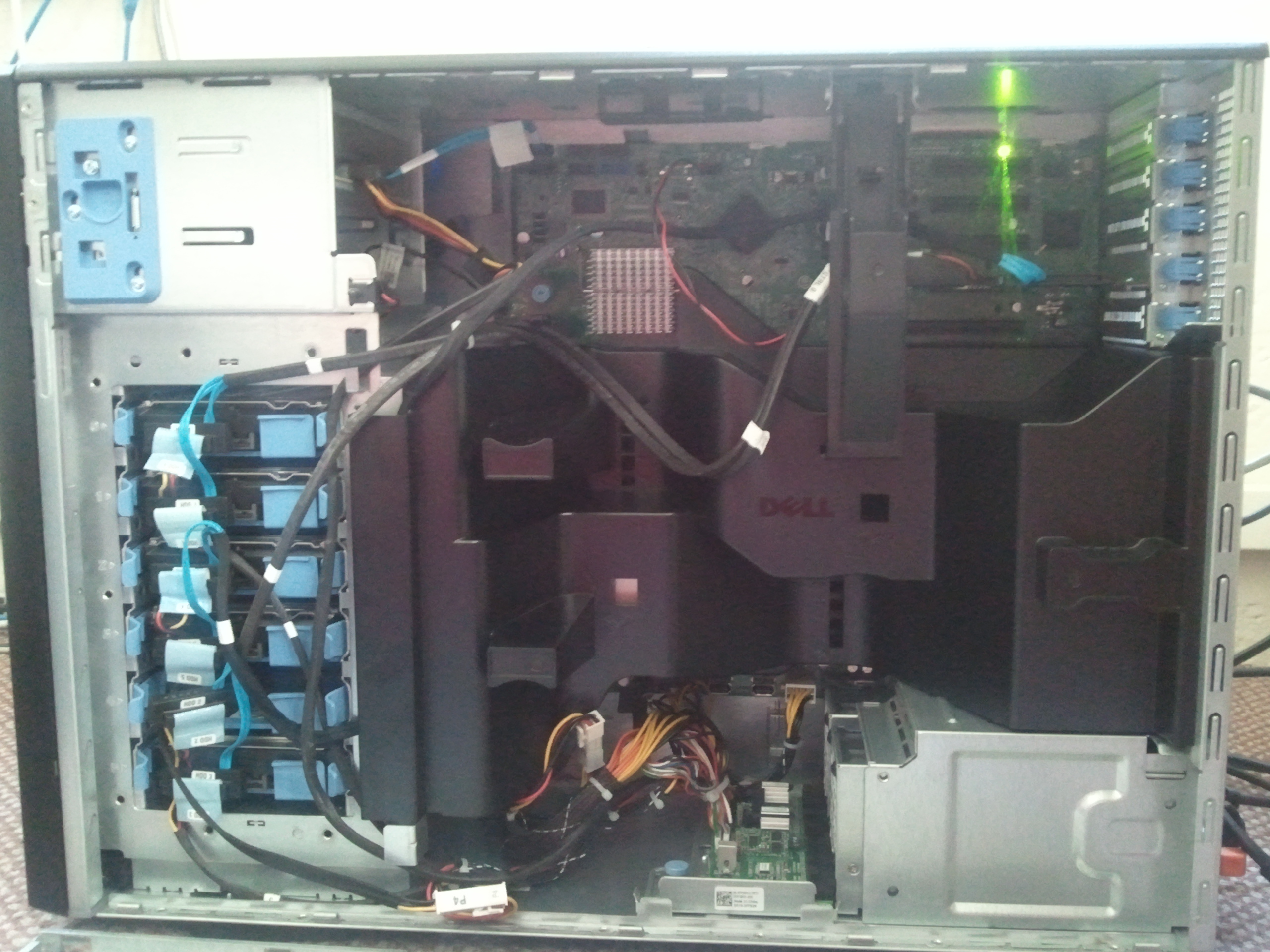
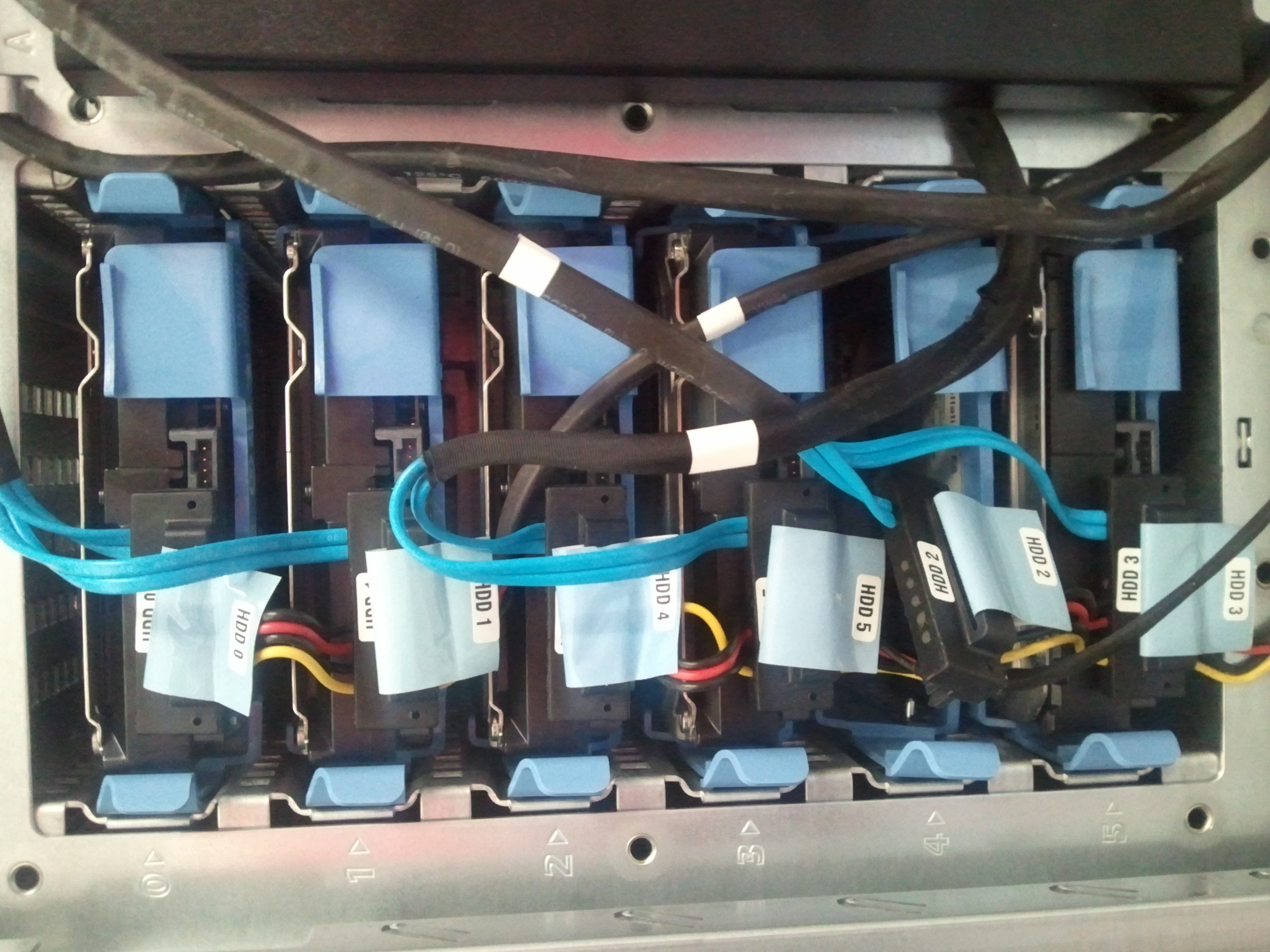
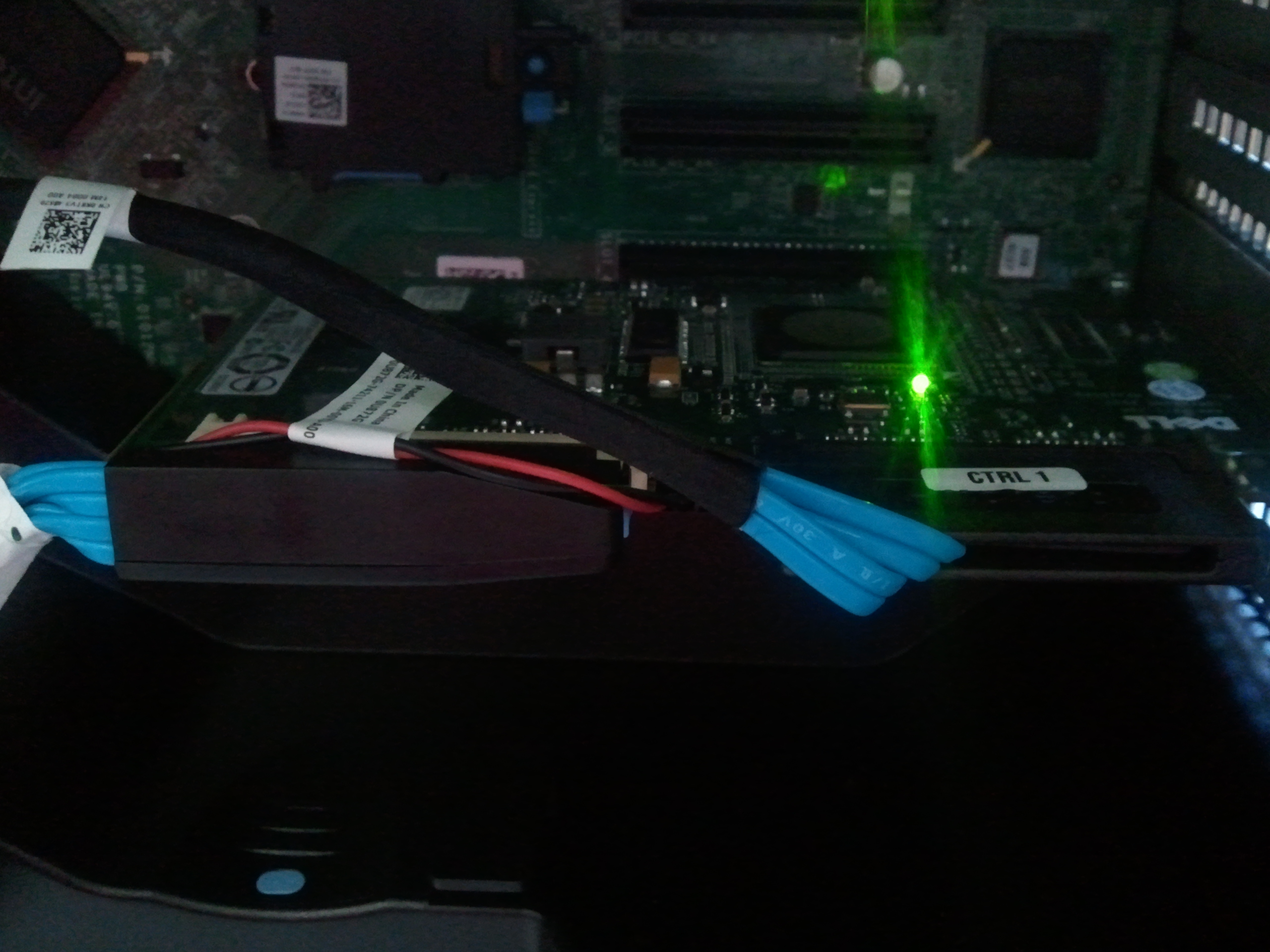
A non-profit organisation I support has just bought a Dell PowerEdge T410 server to be mainly used as a file server. We need a reasonable amount of space and really good reliability features because the system may have periods without being actively monitored, it also has to be relatively cheap. Dell servers are quite cheap, but disks are not cheap at all when Dell sells them. I get the impression that disks and RAM are major profit centers for Dell and that the profit margins on the basic servers are quite small. So naturally we decided to buy some SATA disks from a local store, one advantage of this is that Dell sells nothing bigger than 2TB while 3TB disks are available cheaply everywhere else. So we bought 4 cheap 3TB (2.7TiB) SATA disks, connected them to the server, and found that only 2TiB was accessible. The Dell Tech Center says that some of the RAID controllers don t support anything larger than 2TiB [1]. Obviously we have one of the older models. There s lots of SATA sockets on the motherboard that could be used, however there is one problem. View of the open side of a PowerEdge T410 The above picture is the side view of the T410, it was taken with a Samsung Galaxy S so the quality is a little poor (click for the original picture). The server is quite neat, not many cables for a system with 6 disks, not the 12 separate cables you would get in a typical white-box system. Disks in a PowerEdge T410 The above picture shows the disk enclosure. You can see that each disk has a single connector for power and data, also the disks aren t separate, multiple disks have the same power wires and the data cables are paired. SAS controller in a PowerEdge T410 Above you can see the SAS controller, it has two large connectors that can each handle the data cables for 4 disks, nothing like the standard cables. It s easy to buy SATA data cables and connect them, but there are no spare power cables in the box. The connector that supplies power to all the disks appears to be something proprietary to Dell which goes straight to the double-connectors on each disk that supply power and data. This setup makes cabling very neat but also provides no good option for cabling regular disks. I m sure I could make my own cables and if I hunted around the net enough I could probably buy some matching power cables, but it would be a hassle and the result wouldn t be neat. So the question was then whether to go to more effort, expense, and possibly risk the warranty to get the full 3TB or to just use the SAS controller and get 2TiB (2.2TB) per disk. One factor we considered is the fact that the higher sector numbers typically give much slower access times due to being on shorter tracks (see my ZCAV results page for test results from past disks [2]). We decided that 2.2TB (2TiB) out of 3TB (2.7TiB) was adequate capacity and that losing some of the slow parts of the disk wasn t a big deal. I ve now setup a RAID-Z2 array on the disks, and ZFS reports 3.78TiB available capacity, which isn t a lot considering that we have 4*3TB disks in the array. But the old server had only 200G of storage, so it s a good improvement in capacity, performance, and RAID-Z2 should beat the hell out of RAID-6 for reliability. Related posts:
  1. Dell PowerEdge T105 Today I received a Dell PowerEDGE T105 for use by...
  2. ZFS vs BTRFS on Cheap Dell Servers I previously wrote about my first experiences with BTRFS [1]....
  3. How I Partition Disks Having had a number of hard drives fail over the...

Russell Coker: The Retina Display

Last night I played with an Apple Macbook Pro with the new Retina Display (Wikipedia link). Wikipedia cites some controversy about whether the display actually has higher resolution than the human eye can perceive. When wearing glasses my vision is considerably better than average (I have average vision without glasses) and while kneeling in front of the Macbook I couldn t easily distinguish pixels. So Apple s marketing claims seem technically correct to me. When I tested the Macbook Pro I found that the quality of the text display was very high, even now the 1680*1050 display on my Thinkpad T61 looks completely crap when compared to the 2880*1800 display on the Macbook. The Macbook was really great for text and for a JPEG that was installed on the system for testing. But unfortunately pictures on web sites didn t look particularly good. Pictures on my blog looked quite poor and pictures returned by a Google search for art didn t look that great either. I wonder if Safari (the Apple web browser) isn t properly optimised for the display or if there is something that we should do when preparing pictures for web sites to make them look better on Safari. The retina display has a 71% greater DPI which means 2.93* the total number of pixels of my Thinkpad. The overall quality of the experience for me (apart from web pictures) seems more like a factor of 2.93 when compared with my Thinkpad than a factor of 1.71. This has to be one of the most desirable products I ve seen from a company that s opposed to freedom for it s users. I m not about to buy one though, $2,300 is a lot of money for a system that can t be upgraded, repaired, or recycled, and doesn t even have an Ethernet port. I m sure that if I bought one I would discover that it some of the hardware features don t work properly with Linux. The new Apple design trend of making it impossible to repair anything works reasonably well for phones and tablets which are cheap enough that they are hardly worth repairing when they have been used for a while. Lots of people can afford to spend about $600 on something that may be discarded after a year or two, but very few people can afford to spend more than $2,000 on such a disposable product. Why is Apple the only company producing systems with such displays? If someone produced regular PCs that have the expected features (including an Ethernet port) with such a display at a lower price then I m sure that there would be a great demand. Related posts:
  1. Modern Laptops Suck One of the reasons why I m moving from a laptop...
  2. A First Digital Camera I ve just been asked for advice on buying a digital...
  3. RPC and SE Linux One ongoing problem with TCP networking is the combination of...

27 July 2012

C.J. Adams-Collier: The blog was down yesterday

The brief outage was due to a scheduled move of the servers to a separate rack and subnet dedicated to our work with the Center for Information Assurance & Cybersecurity (ciac) at the University of Washington Bothell (uwb), and a11y.com I am currently exercising the new (to us) equipment and hope to winnow the less than awesome equipment over the next quarter. I spent the last six months finding the best in breed of the surplussed DL385 and DL380 chassis we (work) were going to have recycled. The team and I were able to find enough equipment to bring up one of each with eight and six gigs of memory, respectively. These will make excellent hypervisors for provisioning embedded instances of Slackware, Fedora, RHEL, CentOS, Debian, FreeBSD, OpenSolaris, OpenIndiana, FreeDOS, etc. When I initially configured this xen paravirt environment, I failed to plan for integration with libvirt, so I am now re-jiggering the software bridges so that they are managed using virt-manager. My experience doing this in the Eastsound lab has proved to be quite rewarding. Once network, storage and memory allocation are handled by libvirt, it will be trivial to automate the process of deploying, reclaiming, and managing these Telecommunications Resources efficiently and effectively using Perl. The new equipment we racked over the last weekend all has hardware assisted virtualization and is capable of hosting operating systems which have not been patched to communicate with the host hypervisor. This provides a higher level of assurance that guests will receive the full amount of provisioned resources and reduces the likelihood of resource conflicts, should the cluster operations team mistakenly over-commit. It also makes it possible for these nodes to host Windows-based operating systems. Oh, and they will also host these not insignificant things called BIG-IP Local Traffic Manager Virtual Edition (VE) and BIG-IP GTM Virtual Edition.

20 July 2012

John Goerzen: A Linux-Based RFID Thing Finder

Sometimes I have things nicely organized. Power adapters for radios in one drawer, for cameras in the next. And sometimes not so much. Sometimes I m not sure if things are in the basement or the attic. It seems like technology should be able to help solve this problem, but as far as I can tell, no such solution exists yet. So I m planning to build one. Here s my general idea. Feedback, of course, is welcome. Each item to be tracked can have an RFID tag of some sort attached to it. These tags can be read by an RFID reader at a distance of somewhere between 1ft and 1m in typical conditions. The reader could then act as a proximity alert to an object being searched for a you re close beep, for instance. That helps, but is only part of the battle. It doesn t help if you don t even know which room to look in. So the second part of the plan is that the RFID reader is constantly talking to an object database. Besides the obvious association between RFID tag IDs and object descriptions, the database will also capture background reads of RFID tags. Logged with accurate timestamps, we can then conjecture that RFID reads that occurred within a few seconds of each other are probably physically nearby. If boxes have RFID tags on them, then I can probably get a reasonable idea, down to a box or two, of which box that elusive book is in. If I further put tags on certain immovable physical locations in the house, such as every few feet along shelving, then these will also be captured in the background and hopefully associated with objects nearby, giving a good physical idea of where things are. What s more, the simple act of looking for things using the RFID reader would help keep the proximity tables up-to-date, since it could of course log the RFID tags it sees on the way. The only discipline required to keep this info current is to periodically hover nearby storage areas when moving things around. I like this concept a lot. That doesn t mean it s necessarily simple. Implementation requirements Software side I m envisioning the software being split into two components. One would run on an embedded system with the RFID reader. Its job is simple transmitting of scanned RFIDs to the server, receiving instructions from the server, and generating a tone if it s in search mode and the item being searched is nearby. On the server lies a database. The database would contain descriptions for the objects that are tagged (so that the tag ID can be looked up). It would also contain the timestamped scan logs. I envision a simple CGI-based frontend to it that is mobile-friendly, so a laptop, phone, tablet, etc. could be the user interface for the thing saving the cost of a display and input device by reusing what most people already have. This is the part I feel most qualified to work on already. Hardware The first question is what kind of RFID tags to use. Optimizing for cost per tag, the 800/900MHz UHF tags (EPC gen 2) seem ideal. I have found them in costs approaching $0.10 per tag when bought in rolls of 500 or 1000 Avery RFID labels. That s reasonable. The RFID reader is the more complicated part. UHF RFID readers are a lot more costly than their HF or LF counterparts. So far, the cheapest solution I have found started with a post about an Arduino UHF reader. It used a SolidDigi UHF reader board with UART interface for $177. That same board is also available with a USB interface at the same cost. There is also the need for an antenna. There is a small 5dBi one rated 0-50cm for $8, or a $100 8dBi version rated 1-6m designed for wall mounting. They sell these in kit form that include power adapter, USB cables, etc. as well. The kit with the small antenna runs $192, including reader board. Next is the compute platform. A DreamPlug might work for this at $160, though both the cost and the power consumption (5VDC 3A) are high. A Raspberry Pi seems perfect, though for whatever reason seem to be backordered by months everywhere and don t include wifi. The Pi is $35, and the USB wifi is another $30, plus a cheap SD card, so we re around $80 of computing. The running total of the project, then, is at least $272. Add on provisions for batteries, some sort of case, etc. and we re probably past the $300 mark. That s a lot cheaper than the $1000 for handheld RFID readers. The final item is tags. Bulk tags can be found in the $100 to $200 range, making the total cost of the project $400 to $500. Higher than I d like, but providing some valuable experience building something. Risks There are a few major risks to the project. First among them is read distance. If it s not long enough, the usefulness of the project will be low. Fortunately, $100 gets a more high-gain antenna and I d only be out the $8 if the cheaper one doesn t pan out. But that s something of a cold comfort, as it s another, well, $100. Having a bunch of RFID hardware can be used for all sorts of other interesting things, though, so it could perhaps be reused or repurposed. Another risk is that RFID collisions wouldn t be handled as intelligently as I d like, meaning that the read range required to be useful would activate so many tags that collision algorithms break down. I don t know enough about RFID collision algorithms to know if this is a serious councern.

15 July 2012

Jordi Mallach: Season of change

It feels like I'm sitting in a roller-coaster wagon. There's probably too much change going on for me to assimilate naturally. In particular: I just wrapped up (well, mostly) one of the toughest Uni semestres. I had to deal with lots of very time consuming assignments, and then the usual round of final exams. Even if this semester I got the best marks in my journey (or shall we say Via Crucis) through University, I still managed to fail one exam, for the Advanced Networks subject, which is quite annoying, given I got high marks (even the highest in one case) in other subjects I really don't master at all. In any case, this is the end of the pain. The only thing that's left is just one exam and a project based on GNU/Linux technologies which will basically mean formatting for prettyness the sysadmin docs we've been collecting at the office during the last few years. This effort will be nothing to what I've been doing during the past 18 months, so I'm really relieved to have it past me already. Getting rid of studies comes just two weeks before a big change in my professional career. Friday was my last day at the Institut Tecnol gic d'Inform tica, after five and a half fantastic years working with awesome people in a very friendly atmosphere. I've learned a great deal, and taking this decision wasn't easy at all. I leave lots of good friends behind, people I really love, and tomorrow will be difficult to not have them around me. I wish my ITI ex-workmates the best of luck in these difficult times for everyone in Spain and specially in the Valencian Country with the massive cuts going on. I feel the timing for this jump couldn't be better. Tomorrow, when I get ready to go for work, I won't be leaving home at all, instead I will just sit where I am right now, at home, and log into some corporate IRC server. Tomorrow I'll be joining Collabora, and I'm a mix of excited, curious and happy about this incredible opportunity. Thanks to Sjoerd for nags, I might not be writing this if it wasn't for you!

Collabora When I was first approached about this, I thought Collabora was a small company. But as I looked more into it, I discovered that's not longer the case, there's many more people than I imagined working there (here!), and was delighted to see I knew many of them, and many other are well known members of the major Free Sofware communities. I'll be joining the sysadmin team to work closely with Jo Shields. See you tomorrow, folks. :) This opportunity to work from home is godsend, given the third bit of change that'll be happening soon: sometime in late September, Maria and I should join the ranks of first-time parents, following the baby boom wave surrounding us. While you can imagine we're really happy about this, we're also freaking out because this is going to happen in just two months and a half, and weeks go by really fast lately. So yeah, being able to be at home with this really small baby will be a big bonus for the incredible experience we're about to enjoy. We've been both busy with other stuff, but during the summer we should be focusing on preparing the baby's arrival. There's a whole lot to do! Expect my Debian and other Free Software activities to get a hit, of course. :) If I am normally sleep-deprived, this is going to be the next level.

Paul Tagliamonte: usage of vcs-git in the Debian archive

I ve recently gone through some of the unpacked source sitting in the lintian lab, and I ve got a few cool stats. First of all, the types of VCS tags I ve found:
      1 vcs-git
    123 Vcs-git
   6480 Vcs-Git
      1 Vcs-GIT
      5 VCS-git
     86 VCS-Git
Interesting! It seems the (IMHO correct) Vcs-Git style has a lot of adoption
     17 XS-Vcs-Git
and a few old style git tags :) Well, let s take a look at the most common prefixes:
   6498 git
    196 http
     15 https
All pretty stock, when I see (to my shock) a:
      4 git+ssh
Oh noes! Let s get rid of those, folks! :) So, let s check out the most popular domains to host git packages:
    5375 git.debian.org
     555 anonscm.debian.org
     171 github.com
OK, I d like to stop right here. As much as I hate nonfree software, and I think relying on as part of our infrastructure sucks, there is a degree of sense to keeping stuff on GitHub. If upstream is on GitHub, it may make it easier to coordinate and work with them. However! These are repos sitting in people s personal accounts which means taking over the package in the event someone needed to is not practical. The person with the highest number of Debian repos on GitHub is 19, followed by 12, 5 and a few 4s. Enter github.com/debian IMHO, we should consider putting the repos that are already on GitHub under Debian namespace, so that the team of maintainers may be able to add new collaborators. I mean, we have the account and some friendly DDs who offered to take care of this organization outside the project. That, or get us off GitHub entirely. I m not sure that s wise, though. However, even though there are a ton of repos on GitHub, it s about 1/40th of the total number of VCS tagged packages in Debian. On with the show:
      60 git.debian-maintainers.org
      39 gitorious.org
      26 git.b9.com
      22 git.lxde.org
      19 git.kitenet.net
      19 git.brad-smith.co.uk
      18 git.gag.com
And some of the more interesting ones:
      1 code.launchpad.net
for Vcs-Git??? :)
      1 git.debian.org:
Looks like it was a login@git.d.o: URL that was just changed slightly. Let s double-check our VCS tags, people :) The breakdown of Debian VCS d URLs:
      1 anonscm.alioth.debian.org
      1 anonscp.debian.org
      1 git.debian.org:
      2 scm.alioth.debian.org
     12 alioth.debian.org
    555 anonscm.debian.org
   5375 git.debian.org
And out of git.d.o, 2544 of them use the git://git.debian.org/git/pkg-foo pattern rather then the git://git.debian.org/pkg-foo pattern. Interesting! roughly 78 use /users and roughly 113 use /git/users I had no idea we had so many complexities in our VCS pointers :) When I get some more time, I ll go through and figure out which team has the most Git VCS tags :)

30 June 2012

Russell Coker: Links June 2012

This Youtube video is an amusing satire of EULAs and copyright law as applied to uploading consciousness [1]. Washington s Blog has an insightful article about the way that the lack of trust in the US is killing their economy [2]. It seems that as long as the 1% are allowed to get away with breaking the law the US economy won t recover. It s something we should all keep in mind at election time, let s not be like the US. AirBnB is an interesting service to allow people to rent a room or an apartment, a quick scan indicates that it s a lot cheaper than hotels and offers many good locations [3]. It s probably of most interest to the more social people though which is a down side for me. Queensland s highest court has ruled that vilification of homosexuals is also vilification of bisexuals because an essential aspect of bisexuality is a sexual feeling of a person of the same sex, that is, homosexuality [4]. Anyone who didn t find that totally obvious could simply consult any dictionary or encyclopedia to find out. But the Australian legal system needed a 46 page ruling. We really need some sanity in the courts. Father Gregory Boyle founded an organisation named Homeboy Industries with the purpose of providing jobs for people with criminal records [5]. It s amazing the way he is helping people turn their lives around and it s apparently a lot cheaper than sending them to jail. Related posts:
  1. Links February 2012 Sociological Images has an interesting article about the attempts to...
  2. Links March 2012 Washington s Blog has an informative summary of recent articles about...
  3. Links April 2012 Karen Tse gave an interesting TED talk about how to...

29 June 2012

Dirk Eddelbuettel: Rcpp 0.9.13

The bug-fix in version 0.9.12 of Rcpp turned out to be incomplete, so a new version 0.9.13 is now on CRAN and will get to Debian shortly. The Rcpp::Enviroment constructor is now properly fixed (using the global environment as a default value). As well, a new #define was created to detect the clang++ compiler before/after version 3.0.0 as one exceptions header changed location. Unit tests files were also once more updated. The complete NEWS entry for 0.9.13 is below; more details are in the ChangeLog file in the package and on the Rcpp Changelog page.
0.9.13  2012-06-28
    o   Truly corrected Rcpp::Environment class by having default constructor
        use the global environment, and removing the default argument of
        global environment from the SEXP constructor
    o   Added tests for clang++ version to include bits/exception_defines.h
        for versions 3.0 or higher (similar to g++ 4.6.0 or later), needed to
        include one particular exceptions header
    o   Made more regression tests conditional on the RunAllRcppTests to come
        closer to the CRAN mandate of running tests in sixty seconds
    o   Updated unit test wrapper tests/doRUnit.R as well as unitTests/runTests.R
Thanks to CRANberries, you can also look at a diff to the previous release 0.9.12. As always, even fuller details are on the Rcpp Changelog page and the Rcpp page which also leads to the downloads, the browseable doxygen docs and zip files of doxygen output for the standard formats. A local directory has source and documentation too. Questions, comments etc should go to the rcpp-devel mailing list off the R-Forge page

24 June 2012

Paul Tagliamonte: debian-desktop/7.0.0~exp2 in experimental

Mirroring my post to debian-desktop here:
Howdy, -desktop,
Hopefully we can contain the flame to the other thread.
desktop-base/7.0.0~exp2 has been accepted into experimental, for testing
by y'all (and generally interested folks) for feedback and testing
before pushing to unstable.
I urge y'all to give it a try and provide feedback on issues that you
may run into.
You can overlay experimental on any unstable install, and install
desktop-base by running:
    $ sudo apt-get -t experimental install desktop-base
For more information on using experimental, check out the wiki[1].
If you would care to test out the plymouth bootsplash, here's the short
version of how to get it running:
 1) Install plymouth via apt ($ sudo apt-get install plymouth)
 2) Set the theme to use  joy' ($ sudo /usr/sbin/plymouth-set-default-theme joy)
 3) Edit the file /etc/default/grub, and add
    "splash" to GRUB_CMDLINE_LINUX_DEFAULT
 4) update your initramfs ($ sudo update-initramfs -u)
Here's the full list of changes from the version in unstable:
    desktop-base (7.0.0~exp2) experimental; urgency=low
      * Remove GConf defaults, they are not used anymore.
      * Remove the GDM3 settings, since the configuration format for GDM
        change again, yay.
      * Add a dconf file for the new-style GDM3 configuration.
      * Add a XML file describing the available resolutions for the
        background (for use with GNOME).
      * postinst: use a higher priority for the 1920x1080 background.
      * Cleanup postinst/prerm/postrm.
      * Add a new alternative: desktop-background.xml.
      * Use it from the gsettings override.
      * Reload gdm3 after installation/removal.
      * Drop old libgnome2-common hack.
      * Clean up an alternative that is no longer available.
     -- Josselin Mouette <joss@debian.org>  Sat, 23 Jun 2012 23:28:15 +0200
    desktop-base (7.0.0~exp1) experimental; urgency=low
      [ Paul Tagliamonte ]
      * Adding myself as a maintainer
      * We've got a new theme --  joy' by Adrien Aubourg. Thanks, Adrien!
         - Theme added to backgrounds.
         - Theme added for Grub
         - Background changed for GDM3
         - Theme added for KDM & changed that to default.
         - Theme added for ksplash & changed to default.
      * Standards bump to 3.9.3
      * Pre-Dependency added for dpkg (>= 1.15.7.2~), since we use dpkg helpers
        in our preinst.
      * Add in Jonathan Carter's Plymouth theme.
      [ Jonathan Carter ]
      * Remove splashy theme since it's no longer available in archives
      [ Yves-Alexis Perez ]
      * Install emblem in the correct folder.
     -- Paul Tagliamonte <paultag@ubuntu.com>  Sat, 23 Jun 2012 13:00:47 +0200
I thank all of you dearly for putting up with this,
  Paul
[1]: http://wiki.debian.org/DebianExperimental

23 June 2012

Bernd Zeimetz: Report from the Bug Squashing Party in Salzburg

bsp_2012_salzburg photo from salzburg-cityguide.com, Copyright (C) Uwe Brandl

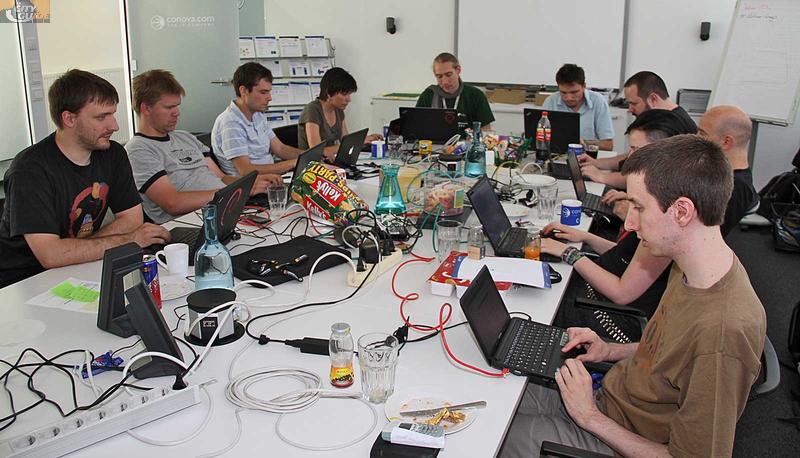
Participation and Results From June 15-17th we held a Debian BugSquashingParty in Salzburg, hosted and sponsored by conova communications GmbH. It was a fun and busy weekend, with 15-17 people from 5 countries being around, mainly working on RC bugs in Testing/Unstable. Gerfried Fuchs (rhonda) also worked on triaging the impact of RC bugs on the version in Squeeze, while Peter Palfrader (weasel) took care of Tor related things and Debian sysadmin work, including starting on the new bugs and udd hosts. Phillip Hug (hug) worked on the debian.ch infrastructure. Together with Miroslav Such from Red Hat Bernd Zeimetz (bzed) worked on the packaging of the necessary libraries and daemons to add (basic) Spacewalk client support to Debian. As soon as the packages passed NEW and #677871 was applied (thanks to the APT guys for working on that already), managing Debian clients with Spacewalk should work out of the box. Of course we also had a little keysigning party :)

Statistics
  • about 68 bugs in unstable/testing were triaged/patched/fixed or at least pinged
  • 54 bugs were tagged to show if they affect Squeeze, several other bugs were pinged to retrieve necessary information or to trigger an update in the next stable pointrelease.
  • 5 packages were introduced into Debian (still in NEW, though) - the Spacewalk client related packages and libapache2-mod-auth-memcookie.

Accomodation Thanks to Debian funds we were able to provide accomodation for four participants in the JUFA youth hostel in Salzburg. We had paid in advance for eight, but changing to rooms with a higher category for only 4 people would have been equally or more expensive.

Press/Media coverage Additionally to being mentioned in the calendars on ProLinux and similar pages, we had some press coverage by the local newspaper and online magazines:

Fun facts We consumed 2kg of Leberkas, a big plate of "Buchteln mit Vanillesosse", about 16000cm^2 of Pizza, about 80 litres of coke, juice, beer and wine and I guess we drank at least the same amount of water. We had coffee made of 1.5kg coffee beans and managed to empty the (formerly well filled) icemaker in the fridge. Also we had successful training sessions of a standard Debconf game (rules won't be explained here obviously). Maybe we even successfully spread the game to the employees of a commercial linux distribution ;)

22 June 2012

Philipp Kern: The upcoming DebConf 12

Update 2: Richard and especially Moray debunked my statistics and given that they're actually on the DebConf team, they simply know it better what to look at and which numbers cannot be trusted. So look over to Moray's post for some numbers about DC11 and DC12.

Oops. At least the average count of days per person seems slightly higher. (But then the stats may likely be off, given that any part of the day counts as full.)
This year's DebConf will have remote participation through video streams and IRC chat, as usual. But they will be late at night for Europeans. Despite those hurdles, let's make this conference a success! The same procedure as every year. ;-)

Update: I don't have any privileged access to Pentabarf and hence I was just working on the exported data at the link above. When perusing the "Statistics for ONLY people who have both dates in Penta" I get this:
That's because this year seems to have a much higher percentage of people filling out both fields (~58% for DC10/DC11 and 85% for DC12). I'm still unsure if Penta was set to filter out those who did not reconfirm. But after all the others would not be very meaningful for room planning.

17 June 2012

Johannes Schauer: port bootstrap build-ordering tool report 2

A copy of this post is sent to soc-coordination@lists.alioth.debian.org as well as to debian-bootstrap@lists.mister-muffin.de. Diary June 4 I added the first version of basenocycles.ml to git. Given an initial set of cross built packages, it tries to compile as much as possible on the resulting system in multiple rounds. June 5 During June 3, I discovered and error in my program that would only come up when using the Debian Sid package lists as the input:
Fatal error: exception Assert_failure("common/edosSolver.ml", 610, 11)
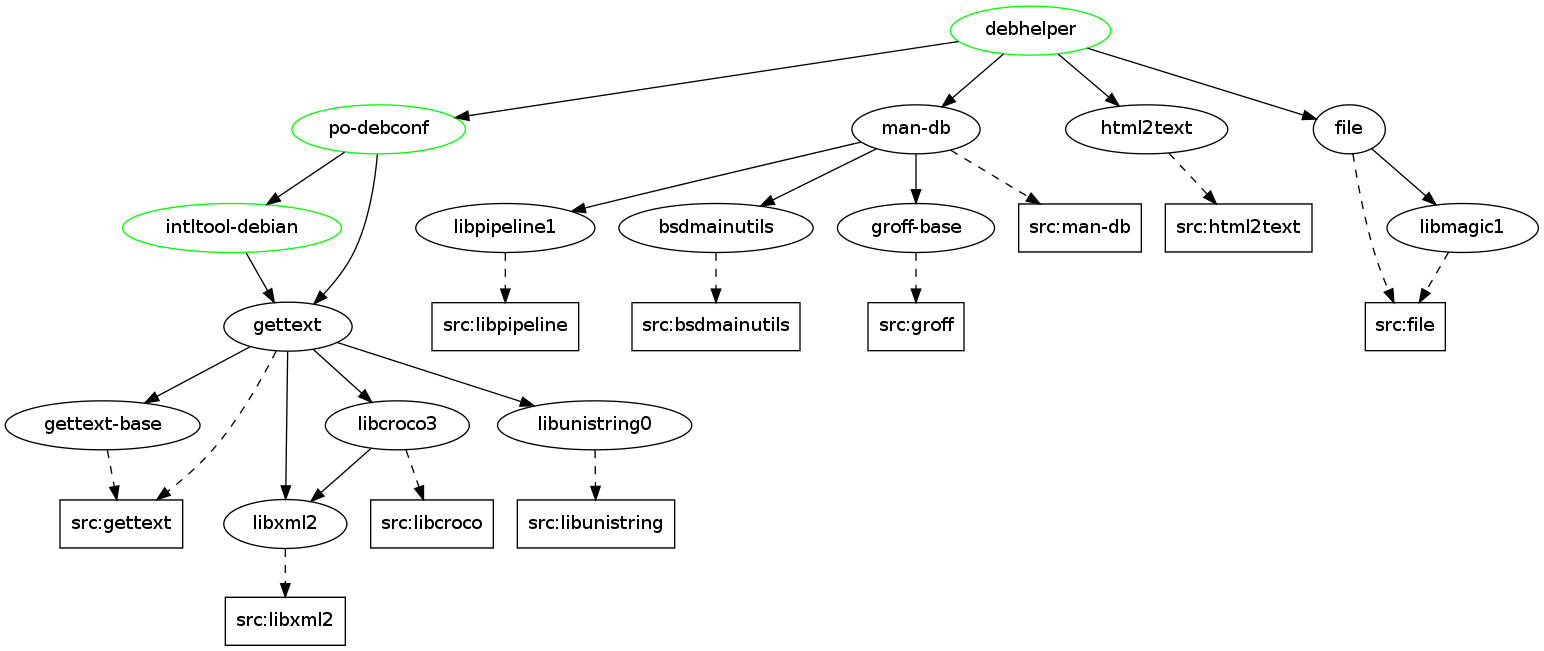
On this day, June 5, I wrote a minimal test case for this problem. The same day, Pietro figured out that this is a bug in dose which will be fixed in the next release. Begin writing code to figure out how important a binary package is for the further build process. Try to use Depsolver.edos_install to find out what packages are needed to make debhelper available. Restructure basenocycles.ml, exclude source packages that already have been built, still trouble with already existing binary packages and Cudf.mem_installed, comment stuff better. June 6 I wrote some crude code (only estimate, not correct, fixed later) that would give a rough overview of how often a given binary package is directly required as a build dependency. Debhelper came out as the most needed package. It is architecture:all, so it does not have to be built but it has unfulfilled runtime dependencies. To make those packages available, 13 (actually 11, fixed later) packages have to be compiled on Ubuntu Natty. But those packages all (except gettext) require debhelper itself to be built. The first dependency cycle. This dependency cycle (actually, the 12 cycles) can be broken by either cross compiling those source packages or by making them build without debhelper. One goal of the program is to help decide what the easier option is, but this is not yet implemented. To play around a bit, I created the possibility to specify a list of packages that are additionally to the minimal set of cross compiled packages also cross compiled. I added the 13 packages found above to the list, thus making the binary packages they build available. This made debhelper available in the system. As a result, 1625 out of 3339 source packages can be built with just a minimal build system (priority:essential packages plus build-essential) and debhelper available. The next package that blocks the most other source packages from being built is cdbs. The next nine packages in that list also require cdbs so it seems to be the next important package to be available. Pietro's suggestions make me:
 - do not open BootstrapCommon but ExtLib, Common, Algo, Debian
 - do proper option parsing and logging
 - use Debcudf.ignore_essential = true
 - do Debcudf.init_tables (binlist@srclist)
 - use @ with shorter list first
 - use more List.rev_append instead of @
 - use CudfAdd.who_provides to find if a package is available
June 7 Pietro and Patrick suggest that for solving the debhelper cycles, one could provide a minimal debhelper version so that the above list of 12 packages can be built without debhelper. I try to figure out how to get a list of packages that are missing to make a package installable/buildable. This functionality should be provided in dose but I fail to find it. June 8 Lacking a solution of the problem of June 7, I write a mail to Pietro. I start my first graphs in ocaml using the ocamlgraph library. The graph I generate, starts off at a binary package. For each binary package it connects new vertices as its runtime dependencies. If a binary package is not arch:all and also not yet otherwise compiled, its source package is also added. The result is a graph in which set of source packages in it will make the initial package available, if those source packages would be cross compiled. The graph is extended further than the source packages. June 9 I refine a couple of functions, make univ_get_pkg_by_name return the package with the highest version number. I wrote a rather lengthy (1027 words) email to the list that explains my status as of this day. I can create graphviz dot files with ocaml, can create node and edge types and create the graph by an imperative pattern that I saw a lot in Pietro's code. Disjunctions are not yet handled correctly (see mail from June 8). The graphs generated look like the following: http://mister-muffin.de/p/8nyc.png June 11 I write a test case which shows how CudfAdd.who_provides doesnt find virtual packages. Automate the process of finding the packages that, if cross compiled, would make another package available. Add more predicates (identifying source packages) and improve input file reading code. Move build_compile_rounds which compiles as many source packages as it can in multiple rounds on a given minimal system a toplevel function and thereby abstract it more. Create a rudimentary text based menu to choose different actions to take for an analysis. Start writing an extended version of simple_dependency_graph for deeper analysis. Use xdot to show graphs from the text menu. Allow saving those graphs to a file. June 12 Move functionality from the extended version of simple_dependency_graph over to the normal version and delete the extended version. Add the new Closure vertex type. Create extended_dependency_graph which is supposed to not contain single binary package vertices but handle a package and its installation set as one vertex. The output of extended_dependency_graph is optionally reduced to the biggest (non degenerate) strongly connected component. User gets the option of choosing the exploration depth. June 13 Pietro replies to my mail from June 8 but apparently I failed to express myself well enough in my last mail, so I rephrase my question. Pietro replies to my email from June 11 and explains how the effect I see is due to "a nuisance of the debian to cudf encoding". As a result I change my code accordingly. June 14 Another lengthy (1130 words) email to the list. I explain what was done in the past days, what parts work and how they work. I list some rationales on why I did things the way I did them. The most important observation is, that after improving my code again and again, I ended up representing the dependency cycle problem in the same (very similar) way that Pietro suggested in the beginning. This is probably a good discovery. Lots of data of that email is now of only little use as of June 16, I make lots of improvements in correctness. As I dont have an answer to my other email to Pietro from June 13, I implement a very crude way to get an answer to the question of what packages are missing for a package to be available/compileable. I called it flatten_vpkgformula_best_effort and it suffers from many faults including disjunctions and package conflicts. Patrick spots a problem. As a result, I make sure that at no point, the source package of an arch:all package can be listed. June 15 As a reply to my mail from June 13, Pietro creates a new branch in the git and adds the code I needed to get a proper installation set. June 16 As a result of Pietro's efforts from June 15, I make great advancements on all fronts. Details of the current status follow in the next section. Results A big leap was made on June 16 due to Pietro's great help on making me understand how Depsolver.listcheck can be used for my purposes. My difficulties in finding the solution myself are rooted in many parts of the dose framework being poorly commented but Pietro did already a couple of documentation commits whenever things were unclear for me. Using Depsolver.listcheck makes it possible to be more distribution agnostic and I dont have to handle vpkgs, virtual packages and constraints myself anymore. The code also doesnt suffer anymore by wrongly analyzed dependencies and conflicts. The only thing that is not yet taken care of, is that Depsolver.listcheck only chooses one out of several possible installation set. A final version should be able to take into account that a different installation set could provide a better solution. Overall, in comparison to two weeks ago, I can now properly build, traverse and analyze graphs, can choose an installation set properly, understand more about dependencies, closures, dose and ocaml in general. Finding the importance of binary packages for building When calculating how many source packages are depending on the availability of a binary package I originally flattened the pkg.Cudf.depends list twice for a rough overview. This is of course wrong due to disjunctions and conflicts and also doesnt provide a deep dependency inspection. The new method is to calculate an installation set that is necessary to compile a source package for every source package. The resulting list of binary packages is then used to find out how often a binary package appears in an installation set. I see three drawbacks though: Removing simple graph The simple graph which contained single binary and source packages was removed. I realized it doesnt really serve any purpose to look at it. As a result, Bin vertices and InstallDep edges are also not part of the graph anymore. Since it was responsible for generating the list of source packages that have to be cross built to make a package available, I created a new function get_cross_source_packages which uses an installation to serve the same purpose. Fix extended_dependency_graph extended_dependency_graph now uses installation sets for generating the list of packages that is needed to compile a source package or install a binary package. The list of build dependencies does not include packages that are already installable. The list of runtime dependencies does not include packages that are otherwise available (cross built, arch:all...). Instead of checking for list membership all the time, I created hash tables for the list of installable as well as for the list of available binary packages. Future There are two big tasks for the next two weeks: Task one is to find a way to give hints on which packages to best consider for having reduced build dependencies. This would then probably finally make use of Pietro's cycle algorithms. Task two is to find a way to break cycles and create a build-DAG from a list of packages that already have staged build dependency information. Patrick is currently working on patching dpkg with Build-Depends-StageN dependencies as making perl cross compilable. If he doesnt need the ability to decide which packages to modify to have staged build dependencies in the near future, then task one is probably less urgent and therefor of less importance right now? On the other hand, I can easily generate fake reduced build dependencies so that doing task two right now would not be a problem. Also, having the solution for task two will make it possible to show the user what effect it would have to add reduced build dependencies to a package. For the reasons above (it's not urgent, task one profits from task two being solved) I will go and implement task two first (if there are no objections from my mentors). Another idea, that I discussed with wookey and Patrick yesterday, was that due to multiarch being used for more and more packages, there should exist a set of packages that is cross compilable without any change to the package. We agreed that I make a list of packages that, if cross compiled, would break dependency cycles and make other packages available. I created such a list of about 160 packages for Ubuntu Natty that, if cross compiled, made it possible to have 87% of Natty available (those numbers have to be treated with caution as I did not yet use the proper way of installation sets when generating that list, but the order of magnitude should be correct). Wookey can then try to cross compile those packages. If some packages of those "crucial" source packages are found to be cross compilable, then they should be cross compiled because it means that no work has to be done to break some cycles. Cross compiling all packages that are cross compilable out of the box is no solution, as only natively compiled packages can go into the archive. This is why the list of potentially additionally cross compiled source packages has to be kept as small as possible.

Next.

Previous.