Search Results: "ema"

7 January 2024

Jonathan McDowell: Free Software Activities for 2023

This year was hard from a personal and work point of view, which impacted the amount of Free Software bits I ended up doing - even when I had the time I often wasn t in the right head space to make progress on things. However writing this annual recap up has been a useful exercise, as I achieved more than I realised. For previous years see 2019, 2020, 2021 + 2022.

Conferences The only Free Software related conference I made it to this year was DebConf23 in Kochi, India. Changes with projects at work meant I couldn t justify anything work related. This year I m planning to make it to FOSDEM, and haven t made a decision on DebConf24 yet.

Debian Most of my contributions to Free software continue to happen within Debian. I started the year working on retrogaming with Kodi on Debian. I got this to a much better state for bookworm, with it being possible to run the bsnes-mercury emulator under Kodi using RetroArch. There are a few other libretro backends available for RetroArch, but Kodi needs some extra controller mappings packaged up first. Plenty of uploads were involved, though some of this was aligning all the dependencies and generally cleaning things up in iterations. I continued to work on a few packages within the Debian Electronics Packaging Team. OpenOCD produced a new release in time for the bookworm release, so I uploaded 0.12.0-1. There were a few minor sigrok cleanups - sigrok 0.3, libsigrokdecode 0.5.3-4 + libsigrok 0.5.2-4 / 0.5.2-5. While I didn t manage to get the work completed I did some renaming of the ESP8266 related packages - gcc-xtensa-lx106 (which saw a 13 upload pre-bookworm) has become gcc-xtensa (with 14) and binutils-xtensa-lx106 has become binutils-xtensa (with 6). Binary packages remain the same, but this is intended to allow for the generation of ESP32 compiler toolchains from the same source. onak saw 0.6.3-1 uploaded to match the upstream release. I also uploaded libgpg-error 1.47-1 (though I can claim no credit for any of the work in preparing the package) to help move things forward on updating gnupg2 in Debian. I NMUed tpm2-pkcs11 1.9.0-0.1 to fix some minor issues pre-bookworm release; I use this package myself to store my SSH key within my laptop TPM, so I care about it being in a decent state. sg3-utils also saw a bit of love with 1.46-2 + 1.46-3 - I don t work in the storage space these days, but I m still listed as an uploaded and there was an RC bug around the library package naming that I was qualified to fix and test pre-bookworm. Related to my retroarch work I sponsored uploads of mgba for Ryan Tandy: 0.10.0+dfsg-1, 0.10.0+dfsg-2, 0.10.1+dfsg-1, 0.10.2+dfsg-1, mgba 0.10.1+dfsg-1+deb12u1. As part of the Data Protection Team I responded to various inbound queries to that team, both from project members and those external to the project. I continue to keep an eye on Debian New Members, even though I m mostly inactive as an application manager - we generally seem to have enough available recently. Mostly my involvement is via Front Desk activities, helping out with queries to the team alias, and contributing to internal discussions as well as our panel at DebConf23. Finally the 3 month rotation for Debian Keyring continues to operate smoothly. I dealt with 2023.03.24, 2023.06.26, 2023.06.29, 2023.09.10, 2023.09.24 + 2023.12.24.

Linux I had a few minor patches accepted to the kernel this year. A pair of safexcel cleanups (improved error logging for firmware load fail and cleanup on load failure) came out of upgrading the kernel running on my RB5009. The rest were related to my work on repurposing my C.H.I.P.. The AXP209 driver needed extended to support GPIO3 (with associated DT schema update). That allowed Bluetooth to be enabled. Adding the AXP209 internal temperature ADC as an iio-hwmon node means it can be tracked using the normal sensor monitoring framework. And finally I added the pinmux settings for mmc2, which I use to support an external microSD slot on my C.H.I.P.

Personal projects 2023 saw another minor release of onak, 0.6.3, which resulted in a corresponding Debian upload (0.6.3-1). It has a couple of bug fixes (including a particularly annoying, if minor, one around systemd socket activation that felt very satisfying to get to the bottom of), but I still lack the time to do any of the major changes I would like to. I wrote listadmin3 to allow easy manipulation of moderation queues for Mailman3. It s basic, but it s drastically improved my timeliness on dealing with held messages.

4 January 2024

Aigars Mahinovs: Figuring out finances part 5

At the end of the last part of this, we got a Home Assistant OS installation that contains in itself a Firefly III instance and that contains all the current financial information. They are communicating and calculating predictions for me. The only part that I was not 100% happy with was accounting of cash transactions. You see payments in cash are mostly made away from computer and sometimes even in areas without a mobile Internet connection. And all Firefly III apps that I tried failed at the task of creating a new transaction when offline. Even the one recommended Telegram bot from Firefly III page used a dialog-based approach for creating even a simplest transaction. Issue asking for a one-shot transaction creation option stands as unresolved. Theoretically it would have been best if I could simply contribute that feature to that particular Telegram bot ... but it's written in Javascript. By mapping the API onto tasks somehow. After about 4 hours I still could not figure out where in the code anything actually happens. It all looked like just sugar or spagetty. Connectors on connectors on mappers. So I did the real open-source thing and just wrote my own tool. firefly3_telegram_oneshot is a maximally simple Telegram bot based on python-telegram-bot library. So what does it do? The primary usage for me is to simply send a message to the bot at any time with text like "23.2 coffee and cake" and when the message eventually reaches the bot, it then should create a new transaction from my "cash" account to "Unknown" account in amount of 23.20 and description "coffee and cake". That is the key. Everything else in the bot is comfort. For example "/undo" command deletes the last transaction in cash account (presumably added by error) and "/last" shows which transaction the "/undo" would delete. And to help with expense categorisation one can also do a message like "6.1 beer, dest=Edeka, cat=alcohol" that would search for a destination account that would fuzzy match to "Edeka" (a supermarket in Germany) and add the transation to the category fuzzy matched to "alcohol", like "Shopping - alcoholic drinks". And to make that fuzzy matching more reliable I also added "/cat something" and "/dest something" commands that would show which category or destination account would be matched with a given string. All of that in around 250 lines of Python code and executed by a 17 line Dockerfile (via the Portainer on my Home Assistant OS). One remaining function that could be nice is creating a category or destination account on request (for example when the first character of the supplied string is "+"). I am really plesantly surprised about how much can be done with how little code using the above Python library. And you never need to have any open incoming ports anywhere to runs such bots, so the attack surface for such bot-based service is much tighter. All in all the system works and works well. The only exception is that for my particual bank there is still no automatic way of extracting data about credit card transactions. For those I still have to manually log into the Internet bank, export a CSV file and then feed that into the Firefly III importer. Annoying. And I am not really motivated to try to hack my bank :D Has this been useful to any of you? Any ideas to expand or improve what I have? Just find me as "aigarius" on any social media and speak up :)

2 January 2024

Thomas Koch: Waiting for a STATE folder in the XDG basedir spec

Posted on February 18, 2014
The XDG Basedirectory specification proposes default homedir folders for the categories DATA (~/.local/share), CONFIG (~/.config) and CACHE (~/.cache). One category however is missing: STATE. This category has been requested several times but nothing happened. Examples for state data are: The missing STATE category is especially annoying if you re managing your dotfiles with a VCS (e.g. via VCSH) and you care to keep your homedir tidy. If you re as annoyed as me about the missing STATE category, please voice your opinion on the XDG mailing list. Of course it s a very long way until applications really use such a STATE directory. But without a common standard it will never happen.

Valhalla's Things: Crescent Shawl

Posted on January 2, 2024
Tags: madeof:atoms
a woman wearing a shawl, seen from the back where it looks like a big dark grey triangle with a light grey border and another light grey border with a grid of holes. There is also a double line of holes in the center of the back, and two single ones towards the sides. One of the knitting projects I m working on is a big bottom-up triangular shawl in less-than-fingering weight yarn (NM 1/15): it feels like a cloud should by all rights feel, and I have good expectations out of it, but it s taking forever and a day. And then one day last spring I started thinking in the general direction of top-down shawls, and decided I couldn t wait until I had finished the first one to see if I could design one. For my first attempt I used an odd ball of 50% wool 50% plastic I had in my stash and worked it on 12 mm tree trunks, and I quickly made something between a scarf and a shawl that got some use during the summer thunderstorms when temperatures got a bit lower, but not really cold. I was happy with the shape, not with the exact position of the increases, but I had ideas for improvements, so I just had to try another time. Digging through the stash I found four balls of Drops Alpaca in two shades of grey: I had bought it with the intent to test its durability in somewhat more demanding situations (such as gloves or even socks), but then the LYS1 no longer carries it, so I might as well use it for something a bit more one-off (and when I received the yarn it felt so soft that doing something for the upper body looked like a better idea anyway). I decided to start working in garter stitch with the darker colour, then some garter stitch in the lighter shade and to finish with yo / k2t lace, to make the shawl sort of fade out. The first half was worked relatively slowly through the summer, and then when I reached the colour change I suddenly picked up working on it and it was finished in a couple of weeks. the same shawl, worn before blocking: the garter stitch part
looks denser in a nice way, but the the lace border is scrunched up.
Then I had doubts on whether I wanted to block it, since I liked the soft feel, but I decided to try it anyway: it didn t lose the feel, and the look is definitely better, even if it was my first attempt at blocking a shawl and I wasn t that good at it. the same shawl, blocked, worn and seen from the front, where it falls in wide falls from the shoulders between the arms and the body. I m glad that I did it, however, as it s still soft and warm, but now also looks nicer. The pattern is of course online as #FreeSoftWear on my fiber craft patterns website.

  1. at least local to somebody: I can t get to a proper yarn shop by foot, so I ve bought this yarn online from one that I could in theory reach on a day trip, but it has not happened yet.

1 January 2024

Petter Reinholdtsen: Welcome out of prison, Mickey, hope you find some freedom!

Today, the animation figure Mickey Mouse finally was released from the corporate copyright prison, as the 1928 movie Steamboat Willie entered the public domain in USA. This movie was the first public appearance of Mickey Mouse. Sadly the figure is still on probation, thanks to trademark laws and a the Disney corporations powerful pack of lawyers, as described in the 2017 article in "How Mickey Mouse Evades the Public Domain" from Priceonomics. On the positive side, the primary driver for repeated extentions of the duration of copyright has been Disney thanks to Mickey Mouse and the 2028 movie, and as it now in the public domain I hope it will cause less urge to extend the already unreasonable long copyright duration. The first book I published, the 2004 book "Free Culture" by Lawrence Lessig, published 2015 in English, French and Norwegian Bokm l, touch on the story of Disney pushed for extending the copyright duration in USA. It is a great book explaining problems with the current copyright regime and why we need Creative Commons movement, and I strongly recommend everyone to read it. This movie (with IMDB ID tt0019422) is now available from the Internet Archive. Two copies have been uploaded so far, one uploaded 2015-11-04 (torrent) and the other 2023-01-01 (torrent) - see VLC bittorrent plugin for streaming the video using the torrent link. I am very happy to see the number of public domain movies increasing. I look forward to when those are the majority. Perhaps it will reduce the urge of the copyright industry to control its customers. A more comprehensive list of works entering the public domain in 2024 is available from the Public Domain Review. As usual, if you use Bitcoin and want to show your support of my activities, please send Bitcoin donations to my address 15oWEoG9dUPovwmUL9KWAnYRtNJEkP1u1b.

Tim Retout: Prevent DOM-XSS with Trusted Types - a smarter DevSecOps approach

It can be incredibly easy for a frontend developer to accidentally write a client-side cross-site-scripting (DOM-XSS) security issue, and yet these are hard for security teams to detect. Vulnerability scanners are slow, and suffer from false positives. Can smarter collaboration between development, operations and security teams provide a way to eliminate these problems altogether? Google claims that Trusted Types has all but eliminated DOM-XSS exploits on those of their sites which have implemented it. Let s find out how this can work!

DOM-XSS vulnerabilities are easy to write, but hard for security teams to catch It is very easy to accidentally introduce a client-side XSS problem. As an example of what not to do, suppose you are setting an element s text to the current URL, on the client side:
// Don't do this
para.innerHTML = location.href;
Unfortunately, an attacker can now manipulate the URL (and e.g. send this link in a phishing email), and any HTML tags they add will be interpreted by the user s browser. This could potentially be used by the attacker to send private data to a different server. Detecting DOM-XSS using vulnerability scanning tools is challenging - typically this requires crawling each page of the website and attempting to detect problems such as the one above, but there is a significant risk of false positives, especially as the complexity of the logic increases. There are already ways to avoid these exploits developers should validate untrusted input before making use of it. There are libraries such as DOMPurify which can help with sanitization.1 However, if you are part of a security team with responsibility for preventing these issues, it can be complex to understand whether you are at risk. Different developer teams may be using different techniques and tools. It may be impossible for you to work closely with every developer so how can you know that the frontend team have used these libraries correctly?

Trusted Types closes the DevSecOps feedback loop for DOM-XSS, by allowing Ops and Security to verify good Developer practices Trusted Types enforces sanitization in the browser2, by requiring the web developer to assign a particular kind of JavaScript object rather than a native string to .innerHTML and other dangerous properties. Provided these special types are created in an appropriate way, then they can be trusted not to expose XSS problems. This approach will work with whichever tools the frontend developers have chosen to use, and detection of issues can be rolled out by infrastructure engineers without requiring frontend code changes.

Content Security Policy allows enforcement of security policies in the browser itself Because enforcing this safer approach in the browser for all websites would break backwards-compatibility, each website must opt-in through Content Security Policy headers. Content Security Policy (CSP) is a mechanism that allows web pages to restrict what actions a browser should execute on their page, and a way for the site to receive reports if the policy is violated. Diagram showing a browser communicating with a web server. Content-Security-Policy headers are returned by the URL “/”, and the browser reports any security violations to “/csp”. Figure 1: Content-Security-Policy browser communication This is revolutionary, because it allows servers to receive feedback in real time on errors that may be appearing in the browser s console.

Trusted Types can be rolled out incrementally, with continuous feedback Web.dev s article on Trusted Types explains how to safely roll out the feature using the features of CSP itself:
  • Deploy a CSP collector if you haven t already
  • Switch on CSP reports without enforcement (via Content-Security-Policy-Report-Only headers)
  • Iteratively review and fix the violations
  • Switch to enforcing mode when there are a low enough rate of reports
Static analysis in a continuous integration pipeline is also sensible you want to prevent regressions shipping in new releases before they trigger a flood of CSP reports. This will also give you a chance of finding any low-traffic vulnerable pages.

Smart security teams will use techniques like Trusted Types to eliminate entire classes of bugs at a time Rather than playing whack-a-mole with unreliable vulnerability scanning or bug bounties, techniques such as Trusted Types are truly in the spirit of Secure by Design build high quality in from the start of the engineering process, and do this in a way which closes the DevSecOps feedback loop between your Developer, Operations and Security teams.

  1. Sanitization libraries are especially needed when the examples become more complex, e.g. if the application must manipulate the input. DOMPurify version 1.0.9 also added Trusted Types support, so can still be used to help developers adopt this feature.
  2. Trusted Types has existed in Chrome and Edge since 2020, and should soon be coming to Firefox as well. However, it s not necessary to wait for Firefox or Safari to add support, because the large market share of Chrome and Edge will let you identify and fix your site s DOM-XSS issues, even if you do not set enforcing mode, and users of all browsers will benefit. Even so, it is great that Mozilla is now on board.

29 December 2023

Ulrike Uhlig: How do kids conceive the internet? - part 4

Read all parts of the series Part 1 // Part 2 // Part 3 // Part 4 I ve been wanting to write this post for over a year, but lacked energy and time. Before 2023 is coming to an end, I want to close this series and share some more insights with you and hopefully provide you with a smile here and there. For this round of interviews, four more kids around the ages of 8 to 13 were interviewed, 3 of them have a US background these 3 interviews were done by a friend who recorded these interviews for me, thank you! As opposed to the previous interviews, these four kids have parents who have a more technical professional background. And this seems to make a difference: even though none of these kids actually knew much better how the internet really works than the other kids that I interviewed, specifically in terms of physical infrastructures, they were much more confident in using the internet, they were able to more correctly name things they see on the internet, and they had partly radical ideas about what they would like to learn or what they would want to change about the internet! Looking at these results, I think it s safe to say that social reproduction is at work and that we need to improve education for kids who do not profit from this type of social and cultural wealth at home. But let s dive into the details.

The boy and the aliens (I ll be mostly transribing the interview, which was short, and which I find difficult to sum up because some of the questions are written in a way to encourage the kids to tell a story, and this particular kid had a thing going on with aliens.) He s a 13 year old boy living in the US. He has his own computer, which technically belongs to his school but can be used by him freely and he can also take it home. He s the first kid saying he s reading the news on the internet; he does not actually use social media, besides sometimes watching TikTok. When asked: Imagine that aliens land and come to you and say: We ve heard about this internet thing you all talk about, what is it? What do you tell them? he replied:
Well, I mean they re aliens, so I don t know if I wanna tell them much.
(Parents laughing in the background.) Let s assume they re friendly aliens.
Well, I would say you can look anything up and play different games. And there are alien games. But mostly the enemies are aliens which you might be a little offended by. And you can get work done, if you needed to spy on humans. There s cameras, you can film yourself, yeah. And you can text people and call people who are far away
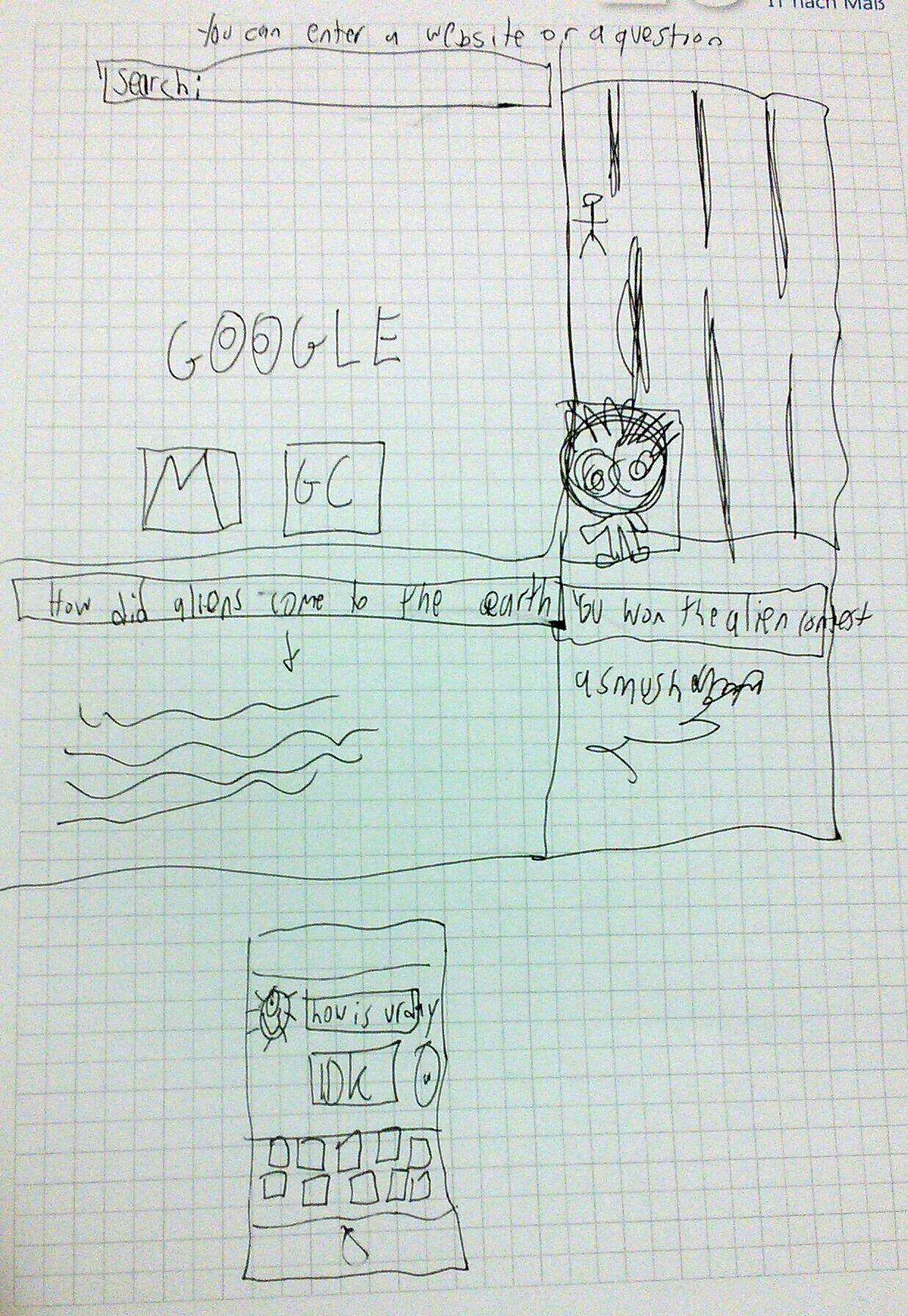
And what would be in a drawing that would explain the internet? Google, an alien using Twitch, Google search results, and the interface of an IM software on an iPhone drawn by a 13 year old boy And here s what he explains about his drawing:
First, I would draw what I see when you open a new tab, Google.
On the right side of the drawing we see something like Twitch.
I don t wanna offend the aliens, but you can film yourself playing a game, so here is the alien and he s playing a game.
And then you can ask questions like: How did aliens come to the Earth? And the answer will be here (below). And there ll be different websites that you can click on.
And you can also look up Who won the alien contest? And that would be Usmushgagu, and that guy won the alien contest.
Do you think the information about alien intergalactic football is already on the internet?
Yeah! That s how fast the internet is.
On the bottom of the drawing we see an iPhone and an instant messaging software.
There s also a device called an iPhone and with it you can text your friends. So here s the alien asking: How was ur day? and the friend might answer IDK [I don t know].
Imagine that a wise and friendly dragon could teach you one thing about the internet that you ve always wanted to know. What would you ask the dragon to teach you about?
Is there a way you don t have to pay for any channels or subscriptions and you can get through any firewall?
Imagine you could make the internet better for everyone. What would you do first?
Well you wouldn t have to pay for it [paywalls].
Can you describe what happens between your device and a website when you visit a website?
Well, it takes 0.025 seconds. [ ] It s connecting.
Wow, that s indeed fast! We were not able to obtain more details about what is that fast thing that s happening exactly

The software engineer s kid This kid identifies as neither boy nor girl, is 10 years old and lives in Germany. Their father works as a software engineer, or in the words of the child:
My dad knows everything.
The kid has a laptop and a mobile phone, both with parental control they don t think that the controlling is fair. This kid uses the internet foremostly for listening to music and watching prank channels on Youtube but also to work with Purple Mash (a teaching platform for the computing curriculum used at their school), finding 3d printing models (that they ask their father to print with them because they did not manage to use the printer by themselves yet). Interestingly, and very differently from the non-tech-parent kids, this kid insists on using Firefox and Signal - the latter is not only used by their dad to tell them to come downstairs for dinner, but also to call their grandmother. This kid also shops online, with the help of the father who does the actual shopping for them using money that the kid earned by reading books. If you would need to explain to an alien who has landed on Earth what the internet is, what would you tell them?
The internet is something where you search, for example, you can look for music. You can also watch videos from around the world, and you can program stuff.
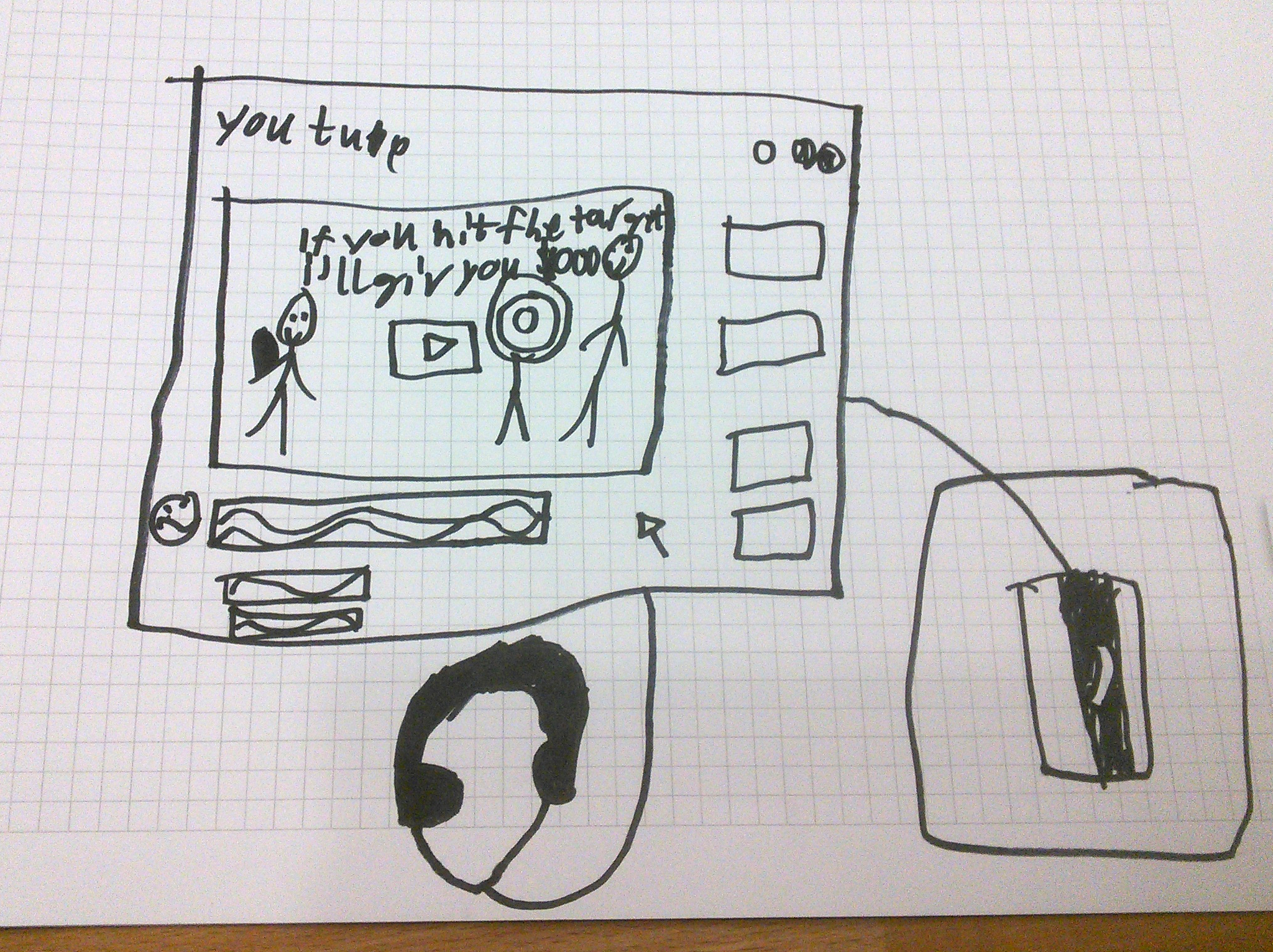
Like most of the kids interviewed, this kid uses the internet mostly for media consumption, but with the difference that they also engage with technology by way of programming using Purple Mash. drawing of the internet by a 10 year old showing a Youtube prank channel, an external device trackpad, and headphones In their drawing we see a Youtube prank channel on a screen, an external trackpad on the right (likely it s not a touch screen), and headphones. Notice how there is no keyboard, or maybe it s folded away. If you could ask a nice and friendly dragon anything you d like to learn about the internet, what would it be?
How do I shutdown my dad s computer forever?
And what is it that he would do to improve the internet for everyone? Contrary to the kid living in the US, they think that
It takes too much time to load stuff!
I wonder if this kid experiences the internet as being slow because they use the mobile network or because their connection somehow gets throttled as a way to control media consumption, or if the German internet infrastructure is just so much worse in certain regions If you could improve the internet for everyone, what would you do first? I d make a new Firefox app that loads the internet much faster.

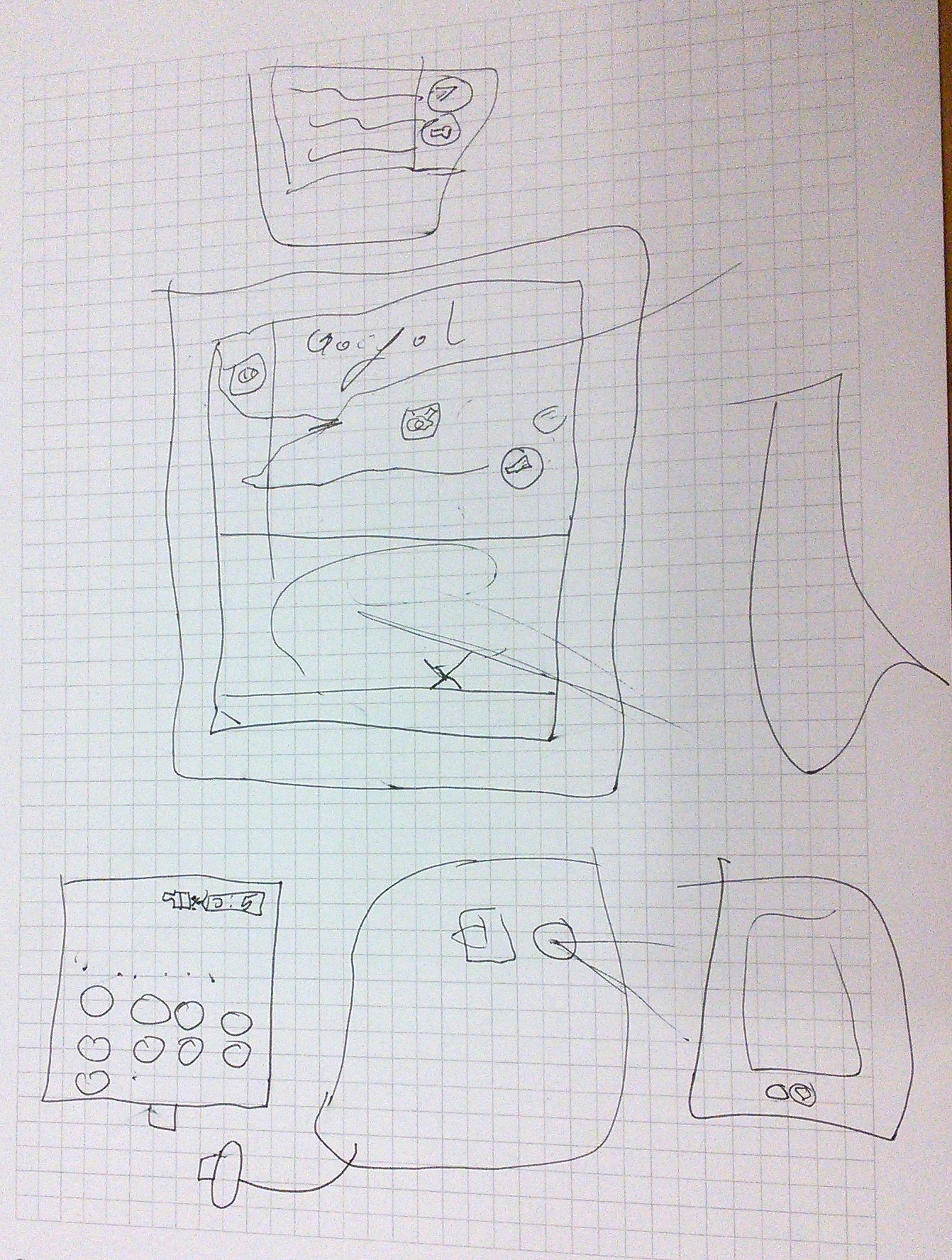
The software engineer s daughter This girl is only 8 years old, she hates unicorns, and her dad is also a software engineer. She uses a smartphone, controlled by her parents. My impression of the interview is that at this age, kids slightly mix up the internet with the devices that they use to access the internet. drawing of the internet by an 8 year old girl, Showing Google and the interface to call and text someone In her drawing, we see again Google - it s clearly everywhere - and also the interfaces for calling and texting someone. To explain what the internet is, besides the fact that one can use it for calling and listening to music, she says:
[The internet] is something that you can [use to] see someone who is far away, so that you don t need to take time to get to them.
Now, that s a great explanation, the internet providing the possibility for communication over a distance :) If she could ask a friendly dragon something she always wanted to know, she d ask how to make her phone come alive:
that it can talk to you, that it can see you, that it can smile and has eyes. It s like a new family member, you can talk to it.
Sounds a bit like Siri, Alexa, or Furby, doesn t it? If you could improve the internet for everyone, what would you do first? She d have the phone be able to decide over her free time, her phone time. That would make the world better, not for the kids, but certainly for the parents.

The antifascist kid This German boy s dad has a background in electrotechnical engineering. He s 10 years old and he told me he s using the internet a lot for searching things for example about his passion: the firefighters. For him, the internet is:
An invisible world. A virtual world. But there s also the darknet.
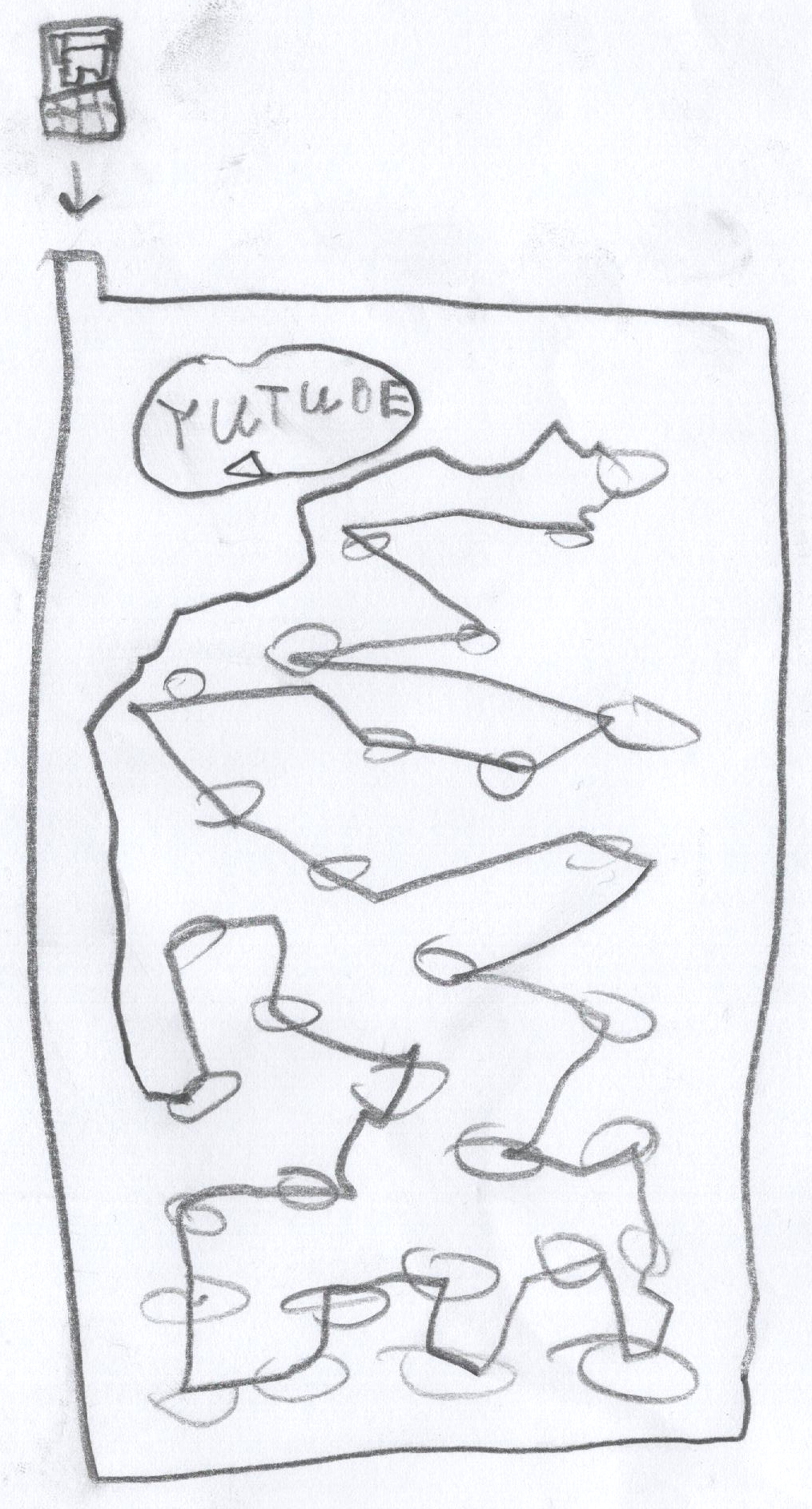
He told me he always watches that German show on public TV for kids that explains stuff: Checker Tobi. (In 2014, Checker Tobi actually produced an episode about the internet, which I d criticize for having only male characters, except for one female character: a secretary Google, a nice and friendly woman guiding the way through the huge library that s the internet ) This kid was the only one interviewed who managed to actually explain something about the internet, or rather about the hypertextual structure of the web. When I asked him to draw the internet, he made a drawing of a pin board. He explained:
Many items are attached to the pin board, and on the top left corner there s a computer, for example with Youtube and one can navigate like that between all the items, and start again from the beginning when done.
hypertext structure representing the internet drawn by a kid When I asked if he knew what actually happens between the device and a website he visits, he put forth the hypothesis of the existence of some kind of
Waves, internet waves - all this stuff somehow needs to be transmitted.
What he d like to learn:
How to get into the darknet? How do you become a Whitehat? I ve heard these words on the internet, the internet makes me clever.
And what would he change on the internet if he could?
I want that right wing extreme stuff is not accessible anymore, or at least, that it rains turds ( Kackw rste ) whenever people watch such stuff. Or that people are always told: This video is scum.
I suspect that his father has been talking with him about these things, and maybe these are also subjects he heard about when listening to punk music (he told me he does), or browsing Youtube.

Future projects To me this has been pretty insightful. I might share some more internet drawings by adults in the future, which I think are also really interesting, as they show very different things depending on the age of the person. I ve been using the information gathered to work on a children s book which I hope to be able to share with you next year.

Russ Allbery: Review: The Afterward

Review: The Afterward, by E.K. Johnston
Publisher: Dutton Books
Copyright: February 2019
Printing: 2020
ISBN: 0-7352-3190-7
Format: Kindle
Pages: 339
The Afterward is a standalone young adult high fantasy with a substantial romance component. The title is not misspelled. Sir Erris and her six companions, matching the number of the new gods, were successful in their quest for the godsgem. They defeated the Old God and destroyed Him forever, freeing King Dorrenta from his ensorcellment, and returned in triumph to Cadrium to live happily ever after. Or so the story goes. Sir Erris and three of the companions are knights. Another companion is the best mage in the kingdom. Kalanthe Ironheart, who distracted the Old God at a critical moment and allowed Sir Erris to strike, is only an apprentice due to her age, but surely will become a great knight. And then there is Olsa Rhetsdaughter, the lowborn thief, now somewhat mockingly called Thief of the Realm for all the good that does her. The reward was enough for her to buy her freedom from the Thief's Court. It was not enough to pay for food after that, or enough for her to change her profession, and the Thief's Court no longer has any incentive to give her easy (or survivable) assignments. Kalanthe is in a considerably better position, but she still needs a good marriage. Her reward paid off half of her debt, which broadens her options, but she's still a debt-knight, liable for the full cost of her training once she reaches the age of nineteen. She's mostly made her peace with the decisions she made given her family's modest means, but marriages of that type are usually for heirs, and Kalanthe is not looking forward to bearing a child. Or, for that matter, sleeping with a man. Olsa and Kalanthe fell in love during the Quest. Given Kalanthe's debt and the way it must be paid, and her iron-willed determination to keep vows, neither of them expected their relationship to survive the end of the Quest. Both of them wish that it had. The hook is that this novel picks up after the epic fantasy quest is over and everyone went home. This is not an entirely correct synopsis; chapters of The Afterward alternate between "After" and "Before" (and one chapter delightfully titled "More or less the exact moment of"), and by the end of the book we get much of the story of the Quest. It's not told from the perspective of the lead heroes, though; it's told by following Kalanthe and Olsa, who would be firmly relegated to supporting characters in a typical high fantasy. And it's largely told through the lens of their romance. This is not the best fantasy novel I've read, but I had a fun time with it. I am now curious about the intended audience and marketing, though. It was published by a YA imprint, and both the ages of the main characters and the general theme of late teenagers trying to chart a course in an adult world match that niche. But it's also clearly intended for readers who have read enough epic fantasy quests that they will both be amused by the homage and not care that the story elides a lot of the typical details. Anyone who read David Eddings at an impressionable age will enjoy the way Johnston pokes gentle fun at The Belgariad (this book is dedicated to David and Leigh Eddings), but surely the typical reader of YA fantasy these days isn't also reading Eddings. I'm therefore not quite sure who this book was for, but apparently that group included me. Johnston thankfully is not on board with the less savory parts of Eddings's writing, as you might have guessed from the sapphic romance. There is no obnoxious gender essentialism here, although there do appear to be gender roles that I never quite figured out. Knights are referred to as sir, but all of the knights in this story are women. Men still seem to run a lot of things (kingdoms, estates, mage colleges), but apart from the mage, everyone on the Quest was female, and there seems to be an expectation that women go out into the world and have adventures while men stay home. I'm not sure if there was an underlying system that escaped me, or if Johnston just mixed things up for the hell of it. (If the latter, I approve.) This book does suffer a bit from addressing some current-day representation issues without managing to fold them naturally into the story or setting. One of the Quest knights is transgender, something that's revealed in a awkward couple of paragraphs and then never mentioned again. Two of the characters have a painfully earnest conversation about the word "bisexual," complete with a strained attempt at in-universe etymology. Racial diversity (Olsa is black, and Kalanthe is also not white) seemed to be handled a bit better, although I am not the reader to notice if the discussions of hair maintenance were similarly awkward. This is way better than no representation and default-white characters, to be clear, but it felt a bit shoehorned in at times and could have used some more polish. These are quibbles, though. Olsa was the heart of the book for me, and is exactly the sort of character I like to read about. Kalanthe is pure stubborn paladin, but I liked her more and more as the story continued. She provides a good counterbalance to Olsa's natural chaos. I do wish Olsa had more opportunities to show her own competence (she's not a very good thief, she's just the thief that Sir Erris happened to know), but the climax of the story was satisfying. My main grumble is that I badly wanted to dwell on the happily-ever-after for at least another chapter, ideally two. Johnston was done with the story before I was. The writing was serviceable but not great and there are some bits that I don't think would stand up to a strong poke, but the characters carried the story for me. Recommended if you'd like some sapphic romance and lightweight class analysis complicating your Eddings-style quest fantasy. Rating: 7 out of 10

27 December 2023

David Bremner: Generating links to a web IDE from org-beamer

The Emacs part is superceded by a cleaner approach I the upcoming term I want to use KC Lu's web based stacker tool. The key point is that it takes (small) programs encoded as part of the url. Yesterday I spent some time integrating it into my existing org-beamer workflow. In my init.el I have
(defun org-babel-execute:stacker (body params)
  (let* ((table '(? ?\n ?: ?/ ?? ?# ?[ ?] ?@ ?! ?$ ?& ??
                    ?( ?) ?* ?+ ?, ?= ?%))
         (slug (org-link-encode body table))
         (simplified (replace-regexp-in-string "[%]20" "+" slug nil 'literal)))
    (format "\\stackerlink %s " simplified)))
This means that when I "execute" the block below with C-c C-c, it updates the link, which is then embedded in the slides.
#+begin_src stacker :results value latex :exports both
  (deffun (f x)
    (let ([y 2])
      (+ x y)))
  (f 7)
#+end_src
#+RESULTS:
#+begin_export latex
\stackerlink %28deffun+%28f+x%29%0A++%28let+%28%5By+2%5D%29%0A++++%28%2B+x+y%29%29%29%0A%28f+7%29 
#+end_export
The \stackerlink macro is probably fancier than needed. One could just use \href from hyperref.sty, but I wanted to match the appearence of other links in my documents (buttons in the margins). This is based on a now lost answer from stackoverflow.com; I think it wasn't this one, but you get the main idea: use \hyper@normalise.
\makeatletter
% define \stacker@base appropriately
\DeclareRobustCommand* \stackerlink \hyper@normalise\stackerlink@ 
\def\stackerlink@#1 %
  \begin tikzpicture [overlay]%
    \coordinate (here) at (0,0);%
    \draw (current page.south west  - here)%
    node[xshift=2ex,yshift=3.5ex,fill=magenta,inner sep=1pt]%
     \hyper@linkurl \tiny\textcolor white stacker \stacker@base?program=#1 ; %
  \end tikzpicture 
\makeatother

Russ Allbery: Review: A Study in Scarlet

Review: A Study in Scarlet, by Arthur Conan Doyle
Series: Sherlock Holmes #1
Publisher: AmazonClassics
Copyright: 1887
Printing: February 2018
ISBN: 1-5039-5525-7
Format: Kindle
Pages: 159
A Study in Scarlet is the short mystery novel (probably a novella, although I didn't count words) that introduced the world to Sherlock Holmes. I'm going to invoke the 100-year-rule and discuss the plot of this book rather freely on the grounds that even someone who (like me prior to a few days ago) has not yet read it is probably not that invested in avoiding all spoilers. If you do want to remain entirely unspoiled, exercise caution before reading on. I had somehow managed to avoid ever reading anything by Arthur Conan Doyle, not even a short story. I therefore couldn't be sure that some of the assertions I was making in my review of A Study in Honor were correct. Since A Study in Scarlet would be quick to read, I decided on a whim to do a bit of research and grab a free copy of the first Holmes novel. Holmes is such a part of English-speaking culture that I thought I had a pretty good idea of what to expect. This was largely true, but cultural osmosis had somehow not prepared me for the surprise Mormons. A Study in Scarlet establishes the basic parameters of a Holmes story: Dr. James Watson as narrator, the apartment he shares with Holmes at 221B Baker Street, the Baker Street Irregulars, Holmes's competition with police detectives, and his penchant for making leaps of logical deduction from subtle clues. The story opens with Watson meeting Holmes, agreeing to split the rent of a flat, and being baffled by the apparent randomness of Holmes's fields of study before Holmes reveals he's a consulting detective. The first case is a murder: a man is found dead in an abandoned house, without a mark on him although there are blood splatters on the walls and the word "RACHE" written in blood. Since my only prior exposure to Holmes was from cultural references and a few TV adaptations, there were a few things that surprised me. One is that Holmes is voluble and animated rather than aloof. Doyle is clearly going for passionate eccentric rather than calculating mastermind. Another is that he is intentionally and unabashedly ignorant on any topic not related to solving mysteries.
My surprise reached a climax, however, when I found incidentally that he was ignorant of the Copernican Theory and of the composition of the Solar System. That any civilized human being in this nineteenth century should not be aware that the earth travelled round the sun appeared to be to me such an extraordinary fact that I could hardly realize it. "You appear to be astonished," he said, smiling at my expression of surprise. "Now that I do know it I shall do my best to forget it." "To forget it!" "You see," he explained, "I consider that a man's brain originally is like a little empty attic, and you have to stock it with such furniture as you chose. A fool takes in all the lumber of every sort that he comes across, so that the knowledge which might be useful to him gets crowded out, or at best is jumbled up with a lot of other things so that he has a difficulty in laying his hands upon it. Now the skilful workman is very careful indeed as to what he takes into his brain-attic. He will have nothing but the tools which may help him in doing his work, but of these he has a large assortment, and all in the most perfect order. It is a mistake to think that that little room has elastic walls and can distend to any extent. Depend upon it there comes a time when for every addition of knowledge you forget something that you knew before. It is of the highest importance, therefore, not to have useless facts elbowing out the useful ones."
This is directly contrary to my expectation that the best way to make leaps of deduction is to know something about a huge range of topics so that one can draw unexpected connections, particularly given the puzzle-box construction and odd details so beloved in classic mysteries. I'm now curious if Doyle stuck with this conception, and if there were any later mysteries that involved astronomy. Speaking of classic mysteries, A Study in Scarlet isn't quite one, although one can see the shape of the genre to come. Doyle does not "play fair" by the rules that have not yet been invented. Holmes at most points knows considerably more than the reader, including bits of evidence that are not described until Holmes describes them and research that Holmes does off-camera and only reveals when he wants to be dramatic. This is not the sort of story where the reader is encouraged to try to figure out the mystery before the detective. Rather, what Doyle seems to be aiming for, and what Watson attempts (unsuccessfully) as the reader surrogate, is slightly different: once Holmes makes one of his grand assertions, the reader is encouraged to guess what Holmes might have done to arrive at that conclusion. Doyle seems to want the reader to guess technique rather than outcome, while providing only vague clues in general descriptions of Holmes's behavior at a crime scene. The structure of this story is quite odd. The first part is roughly what you would expect: first-person narration from Watson, supposedly taken from his journals but not at all in the style of a journal and explicitly written for an audience. Part one concludes with Holmes capturing and dramatically announcing the name of the killer, who the reader has never heard of before. Part two then opens with... a western?
In the central portion of the great North American Continent there lies an arid and repulsive desert, which for many a long year served as a barrier against the advance of civilization. From the Sierra Nevada to Nebraska, and from the Yellowstone River in the north to the Colorado upon the south, is a region of desolation and silence. Nor is Nature always in one mood throughout the grim district. It comprises snow-capped and lofty mountains, and dark and gloomy valleys. There are swift-flowing rivers which dash through jagged ca ons; and there are enormous plains, which in winter are white with snow, and in summer are grey with the saline alkali dust. They all preserve, however, the common characteristics of barrenness, inhospitality, and misery.
First, I have issues with the geography. That region contains some of the most beautiful areas on earth, and while a lot of that region is arid, describing it primarily as a repulsive desert is a bit much. Doyle's boundaries and distances are also confusing: the Yellowstone is a northeast-flowing river with its source in Wyoming, so the area between it and the Colorado does not extend to the Sierra Nevadas (or even to Utah), and it's not entirely clear to me that he realizes Nevada exists. This is probably what it's like for people who live anywhere else in the world when US authors write about their country. But second, there's no Holmes, no Watson, and not even the pretense of a transition from the detective novel that we were just reading. Doyle just launches into a random western with an omniscient narrator. It features a lean, grizzled man and an adorable child that he adopts and raises into a beautiful free spirit, who then falls in love with a wild gold-rush adventurer. This was written about 15 years before the first critically recognized western novel, so I can't blame Doyle for all the cliches here, but to a modern reader all of these characters are straight from central casting. Well, except for the villains, who are the Mormons. By that, I don't mean that the villains are Mormon. I mean Brigham Young is the on-page villain, plotting against the hero to force his adopted daughter into a Mormon harem (to use the word that Doyle uses repeatedly) and ruling Salt Lake City with an iron hand, border guards with passwords (?!), and secret police. This part of the book was wild. I was laughing out-loud at the sheer malevolent absurdity of the thirty-day countdown to marriage, which I doubt was the intended effect. We do eventually learn that this is the backstory of the murder, but we don't return to Watson and Holmes for multiple chapters. Which leads me to the other thing that surprised me: Doyle lays out this backstory, but then never has his characters comment directly on the morality of it, only the spectacle. Holmes cares only for the intellectual challenge (and for who gets credit), and Doyle sets things up so that the reader need not concern themselves with aftermath, punishment, or anything of that sort. I probably shouldn't have been surprised this does fit with the Holmes stereotype but I'm used to modern fiction where there is usually at least some effort to pass judgment on the events of the story. Doyle draws very clear villains, but is utterly silent on whether the murder is justified. Given its status in the history of literature, I'm not sorry to have read this book, but I didn't particularly enjoy it. It is very much of its time: everyone's moral character is linked directly to their physical appearance, and Doyle uses the occasional racial stereotype without a second thought. Prevailing writing styles have changed, so the prose feels long-winded and breathless. The rivalry between Holmes and the police detectives is tedious and annoying. I also find it hard to read novels from before the general absorption of techniques of emotional realism and interiority into all genres. The characters in A Study in Scarlet felt more like cartoon characters than fully-realized human beings. I have no strong opinion about the objective merits of this book in the context of its time other than to note that the sudden inserted western felt very weird. My understanding is that this is not considered one of the better Holmes stories, and Holmes gets some deeper characterization later on. Maybe I'll try another of Doyle's works someday, but for now my curiosity has been sated. Followed by The Sign of the Four. Rating: 4 out of 10

25 December 2023

Sergio Talens-Oliag: GitLab CI/CD Tips: Automatic Versioning Using semantic-release

This post describes how I m using semantic-release on gitlab-ci to manage versioning automatically for different kinds of projects following a simple workflow (a develop branch where changes are added or merged to test new versions, a temporary release/#.#.# to generate the release candidate versions and a main branch where the final versions are published).

What is semantic-releaseIt is a Node.js application designed to manage project versioning information on Git Repositories using a Continuous integration system (in this post we will use gitlab-ci)

How does it workBy default semantic-release uses semver for versioning (release versions use the format MAJOR.MINOR.PATCH) and commit messages are parsed to determine the next version number to publish. If after analyzing the commits the version number has to be changed, the command updates the files we tell it to (i.e. the package.json file for nodejs projects and possibly a CHANGELOG.md file), creates a new commit with the changed files, creates a tag with the new version and pushes the changes to the repository. When running on a CI/CD system we usually generate the artifacts related to a release (a package, a container image, etc.) from the tag, as it includes the right version number and usually has passed all the required tests (it is a good idea to run the tests again in any case, as someone could create a tag manually or we could run extra jobs when building the final assets if they fail it is not a big issue anyway, numbers are cheap and infinite, so we can skip releases if needed).

Commit messages and versioningThe commit messages must follow a known format, the default module used to analyze them uses the angular git commit guidelines, but I prefer the conventional commits one, mainly because it s a lot easier to use when you want to update the MAJOR version. The commit message format used must be:
<type>(optional scope): <description>
[optional body]
[optional footer(s)]
The system supports three types of branches: release, maintenance and pre-release, but for now I m not using maintenance ones. The branches I use and their types are:
  • main as release branch (final versions are published from there)
  • develop as pre release branch (used to publish development and testing versions with the format #.#.#-SNAPSHOT.#)
  • release/#.#.# as pre release branches (they are created from develop to publish release candidate versions with the format #.#.#-rc.# and once they are merged with main they are deleted)
On the release branch (main) the version number is updated as follows:
  1. The MAJOR number is incremented if a commit with a BREAKING CHANGE: footer or an exclamation (!) after the type/scope is found in the list of commits found since the last version change (it looks for tags on the same branch).
  2. The MINOR number is incremented if the MAJOR number is not going to be changed and there is a commit with type feat in the commits found since the last version change.
  3. The PATCH number is incremented if neither the MAJOR nor the MINOR numbers are going to be changed and there is a commit with type fix in the the commits found since the last version change.
On the pre release branches (develop and release/#.#.#) the version and pre release numbers are always calculated from the last published version available on the branch (i. e. if we published version 1.3.2 on main we need to have the commit with that tag on the develop or release/#.#.# branch to get right what will be the next version). The version number is updated as follows:
  1. The MAJOR number is incremented if a commit with a BREAKING CHANGE: footer or an exclamation (!) after the type/scope is found in the list of commits found since the last released version.In our example it was 1.3.2 and the version is updated to 2.0.0-SNAPSHOT.1 or 2.0.0-rc.1 depending on the branch.
  2. The MINOR number is incremented if the MAJOR number is not going to be changed and there is a commit with type feat in the commits found since the last released version.In our example the release was 1.3.2 and the version is updated to 1.4.0-SNAPSHOT.1 or 1.4.0-rc.1 depending on the branch.
  3. The PATCH number is incremented if neither the MAJOR nor the MINOR numbers are going to be changed and there is a commit with type fix in the the commits found since the last version change.In our example the release was 1.3.2 and the version is updated to 1.3.3-SNAPSHOT.1 or 1.3.3-rc.1 depending on the branch.
  4. The pre release number is incremented if the MAJOR, MINOR and PATCH numbers are not going to be changed but there is a commit that would otherwise update the version (i.e. a fix on 1.3.3-SNAPSHOT.1 will set the version to 1.3.3-SNAPSHOT.2, a fix or feat on 1.4.0-rc.1 will set the version to 1.4.0-rc.2 an so on).

How do we manage its configurationAlthough the system is designed to work with nodejs projects, it can be used with multiple programming languages and project types. For nodejs projects the usual place to put the configuration is the project s package.json, but I prefer to use the .releaserc file instead. As I use a common set of CI templates, instead of using a .releaserc on each project I generate it on the fly on the jobs that need it, replacing values related to the project type and the current branch on a template using the tmpl command (lately I use a branch of my own fork while I wait for some feedback from upstream, as you will see on the Dockerfile).

Container used to run itAs we run the command on a gitlab-ci job we use the image built from the following Dockerfile:
Dockerfile
# Semantic release image
FROM golang:alpine AS tmpl-builder
#RUN go install github.com/krakozaure/tmpl@v0.4.0
RUN go install github.com/sto/tmpl@v0.4.0-sto.2
FROM node:lts-alpine
COPY --from=tmpl-builder /go/bin/tmpl /usr/local/bin/tmpl
RUN apk update &&\
  apk upgrade &&\
  apk add curl git jq openssh-keygen yq zip &&\
  npm install --location=global\
    conventional-changelog-conventionalcommits@6.1.0\
    @qiwi/multi-semantic-release@7.0.0\
    semantic-release@21.0.7\
    @semantic-release/changelog@6.0.3\
    semantic-release-export-data@1.0.1\
    @semantic-release/git@10.0.1\
    @semantic-release/gitlab@9.5.1\
    @semantic-release/release-notes-generator@11.0.4\
    semantic-release-replace-plugin@1.2.7\
    semver@7.5.4\
  &&\
  rm -rf /var/cache/apk/*
CMD ["/bin/sh"]

How and when is it executedThe job that runs semantic-release is executed when new commits are added to the develop, release/#.#.# or main branches (basically when something is merged or pushed) and after all tests have passed (we don t want to create a new version that does not compile or passes at least the unit tests). The job is something like the following:
semantic_release:
  image: $SEMANTIC_RELEASE_IMAGE
  rules:
    - if: '$CI_COMMIT_BRANCH =~ /^(develop main release\/\d+.\d+.\d+)$/'
      when: always
  stage: release
  before_script:
    - echo "Loading scripts.sh"
    - . $ASSETS_DIR/scripts.sh
  script:
    - sr_gen_releaserc_json
    - git_push_setup
    - semantic-release
Where the SEMANTIC_RELEASE_IMAGE variable contains the URI of the image built using the Dockerfile above and the sr_gen_releaserc_json and git_push_setup are functions defined on the $ASSETS_DIR/scripts.sh file:
  • The sr_gen_releaserc_json function generates the .releaserc.json file using the tmpl command.
  • The git_push_setup function configures git to allow pushing changes to the repository with the semantic-release command, optionally signing them with a SSH key.

The sr_gen_releaserc_json functionThe code for the sr_gen_releaserc_json function is the following:
sr_gen_releaserc_json()
 
  # Use nodejs as default project_type
  project_type="$ PROJECT_TYPE:-nodejs "
  # REGEX to match the rc_branch name
  rc_branch_regex='^release\/[0-9]\+\.[0-9]\+\.[0-9]\+$'
  # PATHS on the local ASSETS_DIR
  assets_dir="$ CI_PROJECT_DIR /$ ASSETS_DIR "
  sr_local_plugin="$ assets_dir /local-plugin.cjs"
  releaserc_tmpl="$ assets_dir /releaserc.json.tmpl"
  pipeline_runtime_values_yaml="/tmp/releaserc_values.yaml"
  pipeline_values_yaml="$ assets_dir /values_$ project_type _project.yaml"
  # Destination PATH
  releaserc_json=".releaserc.json"
  # Create an empty pipeline_values_yaml if missing
  test -f "$pipeline_values_yaml"   : >"$pipeline_values_yaml"
  # Create the pipeline_runtime_values_yaml file
  echo "branch: $ CI_COMMIT_BRANCH " >"$pipeline_runtime_values_yaml"
  echo "gitlab_url: $ CI_SERVER_URL " >"$pipeline_runtime_values_yaml"
  # Add the rc_branch name if we are on an rc_branch
  if [ "$(echo "$CI_COMMIT_BRANCH"   sed -ne "/$rc_branch_regex/ p ")" ]; then
    echo "rc_branch: $ CI_COMMIT_BRANCH " >>"$pipeline_runtime_values_yaml"
  elif [ "$(echo "$CI_MERGE_REQUEST_SOURCE_BRANCH_NAME"  
      sed -ne "/$rc_branch_regex/ p ")" ]; then
    echo "rc_branch: $ CI_MERGE_REQUEST_SOURCE_BRANCH_NAME " \
      >>"$pipeline_runtime_values_yaml"
  fi
  echo "sr_local_plugin: $ sr_local_plugin " >>"$pipeline_runtime_values_yaml"
  # Create the releaserc_json file
  tmpl -f "$pipeline_runtime_values_yaml" -f "$pipeline_values_yaml" \
    "$releaserc_tmpl"   jq . >"$releaserc_json"
  # Remove the pipeline_runtime_values_yaml file
  rm -f "$pipeline_runtime_values_yaml"
  # Print the releaserc_json file
  print_file_collapsed "$releaserc_json"
  # --*-- BEG: NOTE --*--
  # Rename the package.json to ignore it when calling semantic release.
  # The idea is that the local-plugin renames it back on the first step of the
  # semantic-release process.
  # --*-- END: NOTE --*--
  if [ -f "package.json" ]; then
    echo "Renaming 'package.json' to 'package.json_disabled'"
    mv "package.json" "package.json_disabled"
  fi
 
Almost all the variables used on the function are defined by gitlab except the ASSETS_DIR and PROJECT_TYPE; in the complete pipelines the ASSETS_DIR is defined on a common file included by all the pipelines and the project type is defined on the .gitlab-ci.yml file of each project. If you review the code you will see that the file processed by the tmpl command is named releaserc.json.tmpl, its contents are shown here:
 
  "plugins": [
     - if .sr_local_plugin  
    "  .sr_local_plugin  ",
     - end  
    [
      "@semantic-release/commit-analyzer",
       
        "preset": "conventionalcommits",
        "releaseRules": [
            "breaking": true, "release": "major"  ,
            "revert": true, "release": "patch"  ,
            "type": "feat", "release": "minor"  ,
            "type": "fix", "release": "patch"  ,
            "type": "perf", "release": "patch"  
        ]
       
    ],
     - if .replacements  
    [
      "semantic-release-replace-plugin",
        "replacements":   .replacements   toJson    
    ],
     - end  
    "@semantic-release/release-notes-generator",
     - if eq .branch "main"  
    [
      "@semantic-release/changelog",
        "changelogFile": "CHANGELOG.md", "changelogTitle": "# Changelog"  
    ],
     - end  
    [
      "@semantic-release/git",
       
        "assets":   if .assets   .assets   toJson   else  []  end  ,
        "message": "ci(release): v$ nextRelease.version \n\n$ nextRelease.notes "
       
    ],
    [
      "@semantic-release/gitlab",
        "gitlabUrl": "  .gitlab_url  ", "successComment": false  
    ]
  ],
  "branches": [
      "name": "develop", "prerelease": "SNAPSHOT"  ,
     - if .rc_branch  
      "name": "  .rc_branch  ", "prerelease": "rc"  ,
     - end  
    "main"
  ]
 
The values used to process the template are defined on a file built on the fly (releaserc_values.yaml) that includes the following keys and values:
  • branch: the name of the current branch
  • gitlab_url: the URL of the gitlab server (the value is taken from the CI_SERVER_URL variable)
  • rc_branch: the name of the current rc branch; we only set the value if we are processing one because semantic-release only allows one branch to match the rc prefix and if we use a wildcard (i.e. release/*) but the users keep more than one release/#.#.# branch open at the same time the calls to semantic-release will fail for sure.
  • sr_local_plugin: the path to the local plugin we use (shown later)
The template also uses a values_$ project_type _project.yaml file that includes settings specific to the project type, the one for nodejs is as follows:
replacements:
  - files:
      - "package.json"
    from: "\"version\": \".*\""
    to: "\"version\": \"$ nextRelease.version \""
assets:
  - "CHANGELOG.md"
  - "package.json"
The replacements section is used to update the version field on the relevant files of the project (in our case the package.json file) and the assets section includes the files that will be committed to the repository when the release is published (looking at the template you can see that the CHANGELOG.md is only updated for the main branch, we do it this way because if we update the file on other branches it creates a merge nightmare and we are only interested on it for released versions anyway). The local plugin adds code to rename the package.json_disabled file to package.json if present and prints the last and next versions on the logs with a format that can be easily parsed using sed:
local-plugin.cjs
// Minimal plugin to:
// - rename the package.json_disabled file to package.json if present
// - log the semantic-release last & next versions
function verifyConditions(pluginConfig, context)  
  var fs = require('fs');
  if (fs.existsSync('package.json_disabled'))  
    fs.renameSync('package.json_disabled', 'package.json');
    context.logger.log( verifyConditions: renamed 'package.json_disabled' to 'package.json' );
   
 
function analyzeCommits(pluginConfig, context)  
  if (context.lastRelease && context.lastRelease.version)  
    context.logger.log( analyzeCommits: LAST_VERSION=$ context.lastRelease.version  );
   
 
function verifyRelease(pluginConfig, context)  
  if (context.nextRelease && context.nextRelease.version)  
    context.logger.log( verifyRelease: NEXT_VERSION=$ context.nextRelease.version  );
   
 
module.exports =  
  verifyConditions,
  analyzeCommits,
  verifyRelease
 

The git_push_setup functionThe code for the git_push_setup function is the following:
git_push_setup()
 
  # Update global credentials to allow git clone & push for all the group repos
  git config --global credential.helper store
  cat >"$HOME/.git-credentials" <<EOF
https://fake-user:$ GITLAB_REPOSITORY_TOKEN @gitlab.com
EOF
  # Define user name, mail and signing key for semantic-release
  user_name="$SR_USER_NAME"
  user_email="$SR_USER_EMAIL"
  ssh_signing_key="$SSH_SIGNING_KEY"
  # Export git user variables
  export GIT_AUTHOR_NAME="$user_name"
  export GIT_AUTHOR_EMAIL="$user_email"
  export GIT_COMMITTER_NAME="$user_name"
  export GIT_COMMITTER_EMAIL="$user_email"
  # Sign commits with ssh if there is a SSH_SIGNING_KEY variable
  if [ "$ssh_signing_key" ]; then
    echo "Configuring GIT to sign commits with SSH"
    ssh_keyfile="/tmp/.ssh-id"
    : >"$ssh_keyfile"
    chmod 0400 "$ssh_keyfile"
    echo "$ssh_signing_key"   tr -d '\r' >"$ssh_keyfile"
    git config gpg.format ssh
    git config user.signingkey "$ssh_keyfile"
    git config commit.gpgsign true
  fi
 
The function assumes that the GITLAB_REPOSITORY_TOKEN variable (set on the CI/CD variables section of the project or group we want) contains a token with read_repository and write_repository permissions on all the projects we are going to use this function. The SR_USER_NAME and SR_USER_EMAIL variables can be defined on a common file or the CI/CD variables section of the project or group we want to work with and the script assumes that the optional SSH_SIGNING_KEY is exported as a CI/CD default value of type variable (that is why the keyfile is created on the fly) and git is configured to use it if the variable is not empty.
Warning: Keep in mind that the variables GITLAB_REPOSITORY_TOKEN and SSH_SIGNING_KEY contain secrets, so probably is a good idea to make them protected (if you do that you have to make the develop, main and release/* branches protected too).
Warning: The semantic-release user has to be able to push to all the projects on those protected branches, it is a good idea to create a dedicated user and add it as a MAINTAINER for the projects we want (the MAINTAINERS need to be able to push to the branches), or, if you are using a Gitlab with a Premium license you can use the api to allow the semantic-release user to push to the protected branches without allowing it for any other user.

The semantic-release commandOnce we have the .releaserc file and the git configuration ready we run the semantic-release command. If the branch we are working with has one or more commits that will increment the version, the tool does the following (note that the steps are described are the ones executed if we use the configuration we have generated):
  1. It detects the commits that will increment the version and calculates the next version number.
  2. Generates the release notes for the version.
  3. Applies the replacements defined on the configuration (in our example updates the version field on the package.json file).
  4. Updates the CHANGELOG.md file adding the release notes if we are going to publish the file (when we are on the main branch).
  5. Creates a commit if all or some of the files listed on the assets key have changed and uses the commit message we have defined, replacing the variables for their current values.
  6. Creates a tag with the new version number and the release notes.
  7. As we are using the gitlab plugin after tagging it also creates a release on the project with the tag name and the release notes.

Notes about the git workflows and merges between branchesIt is very important to remember that semantic-release looks at the commits of a given branch when calculating the next version to publish, that has two important implications:
  1. On pre release branches we need to have the commit that includes the tag with the released version, if we don t have it the next version is not calculated correctly.
  2. It is a bad idea to squash commits when merging a branch to another one, if we do that we will lose the information semantic-release needs to calculate the next version and even if we use the right prefix for the squashed commit (fix, feat, ) we miss all the messages that would otherwise go to the CHANGELOG.md file.
To make sure that we have the right commits on the pre release branches we should merge the main branch changes into the develop one after each release tag is created; in my pipelines the fist job that processes a release tag creates a branch from the tag and an MR to merge it to develop. The important thing about that MR is that is must not be squashed, if we do that the tag commit will probably be lost, so we need to be careful. To merge the changes directly we can run the following code:
# Set the SR_TAG variable to the tag you want to process
SR_TAG="v1.3.2"
# Fetch all the changes
git fetch --all --prune
# Switch to the main branch
git switch main
# Pull all the changes
git pull
# Switch to the development branch
git switch develop
# Pull all the changes
git pull
# Create followup branch from tag
git switch -c "followup/$SR_TAG" "$SR_TAG"
# Change files manually & commit the changed files
git commit -a --untracked-files=no -m "ci(followup): $SR_TAG to develop"
# Switch to the development branch
git switch develop
# Merge the followup branch into the development one using the --no-ff option
git merge --no-ff "followup/$SR_TAG"
# Remove the followup branch
git branch -d "followup/$SR_TAG"
# Push the changes
git push
If we can t push directly to develop we can create a MR pushing the followup branch after committing the changes, but we have to make sure that we don t squash the commits when merging or it will not work as we want.

22 December 2023

Gunnar Wolf: Pushing some reviews this way

Over roughly the last year and a half I have been participating as a reviewer in ACM s Computing Reviews, and have even been honored as a Featured Reviewer. Given I have long enjoyed reading friends reviews of their reading material (particularly, hats off to the very active Russ Allbery, who both beats all of my frequency expectations (I could never sustain the rythm he reads to!) and holds documented records for his >20 years as a book reader, with far more clarity and readability than I can aim for!), I decided to explicitly share my reviews via this blog, as the audience is somewhat congruent; I will also link here some reviews that were not approved for publication, clearly marking them so. I will probably work on wrangling my Jekyll site to display an (auto-)updated page and RSS feed for the reviews. In the meantime, the reviews I have published are:

Russ Allbery: Review: Wintersmith

Review: Wintersmith, by Terry Pratchett
Series: Discworld #35
Publisher: Clarion Books
Copyright: 2006
Printing: 2007
ISBN: 0-06-089033-9
Format: Mass market
Pages: 450
Wintersmith is the 35th Discworld novel and the 3rd Tiffany Aching novel. You could probably start here, since understanding the backstory isn't vital for following the plot, but I'm not sure why you would. Tiffany is now training with Miss Treason, a 113-year-old witch who is quite different in her approach from Miss Level, Tiffany's mentor in A Hat Full of Sky. Miss Level was the unassuming and constantly helpful glue that held the neighborhood together. Miss Treason is the judge; her neighbors are scared of her and proud of being scared of her, since that means they have a proper witch who can see into their heads and sort out their problems. On the surface, they're quite different; part of the story of this book is Tiffany learning to see the similarities. First, though, Miss Treason rushes Tiffany to a strange midnight Morris Dance, without any explanation. The Morris Dance usually celebrates the coming of spring and is at the center of a village party, so Tiffany is quite confused by seeing it danced on a dark and windy night in late autumn. But there is a hole in the dance where the Fool normally is, and Tiffany can't keep herself from joining it. This proves to be a mistake. That space was left for someone very different from Tiffany, and now she's entangled herself in deep magic that she doesn't understand. This is another Pratchett novel where the main storyline didn't do much for me. All the trouble stems from Miss Treason being maddeningly opaque, and while she did warn Tiffany, she did so in that way that guarantees a protagonist of a middle-grade novel will ignore. The Wintersmith is a boring, one-note quasi-villain, and the plot mainly revolves around elemental powers being dumber than a sack of hammers. The one thing I will say about the main plot is that the magic Tiffany danced into is entangled with courtship and romance, Tiffany turns thirteen over the course of this book, and yet this is not weird and uncomfortable reading the way it would be in the hands of many other authors. Pratchett has a keen eye for the age range that he's targeting. The first awareness that there is such a thing as romance that might be relevant to oneself pairs nicely with the Wintersmith's utter confusion at how Tiffany's intrusion unbalanced his dance. This is a very specific age and experience that I think a lot of authors would shy away from, particularly with a female protagonist, and I thought Pratchett handled it adroitly. I personally found the Wintersmith's awkward courting tedious and annoying, but that's more about me than about the book. As with A Hat Full of Sky, though, everything other than the main plot was great. It is becoming obvious how much Tiffany and Granny Weatherwax have in common, and that Granny Weatherwax recognizes this and is training Tiffany herself. This is high-quality coming-of-age material, not in the traditional fantasy sense of chosen ones and map explorations, but in the sense of slowly-developing empathy and understanding of people who think differently than you do. Tiffany, like Granny Weatherwax, has very little patience with nonsense, and her irritation with stupidity is one of her best characteristics. But she's learning how to blunt it long enough to pay attention, and to understand how people she doesn't like can still be the right people for specific situations. I particularly loved how Granny carries on with a feud at the same time that Tiffany is learning to let go of one. It's not a contradiction or hypocrisy; it's a sign that Tiffany is entitled to her judgments and feelings, but has to learn how to keep them in their place and not let them take over. One of the great things about the Tiffany Aching books is that the villages are also characters. We don't see that much of the individual people, but one of the things Tiffany is learning is how to see the interpersonal dynamics and patterns of village life. Somehow the feelings of irritation and exasperation fade once you understand people's motives and see more sides to their character. There is a lot more Nanny Ogg in this book than there has been in the last few, and that reminded me of how much I love her character. She has a completely different approach than Granny Weatherwax, but it's just as effective in different ways. She's also the perfect witch to have around when you've stumbled into a stylized love story that you don't want to be a part of, and yet find oddly fascinating. It says something about the skill of Pratchett's characterization that I could enjoy a book this much while having no interest in the main plot. The Witches have always been great characters, but somehow they're even better when seen through Tiffany's perspective. Good stuff; if you liked any of the other Tiffany Aching books, you will like this as well. Followed by Making Money in publication order. The next Tiffany Aching novel is I Shall Wear Midnight. Rating: 8 out of 10

21 December 2023

Russ Allbery: Review: The Box

Review: The Box, by Marc Levinson
Publisher: Princeton University Press
Copyright: 2006, 2008
Printing: 2008
ISBN: 0-691-13640-8
Format: Trade paperback
Pages: 278
The shipping container as we know it is only about 65 years old. Shipping things in containers is obviously much older; we've been doing that for longer than we've had ships. But the standardized metal box, set on a rail car or loaded with hundreds of its indistinguishable siblings into an enormous, specially-designed cargo ship, became economically significant only recently. Today it is one of the oft-overlooked foundations of global supply chains. The startlingly low cost of container shipping is part of why so much of what US consumers buy comes from Asia, and why most complex machinery is assembled in multiple countries from parts gathered from a dizzying variety of sources. Marc Levinson's The Box is a history of container shipping, from its (arguable) beginnings in the trailer bodies loaded on Pan-Atlantic Steamship Corporation's Ideal-X in 1956 to just-in-time international supply chains in the 2000s. It's a popular history that falls on the academic side, with a full index and 60 pages of citations and other notes. (Per my normal convention, those pages aren't included in the sidebar page count.) The Box is organized mostly chronologically, but Levinson takes extended detours into labor relations and container standardization at the appropriate points in the timeline. The book is very US-centric. Asian, European, and Australian shipping is discussed mostly in relation to trade with the US, and Africa is barely mentioned. I don't have the background to know whether this is historically correct for container shipping or is an artifact of Levinson's focus. Many single-item popular histories focus on something that involves obvious technological innovation (paint pigments) or deep cultural resonance (salt) or at least entertaining quirkiness (punctuation marks, resignation letters). Shipping containers are important but simple and boring. The least interesting chapter in The Box covers container standardization, in which a whole bunch of people had boring meetings, wrote some things done, discovered many of the things they wrote down were dumb, wrote more things down, met with different people to have more meetings, published a standard that partly reflected the fixations of that one guy who is always involved in standards discussions, and then saw that standard be promptly ignored by the major market players. You may be wondering if that describes the whole book. It doesn't, but not because of the shipping containers. The Box is interesting because the process of economic change is interesting, and container shipping is almost entirely about business processes rather than technology. Levinson starts the substance of the book with a description of shipping before standardized containers. This was the most effective, and probably the most informative, chapter. Beyond some vague ideas picked up via cultural osmosis, I had no idea how cargo shipping worked. Levinson gives the reader a memorable feel for the sheer amount of physical labor involved in loading and unloading a ship with mixed cargo (what's called "breakbulk" cargo to distinguish it from bulk cargo like coal or wheat that fills an entire hold). It's not just the effort of hauling barrels, bales, or boxes with cranes or raw muscle power, although that is significant. It's also the need to touch every piece of cargo to move it, inventory it, warehouse it, and then load it on a truck or train. The idea of container shipping is widely attributed, including by Levinson, to Malcom McLean, a trucking magnate who became obsessed with the idea of what we now call intermodal transport: using the same container for goods on ships, railroads, and trucks so that the contents don't have to be unpacked and repacked at each transfer point. Levinson uses his career as an anchor for the story, from his acquisition of Pan-American Steamship Corporation to pursue his original idea (backed by private equity and debt, in a very modern twist), through his years running Sea-Land as the first successful major container shipper, and culminating in his disastrous attempted return to shipping by acquiring United States Lines. I am dubious of Great Man narratives in history books, and I think Levinson may be overselling McLean's role. Container shipping was an obvious idea that the industry had been talking about for decades. Even Levinson admits that, despite a few gestures at giving McLean central credit. Everyone involved in shipping understood that cargo handling was the most expensive and time-consuming part, and that if one could minimize cargo handling at the docks by loading and unloading full containers that didn't have to be opened, shipping costs would be much lower (and profits higher). The idea wasn't the hard part. McLean was the first person to pull it off at scale, thanks to some audacious economic risks and a willingness to throw sharp elbows and play politics, but it seems likely that someone else would have played that role if McLean hadn't existed. Container shipping didn't happen earlier because achieving that cost savings required a huge expenditure of capital and a major disruption of a transportation industry that wasn't interested in being disrupted. The ships had to be remodeled and eventually replaced; manufacturing had to change; railroad and trucking in theory had to change (in practice, intermodal transport; McLean's obsession, didn't happen at scale until much later); pricing had to be entirely reworked; logistical tracking of goods had to be done much differently; and significant amounts of extremely expensive equipment to load and unload heavy containers had to be designed, built, and installed. McLean's efforts proved the cost savings was real and compelling, but it still took two decades before the shipping industry reconstructed itself around containers. That interim period is where this history becomes a labor story, and that's where Levinson's biases become somewhat distracting. In the United States, loading and unloading of cargo ships was done by unionized longshoremen through a bizarre but complex and long-standing system of contract hiring. The cost savings of container shipping comes almost completely from the loss of work for longshoremen. It's a classic replacement of labor with capital; the work done by gangs of twenty or more longshoreman is instead done by a single crane operator at much higher speed and efficiency. The longshoreman unions therefore opposed containerization and launched numerous strikes and other labor actions to delay use of containers, force continued hiring that containers made unnecessary, or win buyouts and payoffs for current longshoremen. Levinson is trying to write a neutral history and occasionally shows some sympathy for longshoremen, but they still get the Luddite treatment in this book: the doomed reactionaries holding back progress. Longshoremen had a vigorous and powerful union that won better working conditions structured in ways that look absurd to outsiders, such as requiring that ships hire twice as many men as necessary so that half of them could get paid while not working. The unions also had a reputation for corruption that Levinson stresses constantly, and theft of breakbulk cargo during loading and warehousing was common. One of the interesting selling points for containers was that lossage from theft during shipping apparently decreased dramatically. It's obvious that the surface demand of the longshoremen unions, that either containers not be used or that just as many manual laborers be hired for container shipping as for earlier breakbulk shipping, was impossible, and that the profession as it existed in the 1950s was doomed. But beneath those facts, and the smoke screen of Levinson's obvious distaste for their unions, is a real question about what society owes workers whose jobs are eliminated by major shifts in business practices. That question of fairness becomes more pointed when one realizes that this shift was massively subsidized by US federal and local governments. McLean's Sea-Land benefited from direct government funding and subsidized navy surplus ships, massive port construction in New Jersey with public funds, and a sweetheart logistics contract from the US military to supply troops fighting the Vietnam War that was so generous that the return voyage was free and every container Sea-Land picked up from Japanese ports was pure profit. The US shipping industry was heavily government-supported, particularly in the early days when the labor conflicts were starting. Levinson notes all of this, but never draws the contrast between the massive support for shipping corporations and the complete lack of formal support for longshoremen. There are hard ethical questions about what society owes displaced workers even in a pure capitalist industry transformation, and this was very far from pure capitalism. The US government bankrolled large parts of the growth of container shipping, but the only way that longshoremen could get part of that money was through strikes to force payouts from private shipping companies. There are interesting questions of social and ethical history here that would require careful disentangling of the tendency of any group to oppose disruptive change and fairness questions of who gets government support and who doesn't. They will have to wait for another book; Levinson never mentions them. There were some things about this book that annoyed me, but overall it's a solid work of popular history and deserves its fame. Levinson's account is easy to follow, specific without being tedious, and backed by voluminous notes. It's not the most compelling story on its own merits; you have to have some interest in logistics and economics to justify reading the entire saga. But it's the sort of history that gives one a sense of the fractal complexity of any area of human endeavor, and I usually find those worth reading. Recommended if you like this sort of thing. Rating: 7 out of 10

20 December 2023

Ulrike Uhlig: How volunteer work in F/LOSS exacerbates pre-existing lines of oppression, and what that has to do with low diversity

This is a post I wrote in June 2022, but did not publish back then. After first publishing it in December 2023, a perfectionist insecure part of me unpublished it again. After receiving positive feedback, i slightly amended and republish it now. In this post, I talk about unpaid work in F/LOSS, taking on the example of hackathons, and why, in my opinion, the expectation of volunteer work is hurting diversity. Disclaimer: I don t have all the answers, only some ideas and questions.

Previous findings In 2006, the Flosspols survey searched to explain the role of gender in free/libre/open source software (F/LOSS) communities because an earlier [study] revealed a significant discrepancy in the proportion of men to women. It showed that just about 1.5% of F/LOSS community members were female at that time, compared with 28% in proprietary software (which is also a low number). Their key findings were, to name just a few:
  • that F/LOSS rewards the producing code rather than the producing software. It thereby puts most emphasis on a particular skill set. Other activities such as interface design or documentation are understood as less technical and therefore less prestigious.
  • The reliance on long hours of intensive computing in writing successful code means that men, who in general assume that time outside of waged labour is theirs , are freer to participate than women, who normally still assume a disproportionate amount of domestic responsibilities. Female F/LOSS participants, however, seem to be able to allocate a disproportionate larger share of their leisure time for their F/LOSS activities. This gives an indication that women who are not able to spend as much time on voluntary activities have difficulties to integrate into the community.
We also know from the 2016 Debian survey, published in 2021, that a majority of Debian contributors are employed, rather than being contractors, and rather than being students. Also, 95.5% of respondents to that study were men between the ages of 30 and 49, highly educated, with the largest groups coming from Germany, France, USA, and the UK. The study found that only 20% of the respondents were being paid to work on Debian. Half of these 20% estimate that the amount of work on Debian they are being paid for corresponds to less than 20% of the work they do there. On the other side, there are 14% of those who are being paid for Debian work who declared that 80-100% of the work they do in Debian is remunerated.

So, if a majority of people is not paid, why do they work on F/LOSS? Or: What are the incentives of free software? In 2021, Louis-Philippe V ronneau aka Pollo, who is not only a Debian Developer but also an economist, published his thesis What are the incentive structures of free software (The actual thesis was written in French). One very interesting finding Pollo pointed out is this one:
Indeed, while we have proven that there is a strong and significative correlation between the income and the participation in a free/libre software project, it is not possible for us to pronounce ourselves about the causality of this link.
In the French original text:
En effet, si nous avons prouv qu il existe une corr lation forte et significative entre le salaire et la participation un projet libre, il ne nous est pas possible de nous prononcer sur la causalit de ce lien.
Said differently, it is certain that there is a relationship between income and F/LOSS contribution, but it s unclear whether working on free/libre software ultimately helps finding a well paid job, or if having a well paid job is the cause enabling work on free/libre software. I would like to scratch this question a bit further, mostly relying on my own observations, experiences, and discussions with F/LOSS contributors.

Volunteer work is unpaid work We often hear of hackathons, hack weeks, or hackfests. I ve been at some such events myself, Tails organized one, the IETF regularly organizes hackathons, and last week (June 2022!) I saw an invitation for a hack week with the Torproject. This type of event generally last several days. While the people who organize these events are being paid by the organizations they work for, participants on the other hand are generally joining on a volunteer basis. Who can we expect to show up at this type of event under these circumstances as participants? To answer this question, I collected some ideas:
  • people who have an employer sponsoring their work
  • people who have a funder/grant sponsoring their work
  • people who have a high income and can take time off easily (in that regard, remember the Gender Pay Gap, women often earn less for the same work than men)
  • people who rely on family wealth (living off an inheritance, living on rights payments from a famous grandparent - I m not making these situations up, there are actual people in such financially favorable situations )
  • people who don t need much money because they don t have to pay rent or pay low rent (besides house owners that category includes people who live in squats or have social welfare paying for their rent, people who live with parents or caretakers)
  • people who don t need to do care work (for children, elderly family members, pets. Remember that most care work is still done by women.)
  • students who have financial support or are in a situation in which they do not yet need to generate a lot of income
  • people who otherwise have free time at their disposal
So, who, in your opinion, fits these unwritten requirements? Looking at this list, it s pretty clear to me why we d mostly find white men from the Global North, generally with higher education in hackathons and F/LOSS development. ( Great, they re a culture fit! ) Yes, there will also always be some people of marginalized groups who will attend such events because they expect to network, to find an internship, to find a better job in the future, or to add their participation to their curriculum. To me, this rings a bunch of alarm bells.

Low diversity in F/LOSS projects a mirror of the distribution of wealth I believe that the lack of diversity in F/LOSS is first of all a mirror of the distribution of wealth on a larger level. And by wealth I m referring to financial wealth as much as to social wealth in the sense of Bourdieu: Families of highly educated parents socially reproducing privilege by allowing their kids to attend better schools, supporting and guiding them in their choices of study and work, providing them with relations to internships acting as springboards into well paid jobs and so on. That said, we should ask ourselves as well:

Do F/LOSS projects exacerbate existing lines of oppression by relying on unpaid work? Let s look again at the causality question of Pollo s research (in my words):
It is unclear whether working on free/libre software ultimately helps finding a well paid job, or if having a well paid job is the cause enabling work on free/libre software.
Maybe we need to imagine this cause-effect relationship over time: as a student, without children and lots of free time, hopefully some money from the state or the family, people can spend time on F/LOSS, collect experience, earn recognition - and later find a well-paid job and make unpaid F/LOSS contributions into a hobby, cementing their status in the community, while at the same time generating a sense of well-being from working on the common good. This is a quite common scenario. As the Flosspols study revealed however, boys often get their own computer at the age of 14, while girls get one only at the age of 20. (These numbers might be slightly different now, and possibly many people don t own an actual laptop or desktop computer anymore, instead they own mobile devices which are not exactly inciting them to look behind the surface, take apart, learn, appropriate technology.) In any case, the above scenario does not allow for people who join F/LOSS later in life, eg. changing careers, to find their place. I believe that F/LOSS projects cannot expect to have more women, people of color, people from working class backgrounds, people from outside of Germany, France, USA, UK, Australia, and Canada on board as long as volunteer work is the status quo and waged labour an earned privilege.

Wait, are you criticizing all these wonderful people who sacrifice their free time to work towards common good? No, that s definitely not my intention, I m glad that F/LOSS exists, and the F/LOSS ecosystem has always represented a small utopia to me that is worth cherishing and nurturing. However, I think we still need to talk more about the lack of diversity, and investigate it further.

Some types of work are never being paid Besides free work at hacking events, let me also underline that a lot of work in F/LOSS is not considered payable work (yes, that s an oxymoron!). Which F/LOSS project for example, has ever paid translators a decent fee? Which project has ever considered that doing the social glue work, often done by women in the projects, is work that should be paid for? Which F/LOSS projects pay the people who do their Debian packaging rather than relying on yet another already well-paid white man who can afford doing this work for free all the while holding up how great the F/LOSS ecosystem is? And how many people on opensourcedesign jobs are looking to get their logo or website done for free? (Isn t that heart icon appealing to your altruistic empathy?) In my experience even F/LOSS projects which are trying to do the right thing by paying everyone the same amount of money per hour run into issues when it turns out that not all hours are equal and that some types of work do not qualify for remuneration at all or that the rules for the clocking of work are not universally applied in the same way by everyone.

Not every interaction should have a monetary value, but Some of you want to keep working without being paid, because that feels a bit like communism within capitalism, it makes you feel good to contribute to the greater good while not having the system determine your value over money. I hear you. I ve been there (and sometimes still am). But as long as we live in this system, even though we didn t choose to and maybe even despise it - communism is not about working for free, it s about getting paid equally and adequately. We may not think about it while under the age of 40 or 45, but working without adequate financial compensation, even half of the time, will ultimately result in not being able to care for oneself when sick, when old. And while this may not be an issue for people who inherit wealth, or have an otherwise safe economical background, eg. an academic salary, it is a huge problem and barrier for many people coming out of the working or service classes. (Oh and please, don t repeat the neoliberal lie that everyone can achieve whatever they aim for, if they just tried hard enough. French research shows that (in France) one has only 30% chance to become a class defector , and change social class upwards. But I managed to get out and move up, so everyone can! - well, if you believe that I m afraid you might be experiencing survivor bias.)

Not all bodies are equally able We should also be aware that not all of us can work with the same amount of energy either. There is yet another category of people who are excluded by the expectation of volunteer work, either because the waged labour they do already eats all of their energy, or because their bodies are not disposed to do that much work, for example because of mental health issues - such as depression-, or because of physical disabilities.

When organizing events relying on volunteer work please think about these things. Yes, you can tell people that they should ask their employer to pay them for attending a hackathon - but, as I ve hopefully shown, that would not do it for many people, especially newcomers. Instead, you could propose a fund to make it possible that people who would not normally attend can attend. DebConf is a good example for having done this for many years.

Conclusively I would like to urge free software projects that have a budget and directly pay some people from it to map where they rely on volunteer work and how this hurts diversity in their project. How do you or your project exacerbate pre-existing lines of oppression by granting or not granting monetary value to certain types of work? What is it that you take for granted? As always, I m curious about your feedback!

Worth a read These ideas are far from being new. Ashe Dryden s well-researched post The ethics of unpaid labor and the OSS community dates back to 2013 and is as important as it was ten years ago.

Melissa Wen: The Rainbow Treasure Map Talk: Advanced color management on Linux with AMD/Steam Deck.

Last week marked a major milestone for me: the AMD driver-specific color management properties reached the upstream linux-next! And to celebrate, I m happy to share the slides notes from my 2023 XDC talk, The Rainbow Treasure Map along with the individual recording that just dropped last week on youtube talk about happy coincidences!

Steam Deck Rainbow: Treasure Map & Magic Frogs While I may be bubbly and chatty in everyday life, the stage isn t exactly my comfort zone (hallway talks are more my speed). But the journey of developing the AMD color management properties was so full of discoveries that I simply had to share the experience. Witnessing the fantastic work of Jeremy and Joshua bring it all to life on the Steam Deck OLED was like uncovering magical ingredients and whipping up something truly enchanting. For XDC 2023, we split our Rainbow journey into two talks. My focus, The Rainbow Treasure Map, explored the new color features we added to the Linux kernel driver, diving deep into the hardware capabilities of AMD/Steam Deck. Joshua then followed with The Rainbow Frogs and showed the breathtaking color magic released on Gamescope thanks to the power unlocked by the kernel driver s Steam Deck color properties.

Packing a Rainbow into 15 Minutes I had so much to tell, but a half-slot talk meant crafting a concise presentation. To squeeze everything into 15 minutes (and calm my pre-talk jitters a bit!), I drafted and practiced those slides and notes countless times. So grab your map, and let s embark on the Rainbow journey together! Slide 1: The Rainbow Treasure Map - Advanced Color Management on Linux with AMD/SteamDeck Intro: Hi, I m Melissa from Igalia and welcome to the Rainbow Treasure Map, a talk about advanced color management on Linux with AMD/SteamDeck. Slide 2: List useful links for this technical talk Useful links: First of all, if you are not used to the topic, you may find these links useful.
  1. XDC 2022 - I m not an AMD expert, but - Melissa Wen
  2. XDC 2022 - Is HDR Harder? - Harry Wentland
  3. XDC 2022 Lightning - HDR Workshop Summary - Harry Wentland
  4. Color management and HDR documentation for FOSS graphics - Pekka Paalanen et al.
  5. Cinematic Color - 2012 SIGGRAPH course notes - Jeremy Selan
  6. AMD Driver-specific Properties for Color Management on Linux (Part 1) - Melissa Wen
Slide 3: Why do we need advanced color management on Linux? Context: When we talk about colors in the graphics chain, we should keep in mind that we have a wide variety of source content colorimetry, a variety of output display devices and also the internal processing. Users expect consistent color reproduction across all these devices. The userspace can use GPU-accelerated color management to get it. But this also requires an interface with display kernel drivers that is currently missing from the DRM/KMS framework. Slide 4: Describe our work on AMD driver-specific color properties Since April, I ve been bothering the DRM community by sending patchsets from the work of me and Joshua to add driver-specific color properties to the AMD display driver. In parallel, discussions on defining a generic color management interface are still ongoing in the community. Moreover, we are still not clear about the diversity of color capabilities among hardware vendors. To bridge this gap, we defined a color pipeline for Gamescope that fits the latest versions of AMD hardware. It delivers advanced color management features for gamut mapping, HDR rendering, SDR on HDR, and HDR on SDR. Slide 5: Describe the AMD/SteamDeck - our hardware AMD/Steam Deck hardware: AMD frequently releases new GPU and APU generations. Each generation comes with a DCN version with display hardware improvements. Therefore, keep in mind that this work uses the AMD Steam Deck hardware and its kernel driver. The Steam Deck is an APU with a DCN3.01 display driver, a DCN3 family. It s important to have this information since newer AMD DCN drivers inherit implementations from previous families but aldo each generation of AMD hardware may introduce new color capabilities. Therefore I recommend you to familiarize yourself with the hardware you are working on. Slide 6: Diagram with the three layers of the AMD display driver on Linux The AMD display driver in the kernel space: It consists of three layers, (1) the DRM/KMS framework, (2) the AMD Display Manager, and (3) the AMD Display Core. We extended the color interface exposed to userspace by leveraging existing DRM resources and connecting them using driver-specific functions for color property management. Slide 7: Three-layers diagram highlighting AMD Display Manager, DM - the layer that connects DC and DRM Bridging DC color capabilities and the DRM API required significant changes in the color management of AMD Display Manager - the Linux-dependent part that connects the AMD DC interface to the DRM/KMS framework. Slide 8: Three-layers diagram highlighting AMD Display Core, DC - the shared code The AMD DC is the OS-agnostic layer. Its code is shared between platforms and DCN versions. Examining this part helps us understand the AMD color pipeline and hardware capabilities, since the machinery for hardware settings and resource management are already there. Slide 9: Diagram of the AMD Display Core Next architecture with main elements and data flow The newest architecture for AMD display hardware is the AMD Display Core Next. Slide 10: Diagram of the AMD Display Core Next where only DPP and MPC blocks are highlighted In this architecture, two blocks have the capability to manage colors:
  • Display Pipe and Plane (DPP) - for pre-blending adjustments;
  • Multiple Pipe/Plane Combined (MPC) - for post-blending color transformations.
Let s see what we have in the DRM API for pre-blending color management. Slide 11: Blank slide with no content only a title 'Pre-blending: DRM plane' DRM plane color properties: This is the DRM color management API before blending. Nothing! Except two basic DRM plane properties: color_encoding and color_range for the input colorspace conversion, that is not covered by this work. Slide 12: Diagram with color capabilities and structures in AMD DC layer without any DRM plane color interface (before blending), only the DRM CRTC color interface for post blending In case you re not familiar with AMD shared code, what we need to do is basically draw a map and navigate there! We have some DRM color properties after blending, but nothing before blending yet. But much of the hardware programming was already implemented in the AMD DC layer, thanks to the shared code. Slide 13: Previous Diagram with a rectangle to highlight the empty space in the DRM plane interface that will be filled by AMD plane properties Still both the DRM interface and its connection to the shared code were missing. That s when the search begins! Slide 14: Color Pipeline Diagram with the plane color interface filled by AMD plane properties but without connections to AMD DC resources AMD driver-specific color pipeline: Looking at the color capabilities of the hardware, we arrive at this initial set of properties. The path wasn t exactly like that. We had many iterations and discoveries until reached to this pipeline. Slide 15: Color Pipeline Diagram connecting AMD plane degamma properties, LUT and TF, to AMD DC resources The Plane Degamma is our first driver-specific property before blending. It s used to linearize the color space from encoded values to light linear values. Slide 16: Describe plane degamma properties and hardware capabilities We can use a pre-defined transfer function or a user lookup table (in short, LUT) to linearize the color space. Pre-defined transfer functions for plane degamma are hardcoded curves that go to a specific hardware block called DPP Degamma ROM. It supports the following transfer functions: sRGB EOTF, BT.709 inverse OETF, PQ EOTF, and pure power curves Gamma 2.2, Gamma 2.4 and Gamma 2.6. We also have a one-dimensional LUT. This 1D LUT has four thousand ninety six (4096) entries, the usual 1D LUT size in the DRM/KMS. It s an array of drm_color_lut that goes to the DPP Gamma Correction block. Slide 17: Color Pipeline Diagram connecting AMD plane CTM property to AMD DC resources We also have now a color transformation matrix (CTM) for color space conversion. Slide 18: Describe plane CTM property and hardware capabilities It s a 3x4 matrix of fixed points that goes to the DPP Gamut Remap Block. Both pre- and post-blending matrices were previously gone to the same color block. We worked on detaching them to clear both paths. Now each CTM goes on its own way. Slide 19: Color Pipeline Diagram connecting AMD plane HDR multiplier property to AMD DC resources Next, the HDR Multiplier. HDR Multiplier is a factor applied to the color values of an image to increase their overall brightness. Slide 20: Describe plane HDR mult property and hardware capabilities This is useful for converting images from a standard dynamic range (SDR) to a high dynamic range (HDR). As it can range beyond [0.0, 1.0] subsequent transforms need to use the PQ(HDR) transfer functions. Slide 21: Color Pipeline Diagram connecting AMD plane shaper properties, LUT and TF, to AMD DC resources And we need a 3D LUT. But 3D LUT has a limited number of entries in each dimension, so we want to use it in a colorspace that is optimized for human vision. It means in a non-linear space. To deliver it, userspace may need one 1D LUT before 3D LUT to delinearize content and another one after to linearize content again for blending. Slide 22: Describe plane shaper properties and hardware capabilities The pre-3D-LUT curve is called Shaper curve. Unlike Degamma TF, there are no hardcoded curves for shaper TF, but we can use the AMD color module in the driver to build the following shaper curves from pre-defined coefficients. The color module combines the TF and the user LUT values into the LUT that goes to the DPP Shaper RAM block. Slide 23: Color Pipeline Diagram connecting AMD plane 3D LUT property to AMD DC resources Finally, our rockstar, the 3D LUT. 3D LUT is perfect for complex color transformations and adjustments between color channels. Slide 24: Describe plane 3D LUT property and hardware capabilities 3D LUT is also more complex to manage and requires more computational resources, as a consequence, its number of entries is usually limited. To overcome this restriction, the array contains samples from the approximated function and values between samples are estimated by tetrahedral interpolation. AMD supports 17 and 9 as the size of a single-dimension. Blue is the outermost dimension, red the innermost. Slide 25: Color Pipeline Diagram connecting AMD plane blend properties, LUT and TF, to AMD DC resources As mentioned, we need a post-3D-LUT curve to linearize the color space before blending. This is done by Blend TF and LUT. Slide 26: Describe plane blend properties and hardware capabilities Similar to shaper TF, there are no hardcoded curves for Blend TF. The pre-defined curves are the same as the Degamma block, but calculated by the color module. The resulting LUT goes to the DPP Blend RAM block. Slide 27: Color Pipeline Diagram  with all AMD plane color properties connect to AMD DC resources and links showing the conflict between plane and CRTC degamma Now we have everything connected before blending. As a conflict between plane and CRTC Degamma was inevitable, our approach doesn t accept that both are set at the same time. Slide 28: Color Pipeline Diagram connecting AMD CRTC gamma TF property to AMD DC resources We also optimized the conversion of the framebuffer to wire encoding by adding support to pre-defined CRTC Gamma TF. Slide 29: Describe CRTC gamma TF property and hardware capabilities Again, there are no hardcoded curves and TF and LUT are combined by the AMD color module. The same types of shaper curves are supported. The resulting LUT goes to the MPC Gamma RAM block. Slide 30: Color Pipeline Diagram with all AMD driver-specific color properties connect to AMD DC resources Finally, we arrived in the final version of DRM/AMD driver-specific color management pipeline. With this knowledge, you re ready to better enjoy the rainbow treasure of AMD display hardware and the world of graphics computing. Slide 31: SteamDeck/Gamescope Color Pipeline Diagram with rectangles labeling each block of the pipeline with the related AMD color property With this work, Gamescope/Steam Deck embraces the color capabilities of the AMD GPU. We highlight here how we map the Gamescope color pipeline to each AMD color block. Slide 32: Final slide. Thank you! Future works: The search for the rainbow treasure is not over! The Linux DRM subsystem contains many hidden treasures from different vendors. We want more complex color transformations and adjustments available on Linux. We also want to expose all GPU color capabilities from all hardware vendors to the Linux userspace. Thanks Joshua and Harry for this joint work and the Linux DRI community for all feedback and reviews. The amazing part of this work comes in the next talk with Joshua and The Rainbow Frogs! Any questions?
References:
  1. Slides of the talk The Rainbow Treasure Map.
  2. Youtube video of the talk The Rainbow Treasure Map.
  3. Patch series for AMD driver-specific color management properties (upstream Linux 6.8v).
  4. SteamDeck/Gamescope color management pipeline
  5. XDC 2023 website.
  6. Igalia website.

19 December 2023

Jonathan Dowland: William Basinski, Gateshead, 2022

I was looking over the list of live music I'd seen this year and realised that avante-garde composer William Basinski was actually last year and I had forgotten to write about it! In November 2022, Basinski headlined a night of performances which otherwise featured folk from the venue's "Arists in Residence" programme, with some affiliation to Newcastle's DIY music scene. Unfortunately we arrived too late to catch any of the other acts: partly because of the venue's sometimes doggiest insistence that people can only enter or leave the halls during intervals, and partly because the building works surrounding it had made the southern entrance effectively closed, so we had to walk to the north side of the building to get in1. Basinski was performing work from Lamentations. Basinski himself presented very unexpectedly to how I imagined him: he's got the Texas drawl, mediated through a fair amount of time spent in New York; very camp, in a glittery top; he kicked off the gig complaining about how tired he was, before a mini rant about the state of the world, riffing on a title from the album: Please, This Shit Has Got To Stop. We were in Hall 1, the larger of the two, and it was sparsely attended; a few people walked out mid performance. My gig-buddy Rob (a useful barometer for me on how things have gone) remarked that it was one of the most unique and unusual gigs he'd been to. I recognised snatches of the tracks from the album, but I'm hard-placed to name or sequence them, and they flowed into each other. I don't know how much of what we were hearing was "live" or what, if anything, was being decided during the performance, but Basinski's set-up included what looked like archaic tape equipment, with exposed loops of tape running between spools that could be interfered with by other tools. The encore was a unique, unreleased mix of Melancholia (II), which (making no apologies) Basinski hit play on before retiring backstage. I didn't take any photos. From memory, I think the venue had specifically stated filming or photos were not allowed for this performance. People at prior shows in New York and London filmed some of their shows; which were substantially similar: I've included embeds of them above. Lots of Basinski's work is on Bandcamp; the three pieces I particularly enjoy are Lamentations, Lamentations by William Basinski On Time Out of Time, On Time Out of Time by William Basinski and his best-known work, The Disintegration Loops. The Disintegration Loops by William Basinski

  1. I don't want to speak ill of the venue, though: The Sage, as it was, and the Glasshouse, as it is now known, has ended up being the venue I've attended most this year (2023), and it's such a civilised place: plenty of bars, great drinks selection (both alcoholic and not, hot and cold), loads of clean toilets, a free cloakroom, fantastic accoustics, polite staff; the list goes on.

Fran ois Marier: Filtering your own spam using SpamAssassin

I know that people rave about GMail's spam filtering, but it didn't work for me: I was seeing too many false positives. I personally prefer to see some false negatives (i.e. letting some spam through), but to reduce false positives as much as possible (and ideally have a way to tune this). Here's the local SpamAssassin setup I have put together over many years. In addition to the parts I describe here, I also turn off greylisting on my email provider (KolabNow) because I don't want to have to wait for up to 10 minutes for a "2FA" email to go through. This setup assumes that you download all of your emails to your local machine. I use fetchmail for this, though similar tools should work too.

Three tiers of emails The main reason my setup works for me, despite my receiving hundreds of spam messages every day, is that I split incoming emails into three tiers via procmail:
  1. not spam: delivered to inbox
  2. likely spam: quarantined in a soft_spam/ folder
  3. definitely spam: silently deleted
I only ever have to review the likely spam tier for false positives, which is on the order of 10-30 spam emails a day. I never even see the the hundreds that are silently deleted due to a very high score. This is implemented based on a threshold in my .procmailrc:
# Use spamassassin to check for spam
:0fw: .spamassassin.lock
  /usr/bin/spamassassin
# Throw away messages with a score of > 12.0
:0
* ^X-Spam-Level: \*\*\*\*\*\*\*\*\*\*\*\*
/dev/null
:0:
* ^X-Spam-Status: Yes
$HOME/Mail/soft_spam/
# Deliver all other messages
:0:
$ DEFAULT 
I also use the following ~/.muttrc configuration to easily report false negatives/positives and examine my likely spam folder via a shortcut in mutt:
unignore X-Spam-Level
unignore X-Spam-Status
macro index S "c=soft_spam/\n" "Switch to soft_spam"
# Tell mutt about SpamAssassin headers so that I can sort by spam score
spam "X-Spam-Status: (Yes No), (hits score)=(-?[0-9]+\.[0-9])" "%3"
folder-hook =soft_spam 'push ol'
folder-hook =spam 'push ou'
# <Esc>d = de-register as non-spam, register as spam, move to spam folder.
macro index \ed "<enter-command>unset wait_key\n<pipe-entry>spamassassin -r\n<enter-command>set wait_key\n<save-message>=spam\n" "report the message as spam"
# <Esc>u = unregister as spam, register as non-spam, move to inbox folder.
macro index \eu "<enter-command>unset wait_key\n<pipe-entry>spamassassin -k\n<enter-command>set wait_key\n<save-message>=inbox\n" "correct the false positive (this is not spam)"

Custom SpamAssassin rules In addition to the default ruleset that comes with SpamAssassin, I've also accrued a number of custom rules over the years. The first set comes from the (now defunct) SpamAssassin Rules Emporium. The second set is the one that backs bugs.debian.org and lists.debian.org. Note this second one includes archived copies of some of the SARE rules and so I only use some of the rules in the common/ directory. Finally, I wrote a few custom rules of my own based on specific kinds of emails I have seen slip through the cracks. I haven't written any of those in a long time and I suspect some of my rules are now obsolete. You may want to do your own testing before you copy these outright. In addition to rules to match more spam, I've also written a ruleset to remove false positives in French emails coming from many of the above custom rules. I also wrote a rule to get a bonus to any email that comes with a patch:
describe FM_PATCH   Includes a patch
body FM_PATCH   /\bdiff -pruN\b/
score FM_PATCH  -1.0
since it's not very common in spam emails :)

SpamAssassin settings When it comes to my system-wide SpamAssassin configuration in /etc/spamassassin/, I enable the following plugins:
loadplugin Mail::SpamAssassin::Plugin::AntiVirus
loadplugin Mail::SpamAssassin::Plugin::AskDNS
loadplugin Mail::SpamAssassin::Plugin::ASN
loadplugin Mail::SpamAssassin::Plugin::AutoLearnThreshold
loadplugin Mail::SpamAssassin::Plugin::Bayes
loadplugin Mail::SpamAssassin::Plugin::BodyEval
loadplugin Mail::SpamAssassin::Plugin::Check
loadplugin Mail::SpamAssassin::Plugin::DKIM
loadplugin Mail::SpamAssassin::Plugin::DNSEval
loadplugin Mail::SpamAssassin::Plugin::FreeMail
loadplugin Mail::SpamAssassin::Plugin::FromNameSpoof
loadplugin Mail::SpamAssassin::Plugin::HashBL
loadplugin Mail::SpamAssassin::Plugin::HeaderEval
loadplugin Mail::SpamAssassin::Plugin::HTMLEval
loadplugin Mail::SpamAssassin::Plugin::HTTPSMismatch
loadplugin Mail::SpamAssassin::Plugin::ImageInfo
loadplugin Mail::SpamAssassin::Plugin::MIMEEval
loadplugin Mail::SpamAssassin::Plugin::MIMEHeader
loadplugin Mail::SpamAssassin::Plugin::OLEVBMacro
loadplugin Mail::SpamAssassin::Plugin::PDFInfo
loadplugin Mail::SpamAssassin::Plugin::Phishing
loadplugin Mail::SpamAssassin::Plugin::Pyzor
loadplugin Mail::SpamAssassin::Plugin::Razor2
loadplugin Mail::SpamAssassin::Plugin::RelayEval
loadplugin Mail::SpamAssassin::Plugin::ReplaceTags
loadplugin Mail::SpamAssassin::Plugin::Rule2XSBody
loadplugin Mail::SpamAssassin::Plugin::SpamCop
loadplugin Mail::SpamAssassin::Plugin::TextCat
loadplugin Mail::SpamAssassin::Plugin::TxRep
loadplugin Mail::SpamAssassin::Plugin::URIDetail
loadplugin Mail::SpamAssassin::Plugin::URIEval
loadplugin Mail::SpamAssassin::Plugin::VBounce
loadplugin Mail::SpamAssassin::Plugin::WelcomeListSubject
loadplugin Mail::SpamAssassin::Plugin::WLBLEval
Some of these require extra helper packages or Perl libraries to be installed. See the comments in the relevant *.pre files. My ~/.spamassassin/user_prefs file contains the following configuration:
required_hits   5
ok_locales en fr
# Bayes options
score BAYES_00 -4.0
score BAYES_40 -0.5
score BAYES_60 1.0
score BAYES_80 2.7
score BAYES_95 4.0
score BAYES_99 6.0
bayes_auto_learn 1
bayes_ignore_header X-Miltered
bayes_ignore_header X-MIME-Autoconverted
bayes_ignore_header X-Evolution
bayes_ignore_header X-Virus-Scanned
bayes_ignore_header X-Forwarded-For
bayes_ignore_header X-Forwarded-By
bayes_ignore_header X-Scanned-By
bayes_ignore_header X-Spam-Level
bayes_ignore_header X-Spam-Status
as well as manual score reductions due to false positives, and manual score increases to help push certain types of spam emails over the 12.0 definitely spam threshold. Finally, I have the FuzzyOCR package installed since it has occasionally flagged some spam that other tools had missed. It is a little resource intensive though and so you may want to avoid this one if you are filtering spam for other people. As always, feel free to leave a comment if you do something else that works well and that's not included in my setup. This is a work-in-progress.

16 December 2023

Thomas Lange: Adding a writeable data partition to an ISO image

Some years ago a customer needed a live ISO containing a customized FAI environment (not for installing but for extended hardware stress tests), but on an USB stick with the possibility to store the logs of the tests on the USB stick. But an ISO file system (iso9660) remains read-only, even when put onto an USB stick. I had the idea to add another partition onto the USB stick after the ISO was written to it (using cp or dd). You can use fdisk with an ISO file, add a new partition, loop mount the ISO and format this partition. That's all. This worked perfect for my customer. I forgot this idea for a while but a few weeks ago I remembered it. What could be possible when my FAI (Fully Automatic Installation) image would also provide such a partition? Which things could be provided on this partition? Could I provide a FAI ISO and my users would be able to easily put their own .deb package onto it without remastering the ISO or building an ISO on their own? Now here's the shell script, that extends an ISO or an USB stick with an ext4 or exFAT partition and set the file system label to MY-DATA. https://github.com/faiproject/fai/blob/master/bin/mk-data-partition Examples how to use mk-data-partition

Add a data partition of size 1G to the Debian installer ISO using an ext4 partition
# mk-data-partition -s 1G debian-12.2.0-amd64-netinst.iso
Create the data partition using an exFAT file system on USB named /dev/sdb.
First copy (or dd) the ISO onto the USB stick. Then add the data partition
to the USB stick.
# cp faicd64-large_6.0.3.iso /dev/sdb
# mk-data-partition -F /dev/sdb
Create the data partition and copy directories A and B to it
# mk-data-partition -c debian-12.2.0-amd64-netinst.iso A B
The next FAI version will use this in different parts of an installation. A blog post about this will follow. A new idea for our Debian installer ISO Here are my ideas how the Debian installer could use such a partition if it automatically detects and mounts it (by it's file system label): The advantage of this approach is that there's no need for the user to remaster the official Debian installer ISO, which is not easy for end users. We only have to extend the installer to use files from this data partition in some portions of the installation. Additional udebs, packages or firmware could automatically be used by the installer. Companies could easily create an OEM installer of Debian. What do you think about this idea? Please send feedback to lange@debian.org

14 December 2023

Arturo Borrero Gonz lez: OpenTofu: handcrafted include-file mechanism with YAML

Post logo I recently started playing with Terraform/OpenTofu almost on a daily basis. The other day I was working with Amazon Managed Prometheus (or AMP), and wanted to define prometheus alert rules on YAML files. I decided that I needed a way to put the alerts on a bunch of files, and then load them by the declarative code, on the correct AMP workspace. I came up with this code pattern that I m sharing here, for my future reference, and in case it is interesting to someone else. The YAML file where I specify the AMP workspace, and where the alert rule files live:
---
alert_files:
  my_alerts_production:
    amp:
      workspace: "production"
    files: "alert_rules/production/*.yaml"
  my_alerts_staging:
    amp:
      workspace: "staging"
    files: "alert_rules/staging/*.yaml"
Note the files entry contains a file pattern. I will later expand the pattern using the fileset() function. Each rule file would be something like this:
---
name: "my_rule_namespace"
rule_data:  
  # this is prometheus-specific config
  groups:
    - name: "example_alert_group"
      rules:
      - alert: Example_Alert_Cpu
        # just arbitrary values, to produce an example alert
        expr: avg(rate(ecs_cpu_seconds_total container=~"something" [2m])) > 1
        for: 10s
        annotations:
          summary: "CPU usage is too high"
          description: "The container average CPU usage is too high."
I m interested in the data structure mutating into something similar to this:
---
alert_files:
  my_alerts_production:
    amp:
      workspace: "production"
    alerts_data:
      - name: rule_namespace_1
        rule_data:  
          # actual alert definition here
          [..]
      - name: rule_namespace_2
        rule_data:  
          # actual alert definition here
          [..]
  my_alerts_staging:
    amp:
      workspace: "staging"
    alerts_data:
      - name: rule_namespace_1
        rule_data:  
          # actual alert definition here
          [..]
      - name: rule_namespace_2
        rule_data:  
          # actual alert definition here
          [..]
This is the algorithm that does the trick:
locals  
  alerts_config =  
    for x, y in  
      for k, v in local.config.alert_files :
      k =>  
        amp : (v.amp),
        files : fileset("", v.files)
       
        : x =>  
      amp : (y.amp),
      alertmanager_data : [
        for z in(y.files) :
        yamldecode(file(z))
      ]


Because the declarative nature of the Terraform/OpenTofu language, I needed to implement 3 different for loops. Each loop reads the map and transforms it in some way, passing the result into the next loop. A bit convoluted if you ask me. To explain the logic, I think it makes more sense to read it from inside out. First loop:
    for k, v in local.config.alert_files :
    k =>  
        amp : (v.amp),
        files : fileset("", v.files)
     
This loop iterates the input YAML map in key-value pairs, remapping each amp entry, and expanding the file globs using the fileset() into a temporal files entry. Second loop:
    for x, y in  
        # previous fileset() loop
        : x =>  
      amp : (y.amp),
      alertmanager_data : [
        # yamldecode() loop
      ]
     
This intermediate loop is responsible for building the final data structure. It iterates the previous fileset() loop to remap it calling the next loop, the yamldecode() one. Note how the amp entry is being rebuilt in each remap (first loop and this one), otherwise we would lose it! Third loop:
    alertmanager_data : [
        for z in(y.files) :
        yamldecode(file(z))
    ]
And finally, this is maybe the easiest loop of the 3, we iterate the temporal file entry that was created in the first loop, calling yamldecode() for each of the file names generated by fileset(). The resulting data structure should allow you to easily create resources later in a for_each loop.

Next.

Previous.