Search Results: "dom"

3 January 2022

Russ Allbery: Review: Crashed

Review: Crashed, by Adam Tooze
Publisher: Penguin Books
Copyright: 2018
Printing: 2019
ISBN: 0-525-55880-2
Format: Kindle
Pages: 615
The histories of the 2008 financial crisis that I have read focus almost exclusively on the United States. They also stop after the bank rescue and TARP or, if they press on into the aftermath, focus on the resulting damage to the US economy and the widespread pain of falling housing prices and foreclosure. Crashed does neither, instead arguing that 2008 was a crisis of European banks as much as American banks. It extends its history to cover the sovereign debt crisis in the eurozone, treating it as a continuation of the same crisis in a different guise. In the process, Tooze makes a compelling argument that one can draw a clear, if wandering, line from the moral revulsion at the propping up of the international banking system to Brexit and Trump. Qualifications first, since they are important for this type of comprehensive and, in places, surprising and counterintuitive history. Adam Tooze is Kathryn and Shelby Cullom Davis Professor of History at Columbia University and the director of its European Institute. His previous books have won multiple awards, and Crashed won the Lionel Gelber Prize for non-fiction on foreign policy. That it won a prize in that topic, rather than history or economics, is a hint at Tooze's chosen lens. The first half of the book is the lead-up and response to the crisis provoked by the collapse in value of securitized US mortgages and leading to the failure of Lehman Brothers, the failure in all but name of AIG, and a massive bank rescue. The financial instruments at the center of the crisis are complex and difficult to understand, and Tooze provides only brief explanation. This therefore may not be the best first book on the crisis; for that, I would still recommend Bethany McClean and Joe Nocera's All the Devils Are Here, although it's hard to beat Michael Lewis's storytelling in The Big Short. Tooze is not interested in dwelling on a blow-by-blow account of the crisis and initial response, and some of his account feels perfunctory. He is instead interested in describing its entangled global sweep. The new detail I took from the first half of Crashed is the depth of involvement of the European banks in what is often portrayed as a US crisis. Tooze goes into more specifics than other accounts on the eurodollar market, run primarily through the City of London, and the vast dollar-denominated liabilities of European banks. When the crisis struck, the breakdown of liquidity markets left those banks with no source of dollar funding to repay dollar-denominated short-term loans. The scale of dollar borrowing by European banks was vast, dwarfing the currency reserves or trade surpluses of their home countries. An estimate from the Bank of International Settlements put the total dollar funding needs for European banks at more than $2 trillion. The institution that saved the European banks was the United States Federal Reserve. This was an act of economic self-protection, not largesse; in the absence of dollar liquidity, the fire sale of dollar assets by European banks in a desperate attempt to cover their loans would have exacerbated the market crash. But it's remarkable in its extent, and in how deeply this contradicts the later public political position that 2008 was an American recession caused by American banks. 52% of the mortgage-backed securities purchased by the Federal Reserve in its quantitative easing policies (popularly known as QE1, QE2, and QE3) were sold by foreign banks. Deutsche Bank and Credit Suisse unloaded more securities on the Fed than any American bank by a significant margin. And when that wasn't enough, the Fed went farther and extended swap lines to major national banks, providing them dollar liquidity that they could then pass along to their local institutions. In essence, in Tooze's telling, the US Federal Reserve became the reserve bank for the entire world, preventing a currency crisis by providing dollars to financial systems both foreign and domestic, and it did so with a remarkable lack of scrutiny. Its swap lines avoided public review until 2010, when Bloomberg won a court fight to extract the records. That allowed the European banks that benefited to hide the extent of their exposure.
In Europe, the bullish CEOs of Deutsche Bank and Barclays claimed exceptional status because they avoided taking aid from their national governments. What the Fed data reveal is the hollowness of those boasts. The banks might have avoided state-sponsored recapitalization, but every major bank in the entire world was taking liquidity assistance on a grand scale from its local central bank, and either directly or indirectly by way of the swap lines from the Fed.
The emergency steps taken by Timothy Geithner in the Treasury Department were nearly as dramatic as those of the Federal Reserve. Without regard for borders, and pushing the boundary of their legal authority, they intervened massively in the world (not just the US) economy to save the banking and international finance system. And it worked. One of the benefits of a good history is to turn stories about heroes and villains into more nuanced information about motives and philosophies. I came away from Sheila Bair's account of the crisis furious at Geithner's protection of banks from any meaningful consequences for their greed. Tooze's account, and analysis, agrees with Bair in many respects, but Bair was continuing a personal fight and Tooze has more space to put Geithner into context. That context tells an interesting story about the shape of political economics in the 21st century. Tooze identifies Geithner as an institutionalist. His goal was to keep the system running, and he was acutely aware of what would happen if it failed. He therefore focused on the pragmatic and the practical: the financial system was about to collapse, he did whatever was necessary to keep it working, and that effort was successful. Fairness, fault, and morals were treated as irrelevant. This becomes more obvious when contrasted with the eurozone crisis, which started with a Greek debt crisis in the wake of the recession triggered by the 2008 crisis. Greece is tiny by the standards of the European economy, so at first glance there is no obvious reason why its debt crisis should have perturbed the financial system. Under normal circumstances, its lenders should have been able to absorb such relatively modest losses. But the immediate aftermath of the 2008 crisis was not normal circumstances, particularly in Europe. The United States had moved aggressively to recapitalize its banks using the threat of compensation caps and government review of their decisions. The European Union had not; European countries had done very little, and their banks were still in a fragile state. Worse, the European Central Bank had sent signals that the market interpreted as guaranteeing the safety of all European sovereign debt equally, even though this was explicitly ruled out by the Lisbon Treaty. If Greece defaulted on its debt, not only would that be another shock to already-precarious banks, it would indicate to the market that all European debt was not equal and other countries may also be allowed to default. As the shape of the Greek crisis became clearer, the cost of borrowing for all of the economically weaker European countries began rising towards unsustainable levels. In contrast to the approach taken by the United States government, though, Europe took a moralistic approach to the crisis. Jean-Claude Trichet, then president of the European Central Bank, held the absolute position that defaulting on or renegotiating the Greek debt was unthinkable and would not be permitted, even though there was no realistic possibility that Greece would be able to repay. He also took a conservative hard line on the role of the ECB, arguing that it could not assist in this crisis. (Tooze is absolutely scathing towards Trichet, who comes off in this account as rigidly inflexible, volatile, and completely irrational.) Germany's position, represented by Angela Merkel, was far more realistic: Greece's debt should be renegotiated and the creditors would have to accept losses. This is, in Tooze's account, clearly correct, and indeed is what eventually happened. But the problem with Merkel's position was the potential fallout. The German government was still in denial about the health of its own banks, and political opinion, particularly in Merkel's coalition, was strongly opposed to making German taxpayers responsible for other people's debts. Stopping the progression of a Greek default to a loss of confidence in other European countries would require backstopping European sovereign debt, and Merkel was not willing to support this. Tooze is similarly scathing towards Merkel, but I'm not sure it's warranted by his own account. She seemed, even in his account, boxed in by domestic politics and the tight constraints of the European political structure. Regardless, even after Trichet's term ended and he was replaced by the far more pragmatic Mario Draghi, Germany and Merkel continued to block effective action to relieve Greece's debt burden. As a result, the crisis lurched from inadequate stopgap to inadequate stopgap, forcing crippling austerity, deep depressions, and continued market instability while pretending unsustainable debt would magically become payable through sufficient tax increases and spending cuts. US officials such as Geithner, who put morals and arguably legality aside to do whatever was needed to save the system, were aghast. One takeaway from this is that expansionary austerity is the single worst macroeconomic idea that anyone has ever had.
In the summer of 2012 [the IMF's] staff revisited the forecasts they had made in the spring of 2010 as the eurozone crisis began and discovered that they had systematically underestimated the negative impact of budget cuts. Whereas they had started the crisis believing that the multiplier was on average around 0.5, they now concluded that from 2010 forward it had been in excess of 1. This meant that cutting government spending by 1 euro, as the austerity programs demanded, would reduce economic activity by more than 1 euro. So the share of the state in economic activity actually increased rather than decreased, as the programs presupposed. It was a staggering admission. Bad economics and faulty empirical assumptions had led the IMF to advocate a policy that destroyed the economic prospects for a generation of young people in Southern Europe.
Another takeaway, though, is central to Tooze's point in the final section of the book: the institutionalists in the United States won the war on financial collapse via massive state interventions to support banks and the financial system, a model that Europe grudgingly had to follow when attempting to reject it caused vast suffering while still failing to stabilize the financial system. But both did so via actions that were profoundly and obviously unfair, and only questionably legal. Bankers suffered few consequences for their greed and systematic mismanagement, taking home their normal round of bonuses while millions of people lost their homes and unemployment rates for young men in some European countries exceeded 50%. In Europe, the troika's political pressure against Greece and Italy was profoundly anti-democratic. The financial elite achieved their goal of saving the financial system. It could have failed, that failure would have been catastrophic, and their actions are defensible on pragmatic grounds. But they completely abandoned the moral high ground in the process. The political forces opposed to centrist neoliberalism attempted to step into that moral gap. On the Left, that came in the form of mass protest movements, Occupy Wall Street, Bernie Sanders, and parties such as Syriza in Greece. The Left, broadly, took the moral side of debtors, holding that the primary pain of the crisis should instead be born by the wealthy creditors who were more able to absorb it. The Right by contrast, in the form of the Tea Party movement inside the Republican Party in the United States and the nationalist parties in Europe, broadly blamed debtors for taking on excessive debt and focused their opposition on use of taxpayer dollars to bail out investment banks and other institutions of the rich. Tooze correctly points out that the Right's embrace of racist nationalism and incoherent demagoguery obscures the fact that their criticism of the elite center has real merit and is partly shared by the Left. As Tooze sketches out, the elite centrist consensus held in most of Europe, beating back challenges from both the Left and the Right, although it faltered in the UK, Poland, and Hungary. In the United States, the Democratic Party similarly solidified around neoliberalism and saw off its challenges from the Left. The Republican Party, however, essentially abandoned the centrist position, embracing the Right. That left the Democratic Party as the sole remaining neoliberal institutionalist party, supplemented by a handful of embattled Republican centrists. Wall Street and its money swung to the Democratic Party, but it was deeply unpopular on both the Left and the Right and this shift may have hurt them more than helped. The Democrats, by not abandoning the center, bore the brunt of the residual anger over the bank bailout and subsequent deep recession. Tooze sees in that part of the explanation for Trump's electoral victory over Hilary Clinton. This review is already much too long, and I haven't even mentioned Tooze's clear explanation of the centrality of treasury bonds to world finances, or his discussions of Russian and Ukraine, China, or Brexit, all of which I thought were excellent. This is not only an comprehensive history of both of the crises and international politics of the time period. It is also a thought-provoking look at how drastic of interventions are required to keep the supposed free market working, who is left to suffer after those interventions, and the political consequences of the choice to prioritize the stability of a deeply inequitable and unsafe financial system. At least in the United States, there is now a major political party that is likely to oppose even mundane international financial institutions, let alone another major intervention. The neoliberal center is profoundly weakened. But nothing has been done to untangle the international financial system, and little has been done to reduce its risk. The world will go into the next financial challenge still suffering from a legitimacy crisis. Given the miserly, condescending, and dismissive treatment of the suffering general populace after moving heaven and earth to save the banking system, that legitimacy crisis is arguably justified, but an uncontrolled crash of the financial system is not likely to be any kinder to the average citizen than it is to the investment bankers. Crashed is not the best-written book at a sentence-by-sentence level. Tooze's prose is choppy and a bit awkward, and his paragraphs occasionally wander away from a clear point. But the content is excellent and thought-provoking, filling in large sections of the crisis picture that I had not previously been aware of and making a persuasive argument for its continuing effects on current politics. Recommended if you're not tired of reading about financial crises. Rating: 8 out of 10

1 January 2022

Caleb Adepitan: Everybody Struggles

I often get intimidated by the brilliance of others by just looking at them from a distance seeing how radiantly they gleam in their knowledge. I often feel like I'm not doing enough or I'm just meant to be a mediocre and there's nothing I can do to be more than that. I often feel like everyone except me is a genius, and are impeccable unlike me. But maybe I'm just at a point these people had previously been at, and have now gone past. Maybe it's my time to steer the wheel they once steered, or maybe they aren't even what they seem to me to be and it's all just a misrepresentation cooked up by an imperfect mind. Hmm...it has to be that. A perfect portrait painted by an imperfect mind which when found out renders every stroke in the portrait imperfect. It has to be that or all. burst.gif No one starts having it all figured out. A king is born in a day, but a king is not nutured in a day. We all have something we struggle with, it's just different all across. And because their current struggle isn't my current struggle and mine not theirs doesn't make them immuned to the system. Most times all that gleaming in thier knowledge is a collective thing and you only notice when you take a closer look; that there are more heads to the knowledge and brilliance than you think. We mostly see what people know and seldom see what they don't know. If it was the other way around, we'll see how ridiculous the things these highly esteemed people don't know are. What matters most is that they keep making it through their struggles. No man is an island! The sooner we realize this the better. We can always take those things we struggle with to others and work collectively on them, learn from a lot other experiences and gleam collectively. It's like a tug of war. When what is on the other end is more than we can pull off, we invite many more hands to pull it off.

Utkarsh Gupta: FOSS Activites in December 2021

Here s my (twenty-seventh) monthly but brief update about the activities I ve done in the F/L/OSS world.

Debian
This was my 36th month of actively contributing to Debian. I became a DM in late March 2019 and a DD on Christmas 19! \o/ Just churning through the backlog again this month. Ugh. Anyway, I did the following stuff in Debian:

Uploads and bug fixes:
  • ruby2.7 (2.7.5-1) - New upstream version fixing 3 new CVEs.

Other $things:
  • Mentoring for newcomers.
  • Moderation of -project mailing list.

Ubuntu
This was my 11th month of actively contributing to Ubuntu. Now that I ve joined Canonical to work on Ubuntu full-time, there s a bunch of things I do! \o/ I mostly worked on different things, I guess. I was too lazy to maintain a list of things I worked on so there s no concrete list atm. Maybe I ll get back to this section later or will start to list stuff from next year onward, as I was doing before. :D

Debian (E)LTS
Debian Long Term Support (LTS) is a project to extend the lifetime of all Debian stable releases to (at least) 5 years. Debian LTS is not handled by the Debian security team, but by a separate group of volunteers and companies interested in making it a success. And Debian Extended LTS (ELTS) is its sister project, extending support to the Jessie release (+2 years after LTS support). This was my twenty-seventh month as a Debian LTS and eighteenth month as a Debian ELTS paid contributor.
I was assigned 40.00 hours for LTS and 60.00 hours for ELTS and worked on the following things:
(since I had a 3-week vacation, I wanted to wrap things up that were pending and so I worked for 20h more for LTS, which I ll compensate the next month!)

LTS CVE Fixes and Announcements:

ELTS CVE Fixes and Announcements:
  • Issued ELA 525-2, fixing CVE-2021-43527, for nss.
    For Debian 8 jessie, these problems have been fixed in version 2:3.26-1+debu8u15.
  • Issued ELA 530-1, for systemd.
    For Debian 8 jessie, these problems have been fixed in version 215-17+deb8u14.
  • Issued ELA 531-1, fixing CVE-2021-41817 and CVE-2021-41819, for ruby2.1.
    For Debian 8 jessie, these problems have been fixed in version 2.1.5-2+deb8u13.
  • Issued ELA 533-1, fixing CVE-2018-12020, for python-gnupg.
    For Debian 8 jessie, these problems have been fixed in version 0.3.6-1+deb8u2.
  • Issued ELA 536-1, fixing CVE-2021-43818, for lxml.
    For Debian 8 jessie, these problems have been fixed in version Prior to version 4.6.5, the HTML Cleaner in lxml.html lets certain.
  • Started working on src:samba for CVE-2020-25717 to CVE-2020-25722 and CVE-2021-23192 for jessie and stretch, both.
    The version difference b/w the suites are a bit too much for the patch(es) to be easily backported. I ve talked to Anton to work something out. \o/
  • Found the problem w/ libjdom1-java. Will have to roll the regression upload.
    I ve prepared the patch but needs some testing to be finally rolled out. Same for stretch.

Other (E)LTS Work:
  • Front-desk duty from 29-11 to 05-12 and 20-12 to 26-12 for both LTS and ELTS.
  • Triaged ffmpeg, git, gpac, inetutils, mc, modsecurity-crs, node-object-path, php-pear, systemd-cron, node-tar, ruby2.3, gst-plugins-bad0.10, npm, nltk, request-tracker4, ros-ros-comm, mediawiki, ruby2.1, ckeditor, ntfs-3g, tiff, wordpress, and jsoup, udisks2, libgit2, python3.5, python3.4, and openssh.
  • Mark CVE-2021-38171/ffmpeg as postponed for stretch.
  • Mark CVE-2021-40330/git as no-dsa for stretch and jessie.
  • Mark CVE-2020-19481/gpac as ignored for stretch.
  • Mark CVE-2021-40491/inetutils as no-dsa for stretch.
  • Mark CVE-2021-36370/mc as no-dsa for stretch and jessie.
  • Mark CVE-2021-35368/modsecurity-crs as no-dsa for stretch.
  • Mark CVE-2021-23434/node-object-path as end-of-life for stretch.
  • Mark CVE-2021-32610/php-pear as no-dsa for stretch.
  • Mark CVE-2017-9525/systemd-cron as no-dsa for stretch.
  • Mark CVE-2021-37701/node-tar as end-of-life for stretch.
  • Mark CVE-2021-37712/node-tar as end-of-life in stretch.
  • Mark CVE-2021-39201/wordpress as not-affected for jessie.
  • Mark CVE-2020-19143/tiff as not-affected for stretch and jessie.
  • Mark CVE-2021-38562/request-tracker4 as no-dsa for stretch.
  • Mark CVE-2021-37146/ros-ros-comm as no-dsa for stretch.
  • Mark CVE-2021-28965/ruby2.1 as ignored for jessie.
  • Mark CVE-2021-37714/jsoup as ignored for jessie.
  • Mark CVE-2021-41617/openssh as no-dsa for jessie.
  • Auto EOL ed ardour, nltk, request-tracker4, python-scrapy, webkit2gtk, and linux for jessie.
  • Attended monthly Debian LTS meeting.
  • Answered questions (& discussions) on IRC (#debian-lts and #debian-elts).
  • General and other discussions on LTS private and public mailing list.

Debian LTS Survey I ve spent 5 hours on the LTS survey on the following bits:
  • Went through the old content on the previous survey.
  • Reviewed the new content - still more work to do.
  • Discussed the survey bits in the team meeting.
  • Partly reviewing the questions of the survey.
  • Walking through the instance to find the doability of the tasks discussed in the meeting.
  • Segregating and staging questions. More work to do here.

Until next time.
:wq for today.

31 December 2021

Chris Lamb: Favourite books of 2021: Fiction

In my two most recent posts, I listed the memoirs and biographies and followed this up with the non-fiction I enjoyed the most in 2021. I'll leave my roundup of 'classic' fiction until tomorrow, but today I'll be going over my favourite fiction. Books that just miss the cut here include Kingsley Amis' comic Lucky Jim, Cormac McCarthy's The Road (although see below for McCarthy's Blood Meridian) and the Complete Adventures of Tintin by Herg , the latter forming an inadvertently incisive portrait of the first half of the 20th century. Like ever, there were a handful of books that didn't live up to prior expectations. Despite all of the hype, Emily St. John Mandel's post-pandemic dystopia Station Eleven didn't match her superb The Glass Hotel (one of my favourite books of 2020). The same could be said of John le Carr 's The Spy Who Came in from the Cold, which felt significantly shallower compared to Tinker, Tailor, Soldier, Spy again, a favourite of last year. The strangest book (and most difficult to classify at all) was undoubtedly Patrick S skind's Perfume: The Story of a Murderer, and the non-fiction book I disliked the most was almost-certainly Beartown by Fredrik Bachman. Two other mild disappointments were actually film adaptions. Specifically, the original source for Vertigo by Pierre Boileau and Thomas Narcejac didn't match Alfred Hitchock's 1958 masterpiece, as did James Sallis' Drive which was made into a superb 2011 neon-noir directed by Nicolas Winding Refn. These two films thus defy the usual trend and are 'better than the book', but that's a post for another day.

A Wizard of Earthsea (1971) Ursula K. Le Guin How did it come to be that Harry Potter is the publishing sensation of the century, yet Ursula K. Le Guin's Earthsea is only a popular cult novel? Indeed, the comparisons and unintentional intertextuality with Harry Potter are entirely unavoidable when reading this book, and, in almost every respect, Ursula K. Le Guin's universe comes out the victor. In particular, the wizarding world that Le Guin portrays feels a lot more generous and humble than the class-ridden world of Hogwarts School of Witchcraft and Wizardry. Just to take one example from many, in Earthsea, magic turns out to be nurtured in a bottom-up manner within small village communities, in almost complete contrast to J. K. Rowling's concept of benevolent government departments and NGOs-like institutions, which now seems a far too New Labour for me. Indeed, imagine an entire world imbued with the kindly benevolence of Dumbledore, and you've got some of the moral palette of Earthsea. The gently moralising tone that runs through A Wizard of Earthsea may put some people off:
Vetch had been three years at the School and soon would be made Sorcerer; he thought no more of performing the lesser arts of magic than a bird thinks of flying. Yet a greater, unlearned skill he possessed, which was the art of kindness.
Still, these parables aimed directly at the reader are fairly rare, and, for me, remain on the right side of being mawkish or hectoring. I'm thus looking forward to reading the next two books in the series soon.

Blood Meridian (1985) Cormac McCarthy Blood Meridian follows a band of American bounty hunters who are roaming the Mexican-American borderlands in the late 1840s. Far from being remotely swashbuckling, though, the group are collecting scalps for money and killing anyone who crosses their path. It is the most unsparing treatment of American genocide and moral depravity I have ever come across, an anti-Western that flouts every convention of the genre. Blood Meridian thus has a family resemblance to that other great anti-Western, Once Upon a Time in the West: after making a number of gun-toting films that venerate the American West (ie. his Dollars Trilogy), Sergio Leone turned his cynical eye to the western. Yet my previous paragraph actually euphemises just how violent Blood Meridian is. Indeed, I would need to be a much better writer (indeed, perhaps McCarthy himself) to adequately 0utline the tone of this book. In a certain sense, it's less than you read this book in a conventional sense, but rather that you are forced to witness successive chapters of grotesque violence... all occurring for no obvious reason. It is often said that books 'subvert' a genre and, indeed, I implied as such above. But the term subvert implies a kind of Puck-like mischievousness, or brings to mind court jesters licensed to poke fun at the courtiers. By contrast, however, Blood Meridian isn't funny in the slightest. There isn't animal cruelty per se, but rather wanton negligence of another kind entirely. In fact, recalling a particular passage involving an injured horse makes me feel physically ill. McCarthy's prose is at once both baroque in its language and thrifty in its presentation. As Philip Connors wrote back in 2007, McCarthy has spent forty years writing as if he were trying to expand the Old Testament, and learning that McCarthy grew up around the Church therefore came as no real surprise. As an example of his textual frugality, I often looked for greater precision in the text, finding myself asking whether who a particular 'he' is, or to which side of a fight some two men belonged to. Yet we must always remember that there is no precision to found in a gunfight, so this infidelity is turned into a virtue. It's not that these are fair fights anyway, or even 'murder': Blood Meridian is just slaughter; pure butchery. Murder is a gross understatement for what this book is, and at many points we are grateful that McCarthy spares us precision. At others, however, we can be thankful for his exactitude. There is no ambiguity regarding the morality of the puppy-drowning Judge, for example: a Colonel Kurtz who has been given free license over the entire American south. There is, thank God, no danger of Hollywood mythologising him into a badass hero. Indeed, we must all be thankful that it is impossible to film this ultra-violent book... Indeed, the broader idea of 'adapting' anything to this world is, beyond sick. An absolutely brutal read; I cannot recommend it highly enough.

Bodies of Light (2014) Sarah Moss Bodies of Light is a 2014 book by Glasgow-born Sarah Moss on the stirrings of women's suffrage within an arty clique in nineteenth-century England. Set in the intellectually smoggy cities of Manchester and London, this poignant book follows the studiously intelligent Alethia 'Ally' Moberly who is struggling to gain the acceptance of herself, her mother and the General Medical Council. You can read my full review from July.

House of Leaves (2000) Mark Z. Danielewski House of Leaves is a remarkably difficult book to explain. Although the plot refers to a fictional documentary about a family whose house is somehow larger on the inside than the outside, this quotidian horror premise doesn't explain the complex meta-commentary that Danielewski adds on top. For instance, the book contains a large number of pseudo-academic footnotes (many of which contain footnotes themselves), with references to scholarly papers, books, films and other articles. Most of these references are obviously fictional, but it's the kind of book where the joke is that some of them are not. The format, structure and typography of the book is highly unconventional too, with extremely unusual page layouts and styles. It's the sort of book and idea that should be a tired gimmick but somehow isn't. This is particularly so when you realise it seems specifically designed to create a fandom around it and to manufacturer its own 'cult' status, something that should be extremely tedious. But not only does this not happen, House of Leaves seems to have survived through two exhausting decades of found footage: The Blair Witch Project and Paranormal Activity are, to an admittedly lesser degree, doing much of the same thing as House of Leaves. House of Leaves might have its origins in Nabokov's Pale Fire or even Derrida's Glas, but it seems to have more in common with the claustrophobic horror of Cube (1997). And like all of these works, House of Leaves book has an extremely strange effect on the reader or viewer, something quite unlike reading a conventional book. It wasn't so much what I got out of the book itself, but how it added a glow to everything else I read, watched or saw at the time. An experience.

Milkman (2018) Anna Burns This quietly dazzling novel from Irish author Anna Burns is full of intellectual whimsy and oddball incident. Incongruously set in 1970s Belfast during The Irish Troubles, Milkman's 18-year-old narrator (known only as middle sister ), is the kind of dreamer who walks down the street with a Victorian-era novel in her hand. It's usually an error for a book that specifically mention other books, if only because inviting comparisons to great novels is grossly ill-advised. But it is a credit to Burns' writing that the references here actually add to the text and don't feel like they are a kind of literary paint by numbers. Our humble narrator has a boyfriend of sorts, but the figure who looms the largest in her life is a creepy milkman an older, married man who's deeply integrated in the paramilitary tribalism. And when gossip about the narrator and the milkman surfaces, the milkman beings to invade her life to a suffocating degree. Yet this milkman is not even a milkman at all. Indeed, it's precisely this kind of oblique irony that runs through this daring but darkly compelling book.

The First Fifteen Lives of Harry August (2014) Claire North Harry August is born, lives a relatively unremarkable life and finally dies a relatively unremarkable death. Not worth writing a novel about, I suppose. But then Harry finds himself born again in the very same circumstances, and as he grows from infancy into childhood again, he starts to remember his previous lives. This loop naturally drives Harry insane at first, but after finding that suicide doesn't stop the quasi-reincarnation, he becomes somewhat acclimatised to his fate. He prospers much better at school the next time around and is ultimately able to make better decisions about his life, especially when he just happens to know how to stay out of trouble during the Second World War. Yet what caught my attention in this 'soft' sci-fi book was not necessarily the book's core idea but rather the way its connotations were so intelligently thought through. Just like in a musical theme and varations, the success of any concept-driven book is far more a product of how the implications of the key idea are played out than how clever the central idea was to begin with. Otherwise, you just have another neat Borges short story: satisfying, to be sure, but in a narrower way. From her relatively simple premise, for example, North has divined that if there was a community of people who could remember their past lives, this would actually allow messages and knowledge to be passed backwards and forwards in time. Ah, of course! Indeed, this very mechanism drives the plot: news comes back from the future that the progress of history is being interfered with, and, because of this, the end of the world is slowly coming. Through the lives that follow, Harry sets out to find out who is passing on technology before its time, and work out how to stop them. With its gently-moralising romp through the salient historical touchpoints of the twentieth century, I sometimes got a whiff of Forrest Gump. But it must be stressed that this book is far less certain of its 'right-on' liberal credentials than Robert Zemeckis' badly-aged film. And whilst we're on the topic of other media, if you liked the underlying conceit behind Stuart Turton's The Seven Deaths of Evelyn Hardcastle yet didn't enjoy the 'variations' of that particular tale, then I'd definitely give The First Fifteen Lives a try. At the very least, 15 is bigger than 7. More seriously, though, The First Fifteen Lives appears to reflect anxieties about technology, particularly around modern technological accelerationism. At no point does it seriously suggest that if we could somehow possess the technology from a decade in the future then our lives would be improved in any meaningful way. Indeed, precisely the opposite is invariably implied. To me, at least, homo sapiens often seems to be merely marking time until we can blow each other up and destroying the climate whilst sleepwalking into some crisis that might precipitate a thermonuclear genocide sometimes seems to be built into our DNA. In an era of cli-fi fiction and our non-fiction newspaper headlines, to label North's insight as 'prescience' might perhaps be overstating it, but perhaps that is the point: this destructive and negative streak is universal to all periods of our violent, insecure species.

The Goldfinch (2013) Donna Tartt After Breaking Bad, the second biggest runaway success of 2014 was probably Donna Tartt's doorstop of a novel, The Goldfinch. Yet upon its release and popular reception, it got a significant number of bad reviews in the literary press with, of course, an equal number of predictable think pieces claiming this was sour grapes on the part of the cognoscenti. Ah, to be in 2014 again, when our arguments were so much more trivial. For the uninitiated, The Goldfinch is a sprawling bildungsroman that centres on Theo Decker, a 13-year-old whose world is turned upside down when a terrorist bomb goes off whilst visiting the Metropolitan Museum of Art, killing his mother among other bystanders. Perhaps more importantly, he makes off with a painting in order to fulfil a promise to a dying old man: Carel Fabritius' 1654 masterpiece The Goldfinch. For the next 14 years (and almost 800 pages), the painting becomes the only connection to his lost mother as he's flung, almost entirely rudderless, around the Western world, encountering an array of eccentric characters. Whatever the critics claimed, Tartt's near-perfect evocation of scenes, from the everyday to the unimaginable, is difficult to summarise. I wouldn't label it 'cinematic' due to her evocation of the interiority of the characters. Take, for example: Even the suggestion that my father had close friends conveyed a misunderstanding of his personality that I didn't know how to respond it's precisely this kind of relatable inner subjectivity that cannot be easily conveyed by film, likely is one of the main reasons why the 2019 film adaptation was such a damp squib. Tartt's writing is definitely not 'impressionistic' either: there are many near-perfect evocations of scenes, even ones we hope we cannot recognise from real life. In particular, some of the drug-taking scenes feel so credibly authentic that I sometimes worried about the author herself. Almost eight months on from first reading this novel, what I remember most was what a joy this was to read. I do worry that it won't stand up to a more critical re-reading (the character named Xandra even sounds like the pharmaceuticals she is taking), but I think I'll always treasure the first days I spent with this often-beautiful novel.

Beyond Black (2005) Hilary Mantel Published about five years before the hyperfamous Wolf Hall (2004), Hilary Mantel's Beyond Black is a deeply disturbing book about spiritualism and the nature of Hell, somewhat incongruously set in modern-day England. Alison Harte is a middle-aged physic medium who works in the various towns of the London orbital motorway. She is accompanied by her stuffy assistant, Colette, and her spirit guide, Morris, who is invisible to everyone but Alison. However, this is no gentle and musk-smelling world of the clairvoyant and mystic, for Alison is plagued by spirits from her past who infiltrate her physical world, becoming stronger and nastier every day. Alison's smiling and rotund persona thus conceals a truly desperate woman: she knows beyond doubt the terrors of the next life, yet must studiously conceal them from her credulous clients. Beyond Black would be worth reading for its dark atmosphere alone, but it offers much more than a chilling and creepy tale. Indeed, it is extraordinarily observant as well as unsettlingly funny about a particular tranche of British middle-class life. Still, the book's unnerving nature that sticks in the mind, and reading it noticeably changed my mood for days afterwards, and not necessarily for the best.

The Wall (2019) John Lanchester The Wall tells the story of a young man called Kavanagh, one of the thousands of Defenders standing guard around a solid fortress that envelopes the British Isles. A national service of sorts, it is Kavanagh's job to stop the so-called Others getting in. Lanchester is frank about what his wall provides to those who stand guard: the Defenders of the Wall are conscripted for two years on the Wall, with no exceptions, giving everyone in society a life plan and a story. But whilst The Wall is ostensibly about a physical wall, it works even better as a story about the walls in our mind. In fact, the book blends together of some of the most important issues of our time: climate change, increasing isolation, Brexit and other widening societal divisions. If you liked P. D. James' The Children of Men you'll undoubtedly recognise much of the same intellectual atmosphere, although the sterility of John Lanchester's dystopia is definitely figurative and textual rather than literal. Despite the final chapters perhaps not living up to the world-building of the opening, The Wall features a taut and engrossing narrative, and it undoubtedly warrants even the most cursory glance at its symbolism. I've yet to read something by Lanchester I haven't enjoyed (even his short essay on cheating in sports, for example) and will be definitely reading more from him in 2022.

The Only Story (2018) Julian Barnes The Only Story is the story of Paul, a 19-year-old boy who falls in love with 42-year-old Susan, a married woman with two daughters who are about Paul's age. The book begins with how Paul meets Susan in happy (albeit complicated) circumstances, but as the story unfolds, the novel becomes significantly more tragic and moving. Whilst the story begins from the first-person perspective, midway through the book it shifts into the second person, and, later, into the third as well. Both of these narrative changes suggested to me an attempt on the part of Paul the narrator (if not Barnes himself), to distance himself emotionally from the events taking place. This effect is a lot more subtle than it sounds, however: far more prominent and devastating is the underlying and deeply moving story about the relationship ends up. Throughout this touching book, Barnes uses his mastery of language and observation to avoid the saccharine and the maudlin, and ends up with a heart-wrenching and emotive narrative. Without a doubt, this is the saddest book I read this year.

Russ Allbery: Review: The Space Between Worlds

Review: The Space Between Worlds, by Micaiah Johnson
Publisher: Del Rey
Copyright: 2020
ISBN: 0-593-13506-7
Format: Kindle
Pages: 327
Cara is valuable because, in most places, she's dead. In the world of Earth Zero, as the employees of the Eldridge Institute call it, a scientific genius named Adam Bosch developed the ability to travel between parallel worlds. This ability is not limitless, however. One restriction is that the parallel world has to be very close; large divergences of history render them unreachable. The other restriction is that anyone who attempts to travel to a world in which the local version of themselves is still alive is rejected: physically mangled in ways that result in a very short remaining lifespan. Earth Zero has not found a way to send information between worlds without sending people there physically to collect it. Those people are traversers, and their value lies in how many of their parallel selves have died. Each death in one of the 380 worlds Earth Zero can reach means another world that person can traverse to. They are the transportation system for a network of information-gathering nodes, whose collected contents are mined for stock tips, political cautions, and other information of value. Cara is dead on 372 worlds, and thus provides valuable savings on employee salaries. These related worlds are not so much post-apocalyptic as a continuation of current wealth disparity trends, although it's also clear that the climate has gotten worse. The Eldridge Institute, which controls traversing, is based in Wiley City, a walled, climate-controlled arcology of skyscrapers with a dome that filters out the dangerous sun. Its citizens are rich, with the best social support that money can buy. They are not interested in immigrants, unless they are extremely valuable. Cara is not from Wiley City. She is from Ashtown, the encampment in the desert outside of Wiley City's walls. That's part of the explanation for her death rate; in Ashtown, there are only a few ways to survive, particularly if one is not from the stiflingly religious Rurals, and most of them are dependent on being in the good graces of the local warlord and his Mad-Max-style enforcers. Being a traverser gets Cara out of Ashtown and into Wiley City, but not as a citizen, although that's dangled vaguely as a possible future prize. She's simply an employee, on a work permit, who enjoys the comforts of Wiley City for exactly as long as she's useful. Meanwhile, she juggles the demands of her job, her attraction to her watcher Dell, and her family in Ashtown. She is profoundly, aggressively cynical. Cara is also not precisely who people think she is. The Space Between Worlds pulls off a beautifully elegant combination of two science fiction subgenres: parallel universes and time travel. Both have been part of science fiction for decades, but normally parallel universes are substantially different from each other. Major historical events go differently, Nazis win World War II, Spock has a goatee, etc. Minor deviations are more often the subject of time travel stories, as travelers attempt to tweak the past and influence the future. Johnson instead provides the minor variations and small divergences of time travel stories in a parallel world framework, with no actual time travel involved or possible. The resulting story shows the same ripple effect of small differences, but the future remains unwritten and unconstrained, which avoids the stiflingly closed feeling of most time travel plots. Against that backdrop is set a story of corporate and personal intrigue, but one with a far deeper understanding of class and place than almost all of science fiction. Cara is not from Ashtown in the normal sense of science fiction novels written by comfortably middle-class white authors about protagonists from the wrong side of the tracks, who show their merit and then never look back. Cara is from Ashtown in a way that means she misses the taste of its dirt and understands its people and feels seen there. Wiley City knows very well that she's from Ashtown, and doesn't let her forget it. This type of ambiguous relationship with place and wealth, and deep connection to where one comes from, is so rare in science fiction, and it's beautifully written here. Cara wants to be in Wiley City over the alternative; the potential loss of her job is a real threat. But at the same time she is not at home there, because she is not visible there. Everything is slightly off, she has no one she can really talk to, and her reactions don't quite fit. No one understands her the way that her family in Ashtown does. And yet, by living in Wiley City, she is becoming less at home in Ashtown as well. She is becoming an outsider. It takes about 70 pages for the story in The Space Between Worlds to really get started. Those first 70 pages is very important background information that the rest of the story builds on, but they weren't that engrossing. Once the story kicks into gear, though, it's a tense, complicated story that I had a hard time predicting and an even harder time putting down. It's not perfect (more on that in a moment), but Johnson weaves together Cara's sense of place, her family connections, her sense of self, and her internal moral compass to create a memorable protagonist in a page-turning plot with a satisfying payoff. She uses our ability to look in on several versions of each character to give them additional satisfying heft and depth. Esther, Cara's highly religious sister, is the most delightful character in this book, and that's saying a lot coming from someone who usually doesn't like highly religious characters. I do have some world-building quibbles, and came up with more when I mulled over the book after finishing it, so you may need to strengthen your suspension of disbelief. The passive information gathering via traversing made a lot of sense; the bulk import of raw materials via the industrial hatch makes less sense given the constraints of the world. (Who is loading those materials into the other side? Or are they somehow traversing them directly out of the ground? Wouldn't someone notice?) The plot also partly hinges on a bit of lost technology that is extremely difficult to square with the rest of the setting, and felt like a transparent justification for introducing Mad Max elements into the setting. The quibble I noticed the most may be unavoidable given the setting: alternate worlds with slightly different versions of the same characters creates a potential explosion in cast size, which Johnson deals with by focusing on the cross-world variations of a small number of characters. I like all of those characters, but it does give the story a bit of an incestuous feel. The politics of every world revolve around the same ten people, and no one else seems to matter (or usually even has a name). That said, a small cast is a better problem to have than a confusing cast. Johnson does a great job helping the reader keep all the characters and relationships straight across their alternate world variations. I didn't realize until after I finished the book how difficult that probably was, which is the sign of a job well done. I do also have to complain about how completely dense Cara is when it comes to Dell, but I won't say any more than that to avoid spoilers. There are some things I figured out way before Cara did, though, and that made her behavior rather frustrating. This is an extremely impressive first novel that does some lovely things with genre and even more impressive things with social class and mobility. It's a little rough in places, you have to bear with the first 70 pages, and the ending, while a fitting conclusion to the emotional arc, seemed wildly unbelievable to me given the events of the plot. But it's very much worth reading despite those flaws. Johnson respects her characters and their culture and their world, and it shows. This was one of the best science fiction novels I read in 2021. (Content warning for physical and emotional partner abuse.) Rating: 8 out of 10

29 December 2021

Chris Lamb: Favourite books of 2021: Memoir/biography

Just as I did for 2020, I won't publically disclose exactly how many books I read in 2021, but they evidently provoked enough thoughts that felt it worth splitting my yearly writeup into separate posts. I will reveal, however, that I got through more books than the previous year, and, like before, I enjoyed the books I read this year even more in comparison as well. How much of this is due to refining my own preferences over time, and how much can be ascribed to feeling less pressure to read particular books? It s impossible to say, and the question is complicated further by the fact I found many of the classics I read well worth of their entry into the dreaded canon. But enough of the throat-clearing. In today's post I'll be looking at my favourite books filed under memoir and biography, in no particular order. Books that just missed the cut here include: Bernard Crick's celebrated 1980 biography of George Orwell, if nothing else because it was a pleasure to read; Hilary Mantel's exhilaratingly bitter early memoir, Giving up the Ghost (2003); and Patricia Lockwood's hilarious Priestdaddy (2017). I also had a soft spot for Tim Kreider's We Learn Nothing (2012) as well, despite not knowing anything about the author in advance, likely a sign of good writing. The strangest book in this category I read was definitely Michelle Zauner's Crying in H Mart. Based on a highly-recommended 2018 essay in the New Yorker, its rich broth of genuine yearning for a departed mother made my eyebrows raise numerous times when I encountered inadvertent extra details about Zauner's relationships.

Beethoven: A Life in Nine Pieces (2020) Laura Tunbridge Whilst it might immediately present itself as a clickbait conceit, organising an overarching narrative around just nine compositions by Beethoven turns out to be an elegant way of saying something fresh about this grizzled old bear. Some of Beethoven's most famous compositions are naturally included in the nine (eg. the Eroica and the Hammerklavier piano sonata), but the book raises itself above conventional Beethoven fare when it highlights, for instance, his Septet, Op. 20, an early work that is virtually nobody's favourite Beethoven piece today. The insight here is that it was widely popular in its time, played again and again around Vienna for the rest of his life. No doubt many contemporary authors can relate to this inability to escape being artistically haunted by an earlier runaway success. The easiest way to say something interesting about Beethoven in the twenty-first century is to talk about the myth of Beethoven instead. Or, as Tunbridge implies, perhaps that should really be 'Beethoven' in leaden quotation marks, given so much about what we think we know about the man is a quasi-fictional construction. Take Anton Schindler, Beethoven's first biographer and occasional amanuensis, who destroyed and fabricated details about Beethoven's life, casting himself in a favourable light and exaggerating his influence with the composer. Only a few decades later, the idea of a 'heroic' German was to be politically useful as well; the Anglosphere often need reminding that Germany did not exist as a nation-state prior to 1871, so it should be unsurprising to us that the late nineteenth-century saw a determined attempt to create a uniquely 'German' culture ex nihilo. (And the less we say about Immortal Beloved the better, even though I treasure that film.) Nevertheless, Tunbridge cuts through Beethoven's substantial legacy using surgical precision that not only avoids feeling like it is settling a score, but it also does so in a way that is unlikely to completely alienate anyone emotionally dedicated to some already-established idea of the man to bring forth the tediously predictable sentiment that Beethoven has 'gone woke'. With Alex Ross on the cult of Wagner, it seems that books about the 'myth of X' are somewhat in vogue right now. And this pattern within classical music might fit into some broader trend of deconstruction in popular non-fiction too, especially when we consider the numerous contemporary books on the long hangover of the Civil Rights era (Robin DiAngelo's White Fragility, etc.), the multifarious ghosts of Empire (Akala's Natives, Sathnam Sanghera's Empireland, etc.) or even the 'transmogrification' of George Orwell into myth. But regardless of its place in some wider canon, A Life in Nine Pieces is beautifully printed in hardback form (worth acquiring for that very reason alone), and it is one of the rare good books about classical music that can be recommended to both the connoisseur and the layperson alike.

Sea State (2021) Tabitha Lasley In her mid-30s and jerking herself out of a terrible relationship, Tabitha Lasley left London and put all her savings into a six-month lease on a flat within a questionable neighbourhood in Aberdeen, Scotland. She left to make good on a lukewarm idea for a book about oil rigs and the kinds of men who work on them: I wanted to see what men were like with no women around, she claims. The result is Sea State, a forthright examination of the life of North Sea oil riggers, and an unsparing portrayal of loneliness, masculinity, female desire and the decline of industry in Britain. (It might almost be said that Sea State is an update of a sort to George Orwell's visit to the mines in the North of England.) As bracing as the North Sea air, Sea State spoke to me on multiple levels but I found it additionally interesting to compare and contrast with Julian Barnes' The Man with Red Coat (see below). Women writers are rarely thought to be using fiction for higher purposes: it is assumed that, unlike men, whatever women commit to paper is confessional without any hint of artfulness. Indeed, it seems to me that the reaction against the decades-old genre of autofiction only really took hold when it became the domain of millennial women. (By contrast, as a 75-year-old male writer with a firmly established reputation in the literary establishment, Julian Barnes is allowed wide latitude in what he does with his sources and his writing can be imbued with supremely confident airs as a result.) Furthermore, women are rarely allowed metaphor or exaggeration for dramatic effect, and they certainly aren t permitted to emphasise darker parts in order to explore them... hence some of the transgressive gratification of reading Sea State. Sea State is admittedly not a work of autofiction, but the sense that you are reading about an author writing a book is pleasantly unavoidable throughout. It frequently returns to the topic of oil workers who live multiple lives, and Lasley admits to living two lives herself: she may be in love but she's also on assignment, and a lot of the pleasure in this candid and remarkably accessible book lies in the way these states become slowly inseparable.

Twilight of Democracy (2020) Anne Applebaum For the uninitiated, Anne Applebaum is a staff writer for The Atlantic magazine who won a Pulitzer-prize for her 2004 book on the Soviet Gulag system. Her latest book, however, Twilight of Democracy is part memoir and part political analysis and discusses the democratic decline and the rise of right-wing populism. This, according to Applebaum, displays distinctly authoritarian tendencies, and who am I to disagree? Applebaum does this through three main case studies (Poland, the United Kingdom and the United States), but the book also touches on Hungary as well. The strongest feature of this engaging book is that Appelbaum's analysis focuses on the intellectual classes and how they provide significant justification for a descent into authoritarianism. This is always an important point to be remembered, especially as much of the folk understanding of the rise of authoritarian regimes tends to place exaggerated responsibility on the ordinary and everyday citizen: the blame placed on the working-class in the Weimar Republic or the scorn heaped upon 'white trash' of the contemporary Rust Belt, for example. Applebaum is uniquely poised to discuss these intellectuals because, well, she actually knows a lot of them personally. Or at least, she used to know them. Indeed, the narrative of the book revolves around two parties she hosted, both in the same house in northwest Poland. The first party, on 31 December 1999, was attended by friends from around the Western world, but most of the guests were Poles from the broad anti-communist alliance. They all agreed about democracy, the rule of law and the route to prosperity whilst toasting in the new millennium. (I found it amusing to realise that War and Peace also starts with a party.) But nearly two decades later, many of the attendees have ended up as supporters of the problematic 'Law and Justice' party which currently governs the country. Applebaum would now cross the road to avoid them, and they would do the same to her, let alone behave themselves at a cordial reception. The result of this autobiographical detail is that by personalising the argument, Applebaum avoids the trap of making too much of high-minded abstract argument for 'democracy', and additionally makes her book compellingly spicy too. Yet the strongest part of this book is also its weakest. By individualising the argument, it often feels that Applebaum is settling a number of personal scores. She might be very well justified in doing this, but at times it feels like the reader has walked in halfway through some personal argument and is being asked to judge who is in the right. Furthermore, Applebaum's account of contemporary British politics sometimes deviates into the cartoonish: nothing was egregiously incorrect in any of her summations, but her explanation of the Brexit referendum result didn't read as completely sound. Nevertheless, this lively and entertaining book that can be read with profit, even if you disagree with significant portions of it, and its highly-personal approach makes it a refreshing change from similar contemporary political analysis (eg. David Runciman's How Democracy Ends) which reaches for that more 'objective' line.

The Man in the Red Coat (2019) Julian Barnes As rich as the eponymous red coat that adorns his cover, Julian Barnes quasi-biography of French gynaecologist Samuel-Jean Pozzi (1846 1918) is at once illuminating, perplexing and downright hilarious. Yet even that short description is rather misleading, for this book evades classification all manner number of ways. For instance, it is unclear that, with the biographer's narrative voice so obviously manifest, it is even a biography in the useful sense of the word. After all, doesn't the implied pact between author and reader require the biographer to at least pretend that they are hiding from the reader? Perhaps this is just what happens when an author of very fine fiction turns his hand to non-fiction history, and, if so, it represents a deeper incursion into enemy territory after his 1984 metafictional Flaubert's Parrot. Indeed, upon encountering an intriguing mystery in Pozzi's life crying out for a solution, Barnes baldly turns to the reader, winks and states: These matters could, of course, be solved in a novel. Well, quite. Perhaps Barnes' broader point is that, given that's impossible for the author to completely melt into air, why not simply put down your cards and have a bit of fun whilst you're at it? If there's any biography that makes the case for a rambling and lightly polemical treatment, then it is this one. Speaking of having fun, however, two qualities you do not expect in a typical biography is simply how witty they can be, as well as it having something of the whiff of the thriller about it. A bullet might be mentioned in an early chapter, but given the name and history of Monsieur Pozzi is not widely known, one is unlikely to learn how he lived his final years until the closing chapters. (Or what happened to that turtle.) Humour is primarily incorporated into the book in two main ways: first, by explicitly citing the various wits of the day ( What is a vice? Merely a taste you don t share. etc.), but perhaps more powerful is the gentle ironies, bon mots and observations in Barnes' entirely unflappable prose style, along with the satire implicit in him writing this moreish pseudo-biography to begin with. The opening page, with its steadfast refusal to even choose where to begin, is somewhat characteristic of Barnes' method, so if you don't enjoy the first few pages then you are unlikely to like the rest. (Indeed, the whole enterprise may be something of an acquired taste. Like Campari.) For me, though, I was left wryly grinning and often couldn't wait to turn the page. Indeed, at times it reminded me of a being at a dinner party with an extremely charming guest at the very peak of his form as a wit and raconteur, delighting the party with his rambling yet well-informed discursive on his topic de jour. A significant book, and a book of significance.

Russ Allbery: Review: A Spindle Splintered

Review: A Spindle Splintered, by Alix E. Harrow
Series: Fractured Fables #1
Publisher: Tordotcom
Copyright: 2021
ISBN: 1-250-76536-6
Format: Kindle
Pages: 121
Zinnia Gray lives in rural Ohio and is obsessed with Sleeping Beauty, even though the fairy tale objectively sucks. That has a lot to do with having Generalized Roseville Malady, an always-fatal progressive amyloidosis caused by teratogenic industrial waste. No one with GRM has ever lived to turn twenty-two. A Spindle Splintered opens on Zinnia's twenty-first birthday. For her birthday, her best (and only) friend Charm (Charmaine Baldwin) throws her a party at the tower. There aren't a lot of towers in Ohio; this one is a guard tower at an abandoned state penitentiary occasionally used by the local teenagers, which is not quite the image one would get from fairy tales. But Charm fills it with roses, guests wearing cheap fairy wings, beer, and even an honest-to-god spinning wheel. At the end of the night, Zinnia decides to prick her finger on the spindle on a whim. Much to both of their surprise, that's enough to trigger some form of magic in Zinnia's otherwise entirely mundane world. She doesn't fall asleep for a thousand years, but she does get dumped into an actual fairy-tale tower near an actual princess, just in time to prevent her from pricking her finger. This is, as advertised on the tin, a fractured fairy tale, but it's one that barely introduces the Sleeping Beauty story before driving it entirely off the rails. It's also a fractured fairy tale in which the protagonist knows exactly what sort of story she's in, given that she graduated early from high school and has a college degree in folk studies. (Dying girl rule #1: move fast.) And it's one in which the fairy tale universe still has cell reception, if not chargers, which means you can text your best friend sarcastic commentary on your multiversal travels. Also, cell phone pictures of the impossibly beautiful princess. I should mention up-front that I have not watched Spider-Man: Into the Spider-Verse (yes, I know, I'm sure it's wonderful, I just don't watch things, basically ever), which is a quite explicit inspiration for this story. I'm therefore not sure how obvious the story would be to people familiar with that movie. Even with my familiarity with the general genre of fractured fairy tales, nothing plot-wise here was all that surprising. What carries this story is the characters and the emotional core, particularly Zinnia's complex and sardonic feelings about dying and the note-perfect friendship between Zinnia and Charm.
"You know it wasn't originally a spinning wheel in the story?" I offer, because alcohol transforms me into a chatty Wikipedia page.
A Spindle Splintered is told from Zinnia's first-person perspective, and Zinnia is great. My favorite thing about Harrow's writing is the fierce and complex emotions of her characters. The overall tone is lighter than The Once and Future Witches or The Ten Thousand Doors of January, but Harrow doesn't shy away from showing the reader Zinnia's internal thought process about her illness (and her eye-rolling bemusement at some of the earlier emotional stages she went through).
Dying girl rule #3 is no romance, because my entire life is one long trolley problem and I don't want to put any more bodies on the tracks. (I've spent enough time in therapy to know that this isn't "a healthy attitude towards attachment," but I personally feel that accepting my own imminent mortality is enough work without also having a healthy attitude about it.)
There's a content warning for parents here, since Harrow spends some time on the reaction of Zinnia's parents and the complicated dance between hope, despair, smothering, and freedom that she and they had to go through. There were no easy answers and all balances were fragile, but Zinnia always finds her feet. For me, Harrow's character writing is like emotional martial arts: rolling with punches, taking falls, clear-eyed about the setbacks, but always finding a new point of stability to punch back at the world. Zinnia adds just enough teenage irreverence and impatience to blunt the hardest emotional hits. I really enjoy reading it. The one caution I will make about that part of the story is that the focus is on Zinnia's projected lifespan and not on her illness specifically. Harrow uses it as setup to dig into how she and her parents would react to that knowledge (and I thought those parts were done well), but it's told from the perspective of "what would you do if you knew your date of death," not from the perspective of someone living with a disability. It is to some extent disability as plot device, and like the fairy tale that it's based on, it's deeply invested in the "find a cure" approach to the problem. I'm not disabled and am not the person to ask about how well a story handles disability, but I suspect this one may leave something to be desired. I thought the opening of this story is great. Zinnia is a great first-person protagonist and the opening few chapters are overflowing with snark and acerbic commentary. Dumping Zinnia into another world but having text messaging still work is genius, and I kind of wish Harrow had made that even more central to the book. The rest of the story was good but not as good, and the ending was somewhat predictable and a bit of a deus ex machina. But the characters carried it throughout, and I will happily read more of this. Recommended, with the caveat about disability and the content warning for parents. Followed by A Mirror Mended, which I have already pre-ordered. Rating: 8 out of 10

26 December 2021

Russ Allbery: rra-c-util 10.1

This is my collection of utility functions, Autoconf macros, test programs, and other support infrastructure for my other packages. Changes in this release: I go a few years between battles with perltidy, then dive in again, try to see if anything has gotten better, make a few tweaks, and leave vaguely frustrated. I've been so spoiled by Python's black that, despite knowing how much harder Perl is to parse, I keep hoping for the same thing. If anyone knows how to get perltidy to format long method calls the way black does, namely:
$spin = App::DocKnot::Spin->new(
      delete => 1, 'style-url' => '/~eagle/styles/'  
);
and not (as perltidy insists) either:
$spin
  = App::DocKnot::Spin->new(  delete => 1, 'style-url' => '/~eagle/styles/'  );
or:
$spin = App::DocKnot::Spin->new(
    delete => 1, 'style-url' => '/~eagle/styles/'  );
or some other weirdness, I'd love to hear it. Also this time around I discovered that changing the indent for continuation lines also changes the outdent for labels, because those are totally the same thing. A very perltidy sort of problem. Disabling vertical alignment (which makes code formatting very unstable and fiddly because perltidy is AMAZINGLY aggressive about what it tries to vertically align) means that perltidy instead aggressively breaks all of your vertical alignment. I just want => to line up, but not the arguments to any random function call or the equal signs for every random assignment. Is this too much to ask? (To be fair, black doesn't do this either, but for some reason it feels more important to line up fat commas in Perl than hash constructors in Python.) I should probably go file bugs against perltidy, and I admit I have not done that and thus there's no reason to expect anyone to know about my wishes. What I want seems different enough from how the program works that I'm not sure that would be appreciated, but I'm probably wrong. Anyway, you can get the latest version of rra-c-util from its distribution page.

16 December 2021

Raphaël Hertzog: Freexian s report about Debian Long Term Support, November 2021

A Debian LTS logo
Every month we review the work funded by Freexian s Debian LTS offering. Please find the report for November below. Debian project funding We continue to looking forward to hearing about Debian project proposals from various Debian stakeholders. This month has seen work on a survey that will go out to Debian Developers to gather feedback on what they think should be the priorities for funding in the project. Learn more about the rationale behind this initiative in this article. Debian LTS contributors In November 13 contributors were paid to work on Debian LTS, their reports are available below. If you re interested in participating in the LTS or ELTS teams, we welcome participation from the Debian community. Simply get in touch with Jeremiah if you are interested in participating. Evolution of the situation In November we released 31 DLAs. The security tracker currently lists 23 packages with a known CVE and the dla-needed.txt file has 16 packages needing an update. Thanks to our sponsors Sponsors that joined recently are in bold.

14 December 2021

Dirk Eddelbuettel: RDieHarder 0.2.3 on CRAN: Packaging Updates

An new version 0.2.3 of the random-number generator tester RDieHarder (based on the DieHarder suite developed / maintained by Robert Brown with contributions by David Bauer and myself) is now on CRAN. This release comes only about one and half months after the previous release 0.2.2 and is once again related to R and CRAN changes. The upcoming (and very useful) UCRT changes for Windows involve small build changes for the updated Windows toolchain so this release includes a patch kindly prepared by Tomas Kalibera. And because compilers get cleverer and cleverer over time, I also address a warning and error found by the newest gcc in what is otherwise unchanged and years old C code In addition, two other warnings were fixed right after the previous release. Thanks to CRANberries, you can also look at the most recent diff. If you like this or other open-source work I do, you can now sponsor me at GitHub.
This post by Dirk Eddelbuettel originated on his Thinking inside the box blog. Please report excessive re-aggregation in third-party for-profit settings.

12 December 2021

Russell Coker: Some Ideas for Debian Security Improvements

Debian security is pretty good, but there s always scope for improvement. Here are some ideas that I think could be used to improve things.
  1. A security wizard , basically a set of scripts with support for plugins that will investigate your system and look for things that can be improved. It could give suggestions on LSMs that could be used, sysctl settings, lists of daemons running as root that possibly don t need root privs, etc. Plugins could be for different daemons, so there could be a plugin for Apache that looks for potential issues with Apache configuration. It wouldn t be possible to cover everything, but it would be possible to cover many common cases.
    It appears that we used to have a harden package to do some of these things which disappeared. It appears that the only remnant of that is the hardening-runtime package.
  2. Kali Linux [1] is a distribution designed for penetration testing, I recently tried out many of it s features and I was very impressed. While I don t think that the aim should be to copy all Kali features into Debian there are probably some that are worthy of inclusion. Most Kali features run well in a VM, but the Wifi penetration testing tools need access to the hardware, so they could be a good candidate for inclusion in Debian (license permitting).
  3. We have a Securing Debian Manual [2] that is really good. It s a little out of date and needs some contributions, it also needs to be better known.
  4. The Security Management page of the Debian wiki [3] has links to a number of pages about improving system security. It needs some updates, it doesn t have a link to a page about SE Linux so there s some work for me to do there.
  5. Can training help people? I would be happy to run some Debian SE Linux training sessions over Matrix or Jitsi. We can probably find people to offer training on other aspects of Linux security that are implemented in Debian if there is an audience. I don t think that I and other DDs (Debian Developers) can train everyone, but we could train people who then go on to run other training sessions and make the session notes etc available under the GPL.
    There would also be some benefits to training other DDs as probably no-one has a good overview of all the security features that are supported.
Any other ideas? Feel free to comment here or start a thread on a public mailing list. If you start a mailing list discussion please email me or comment here with the URL if it s a list that I m not on so I can track it via the archives. This post was inspired by a discussion on a private list of a related topic. I think it s better to have a public discussion instead.

8 December 2021

Dirk Eddelbuettel: #34: Less Is More

Less Is More. Ludwig Mies van der Rohe
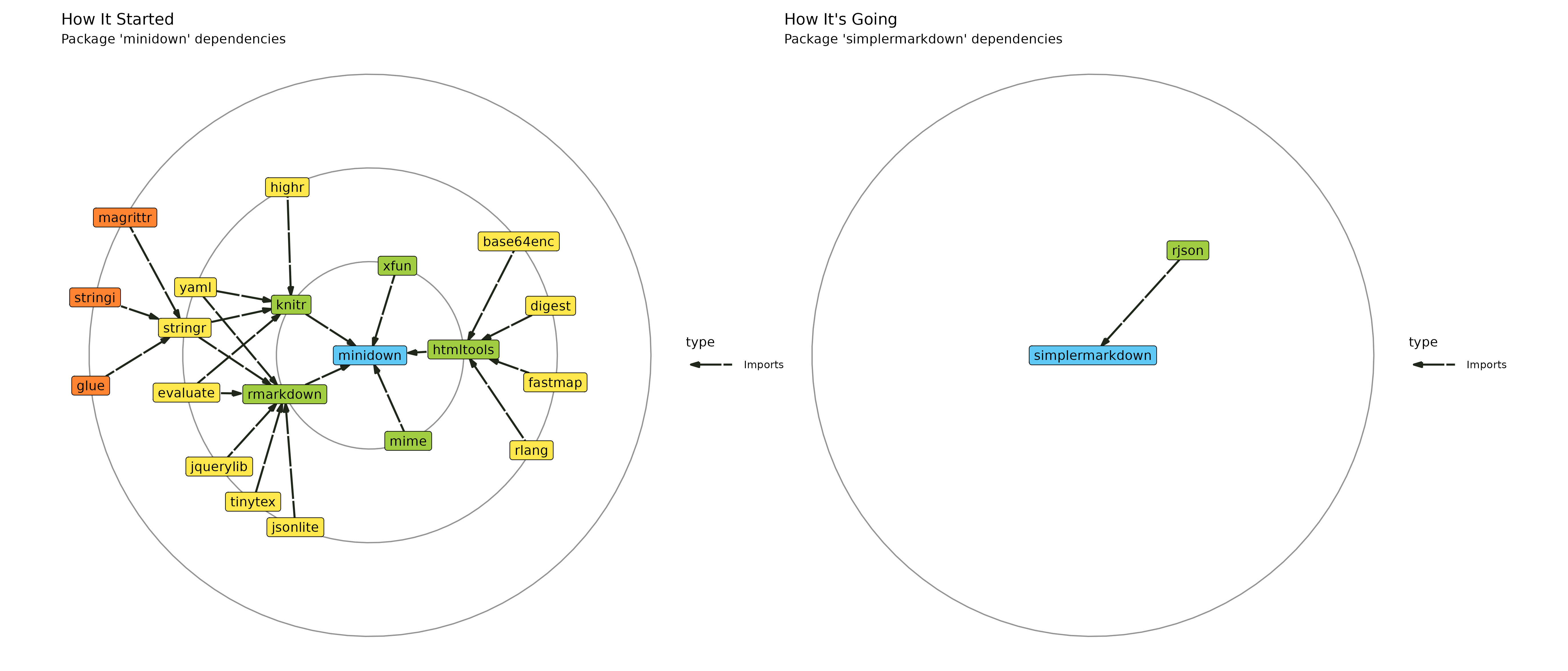
Welcome to the 34th post in the rambunctiously refreshing R recitations, or R4. Today s post is about architecture. Mies defined modernism. When still in Europe, I had been to the Neue Nationalgalerie in Berlin which provides a gorgeous space for the arts. Twenty-five years ago, I worked next to his Toronto-Dominion Center in Toronto. Here in Chicago we have numerous buildings: the Federal Center (the Dirksen, the Kluczynski and the US Post Office rounding out the square in the Loop), multiple buildings on the Illinois Tech (aka IIT) Campus where he taught in the architecture department he created and lead, the (formerly called) IBM Plaza building at the river and more. Structure and minimalism, often based on the same core elements of black steel beams and glass, are a landmark of these buildings. One immediately senses that there is nothing left to take away. Code and programming can be similar. We too compose based on parts we assemble and combine to create something hopefully larger than the parts. The difficulty arising from too many dependencies is something we discussed before both here in this 2018 post but also via the tinyverse site. Over the last seven days, and via uploads to new versions to CRAN, I have switched the vignettes of seven packages from using minidown (which in turn requires rmarkdown and knitr, plus their aggregate dependencies) to using simplermarkdown with its sole dependency. That is, of course, a personal choice. I tend to not even knit much in my vignettes (and simplermarkdown supports what I do) but to rely mostly on pandoc for code rendering. So I only need a small subset of the functionality provided, but I can not access just that as the default comes with numerous bells, whistles as well as enough other instruments to form a small marching band. A picture may express this better: (courtesy of the deepdep package for the figures). Which of these two setups is less likely to surprise you with random breaks, say in continuous integration? Which takes less time to install, and burns fewer cpu cycles just to be set up, each time we run a new test? Which is taxing your students, colleagues, collaborators, users, less on setup for use or replication? The first, comprises a total of 29 dependencies, or the second with just one? My money is on the second choice. Less is more.

5 December 2021

Reproducible Builds: Reproducible Builds in November 2021

Welcome to the November 2021 report from the Reproducible Builds project. As a quick recap, whilst anyone may inspect the source code of free software for malicious flaws, almost all software is distributed to end users as pre-compiled binaries. The motivation behind the reproducible builds effort is therefore to ensure no flaws have been introduced during this compilation process by promising identical results are always generated from a given source, thus allowing multiple third-parties to come to a consensus on whether a build was compromised. If you are interested in contributing to our project, please visit our Contribute page on our website.
On November 6th, Vagrant Cascadian presented at this year s edition of the SeaGL conference, giving a talk titled Debugging Reproducible Builds One Day at a Time:
I ll explore how I go about identifying issues to work on, learn more about the specific issues, recreate the problem locally, isolate the potential causes, dissect the problem into identifiable parts, and adapt the packaging and/or source code to fix the issues.
A video recording of the talk is available on archive.org.
Fedora Magazine published a post written by Zbigniew J drzejewski-Szmek about how to Use Diffoscope in packager workflows, specifically around ensuring that new versions of a package do not introduce breaking changes:
In the role of a packager, updating packages is a recurring task. For some projects, a packager is involved in upstream maintenance, or well written release notes make it easy to figure out what changed between the releases. This isn t always the case, for instance with some small project maintained by one or two people somewhere on GitHub, and it can be useful to verify what exactly changed. Diffoscope can help determine the changes between package releases. [ ]

kpcyrd announced the release of rebuilderd version 0.16.3 on our mailing list this month, adding support for builds to generate multiple artifacts at once.
Lastly, we held another IRC meeting on November 30th. As mentioned in previous reports, due to the global events throughout 2020 etc. there will be no in-person summit event this year.

diffoscope diffoscope is our in-depth and content-aware diff utility. Not only can it locate and diagnose reproducibility issues, it can provide human-readable diffs from many kinds of binary formats. This month, Chris Lamb made the following changes, including preparing and uploading versions 190, 191, 192, 193 and 194 to Debian:
  • New features:
    • Continue loading a .changes file even if the referenced files do not exist, but include a comment in the returned diff. [ ]
    • Log the reason if we cannot load a Debian .changes file. [ ]
  • Bug fixes:
    • Detect XML files as XML files if file(1) claims if they are XML files or if they are named .xml. (#999438)
    • Don t duplicate file lists at each directory level. (#989192)
    • Don t raise a traceback when comparing nested directories with non-directories. [ ]
    • Re-enable test_android_manifest. [ ]
    • Don t reject Debian .changes files if they contain non-printable characters. [ ]
  • Codebase improvements:
    • Avoid aliasing variables if we aren t going to use them. [ ]
    • Use isinstance over type. [ ]
    • Drop a number of unused imports. [ ]
    • Update a bunch of %-style string interpolations into f-strings or str.format. [ ]
    • When pretty-printing JSON, mark the difference as being reformatted, additionally avoiding including the full path. [ ]
    • Import itertools top-level module directly. [ ]
Chris Lamb also made an update to the command-line client to trydiffoscope, a web-based version of the diffoscope in-depth and content-aware diff utility, specifically only waiting for 2 minutes for try.diffoscope.org to respond in tests. (#998360) In addition Brandon Maier corrected an issue where parts of large diffs were missing from the output [ ], Zbigniew J drzejewski-Szmek fixed some logic in the assert_diff_startswith method [ ] and Mattia Rizzolo updated the packaging metadata to denote that we support both Python 3.9 and 3.10 [ ] as well as a number of warning-related changes[ ][ ]. Vagrant Cascadian also updated the diffoscope package in GNU Guix [ ][ ].

Distribution work In Debian, Roland Clobus updated the wiki page documenting Debian reproducible Live images to mention some new bug reports and also posted an in-depth status update to our mailing list. In addition, 90 reviews of Debian packages were added, 18 were updated and 23 were removed this month adding to our knowledge about identified issues. Chris Lamb identified a new toolchain issue, absolute_path_in_cmake_file_generated_by_meson.
Work has begun on classifying reproducibility issues in packages within the Arch Linux distribution. Similar to the analogous effort within Debian (outlined above), package information is listed in a human-readable packages.yml YAML file and a sibling README.md file shows how to classify packages too. Finally, Bernhard M. Wiedemann posted his monthly reproducible builds status report for openSUSE and Vagrant Cascadian updated a link on our website to link to the GNU Guix reproducibility testing overview [ ].

Software development The Reproducible Builds project detects, dissects and attempts to fix as many currently-unreproducible packages as possible. We endeavour to send all of our patches upstream where appropriate. This month, we wrote a large number of such patches, including: Elsewhere, in software development, Jonas Witschel updated strip-nondeterminism, our tool to remove specific non-deterministic results from a completed build so that it did not fail on JAR archives containing invalid members with a .jar extension [ ]. This change was later uploaded to Debian by Chris Lamb. reprotest is the Reproducible Build s project end-user tool to build the same source code twice in widely different environments and checking whether the binaries produced by the builds have any differences. This month, Mattia Rizzolo overhauled the Debian packaging [ ][ ][ ] and fixed a bug surrounding suffixes in the Debian package version [ ], whilst Stefano Rivera fixed an issue where the package tests were broken after the removal of diffoscope from the package s strict dependencies [ ].

Testing framework The Reproducible Builds project runs a testing framework at tests.reproducible-builds.org, to check packages and other artifacts for reproducibility. This month, the following changes were made:
  • Holger Levsen:
    • Document the progress in setting up snapshot.reproducible-builds.org. [ ]
    • Add the packages required for debian-snapshot. [ ]
    • Make the dstat package available on all Debian based systems. [ ]
    • Mark virt32b-armhf and virt64b-armhf as down. [ ]
  • Jochen Sprickerhof:
    • Add SSH authentication key and enable access to the osuosl168-amd64 node. [ ][ ]
  • Mattia Rizzolo:
    • Revert reproducible Debian: mark virt(32 64)b-armhf as down - restored. [ ]
  • Roland Clobus (Debian live image generation):
    • Rename sid internally to unstable until an issue in the snapshot system is resolved. [ ]
    • Extend testing to include Debian bookworm too.. [ ]
    • Automatically create the Jenkins view to display jobs related to building the Live images. [ ]
  • Vagrant Cascadian:
    • Add a Debian package set group for the packages and tools maintained by the Reproducible Builds maintainers themselves. [ ]


If you are interested in contributing to the Reproducible Builds project, please visit our Contribute page on our website. However, you can get in touch with us via:

4 December 2021

Paul Tagliamonte: Receiving BPSK symbols (Part 3/5)

This post is part of a series called "PACKRAT". If this is the first post you've found, it'd be worth reading the intro post first and then looking over all posts in the series.
In the last post, we worked through how to generate a BPSK signal, and hopefully transmit it using one of our SDRs. Let s take that and move on to Receiving BPSK and turning that back into symbols! Demodulating BPSK data is a bit more tricky than transmitting BPSK data, mostly due to tedious facts of life such as space, time, and hardware built with compromises because not doing that makes the problem impossible. Unfortunately, it s now our job to work within our imperfect world to recover perfect data. We need to handle the addition of noise, differences in frequency, clock synchronization and interference in order to recover our information. This makes life a lot harder than when we transmit information, and as a result, a lot more complex.

Coarse Sync Our starting point for this section will be working from a capture of a number of generated PACKRAT packets as heard by a PlutoSDR at (xz compressed interleaved int16, 2,621,440 samples per second) Every SDR has its own oscillator, which eventually controls a number of different components of an SDR, such as the IF (if it s a superheterodyne architecture) and the sampling rate. Drift in oscillators lead to drifts in frequency such that what one SDR may think is 100MHz may be 100.01MHz for another radio. Even if the radios were perfectly in sync, other artifacts such as doppler time dilation due to motion can cause the frequency to appear higher or lower in frequency than it was transmitted. All this is a long way of saying, we need to determine when we see a strong signal that s close-ish to our tuned frequency, and take steps to roughly correct it to our center frequency (in the order of 100s of Hz to kHz) in order to acquire a phase lock on the signal to attempt to decode information contained within. The easiest way of detecting the loudest signal of interest is to use an FFT. Getting into how FFTs work is out of scope of this post, so if this is the first time you re seeing mention of an FFT, it may be a good place to take a quick break to learn a bit about the time domain (which is what the IQ data we ve been working with so far is), frequency domain, and how the FFT and iFFT operations can convert between them. Lastly, because FFTs average power over the window, swapping phases such that the transmitted wave has the same number of in-phase and inverted-phase symbols the power would wind up averaging to zero. This is not helpful, so I took a tip from Dr. Marc Lichtman s PySDR project and used complex squaring to drive our BPSK signal into a single detectable carrier by squaring the IQ data. Because points are on the unit circle and at tau/2 (specifically, tau/(2^1) for BPSK, 2^2 for QPSK) angles, and given that squaring has the effect of doubling the angle, and angles are all mod tau, this will drive our wave comprised of two opposite phases back into a continuous wave effectively removing our BPSK modulation, making it much easier to detect in the frequency domain. Thanks to Tom Bereknyei for helping me with that!
...
var iq []complex 
var freq []complex 
for i := range iq  
iq[i] = iq[i] * iq[i]
 
// perform an fft, computing the frequency
 // domain vector in  freq  given the iq data
 // contained in  iq .
 fft(iq, freq)
// get the array index of the max value in the
 // freq array given the magnitude value of the
 // complex numbers.
 var binIdx = max(abs(freq))
...
Now, most FFT operations will lay the frequency domain data out a bit differently than you may expect (as a human), which is that the 0th element of the FFT is 0Hz, not the most negative number (like in a waterfall). Generally speaking, zero first is the most common frequency domain layout (and generally speaking the most safe assumption if there s no other documentation on fft layout). Negative first is usually used when the FFT is being rendered for human consumption such as a waterfall plot. Given that we now know which FFT bin (which is to say, which index into the FFT array) contains the strongest signal, we ll go ahead and figure out what frequency that bin relates to. In the time domain, each complex number is the next time instant. In the frequency domain, each bin is a discrete frequency or more specifically a frequency range. The bandwidth of the bin is a function of the sampling rate and number of time domain samples used to do the FFT operation. As you increase the amount of time used to preform the FFT, the more precise the FFT measurement of frequency can be, but it will cover the same bandwidth, as defined by the sampling rate.
...
var sampleRate = 2,621,440
// bandwidth is the range of frequencies
 // contained inside a single FFT bin,
 // measured in Hz.
 var bandwidth = sampleRate/len(freq)
...
Now that we know we have a zero-first layout and the bin bandwidth, we can compute what our frequency offset is in Hz.
...
// binIdx is the index into the freq slice
 // containing the frequency domain data.
 var binIdx = 0
// binFreq is the frequency of the bin
 // denoted by binIdx
 var binFreq = 0
if binIdx > len(freq)/2  
// This branch covers the case where the bin
 // is past the middle point - which is to say,
 // if this is a negative frequency.
 binFreq = bandwidth * (binIdx - len(freq))
  else  
// This branch covers the case where the bin
 // is in the first half of the frequency array,
 // which is to say - if this frequency is
 // a positive frequency.
 binFreq = bandwidth * binIdx
 
...
However, sice we squared the IQ data, we re off in frequency by twice the actual frequency if we are reading 12kHz, the bin is actually 6kHz. We need to adjust for that before continuing with processing.
...
var binFreq = 0
...
// [compute the binFreq as above]
 ...
// Adjust for the squaring of our IQ data
 binFreq = binFreq / 2
...
Finally, we need to shift the frequency by the inverse of the binFreq by generating a carrier wave at a specific frequency and rotating every sample by our carrier wave so that a wave at the same frequency will slow down (or stand still!) as it approaches 0Hz relative to the carrier wave.
 var tau = pi * 2
// ts tracks where in time we are (basically: phase)
 var ts float
// inc is the amount we step forward in time (seconds)
 // each sample.
 var inc float = (1 / sampleRate)
// amount to shift frequencies, in Hz,
 // in this case, shift +12 kHz to 0Hz
 var shift = -12,000
for i := range iq  
ts += inc
if ts > tau  
// not actually needed, but keeps ts within
 // 0 to 2*pi (since it is modulus 2*pi anyway)
 ts -= tau
 
// Here, we're going to create a carrier wave
 // at the provided frequency (in this case,
 // -12kHz)
 cwIq = complex(cos(tau*shift*ts), sin(tau*shift*ts))
iq[i] = iq[i] * cwIq
 
Now we ve got the strong signal we ve observed (which may or may not be our BPSK modulated signal!) close enough to 0Hz that we ought to be able to Phase Lock the signal in order to begin demodulating the signal.

Filter After we re roughly in the neighborhood of a few kHz, we can now take some steps to cut out any high frequency components (both positive high frequencies and negative high frequencies). The normal way to do this would be to do an FFT, apply the filter in the frequency domain, and then do an iFFT to turn it back into time series data. This will work in loads of cases, but I ve found it to be incredibly tricky to get right when doing PSK. As such, I ve opted to do this the old fashioned way in the time domain. I ve again opted to go simple rather than correct, and haven t used nearly any of the advanced level trickery I ve come across for fear of using it wrong. As a result, our process here is going to be generating a sinc filter by computing a number of taps, and applying that in the time domain directly on the IQ stream.
// Generate sinc taps

func sinc(x float) float  
if x == 0  
return 1
 
var v = pi * x
return sin(v) / v
 
...
var dst []float
var length = float(len(dst))
if int(length)%2 == 0  
length++
 
for j := range dst  
i := float(j)
dst[j] = sinc(2 * cutoff * (i - (length-1)/2))
 
...
then we apply it in the time domain
...
// Apply sinc taps to an IQ stream

var iq []complex
// taps as created in  dst  above
 var taps []float
var delay = make([]complex, len(taps))
for i := range iq  
// let's shift the next sample into
 // the delay buffer
 copy(delay[1:], delay)
delay[0] = iq[i]
var phasor complex
for j := range delay  
// for each sample in the buffer, let's
 // weight them by the tap values, and
 // create a new complex number based on
 // filtering the real and imag values.
 phasor += complex(
taps[j] * real(delay[j]),
taps[j] * imag(delay[j]),
)
 
// now that we've run this sample
 // through the filter, we can go ahead
 // and scale it back (since we multiply
 // above) and drop it back into the iq
 // buffer.
 iq[i] = complex(
real(phasor) / len(taps),
imag(phasor) / len(taps),
)
 
...
After running IQ samples through the taps and back out, we ll have a signal that s been filtered to the shape of our designed Sinc filter which will cut out captured high frequency components (both positive and negative). Astute observers will note that we re using the real (float) valued taps on both the real and imaginary values independently. I m sure there s a way to apply taps using complex numbers, but it was a bit confusing to work through without being positive of the outcome. I may revisit this in the future!

Downsample Now, post-filter, we ve got a lot of extra RF bandwidth being represented in our IQ stream at our high sample rate All the high frequency values are now filtered out, which means we can reduce our sampling rate without losing much information at all. We can either do nothing about it and process at the fairly high sample rate we re capturing at, or we can drop the sample rate down and help reduce the volume of numbers coming our way. There s two big ways of doing this; either you can take every Nth sample (e.g., take every other sample to half the sample rate, or take every 10th to decimate the sample stream to a 10th of what it originally was) which is the easiest to implement (and easy on the CPU too), or to average a number of samples to create a new sample. A nice bonus to averaging samples is that you can trade-off some CPU time for a higher effective number of bits (ENOB) in your IQ stream, which helps reduce noise, among other things. Some hardware does exactly this (called Oversampling ), and like many things, it has some pros and some cons. I ve opted to treat our IQ stream like an oversampled IQ stream and average samples to get a marginal bump in ENOB. Taking a group of 4 samples and averaging them results in a bit of added precision. That means that a stream of IQ data at 8 ENOB can be bumped to 9 ENOB of precision after the process of oversampling and averaging. That resulting stream will be at 1/4 of the sample rate, and this process can be repeated 4 samples can again be taken for a bit of added precision; which is going to be 1/4 of the sample rate (again), or 1/16 of the original sample rate. If we again take a group of 4 samples, we ll wind up with another bit and a sample rate that s 1/64 of the original sample rate.

Phase Lock Our starting point for this section is the same capture as above, but post-coarse sync, filtering downsampling (xz compressed interleaved float32, 163,840 samples per second) The PLL in PACKRAT was one of the parts I spent the most time stuck on. There s no shortage of discussions of how hardware PLLs work, or even a few software PLLs, but very little by way of how to apply them and/or troubleshoot them. After getting frustrated trying to follow the well worn path, I decided to cut my own way through the bush using what I had learned about the concept, and hope that it works well enough to continue on. PLLs, in concept are fairly simple you generate a carrier wave at a frequency, compare the real-world SDR IQ sample to where your carrier wave is in phase, and use the difference between the local wave and the observed wave to adjust the frequency and phase of your carrier wave. Eventually, if all goes well, that delta is driven as small as possible, and your carrier wave can be used as a reference clock to determine if the observed signal changes in frequency or phase. In reality, tuning PLLs is a total pain, and basically no one outlines how to apply them to BPSK signals in a descriptive way. I ve had to steal an approach I ve seen in hardware to implement my software PLL, with any hope it s close enough that this isn t a hazard to learners. The concept is to generate the carrier wave (as above) and store some rolling averages to tune the carrier wave over time. I use two constants, alpha and beta (which appear to be traditional PLL variable names for this function) which control how quickly the frequency and phase is changed according to observed mismatches. Alpha is set fairly high, which means discrepancies between our carrier and observed data are quickly applied to the phase, and a lower constant for Beta, which will take long-term errors and attempt to use that to match frequency. This is all well and good. Getting to this point isn t all that obscure, but the trouble comes when processing a BPSK signal. Phase changes kick the PLL out of alignment and it tends to require some time to get back into phase lock, when we really shouldn t even be loosing it in the first place. My attempt is to generate two predicted samples, one for each phase of our BPSK signal. The delta is compared, and the lower error of the two is used to adjust the PLL, but the carrier wave itself is used to rotate the sample.
 var alpha = 0.1
var beta = (alpha * alpha) / 2
var phase = 0.0
var frequency = 0.0
...
for i := range iq  
predicted = complex(cos(phase), sin(phase))
sample = iq[i] * conj(predicted)
delta = phase(sample)
predicted2 = complex(cos(phase+pi), sin(phase+pi))
sample2 = iq[i] * conj(predicted2)
delta2 = phase(sample2)
if abs(delta2) < abs(delta)  
// note that we do not update 'sample'.
 delta = delta2
 
phase += alpha * delta
frequency += beta * delta
// adjust the iq sample to the PLL rotated
 // sample.
 iq[i] = sample
 
...
If all goes well, this loop has the effect of driving a BPSK signal s imaginary values to 0, and the real value between +1 and -1.

Average Idle / Carrier Detect Our starting point for this section is the same capture as above, but post-PLL (xz compressed interleaved float32, 163,840 samples per second) When we start out, we have IQ samples that have been mostly driven to an imaginary component of 0 and real value range between +1 and -1 for each symbol period. Our goal now is to determine if we re receiving a signal, and if so, determine if it s +1 or -1. This is a deceptively hard problem given it spans a lot of other similarly entertaining hard problems. I ve opted to not solve the hard problems involved and hope that in practice my very haphazard implementation works well enough. This turns out to be both good (not solving a problem is a great way to not spend time on it) and bad (turns out it does materially impact performance). This segment is the one I plan on revisiting, first. Expect more here at some point! Given that I want to be able to encapsulate three states in the output from this section (our Symbols are no carrier detected ( 0 ), real value 1 ( 1 ) or real value -1 ("-1")), which means spending cycles to determine what the baseline noise is to try and identify when a signal breaks through the noise becomes incredibly important.
var idleThreshold
var thresholdFactor = 10
...
// sigThreshold is used to determine if the symbol
 // is -1, +1 or 0. It's 1.3 times the idle signal
 // threshold.
 var sigThreshold = (idleThreshold * 0.3) + idleThreshold
// iq contains a single symbol's worth of IQ samples.
 // clock alignment isn't really considered; so we'll
 // get a bad packet if we have a symbol transition
 // in the middle of this buffer. No attempt is made
 // to correct for this yet.
 var iq []complex
// avg is used to average a chunk of samples in the
 // symbol buffer.
 var avg float
var mid = len(iq) / 2
// midNum is used to determine how many symbols to
 // average at the middle of the symbol.
 var midNum = len(iq) / 50
for j := mid; j < mid+midNum; j++  
avg += real(iq[j])
 
avg /= midNum
var symbol float
switch  
case avg > sigThreshold:
symbol = 1
case avg < -sigThreshold:
symbol = -1
default:
symbol = 0
// update the idleThreshold using the thresholdFactor
 // to average the idleThreshold over more samples to
 // get a better idea of average noise.
 idleThreshold = (
(idleThreshold*(thresholdFactor-1) + symbol) \
/ thresholdFactor
)
 
// write symbol to output somewhere
...

Next Steps Now that we have a stream of values that are either +1, -1 or 0, we can frame / unframe the data contained in the stream, and decode Packets contained inside, coming next in Part 4!

2 December 2021

Dirk Eddelbuettel: drat 0.2.2 on CRAN: Package Maintenance

drat user A fresh and new minor release of drat arrived on CRAN overnight. This is another small update relative to the 0.2.0 release in April followed by a 0.2.1 update in July. This release follows the changes made in digest yesterday. We removed the YAML file (and badge) for the disgraced former continuous integration service we shall not name (yet that we all used to use). And we converted the vignette from using the minidown package to the (fairly new) simplermarkdown package which is so much more appropriate for our use of the minimal water.css style. drat stands for drat R Archive Template, and helps with easy-to-create and easy-to-use repositories for R packages. Since its inception in early 2015 it has found reasonably widespread adoption among R users because repositories with marked releases is the better way to distribute code. See below for a few custom reference examples. Because for once it really is as your mother told you: Friends don t let friends install random git commit snapshots. Properly rolled-up releases it is. Just how CRAN shows us: a model that has demonstrated for two-plus decades how to do this. And you can too: drat is easy to use, documented by six vignettes and just works. Detailed information about drat is at its documentation site. The NEWS file summarises the release as follows:

Changes in drat version 0.2.2 (2021-12-01)
  • Travis artifacts and badges have been pruned
  • Vignettes now use simplermarkdown

Courtesy of my CRANberries, there is a comparison to the previous release. More detailed information is on the drat page as well as at the documentation site. If you like this or other open-source work I do, you can now sponsor me at GitHub.

This post by Dirk Eddelbuettel originated on his Thinking inside the box blog. Please report excessive re-aggregation in third-party for-profit settings.

1 December 2021

Utkarsh Gupta: FOSS Activites in December 2021

Here s my (twenty-sixth) monthly but brief update about the activities I ve done in the F/L/OSS world.

Debian
This was my 35th month of actively contributing to Debian. I became a DM in late March 2019 and a DD on Christmas 19! \o/ Just churning through the backlog again this month. Ugh. Anyway, I did the following stuff in Debian:

Uploads and bug fixes:
  • rails (2:6.1.4.1+dfsg-3) - No-change rebuild for unstable.

Other $things:
  • Mentoring for newcomers.
  • Moderation of -project mailing list.

Ubuntu
This was my 10th month of actively contributing to Ubuntu. Now that I ve joined Canonical to work on Ubuntu full-time, there s a bunch of things I do! \o/ I mostly worked on different things, I guess. I was too lazy to maintain a list of things I worked on so there s no concrete list atm. Maybe I ll get back to this section later or will start to list stuff from next year onward, as I was doing before. :D

Debian (E)LTS
Debian Long Term Support (LTS) is a project to extend the lifetime of all Debian stable releases to (at least) 5 years. Debian LTS is not handled by the Debian security team, but by a separate group of volunteers and companies interested in making it a success. And Debian Extended LTS (ELTS) is its sister project, extending support to the Jessie release (+2 years after LTS support). This was my twenty-sixth month as a Debian LTS and seventeenth month as a Debian ELTS paid contributor.
I was assigned 30.00 hours for LTS and 45.00 hours for ELTS and worked on the following things:

LTS CVE Fixes and Announcements:
  • Issued DLA 2813-1, fixing CVE-2021-33829 and CVE-2021-37695, for ckeditor.
    For Debian 9 stretch, these problems have been fixed in version 4.5.7+dfsg-2+deb9u1.
  • Issued DLA 2817-1, fixing CVE-2021-23214 and CVE-2021-23222, for postgresql-9.6.
    For Debian 9 stretch, these problems have been fixed in version 9.6.24-0+deb9u1.
  • Issued DLA 2836-1, fixing CVE-2021-43527, for nss.
    For Debian 9 stretch, these problems have been fixed in version 2:3.26.2-1.1+deb9u3.
  • Started working on src:samba for CVE-2020-25717 to CVE-2020-25722 and CVE-2021-23192 for jessie and stretch, both.
    The version difference b/w the suites are a bit too much for the patch(es) to be easily backported. I ve talked to Anton to work something out. \o/
  • Found the problem w/ libjdom1-java. Will have to roll the regression upload.
    I ve prepared the patch but needs some testing to be finally rolled out. Same for jessie.
  • Started working on libgit2.

ELTS CVE Fixes and Announcements:

Other (E)LTS Work:
  • Front-desk duty from 29-11 to 05-12 for both LTS and ELTS.
  • Triaged udisk2, wordpress, samba, gmp, nss, ntfs-3g, and openssh.
  • Auto EOL ed dwarfutils, radare2, mongodb, linux for jessie.
  • As FD, did a deep dive into the no-pu-update issue. Will write to list shortly.
  • Attended monthly Debian LTS meeting.
  • Answered questions (& discussions) on IRC (#debian-lts and #debian-elts).
  • General and other discussions on LTS private and public mailing list.

Debian LTS Survey I ve spent 3 hours on the LTS survey on the following bits:
  • Talking to Laura to revive the old a/c on survey.d.net.
  • Setting up stuff there.
  • Discussing the survey questions and other bits w/ Jeremiah.
  • Partly reviewing the questions of the survey.
  • Doing a walkthru of the LimeSurvey instance we have to make sure there are no changes .

Until next time.
:wq for today.

Paul Wise: FLOSS Activities November 2021

Focus This month I didn't have any particular focus. I just worked on issues in my info bubble.

Changes

Issues

Review

Administration
  • Debian BTS: unarchive/reopen/triage bugs for reintroduced packages
  • Debian wiki: unblock IP addresses, approve accounts

Communication
  • Respond to queries from Debian users and contributors on the mailing lists and IRC

Sponsors The SPTAG, visdom, gensim, purple-discord, plac, fail2ban, uvloop work was sponsored by my employer. All other work was done on a volunteer basis.

17 November 2021

Rapha&#235;l Hertzog: Freexian s report about Debian Long Term Support, October 2021

A Debian LTS logo
Every month we review the work funded by Freexian s Debian LTS offering. Please find the report for October below. Debian project funding We re looking forward to receiving more projects from various Debian teams! Learn more about the rationale behind this initiative in this article. Debian LTS contributors In October 12 contributors were paid to work on Debian LTS, their reports are available below. Evolution of the situation In October we released 34 DLAs.

Also, we would like to remark once again that we are constantly looking for new contributors. Please contact Jeremiah if you are interested! The security tracker currently lists 37 packages with a known CVE and the dla-needed.txt file has 22 packages needing an update. Thanks to our sponsors Sponsors that joined recently are in bold.

9 November 2021

Benjamin Mako Hill: The Hidden Costs of Requiring Accounts

Should online communities require people to create accounts before participating? This question has been a source of disagreement among people who start or manage online communities for decades. Requiring accounts makes some sense since users contributing without accounts are a common source of vandalism, harassment, and low quality content. In theory, creating an account can deter these kinds of attacks while still making it pretty quick and easy for newcomers to join. Also, an account requirement seems unlikely to affect contributors who already have accounts and are typically the source of most valuable contributions. Creating accounts might even help community members build deeper relationships and commitments to the group in ways that lead them to stick around longer and contribute more.
In a new paper published in Communication Research, I worked with Aaron Shaw provide an answer. We analyze data from natural experiments that occurred when 136 wikis on Fandom.com started requiring user accounts. Although we find strong evidence that the account requirements deterred low quality contributions, this came at a substantial (and usually hidden) cost: a much larger decrease in high quality contributions. Surprisingly, the cost includes lost contributions from community members who had accounts already, but whose activity appears to have been catalyzed by the (often low quality) contributions from those without accounts.
A version of this post was first posted on the Community Data Science blog. The full citation for the paper is: Hill, Benjamin Mako, and Aaron Shaw. 2020. The Hidden Costs of Requiring Accounts: Quasi-Experimental Evidence from Peer Production. Communication Research, 48 (6): 771 95. https://doi.org/10.1177/0093650220910345. If you do not have access to the paywalled journal, please check out this pre-print or get in touch with us. We have also released replication materials for the paper, including all the data and code used to conduct the analysis and compile the paper itself.

8 November 2021

Russell Coker: Installing NextCloud

NextCloud and OwnCloud History Some time ago I tried OwnCloud, it wasn t a positive experience for me. Since that time I ve got a server with a much faster CPU, a faster Internet connection, and the NextCloud code is newer and running on a newer version of PHP, I didn t make good notes so I m not sure which factors were most responsible for having a better experience this time. According to the NextCloud Wikipedia page [1] the fork of NextCloud from the OpenCloud base happened in 2016 so it s obviously been a while since I tried it, it was probably long before 2016. Recently the BBC published an interesting article on Turnover contagion which is when one resignation can trigger many more [2] which is interesting to read in the context of OwnCloud losing critical staff failing after one key developer resigned. I mentioned OwnCloud in a 2012 blog post about Liberty and Mobile Phones [3], since then I haven t done well at achieving those goals. A few days ago I decided to try NextCloud and found it a much better experience than I recall OwnCloud being in the past. Installation I installed OwnCloud on an Oracle Cloud ARM VM (see my previous blog post about the Oracle Cloud Free Tier [4]). This CloudCone article on installing NextCloud on Debian 10 (Buster) covers the basics well [5]. Here is the NextCloud URL for downloading the PHP files (a large ZIP archive) [6]. You have to extract to where Apache is configured to have it s webroot and then run chown -R www-data nextcloud/lib/private/Log nextcloud/config nextcloud/apps (or if you use php-fpm then chown it to the user for that). NextCloud recommend having all of the NextCloud files owned by www-data, but that s just a bad idea, allowing it to rewrite some of it s program files is bad, allowing it to rewrite all of them is worse. For my installation I used the Apache modiles macro, rewrite, ssl, php7.4, and headers (this is more about how I configure Apache than about NextCloud). Also I edited /etc/php/7.4/apache2/php.ini and changed memory_limit to 512M (the default of 128M is not enough). I m currently only testing it, for a production use I would use php-fpm and run it under it s own UID so that it can t interact with other PHP apps. After that it was just a matter of visiting the configuration URL and giving it the details of the database etc. After setting it up the command php -d memory_limit=512M occ app:install richdocumentscode_arm64 when run from the root of the OwnCloud installation installs the Cloudera components for editing LibreOffice documents in OwnCloud, this is the command for ARM64 architecture, I presume the command for other architectures is similar. Conclusion OwnCloud is very usable, it has a decent feature set built in and the option to download modules such as the components for editing LibreOffice files on the web is useful. But I am hesitant to install things that require the sort of access it requires. I think it would be better if there was a documented and supported way of installing things and then locking them down so that at runtime it can only write to data files not any program files or configuration files. It would also be better if it was packaged for Debian and had the Debian update process for security fixes. I can imagine many people installing it, forgetting to update it, and ending up with insecure systems.

Next.

Previous.