Search Results: "cts"

23 February 2024

Gunnar Wolf: 10 things software developers should learn about learning

This post is a review for Computing Reviews for 10 things software developers should learn about learning , a article published in Communications of the ACM
As software developers, we understand the detailed workings of the different components of our computer systems. And probably due to how computers were presented since their appearance as digital brains in the 1940s we sometimes believe we can transpose that knowledge to how our biological brains work, be it as learners or as problem solvers. This article aims at making the reader understand several mechanisms related to how learning and problem solving actually work in our brains. It focuses on helping expert developers convey knowledge to new learners, as well as learners who need to get up to speed and start coding. The article s narrative revolves around software developers, but much of what it presents can be applied to different problem domains. The article takes this mission through ten points, with roughly the same space given to each of them, starting with wrong assumptions many people have about the similarities between computers and our brains. The first section, Human Memory Is Not Made of Bits, explains the brain processes of remembering as a way of strengthening the force of a memory ( reconsolidation ) and the role of activation in related network pathways. The second section, Human Memory Is Composed of One Limited and One Unlimited System, goes on to explain the organization of memories in the brain between long-term memory (functionally limitless, permanent storage) and working memory (storing little amounts of information used for solving a problem at hand). However, the focus soon shifts to how experience in knowledge leads to different ways of using the same concepts, the importance of going from abstract to concrete knowledge applications and back, and the role of skills repetition over time. Toward the end of the article, the focus shifts from the mechanical act of learning to expertise. Section 6, The Internet Has Not Made Learning Obsolete, emphasizes that problem solving is not just putting together the pieces of a puzzle; searching online for solutions to a problem does not activate the neural pathways that would get fired up otherwise. The final sections tackle the differences that expertise brings to play when teaching or training a newcomer: the same tools that help the beginner s productivity as training wheels will often hamper the expert user s as their knowledge has become automated. The article is written with a very informal and easy-to-read tone and vocabulary, and brings forward several issues that might seem like commonsense but do ring bells when it comes to my own experiences both as a software developer and as a teacher. The article closes by suggesting several books that further expand on the issues it brings forward. While I could not identify a single focus or thesis with which to characterize this article, the several points it makes will likely help readers better understand (and bring forward to consciousness) mental processes often taken for granted, and consider often-overlooked aspects when transmitting knowledge to newcomers.

20 February 2024

Niels Thykier: Language Server (LSP) support for debian/control

About a month ago, Otto Kek l inen asked for editor extensions for debian related files on the debian-devel mailing list. In that thread, I concluded that what we were missing was a "Language Server" (LSP) for our packaging files. Last week, I started a prototype for such a LSP for the debian/control file as a starting point based on the pygls library. The initial prototype worked and I could do very basic diagnostics plus completion suggestion for field names.
Current features I got 4 basic features implemented, though I have only been able to test two of them in emacs.
  • Diagnostics or linting of basic issues.
  • Completion suggestions for all known field names that I could think of and values for some fields.
  • Folding ranges (untested). This feature enables the editor to "fold" multiple lines. It is often used with multi-line comments and that is the feature currently supported.
  • On save, trim trailing whitespace at the end of lines (untested). Might not be registered correctly on the server end.
Despite its very limited feature set, I feel editing debian/control in emacs is now a much more pleasant experience. Coming back to the features that Otto requested, the above covers a grand total of zero. Sorry, Otto. It is not you, it is me.
Completion suggestions For completion, all known fields are completed. Place the cursor at the start of the line or in a partially written out field name and trigger the completion in your editor. In my case, I can type R-R-R and trigger the completion and the editor will automatically replace it with Rules-Requires-Root as the only applicable match. Your milage may vary since I delegate most of the filtering to the editor, meaning the editor has the final say about whether your input matches anything. The only filtering done on the server side is that the server prunes out fields already used in the paragraph, so you are not presented with the option to repeat an already used field, which would be an error. Admittedly, not an error the language server detects at the moment, but other tools will. When completing field, if the field only has one non-default value such as Essential which can be either no (the default, but you should not use it) or yes, then the completion suggestion will complete the field along with its value. This is mostly only applicable for "yes/no" fields such as Essential and Protected. But it does also trigger for Package-Type at the moment. As for completing values, here the language server can complete the value for simple fields such as "yes/no" fields, Multi-Arch, Package-Type and Priority. I intend to add support for Section as well - maybe also Architecture.
Diagnostics On the diagnostic front, I have added multiple diagnostics:
  • An error marker for syntax errors.
  • An error marker for missing a mandatory field like Package or Architecture. This also includes Standards-Version, which is admittedly mandatory by policy rather than tooling falling part.
  • An error marker for adding Multi-Arch: same to an Architecture: all package.
  • Error marker for providing an unknown value to a field with a set of known values. As an example, writing foo in Multi-Arch would trigger this one.
  • Warning marker for using deprecated fields such as DM-Upload-Allowed, or when setting a field to its default value for fields like Essential. The latter rule only applies to selected fields and notably Multi-Arch: no does not trigger a warning.
  • Info level marker if a field like Priority duplicates the value of the Source paragraph.
Notable omission at this time:
  • No errors are raised if a field does not have a value.
  • No errors are raised if a field is duplicated inside a paragraph.
  • No errors are used if a field is used in the wrong paragraph.
  • No spellchecking of the Description field.
  • No understanding that Foo and X[CBS]-Foo are related. As an example, XC-Package-Type is completely ignored despite being the old name for Package-Type.
  • Quick fixes to solve these problems... :)
Trying it out If you want to try, it is sadly a bit more involved due to things not being uploaded or merged yet. Also, be advised that I will regularly rebase my git branches as I revise the code. The setup:
  • Build and install the deb of the main branch of pygls from https://salsa.debian.org/debian/pygls The package is in NEW and hopefully this step will soon just be a regular apt install.
  • Build and install the deb of the rts-locatable branch of my python-debian fork from https://salsa.debian.org/nthykier/python-debian There is a draft MR of it as well on the main repo.
  • Build and install the deb of the lsp-support branch of debputy from https://salsa.debian.org/debian/debputy
  • Configure your editor to run debputy lsp debian/control as the language server for debian/control. This is depends on your editor. I figured out how to do it for emacs (see below). I also found a guide for neovim at https://neovim.io/doc/user/lsp. Note that debputy can be run from any directory here. The debian/control is a reference to the file format and not a concrete file in this case.
Obviously, the setup should get easier over time. The first three bullet points should eventually get resolved by merges and upload meaning you end up with an apt install command instead of them. For the editor part, I would obviously love it if we can add snippets for editors to make the automatically pick up the language server when the relevant file is installed.
Using the debputy LSP in emacs The guide I found so far relies on eglot. The guide below assumes you have the elpa-dpkg-dev-el package installed for the debian-control-mode. Though it should be a trivially matter to replace debian-control-mode with a different mode if you use a different mode for your debian/control file. In your emacs init file (such as ~/.emacs or ~/.emacs.d/init.el), you add the follow blob.
(with-eval-after-load 'eglot
    (add-to-list 'eglot-server-programs
        '(debian-control-mode . ("debputy" "lsp" "debian/control"))))
Once you open the debian/control file in emacs, you can type M-x eglot to activate the language server. Not sure why that manual step is needed and if someone knows how to automate it such that eglot activates automatically on opening debian/control, please let me know. For testing completions, I often have to manually activate them (with C-M-i or M-x complete-symbol). Though, it is a bit unclear to me whether this is an emacs setting that I have not toggled or something I need to do on the language server side.
From here As next steps, I will probably look into fixing some of the "known missing" items under diagnostics. The quick fix would be a considerable improvement to assisting users. In the not so distant future, I will probably start to look at supporting other files such as debian/changelog or look into supporting configuration, so I can cover formatting features like wrap-and-sort. I am also very much open to how we can provide integrations for this feature into editors by default. I will probably create a separate binary package for specifically this feature that pulls all relevant dependencies that would be able to provide editor integrations as well.

19 February 2024

Valhalla's Things: Jeans, step one

Posted on February 19, 2024
Tags: madeof:atoms, craft:sewing, FreeSoftWear
CW for body size change mentions A woman wearing a pair of tight jeans. Just like the corset, I also needed a new pair of jeans. Back when my body size changed drastically of course my jeans no longer fit. While I was waiting for my size to stabilize I kept wearing them with a somewhat tight belt, but it was ugly and somewhat uncomfortable. When I had stopped changing a lot I tried to buy new ones in the same model, and found out that I was too thin for the menswear jeans of that shop. I could have gone back to wearing women s jeans, but I didn t want to have to deal with the crappy fabric and short pockets, so I basically spent a few years wearing mostly skirts, and oversized jeans when I really needed trousers. Meanwhile, I had drafted a jeans pattern for my SO, which we had planned to make in technical fabric, but ended up being made in a cotton-wool mystery mix for winter and in linen-cotton for summer, and the technical fabric version was no longer needed (yay for natural fibres!) It was clear what the solution to my jeans problems would have been, I just had to stop getting distracted by other projects and draft a new pattern using a womanswear block instead of a menswear one. Which, in January 2024 I finally did, and I believe it took a bit less time than the previous one, even if it had all of the same fiddly pieces. I already had a cut of the same cotton-linen I had used for my SO, except in black, and used it to make the pair this post is about. The parametric pattern is of course online, as #FreeSoftWear, at the usual place. This time it was faster, since I didn t have to write step-by-step instructions, as they are exactly the same as the other pattern. Same as above, from the back, with the crotch seam pulling a bit. A faint decoration can be seen on the pockets, with the line art version of the logo seen on this blog. Making also went smoothly, and the result was fitting. Very fitting. A big too fitting, and the standard bum adjustment of the back was just enough for what apparently still qualifies as a big bum, so I adjusted the pattern to be able to add a custom amount of ease in a few places. But at least I had a pair of jeans-shaped trousers that fit! Except, at 200 g/m I can t say that fabric is the proper weight for a pair of trousers, and I may have looked around online1 for some denim, and, well, it s 2024, so my no-fabric-buy 2023 has not been broken, right? Let us just say that there may be other jeans-related posts in the near future.

  1. I had already asked years ago for denim at my local fabric shops, but they don t have the proper, sturdy, type I was looking for.

18 February 2024

Russell Coker: Release Years

In 2008 I wrote about the idea of having a scheduled release for Debian and other distributions as Mark Shuttleworth had proposed [1]. I still believe that Mark s original idea for synchronised release dates of Linux distributions (or at least synchronised feature sets) is a good one but unfortunately it didn t take off. Having been using Ubuntu a bit recently I ve found the version numbering system to be really good. Ubuntu version 16.04 was release in April 2016, it s support ended 5 years later in about April 2021, so any commonly available computers from 2020 should run it well and versions of applications released in about 2017 should run on it. If I have to support a Debian 10 (Buster) system I need to start with a web search to discover when it was released (July 2019). That suggests that applications packaged for Ubuntu 18.04 are likely to run on it. If we had the same numbering system for Debian and Ubuntu then it would be easier to compare versions. Debian 19.06 would be obviously similar to Ubuntu 18.04, or we could plan for the future and call it Debian 2019. Then it would be ideal if hardware vendors did the same thing (as car manufacturers have been doing for a long time). Which versions of Ubuntu and Debian would run well on a Dell PowerEdge R750? It takes a little searching to discover that the R750 was released in 2021, but if they called it a PowerEdge 2021R70 then it would be quite obvious that Ubuntu 2022.04 would run well on it and that Ubuntu 2020.04 probably has a kernel update with all the hardware supported. One of the benefits for the car industry in naming model years is that it drives the purchase of a new car. A 2015 car probably isn t going to impress anyone and you will know that it is missing some of the features in more recent models. It would be easier to get management to sign off on replacing old computers if they had 2015 on the front, trying to estimate hidden costs of support and lost productivity of using old computers is hard but saying it s a 2015 model and way out of date is easy. There is a history of using dates as software versions. The Reference Policy for SE Linux [2] (which is used for Debian) has releases based on date. During the Debian development process I upload policy to Debian based on the upstream Git and use the same version numbering scheme which is more convenient than the append git date to last full release system that some maintainers are forced to use. The users can get an idea of how much the Debian/Unstable policy has diverged from the last full release by looking at the dates. Also an observer might see the short difference between release dates of SE Linux policy and Debian release freeze dates as an indication that I beg the upstream maintainers to make a new release just before each Debian freeze which is expactly what I do. When I took over the Portslave [3] program I made releases based on date because there were several forks with different version numbering schemes so my options were to just choose a higher number (which is OK initially but doesn t scale if there are more forks) or use a date and have people know that the recent date is the most recent version. The fact that the latest release of Portslave is version 2010.04.19 shows that I have not been maintaining it in recent years (due to lack of hardware as well as lack of interest), so if someone wants to take over the project I would be happy to help them do so! I don t expect people at Dell and other hardware vendors to take much notice of my ideas (I have tweeted them photographic evidence of a problem with no good response). But hopefully this will start a discussion in the free software community.

13 February 2024

Arturo Borrero Gonz lez: Back to the Wikimedia Foundation!

Wikimedia Foundation logo In October 2023, I departed from the Wikimedia Foundation, the non-profit organization behind well-known projects like Wikipedia and others, to join Spryker. However, in January 2024 Spryker conducted a round of layoffs reportedly due to budget and business reasons. I was among those affected, being let go just three months after joining the company. Fortunately, the Wikimedia Cloud Services team, where I previously worked, was still seeking to backfill my position, so I reached out to them. They graciously welcomed me back as a Senior Site Reliability Engineer, in the same team and position as before. Although this three-month career detour wasn t the outcome I initially envisioned, I found it to be a valuable experience. During this time, I gained knowledge in a new tech stack, based on AWS, and discovered new engineering methodologies. Additionally, I had the opportunity to meet some wonderful individuals. I believe I have emerged stronger from this experience. Returning to the Wikimedia Foundation is truly motivating. It feels privileged to be part of this mature organization, its community, and movement, with its inspiring mission and values. In addition, I m hoping that this also means I can once again dedicate a bit more attention to my FLOSS activities, such as my duties within the Debian project. My email address is back online: aborrero@wikimedia.org. You can find me again in the IRC libera.chat server, in the usual wikimedia channels, nick arturo.

12 February 2024

Gunnar Wolf: Heads up! A miniDebConf is approaching in Santa Fe, Argentina

I realize it s a bit late to start publicly organizing this, but better late than never I m happy some Debian people I have directly contacted have already expressed interest. So, lets make this public! For all interested people who are reasonably close to central Argentina, or can be persuaded to come here in a month s time You are all welcome! It seems I managed to convince my good friend Mart n Bayo (some Debian people will remember him, as he was present in DebConf19 in Curitiba, Brazil) to get some facilities for us to have a nice Debian get-together in Central Argentina.

Where? We will meet at APUL Asociaci n de Personal no-docente de la Universidad Nacional del Litoral, in downtown Santa Fe, Argentina.

When? Saturday, 2024.03.09. It is quite likely we can get some spaces for continuing over Sunday if there is demand.

What are we planning? We have little time for planning but we want to have a space for Debian-related outreach (so, please think about a topic or two you d like to share with general free software-interested, not too technical, audience). Please tell me by mail (gwolf@debian.org) about any ideas you might have. We also want to have a general hacklab-style area to hang out, work a bit in our projects, and spend a good time together.

Logistics I have briefly commented about this with our dear and always mighty DPL, and Debian will support Debian-related people interested in attending; please check personally with me for specifics on how to handle this case by case. My intention is to cover costs for travel, accomodation (one or two nights) and food for whoever is interested in coming over.

More information As I don t want to direct people to keep an eye on my blog post for updates, I ll copy this information (and keep it updated!) at the Debian Wiki / DebianEvents / ar / 2024 / MiniDebConf / Santa Fe please refer to that page!

Contact

Codes of Conduct DebConf and Debian Code of Conduct apply. See the DebConf Code of Conduct and the Debian Code of Conduct.

Registration Registration is free, but needed. See the separate Registration page.

Talks Please, send your proposal to gwolf@debian.org

11 February 2024

Freexian Collaborators: Debian Contributions: Upcoming Improvements to Salsa CI, /usr-move, and more! (by Utkarsh Gupta)

Contributing to Debian is part of Freexian s mission. This article covers the latest achievements of Freexian and their collaborators. All of this is made possible by organizations subscribing to our Long Term Support contracts and consulting services.

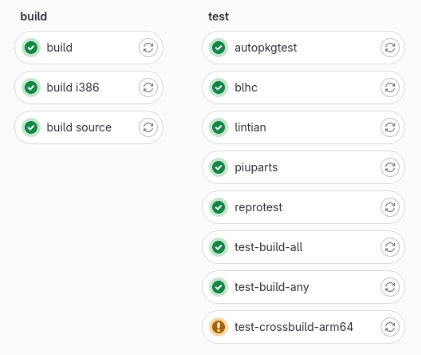
Upcoming Improvements to Salsa CI, by Santiago Ruano Rinc n Santiago started picking up the work made by Outreachy Intern, Enock Kashada (a big thanks to him!), to solve some long-standing issues in Salsa CI. Currently, the first job in a Salsa CI pipeline is the extract-source job, used to produce a debianize source tree of the project. This job was introduced to make it possible to build the projects on different architectures, on the subsequent build jobs. However, that extract-source approach is sub-optimal: not only it increases the execution time of the pipeline by some minutes, but also projects whose source tree is too large are not able to use the pipeline. The debianize source tree is passed as an artifact to the build jobs, and for those large projects, the size of their source tree exceeds the Salsa s limits. This is specific issue is documented as issue #195, and the proposed solution is to get rid of the extract-source job, relying on sbuild in the very build job (see issue #296). Switching to sbuild would also help to improve the build source job, solving issues such as #187 and #298. The current work-in-progress is very preliminary, but it has already been possible to run the build (amd64), build-i386 and build-source job using sbuild with the unshare mode. The image on the right shows a pipeline that builds grep. All the test jobs use the artifacts of the new build job. There is a lot of remaining work, mainly making the integration with ccache work. This change could break some things, it will also be important to test how the new pipeline works with complex projects. Also, thanks to Emmanuel Arias, we are proposing a Google Summer of Code 2024 project to improve Salsa CI. As part of the ongoing work in preparation for the GSoC 2024 project, Santiago has proposed a merge request to make more efficient how contributors can test their changes on the Salsa CI pipeline.

/usr-move, by Helmut Grohne In January, we sent most of the moving patches for the set of packages involved with debootstrap. Notably missing is glibc, which turns out harder than anticipated via dumat, because it has Conflicts between different architectures, which dumat does not analyze. Patches for diversion mitigations have been updated in a way to not exhibit any loss anymore. The main change here is that packages which are being diverted now support the diverting packages in transitioning their diversions. We also supported a few packages with non-trivial changes such as netplan.io. dumat has been enhanced to better support derivatives such as Ubuntu.

Miscellaneous contributions
  • Python 3.12 migration trundles on. Stefano Rivera helped port several new packages to support 3.12.
  • Stefano updated the Sphinx configuration of DebConf Video Team s documentation, which was broken by Sphinx 7.
  • Stefano published the videos from the Cambridge MiniDebConf to YouTube and PeerTube.
  • DebConf 24 planning has begun, and Stefano & Utkarsh have started work on this.
  • Utkarsh re-sponsored the upload of golang-github-prometheus-community-pgbouncer-exporter for Lena.
  • Colin Watson added Incus support to autopkgtest.
  • Colin discovered Perl::Critic and used it to tidy up some poor practices in several of his packages, including debconf.
  • Colin did some overdue debconf maintenance, mainly around tidying up error message handling in several places (1, 2, 3).
  • Colin figured out how to update the mirror size documentation in debmirror, last updated in 2010. It should now be much easier to keep it up to date regularly.
  • Colin issued a man-db buster update to clean up some irritations due to strict sandboxing.
  • Thorsten Alteholz adopted two more packages, magicfilter and ifhp, for the debian-printing team. Those packages are the last ones of the latest round of adoptions to preserve the old printing protocol within Debian. If you know of other packages that should be retained, please don t hesitate to contact Thorsten.
  • Enrico participated in /usr-merge discussions with Helmut.
  • Helmut sent patches for 16 cross build failures.
  • Helmut supported Matthias Klose (not affiliated with Freexian) with adding -for-host support to gcc-defaults.
  • Helmut uploaded dput-ng enabling dcut migrate and merging two MRs of Ben Hutchings.
  • Santiago took part in the discussions relating to the EU Cyber Resilience Act (CRA) and the Debian public statement that was published last year. He participated in a meeting with Members of the European Parliament (MEPs), Marcel Kolaja and Karen Melchior, and their teams to clarify some points about the impact of the CRA and Debian and downstream projects, and the improvements in the last version of the proposed regulation.

9 February 2024

Reproducible Builds (diffoscope): diffoscope 256 released

The diffoscope maintainers are pleased to announce the release of diffoscope version 256. This version includes the following changes:
* CVE-2024-25711: Use a determistic name when extracting content from GPG
  artifacts instead of trusting the value of gpg's --use-embedded-filenames.
  This prevents a potential information disclosure vulnerability that could
  have been exploited by providing a specially-crafted GPG file with an
  embedded filename of, say, "../../.ssh/id_rsa".
  Many thanks to Daniel Kahn Gillmor <dkg@debian.org> for reporting this
  issue and providing feedback.
  (Closes: reproducible-builds/diffoscope#361)
* Temporarily fix support for Python 3.11.8 re. a potential regression
  with the handling of ZIP files. (See reproducible-builds/diffoscope#362)
You find out more by visiting the project homepage.

8 February 2024

Dirk Eddelbuettel: RcppArmadillo 0.12.8.0.0 on CRAN: New Upstream, Interface Polish

armadillo image Armadillo is a powerful and expressive C++ template library for linear algebra and scientific computing. It aims towards a good balance between speed and ease of use, has a syntax deliberately close to Matlab, and is useful for algorithm development directly in C++, or quick conversion of research code into production environments. RcppArmadillo integrates this library with the R environment and language and is widely used by (currently) 1119 other packages on CRAN, downloaded 32.5 million times (per the partial logs from the cloud mirrors of CRAN), and the CSDA paper (preprint / vignette) by Conrad and myself has been cited 575 times according to Google Scholar. This release brings a new (stable) upstream (minor) release Armadillo 12.8.0 prepared by Conrad two days ago. We, as usual, prepared a release candidate which we tested against the over 1100 CRAN packages using RcppArmadillo. This found no issues, which was confirmed by CRAN once we uploaded and so it arrived as a new release today in a fully automated fashion. We also made a small change that had been prepared by GitHub issue #400: a few internal header files that were cluttering the top-level of the include directory have been moved to internal directories. The standard header is of course unaffected, and the set of full / light / lighter / lightest headers (matching we did a while back in Rcpp) also continue to work as one expects. This change was also tested in a full reverse-dependency check in January but had not been released to CRAN yet. The set of changes since the last CRAN release follows.

Changes in RcppArmadillo version 0.12.8.0.0 (2024-02-06)
  • Upgraded to Armadillo release 12.8.0 (Cortisol Injector)
    • Faster detection of symmetric expressions by pinv() and rank()
    • Expanded shift() to handle sparse matrices
    • Expanded conv_to for more flexible conversions between sparse and dense matrices
    • Added cbrt()
    • More compact representation of integers when saving matrices in CSV format
  • Five non-user facing top-level include files have been removed (#432 closing #400 and building on #395 and #396)

Courtesy of my CRANberries, there is a diffstat report relative to previous release. More detailed information is on the RcppArmadillo page. Questions, comments etc should go to the rcpp-devel mailing list off the Rcpp R-Forge page. If you like this or other open-source work I do, you can sponsor me at GitHub.

This post by Dirk Eddelbuettel originated on his Thinking inside the box blog. Please report excessive re-aggregation in third-party for-profit settings.

Reproducible Builds: Reproducible Builds at FOSDEM 2024

Core Reproducible Builds developer Holger Levsen presented at the main track at FOSDEM on Saturday 3rd February this year in Brussels, Belgium. Titled Reproducible Builds: The First Ten Years
In this talk Holger h01ger Levsen will give an overview about Reproducible Builds: How it started with a small BoF at DebConf13 (and before), then grew from being a Debian effort to something many projects work on together, until in 2021 it was mentioned in an Executive Order of the President of the United States. And of course, the talk will not end there, but rather outline where we are today and where we still need to be going, until Debian stable (and other distros!) will be 100% reproducible, verified by many. h01ger has been involved in reproducible builds since 2014 and so far has set up automated reproducibility testing for Debian, Fedora, Arch Linux, FreeBSD, NetBSD and coreboot.
More information can be found on FOSDEM s own page for the talk, including a video recording and slides.
Separate from Holger s talk, however, there were a number of other talks about reproducible builds at FOSDEM this year: and there was even an entire track on Software Bill of Materials.

7 February 2024

Reproducible Builds: Reproducible Builds in January 2024

Welcome to the January 2024 report from the Reproducible Builds project. In these reports we outline the most important things that we have been up to over the past month. If you are interested in contributing to the project, please visit our Contribute page on our website.

How we executed a critical supply chain attack on PyTorch John Stawinski and Adnan Khan published a lengthy blog post detailing how they executed a supply-chain attack against PyTorch, a popular machine learning platform used by titans like Google, Meta, Boeing, and Lockheed Martin :
Our exploit path resulted in the ability to upload malicious PyTorch releases to GitHub, upload releases to [Amazon Web Services], potentially add code to the main repository branch, backdoor PyTorch dependencies the list goes on. In short, it was bad. Quite bad.
The attack pivoted on PyTorch s use of self-hosted runners as well as submitting a pull request to address a trivial typo in the project s README file to gain access to repository secrets and API keys that could subsequently be used for malicious purposes.

New Arch Linux forensic filesystem tool On our mailing list this month, long-time Reproducible Builds developer kpcyrd announced a new tool designed to forensically analyse Arch Linux filesystem images. Called archlinux-userland-fs-cmp, the tool is supposed to be used from a rescue image (any Linux) with an Arch install mounted to, [for example], /mnt. Crucially, however, at no point is any file from the mounted filesystem eval d or otherwise executed. Parsers are written in a memory safe language. More information about the tool can be found on their announcement message, as well as on the tool s homepage. A GIF of the tool in action is also available.

Issues with our SOURCE_DATE_EPOCH code? Chris Lamb started a thread on our mailing list summarising some potential problems with the source code snippet the Reproducible Builds project has been using to parse the SOURCE_DATE_EPOCH environment variable:
I m not 100% sure who originally wrote this code, but it was probably sometime in the ~2015 era, and it must be in a huge number of codebases by now. Anyway, Alejandro Colomar was working on the shadow security tool and pinged me regarding some potential issues with the code. You can see this conversation here.
Chris ends his message with a request that those with intimate or low-level knowledge of time_t, C types, overflows and the various parsing libraries in the C standard library (etc.) contribute with further info.

Distribution updates In Debian this month, Roland Clobus posted another detailed update of the status of reproducible ISO images on our mailing list. In particular, Roland helpfully summarised that all major desktops build reproducibly with bullseye, bookworm, trixie and sid provided they are built for a second time within the same DAK run (i.e. [within] 6 hours) . Additionally 7 of the 8 bookworm images from the official download link build reproducibly at any later time. In addition to this, three reviews of Debian packages were added, 17 were updated and 15 were removed this month adding to our knowledge about identified issues. Elsewhere, Bernhard posted another monthly update for his work elsewhere in openSUSE.

Community updates There were made a number of improvements to our website, including Bernhard M. Wiedemann fixing a number of typos of the term nondeterministic . [ ] and Jan Zerebecki adding a substantial and highly welcome section to our page about SOURCE_DATE_EPOCH to document its interaction with distribution rebuilds. [ ].
diffoscope is our in-depth and content-aware diff utility that can locate and diagnose reproducibility issues. This month, Chris Lamb made a number of changes such as uploading versions 254 and 255 to Debian but focusing on triaging and/or merging code from other contributors. This included adding support for comparing eXtensible ARchive (.XAR/.PKG) files courtesy of Seth Michael Larson [ ][ ], as well considerable work from Vekhir in order to fix compatibility between various and subtle incompatible versions of the progressbar libraries in Python [ ][ ][ ][ ]. Thanks!

Reproducibility testing framework The Reproducible Builds project operates a comprehensive testing framework (available at tests.reproducible-builds.org) in order to check packages and other artifacts for reproducibility. In January, a number of changes were made by Holger Levsen:
  • Debian-related changes:
    • Reduce the number of arm64 architecture workers from 24 to 16. [ ]
    • Use diffoscope from the Debian release being tested again. [ ]
    • Improve the handling when killing unwanted processes [ ][ ][ ] and be more verbose about it, too [ ].
    • Don t mark a job as failed if process marked as to-be-killed is already gone. [ ]
    • Display the architecture of builds that have been running for more than 48 hours. [ ]
    • Reboot arm64 nodes when they hit an OOM (out of memory) state. [ ]
  • Package rescheduling changes:
    • Reduce IRC notifications to 1 when rescheduling due to package status changes. [ ]
    • Correctly set SUDO_USER when rescheduling packages. [ ]
    • Automatically reschedule packages regressing to FTBFS (build failure) or FTBR (build success, but unreproducible). [ ]
  • OpenWrt-related changes:
    • Install the python3-dev and python3-pyelftools packages as they are now needed for the sunxi target. [ ][ ]
    • Also install the libpam0g-dev which is needed by some OpenWrt hardware targets. [ ]
  • Misc:
    • As it s January, set the real_year variable to 2024 [ ] and bump various copyright years as well [ ].
    • Fix a large (!) number of spelling mistakes in various scripts. [ ][ ][ ]
    • Prevent Squid and Systemd processes from being killed by the kernel s OOM killer. [ ]
    • Install the iptables tool everywhere, else our custom rc.local script fails. [ ]
    • Cleanup the /srv/workspace/pbuilder directory on boot. [ ]
    • Automatically restart Squid if it fails. [ ]
    • Limit the execution of chroot-installation jobs to a maximum of 4 concurrent runs. [ ][ ]
Significant amounts of node maintenance was performed by Holger Levsen (eg. [ ][ ][ ][ ][ ][ ][ ] etc.) and Vagrant Cascadian (eg. [ ][ ][ ][ ][ ][ ][ ][ ]). Indeed, Vagrant Cascadian handled an extended power outage for the network running the Debian armhf architecture test infrastructure. This provided the incentive to replace the UPS batteries and consolidate infrastructure to reduce future UPS load. [ ] Elsewhere in our infrastructure, however, Holger Levsen also adjusted the email configuration for @reproducible-builds.org to deal with a new SMTP email attack. [ ]

Upstream patches The Reproducible Builds project tries to detects, dissects and fix as many (currently) unreproducible packages as possible. We endeavour to send all of our patches upstream where appropriate. This month, we wrote a large number of such patches, including: Separate to this, Vagrant Cascadian followed up with the relevant maintainers when reproducibility fixes were not included in newly-uploaded versions of the mm-common package in Debian this was quickly fixed, however. [ ]

If you are interested in contributing to the Reproducible Builds project, please visit our Contribute page on our website. However, you can get in touch with us via:

6 February 2024

Robert McQueen: Flathub: Pros and Cons of Direct Uploads

I attended FOSDEM last weekend and had the pleasure to participate in the Flathub / Flatpak BOF on Saturday. A lot of the session was used up by an extensive discussion about the merits (or not) of allowing direct uploads versus building everything centrally on Flathub s infrastructure, and related concerns such as automated security/dependency scanning. My original motivation behind the idea was essentially two things. The first was to offer a simpler way forward for applications that use language-specific build tools that resolve and retrieve their own dependencies from the internet. Flathub doesn t allow network access during builds, and so a lot of manual work and additional tooling is currently needed (see Python and Electron Flatpak guides). And the second was to offer a maybe more familiar flow to developers from other platforms who would just build something and then run another command to upload it to the store, without having to learn the syntax of a new build tool. There were many valid concerns raised in the room, and I think on reflection that this is still worth doing, but might not be as valuable a way forward for Flathub as I had initially hoped. Of course, for a proprietary application where Flathub never sees the source or where it s built, whether that binary is uploaded to us or downloaded by us doesn t change much. But for an FLOSS application, a direct upload driven by the developer causes a regression on a number of fronts. We re not getting too hung up on the malicious developer inserts evil code in the binary case because Flathub already works on the model of verifying the developer and the user makes a decision to trust that app we don t review the source after all. But we do lose other things such as our infrastructure building on multiple architectures, and visibility on whether the build environment or upload credentials have been compromised unbeknownst to the developer. There is now a manual review process for when apps change their metadata such as name, icon, license and permissions which would apply to any direct uploads as well. It was suggested that if only heavily sandboxed apps (eg no direct filesystem access without proper use of portals) were permitted to make direct uploads, the impact of such concerns might be somewhat mitigated by the sandboxing. However, it was also pointed out that my go-to example of Electron app developers can upload to Flathub with one command was also a bit of a fiction. At present, none of them would pass that stricter sandboxing requirement. Almost all Electron apps run old versions of Chromium with less complete portal support, needing sandbox escapes to function correctly, and Electron (and Chromium s) sandboxing still needs additional tooling/downstream patching to run inside a Flatpak. Buh-boh. I think for established projects who already ship their own binaries from their own centralised/trusted infrastructure, and for developers who have understandable sensitivities about binary integrity such such as encryption, password or financial tools, it s a definite improvement that we re able to set up direct uploads with such projects with less manual work. There are already quite a few applications including verified ones where the build recipe simply fetches a binary built elsewhere and unpacks it, and if this already done centrally by the developer, repeating the exercise on Flathub s server adds little value. However for the individual developer experience, I think we need to zoom out a bit and think about how to improve this from a tools and infrastructure perspective as we grow Flathub, and as we seek to raise funds for different sources for these improvements. I took notes for everything that was mentioned as a tooling limitation during the BOF, along with a few ideas about how we could improve things, and hope to share these soon as part of an RFP/RFI (Request For Proposals/Request for Information) process. We don t have funding yet but if we have some prospective collaborators to help refine the scope and estimate the cost/effort, we can use this to go and pursue funding opportunities.

2 February 2024

Scarlett Gately Moore: Some exciting news! Kubuntu: I m back!!!

It s official, the Kubuntu Council has hired me part time to work on the 24.04 LTS release, preparation for Plasma 6, and to bring life back into the Distribution. First I want thank the Kubuntu Council for this opportunity and I plan a long and successful journey together!!!! My first week ( I started midweek ): It has been a busy one! Many meet and greets with the team and other interested parties. I had the chance to chat with Mike from Kubuntu Focus and I have to say I am absolutely amazed with the work they have done, and if you are in the market for a new laptop, you must check these out!!! https://kfocus.org Or if you want to try before you buy you can download the OS! All they ask is for an e-mail, which is completely reasonable. Hosting isn t free! Besides, you can opt out anytime and they don t share it with anyone. I look forward to working closely with this project. We now have a Kubuntu Team in KDE invent https://invent.kde.org/teams/distribution-kubuntu if you would like to join us, please don t hesitate to ask! I have started a new Wiki and our first page is the ever important Bug triaging! It is still a WIP but you can check it out here: https://invent.kde.org/teams/distribution-kubuntu/docs/-/wikis/Bug-Triage-Story-WIP , with that said I have started the launchpad work to make tracking our bugs easier buy subscribing kubuntu-bugs to all our packages and creating proper projects for our packages missing them. We have compiled a list of our various documentation links that need updated and Rick Timmis is updating kubuntu.org! Aaron Honeycutt has been busy with the Kubuntu Manual https://github.com/kubuntu-team/kubuntu-manual which is in good shape. We just need to improve our developer story  I have been working on the rather massive Apparmor bug https://bugs.launchpad.net/ubuntu/+source/apparmor/+bug/2046844 with testing the fixes from the ppa and writing profiles for the various KDE packages affected ( pretty much anything that uses webengine ) and making progress there. My next order of business staging Frameworks 5.114 with guidance from our super awesome Rik Mills that has been doing most of the heavy lifting in Kubuntu for many years now. So thank you for that Rik  I will also start on our big transition to the Calamaras Installer! I do have experience here, so I expect it will be a smooth one. I am so excited for the future of Kubuntu and the exciting things to come! With that said, the Kubuntu funding is community donation driven. There is enough to pay me part time for a couple contracts, but it will run out and a full-time contract would be super awesome. I am reaching out to anyone enjoying Kubuntu and want to help with the future of Kubuntu to please consider a donation! We are working on more donation options, but for now you can donate through paypal at https://kubuntu.org/donate/ Thank you!!!!!

Dirk Eddelbuettel: RQuantLib 0.4.21 on CRAN: Maintenance

A new minor release 0.4.21 of RQuantLib arrived at CRAN this afternoon, and has already been uploaded to Debian as well. QuantLib is a rather comprehensice free/open-source library for quantitative finance. RQuantLib connects (some parts of) it to the R environment and language, and has been part of CRAN for more than twenty years (!!) as it was one of the first packages I uploaded there. This release of RQuantLib benefits from some kind attention that Jeroen has been paying to how we build (especially at CRAN) on both macOS and Windows. So the build processes are a little better now, and no internal code changed. QuantLib 1.33 built unchanged.

Changes in RQuantLib version 0.4.21 (2024-02-01)
  • Generalize macOS build to universal build (Jeroen in #179)
  • Generalize Windows build to arm64 (Jeroen in #181)
  • Generalize version string use to support cmake use (Jeroen in #181 fixing #180)
  • Minor update to 'ci.yaml' github action (Dirk)

Courtesy of my CRANberries, there is also a diffstat report for the this release. As always, more detailed information is on the RQuantLib page. Questions, comments etc should go to the rquantlib-devel mailing list. Issue tickets can be filed at the GitHub repo. If you like this or other open-source work I do, you can now sponsor me at GitHub.

This post by Dirk Eddelbuettel originated on his Thinking inside the box blog. Please report excessive re-aggregation in third-party for-profit settings.

1 February 2024

Russ Allbery: Review: System Collapse

Review: System Collapse, by Martha Wells
Series: Murderbot Diaries #7
Publisher: Tordotcom
Copyright: 2023
ISBN: 1-250-82698-5
Format: Kindle
Pages: 245
System Collapse is the second Murderbot novel. Including the novellas, it's the 7th in the series. Unlike Fugitive Telemetry, the previous novella that was out of chronological order, this is the direct sequel to Network Effect. A very direct sequel; it picks up just a few days after the previous novel ended. Needless to say, you should not start here. I was warned by other people and therefore re-read Network Effect immediately before reading System Collapse. That was an excellent idea, since this novel opens with a large cast, no dramatis personae, not much in the way of a plot summary, and a lot of emotional continuity from the previous novel. I would grumble about this more, like I have in other reviews, but I thoroughly enjoyed re-reading Network Effect and appreciated the excuse.
ART-drone said, I wouldn t recommend it. I lack a sense of proportional response. I don t advise engaging with me on any level.
Saying much about the plot of this book without spoiling Network Effect and the rest of the series is challenging. Murderbot is suffering from the aftereffects of the events of the previous book more than it expected or would like to admit. It and its humans are in the middle of a complicated multi-way negotiation with some locals, who the corporates are trying to exploit. One of the difficulties in that negotiation is getting people to believe that the corporations are as evil as they actually are, a plot element that has a depressing amount in common with current politics. Meanwhile, Murderbot is trying to keep everyone alive. I loved Network Effect, but that was primarily for the social dynamics. The planet that was central to the novel was less interesting, so another (short) novel about the same planet was a bit of a disappointment. This does give Wells a chance to show in more detail what Murderbot's new allies have been up to, but there is a lot of speculative exploration and detailed descriptions of underground tunnels that I found less compelling than the relationship dynamics of the previous book. (Murderbot, on the other hand, would much prefer exploring creepy abandoned tunnels to talking about its feelings.) One of the things this series continues to do incredibly well, though, is take non-human intelligence seriously in a world where the humans mostly don't. It perfectly fills a gap between Star Wars, where neither the humans nor the story take non-human intelligences seriously (hence the creepy slavery vibes as soon as you start paying attention to droids), and the Culture, where both humans and the story do. The corporates (the bad guys in this series) treat non-human intelligences the way Star Wars treats droids. The good guys treat Murderbot mostly like a strange human, which is better but still wrong, and still don't notice the numerous other machine intelligences. But Wells, as the author, takes all of the non-human characters seriously, which means there are complex and fascinating relationships happening at a level of the story that the human characters are mostly unaware of. I love that Murderbot rarely bothers to explain; if the humans are too blinkered to notice, that's their problem. About halfway into the story, System Collapse hits its stride, not coincidentally at the point where Murderbot befriends some new computers. The rest of the book is great. This was not as good as Network Effect. There is a bit less competence porn at the start, and although that's for good in-story reasons I still missed it. Murderbot's redaction of things it doesn't want to talk about got a bit annoying before it finally resolved. And I was not sufficiently interested in this planet to want to spend two novels on it, at least without another major revelation that didn't come. But it's still a Murderbot novel, which means it has the best first-person narrative voice I've ever read, some great moments, and possibly the most compelling and varied presentation of computer intelligence in science fiction at the moment.
There was no feed ID, but AdaCol2 supplied the name Lucia and when I asked it for more info, the gender signifier bb (which didn t translate) and he/him pronouns. (I asked because the humans would bug me for the information; I was as indifferent to human gender as it was possible to be without being unconscious.)
This is not a series to read out of order, but if you have read this far, you will continue to be entertained. You don't need me to tell you this nearly everyone reviewing science fiction is saying it but this series is great and you should read it. Rating: 8 out of 10

29 January 2024

Russ Allbery: Review: Bluebird

Review: Bluebird, by Ciel Pierlot
Publisher: Angry Robot
Copyright: 2022
ISBN: 0-85766-967-2
Format: Kindle
Pages: 458
Bluebird is a stand-alone far-future science fiction adventure. Ten thousand years ago, a star fell into the galaxy carrying three factions of humanity. The Ascetics, the Ossuary, and the Pyrites each believe that only their god survived and the other two factions are heretics. Between them, they have conquered the rest of the galaxy and its non-human species. The only thing the factions hate worse than each other are those who attempt to stay outside the faction system. Rig used to be a Pyrite weapon designer before she set fire to her office and escaped with her greatest invention. Now she's a Nightbird, a member of an outlaw band that tries to help refugees and protect her fellow Kashrini against Pyrite genocide. On her side, she has her girlfriend, an Ascetic librarian; her ship, Bluebird; and her guns, Panache and Pizzazz. And now, perhaps, the mysterious Ginka, a Zazra empath and remarkably capable fighter who helps Rig escape from an ambush by Pyrite soldiers. Rig wants to stay alive, help her people, and defy the factions. Pyrite wants Rig's secrets and, as leverage, has her sister. What Ginka wants is not entirely clear even to Ginka. This book is absurd, but I still had fun with it. It's dangerous for me to compare things to anime given how little anime that I've watched, but Bluebird had that vibe for me: anime, or maybe Japanese RPGs or superhero comics. The storytelling is very visual, combat-oriented, and not particularly realistic. Rig is a pistol sharpshooter and Ginka is the type of undefined deadly acrobatic fighter so often seen in that type of media. In addition to her ship, Rig has a gorgeous hand-maintained racing hoverbike with a beautiful paint job. It's that sort of book. It's also the sort of book where the characters obey cinematic logic designed to maximize dramatic physical confrontations, even if their actions make no logical sense. There is no facial recognition or screening, and it's bizarrely easy for the protagonists to end up in same physical location as high-up bad guys. One of the weapon systems that's critical to the plot makes no sense whatsoever. At critical moments, the bad guys behave more like final bosses in a video game, picking up weapons to deal with the protagonists directly instead of using their supposedly vast armies of agents. There is supposedly a whole galaxy full of civilizations with capital worlds covered in planet-spanning cities, but politics barely exist and the faction leaders get directly involved in the plot. If you are looking for a realistic projection of technology or society, I cannot stress enough that this is not the book that you're looking for. You probably figured that out when I mentioned ten thousand years of war, but that will only be the beginning of the suspension of disbelief problems. You need to turn off your brain and enjoy the action sequences and melodrama. I'm normally good at that, and I admit I still struggled because the plot logic is such a mismatch with the typical novels I read. There are several points where the characters do something that seems so monumentally dumb that I was sure Pierlot was setting them up for a fall, and then I got wrong-footed because their plan worked fine, or exploded for unrelated reasons. I think this type of story, heavy on dramatic eye-candy and emotional moments with swelling soundtracks, is a lot easier to pull off in visual media where all the pretty pictures distract your brain. In a novel, there's a lot of time to think about the strategy, technology, and government structure, which for this book is not a good idea. If you can get past that, though, Rig is entertainingly snarky and Ginka, who turns out to be the emotional heart of the book, is an enjoyable character with a real growth arc. Her background is a bit simplistic and the villains are the sort of pure evil that you might expect from this type of cinematic plot, but I cared about the outcome of her story. Some parts of the plot dragged and I think the editing could have been tighter, but there was enough competence porn and banter to pull me through. I would recommend Bluebird only cautiously, since you're going to need to turn off large portions of your brain and be in the right mood for nonsensically dramatic confrontations, but I don't regret reading it. It's mostly in primary colors and the emotional conflicts are not what anyone would call subtle, but it delivers a character arc and a somewhat satisfying ending. Content warning: There is a lot of serious physical injury in this book, including surgical maiming. If that's going to bother you, you may want to give this one a pass. Rating: 6 out of 10

28 January 2024

Niels Thykier: Annotating the Debian packaging directory

In my previous blog post Providing online reference documentation for debputy, I made a point about how debhelper documentation was suboptimal on account of being static rather than online. The thing is that debhelper is not alone in this problem space, even if it is a major contributor to the number of packaging files you have to to know about. If we look at the "competition" here such as Fedora and Arch Linux, they tend to only have one packaging file. While most Debian people will tell you a long list of cons about having one packaging file (such a Fedora's spec file being 3+ domain specific languages "mashed" into one file), one major advantage is that there is only "the one packaging file". You only need to remember where to find the documentation for one file, which is great when you are running on wetware with limited storage capacity. Which means as a newbie, you can dedicate less mental resources to tracking multiple files and how they interact and more effort understanding the "one file" at hand. I started by asking myself how can we in Debian make the packaging stack more accessible to newcomers? Spoiler alert, I dug myself into rabbit hole and ended up somewhere else than where I thought I was going. I started by wanting to scan the debian directory and annotate all files that I could with documentation links. The logic was that if debputy could do that for you, then you could spend more mental effort elsewhere. So I combined debputy's packager provided files detection with a static list of files and I quickly had a good starting point for debputy-based packages.
Adding (non-static) dpkg and debhelper files to the mix Now, I could have closed the topic here and said "Look, I did debputy files plus couple of super common files". But I decided to take it a bit further. I added support for handling some dpkg files like packager provided files (such as debian/substvars and debian/symbols). But even then, we all know that debhelper is the big hurdle and a major part of the omission... In another previous blog post (A new Debian package helper: debputy), I made a point about how debputy could list all auxiliary files while debhelper could not. This was exactly the kind of feature that I would need for this feature, if this feature was to cover debhelper. Now, I also remarked in that blog post that I was not willing to maintain such a list. Also, I may have ranted about static documentation being unhelpful for debhelper as it excludes third-party provided tooling. Fortunately, a recent update to dh_assistant had provided some basic plumbing for loading dh sequences. This meant that getting a list of all relevant commands for a source package was a lot easier than it used to be. Once you have a list of commands, it would be possible to check all of them for dh's NOOP PROMISE hints. In these hints, a command can assert it does nothing if a given pkgfile is not present. This lead to the new dh_assistant list-guessed-dh-config-files command that will list all declared pkgfiles and which helpers listed them. With this combined feature set in place, debputy could call dh_assistant to get a list of pkgfiles, pretend they were packager provided files and annotate those along with manpage for the relevant debhelper command. The exciting thing about letting debpputy resolve the pkgfiles is that debputy will resolve "named" files automatically (debhelper tools will only do so when --name is passed), so it is much more likely to detect named pkgfiles correctly too. Side note: I am going to ignore the elephant in the room for now, which is dh_installsystemd and its package@.service files and the wide-spread use of debian/foo.service where there is no package called foo. For the latter case, the "proper" name would be debian/pkg.foo.service. With the new dh_assistant feature done and added to debputy, debputy could now detect the ubiquitous debian/install file. Excellent. But less great was that the very common debian/docs file was not. Turns out that dh_installdocs cannot be skipped by dh, so it cannot have NOOP PROMISE hints. Meh... Well, dh_assistant could learn about a new INTROSPECTABLE marker in addition to the NOOP PROMISE and then I could sprinkle that into a few commands. Indeed that worked and meant that debian/postinst (etc.) are now also detectable. At this point, debputy would be able to identify a wide range of debhelper related configuration files in debian/ and at least associate each of them with one or more commands. Nice, surely, this would be a good place to stop, right...?
Adding more metadata to the files The debhelper detected files only had a command name and manpage URI to that command. It would be nice if we could contextualize this a bit more. Like is this file installed into the package as is like debian/pam or is it a file list to be processed like debian/install. To make this distinction, I could add the most common debhelper file types to my static list and then merge the result together. Except, I do not want to maintain a full list in debputy. Fortunately, debputy has a quite extensible plugin infrastructure, so added a new plugin feature to provide this kind of detail and now I can outsource the problem! I split my definitions into two and placed the generic ones in the debputy-documentation plugin and moved the debhelper related ones to debhelper-documentation. Additionally, third-party dh addons could provide their own debputy plugin to add context to their configuration files. So, this gave birth file categories and configuration features, which described each file on different fronts. As an example, debian/gbp.conf could be tagged as a maint-config to signal that it is not directly related to the package build but more of a tool or style preference file. On the other hand, debian/install and debian/debputy.manifest would both be tagged as a pkg-helper-config. Files like debian/pam were tagged as ppf-file for packager provided file and so on. I mentioned configuration features above and those were added because, I have had a beef with debhelper's "standard" configuration file format as read by filearray and filedoublearray. They are often considered simple to understand, but it is hard to know how a tool will actually read the file. As an example, consider the following:
  • Will the debhelper use filearray, filedoublearray or none of them to read the file? This topic has about 2 bits of entropy.
  • Will the config file be executed if it is marked executable assuming you are using the right compat level? If it is executable, does dh-exec allow renaming for this file? This topic adds 1 or 2 bit of entropy depending on the context.
  • Will the config file be subject to glob expansions? This topic sounds like a boolean but is a complicated mess. The globs can be handled either by debhelper as it parses the file for you. In this case, the globs are applied to every token. However, this is not what dh_install does. Here the last token on each line is supposed to be a directory and therefore not subject to globs. Therefore, dh_install does the globbing itself afterwards but only on part of the tokens. So that is about 2 bits of entropy more. Actually, it gets worse...
    • If the file is executed, debhelper will refuse to expand globs in the output of the command, which was a deliberate design choice by the original debhelper maintainer took when he introduced the feature in debhelper/8.9.12. Except, dh_install feature interacts with the design choice and does enable glob expansion in the tool output, because it does so manually after its filedoublearray call.
So these "simple" files have way too many combinations of how they can be interpreted. I figured it would be helpful if debputy could highlight these difference, so I added support for those as well. Accordingly, debian/install is tagged with multiple tags including dh-executable-config and dh-glob-after-execute. Then, I added a datatable of these tags, so it would be easy for people to look up what they meant. Ok, this seems like a closed deal, right...?
Context, context, context However, the dh-executable-config tag among other are only applicable in compat 9 or later. It does not seem newbie friendly if you are told that this feature exist, but then have to read in the extended description that that it actually does not apply to your package. This problem seems fixable. Thanks to dh_assistant, it is easy to figure out which compat level the package is using. Then tweak some metadata to enable per compat level rules. With that tags like dh-executable-config only appears for packages using compat 9 or later. Also, debputy should be able to tell you where packager provided files like debian/pam are installed. We already have the logic for packager provided files that debputy supports and I am already using debputy engine for detecting the files. If only the plugin provided metadata gave me the install pattern, debputy would be able tell you where this file goes in the package. Indeed, a bit of tweaking later and setting install-pattern to usr/lib/pam.d/ name , debputy presented me with the correct install-path with the package name placing the name placeholder. Now, I have been using debian/pam as an example, because debian/pam is installed into usr/lib/pam.d in compat 14. But in earlier compat levels, it was installed into etc/pam.d. Well, I already had an infrastructure for doing compat file tags. Off we go to add install-pattern to the complat level infrastructure and now changing the compat level would change the path. Great. (Bug warning: The value is off-by-one in the current version of debhelper. This is fixed in git) Also, while we are in this install-pattern business, a number of debhelper config files causes files to be installed into a fixed directory. Like debian/docs which causes file to be installed into /usr/share/docs/ package . Surely, we can expand that as well and provide that bit of context too... and done. (Bug warning: The code currently does not account for the main documentation package context) It is rather common pattern for people to do debian/foo.in files, because they want to custom generation of debian/foo. Which means if you have debian/foo you get "Oh, let me tell you about debian/foo ". Then you rename it to debian/foo.in and the result is "debian/foo.in is a total mystery to me!". That is suboptimal, so lets detect those as well as if they were the original file but add a tag saying that they are a generate template and which file we suspect it generates. Finally, if you use debputy, almost all of the standard debhelper commands are removed from the sequence, since debputy replaces them. It would be weird if these commands still contributed configuration files when they are not actually going to be invoked. This mostly happened naturally due to the way the underlying dh_assistant command works. However, any file mentioned by the debhelper-documentation plugin would still appear unfortunately. So off I went to filter the list of known configuration files against which dh_ commands that dh_assistant thought would be used for this package.
Wrapping it up I was several layers into this and had to dig myself out. I have ended up with a lot of data and metadata. But it was quite difficult for me to arrange the output in a user friendly manner. However, all this data did seem like it would be useful any tool that wants to understand more about the package. So to get out of the rabbit hole, I for now wrapped all of this into JSON and now we have a debputy tool-support annotate-debian-directory command that might be useful for other tools. To try it out, you can try the following demo: In another day, I will figure out how to structure this output so it is useful for non-machine consumers. Suggestions are welcome. :)
Limitations of the approach As a closing remark, I should probably remind people that this feature relies heavily on declarative features. These include:
  • When determining which commands are relevant, using Build-Depends: dh-sequence-foo is much more reliable than configuring it via the Turing complete configuration we call debian/rules.
  • When debhelper commands use NOOP promise hints, dh_assistant can "see" the config files listed those hints, meaning the file will at least be detected. For new introspectable hint and the debputy plugin, it is probably better to wait until the dust settles a bit before adding any of those.
You can help yourself and others to better results by using the declarative way rather than using debian/rules, which is the bane of all introspection!

Russell Coker: Links January 2024

Long Now has an insightful article about domestication that considers whether humans have evolved to want to control nature [1]. The OMG Elite hacker cable is an interesting device [2]. A Wifi device in a USB cable to allow remote control and monitoring of data transfer, including remote keyboard control and sniffing. Pity that USB-C cables have chips in them so you can t use a spark to remove unwanted chips from modern cables. David Brin s blog post The core goal of tyrants: The Red-Caesar Cult and a restored era of The Great Man has some insightful points about authoritarianism [3]. Ron Garret wrote an interesting argument against Christianity [4], and a follow-up titled Why I Don t Believe in Jesus [5]. He has a link to a well written article about the different theologies of Jesus and Paul [6]. Dimitri John Ledkov wrote an interesting blog post about how they reduced disk space for Ubuntu kernel packages and RAM for the initramfs phase of boot [7]. I hope this gets copied to Debian soon. Joey Hess wrote an interesting blog post about trying to make LLM systems produce bad code if trained on his code without permission [8]. Arstechnica has an interesting summary of research into the security of fingerprint sensors [9]. Not surprising that the products of the 3 vendors that supply almost all PC fingerprint readers are easy to compromise. Bruce Schneier wrote an insightful blog post about how AI will allow mass spying (as opposed to mass surveillance) [10]. ZDnet has an informative article How to Write Better ChatGPT Prompts in 5 Steps [11]. I sent this to a bunch of my relatives. AbortRetryFail has an interesting article about the Itanic Saga [12]. Erberus sounds interesting, maybe VLIW designs could give a good ration of instructions to power unlike the Itanium which was notorious for being power hungry. Bruce Schneier wrote an insightful article about AI and Trust [13]. We really need laws controlling these things! David Brin wrote an interesting blog post on the obsession with historical cycles [14].

24 January 2024

Thomas Lange: FAI 6.2 released

After more than one a year, a new minor FAI version is available, but it includes some interesting new features. Here a the items from the NEWS file: fai (6.2) unstable; urgency=low In the past the command fai-cd was only used for creating installation ISOs, that could be used from CD or USB stick. Now it possible to create a live ISO. Therefore you create your live chroot environment using 'fai dirinstall' and then convert it to a bootable live ISO using fai-cd. See man fai-cd(8) for an example. Years ago I had the idea to use the remaining disk space on an USB stick after copying an ISO onto it. I've blogged about this recently: https://blog.fai-project.org/posts/extending-iso-images/ The new FAI version includes the tool mk-data-partition for adding a data partition to the ISO itself or to an USB stick. FAI detects this data partition, mounts it to /media/data and can then use various configurations from it. You may want to copy your own set of .deb packages or your whole FAI config space to this partition. FAI now automatically searches this partition for usable FAI configuration data and packages. FAI will install all packages from pkgs/<CLASSNAME> if the equivalent class is defined. Setting FAI_CONFIG_SRC=detect:// now looks into the data partition for the subdirectory 'config' and uses this as the config space. So it's now possible to modify an existing ISO (that is read-only) and make changes to the config space. If there's no config directory in the data partition FAI uses the default location on the ISO. The tool fai-kvm, which starts virtual machines can now boot an ISO not only as CD but also as USB stick. Sometimes users want to adjust the list of disks before the partitioning is startet. Therefore FAI provides several new functions including You can select individual disks by their model name or even the serial number. Two new FAI flags were added (tmux and screen) that make it easy to run FAI inside a tmux or screen session. And finally FAI uses systemd. Yeah! This technical change was waiting since 2015 in a merge request from Moritz 'Morty' Str be, that would enable using systemd during the installation. Before FAI still was using old-style SYSV init scripts and did not started systemd. I didn't tried to apply the patch, because I was afraid that it would need much time to make it work. But then in may 2023 Juri Grabowski just gave it a try at MiniDebConf Hamburg, and voil it just works! Many, many thanks to Moritz and Juri for their bravery. The whole changelog can be found at https://tracker.debian.org/media/packages/f/fai/changelog-6.2 New ISOs for FAI are also available including an example of a Xfce desktop live ISO: https://fai-project.org/fai-cd/ The FAIme service for creating customized installation ISOs will get its update later. The new packages are available for bookworm by adding this line to your sources.list: deb https://fai-project.org/download bookworm koeln

22 January 2024

Russell Coker: Storage Trends 2024

It has been less than a year since my last post about storage trends [1] and enough has changed to make it worth writing again. My previous analysis was that for <2TB only SSD made sense, for 4TB SSD made sense for business use while hard drives were still a good option for home use, and for 8TB+ hard drives were clearly the best choice for most uses. I will start by looking at MSY prices, they aren't the cheapest (you can get cheaper online) but they are competitive and they make it easy to compare the different options. I'll also compare the cheapest options in each size, there are more expensive options but usually if you want to pay more then the performance benefits of SSD (both SATA and NVMe) are even more appealing. All prices are in Australian dollars and of parts that are readily available in Australia, but the relative prices of the parts are probably similar in most countries. The main issue here is when to use SSD and when to use hard disks, and then if SSD is chosen which variety to use. Small Storage For my last post the cheapest storage devices from MSY were $19 for a 128G SSD, now it s $24 for a 128G SSD or NVMe device. I don t think the Australian dollar has dropped much against foreign currencies, so I guess this is partly companies wanting more profits and partly due to the demand for more storage. Items that can t sell in quantity need higher profit margins if they are to have them in stock. 500G SSDs are around $33 and 500G NVMe devices for $36 so for most use cases it wouldn t make sense to buy anything smaller than 500G. The cheapest hard drive is $45 for a 1TB disk. A 1TB SATA SSD costs $61 and a 1TB NVMe costs $79. So 1TB disks aren t a good option for any use case. A 2TB hard drive is $89. A 2TB SATA SSD is $118 and a 2TB NVMe is $145. I don t think the small savings you can get from using hard drives makes them worth using for 2TB. For most people if you have a system that s important to you then $145 on storage isn t a lot to spend. It seems hardly worth buying less than 2TB of storage, even for a laptop. Even if you don t use all the space larger storage devices tend to support more writes before wearing out so you still gain from it. A 2TB NVMe device you buy for a laptop now could be used in every replacement laptop for the next 10 years. I only have 512G of storage in my laptop because I have a collection of SSD/NVMe devices that have been replaced in larger systems, so the 512G is essentially free for my laptop as I bought a larger device for a server. For small business use it doesn t make sense to buy anything smaller than 2TB for any system other than a router. If you buy smaller devices then you will sometimes have to pay people to install bigger ones and when the price is $145 it s best to just pay that up front and be done with it. Medium Storage A 4TB hard drive is $135. A 4TB SATA SSD is $319 and a 4TB NVMe is $299. The prices haven t changed a lot since last year, but a small increase in hard drive prices and a small decrease in SSD prices makes SSD more appealing for this market segment. A common size range for home servers and small business servers is 4TB or 8TB of storage. To do that on SSD means about $600 for 4TB of RAID-1 or $900 for 8TB of RAID-5/RAID-Z. That s quite affordable for that use. For 8TB of less important storage a 8TB hard drive costs $239 and a 8TB SATA SSD costs $899 so a hard drive clearly wins for the specific case of non-RAID single device storage. Note that the U.2 devices are more competitive for 8TB than SATA but I included them in the next section because they are more difficult to install. Serious Storage With 8TB being an uncommon and expensive option for consumer SSDs the cheapest price is for multiple 4TB devices. To have multiple NVMe devices in one PCIe slot you need PCIe bifurcation (treating the PCIe slot as multiple slots). Most of the machines I use don t support bifurcation and most affordable systems with ECC RAM don t have it. For cheap NVMe type storage there are U.2 devices (the enterprise form of NVMe). Until recently they were too expensive to use for desktop systems but now there are PCIe cards for internal U.2 devices, $14 for a card that takes a single U.2 is a common price on AliExpress and prices below $600 for a 7.68TB U.2 device are common that s cheaper on a per-TB basis than SATA SSD and NVMe! There are PCIe cards that take up to 4*U.2 devices (which probably require bifurcation) which means you could have 8+ U.2 devices in one not particularly high end PC for 56TB of RAID-Z NVMe storage. Admittedly $4200 for 56TB is moderately expensive, but it s in the price range for a small business server or a high end home server. A more common configuration might be 2*7.68TB U.2 on a single PCIe card (or 2 cards if you don t have bifurcation) for 7.68TB of RAID-1 storage. For SATA SSD AliExpress has a 6*2.5 hot-swap device that fits in a 5.25 bay for $63, so if you have 2*5.25 bays you could have 12*4TB SSDs for 44TB of RAID-Z storage. That wouldn t be much cheaper than 8*7.68TB U.2 devices and would be slower and have less space. But it would be a good option if PCIe bifurcation isn t possible. 16TB SATA hard drives cost $559 which is almost exactly half the price per TB of U.2 storage. That doesn t seem like a good deal. If you want 16TB of RAID storage then 3*7.68TB U.2 devices only costs about 50% more than 2*16TB SATA disks. In most cases paying 50% more to get NVMe instead of hard disks is a good option. As sizes go above 16TB prices go up in a more than linear manner, I guess they don t sell much volume of larger drives. 15.36TB U.2 devices are on sale for about $1300, slightly more than twice the price of a 16TB disk. It s within the price range of small businesses and serious home users. Also it should be noted that the U.2 devices are designed for enterprise levels of reliability and the hard disk prices I m comparing to are the cheapest available. If NAS hard disks were compared then the price benefit of hard disks would be smaller. Probably the biggest problem with U.2 for most people is that it s an uncommon technology that few people have much experience with or spare parts for testing. Also you can t buy U.2 gear at your local computer store which might mean that you want to have spare parts on hand which is an extra expense. For enterprise use I ve recently been involved in discussions with a vendor that sells multiple petabyte arrays of NVMe. Apparently NVMe is cheap enough that there s no need to use anything else if you want a well performing file server. Do Hard Disks Make Sense? There are specific cases like comparing a 8TB hard disk to a 8TB SATA SSD or a 16TB hard disk to a 15.36TB U.2 device where hard disks have an apparent advantage. But when comparing RAID storage and counting the performance benefits of SSD the savings of using hard disks don t seem to be that great. Is now the time that hard disks are going to die in the market? If they can t get volume sales then prices will go up due to lack of economy of scale in manufacture and increased stock time for retailers. 8TB hard drives are now more expensive than they were 9 months ago when I wrote my previous post, has a hard drive price death spiral already started? SSDs are cheaper than hard disks at the smallest sizes, faster (apart from some corner cases with contiguous IO), take less space in a computer, and make less noise. At worst they are a bit over twice the cost per TB. But the most common requirements for storage are small enough and cheap enough that being twice as expensive as hard drives isn t a problem for most people. I predict that hard disks will become less popular in future and offer less of a price advantage. The vendors are talking about 50TB hard disks being available in future but right now you can fit more than 50TB of NVMe or U.2 devices in a volume less than that of a 3.5 hard disk so for storage density SSD can clearly win. Maybe in future hard disks will be used in arrays of 100TB devices for large scale enterprise storage. But for home users and small businesses the current sizes of SSD cover most uses. At the moment it seems that the one case where hard disks can really compare well is for backup devices. For backups you want large storage, good contiguous write speeds, and low prices so you can buy plenty of them. Further Issues The prices I ve compared for SATA SSD and NVMe devices are all based on the cheapest devices available. I think it s a bit of a market for lemons [2] as devices often don t perform as well as expected and the incidence of fake products purporting to be from reputable companies is high on the cheaper sites. So you might as well buy the cheaper devices. An advantage of the U.2 devices is that you know that they will be reliable and perform well. One thing that concerns me about SSDs is the lack of knowledge of their failure cases. Filesystems like ZFS were specifically designed to cope with common failure cases of hard disks and I don t think we have that much knowledge about how SSDs fail. But with 3 copies of metadata BTFS or ZFS should survive unexpected SSD failure modes. I still have some hard drives in my home server, they keep working well enough and the prices on SSDs keep dropping. But if I was buying new storage for such a server now I d get U.2. I wonder if tape will make a comeback for backup. Does anyone know of other good storage options that I missed?

Next.

Previous.