Search Results: "pa"

30 May 2016

Reproducible builds folks: Reproducible builds: week 57 in Stretch cycle

What happened in the Reproducible Builds effort between May 22nd and May 28th 2016: Media coverage Documentation update Toolchain fixes Packages fixed The following 18 packages have become reproducible due to changes in their build dependencies: canl-c configshell dbus-java dune-common frobby frown installation-guide jexcelapi libjsyntaxpane-java malaga octave-ocs paje.app pd-boids pfstools r-cran-rniftilib scscp-imcce snort vim-addon-manager The following packages have become reproducible after being fixed: Some uploads have fixed some reproducibility issues, but not all of them: Patches submitted that have not made their way to the archive yet: Package reviews 123 reviews have been added, 57 have been updated and 135 have been removed in this week. 21 FTBFS bugs have been reported by Chris Lamb and Santiago Vila. strip-nondeterminism development tests.reproducible-builds.org Misc. This week's edition was written by Reiner Herrmann and Holger Levsen and reviewed by a bunch of Reproducible builds folks on IRC.

Daniel Stender: My work for Debian in May

No double posting this time ;-) I've got not so much spare time this month to spend on Debian, but I could work on the following packages: This series of blog postings also includes little introductions of and into new packages in the archive. This month there is: Pyinfra Pyinfra is a new project which is currently still in development state. It has been already pointed out in an interesting German article1, and is now available as package maintained within the Python Applications Team. It's currently a one man production by Nick Barrett, and eagerly developed in the past weeks (we're currently at 0.1~dev24). Pyinfra is a remote server configuration/provisioning/service deployment tool which belongs in the same software category like Puppet or Ansible2. It's for provisioning one or an array of remote servers with software packages and to configure them. Pyinfra runs agentless like Ansible, that means for using it nothing special (like a daemon) has to run on targeted servers. It's written to be used for provisioning POSIX compatible Linux systems and has alternatives when it comes to special features like package managers (e.g. supports apt as well as yum). The documentation could be found in usr/share/doc/pyinfra/html/. Here's a little crash course on how to use Pyinfra: The pyinfra CLI tool is used on the command line like this, deploy scripts, single operations or facts (see below) could be used on a single server or a multitude of remote servers:
$ pyinfra -i <inventory script/single host> <deploy script>
$ pyinfra -i <inventory script/single host> --run <operation>
$ pyinfra -i <inventory script/single host> --facts <fact>
Remote servers which are operated on must provide a working shell and they must be reachable by SSH. For connecting, --port, --user, --password, --key/--key-password and --sudo flags are available, --sudo to gain superuser rights. Root access or sudo rights of course have to be already set up. By the way, localhost could be operated on the same way. Single operations are organized in modules like "apt", "files", "init", "server" etc. With the --run option they could be used individually on servers like follows, e.g. server.user adds a new user on a single targeted system (-v adds verbosity to the pyinfra run):
$ pyinfra -i 192.0.2.10 --run server.user sam --user root --key ~/.ssh/sshkey --key-password 123456 -v
Multiple servers can be grouped in inventories, which hold the targeted hosts and data associated with them, like e.g. an inventory file farm1.py would contain lists like this:
COMPUTE_SERVERS = ['192.0.2.10', '192.0.2.11']
DATABASE_SERVERS = ['192.0.2.20', '192.0.2.21']
Group designators must be all caps. A higher level of grouping are the file names of inventory scripts, thus COMPUTE_SERVERS and DATABASE_SERVERS can be referenced to at the same time by the group designator farm1. Plus, all servers are automatically added to the group all. And, inventory scripts should be stored in the subfolder inventory/ in the project directory. Inventory files then could be used instead of specific IP addresses like this, the single operation then gets performed on all given machines in farm1.py:
$ pyinfra -i inventory/farm1.py  --run server.user sam --user root --key ~/.ssh/sshkey --key-password=123456 -v
Deployment scripts could be used together with group data files in the subfolder group_data/ in the project directory. For example, a group_data/farm1.py designates all servers given in inventory/farm1.py (by the way, all.py designates all servers), and contains the random attribute user_name (attributes must be lowercase), next to authentication data for the whole inventory group:
user_name = 'sam'
ssh_user = 'root'
ssh_key = '~/.ssh/sshkey'
ssh_key_password = '123456'
The random attribute can be picked up by a deployment script using host.data() like follows, user_name could be used again for e.g. server.user(), like this:
from pyinfra import host
from pyinfra.modules import server
server.user(host.data.user_name)
This deploy, the ensemble of inventory file, group data file and deployment script (usually placed top level in the project folder) then could be run that way:
$ pyinfra -i inventory/farm1.py deploy.py
You have guessed it, since deployment scripts are Python scripts they are fully programmable (please regard that Pyinfra is build & runs on Python 3 on Debian), and that's the main advantage point with this piece of software. Quite handy for that come Pyinfra facts, functions which check different things on remote systems and return information as Python data. Like e.g. deb_packages returns a dictionary of installed packages from a remote apt based server:
$ pyinfra -i 192.0.2.10 --fact deb_packages --user root --key ~/.ssh/sshkey --key-password=123456
 
    "192.0.2.10":  
        "libdebconfclient0": "0.192",
        "python-debian": "0.1.27",
        "libavahi-client3": "0.6.31-5",
        "dbus": "1.8.20-0+deb8u1",
        "libustr-1.0-1": "1.0.4-3+b2",
        "sed": "4.2.2-4+b1",
Using facts, Pyinfra reveals its full potential. For example, a deployment script could go like this, linux.distribution() returns a dict containing the installed distribution:
from pyinfra import host
from pyinfra.modules import apt
if host.fact.linux_distribution['name'] == 'Debian':
   apt.packages(packages='gummi', present=True, update=True)
elif host.fact.linux_distribution['name'] == 'CentOS':
   pass
I'll spare more sophisticated examples to keep this introduction simple. Beyond fancy deployment scripts, Pyinfra features an own API by which it could be programmed from the outside, and much more. But maybe that's enough to introduce Pyinfra. That are the usage basics. Pyinfra is a brand new project and it remains to be seen whether the developer can keep on further developing the tool like he does these days. For a private project it's insane to attempt to become a contender for the established "big" free configuration management tools and frameworks, but, if Puppet has become too complex in the meanwhile or not3, I really don't think that's the point here. Pyinfra follows an own approach in being programmable the way which it is. And it's definitely not harm to have it in the toolbox already, not trying to replace nothing. Brainstorm After the first package has been in experimental, the Brainstorm library from Swiss AI research institute IDSIA4 is now available as python3-brainstorm in unstable. Brainstorm is a lean, easy-to-use library for setting up deep learning networks (multiple layered artificial neural networks) for machine learning applications like for image and speech recognition or natural language processing. To set up a working training network for a classifier for handwritten digits like the MNIST dataset (a usual "hello world") just takes a couple of lines, like an example demonstrates. The package is maintained within the Debian Python Modules Team. The Debian package ships a couple of examples in /usr/share/python3-brainstorm/examples (the data/ and examples/ folders of the upstream tarball are combined here). Among them there are5: The current documentation in /usr/share/doc/python3-brainstorm/html/ isn't complete yet (several chapters are under construction), but there's a walkthrough on the CIFAR-10 example. The MNIST example has been extended by Github user pinae, and has been explained in German C't recently6. What are the perspectives for further development? Like Zhou Mo confirmed, there are a couple of deep learning frameworks around having a rather poor outlook since there have been abandoned after being completed as PhD projects. There's really no point for thriving to have them all in Debian, like the ITP of Minerva has been given up partly for this reason, there weren't any commits since 08/2015 (and because cuDNN isn't available and most likely won't). Brainstorm, 0.5 have been released 05/2015, also was a PhD project as IDSIA. It's stated on Github that the project is "under active development", but the rather sparse project page on the other side expresses the "hope the community will help us to further improve Brainstorm". This sentence much often implies that the developers are not actively working on the project. But there are recent commits and it looks that upstream is active and could be reached when there are problems, and that the project is active. So I don't think we're riding a dead horse, here. The downside for Brainstorm in Debian is, it seems that the libraries which are needed for GPU accelerated processing can't be fully provided. Pycuda is available, but scikit-cuda (an additional library which provides wrappers for CUDA features like CUBLAS, CUFFT and CUSOLVER) is not and won't be, because the CULA Dense Toolkit (scikit-cuda also contains wrappers for also that) is not available freely as source. Because of that, a dependency against pycuda, not even as Suggests (it's non-free), has been spared. Without GPU acceleration, Brainstorm computes the matrices on openBLAS using a Cython wrapper on the NumpyHandler, and the PyCudaHandler couldn't be used. openBLAS makes pretty good use of the available hardware (it distributes over all available CPU cores), but it's not yet possible to run Brainstorm full throttle using available floating point devices to reduce training times, which becomes crucial when the projects are getting bigger. Brainstorm belongs to the number of deep learning frameworks already being or becoming available in Debian. Currently there is: I've checked over Microsoft's CNTK, but although it's also set free recently I have my doubts if that could be included. Apparently there are dependencies against non-free software and most likely other issues. So much for a little update on the state of deep learning in Debian, please excuse if my radar misses something.

  1. Tim Sch rmann: "Schlangen l: Automatisiertes Service-Deployment mit Pyinfra". In: IT-Administrator 05/2016, pp. 90-95.
  2. For a comparison of configuration management software like this, see B wetter/Johannsen/Steig: "Baukastensysteme: Konfigurationsmanagement mit Open-Source-Software". In: iX 04/2016, pp. 94-99 (please excuse the prevalence of German articles in the pointers, I've just have them at hand).
  3. On the points of critique on Puppet, see Martin Loschwitz: "David gegen Goliath Zwei Welten treffen aufeinander: Puppet und Ansible". In Linux-Magazin 01/2016, 50-54.
  4. See the interview with IDSIA's deep learning guru J rgen Schmidhuber in German C't 2014/09, p. 148
  5. The examples scripts need some more finetuning. To run the data creation scripts in place the environment variable BRAINSTORM_DATA_DIR could be set, but the trained networks are currently tried to write in place. So please copy the scripts into some workspace if you want to try them out. I'll patch the example scripts to run out-of-the-box, soon.
  6. Johannes Merkert: "Ziffernlerner. Ein k nstliches neuronales Netz selber gebaut". In: C't 2016/06, p. 142-147. Web: http://www.heise.de/ct/ausgabe/2016-6-Ein-kuenstliches-neuronales-Netz-selbst-gebaut-3118857.html.
  7. See Ramon Wartala: "Tiefensch rfe: Deep learning mit NVIDIAs Jetson-TX1-Board und dem Caffe-Framework". In: iX 06/2016, pp. 100-103
  8. https://lists.debian.org/debian-science/2016/03/msg00016.html

Steve Kemp: A mixed weekend

This past seven days have been a little mixed: Finally I spent the tail end of the weekend being a little red, sore, and itchy. . I figured this was a surprising outbreak of Dyshidrosis on my hands, and eczema on my body. Instead I received a diagnosis of Scarlet Fever. So now I feel somewhat Dickensian! Apparently this infection is on the rise!

Russ Allbery: Review: Empires of EVE

Review: Empires of EVE, by Andrew Groen
Publisher: Andrew Groen
Copyright: 2015
Printing: 2016
ISBN: 0-9909724-0-2
Format: Hardcover
Pages: 171
The version of this book I read was the hardcover Kickstarter campaign reward, since I was a backer. I believe it's the same as the hardcover currently available for sale from the author's site for those who didn't back the project. There are also softcover and Kindle versions. I've lost track of whether they have less sidebar content, or just less high-quality artwork. EVE Online ("EVE" is not an acronym, just the developer's way of writing the name, so you'll also see "Eve" both for the game and for this book) is a massively multiplayer on-line role-playing game (MMORPG) based on interstellar mining, manufacturing, and combat. Its Icelandic developer takes a different, more emergent approach than most MMORPG developers: rather than fill the world exclusively with pre-scripted adventures and enemies (although there is some of that for those who want it), vast regions of EVE's world are left open to the players to govern, exploit, or fight over as they see fit. Player versus player combat plays a large role in that aspect of the game, and many actions that would be prohibited or made impossible in other games (stealing from other players, betrayals, tricking other players into fatal situations) are permitted and sometimes core components of the game. EVE is best-known for its economy, which is almost entirely player-driven and requires extensive mining and manufacturing work by large teams of players to build the largest and most powerful ships in the game. Empires of EVE is an unusual type of book, one that I'm not sure would have been possible ten years ago. Subtitled "a history of the great wars of EVE Online," it's a history of a virtual world, but not one sponsored by the developer or part of the marketing or lore of the game. I love seeing this (which is also why I backed the Kickstarter). Video games have developed beyond just games to play into games to watch other people play (successfully competing, for me and for many others, for the role previously filled by professional sports), and now into emergent events that are complex enough, and dramatic enough, to warrant their own third-party history. I was quite surprised and delighted by how broad the audience for this sort of writing is. And this is not a shallow effort. Andrew Groen is a freelance writer who does not, himself, play EVE. He approaches the complex political and in-game fighting with the attitude of a reporter and historian, cites sources (to the standards I would expect for long-form journalism, if not quite at the level of academic history), discloses where history has been lost or one side of some fight could not be contacted, and puts substantial effort into explaining the political strengths and weaknesses of the shifting in-game alliances. It's a proper political history of an imaginary world, including objective (so far as I can tell) reporting of times when developers were accused of assisting one of the factions. If, like me, you don't play EVE and are primarily interested in this book to get a feel for the game, there are a few caveats to be aware of. EVE is divided into regions with game-enforced security levels. The ones near the center of the game galaxy are heavily policed by the game to prevent most of the player versus player combat and let new players get their feet. Those regions also offer various built-in missions that don't require interacting with other players. As one moves out from that central area, the game-provided security (and I believe the game-provided interactions) drops off. Empires of EVE deals exclusively with nullsec space: the outer regions of the game where the richest resources are, and where there is no law or policing except what's done by the players themselves. The game here, and as described in the book, is relentlessly blood-thirsty, but this isn't representative of the entire game. Second, most of this book is devoted to ship-to-ship combat and missions of conquest and reprisal. But combat is built on top of a vast "civilian" infrastructure of mining and manufacturing, and there are players who focus on those aspects of the game and rarely, if ever, fight. Groen talks about this in passing, since it can have significant influence on the politics of the game, but spends little time describing the day-to-day life in the game for those players. The focus here is on the resulting combat. Finally, Groen starts his history at the EVE beta in 2003 but ends it in 2009. Maneuvering and wars have, of course, continued ever since, but he has to stop somewhere. As he mentioned during the Kickstarter, it takes some years for events to become history, and for people to be willing to talk about them. The developer has kept changing the game, so some of the mechanics here will be mildly stale and the current political alliances are quite likely far different (although many of the players discussed in this book are still playing). With those caveats, though, this is a fascinating book, even if this isn't your sort of game. Personally, I have a deep-seated dislike of games like Diplomacy where alliances, betrayal, and political maneuvering is sanctioned and encouraged by the game. I've never played EVE and I can't imagine ever wanting to, particularly after reading this book. But it's still a fascinating war history and analysis of slightly skew human politics. The alliances and backstabbing are reminiscent of real human history, but the game setting adds some significant twists: players can just quit if they're not having fun, the largest threat to strong alliances is players just not bothering to show up because they're not having fun or because the risk is too high, and without the stability and momentum of real-world institutions, in-game corporations and alliances can collapse overnight when players lose faith in them. From a distance, it's quite entertaining to see how those factors reshape politics and propaganda. (If sadly somewhat reminiscent of the sort of personalities that killed Usenet. I shouldn't have been surprised that organized Internet trolls made an appearance in EVE, although the nature of EVE politics meant they fit right in rather than doing much to spoil other people's fun, at least in nullsec.) I can't speak to the other formats, but the hardcover is also a gorgeous book. The artwork isn't quite my style, and the in-game screen shots are a bit muddy and confusing (not Groen's fault), but the maps are clear and invaluable, the propaganda posters are amazing, and the hardcover printing is clearly of a very high quality. I felt like I got my $50 worth in terms of presentation and quality printing, and have a book that isn't going to fall apart in a few years. The one quibble that I have is that Groen picked a fairly thin and light font for the main text, which my eyes had some trouble with on high-gloss paper. Something thicker and darker may not have looked as good on the page, but it would have been easier to read. The font choice for the sidebars was a lovely high-contrast white on black, but I would have appreciated something a bit larger. If you have vision issues, you may find the ebook more readable, if not as beautiful. Empires of EVE has apparently been very successful within its niche, which makes me happy. I would love to read more books of this type. I know I'm not the only person who grew up with gaming but has been increasingly drawn into watching other people game or reading about other people game. I love watching or reading about people who have put the effort into becoming very good at something they love, and when that comes with emergent history, creative propaganda, and a lot of assholes to root against (although sadly not many people to root for), the history of EVE makes compelling reading, at least for me. Recommended if this is at all your sort of thing; the ebook version of the book is fairly inexpensive. Rating: 8 out of 10

Sean Whitton: Skype inside Firejail version 0.9.40-rc1

Since my PGP key is on its way into the Debian Maintainers keyring, I feel that I should be more careful about computer security. This week I find that I need to run Skype in order to make some calls to some landlines. With the new release candidate of Firejail, it s really easy to minimise the threat from its non-free code. Firstly, check that the Skype .deb you download from their website merely installs files and does not run any prerm or postinst scripts. You can run dpkg-deb --control skype-debian_4.3.0.37-1_i386.deb and confirm that there s nothing executable in there. You should also list the contents with dpkg-deb --contents skype-debian_4.3.0.37-1_i386.deb, and confirm that it doesn t install anything to places that will be executed by the system, such as to /etc/cron.d. For my own reference the safe .deb has sha256 hash a820e641d1ee3fece3fdf206f384eb65e764d7b1ceff3bc5dee818beb319993c, but you should perform these checks yourself. Then install Firejail and Xephyr. You can hook Firejail and Xephyr together manually, but Firejail version 0.9.40-rc1 can do it for you, which is very convenient, so we install that from the Debian Experimental archive:
# apt-get install xserver-xephyr firejail/experimental
Here s an invocation to use the jail:
$ firejail --x11=xephyr --private --private-tmp openbox
$ DISPLAY=$(firemon --x11   grep "DISPLAY"   sed 's/   DISPLAY //') \
  firejail --private --private-tmp skype
This takes advantage of Firejail s existing jail profile for Skype. We get the following: This isn t perfect. An annoyance is that the Xephyr window sticks around when you close Skype. More seriously, computer security is always an attacker s advantage game, so this is just an attempt at reducing (optimistically: minimising) the threat posed by non-free code. Update 2016/vi/1: use openbox

Norbert Preining: OpenPHT 1.5.2 for Debian/sid

I have updated the openpht repository with builds of OpenPHT 1.5.2 for Debian/sid for both amd64 and i386 architecture. For those who have forgotten it, OpenPHT is the open source fork of Plex Home Theater that is used on RasPlex, see my last post concerning OpenPHT for details. plex-debian-new The repository also contains packages (source and amd64/i386) for shairplay which is necessary for building and running OpenPHT. sid and testing For sid use the following lines:

deb http://www.preining.info/debian/ openpht-sid main
deb-src http://www.preining.info/debian/ openpht-sid main
You can also grab the binary for amd64 directly here for amd64 and i386, you can get the source package with
dget http://www.preining.info/debian/pool/main/o/openpht/openpht_1.5.2.514-1.dsc
Note that if you only get the binary deps, you also need libshairplay0 from amd64 or i386. jessie Builds for Debian stable release jessie are not done by now. The release file and changes file are signed with my official Debian key 0x860CDC13. Now be ready for enjoying the next movie!

29 May 2016

Kevin Avignon: Interesting project : Render stereoscopic 3D images using Kinect 2.0

Hi guys, Last summer, I got into an interesting course entitled Emerging topics in information technologies . During the first part of the course, we focused more on 3D computer vision techniques and how to manipulate 3D images.Issues such as depth-image-based rendering were obscure and captivating enough to get me motivated throughout the summer semester. In order Continue reading Interesting project : Render stereoscopic 3D images using Kinect 2.0

Iustin Pop: Mind versus body: time perception

Mind versus body: time perception Since mid-April I'm playing a new game. It's really awesome, and I learned some surprising things. The game Zwift is quite different from the games I'm usually playing. While it does have all or most of the elements of a game, more precisely an MMO, the main point of the game if physical exercise (in the real world). The in-game performance if the result of the (again, real-world) power output. Playing the game is more or less like many other games: very nice graphics, varied terrain (or not), interaction, or better said competition, with other players, online leader boards, races, gear "upgrade" (only cosmetic AFAIK), etc. The game more or less progresses like usual, but the fact that the main driver is body changes, to my surprise, the time component of the game. For me, with a normal game let's say one of Bioware's Dragon Age games, or one of CD Red's Witcher games a short gaming session is 2-3 hours, a reasonable session 6-8 hours, and longer ones are for "marathon" gaming sessions. Playing a good game for one hour feels like you've been cheated one barely starts and has to stop. On Zwift, things are different. A short session is 20-30 minutes, but this already feels good. A good one is more than one hour, and for me, the longest rides I had were three hours. A three hour session, if done at or near Functional Threshold Power (see here for another article about it), leaves me spent. I just had today such a long ride (at around 85% FTP) and it took me an hour afterwards (and eating) to recover. The interesting part is that, body exertion aside, the brain sees a 3 hour Zwift equivalent to an 8-10 hour gaming session. Both are tiring, and the perception of passed time is the same (long). Same with shorter sessions: if I do a 40 minutes ride, it feels subjectively as rewarding as a 2-3 hour normal gaming session. I wonder what mechanism is that influences this perception. Is it just effort level? But there's no real effort (as in increased heart rate) for computer games. Is it the fact that so much blood is needed for the muscles when cycling that the brain gets comparatively little, so it enters slow-speed mode (hey, who pressed the Turbo button)? In any case, using Zwift results in a much more efficient use of my time when I'm playing just to decompress/relax. Another interesting difference is how much importance a good night sleep has on body performance. With computer games, it makes a difference, but not a huge one, and it usually goes away a couple of hours in the game, at least subjectively. With cycling, a bad night results in persistent lower performance all around (for me at least), and one that you easily feel (e.g. for max 5-second average power). And the last thing I learned, although this shouldn't be a surprise: my FTP is way lower than it's supposed to be (according to the internet). I guess the hundreds of hours I put into pure computer games didn't do anything to my fitness, to my "surprise". I'm curious to see, if I can keep this going on, how things will look like in ~6 months or so.

Christoph Berg: vcswatch is now looking for tags

About a week ago, I extended vcswatch to also look at tags in git repositories. Previously, it was solely paying attention to the version number in the top paragraph in debian/changelog, and would alert if that version didn't match the package version in Debian unstable or experimental. The idea is that "UNRELEASED" versions will keep nagging the maintainer (via DDPO) not to forget that some day this package needs an upload. This works for git, svn, bzr, hg, cvs, mtn, and darcs repositories (in decreasing order of actual usage numbers in Debian. I had actually tried to add arch support as well, but that VCS is so weird that it wasn't worth the trouble). There are several shortcomings in that simple approach: The new mechanism fixes this for git repositories by also looking at the output of git describe --tags. If there are any commits since the last tag, and the vcswatch status according to debian/changelog would otherwise be "OK", a new status "COMMITS" is set. DDPO will report e.g. "1.4-1+2", to be read as "2 commits since the tag [debian/]1.4-1". Of the 16644 packages using git in Debian, currently 7327 are "OK", 2649 are in the new "COMMITS" state, and 4227 are "NEW". 723 are "OLD" and 79 are "UNREL" which indicates that the package in Debian is ahead of the git repository. 1639 are in an ERROR state. So far the new mechanism works for git only, but other VCSes could be added as well.

28 May 2016

Russ Allbery: Another small book haul

Book reading is happening, and more book review posting will be happening. I'm a bit behind in writing reviews, but the holiday weekend is a good opportunity to do a bit of catching up. In the meantime, here are some new acquisitions: Roxanne J. Coady & Joy Johannessen (ed.) The Books That Changed My Life (nonfiction)
James S.A. Corey Caliban's War (sff)
James S.A. Corey Abaddon's Gate (sff)
Max Gladstone Full Fathom Five (sff)
Max Gladstone Last First Snow (sff)
N.K. Jemisin The Fifth Season (sff)
Guy Gavriel Kay Children of Earth and Sky (sff)
Naomi Novik Uprooted (sff)
Ada Palmer Too Like the Lightning (sff)
Graydon Saunders Safely You Deliver (sff)
Neal Stephenson Seveneves (sff)
Jeff VanderMeer Annihilation (sff) This is mostly catching up on books that were nominated for awards. I want to read the (legitimate) nominees for Hugo best novel this year if I can find the time, and VanderMeer won the Nebula last year. The rest of Gladstone's series to date was on sale, and I really liked the first book. And of course a new Guy Gavriel Kay is buy on sight. I'm currently re-reading The Sarantine Mosaic, since I read that before I started writing reviews and Children of Earth and Sky is apparently set in historical contact with it. (It's possible all of Kay's historical fantasies are set in the same universe, but they're usually fairly disconnected.)

Evgeni Golov: how to accidentally break DNS for 15 domains or why you maybe could not send mail to me

TL;DR: DNS for golov.de and other (14) domains hosted on my infra was flaky from 15th to 17th of May, which may have resulted in undelivered mail. Yeah, I know, I haven't blogged for quite some time. Even not after I switched the engine of my blog from WordPress to Nikola. Sorry! But this post is not about apologizing or at least not for not blogging. Last Tuesday, mika sent me a direct message on Twitter (around 13:00) that read problem auf deiner Seite? or problem on your side/page? . Given side and page are the same word in German, I thought he meant my (this) website, so I quickly fired up a browser, checked that the site loads (I even checked both, HTTP and HTTPS! :-)) and as everything seemed to be fine and I was at a customer I only briefly replied ? . A couple messages later we found out that mika tried to send a screenshot (from his phone) but that got lost somewhere. A quick protocol change later (yay, Signal!) and I got the screenshot. It said "<evgeni+grml@golov.de>: Host or domain name not found. Name service error for name=golov.de type=AAAA: Host found, but no data record of requested type". Well, yeah, that looks like an useful error message. And here the journey begins. For historical nonsense golov.de currently does not have any AAAA records, so it looked odd that Postfix tried that. Even odder was that dig MX golov.de and dig mail.golov.de worked just fine from my laptop. Still, the message looked worrying and I decided to dig deeper. golov.de is served by three nameservers: ns.die-welt.net, ns2.die-welt and ns.inwx.de and dig was showing proper replies from ns2.die-welt.net and ns.inwx.de but not from ns.die-welt.net, which is the master. That was weird, but gave a direction to look at, and explained why my initial tests were OK. Another interesting data-point was that die-welt.net was served just fine from all three nameservers. Let's quickly SSH into that machine and look what's happening Yeah, but I only have my work laptop with me, which does not have my root key (and I still did not manage to setup a Yubikey/Nitrokey/whatver). Thankfully my key was allowed to access the hypervisor, yay console! Now let's really look. golov.de is served from from the bind backend of my PowerDNS, while die-welt.net is served from the MySQL backend. That explains why one domain didn't work while the other did. The relevant zone file looked fine, but the zones.conf was empty. WTF?! That zones.conf is autogenerated by Froxlor and I had upgraded it during the weekend to get Let's Encrypt support. Oh well, seems I hit a bug, damn. A few PHP hacks later and I got my zones.conf generated properly again and all was good. But what had really happened?
  • On Saturday (around 17:00) I upgraded to Froxlor 0.9.35.1 to get Let's Encrypt support and hit Froxlor bug 1615 without noticing as PowerDNS re-reads zones.conf only when told.

  • On Sunday PowerDNS was restarted because of upgraded packages, thus re-reading zones.conf and properly logging:

    May 15 08:10:59 shokki pdns[2210]: [bindbackend] Parsing 0 domain(s), will report when done
    
  • On Tuesday the issue hit a friend who cared and notified me

  • On Tuesday the issue was fixed (first by a quick restore from etckeeper, later by fixing the generating code):

    May 17 14:56:08 shokki pdns[24422]: [bindbackend] Parsing 15 domain(s), will report when done
    
And the lessons learned?
  • Monitor all your domains, on all your nameservers. (I didn't)
  • Have emergency access to all you servers. (I did, but it was complicated)
  • Use etckeeper, it's easier to use than backups in such cases.
  • When hitting bugs, look in the bugtracker before solving the issue yourself. (I didn't)
  • Have friends who care :-)

Stig Sandbeck Mathisen: Puppet 4 uploaded to Debian unstable

Puppet 4 has been uploaded to Debian unstable. This is a major upgrade from Puppet 3. If you are using Puppet, chances are that it is handling important bits of your infrastructure, and you should upgrade with care. Here are some points to consider.

Read Puppet s upgrade checklist First, there are a number of changes in Puppet itself. There is an upgrade checklist for Puppet (the software) published by Puppet (the company). Please read this before you upgrade, and not after.

Using exported resources? In Puppet 4, using exported resources requires PuppetDB, which is not packaged in Debian.

Getting PuppetDB Puppet provides good installation documentation for PuppetDB, and an apt software repository where you you can get the packages you require.

Editor support packages The packages vim-puppet and puppet-el provide support for editors Vim and Emacs. These are no longer built from the puppet source package. The sources for these have moved to separate repositories, and will get individual source packages. For vim-puppet, there are two alternatives for new packaging, rodjek/vim-puppet, and puppetlabs/puppet-syntax-vim For puppet-el puppetlabs/puppet-syntax-emacs and lunaryorn/puppet-mode are available.

Dirk Eddelbuettel: RcppArmadillo 0.7.100.3.0

armadillo image The first Armadillo release of the 7.* series is out: a new version 7.100.3. We uploaded RcppArmadillo 0.7.100.3.0 to CRAN and Debian. This followed the usual thorough reverse-dependecy checking of by now 230 packages using it. This release now requires a recent enough compiler. As g++ is so common, we explicitly test for version 4.6 or newer. So if you happen to be on an older RHEL or CentOS release, you may need to get yourself a more modern compiler. R on Windows is now at 4.9.3 which is decent (yet stable) choice; the 4.8 series of g++ will also do. For reference, the current LTS of Ubuntu is at 5.3.1, and we have g++ 6.1 available in Debian testing. This new upstream release adds a few new helper functions (which are particularly useful in statistics, but were of course already available to us via Rcpp), more slicing of Cube data structures and a brand new sparse matrix decomposition module courtesy of Yixuan Qiu -- whom R users know as the author of the RSpectra package (which replaces his older rArpack package) and of course all the most excellent work he provided to RcppEigen. Armadillo is a powerful and expressive C++ template library for linear algebra aiming towards a good balance between speed and ease of use with a syntax deliberately close to a Matlab. Changes in this release are as follows:
Changes in RcppArmadillo version 0.7.100.3.0 (2016-05-25)
  • Upgraded to Armadillo test release 7.100.3
    • added erf(), erfc(), lgamma()
    • added .head_slices() and .tail_slices() to subcube views
    • spsolve() now requires SuperLU 5.2
    • eigs_sym(), eigs_gen() and svds() now use a built-in reimplementation of ARPACK for real (non-complex) matrices (code contributed by Yixuan Qiu)
  • The configure code now checks against old g++ version which are no longer sufficient to build the package.
Courtesy of CRANberries, there is also a diffstat report for this release. As always, more detailed information is on the RcppArmadillo page. Questions, comments etc should go to the rcpp-devel mailing list off the R-Forge page.

This post by Dirk Eddelbuettel originated on his Thinking inside the box blog. Please report excessive re-aggregation in third-party for-profit settings.

Petter Reinholdtsen: Tor - from its creators mouth 11 years ago

A little more than 11 years ago, one of the creators of Tor, and the current President of the Tor project, Roger Dingledine, gave a talk for the members of the Norwegian Unix User group (NUUG). A video of the talk was recorded, and today, thanks to the great help from David Noble, I finally was able to publish the video of the talk on Frikanalen, the Norwegian open channel TV station where NUUG currently publishes its talks. You can watch the live stream using a web browser with WebM support, or check out the recording on the video on demand page for the talk "Tor: Anonymous communication for the US Department of Defence...and you.". Here is the video included for those of you using browsers with HTML video and Ogg Theora support: I guess the gist of the talk can be summarised quite simply: If you want to help the military in USA (and everyone else), use Tor. :)

Scarlett Clark: Debian: Outreachy, Debian Reproducible builds Week 1 Progress Report

It has been an exciting first week of my internship. I was able to produce a few patches,
and submitted upstream, as well as into debian packaging. I am hopeful they will get accepted,
preferably upstream so all can benefit! kapptemplate:
https://bugs.kde.org/show_bug.cgi?id=363448
https://bugs.debian.org/cgi-bin/bugreport.cgi?bug=825122 choqok:
https://bugs.debian.org/cgi-bin/bugreport.cgi?bug=825322 However, after speaking with Lisandro ( choqok maintainer ) I decided a better course of action
is to try and fix the actual source of the problem, kconfig_compiler from kde4libs is generating
non utf-8 cpp and header files under certain conditions like an environment that does not have a
locale set. Of course, I have some help with this from wonderful folks in KDE, which is good
because kde4libs codebase is HUGE! So I hope to have two new bugs early next week for choqok. I checked up on my existing kdevplatform bug:
https://bugs.debian.org/cgi-bin/bugreport.cgi?bug=815962 And noticed it has not received attention, so I created upstream bug:
https://bugs.kde.org/show_bug.cgi?id=363615 And updated the debian bug patch DEP 3 with upstream bug url. I have been working on kdevelop-php without success yet, looks like build-id
( I still need to find the source ) and embedded kernel which I think I found,
though I will reach out to my awesome mentor to get some help on this one. I did not knock out quite as many builds as I wanted, but I picked some hard ones
that are new to me  So in the end it was a very successful first week, because I
have learned several new things that will help me with future reproducible builds. Have a great weekend.

27 May 2016

Mike Gabriel: MATE 1.14 landing in Debian unstable...

I just did a bundle upload of all MATE 1.14 related packages to Debian unstable. Packages are currently building for the 23 architectures supported by Debian, build status can be viewed on the DDPO page of the Debian MATE Packaging Team [1] Credits Again a big thanks to the packaging team. Martin Wimpress again did a fabulous job in bumping all packages towards the 1.14 release series during the last weeks. During last week, I reviewed his work and uploaded all binary packages to a staging repository. Also a big thanks to Vangelis Mouhtsis, who recently added more hardening support to all those MATE packages that do some sort of C compilation at build time. After testing all MATE 1.14 packages on a Debian unstable system, I decided to do a bundle upload today. Packages should be falling out of the build daemons within the next couple of hours/days (depending on the architecture being built for). GTK2 -> GTK3 The greatest change for this release of MATE to Debian is the switch over from GTK2 to GTK3. People using the MATE desktop environment on Debian systems are invited to test the new MATE 1.14 packages and give feedback via the Debian bug tracker, esp. on the user experience regarding the switch over to GTK3. Thanks to all who help getting MATE 1.14 in Debian better every day!!! Known issues when running in NXv3 sessions The new GTK3 build of MATE works fine locally (against local X.org server). However, it causes some trouble (i.e. graphical glitches) when running in an NXv3 based remote desktop session. Those issues have to be addressed by me (while wearing my NXv3 upstream hat), I guess (sigh...). light+love,
Mike [1] https://qa.debian.org/developer.php?login=pkg-mate-team@lists.alioth.deb...

Patrick Matth i: Packages updates from may

There are some news on my packaging work from may:

Kevin Avignon: Euler problems

Hi guys, Late post before I go to bed. I don t know if you ever heard about Euler problems ? It s a series of challenging computer and mathematical programming problems. They require some thinking in order to be solved. The reason behind solving them is to acquire better skills at problem solving, which is something Continue reading Euler problems

Dirk Eddelbuettel: rfoaas 0.1.9

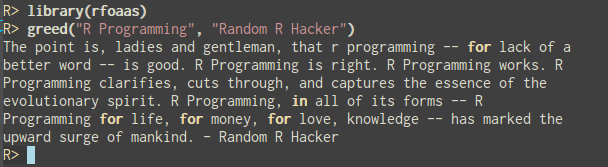
rfoaas greed example Time for new release! We just updated rfoaas on CRAN, and it now corresponds to version 0.1.9 of the FOAAS API. The rfoaas package provides an interface for R to the most excellent FOAAS service--which provides a modern, scalable and RESTful web service for the frequent need to tell someone to f$#@ off. Release 0.1.9 brings three new access point functions: greed(), me() and morning(). It also adds an S3 print method for the returned object. A demo of first of these additions in shown in the image in this post. As usual, CRANberries provides a diff to the previous CRAN release. Questions, comments etc should go to the GitHub issue tracker.

This post by Dirk Eddelbuettel originated on his Thinking inside the box blog. Please report excessive re-aggregation in third-party for-profit settings.

26 May 2016

Kevin Avignon: Bring more functionalities to types using extension methods

Hey guys, What are extension methods ? Extension methods are quite simple to understand and they can be quite useful in time of needs. An extension method give you the power to create a new method for any type that you would like. They re static methods designed to extend the capabilities of a type without Continue reading Bring more functionalities to types using extension methods

Next.

Previous.

