Search Results: "ed"

30 August 2016

Rhonda D'Vine: Thomas D

It's not often that an artist touches you deeply, but Thomas D managed to do so to the point of that I am (only half) jokingly saying that if there would be a church of Thomas D I would absolutely join it. His lyrics always did stand out for me in the context of the band I found about him, and the way he lives his life is definitely outstanding. And additionally there are these special songs that give so much and share a lot. I feel sorry for the people who don't understand German to be able to appreciate him. Here are three songs that I suggest you to listen to closely: Like always, enjoy!

/music permanent link Comments: 1 Flattr this

Joachim Breitner: Explicit vertical alignment in Haskell

Chris Done s automatic Haskell formatter hindent is released in a new version, and getting quite a bit of deserved attention. He is polling the Haskell programmers on whether two or four spaces are the right indentation. But that is just cosmetics I am in principle very much in favor of automatic formatting, and I hope that a tool like hindent will eventually be better at formatting code than a human. But it currently is not there yet. Code is literature meant to be read, and good code goes at length to be easily readable, and formatting can carry semantic information. The Haskell syntax was (at least I get that impression) designed to allow the authors to write nicely looking, easy to understand code. One important tool here is vertical alignment of corresponding concepts on different lines. Compare
maze :: Integer -> Integer -> Integer
maze x y
  abs x > 4    abs y > 4  = 0
  abs x == 4   abs y == 4 = 1
  x ==  2    && y <= 0     = 1
  x ==  3    && y <= 0     = 3
  x >= -2    && y == 0     = 4
  otherwise                = 2
with
maze :: Integer -> Integer -> Integer
maze x y
  abs x > 4   abs y > 4 = 0
  abs x == 4   abs y == 4 = 1
  x == 2 && y <= 0 = 1
  x == 3 && y <= 0 = 3
  x >= -2 && y == 0 = 4
  otherwise = 2
The former is a quick to grasp specification, the latter (the output of hindent at the moment) is a desert of numbers and operators. I see two ways forward: What could such ways be? (This post is cross-posted on reddit.) Update (2016-09-05) Shortly after this post, the Haskell formatter brittany gets released, which supports vertial alignment. Yay!

Petter Reinholdtsen: First draft Norwegian Bokm l edition of The Debian Administrator's Handbook now public

In April we started to work on a Norwegian Bokm l edition of the "open access" book on how to set up and administrate a Debian system. Today I am happy to report that the first draft is now publicly available. You can find it on get the Debian Administrator's Handbook page (under Other languages). The first eight chapters have a first draft translation, and we are working on proofreading the content. If you want to help out, please start contributing using the hosted weblate project page, and get in touch using the translators mailing list. Please also check out the instructions for contributors. A good way to contribute is to proofread the text and update weblate if you find errors. Our goal is still to make the Norwegian book available on paper as well as electronic form.

Dirk Eddelbuettel: RProtoBuf 0.4.5: now with protobuf v2 and v3!

A few short weeks after the 0.4.4 release of RProtoBuf, we are happy to announce a new version 0.4.5 which appeared on CRAN earlier today. RProtoBuf provides R bindings for the Google Protocol Buffers ("Protobuf") data encoding library used and released by Google, and deployed as a language and operating-system agnostic protocol by numerous projects. This release brings support to the recently-release 'version 3' Protocol Buffers standard, used e.g. by the (very exciting) gRPC project (which was just released as version 1.0). RProtoBuf continues to supportv 'version 2' but now also cleanly support 'version 3'.
Changes in RProtoBuf version 0.4.5 (2016-08-29)
  • Support for version 3 of the Protcol Buffers API
  • Added 'syntax = "proto2";' to all proto files (PR #17)
  • Updated Travis CI script to test against both versions 2 and 3 using custom-built .deb packages of version 3 (PR #16)
  • Improved build system with support for custom CXXFLAGS (Craig Radcliffe in PR #15)
CRANberries also provides a diff to the previous release. The RProtoBuf page has an older package vignette, a 'quick' overview vignette, a unit test summary vignette, and the pre-print for the JSS paper. Questions, comments etc should go to the GitHub issue tracker off the GitHub repo.

This post by Dirk Eddelbuettel originated on his Thinking inside the box blog. Please report excessive re-aggregation in third-party for-profit settings.

29 August 2016

David Moreno: Webhook Setup with Facebook::Messenger::Bot

The documentation for the Facebook Messenger API points out how to setup your initial bot webhook. I just committed a quick patch that would make it very easy to setup a quick script to get it done using the unreleased and still in progress Perl s Facebook::Messenger::Bot:
use Facebook::Messenger::Bot;
use constant VERIFY_TOKEN => 'imsosecret';
my $bot = Facebook::Messenger::Bot->new(); # no config specified!
$bot->expect_verify_token( VERIFY_TOKEN );
$bot->spin();
This should get you sorted. What endpoint would that be, though? Well that depends on how you re giving Facebook access to your Plack s .psgi application.

Michal &#268;iha&#345;: motranslator 1.1

Four months after 1.0 release, motranslator 1.1 is out. If you happen to use it for untrusted data, this might be as well called security release, though this is still not good idea until we remove usage of eval() used to evaluate plural formula. Full list of changes: The motranslator is a translation library used in current phpMyAdmin master (upcoming 4.7.0) with focus on speed and memory usage. It uses Gettext MO files to load the translations. It also comes with testsuite (100% coverage) and basic documentation. Recommended way to install it is using composer from Packagist repository:
composer require phpmyadmin/motranslator
The Debian package will be available probably at point phpMyAdmin 4.7.0 will be out, but if you see need to have it earlier, just let me know.

Filed under: Debian English phpMyAdmin 0 comments

Zlatan Todori : Support open source motion comic

There is an ongoing campaign for motion comic. It will be done entirely with FLOSS tools (Blender, Krita, GNU/Linux) and besides that, it really looks great (and no, it is not only for the kids!). Please support this effort if you can because it also shows the power of Free software tools. All will be released Creative Commons Atribution-ShareAlike license together with all sources.

Michal &#268;iha&#345;: Improving phpMyAdmin Docker container

Since I've created the phpMyAdmin container for Docker I've always felt strange about using PHP's built in web server there. It really made it poor choice for any production setup and probably was causing lot of problems users saw with this container. During the weekend, I've changed it to use more complex setup with Supervisor, nginx and PHP FPM. As building this container is one of my first experiences with Docker (together with Weblate container), it was not as straightforward as I'd hope for, but in the end is seems to be working just fine. While touching the code, I've also improved testing of the Docker container to tests all supported setups and to better report in case of test fails. The nice side effect of this is that the PHP code is no longer being executed under root in the container, so that should make it more sane for production use as well (honestly I never liked this approach that almost everything is executed as root in Docker containers).

Filed under: Debian English phpMyAdmin 4 comments

Gergely Nagy: Recruitment mistakes: part 3

It has been a while that I have been contacted by a recruiter, and the last few ones were fairly decent conversations, where they made an effort to research me first, and even if they did not get everything right, they still listened, and we had a productive talk. But four days ago, I had another recruiter reach out to me, from a company I know oh so well: one I ranted about before: Google. Apparently, their recruiters still do carpet-bombing style outreach. My first thought was "what took them so long?" - it has been five years since my last contact with a Google recruiter. I almost started missing them. Almost. To think that Google is now powerful enough to read my mind, is scary. Yet, I believe, this is not the case; rather, it's just another embarrassing mistake.To make my case, let me quote the full e-mail I was sent, with the name of the sender redacted, and my comments - which I'm also sending to the recruiter:
Hi Gergely,
Hi!
How are you? Hope you're well.
Thank you, I'm fine, just back from vacation, and I was thrilled to read your e-mail. Although, I did find it surprising too, and considering past events, I thought it to be spam first.
My name is XXX and I am recruiting for the Google Engineering team. I have just found your details on Github...
I'm happy that you found me through GitHub, but I'm curious why you mailed me at my debian.org address then? That address is not on my GitHub profile, and even though I have some code signed with that address, that's not what I use normally. My GitHub profile also links to a page I created especially for recruiters, which I don't think you have read - but more on that below.
...and your experience with software development combined with your open source contributions is particularly relevant to Google
Which part of my recent contributions are relevant to Google? For the past few months, the vast majority (over 90%) of my open source work has been on keyboard firmware. If Google is developing a keyboard, then this may be relevant, otherwise, I find it doubtful.Some of my past OSS contributions may be more relevant, but that's in the past, and it would take some digging to see those from GitHub. And if you did that kind of digging, you would have found the page on my site for recruiters, and would not have e-mailed me at my Debian address, either.
We are always interested in talking to top engineers with your mix of skills and I was wondering if you are at all open to exploring roles with Google in EMEA.
To make things short, my stance is the same as it was five years ago, when I wrote - and I quote - "So, here's a public request: do not email me ever again about job opportunities within Google. I do not wish to work for Google. Not now, not tomorrow, not ever."This still stands. Please do not ever e-mail me about job opportunities within Google. I do not wish to work for Google, not now, not tomorrow, not five years from now, not ever. This will not change. Many things may change, this however, will not.But even if I ignore this, let me ask you mix of skills are you exactly interested in? Keyboard firmware hacking, mixed with Emacs Lisp, some Clojure, and hacking on Hy (which, if you have explored my GitHub profile, will surely know) from time to time? Or is it my Debian Developer hat that got your interest? If so, why didn't you say so? Not that it would change anything, but I'm curious.Is it my participation in 24pullrequests? Or my participation in GSoC in years past?Nevertheless, my list of conditions I mentioned above, apply. Is Google able to fulfill all my requirements, and the preferences too? Last time I heard, working for Google required one to relocate, which I clearly said on that page, I'm not willing to do.
The teams I recruit for are responsible for Google's planet-scale systems. Just to give you more of an idea, some of the projects we work on that might be of interest to you would include:
  • MapReduce
  • App Engine
  • Mesa
  • Maglev
And how would these be interesting to me, considering my recent OSS work? (Hint: none of them interest me, not a bit. Ok perhaps MapReduce, a little.)
I think you could be a great fit here, where you can develop a great career and at the same time you will be part of the most mission critical team, designing and developing systems which run Google Search, Gmail, YouTube, Google+ and many more as you can imagine.
My career is already developing fine, thank you, I do not need Google to do that. I am already working on things I consider important and interesting, if I wanted to change, I would. But I certainly would not consider a company which I had asked numerous times NOT to contact me about opportunities. If you can't respect this wish, and forget about this in mere five years, why would I trust you to keep any other promises you make now?
Thank you so much for your time and I look forward to hearing from you.
I wish you had spent as much time researching me - or even half that - as I have spent replying to you. I suppose this is not the reply you were expecting, or looking for, but this is the only one I'll ever give to anyone from Google.And here, at the end, if you read this far, I'm asking you, and everyone at Google to never contact me about job opportunities. I will not work for Google. Not now, not tomorrow, not five years from now, not ever. Please do not e-mail me again, and do not reply to this e-mail either. I'm not interested in neither apologies, nor promises that you won't contact me - just simply don't do it.Thank you.

Russell Coker: Monitoring of Monitoring

I was recently asked to get data from a computer that controlled security cameras after a crime had been committed. Due to the potential issues I refused to collect the computer and insisted on performing the work at the office of the company in question. Hard drives are vulnerable to damage from vibration and there is always a risk involved in moving hard drives or systems containing them. A hard drive with evidence of a crime provides additional potential complications. So I wanted to stay within view of the man who commissioned the work just so there could be no misunderstanding. The system had a single IDE disk. The fact that it had an IDE disk is an indication of the age of the system. One of the benefits of SATA over IDE is that swapping disks is much easier, SATA is designed for hot-swap and even systems that don t support hot-swap will have less risk of mechanical damage when changing disks if SATA is used instead of IDE. For an appliance type system where a disk might be expected to be changed by someone who s not a sysadmin SATA provides more benefits over IDE than for some other use cases. I connected the IDE disk to a USB-IDE device so I could read it from my laptop. But the disk just made repeated buzzing sounds while failing to spin up. This is an indication that the drive was probably experiencing stiction which is where the heads stick to the platters and the drive motor isn t strong enough to pull them off. In some cases hitting a drive will get it working again, but I m certainly not going to hit a drive that might be subject to legal action! I recommended referring the drive to a data recovery company. The probability of getting useful data from the disk in question seems very low. It could be that the drive had stiction for months or years. If the drive is recovered it might turn out to have data from years ago and not the recent data that is desired. It is possible that the drive only got stiction after being turned off, but I ll probably never know. Doing it Properly Ever since RAID was introduced there was never an excuse for having a single disk on it s own with important data. Linux Software RAID didn t support online rebuild when 10G was a large disk. But since the late 90 s it has worked well and there s no reason not to use it. The probability of a single IDE disk surviving long enough on it s own to capture useful security data is not particularly good. Even with 2 disks in a RAID-1 configuration there is a chance of data loss. Many years ago I ran a server at my parents house with 2 disks in a RAID-1 and both disks had errors on one hot summer. I wrote a program that s like ddrescue but which would read from the second disk if the first gave a read error and ended up not losing any important data AFAIK. BTRFS has some potential benefits for recovering from such situations but I don t recommend deploying BTRFS in embedded systems any time soon. Monitoring is a requirement for reliable operation. For desktop systems you can get by without specific monitoring, but that is because you are effectively relying on the user monitoring it themself. Since I started using mon (which is very easy to setup) I ve had it notify me of some problems with my laptop that I wouldn t have otherwise noticed. I think that ideally for desktop systems you should have monitoring of disk space, temperature, and certain critical daemons that need to be running but which the user wouldn t immediately notice if they crashed (such as cron and syslogd). There are some companies that provide 3G SIMs for embedded/IoT applications with rates that are significantly cheaper than any of the usual phone/tablet plans if you use small amounts of data or SMS. For a reliable CCTV system the best thing to do would be to have a monitoring contract and have the monitoring system trigger an event if there s a problem with the hard drive etc and also if the system fails to send a I m OK message for a certain period of time. I don t know if people are selling CCTV systems without monitoring to compete on price or if companies are cancelling monitoring contracts to save money. But whichever is happening it s significantly reducing the value derived from monitoring.

Joey Hess: hiking the Roan

Three moments from earlier this week.. Sprawled under a tree after three hours of hiking with a heavy, water-filled pack, I look past my feet at six ranges of mountains behind mountains behind flowers. From my campsite, I can see the rest of the path of the Appalachian Trail across the Roan balds, to Big Hump mountain. It seems close enough to touch, but not this trip. Good to have a goal. Near sunset, land and sky merge as the mist moves in.

28 August 2016

Reproducible builds folks: Reproducible builds: week 70 in Stretch cycle

What happened in the Reproducible Builds effort between Sunday August 21 and Saturday August 27 2016: GSoC and Outreachy updates Packages reviewed and fixed, and bugs filed Reviews of unreproducible packages 10 package reviews have been added and 6 have been updated this week, adding to our knowledge about identified issues. A large number of issue types have been updated: Weekly QA work 29 FTBFS bugs have been reported by: diffoscope development Holger also created another test job for diffoscope on jenkins.debian.net, so that now also all commits to branches other than master are being tested. strip-nondeterminism development strip-nondeterminism 0.023-1 was uploaded by Chris Lamb:
 * Support Android .apk files with the JAR normalizer.
 * handlers/png.pm: Drop unused Archive::Zip import
 * Remove hyphen from non-determinism and non-deterministic.
 * javaproperties.pm: Match more styles of .properties and loosen filename matching.
 * Improve tests:
   - Make fixture runner generic to all normalizer types.
   - Replace (single) pearregistry test with a fixture.
   - Set a canonical time for fixture tests.
   - Add gzip testcase fixture.
   - Replace t/javadoc.t with fixture
   - Replace t/ar.t with a fixture.
   - t/javaproperties: move pom.properties and version.properties tests to fixtures
   - t/fixtures.t: move to using subtests
   - t/fixtures.t: Explicitly test that we can find a normalizer
   - t/fixtures.t: Don't run normalizer if we didn't find one.
strip-nondeterminism 0.023-2 uploaded by Mattia Rizzolo to allow stderr in autopkgtest. disorderfs development tests.reproducible-builds.org Debian: Somewhat related to reproducible builds there has been a first Debian jenkins team maintainance meeting on the #debian-qa IRC channel, to discuss current issues with the setup and to start the work of migrating jenkins.debian.net to jenkins.debian.org. The next meeting will take place on September 28th 2016 at 19 UTC. Misc. This week's edition was written by Chris Lamb and Holger Levsen and reviewed by a bunch of Reproducible Builds folks on IRC.

Mart n Ferrari: On speaking at community conferences

Many people reading this have already suffered me talking to them about Prometheus. In personal conversation, or in the talks I gave at DebConf15 in Heidelberg, the Debian SunCamp in Lloret de Mar, BRMlab in Prague, and even at a talk on a different topic at the RABS in Cluj-Napoca. Since their public announcement, I have been trying to support the project in the ways I could: by packaging it for Debian, and by spreading the word. Last week the first ever Prometheus conference took place, so this time I did the opposite thing and I spoke about Debian to Prometheus people: I gave a 5 minutes lightning talk on Debian support for Prometheus. What blew me away was the response I've got: from this tiny non-talk I prepared in 30 minutes, many people stopped me later to thank me for packaging Prometheus, and for Debian in general. They told me they were using my packages, gave me feedback, and even some RFPs! At the post-conference beers, I had quite a few interesting discussions about Debian, release processes, library versioning, and culture clashes with upstream. I was expecting some Debian-bashing (we are old-fashioned, slow, etc.), instead I had intelligent and enriching conversations. To me, this enforces once again my support and commitment to community conferences, where nobody is a VIP and everybody has something to share. It also taught me the value of intersecting different groups, even when there seems to be little in common. Comment
Dirk Eddelbuettel: rfoaas 1.1.0

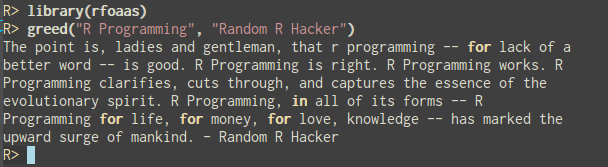
rfoaas greed example FOAAS upstream came out with release 1.1.0 earlier last week. Tyler Hunt was kind enough to provide an almost immediate pull request adding support for the extended capabilties. Following yesterday's upload we now have version 1.1.0 of rfoaas on CRAN. It brings six more accessors: maybe(), blackadder(), horse(), deraadt(), problem(), cocksplat() and too(). As usual, CRANberries provides a diff to the previous CRAN release. Questions, comments etc should go to the GitHub issue tracker. More background information is on the project page as well as on the github repo

This post by Dirk Eddelbuettel originated on his Thinking inside the box blog. Please report excessive re-aggregation in third-party for-profit settings.

Craig Sanders: fakecloud

I wrote my first Mojolicious web app yesterday, a cloud-init meta-data server to enable running pre-built VM images (e.g. as provided by debian, ubuntu, etc) without having to install and manage a complete, full-featured cloud environment like openstack. I hacked up something similar several years ago when I was regularly building VM images at home for openstack at work, with just plain-text files served by apache, but that had pretty-much everything hard-coded. fakecloud does a lot more and allows per-VM customisation of user-data (using the IP address of the requesting host). Not bad for a day s hacking with a new web framework. https://github.com/craig-sanders/fakecloud fakecloud is a post from: Errata

Hideki Yamane: please help to maintain net-snmp package

I stepped down from net-snmp package maintainers, and want someone to maintain it.

27 August 2016

Arturo Borrero Gonz lez: Why conntrackd in Debian is better with systemd


There has been some discussion [0] around my decision to drop sysvinit support in the conntrackd package in Debian [1] (version 1:1.4.4-2).

The rationale I used for such a movement was sent to the debian-devel [2] mailing list, and here it is:


Lots of people have talked to me with both support and disagreement with the change.

Before reading the rest of this blogpost, please note that I'm not interested in the 'systemd vs sysvinit' war, and starting now I will focus mainly on the subject of building a firewall cluster with netfilter technology and the reasons why I think sysvinit here is irrelevant.

I started working with firewall clusters by the time of Debian Squeeze. By then, I used only sysvinit, because it was the Debian default init system and because I did not dive so much in the internals of the firewall cluster itself.

By then, the conntrackd debian package included support for sysvinit by means of two files (the two files that I dropped in 1:1.4.4-2) :


Using both files, you could start/stop conntrackd, and nothing more (for example, a proper status check was not implemented).

The conntrackd daemon is used in HA firewall clusters to replicate connection states between nodes of the cluster, so flow states are known in all nodes and they can properly perform stateful firewalling.

When you build HA clusters, there are 2 basic states of the cluster you may check and adjust: failover and failback.

With conntrackd, the failover situation is straight forward: the other node has the state information already from the dying node.
The failback situation is different: depending on the configuration of both the cluster and conntrackd, the new node may ask for a complete synchronisation to the other node when it become alive again (at boot time, for example) . This is the case if you are building a multi-master firewall cluster (i.e: both nodes are seeing traffic and filtering at the same time).

Asking for a complete synchronisation is done by means of a new instance of conntrackd, which communicates using a UNIX socket to the main conntrackd daemon (the one which is actually communicating with the other node). A failback boot procedure may look like this:

  1. system boots
  2. firewall ruleset loading
  3. networking up
  4. conntrackd up (main sync daemon: using 'conntrackd -d'; UNIX socket is opened)
  5. request sync with other node (using conntrackd -n' which uses the UNIX socket opened in step 4)

In both sysvinit and systemd cases, the step 5 may be implemented using another dummy service which performs the required operations and that depends on the main service representing the step 4.

The point here is that steps 4 and 5 suffer a very bad race condition: the conntrackd daemon may open the UNIX socket (step 4) *after* the we try to use it (step 5).

As you could probably imagine, this is the worst possible scenario: as one of the nodes of the cluster is missing important flow state information the stateful firewall will drop packets and all the network monitoring alarms will start to ring... Ironically, just after a failback operation, when all of our cluster is supposed to be up an running.

To avoid the race conditions, some typical hacks could be implemented:


After a bit of research, I found that the last point could be implemented very easily using libsystemd, so the daemon inform of its internal state to systemd [4].

The solution is elegant, simple and offers more direct benefits:

So the clear winner for conntrackd is to go with systemd, using an unit service file of Type=notify. Using sysvinit is prone to the described race condition. No serious firewall cluster with this architecture would use sysvinit.

It's obvious to me that systemd is a better technology than sysvinit. The sysvinit approach has been OK for a while, and for me it was fascinating when I started developing init scripts and learning how things worked.
But now we have systemd. It's the default in Debian. It's far better.

Conclusions: yes, I will probably reintroduce sysvinit files just to avoid any flamewar.


[0] https://lists.debian.org/debian-devel/2016/08/msg00448.html
[1] https://tracker.debian.org/pkg/conntrack-tools
[2] https://lists.debian.org/debian-devel/2016/08/msg00456.html
[3] https://sources.debian.net/src/systemd/231-4/debian/systemd.NEWS/
[4] http://git.netfilter.org/conntrack-tools/tree/src/systemd.c

Dirk Eddelbuettel: RcppCNPy 0.2.5

A maintenance release of the RcppCNPy package is now on CRAN. RcppCNPy provides R with read and write access to NumPy files thanks to the cnpy library by Carl Rogers. This release just updates a few package internals such as the vignette, the DESCRIPTION and the README.md file as well as under Travis script used for continuous integration.
Changes in version 0.2.5 (2016-08-26)
  • Synchronized code with the cnpy repository
  • Updated vignette
  • Expanded DESCRIPTION
CRANberries also provides a diffstat report for the latest release. As always, feedback is welcome and the best place to start a discussion may be the GitHub issue tickets page.

This post by Dirk Eddelbuettel originated on his Thinking inside the box blog. Please report excessive re-aggregation in third-party for-profit settings.

26 August 2016

Norbert Preining: ESSLLI 2016 Course: Algebraic Specification and Verification with CafeOBJ

During this year s ESSLLI (European Summer School in Logic, Language and Information) I was teaching a course on Algebraic Specification and Verification with CafeOBJ. Now that the course is over I can relax a bit and enjoy the beauty of the surrounding North Tyrol.
ESSLLI-2016-logo-darkblue-small For those who couldn t attend the ESSLLI or the course, here are the course materials: Thanks to the participants for the interesting questions and participation. What follows is the original description of the course. Abstract Ensuring correctness of complex systems like computer programs or communication protocols is gaining ever increasing importance. For correctness it does not suffice to consider the finished system, but correctness already on the level of specification is necessary, that is, before the actual implementation starts. To this aim, algebraic specification and verification languages have been conceived. They are aiming at a mathematically correct description of the properties and behavior of the systems under discussion, and in addition often allow to prove (verify) correctness within the same system. This course will give an introduction to algebraic specification, its history, logic roots, and actuality with respect to current developments. Paired with the theoretical background we give an introduction to CafeOBJ, a programming language that allows both specification and verification to be carried out together. The course should enable students to understand the theoretical background of algebraic specification, as well as enable them to read and write basic specifications in CafeOBJ. Description CafeOBJ is a specification language based on three-way extensions to many-sorted equational logic: the underlying logic is order-sorted, not just many-sorted; it admits unidirectional transitions, as well as equations; it also accommodates hidden sorts, on top of ordinary, visible sorts. A subset of CafeOBJ is executable, where the operational semantics is given by a conditional order-sorted term rewriting system. The language system CafeOBJ has been under constant development at the institute of the lecturers since the late 80ies. It is closely related to other algebraic specification languages in the OBJ family, including Maude. The CafeOBJ language and the range of verification methods and tools it supports including its support for inductive theorem proving, verification of behavioral specifications, deductive invariant proof, and reachability analysis of concurrent systems has played a key role in both extending and bringing algebraic specification techniques into contact with many software engineering applications. The following topics will be discussed: To make the lectures not too heavy , we will structure each lecture into two parts: A first part providing an introduction of some theoretical concept, or framework, and a second part dealing with actual programming and implementation. Especially for the second part of each lecture students are encouraged to use their laptops to try out code and experiment.

Michal &#268;iha&#345;: CI coverage from Windows, Linux and OSX

Once I got CI working on multiple platforms the obvious next step was to be able to aggregate coverage reports across them. This should not be that hard, right? Well I've spent couple of hours on that during last few days. On Linux and OSX it was pretty much straightforward. Both GCC and Clang do support coverage, so it's just matter of configuring them properly and collect the coverage reports. I've used own solution for that in past and that was really far from working well (somehow I never managed to get coverage fully uploaded to Codecov). Fortunately there exists CMake script called CMake-codecov which does all needed work and works out of the box on GCC and Clang (even on OSX). Well it works on Travis only once you update the compilers and install llvm-cov tool. The Windows part on AppVeyor was much harder for me. This can be heavily accounted to lack of my experience with Windows and especially development on Windows in past ten years (probably even more). First challenge was to find something what can generate code coverage there. After lot of googling I've settled down on OpenCppCoverage what seems to be the only free solution I was able to find. The good thing is that it can generate coverage in Cobertura format that Codecov undestands. There are also bad things that I've learned. First of all it's quite hard to integrate this with CTest. There is no support for wrapping test calls in custom commands, so I've misused the memory checks for that purpose. I've written small python script which pretends the valgrind interface and does call OpenCppCoverage in the background. Now I had around 800 coverage files (one for each test case) and we need to deal with them somehow. The Codeconv command line client doesn't deal wit this out of the box so the obvious choice was to merge them before upload. There even seems to be script doing that, but unfortunately trying that on our coverage data make it nowhere near completion within hour, so that's not really good choice. Second thing I've tried was merging binary coverage in OpenCppCoverage and then exporting to Cobertura format. Obviously Gammu is special project as all I got from this attempt was crashing OpenCppCoverage (it did merge some of the coverages, but it failed in the end without indicating any error). In the end I've settled down to uploading files in chunks to Codecov. This seems to work quite okay, though is a bit slow, mostly due to way how Codecov bash uploader prepares data to upload (but this will be hopefully fixed soon). Anyway the goal has been reached, both Windows and Linux code shows in coverage reports.

Filed under: Debian English Gammu 0 comments

Next.

Previous.