Jonathan McDowell: Which data contract?
 I bought an EEE 901. More on that later.
For the past few weeks I've been trying to work out which "mobile broadband" provider to go with for my daily commute. It's a train journey from the north coast of Northern Ireland to Belfast and goes through some sparsely populated areas, so I wasn't expecting to get anything that would provide 3G all the way. However I do want a provider that can do their best to keep a session up for the journey, handing over between 2G + 3G as necessary. Coverage maps/checkers aren't too bad if you just want to check a static point, but really even then it's better to actually try the provider in the location yourself. So, armed with a bluetooth GPS (Bl eNEXT BN-909GR), an Option GT 3G Quad PCMCIA card and my laptop I set about measuring signal strength along my train journey for each of the 5 providers available. I also made sure to actually try a session with them for at least one journey, because signal strength is not everything.
I wrote some Perl using Net::GPSD and Device::Gsm to query my current location, signal strength, 2G/3G status and network every 10 seconds. I did this for 3 train journeys (except for O2) and then also produced an "optimistic" file of all the data points combined for that provider.
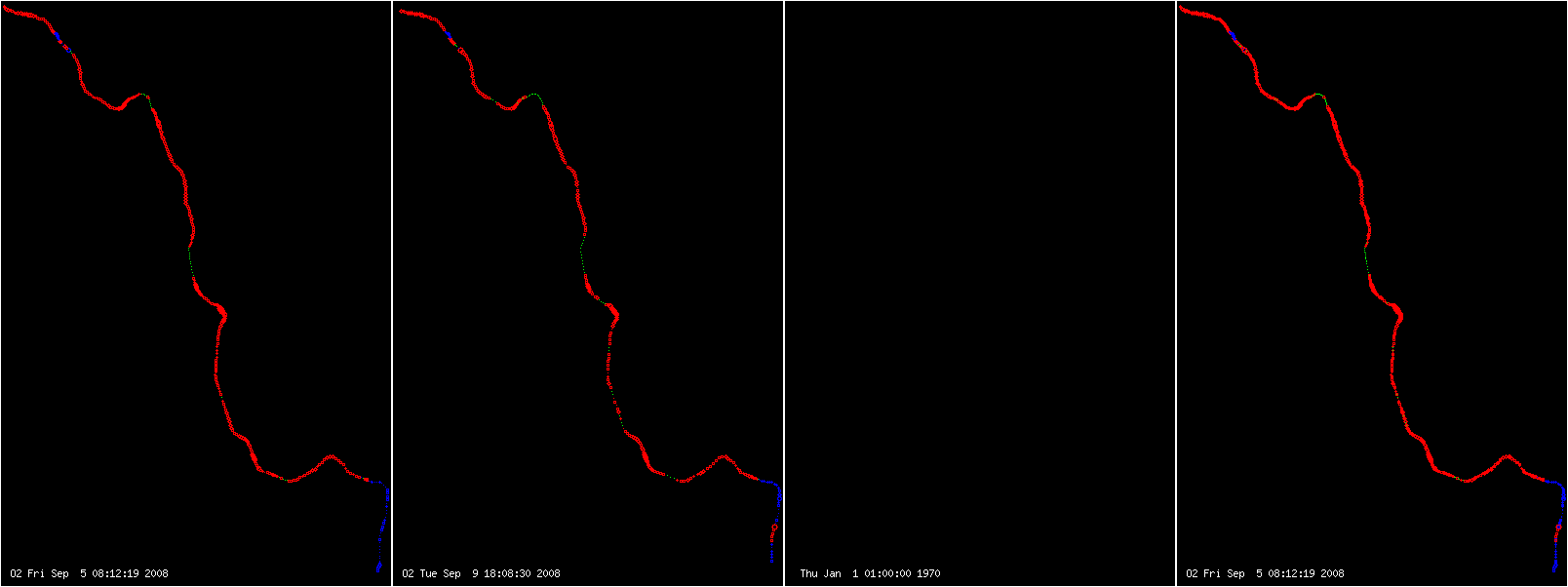
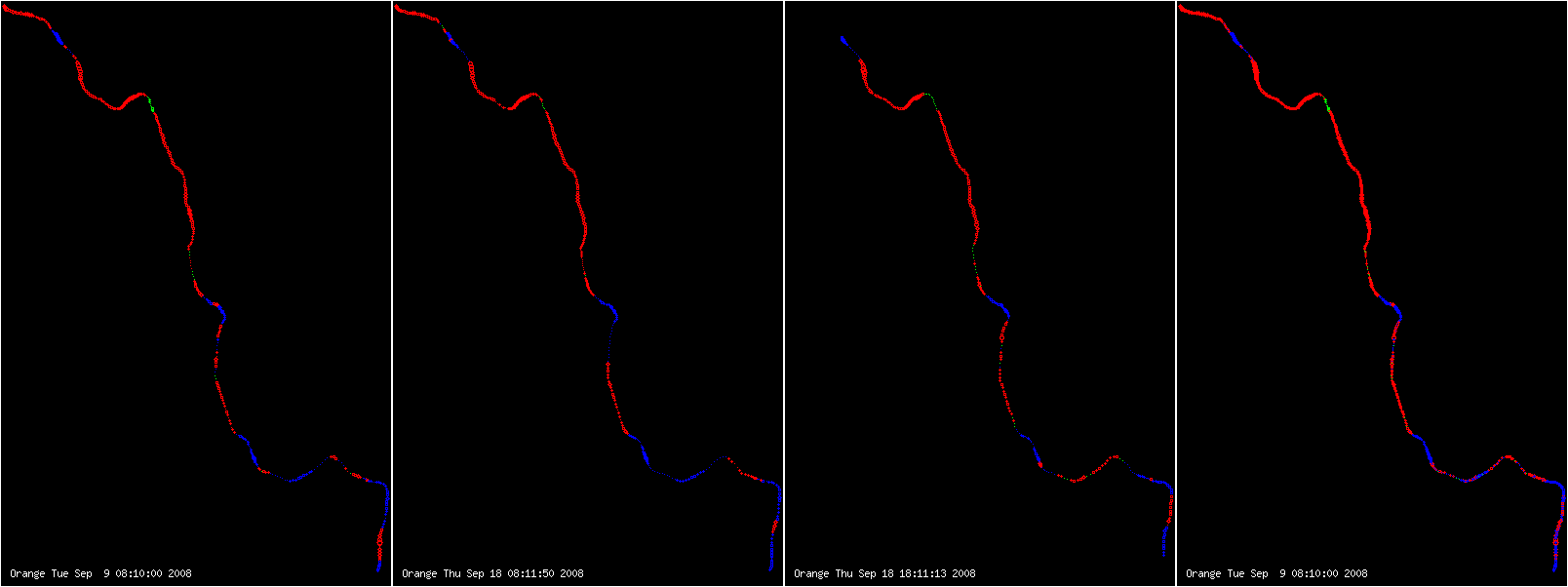
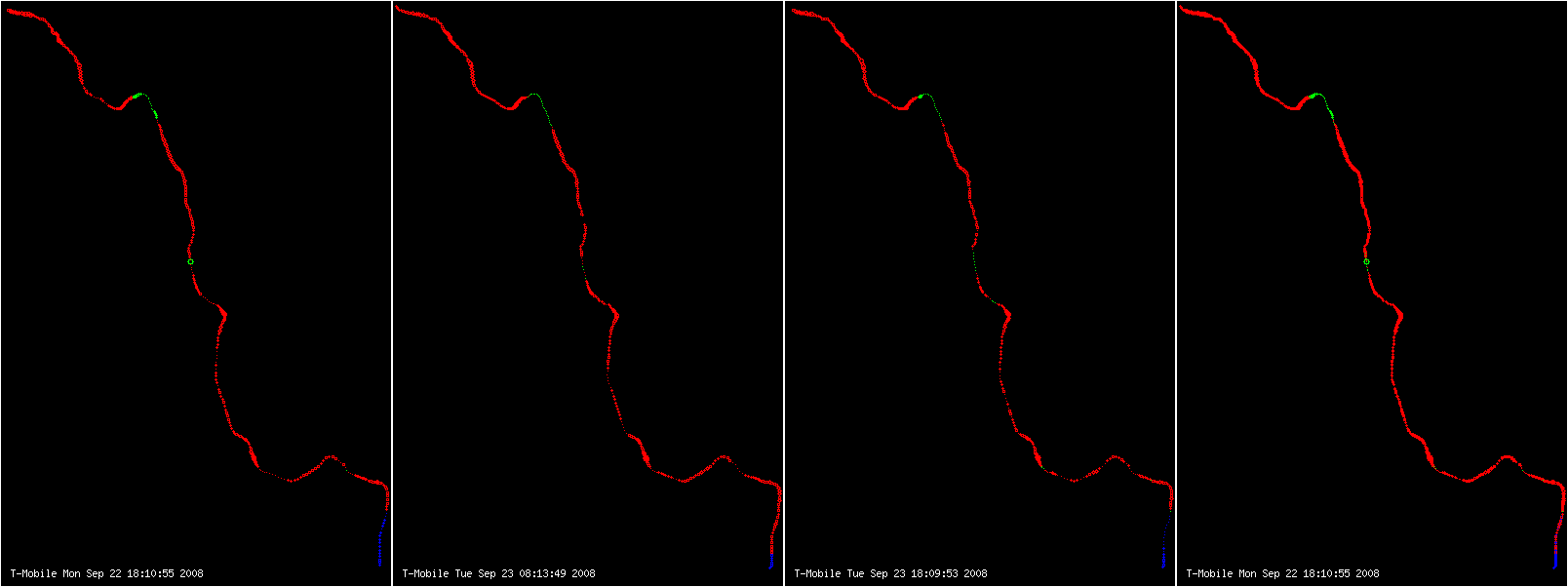
A second piece of Perl took this data and drew the maps you see below. The graph on the right for each provider is all data points. Red means 2G, blue means 3G, green means "Limited Service" (ie it could see a signal, but not one it was allowed to connect to). White means that we had a GPS location and no signal at all. Click on the maps for bigger versions. You can see the route on OpenStreetMap - my graphs are a little squished horizontally, but the journey is from Castlerock (top left on the coast near Coleraine) to Belfast (bottom right).
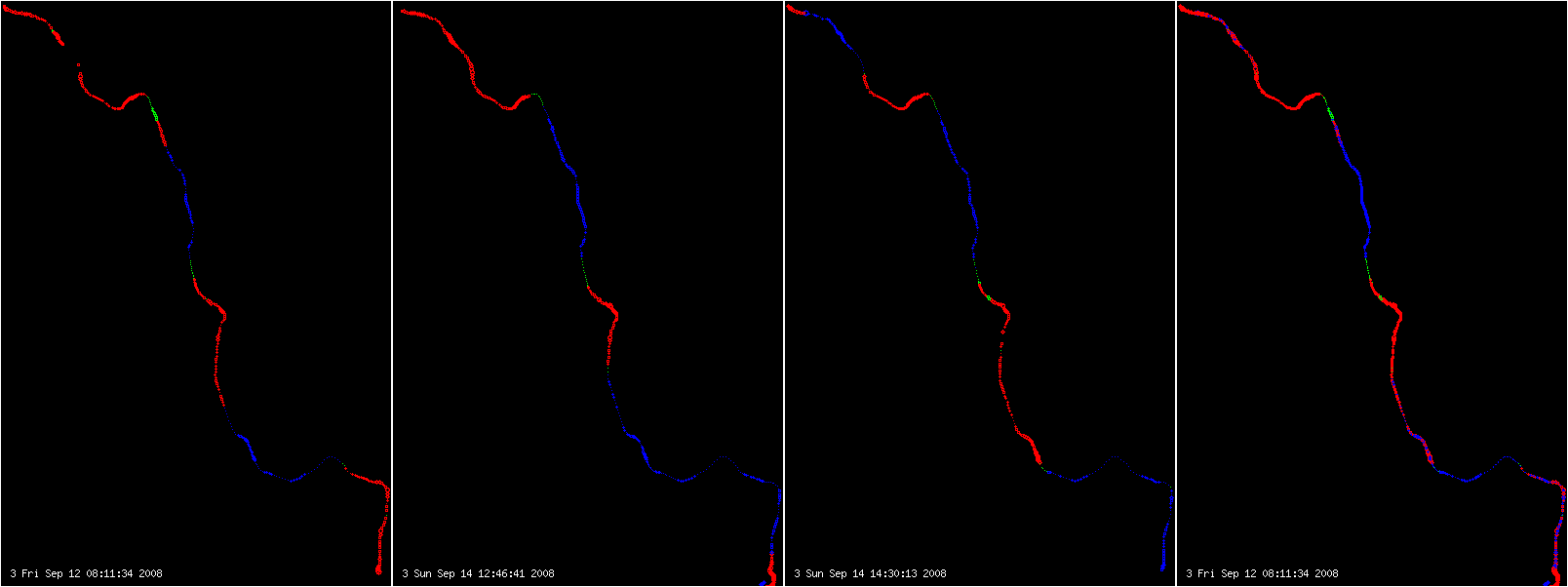
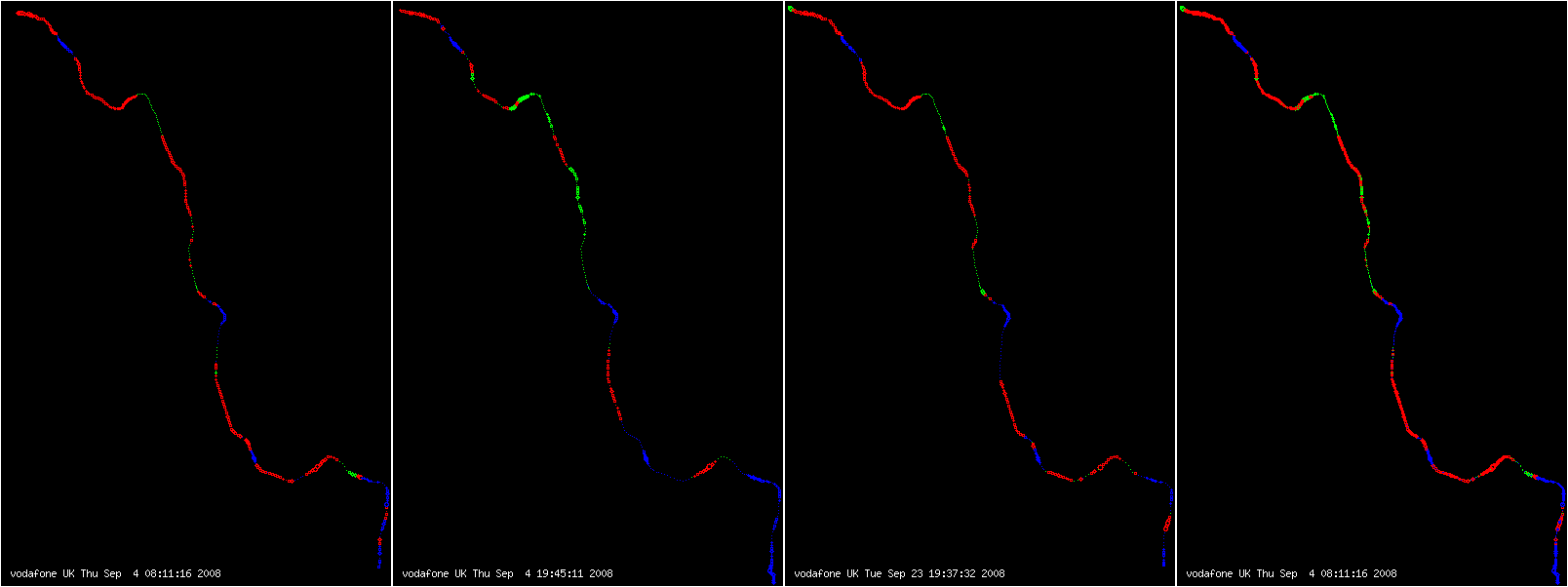
At first glance 3 look to be the best bet. Lots of blue, a reasonably priced data plan. Except they can't hold up a session to save themselves. Not only does a 2G/3G handover almost always seem to result in a drop, but I had periods of failing to get a 2G session up at all and had some random drops while in 3G coverage as well. So strike them off.
O2 and T-Mobile don't manage any 3G outside Belfast (that's the bottom right corner btw). I found that a few periods of 3G along the journey helped a lot; it meant I could do a quick mail sync rather than the long drawn out affair it was on a 2G connection. They can both handle handover between 2G/3G and keep a session up for most of the journey, but the lack of speed counts them out.
Vodafone managed the worst reception, which is disappointing. I found them quite good when I lived in England (my datacard is from a Vodafone Pay as You Use data contract). I did find sessions being dropped during the no signal regions, so they just don't seem to be a good bet.
Which leaves Orange. I've had issues with Orange and data in the past (pre 2004 IIRC) but in testing they were able to keep a session up between Belfast and Castlerock, handling 2G/3G handover fine. Coverage was reasonably good and they manage 3G at several points along the journey (the blue points roughly correspond to Coleraine, Ballymena, Antrim and Belfast). I understand Orange have some EDGE capability, but my card doesn't do EDGE so I've no idea if that'll be an extra gain or not. I had a few issues with getting dud DNS servers but this happened with the other providers too so I was beginning to suspect the datacard of playing up. Manually setting known good servers in resolv.conf worked fine.
So, before I go and sign up to an 18 month Orange contract, what have I forgotten?
 (when your wife/SO is not around)
 When the Debian installer starts, it will normally ask you what language
you want to install in and gives you a really long list of languages to
choose from. Unfortunately, that's not how it works when you install on a
headless NAS device. The reason for this is that installations on NAS
devices are done via SSH and the installer normally brings the network up
after asking the user for their language. So we'd simply skip the language
question and go with English.
When Timo Jyrinki recently mentioned that he couldn't install in Finnish,
Frans Pop pointed out that localechooser has changed a lot since etch and
that it should now be possible to have the language question after setting
up the network. This turned out to be correct and I managed to choose a
different language but the installer still showed everything in English.
Frans reminded me that the installer drops all translations that are not
necessary but unfortunately this happens too early in our case. He pointed
me to a variable that determines whether translations will be dropped. So
in lenny translations will not be dropped on NAS devices that have enough
RAM and users will be asked when they connect to the installer via SSH what
language they'd like to install in.
 First root canal today. There were some interesting parts. I'll spare you.
If I seemed a bit annoyed with awesome 3 configuration in the last post,
this has put it well in perspective.
One nice thing about awesome 3 is that it has good system tray support
built in. So I've at least temporarily mainstreamed my laptop, so it's
using the gnome power manager, and network manager, instead of hibernate
and sleepd and my own scripts.
 I ve been silent in this blog last few days, but that has an explanation: I ve been trying to make JRuby 1.1.4 work with one of my scripts.
The problem is that after having done all the tweaks I can imagine, I still can t get enough performance with Ruby 1.8.7 (latest etch-backports). Our client will not allow Ruby 1.9 in the server (what is really a pity, for the performance boost I had with Ruby 1.9 is awesome!), but it already have Java6 So the only option I have left is trying JRuby beast.
Since our script deals with system stuff, it uses syslog a lot, and that is where the main problem seems to be. Syslog support is new in JRuby, has had some
 I was invited to participate at
 I finally managed to process all my mails and it's not time to push Gammu
towards stable release. If everything goes without problems, the just born
1.20.93 will be followed by 1.21.0.
Version 1.20.93 fixes several crashes with parsing strange data from phones
and changes a bit initialization of FBUS protocols. If you are using this
connection type, please test this new code whether it behaves better or worse
than older version.
Full list of changes:
 I don’t have the expertise to intelligently explain the entire global financial meltdown myself, but here are a few resources that merit wide dissemination, especially if you are a podcast-listener:
 Just stumbled over
 Lately following the US elections (and lately the finance collapse) is an interesting thing, I have been watching the following (in the order of importance):


 (including English!)
The string freeze of Debian Installer officially ended at 23:59
yesterday (Sept. 20th). Indeed, this was extended a bit to today, with
agreement by Otavio Salvador who I thank for this.
That allowed Zak to "save" Tagalog and also the Welsh and Latvian
translators to polish their work.
We now have to decide about some of these languages: those that failed
to meet the release criteria but were formerly activated in D-I. There
are four such languages: Amharic, Welsh, Estonian and Northern Sami.
Please find below the mail I just sent to debian-i18n and
debian-boot. I promised that this discussion would happen in
public. It will (but it will be short as we can't delay the release of
the installer for ages....and I think that my proposals are
reasonable!)