Search Results: "tim"

6 January 2014

Aurelien Jarno: Debian QEMU images updated

Following the release of Debian Wheezy, I have (finally) updated my set of Debian QEMU images for both Squeeze (6.0.8) and Wheezy (7.3). The following images are now available: Each of these directories contains a GPG signed README.txt file with the md5sums all files, detailed instructions how to run these images and especially the minimum QEMU version to use. The requirements to run the default desktop environment have increased a lot between Squeeze and Wheezy. An accelerated graphics card is now needed to be able to use Gnome (unless you use the fallback mode), which is not something provided by QEMU (actually there is now a QXL para-virtualized video card, but the driver is only in unstable). In addition GDM now needs more than 128MiB to start, while this is the default amount of memory provided for virtual machines. I have therefore decided to switch the default desktop environment on the Wheezy images to Xfce and the display manager to LightDM. Both Gnome and GDM are still installed on the images, and the original default can easily be restored using the following commands: Beside this the new images only contain minor changes. The filesystems have been tweaked to not run fsck after a certain amount of days, and locales-all and openssh-server are now installed in all images. For MIPS and MIPSEL, 64-bit kernels are now also installed and provided, so that it is possible to choose between a 32-bit or a 64-bit kernel (see the README.txt for more details). There is no Debian Wheezy SPARC image available, as QEMU does not fully support SPARC64 yet (it is actually possible to run it, but then the VM crashes often), and Debian Wheezy now only supports 64-bit kernels. I will also invest time to build an S390X image, but so far I haven t been successful on that. The following images are still available at the same location, though they haven t been updated:

Vincent Sanders: NetSurf Developer Workshop Redux

The NetSurf Developers bringing you alternative LOLcat viewing software since 2002Once again the NetSurf developers congregated in Cambridge at the Collabora offices where we were made welcome in a nice environment for the event.

Five developers managed to attend from around the UK Rob Kendrick, Vincent Sanders, Daniel Silverstone, John-Mark Bell and Michael Drake. We also had Chris Young and Fran ois Revol providing some bug fixes remotely.

This was the first time we had all met since the previous event towards the end of 2012 and we took full advantage of this to discuss a pretty extensive agenda in addition to the practical programming tasks.

From Friday lunchtime through to Sunday evening we managed 30 hours of work consisting of over 70 commits to over 100 files.

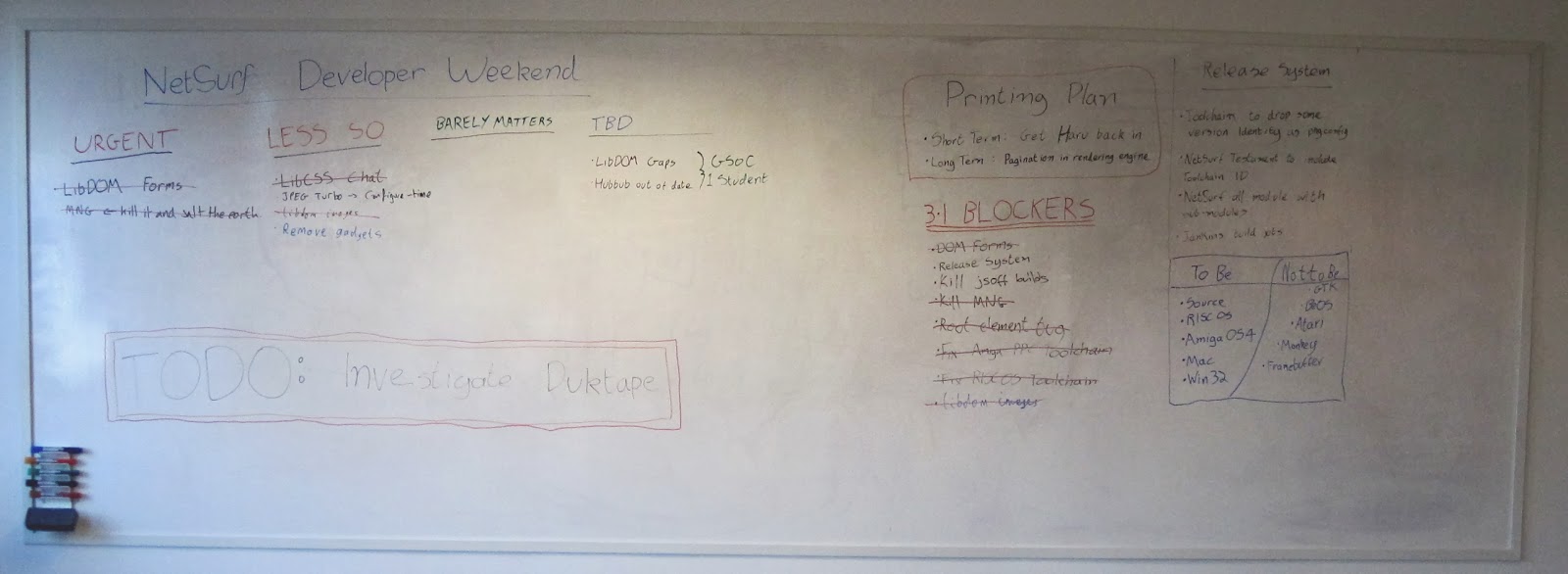
The whiteboard of our notes

Our main focus was working towards a 3.1 release which is scheduled for early April. Along with the source the release will have binary builds for RISC OS, AmigaOS, Windows and Mac OS X (x86 and ppc). Although the NetSurf project will not be directly releasing binaries for the GTK and Framebuffer frontends we will be ensuring the Debian packages are updated which is our prefered method of distribution for those targets.

We analysed the 3.0 release and formulated an improved process for the future. The 3.1 release will be generated automatically by the CI system ensuring constant results and removing the problems we encountered previously.

A set of release blocking issues was derived which we used as a task list during the workshop.The majority of these were completed including:
DOM based forms
Web forms are a feature Netsurf has supported for a long time and their implementation has not kept up with the rest of the browser. This is a long standing problem area which has resulted in numerous strange bugs with form submission. With this change the form system has been reworked to correctly operate directly from the DOM resulting in the squashing of a large number of bugs and a much improved user experience.

DOM based image loading
Up to now image fetching was performed only during the rendering of a page. With this change when the image link is placed into the DOM during the page parse it is scheduled to be fetched, this should give an improved user experience as images should be available earlier in a pages render.

Removal of MNG support
NetSurf has supported MNG since the 1.0 release, indeed the MNG library used to provide the PNG support too though we have long ago transitioned to libPNG. Alas the web has moved on and MNG has been largely forgotten, the libMNG library that performs the image decoding is old and generally unsupported specifically lacking security updates.

The build issues with libMNG (lack of pkg-config, reliance on libcms1 etc.) were causing maintenance issues in code nobody was actually using (there were crash bugs discovered during its removal!). Because of these issues it was decided to join the vast majority of browsers and remove support for this format.
The developers also addressed several issues with toolchain construction and a number of annoying usability bugs.

Plans for how to improve printing support we made. Initially we intend to fix the existing haru based pdf generation using this to print via pdf and in future have correct css styled page paginated printing render output.

The perennial issue of javascript was discussed however, while efforts to improve the existing support are ongoing, our usage of the spidermonkey library continues to raise various challenges including platform support and API changes between versions.

Due to these issues it has been suggested that we might add support for using the duktape JS engine instead, initial results are promising but given the size of the task of implementing an additional javascript engine binding further investigation is necessary before making a commitment.

Amongst the other discussions the group has also agreed that we will once again apply to be a GSoC organisation for a single student with some very focused projects:
  • Improving our HTML5 parser (hubbub)
  • Improving the DOM library implementing missing functionality.
While neither of these projects are as fashionable as some of our previous proposals they are well defined enough that as a group we believe we could offer enough support to the student to make their experience a pleasurable one and get the resulting code reviewed and merged promptly.

This event was very successful with a great deal achieved, the project is much more likely to be in a good shape to release 3.1 by April now and the meeting has given the developers a much welcomed boost.

I would like to extend the groups thanks to Robert McQueen for letting us use the Collabora offices, Dor e Carrier for organising all the administrative things and to Vivek Dasmohapatra for coming out on his Sunday afternoon to let us back in after locking ourselves out.


Julian Andres Klode: python-apt now native Python 3 code

Today I made an important change to the python-apt code: It is now native Python 3 code (but also works under Python 2). The previous versions all run 2to3 during the build process to create a Python 3 version. This is no longer needed, as the code is now identical. As part of that change, python-apt now only supports Python 2.7, Python 3.3, and newer. I m using some features only present in 3.3 like Python2 unicode literal syntax in order to keep the code simple. Here s how I did it: I took the Python 2 code and ran 2to3 -f print -x future on it. This turned every print statement in a call to the print function. I then went ahead and added a from __future__ import print_function to the top of each module. This was the first commit. For the second commit, I ran 2to3 -p -x future to convert the remaining stuff to Python 3, and then undid some changes (like unicode literals) and fixed the rest of the changes to work under both Python 2 and 3. Sometimes I added a top-level code like:
if sys.version_info_major >= 3:
    unicode = str
So I could use unicode in the code for the Python 2 cases. I used various backported modules like io and stuff only available in Python 2.7, so dropped support for Python 2.6.
Filed under: Debian, Python

Julien Danjou: Databases integration testing strategies with Python

The Ceilometer project supports various database backend that can be used as storage. Among them are MongoDB, SQLite MySQL, PostgreSQL, HBase, DB2 All Ceilometer's code is unit tested, but when dealing with external storage services, one cannot be sure that the code is really working. You could be inserting data with an incorrect SQL statement, or in the wrong table. Only having the real database storage running and being used can tell you that.
Over the months, we developed integration testing on top of our unit testing to validate that our storage drivers are able to deal with real world databases. That is not really different from generic integration testing. Integration testing is about plugging all the pieces of your software all together and running. In what I call "database integration testing", the pieces will be both your software and the database system that you are going to rely on. The only difference here is that one of the module is not coming from the application itself but is an external project. The type of database that you use (RDBMS, NoSQL ) does not matter. Taking a step back, what I will describe here could also apply to a lot of other different software modules, even something that would not be a database sytem at all. Writing tests for integration Presumably, your Python application has unit tests. In order to test against a database back-end, you need to write a few specific classes of tests that will use the database subsystem for real. For example:
import unittest
import os
import sqlalchemy

class TestDB(unittest.TestCase):
def setUp(self):
url = os.getenv("DB_TEST_URL")
if not url:
self.skipTest("No database URL set")
self.engine = sqlalchemy.create_engine(url)

This code will try to fetch the database URL to use from an environment variable, and then will rely on SQLAlchemy to create a database connection.
import unittest
import os
import sqlalchemy

import myapp

class TestDB(unittest.TestCase):
def setUp(self):
url = os.getenv("DB_TEST_URL")
if not url:
self.skipTest("No database URL set")
self.engine = sqlalchemy.create_engine(url)

def test_foobar(self):
self.assertTrue(myapp.store_integer(self.engine, 42))

You can then add as many tests as you want using the connection stored in self.engine. If no test database URL is, the tests will be skipped; however that decision is up to you. You may want to have these tests always run and fail if they can't be run. In the setUp() method, you may also need to do more work, like create a database and delete a database.
import unittest
import os
import sqlalchemy

class TestDB(unittest.TestCase):
def setUp(self):
url = os.getenv("DB_TEST_URL")
if not url:
self.skipTest("No database URL set")
self.engine = sqlalchemy.create_engine(url)
self.connection = self.engine.connect()
self.connection.execute("CREATE DATABASE testdb")

def tearDown(self):
self.connection.execute("DROP DATABASE testdb")

This will make sure that the database you need is clean and ready to be used to testing. Launching modules, a.k.a. databases
The main problem we encountered when building integration testing with databases, is to find a way to start them. Most users are used to start them system-wide with some sort of init script, but when running sandboxed tests, that is not really a good option. Browsing the documentation of each storage allowed us to find a way to start them in foreground and control them "interactively" via a shell script. The following is a script that you can use to run Python tests using nose and is heavily inspired by the one we wrote for Ceilometer.
#!/bin/bash
set -e

clean_exit()
local error_code="$?"
kill -9 $(jobs -p) >/dev/null 2>&1 true
rm -rf "PGSQL_DATA"
return $error_code


check_for_cmd ()
if ! which "$1" >/dev/null 2>&1
then
echo "Could not find $1 command" 1>&2
exit 1
fi


wait_for_line ()
while read line
do
echo "$line" grep -q "$1" && break
done < "$2"
# Read the fifo for ever otherwise process would block
cat "$2" >/dev/null &


check_for_cmd mongod

trap "clean_exit" EXIT

# Start PostgreSQL process for tests
PGSQL_DATA= mktemp -d /tmp/PGSQL-XXXXX
PGSQL_PATH= pg_config --bindir
PGSQL_PATH /initdb $ PGSQL_DATA
mkfifo $ PGSQL_DATA /out
$ PGSQL_PATH /postgres -F -k $ PGSQL_DATA -D $ PGSQL_DATA &> $ PGSQL_DATA /out &
# Wait for PostgreSQL to start listening to connections
wait_for_line "database system is ready to accept connections" $ PGSQL_DATA /out
export DB_TEST_URL="postgresql:///?host=$ PGSQL_DATA &dbname=template1"

# Run the tests
nosetests

If you use tox to automatize your test run, you can use this scripts (I call it run-test.sh) in your tox.ini file.
[testenv]
commands = toxinidir /run-tests.sh posargs

Most databases are able to be run in some sort of standalone mode where you can connect to them using a either a Unix domain socket, or a fixed port. Here are the snippet used in Ceilometer to run with MongoDB and MySQL:
# Start MongoDB process for tests
MONGO_DATA=$(mktemp -d /tmp/MONGODB-XXXXX)
MONGO_PORT=29000
mkfifo $ MONGO_DATA /out
mongod --maxConns 32 --nojournal --noprealloc --smallfiles --quiet --noauth --port $ MONGO_PORT --dbpath "$ MONGO_DATA " --bind_ip localhost &>$ MONGO_DATA /out &
# Wait for Mongo to start listening to connections
wait_for_line "waiting for connections on port $ MONGO_PORT " $ MONGO_DATA /out
export DB_TEST_URL="mongodb://localhost:$ MONGO_PORT /testdb"

# Start MySQL process for tests
MYSQL_DATA=$(mktemp -d /tmp/MYSQL-XXXXX)
mkfifo $ MYSQL_DATA /out
mysqld --datadir=$ MYSQL_DATA --pid-file=$ MYSQL_DATA /mysql.pid --socket=$ MYSQL_DATA /mysql.socket --skip-networking --skip-grant-tables &> $ MYSQL_DATA /out &
# Wait for MySQL to start listening to connections
wait_for_line "mysqld: ready for connections." $ MYSQL_DATA /out
export DB_TEST_URL="mysql://root@localhost/testdb?unix_socket=$ MYSQL_DATA /mysql.socket&charset=utf8"

The mechanism is always the same. We create a fifo with mkfifo, and then run the database daemon with the output redirected to that fifo. We then read from it until we find a line stating the the database is ready to be used. At that point, we can continue and start running the tests. You have to read continuously from the fifo, otherwise the process writing to it will block. We redirect the output to /dev/null, but you could also redirect it to a different log file, or not at all. One step further: using parallelism and scenarios The described approach is quite simple, as it only support one database type. When using an abstraction layer, such as SQLAlchemy, it would be a good idea to run all these tests against different RDBMS, such as MySQL and PostgreSQL for example. The snippet above allows to run both RDBMS in parallel, but the classic approach of unit tests does not allow that. Using one scenario for each database backend would be a great idea. To that end, you can use the testscenarios library.
import unittest
import os
import sqlalchemy
import testscenarios

load_tests = testscenarios.load_tests_apply_scenarios

class TestDB(unittest.TestCase):
scenarios = [
('mysql', dict(database_connection=os.getenv("MYSQL_TEST_URL")),
('postgresql', dict(database_connection=os.getenv("PGSQL_TEST_URL")),
]

def setUp(self):
if not self.database_connection:
self.skipTest("No database URL set")
self.engine = sqlalchemy.create_engine(self.database_connection)
self.connection = self.engine.connect()
self.connection.execute("CREATE DATABASE testdb")

def tearDown(self):
self.connection.execute("DROP DATABASE testdb")

$ python -m subunit.run test_scenario   subunit2pyunit
test_scenario.TestDB.test_foobar(mysql)
test_scenario.TestDB.test_foobar(mysql) ... ok
test_scenario.TestDB.test_foobar(postgresql)
test_scenario.TestDB.test_foobar(postgresql) ... ok

---------------------------------------------------------
Ran 2 tests in 0.061s

OK

To speed up tests run, you could also run the test in parallel. It can be intesting as you'll be able to spread the workload among a lot of different CPUs. However, note that it can require a different database for each test or a locking mechanism to be in place. It's likely that your tests won't be able to work altogether at the same time on only one database. (Both usage of scenarios and parallelism in testing will be covered in The Hacker's Guide to Python, in case you wonder.)
The Hacker's Guide to Python
A book I'm writing that will be launched soon, talking about designing Python applications, state of the art, and various Python tips. If you want to be the first to hear about the launch, subscribe now.

Steve Kemp: A beginning is a very delicate time.

Recently I wrote about docker, after a brief diversion into using runit for service management, I then wrote about it some more. I'm currently setting up a new PXE-boot environment which uses docker for serving DHCP and TFTPD, which is my first "real" usage of any note. It is fun, although I now discover I'm not alone in using docker for this purpose. Otherwise life is good, and my blog-spam detection service recently broke through the 11 million-rejected-comment barrier. The Wordpress Plugin is seeing a fair amount of use, which is encouraging - but more reviews would be nice ;) I could write about work, I've not done that since changing job, but I'm waiting for something disruptive to happen first.. ObQuote: Dune. (film)

Russell Coker: Length of Conference Questions

After LCA last year I wrote about speaking stacks and conference questions [1]. In that post I did some rough calculations on the amount of conference time taken by questions and determined that anyone who asks one question per day at a conference such as LCA (with about 600 delegates) is going to be asking more than 1/600 of all questions. That doesn t necessarily mean that someone shouldn t ask more than one question in a day, but they should carefully consider whether their questions are adding value to other delegates. Another issue that I ve noticed is the length of questions which seems to be a separate problem and it seems that we should consider keynote speeches separately as they involve all delegates. The regular conference lectures involve 4 to 6 streams running in parallel which means that in aggregate more questions can be asked. LCA has one keynote for each day including the mini-conf days, so that s 5 keynote speeches in total. If each keynote has 20 minutes of question time (and most keynote speeches probably have less) then there s 100 minutes of question time for the entire conference. For a genuine question (IE not a statement) that is non-trivial (anything that has a yes/no answer probably isn t interesting to the whole audience) the answer is probably going to be about three times as long as the question. Given some overheads for applause etc that means that the amount of time spent asking questions would be something less than 20 minutes at keynote speeches over the entire conference. If every delegate asked one keynote-speech question in the entire conference then that 20 minutes of questions would allow each delegate to spend 2 seconds asking a question. If 10% of delegates each asked one question and no-one asked a second question then each question could take an average of 20 seconds. Given the acoustic issues of asking a question from the back of the hall it seems unlikely to get a speaking rate of much more than a word a second, so 20 seconds of speaking would be in the range of 25 words (one tweet) to 50 words (if you speak at the typical speed of audio books according to Wikipedia). I think that audio-book speed isn t going to work well so a question asked at a keynote speech should probably be of a length that would fit on twitter. So if a question wouldn t fit on twitter then maybe a blog post or a discussion after the lecture would be a more suitable option. Before Asking a Question I think that before asking a question at a keynote speech people should consider whether that question would fit on twitter. They should also consider whether it is strictly a question and whether it will be of interest to other delegates. If your question is significantly longer than something that would fit on twitter then the next thing to consider is whether you are more important than other delegates. Because when someone asks more or longer questions than other people it will be interpreted as an implicit I am more important than you statement by many other delegates. Some Disclaimers Firstly I m not making any suggestions here for people who run conferences. I m making suggestions for delegates who are considering how they should act. The next disclaimer is that the educational benefit of the conference has the priority. If you have a question that really helps other delegates learn something which takes a little longer to ask then that s OK. Finally I apply the same criteria to my own decisions. There were several questions I considered asking at the keynote this morning, but I decided that none of them met the criteria of being short enough and generally interesting enough. There is one issue I will discuss with the speaker privately and I ll probably write at least one blog post related to the lecture.

5 January 2014

Jon Dowland: 2013 In Fiction

I read a lot this year - I'll write more about that and reflections on goodreads in another post - but most of the things I read weren't published in 2013. (I should also write a bit about my thoughts on e-readers). However, it seems I have enough to write about 2013's novels to make a round-up post worthwhile, so here we go.

The Cuckoos Calling UK cover
This year, crime author Robert Galbraith published his first novel The Cuckoo's Calling. I'd never have heard of it if Galbraith was not outed as an alias for Joanne "JK" Rowling. Clues that Rowling was working on a detective story exist as early as a Guardian preview article in 2012 for her last novel, The Casual Vacancy. Further hints, for me, that this was no first-time author were the taglines from Ian Rankin and Val McDermid on the cover, writers of a calibre I'd be surprised a new author could attract. However I don't know whether they were on the pre-unveiling cover or not. Rowling was upset be outed, having enjoyed the freedom to write without the baggage of expectation that she is subject to. I hope she's pleased: prior to her unmasking the novel was warmly received by the (admittedly relatively small) number of people who read it. And a very good novel it is too. It starts with a genre clich of a grizzled, meloncholy detective, Mr. Cormoran Strike, in an upstairs office with a neon light flickering through the window, but fleshes the story out both forwards - a client, a mysterious death - and backwards - how did Mr. Strike end up in that upstairs office - living out of it, no less? As is traditional for the genre there's a very clever twist. What I really enjoyed about Cormoran Strike was Galbraith/Rowling moving quickly from Chandler-esque everyman to a well fleshed-out, complex protagonist, intertwining the development of the character with the unfolding of the wider plot. I'm looking forward to the sequel, expected in 2014.
The Shining Girls UK cover
A second surprise favourite this year was Lauren Beukes' time-tripping crime story The Shining Girls. A monsterous murder of women somehow finds a room in Chicago that lets him travel through time (or perhaps the room finds him). He uses this facility to stalk and murder a set of Shining Girls: women who, for one reason or another, literally 'shine' in his perception of them. One such woman survives his first attack and decides to try and find out who attacked her, and why. The crimes are described in a brutal fashion which - from a distance - resemble the sometimes glorified violence for which crime fiction is sometimes criticised, but the focus of the story is very much on the victims: they are fully fleshed out characters and each death is felt by the reader as a genuine tragedy. I discovered Beukes when her earlier novel Zoo City was included in a Humble eBook bundle. On reading The Shining Girls I felt that the novel deserved to be more widely known than I would expect it to be trapped in the ghetto of genre fiction, so I was pleased to discover that the very mainstream Richard and Judy Book Club discovered it. In established author news, Terry Pratchett, having adopted speech recognition for writing (to combat his debilitating Alzheimer's) has seemingly managed to accelerate his rate of production and squeezed out at least two this year: The Long War with Stephen Baxter is the sequel to 2012's The Long Earth which I very much enjoyed, but it really felt like "difficult second novel" to me. Hopefully there'll be a third. Raising Steam, the 40th Discworld novel, was an enjoyable romp around the concept of steam trains, featuring the relatively new Moist von Lipwig who has managed to become one of my favourite Discworld characters. I can't think of much more to say about the novel, really. It's a Discworld novel, probably not the best introduction to the series for a new reader, but will give a reader familiar with the franchise everything they expect, and possibly no more. Iain Banks sadly died this year, shortly after the publication of his last novel, The Quarry. It's sat on my hardback shelf for the time being. I couldn't bring myself to read it in 2013. I did read his last SF offering from the year prior, The Hydrogen Sonata. Sadly, yet coincidentally, both of these books examine the nature of living and dying, The Quarry in particular from the point of view of a terminal cancer sufferer. I have a small backlog of unread Banks fiction which I want to take my time over with. Finally, whilst not really a book, I thoroughly enjoyed the BBC's 2013 adaptation of Neil Gaiman's Neverwhere. Natalie Dormer wrote a piece on the making of the drama which should serve as a good introduction. At the time of writing, most of the programmes have disappeared from iPlayer, but I would be surprised if this wasn't released commercially at some point.

4 January 2014

Simon Josefsson: Necrotizing Fasciitis

Dear World, On the morning of December 24th I felt an unusual pain in my left hand between the thumb and forefinger. The pain increased and in the afternoon I got a high fever, at some point above 40 degrees Celsius or 104 degree Fahrenheit. I went to the emergency department and was hospitalized during the night between the 24th and 25th of December. On the afternoon of December 26th I underwent surgery to find out what was happening, and was then diagnosed with Necrotizing Fasciitis (the wikipedia article on NF gives a fair summary), caused by the common streptococcus bacteria (again see wikipedia article on Streptococcus). A popular name for the disease is flesh-eating bacteria. Necrotizing Fasciitis is a rare and aggresive infection, often deadly if left untreated, that can move through the body at speeds of a couple of centimeters per hour. I have gone through 6 surgeries, leaving wounds all over my left hand and arm. I have felt afraid of what the disease will do to me, anxiety over what will happen in the future, confusion and uncertainty about how a disease like this can exist and that I get the right treatment since so little appears to be known about it. The feeling of loneliness and that nobody is helping, or even can help, has also been present. I have experienced pain. Even though pain is something I m less afraid of (I have a back problem) compared to other feelings, I needed help from several pain killers. I ve received normal Paracetamol, stronger NSAID s (e.g., Ketorolac/Toradol), several Opiate pain-killers including Alfentanil/Rapifen, Tramadol/Tradolan, OxyContin/OxyNorm, and Morphine. After the first and second surgery, nothing helped and I was still screaming with pain and kicking the bed. After the first surgery, I received a local anesthetic (a plexus block). After the second surgery, the doctors did not want to masquerade my pain, because sign of pain indicate further growth of the infection, and I was given the pain-dissociative drug Ketamine/Ketalar and the stress-releasing Clonidine/Catapresan. Once the third surgery removed all of the infection, pain went down, and I experienced many positive feelings. I am very grateful to be alive. I felt a strong sense of inner power when I started to fight back against the decease. I find joy in even the simplest of things, like being able to drink water or seeing trees outside the window. I cried out of happiness when I saw our children s room full of toys. I have learned many things about the human body, and I am curious by nature so I look forward to learn more. I hope to be able to draw strength from this incident, to help me prioritize better in my life. My loving wife sa has gone through a nightmare as a consequence of my diagnosis. At day she had to cope with daily life taking care of our wonderful 1-year old daughter Ingrid and 3-year old boy Alfred. All three of them had various degrees of strep throat with fever, caused by the same bacteria and anyone with young kids know how intense that alone can be. She gave me strength over the phone. She kept friends and relatives up to date about what happened, with the phone ringing all the time. She worked to get information out from the hospital about my status, sometimes being rudely treated and just being hanged up on. After a call with the doctor after the third surgery, when the infection had spread from the hand to within 5cm of my torso, she started to plan for a life without me. My last operation were on Thursday January 2nd and I left hospital the same day. I m writing this on the Saturday of January 4rd, although some details and external links have been added after that. I have regained access to my arm and hand and doing rehab to regain muscle control, while my body is healing. I m doing relaxation exercises to control pain and relax muscles, and took the last strong drug yesterday. Currently I take antibiotics (more precisely Clindamycin/Dalacin) and the common Paracetamol-based pain-killer Alvedon together with on-demand use of an also common NSAID containing Ibuprofen (Ipren). My wife and I were even out at a restaurant tonight. Fortunately I was healthy when this started, and with bi-weekly training sessions for the last 2 years I was physically at my strongest peak in my 38 year old life (weighting 78kg or 170lb, height 182cm or 6 feet). I started working out to improve back issues, increase strength, and prepare for getting older. Exercise has never been my thing although I think it is fun to run medium distances (up to 10km). I want thank everyone who helped me and our family through this, both professionally and personally, but I don t know where to start. You know who you are. You are the reason I m alive. Naturally, I want to focus on getting well and spend time with my family now. I don t yet know to what extent I will recover, but the prognosis is good. Don t expect anything from me in the communities and organization that I m active in (e.g., GNU, Debian, IETF, Yubico). I will come back as energy, time and priorities permits. flattr this!

Andrew Pollock: [life] My daughter, the future Olympic swimmer

I'm not a strong swimmer, and never have been. I was never confident in the water as a child. In my teenage years, I had some skin issues that I was very self-conscious about. Going to a boy's school where I was already bullied, I didn't want to add material, so I avoided swimming. To this day, I can barely swim 50 metres freestyle. To think I once had aspirations of getting into the police, which required a bronze medallion. As as result of my atrocious swimming abilities, it's been very important to me that Zoe be able to swim well. Purely for her own personal safety if nothing more. She's been doing "swim classes" of various sorts since she's been 6 months old. In the US, they were group parent/child water familiarisation classes. When we moved back to Australia and turned three, she was eligible to start doing small-group instructor-led classes with Hampton Swim School. It felt like such an milestone just to no longer have to be in the pool with Zoe. I was initially quite skeptical of Hampton's methods, compared with what I'd observed at the Betty Wright Swim School (which subsequently had to close due to aging facilities). Having seen how well Zoe's swimming has progressed in 3 quarters of classes is just amazing. The last few times I've taken Zoe to a public pool for some non-class swim time, her confidence in the water has been fantastic. I've bought some "sinkies", toys that sink to the bottom, and she'll happily dive down to the bottom to retrieve them (with assistance from me getting down there). Today, to escape the 40 plus degree heat, I took her to the Sleeman Sports Centre, because they have a really cool slide, and the whole thing's indoors. Zoe was confidently swimming between me and the side of the pool in water that was over her head, repeatedly. So to have her go from being fine in the water as long as she was being held, to actively asking me to go further back from the wall, in under a year has been really excellent progress. She's also "diving" in off the side (it's more like a bad belly flop, but she has brilliant form at the start, with her hands over her head). We got to the pool today around 10:30am, and it turned out the slide didn't open until 1pm, so we decided to stick around for lunch and wait until the slide opened. To kill time after lunch, we went to the 50 metre pool, where some other kids were taking turns to jump in off the starting blocks. Fearless Zoe wanted to have a go too. This was seriously deep water. It was really inspiring watching this tiny little girl climb up onto the starting blocks of the 1982 Commonwealth Games 50 metre pool and "dive" into the water, flounder over to me, who was furiously treading water in the middle of the lane, and then flounder over to the side, climb out unassisted and do it all over again. It was a seriously "proud father" moment, while I was trying not to drown myself in the middle of the lane. I wish I'd had someone there with a camera to capture the moment. I have great hopes for the future of her swimming, and I think she's ready to go up a level in her swim class.

Brett Parker: Wow, I do believe Fasthosts have outdone themselves...

So, got a beep this morning from our work monitoring system. One of our customers domain names is hosted with livedns.co.uk (which, as far as I can tell, is part of the Fasthosts franchise)... It appears that Fasthosts have managed to entirely break their DNS:
brettp@laptop:~$ host www.fasthosts.com
;; connection timed out; no servers could be reached
brettp@laptop:~$ whois fasthosts.com   grep -i "Name Server"
   Name Server: NS1.FASTHOSTS.NET.UK
   Name Server: NS2.FASTHOSTS.NET.UK
Name Server: NS1.FASTHOSTS.NET.UK
Name Server: NS2.FASTHOSTS.NET.UK
brettp@laptop:~$ whois fasthosts.net.uk   grep -A 2 "Name servers:"
    Name servers:
        ns1.fasthosts.net.uk      213.171.192.252
        ns2.fasthosts.net.uk      213.171.193.248
brettp@laptop:~$  host -t ns fasthosts.net.uk 213.171.192.252
;; connection timed out; no servers could be reached
brettp@laptop:~$ host -t ns fasthosts.net.uk 213.171.193.248
;; connection timed out; no servers could be reached
brettp@laptop:~$
So, that's fasthosts core nameservers not responding, good start! They also provide livedns.co.uk, so lets have a look at that:
brettp@laptop:~$ whois livedns.co.uk   grep -A 3 "Name servers:"
    Name servers:
        ns1.livedns.co.uk         213.171.192.250
        ns2.livedns.co.uk         213.171.193.250
        ns3.livedns.co.uk         213.171.192.254
brettp@laptop:~$ host -t ns ns1.livedns.co.uk 213.171.192.250
;; connection timed out; no servers could be reached
brettp@laptop:~$ host -t ns ns1.livedns.co.uk 213.171.193.250
;; connection timed out; no servers could be reached
brettp@laptop:~$ host -t ns ns1.livedns.co.uk 213.171.192.254
;; connection timed out; no servers could be reached
So, erm, apparently that's all their DNS servers "Not entirely functioning correctly"! That's quite impressive!

Hideki Yamane: more epub format support for Debian docs

I've added epub format to debien-devel-reference some time ago,
And now we have debian-reference epub support. Enjoy :)

3 January 2014

Wouter Verhelst: Dear google,

About half a decade ago, I created a gmail account (maybe longer not so sure anymore). After testing it out for a while, I decided that it wasn't for me; but as a gmail account comes with a google account for free, I didn't throw it out. As time went on, I added a few other things to that account. I try to limit its use a bit, but I do own a few android devices (for lack of a better alternative), and I do use adsense on my website, and all of these are linked to my existing google account; so I don't want to throw it away. I don't ever read mail sent to my gmail account, though; I prefer to read my mail in a local mail client (I used mutt for about a decade, having switched to thunderbird recently). Since it kept happening that people thought I would read my gmail account (which I do still use for XMPP, in spite of your recent crippling of that service), I configured an autoresponder on gmail to warn people off, and told them to use my main mail address instead of the gmail one. Additionally, I configured my main mail addresses (plural; they're really aliases) as "secondary" addresses on my gmail account, so that people who try to send mail to me could figure out where to actually send it before seeing the autoreply. Unfortunately, for some reason you seem to have interpreted that as "screw his MX records and DNSSEC, we'll just intercept anything coming from our servers and going to Wouter Verhelst as going to his gmail account". There's a word for that. I'm not going to use it.

Russ Allbery: A quick copy-paste UNIX trick

I ran across this trick a long time ago and now use it regularly, but it occurred to me today that I don't remember seeing anyone else mention it. So, just in case it helps someone else: I often find myself wanting to copy and paste the contents of several small files into an email message, particularly when explaining Debian packaging. I want to show all the file contents with little headers showing which lines come from each file. This gets tedious if I actually do this file-by-file. The obvious approaches, from including them into my editor to cat'ing them one-by-one and pasting them, are tedious and require writing the headers by hand. Obviously, cat doesn't help, since it obliterates the difference between the files. What does help, however, is good old head (or tail, for that matter). People normally use those utilities with standard input or a single file, but you can give them multiple files, and they do just about exactly what you want. Consider this shell transcript:
    % head -n 20 *.install
    ==> liblog4shib-dev.install <==
    usr/bin/log4shib-config
    usr/include/*
    usr/lib/*/lib*.a
    usr/lib/*/lib*.so
    usr/lib/*/pkgconfig/log4shib.pc
    usr/share/aclocal/log4shib.m4
    debian/log4shib-config.1 usr/share/man/man1
    ==> liblog4shib-doc.install <==
    usr/share/doc/log4shib-*/api/html usr/share/doc/liblog4shib-doc
    ==> liblog4shib1.install <==
    usr/lib/*/lib*.so.*
Just pick some value for -n that's longer than any of the files (I normally want to show the contents of small files anyway), run head on all the files whose contents you want to show, and then you can cut and paste its full output directly into your email message. Bonus: This behavior is even guaranteed by POSIX (something that I didn't realize until I checked while writing this post).

2 January 2014

Tim Retout: OpenVPN and easy-rsa

One of those enlightenment moments that I should have had sooner: every time I have seen someone set up an OpenVPN VPN, they have generated all the certificates on the VPN server as root using easy-rsa. This is kind of strange, because you end up with an incredibly sensitive directory on the VPN server containing every private key for every client. Another angle is whether you trust the random number generators used to create all these keys - does your hosting provider use a weak RNG? Instead, you could set up your CA using easy-rsa on a separate machine - perhaps even air-gapped. Then private keys can be generated on each machine that wants to join the VPN, and the certificates can get signed by the CA and returned. (The easy-rsa package has been split out of the openvpn package in Debian unstable, which makes this more understandable.) Is there a security benefit? You could argue that if your VPN server has been compromised, then you are already in trouble. But I'm thinking about a setup where I could run multiple VPN servers for redundancy, signed by the same CA - then if one server gets broken into, you could kill it without having to revoke all the client keys. By the way, the default RSA key size used by easy-rsa is 1024 bits at the time of writing (fixed upstream: Debian bug #733905). This is simple to change, but you need to know to do it. One of the 30c3 lightning talks was about bettercrypto.org - a guide to which cryptography settings to choose for commonly used software.

Luke Faraone: Unstandardized standards are the worst: sendmail

Implementing software to replace legacy systems is always a challenge, especially when you're dealing with a system with as much legacy as sendmail, which was first introduced as delivermail in 1979.ref

Each UNIX vendor, it seems, rewrote or heavily customized sendmail. This has lead to sometimes conflicting implementations.
Case in point: -tNormally, you invoke sendmail(8) with a series of arguments indicating the subject of a message, the recipients, etc. When invoked this way, the command expects a message on standard input, waits for EOF, and then sends your message along.

However, sometimes you don't want to have to fiddle with command-line parameters; you've already written a perfectly fine message with headers.

-t is generally passed to sendmail when you want to build a message envelope from an already-formatted message, with headers, etc. For example, if you had a file foo.txt with a body like this:
From: Luke Faraone 
To: John Smith
Subject: Hello, world!

Hi there.

you could send the message with a simple invocation of cat foo.txt sendmail -t. The system would take care of ensuring a Message-id was appended if appropriate, and queue the message to be sent. However, it is when you do slightly more complex invocations of sendmail that things get ambiguous.

It turns out that implementations differ on what exactly it means when you use -t in combination with naming destination addresses after the arguments to sendmail. exim4's documentation describes the situation in greater detail:
extract_addresses_remove_ argumentsUse: mainType: booleanDefault: true
According to some Sendmail documentation (Sun, IRIX, HP-UX), if any addresses are present on the command line when the -t option is used to build an envelope from a message s To:, Cc: and Bcc: headers, the command line addresses are removed from the recipients list. This is also how Smail behaves. However, other Sendmail documentation (the O Reilly book) states that command line addresses are added to those obtained from the header lines. When extract_addresses_remove_arguments is true (the default), Exim subtracts argument headers. If it is set false, Exim adds rather than removes argument addresses.

Thus, there's basically no mechanism for a program to know which behaviour to expect. God forbid two programs are installed on a system that expect different behaviours!

It appears that the default behaviour of Ruby is the opposite of what exim4 (Debian's default mail client) expects. This has resulted in numerous bug reports. Some replies suggest changing exim4's defaults, while others advocate overriding ActionMailer and friends to use sendmail -i instead, without -t.

That said, its not really clear who's wrong here; at no point does there appear to have been a definitive specification for sendmail, and as such we can hope for defined behaviour by common custom at best, and a sea of incompatibility bugs at worst. Amusingly, POSIX standards have nothing to say on this subject of sendmail at all; it defines that a mailx command must exist, but says that its sending mode may be implementation-specific.

As Matthew Garrett writes, there's not enough gin in the world.

Keith Packard: Present-pixmap-lifetimes-part-deux

Pixmap ID Lifetimes under Present Redirection (Part Deux) I recently wrote about pixmap content and ID lifetimes. I think the pixmap content lifetime stuff was useful, but the pixmap ID stuff was not quite right. I ve just copied the section from the previous post and will update it. PresentRedirect pixmap ID lifetimes (reprise) A compositing manager will want to know the lifetime of the pixmaps delivered in PresentRedirectNotify events to clean up whatever local data it has associated with it. For instance, GL compositing managers will construct textures for each pixmap that need to be destroyed when the pixmap disappears. Present encourages pixmap destruction The PresentPixmap request says:
PresentRegion holds a reference to pixmap until the presentation occurs, so pixmap may be immediately freed after the request executes, even if that is before the presentation occurs.
Breaking this when doing Present redirection seems like a bad idea; it s a very common pattern for existing 2D applications. New pixmap IDs for everyone Because pixmap IDs for present contents are owned by the source application (and may be re-used immediately when freed), Present can t use that ID in the PresentRedirectNotify event. Instead, it must allocate a new ID and send that instead. The server has it s own XID space to use, and so it can allocate one of those and bind it to the same underlying pixmap; the pixmap will not actually be destroyed until both the application XID and the server XID are freed. The compositing manager will receive this new XID, and is responsible for freeing it when it doesn t need it any longer. Of course, if the compositing manager exits, all of the XIDs passed to it will automatically be freed. I considered allocating client-specific XIDs for this purpose; the X server already has a mechanism for allocating internal IDs for various things that are to be destroyed at client shut-down time. Those XIDs have bit 30 set, and are technically invalid XIDs as X specifies that the top three bits of every XID will be zero. However, the cost of using a server ID instead (which is a valid XID) is small, and it s always nice to not intentionally break the X protocol (even as we continue to take advantage of accidental breakages). (Reserving the top three bits of XIDs and insisting that they always be zero was a nod to the common practice of weakly typed languages like Lisp. In these languages, 32-bit object references were typed by using few tag bits (2-3) within the value. Most of these were just pointers to data, but small integers, that fit in the remaining bits (29-30), could be constructed without allocating any memory. By making XIDs only 29 bits, these languages could be assured that all XIDs would be small integers.) Pixmap Destroy Notify The Compositing manager needs to know when the application is done with the pixmap so that it can clean up when it is also done; destroying the extra pixmap ID it was given and freeing any other local resources. When the application sends a FreePixmap request, that XID will become invalid, but of course the pixmap itself won t be freed until the compositing manager sends a FreePixmap request with the extra XID it was given. Because the pixmap ID known by the compositing manager is going to be different from the original application XID, we need an event delivered to the compositing manager with the new XID, which makes this event rather Present specific. We don t need to select for this event; the compositing manager must handle it correctly, so we ll just send it whenever the composting manager has received that custom XID. PresentPixmapDestroyNotify
 
    PresentPixmapDestroyNotify
    type: CARD8         XGE event type (35)
    extension: CARD8        Present extension opcode
    sequence-number: CARD16
    length: CARD32          0
    evtype: CARD16          Present_PixmapDestroyNotify
    eventID: XFIXESEVENTID
    event-window: WINDOW
    pixmap: pixmap
 
This event is delivered to the clients selecting for SubredirectNotify for pixmaps which were delivered in a PresentRedirectNotify event and for which the originating application Pixmap has been destroyed. Note that the pixmap may still be referenced by other objects within the X server, by a pending PresentPixmap request, as a window background, GC tile or stipple or Picture drawable (among others), but this event serves to notify the selecting client that the application is no longer able to access the underlying pixmap with it s original Pixmap ID.

1 January 2014

Russ Allbery: 2013 Book Reading in Review

What a strange year. 2013 was marked by a whole sequence of entirely unexpected events, including multiple major work upheavals. For large chunks of the year, I had very little time or emotional energy for personal reading goals, and particularly for writing reviews. I declared personal amnesty on most of my intentions halfway through the year, and all the totals will reflect that. On the plus side (although not for reading and reviews), it was a great year for video games. Next year, there will be no specific goals. Between continuing work fallout, a very busy project schedule, my intent to keep playing a lot of video games, and various other personal goals I want to take on, I'm going to take the pressure off of reading. Things will be read and reviews will be written (and I'm going to make more of an effort to write reviews shortly after reading books), but I'm not going to worry about how many. The below statistics are confined to the books I reviewed in 2013. I read six more books that I've not yet reviewed, due to the chaos at the end of the year. Those will be counted in 2014. There were no 10 out of 10 books this year, partly due to the much lower reading totals and partly due to my tendency this year to turn to safe comfort reading, which is reliably good but unlikely to be exceptional. There were, however, several near-misses that were worth calling out. My favorite book of the year was Neal Stephenson's Anathem, which narrowly missed a 10 for me due to some fundamental problems with the plot premise. But this is still an excellent book: the best novel about the practice of science and philosophy that I've ever read. Also deserving mention are K.E. Lane's And Playing the Role of Herself, lovely and intelligent lesbian romance that's likely to appeal even to people who would not normally try that genre, and Guy Gavriel Kay's River of Stars. The latter isn't quite at the level of Kay's earlier Under Heaven, but it's still an excellent work of alternate historical fiction in a memorable setting. A special honorable mention goes to Lisa O'Donnell's The Death of Bees. It requires a lot of warnings for very dark subject matter and a rather abrupt ending, but it's been a long time since I've cared that much about the characters of a book. My favorite non-fiction book of the year was Gary J. Hudson's They Had to Go Out, a meticulously researched account of a tragic Coast Guard mission. The writing is choppy, the editing could have been better, and it's clear that the author is not a professional writer, but it's the sort of detailed non-fiction account that can only be written by someone who's been there and lived through similar experiences. Also worth mentioning is Mark Jason Dominus's Higher Order Perl, which was the best technical book I read all year and which I found quite inspiring for my own programming. The full analysis includes some additional personal reading statistics, probably only of interest to me.

Tim Retout: 2014

So, happy new year. :) I watched many 30c3 talks via the streams over Christmas - they were awesome. I especially enjoyed finding out (in the Tor talk) that the Internet Watch Foundation need to use Tor when checking out particularly dodgy links online, else people just serve them up pictures of kittens. Today's fail: deciding to set up OpenVPN, then realising the OpenVZ VPS I was planning to use would not support /dev/net/tun. I'm back at work tomorrow, preparing for the January surge of people looking for jobs. Tonight, the first Southampton Perl Mongers meeting of the year.

Debian Sysadmin Team: Peter Palfrader: Securing the Debian zones

We are in the process of deploying DNSSEC, the DNS Security Extensions, on the Debian zones. This means properly configured resolvers will be able to verify the authenticity of information they receive from the domain name system. The plan is to introduce DNSSEC in several steps so that we can react to issues that arise without breaking everything at once. We will start with serving signed debian.net and debian.com zones. Assuming nobody complains loudly enough the various reverse zones and finally the debian.org zone will follow. Once all our zones are signed we will publish our trust anchors in ISC's DLV Registry, again in stages. The various child zones that are handled differently from our normal DNS infrastructure (mirror.debian.net, alioth, bugs, ftp, packages, security, volatile, www) will follow at a later date. We are using bind 9.6 for NSEC3 support and our fork of RIPE's DNSSEC Key Management Tools for managing our keys because we believe that it integrates nicely with our existing DNS helper scripts, at least until something better becomes available. We will use NSEC3RSASHA1 with key sizes of 1536 bits for the KSK and 1152 bits for the ZSK. Signature validity period will most likely be four weeks, with a one week signature publication period (cf. RFC4641: DNSSEC Operational Practices). Zone keys rollovers will happen regularly and will not be announced in any specific way. Key signing key rollovers will probably be announced on the debian-infrastructure-announce list until such time that our zones are reachable from a signed root. KSK rollovers for our own child zones (www.d.o et al.), once signed, will not be announced because we can just put proper DS records in the respective parent zone. Until we announce the first set of trust anchors on the mailinglist the keysets present in DNS should be considered experimental. They can be changed at any time, without observing standard rollover practices. Please direct questions or comments to either the debian-admin or, if you want a more public forum, the debian-project list at lists.debian.org. See also: -- Peter Palfrader

Debian Sysadmin Team: Martin Zobel-Helas: Dropping security.geo.debian.org zone

While setting up GeoDNS for parts of the debian.org zone, we set up a new subzone security.geo.debian.org. This was mainly due to the fact we didn't want to mess up the existing zone while experimenting with GeoDNS. Now that our GeoDNS setup has been working for more than half a year without any problems, we will drop this zone. We will do that in two phases.

Phase 1 Beginning on July 1st, we will redirect all requests to security.geo.debian.org to a static webpage indicating that this subzone is deprecated and should not be used any more. If you still have security.geo.debian.org in your apt sources.list, updates will fail.

Phase 2 On August 1st, we will stop serving the subzone security.geo.debian.org from our DNS servers.

Conclusion In case you use a security.geo.debian.org entry in your /etc/apt/sources.list, now is the best time to change that entry to security.debian.org. Both zones currently serve the same content.

Next.

Previous.