Simon D saulniers: Google Summer Of Code
I am part of the group of students working with the Debian organization. You can
see my profile on the Debian wiki here.
Improving distributed and secure communication using free software
This the title of my project for this summer. It sounds good, but what am I
going to really do? Well, since I m a student at Universit du Qu bec
Montr al, I have had the opportunity to meet with the company
Savoir-Faire Linux in Montreal last year and that s when I found out about
their exciting project: Ring.
 Ring is one of the few projects which bring communication confidentiality and
freedom in the hands of the users.
OpenDHT
Ring is divided in multiple components as explained here:
https://ring.cx/en/about/technical. The component I work on is called
OpenDHT. This is the distributed hash table which enables Ring users to
communicate in a decentralized network.
I have already been working on this project for a year now, so you won t see me
posting reports where I say I have to find my way around in this project. In
fact, I have contributed to rewriting a major part of the code for better
maintainability.
In the begining of last summer, I was able to be part of a research association
between Savoir-Faire Linux and Universit du Qu bec Montr al. We have been
working on adding two major features to OpenDHT.
Short introduction to Distributed Hash Tables
OpenDHT is based on the Kademlia design. If you know about DHTs, you are
aware that they define the notion of distance using the XOR metric. This
makes the tuple (H_n, xor) a metric space, where H_n is the space of
identifier keys of length n. This way, you can find an identifier be the
closest to a target hash than the rest of the nodes in the network.
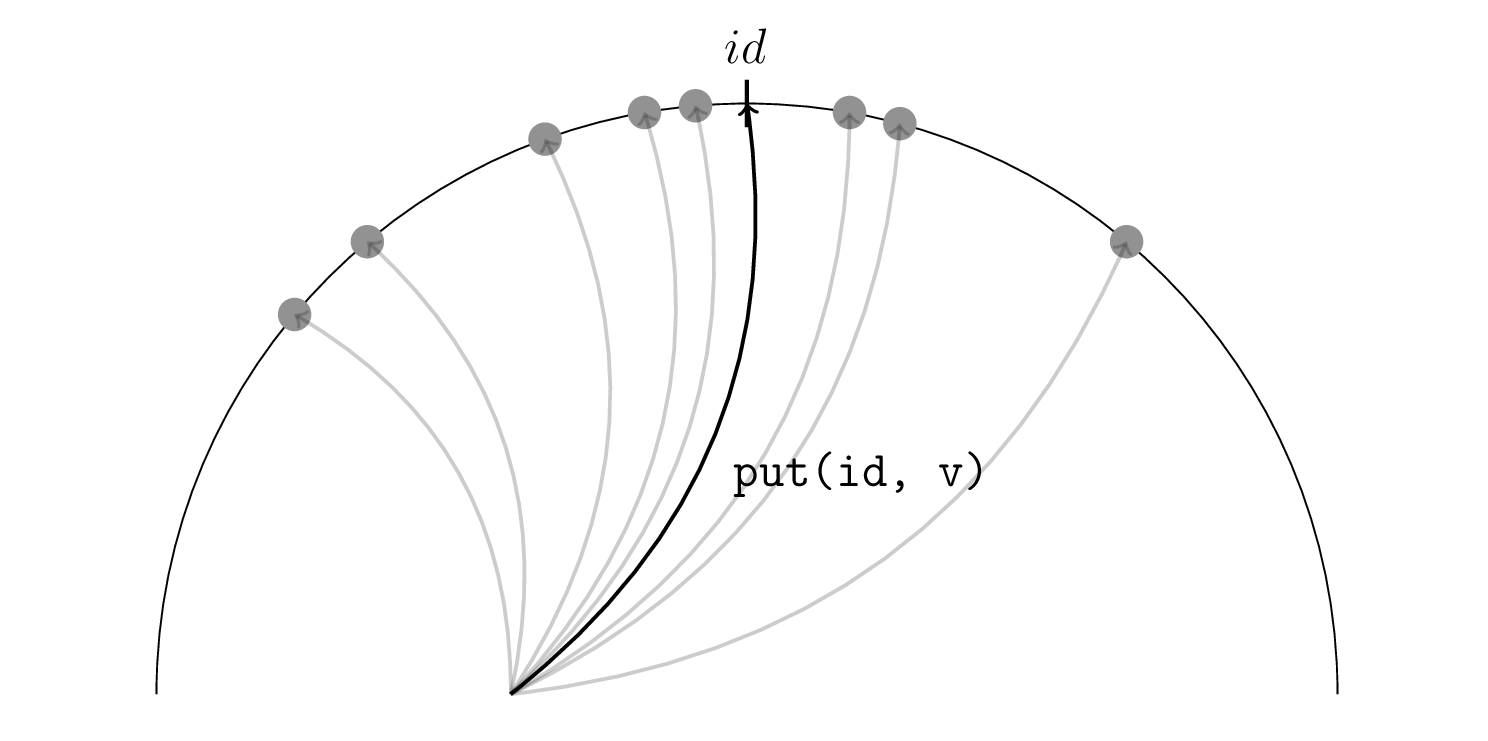 In order to find some data that is associated with some hash
h, you have to
find the nodes in the network for which the distance between their hash
identifier and the target hash h is minimized. The group of nodes which are
the closest to the target hash (OpenDHT allows up to 8 nodes) will hold data for
that hash.
Data persistence
Let s say you ask a group of 8 nodes to hold some data for a hash and you want
the data to hold the whole time until its expiration time as come. If the group
of 8 nodes change because that for some reason those nodes leave or others just
arrive and have an id that is closer to the target hash than the initial group
of 8 nodes. The data would then not be found on the new group of 8 nodes. A
first and simple solution was to count on the initial creator of the value to
periodically announce the value to the group of 8 nodes. However, what if this
node leaves? This is one of the main problem that I ve been working on solving
since 2015. A first version of this was produced on September 2015. However, we
experienced traffic issues and were forced to redesign the OpenDHT network
requests engine. We are presently working on adding a Query feature that would
enable filtering of data on remote nodes, hence substantially lowering the
overall traffic produced by a response to a get request.
Indexation
During the last year, I have also been working on the design of a solution for
the use case of indexation. In a more technical way, this is the capability to
find data by providing a map where its key is a string field and the mapped
value is the value associated to that field, much like in a form. This could
help find data for which you don t know the hash, but you have specific
information about its content. In other words, this would be a search engine for
OpenDHT. I have already created a working, but still in progress, version of
this. You can find it on http://opendht.net, on the index branch. Now, Nicolas
Reynaud (kaldoran) is contributing to this during the GSOC.
Roadmap
As I explained on my page on the Debian Wiki, I am going to work on:
- Developing new functionalities in OpenDHT aiming at reducing overall
generated traffic.
- Maintenance and optimization of the OpenDHT code in general.
- Optimizing data persistence solution over the distributed hash table.
- Merge (1) in the Ring daemon component in order to benefit from lower traffic
in Ring.
- Make OpenDHT use TCP protocol instead of UDP. This is going to reduce code
complexity and enhance robsutness of the DHT.
For further details, read my reports!
Short introduction to Distributed Hash Tables
OpenDHT is based on the Kademlia design. If you know about DHTs, you are
aware that they define the notion of distance using the XOR metric. This
makes the tuple (H_n, xor) a metric space, where H_n is the space of
identifier keys of length n. This way, you can find an identifier be the
closest to a target hash than the rest of the nodes in the network.
In order to find some data that is associated with some hash h, you have to
find the nodes in the network for which the distance between their hash
identifier and the target hash h is minimized. The group of nodes which are
the closest to the target hash (OpenDHT allows up to 8 nodes) will hold data for
that hash.
Data persistence
Let s say you ask a group of 8 nodes to hold some data for a hash and you want
the data to hold the whole time until its expiration time as come. If the group
of 8 nodes change because that for some reason those nodes leave or others just
arrive and have an id that is closer to the target hash than the initial group
of 8 nodes. The data would then not be found on the new group of 8 nodes. A
first and simple solution was to count on the initial creator of the value to
periodically announce the value to the group of 8 nodes. However, what if this
node leaves? This is one of the main problem that I ve been working on solving
since 2015. A first version of this was produced on September 2015. However, we
experienced traffic issues and were forced to redesign the OpenDHT network
requests engine. We are presently working on adding a Query feature that would
enable filtering of data on remote nodes, hence substantially lowering the
overall traffic produced by a response to a get request.
Indexation
During the last year, I have also been working on the design of a solution for
the use case of indexation. In a more technical way, this is the capability to
find data by providing a map where its key is a string field and the mapped
value is the value associated to that field, much like in a form. This could
help find data for which you don t know the hash, but you have specific
information about its content. In other words, this would be a search engine for
OpenDHT. I have already created a working, but still in progress, version of
this. You can find it on http://opendht.net, on the index branch. Now, Nicolas
Reynaud (kaldoran) is contributing to this during the GSOC.
Roadmap
As I explained on my page on the Debian Wiki, I am going to work on:
- Developing new functionalities in OpenDHT aiming at reducing overall
generated traffic.
- Maintenance and optimization of the OpenDHT code in general.
- Optimizing data persistence solution over the distributed hash table.
- Merge (1) in the Ring daemon component in order to benefit from lower traffic
in Ring.
- Make OpenDHT use TCP protocol instead of UDP. This is going to reduce code
complexity and enhance robsutness of the DHT.
For further details, read my reports!
- Developing new functionalities in OpenDHT aiming at reducing overall generated traffic.
- Maintenance and optimization of the OpenDHT code in general.
- Optimizing data persistence solution over the distributed hash table.
- Merge (1) in the Ring daemon component in order to benefit from lower traffic in Ring.
- Make OpenDHT use TCP protocol instead of UDP. This is going to reduce code complexity and enhance robsutness of the DHT.

 My monthly report covers a large part of what I have been doing in the free software world. I write it for
 During the month I spent quite some time providing guidance to the new contributors both in private mails and on the debian-lts mailing list.
I also


 )
 Here is my monthly update covering a large part of what I have been doing in the free software world (
 Back in 2014,