Search Results: "ina"

5 July 2012

Christian Perrier: DebConf running: take 3

The Grand Plan today was reaching the end of the road I already explored on Tuesday. Named "Camino Las Viudas", it's climbing in the southern hills up to a place named "Intermzeeo del Bosque", apparently a very fancy (and expensive) restaurant. The road climbs in the apparently "rich" neighbourhood of Managua, with very fancy villas as guarded by private security, as well as private condominiums, guarded as well. What's funny to see is that, at the bottom of the road, when it crosses a large avenue (Pista Suburbana Espana), you can find several auto-rickshaws, just like those you find everywhere in India. Those autos apparently drive people who happen to work in these villas (like maids, gardeners, security guards, etc.) up to the place they work. We even met two cows wandering on the road and I hesitated waiting for a rickshaw to show up and take a pic of the road (with holes), the auto and the cows, then pretending that I'm no longer in Nicaragua but back in Karnataka. I did the run along with No l K the, who I was very happy to find again, restoring our now famous Debconf Runners Duet. We even found the German Embassy! Though climb, even if we took care to start at 6 a.m. to avoid the heat (and also the traffic and noise). No l unfortunately had to give up at 1km from the top of the road, when a 15% climb suddenly "killed" his legs. I need to train him more for ups and downs..:-) I could continue the road and finally reached the restaurant....which was guarded by private security (as apparently everything in this country) who unfortunately didn't let me in despite my desperate attempts to convince him, in broken Spanish, that I just wanted to take a few pictures and not place a bomb or rob someone... So, I gota little bit disappointed and the only option was then....to run down for another 8.5 kilometers, accelerating all the way, to finish nearly at 14 km/h on Managua's sidewalks...Fun. Great run (nearly 400m positive slope in less than 17km). Next challenge : find another such nice run in the neighbourhood! Maybe Volcan Masaya tomorrow. GPS trace is here.

Michal Čihař: Roadmap for Weblate 1.2

As Weblate 1.1 is out, it's time to schedule next release. This release will bring some small improvements to the workflow, especially it will allow to tune it to different use cases than I originally had in mind. I've already started tagging bugs and feature requests to be fixed in 1.2 in [issue tracker][4]. Basically no big features on the list, just smaller things like notifications and locking. And of course dozen of bugfixes as the bugs will appear :-). As you can see there as well, 1.2 should be ready about month from now. This will be possible only thanks to Hackweek VIII (the wiki is still showing last one), which will happen from July 23rd to July 27th. The rest is time for testing the features and polishing the features. Anyway I might have time for some other features as well, so 1.2 might bring more things than I currently plan. But that depends on how fast I will be in implementing planned stuff.

Filed under: English Suse Weblate 0 comments Flattr this!

4 July 2012

Johannes Schauer: enumerating elementary circuits of a directed_graph

For my GSoC project this year I need to be able to enumerate all elementary circuits of a directed graph. My code is written in Ocaml but neither the ocamlgraph library nor graph libraries for other languages seem to implement a well tested algorithm for this task. In lack of such a well tested solution to the problem, I decided to implement a couple of different algorithms. Since it is unlikely that different algorithms yield the same wrong result, I can be certain enough that each individual algorithm is working correctly in case they all agree on a single solution. As a result I wrote a testsuite, containing an unholy mixture of Python, Ocaml, D and Java code which implements algorithms by D. B. Johnson, R. Tarjan, K. A. Hawick and H. A. James.

Algorithm by R. Tarjan The earliest algorithm that I included was published by R. Tarjan in 1973.
Enumeration of the elementary circuits of a directed graph
R. Tarjan, SIAM Journal on Computing, 2 (1973), pp. 211-216
http://dx.doi.org/10.1137/0202017
I implemented the pseudocode given in the paper using Python. The git repository can be found here: https://github.com/josch/cycles_tarjan

Algorithm by D. B. Johnson The algorithm by D. B. Johnson from 1975 improves on Tarjan's algorithm by its complexity.
Finding all the elementary circuits of a directed graph.
D. B. Johnson, SIAM Journal on Computing 4, no. 1, 77-84, 1975.
http://dx.doi.org/10.1137/0204007
In the worst case, Tarjan's algorithm has a time complexity of O(n e(c+1)) whereas Johnson's algorithm supposedly manages to stay in O((n+e)(c+1)) where n is the number of vertices, e is the number of edges and c is the number of cycles in the graph. I found two implementations of Johnson's algorithm. One was done by Frank Meyer and can be downloaded as a zip archive. The other was done by Pietro Abate and the code can be found in a blog entry which also points to a git repository. The implementation by Frank Meyer seemed to work flawlessly. I only had to add code so that a graph could be given via commandline. The git repository of my additions can be found here: https://github.com/josch/cycles_johnson_meyer Pietro Abate implemented an iterative and a functional version of Johnson's algorithm. It turned out that both yielded incorrect results as some cycles were missing from the output. A fixed version can be found in this git repository: https://github.com/josch/cycles_johnson_abate

Algorithm by K. A. Hawick and H. A. James The algorithm by K. A. Hawick and H. A. James from 2008 improves further on Johnson's algorithm and does away with its limitations.
Enumerating Circuits and Loops in Graphs with Self-Arcs and Multiple-Arcs.
Hawick and H.A. James, In Proceedings of FCS. 2008, 14-20
www.massey.ac.nz/~kahawick/cstn/013/cstn-013.pdf
In contrast to Johnson's algorithm, the algorithm by K. A. Hawick and H. A. James is able to handle graphs containing edges that start and end at the same vertex as well as multiple edges connecting the same two vertices. I do not need this functionality but add the code as additional verification. The paper posts extensive code snippets written in the D programming language. A full, working version with all pieces connected together can be found here: https://github.com/josch/cycles_hawick_james The algorithm was verified using example output given in the paper. The project README states how to reproduce it.

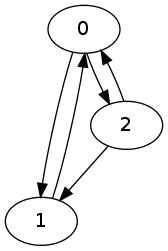
Input format All four codebases have been modified to produce executables that take the same commandline arguments which describes the graphs to investigate. The first argument is the number of vertices of the graph. Subsequent arguments are ordered pairs of comma separated vertices that make up the directed edges of the graph. Lets look at the following graph as an example: cycle example The DOT source for this graph is:
digraph G  
  0;
  1;
  2;
  0 -> 1;
  0 -> 2;
  1 -> 0;
  2 -> 0;
  2 -> 1;
   
To generate the list of elementary circuits using Tarjan's algorithm for the graph above, use:
$ python cycles.py 3 0,1 0,2 1,0 2,0 2,1
0 1
0 2
0 2 1
The commandline arguments are the exact same for the other three methods and yield the same result in the same order. If the DOT graph is in a format as simple as above, the following sed construct can be used to generate the commandline argument that represents the graph:
$ echo  sed -n -e '/^\s*[0-9]\+;$/p' graph.dot   wc -l   sed -n -e 's/^\s*\([0-9]\) -> \([0-9]\);$/\1,\2/p' graph.dot 

Testsuite As all four codebases take the same input format and have the same output format, it is now trivial to write a testsuite that compares the individual output of each algorithm for the same input and checks for differences. The code of the testsuite is available via this git repository: https://github.com/josch/cycle_test The other four repositories exist as submodules of the testsuite repository.
$ git clone git://github.com/josch/cycle_test.git
$ cd cycle_test
$ git submodule update --init
A testrun is done via calling:
$ ./test.sh 11
The argument to the shell script is an integer denoting the maximum number N of vertices for which graphs will be generated. The script will compile the Ocaml, Java and D sourcecode of the submodules as well as an ocaml script called rand_graph.ml which generates random graphs from v = 1..N vertices where N is given as a commandline argument. For each number of vertices n, e = 1..M number of edges are chosen where M is maximum number of edges given the number of vertices. For every combination of number of vertices v and number of edges e, a graph is randomly generated using Pack.Digraph.Rand.graph from the ocamlgraph library. Each of those generated graphs is checked for cycles and written to a file graph-v-e.dot if the graph contains a cycle. test.sh then loops over all generated dot files. It uses the above sed expression to convert each dot file to a commandline argument for each of the algorithms. The outputs of each algorithm are then compared with each other and only if they do not differ, does the loop continue. Otherwise the script returns with an exit code. The tested algorithms are the Python implementation of Tarjan's algorithm, the iterative and functional Ocaml implementation as well as the Java implementation of Johnson's algorithm and the D implementation of the algorithm by Hawick and James.

Future developments Running the testsuite with a maximum of 12 vertices takes about 33 minutes on a 2.53GHz Core2Duo and produces graphs with as much as 1.1 million cycles. It seems that all five implementations agree on the output for all 504 generated graphs that were used as input. If there should be another implementation of an algorithm that enumerates all elementary circuits of a directed graph, I would like to add it. There are some more papers that I would like to read but I lack access to epubs.siam.org and ieeexplore.ieee.org and would have to buy them. Benchmarks seem a bit pointless as not only the algorithms are very different from each other (and there are many ways to tweak each of them) but also the programming languages differ. Though for the curious kind, it follows the time each algorithm takes to enumerate all cycles for all generated graphs up to 11 vertices.
algorithmtime (s)
Johnson, Abate, Ocaml, iterative137
Johnson, Abate, Ocaml, functional139
Tarjan, Python153
Hawick, D175
Johnson, Meyer, Java357
The iterative Ocaml code performs as well as the functional one. In practice, the iterative code should probably be preferred as the functional code is not tail recursive. On the other hand it is also unlikely that cycles ever grow big enough to make a difference in the used stack space. The Python implementation executes surprisingly fast, given that Tarjan's algorithm is supposedly inferior to Johnson's and given that Python is interpreted but the Python implementation is also the most simple one with the least amount of required datastructures. The D code potentially suffers from the bigger datastructures and other bookkeeping that is required to support multi and self arcs. The java code implements a whole graph library which might explain some of its slowness.

Michael Banck: 4 Jul 2012

Update on computational chemistry packages in Debian

For many years, me and the Debichem team maintained two computational chemistry packages, first MPQC and later PSI3. In recent years however, two respected quantum chemistry codes have been open sourced and are now available in Debian: ACESIII and NWChem. Make no mistake, those are not recently started codes or some Ph.D.'s pet-project but state-of-the-art projects targeted at massively parallel supercomputers and developed at the University of Florida's Quantum Chemistry Project (QTP) in the case of ACESIII and at Pacific Northwest National Laboratory (PNNL) for NWChem.

While ACESIII has a somewhat narrow focus on Coupled-Cluster (unfortunately, the current version does not yet implement analytic gradients for the "golden standard" CCSD(T) method) and Multi-Body Perturbation Theory methods, NWChem is a very versatile package supporting a variety of molecular quantum chemistry methods (including Density Functional Theory (DFT)), as well as periodic plane-wave electronic structure and (ab-initio and classical) molecular dynamics. At this point, NWChem probably covers 90% of all use cases for routine computational chemistry compared to the popular non-free codes Gaussian and GAMESS, while likely exhibiting superior parallel scaling at least compared to Gaussian.

Over the last year, I have packaged and integrated NWChem and ACESIII for Debian, and they are now both in testing. Furthermore, I have recently overhauled the packaging of MPQC and enabled parallel execution via MPI. Further, both MPQC and PSI will see updated versions (MPQC3 and PSI4) in the near future with significant increased functionality, including some unique (at least among open source codes) features like Symmetry-Adapted Perturbation Theory (SAPT) for PSI4 and general explicitly correlated corrections ([2]f12) for MPQC3. Unfortunately, they both did not get released in time for the wheezy freeze.

On the periodic/plane-wave front, I have also packaged and uploaded Quantum ESPRESSO (formerly PwSCF), a set of plane-wave programs, and I have been working with lafur Jens Sigur sson to get the latest Abinit release packaged. The nanoscale-physics team is also targeting further periodic ab-initio packages like BigDFT and Octopus, but those as well did not land in time for the freeze.

Finally, I also packaged and uploaded CP2K, a well-engineered and versatile periodic plane-wave/pseudo-potential code which focuses on state-of-the-art ab-initio Molecular Dynamics (AIMD) using Density Functional Theory. Some of the authors have recently published a paper reporting linear scaling benchmark calculations on a system with a million atoms using almost 50,000 CPU cores.

All of the above mentioned packages are included either in the molecular ab-initio or the periodic ab-initio Debichem tasks.

Stefano Zacchiroli: bits from the DPL for June 2012

Monthly DPL bits, fresh from the oven^W^W^W hot from DebConf12, and just posted to d-d-a.
Howdy from DebConf12. It's hot, but it's also time to bother you again with a (not so) brief DPL activity report, this time for June 2012. Time-based freeze: DONE, short freeze: TODO Two highlights for this month. First, you've probably noticed Wheezy is now frozen, YAY. This is huge achievement for the release, but also for the project. It's the first time we do a time-based freeze, and it took some quite heated discussion at the beginning of the release cycle to decide to do this. And we did it properly: respecting the planned month and narrowing down the period later. This exercise has hopefully helped both DDs in their package planning and our upstreams in targeting Wheezy with stable releases of their software. Kudos to the release team for their coordination work! Now we've the second part still TODO: releasing Wheezy, without RC bugs, with a freeze period as short as possible. See the beginning of my last "bits from the DPL" mail for my usual song and dance :-P on how to deliver that, together. DebConf12 A lot of us will attend DebConf12. Enjoy it! ... and take the chance to both have fun and make great plans for Debian's future. But remember that "if it didn't happen on a mailing list, it didn't happen". Not all of us will be lucky enough to attend DebConf (in person or remotely). Make sure that those who don't can take part in your team decisions and get informed of what is going to happen here. Politics Zack's spring tour I spent a significant part of June doing Debian talks ins some sort of "spring tour" between Italy and France. In particular: Many thanks to the organizers of these events for inviting and sponsoring me (as well as other Debian people, in the ESRF case) and for their interest in Debian. Sprints Assets Discussions Some relevant discussions for project evolution has been going on in June and I took part into them. You might want to have a look at them: Misc Cheers.
PS the boring day-to-day activity log for June is available at master:/srv/leader/news/bits-from-the-DPL.txt.201206

3 July 2012

C.J. Adams-Collier: Currency platform superior to US Federal Reserve Bank

Should I recommend that Software in the Public Interest implement a monetary stack with the stated purpose of replacing the federal reserve system? We would have to publish the source code, of course, and the transaction db would need to be de-centralized so as to avoid private interests using it for their own benefit at the expense of their fellow humans. Not that that would ever happen, mittens. We d probably experience a period of instability due to scaling issues during the learning state, say the first two to five years. The IRS would need to be convinced that it would be a good idea, though. And I think they only listen to voters. And I don t want to be the one responsible for convincing them. I m not so good at exchanging paperwork with them, and they would likely get confused. Anyway, the idea would be that after the learning state, sessions would be migrated from the Fed db at a sustainable rate. After moving the sessions off of the Fed s current, compromised stack, the increase in tax revenues caused by removal of the current implementation s filters should be more than enough to fund the maintenance of the implementation undergoing strict peer review. http://www.wapublicbankproject.org/

Miriam Ruiz: Scratch in Debian

Scratch has finally reached Debian repositories. Scratch is a programming learning environment created by the Lifelong Kindergarten Group at the MIT Media Lab designed to be accessible by young learners (over 8 years old). Scratch makes it easy to create your own interactive stories, animations, games, music, and art through a visual interface based on blocks. Thus, beginners can get results without having to learn to write syntactically correct code first. It is powerful enough to have even been adopted as an entry-level computer language in computer science programs at different universities. Scratch makes use of pieces of code embedded in different blocks that are shaped like puzzle pieces. That way, programming consists on putting different blocks together, which gives immediate visual feedback to the programmer about the correctness of the syntax: If the pieces fit together, then the expression is valid. Scratch programming system is so nice and easy that has been the inspiration of other systems such as MIT App Inventor or Google Blocky.

Scratch animations consist of sprites that are animated by dragging the corresponent blocks into the Scripts area of the Scratch interface. Multiple sprites can be created and interact with one another. Each of the sprites can have different looks (called costumes in Scratch). You can use built-in sprites, load them from files, or draw your own using a drawing tool integrated in the environment. Scratch itself is coded in Squeak, a Smalltalk implementation derived from Smalltalk-80. The Scratch 1.4 source went GPLv2 on March, but there were some incompatibilites with the Squeak Virtual Machine currently in Wheezy that had to be resolved first. Luckily we were able to solve them, with the help of the Scratch and the Squeak guys, so I m happy to say that Scrach is finally available from Debian repositories. Note: If any Scratch derivatives (such as BYOB or Panther) also need to be ported to the current version of Squeak, they should have a look at the comments in the Scratch ITP, and especially to the script uploaded by Bert Freudenberg, that replaces 90 indexed primitive declarations (removed in later versions of Squeak VM) with their named counterpart. Note 2: This wouldn t have been possible without all the great work and effort made by Amos Blanton and many others. Lots of thanks!

2 July 2012

Matthew Garrett: Fun with firmware ABI confusion

I spent a bunch of the past week trying to figure out why my UEFI bootloader code was crashing in bizarre ways. It turns out to be a known issue that various people have hit in the past. After a lot of staring (and swearing) I finally got to the point where I could run a debugger against a running UEFI binary under qemu and found that I was entering a function with valid arguments but executing it with invalid ones. After spending a while crying on IRC people suggested that maybe the red zone was getting corrupted, and it turned out that this was the problem.

The red zone is part of the AMD64 System V ABI and consists of 128 bytes at the bottom of the stack frame. This region is guaranteed to be left untouched by any interrupt or signal handlers, so it's available for functions to use as scratch space. For the code in question, gcc was copying the registers onto the stack before executing the function. Something then trod on those registers. This also explained why I wasn't seeing the problem when I added debug print statements - signal and interrupt handlers won't touch it, but other functions might, so it tends to only be used by functions that don't call any other functions. Adding a print statement meant that the compiler left the red zone alone.

But why was it getting corrupted? UEFI uses the Microsoft AMD64 ABI rather than the System V one, and the Microsoft ABI doesn't define a red zone. UEFI executables built on Linux tend to use System V because that means we can link in static libraries built for Linux, rather than needing an entirely separate toolchain and libraries to build UEFI executables. The problem arises when we run one of these executables and there's a UEFI interrupt handler still running. Take an interrupt, Microsoft ABI interrupt handler gets called and the red zone gets overwritten.

There's a simple fix - we can just tell gcc not to assume that the red zone is there by passing -mno-red-zone. I did that and suddenly everything was stable. Frustrating, but at least it works now.

comment count unavailable comments

Raphaël Hertzog: My Debian Activities in June 2012

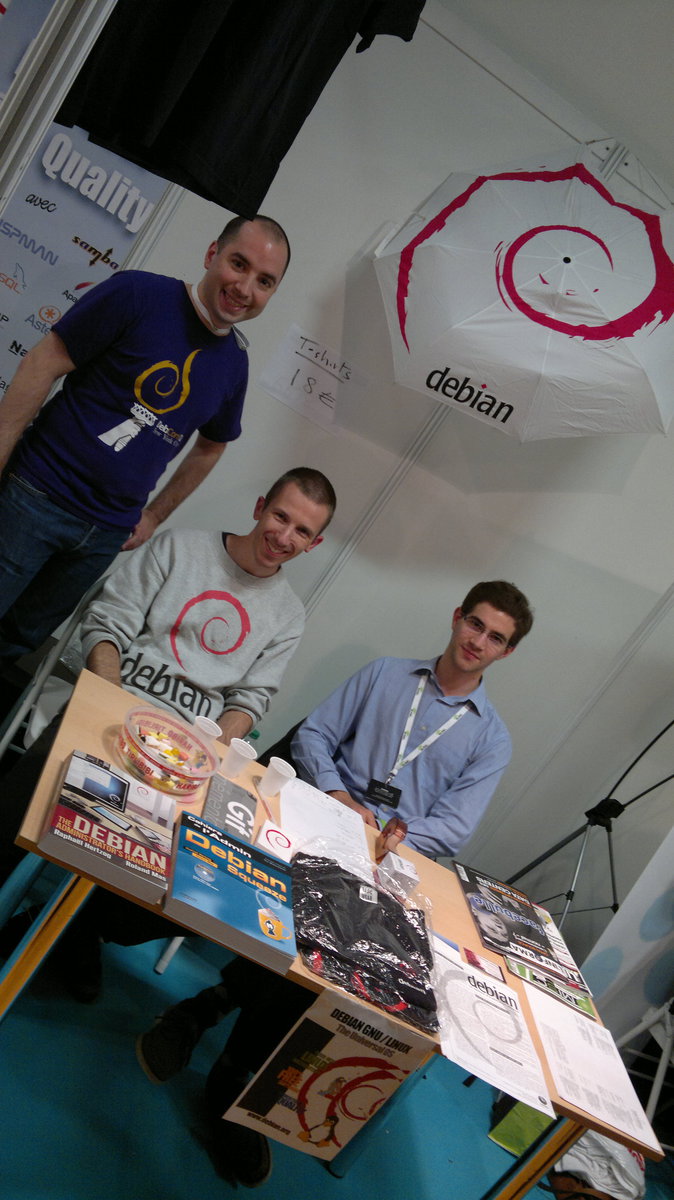
This is my monthly summary of my Debian related activities. If you re among the people who made a donation to support my work (168.12 , thanks everybody!), then you can learn how I spent your money. Otherwise it s just an interesting status update on my various projects. Dpkg This month, I resumed my work on dpkg. I concentrated my efforts on some polishing of the 3.0 (quilt) format. With the latest version (1.16.6 which was uploaded to unstable shortly before the freeze), dpkg-source restores the source tree in a clean state after a failed patch application (#652970), doesn t overwrite the patch header from the pre-existing automatic patch, updates automatically debian/source/include-binaries during dpkg-source commit, and supports a new no-unapply-patches option for those who dislike the auto-unapplication at the end of the process when the patches were not applied at the start. I wanted to go further and offer a new feature that could insert the automatic patch at the bottom of the quilt series but I have been short on time to complete this feature. I just managed to factorize all the quilt handling in a dedicated Perl module (Dpkg::Source::Quilt) to have cleaner code in the module handling the source format (Dpkg::Source::Package::V3::quilt). For those who wonder, this feature is meant primarily for the X Strike Force team which maintains packages in Git and are doings lots of upstream cherry-picks (to fix regressions, etc.). But they also use quilt on top of that tree to keep some lasting Debian specific changes. With the 1.0 format, the automatic diff is a bit messy but at least it gets smaller automatically when a new upstream release gets out, there s nothing to clean out. I d like them to be able to use 3.0 (quilt) while keeping their workflow. I m leaning towards allowing --auto-commit=first:cherry-picks that would name the automatic patch cherry-picks and put it in the first position in the quilt series. (Opinions welcome on that feature, BTW) Packaging There s been quite some packaging in this last month before the freeze: While doing all this packaging work, I found 2 possible improvements that I filed as bug reports: Debian France Booth at Solutions Linux From June 19th to June 21th, I manned the Debian France booth at Solutions Linux together with Carl Chenet, Tanguy Ortolo and other members of the association. We answered lots of questions, sold all t-shirts and umbrellas that Carl imported from Germany and Switzerland (we really need to get our own merchandising stuff produced in France!), got people to join the association. We also presented a printed copy of the Debian Administrator s Handbook and of the corresponding French book. You can see Carl, me and Tanguy on this picture (click on it to see a bigger picture, thanks to S bastien Dubois of Evolix for this one!):
I know lots of people are preparing for Debconf but I decided to not attend this year, the price of the air plane ticket was a bit too hefty for me and it was also in partial conflict with our family vacations. I thought about attending the Libre Software Meeting instead but alas I won t go there either (but Roland Mas will be there!), I have too much work to complete before my own vacation in 2 weeks. Thanks See you next month for a new summary of my activities.

2 comments Liked this article? Click here. My blog is Flattr-enabled.

Johannes Schauer: port bootstrap build-ordering tool report 3

A copy of this post is sent to soc-coordination@lists.alioth.debian.org as well as to debian-bootstrap@lists.mister-muffin.de.

Diary

June 18 Pietro suggests a faster way to generate installation sets for a list of packages. In my case, I need an installation set for every source package in the archive to find out how often a binary package is needed to build a source package. As a result, the speed is doubled in contrast to the original approach.

June 19
  • adapt code to work with new dose release 3.0
  • remove unneeded parts of code
  • add different possibilities to find amount of source packages that need a binary package
  • add code to get multiple installation sets using Depsolver_int.solve

June 20
  • add ~global_constraints:false to Depsolver.listcheck, Depsolver.trim and Depsolver.edos_install calls
  • adapt output graph to limited xdot capabilities

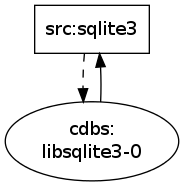
June 21 I formulate an email to the list, reporting of dependency graphs of debhelper, cdbs, pkg-config and libgtk2.0-dev. My current technique gets an installation set for a source package, removes all those that are already installable and adds the others as a dependency of that source package. This dependency will include an installation set of that binary as well minus all packages that are already available. The problem with that approach are dependency cycles created by long dependency chains. Example: src:A needs B needs C needs A. B and C would both be added as a dependency of src:A. B as well as C would also include their installation set which in both cases includes A. So now there are two cycles: src:A->B->A and src:A->C->A. For a real life example, look at the following situation of cdbs and src:sqlite3. cdbs old situation It is created because src:sqlite3 needs cdbs needs python-scour needs python needs python2.7 needs libsqlite3-0. Therfor libsqlite3-0 is in the installation set of cdbs, python-scour, python and python2.7. This creates five cycles in the graph even though there is only one. It would be better to reduce the dependencies added to src:sqlite3 to its direct dependency which is cdbs. Package dependencies are disjunctions from which the solver chooses one or the other to build an installation set. To solve the problem above I would need to know which disjunction the solver chose and then only add the direct dependency of a package to the dependency graph.
  • improve build_compile_rounds performance
  • big overhaul of menu structure
  • fix subgraph extraction code

June 22
  • do not create a universe if not needed - use hashtables instead
  • for sorting packages, generating difference of package sets and otherwise comparing packages, always use CudfAdd.compare
  • as a custom list membership function, use List.exists instead of trying List.find
  • more speedup for build_compile_rounds
  • the number of source packages that can be built does NOT include the cross built packages
  • print closure members in graph
  • refactor code and move common functions to bootstrapCommon.ml
  • add breakcycles.ml for future code to break cycles using staged build dependencies
  • use more extlib functionality
  • extended package list input format

June 23 After several emails with Pietro I learn about syntactic dependency graphs. To document my progress and prove my efforts I committed the code as commit 6684c13. But this code was soon found out to be unecessary so it will be removed later and just serves as documentation.

June 24 I came up with another (better?) solution to get the chosen disjunctions. It simply uses the calculated installation set to decide for each disjunction which one was taken by the solver. I reported that important step and the open questions involved with it in an email to the list. The problem always was, that an installation set can easily contain more than one package of a disjunction. In this case it is not clear which branch was chosen by the solver. I found, that in Ubuntu Natty there are only 6 such packages and for each of them the situation can be solved. It can be solved because in all of those cases it is that either one package of a disjunction provides the other or that both packages depend upon each other, which means that both have to be included.

June 27
  • use installation set to flatten build dependencies of source packages
  • refactor code and move common functions to bootstrapCommon.ml

June 25 I have to have an algorithm that finds all circuits in a given graph. This is necessary so that:
  1. cycles can be enumerated for huge dependency graphs where cycles are hard to see
  2. cycles can be enumerated to find a cycle that can be broken using staged build dependencies
It seems that Johnson's algorithm is the best way to do this complexity wise and Pietro already blogged about the problem together with an implementation of the algorithm in ocaml. Unfortunately it turns out that his code doesnt implement the algorithm correctly and hence misses out on some cycles. The fix seems not to be too trivial so I'm still investigating it.

June 28
  • add crosseverything.ml to obtain a list of source packages that, if cross compiled, would make the whole archive available

Results While the first week was productive as usual, I had to work some time on a University project during the second week as well as attend a family meeting. I will catch up with the lost time over the course of the next week.

dose3 Using dose 3.0 (which fixes a bug about essential packages) the output of the algorithms is now likely less wrong then before.

performance Performance was improved in the generation of installation sets as well as in the code that tries out how many packages can be built in multiple rounds. This was achieved by more caching, less unnecessary operations in looping constructs, replacing lists with hashtables, not creating universes where not necessary.

user interface The main program, basenocycles.ml now has a much better menu structure.

input format The programs take two package file inputs. The list of source packages that has to be cross built for a minimal build system and the list of source packages that was chosen to be cross compiled in addition to that. Both files list one source package per line and now allow comments.

refactoring As more and more scripts are added, more and more functionality is moved to bootstrapCommon.ml which makes each script much cleaner.

what to test for cross building As discussed in the "Future" section of the last report, I now automated the process of finding out which packages, if they were cross compiled, would make the whole archive available because they break all cycles and allow native compilation of the rest. The outcome: to build 3333 out of 3339 packages in natty natively, at most 186 source packages must be cross compiled. The other six cannot be compiled because of version mismatches in the Natty Sources.bz2 and Packages.bz2. The code can be run from crosseverything.ml.

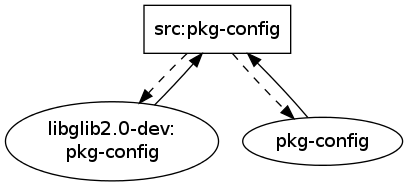
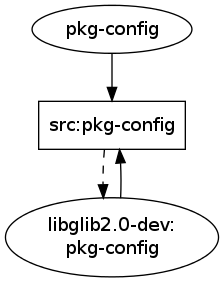
limit source dependencies to direct dependencies Reducing the dependencies of source packages from their full installation set to their direct dependencies by finding out which disjunction of their dependency list were taken, greatly simplifies the dependency graphs. The dependency graph created for libgtk2.0-dev could be reduced from 491 to 247 vertices for a depth of three. For cdbs it is now clearly visible that cdbs depends on libsqlite3-0 which builds from src:sqlite3 which depends on cdbs. Before: cdbs old situation After: cdbs new situation For pkg-config the graph also has been reduced to the one single cycle that matters: src:pkg-config needs libglib2.0-dev which depends on pkg-config which builds from src:pkg-config. Before: pkg-config old situation After: pkg-config old situation

Future I will prepare content for wookey's debconf talk on crossbuilding and bootstrapping. As this will include directions how to use the current code, I will kill two birds with one stone and write some proper documentation for my current source. The following two lists will be displayed after a dependency graph is calculated and reduced to its scc:
  • those source packages that have the least build dependencies not fulfilled. Those might be candidates for easy staged build dependencies. Since the source package is part of the scc, it will definitely be involved in some cycle somewhere.
  • those binary packages that most source packages depend upon. Those could be candidates for cross compilation as it might be easier to cross compile the source package than using staged build dependencies.
Patrick managed to cross build packages with sbuild now. So the list of packages that crosseverything.ml produces can now be checked efficiently for cross buildability. With this list, potentially more cycles can be broken out of the box. A feature will be added that allows the user to remove all packages from a dependency graph that can be cross compiled without any additional effort. Version mismatches between source and binary packages in Sources.bz2 and Packages.bz2 respectively in Ubuntu make the scripts fail and/or produce wrong results. Debian (even Sid) doesnt have this problem so I should find out where to report this problem to Ubuntu. I need to write a working version of Johnson's algorithm because much functionality depends upon it. I have the option to improve Pietro's version or write one from scratch. Writing one from scratch might be easier as I have Pietro's code as template as well as a Java implementation of Johnson's algorithm which seems to work. The following functionalities need working cycle enumeration:
  • given source packages with staged build dependencies, an enumeration of cycles is needed to find out which cycles can be broken by building packages staged. It makes less sense to blindly build a package stage and then check if this makes more packages available.
  • display cycles of a dependency graph to the user. After obtaining all cycles in the graph it makes sense to sort them by their length. The user would then investigate the situation of the smallest cycles first. This makes sense because breaking small cycles can potentially break bigger cycles. Since in the end, all cycles have to be eliminated anyway, it makes sense for the user to first tackle the small ones.
  • display the feedback arc set to the user. The packages in the feedback arc set might be very good candidates for reduced build dependencies or cross compilation.

Joey Hess: notes for a caretaker

I recently had the sort of weird experience of a recent blog post being on the top of Hacker News and there being a fair amount of interest in the details of my wacky living situation. I could write a detailed post explaining everything, but that'd be boring .. instead I'll tease the stalkers with more oblique references to it. So here's my notes for a caretaker who will be here while I'm away at DebConf.
Please make yourself at home!

1 July 2012

Gunnar Wolf: Arrived to Nicaragua. DebCamp has officially started!

Yesterday night, Regina and me arrived to Nicaragua. Ready to greet us, we found quite a good number of good friends. We had a nice pizza+beer dinner at Diana's house, and some of the foreigners among us were distributed among the houses of several locals. This morning, we woke up together with V ctor, Moray and Gaudenz in Norman's brother's beautiful house. We had breakfast with the family, were picked up to go to the hotel that will have the ho(n rr)or to host us all for the following two weeks, and walked to the Universidad Centroamericana (UCA) campus. Contrary to our usual practices... It seems everything is working fine! I mean, I'm sure we will stumble with some unforseen details and what not... But coming on the very first day to the university, to find that food is all sorted out, that we have food tickets (and they are all printed!), that network works (and it's by a fiber connection that was laid out expressly for us), that we have all the hardware I was worried about, that people are arriving and getting accepted at the hotel. I mean, things work! So, I'm quite optimistic this DebCamp will have everything ready to be a success And the DebConf following it as well, of course! If you have not yet arrived - See you soon!

Niels Thykier: Performance bottlenecks in Lintian

Thanks to a heads up from Bastian Blank, I learned that Lintian 2.5.7 and 2.5.8 were horribly slow on the Linux binaries. Bastian had already identified the issue and 2.5.9 fixed the performance regression. But in light of that, I decided to have a look at a couple of other bottlenecks. First, I added a simple benchmark support to Lintian 2.5.10 (enabled with -dd) that prints the approximate run time of a given collection. As an example, when running lintian -dd on lintian 2.5.10, you can see something like:
N: Collecting info: unpacked for source:lintian/2.5.10 ...
[...]
N: Collection script unpacked for source:lintian/2.5.10 done (0.699s)
When done on linux-image, the slowest 3 things with 2.5.10 are (in order of appearance):
[...]
N: Collection script strings for binary:linux-image-3.2.0-2-amd64/3.2.20-1/amd64 done (12.333s)
N: Collection script objdump-info for binary:linux-image-3.2.0-2-amd64/3.2.20-1/amd64 done (15.915s)
[...]
N: Finished check: binaries (5.911s)
[...]
(The mileage (and order) probably will vary a bit.) These 3 things makes up about 22 seconds of a total running time on approximately 28-30s on my machine. Now if you wondering how 12, 16 and 6 becomes 22 the answer is parallelization . strings and objdump-info are run in parallel so only the most
expensive of the two counts in practise (with multiple processing units). The version of linux-image I have been testing (3.2.20-1, amd64) has over 2800 ELF binaries (kernel modules). That makes the runtime of strings and objdump-info much more dominating than in your average package . For the fun of it I have done a small informal benchmark of various Lintian versions on the binary. I have used the command line:
# time is the bash shell built-in and not /usr/bin/time
$ time lintian -EvIL +pedantic linux-image-3.2.0-2-amd64_3.2.20-1_amd64.deb >/dev/null
# This was used with only versions that did not accept -L +pedantic
$ time lintian -EvI --pedantic linux-image-3.2.0-2-amd64_3.2.20-1_amd64.deb >/dev/null
With older versions of Lintian (<= 2.5.3) Perl starts to emit warnings; these have been manually filtered out. I used lintian from the git repository (i.e. I didn t install the packages, but checked out the relevant git tags). I had libperlio-gzip-perl installed (affects the 2.5.10 run). Most results are only from a single run, though I ran it twice on the first version (hoping my kernel would cache the deb for the next run). The results are:
2.5.10
real  0m28.836s
user  0m36.982s
sys  0m3.280s
2.5.9
real  1m9.378s
user  0m33.702s
sys  0m11.177s
2.5.8
real  4m54.492s
user  4m0.631s
sys  0m30.466s
2.5.7 (not tested, but probably about same as 2.5.8)
2.5. 0..6 
real  1m20s  - 1m22s
user  0m19.0s - 0m20.7s
sys  0m5.1s  - 0m5.6s
I think Bastian s complaint was warranted for 2.5. 7,8 . :) While it would have been easy to attribute the performance gain in 2.5.10 on the new parallelization improvements, it is simply not the case. These improvements only apply to running collections when checking multiple packages. On my machine, the parallelization limit for a package is effectively determined by the dependencies between the collections on my machine. Instead the improvements comes from reducing the number of system(3) (or fork+exec) calls Lintian does. Mostly through using xargs more, even if it meant slightly more complex code. But also, libperlio-gzip-perl shaved off a couple of seconds on binaries check. But as I said, linux-image is not your average package . Most of the improvements mentioned here are hardly visible on other packages. So let s have a look at some more other bottlenecks. In my experience the following are the worst offenders : But enough Lintian for now time to fix some RC bugs!

Dirk Eddelbuettel: Getting numpy data into R

The other day, I found myself confronted with a large number of large files. Which were presented in (gzip-)compressed ascii format---which R reads directly via gzfile() connections---as well as (compressed) numpy files. The numpy can be read very efficiently into Python. We can do the same in R via save() and load(), of course. But the trouble is that you need to read them first. And reading hundreds of megabytes from ascii is slow, no matter which language you use. Concerning R, I poked aound scan(), played with the colClasses argument and looked at the recent LaF package written just for this purpose. And all these solutions were still orders of magnitude slower than reading numpy. Which is no surprise as it is really hard to beat binary formats when you have to parse countless ascii tokens. So the obvious next idea was to read the numpy file in Python, and to write a simple binary format. One helpful feature with this data set was that it contained only regular (rectangular) matrices of floats. So we could just store two integers for the dimensions, followed by the total data in either one large binary blob, or a sequence of column vectors. But one minor trouble was that the Intertubes lead to no easy solution to unpack the numpy format. StackOverflow had plenty of question around this topic converned with, say, how to serialize in language-independent way. But no converters. And nobody local knew how to undo the "pickle" format underlying numpy. But a remote friend did: Laurent, well-known for his Rpy2 package, pointed me towards using the struct module and steered me towards the solution shown below. So a shameless plug: if you need a very experienced Python or R consultant for sciece work, consider his consulting firm. Finally, to round out this post, let's show the simple solution we crafted so that the next guy searching the Intertubes will have an easier. Let us start with a minimal Python program writing numpy data to disk:
#!/usr/bin/env python
#
# simple example for creating numpy data to demonstrate converter
import numpy as np
# simple float array
a = np.arange(15).reshape(3,5) * 1.1
outfile = "/tmp/data.npy"
np.save(outfile, a)
Next, the simple Python converter to create a binary file containing two integers for row and column dimension, followed by row times columns of floats:
#!/usr/bin/python
#
# read a numpy file, and write a simple binary file containing
#   two integers 'n' and 'k' for rows and columns
#   n times k floats with the actual matrix
# which can be read by any application or language that can read binary
 
import struct
import numpy as np
inputfile = "/tmp/data.npy"
outputfile = "/tmp/data.bin"
# load from the file
mat = np.load(inputfile)
# create a binary file
binfile = file(outputfile, 'wb')
# and write out two integers with the row and column dimension
header = struct.pack('2I', mat.shape[0], mat.shape[1])
binfile.write(header)
# then loop over columns and write each
for i in range(mat.shape[1]):
    data = struct.pack('%id' % mat.shape[0], *mat[:,i])
    binfile.write(data)
binfile.close()
Lastly, a quick littler script showing how R can read the data in a handful of lines:
#!/usr/bin/r
infile <- "/tmp/data.bin"
con <- file(infile, "rb")
dim <- readBin(con, "integer", 2)
Mat <- matrix( readBin(con, "numeric", prod(dim)), dim[1], dim[2])
close(con)
print(Mat)
That did the job---and I already used to converter to read a few weeks worth of data for further analysis in R. This obviously isn't the last word on possible solutions as the additional temporary file can be wasteful (unless it forms a cache for data read multiple times). If someone has nice solutions, please don't hold back and contact me. Thanks again to Laurent for the winning suggestion concerning struct, and help in getting the examples shown here to work.

Steinar H. Gunderson: Leap second

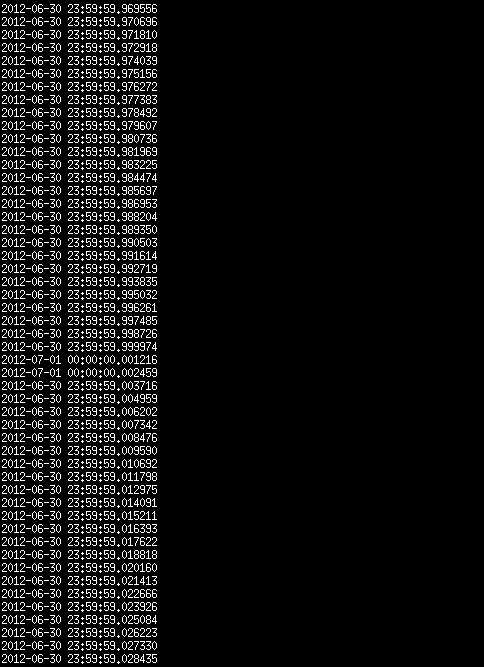
Leap second Hope you used it well.

30 June 2012

Luca Falavigna: FTP Team stats during Wheezy development

Already chilled by Wheezy freeze? It s been a long ride since the release of Squeeze, and your beloved FTP Team tried to assist our tireless developers and contributors at its best. Here are some hot stats to give you a figure about what happened behind the scenes. Since the release of Squeeze, 7462 .changes files with NEW components were processed by dak, with an average of 14.660 NEW packages per day. On the FTP Team side, we had 6877 accepts (13.511 per day), 641 rejects (1.259 per day) and 280 comments to maintainers (0.550 per day). This table represents the activity by single team member:
Login Accepts Rejects Comments
ansgar 407 accepts (0.800 per day) 71 rejects (0.139 per day) 53 comments (0.104 per day)
dak 12 accepts (0.024 per day) 1 rejects (0.002 per day) 0 comments (0.000 per day)
dktrkranz 4319 accepts (8.485 per day) 381 rejects (0.749 per day) 104 comments (0.204 per day)
joerg 100 accepts (0.196 per day) 12 rejects (0.024 per day) 1 comments (0.002 per day)
mhy 214 accepts (0.420 per day) 14 rejects (0.028 per day) 5 comments (0.010 per day)
stew 67 accepts (0.132 per day) 16 rejects (0.031 per day) 7 comments (0.014 per day)
tolimar 1480 accepts (2.908 per day) 93 rejects (0.183 per day) 84 comments (0.165 per day)
twerner 278 accepts (0.546 per day) 53 rejects (0.104 per day) 26 comments (0.051 per day)


Who were the most prolific maintainers who got a NEW processing? Here is our special top ten:
  1. Debian Perl Group (559 accepts)
  2. Debian Haskell Group (491 accepts)
  3. Debian Ruby Extras Maintainers (285 accepts)
  4. Debian Java Maintainers (257 accepts)
  5. Debian Med Packaging Team (164 accepts)
  6. Debian Multimedia Maintainers (160 accepts)
  7. Debian Fonts Task Force (156 accepts)
  8. Debian Javascript Maintainers (137 accepts)
  9. Debian Python Modules Team (129 accepts)
  10. Debian Qt/KDE Maintainers (98 accepts)
That doesn t reflect the real developers, though. Here s our Changed-By top ten:
  1. Clint Adams (216 accepts)
  2. Jonas Smedegaard (208 accepts)
  3. Ben Hutchings (203 accepts)
  4. Joachim Breitner (153 accepts)
  5. TANIGUCHI Takaki (112 accepts)
  6. Alessio Treglia (101 accepts)
  7. David Paleino (95 accepts)
  8. Nicholas Bamber (76 accepts)
  9. Mathieu Parent (68 accepts)
  10. Jeff Breidenbach (63 accepts)
Clint rocks with tons of Haskell packages, followed by Jonas (mostly Perl packages), and Ben (kernel uploads). Italian cabal stands still, with Alessio and David respectively at 6th and 7th place ;)


How long does a package stay in NEW? Some more, some less, but the average is 3 days, 15 minutes and 21 seconds. Now go and check your dak mails to see whether you had a fast processing or not :) liblog4ada 1.2-1 surely had, as it was accepted after 30 seconds! gsoap 2.7.17-1 was not so lucky, it took 103 days, 8 hours, 20 minutes and 43 seconds to clear NEW, but then made its way to the archive. Better late than never ;)


FTP Team is not just accepting NEW packages, but also removing obsolete ones. Here are some details about this task:

FTP Team also took care of override changes:

Timo Jyrinki: Where computing takes you...

Do you ever have those afternoons you get a great idea and you've all the evening time for that task. The task is a relaxing one and won't need much attention, and you can watch a movie or something. But then, it happens that the evening turns into night as you realize a couple of little details adding complexity to the idea, and the task turns out to be much more invasive to your evening than you thought?

In this example, I got the great idea to upgrade my Debian running NAS device (thanks Martin for everything!) to use ext4 instead of ext3. The kind of idea that takes a long time for relatively little practical benefit, but it just feels like a nice thing do when you've the extra amounts of nerd time available. It's basically just opening the NAS device up, mounting its hard disk to a laptop via external case, running the tune2fs and fsck then putting the disk back. It just takes a long time for the initial fsck (to make sure everything's intact) and then the required fsck run to get ext4 mountable.

Only in this situation, it would have been beneficial to have the ext4 support in the flashed initramfs before the migration. So... before the photo below, I've already:
  1. done the ext4 migration and fsck:s
  2. screwed the disk back to the NAS case, attached cables and found that it doesn't boot
  3. (on the laptop with the hard disk attached again tried manually unpacking initramfs and adding ext4 module... also had time to bind mount everything and chroot into the ARM system to run update-initramfs manually... also tried booting with those... until remembered the simple fact that the /boot partition is only for show and also the initramfs is loaded directly from flash)
  4. copied the main root filesystem content from the original disk to another external disk with ext3 partition
  5. attached the another disk (with same UUID:s) to the QNAP NAS device, booted, double-checked that I have now ext4 specified under /etc/initramfs-tools/modules, reconfigured the linux image that also regenerates initramfs and flashes it
And in the photo, what's happening is that:
  1. I've again the original disk reattached and system booted with the initramfs generated and flashed from the ext3 disk
  2. the NAS device is hanging in the air, cover open, from the closet where I've things stuffed in (normally secured with cable ties), and I need to support it with a knee or one hand since the 2TB disk is much heavier than the small SSD I used as the ext3 disk so the power cable and RJ-45 cable would have pretty heavy load
  3. Since I've only one hand in use and can't use a laptop, I'm logging in via my Nokia N9 and then reflashing the kernel + initramfs from this original disk, just to make sure everything is now alright and also after that flashing it still boots (it does!). Note that I feel like the setup is secure enough for non-interrupted flashing so that I can indeed support the NAS with a knee, use one hand to keep N9 and another hand to take a photo with a camera.

And so we have had a productive and educating afternoon/evening/night once again. Does this ever happen to you?

Andrea Veri: Nagios IRC Notifications

Lately (as I earlier pointed out on my blog) I ve been working on improving GNOME s infrastructure monitoring services. After configuring XMPP it was time to find out a good way for sending out relevant notifications to our IRC channel hosted on GIMPNET. I achieved that with a nice combo: supybot + supybot-notify, all that mixed up with a few grains of Nagios command definitions. But here we go with a little step-by-step guide: Requirements 1. Install supybot and configure a new installation:
apt-get install supybot or yum install supybot
mkdir /home/$user/nagbot && cd /home/$user/nagbot
supybot-wizard (follow the directions to get the bot initially configured)
2. Install and load the supybot-notify plugin by doing:
git clone git://git.fedorahosted.org/supybot-notify.git && cd supybot-notify
mkdir -p /home/$user/nagbot/plugins/notify && cp -r * /home/$user/nagbot/plugins/notify
Finally, load the plugin. (this will require you to authenticate to the bot) Nagios configuration 1. Add the relevant command definitions to the commands.cfg file:
# 'notify-by-ircbot' command definition
define command 
    command_name    notify-by-ircbot
    command_line    /usr/bin/printf "%b" "#channel $NOTIFICATIONTYPE$ - $HOSTALIAS$/$SERVICEDESC$ is $SERVICESTATE$: $SERVICEOUTPUT$ ($$(hostname -s))"   nc -w 1 localhost 5050
     
# 'host-notify-by-ircbot' command definition
define command 
	command_name	host-notify-by-ircbot
	command_line	/usr/bin/printf "%b" "#channel $NOTIFICATIONTYPE$ - $HOSTALIAS$ is $HOSTSTATE$: $HOSTOUTPUT$ ($$(hostname -s))"   nc -w 1 localhost 5050
	 
* adjust the Netcat s host and port to your needs, in my case Supybot and Nagios were running on the same host. In the case of a Supybot running on a different host than Nagios, tweak Iptables to allow the desired port:
-A INPUT -m state --state NEW,ESTABLISHED -m tcp -p tcp --dport 5050 -j ACCEPT
2. Add a new entry on the contacts.cfg file:
define contact 
 	contact_name    nagbot
   	use             generic-contact
        alias		Nagios IRC Bot
        email           example@example.com
        service_notification_commands   notify-by-ircbot
 	host_notification_commands      host-notify-by-ircbot
 
3. Reload Nagios:
sudo /etc/init.d/nagios3 reload
And finally, enjoy the result:
 PROBLEM - $hostalias/load average is CRITICAL: CRITICAL - load average: 30.45, 16.24, 7.16 (nagioshost)
 RECOVERY - $hostalias/load average is OK: OK - load average: 0.06, 0.60, 3.65 (nagioshost)

Russell Coker: Links June 2012

This Youtube video is an amusing satire of EULAs and copyright law as applied to uploading consciousness [1]. Washington s Blog has an insightful article about the way that the lack of trust in the US is killing their economy [2]. It seems that as long as the 1% are allowed to get away with breaking the law the US economy won t recover. It s something we should all keep in mind at election time, let s not be like the US. AirBnB is an interesting service to allow people to rent a room or an apartment, a quick scan indicates that it s a lot cheaper than hotels and offers many good locations [3]. It s probably of most interest to the more social people though which is a down side for me. Queensland s highest court has ruled that vilification of homosexuals is also vilification of bisexuals because an essential aspect of bisexuality is a sexual feeling of a person of the same sex, that is, homosexuality [4]. Anyone who didn t find that totally obvious could simply consult any dictionary or encyclopedia to find out. But the Australian legal system needed a 46 page ruling. We really need some sanity in the courts. Father Gregory Boyle founded an organisation named Homeboy Industries with the purpose of providing jobs for people with criminal records [5]. It s amazing the way he is helping people turn their lives around and it s apparently a lot cheaper than sending them to jail. Related posts:
  1. Links February 2012 Sociological Images has an interesting article about the attempts to...
  2. Links March 2012 Washington s Blog has an informative summary of recent articles about...
  3. Links April 2012 Karen Tse gave an interesting TED talk about how to...

29 June 2012

Jo Shields: How to build a bungalow begin with the chimney

Whilst nobody was looking, Mono became the most important framework in the world of games. And I mean that with only a smidge more than my usual levels of hyperbole. It really is fantastically important, as far as game development goes. I blogged a long time ago about its use inside EA s multi-million-selling The Sims 3. And the massive performance gains in Second Life when they switched from their in-house scripting language to Mono are well documented. But I m not talking about those, I m talking about the now, the recent stuff. First up is Unity 3D. Not to be confused with the Ubuntu user interface, Unity 3D is a proprietary game development tool which began life for Mac, and has now managed to become the single most popular game engine amongst smartphone developers. It targets a bunch of new platforms not just Android and Windows and iOS, but in the new 4.0 release, Linux too for the first time. And every Unity 3D game is a Mono game the core of Unity is a fork of Mono, which enables it to have the performance and ease of development which it does. A reasonably large percentage of the cross-platform games on Kickstarter, such as Wasteland 2 and Super Retro Squad, are cross-platform because Unity 3D makes it easy and each of those games is powered by Mono. However, I have better things to do today than gush about a proprietary tool. No, far more important are the Free ways to develop games. So today I m going to talk about MonoGame. MonoGame is an implementation of Microsoft XNA a high level framework for developing in .NET languages, originally designed to allow indie developers access to the Xbox 360. XNA covers many of the bases covered by SDL sound, graphics, input, and so on, but can go onto platforms where SDL isn t an option, such as the aforementioned Xbox 360. And with MonoGame, any game written for XNA is a game which can not only run on Microsoft s approved platforms Windows, Xbox 360, Windows Phone but also on other platforms such as Mac OS X, iPhone, iPad, Android, and Linux. Cross-platform is good. More games are good. And MonoGame enables every Xbox 360 indie developer to throw a Linux port out of the door with a relative minimum of fuss. There are 2,521 games on the Xbox Live Indie Games store (games by individuals or small groups, with no major publisher) and each of those can become a game for Debian and Ubuntu with very little work. Not to mention the games with actual publishers (some portion of the 492 games on XBLA), not to mention the mobile games written for Windows Phone, Android and iOS. All of these developers have an easy route to Linux releases, as long as the effort remains low. And with today s publishing in the Debian archive of MonoGame 2.5.1, the effort is as low as can be. Anyone who purchased the recent Humble Indie Bundle 5, and played Bastion, has seen MonoGame in action Bastion began life as an XNA game for Xbox 360, and the Linux port was made possible only by MonoGame. Bastion s 100+ industry awards should indicate the possibilities open to a creative mind with decent developer tools. MonoGame is Free Software, built on top of other Free Software, with an active upstream development team genuinely responsive to the needs of Linux distributions. It s well worth a look not just for porting, but for new projects too. And I m delighted that it will be available to all users of Debian 7.0, as well as Ubuntu 12.10.
Next.

Previous.