Search Results: "reg"

26 September 2007

Eddy Petrișor: svn-buildpackage pending changes

Just a few snippets:

Author: eddyp-guest
Date: Wed Sep 26 02:14:15 2007
New Revision: 4959

URL: http://svn.debian.org/wsvn/collab-maint/?sc=1&rev=4959
Log:
create a special branch for the svn "mkdir -p" like functionality until all scripts are converted to use this function and more tests are done

Added:
deb-maint/svn-buildpackage/branches/svnmkdir-p/
- copied from r4958, deb-maint/svn-buildpackage/trunk/

0 eddy@bounty ~/usr/src/svn-buildpackage/svnmkdir-p $ dpkg-parsechangelog
Source: svn-buildpackage
Version: 0.6.22
Distribution: UNRELEASED
Urgency: low
Maintainer: Eddy Petri or
Date: Wed, 26 Sep 2007 05:24:59 +0300
Closes: 408690 411666 414581 419996 423487 428225 428689 433404 433536 434932 435746 436133
Changes:
svn-buildpackage (0.6.22) UNRELEASED; urgency=low
.
[ Eddy Petri or ]
* IMPORTANT: changed default behaviour of saving the configuration in
.svn/deb-layout by default to avoid stale data to override the
configuration options that were updated in the repository.
(Closes: #414581)
As a consequence, a new option --svn-savecfg was added to allow a
mechanism for easily overriding options locally
.
[ Gon ri Le Bouder ]
* SDCommon::sd_exit: read the parameter correctly is SDCommon::nosave=1
(Closes: #428225)
.
[ Eddy Petri or ]
* s-u: when importing options from ~/.svn-buildpackage.conf, filter in
only the valid options (Closes: #428689)
* s-u: replace retcode with retval for consistency with svn-bp
* s-i: manpage still claimed layout 2 was not implmented (Closes: #433404)
* s-i: now really supports injects for layout 2 (with the disadvantage of
not creating the tag directory)
* s-i: no longer fails on initial checkout (Closes: 411666)
* when using origUrl, make sure the origDir exists before downloading
in it
* s-i: man page: document the missing -o option (Closes: 419996, 435746)
* s-u: complete the man page synopsis section (Closes: 436133)
* s-b: do not require the build deps to be present when exporting
(Closes: 423487); thanks Stefano Zacchiroli for the patch
* SDcommon.pm: enhance the guessing algo of the layout to make svn-upgrade
guess correctly on layout 2 repos; thanks Gregor Herrmann for the patch
(Closes: 434932)
* Makefile: the version of the package is placed quoted in "SDCommon.pm" so
that versions like "0.6.22~bpo40+1" don't cause s-b to barf
* SDCommon.pm: implemented a function that emulates a 'mkdir -p'
functionality for svn; this will allow a fix for #434932
* s-i: based on the mkdir-p functionality create missing directories on
inject (Closes: 433536, 408690)


25 September 2007

Russell Coker: Census

I’m just completing Jeff and Pia Waugh’s Australian Open Source Industry & Community Census [1]. There are some things that can be improved with that survey in particular and surveys in general. It seems to be assumed that everyone is trying to work full-time. I admit that there are probably few people who have decided that they don’t need as much money as they would earn in full-time work and reduced their work hours to match their financial needs (as I have done). Surveys that just ask a for a figure of how much is earned add to the pressure to earn as much as possible, which isn’t what’s best for most people. I have the impression that the questions about “how long have you been doing X” assume that doing so is contiguous. If that’s the case then asking “when did you first do X” and giving a drop-down list-box of the last 20 years to select from would probably be better (more precise and remove confusion). Debian wasn’t listed as a Linux distribution! It only has Ubuntu, RHEL, Fedora, and SUSE. The question mixing kernels and distributions was a little strange. It gives BSD as a kernel option but no BSD option in user-space, so apparently it’s assumed that there is only one user-space/distribution for BSD (there have been some attempts to release Debian with the various BSD kernels). Also it wasn’t clear what you have to do regarding the kernel to select it (is the couple of hundred lines of patches I submitted to the Linux kernel adequate to let me list it?). There were a bunch of questions that would get very predictable answers. Do you want to have access to official government web-sites and documents with free software? I guess that they want to get a large number of people requesting such things. Incidentally much of that is in the Greens IT policy… Immediately below the buttons on the screen to go to the Next and Previous pages there is a link to clear the form and exit. When doing something difficult like sys-admin work it’s expected that a command to wipe out your work will be immediately next to something innocuous, but for something that generally doesn’t require much concentration (such as filling out a survey) it would be good to have the dangerous options a little further away. At the end of the survey there are questions about whether you want to be contacted about events held by various companies. I think that it would be better to have an RSS feed of such events that we can poll when we have spare time. I’m sure that the PR people running the events are happy when they see a good number of people signed up to their mailing list. But if you actually want to get people to sign up without prior contact the best thing to do is have it on a web site with an RSS feed (either a blog or a CMS) so that it can be polled, syndicated, and googled.

Masayuki Hatta: ghostscript 8.61.dfsg.1~svn8187-1 uploaded

So, brand-new packages are now in the NEW queue. Sorry it took soooo long time(my life has been hectic these days). I guess it might take another long time to make them entered into the archive, so I give you some apt-line:
deb http://people.debian.org/~mhatta/debian/ghostscript/ ./
deb-src http://people.debian.org/~mhatta/debian/ghostscript/ ./
Tell me if something goes wrong in the process of transition. One of the reason I was reluctant to upload them (while Ubuntu has already did almost 2 month ago) was, the CJKV support in GPL Ghostscript 8.60 is notably regressed from the level of ESP Ghostscript 8.15.1. Seems Till Kamppeter once merged some key CJKV patches into the mainline SVN repository, but later they were revoked. Until recently, I didn't realize why Till used a rather peculiar old SVN snapshot 8187 for Ubuntu (the current SVN revision is something like 8249), but now it's clear for me. I could choose to apply those revoked patches to the 8.60 source by myself, but as you might know I'm a lazy bastard, so I simply follow the Ubuntu path, with some Debian-specific tweaks. Well, let's hope this issue will be fixed before the official 8.61 is released...or I'll try, hopefully.

Tag this post with del.icio.us!

24 September 2007

Jordi Mallach: GNOME 2.20 for Debian

My lack of posts lately left Planet readers without yet another yay, GNOME 2.20 released post. I'm sure nobody missed it. However, I can report what's going on in Debian regarding its packaging. The executive summary is: the GNOME team rocks, and having much of GNOME 2.20 available in sid on the very same day it was officially announced was possible thanks to the incredible work done by lool, Np237, slomo and other restless team members, who spent the summer tracking GNOME 2.19 releases and packaging them in experimental. To get a better view on what's left to do, you can use the 2.20 status page, which you'll see shows lots of green at this point. Some of the outstanding blockers are gtksourceview and the new epiphany-webkit binary stuck in NEW, which block gedit and epiphany, and of course, the initial mess that the buildds need to sort out to get the dependencies installed. The rest of red bits will continue trickling in unstable in the next few days. Beware of the new behaviour in control-center, which will by default use the DPI value provided by X. Some X drivers are still buggy and can provide bad values, which will cause bad font displays. If you're hit by this, you can force a DPI value in control-center, which should fix the issue. Also, you can read the relevant thread in our mailing list. Enjoy 2.20! Update: yeah, ftpmasters rock too, and epiphany hit incoming just a few hours after posting this entry. Yay ephy-webkit!

Adeodato Sim : Dear Lazyweb, an RSS reader that with new != unread count?

I’m looking (or I’m desperate) for an RSS reader which differentiates between new and unread articles, and can show a count that only includes new articles for each feed. My current reader, Akregator, sort of fulfills the first requirement, but not the second. If you know of one, please let me know. I’m willing to give it a try even if it’s written for another desktop environment than my own, or in a language that I don’t like. If I can’t find one, I will try to go back to rss2email and Mutt. But I really, really, really dislike the management of feeds with rss2email. I would love to have it read a simple text file where feeds are listed in groups, each group has a keyword to add as an email header, and I’m free to add/delete/move feeds in the text file with changes being effective in the next r2e run. Any suggestions on this side?

Russell Coker: Blogger is Not for Serious Blogging

When I started blogging I used Blogger [1]. After some time I decided that it did not offer me the freedom I desired. I could not easily make changes (I could have created new themes, but it would have taken an unreasonable amount of work). I currently use Wordpress, it’s still a lot of work to change themes, but at least it’s CSS and PHP coding which can be used for other things. Blogger offers no statistics on web use (I tried adding support for Google Analytics but couldn’t get it to work properly), what I want is Webalizer or something similar (which is easy to do when running your own server). Blogger is a reasonable way of starting blogging, but if you use it then you want to make it easy to change to something that you own. Blogger has a feature of using a DNS name in a domain that you own for the name of your blog (which is much less obvious than it once was), I regret not using that feature as I still have my old posts on blogger and don’t want to break the links. Blogger has in the past had problems with time-stamps on posts, when I used blogger I had some complaints that my posts were staying at the top of Planet listings for unreasonable amounts of time (I never tracked this down before switching to my own platform). Hosting your own blog is not as difficult as you might expect (initially at least). It becomes difficult when you want to install lots of plug-ins, but then any blogging solution would be difficult if you want to do that. The Wordpress [2] package in Debian works well and has good support for multiple Wordpress blogs. There is a separate product named Wordpress-MU [3] which is designed for people who want to run a service in competition with Blogger, some people recommend that you use Wordpress-MU if you want to set up blogs for several people. I disagree. If you are setting up blogs for a small number of people then you can use the standard Wordpress package and create a file named /etc/wordpress/config-whatever.example.com.php which contains the configuration for whatever.example.com and then create a new Wordpress blog by using the web-based interface to do the rest. It would not be difficult to create the configuration file in question with an M4 script if you have a moderate number of blogs to host (maybe a hundred or so). I think that it’s only if you want to host thousands of blogs that you need the features of Wordpress-MU. Note that MU is not as well packaged as the base Wordpress and has some rough edges. Last time I tried to set up MU I was not successful. This is not to say that Wordpress is inherently the best program, there are many other free software blogging platforms out there. Wordpress is the one that I use and am happy to recommend but if your requirements differ from mine then another platform may be better for you. I also suggest that Wordpress be used as the base-line for comparing blogging software. Blogger does not require significant resources. A virtual host with 256M of RAM should be more than adequate to run Wordpress plus MySQL. Such virtual hosts are getting quite cheap nowadays, and one such host could easily be shared by a number of bloggers. My blog uses about 1.2G of data transfer per month. vpsland.com offers virtual hosts starting at 150G per month data transfer with 192M of RAM being the minimum. Prices start at $US15 per month. While I can’t compare vpsland.com to other virtual hosting providers (having never used any other such service) I can say that they work reasonably well and I have a client who is happy with them. So it seems that a minimal plan with vpsland.com would host 20 blogs with the same traffic as mine (with RAM being the limiting factor) and a slightly larger plan (with more RAM and more bandwidth) that costs $US30 or $US40 per month could handle 100 or more blogs that are similar to mine. If you get together with some friends and share a virtual server then blogging would not be expensive. Incidentally I had previously read a blog comment about people being hesitant to share servers with their friends (as they apparently would rather grant some unknown people at a faceless corporation the ability to snoop on them than people that they know). The advantage of a blog server in this regard is that everything is public anyway! If you have good technical skills then I recommend using Wordpress as your first blogging platform. If you find that you don’t like it for some reason then you can convert to another platform if you own the domain. If you are setting up a blog for a less technical user then Wordpress is also a good choice. My sister uses Wordpress, not that she made much of a choice (I had set up a Blogger account for her some time ago which she never used - I guess that could be considered as a choice to not use Blogger) but that I set up a Wordpress blog for her and she seemed to like using it.

23 September 2007

Biella Coleman: Kaltura, lowering the bar

I have a number of friends who are finishing PhDs and then I have those “special” friends who are wrapping up their dissertation and manage to do something else quite extraordinary right at the same time. Shay David is one such friend who is currently wrapping up a fascinating dissertation on the social implications of openness and collaboration in various contexts (software, biology) but is also pushing the boundaries of what we mean by collaboration by helping to create a new vision, platform, medium, tool, and site, Kaltura. As you can read about more on their about page, Kaltura basically lowers the technical bar for video editing bringing the power of editing to anyone, at least anyone who registers for an account. Kaltura provides an easy-to-use tool kit that allows you and others to hack away to create, edit, & mashup videos. In lowering the bar, they are significantly expanding the mind (and actual space) for video collaboration. Some more good news is that Kaltura is soon going to GPL its technology, and they are looking for developers who want to contribute to this exciting project. The project is in PHP and Flex/ActionScript3, if anyone is interested, they should email developers@kaltura.com! Happy (video) hacking…

Russell Coker: DMCA and Sci-Fi

My previous post about the SFWA falsely issuing DMCA take-down notices [1] has got some reactions, many of which indicate a lack of clear reading of my post. I am not advocating boycotting sci-fi. I am merely changing the priorities for my reading list. There must be at least 10 sci-fi books on my shelf of books to read, so refraining from buying more for a while isn’t going to impact my reading much either. In regard to whether boycots are good or bad, it should be considered that the enjoyment of a work of art is highly subjective. If you don’t like the artist then you probably won’t enjoy the art. Boycots on products for which there are objective criteria of quality are often unsuccessful because the buyers have to make a conscious decision to buy a product of a lower quality or a higher price. I can’t make any objective claim about the relative merits of the work of Cory Doctorow and Jerry Pournelle. But it is impossible for me to enjoy reading Jerry’s work as much as I enjoy reading Cory’s work due to my opinion of the two authors. I have just read a post by Eva Whitley [2] (the widow of Jack L. Chalker - one of my favourite authors when I was younger). She starts by describing Jack’s attitude towards electronic publishing, which sounds quite enlightened. She then notes that Del Rey has the rights to some of his books which are officially still in-print but in practice impossible to get, Baen is still paying royalties but had paid him a large advance so he won’t receive money until the royalties exceed the advance, and some books are out of print but no publisher wants to buy the rights to do a re-print. So it seems that she is not receiving money from her late husbands work partly due to book companies being uncooperative (not printing the books and not permitting others to print them without payment) and partly due to being paid in advance. Eva states that she is happy that the SFWA issued take-down requests for copies of the work of her late husband. That is good and in fact it’s a legal requirement. No-one can legally get copyright laws enforced unless they own the copyright or they are acting on behalf of the copyright owner. She is entitled to authorise the SFWA (or any other group) to act on her behalf in regard to her copyright violations. Neither the SFWA nor anyone else can take action against copyright violations without such permission. Jerry Pournelle has written about the situation [3]. He complains that the site owners wanted the items listed individually. The Wikipedia page about the DMCA [4] makes it quite clear that you must provide such detailed information to get something taken offline, and that the DMCA take-down request MUST include a statement claiming ownership of the material UNDER PENALTY OF PERJURY. If you make a false DMCA claim then you are committing perjury, according to Wikipedia the penalty for perjury in the US is up to five years in prison [5]. Sure any idiot can write up DMCA take-down requests for random stuff on the net and get them acted on (here’s an example of a 15yo idiot who did just that [6]). But if you want to stay out of jail you have to avoid making such false claims. Jerry expresses a total lack of sympathy for Cory Doctorow and other people who have been victims of slander of title [7]. I wonder how he would react if someone started making public statements under penalty of perjury claiming that he didn’t own the title to some of his work. I suspect that he would desire something similar to what he desires to be done to people associated with 9-11 [8]. Finally one thing that I suggest doing to make some additional money from writing sci-fi is to release T-shirts. A basic T from cafepress.com was $7 last time I checked. $11 for a shirt based on a sci-fi book is not overly expensive and gives $4 profit for the author (more than twice what most authors make from a book sale). Shirt sales are unlikely to make as much money as book sales due to lower volumes, but the effort involved in creating a shirt design is not so great. A publishing company may deny an author (or their estate) future revenue by refraining from printing further copies, but unless they also own the trademarks related to the book and deny the author (or their estate) the right to use them then it should still be possible to make money from merchandise. Making money from merchandise is not as glamourous as making money from book royalties, but it can be effective as demonstrated by xkcd.com.

21 September 2007

Russell Coker: Multiple DNS Names

There are many situations where multiple DNS names for a single IP address that runs a single service are useful. One common example is with business web servers that have both www.example.com and example.com being active, so whichever a customer hits they will get the right content (the last thing you want is for a potential customer to make some trivial mistake and then give up). Having both DNS names be equal and separate is common. One example of this is the way http://planet.ubuntulinux.org/ and http://planet.ubuntu.com/ both have the same content, it seems to me that planet.ubuntu.com is the more official name as the wiki for adding yourself to the Planet is wiki.ubuntu.com. Another example of this is the way http://planet.debian.org/ and http://planet.debian.net/ both have the same content. So far this month I have had 337 referrals to my blog from planet.debian.org and 147 from planet.debian.net. So even though I can’t find any official reason for preferring one over another the fact that more than 2/3 of the referrals from that planet come from the planet.debian.org address indicates that most people regard it as the canonical one. In times past there was no problem with such things, it was quite routine to have web servers with multiple names and no-one cared about this (until of course one name went away and a portion of the user-base had broken links). Now there are three main problems with having two names visible:

  1. Confusion for users. When a post on thedebianuser.org referred to my post about Planet Ubuntu it used a different URL to the one I had used. I was briefly worried that I had missed half (or more) of the content by getting my links from the wrong blog - but it turned out that the same content was on both addresses.

  2. More confusing web stats for the people who run sites that are referenced (primarily the bloggers in the case of a Planet installation). This also means a lower ranking as the counts are split. In my Webalizer logs planet.debian.org is in position #5 and planet.debian.net is in position #14. If they were combined they would get position #3. One thing to keep in mind is that the number of hits that you get has some impact on the content. If someone sees repeated large amounts of traffic coming from planet.debian.org then they are likely to write more content that appeals to those users.

  3. Problems with sites that have strange security policies. Some bloggers configure their servers to only serve images if the referrer field in the HTTP protocol has an acceptable value (to prevent bandwidth theft by unethical people who link to their pictures). My approach to this problem is reactive (I rename the picture to break the links when it happens) because I have not had it happen often enough to do anything else. But I can understand why some people want to do more. If we assume that an increasing number of bloggers do this, it would be good to not make things difficult for them by having the smallest possible number of referrer URLs. It would suck for the readers to find that planet.debian.org has the pictures but planet.debian.net doesn’t.

The solution to this is simple, one name should redirect to the other. Having something like the following in the Apache virtual host configuration (or the .htaccess) file for the least preferred name should redirect all access to the other name. RewriteCond % REQUEST_URI ^(.*$) [NC]
RewriteRule . http://planet.example.com/%1 [R=301,L] In my posts last night I omitted the URLs for the Planet Searches from the email version (by not making them human readable). Here they are:

20 September 2007

Michael Prokop: grml-live - mach dir deine eigene Live-CD

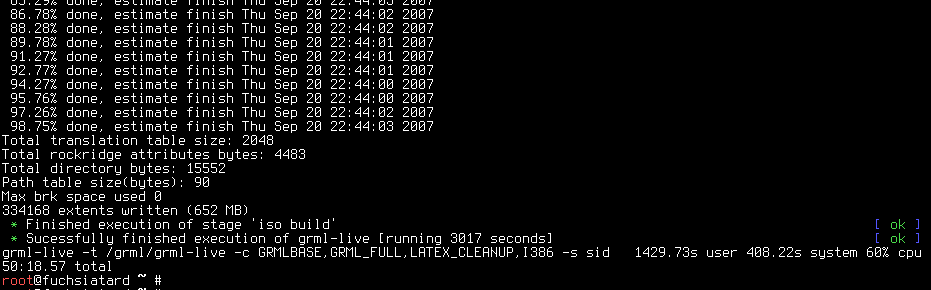
grml-live ist ein Framework, mit dessen Hilfe man mit nur 1 Kommando eine auf grml/Debian basierende Linux Live-CD bauen kann. grml-live baut auf FAI (Fully Automatic Installation) auf und nutzt dessen klassenbasiertes Konzept: Screenshot: grml-live In diesem Beispiel habe ich gerade ein gro es grml-ISO gebaut. Dabei habe ich einfach nur den Debian-Mirror in /etc/grml/grml-live.conf auf meinen lokalen Mirror gedreht (um Traffic und Zeit zu sparen) und dann folgendes Kommando aufgerufen:
# grml-live -t /grml/grml-live -c GRMLBASE,GRML_FULL,LATEX_CLEANUP,I386 -s sid
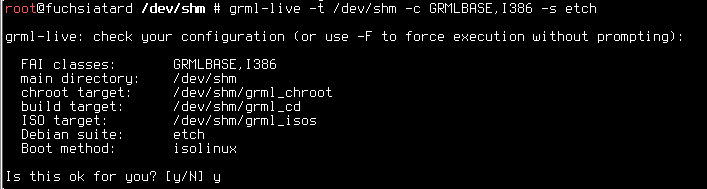
Ca. 50 Minuten sp ter habe ich im Ordner grml_isos unter /grml/grml-live/ (-t …) ein fertiges grml-ISO. Dieses wurde auf Basis der Klassen (-c …) GRMLBASE (da steckt alles essenzielle drin), GRML_FULL (Software-Auswahl wie auf der offiziellen gro en grml), LATEX_CLEANUP (ein paar sehr gro e LaTeX-Verzeichnisse aufr umen) und I386 (x86-spezifische Pakete wie z.B. der Kernel) gebaut. Als Debian-Suite (-s) wurde sid (unstable) ausgew hlt. Und das war es auch schon. Ein kleinere grml-Version auf Basis von Debian/stable gef llig? Kein Problem, machen wir es doch einfach mal im Shared-Memory (superschnell und mit genug RAM und den Mountoptionen rw,suid,dev auch kein Problem): Screenshot grml-live: der Start Ein ‘grml-live -t /dev/shm -c GRMLBASE,I386 -s etch’ und keine 5(!) Minuten sp ter hab ich dann mein 135MB kleines grml: Screenshot grml-live: done Mit grml-live kann man sich somit seine pers nlich angepasste Linux Live-CD erstellen, ohne sich erst mit Remastering im Detail besch ftigen zu m ssen. Auch muss man dabei nicht zwingend Debian/unstable nehmen, sondern kann auch Debian/stable als Basis ausw hlen. Durch das Erstellen einer neuen Klasse oder das Anpassen einer existierenden kann man auch spezielle Software-W nsche ganz einfach erf llen. Wird damit das offizielle grml-ISO etwa obsolet? Nein, auf keinen Fall. grml-live soll dem grml-Team als Buildsystem dienen (automatisierte Snapshots auf regelm iger Basis z.B. sind schon in Planung) und die langweilige Arbeit abnehmen, damit wir uns auf die wirklich wichtigen Sachen konzentrieren k nnen: Testen, Bugfixing, Implementieren von neuen Features, Arbeit am Kernel, Qualit tssicherung, Dokumentation,… grml-live hat den Anspruch, auf jedem Debian-basierten System zu funktionieren und wer Interesse daran gefunden hat, kann sich das Debian-Pakete aus dem grml-Repository holen. Den Quellcode gibt es nat rlich auf unserer Mercurial-Webseite. Wer jetzt noch Fragen hat oder mehr Details zu grml-live erfahren m chte, der m ge einfach auf die grml-live-Homepage schauen. Falls dort eine Frage noch nicht beantwortet sein sollte, jemand Feature-Requests, Bugreports oder Patches hat: meine Inbox freut sich ber Post! :-)

Ross Burton: Stephen Fry Is My Hero (Even More Than Before)

Stephen Fry has long been a hero of mine for his acting and comedy, but I've just discovered that not only is he a geek, but he also gets it. From his blog regarding the iPhone:
Server side apps only. No, no, no, no, no. This is NOT good. It's one thing to want to keep the proprietary system closed, but to present a device sealed in digital Araldite is a Bad Idea. An Ubuntu flavoured Linux for mobiles is in the works, and you don't get more open source than that.
The full article is rather long but a very good read. Now I just want him to stop fawning over his iPhone and get back to making another series of QI, damnit! NP: Digital Shades Volume 1, M83

19 September 2007

MJ Ray: London LinuxWorld Postponed

IDG World Expo announces:
"It is with regret that we must announce that LinuxWorld Conference & Expo London 2007 has been postponed until spring 2008."
Anyone interested in an UnConference? At least we shouldn't cancel that.

Martin F. Krafft: Archiving web pages

Every now and then I encounter a web page which I'd like to archive for later purposes, e.g. because I can see that it might be related to my research, or simply because I want to keep the information until eternity. I know of three ways to achieve this, but each of them has drawbacks: So, dear lazyweb, how do you do it? I am aware that it'll be trivial to hack up a little script which uses wget to obtain page and dependencies, create a file with stamp data and produce a frameset to put this data above the actual file, but before I spend time implementing the wheel, I'd like to make sure it doesn't yet exist. NP: The Flower Kings: Paradox Hotel Update: Michael Stevens pointed me to furl.net, but I need a solution that I can use offline. Part of the reason that I want to archive web pages is because I don't want to come back in a couple of months and find a webpage removed, a server dead, or a site like furl.net discontinued. J rg Jaspert introduced me to Scrapbook, a Firefox extension I'll have to check out. However, even before looking at it: I really want files or directories on the filesystem, so that I can check them into version control and have them archived and replicated. I don't trust any data to Firefox or any of its extensions, or anything under ~/.mozilla. This is also the reason why I Slogger doesn't cut the mustard for me. Matej Cepl wants me to use konqueror to archive them. I don't want to install hundreds of megabytes for this feature, nor can I imagine that this feature will be much different or less cumbersome than Firefox's ability to save pages. I hate the mouse. Thanks for all your comments, regardless! Update: Just found this post about archiving stuff like digg/delicious.

Russell Coker: Categories for Best and Most Popular Posts

I have just added two new categories to my blog, one is for the most popular posts [1] (as indicated by the number of hits on the permalink pages). The other is for the best posts [2]. My criteria for adding a post to the best-posts list is that it provides some information that is new or some analysis that others do not appear to have performed, that it doesn’t get refuted by someone else (sometimes an idea seems good but someone points out a flaw), and that there is some level of interest in it from readers (based on page hits, comments, and links from other blogs). Both of these categories may be added to posts some days or weeks after they are published. So adding the feeds for them to a syndication configuration might not be a good idea as they will always include posts that are old. I expect that a typical Planet configuration would never display posts from those feeds. I suggest that other people consider adding similar categories to their blogs. It will allow readers who quickly browse your blog to see the posts that you regard as your best content and other bloggers in the same space to see what gets the most hits (which is worth-while if you don’t consider blogging to be a zero sum game). I expect that someone will suggest that I only write posts that are eligible for the best-posts category. However this is one example of a post which I don’t consider to be eligible but which will still be useful to some people.

16 September 2007

Steve Kemp: And he pulled the bow across his strings and it made an evil hiss.

Friday Morning I ordered an 80Gb iPod classic. Friday Afternoon I discover Apple Cuts Off Linux iPod Users Saturday / Sunday I follow along on IRC the reverse engineering effort Progress is being made, but still a little bit away from having a result. In the meantime I'm ripping Megan's cds. In other news Debian Security Advisories are being held up by missing buildd machines for several archs. Previously I supported the position that Debian should release for 14+ plus platforms, but given the regular frustrations and delays I'm now of the opinion that we should only release for platforms that have at least two buildds - one for security, and one for regular use. (Benefit of two? If one dies we can both use the other.) Finally I'm still doing more SMTP work, and it is going extremely well. The next job is to wire up a payment gateway which is tedious and dull. Update - Looks like the ipod issue is fixed. kudos to wtbw + nopcode .. and everybody else who put in the work.

Russell Coker: iRiver H320 and Liquid

Recently my iRiver [1] H320 had some milk based drink spilt on it. I’m not sure what the drink was (I discovered it when my iRiver stopped working and the drink was dry) but it smelled like coffee or hot chocolate when I washed it off (I considered tasting it but decided that knowing exactly which drink had damaged my iRiver probably wouldn’t help me fix it). The initial problem was that no buttons other than the play button (which is also used to turn it on) worked. When I first discovered this I had no way of hitting the reset button so my iRiver played until the battery ran flat. I tried to disassemble it by removing the five tiny phillips-head screws from the sides, but that didn’t make any part of it loose. I tried using a small amount of force on the front piece of plastic and broke two of the clips that hold it in place while getting another two loose without breaking (but there were still at least four clips to go). Then I realised that the problem was that the keys were physically sticking and that maybe if I washed the keypad out I might get it to work. So I spent some time in a cycle of dripping water into my iRiver, pressing the buttons to get some of the nasty stuff dissolved, and then using a towel to soak up some of the water with milk or whatever. After repeating this for a while the buttons all seemed to work well apart from the play button which kept registering presses when I wasn’t touching it. This meant that it always automatically turned on and then played a song in a stuttering manner as the play button is also the pause button and it paused and played as rapidly as it could. Finally I left it in the sun to dry for a few hours, which seemed to do some good. The play button mostly works now. Also it seems quite easy to get water between the front layer of protective plastic and the layer behind (which actually houses the keypad). So I have several large drops of water spread out between the layers which move around as I squeeze it. I think that if I get that dried out before algae can grow then everything will be fine.

15 September 2007

MJ Ray: Spammers: Total Language Solutions Limited

My personal email account was spammed by Jennifer Kirkham-Sandy (Phone 0800 6 121 151) of Total Language Solutions Limited, 3 The Courtyard, New North Road, Exeter EX4 4EP, Devon. Registered number (England and Wales) at the above address: 03933805. They seemed to be using a service called qwertywordmarketing. I've reported it to the hosting company, so we'll see what happens.

Holger Levsen: some simple backports

Bernd blogged about the new version of gimp-plugin-registry he packaged, which includes the cool new GIMP Liquid rescale plug-in which I had to try out. It really rocks, though it is much slower than in that video.

Anyway, backports for etch are available at "deb http://layer-acht.org/debian etch backports" Those are simple rebuilds of gimp-plugin-registry and opencv.

If you replace backports with xorg or xorg-experimental you'll also find rebuilds of xorg for etch, either from lenny or from experimental. They are slightly outdated (built two weeks ago) and need to updated against the newer sources, but they work for me.

Jose Luis Rivas Contreras: Third talugian meeting

I was in the third talugian meeting which has the best ambient I have ever been. Is nice when you talk about linux and nobody look at you like this guy what's smoking?!, and is great that the community is growing. I'm feeling that these meetings could get us better and stronger communities and with more experience. And there's a lot coming...! Thanks kamihacker for being such a kind host in this 3 meetings, we swear in the 100th we're gonna change the place ;-) P.S. talugian is from TALUG, T chira Linux User Group, my regional LUG.

14 September 2007

Simon Richter: "Free" markets

Over in alt.anarchism rages a discussion on the "efficiency" of markets, mostly circling around the medical sector as an extreme example (lots of government interference). Since this is Usenet, we haven't found consensus on the definition of a free market yet. The definition I learned in school was that free markets are fully transparent, i.e. buyers and sellers both have the necessary knowledge to determine a product's quality and are aware of the other market participants. The proponents of anarcho-capitalism contend that a free market is one that is devoid of regulation. These definitions are pretty much opposites in highly specialised fields (such as medicine), as patients usually lack the expertise to recognise "quality", so market regulations are established to promote transparency and establish a free market. So, which definition were you taught? Update: corrected the name of the group.

Next.

Previous.