Search Results: "ms"

12 August 2013

Ian Campbell: Heading to DebConf 13

Going to DebConf13! Seems like DebConf 13 is in full swing, I'm not heading over until tomorrow because I spent the weekend at the Bloodstock Festival. As sad as I am to miss the Cheese and Wine party tonight, having seen a dozen or so excellent bands since Friday, lubricated by a few gallons of Hobgoblin, and rounded off by Exodus, Anthrax & Slayer last night I think I made the right call! So I got home around lunchtime today, unpacked my rucksack, scrubbed myself clean, repacked again for Switzerland (no tent this time). Next up is a curry with my parents tonight and then catching the Eurostar tomorrow morning, I'll have plenty of time for hacking on my cubieboard2 on the train and finally arrive in Vaumarcus tomorrow evening. See everyone soon!

Joey Hess: please build a haskell to perl compiler

The Fay compiler is a simple way to build fairly comprehensible javascript code from Haskell source. It occurs to me that it should be rather easy to modify Fay to emit perl code rather than javascript. This would allow contributing things like plugins to various perl programs, without writing perl. Of course, the same idea could probably be used to compile Haskell to other languages like python, but perl seems particularly well suited as a second Fay target, since javascript and it have quite similar syntax and similar support for features like closures which Fay relies on. I do not have time to work on this idea myself. It would be a good project for a beginning Haskell programmer. You probably don't even need to fully understand monads to do it! Essentially, look at Fay output examples, translate them from javascript to perl, and then much of the code changes in Fay would probably be in simple string generation code.
I will forward any bitcoins sent to the address 149eBtWS6i8cwQdPQJJ8hAGpDuEqNidyTj to whoever makes this. If it doesn't happen in 1 year, any donations will be forwarded to the EFF instead.

Tanguy Ortolo: grep --only-matching

Magnifying glass over a sheet of text grep is designed to print lines matching a given pattern, but I often need to print only the matching part, discarding the remaining. I used to do that with sed, but it involves several actions: match, replace the line by only the matching pattern and print. Fortunately, GNU grep has an option to do just that:
-o, --only-matching
Print only the matched (non-empty) parts of a matching line, with each such part on a separate output line.
Unfortunately it is not a standard option, so it may be missing on non-GNU systems.

10 August 2013

DebConf team: DebConf13 video streams (Posted by Holger Levsen and the DebConf videoteam)

This is just a quick note that the video streams of DebConf13 will be available at the following URLs: May you have a productive and joyful DebConf - and thanks for volunteering + talking if you do so! DebConf is what you make it.

Rudy Godoy: Bulding non-service cartridges for RedHat Openshift

Cloud is passing the hype curve and we are seeing more stable developments and offerings on the market. Lately I ve been playing with RedHat s Openshift. Openshift is a PaaS (Platform as a Service) offering that intends to be an alternative for vendors such as Heroku. The focus for such offerings is to give developers enough flexibility and tools that handle the application deployment and maintenance process in a way that is integrated with their existing development workflow and tools. I ve been using Heroku for a while to deploy small to medium size projects. I liked the tools and developer-centered experience they offer. Openshift is quite new on the market and it comes in two flavors: Openshift Online, which is a PaaS service, and Openshift Enterprise, which allows organization to setup a PaaS within their own infrastructure. Both of them powered by the Openshift origin software. I ll not compare Heroku vs. Openshift feature by feature but from my experience I can tell that Openshift is far from mature and will need to give developers more features to increase adoption. When developing applications for Openshift developers are given a set of application stack components, similar to Heroku s buildpacks. They call them cartridges. You can think of them as operating system packages, since the idea is the same: have a particular application stack component ready to be used by application developers. Most of the cartridges offered by the service are base components such as application server, programming language interpreters (Ruby, Python, etc), web development frameworks and data storage, such as relational and non-relational databases. Cartridges are installed inside a gear, which is a sort of application container (I believe it uses LXC internally). Unsurprisingly this Openshift component doesn t leverage on existing packaging for RHEL 64bit, the OS that powers the service. I d expect such things from the RedHat ecosystem. I had to develop a cartridge to have a particular BI engine to be used as embed component by application developers. After reading docs and reference I realized this can be piece of cake, since I have packaging experience. Wrong. Well, quite so. The tricky part for Openshift Online is that it does not offer enough information on the cartridge install process so you can see what s going wrong. To be able to see more details on the process you ll need to setup an Openshift origin server and use it as a testing facility. Turns out that having a Origin server to operate correctly is also a challenging task and consumed a lot of my time. Over the recent weeks I ve learned from origin developers that such features are on the road map for the upcoming releases. That s good news. One of the challenges I had, and still have to figure out, is that unlike the normal cartridges mine didn t required to launch any service. Since it is a BI engine I just needed to configure and deploy to an application server such as JBoss. Cartridge format requires to have a sort of service init.d script under bin along with setup, install and configuration scripts that are ran on install. Although every day I become more familiar with origin and Openshift internals I still have work to do. Nice thing is that I was already familiar with LXC and Ruby-based applications so I could figure where things are placed and where to look for errors on origin quite easily. The cartridges are on my github account if you care to take a look and offer advice.

Daniel Pocock: DebConf13 arrival

DebConf13 is about to get under way at Vaumarcus, Switzerland. Bus stop Swiss PostBus drops delegates at the entrance to Le Camp. The ascent Delegates get a feel for the Swiss landscape. Main talk room Rooms are prepared and ready for speakers Ambience There are many relaxing places for people to catch up and have a discussion Leadership One of the DebConf chairs enjoys a quiet moment of reflection Drinks The bar is open DebConf13 begins

9 August 2013

Justus Winter: My worst week yet...

This hasn't been my week. I had to fix two of my Hurd installations I use for development and testing. I spent countless hours waiting for some package to be rebuilt, reading scientific papers about adding stuff to the Mach kernel. Fascinating stuff like thread migration that would (among other things) allow for proper resource accounting on Mach kernels. Oh, and gcc is a sadistic bastard:
In file included from printf-parsewc.c:2:0:
printf-parsemb.c: In function  __parse_one_specwc :
printf-parsemb.c:407:1: internal compiler error: Segmentation fault
Please submit a full bug report,
with preprocessed source if appropriate.
See <file:///usr/share/doc/gcc-4.7/README.Bugs> for instructions.
The bug is not reproducible, so it is likely a hardware or OS problem.
A similar error came up like five hours into my libc rebuild. How nice of gcc to retry the build to figure out whether it is to blame or the environment only to throw away the successful build and abort my build process :/ Next week I'll finally propose my sysvinit patch series. Oh, and implement the -d flag in our umount. I thought I had implemented all the flags used by the initscripts, but somehow I missed -d. If I get bored, I'll take a look at the network related issues, but I bet I won't get there...

Daniel Leidert: Local link networking on Debian/Linux between server and workstation

My network is based on wireless LAN, which is running at 54MBit/s. Transfering files between two systems therefor is not very fast. I could use wired connections, but cables would need to be pretty long to connect to the router. However the file server and the workstation are located near to each other and both have a free Gigabit LAN link. So why not connect these systems directly?Both systems run network-manager, whereas the server runs without a graphical/desktop environment. The file /etc/network/interfaces contains this entry related to the LAN devices on both systems:

allow-hotplug eth0
auto eth0
To create the connection it is necessary to have the package avahi-autoipd installed. In a graphical environment is is then as easy as open the network(-manager) preferences dialog, create a new wired connection, change to the IPv4 Settings tab in its Options dialog and choose the Link local only method. Done.On the server I have no desktop environment. Therefor I wrote the necessary file /etc/NetworkManager/system-connections/LocalLink myself. The UUID value can be obtained via uuid -n 1:

[802-3-ethernet]
duplex=full
mac-address=<MAC-address>

[connection]
id=LocalLink
uuid=<value of: uuid -n 1>
type=802-3-ethernet
timestamp=0
autoconnect=true

[ipv6]
method=auto

[ipv4]
method=link-local
I restarted the manager via service network-manager restart on the server and the link came up too. The direct link was ready.A note: I was able to create the connection by using a patch cable because my cards are able to handle the situation. On older systems it might be necessary to use a cross-over-cable.I would really like to use bonding on the wired ethernet and the wireless devices. But the wireless connections are done via router whereas the ethernet connections are created via local link. I think, this is impossible. Any ideas/hints?

Richard Hartmann: Release Critical Bug report for Week 32

As a more or less random data point for DebConf13, here's the current bug stats for Debian. Hope to see you there, and if you want to attend the BoF Gitify ALL the things or the talk Gitify your life you can do so on site, via IRC in #vcs-home on OFTC, or simply follow the live streams. If you see my in person, I have two crates of Scheider Aventinus with me and don't plan on bringing home any full bottles. The UDD bugs interface currently knows about the following release critical bugs: Graphical overview of bug stats thanks to azhag:

Craig Small: pidof moving to procps

pidof is a program that finds the PID of a named program. In some ways it is like a cut-down pgrep found in the procps package. pidof currently sits in sysvinit-tools. There are plans to move all utilities that use the proc filesystem under one package which will make the maintenance of them simpler, which in effect means moving pidof from sysvinit-tools to procps. The short-term bump should make it better in the long term. Now as I wear two hats (Debian maintainer and procps upstream) there are two very important things I/we need to know. Debian developers can chime in on the debian-devel email list, or email myself. If its an upstream issue then either email me, or even better, the procps email list

Daniel Pocock: GSoC students progress

I've been lucky enough to be involved in a team mentoring two students contributing to Debian under the Google Summer of Code program this year. Both students have demonstrated a lot of enthusiasm and talent and have just passed their mid-term evaluations. Students often provide a fresh insight to projects. Their potential is not to be underestimated: one diligent student, Thomas Herndon from UMass Amherst recently came to fame exposing fundamental spreadsheet errors in calculations used to back the IMF case for austerity. Herndon was lucky to receive a copy of the spreadsheet (the source was not published openly as in free software): that is one problem that GSoC students don't have to wrestle with. Both of our GSoC students have exposed previously unknown issues in the code they are working on: Fabian discovered API differences in GnuTLS caused problems for dynalogin, while Catalin helped discover that some headers from reSIProcate are susceptible to ABI-breaking behavior dependending on the combination of CPPFLAGS. DebConf this month Both students are going to discuss some of their work on 17 August at DebConf - they are particularly keen to meet with other members of the Debian community throughout the week and find out how their work can best be leveraged by the community and Debian's wider userbase (and derivatives). Fabian Gr nbichler : one time passwords Fabian's project has been working on oath-toolkit and dynalogin. These are excellent projects, helping us realise new opportunities to use tokens for various types of authentication exchanges, such as login. Part of his project involves implementing the recently formalized IETF RFC 6287 for OCRA in a practical way that developers can use. Catalin Usurelu : real-time communications Catalin's project involves working with a variety of open source communications applications to make them work well together on a Debian system. One piece of work he is just completing provides a turn-key SIP conferencing solution that could replace Mumble (which attracted quite some controversy in the previous Debian release cycle) Community development These are all community projects and any feedback from users and other developers is always very welcome. For example, if you have time to test or provide suggestions, please feel free to jump in on the mailing lists we use for these projects.

8 August 2013

Nicolas Dandrimont: Hello from DebCamp

DebConf flag (minus the wind) Small update as someone was complaining about the lack of pictures from DebCamp on planet. Not to worry, everything is going fine, and some of the most important stuff is ready s3kr3t You can see a few pictures from the gallery. The view from the venue is quite outstanding (it was better when there was some sun on Tuesday, but my camera battery was out ). On my TODO-list: See you there!

Enrico Zini: Getting new Front Desk members (part of things to do at Debconf)

Getting new Front Desk members (part of things to do at Debconf) We need more Front Desk members. Jonathan Wiltshire has kindly put together a job description for the current status quo. Currently we'd like a person to have been an Application Manager before joining Front Desk, but FD tasks are now more diverse than they used to be, and I'd like to spend some time thinking about it, for example here. Job Description for Front Desk Assistant Front Desk assistants are often the first point of contact for new applicants to Debian's New Member process, and are responsible for guiding them through all stages. Front Desk collates applications, assigns them to an Application Manager, checks over the completed application and hands it off to the Account Managers. Front Desk also handles membership of the collab-maint Alioth project. It is not currently involved with applications for Debian Maintainer status. You will 'meet' a wide variety of applicants, some of whom are excited to be starting their journey to Debian membership, whilst others are already established and taking the next step to full developer status. This is a mostly procedural role, but some diplomatic skills are required, particularly when applications are held up for reasons beyond your control. You must have excellent written communication, an eye for detail, and a thorough understanding of what it is to be Debian Members. Expect to spend 2-3 hours per week on this role, divided by as many days as you can manage (to ensure mail is dealt with as soon as possible). The most time-consuming part is processing the completed application. Responsibilities:
  1. To be the first point of contact at Front Desk
  2. To perform initial triage of applications
  3. To match each application with an appropriate Application Manager
  4. To ensure applicants are processed in a timely manner, which may require intervening with an application when it is not progressing satisfactorily
  5. To check completed applications for any missing detail and pass them on to the Account Managers
  6. To handle collab-maint membership business
  7. To answer any queries from applicants, Application Managers, and other stakeholders
  8. To monitor output from the NM routine jobs and fix or escalate any problems
Front Desk staff are not expected to make a judgement call on applicants, though some discretion can be used when appropriate.

7 August 2013

Keith Packard: embedded cpus

Choosing Embedded Processors for AltOS When Bdale and I started building rocketry hardware together, we had already picked out a target processor, the TI cc1111. We picked that chip almost entirely based on the digital transceiver that is built in to the chip, and not because we had any particular love for the 8051 microcontroller. At that time, I d seen people struggle with PIC processors, battle AVR to a draw and spend a lot of time trying to get various ARM processors running. So, the 8051 didn t seem all that far from normal, and the cc1111 implementation of it is pretty reasonable, including credible USB support and a built-in DMA engine. Since those early days, we ve gone on to build boards with a slightly wider range of processors: Bdale thinks we should reduce the number of components we use to focus our efforts better. He s probably right, but I have to admit that I ve had way too much fun getting each of these chips running. I thought I d spend a bit of time describing our general process for selecting a new CPU. CC1111 involved a lot of software hacking The 8051 processor in the CC1111 is very well documented, including the two-wire debugging interface. What was missing was a canned solution for programming and debugging the chip from Debian. However, with sufficient motivation and accurate docs, I was able to create a programmer from a USB device with a couple of GPIOs and a lot of ugly software on Linux. That sufficed to get the USB stack limping along, at which point I wrote a much faster programmer that ran on the cc1111 itself and could program another cc1111. With that, I created an assembly-level debugger that could be hooked to the existing SDCC source level debugger and had a full source-level debugging environment for the 8051. This turned out to be way better than what I could get on the Atmel processors, where I ve got a program loader and a whole lot of printf debugging. STM has been great The STM32L-Discovery board has a standard STM debugging setup for the Cortex SWD interface right on the same board as a target CPU. That made for completely self-contained development, with no jumper wires (a first for me, for sure). There s free software, stlink which can talk over the debugger USB connection to drive the SWD interface. This is sufficient to flash and debug applications using GDB. Of course, GCC supports ARM quite well; the only hard part was figuring out what to do for a C library. I settled on pdclib, which is at least easy to understand, if not highly optimized for ARM. We ve built a ton of boards with the STM32L151 and STM32L152; at this point I m pretty darn comfortable with the architecture and our tool chain. Adventures with NXP The NXP LPC11U14 is a very different beast. I m using this because: The LPCXpresso board looks much like the STM32L-Discovery, with a debugger interface wired to the CPU directly on the board. However, I haven t found free software tools to drive this programmer; all I ve found are binary-only tools from NXP. No thanks. Fortunately, the LPC11U14 uses exactly the same SWD interface as the STM32L, so I was able to sever the link between the programmer and the target on the LPCXpresso board and hook the target to an ST-Link device (either the one on the STM32L-Discovery board, or the new stand-along programming dongle I bought). With that, I wrote an openocd script to talk to the LPC11U14 and was in business. What I found in the NXP processor was a bit disturbing though there s a mask ROM that contains a boot loader, which always runs when the chip starts, and a bunch of utility code, including the only documented interface to programming the flash memory. I cannot fathom why anyone thought this was a good idea I don t want a BIOS in my embedded CPU, thankyouverymuch; I d really like my code to be the first instructions executed by the CPU. And, any embedded developer is more than capable of programming flash using a register specification, and calling some random embedded code in ROM from the middle of my operating system is more than a bit scary. NXP could do two simple things to make me like their parts a whole lot more: Right now, I m hoping the STM32L100C6 parts become available in small quantities so I can try them out; they promise to be as cheap as the LPC11U14, but are better supported by free software and offer more complete hardware documentation. Yeah, they re a bit larger; that will probably be annoying.

Keith Packard: Cursor tracking

Tracking Cursor Position I spent yesterday morning in the Accessibility BOF here at Guadec and was reminded that one persistent problem with tools like screen magnifiers and screen readers is that they need to know the current cursor position all the time, independent of which window the cursor is in and independent of grabs. The current method that these applications are using to track the cursor is to poll the X server using XQueryPointer. This is obviously terrible for at least a couple of reasons: These two problems also conflict with one another. Reducing input latency comes at the cost of further reducing the opportunities for power saving, and vice versa. XInput2 to the rescue (?) XInput2 has the ability to deliver raw device events right to applications, bypassing the whole event selection mechanism within the X server. This was designed to let games and other applications see relative mouse motion events and drawing applications see the whole tablet surface. These raw events are really raw though; they do not include the cursor position, and so cannot be directly used for tracking. However, we do know that the cursor only moves in response to input device events, so we can easily use the arrival of a raw event to trigger a query for the mouse position. A better plan? Perhaps what we should do is to actually create a new event type to report the cursor position and the containing window so that applications can simply track that. Yeah, it s a bit of a special case, but it s a common requirement for accessibility tools.
 
    CursorEvent
        EVENTHEADER
        detail:                    CARD32
        sourceid:                  DEVICEID
        flags:                     DEVICEEVENTFLAGS
    root:                      WINDOW
    window:                    WINDOW
    root-x, root-y:            INT16
    window-x, window-y:        INT16
 
A CursorEvent is sent whenever a sprite moves on the screen. sourceid is the master pointer which is moving. root is the root window containing the cursor, window is the window that the pointer is in. root-x and root-y indicate the position within the root window, window-x and window-y indicate the position within window . Demo Application Here s a short application, hacked from Peter Hutterer s part1.c
/* cc -o track_cursor track_cursor.c  pkg-config --cflags --libs xi x11  */
#include <stdio.h>
#include <string.h>
#include <X11/Xlib.h>
#include <X11/extensions/XInput2.h>
/* Return 1 if XI2 is available, 0 otherwise */
static int has_xi2(Display *dpy)
 
    int major, minor;
    int rc;
    /* We support XI 2.2 */
    major = 2;
    minor = 2;
    rc = XIQueryVersion(dpy, &major, &minor);
    if (rc == BadRequest)  
    printf("No XI2 support. Server supports version %d.%d only.\n", major, minor);
    return 0;
      else if (rc != Success)  
    fprintf(stderr, "Internal Error! This is a bug in Xlib.\n");
     
    printf("XI2 supported. Server provides version %d.%d.\n", major, minor);
    return 1;
 
static void select_events(Display *dpy, Window win)
 
    XIEventMask evmasks[1];
    unsigned char mask1[(XI_LASTEVENT + 7)/8];
    memset(mask1, 0, sizeof(mask1));
    /* select for button and key events from all master devices */
    XISetMask(mask1, XI_RawMotion);
    evmasks[0].deviceid = XIAllMasterDevices;
    evmasks[0].mask_len = sizeof(mask1);
    evmasks[0].mask = mask1;
    XISelectEvents(dpy, win, evmasks, 1);
    XFlush(dpy);
 
int main (int argc, char **argv)
 
    Display *dpy;
    int xi_opcode, event, error;
    XEvent ev;
    dpy = XOpenDisplay(NULL);
    if (!dpy)  
    fprintf(stderr, "Failed to open display.\n");
    return -1;
     
    if (!XQueryExtension(dpy, "XInputExtension", &xi_opcode, &event, &error))  
       printf("X Input extension not available.\n");
          return -1;
     
    if (!has_xi2(dpy))
    return -1;
    /* select for XI2 events */
    select_events(dpy, DefaultRootWindow(dpy));
    while(1)  
    XGenericEventCookie *cookie = &ev.xcookie;
    XIRawEvent      *re;
    Window          root_ret, child_ret;
    int         root_x, root_y;
    int         win_x, win_y;
    unsigned int        mask;
    XNextEvent(dpy, &ev);
    if (cookie->type != GenericEvent  
        cookie->extension != xi_opcode  
        !XGetEventData(dpy, cookie))
        continue;
    switch (cookie->evtype)  
    case XI_RawMotion:
        re = (XIRawEvent *) cookie->data;
        XQueryPointer(dpy, DefaultRootWindow(dpy),
                  &root_ret, &child_ret, &root_x, &root_y, &win_x, &win_y, &mask);
        printf ("raw %g,%g root %d,%d\n",
            re->raw_values[0], re->raw_values[1],
            root_x, root_y);
        break;
     
    XFreeEventData(dpy, cookie);
     
    return 0;
 
Hacks in xeyes Of course, one common mouse tracking application is xeyes, so I ve hacked up that code (on top of my present changes) here:
git clone git://people.freedesktop.org/~keithp/xeyes.git

6 August 2013

Craig Small: Careful with apache upgrades

You might (or not if you don t visit) notice all my websites were down. A rushed apt-get dist-upgrade and I found two problems:
  1. PHP5 got removed, which is bad if you run a wordpress site that uses PHP to run
  2. The apache configuration has changed.
Yes, the NEWS entries did warn me, if I read them fully. Yes, I didn t read them enough. Apache now ignores configuration files that don t end in .conf To give a completely non-theoretical example, if you have your virtual hosts in files such as /etc/apache2/sites-enabled/enc.com.au then this will not be recognised and your sites will show the default It works page. Stuff that doesn t fall in the usual places where website stuff should go, which for my setup is a lot of things, will also be denied as the developers have tightened up the rules around what is permitted. Pretty simple to fix with a few <Directory blah> clauses. This isn t a criticism of the Debian apache developers. They do an awesome job of keeping the package workable, flexible but secure which isn t easy. Now it s all back working, I actually agree with the changes they have made. It is just that the latest changes are, well, tricky so be forewarned.

Daniel Pocock: DebConf next week, free real-time communications session

DebConf13 is just about to get under way. While last year's event involved an exciting visit to Nicaragua, this year it is right here in Switzerland making it very convenient for many of those in the very populous community of free software enthusiasts across western Europe.
A long queue has already formed on the freeway going north from Italy into Switzerland's Gotthard Tunnel: did somebody put Debian's 20th birthday party on a social networking site? The big invitation On the final day of DebConf, Saturday 17 August, there is an afternoon track dedicated to the topic of free real-time communications. While DebConf is traditionally aimed at the Debian Developer community, real-time communications, by definition, requires cross-platform collaboration in order to succeed and it is a particularly hot topic thanks to recent revelations about communications privacy. Therefore, there is a wider invitation for visitors to attend this session, please just remember to register your details here, it is free (and private). To get a feel for the topic, please see the video of the Free, Open and Secure Communications panel from FOSDEM 2013 Seeing Switzerland
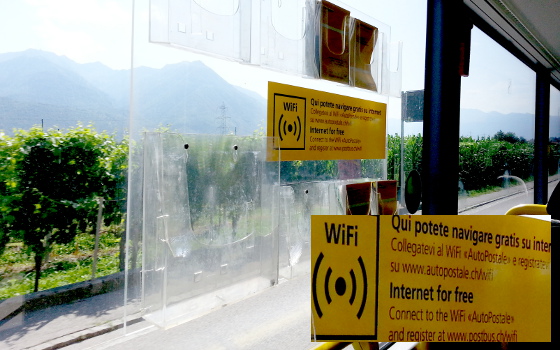
Who said Switzerland is expensive? Swiss Postbus is offering free wifi now Please see some of my previous blogs about Swiss travel for videos and pictures if you are looking for ideas for your time in .ch

5 August 2013

Ian Wienand: Skipping bash history for command-lines starting with space

I was recently reading about a case where part of the evidence appears to be a deleted bash history-file. From what I gather, the accused says that the removal was a clean-up job to remove inadvertently stored passwords rather than an attempt to hide nefarious activity. What had managed to pass me by in 15 or so years of using bash but not reading man bash properly is the HISTCONTROL variable. If it is set to ignorespace then commands entered with a leading-space will not be stored in the history. Like all the best discoveries I found this only by accident on a machine where it was turned on. It's been quite useful in keeping my history pruned. However, not usually for security reasons around hiding passwords passwords on the command-line have other problems and I'm sure any security person would tell you not to use them just from a defense-in-depth perspective. That said, from a "keeping ctrl-r reversi-search useful" point-of-view it's often helpful; for example I've mostly trained my fingers to <space>rm -rf because I'm sure I'm not the only one who has deleted the wrong thing via a history-recall-combined-with-typing-to-fast scenario. So, HISTCONTROL=ignoreboth (which also ignores duplicates) is certainly a useful one to slip into your .bashrc. At least it would be one-less thing to explain to the FBI!

Sylvestre Ledru: Switch to OpenJDK 7

As announcement on debian-devel-announce, I just uploaded java-common version 0.49. This version changes the default version of OpenJDK to version 7. That means that packages depending on default-jdk/default-jre will be now built with OpenJDK 7 (instead of the 6) and also that the java/javac commands will be providing Java 7.
I also used the opportunity of this upload to update the Java policy.

Next.

Previous.