Search Results: "mak"

27 February 2012

Petter Reinholdtsen: Second release candidate of Debian Edu / Skolelinux based on Squeeze

This weekend we wrapped up and published the second release candidate for Debian Edu / Skolelinux based on Squeeze. The full announcement did for some reason not make it the project announcement list, but is available from the Debian development announcement list. Check it out if you need a software solution for your school.

26 February 2012

Craig Small: psmisc 22.16 Released

psmisc version 22.16 was released today. It is a bugfix release that bascially fixes a problem around strings in C. Process name lengths are only supposed to be 16 characters long, so a 17 bye buffer is ok; until you have processes with brackets which means the string is 18 characters. The next wrinkle is that at times the brackets are stripped out so matches fail because the lengths don t quite line up. You ll see this with the debian 22.15-2 version of psmisc where killall won t find long-named processes. So, 22.16 fixes all that. Test Processes It really shows that psmisc needs a set of tests like procps has already. The difficulty with both is that its not simple in the DejaGNU framework to make test processes. These are not the programs within the package but other processes that the programs can work on. There really needs to be an equivalent to touch for processes just for this sort of thing. Creating processes is rather simple, but ensuring they go away is the tricky part, or they die with certain signals.

John Goerzen: Timelessness of an Old Pickup

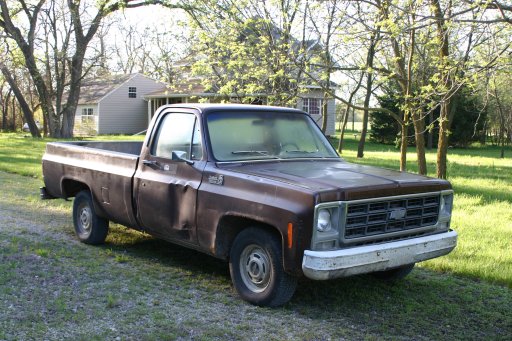
Our society is one that is pretty well defined by timeliness. TV programs start at a precise time, down to the second. Schools have elaborate timekeeping systems. Even church services are carefully timed. We know how fast we re going, and our GPS or phones tell us when we ll get there. And we re pretty confident that we will, in fact, get there. Somehow this doesn t apply to our pickup. This pickup, in case you re wondering, is a thing of stories, shall we say. After a particularly frustrating experience with it one week (oh yes, the battle extended several days), I likened it to the Greek gods. And Terah had a good laughing fit when I began a sentence with The reason there s a towel connecting the brake pedal to the steering wheel But I guess the thrifty side of me won out, and somewhere along the line, I relented. My brother fixed up the carburetor. I got it a new battery. The flat tire is repaired. The starter broke, and I got it replaced. And I even got an oil change. Fancy, I know. So today, when I needed to take some backbreaking junk off the yard, I was hoping the pickup would work. I hadn t driven it in months, and any manner of catastrophe could have struck it in that time. So I was mildly relieved when it started on the 6th try. That is, quite seriously, quite the improvement, and shows how skilled a mechanic my brother is. The speedometer, of course, isn t working. The odometer stupidly reads 21531 or something like that (it was only a 5-digit odometer, broke long ago, so who knows how many miles it really has.) And I like to keep things like grease and heavy ancient air conditioners (one of the things I was hauling) away from my watch, so I wasn t wearing it. The result: I have no idea what time it is, how fast I m going, when I ll get there, IF I ll get there, or all those things. I set out, and made it a good half mile before it died as I was rounding a corner at the bottom of the hill. Always a great place for a finicky old stick-shift vehicle to die, right? Anyhow, a few random adjustments to the choke later, and the thing sputtered then roared (and I do mean roared) back to life. A little lurching up the hill and I was back on my way. Now, I was stuck there in the middle of the road, but it was a country road, so I d have probably had a good hour to get it fixed before worrying about blocking anybody s way. My first stop: my great uncle s place. He has a scrap metal for charity project going on. He is looking for old motors, air conditioners, dehumidifiers, etc. He takes them apart, separates out the metals, sells them, and donates the result to MCC, a world relief agency. I knew I had an old dehumidifier in the basement, and thought I remembered seeing an old window air conditioner in the elevator. That thing is probably the single heaviest object I have ever moved without help. I have a bandaid to prove it. It was way too heavy to carry, so I kind of rolled it, side to side, from the side of the elevator on to the pickup. If you were watching, you d have heard me making struggling noises, followed by BANG rattle rattle rattle pause struggling noises . BANG rattle rattle rattle as I rolled it along the ground, and waited for the internal bits to settle after each quarter turn. So anyway, eventually I got it to the pickup, and then had the sickening realization: I have no way to get this thing up there. Oops. I eventually placed it on top of an old tire rim, balanced it there as I knelt down, and somehow still not quite sure how managed to lift the entire thing a few feet until I could get some leverage to shove it onto the pickup. I later commented to my dad that it was a Chrysler brand air conditioner, somewhat to my surprise, and he said that it was probably my great-grandpa s. That was a surprise. Anyhow, back to the pickup. I drove down the few miles to my great grandpa s place, not really knowing how fast I was going. I smelled the familiar smells of the old pickup: exhaust fumes, oil on hot surfaces it shouldn t be on, a touch of hot antifreeze. You never have any doubt about whether the engine is running. It was sort of nice to not know, or particularly care, how fast I was going, or what time it was. Sometimes I d idly wonder, but you know, it didn t really matter and there wasn t a thing I could do about it anyhow. I got to uncle s place, unloaded the junk sorta dropped the air conditioner off the back of the pickup with a terrific BANG, then rolled it all the way to his trailer and got back in. On to town. I hadn t put gas in the pickup in a few years, and I suspected it was getting low. (The gas gauge, you guessed it, doesn t work right either.) Plus we had some large recyclables built up and it was time to get rid of them. And for that, I had to drive on the highway a ways. The speed limit there is 65MPH. I have no idea how fast I was going, but it wasn t 65. Maybe it was 45. I got passed a lot, but nobody looked particularly surprised that a pickup that looks like mine wasn t going 65. Partway there, I smelled a different smoke smell. Not an oil smoke, but more of a grassy or wood smoke. Hmm, I thought. That s odd. Hope it s not coming from the pickup. I didn t really see smoke anywhere else, so I just drove on until I couldn t smell it anymore. I unloaded the recyclables, then went to the gas station. As the pump readout neared $50, I decided: 1) the gas tank really was pretty empty, and 2) I just can t put more gas in it anymore. That would be more than the truck s worth. So I drove home. The drive home was into the wind. My face got pretty cold I always drive with the windows open to prevent carbon monoxide poisoning (remember the fumes?) I got home and prepared to pack up the pickup close the windows, replace the bungee cord holding the brake pedal up, etc. I then thought I d have a look under the hood to see if there was anything, well, on fire. Nope, but there was a packrat nest that fell down as soon as the wind hit it. Source of grassy-smelling smoke identified. It s amazing what difference simple lack of knowledge makes sometimes. Not knowing what time it is or how fast I m going means I don t have to worry about those things. I wonder how society has changed simply because accurate and cheap watches are available. I kind of like driving the old truck. It s a bit of an adventure, a bit of a challenge, a bit of randomness, and a bit of an escape from the normal and predictable. Not a bad deal for a $75 vehicle.

Iustin Pop: First running event of 2012

Today I had the first running race of 2012. Well, actually, it was my first race in Switzerland ever so double first. And, if I have to be precise, it was my first run with a shiny new Garmin 910XT; while I had it ordered for more than a month, out-of-stock and other delays converged such that I received the new toy the evening before the run. After getting it, I walked around a bit to confirm it's not DOA, read the manual, and hoped it's not too different in basic operation to my old Garmin. So a triple first. Also, (this is the last one, I promise!) this was the first time I ran with a foot pod (pedometer), so it was the first time I got actual cadence measurements. The run I went to the Bremgarter Reusslauf, which is an 11km flat run held in the woods near Bremgarten, a very very nice small town. I have never before visited it (even though it's quite close to Z rich), and I was pleasantly surprised by it. I should go sometimes back and visit a bit more. The weather was cloudy (and just a tiny bit foggy), a bit cold but not much. From this point of view, it was good running weather, but it detracted from the scenery. Otherwise, the course itself was very very enjoyable, I could have used a camera lots. At one point, in the middle of the (light, not dense) woods, the course passed beneath the arm of an excavator which was like a mechanical arch (in the middle of nature); at another point, we crossed the river, and the sight was so nice I had to stop myself from stopping and admiring the view . The course is marked as a 'flat' one, but I've read some blog posts saying that this is not entirely true, so I was prepared for 'the worst'. Actually, I found it to be surprisingly well behaved; even though the finish was near the start, it seemed to me to be 60% downhill, 30% flat and only 10% somewhat-uphill. Garmin 910XT I didn't quite know what to expect, upgrading from my Forerunner 205. I read the very nice review on dcrainmaker, but in practice I didn't know what to expect (review awesome, but soo detailed). The new toy seems more stylish, so I expected worse UI or behaviour. On the contrary, it worked very well; much more responsive to changes in direction/pace (my 205 used to delays tens before adjusting the pace, the 910 is very fast), and new minor features (like auto-lap) were nice (I was able to track average speed on each 1KM lap, very useful). It's a ++ on the upgrade, with the big downside that so far it doesn't seem to work under Linux . It also has a barometric altimeter, but I didn't calibrate it (explicitly); so while the absolute measurements might be off, the relative elevation changes were much more sane than with 205 (GPS is not too good at elevation changes, as far as I know). One funny thing about the delays in getting the device: before the race, another runner asks me (note: the conversation was in German, accuracy not guaranteed):
Is that the new Garmin? Yes, it is, just got it last evening. (showing me his identical watch) Ha! Me too, I got this only two days ago!
So yes, I think a few people were happy to get their new toy before the race. I also have now a heartbeat sensor, but as I never used one before, I didn't want to try it the first time during a race; so I skipped on that. The foot pod on the other hand is practically ignorable, so I took that along (sometime I think I run just because there are nice running toys ). As to accuracy, it was quite OK; it measured 10.86 km instead of the official 11 km, but most/all of the difference was in the first km of the run (inaccuracy while starting to run? who knows). I'll have to see how the watch performs while cycling (uh, I didn't do that in a long while) or swimming ( I didn't do that in an even longer while), but for running it's a good upgrade from my old watch. Results My normal run pace is about 6min/km, which is quite slow. So I didn't expect anything of the race, except to finish it. There were lots of people participating (> 2,600 in the main 11km category). I started slow, because I know I usually start too fast and get tired quickly. This allowed me to not feel the first, and only, significant hill, and after that it was or seemed all downhill (literally, I mean, not figuratively), so in the end I had (for me) a very good time. By the Garmin, I run 10.86 km in 59:01, to an average 5.26 min/km. By the official results, I had 11 km in 58:56, with a pace of 5.21 min/km. I have never before run 10k faster than 5:30, so I was very very happy. As for individual laps (1 km) as recorded by the Garmin: On the overall ranking, I ended up 362 out of 394 in my category. Hah! I'll try to remember this race simply for my own pace results, and ignore the ranking . Honestly I'm not sure how people can run twice as fast need to train more! The foot pod gave me a cadence of 83 steps per minute (average, max 88). This was quite surprising for me, I expected to be significantly below the much talked about 90 steps per minute. But anyway, I have lots of work ahead of me to improve my running speed. Overall, it was an excellent day, and I'm looking forward to the next races in/around Z rich. But I should be careful not to overdo-it, like I do whenever I get excited about something .

25 February 2012

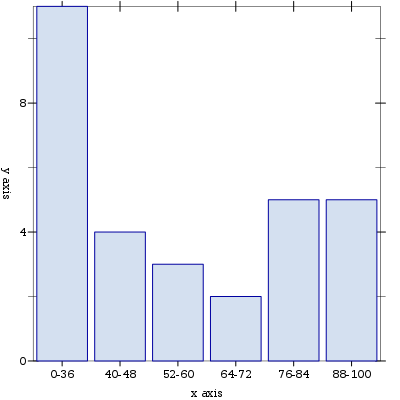
David Bremner: First steps with Racket PLoT

I have been in the habit of using R to make e.g. histograms of test scores in my courses. The main problem is that I don't really need (or am too ignorant to know that I need) the vast statistical powers of R, and I use it rarely enough that its always a bit of a struggle to get the plot I want. racket is a programming language in the scheme family, distinguished from some of its more spartan cousins by its "batteries included" attitude. I recently stumbled upon the PLoT graph (information visualization kind, not networks) plotting module and was pretty impressed with the Snazzy 3D Pictures. So this time I decided try using PLoT for my chores. It worked out pretty well; of course I am not very ambitious. Compared to using R, I had to do a bit more work in data preparation, but it was faster to write the Racket than to get R to do the work for me (again, probably a matter of relative familiarity). racket-hist.png
#lang racket/base
(require racket/list)
(require plot)
(define marks (build-list 30 (lambda (n) (random 25))))
(define out-of 25)
(define breaks '((0  9) (10 12) (13 15) (16 18) (19 21) (22 25)))
(define (per-cent n)
  (ceiling (* 100 (/ n out-of))))
(define (label l)
  (format "~a-~a" (per-cent (first l)) (per-cent (second l))))
(define (buckets l)
  (let ((sorted (sort l <)))
    (for/list ([b breaks])
          (vector (label b)
           (count (lambda (x) (and 
                    (<= x ( second b))
                    (>= x ( first b))))
               marks)))))
(plot
 (list
  (discrete-histogram 
  (buckets marks)))
 #:out-file "racket-hist.png")

24 February 2012

Richard Hartmann: apt-get install vcsh

apt-get install vcsh I finally got around to package vcsh and David Bremner was kind enough to sponsor it. vcsh is available in testing, unstable, and squeeze-backports. Also, Ubuntu seems to have copied it over into their repositories automagically. As you probably don't know, vcsh is a tool to manage config files in git. Say you want to maintain one repository for zsh, one for vim, one for ssh, one for mplayer, and one for mr, but obviously there can only be one .git in $HOME. vcsh helps by moving $GIT_DIR into $XDG_CONFIG_HOME/vcsh/repo.d/ but keeping $GIT_WORK_TREE in $HOME. The splitting of configuration sets into separate repositories allows you avoid checking out, say, mplayer's config on your servers, or checking out your ssh config at work. If this sounds complicated, it's not; vcsh hides all of the dirty details from you. vcsh integrates nicely with mr by means of a plugin, making handling your configurations even more trivial. If you do get stuck along the way, simply drop into #vcs-home on irc.oftc.net or send email to the vcs-home mailing list. popcon tells me that there are more users than I know about directly, so pipe up if you're one of them. And if you are one of the people who have it installed but don't use it, I am even more interested. I would love to know why so I can improve it. Long story short, if you care about the integrity and/or history of your configuration, or if you use one or more computers, you should definitely give vcsh a try. Any kind of feedback appreciated :)

MJ Ray: Signed the PDFreaders Petition

We, the undersigned, hereby state that we expressly and unequivocally oppose the advertising of proprietary software products on government websites. Such advertising breaches impartiality and encourages citizens to employ technologies that unnecessarily restrict their freedom. The role of government is not to support certain market participants and not others, particularly when doing so works to maintain the monopolies of global software companies. In explanations of how to use digital resources that they provide, government agencies should clarify that multiple methods are available, and favour technologies which do not restrict users digital rights; by linking to PDFreaders.org, for example. Free Software guarantees the users right to use (for any purpose), study (without secrets), share (with anyone), and improve the software that they use. Public institutions should publish their documents in formats that can be read with Free Software. Indeed, many Free Software applications exist for reading such documents. Governments should lead citizens to freedom, and encourage them to make use of these applications. Sincerely,
Our co-op and 56 other businesses, 69 organisations and over 2200 individuals so far. How about adding your signature? Surely it s time for our governments to stop giving free adverts to Adobe? It was particularly annoying in the Digital Britain report, I thought.

23 February 2012

Tanguy Ortolo: Who gave my address to spammers?

For hurried readers: do not give your main email address to Moneybookers or to deviantART, since they may give it (unintentionally, I hope) to spammers.Dedicated addresses Since I have set up my own email server, when a company or an unknown individual asks for an address I give it a dedicated one. For instance, to make a payment I had to give an address to Moneybookers: instead of giving them my main address <tanguy@>, I used <tanguy+moneybookers@>. Thanks to Postfix's address extension feature (look for recipient_delimiter in postconf(5) manpage), these <tanguy+whatever@> are all implicit aliases to my main address. This practice has several benefits, since it allows me to: Working around lamers Some systems are coded by lamers that think the + sign is forbidden for email addresses, so I have to work around that. My current solution it to use a static alias <tanguy-2012@>, which I simply drop after a year to replace it by a new one. Two years report After two years collecting spam, the first noticeable thing is that, among 5.5k spams I received, only 78 are the result of an information leak from an organization. I excluded from that count the addresses I use in public mailing-lists, for instance <tanguy+debian@>. So, after some fine exclusion and checking of messages, these are the only two organizations that somehow gave my address to spammers:
  1. Moneybookers: 43 spam messages received;
  2. deviantArt: 35 spam messages received.

Russ Allbery: Debian Policy 3.9.3.0

I've just uploaded version 3.9.3.0 of Debian Policy. The really big change in this version is the 1.0 version of the copyright format specification, but that will get a separate announcement once the www team has had a chance to put it in place on the web site. There are a bunch of other fixes, though, including some normative changes. Here's the upgrading checklist (duplicated from my announcement, but formatted a bit prettier):
2.4
New archive sections education, introspection, and metapackages added.
5.6.8
The Architecture field in *.dsc files may now contain the value any all for source packages building both architecture-independent and architecture-dependent packages.
7.1
If a dependency is restricted to particular architectures, the list of architectures must be non-empty.
9.1.1
/run is allowed as an exception to the FHS and replaces /var/run. /run/lock replaces /var/lock. The FHS requirements for the older directories apply to these directories as well. Backward compatibility links will be maintained and packages need not switch to referencing /run directly yet. Files in /run should be stored in a temporary file system.
9.1.4
New section spelling out the requirements for packages that use files in /run, /var/run, or /var/lock. This generalizes information previously only in 9.3.2.
9.5
Cron job file names must not contain "." or "+" or they will be ignored by cron. They should replace those characters with "_". If a package provides multiple cron job files in the same directory, they should each start with the package name (possibly modified as above), "-", and then some suitable suffix.
9.10
Packages using doc-base do not need to call install-docs anymore.
10.7.4
Packages that declare the same conffile may see left-over configuration files from each other even if they conflict.
11.8
The Policy rules around Motif libraries were just a special case of normal rules for non-free dependencies and were largely obsolete, so they have been removed.
12.5
debian/copyright is no longer required to list the Debian maintainers involved in the creation of the package (although note that the requirement to list copyright information is unchanged).
copyright-format
Version 1.0 of the "Machine-readable debian/copyright file" specification is included.
mime
This separate document has been retired and and its (short) contents merged into Policy section 9.7. There are no changes to the requirements.
perl
Packages may declare an interest in the <perl-major-upgrade> trigger to be notified of major upgrades of perl.
virtual
ttf-japanese- mincho,gothic have been renamed to fonts-japanese- mincho,gothic .
Please review and update your packages as necessary the next time you make an upload.

22 February 2012

Bartosz Fe&#324;ski: [B]ack[U]p and [R]estore [P]rogram

One of the most popular backup solution under Linux is Bacula, but it s quite complicated to setup. The same for Amanda.
Since my last sponsored upload we ve got another alternative in Debian. It s called burp. Let s enumerate its features as of version 1.3.0: Sounds good and this project is only 1 year old! Author claims that setup is much easier than with Bacula. Let s find out is that truth ;) Since we ve got this software in Debian installing it on unstable is as simple as apt-get install burp .
Both client and server came from the same binary package. Now let s configure server side. Well in fact we just have to run it, so just change RUN=no to RUN=yes in /etc/default/burp and launch it using /etc/init.d/burp start . Now the client side. If the client is on the same machine then you re ready. Yes you re ready! Let s do our first backup:
backup ~ # burp -a b
2012-02-22 17:53:03: burp[30584] Listing configured paths:
2012-02-22 17:53:03: burp[30584] include: /home
2012-02-22 17:53:03: burp[30584] Listing starting paths:
2012-02-22 17:53:03: burp[30584] /home
2012-02-22 17:53:03: burp[30584] before client
2012-02-22 17:53:03: burp[30584] begin client
2012-02-22 17:53:03: burp[30584] auth ok
2012-02-22 17:53:03: burp[30584] Compression level: 9
2012-02-22 17:53:03: burp[30584] do backup client
2012-02-22 17:53:03: burp[30584] Phase 1 begin (file system scan)
 
ddwdffffddffdfdfdddfffffdddfffffffdfffdfdfffffdfdfdffdddddfffddff 64
[...a lot of output...]
 
2012-02-22 17:53:03: burp[30584] Phase 1 end (file system scan)
2012-02-22 17:53:03: burp[30584] Phase 2 begin (send file data)
 
ffffffffffffffffffffffffffffffffffffffffffffffffffffffffffffffff 64
[...a lot of output...]
 
--------------------------------------------------------------------------------
Start time: 2012-02-22 17:53:03
  End time: 2012-02-22 17:53:07
Time taken: 00:04
                             New   Changed Unchanged     Total    Scanned
                       --------------------------------------------------
                Files:       100         0         -       100        100
          Directories:         -         -         -         -         76
           Soft links:         -         -         -         -          1
          Grand total:       100         0         -       100        177
                       --------------------------------------------------
 
             Warnings:             1
 
      Bytes estimated:      17628946 (16.81 MB)
      Bytes in backup:      17628946 (16.81 MB)
       Bytes received:             0
           Bytes sent:      17628946 (16.81 MB)
--------------------------------------------------------------------------------
2012-02-22 17:53:07: burp[30584] Phase 2 end (send file data)
2012-02-22 17:53:07: burp[30584] backup finished ok
2012-02-22 17:53:07: burp[30584] after client
backup ~ #
Yes. By default it is so extremely simple! Of course this way we can make backup of /home (that s default) to /var/spool/burp (also default location) but you can easily change this.
For the simplest scenario (backing up laptop to remote server) all I had to change was server = 127.0.0.1 in /etc/burp/burp.conf on the client side. Burp comes with handy tool called burp_ca and it simplifies setting up encrypted backups. In fact there is step by step howto in documentation.
Other options are quite self explanatory and well documented in both client and server config files that came with the package. Happy backuping!

Michal &#268;iha&#345;: Secure your phpMyAdmin

phpMyAdmin is quite popular software (to give some numbers let's mention 10000 downloads daily on SourceForge.net or 122685 reports in Debian's popcon) and as such is quite attractive target for various scripted attacks. If you run phpMyAdmin installation somewhere you should really make sure it is enough secured, so that these script kiddies don't get through. In past month I've looked at what kind of attacks are these guys trying and in all cases these are pretty old vulnerabilities, some of them fixed years ago. So the first thing you should do is to update. It is always good to run latest stable version, but in case you can not for whatever reason, try at least taking the most important fixes and using them. In ideal world your distribution would do this job for you, but in case it did not, you can for example take patches from Debian, which is pretty good at taking our patches (surprisingly it is not much related to my involvement there). To check which patches they have applied you can use excellent patch-tracker tool, which exposes patches from all released packages. To give you overview of which issues are mostly being attempted to exploit by script kiddies right now, here is the list: If you have fixed these, you should be pretty safe for now, but follow our security announcements for possible future issues (you can use RSS feed or subscribe to news mailing list, where all security issues are announced as well). However there are more things you can do to keep you safer: So these are the basic steps which will help you against possible compromise, I might return to some of these in more details in future posts.

Filed under: Debian English Phpmyadmin Suse 0 comments Flattr this!

21 February 2012

Aigars Mahinovs: Le Camp Le DebConf Le 2013!

The meeting was as long as the kernel changelog, the decision was as difficult as a Debian release, but in the end Le Camp has won in the voting 5 to 4. It was lucky that one member of the 10 man committee was not present or we could have had a tie, just like there was one in the first round of voting. Well, congratulations to the poor sods of the Swiss team, who will now have to fulfil what they promised and also all the small things that everyone always forgets that also need to be done for every Debconf! I think that I will try again for 2015, but before that we will try to get a few people from Latvian community to go to Debconf13 to get the Debconf and Debian experience and exposure. Meanwhile, it looks like I will be skipping this years Debconf12 it is very far away for me and as I could not find a reasonable business rationale for me being there, it would be a far and expensive vacation for me. I don t think there is enough benefit from me being there to ask for any Debian funds for this either, especially hearing how tight money is this year. So if you re going, make sure to take a camera and take a bunch of pictures, so we at home can see it too :)

Michal &#268;iha&#345;: Cleaning up websites, say goodbye to Twitter

Finally I've found some time to do small cleanup on my websites. First of all I've removed links to my Twitter and Identi.ca profiles as they are dead and I don't think I'm going to make them alive any time soon. I never really got into this business and only used it as one interface to feed posts to Facebook (via Identi.ca's app there). Together my mostly read only Facebook usage, there is nothing going on there. While touching the website code, I also did some cleanup on Wammu website (where Twitter and Identi.ca still stays as announcement media for new versions). Most notable change is that I've reduced usage of external (and in times heavy) javascript and links to social media are now just static HTML, which also nicer fit into website layout. It did indeed remove several options, but I don't think these were worth of the load it introduced.

Filed under: English Gammu 0 comments Flattr this!

Russ Allbery: Debian packaging updates

Now is the point in the Debian release cycle where I usually try to go through my packages and bring them generally up to date. In case other people are doing the same thing, here are a few new facilities or techniques that I'm rolling out across my packages. (This is apart from the obvious stuff, like multiarch where appropriate and debhelper 9, and the older stuff, like using dh.) It's also worth mentioning that Ubuntu was responsible for breaking a lot of ground here. Due to bug reports and patches submitted from Ubuntu, several of my packages already had hardening build flags and --as-needed issues fixed before this round of packaging refresh, which made adding these features much easier than it would be otherwise.

20 February 2012

Richard Hartmann: Lenovo hardware quality

This is half rant, half warning to others. Relative merrits of the IBM ThinkPad X31 vs the Lenovo ThinkPad X220... Old IBM ThinkPad X31 which I abused for years: I upgraded the RAM, swapped the battery once and the HDD twice. If not for a loose power socket, I would still use it. Contrast my new Lenovo ThinkPad X220 after a few months of pampering: Google tells me there are several people with random issues with their X220, especially when the mini-PCI slot is being used in a machine with USB 3.0. Removing the UMTS/GPS module did help, but still, this means no SSD for me as that's the slot I would have to use. Recently, things have been degrading very quickly to the point where I refuse to do even simple things, like write and push blog posts, on this machine. I am not sure if I am simply unlucky and received a dud, if the X220 is a model with issues, or if this is indicative of a general trend within Lenovo, but it's time to contact Lenovo support. If I had known all of this in advance, I would simply have soldered the power socket back into my X31 and held out for the X221. Or something else, entirely.

Gunnar Wolf: Left Google Reader for rssLounge

Ben mentions he left Google Reader and went back to Liferea, but mentions a series of bugs that keep him from being happy. After pondering it a bit, a couple of months ago I also left Google Reader, but I turned to a free webapp: rssLounge aggregator. Although it does not fully cover Ben's wishlist (I'll get to it now), I am happy using it as it covers my main need: Being able to read my stuff from just about everywhere, without installing even a ssh client (that would make public Windows machines a liability for me, as they could sniff my keystrokes while authenticating to my ssh server). So, for me, a webapp is basically a must. Well, as for Ben's list:
  1. MAY be a desktop or web application.
    Check. Well, I don't know what would fail this :)
  2. If it's a web application, it MUST be reasonably secure, e.g. it must not be written in PHP.
    Fail. It's PHP. And that's my main reason for not uploading it to Debian I use and enjoy this app every day, but it has some bugs I don't really feel like looking into. And yes, maintaining PHP code is ugly.
  3. If it's a web application, it MUST allow for multiple independent users on the same server.
    Don't really remember, I set it up just for myself. But in any case, you could install a different instance per user?
  4. If it's a desktop application, it MUST embed a browser engine (presumably Gecko or WebKit) so I can follow links without having to switch windows.
    N/A
  5. MUST support organisation of feeds by folders or tags, including combined item lists.
    Pass.
  6. MUST keep track of which items have been read.
    Pass.
  7. MUST support a global 'unread items' list. SHOULD only remove items from this list when I refresh it, not as soon as I move away from an item.
    Pass. In fact, given that storage is cheap, I have set it to never expire old entries. I don't know if it will ever be useful, but as long as it does not hurt me...
  8. SHOULD support a three-pane (folder/list/item) view or something similar. Google Reader's list view with expanding items is perhaps even better, though it means links must be opened in a separate tab.
    It's more like Google Reader's
  9. SHOULD support folder and item navigation by keyboard.
    Pass.
  10. SHOULD have some way to flag/bookmark items for later attention.
    Pass.
  11. If it's a desktop application, it SHOULD have some sort of download manager to support podcasts.
    N/A
So, Ben, with only one (big) fail, it might be a good candidate for you. PS- And hard as it might seem, I am leading an almost-Google-free life now! :) But don't let them hear this, as we want them to keep sponsoring Summer of Code and DebConf.

Ben Hutchings: Feed reading

I switched from Google Reader to Liferea a while back. I was mostly happy with the functionality of Reader but I don't really want my reading history to be recorded or my feed list to be vulnerable to the whim of Google's inscrutable abuse department. I'm still using Liferea but unfortunately it has a lot of problems. Yes I do have bug numbers: So, I'm looking for an alternative again. My requirements are:
  1. MAY be a desktop or web application.
  2. If it's a web application, it MUST be reasonably secure, e.g. it must not be written in PHP.
  3. If it's a web application, it MUST allow for multiple independent users on the same server.
  4. If it's a desktop application, it MUST embed a browser engine (presumably Gecko or WebKit) so I can follow links without having to switch windows.
  5. MUST support organisation of feeds by folders or tags, including combined item lists.
  6. MUST keep track of which items have been read.
  7. MUST support a global 'unread items' list. SHOULD only remove items from this list when I refresh it, not as soon as I move away from an item.
  8. SHOULD support a three-pane (folder/list/item) view or something similar. Google Reader's list view with expanding items is perhaps even better, though it means links must be opened in a separate tab.
  9. SHOULD support folder and item navigation by keyboard.
  10. SHOULD have some way to flag/bookmark items for later attention.
  11. If it's a desktop application, it SHOULD have some sort of download manager to support podcasts.

19 February 2012

Richard Hartmann: RAID sucks

Intro RAID sucks, and so do all other Free alternatives in the Linux world. Having been in exactly the same situation several times in the past, I have been following Russell Coker's posts regarding data integrity with interest. FWIW, the correct answer to "BTRFS (sic) and Xen" is: subvolumes. Now that Fedora has, once again, decided to postpone their switch to Btrfs as default file system, I decided to write up my own take on this topic. Any and all my considerations are made under the assumption that important data is backed up while semi-important data is at least living on two different machines. Beware, this is a long post, but I do like to think it's well worth reading. RAID Disk failures Let's recap the current situation for "traditional" file systems like xfs, ext 2..4 , etc. In case you need to freshen up on the technical details go here. Silent corruption All the RAID levels with redundancy are fine and dandy if you lose a whole disk and put in a new one. Of course, that does not help you the tiniest bit once you get read errors. Controllers which manage RAID 1 or 10 may or may not compare the data while it's being read and may or may not tell you about discrepancies. They can then toss a coin and give you either result. There is no way to determine which is correct. RAID 2, 3, 4, 5, and 6 could, in theory, verify the data as it's being read, but that would limit your read rate to that of a single disk so no one does that. We actually had a massive web presence fail over night, once. No one knew what the cause was as there hadn't been any kind of access logged. As that particular deployment is done directly from a VCS, we simply ran a diff and found one change. We traced the failure down to a syntax error; a one character change made everything fail. Looking at the ASCII table, it was clear that one single bit had flipped. This sucked. A lot. Mitigation So you end up scrubbing your RAID sets on a weekly basis, recovering from silent corruption with the help of your RAID 6's two parity stripes. And even though you schedule the scrubbings with the least priority, you still take a performance hit when randomly seeking a lot. ZFS Some smart people at Sun set out to fix these problems and more, and fix it they did. The "Z" in ZFS is meant to imply that this is the last file system you will ever need and if not for its license, this might have worked. Of course, "last" and "forever" mean "not now" and "10 years" respectively, in computer terms. The limits within ZFS have been chosen so that the entropy needed to create a disk able to max out a ZFS volume would, literally, require our oceans to boil. Let's just say that you won't encounter these limits any time soon. While that is a nice thing to know, it does not say anything about data integrity. There are several mechanisms ensuring data integrity built in ZFS, the most fundamental being extensive checksumming. Checksums are vastly superior to live comparisions which RAID would have to perform as it does not need to sacrifice any significant i/o reading checksum data. With HDD access, you are i/o-bound, and not CPU-bound, anyway, so performing the checksum calculations is laughably cheap when factoring in the added safety. Everything, be data, metadata, inodes, you name it, is checksummed. Every read operation must go through the checksumming functions, ensuring that all data which reaches your user space is correct. If ZFS can't verify the checksum, it will not deliver any data at all, ensuring noticeable, as opposed to silent, corruption. So how does ZFS recover when the checksum does not match the data? copies= 1..3 The easy way is to store several copies of your data within your volume. Mount a ZFS volume or subvolume with copies=2 or 3 and all data that is being written from then on will be copied twice or three times. Trivial in principle, but powerful when built into a file system. RAIDz 1..3 This is where things start to get interesting. RAIDz1, 2, and 3 will allow you to lose 1, 2, or 3 disks respectively while still retaining your data; at the obvious expense of the storage capacity of as many disks. Basically, RAIDz2 is ZFS' variant of RAID 6, but it's so much better than mere RAID 6. Moo! RAIDz will not assign fixed slices and fill them up like RAID does. It will look at the current write speeds and use appropriate slice sizes dynamically. As a direct result, data which has been written at roughly the same time will always be near other data written at the same time. This is very nice for functionality like snapshots, writeable subvolumes and other things and is called COW, ZFS' variant of super cow powers. This also enables ZFS to write data, read it back and verify the checksum and only then point to the new data. Atomic commits done right. Keep rollin' As ZFS has to keep track of what data is still in use in which volumes and subvolumes anyway, it knows which regions are free to be reclaimed. Instead of filling up random places, ZFS will roll over your disks, overwriting unused data on the fly. This bears repeating: Contrary to RAID 5 and 6, ZFS will never need to read old data in order to write new data. Write performance galore and anyone still stuck on RAID 10 can finally enjoy the increased data security. Btrfs To be completely honest, I do not know Btrfs as well as I know ZFS. If I get anything wrong, correct me. If I offend anyone with my outsider's interpretation, that is not my intention. Btrfs has been initiated by Oracle way before it ever even thought about buying Sun or history might have run a different course, for worse or a lot worse. The closing of Java, Solaris, ZFS, Hudson, OpenOffice (since then "gifted" aka thrown away), and others makes me think the latter. As there are few technological developments which caused me as much stress, overtime and pain as OCFS2, I am naturally wary of file systems sponsored by Oracle and their data focus integrity/availability. The fact that there's still no way to fsck a Btrfs volume could be birthing pain or yet another facet of Oracle's stance on this topic, I honestly don't know. Either way, it's a good idea to be wary for now. I can't say too much on Btrfs' technical underpinnings, but I know it uses COW and that it has its own variant of RAID. Toss in snapshots (writeable?), subvolumes and integrated block device management, and you have the building blocks of a decent file system. Still, Btrfs is not ready for prime time. Btrfs has been "one or two years in the future" for a few years now so I will not be holding my breath. And once the first distributions are starting to use Btrfs by default, people will lose data. A year or three after that, I will feel comfortable to use it myself and in production. Commercial solutions You can either hand a lot of money to proprietary vendors who will not tell you a thing about how things work internally (and no way to fix things directly) or you can buy solutions that employ ZFS in the back-end. I prefer my storage hardware to be relatively dumb while keeping the intelligent bits where I can see and poke them so this is not really part of these considerations. So what can you do? Test your disks before deploying them Easy, but vitally important:
disk=/dev/foo
smartctl -a $disk
smartctl -t long $disk
badblocks -swo $vendor_$model_$serial_$timestamp.badblocks.swo $disk
smartctl -a $disk

If you are lazy, get a copy of disktest, a tool I wrote to do exactly this. It should wait for the long self-test to finish, can not read out all vendor names, and does not have a way to document who ran the test, but it's a start. Patches and feedback are, obviously, welcome. And yes, I will package this soonish. Using your disks This list is surprisingly short. You can use And that's it. At work, I prefer small RAID 6 volume sets. It sucks, but there is nothing better. For personal use, I have a machine with a FUSE-based RAIDz2 mounted with copies=2. Three disks can fail and my data is still secure. While this setup is slow as molasses due to FUSE, speed is not a consideration for me here; data safety is. A migration to Debian/kFreeBSD in the medium term is still likely. If you have things to add or disagree with me, I would love to hear from you. Update: Jan Christian Kaessens pointed out that, contrary to my experience, zfsonlinux did not bring down his sytem in flames. As zfsonlinux is a kernel module, potential performance is a lot better. Also, it supports ZFS Pool Version 28 as opposed to FUSE-ZFS' 23. While the really nice features are in v 29 and 30 (which are closed thanks to Oracle) v 28 still has some nice changes.
Lars Wirzenius: Copyright as theft

Copyright maximalists, such as MPAA and RIAA, like to say that copyright violations are theft. I don't agree, but if they are, then logically, extending copyright in a way that makes things that were out of copyright to again be in copyright is also theft. And that's happened so much it's grand larceny.

Gregor Herrmann: RC bugs 2012/07

thanks to the Paris BSP & other activities we're seeing a nice decline in RC bugs. here are my recent contributions:

Next.

Previous.