Search Results: "tar"

24 November 2012

Russ Allbery: Review: Dune

Review: Dune, by Frank Herbert
Series: Dune #1
Publisher: Ace
Copyright: 1965
Printing: September 1990
ISBN: 0-441-17271-7
Format: Mass market
Pages: 537
The Atreides family, distant cousins to the imperial family, have ruled the planet of Caladan for twenty generations. Caladan is a wet farming world, comfortable and pleasant, but not horribly important. But House Atreides is feuding with House Harkonnen, and, at the start of Dune, that feud maneuvers Duke Leto into giving up his holdings and moving his family to take possession of Arrakis. Arrakis is a desert planet, previously controlled by Baron Harkonnen. It is unrelentingly hostile, home to smugglers and dangerous local desert dwellers called Fremen. But it's also one of the most important planets in the galaxy, since it's the sole origin of the chemical called melange, or spice. Spice permits a limited form of prescience, which allows the navigators of the Spacing Guild to successfully steer ships across the interstellar void. Arrakis's production of spice is what makes interstellar travel, and therefore all of interstellar civilization, possible. Dune is the story of Paul Atreides, son and heir to Duke Leto Atreides. His mother, Lady Jessica, is one of the Bene Gesserit, a secretive order of women devoted to mental and physical discipline and to the long-term genetic improvement of mankind. He is not supposed to exist; Lady Jessica was supposed to only bear a daughter of Leto. But he may be something special, the long-sought (but also dangerous) Kwisatz Haderach who can unite male and female Bene Gesserit powers. The Bene Gesserit take great interest in him from the start of Dune. More surprisingly, so do the Fremen of Arrakis; from the moment he arrives there, he seems to be fulfilling prophecies of theirs that are partly, but not entirely, ones planted by the Bene Gesserit long ago. The feud with the Harkonnens, the unstable place of Arrakis in galactic politics, the dreams of the Fremen and the Imperial ecologist on Arrakis of terraforming, Bene Gesserit plans, Paul's abilities, and the legends of the Fremen all combine in a complex mix of politics, battle, and clashes of culture. Dune is an acknowledged SF masterpiece, one of the best-known classics of the genre. It's usually found in short lists of the best SF novels ever written. It spawned five sequels by Frank Herbert (about which more in a moment), as well as numerous additional sequels and prequels by Kevin J. Anderson and Brian Herbert. It's been adopted for the screen twice, not to mention board games, video games, and numerous other projects. This is my second reading, the first in about twenty years, but the story was still immediately familiar from having seen films and having discussed and read about the universe. This is not science fiction in any strict sense. Dune is science fiction in the same way that Star Wars is: a futuristic gloss on top of power structures inspired by feudalism, heavily mixed with mysticism, mental powers, magic, and implausible but convenient science that creates the story effects the author wants. Both Bene Gesserit powers in general and Paul's abilities in particular are effectively magic. There is some hand-waving explanation of their ability to verbally control other people as taking advantage of specific pitches and intonations that people are vulnerable to, but it's effectively spell-casting (and is a direct inspiration for Jedi mind tricks). All of the mysticism (and there's quite a lot of it in Dune, including race memory, precognition, and even molecular transformation) resembles the Force from Star Wars more than anything scientific. Dune is epic fantasy told on a science fiction stage, complete with a young protagonist coming into his powers and dangerous and sometimes hostile mentors. What Dune gets right, and what has put it so high in the pantheon of great science fiction, is the world building. Herbert sets the story tens of thousands of years into the future of humanity and then effectively projects the feeling of deep history over everything in the novel. This is the kind of book that has appendices with more background information; more to the point, it's the kind of book where you may actually read them out of curiosity. Mankind has a vast interstellar empire (Herbert's universe, like Asimov's Foundation universe, admits no aliens) governed by a system akin to the early British monarchy. An emperor rules in balance with the Great Houses, who meet in a sort of parliament. But against both is a third force: the Spacing Guild, who maintains a monopoly over all interstellar travel. (And the Bene Gesserit form an underground, secretive fourth power base.) Herbert plays with vast swaths of time and great forces of history as well as very good epic fantasy and better than nearly all SF I've read. The detailed world-building is equally good. Nearly all of Dune takes place on the desert planet of Arrakis, which has a lovingly-described ecology and local culture built entirely around scarcity of water. (The details of that ecology are much of the plot and mystery of the book, so I won't spoil them further.) While I doubt the precise details hold up to close scientific scrutiny, this is an obvious precursor to the great ecological stories of later SF, such as Kim Stanley Robinson's Mars trilogy. The details all feel right and hang together in satisfying ways, while also generating the great Sand Worms of Arrakis, a key ingredient in several of the best set pieces in the history of SF. This is the sort of book where the fascinating details and discoveries about the world do as much to keep one turning the pages as the plot, although the plot is also satisfyingly twisty and tense. Unfortunately, Dune doesn't get everything right. The amount of mysticism involved is a bit much, and at times the drug-trip mystical experiences of viewpoint characters turn into excessively purple prose and nearly incomprehensible descriptions. Those mystical experiences also involve race and genetic memory, a concept that's just scientific enough to be unbelievable. A few of the other scentific cheats are also rather blantant; for example, Herbert constructs an elaborate, artificial technology of shielding that seems designed primarily as an excuse to add sword combat to a futuristic story, and I have always struggled to suspend disbelief about the way lasers and shields interact in Dune. The Spacer Guild's monopoly on interstellar travel can be explained; their monopoly on local orbital space, or even the high stratosphere, both vital to allow certain things on Arrakis to remain secret, are much more dubious. Herbert mostly doesn't try to explain these things, and as with Star Wars the less explained the cheats are, the better they work as part of the story. But the technological background doesn't hold up against much examination. Worse, for me, is the general quality of the writing. Herbert does some things very well, such as world-building, and avoids awkward infodumps. Characterization and pacing are both fairly solid; he does a good job with Paul and Jessica in particular, and I've always liked the Fremen. But he wants to put the reader in everyone's head, frequently by giving character thoughts as italicized dialogue, and to enable that he uses a perspective that I always find distracting. Most fiction is written in tight third person. This means that the viewpoint character for any given section of the book is referred to in the third person, like all the other characters, but the reader has special access to their thoughts and emotions. We get to know what they're really thinking and feeling, not just the impressions they give to others, while the non-viewpoint characters are shown only from external appearances and the thoughts of the viewpoint character. Some books hold to the same viewpoint character throughout, but more commonly books move between viewpoint characters at scene breaks to provide more angles on the book's events. First person, in which the story is told by a specific character as if they were telling a story or writing it down, is the most common alternative. Third person objective, in which we don't get any special insight into the internal thoughts of any of the characters, is less common but still unsurprising. Dune does not use any of those perspectives. Instead, Dune uses wandering third-person omniscient, in which we get the inner thoughts and emotions of a character in a scene and then a few lines later the inner thoughts and emotions of a different character. This is the sort of thing that may or may not bug you depending on how much you've read, how deep the expectations of perspective are ingrained, and how much you notice perspective. It drives me nuts. I subconsciously align with the viewpoint character of a section, and pay attention to the ways that authors indicate which character will be the viewpoint character at the start of a scene. Herbert's constant flitting from character to character makes me dizzy. We get the verbatim thoughts of everyone almost indiscriminately, making me feel like I'm randomly hopscotching through the scene. For me, this does two things: it hurts my ability to get engrossed in the story, since I'm constantly thrown out of my normal reading mode when the viewpoint unexpectedly shifts, and it makes the writing feel repetitive. One keeps hearing about the same thing from multiple perspectives, and at times the story bogs down in everyone's internal dialogues rather than showing character reactions and letting the reader draw their own conclusions. I think it tries for a cinematic perspective, but ends up making the story feel muddled. The other flaw, which I didn't notice originally but which leaped out at me during this re-read, is that Herbert's world-building uses quite a few stereotypes. The most notorious, and most widely discussed, is of course the Fremen. Herbert draws heavily on Arab and Islamic culture even beyond the obvious similarities of people living in a harsh, arid climate. He borrows some rather loaded terms and cultural markers, such as jihad, to construct a culture of potential religious fanatics. This is not all bad; the Fremen are clearly portrayed as the good guys, which is a refreshing change from more typical current portrayals of Islam. But it becomes clear that they have aligned their entire culture around influences from outside, and the whole plot of Dune can be fairly characterized as an instance of "what these people need is a white man." Paul (and Kynes before him) joins their culture as well, but Paul becomes a better native than the natives, while simultaneously bringing his outside perspective. It's the sort of plot that is more widely noticed today than it would have been in 1965. Another major example of this, and one that I found more blatant, is that Herbert turns the Harkonnen into hissable, one-sided villains and uses some nasty stereotypes to do it. The insane torturer is consistently and repeatedly described as effeminate, fat is used as a marker of moral inferiority and evil, and the primary villain is homosexual and prefers drugged young male slaves. Here too, this sort of characterization short-cut was more common in 1965, but it's not appealing and makes the (already rather camp) scenes set among the Harkonnen even less enjoyable. Less clear-cut is the way women are handled throughout Dune. I do have to give Herbert some credit, particularly for the era in which he was writing. There are powerful female characters in Dune, including both Jessica and Alia, who have their own independent power and successfully pursue their own agendas throughout. The effectively all-female Bene Gesserit is a major political power in the story and is treated by the other players with respect as well as fear. But it's hard not to also notice the general position of women as subservient to men, not only in the general culture of the Great Houses but also in the more positively-portrayed Fremen culture. Indeed, the subservience of women is even worse in Fremen culture, where they're treated like property and where being killed by a woman is a sign of shame. Again, Herbert deserves some credit for doing better than a lot of 1960s fiction, but the sexism fairy has still been at work here. None of these flaws change the fact that Dune is a masterpiece. Herbert brings together history, world building, ecology, politics, and a compelling coming-of-age story about a messiah figure into a fast-paced, sweeping epic with a thoroughly satisfying conclusion. I think they do make it a flawed masterpiece, but it's still one of those SF novels that everyone should read at least once. Sadly, it's also a masterpiece that I think has suffered from its own success in the form of sequels, prequels, and a ton of supporting material. This is one of the problems that truly excellent world building can lead to. Human history is fractal: any specific detail can be examined in more depth and will usually lead (provided that information is available at all) to even more fascinating detail. The best world building conveys that impression of depth. That's what Herbert achieves here with hints, notes, and asides: the sense that galactic history is a vast ediface with the same fractal complexity as real human history. It makes for a compelling background, but it also inspires people to dig into that background and flesh out all of the details the way that we do with human history. But this doesn't actually work; invented history created by one person simply cannot be fractal in the same way. Human history is endlessly complex because it was generated by the complex interactions of many people. Invented history is an illusion that hints at complexity by building the same surface, but one mind, or even a small number of minds, cannot generate the same depth. The result is that if one digs too deep, one removes that convincing surface and ends up with a mundane, simplistic, and unsatisfyingly fake set of events. I think that's what's happened with all of the supporting material that's been written around Dune since its original publication. Dune is of a piece, a single story that's deeply enjoyable on its own terms and leaves the reader with a satisfying impression of complexity. The systemic excavation of that complexity lessens it and reveals too much of the illusion. Yes, I want to know more about the Butlerian Jihad, but that's the point: the wanting is the sign of succesful crafting of imagined history. Reading the definitive account is more likely to leave me unsatisfied than to lead to the recursive curiosity that human history can create. The sequels to Dune written by Herbert himself are, for me, another matter. Some reviewers level the same criticism at them: that Herbert dives too far into background best left unexplored. But they have the advantage of moving forward, telling more of the story set off by Paul, and the end of Dune is a clear setup for a sequel. One of Paul's goals throughout most of the book has been left unaccomplished. I don't think Herbert dove too deep into his creation; rather, my problem with his sequels (all of which I've read, although it's been some years now) is that he took the story in a direction that I actively disliked and found painful to read. Regardless, the general consensus is that the sequels aren't as good as the original, and while Dune doesn't fully resolve its story, it's complete enough that it's possible to stop here. Stopping is the general recommendation, although I still may re-read and review the sequels at some point. Followed by Dune Messiah. Rating: 8 out of 10

23 November 2012

Keith Packard: MicroPeak

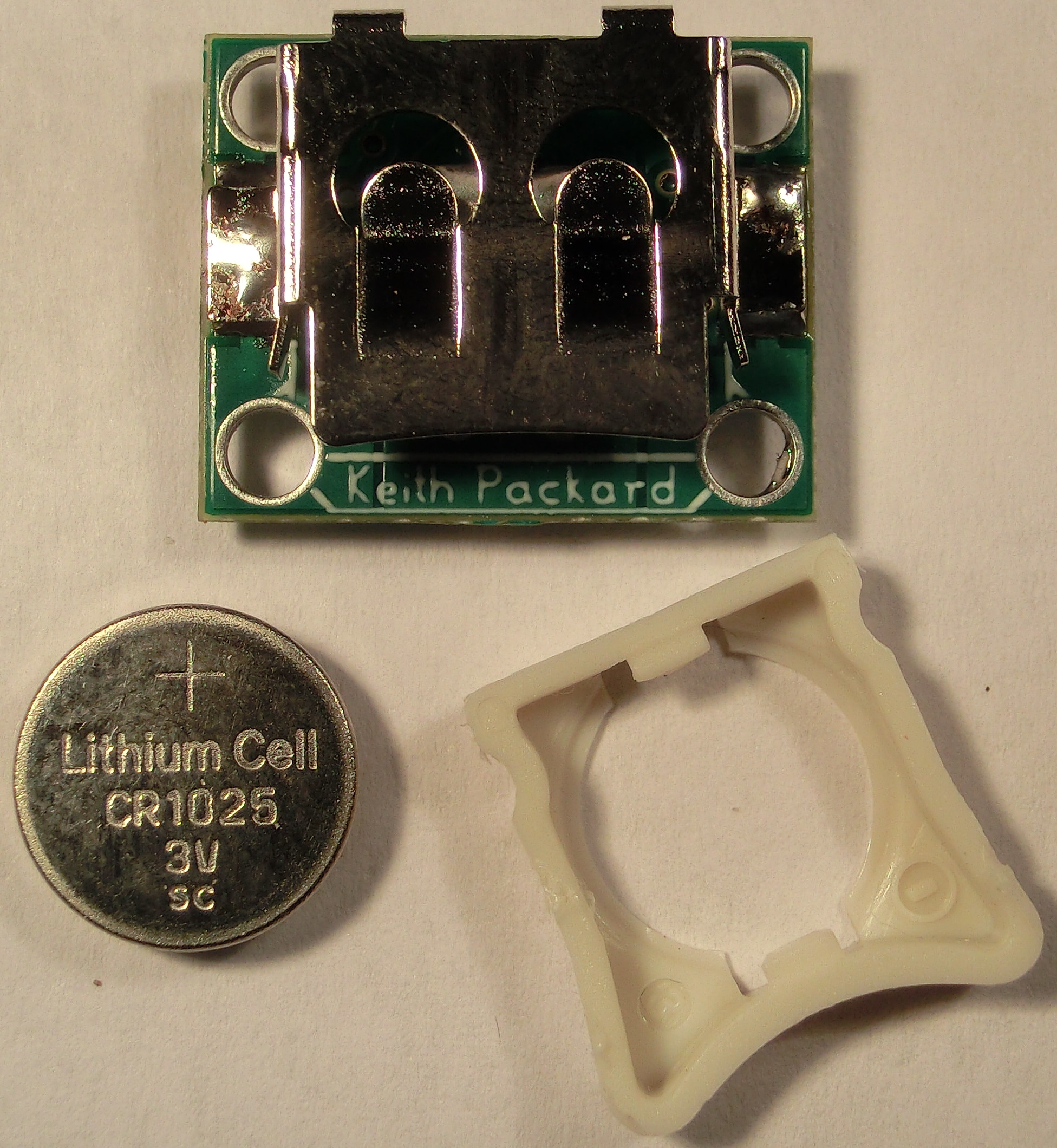
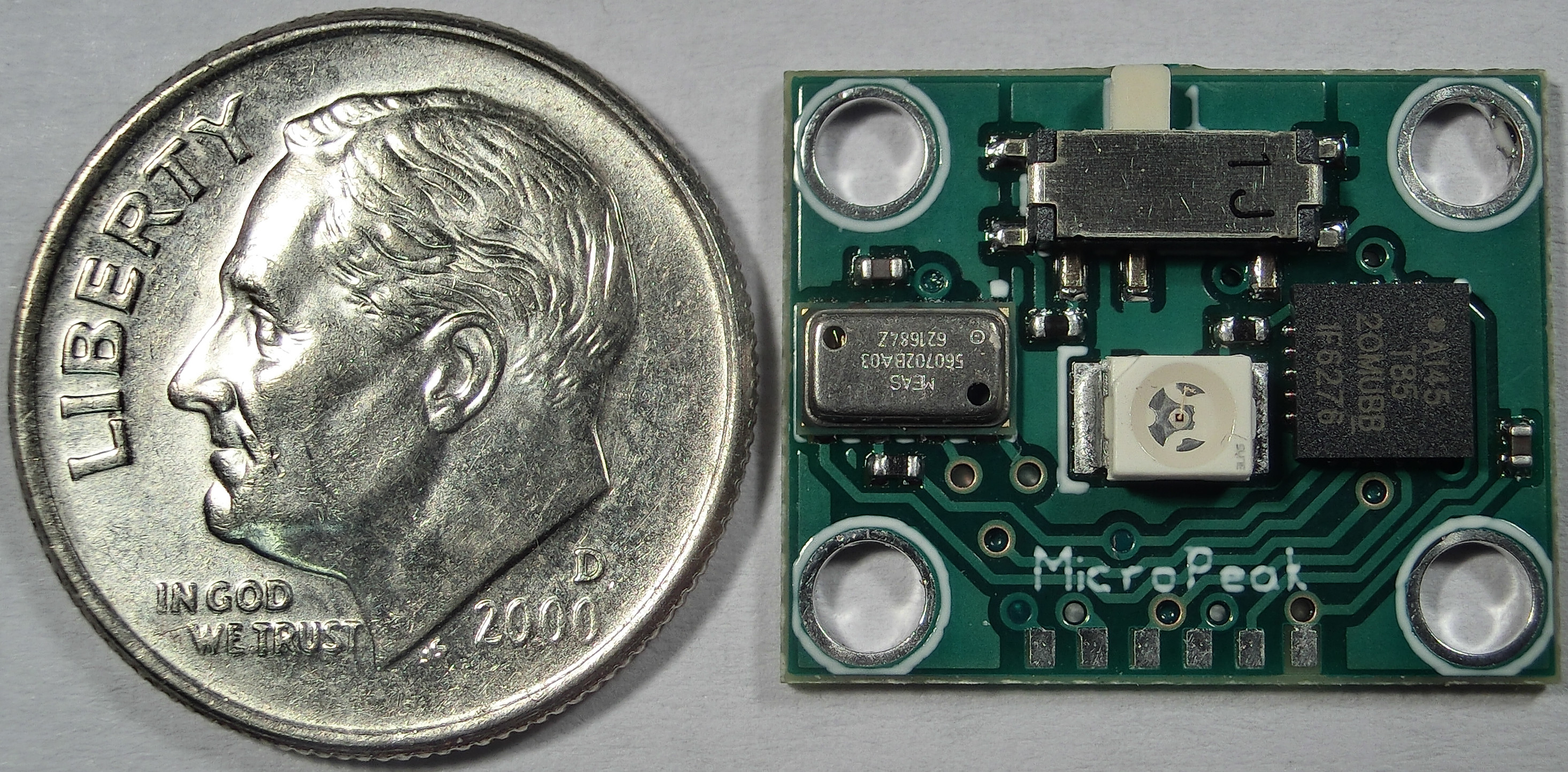
MicroPeak tiny peak-recording altimeter now available MicroPeak is a miniature peak-recording altimeter. About the same size and weight as a US dime (with battery), MicroPeak offers fabulous accuracy (20cm or 8in at sea level) and wide range (up to 31km or 101k ). The size of the board was predicated with the premise that we needed a battery included to avoid having wiring running between the altimeter and the board, we found some small lithium coin-cell battery holders for the CR1025 battery. These battery holders are rated to hold the battery secure up to 150gs. We d already started playing with the Measurement Specialties MS5607 pressure sensor which offers amazing accuracy while using very little power. Taking full-precision measurements every 96ms consumes about .2mA on average. Once on the ground, we stop taking measurements entirely, dropping the power use to around 1 A. It s also pretty small, measuring only 5mm x 3mm. For a CPU, this little project didn t need much. The 8-bit ATtiny85 comes in a 20qwfn package which is only 4mm x 4mm. When run at full speed (8MHz), it consumes a couple of mA of power. Reduce the clock to a pokey 250kHz and the CPU has enough CPU power to track altitude while consuming less than .2mA on average. To avoid losing the battery, we wanted to avoid having it removed while the board wasn t in use. So, we added a little power switch to the board. The one we found is good to at least 50g. Finally, we wanted to find a nice bright LED to show the state of the device and to blink out the final altitude. The OSRAM LO T67K are bright-orange surface-mount LEDs that run happily on 2mA. We used OSHPark.com to create prototype circuit boards for this project. Because of the small size of the board, each prototype run cost only $2 for three boards. It takes a couple of weeks to get boards, but it s really hard to beat the price. All of the schematic and circuit board artwork are published under the TAPR Open Hardware License and are available via git. All of the source code is published under the GPLv2 and is included in the main AltOS source repository.
22 November 2012

Bdale Garbee: Shiny Black Friday

Altus Metrum is pleased to announce our first-ever "Shiny Black Friday" event! We're combining a special, one-time discount on TeleMini products with a price reduction on TeleMetrum boards ... and a new product introduction! For one day only, Friday, 23 November 2012, we are offering a special $50 discount on TeleMini Starter Kits (regular $225, now only $175!) and TeleMini boards (regular $125, now only $75!). This discount is available only for direct orders from our web site, see below. TeleMini is a baro-only recording dual deployment altimeter with radio telemetry and direction finding features. Learn more about TeleMini at We are also pleased to announce that TeleMetrum is back in stock after a brief production delay. To celebrate, we are dropping the price of extra TeleMetrum boards from $350 to $325. Starter kits will continue to sell for $400. TeleMetrum is a dual-deploy altimeter with accel and baro sensors, GPS, and radio telemetry and direction finding features all on one board! Learn more about TeleMetrum at Last, but certainly not least (unless we're talking size or mass!), we are proud to introduce a new product... MicroPeak! MicroPeak is a tiny board that provides highly accurate peak barometric altitude recording. About the size and weight of a US dime with battery ready to fly (18x14mm, 1.9 grams), this is the ideal altimeter for model rocket contests. MicroPeak is so easy to use that it's also the ideal altimeter for young people working on rocket related science fair projects, etc! MicroPeak sells for $50, learn more at Find more information on all Altus Metrum products at http://altusmetrum.org. The special Black Friday discount on TeleMini products is available only on orders placed through Bdale's web store at http://auric.gag.com. Thank you for making 2012 such a great year for Altus Metrum, LLC. We're having fun, and look forward to introducing several exciting new products in the weeks and months ahead!

Andrew Pollock: [life] Portland bound

So, after just having run 10K, I'm going to sit on a train for 20 hours and completely seize up. I've got me some stretching to do! I'm getting away to Portland for a few days. I'm taking the Coastal Starlight train up and back, and staying with Nigel and his family. I'm looking forward to having some time to myself on the train, I'm looking forward to the trip, because some mutual friends did it, and I've wanted to do it ever since. I'm also looking forward to catching up with Nigel, because I've barely spoken to him since he left Google, and he's a friend and fellow countryman who I really enjoyed working with. I'd also like to check out this barber shop, because I'm weird and like the idea of someone attacking my face with a cutthroat razor. And of course, you can't go to Portland without visiting Powell's City of Books. I'm probably spending as much time on the train as I am in Portland (I head back on Sunday), but I want to be back for Zoe's first dentist appointment on Tuesday.

Andrew Pollock: [life] Silicon Valley Turkey Trot

Sarah, Zoe and I ran in the 10K Applied Materials Silicon Valley Turkey Trot this morning. Apparently it's a bit of a Silicon Valley institution (people get dressed up, particularly as turkeys), so I guess it's up there with the Bay to Breakers. This is the first time I've ever run a 10K fun run and actually run the whole way, so I'm feeling pretty happy with my fitness. In fact, I think I'm the fittest and lightest I've ever been. I'm actually a couple of kilograms under my target weight, and really pleased with myself for being able to run a 10K training run on Tuesday as well as the race today. I managed to run it in a respectable 1:05. I think I'll set a goal for myself to be able to run 10K in under an hour. No idea if that's realistic or not, but it's a goal with a nice round number. Sarah did her run in 1:06, which is impressive considering she was pushing Zoe in the jogging stroller. Zoe also did well putting up with being in the jogging stroller for that long. I think it helped having lots of things for her to look at, as well as a steady supply of food to graze on. She was having a great time running on the closed streets as we headed back to where we parked the car. We might have to make this a Thanksgiving family tradition. It'll be nice when Zoe's big enough to run in the kid's fun run as well.

Paul Tagliamonte: update on dput-ng & debuild.me

I ve been working (although; slowly) on dput-ng. I need to finish dirt (a tool to modify the config files, sorta like how git works at times), but it s otherwise mostly in the state it will be in upon our upload to unstable. good-intentioned co-maintainers and contributors are welcome. Code s in collab-maint, be sure to run big changes through us over in #torabora on irc.oftc.net. I ve also spent some time on debuild.me, and I ve written out most of the krufty bits, more changes to come. If anyone has ARM hardware suggestions, I m open to them, but I m thinking (from some debian-arm advice) that it d be best to wait for the v8 goodies to drop. Godspeed!

21 November 2012

Axel Beckert: Suggestions for the GNOME Team

Thanks to Erich Schubert s blog posting on Planet Debian I became aware of the 2012 GNOME User Survey at Phoronix. Like back in 2006 I still use some GNOME applications, so I do consider myself as GNOME user in the widest sense and hence I filled out that survey. Additionally I have to live with GNOME 3 as a system administrator of workstations, and that s some kind of usage, too. ;-) The last question in the survey was Do you have any comments or suggestions for the GNOME team? Sure I have. And since I tried to give constructive feedback instead of only ranting, here s my answer to that question as I submitted it in the survey, too, just spiced up with some hyperlinks and highlighting:
Don t try to change the users. Give the users more possibilities to change GNOME if they don t agree with your own preferences and decisions. (The trend to castrate the user was already starting with GNOME 2 and GNOME 3 made that worse IMHO.) If you really think that you need less configurability because some non-power-users are confused or challenged by too many choices, then please give the other users at least the chance to enable more configuration options. A very good example in that hindsight was Kazehakase (RIP) who offered several user interfaces (novice, intermediate and power user or such). The popular text-mode web browser Lynx does the same, too, btw. GNOME lost me mostly with the change to GNOME 2. The switch from Galeon 1.2 to 1.3/2.0 was horrible and the later switch to Epiphany made things even worse on the browser side. My short trip to GNOME as desktop environment ended with moving back to FVWM (configurable without tons of clicking, especially after moving to some other computer) and for the browser I moved on to Kazehakase back then. Nowadays I m living very well with Awesome and Ratpoison as window managers, Conkeror as web browser (which are all very configurable) and a few selected GNOME applications like Liferea (luckily still quite configurable despite I miss Gecko s about:config since the switch to WebKit), GUCharmap and Gnumeric. For people switching from Windows I nowadays recommend XFCE or maybe LXDE on low-end computers. I likely would recommend GNOME 2, too, if it still would exist. With regards to MATE I m skeptical about its persistance and future, but I m glad it exists as it solves a lot of problems and brings in just a few new ones. Cinnamon as well as SolusOS are based on the current GNOME libraries and are very likely the more persistent projects, but also very likely have the very same multi-head issues we re all barfing about at work with Ubuntu Precise. (Heck, am I glad that I use Awesome at work, too, and all four screens work perfectly as they did with FVWM before.)
Thanks to Dirk Deimeke for his (German written) pointer to Marcus Moeller s interview with Ikey Doherty (in German, too) about his Debian-/GNOME-based distribution SolusOS.

Ian Campbell: Consolidating Qcontrol Configuration Files

A little while ago Michele Cane filed Debian bug #689912 against qcontrol asking that the package install the correct configuration file for a TS-419P II, a newer device which has an LCD. It turns out that to support devices with LCDs properly we need to probe a GPIO line in order to figure out if an LCD is attached or if a serial console is in use (since the two are mutually exclusive on this hardware, when you attach a serial console you must toggle a jumper too). This actually turns out to be rather trivial since qcontrol's configuration files are actually simple Lua programs and the state of the GPIO lines can be accessed via sysfs and so we can read the state directly from the configuration file itself. While looking into this I happened to notice that the various board-specific configuration files are actually very similar and that the differences can all be detected by a combination of the Hardware field in /proc/cpuinfo and the GPIO lines. So I started looking into whether I could write a single consolidated qcontrol.conf file to replace the various variant specific files. It turns out to be quite possible, the resulting consolidated file has been posted to the bug log (see also my mail). The danger with configuration files which are also fully-fledged programming languages is that there is a temptation to write more and more complex configuration files with the danger that the primary purpose of the file (configuration) can be obscured. I think in this case it is a close call but on balance I think the downsides outweigh the advantages, so I've uploaded qcontrol 0.4.2+svn-r40-2 which simply adds LCD support to the relevant board specific configuration file. In process of doing so I seem to have fallen into a trap which seems to catch out many sbuild users at least once and uploaded a package with "UNRELEASED" still in the changelog. To try and save myself (and others) some blushes in the future I've filed Debian bug #693841 (wishlist) against dput to see if it can catch this case, I've also added to my prerelease checklist. As it happens my own TS-419P II arrived today. I intend to use it for second tier storage (mythtv recordings, music, mirrors) as well as light server duties (MTA, internal DNS etc) which should allow me to turn off the existing PC in the cupboard under the stairs which is getting a bit long in the tooth and starting to become a bit unreliable (I also suspect its costing a fortune to run).

Sandro Tosi: Attending the Codecademy

You've probably already got it, I'm surveying several sites to improve programming skills. This episode is about Codecademy.

It's a very well done site, for people that want to learn a language. It has a Python track, along with several others: Ruby, JQuery, Javascript & so on.

You'll be required to actually write code and run it! yes, the code you write is then executed in a web "interpreter" (modified for educational purposes) and the output displayed on screen. In a section is also possible to write to files and have their contents shown on another tab.

I'd encourage you to start from it if you never saw Python and you're willing to learn if from the ground up.

Axel Beckert: zutils: zcat and friends on Steroids

I recently wrote about tools to handle archives conveniently. If you just have to handle compressed text files, there are some widely known shortcut commands to mimic common commands on files compressed with a specific compression format.
gzip bzip2 lzma xz
cat zcat bzcat lzcat xzcat
cmp zcmp bzcmp lzcmp xzcmp
diff zdiff bzdiff lzdiff xzdiff
grep zgrep bzgrep lzgrep xzgrep
egrep zegrep bzegrep lzegrep xzegrep
fgrep zfgrep bzfgrep lzfgrep xzfgrep
more zmore bzmore lzmore xzmore
less zless bzless lzless xzless
In Debian and derivatives, those tools are part of the according package for that compression utility, i.e. the zcat command is part of the gzip package and the xzfgrep command is part of the xz-utils package. But despite this matrix is quite easy to remember, the situation has a few drawbacks: This is where the zutils project comes in: zutils provides the functionality of most of these utilities, too, but with one big difference: You don t have to remember, think about or type which compression method has been used for your data, just use zcat, zcmp, zdiff, zgrep, zegrep, or zfgrep and it works independently of what compression method has been used if any or if there are different compression types mixed in the parameters to the same command:
$ zfgrep foobar bla.txt fnord.gz hurz.xz quux.lz bar.lzma
Especially if you use logrotate and let logrotate compress old logs, it s very comfortable that one command suffices to concatenate all the available logfiles, including the current uncompressed one:
$ zcat /var/log/syslog*    
Additionally, zutils versions of these tools also support lzip-compressed files. The zutils package is available in Debian starting with Wheezy and in Ubuntu since Oneiric. When being installed, it replaces the original z* utilities from the gzip package by diverting them away. The only drawback so far is that there neither a zless nor a zmore utility from the zutils project, so zless bla.txt fnord.gz hurz.xz quux.lz bar.lzma will not work as expected even after installing zutils as it is still the one from the gzip package and hence it will show you just the first two files in plain text, but not the remaining ones.

20 November 2012

Jon Dowland: Waterstones

In May this year, in a desperate bid to bail water out of a sinking ship, HMV group sold off the Waterstones chain of bookstores. I'm fond of reading so naturally I visit Waterstones from time to time. (but not exclusively.) For many years, their promotions were unanimously structured as "3 for 2" offers: find three books in the promotion, in-store, and get the cheapest of the three for free. I hated these promotions. I always found it very challenging to find three books in the promotion that I wanted. If I was visiting to buy a specific book and found it in the promotion, on more than one occasion I left the shop empty handed: I wasn't prepared to pay full price for a book in a promotion and not get the benefit of the promotion. Since being sold, Waterstones seem to have made a lot of changes. Many new hardbacks from popular authors have debuted at a discount for a short period (Rowling, Pratchett). I've found many more discounted books not tied to others in 3-for-2-style offers, sometimes window-display stock at half price, a month or so after release. They started a loyalty-card scheme, with a 10 gift card the prize you reach once you've spent 100. (I wonder if such schemes are examples of a token economy?) Finally, they've tentatively started to explore putting cafes in their branches. The one in Newcastle is best described as 'fledgling', but it's nice to have one more place to escape for a cup of tea at lunchtimes. The cafe, as well as a very well stocked collection of magazines, were the two killer features of the sadly- defunct Borders bookseller chain. For years before we got our own Borders in the North East, I used to enjoy the York branch if I was passing. I actually managed to fill a loyalty card this year, so clearly their change in attitude has worked on me! I'm generally not a fan of gift cards, especially in today's climate, so I quickly spent it. I hold an American Express credit card, which earns me cashbask on purchases which I make with it. I think the rate is about 1%. However, I can opt to receive the cashback in the form of gift vouchers. If I do so, I get them to the value of 110% my cashback balance. One of the retailers in on the scheme are Waterstones. I'm tempted

Michal Čihař: Weblate hook at Github

Github now provides native hook for Weblate. This means that all you need to do to link these two together is to enter URL of your Weblate installation and you are done. This was actually my first code in Ruby and I don't think I will start to like it, Python still looks nicer to me :-). However it was not that hard as I expected and I've even contribute (simple) testcase for this service.

Filed under: English Weblate 3 comments Flattr this!

19 November 2012

Vasudev Kamath: Weekly Log - 17/23 - 112012

The last week was quite productive as I was on vacation and at home town but sadly I couldn't complete this post so again merging the work with this week but this week ain't much productive as I was tired from journey back and didn't get enough time to recover. So here it goes. Debian Related Upstream Related I raised a pull request #8 on Gubbi fixing the Makefile to more organized and introducing xz compression in it. Additionally I removed distribution specific stuffs from Makefile and made it generic. That's all for the two weeks. This week there will be foss.in and we will be having some Debian specific mini conference, including some Debian basics to newbies and some bug squashing if any :-). So more to report next week, till then Cya.

Russ Allbery: Review: Inversions

Review: Inversions, by Iain M. Banks
Publisher: Pocket
Copyright: 1998
Printing: May 2001
ISBN: 0-7434-1196-X
Format: Mass market
Pages: 376
Inversions poses a special challenge for book metadata for reviews that try to avoid spoilers. If you've looked at my index of reviews, I may have arguably already spoiled you. I'm going to discuss the book with that spoiler, as most reviews do, because I think it's a better book knowing that information up-front. But if you want to avoid any spoilers, stop reading here, and avoid looking at its placement in my review index. Inversions consists of the interleaved stories of two people: a strange female doctor to the king of Haspide, and the bodyguard of the Protector of Tassassen. The doctor's story is told in the form of letters written by the doctor's apprentice to his "Master," who has clearly told him to spy on the doctor. (The identity of this person is revealed during the story.) The bodyguard's story is told in the third person and presented as a reconstruction of events. The stories never meet, although the two countries have some indirect political exchanges. The doctor becomes entangled in court intrigue and several murders, and the bodyguard protects the Protector (a general in charge of what was effectively a military coup against the former regime) during a war with neighboring barons who had initially supported him. Both stories reach conclusions, but somewhat unsatisfactory ones. The two characters never meet in the book. All of this is set among countries at a medieval level of technology. The doctor faces scorn and derision, not to mention outright opposition, both because she's a woman (she's only permitted to claim the title of doctor due to the king's favor and her claimed citizenship in a far-away land with strange customs) and because she uses more effective and more modern techniques. Other physicians still bleed patients, but the doctor is clearly aware of the germ theory of disease, dismisses contageon via bad odors, and otherwise strikes the reader as someone with advanced medical knowledge trying to practice it in primitive conditions. The spoiler, which is never stated outright but which is relatively apparent from various hints and allusions dropped by the characters, as well as at least one event that would otherwise have to be supernatural, is that Inversions actually takes place in the Culture milieu. How this planet and these stories fit into that milieu remains unexplained throughout the story, but we do get some clues in supposedly made-up stories that the bodyguard tells the son of the Protector, stories that are recognizable to Culture readers as less fictional than they sound in a medieval context. Banks has a tendency to play with unusual narrative structure and to fall on the mainstream side of SF plot construction. Inversions is a very closely-observed pair of entwined stories told in a way that downplays most of the dramatic structure and rising action and that undermines feelings of conclusion or catharsis. Despite having, on later reflection, two clear plots with clear conclusions, it feels more like parallel slices of life and stubbornly refuses to advertise any conclusions or deeper meaning. Whether that works will probably have a lot to do with the reader's tolerance for trying to draw one's own conclusions. I found it frustrating and unsatisfying, but knowing going in that it's a Culture novel helped by adding some deeper structure to give the story a modicum of meaning. Insofar as there's a larger theme, it's the exploration of the conflict between the two Culture citizens that is presented, thinly disguised, in the bodyguard's stories. This connection is not obvious; even determining how to map the two characters into the stories is a touch challenging. But if one is aware of it and looking for it in advance, it provides a bit of broader structure and some basis for judging the actions of the doctor and the bodyguard against a larger plan. I needed that to wring enjoyment from the book; I never cared enough about the characters otherwise to fully engage with either story. With the puzzle, and the constant search for connections to Culture concepts, it's somewhat more interesting, but it's still maddeningly indirect. (And, from various other Internet reactions, I don't think I'm missing something obvious.) It's possible that I went into the book with some incorrect assumptions that undermined my enjoyment. Hopefully this review will help other readers. Knowing that this is a Culture book and enjoying the process of finding references makes it more fun (and most of the references aren't too hard to find). But don't expect lots of closure from the stories, and don't expend to find out "what's really going on." It's not that sort of book. If you enjoy the individual stories for themselves, you'll have the best chance of enjoying the book as a whole, with the Culture references providing a fun additional layer. If the basic stories don't appeal, the Culture material probably isn't enough to make the book engrossing. Rating: 6 out of 10

18 November 2012

Sven Mueller: Ingress

As some may have noticed, Google launched something that is unusual for the company: A game. A mobile alternate reality game, to be precise. See allthingsd article for a bit more information. In my opinion this game is most interesting to people who are mildly interested in geo-caching. You spend most of the gaming time either looking for the right portals (geo-location that is an interesting place for one reason or another, many located at sculptures, murals or (more scarcely) interesting local businesses), or trying to solve the puzzles that appear in the game itself or on http://www.nianticproject.com/. I was one of the beta testers and really enjoy the game, especially in areas with more players. As the game is most fun when people coordinate a bit, I started a google group for the munich area for one of the two teams (the enlightenment), but I will only let people enter that group who can be verified to be on that team. On a side note: I still have a few invites to the game left, so if you are interested, please leave a comment and enter your gmail.com email address (you need a Google account to play anyway) while doing so. I will send out invites in the order I received the requests (which I admit might not always be the same in which they were submitted. First come first serve and no guarantee to get an invitation though. Your email address you enter when commenting isn t shown to anyone and I don t share them with anyone but the game (and thus Google). EDIT: So short time went past, but I already ran out of invites (note that I didn t approve comments that really only were like please send me an invite , but still did sent one out). Feel free to still ask me for an invite, I will send some out as I get new ones, but this might take anything between a few days and some weeks. PS: For the lucky ones who got invites: You don t strictly need to do the training offered when you start the game for the first time, but I strongly encourage you to do so.
PPS: I m opening my group to any enlightened players in Germany. I will share some useful information about some game details there in the near future (nothing company confidential of course, just information anyone can gather in the game or from the published information). EDIT: As noted before, I don t have any more invites to give away. As I still get like 4 requests for invites per day, and now have more than 30 unfulfilled requests pending (with no new invites to give in sight), I m now disabling comments. Disclaimer: I work for Google since a few months ago, but this post solely represents my own opinions and hasn t been endorsed by Google in any way.

Andrew Pollock: [tech] Better late than never

Last year (I think for my birthday) Sarah backed the Twine project on Kickstarter. Well, to say the project experienced some delays would be a bit of an understatement, but in yesterday's mail, it finally arrived. Twine box I'm planning on using it to replace the cat water bowl sensor that never got reinstated when we moved house.

Gregor Herrmann: RC bugs 2012/46

it's seems we're starting to run out of RC bugs with the implicit usertag easy-enough-for-gregoa

what I've done in the last days besides working on the bugs listed below is to tag quite a few bugs pending that were uploaded into a DELAYED queue. please try to remember to set this tag on delayed NMUs, nmudiff is quite convenient here.

Neil Williams: Long term maintenance of perl cross-build support in Debian

After prompts from Wookey and Steve McIntyre, I decided to look at #285559 and #633884 for perl cross-build support and then port that support forward to the current perl in Wheezy and on to the version of perl currently in experimental. The first patch is for perl 5.8, the second for perl 5.12, neither of which is available currently in Debian. snapshot.debian.org provided the 5.12 source but then that no longer cross-builds with the patch.
The problem, as with any cross build, is that the build must avoid trying to execute binaries compiled within the build to achieve the test results required by ./configure (or in the case of perl, Configure). dpkg-cross has one collection of cache values but the intention was always to migrate the package-specific support data into the packages themselves and keep the architecture-specific data in dpkg-cross or dpkg-dev. Therefore, the approach taken in #633884 would be correct, if only there was a way of ensuring that the cached values remain in sync with the relevant Debian package.

I'll note here that I am aware of other ways of cross-building perl, this is particularly concerned with cross-building the Debian configuration of perl as a Debian package and using Debian or Emdebian cross-compilers. After all, the objective is to support bootstrapping Debian onto new architectures. However, I fully expect this to be just as usable with Ubuntu packages of perl compiled with, e.g. Linaro cross-compilers but I haven't yet looked at the differences between perl in Debian vs Ubuntu in any detail.

I've just got perl 5.14.2 cross-building for armel using the Emdebian gcc-4.4 cross-compiler (4.4.5-8) on a Debian sid amd64 machine without errors (it needs testing, which I'll look at later), so now is the time to document how it is done and what needs to be fixed. I've already discussed part of this with the current perl maintainers in Debian and, subject to just how the update mechanism works, have outline approval for pushing these changes into the Debian package and working with upstream where appropriate. The cache data itself might live in a separate source package which will use a strict dependency on perl to ensure that it remains in sync with the version which it can cross-build. Alternatively, if I can correctly partition the cache data between architecture-specific (and therefore generated from the existing files) and package_$version specific, then it may be possible to push a much smaller patch into the Debian perl package. This would start with some common data, calculate the arch-specific data and then look for some version-specific data, gleaned from Debian porter boxes whilst the version is in Debian experimental.

The key point is that I've offered to provide this support for the long term, ensuring that we don't end up with future stable releases of Debian having a perl package which cannot be cross-built. (To achieve that, we will also end up with versions of perl in Debian testing which also cross-build.)

This cross-build is still using dpkg-cross paths, not MultiArch paths, and this will need to be changed eventually. (e.g. by the source package providing two binaries, one which uses MultiArch and one which expects dpkg-cross paths.) The changes include patches for the upstream Makefile.SH, debian/rules and the cache data itself. Depending on where the cache data finally lives, the new support might or might not use the upstream Cross/ directory as the current contents date from the Zaurus support and don't appear to be that useful for current versions of perl.

The cache data itself has several problems:

  1. It is tightly tied to the version of perl which generated it.

  2. It is, as expected, architecture-dependent

  3. It is, unfortunately, very sensitive to the specific configuration used by the distribution itself


That last point is important because it means that the cache data is not useful upstream as a block. It also means that generating the cache data for a specific Debian package means running the generation code on the native architecture with all of the Debian build-dependencies installed for the full perl build. This is going to complicate the use of this method for new architectures like arm64.

My objective for the long term maintenance of this code is to create sufficient data that a new architecture can be bootstrapped by judicious use of some form of template. Quite how that works out, only time will tell. I expect that this will involve isolating the data which is truly architecture-specific which doesn't change between perl versions from the data which is related to the tests for build-dependencies which does change between perl versions and then work out how to deal with any remainder. A new architecture for a specific perl version should then just be a case of populating the arch-specific data such as the size of a pointer/char and the format specifiers for long long etc. alongside the existing (and correct) data for the current version of perl.

Generating the cache data natively

The perl build repeats twice (three builds in total) and each build provides and requires slightly different cache data - static, debug and shared. Therefore, the maintenance code will need to provide a script which can run the correct configuration step for each mode, copy out the cache data for each one and clean up. The script will need to run inside a buildd chroot on a porter box (I'm looking at using abel.debian.org and harris.debian.org for this work so far) so that the derived data matches what the corresponding Debian native build would use. The data then needs slight modification - typically to replace the absolute paths with PERL_BUILD_DIR. It may also be necessary to change the value of cc, ranlib and other compiler-related values to the relevant cross-compiler executables. That should be possible to arrange within the build of the cache data support package itself, allowing new cache files to be dropped in directly from the porter box.

The configuration step may need to be optimised within debian/rules of perl itself as it currently proceeds on from the bare configuration to do some actual building but I need to compare the data to see if a bare config is modified later. The test step can be omitted already. Each step is performed as:

DEB_BUILD_OPTIONS="nocheck" fakeroot debian/rules perl.static


That is repeated for perl.debug and libperl.so.$(VERSION) where $VERSION comes from :

/bin/bash debian/config.debian --full-version


The files to be copied out are:


There is a lot of scope for templating of some form here, e.g. config.h.debug is 4,686 lines long but only 41 of those lines differ between amd64 and armhf for the same version of perl (and some of those can be identified from existing architecture-specific constants) which should make for a much smaller patch.

Architecture-specific cache data for perl

So far, the existing patches only deal with armel and armhf. If I compare the differences between armel & armhf, it comes down to:

  1. compiler names (config.h.*)

  2. architecture names (config.sh.*)

  3. architecture-based paths (config.sh.*)


However, comparing armel and armhf doesn't provide sufficient info for deriving arm64 or mips etc. Comparing the same versions for armhf and amd64 shows the range of differences more clearly. Typical architecture differences exist like the size of a long, flags to denote if the compiler can cast negative floats to 32bit ints and the sprintf format specifier strings for handling floats and doubles. The data also includes some less expected ones like:

armhf: #define Netdb_host_t const void * /**/
amd64: #define Netdb_host_t char * /**/


I'm not at all sure why that is arch-specific - if anyone knows, email codehelp @ d.o - same address if anyone fancies helping out ....

Cross-builds and debclean

When playing with the cross-build, remember to use the cross-build clean support, not just debclean:


dpkg-architecture -aarmel -c fakeroot debian/rules clean


That wasted quite a bit of my time initially with having to blow away the entire tree, unpack it from original apt sources and repatch it. (Once Wheezy is out, may actually investigate getting debclean to support the -a switch).

OK, that's an introduction, I'm planning on pushing the cross-build support code onto github soon-ish and doing some testing of the cross-built perl binaries in a chroot on an armel box. I'll detail that in another blog post when it's available.

Next step is to look at perl 5.16 and then current perl upstream git to see how to get Makefile.SH fixed for the long term.

Mike Hommey: Debian EFI mode boot on a Macbook Pro, without rEFIt

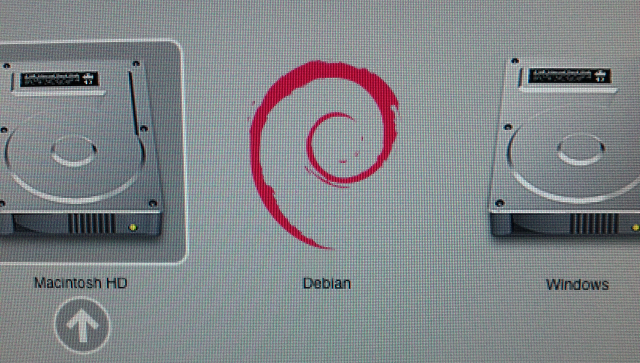
Diego s post got me to switch from grub-pc to grub-efi to boot Debian on my Macbook Pro. But I wanted to go further: getting rid of rEFIt. rEFIt is a pretty useful piece of software, but it s essentially dead. There is the rEFInd fork, which keeps it up-to-date, but it doesn t really help with FileVault. Moreover, the boot sequence for a Linux distro with rEFIt/rEFInd looks like: Apple EFI firmware rEFIt/rEFInd GRUB Linux kernel. Each intermediate step adding its own timeout, so rEFIt/rEFInd can be seen as not-so-useful intermediate step. Thankfully, Matthew Garrett did all the research to allow to directly boot GRUB from the Apple EFI firmware. Unfortunately, his blog post didn t have much actual detail on how to do it. So here it is, for a Debian system: Now, the Apple Boot Manager, shown when holding down the option key when booting the Macbook Pro, looks like this:
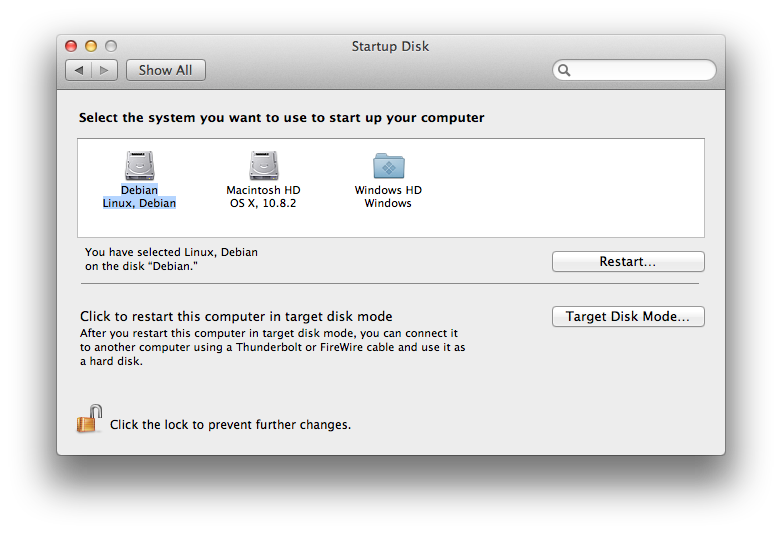
And the Startup disk preferences dialog under OSX, like this:
17 November 2012

Craig Sanders: done

OK, I m finished my experiment. It s over now and I can break character . First, I have to offer special thanks to tshirtman for being the first to unambiguously exemplify one of my main points. well done! In case it s not blindingly obvious (as it should be), the reason for my post was that I was outraged by the spectacle of one fairly high-profile member of the linux community trying to rally support to shun and exclude another fairly high-profile member because a nightmare had upset her. WTF? Is that really all it s going to take to destroy someone s reputation and perhaps their career? even with the shunning target s own words available and archived to disprove the ridiculous straw-man mis-characterisations of what he actually said? Not one of the arguments against him actually addressed anything he said, they ALL attacked him for things he didn t say, for things that other people claimed he said. I was further outraged by seeing everyone who even suggested that questioning of stats (or, indeed, ANY claim of fact or evidence) may be, in some small way, a valid and reasonable thing to do get instantly put in their place and dismissed as Yet Another Rape Apologist. Are we supposed to be anti-science, anti-scientific method now? or are rape stats a special case like religion where we are just supposed to switch off our analytical brains and accept what we are told on faith, without question? Surely we are capable of better than that? i know we are capable of better than that. Or, at least, i used to know that. Now i m not so sure. In 2011, all it took was Ted Tso ( TT ) making some fairly reasonable statements about the need for any claimed evidence or statistics to be viewed skeptically and that dissenting research should also be considered and he was instantly vilified as a rape apologist . Sorry, but questioning extremely dodgy stats (that even in feminist circles are viewed more as ideological propaganda than as serious research) is NOWHERE NEAR SUFFICIENT to earn the label of rape-apologist. That is not how debate works you can t just refuse to engage with someone s point and simply accuse them of being the enemy for not agreeing 100% with whatever you say at least, not if you have any intellectual honesty or self-respect. (sure, some people are complete jerks and deserve to be told to FOAD in no uncertain terms but a) jerks like that are self-evident and obvious, and b) TT s participation in that thread was at all times civil and reasonable) But that thread is ancient history it was over and done with nearly two years ago.
In October this year, for reasons which are not at all clear, Valerie Aurora ( VA ) decided to revive the issue (which had been resolved back in 2011 with a resounding fuck no, we don t want misogynist shit or porn in our conferences from pretty much the entire linux community including near-universal support for improved anti-harassment policies both for linux.conf.au and for geek conferences in general) and use it to attack TT. And she did so by twisting his words and claiming in a post on The Ada Initiative blog that he said something which he didn t, that rape was impossible if both people were drunk enough . If he chose, he could quite easily win a libel case against her and TAI on that. It s not what he said, it s not even close to what he said, and VA is clearly too smart to honestly believe that it is what he said. In another post on her personal, blog she talks about how what he said was so terrible that it even now gives her nightmares, and that she can t bear the thought of working with him. Again, WTF? VA can say I had nightmares and was upset and furious and THAT is enough to justify a call to shun TT?? He didn t attack her, or threaten her (explicitly or implicitly), he was polite and civil. What he did was disagree with VA by referring to other research that disputed VA s preferred studies. I agree with and support many (perhaps most) of VA s and The Ada Initiative s aims, I certainly believe that linux and open source etc should be very welcoming and supportive of human diversity (including gender and sexuality, identity, religion, politics and so on), believe that it s a good thing that The Ada Initiative exists as part of that diversity welcome to be particularly supportive of women in geekdom. And i wholeheartedly agree that Linux leaders should not make public statements belittling and condoning rape BUT: a) I haven t seen one instance of that happening, ever and b) I find VA s choice of tactics here to be despicable. as i do when anyone else uses similar tactics, because they ARE despicable tactics. They are exactly the same as accusing someone of being a child pornographer for being against net censorship: You dared to disagree with me so I m going to accuse you of being a monster. (and, i must admit, the enthusiasm level of my support for The Ada Initiative is somewhat .diminished by this tactical blunder by the spokesperson and co-founder) There are far more deserving targets of VA s ire than TT. And there are far better ways for the Ada Initiative to achieve their aims.
Why? So why did I decide to comment when I knew that I was inevitably going to be accused of hating women and being a rape apologist? Mostly because I thought it would be gutless of me not to. Hardly anyone else had, and they quickly backed down under the accusations of misogyny and since I consider myself to be psychologically fairly strong, I felt that I am capable of wearing a little shit (or even a lot) for a while. In my egocentric fashion, I thought if I can t do then it s no wonder that no one else dares . And also because anyone who cared to make even the slightest effort to find out what my actual views on sexual harassment, rape, women s rights and numerous inter-related issues are can fairly easily see a very consistent record of the kinds of things I argue for and against, and my scathing responses to actual misogynists when they appear on lists that I participate in. they are not my kind of people. and even then, i hesitated. it s scary and intimidating to be putting yourself forward to be accused of being one of the things you hate. this is, of course, an instance of the chilling effect. So, I found the prospect scary, almost terrifying .and I can t think of a single person who has met me online or in real life who would even remotely describe me as being any kind of delicate or sensitive wall-flower. again, if i can t do it, it s no wonder no one else dares . so i clicked the Publish button. an ego is useful for some things. Also, I took VA s words but don t be silent as inspiration. In the process, i discovered why it is that some people just simply refuse to engage in rational discourse. I ve seen it many times from the other side, but i ve never experienced the seductive pleasure of indulging in it myself before there s a liberating freedom in just ignoring any and every point that someone makes and simply accuse them of being the enemy. You don t have to try to understand what they wrote, hell you don t even have to really read it you just need to quickly scan it for overall tone and if they don t seem like they re 100% supportive, you just accuse them of being the enemy or an apologist for the enemy. it s that fucking simple and easy. well, sort of easy. easy for some, perhaps. i personally found it extremely difficult a struggle to refrain from engaging, to remain in character (i m not much of an actor). especially when i kind of agreed with whoever was arguing against my experimental character or if i thought they made a good point. and even more so when i thought that some comments skirted a bit too close to being the kind of misogynist crap that i didn t want to tolerate having on MY blog. (i resolved that issue by just approving any reply that didn t squick me or that i could squint at and think hmmm borderline, give benefit of doubt ) but even though i don t like it, i can recognise the attraction it holds for some people.
Other thoughts: I m particularly disgusted by the men who intervene way too early without an explicit invitation or request for help or a clear need such as an immediate threat of violence in womens issues. Many or maybe even most may not realise it, but they are just taking over and asserting male strength and control by protecting women rather than giving them the support and space to discover and practice their own strength and their own voices. These uninvited interventions do not help women, they weaken and undermine them, they perpetuate dependence, they steal strength from the movement. It is patronising and enfeebling. But mostly, they just re-assert male dominance and are an attempt to make women s spaces more comfortable, more palatable, for men.(*) (it s also quite often very transparent self-serving and ingratiating behaviour from blokes who want to lay the groundwork for perhaps getting laid one day) IMO this goes far beyond a problem with men over-involving themselves in feminist causes i feel the same way for any relatively less-privileged group with a need to find their own voice and their own power they ll never find it if members of the privileged class (i.e. white males like me) just ride roughshod over the movement and speak FOR them rather then just silently lending their strength in support. For the most part, they (we) should just shut up and listen we already have more than enough opportunities to have our say. (*) yes, i m well aware of the difficulty in writing something like that paragraph as a member of a privileged class, without coming across as either self-hating or patronising or both. if i ve failed here, it s not for want of trying. done is a post from: Errata

Next.

Previous.