Search Results: "ron"

11 October 2009

Joachim Breitner: arbtt: Now with Documentation

Yesterday I did what Free Software authors supposedly don t do. I wrote documentation. In fact, I had a relatively detailed README already, but I thought this would be a good opportunity to create a more elaborate documentation, using the ubiquitous DocBook. You can read the HTML documentation for arbtt online, where it s automatically updated when I push to the darcs repository. You can see, I use the same CSS file that most Haskell-related DocBook documentation seems to use.One motivation to use DocBook was that I can extract manpages from it, which should be present if I package arbtt for Debian. I was about to complain that references from the manpages to other part of the documentation can not work sensibly, but using the profiling feature of docbook-xsl, I can replace them by a textual reference to the user s manual if the file is processed for manpage output. Have a look at my changes for that if you want to know how it works.For some reason, the <refentry>-tags that make up the manpages are split to separate files when generating chunked HTML output, but they do not appear in the table of contents. You have to find a spot in the text where they are linked, as they are now in the section Program references , to find them. This is unfortunate, I expect that a few readers might miss this important part of the documentation. Am I doing something wrong?For the configuration file, I put an EBNF-style grammar description in the documentation. There is a special DocBook module for that, but I m not satisfied with it. On the right hand side of production rules, it has only special support for nonterminals, but no tags to semantically mark up choice, repetition etc. I followed the lead found at the YAML specification and put <quote>-Tags around literal parts of the grammar, but this is not valid according to the DocBook DTD. Speaking of the DTD: I guess since the EBNF-stuff is just a module, the tag <productionset> is not a valid content of <figure>. So, if I choose to use the EBNF module in a sensible way, I will not have a valid DocBook file.All in all, I am satisified with the result. Especially that nobody can say any more I like your program, but I can t contribute, because I don t know Haskell . Just improve the docs! :-)

10 October 2009

Wouter Verhelst: Fuck you, Sony.

I had wanted to buy a PS3 ever since I learned about this interesting processor that is called the Cell. Not that I'm very much into console gaming or any such thing; I'd have settled for any kind of affordable Cell hardware, really, but that basically is 'the PS3' these days. What I had missed, however, was the fact that recent PS3 machines don't support running Linux anymore. Apparently this was all over the interwebs, but unfortunately I didn't see that. That's 300 I won't see again, for a useless (to me) piece of hardware. Stupid morons.

Dirk Eddelbuettel: R for system administration and scripting

On several occassions, R had suggested itself as a language for <it>systems scripting</it>. By this I mean random little adminstrative task such as (re-)moving or maybe renaming files or directories and the like. One of such cases just happened a few minutes ago. The aforementioned Garmin Forerunner 405 can cooperate quite nicely with Linux using the gant reader for the ant wireless communication protocol between the usb hardware dongle and the Garmin 405. (Sources for gant are both this file and this git archive.) I had meant to blog about this tool and the resulting files one of these days anyway, but today I just want to mention that the default filenames created by the program were somewhat horrid such as 20.09.2009 101112.TCX to denote the 20th of September of this year at 10:11h and 12 seconds. As we all know, filenames with spaces are bad for the environment as well as plain annoying. So I had made the simple change in the C sources to switch to a saner format such as 20090920-101112.TCX (and I see that the git archive now contains a similar fix). But that still left me with some 80+ files with the dreaded names. There are of course many ways to skin this cat and to rename the files in bulk. However, I found the following four lines to be fairly succinct
#!/usr/bin/r
files <- dir(".", pattern=".*\\.TCX$")
res <- lapply(files, function(f)  
    pt <- strptime(f, "%d.%m.%Y %H%M%S.TCX")  # parsed time
    ft <- strftime(pt, "%Y%m%d-%H%M%S.TCX")   # formatted time
    file.rename(f, ft)
 )
as they show, among other things, So about five lines and two minutes later, some eighty-ish files were renamed and sanity was restored. Hm, and I took me five times as long to blog this. Lastly, I do not mean to imply that Python or Perl or Ruby or (insert favourite tool here) cannot do it equally well. I simply meant to say that programmatically creating new filenames is definitely easier in R than it would have been in shell. And as an added bonus, we even get fully parsed time objects that I could have tested for. But then tests and documentation never get written on a Saturday.

Bastian Venthur: python-debianbts 1.0 uploaded to unstable

Today I was working all day on python-debianbts 1.0 and uploaded it to unstable a few minutes ago. This version breaks backwards compatibility with previous versions. I removed lots of unneeded old cruft like the HTMLStripper class needed ages ago when I was still using HTML instead of debbugs SOAP interface. A new method get_usertag(email, *tags) was introduced. It returns a dict containing usertag-buglist mappings. If tags are given the dict is limited to matching tags, otherwise all available tags of the given user are returned:
In [1]: import debianbts as bts
In [2]: bts.get_usertag( debian-python@lists.debian.org )
Out[2]:
 dist-packages : [547838, 547832, ..., 547858],
  dpmt-todo : [332913],
  policy : [373301, 373302, ..., 377089],
  python-oldnum : [478467, 478442, ..., 478441],
  python2.1 : [351108, 351110, ..., 351131],
  python2.2 : [351108, 351109, ..., 351161],
  python2.6 : [547838, 547832, ... 547858] 
In [3]: bts.get_usertag( debian-python@lists.debian.org ,  python2.1 ,  python2.2 )
Out[3]:
 python2.1 : [351108, 351110, ..., 351131],
  python2.2 : [351108, 351109, ..., 351161] 
get_bug_log(nr) now returns a list of dicts with the keys: header (string), body (string), msg_num (int) and attachments (list). Before 1.0 it returned a list of Buglog objects. The Bugreport class now supports every information provided by the SOAP interface. I tried to stay as close as possible to the data SOAP provides, so I renamed existing attributes (like Bugreport.nr which is not supported by SOAP but is now Bugreport.bug_num) and also added the quirky ones like: id and bug_nr, found and found_versions, keywords and tags, fixed and fixed_date which always seem to provide the same data. Instead of the Bugreport.value() method which provided a number representing the openness (in terms of: open, closed and archived) and urgency (like: grave, important, ) to make bugreports sortable by their status, the Bugreport class now has a __cmp__ method which makes bugreports comparable. The more open and urgent a bug is, the greater it is. Openness always beats urgency (eg: an open whishlist bug is greater than a closed grave one). While pre 1.0 versions of python-debianbts more or less served the needs of reportbug-ng, it now tries to stay as close as possible to the data provided by SOAP. As a result many parts of reportbug-ng had to be fixed for the new version. I hope this makes python-debianbts more attractive for other projects dealing with Debian s bug tracker. As always: python-debianbts is on github and forks, patches or other kinds of collaboration are very welcome. For the curious here a litte quickstart. it shows how to get all important bugs from reportbug-ng and prints out the bugnumber and summary:
# Get all important bugs of reportbug-ng (returns a list of integers)
bugnrlist = bts.get_bugs("package", "reportbug-ng", "severity", "important")
bugnrlist
[548871, 439203, 542759]
# Get the actual bugreports (returns a list of Bugreport-objects)
bugs = bts.get_status(bugnrlist)
for bug in bugs: print bug.bug_num, bug.subject
    .:
542759 [reportbug-ng] Erroneously reports nothing or repeats previous package s report
439203 Doesn t give any explanations of the severities and what they mean
548871 reportbug-ng: does not check for newer versions before reporting a bug

Stefano Zacchiroli: RC bugs of the week - week 6

RCBW - week #6 RC bugs squashed this week by yours truly: This week I've cheated for at least two reasons:
  1. the first 4 entries in the list above are bugs of "mine", since within the Debian OCaml Maintainers team we migrated to a new package toolchain called dh_ocaml (with a lot of advantages I've anticipated before my summer break). The migration to that triggered (thanks, Lucas! :-) ) more than 30 FTBFSs which had to be dealt with. So, even if not cheating, it is at least breaking the NMU tradition of RCBW, but they were still RC bugs looking for a fix! All in all, I'm impressed by the fact that in about a week we dealt with most of them.
  2. the lxml fix above is severity "important" and as such, not RC. I attacked that because I intended to help out with the Python 2.6 transition which is still, at the time of writing, 41 bugs away from hitting unstable. I confess I did not find the task particularly fun (which is a requirement for me when I work on packages which are not mine) yet, we'll see next week ...
The feeling of the week I've to share is that I'm more and more impressed to not have received any complaint about my NMU activity, and I'm approaching the 50 NMUs. Actually I've received several "thank you" replies (you rock guys and you know who you are). On one hand this is probably a good indication that I haven't (yet) done any serious mistake; I do love peer-review! On the other hand, and more importantly, this is dispelling inside me the folklore / cultural block we have in Debian that "NMU is bad", while NMUing should become a way to help each other routinely. Really.

9 October 2009

Biella Coleman: Taking Down Internet Pundits

So I love biting irony as a way to make A Point and one of my favorite essays in this regard is If Men Could Menstruate. For a while now, I have been waiting for some biting irony, really mockery, to be launched at the free wheeling Internet punditry that is so common today . Well, here is one amazing video morsel directed at the social media guru (pictured below). Since the social media guru is just one class of Internet pundit, I hope more mockery will follow. <object height="344" width="425"><param name="movie" value="http://www.youtube.com/v/ZKCdexz5RQ8&amp;hl=en&amp;fs=1&amp;"><param name="allowFullScreen" value="true"><param name="allowscriptaccess" value="always"><embed allowfullscreen="true" allowscriptaccess="always" height="344" src="http://www.youtube.com/v/ZKCdexz5RQ8&amp;hl=en&amp;fs=1&amp;" type="application/x-shockwave-flash" width="425"></embed></object>

Brett Parker: Firefox Paper Size

It appears that no matter what the system papersize is set to, and no matter what cups says is the default paper size, firefox, in its infinite wisdom locks it to being letter - this would probably be fine if I was in the US, but I'm not, and I want it to be A4... So, the stages to go through to get it to do the right thing appear to be: This seems like something that should be much easier set, apparently using Page Setup only affects the current tab/window you are in and doesn't change the default, which is just odd.

8 October 2009

Barry Hawkins: More Expensive and Complicated Equals Better: Carseats and Software

So I finally got around to checking out the TED site; I ve quickly become a fan. One of the first talks I watched was Steven Levitt s child carseats talk. Both the talk and the feedback comments on the TED site reminded me of things I see in software development. Here s the video if you haven t seen it.
<object height="326" width="334"><param name="movie" value="http://video.ted.com/assets/player/swf/EmbedPlayer.swf"><param name="allowFullScreen" value="true"><param name="wmode" value="transparent"><param name="bgColor" value="#ffffff"><param name="flashvars" value="vu=http://video.ted.com/talks/dynamic/StevenLevitt_2005G-medium.flv&amp;su=http://images.ted.com/images/ted/tedindex/embed-posters/StevenLevitt-2005G.embed_thumbnail.jpg&amp;vw=320&amp;vh=240&amp;ap=0&amp;ti=30&amp;introDuration=16500&amp;adDuration=4000&amp;postAdDuration=2000&amp;adKeys=talk=steven_levitt_on_child_carseats;year=2005;theme=unconventional_explanations;theme=presentation_innovation;theme=how_the_mind_works;theme=not_business_as_usual;event=TEDGlobal+2005;&amp;preAdTag=tconf.ted/embed;tile=1;sz=512x288;"><embed allowfullscreen="true" bgcolor="#ffffff" flashvars="vu=http://video.ted.com/talks/dynamic/StevenLevitt_2005G-medium.flv&amp;su=http://images.ted.com/images/ted/tedindex/embed-posters/StevenLevitt-2005G.embed_thumbnail.jpg&amp;vw=320&amp;vh=240&amp;ap=0&amp;ti=30&amp;introDuration=16500&amp;adDuration=4000&amp;postAdDuration=2000&amp;adKeys=talk=steven_levitt_on_child_carseats;year=2005;theme=unconventional_explanations;theme=presentation_innovation;theme=how_the_mind_works;theme=not_business_as_usual;event=TEDGlobal+2005;" height="326" pluginspace="http://www.macromedia.com/go/getflashplayer" src="http://video.ted.com/assets/player/swf/EmbedPlayer.swf" type="application/x-shockwave-flash" width="334" wmode="transparent"></embed></object>
Steven Levitt shows in his talk how 30 years of data on car crash fatalities imply that carseats do not outperform regular seatbelts for children ages 2 and up. Anyone who has a child or grandchildren will probably bristle at hearing that; as the father of a pre-schooler, it certainly gave me pause. We spent no small amount of time and decent chunk of money in selecting carseats for our child, thinking we had done our best to ensure our child s safety. For that matter, it would be illegal for us not to have done so. To see a decent-sized data sample suggesting my child would be better off in a seatbelt at her age is rather unsettling. By the end of the talk, I took away these observations: So, software professionals, does any of that sound familiar? It reminds me of numerous initiatives over the years that have led us inexorably to the software productivity morass we have slogged through for years now. I suppose the most heinous case study in my own experience would be J2EE and the insistence that it was the solution that any reasonable business application would choose for a platform. (Before you .Net folks jump on that one, DCOM and later the .Net enterprise stack was much the same.) And who hasn t read a benchmark or white paper with seemingly incontrovertible data depicted in highly-polished graphics insisting that Product Y is the one solution to address them all? I noticed that there were comments below the video on its page at the TED site, largely because the negative verbiage of the topmost comment jumped out at me. I took the time to read through them all (there were 36 at the time of this writing), and to my amusement, I saw parallels between them and how people react to questioning and examining our existing practices and means of developing software. See if any of these strike a chord: In recent years I ve been greatly encouraged by the willingness of companies to question whether or not the heavyweight frameworks and technology stacks are what they should be using. Helping companies slough off high-ceremony processes in favor of right-sized process that focuses on delivering the right software in a timely manner has been some of the more rewarding work I ve done the past several years. I think we have an encouraging number of people in the industry who are challenging the more expensive and complicated always equals better mantra. For the brave individuals willing to put these questions to the community at large, I hope you find some comfort in knowing that the resistance and rejection you will encounter is a thing to be expected; you are not alone in that respect. Here s hoping we continue to be open to self-examination, no matter what emotional responses it might provoke or what fear of the future it may stir up within us.

Martin F. Krafft: Commencing work on the second edition of my book

Today I branched the (LaTeX) source of my Debian book in preparation of the second edition, targetted for the forthcoming Debian 6.0 squeeze . I am very excited to come back to this project after deprioritising it in favour of my research for too long. Thanks to my publishers Open Source Press and No Starch Press for their patience. If you want to be the first to receive announcements about the book, such as release dates, previews, or other information, please sign up to the announcement mailing list. The second edition has two goals: I want to re-establish the book as the standard Debian reference, but also to give my existing readers a good reason to buy the book again. While we re on the topic of buying: yes, the book is pay-ware, and yes, in some ways that goes against the spirit of open-source, and Debian in particular. However, this is a choice I made. If this book didn t have a commercial basis, then I could not put as much time into it, and I would not be able to profit from the outstanding help from the folks at Open Source Press and No Starch Press it is thanks to their advice and experience that the book turned out to be as it is. The book will be available as PDF from the start, so if you care as much about the environment as I do, you ll prefer to get that over the Dead Tree Version. And if you re as haptic as I am, then you still have the option to buy the book so you can hold something real in your hands. I am looking forward to working on this project, to working intensely with the Debian community throughout, and to your input.

7 October 2009

Adnan Hodzic: DebConf11 bid in Banja Luka?

Yesterday was a glorious day for DebConf11 bid in Bosnia and Herzegovina. I had a scheduled meeting with Banja Luka s mayor Dragoljub Davidovic. We met in his cabinet, where I presented him with the paper DebConf11 in Bosnia and Herzegovina in which I tried to explain what it all means. From what Debian is, over what DebConf is, to why is DebConf important. The thing I was most worried about was how am I going to explain all this in simple non-tech words Smile Either way, I was in middle of explaining what Debian is when mayor interrupted me I understand, I m electrical engineer myself you have no idea what relief came from these words! Grin Explaining what DebConf is and what kind of profiles attend one such event went smoothly as well, where mayor made some replicas on my story from the projects he worked on and so on. After my last case he also explained me how it s good that we meet, since Banja Luka was known as electronic city in ex-Yugoslavia.


Mayor and I
And this is where things start going just ballistic! He says something along the line this is a great idea and that we have his full support, I think you should talk to the prime minister (Milorad Dodik) about this as well! Shock I find my way to the government building, wait for brief period of time and I get called inside of the prime ministers cabinet. I tell him somewhat different story, in terms of more details, how we are competing with M nchen for this bid, and how I m actually planning if we win the bid, and if the bid is successful we d most likely change the whole city s infrastructure to Debian. He picks up the phone and calls for someone, person comes in and I m introduced to IT Center General Manager (Krsto Grujic). He tells me that they have few RedHat servers while he leads the way to his office where I m introduced to director of Agency for IT (Srdjan Rajcevic) where we even have this informal talk where Srdjan tells me he used GNU/Linux user himself and that he still manages two OpenBSD servers. We talk about various topics, in the end I tell them what we need for the conference, they write it all down and we exchange contact details, since I was called back up by the prime minister. Prime minister, asks me what I need from him to realize this project and I tell him that I d need everything I gave IT guys below, and binding papers that we d have full government and city support by the end of the month, and that I ll consult with people from Debian in case we need anything else. No problem were his words Grin
Prime minister and I
I walk out, really asking myself, what just happened, was that a Disney movie or what? Cool I d really like to use this opportunity to invite all Debian members to come and help us realize this bid. Help us put Bosnia and Herzegovina on map of the open source world! Stay tuned Wink

6 October 2009

Gerfried Fuchs: New Face, Part 2

Like written in a former blog entry I am working on preparing for getting Kalle's Debian Redesign tested and installed. Even though some unfortunate events happened which made me reconsider my efforts and a lot of things changed for me I am still up with the effort. Mostly because I didn't became part of the webmasters just to chicken away in the face of obstacles, and also not just because yet another image-hack did pop up that neither showed anything usable or overall-thoughts or actual code/concepts or even tried to get in contact with the webteam. I only remember to have received positive feedback in which I also include minor change suggestions like that the exact hits and other hits sections in the packages site aren't as clearly distinguishable as before. I have of course forwarded these to Kalle and we are looking for a solution that would go with the style. Speaking of the packages site I finally managed to get the packages from the main pool displayed too so it shouldn't behave differently to the old one anymore in that respect (see e.g. wesnoth for some more distributed package). The next step I finished these last days was setting up a testsite for www as you can find it on www.deb.at. Please notice that you might want to surf that site in English (either change your Accept-Language settings or click on the English links at the bottom of the pages) because some of the changes are only recognizable there; like, the main page in other languages look immensely different. Where to go from here? Kalle also has proposal for the BugTracking System and the Planet so that targets are the obvious next steps. I can't tell yet when they will be done, depends on how complicated it is to set up an environment for it, but I will keep you updated.

Steve Kemp: Poppa's got a brand new bang.

Recently I posted a brief tool for managing "dotfile collections". This tool was the rationalisation of a couple of adhoc scripts I already used, and was a quick hack written in nasty bash. I've updated my tool so that it is coded in slightly less nasty Perl. You can find the dotfile-manager repository online now. This tool works well with my dotfile repository, and the matching, but non-public dotfiles-private repository. I'm suspect that this post might flood a couple of feed agregators, because I've recently my chronicle blog compiler with a new release. This release has updated all the supplied themes/templates such that they validate strictly, and as part of that I had to edit some of my prior blog entries to remove bogus HTML markup. (Usually simple things suck as failing to escape & characters correctly, or using "[p][/P]" due to sloppy shift-driving.) I should probably update the way I post entries, and use markdown or textile instead of manually writing HTML inside Emacs, but the habit has been here for too long. Even back when I used wordpress I wrote my entries in HTML... Finally one other change in the most recent chronicle release is that the "mail-scanning.com theme" has been removed, as the service itself is no longer available. But all is not lost. ObFilm: Blade II

Jon Dowland: A new wheel for 2009

Forgive me if I'm missing a nuance here, but consider this quote from the article "Developing for the Apple iPhone using Flash":
We created a new compiler front end that allowed LLVM to understand ActionScript 3 and used its existing ARM back end to output native ARM assembly code. We call this Ahead of Time (AOT) compilation in contrast to the way Adobe Flash Player and Adobe AIR function on the desktop using Just in Time (JIT) compilation.
So er, this new-fangled non-JIT technology is important enough to get it's own three-letter acronym: AOT. Perhaps at some point it might be added to the already crowded wikipedia 'AOT' article. But isn't this essentially a garden-variety Compiler, the same technology we've enjoyed since 1957? Please don't misinterpret this as a slight at LLVM, which is very a very promising piece of software.

5 October 2009

Joerg Jaspert: Back from Taiwan

I m back from Taiwan since Thursday already. It was a nice trip, the whole week and I do like Taiwan. We had a transit stop in Bangkok, pretty annoying useless stop (I m sure the smokers disagree, seeing how fast they got into the smokers lounge :) ). One nice detail at Bangkok airport are the ramps down to the Gates. If you use a wheelchair, you might end up having some fun in case you ever lose control of it. Better don t. The ramp down directly ends in a set of stairs, with nothing between which would stop you. Makes too great a jump down, hehe. We arrived in Taipei Thursday (the 24th) evening and so got rid of our luggage and went out for Dinner. Which was the only time in Taiwan I wasn t happy about the food, only one of the dishes was ok, the rest not for me. But the rest of the group did like em, so maybe it was just me after a long flight. On Friday we had nothing planned, except for Dinner, so took a very relaxed day. Somewhere around noon we went out for food, after that a bit sightseeing around the hostel . There are two attributes that are always true for Taipei:
  1. It s a busy place, lots of people. No matter where.
  2. It has more scooters than you ever saw before. (True, there are two times more scooters than cars).
Oh, and of course there are the same rules of the road than in Mexico: Something might be written on paper, but better don t count on that. Red traffic lights are followed (mostly), and then its whoever is stronger. But if everyone is following this, it does seem to work out. :) Friday evening we had Dinner in a place run by Taiwan aborigines where we met the other people attending the mini-DebConf. Oh, and as it was the third time I had to use them, I was slowly growing accustomed to chopsticks, a thing I was never able to get done before. (Ok, fine, if its the only way to get food and all the others are stealing your food if you can t handle them, now thats a good reason to learn to eat with chopsticks fast :) ). Saturday and Sunday we had the mini-DebConf as part of the ICOS. I took no pictures there, but a number of other people have, you can find them on gallery.debconf.org. It was a pretty nice event where I held one talk about the Debian archive and lead one discussion round about SPI and non-profit organizations behind OpenSource Projects. The slides for the archive talk are available (beware of the kittens!), the SPI stuff only had a small introduction, no slides here. Oh, before I forget it: Taiwan does feel very hot. And we found a nice notice in our hostel Monday til Wednesday was planned for just play the Tourist game and see stuff . There was a plan made to visit the Taipei 101. It turned out that Canonical has an office within that building, as well as Google. So people planned to visit their offices too. Just - what the hell would I want to visit a Canonical office? Or a Google one? Besides that it was much too early in the day and promised to be boring, so h01ger and myself skipped it. Luck did mean it good with us, we managed to get Sabrina as a local guide for the day and so went to the Taipei 101 later. The 101 is a pretty nice building, though I would have loved to be able to get up to the real top. And not just in the upper part. Anyways, we had been lucky and had a pretty nice view from it. Getting up from the 4th floor to the 89th is also an experience one has to take: The elevators go up with 1010m/min, which makes it a 37second trip only. Down is much slower, only 600m/min, pretty boring (though you do feel it more than enough in your stomach. I wouldn t want to do lift-boy job there). After the 101 we went and visited the Lungshan temple and in the evening a night market. As it was Monday the market was empty. (Where empty translates to enough people around that you never ever feel alone. Nor think its dead). Good that, I don t think I want to experience it during weekends when its busy We had a pretty good time there, with all the various little shops. Fun how many old-style game places there are. Like, playing basketball, throwing things at other things to win stuff, all those non-computer-using games. In a country where lots of the high tech comes from this is not exactly what you would expect. On Tuesday our trip continued as good as it started on Monday, as we had the pleasure to keep Sabrina as guide for Tuesday and Wednesday. So our Tuesday started out with a visit to the National Palace Museum. Which has a large enough collection that you can spend multiple days exploring it. We didn t have the time nor memory for all of that, so left it after half a day. Lunch we took in a Japanese restaurant and here it was the first and only time during my Taiwan visit that I used a fork. Well, none of the dishes would have worked otherwise. The afternoon we spent in the Yangming Park, so we actually saw a bit of nature near Taipei. Tuesday did end early for us, as we planned to attend the TOSSUG meeting, where I met some more people from debian.org.tw and had an interesting chat about non-profit organizations in Taiwan, their way of operation and what to think of when trying to create a new one. I ve also got a nice debian.org.tw shirt, but I won t ever be able to wear it. They didn t expect someone that large when producing them, oh well. (Hrr, people, if you make Debian shirts of any kind, always do some XXL too. There might be fat, large guys like me visiting. :) ) Anyway, they have another thing, one which I like very much. They created a map of usergroups of other open source projects in Taiwan. It s a foldable map style, titled FLOSS Community Manual , and a lot of different Projects/Usergroups/ are listed there. While its all written in Chinese and I can t read it, it does list them, then describes what they are/do (I think), gives contact information and further links. The backside of it also seem to list events happening there. You can find more information (so you can read it :) ) at their website. Does seem a very nice idea to take. Sometime during the evening I also managed to pick up a Chinese name. Or better, Andrew did so for me. I don t even know how to type it, so copy&paste it has to be. :) There: . And that is: Wednesday was our last day in Taiwan, unfortunately. We went out of Taipei, visting the Golden Mountain City. Another nice place, with a market and a history, but as our Taxi was leaving at 1630 we didn t have much time for sightseeing. You could spend a lot there. Especially not as we still needed to buy postcards, something people left home always request from one. Tssk. I really enjoyed the time I had there. Not only was the organization of the conference we attended good (especially the mini-DebConf is what I saw. The event around it, while named International, was so much chinese spoken, that I couldn t make much of it), but the details around the whole stay had been nicely taken care off. And then people in general did appear very friendly. Now, it might have to do a bit with me not being exactly their height, but I dont think that is all of it. Even without such a conference as an opportunity I think I will visit the country again, but that time I will have much more time available. Like two or three weeks. And I certainly will see more than Taipei City then. Like the whole country. :) (And hope I am lucky again with local guides :) ). So thank you SLAT, Andrew, Arne, (Sabrina), Rita, (Candy) and all the people who worked for the event which names I forgot. Oh, if you didn t find it yet with all the links, a set of my pictures is available from here.

MJ Ray: Betting on British Broadband Bugfixing

High-speed internet links are something that makes FOSS development much easier, but I m still having reliability problems with my ADSL. A fringe benefit of moving to a more open Linux-based router is that I can see what s going wrong in more detail. But now I have to gamble nearly two hundred pounds in order to get the service providers to continue trying to find the bug! Sorry for the length, but let me explain how bad broadband in rural England is just now Outside the big cities with their cable networks, Company A owns the lines, Company B provides the services and we buy those services from reseller Company C. Sometimes the same company is A and B or B and C, but never all three. Most of the companies who are B won t be C themselves - in other words, they don t sell retail, but they nearly always seem to have a main or preferred retail partner. Company A is nearly always OpenReach, part of BT Group, the telephone monopoly privatised back in the 1980s but still somehow keeping its landline monopoly. Why is that allowed? Company C has been The Phone Co-op for me for the last few years. Back in February, I changed how I bought my services, combining phone and broadband into one purchase. They d been two purchases mainly because I switched my ADSL from Pipex to the co-op at a different time to switching my line to them. As I understand it, this change had the side effect of changing Company B from OpenReach to Opal Telecom. Opal are the provider business behind TalkTalk, hardest to use Broadband ISP 2009. Since the change, I ve been suffering unexplained disconnections, especially in the early evenings and at weekends. I m pretty sure it s Opal s equipment to blame for two reasons:- Firstly, this wasn t happening until Opal became Company B, while Companies A and C are the same as before (when I had a stable but unspectacular 4Mbps connection). Secondly, since changing my router, I can see LCP TermReq being sent by Opal s PPP peers. Opal insist their equipment isn t sending TermReq messages. My Netgear router disagrees, but I can t seem to get anyone to take its pppd debug logs seriously. So, I ve complained to my supplier (Company C), they ve pretty straightforwardly passed it to Company B and I ve jumped through all the bloody silly hoops like using only wired connections to the router (yay, wires across the house), plugging the router into different phone sockets (yay, more wires across the house) and disconnecting everything from the phone sockets so Company A can run some voltage test (yay, uncontactability - just as well other software.coop workers can cover for me). Now the next step is for some phone engineer to call. For this to happen, I have to agree that I will pay GBP 164 if a fault is found on my phone network instead of theirs. If I don t, they will give up trying to find the fault. I don t really see why this is necessary: surely if there was a line fault, it would have shown itself on the old service? Also, the router says the line has no fault and the SNR and Attenuation are both fine but not great. Unlike most people, I ve already had my house phone network tested with professional equipment (yay for network engineers in the co-op trying to avoid the painful state of British broadband bugfixing), but I m still left betting hundreds of pounds on the phone engineers not pointing the finger at my network. What choice do I have? I ve read elsewhere about people giving up on ADSL and switching to mobile internet because then they have only one company to deal with. I can see some attraction in that, but I live in a village with poor mobile service and I suspect the forthcoming T-Mobile/Orange and T-Mobile/Three link-ups will soon make that less straightforward too. A confusopoly is probably more profitable to telephone companies. Do most people bet a couple of hundred pounds to get their broadband fixed? How many broadband faults get ignored at that point? Why don t the retail company Cs have access to enough Company B systems to lead the fault-finding instead of only being able to pass it on to people who seem to give replies that contradict the logs and won t talk directly to customers? Is fixing this A-B-C three-companies-pass-the-buck system a necessity for Digital Britain? Why isn t the government intervening to end the OpenReach monopoly outside the big cities?
4 October 2009

Andreas Metzler: nice while it lasted

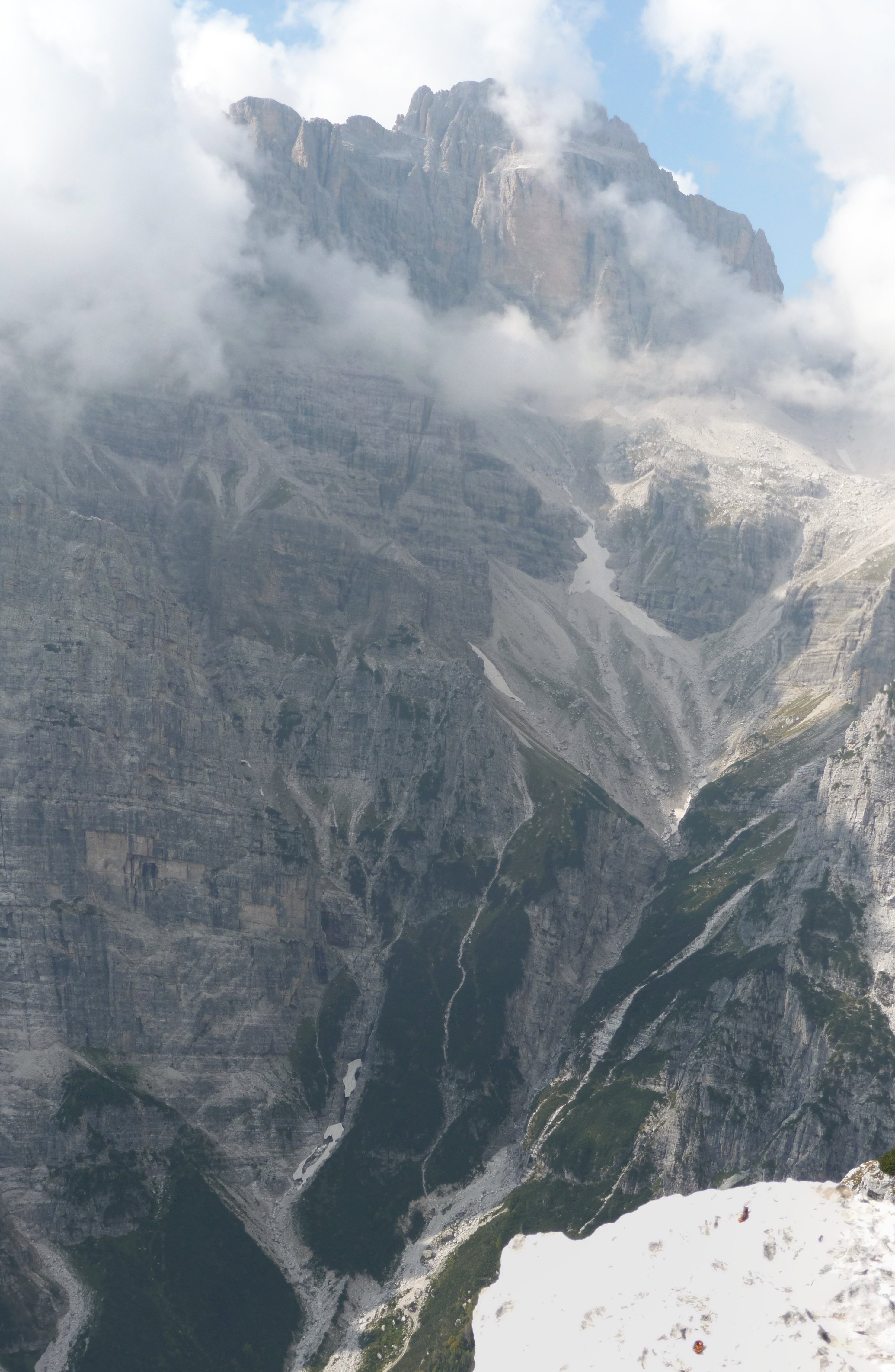
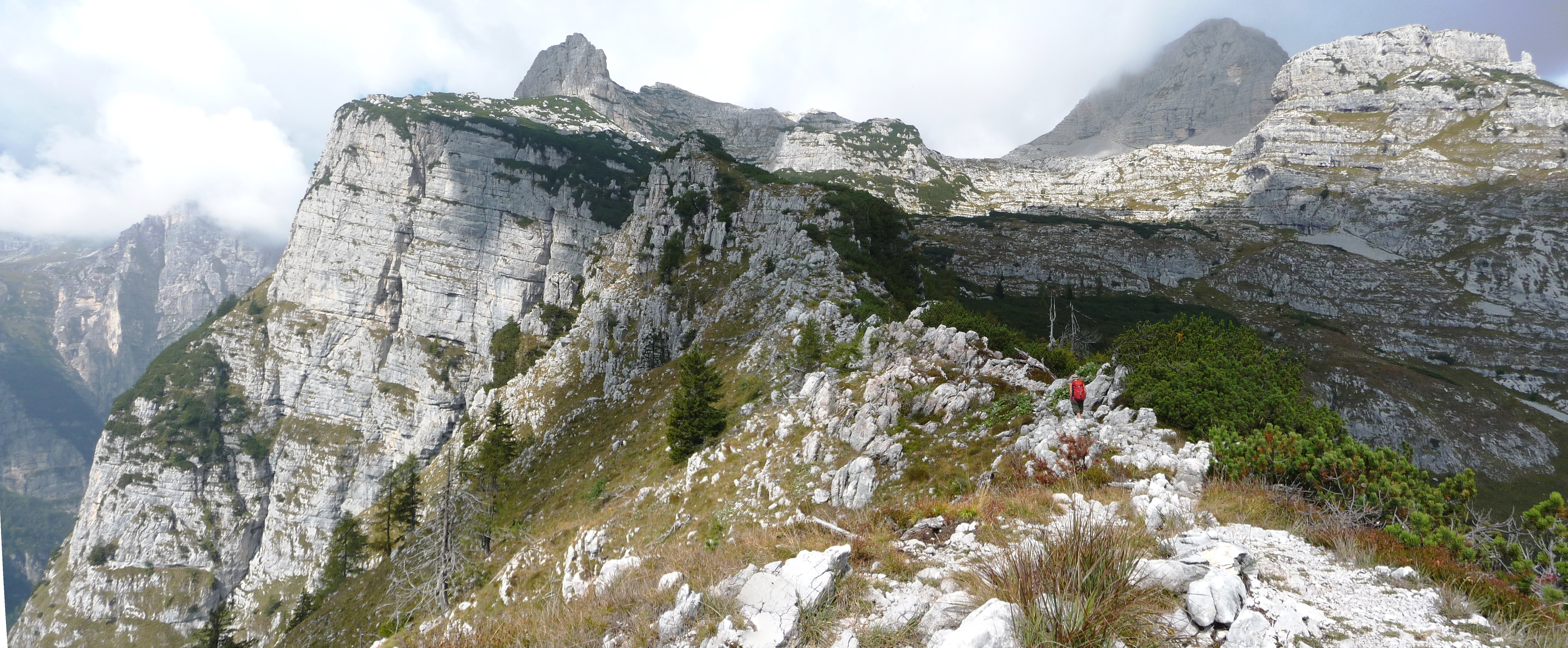
Just a small memorial for my latest holiday in Italy at Lake Garda. Not only was hiking to Croz dell'Altissimo
hiking near Croz dell Altissimo
from Molvino really very nice but the view from the summit is awesome. In front of you there is sheer almost vertical drop of about 800 m to Val delle Seghe and on the other side of the valley looms Cima Brenta.
Cima Brenta

Stefano Zacchiroli: RC bugs of the week - week 5

RCBW - week #5 RC bugs squashed this week by yours truly: This week has been quite though to deliver: I was traveling (actually I still am) during the week-end, starting Thursday afternoon, to go back to Italy (for a scientific/family event) and then back again in Paris. I mostly entirely caught up with the (self-imposed) RC back log in a couple of hours today and Thursday on the train. See? it is doable :-) Interestingly, the RC bug graph is going sharply down this week. Of course it has nothing to do with RCBW (most likely a big transition went in or something such), but it is a huge morale helper!

Romain Beauxis: What they could (not) have said..

So apparently the debate on sexism is going on, and there are interesting contributions, in particular that blog post from Josselin Mouette. I mostly agree with Josselin. Parts of what he writes is a better expanded version of my answer on Daniel Kahn Gillmor's post. A nuance.. However, I think a nuance needs to be added. Josselin says that clich are mainly a rhetoric artifact that helps focusing the audience's mind to a specific image. Quite true. However, not all those clich may be used. For instance, I've been thinking of the following. Please, pretty please, do not get offended, this is just rhetoric arguments.. !
  • The new startup system in Ubuntu is like black people: it runs faster but it is not really clever.
  • Using a workaround for a fixing a bug is like a stinking french using perfume instead of taking a shower.
  • The bug report system is greedy as a jew.
As you may understand, only one one this clich actually makes me laugh. The two other one are strongly offending. So, not all clich are acceptable, even when used as a rhetoric form of humor. So what is the difference ? Well, I guess it is pretty clear: the black people have suffered from slavery for centuries, and are being discriminated every day based on the clich that people have about them. Similarly, the Shoah during the second World Wild War was a horrible massacre, and no one wants to use any of the clich that were very common before this happened because we have respect for this History. However, the stinky French are not really being discriminated, even though they are supposed to be arrogant socialist womanizers :-) Now, coming back to our topic, sexism, the nuance I would like to add is that of the relative overlooking of the discrimination being applied against women. I do not think I am really entitled to tell about the daily discriminations that women suffer from, but the reason why I think we accept to easily the clich about women is probably because we do not understand how bad it can be for them. And I believe this has to come with man's ego because trying to understand how it is to live the life of a woman is probably what we lack. Lagniappe An interesting related though that came to my mind in this debate about clich is about Orwell's writings. When reading Down and Out in Paris and London, I was quite offended by the use of clich about Jews and also Armenians. This was really offensive for a modern reader. But Orwell is a writer that was the perfect opposite of a dogmatic, and he constantly revised his judgment, which is why I like his writings. In particular, in his Tribune chronicle on December 10th, 1943, which is an awesome contribution in the topic so racial discrimination and social issues, we can read the following [1]:
Is there anything that one can do about this, as an individual ? One can at least remember that the colour problem exists. And there is one small precaution which is not much trouble, and which can perhaps do a little to mitigate the horrors of the colour war. That is to avoid using insulting nicknames. It is an astonishing thing that few journalists, even in the left-wing press, bother to find out which names are and which are not resented by members of the other races. The word 'native', which makes and Asiatic boil with rage, and which has been dropped even by British officials in India these ten years past, is flung about all over the place. 'Negro' is habitually printed with a small n, a thing most Negroes resent. One's information about these matters needs to be kept up to date. I have just been carefully going through the proofs of a reprinted book of mine, cutting out the word 'Chinaman' wherever it occurred and substituting 'Chinese'. The book was written less than a dozen years ago, but in the intervening time, 'Chinaman' has become a deadly insult. Even 'Mahomedan' is now beginning to be resented: one should say 'Muslim'. These things are childish, but then nationalism is childish. And after all we ourselves do not actually like being called 'Limeys' or 'Britishers'
I cannot say how much I recommend reading these chronicles, printed under the name Orwell in Tribune.

[1] I would like to reproduce the whole text, but I only have the printed copy, and I am kind of lazy :)

3 October 2009

Robert Collins: Subunit-0.0.3


Subunit 0.0.3 should be a great little release. Its not ready yet, but some key things have been done. Firstly, its been relicensed under BSD/Apache version 2. This makes using Subunit with other test frameworks much easier, as those frameworks tend to be permissive licenses such as the LGPL, BSD or Apache. Thanks go out to the contributors to Subunit who made this process very painless. Secondly, the C client code is getting a few small touch ups, probably not enough to reach complete feature parity with the Python reporter. Thirdly, the CPPUnit patch that Subunit has carried for ages has been turned into a small library built by Subunit, so you ll be able to just install that into an existing CPPUnit environment without rebuilding CPPUnit. Lastly, but most importantly it will have hopefully the last major protocol change (still backwards compatible!) needed for 1.0 the ability to attach fairly arbitrary debug data in an outcome (things like stdout , stderr , a log file X and so forth). This will be used via an experimental object protocol the one I proposed on the Testing In Python list. I should get the protocol changes done on the flight to Montreal tomorrow, which would be a great way for me to get my mind fully focused on testing for the sprint next week.

Next.

Previous.