Search Results: "tar"

3 December 2012

Jon Dowland: Wheezy problems

I've recently replaced my laptop's HDD as the S.M.A.R.T. data suggested a potential failure. I took the opportunity to try out beta4 of debian-installer and to install a pure wheezy system. Prior to this I've been running a mostly wheezy system with some bits from sid or experimental. I've got quite a few notes about bugs I've hit in the installer, most of which I still need to file, but perhaps the most problematic appears to be known as #661789. Unless I'm reading this wrong, it would appear this show-stopper bug makes booting on an EFI system impossible without some workarounds, it's been a known problem for 9 months, and d-i beta4's images opt for EFI booting where possible. After the 8th install run I must admit I started getting angry that someone was wasting my time. Perhaps this is covered in some install notes somewhere. Anyway, I got an install working eventually (with legacy BIOS boot mode). and have been running wheezy for the last week. I've just now had a string of problems which were a fairly typical experience for me running a mixed system. Whenever I hit a problem, particularly in the GNOME3 stack, my first response was to check "am I running the latest version of the packages?" inevitably not and so I got around my problems via a reboot or something similarly drastic; updated the packages and left things. Until the next time. Just now, the following things happened: I've experienced all of the above (except for the PAM thing) more than once over the last 12 months or so since I blogged about moving to GNOME3. Now I'm running a pure wheezy system, at this point in the freeze the relevant packages are likely to be more stable. So, not running the latest version is no longer a reason to avoid fixing the problem. Time for me to start proper analysis! Debian is now in deep freeze. I've heard it said a few times that we are coming to the end of that process. Based on my experiences, in my humble opinion, we've got some work to do before we're release worthy.

Joey Hess: hledger

Apologies in advance for writing a long blog post about the dull and specialised subject of double-entry accounting from the Unix tools perspective, that ends up talking about Monads to boot. I can't believe I'm about to write such a thing, but I'm finding it an oddly interesting subject. double-entry accounting I've known of, though probably not really understood double entry accounting for a while, thanks to GnuCash. I think GnuCash did something rather special in making such a subject approachable to the layman, and I've been happy to recommend GnuCash to friends. I was stoked to find a chapter in my sister Anna's new book that happily and plausibly suggests readers use GnuCash. But for my personal use, GnuCash is clunky. I mean, I'm a programmer, but I can't bring any of my abilities to bear on it, without a deep dive into the code. The file format is opaque (and a real pain to keep checked into git with all the log files); the user interface is often confusing, but there's no benefit to its learning curve, it never seems to get better than manually entering data into its ledger, or perhaps importing data from a bank. I've never found the reports very useful. I've got perhaps a year of data in GnuCash, but it's fragmented and incomplete and not something I've been able to motivate myself to keep up with. So I have less financial data than I'd like. I'm hoping ledger will change that. ledger I've known about ledger for a while, at least since This Linux Weekly News article. It's a quintessential Unix tool, that simply processes text files. The genius of it is the simplicity of the file format, that gets the essence and full power of double entry bookeeping down to something that approaches a meme. Once you get the file format stuck in your head, you're done for.
2004/05/27 Book Store
      Expenses:Books                 $20.00
      Liabilities:Visa
starting to use hledger Now as a Haskell guy, I was immediately drawn to the Haskell clone, hledger. It's nice that there are two (mostly) compatable implementations of ledger too. So from here on, I'll be talking about hledger. I sat down and built a hledger setup for myself the other day. I started by converting the GnuCash books I have been keeping up-to-date, for a small side business (a rental property). It quickly turned into something like programming, in the best way, as I used features like: a modern unix program While I've been diving into hledger, I've been drawing all kinds of parallels between it and other modern Unix-friendly programs I use lately. I think we've gone over a bit of a watershed recently. Unix tools used to be either very simple and crude (though often quite useful), or really baroque and complex with far too many options (often due to 10-30 years of evolution). Or they were a graphical user interface, like GnuCash, and completely divorced from Unix traditions. The new unix programs have some commonalities... importing data After manually converting my GnuCash data, I imported all my PayPal history into hledger. And happily it calculates the same balance Paypal does. It also tells me I've paid PayPal $180 in transaction fees over the years, which is something PayPal certianly doesn't tell you on their website. (However, my current import from PayPal's CSV files is a hackish, and only handles USD currency, so I miss some currency conversion fees.) I also imported my Amazon Payments history, which includes all the Kickstarter transactions. I almost got this to balance, but hledger and Amazon disagree about how many hundreths of a cent remain in my account. Still, pretty good, and I know how much I paid Amazon in fees for my kickstarter, and how much was kicked back to Kickstarter as well. (Look for a cost breakdown in some future blog post.) At this point, hledger stats says I have 3700 transactions on file, which is not bad for what was just a few hours work yesterday. One problem is hledger's gotten a little slow with this many transactions. It takes 5 seconds to get a balance. The ledger program, written in C, is reportedly much faster. hledger recently had a O(n^2) slowdown fixed, which makes me think it's probably only starting to be optimised. With Haskell code, you can get lucky and get near C (language, not speed of light) performace without doing much, or less lucky and get not much better than python performance until you dive into optimising. So there's hope. harnessing haskell If there's one place hledger misses out on being a state of the art modern Unix program, it's in the rules files that are used to drive CSV imports. I found these really hard to use; the manual notes that "rules file parse errors are not the greatest"; and it's just really inflexible. I think the state of the art would be to use a Domain Specific Language here. For both my Amazon and PayPal imports I had CVS data something like:
date, description, amount, fees, gross
I want to take the feeds into account, and make a split transaction, like this:
date description
    assets:accounts:PayPal             $9.90
    expenses:transaction fees:PayPal   $0.10
    income:misc:PayPal                 -$10.00
This does not seem possible with the rules file. I also wanted to combine multiple CVS lines, to do with currency conversions, into a single transaction, and couldn't. The problem is that the rules file is an ad-hoc format, not a fully programmable one. If instead, hledger's rules files were compiled into standalone haskell programs that performed the import, arbitrarily complicated conversions like the above could be done. So, I'm thinking about something like this for a DSL.. I doubt I'll get much further than this, since I have a hacked together multi-pass importer that meets my basic needs. Still, this would be nice, and being able to think about adding thing kind of thing to a program cleanly is one of the reasons I reach for the Haskell version when possible these days. First, here's part of one of my two paypal import rules files (the other one extracts the transaction fees):
amount-field 7
date-field 0
description-field %(3) - %(4) - %(11)
base-account assets:accounts:PayPal
Bank Account
assets:accounts:checking
.*
expenses:misc:PayPal
That fills out the basic fields, and makes things with "Bank Account" in their description be categorised as bank transfers. Here's how it'd look as Haskell, carefully written to avoid the $ operator that's more than a little confusing in this context. :)
main :: IO ()
main = convert paypalConveter
paypalConverter :: [CSVLine] -> [Maybe Transaction]
paypalConverter = map convert
  where
    convert = do
        setAmount =<< field 7
        setDate =<< field 0
        setDescription =<< combine " - " [field 3, field 4, field 11]
        defaultAccounts
            "assets:accounts:PayPal" ==> "expenses:misc:PayPal"
        inDescription "Bank Account" ?
            "assets:accounts:PayPal" ==> "assets:accounts:checking"
That seems like something non-haskell people could get their heads around, especially if they didn't need to write the boilerplate function definitions and types at the top. But I may be biased. :) Internally, this seems to be using a combination Reader and Writer monad that can get at fields from a CSV line and build up a Transaction. But I really just made up a simple DSL as I went along and thew in enough syntax to make it seem practical to implement. :) Of course, a Haskell programmer can skip the monads entirely, or use others they prefer. And could do arbitrarily complicated stuff during imports, including building split transactions, and combining together multiple related CVS lines into a single transaction.

Paul Wise: Debian on mobile devices

Debian on Samsung Galaxy S It is possible to put Debian on smartphones like the Samsung Galaxy S: Linux mainline doesn't run on any of the mobile devices I have. It probably doesn't run on any of the mobile devices you have either. There has been some effort by the OpenMoko community to merge the gta02 kernel patches but it is not yet complete. I doubt Samsung will spend money on merging support for old devices obsoleted by more recent devices. There is Linaro but they are focused on things the hardware vendors pay them for and probably would not have the resources anyway. Therefore I would guess the timeframe for supporting the OpenMoko FreeRunner and the Samsung Galaxy S in Linux mainline is between many years and never. For better or worse, the Debian Linux kernel maintainers prefer not to include non-mainline stuff and Debian as a whole generally prefers to include one copy of each package instead of 9. The procedures I documented above are not a great way to support mobile devices at all and could break at any moment anyway. So everyone, please become a kernel developer and help merge all of the many many versions of Android Linux into Linux mainline so that you can have your favourite distribution on your devices. You can comment on this post at identi.ca.

1 December 2012

Thorsten Glaser: Proposed extensions to the JSON specification

The following proposal extends the JSON specification, with the idea of using JSON as an information interchange format, rather than just a way of writing certain ECMAscript values. They do not add anything but only restrict valid JSON content and encoders with some rationale. First of, I d like to remind everyone, including JSON s author, that JSON is case-sensitive, except in the four hexdigits after a backslash-u sequence in a String. Second, I d like to remind everyone that JSON is not binary-safe. No way around that, it implements Unicode (actually, 16-bit UCS-2, and it doesn t guarantee that UTF-16 surrogates are correctly paired) text. I also consider only UTF- 8, 16,32 B,L E valid encodings for JSON. (No PDP endian, either. Sorry, guys.) For my first proposal, I d like to point out CVE-2011-4815 which was about overflowing hashtables. The obvious fix is to randomise the hash per hashtable; to ensure this doesn t leak, we sort ASCIIbetically the keys of an Object in the encoder. (Using Unicode is good here we can just sort the keys as UTF-8 strings by their uint8_t value or as Unicode (UCS-2 or even UCS-4 or UTF-16) strings by the codepoints.) JSON was never preserving the order of elements in an Object anyway so we make it standardised (we still accept any order, and, when parsing, in collision cases, the later value wins). This also helps diffs. For my second proposal, I d like to forbid \u0000, \uFFFE, \uFFFF in strings. The first because many implementations use C strings, and for an information interchange format this is better; it also has security implications to allow NUL in a string. The other two, but not unpaired UTF-16 surrogates (as ECMAscript uses UCS-2 and got UTF-16 only later) because they re not valid Unicode; JSON was not binary-safe already so why bother. Among other benefits, this also helps implementations. For my third proposal, I d like to agree that implementations should impose a nesting depth limit that may be user-defined, and in the face of which, cyclic checking may be ignored by an encoder. I emit nesting depth overflows as literalnull; might also throw an error. Since I was asked, the common standard value is to restrict nesting depth is 32, unless the user specified one. (I also saw 8, but 32 WFM pretty well.) Most seem to use it even if it may seem low at first. Only specialised applications probably need more, and they can always pass a value. For my forth proposal, backslash-escape U+007F U+009F always. It may upset humans, editors, databases, etc. (This paragraph is newly added, after some IRC discussion.) All these do not permit anything that wasn t accepted to be accepted afterwards. I ve got a fifth proposal which changes acceptance rules but only for a subset of parsers: formally JSON is defined in ECMA-262 as industry standard that, in contrast to RFC 4627, always allowed any Value as top-level element of a JSON text. I d like to make it so, and ignore the RFC s requirement for it to be an Object or Array. Even so, the first two characters (after the BOM, if any) of a JSON text always are in the non-NUL 7-bit ASCII range, allowing for encoding detection. (This is done by the NUL octet pattern in the first four octets.) JSON has only taken off because it s a tightly defined simple format that can be used everywhere and isn t too awful for humans (escaping not needed for U+0020 U+D7FF and U+E000 U+FFFD after all, although I d also take the C1 control characters out, see my forth proposal above). I ve started to use a trailing comma in indexed and associative arrays in code I write at work, when the array values are one a line, to help version control systems to do their diffs, but refrain from asking for a JSON extension to permit that in order to not endanger compatibility any (no comment needed, it s just not worth it), but I d like my above proposals to be followed by implementators (and I m one of them). Some more discussion with Jonathan pointed out that JSON5 allows for trailing commata in Object and Array; IMHO the only feature of it that is not bad or outright harmful. I ll probably keep from accepting them because, on their own, they re not that useful, and I usually would run JSON texts, even configs, through a parser/encoder roundtrip to pretty-print them which would lose them anyway. As for binary-safeness: probably best to just use base64 and let the outer layers worry about compression. The data is usually unrelated to the JSON-encoded structure, and even if it s related to other data the base64 representation is usually similar (unless misaligned). Update 02.12.2012 Wrong I was about the first two characters: " " is a valid JSON text. Still possible to peek at four octets and determine the encoding by ordering the tests; updated my notes.

Steve Kemp: Reassessing what I want from a simple website creation tool

Thanks very much to everybody who commented, both publicly and privately, on my previous entry. To recap: I have three sites that were each generated by slightly different templating software I'd built and tweaked over the years. I was frustrated that the three copies of the generation tool had all drifted and diverged from each other, and was looking to setup a new (static) site. The obvious conclusion was either: I'd cheerfully decided to go down the second route, because life is short. But after having quick reads, then spending several hours investigating likely contenders I kept finding reasons why they weren't suitable. Today I reworked my tool to succesfully generate each of the three sites. That was less annoying than expected, after I'd decided "I'll have to change my templates anyway, when I switch to a real tool". So in the interests of sharing I placed my tool online, and wrote documentation: This is not a U-turn. This is not a commitment to avoid the investigation of real replacements. This is just something I had to do as a cleanup and to make sure I fully understood exactly what my requirements were. In conclusion: My requirements are now absolutely known, fixed, and understood. I still firmly intend and expect to migrate to something by the end of the year. Ideally something that will make tag pages, RSS feeds, and other clever things easy. (Getting rid of literal shell usage in my templates, and unifying the way I auto-generate galleries via file globs was a useful change in its own regard - I always felt slightly dirty..) Lookout for more summaries and reviews of specific tools when I've had the chance to relax and start looking again.

Rapha&#235;l Hertzog: My Free Software Activities in November 2012

This is my monthly summary of my free software related activities. If you re among the people who made a donation to support my work (692.20 , thanks everybody!), then you can learn how I spent your money. Otherwise it s just an interesting status update on my various projects. Misc packaging I updated the publican package (a tool for publishing material authored in DocBook XML) with version 3.0, a major new upstream version. As with any important update, it had its share of problems and I created two patches that I sent upstream. I uploaded the package to experimental since we re in freeze. The Debian Administrator s Handbook Since the translation teams have been working for a few months, I wanted to put the result of their work online. I did it and I blogged about it on debian-handbook.info. By the way, we have a Polish translation that just started. This took quite some time because many translators were not well versed with Docbook XML and its structure. So I fixed their mistakes and asked the Weblate developer (Michal Cihar) to implement new checks to avoid those basic XML mistakes. I also added a couple of build scripts to the git repository to make it easier to rebuild translations in multiple formats. I used this opportunity to file a couple of bugs I encountered with Publican (concerning ePub output mainly, and custom brands). I also blogged about our plans to update the book for Wheezy. Roland started to work on it but I did not have the time yet. Debian France The officers (president, treasurer, secretary) have just changed and we had to organize the transition. As the new president, I got administrator access on our Gandi virtual machine (france.debian.net) as well as access to our bank account. I got also got a bunch of administrative papers retracing the history of the association. Carl Chenet (the former president) gave them to me during the mini-debconf that was organized in Paris. Indeed, Sylvestre Ledru and Mehdi Dogguy organized our second mini-debconf Paris and they did it very well. It was a great success with over 100 attendants each of the 2 days it lasted (November 24-25th). Carl managed a merchandising booth that was well stuffed (Luca Capello also brought goodies of Debian.ch) I gave small lightning talk to present the ideas behind my Librement project (it s about funding free software developers). BTW I have not been very good at it, it was only my second lightning talk and I have been a bit too verbose. The talk did not fit in my 5 minutes time slot ;-) Back from the mini-debconf, I have been trying to delegate some projects (like get a real website, improve the work-flow of members management, update our server which was still running Lenny). Julien Cristau was willing to upgrade the server did not exactly knew how to upgrade the kernel (it s a bit special since Gandi manages the kernel on the Xen hypervisor side). So I took care of this part and also did some cleanup (adding a backup with its associated remote disk, tweaking the email configuration). And Julien completed the upgrade on November 30th. Alexandre Delano volunteered to have a try at the website and Emmanuel Bouthenot has been looking a bit to see if there was something better than Galette to handle our members. It looks like we ll stay with Galette but have to take care of upgrading it to a newer version. I also processed the first membership applications and organized a vote to extend the board of administrators (since we have two vacant seats). On Monday, we should be back to 9 administrators. Librement Except for the talk during the mini-debconf, I did not do much on this project. That said I got an answer from the Autorit de Contr le Prudentiel saying that I might be eligible for the exemption case (see discussion of last month) and that I should fill out a form to get a confirmation. I also contacted Tunz.com who might be able to provide the services I need (their E-money manager product in particular). They have the required accreditation as a banking/credit institution and are willing to partner with enterprises who setup platforms where you must manage flows of money between several parties. I m now waiting for details such as the cost of their various services. I expect to have much more to show next month I m working with two developers to implement the first building blocks of all this. Thanks See you next month for a new summary of my activities.

No comment Liked this article? Click here. My blog is Flattr-enabled.

30 November 2012

Gunnar Wolf: Becoming a teacher!

For many years, I have aspired being a university teacher. I remember asking at different universities as early as ten years ago But I didn't have the needed papers. And yes, I have been a "Licenciado en Ingenier a en Software" for one year already. Anyway, I won't go into the details on why I didn't do this earlier on. But this time, I did get my act together in time, and by mid October, I contacted Juan Carre n, an enthusiastic teacher I met a long time ago as he helped a lot for the formation and cohesion of the (now defunct?) LIDSOL group (Laboratorio de Investigaci n en Software Libre, Free Software Research Laboratory), a group of very worthy students, mostly from the Engineering careers. Juan Carre n had long offered me help in getting to the right people in Facultad de Ingenier a as soon as I had my formal requirements ready. I just didn't expect it to be so swift! Within two days of my initial mail, he contacted me back asking me to look at the subjects in Computing Engineering and choosing some I would be willing to teach Yes, understanding that due to my time (as I'm already full-time employed in UNAM) would allow me to take only one group. Rush of excitement, of course. I promptly looked at the program, and answered with a list of 12 subjects I would be confident to teach. Next day I was contacted by the Chief of Computing Engineering Department, offering me to dictate the Operating Systems course. A subject that has always motivated me, and towards which I feel confident. A fifth semester course (from 9 semesters in the career), with around 30 students in the classroom. And I'm very happy with this! Yes, this will be my first formal university course experience (either as a student or a teacher), and I'm quite nervous on how this will turn out. But I'm already reading again my books on the subject, starting to structure a set of teaching notes, and... Lets see what comes next! So, I will be teaching this course starting January 28, three times a week for 1.5hr, for a formal theric total of 72 hours. We shall see how this results six months from today! :-D

Christoph Berg: pgbouncer running on the same hardware

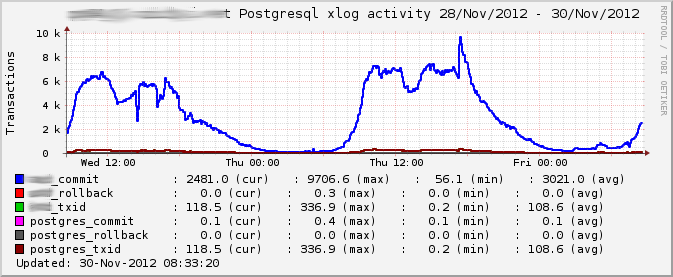
We have a PostgreSQL server with 16 cores that was apparently running well below its capacity: load something between 3.0 and 4.0, around 200 active database connections, almost all always being <IDLE>. However, when the tps count reached 7k transactions per second, things started to throttle, and pgbouncer (running on the database server) started listing up to half of the client connections to be in cl_waiting state. Load was still low, but application performance was bad. The culprit turned out to be the kernel scheduler, fairly distributing CPU time among all running processes. There's one single pgbouncer process, but hundreds of postgres processes. A simple renice of the pgbouncer process did the trick and gave us another extra 2k tps.

29 November 2012

Russ Allbery: Review: American Gods

Review: American Gods, by Neil Gaiman
Publisher: HarperTorch
Copyright: July 2001
Printing: May 2002
ISBN: 0-380-78903-5
Format: Mass market
Pages: 588
At the start of American Gods, Shadow is in prison. He's done three years of a sentence of six and is about to get released on parole. He has a wife and a job waiting for him and every hope of getting back to a good life. None of that happens. The day he's released, he finds out his wife died in a car accident. The job is gone too; it was an offer from his best friend, who died in the same accident. Numb, an ex-con, with no job prospects, he's recruited by a strange man named Wednesday, with the help of a leprechaun named Mad Sweeney, to drive Wednesday around the country, run errands for him, hurt people if absolutely necessary, and hold his vigil if he dies. And that's how Shadow is drawn into the conflict between old gods and young, between the gods that immigrants brought to America from the old world and the flashy new gods of technology and media that America is creating for itself. With native American gods and cultural legends watching around the edges. I first read American Gods shortly after it came out and before I started writing reviews, so this is a re-read. It's a book I'm glad I re-read before reviewing. The first time I read it, I was thoroughly engrossed and thought it was excellent. This time, I was entertained, but surprised at how slowly it moved, how disconnected it sometimes felt, and how little substance there was to the plot. Reading American Gods involves spending lots of time with Shadow, and I think one's reactions to this book will vary a lot based on how much one likes him as a character. Shadow is very withdrawn, very detached from the world, and quietly matter-of-fact in how he goes through his life. He's been through some major shocks and has been severed fairly thoroughly from society by three years in prison, and he doesn't reconnect easily. To some readers, such as myself, this comes across as taciturn competence and quiet observation, two things that I greatly enjoy reading about. I liked Shadow, liked reading between the lines for hints at his feelings, and sympathized a lot with his emotional state. But I can easily see an alternative reading that makes him a cipher or, worse, a blank spot in the book into which the reader has to insert themselves. One has to work at seeing Shadow's character and finding some sympathy for the degree to which he stays separate from the world. American Gods does have a plot, but it's the sort of plot that allows for endless digressions, background stories, and side meetings. In that, it reminded me less of Gaiman's other novels and more of several arcs of Sandman. I think it's worthwhile to think of this less as a novel and more as an extended ramble through the world as Gaiman sees it, full of mythology, stories, quirky people understanding the world in their own ways, and upwellings of the sacred and significant in the most unexpected of places. For example, the holy places of America in American Gods, analogous to the multiple small sacred places and old ruins in Europe, are roadside attractions, via a line of argument that makes much more sense than it has any right to and demonstrates a canny understanding of the expression of American entrepreneurial culture. As with much Gaiman, reading with Wikipedia or another mythological resource at hand is a good idea. Even if you have a good general knowledge of the most common mythology studied in the US, you probably won't recognize many of the figures Gaiman draws on: Czernobog, for example, or Wisakedjak. Part of the fun of this book is seeing Gaiman humanize them and embed them in modern culture and modern concerns while retaining their mythological edge and strangeness. As any reader of Sandman can tell you, this is one of Gaiman's strengths as a writer, and he does it well here. The bits with the undertakers Mr. Ibis and Mr. Jacquel (Thoth and Anubis) are absolutely brilliant and probably the best sections of the book (although Sam's exchange with the Men in Black is a strong contender).
"Back in my day, we had it all set up. You lined up when you died, and you'd answer for your evil deeds and for your good deeds, and if your evil deeds outweighed a feather, we'd feed your soul and your heart to Ammet, the Eater of Souls." "He must have eaten a lot of people." "Not as many as you'd think. It was a really heavy feather. We had it made special. You had to be pretty damn evil to tip the scales on that baby."
Like so much of Gaiman's work, this is the sort of book that contributed a half-dozen quotes to my quote file during my first reading. Gaiman always impresses me by not only managing to portray gods as human without losing the numinous edge, but sustaining that portrayal through very extended contact with the same god. And despite the interlude with the undertakers, the long interlude in small-town life in Lakeside, and the numerous other digressions and meanderings of a book that's not in much of a hurry to get anywhere, there is a plot and a definite conclusion, and Gaiman has some interesting twists in store at the end of that road. There's a lot of philosophical currents going on under the surface, not all of which cohere, but Gaiman does pull a lot of them together. The resolution can be a bit of an anticlimax, but I think it's a fitting one that's true to the nature of the story. I didn't enjoy this as much on the second reading as I did on the first. It didn't feel quite as coherent as I'd remembered it, and the meandering pace occasionally made the story feel stretched. But I do like Shadow, I love spending time in Gaiman's head and with his portrayals of deities, and American Gods is a treasure of great quotes. If you enjoy Gaiman's other work and aren't looking for a lot of plot and forward-moving energy, this is definitely recommended. Rating: 7 out of 10

28 November 2012

Alberto Garc a: QEMU and open hardware: SPEC and FMC TDC

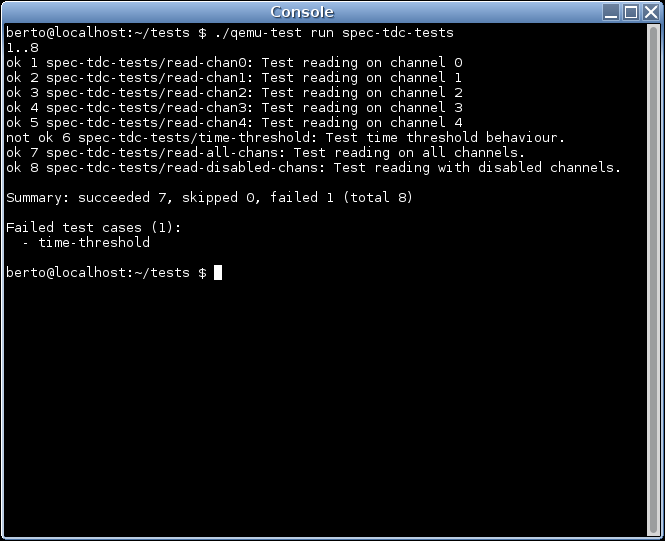
Working with open hardware Some weeks ago at LinuxCon EU in Barcelona I talked about how to use QEMU to improve the reliability of device drivers. At Igalia we have been using this for some projects. One of them is the Linux IndustryPack driver. For this project I virtualized two boards: the TEWS TPCI200 PCI carrier and the GE IP-Octal 232 module. This work helped us find some bugs in the device driver and improve its quality. Now, those two boards are examples of products available in the market. But fortunately we can use the same approach to develop for hardware that doesn t exist yet, or is still in a prototype phase. Such is the case of a project we are working on: adding Linux support for this FMC Time-to-digital converter.
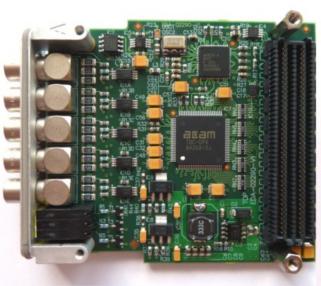
FMC TDC
This piece of hardware is designed by CERN and is published under the CERN Open Hardware Licence, which, in their own words is to hardware what the General Public Licence (GPL) is to software . The Open Hardware repository hosts a number of projects that have been published under this license. Why we use QEMU So we are developing the device driver for this hardware, as my colleague Samuel explains in his blog. I m the responsible of virtualizing it using QEMU. There are two main reasons why we want to do this:
  1. Limited availability of the hardware: although the specification is pretty much ready, this is still a prototype. The board is not (yet) commercially available. With virtual hardware, the whole development team can have as many boards as it needs.
  2. Testing: we can test the software against the virtual driver, force all kinds of conditions and scenarios, including the ones that would probably require us to physically damage the board.
While the first point might be the most obvious one, testing the software is actually the one we re more interested in. My colleague Miguel wrote a detailed blog post on how we have been using QEMU to do testing. Writing the virtual hardware Writing a virtual version of a particular piece of hardware for this purpose is not as hard as it might look. First, the point is not to reproduce accurately how the hardware works, but rather how it behaves from the operating system point of view: the hardware is a black box that the OS talks to. Second, it s not necessary to have a complete emulation of the hardware, there s no need to support every single feature, particularly if your software is not going to use it. The emulation can start with the basic functionality and then grow as needed. The FMC TDC, for example, is an FMC card which is in our case connected to a PCIe bridge called SPEC (also available in the Open Hardware repository). We need to emulate both cards in order to have a working system, but the emulation is, at the moment, treating both as if they were just one, which makes it a bit easier to have a prototype and from the device driver point of view doesn t really make a difference. Later the emulation can be split in two as I did with with TPCI200 and IP-Octal 232. This would allow us to support more FMC hardware without having to rewrite the bridging code. There s also code in the emulation to force different kind of scenarios that we are using to test if the driver behaves as expected and handles errors correctly. Those tests include the simulation of input in the any of the lines, simulation of noise, DMA errors, etc.
Tests
And we have written a set of test cases and a continuous integration system, so the driver is automatically tested every time the code is updated. If you want details on this I recommend you again to read Miguel s post.

Russ Allbery: Review: Emissaries from the Dead

Review: Emissaries from the Dead, by Adam-Troy Castro
Series: Andrea Cort #1
Publisher: Eos
Copyright: March 2008
ISBN: 0-06-144372-7
Format: Mass market
Pages: 387
As a small child, Andrea Cort was a colonist on Bocai, part of a utopian project to create a mixed human and Bocaian community. Until, that is, all the members of the community woke up one day and started horrifically murdering each other for reasons that none of the survivors could ever explain. Now, she's protected from extradition by a life contract with the Diplomatic Corps and serves them as a special investigator. The scene of the investigation of this book is the strange habitat One One One. The habitat was created by the AIsource, an alliance of artificial intelligences now independent of their original creators. It's in deep space, far from any sun, and would have remained entirely unknown to the other inhabitants of the galaxy if the AIsource hadn't announced its presence. The choice to announce it was baffling, since it contains a sentient species entirely under the control of the AIsource, something that's against the shared rules of all the other species, but which they wouldn't have known about if the AIsource hadn't drawn their attention to it. After extensive negotiations, one unofficial human research group has been allowed access, and now two of the members of that group have been murdered. That's where Andrea comes in. This is Castro's first original solo novel, but he has a background in short fiction in the SF, fantasy, and horror genres and some previous collaborations and shared universe writing. The horror shows through a bit more than I'd personally prefer: the preface briefly describing Andrea's past would have been sufficient, but Castro goes back and shows it in horrific and gruesome detail as a flashback. His fight scenes are also strangely and disturbingly detailed. If you have a sensitive stomach, be aware that you may want to skim some parts of this. The overall construction of this novel, though, is not horror. It's an SF murder mystery, about halfway between a procedural and a noir detective story. Andrea does follow a coherent procedure and uses an investigative technique more sophisticated than stirring the pot and seeing what jumps out, making it not quite noir, but it has the noir tendency towards story progress via attacks on the detective and quite a lot of ongoing tension. It also involves quite a lot of setup; be aware going in that we get over a hundred pages of description of the various research group members, the details of the crimes, possible motives, and the details of the artificial habitat without a lot of forward progress on understanding the crime. Castro puts a lot of work into the design of the habitat despite leaving it mostly in the background. It could easily serve as the backdrop of a more typical Big Dumb Object SF novel. The habitable zone where the research team is and where all of Andrea's investigations take place is the effective "top" of the habitat, covered in dense foilage to which the native sentient species clings and crawls its entire life. Below is an effectively infinite fall into crushing acidic atmosphere. Castro managed to not set off my dislike of heights too badly, in part because he focuses more on Andrea's own dislike of heights rather than vividly describing the drop, but it's a constant presence throughout the novel and adds a persistant background tension. It also leads to some minor but neat clashes of perspective in conversations with the native species. For most of the book, I would have described Emissaries from the Dead as an enjoyable but not horribly original detective novel with a neat science fiction background. But there are several interesting ending twists that I won't spoil and some decisions that quite surprised me. They don't have a large effect on the plot of this book, but they make for a fascinating hook and setup for later books in the series (and I see there is a sequel). It's definitely not the sort of thing that you want spoiled before reading this book, so avoid reading blurbs and details about the sequel before reading this one. I wouldn't go out of my way to hunt down this book, but it's solid, enjoyable detective SF with a surprisingly good ending. I can see why it won the Philip K. Dick award (for best SF paperback original). Mildly recommended. Followed by The Third Claw of God. Rating: 7 out of 10

Paul Tagliamonte: debuild.me update

It s working! (ish) Here are some snapshots (and fully automated as much as I could) This comprises a lot of work, so I m fairly proud of it. Feel free to browse over at debuild.me. Patches & feedback welcome!

27 November 2012

Christian Perrier: Tristan da Cunha

I happen to be a great fan of ocean races, so like many, particularly here in France, I'm following the Vend e Globe ocean race, alone around the world on 60-feet IMOCA race ships, without stop or assistance. In its early editions, Vend e Globe was easy to explain : start from Les Sables d'Olonne and come back there after going around Antarctica by leaving it to starboard. Period. Now, it's a bit more complicated as, for security reasons, the sailors have to pass a few points meant to prevent them from going too south (during first editions, some sailors went as south as 65 S). Sailors are currently heading "down" the Atlantic and will probably pass in the vicinity of the Tristan da Cunha island. This island has always been fascinating to me. It is the remotest point inf the world with a permanent population. The closest inhabited land is over 2800km away. 271 people live there. No airport. No regular ship line. Only fishing boats from time to time and that's all. It's probably hard to imagine what is the life there....but I find this fascinating, in some way. Maybe one of these parts of the world where I would like to go and never will. And there's even a volcano (indeed, the island *is* a volcano) : I wonder if there is a Linux user over there...

Daniel Kahn Gillmor: more proprietary workarounds, sigh

In supporting a labful of Debian GNU/Linux machines with NFS-mounted home directories, i find some of my users demand a few proprietary programs. Adobe Flash is one of the most demanded, in particular because some popular streaming video services (like Amazon Prime and Hulu) seem to require it. I'm not a fan of proprietary network services, but i'm happy to see that Amazon Prime takes Linux support seriously enough to direct users to Adobe's Linux Flash "Protected Content" troubleshooting page (Amazon Prime's rival NetFlix, by comparison, has an abysmal record on this platform). Of course, none of this will work on any platform but i386, since the flash player is proprietary software and its proprietors have shown no interest in porting it or letting others port it :( One of the main issues with proprietary network services is their inclination to view their customer as their adversary, as evidenced by various DRM schemes. In two examples, the Flash Player's DRM module appears to arbitrarily break when you use one home directory across multiple machines. Also, the DRM module appears to depend on HAL, which is being deprecated by most of the common distributions. Why bother with this kind of gratuitous breakage? We know that video streaming can and does work fine without DRM. With modern browsers, freely-formatted video, and HTML5 video tags, video just works, and it works under the control of the user, on any platform. But Flash appears to throw up unnecessary hurdles, requiring not only proprietary code, but deprecated subsystems and fiddly workarounds to get it functional. I'm reminded of Mako's concept of "antifeatures" -- how much engineering time and effort went into making this system actually be less stable and reliable than it would have otherwise been? How could that work have been better-directed? Tags: antifeatures, flash, hal, proprietary, streaming

26 November 2012

John Sullivan: Santiago de Compostela

I've put up my nearly unedited, unsorted, and uncommented photos from my recent trip to Santiago de Compostela, Spain, for the Libre Software World Conference. It was a beautiful place (and a great conference) -- I hope to write more about it soon.

Steve Langasek: Upstart in Debian

Good news, everyone! So as of last Sunday, this works on all Linux archs in Debian unstable and gives you a modern version of upstart:
echo 'Yes, do as I say!'   apt-get -o DPkg::options=--force-remove-essential -y --force-yes install upstart
Thanks to the ifupdown, sysvinit, and udev maintainers for their cooperation in getting upstart support in place; to the Debian release team for accomodating the late changes needed for upstart to be supported in wheezy; and to Scott for his past maintenance of upstart in Debian. Benchmarking One of the consequences is that it's now possible to do meaningful head-to-head comparisons of boot speed between sysvinit (with startpar), upstart, and systemd. At one time or another people have tested systemd vs. sysvinit when using bash as /bin/sh, and upstart vs. sysvinit, and systemd vs. sysvinit+startpar, and there are plenty of bootcharts floating around showing results of one init system or another on one distro or another, but I'm not aware of anyone having done a real, fair comparison of the three solutions, changing nothing but the init system. I've done some initial comparisons in a barebones sid VM, and the results are definitely interesting. Sysvinit with startpar (the default in Debian) can boot a stock sid install, with no added services, in somewhere between 3.37 and 3.42 seconds (three runs). That's not a whole lot, but on the other hand this is a system with a single filesystem and no interesting services yet. Is this really as fast as we can boot? No, even this minimal system can boot faster. Testing with upstart shows that upstart can do the same job in between 3.03 and 3.19 seconds (n=3, mean=3.09). This confirms what we'd already seen in Ubuntu, that it makes a difference to boot speed to have filesystem mounting handled by an integrated process that understands the whole system instead of as a group of serialized shell scripts. What about systemd? The same test gives a boot time between 2.32 and 2.85 seconds (n=4, mean=2.48). Interesting; what would make systemd faster than upstart in sid? Well, a quick look at the system shows one possible contributing factor: the rsyslog package in Debian has a systemd unit file, but not an upstart job file. Dropping in the /etc/init/rsyslog.conf from Ubuntu has a noticeable impact, and brings the upstart boot time down nearer to that of systemd (2.78-3.03s, n=5, mean=2.92). Besides telling me that it's time to start spamming Debian maintainers with wishlist bugs asking them to include upstart jobs in their packages, this suggests that the remaining difference in boot time may be due to the outstanding init scripts in rcS.d that are made built-in no-ops by systemd but not (yet) by upstart in Debian (e.g., hwclock, hostname, udev-mtab). (In Ubuntu, /etc/rcS.d has long since been emptied out in favor of upstart jobs in the common case, since the time it takes to get to runlevel=2 is definitely a major issue for boot speed and boot parallelization.) It also gives the lie to the claim that's been made in various places that spawning shells is a major bottleneck for upstart vs. systemd. More study is certainly needed to confirm this, but at least this naive first test suggests that in spite of the purported benefits of hard-coding boot-time policies in C code, upstart with its default degree of runtime configurability is at least in the ballpark of systemd. Indeed, when OpenSuSE switched from upstart to systemd, it seems that something else in the stack managed to nullify any benefit from improving the boot-time performance of apparmor. Contrary to what some would have you believe, systemd is not some kind of silver bullet for boot speed. Upstart, with its boot-time flexibility and its long history of real-world testing in Ubuntu, is a formidable competitor to systemd in the boot speed department - and a solid solution to the many longstanding boot-time ordering bugs in Debian, which still affect users of sysvinit. I've published the bootcharts for the above tests here. Between the fact that Debian's bootchart package logs by default to /var/log/bootchart.tgz (thus overwriting on every boot) and the fact that these tests are in a VM, I haven't bothered to include the raw data, just the bootcharts themselves. The interested reader can probably generate more interesting boot charts of their own anyway - in particular, it will be interesting to see how the different init systems perform with more complicated filesystem layouts, or when booting a less trivial set of services. Other musings The boot charts have been created with the bootchart package rather than with bootchart2. For one thing, it turns out that bootchart2 includes systemd units, not init scripts; so when replacing bootchart with bootchart2, the non-matching init script is left behind and systemd in particular gets terribly confused. This is now reported as Bug #694403. In an amusing twist, while I was experimenting with bootchart2, I also noticed that having systemd installed would slow down booting with other init systems, because systemd installs udev rules which take a noticeable amount of time to run a helper command at boot even though the helper should be a no-op. So if you're doing boot speed testing of other init systems, be sure you don't have systemd on the system at the time!

Russell Coker: Links November 2012

Julian Treasure gave an informative TED talk about The 4 Ways Sound Affects US [1]. Among other things he claims that open plan offices reduce productivity by 66%! He suggests that people who work in such offices wear headphones and play bird-songs. Naked Capitalism has an interesting interview between John Cusack and Jonathan Turley about how the US government policy of killing US citizens without trial demonstrates the failure of their political system [2]. Washington s blog has an interesting article on the economy in Iceland [3]. Allowing the insolvent banks to go bankrupt was the best thing that they have ever done for their economy. Clay Shirky wrote an insightful article about the social environment of mailing lists and ways to limit flame-wars [4]. ZRep is an interesting program that mirrors ZFS filesystems via regular snapshots and send/recv operations [5]. It seems that it could offer similar benefits to DRBD but at the file level and with greater reliability. James Lockyer gave a movingTEDx talk about his work in providing a legal defence for the wrongly convicted [6]. This has included overturning convictions after as much as half a century in which the falsely accused had already served a life sentence. Nathan Myers wrote an epic polemic about US government policy since 9-11 [7]. It s good to see that some Americans realise it s wrong. There is an insightful TED blog post about TED Fellow Salvatore Iaconesi who has brain cancer [8]. Apparently he had some problems with medical records in proprietary formats which made it difficult to get experts to properly assess his condition. Open document standards can be a matter of life and death and should be mandated by federal law. Paul Wayper wrote an interesting and amusing post about Emotional Computing which compares the strategies of Apple, MS, and the FOSS community among other things [9]. Kevin Allocca of Youtube gave an insightful TED talk about why videos go viral [10]. Jason Fried gave an interesting TED talk Why Work Doesn t Happen at Work [11]. His main issues are distraction and wasted time in meetings. He gives some good ideas for how to improve productivity. But they can also be used for sabotage. If someone doesn t like their employer then they could call for meetings, incite managers to call meetings, and book meetings so that they don t follow each other and thus waste more of the day (EG meetings at 1PM and 3PM instead of having the second meeting when the first finishes). Shyam Sankar gave an interesting TED talk about human computer cooperation [12]. He describes the success of human-computer partnerships in winning chess tournaments, protein folding, and other computational challenges. It seems that the limit for many types of computation will be the ability to get people and computers to work together efficiently. Cory Doctorow wrote an interesting and amusing article for Locus Magazine about some of the failings of modern sci-fi movies [13]. He is mainly concerned with pointless movies that get the science and technology aspects wrong and the way that the blockbuster budget process drives the development of such movies. Of course there are many other things wrong with sci-fi movies such as the fact that most of them are totally implausible (EG aliens who look like humans). The TED blog has an interesting interview with Catarina Mota about hacker spaces and open hardware [14]. Sociological Images has an interesting article about sporting behaviour [15]. They link to a very funny youtube video of a US high school football team who make the other team believe that they aren t playing until they win [16] Related posts:
  1. Links April 2012 Karen Tse gave an interesting TED talk about how to...
  2. Links March 2012 Washington s Blog has an informative summary of recent articles about...
  3. Links November 2011 Forbes has an interesting article about crowd-sourcing by criminals and...

25 November 2012

Steve Kemp: A busy few weeks - bah humbug

The following companies are amongst those showing Christmas Adverts on television before the start of December: I will boycott these companies until next year. In happier news I've spent the past week or two replacing the monitoring system that we use at work. Our previous monitoring system had been struggling to keep up with the sheer number of tests it was being asked to process. This was partly because we carry out many ping-tests, ssh-tests, http-tests, dns-tests, etc. The other reason was that our monitoring system was a behemoth of threaded-ruby, which all ran upon a single host. This made adding another monitoring host a complex undertaking. The new solution uses a work-queue: The code is open-source, written in Ruby, and available here: I've completed the process of tidying up the code to the extent I'm happy with it, and I believe I've also abstracted away the work-specific pieces of the code. That said I'd not be surprised if it needs a few minor tweaks before it it useful for other people.

Dirk Eddelbuettel: digest 0.6.0

A new version of the digest package (which generates hash function summaries for arbitrary (and possibly nested) R objects using any of the standard md5, sha-1, sha-256, sha-512 or crc32 algorithms) is now on CRAN, and I will push the corresponding version into Debian in a moment. For this release, Hannes Muehleisen added support for sha-512 using an older standalone function by Aaron D. Gifford which I had to whip into slightly more portable shape to work on Windows. (Hint: uint32_t from stdint.h, not u_int32_t) CRANberries provides the usual summary of changes to version 0.5.2. As usual, our package is available via the R-Forge page leading to svn and tarball access, my digest page and the local directory here.

Olivier Berger: Presented Generating Linked Data descriptions of Debian packages in the Debian PTS at the Paris Mini DebConf

I have made a presentation at the Paris MinDebconf 2012 about the work I ve done to bring more semantic meta-data to the Debian PTS (see previous posts). Here are my slides :
<iframe allowfullscreen="allowfullscreen" frameborder="0" height="356" marginheight="0" marginwidth="0" mozallowfullscreen="mozallowfullscreen" scrolling="no" src="http://www.slideshare.net/slideshow/embed_code/15336720" style="border:1px solid #CCC;border-width:1px 1px 0;margin-bottom:5px" webkitallowfullscreen="webkitallowfullscreen" width="427"> </iframe>
Generating Linked Data descriptions of Debian packages in the Debian PTS from olberger
Also available here as PDF.

Next.

Previous.