Search Results: "ag"

22 May 2016

Reproducible builds folks: Reproducible builds: week 56 in Stretch cycle

What happened in the Reproducible Builds effort between May 15th and May 21st 2016: Media coverage Blog posts from our GSoC and Outreachy contributors: Documentation update Ximin Luo clarified instructions on how to set SOURCE_DATE_EPOCH. Toolchain fixes Other upstream fixes Packages fixed The following 18 packages have become reproducible due to changes in their build dependencies: abiword angband apt-listbugs asn1c bacula-doc bittornado cdbackup fenix gap-autpgrp gerbv jboss-logging-tools invokebinder modplugtools objenesis pmw r-cran-rniftilib x-loader zsnes The following packages have become reproducible after being fixed: Some uploads have fixed some reproducibility issues, but not all of them: Patches submitted that have not made their way to the archive yet: Reproducibility-related bugs filed: Package reviews 51 reviews have been added, 19 have been updated and 15 have been removed in this week. 22 FTBFS bugs have been reported by Chris Lamb, Santiago Vila, Niko Tyni and Daniel Schepler. tests.reproducible-builds.org Misc. This week's edition was written by Reiner Herrmann and Holger Levsen and reviewed by a bunch of Reproducible builds folks on IRC.

Antonio Terceiro: Adopting pristine-tar

As of yesterday, I am the new maintainer of pristine-tar. As it is the case for most of Joey Hess creations, it is an extremely useful tool, and used in a very large number of Debian packages which are maintained in git. My first upload was most of a terrain recognition nature: I did some housekeeping tasks, such as making the build idempotent and making sure all binaries are built with security hardening flags, and wrote a few automated test cases to serve as build-time and run-time regression test suite. No functional changes have been made. As Joey explained when he orphaned it, there are a few technical challenges involved in making sure pristine-tar stays useful in the future. Although I did read some of the code, I am not particularly familiar with the internals yet, and will be more than happy to get co-maintainers. If you are interested, please get in touch. The source git repository is right there.

21 May 2016

Petter Reinholdtsen: French edition of Lawrence Lessigs book Cultura Libre on Amazon and Barnes & Noble

A few weeks ago the French paperback edition of Lawrence Lessigs 2004 book Cultura Libre was published. Today I noticed that the book is now available from book stores. You can now buy it from Amazon ($19.99), Barnes & Noble ($?) and as always from Lulu.com ($19.99). The revenue is donated to the Creative Commons project. If you buy from Lulu.com, they currently get $10.59, while if you buy from one of the book stores most of the revenue go to the book store and the Creative Commons project get much (not sure how much less). I was a bit surprised to discover that there is a kindle edition sold by Amazon Digital Services LLC on Amazon. Not quite sure how that edition was created, but if you want to download a electronic edition (PDF, EPUB, Mobi) generated from the same files used to create the paperback edition, they are available from github.

20 May 2016

Zlatan Todori : 4 months of work turned into GNOME, Debian testing based tablet

Huh, where do I start. I started working for a great CEO and great company known as Purism. What is so great about it? First of all, CEO (Todd Weaver), is incredible passionate about Free software. Yes, you read it correctly. Free software. Not Open Source definition, but Free software definition. I want to repeat this like a mantra. In Purism we try to integrate high-end hardware with Free software. Not only that, we want our hardware to be Free as much as possible. No, we want to make it entirely Free but at the moment we don't achieve that. So instead going the way of using older hardware (as Ministry of Freedom does, and kudos to them for making such option available), we sacrifice this bit for the momentum we hope to gain - that brings growth and growth brings us much better position when we sit at negotiation table with hardware producers. If negotiations even fail, with growth we will have enough chances to heavily invest in things such as openRISC or freeing cellular modules. We want to provide in future entirely Free hardware&software device that has integrated security and privacy focus while it is easy to use and convenient as any other mainstream OS. And we choose to currently sacrifice few things to stay in loop. Surely that can't be the only thing - and it isn't. Our current hardware runs entirely on Free software. You can install Debian main on it and all will work out of box. I know I did this and enjoy my Debian more than ever. We also have margin share program where part of profit we donate to Free software projects. We are also discussing a lot of new business model where our community will get a lot of influence (stay tuned for this). Besides all this, our OS (called PureOS - yes, a bit misfortune that we took the name of dormant distribution), was Trisquel based but now it is Debian testing based. Current PureOS 2.0 is coming with default DE as Cinnamom but we are already baking PureOS 3.0 which is going to come with GNOME Shell as default. Why is this important? Well, around 12 hours ago we launched a tablet campaign on Indiegogo which comes with GNOME Shell and PureOS as default. Not one, but two tablets actually (although we heavily focus on 11" one). This is the product of mine 4 months dedicated work at Purism. I must give kudos to all Purism members that pushed their parts in preparation for this campaign. It was hell of a ride. Librem11 I have also approached (of course!) Debian for creation of OEM installations ISOs for our Librem products. This way, with every sold Librem that ships with Debian preinstalled, Debian will get donation. It is our way to show gratitude to Debian for all the work our community does (yes, I am still extremely proud Debian dude and I will stay like that!). Oh yes, I am the chief technology person at Purism, and besides all goals we have, I also plan (dream) about Purism being the company that has highest number of Debian Developers. In that terms I am very proud to say that Matthias Klumpp became part of Purism. Hopefully we soon extend the number of Debian population in Purism. Of course, I think it is fairly known that I am easy to approach so if anyone has any questions (as I didn't want this post to be too long) feel free to contact me. Also - in Free software spirit - we welcome any community engagement, suggestion and/or feedback.

19 May 2016

Matthew Garrett: Your project's RCS history affects ease of contribution (or: don't squash PRs)

Github recently introduced the option to squash commits on merge, and even before then several projects requested that contributors squash their commits after review but before merge. This is a terrible idea that makes it more difficult for people to contribute to projects.

I'm spending today working on reworking some code to integrate with a new feature that was just integrated into Kubernetes. The PR in question was absolutely fine, but just before it was merged the entire commit history was squashed down to a single commit at the request of the reviewer. This single commit contains type declarations, the functionality itself, the integration of that functionality into the scheduler, the client code and a large pile of autogenerated code.

I've got some familiarity with Kubernetes, but even then this commit is difficult for me to read. It doesn't tell a story. I can't see its growth. Looking at a single hunk of this diff doesn't tell me whether it's infrastructural or part of the integration. Given time I can (and have) figured it out, but it's an unnecessary waste of effort that could have gone towards something else. For someone who's less used to working on large projects, it'd be even worse. I'm paid to deal with this. For someone who isn't, the probability that they'll give up and do something else entirely is even greater.

I don't want to pick on Kubernetes here - the fact that this Github feature exists makes it clear that a lot of people feel that this kind of merge is a good idea. And there are certainly cases where squashing commits makes sense. Commits that add broken code and which are immediately followed by a series of "Make this work" commits also impair readability and distract from the narrative that your RCS history should present, and Github present this feature as a way to get rid of them. But that ends up being a false dichotomy. A history that looks like "Commit", "Revert Commit", "Revert Revert Commit", "Fix broken revert", "Revert fix broken revert" is a bad history, as is a history that looks like "Add 20,000 line feature A", "Add 20,000 line feature B".

When you're crafting commits for merge, think about your commit history as a textbook. Start with the building blocks of your feature and make them one commit. Build your functionality on top of them in another. Tie that functionality into the core project and make another commit. Add client support. Add docs. Include your tests. Allow someone to follow the growth of your feature over time, with each commit being a chapter of that story. And never, ever, put autogenerated code in the same commit as an actual functional change.

People can't contribute to your project unless they can understand your code. Writing clear, well commented code is a big part of that. But so is showing the evolution of your features in an understandable way. Make sure your RCS history shows that, otherwise people will go and find another project that doesn't make them feel frustrated.

(Edit to add: Sarah Sharp wrote on the same topic a couple of years ago)

comment count unavailable comments

Antoine Beaupr : My free software activities, May 2016

Debian Long Term Support (LTS) This is my 6th month working on Debian LTS, started by Raphael Hertzog at Freexian. This is my largest month so far, for which I had requested 20 hours of work.

Xen work I spent the largest amount of time working on the Xen packages. We had to re-roll the patches because it turned out we originally just imported the package from Ubuntu as-is. This was a mistake because that package forked off the Debian packaging a while ago and included regressions in the packaging itself, not just security fixes. So I went ahead and rerolled the whole patchset and tested it on Koumbit's test server. Brian May then completed the uploaded, which included about 40 new patches, mostly from Ubuntu.

Frontdesk duties Next up was the frontdesk duties I had taken this week. This was mostly uneventful, although I had forgotten how to do some of the work and thus ended up doing extensive work on the contributor's documentation. This is especially important since new contributors joined the team! I also did a lot of Debian documentation work in my non-sponsored work below. The triage work involved chasing around missing DLAs, triaging away OpenJDK-6 (for which, let me remind you, security support has ended in LTS), raised the question of Mediawiki maintenance.

Other LTS work I also did a bunch of smaller stuff. Of importance, I can note that I uploaded two advisories that were pending from April: NSS and phpMyAdmin. I also reviewed the patches for the ICU update, since I built the one for squeeze (but didn't have time to upload before squeeze hit end-of-life). I have tried to contribute to the NTP security support but that was way too confusing to me, and I have left it to the package maintainer which seemed to be on top of things, even if things mean complete chaos and confusion in the world of NTP. I somehow thought that situation had improved with the recent investments in ntpsec and ntimed, but unfortunately Debian has not switched to the ntpsec codebase, so it seems that the NTP efforts have diverged in three different projects instead of closing into a single, better codebase.

Future LTS work This is likely to be my last month of work on LTS until September. I will try to contribute a few hours in June, but July and August will be very busy for me outside of Debian, so it's unlikely that I contribute much to the project during the summer. My backlog included those packages which might be of interest to other LTS contributors:
  • libxml2: no upstream fix, but needs fixing!
  • tiff ,3 : same mess
  • libgd2: maintainer contacted
  • samba regression: mailed bug #821811 to try to revive the effort
  • policykit-1: to be investigated
  • p7zip: same

Other free software work

Debian documentation I wrote an detailed short guide to Debian package development, something I felt was missing from the existing corpus, which seems to be too focus in covering all alternatives. My guide is opinionated: I believe there is a right and wrong way of doing things, or at least, there are best practices, especially when just patching packages. I ended up retroactively publishing that as a blog post - now I can simply tag an item with blog and it shows up in the blog. (Of course, because of a mis-configuration on my side, I have suffered from long delays publishing to Debian planet, so all the posts dates are off in the Planet RSS feed. This will hopefully be resolved around the time this post is published, but this allowed me to get more familiar with the Planet Venus software, as detailed in that other article.) Apart from the guide, I have also done extensive research to collate information that allowed me to create workflow graphs of the various Debian repositories, which I have published in the Debian Release section of the Debian wiki. Here is the graph: It helps me understand how packages flow between different suites and who uploads what where. This emerged after I realized I didn't really understand how "proposed updates" worked. Since we are looking at implementing a similar process for the security queue, I figured it was useful to show what changes would happen, graphically. I have also published a graph that describes the relations between different software that make up the Debian archive. The idea behind this is also to provide an overview of what happens when you upload a package in the Debian archive, but it is more aimed at Debian developers trying to figure out why things are not working as expected. The graphs were done with Graphviz, which allowed me to link to various components in the graph easily, which is neat. I also prefered Graphviz over Dia or other tools because it is easier to version and I don't have to bother (too much) about the layout and tweaking the looks. The downside is, of course, that when Graphviz makes the wrong decision, it's actually pretty hard to make it do the right thing, but there are various workarounds that I have found that made the graphs look pretty good. The source is of course available in git but I feel all this documentation (including the guide) should go in a more official document somewhere. I couldn't quite figure out where. Advice on this would be of course welcome.

Ikiwiki I have made yet another plugin for Ikiwiki, called irker, which enables wikis to send notifications to IRC channels, thanks to the simple irker bot. I had trouble with Irker in the past, since it was not quite reliable: it would disappear from channels and not return when we'd send it a notification. Unfortunately, the alternative, the KGB bot is much heavier: each repository needs a server-side, centralized configuration to operate properly. Irker's design is simpler and more adapted to a simple plugin like this. Let's hope it will work reliably enough for my needs. I have also suggested improvements to the footnotes styles, since they looked like hell in my Debian guide. It turns out this was an issue with the multimarkdown plugin that doesn't use proper semantic markup to identify footnotes. The proper fix is to enable footnotes in the default Discount plugin, which will require another, separate patch. Finally, I have done some improvements (I hope!) on the layout of this theme. I made the top header much lighter and transparent to work around an issue where followed anchors would be hidden under the top header. I have also removed the top menu made out of the sidebar plugin because it was cluttering the display too much. Those links are all on the frontpage anyways and I suspect people were not using them so much. The code is, as before, available in this git repository although you may want to start from the new ikistrap theme that is based on Bootstrap 4 and that may eventually be merged in ikiwiki directly.

DNS diagnostics Through this interesting overview of various *ping tools, I got found out about the dnsdiag tool which currently allows users to do DNS traces, tampering detection and ping over DNS. In the hope of packaging it into Debian, I have requested clarifications regarding a modification to the DNSpython library the tool uses. But I went even further and boldly opened a discussion about replacing DNSstuff, the venerable DNS diagnostic tools that is now commercial. It is somewhat surprising that there is no software that has even been publicly released that does those sanity checks for DNS, given how old DNS is. Incidentally, I have also requested smtpping to be packaged in Debian as well but httping is already packaged.

Link checking In the process of writing this article, I suddenly remembered that I constantly make mistakes in the various links I post on my site. So I started looking at a link checker, another tool that should be well established but that, surprisingly, is not quite there yet. I have found this neat software written in Python called LinkChecker. Unfortunately, it is basically broken in Debian, so I had to do a non-maintainer upload to fix that old bug. I managed to force myself to not take over maintainership of this orphaned package but I may end up doing just that if no one steps up the next time I find issues in the package. One of the problems I had checking links in my blog is that I constantly refer to sites that are hostile to bots, like the Debian bugtracker and MoinMoin wikis. So I published a patch that adds a --no-robots flag to be able to crawl those sites effectively. I know there is the W3C tool but it's written in Perl, and there's probably zero chance for me to convince those guys to bypass robots exclusion rules, so I am sticking to Linkchecker.

Other Debian packaging work At my request, Drush has finally been removed from Debian. Hopefully someone else will pick up that work, but since it basically needs to be redone from scratch, there was no sense in keeping it in the next release of Debian. Similarly, Semanticscuttle was removed from Debian as well. I have uploaded new versions of tuptime, sopel and smokeping. I have also file a Request For Help for Smokeping. I am happy to report there was a quick response and people will be stepping up to help with the maintenance of that venerable monitoring software.

Background radiation Finally, here's the generic background noise of me running around like a chicken with his head cut off: Finally, I should mention that I will be less active in the coming months, as I will be heading outside as the summer finally came! I somewhat feel uncomfortable documenting publicly my summer here, as I am more protective of my privacy than I was before on this blog. But we'll see how it goes, maybe you'll hear non-technical articles here again soon!

Steve Kemp: Accidental data-store .. is go!

A couple of days ago I wrote::
The code is perl-based, because Perl is good, and available here on github: .. TODO: Rewrite the thing in #golang to be cool.
I might not be cool, but I did indeed rewrite it in golang. It was quite simple, and a simple benchmark of uploading two million files, balanced across 4 nodes worked perfectly. https://github.com/skx/sos/

Valerie Young: Summer of Reproducible Builds

Hello friend, family, fellow Outreachy participants, and the Debian community!
This blog's primary purpose will be to track the progress of the Outreachy project in which I'm participating this summer    This post is to introduce myself and my project (working on the Debian reproducible builds project).
What is Outreachy? You might not know! Let me empower you: Outreachy is an organization connecting woman and minorities to mentors in the free (as in freedom) software community, /and/ funding for three months to work with the mentors and contribute to a free software project.  If you are a woman or minority human that likes free software, or if you know anyone in this situation, please tell them about Outreachy   Or put them in touch with me, I'd happily tell them more.
So who am I?
My name is Valerie Young. I live in the Boston Metropolitan Area (any other outreachy participants here?) and hella love free software. 
Some bullet pointed Val facts in rough reverse chronological order:
- I run Debian but only began contributing during the Outreachy application process
- If you went to DebConf2015, you might have seen me dye nine people's hair blue, blond or Debian swirl.
- If you stop through Boston I could be easily convinced to dye your hair.
- I worked on electronic medical records web application for the last two years (lotsa Javascriptin' and Perlin' at athenahealth)
- Before that I taught a programming summer program at University of Moratuwain Sri Lanka.
- Before that I got a degrees in physics and computer science at Boston University.
- At BU I helped start a hackerspace where my interest in technology, free software, hacker culture, anarchy, the internet all began.
- I grew up in the very fine San Francisco Bay Area.
What will I be working on?
Reproducible builds!
In the near future I'll write a  What is reproducible builds? Why is it so hot right now?  post.  For now, from a high (and not technical) level, reproducible builds is a broad effort to verify that the computer executable binary programs you run on your computer come from the human readable source code they claim to. It is not presently /impossible/ to do this verification, but it's not easy, and there are a lot of nuanced computer quirks that make it difficult for the most experienced programmer and straight-up impossible for a user with no technical expertise. And without this ability to verify -- the state we are in now -- any executable piece of software could be hiding secret code. 
The first step towards the goal of verifiability is to make reproducibility a essential part of software development. Reproducible builds means this: when you compile a program from the source code, it should always be identical, bit by bit. If the program is always identical, you can compare your version of the software to any trusted programmer with very little effort. If it is identical, you can trust it -- if it's not, you have reason to worry.
The Debian project is undergoing an effort to make the entire Debian operating system verifiable reproducible (hurray!). My outreachy-funded summer contribution involves the improving and updating tests.reproducible-builds.org   a site that presently presently surfaces the results of reproducibility testing of several free software projects (including Debian, Fedora, coreboot, OpenWrt, NetBSD, FreeBSD and ArchLinux). However, the design of test.r-b.org is a bit confusing, making it difficult for a user to find how to check on the reproducibility of a given package for one of the aforementioned projects, or understand the reasons for failure. Additional, the backend test results of Debian are outgrowing the original SQLite database, and many projects do not log the results of package testing at all. I hope, by the end of the summer, we'll have a more beefed-out and pretty site as well as better organized backend data  
This summer there will be 3 other Outreachy participants working on the Debian reproducible builds project! Check out their blogs/projects:
Scarlett
Satyam
Ceridwen
Thanks to our Debian mentors -- Lunar, Holger Levsen, and Mattia Rizzolo -- for taking us on   

Michal Čihař: wlc 0.3

wlc 0.3, a command line utility for Weblate, has been just released. This is probably first release which is worth using so it's probably also worth of bigger announcement. It is built on API introduced in Weblate 2.6 and still being in development. Several commands from wlc will not work properly if executed against Weblate 2.6, first fully supported version will be 2.7 (current git is okay as well, it is now running on both demo and hosting servers). How to use it? First you will probably want to store the credentials, so that your requests are authenticated (you can do unauthenticated requests as well, but obviously only read only and on public objects), so lets create ~/.config/weblate:
[weblate]
url = https://hosted.weblate.org/api/
[keys]
https://hosted.weblate.org/api/ = APIKEY
Now you can do basic commands:
$ wlc show weblate/master/cs
...
last_author: Michal  iha 
last_change: 2016-05-13T15:59:25
revision: 62f038bb0bfe360494fb8dee30fd9d34133a8663
share_url: https://hosted.weblate.org/engage/weblate/cs/
total: 1361
total_words: 6144
translate_url: https://hosted.weblate.org/translate/weblate/master/cs/
translated: 1361
translated_percent: 100.0
translated_words: 6144
url: https://hosted.weblate.org/api/translations/weblate/master/cs/
web_url: https://hosted.weblate.org/projects/weblate/master/cs/
You can find more examples in wlc documentation.

Filed under: Debian English phpMyAdmin SUSE Weblate 0 comments

Petter Reinholdtsen: I want the courts to be involved before the police can hijack a news site DNS domain (#domstolkontroll)

I just donated to the NUUG defence "fond" to fund the effort in Norway to get the seizure of the news site popcorn-time.no tested in court. I hope everyone that agree with me will do the same. Would you be worried if you knew the police in your country could hijack DNS domains of news sites covering free software system without talking to a judge first? I am. What if the free software system combined search engine lookups, bittorrent downloads and video playout and was called Popcorn Time? Would that affect your view? It still make me worried. In March 2016, the Norwegian police seized (as in forced NORID to change the IP address pointed to by it to one controlled by the police) the DNS domain popcorn-time.no, without any supervision from the courts. I did not know about the web site back then, and assumed the courts had been involved, and was very surprised when I discovered that the police had hijacked the DNS domain without asking a judge for permission first. I was even more surprised when I had a look at the web site content on the Internet Archive, and only found news coverage about Popcorn Time, not any material published without the right holders permissions. The seizure was widely covered in the Norwegian press (see for example Hegnar Online and ITavisen and NRK), at first due to the press release sent out by kokrim, but then based on protests from the law professor Olav Torvund and lawyer Jon Wessel-Aas. It even got some coverage on TorrentFreak. I wrote about the case a month ago, when the Norwegian Unix User Group (NUUG), where I am an active member, decided to ask the courts to test this seizure. The request was denied, but NUUG and its co-requestor EFN have not given up, and now they are rallying for support to get the seizure legally challenged. They accept both bank and Bitcoin transfer for those that want to support the request. If you as me believe news sites about free software should not be censored, even if the free software have both legal and illegal applications, and that DNS hijacking should be tested by the courts, I suggest you show your support by donating to NUUG.

Reproducible builds folks: Improving the process for testing build reproducibility

Author: ceridwen Hi! I'm Ceridwen. I'm going to be one of the Outreachy interns working on Reproducible Builds for the summer of 2016. My project is to create a tool, tentatively named reprotest, to make the process of verifying that a build is reproducible easier. The current tools and the Reproducible Builds site have limits on what they can test, and they're not very user friendly. (For instance, I ended up needing to edit the rebuild.sh script to run it on my system.) Reprotest will automate some of the busywork involved and make it easier for maintainers to test reproducibility without detailed knowledge of the process involved. A session during the Athens meeting outlines some of the functionality and command-line and configuration file API goals for reprotest. I also intend to use some ideas, and command-line and config processing boilerplate, from autopkgtest. Reprotest, like autopkgtest, should be able to interface with more build environments, such as schroot and qemu. Both autopkgtest and diffoscope, the program that the Reproducible Builds project uses to check binaries for differences, are written in Python, and as Python is the scripting language I'm most familiar with, I will be writing reprotest in Python too. One of my major goals is to get a usable prototype released in the first three to four weeks. At that point, I want to try to solicit feedback (and any contributions anyone wants to make!). One experience I've had in open source software is that connecting people with software they might want to use is often the hardest part of a project. I've reimplemented existing functionality myself because I simply didn't know that someone else had already written something equivalent, and seen many other people do the same. Once I have the skeleton fleshed out, I'm going to be trying to find and reach out to any other communities, outside the Debian Reproducible Builds project itself, who might find reprotest useful.

18 May 2016

Stig Sandbeck Mathisen: Puppet 4 uploaded to Debian experimental

I ve uploaded puppet 4.4.2-1 to Debian experimental. Please test with caution, and expect sharp corners. This is a new major version of Puppet in Debian, with many new features and potentially breaking changes, as well as a big rewrite of the .deb packaging. Bug reports for src:puppet are very welcome. As previously described in #798636, the new package names are: Lots of hugs to the authors, keepers and maintainers of autopkgtest, debci, piuparts and ruby-serverspec for their software. They helped me figure out when I had reached good enough for experimental . Some notes: I sincerely hope someone finds this useful. :)

Jonathan McDowell: First steps with the ATtiny45

1 port USB Relay
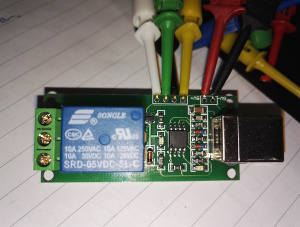
These days the phrase embedded usually means no console (except, if you re lucky, console on a UART for debugging) and probably busybox for as much of userspace as you can get away with. You possibly have package management from OpenEmbedded or similar, though it might just be a horrible kludged together rootfs if someone hates you. Either way it s rare for it not to involve some sort of hardware and OS much more advanced than the 8 bit machines I started out programming on. That is, unless you re playing with Arduinos or other similar hardware. I m currently waiting on some ESP8266 dev boards to arrive, but even they re quite advanced, with wifi and a basic OS framework provided. A long time ago I meant to get around to playing with PICs but never managed to do so. What I realised recently was that I have a ready made USB relay board that is powered by an ATtiny45. First step was to figure out if there were suitable programming pins available, which turned out to be all brought out conveniently to the edge of the board. Next I got out my trusty Bus Pirate, installed avrdude and lo and behold:
$ avrdude -p attiny45 -c buspirate -P /dev/ttyUSB0
Attempting to initiate BusPirate binary mode...
avrdude: Paged flash write enabled.
avrdude: AVR device initialized and ready to accept instructions
Reading   ##################################################   100% 0.01s
avrdude: Device signature = 0x1e9206 (probably t45)
avrdude: safemode: Fuses OK (E:FF, H:DD, L:E1)
avrdude done.  Thank you.
Perfect. I then read the existing flash image off the device, disassembled it, worked out it was based on V-USB and then proceeded to work out that the only interesting extra bit was that the relay was hanging off pin 3 on IO port B. Which led to me knocking up what I thought should be a functionally equivalent version of the firmware, available locally or on GitHub. It s worked with my basic testing so far and has confirmed to me I understand how the board is set up, meaning I can start to think about what else I could do with it

Andy Simpkins: OpenTAC sprint, Cambridge

Last weekend saw a small group get togeather in Cambridge to hack on the OpenTAC. OpenTAC is an OpenHardware OpenSoftware test platform, designed specificly to aid automated testing and continious intergration. Aimed at small / mobile / embedded targets OpenTAC v1 provides all of the support infrastructure to drive up to 8 DUTs (Device Under Test) to your test or CI system.
Each of the 8 EUT ports provides: All ports on the EUT interface are relay issolated, this means that cables to your EUT can be unplugged under software control (we are aware of several SoC development boards that latch up if there is a serial port connected before power is applied). Additionly there are 8 GPIO lines that can be used as switch controls to any EUT (perhaps to put a specific EUT into a programming mode, reboot it or even start it) Anyway, back to the hacking weekend. .. Joining Steve McIntyre and myself were Mark Brown, and Michael Grzeschik (sorry Michael, I couldn t find a homepage). Mark traveled down from Scotland whilst Michael flew in from Germany for the weekend. Gents we greatly apprecate you taking the time and expence to join us this weekend. I should also thank my employer Toby Churchill Ltd. for allowing us to use the office to host the event. A lot of work got done, and I beleive we have now fully tested and debugged the hardware. We have also made great progress with the device tree and dvice drivers for the platform. Mark got the EUT power system working as proof of concept, and has taken an OpenTAC board back with him to turn this into suitable drivers and hopfully push them up stream. Meanwhile Michael spent his time working on the system portion of the device tree; OpenTAC s internal power sequancing, thermal managment subsystem, and USB hub control. Steve got to grips with the USB serial converters (including how to read and program their internal non-volatile settings). Finally I was able to explain hardware sequancing to everyone, and to modify boards to overcome some of my design mistakes (the biggest was by far the missing sence resistors for the EUT power managment)

Steve Kemp: Accidental data-store ..

A few months back I was looking over a lot of different object-storage systems, giving them mini-reviews, and trying them out in turn. While many were overly complex, some were simple. Simplicity is always appealing, providing it works. My review of camlistore was generally positive, because I like the design. Unfortunately it also highlighted a lack of documentation about how to use it to scale, replicate, and rebalance. How hard could it be to write something similar, but also paying attention to keep it as simple as possible? Well perhaps it was too easy.
Blob-Storage
First of all we write a blob-storage system. We allow three operations to be carried out:
  • Retrieve a chunk of data, given an ID.
  • Store the given chunk of data, with the specified ID.
  • Return a list of all known IDs.
API Server
We write a second server that consumers actually use, though it is implemented in terms of the blob-storage server listed previously. The public API is trivial:
  • Upload a new file, returning the ID which it was stored under.
  • Retrieve a previous upload, by ID.
Replication Support
The previous two services are sufficient to write an object storage system, but they don't necessarily provide replication. You could add immediate replication; an upload of a file could involve writing that data to N blob-servers, but in a perfect world servers don't crash, so why not replicate in the background? You save time if you only save uploaded-content to one blob-server. Replication can be implemented purely in terms of the blob-servers:
  • For each blob server, get the list of objects stored on it.
  • Look for that object on each of the other servers. If it is found on N of them we're good.
  • If there are fewer copies than we like, then download the data, and upload to another server.
  • Repeat until each object is stored on sufficient number of blob-servers.
My code is reliable, the implementation is almost painfully simple, and the only difference in my design is that rather than having an API-server which allows both "uploads" and "downloads" I split it into two - that means you can leave your "download" server open to the world, so that it can be useful, and your upload-server can be firewalled to only allow a few hosts to access it. The code is perl-based, because Perl is good, and available here on github: TODO: Rewrite the thing in #golang to be cool.

Bits from Debian: Imagination accelerates Debian development for 64-bit MIPS CPUs

Imagination Technologies recently donated several high-performance SDNA-7130 appliances to the Debian Project for the development and maintenance of the MIPS ports. The SDNA-7130 (Software Defined Network Appliance) platforms are developed by Rhino Labs, a leading provider of high-performance data security, networking, and data infrastructure solutions. With these new devices, the Debian project will have access to a wide range of 32- and 64-bit MIPS-based platforms. Debian MIPS ports are also possible thanks to donations from the aql hosting service provider, the Eaton remote controlled ePDU, and many other individual members of the Debian community. The Debian project would like to thank Imagination, Rhino Labs and aql for this coordinated donation. More details about GNU/Linux for MIPS CPUs can be found in the related press release at Imagination and their community site about MIPS.

17 May 2016

Reproducible builds folks: Reproducible builds: week 55 in Stretch cycle

What happened in the Reproducible Builds effort between May 8th and May 14th 2016: Documentation updates Toolchain fixes Packages fixed The following 28 packages have become newly reproducible due to changes in their build dependencies: actor-framework ask asterisk-prompt-fr-armelle asterisk-prompt-fr-proformatique coccinelle cwebx d-itg device-tree-compiler flann fortunes-es idlastro jabref konclude latexdiff libint minlog modplugtools mummer mwrap mxallowd mysql-mmm ocaml-atd ocamlviz postbooks pycorrfit pyscanfcs python-pcs weka The following 9 packages had older versions which were reproducible, and their latest versions are now reproducible again due to changes in their build dependencies: csync2 dune-common dune-localfunctions libcommons-jxpath-java libcommons-logging-java libstax-java libyanfs-java python-daemon yacas The following packages have become newly reproducible after being fixed: The following packages had older versions which were reproducible, and their latest versions are now reproducible again after being fixed: Some uploads have fixed some reproducibility issues, but not all of them: Patches submitted that have not made their way to the archive yet: Package reviews 344 reviews have been added, 125 have been updated and 20 have been removed in this week. 14 FTBFS bugs have been reported by Chris Lamb. tests.reproducible-builds.org Misc. Dan Kegel sent a mail to report about his experiments with a reproducible dpkg PPA for Ubuntu. According to him sudo add-apt-repository ppa:dank/dpkg && sudo apt-get update && sudo apt-get install dpkg should be enough to get reproducible builds on Ubuntu 16.04. This week's edition was written by Ximin Luo and Holger Levsen and reviewed by a bunch of Reproducible builds folks on IRC.

Sean Whitton: seoulviasfo

I spent last night in San Francisco on my way from Tucson to Seoul. This morning as I headed to the airport, I caught the end of a shouted conversation between a down-and-out and a couple of middle school-aged girls, who ran away back to the Asian Art museum as the conversation ended. A security guard told the man that he needed him to go away. The wealth divide so visible here just isn t something you really see around Tucson. I m working on a new module for Propellor that s complicated enough that I need to think carefully about the Haskell in order to write produce a flexible and maintainable module. I ve only been doing an hour or so of work on it per day, but the past few days I wake up each day with an idea for restructuring yesterday s code. These ideas aren t anything new to me: I think I m just dredging up the understanding of Haskell I developed last year when I was studying it more actively. Hopefully this summer I can learn some new things about Haskell. Riding on the Bay Area Rapid Transit (BART) feels like stepping back in time to the years of Microsoft s ascendency, before we had a tech world dominated by Google and Facebook: the platform announcements are in a computerised voice that sounds like it was developed in the nineties. They ll eventually replace the old trains apparently some new ones are coming in 2017 so I feel privileged to have been able to ride the older ones. I feel the same about the Tube in London. I really appreciate old but supremely reliable and effective public transport. It reminds me of the Debian toolchain: a bit creaky, but maintained over a sufficiently long period that it serves everyone a lot better than newer offerings, which tend to be produced with ulterior corporate motives.

Mike Gabriel: NXv3 Rebase: Build nxagent against X.org 7.0

As already hinted in my previous blog post, here comes a short howto that explains how to test-build nxagent (v3) against a modularized X.org 7.0 source tree. WARNING: Please note that mixing NX code and X.org code partially turns the original X.org code base into GPL-2 code. We are aware of this situation and work on moving all NXv3 related GPL-2 code into the nxagent DDX code (xserver-xorg/hw/nxagent) or--if possible--dropping it completely. The result shall be a range of patches against X.org (licensable under the same license as the respective X.org files) and a GPL-2 licensed DDX (i.e. nxagent). How to build this project For the Brave and Playful
$ git clone https://git.arctica-project.org/nx-X11-rebase/build.git .
$ bash populate.sh sources.lst
$ ./buildit.sh
You can find the built tree in the _install/ sub-directory. Please note that cloning Git repositories over the https protocol can be considerably slow. If you want to speed things up, consider signing up with our GitLab server. For Developers... ... who have registered with our GitLab server.
$ git clone git@git.arctica-project.org:nx-X11-rebase/build.git .
$ bash populate.sh sources-devs.lst
$ ./buildit.sh
You will find the built tree in the _install/ sub-directory. The related git repositories are in the repos/ sub-directory. All repos modified for NX have been cloned from the Arctica Project's GitLab server via SSH. Thus, you as a developer can commit changes on those repos and push back your changes to the GitLab server. Required tools for building Debian/Ubuntu and alike In a one-liner command:
$ sudo apt-get install build-essential automake gawk git pkg-config libtool libz-dev libjpeg-dev libpng-dev
Fedora If someone tries this out in a clean Fedora chroot environment, please let us know about build dependent packages. openSUSE If someone tries this out in a clean openSUSE chroot environment, please let us know about build dependent packages. Testing the built nxagent and nxproxy The tests/ subdir contains some scripts which can be used to test the compile results. Notes on required X.org changes (NX_MODIFICATIONS) For this build workflow to work, we (i.e. mostly Ulrich Sibiller) had to work several NoMachine patches into original X.org 7.0 code. Here is a list of modified X11 components with URLs pointing to the branch containing those changes:
xkbdata                            xorg/data/xkbdata                       rebasenx  1.0.1     https://git.arctica-project.org/nx-X11-rebase/xkbdata.git
libfontenc                         xorg/lib/libfontenc                     rebasenx  1.0.1     https://git.arctica-project.org/nx-X11-rebase/libfontenc.git
libSM                              xorg/lib/libSM                          rebasenx  1.0.0     https://git.arctica-project.org/nx-X11-rebase/libSM.git
libX11                             xorg/lib/libX11                         rebasenx  1.0.0     https://git.arctica-project.org/nx-X11-rebase/libX11.git
libXau                             xorg/lib/libXau                         rebasenx  1.0.0     https://git.arctica-project.org/nx-X11-rebase/libXau.git
libXfont                           xorg/lib/libXfont                       rebasenx  1.3.1     https://git.arctica-project.org/nx-X11-rebase/libXfont.git
libXrender                         xorg/lib/libXrender                     rebasenx  0.9.0.2   https://git.arctica-project.org/nx-X11-rebase/libXrender.git
xtrans                             xorg/lib/libxtrans                      rebasenx  1.0.0     https://git.arctica-project.org/nx-X11-rebase/libxtrans.git
kbproto                            xorg/proto/kbproto                      rebasenx  1.0.2     https://git.arctica-project.org/nx-X11-rebase/kbproto.git
xproto                             xorg/proto/xproto                       rebasenx  7.0.4     https://git.arctica-project.org/nx-X11-rebase/xproto.git
xorg-server                        xorg/xserver                            rebasenx  1.0.1     https://git.arctica-project.org/nx-X11-rebase/xserver.git
mesa                               mesa/mesa                               rebasenx  6.4.1     https://git.arctica-project.org/nx-X11-rebase/mesa.git
Credits Nearly all of this has been achieved by Ulrich Sibiller. Thanks a lot for giving your time and energy to that. As the rebasing of NXv3 is currently a funded project supported by the Qindel Group, we are currently negotiating ways of monetarily appreciating Ulrich's intensive work on this. Thanks a lot, once more!!! Feedback If anyone of you feels like trying out the test build as described above, please consider signing up with the Arctica Project's GitLab server and reporting your issues there directly (against the repository nx-X11-rebase/build). Alternatively, feel free to contact us on IRC (Freenode): #arctica or subscribe to our developers' mailing list. Thank you. light+love
Mike Gabriel

Raphaël Hertzog: Freexian s report about Debian Long Term Support, April 2016

A Debian LTS logoLike each month, here comes a report about the work of paid contributors to Debian LTS. Individual reports In April, 116.75 work hours have been dispatched among 9 paid contributors. Their reports are available: Many contributors did not use all their allocated hours. This is partly explained by the fact that in April Wheezy was still under the responsibility of the security team and they were not able to drive updates from start to finish. In any case, this means that they have more hours available over May and since the LTS period started, they should hopefully be able to make a good dent in the backlog of security updates. Evolution of the situation The number of sponsored hours reached a new record with 132 hours per month, thanks to two new gold sponsors (Babiel GmbH and Plat Home). Plat Home s sponsorship was aimed to help us maintain Debian 7 Wheezy on armel and armhf (on top of already supported amd64 and i386). Hopefully the trend will continue so that we can reach our objective of funding the equivalent of a full-time position. The security tracker currently lists 45 packages with a known CVE and the dla-needed.txt file lists 44 packages awaiting an update. This is a bit more than the 15-20 open entries that we used to have at the end of the Debian 6 LTS period. Thanks to our sponsors New sponsors are in bold.

No comment Liked this article? Click here. My blog is Flattr-enabled.

Next.

Previous.