Search Results: "tar"

10 December 2012

Gerfried Fuchs: BSP Essen November 2012, Report

So it happened: the Bug Squashing Party in Essen is done. And depending on your point of view at least I would call it a success. We had in total fourteen participants. The number of release-critical bugreports touched and processed is not clear, but over 100 bugreports were looked at and either got comments added for clearification, maintainer pinged, unblock requests filed or already filed ones noted down, or NMUed. Given that we are in freeze since a while now and many easy bugreports already squashed by those who aim for a daily fix, I consider this impressive. There is also the point that we managed to get some people involved that didn't consider themself techy enough to be of help. On the contrary, they were a great help on checking these bugreports with analyzing the discussions in some lengthy bugreports and upstream bug trackers, or trying to reproduce some issues. I can just hope that the weekend left an impression deep enough to keep them in the boat. All in all, I'm quite pleased of the outcome, especially in the light of several other events catching the interest of potential participants which were going on at the same weekend. Thanks to all the people that stumbled by, and I am looking forward to maybe having another BSP at some point, but then I hope to not clash with so many other events. Thanks!

/debian permanent link Comments: 0 Flattr this

Russell Coker: Returning the Aldi Tablet

I have decided to return the 7 Android tablet I bought from Aldi last week [1]. I still think that the tablet isn t all bad, but the main problem I had is the short battery life. The battery can be entirely exhausted in less than an hour s use. Another problem is the fact that most of the Angry Birds games just abort on startup, as my plans for the tablet involved some recreational use this is a significant problem. The final factor that made me decide to return it is the fact that Kogan offered a special deal on a Samsung Galaxy S3 [2] for $449. That ended up as $507 per phone for two phones that have PowerCases (which more than double the battery life as well as protecting the phone from being dropped). So a Galaxy S3 increments my Android device count and with a 4.8 720*1280 display will compete well with a low-end 7 tablet that only has a 800*480 display (the Galaxy S3 has 2.4* as many pixels). Aldi offers 60 days money back, so I ll return the tablet when my Galaxy S3 arrives.

9 December 2012

Stefano Zacchiroli: bits from the DPL for November 2012

Just posted, bits from the DPL for November 2012.
 ---------------------------------------------------------------------------------
/ Pop-up advertisement. Breaking news. Help the Release Team [0] by reviewing     \
  pending unblock requests. Oh, and by fixing RC bugs too.                         
                                                                                   
  [0]: http://nthykier.wordpress.com/2012/12/09/wheezy-release-progress-december/  
\---------------------------------------------------------------------------------/

Dear Project Members, here is another (delayed) monthly report of DPL activities, this time for November 2012. Highlights Events Assets That's all for now,
let's go back releasing Wheezy,
Cheers.
PS the day-to-day activity log for November 2012 is available at the usual place master:/srv/leader/news/bits-from-the-DPL.txt.201211

8 December 2012

Dirk Eddelbuettel: Rcpp attributes: Even easier integration of GSL code into R

Following the Rcpp 0.10.0 release, I had written about simulating pi easily by using the wonderful new Rcpp Attributes feature. Now with Rcpp 0.10.1 released a good week ago, it is time to look at how Rcpp Attributes can help with external libraries. As this posts aims to show, it is a breeze! One key aspect is the use of the plugins for the inline package. They provide something akin to a callback mechanism so that compilation and linking steps can be informed about header and library locations and names. We are going to illustrate this with an example from GNU Scientific Library (GSL). The example I picked uses B-Spline estimation from the GSL. This is a little redundant as R has its own spline routines and package, but serves well as a simple illustration---and, by reproducing an existing example, followed an established path. So we will look at Section 39.7 of the GSL manual which has a complete example as a standalone C program, generating both the data and the fit via cubic B-splines. We can decompose this two parts: data generation, and fitting. We will provide one function each, and then use both from R. These two function will follow the aforementioned example from Section 39.7 somewhat closely. We start with the first function to generate the data.
// [[Rcpp::depends(RcppGSL)]]
#include <RcppGSL.h>
#include <gsl/gsl_bspline.h>
#include <gsl/gsl_multifit.h>
#include <gsl/gsl_rng.h>
#include <gsl/gsl_randist.h>
#include <gsl/gsl_statistics.h>
const int N = 200;                              // number of data points to fit 
const int NCOEFFS = 12;                         // number of fit coefficients */
const int NBREAK = (NCOEFFS - 2);               // nbreak = ncoeffs + 2 - k = ncoeffs - 2 since k = 4 */
// [[Rcpp::export]]
Rcpp::List genData()  
    const size_t n = N;
    size_t i;
    double dy;
    gsl_rng *r;
    RcppGSL::vector<double> w(n), x(n), y(n);
    gsl_rng_env_setup();
    r = gsl_rng_alloc(gsl_rng_default);
    //printf("#m=0,S=0\n");
    /* this is the data to be fitted */
    for (i = 0; i < n; ++i)  
        double sigma;
        double xi = (15.0 / (N - 1)) * i;
        double yi = cos(xi) * exp(-0.1 * xi);
        sigma = 0.1 * yi;
        dy = gsl_ran_gaussian(r, sigma);
        yi += dy;
        gsl_vector_set(x, i, xi);
        gsl_vector_set(y, i, yi);
        gsl_vector_set(w, i, 1.0 / (sigma * sigma));
                
        //printf("%f %f\n", xi, yi);
     
    Rcpp::DataFrame res = Rcpp::DataFrame::create(Rcpp::Named("x") = x,
                                                  Rcpp::Named("y") = y,
                                                  Rcpp::Named("w") = w);
    x.free();
    y.free();
    w.free();
    gsl_rng_free(r);
    return(res);
 
We include a few header files, define (in what is common for C programs) a few constants and then define a single function genData() which returns and Rcpp::List as a list object to R. A primary importance here are the two attributes: one to declare a dependence on the RcppGSL package, and one to declare the export of the data generator function. That is all it takes! The plugin of the RcppGSL will provide information about the headers and library, and Rcpp Attributes will do the rest. The core of the function is fairly self-explanatory, and closely follows the original example. Space gets allocated, the RNG is setup and a simple functional form generates some data plus noise (see below). In the original, the data is written to the standard output; here we return it to R as three columns in a data.frame object familiar to R users. We then free the GSL vectors; this manual step is needed as they are implemented as C vectors which do not have a destructor. Next, we can turn the fitting function.
// [[Rcpp::export]]
Rcpp::List fitData(Rcpp::DataFrame ds)  
    const size_t ncoeffs = NCOEFFS;
    const size_t nbreak = NBREAK;
    const size_t n = N;
    size_t i, j;
    Rcpp::DataFrame D(ds);              // construct the data.frame object
    RcppGSL::vector<double> y = D["y"]; // access columns by name, 
    RcppGSL::vector<double> x = D["x"]; // assigning to GSL vectors
    RcppGSL::vector<double> w = D["w"];
    gsl_bspline_workspace *bw;
    gsl_vector *B;
    gsl_vector *c; 
    gsl_matrix *X, *cov;
    gsl_multifit_linear_workspace *mw;
    double chisq, Rsq, dof, tss;
    bw = gsl_bspline_alloc(4, nbreak);      // allocate a cubic bspline workspace (k = 4)
    B = gsl_vector_alloc(ncoeffs);
    X = gsl_matrix_alloc(n, ncoeffs);
    c = gsl_vector_alloc(ncoeffs);
    cov = gsl_matrix_alloc(ncoeffs, ncoeffs);
    mw = gsl_multifit_linear_alloc(n, ncoeffs);
    gsl_bspline_knots_uniform(0.0, 15.0, bw);   // use uniform breakpoints on [0, 15] 
    for (i = 0; i < n; ++i)                     // construct the fit matrix X 
        double xi = gsl_vector_get(x, i);
        gsl_bspline_eval(xi, B, bw);            // compute B_j(xi) for all j 
        for (j = 0; j < ncoeffs; ++j)           // fill in row i of X 
            double Bj = gsl_vector_get(B, j);
            gsl_matrix_set(X, i, j, Bj);
         
     
    gsl_multifit_wlinear(X, w, y, c, cov, &chisq, mw);  // do the fit 
    
    dof = n - ncoeffs;
    tss = gsl_stats_wtss(w->data, 1, y->data, 1, y->size);
    Rsq = 1.0 - chisq / tss;
    
    Rcpp::NumericVector FX(151), FY(151);       // output the smoothed curve 
    double xi, yi, yerr;
    for (xi = 0.0, i=0; xi < 15.0; xi += 0.1, i++)  
        gsl_bspline_eval(xi, B, bw);
        gsl_multifit_linear_est(B, c, cov, &yi, &yerr);
        FX[i] = xi;
        FY[i] = yi;
     
    Rcpp::List res =
      Rcpp::List::create(Rcpp::Named("X")=FX,
                         Rcpp::Named("Y")=FY,
                         Rcpp::Named("chisqdof")=Rcpp::wrap(chisq/dof),
                         Rcpp::Named("rsq")=Rcpp::wrap(Rsq));
    gsl_bspline_free(bw);
    gsl_vector_free(B);
    gsl_matrix_free(X);
    gsl_vector_free(c);
    gsl_matrix_free(cov);
    gsl_multifit_linear_free(mw);
    
    y.free();
    x.free();
    w.free();
    return(res);   
 
The second function closely follows the second part of the GSL example and, given the input data, fits the output data. Data structures are setup, the spline basis is created, data is fit and then the fit is evaluated at a number of points. These two vectors are returned along with two goodness of fit measures. We only need to load the Rcpp package and source a file containing the two snippets shown above, and we are ready to deploy this:
library(Rcpp)
sourceCpp("bSpline.cpp")                # compile two functions
dat <- genData()                        # generate the data
fit <- fitData(dat)                     # fit the model, returns matrix and gof measures
And with that, we generate a chart such as Spline fitting example from GSL manual redone with Rcpp Attributes via a simple four lines, or as much as it took to create the C++ functions, generate the data and fit it!
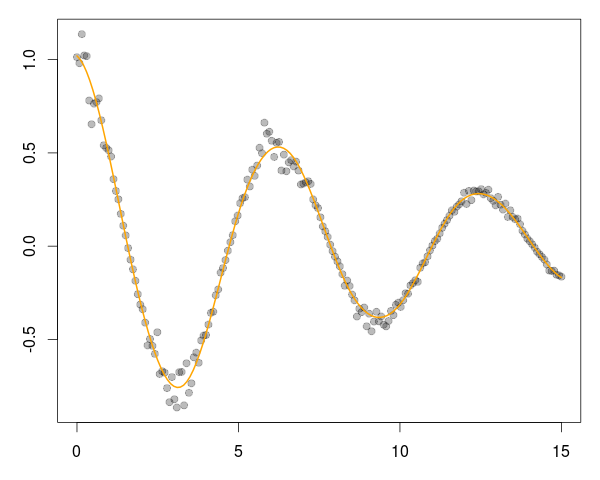
op <- par(mar=c(3,3,1,1))
plot(dat[,"x"], dat[,"y"], pch=19, col="#00000044")
lines(fit[[1]], fit[[2]], col="orange", lwd=2)
par(op)
The RcppArmadillo and RcppEigen package support plugin use in the same way. Add an attribute to export a function, and an attribute for the depends -- and you're done. Extending R with (potentially much faster) C++ code has never been easier, and opens a whole new set of doors.

Eddy Petri&#537;or: Consent is needed, but not the point

Russ makes a good point about a nuance of practical jokes that makes them special, the characteristic of involving a third party which is the target of the joke, and how that relates to consent. He is right, consent is an important fact, I acknowledge that. Russ also says at the end of his post that being an asshole doesn't make you responsible for somebody else's decisions, I ackowledge that, too. I even somewhat agree to the position that the employer might fire you on assholery reasons, but in this particular case, I think that's a hypocrite position. If assholery was an issue, it should have been before, too, and I don't think the employer thought of it before this sad even, as long as it meant more money for them. I think this only shows how cynical they are, the cost analysis for them showed them they now might lose more money by not firing, than by keeping them. It's just cynical.

In spite of that, my initial post, just as I wrote, was not about the DJs, the people involved, the assholery, the taste or lack thereof of the joke. That's why I was intentionally leaving out names or specific context. It was about the bigger picture, irrational reactions and how in the face of a tragedy we surrender our thinking capabilities and react in an irrational manner to the least significant things.

I have had quite recent unfortunate events happening to people close to me, and, invariably, I observe this loss of rational faculties in the face of sad events. Even when this kind of disproportionate response is shown for what it is and how it is harmful in itself, people still refuse to give up on being irrational or they do after a long struggle with the facts.

I'll finish my article with a similar question: can we, as a species, go beyond our condition and make a conscious effort to keep calm and think things through before making decisions in the face of tragedy, or are we incapable to do that?

And no, I am not advocating to drop feelings and affection, I find it sad that I have to say that again, but I am almost sure that in spite of it, I will be wrongly understood by somebody.

Russ Allbery: Review: Peacekeeper

Review: Peacekeeper, by Laura E. Reeve
Series: Major Ariane Kedros #1
Publisher: Roc
Copyright: December 2008
ISBN: 0-451-46245-9
Format: Mass market
Pages: 324
Ariane Kedros is a pilot of a second-wave prospecting ship. Second-wave prospectors are the first explorers into new systems after slower-than-light generation ships haul in the beacons that add them to the FTL network. She's also a reserve major in the Consortium military, which is a point of ongoing tension with her business partner and employer. She disappears on missions for the intelligence branch that she can't talk about, and usually ends up drinking herself into a stupor when she returns. In actuality, Kedros is not her real name. It's a fake identity given her after the last war, a war in which humans detonated a temporal distortion warhead for the first time and possibly destroyed an entire solar system. Kedros was part of the team that launched the bomb and is, according to the Terran Expansion League (the other side of the all-human conflict), a war criminal. She's in the equivalent of a witness protection program, as are all the other people involved in the act. But someone has broken their cover and is picking them off, one by one, and her latest secret mission from the Consortium is to protect another member of the group. Peacekeeper is Reeve's first novel, and unfortunately this shows badly at the start of the book. The writing is choppy and awkward, the paragraph breaks are a bit off, and the sentence structure kept making my teeth itch. I'm not a good enough technical critic to put a finger on what's wrong, but the writing doesn't flow. I also found myself anticipating and completing sentences in my head, which is a sign of too many low-level cliches. A few dozen pages into the book, the writing was bothering me, I hadn't warmed to any of the characters, and I wasn't sure I was going to like it. Ariane grew on me, though, particularly once she got into her mission and started balancing a cover assignment and her actual work. She's hurt, suffering from what's probably post-traumatic stress disorder and self-medicating with alcohol, but she's smart and competent and the plot is sufficiently tricky to provide a lot of meat. Not only is someone after her old team, but she and her partner discovered something potentially major on their last trip, an old friend of her partner has been murdered, the Consortium and the Terrans are negotiating a peace treaty, and all this is happening under the watchful eye of a superior alien race. The Minoans are probably Reeve's best creation here (if a little too similar to Vorlons at times). They're absolutely neutral, but they do not want humanity messing with temporal distortion weapons and are trying to nudge (or push) the humans into peace and disarmament. They are sticklers for not imposing their cultural practices on others, attempting to judge humanity solely by its own rules, but they're utterly literal-minded about rules. They expect everyone to follow any stated rules exactly and to the letter, making them excellent but frustrating overseers of disarmament treaties. They also have a fascinating tendency to interact with people in roles rather than as individuals. This is clearly the first book in an ongoing series, and a lot of the setup is not resolved here. We get only glimpses of what Ariane and her partner may have found, and only a few interactions with the Minoans, while Ariane tracks down who is responsible for killing her former team. There's a bit too much torture for my taste, and the subplot of Ariane's struggle with alcoholism wasn't really what I wanted to read about, but the writing seemed to get substantially better and the plot kept me turning the pages. There's a quality to military SF written by people who have actually been in the military that I find hard to describe but that helps a book tremendously. It didn't surprise me at all to learn that Reeve served in the US Air Force, since Peacekeeper has that quality. It's less about technical accuracy and more about a feel, a sense of what it's like to be inside a military routine and interacting with other military personnel. The culture feels coherent, despite not being described in detail. I think it makes for good SF in general, since it conveys to someone like me (who has never been in the military) a semi-alien but completely coherent culture. It certainly improves this book; in general, I thought Reeve's military characters were more interesting and more believable than her non-military characters. With the rocky beginning, the unpolished writing, and a villain who wasn't entirely satisfactory, I can't quite recommend Peacekeeper, but it's not a bad read. I'm not sure if I'll pick up the sequels, but I did leave it curious about the unresolved plot threads and willing to learn more about Reeve's world. Followed by Vigilante. Rating: 6 out of 10

Eddy Petri&#537;or: Faulty logic - confusing correlation with causation

I want to start this post by saying two things:
  1. It is sad when a good person decides to commit suicide
  2. It is even sadder anyone writing on a subject like this MUST add this kind of disclaimers in the hope the message of the writing isn't distorted because we are unable to listen to each other without suspecting/blaming the other of pure evilness/lack of compassion.
Imagine you are working in an office with other colleagues and one of them makes a print screen of your desktop screen and then displays it full-screen on your computer. You struggle a little and get frustrated when nothing works, the colleagues laugh at your expense. Pretty childish, but no harm, right? You laugh it off.

Imagine a similar scenario, but your shoelaces are tied to the desk without your notice, and the colleagues tied your laces so you can't stand, so the risk of injury is null. You stumble a little when you want to leave the desk. Again, childish, funny, but no harm, right? Again, you laugh it off.

Imagine even a scenario where you are the target of a prank that doesn't injure you physically, but it happens in front of an audience of 100 people. You might feel ashamed, embarrassed, depending on the prank. But that would go away with time, with your laughs or by leaving that audience, right?

So now imagine you are just a person that unknowingly contributed to the success of a harmless prank in which somebody was duped into thinking they were talking to a very public figure about some unimportant and inconsequential stuff related to their job. You'd brush it off, wouldn't you? Most likely, you'd probably laugh at the prank and you wouldn't think the pranksters should be prosecuted or fired. Even if the famous public figure would be upset, taking into account the fact that the things discussed were inconsequential, you wouldn't worry about it. I wouldn't worry even if that famous person was my direct boss and I was the one talking about my boss.

At least, that's how I am thinking, but for some reason, many people don't think this way. And yes, I am talking about the recent sad news about the apparent suicide of a nurse who was involved in the care of the person called Kate Middleton.

I don't want to talk about names, or man-made titles, man-made concepts, or how some people forget that even the most influential people in the world are still a member of this same species that all of us are. I don't even want to talk about this particular sad situation, I just want to talk about the totally irrational reaction many people had to it.


Everybody knows that jokes are a matter of taste. What I might consider funny, some people would take offence at, but, generally speaking, there's an area of jokes that even kids would consider funny. Also, if we are honest to ourselves, a joke is not funnier or less funnier if from the total of people in the room instead of 2 people not liking it, 5 people don't. Not even if some of them are so offended by the joke they leave the room. The joke is equally funny or in poor taste with 2 or with 100 people in the room.

And there's the issue of confusing correlation with causation. If I tell somebody some good news about my aunt and the next day that somebody happens to had bought a car, it doesn't mean my good news made that person decide they want to buy a car. It could be, but it's not necessary, it could be a coincidence.

The same happens in the sad case of the nurse. She decided to take her life, as far as it seems. But that's the extent to which we know anything about the situation. We don't know if the suicide had anything to do with the prank or not. Just the fact that it happened the next day doesn't mean AT ALL the prank call is the cause of the suicide. It doesn't even mean that is "the straw that broke the camel's back", it might be totally unrelated. Or it might not. Taking into account the inconsequential and harmless nature of the call, it seems even less likely. Yet, I might be mistaken.

What I am sure of now is that jumping to the conclusion that the prank call had anything to do with the death, is wrong, as it is jumping to the opposing conclusion. I am also sure that in the absence of other information, the latter, the lack of connection, is more likely, because we know that such drastic sad decisions are not generally caused by trivial stuff.

Time proximity doesn't prove causation. Geographical proximity doesn't either. There needs to be a lot more into it than simple temporal sequence.


Which gets me to the second part of irrational reactions: terminating the show and twitter accounts of the two pranksters. What the hell? Talk about hypersensitivity and paranoid reactions! Are we this blind and willing to blame the least insignificant thing for the gravest consequences that we forget how we all make decisions and how to use our brains, as soon as some tragedy happens?

<iframe allowfullscreen="allowfullscreen" frameborder="0" height="315" src="http://www.youtube.com/embed/tbhsdlJ_MiQ" width="560"></iframe>
Australian Prime-minister Julia Gillard making fun of doomsday believers


Imagine some person who thinks the 21st of December 2012 will bring the end of the earth. Imagine that person taking as a serious declaration the obvious joke from the Australian prime-minister Julia Gillard, and would end their lives to avoid the mayhem, panic and violence they think would follow the 21st of December. I wonder, would as many people blame Julia Gillard for the suicide? I doubt it. And the irony is that for such an hypothetical case, there would be a stronger case for causation than what we now know about the previous case.


I still wonder, when will we learn to think a little more rationally than the people walking the Earth 100.000 years ago?

7 December 2012

Christoph Berg: apt.postgresql.org

So we finally made it, and sent out an official announcement for apt.postgresql.org. This new repository hosts packages for all PostgreSQL server versions (at the moment 8.3, 8.4, 9.0, 9.1, 9.2) for several Debian/Ubuntu distributions (squeeze, wheezy, sid, precise) on two architectures (amd64, i386). Now add packages for extension modules on top of all these, and you get a really large amount of binaries from a small number of sources. Right now there's 1670 .deb files and 148 .dsc files, but the .dsc count includes variants that only differ in the version number per distribution (we attach .pgdg60+1 for squeeze packages, .pgdg70+1 for wheezy and so on), so the real number of different sources is rather something like 81, with 38 distinct source package names. Dimitri Fontaine, Magnus Hagander, and I have been working on this since I first presented the idea at PGconf.EU 2011 in Amsterdam. We now have a Jenkins server building all the packages, an archive server with the master repository, and a feed that syncs the repository to the postgresql.org FTP (well, mostly http) server. If you were previously using pgapt.debian.net, that's the same archive as on apt.postgresql.org (one rsync away). Please update your sources.list to point to apt.postgresql.org, I'll shut down the archive at that location at the end of January. Here's the Quickstart instructions from the Wiki page: Import the repository key from http://apt.postgresql.org/pub/repos/apt/ACCC4CF8.asc:
wget -O - http://apt.postgresql.org/pub/repos/apt/ACCC4CF8.asc   sudo apt-key add -
Edit /etc/apt/sources.list.d/pgdg.list. The distributions are called codename-pgdg. In the example, replace squeeze with the actual distribution you are using:
deb http://apt.postgresql.org/pub/repos/apt/ squeeze-pgdg main
Configure apt's package pinning to prefer the PGDG packages over the Debian ones in /etc/apt/preferences.d/pgdg.pref:
Package: *
Pin: release o=apt.postgresql.org
Pin-Priority: 500
Note: this will replace all your Debian/Ubuntu packages with available packages from the PGDG repository. If you do not want this, skip this step. Update the package lists, and install the pgdg-keyring package to automatically get repository key updates:
apt-get update
apt-get install pgdg-keyring

6 December 2012

Daniel Kahn Gillmor: set default margins for OpenOffice as a sysadmin?

I'm maintaining a lab of debian squeeze machines that run OpenOffice.org (i'm considering upgrading to LibreOffice from squeeze-backports). I'd like to adjust the default page margins for all users of Writer. Most instructions i've found suggest ways to do this as a single user, but not how to make the change system-wide. I don't want to ask every user of these machines to do this (and i also don't want to tamper with each home directory directly -- that's not something i can maintain reliably). Alas, i can find no documentation about how to change the default page margins system-wide for either Oo.o or LibreOffice. Surely this is something that can be done without a recompile. What am i missing? Tags: configuration, libreoffice, margins, openoffice.org, sysadmin, templates

Leo 'costela' Antunes: Silly Wal(l Cloc)k 2.0

So I finally got the first laser-cut version of the Silly Wal(l Cloc)k done: The back plate was cut from a 1mm plexiglass sheet using this SVG. The black parts were spray painted with matte black and inserted back into the hollowed out sections (I should have made pictures of the pieces before assembling; too lazy to do it now). This proved out to be somewhat problematic, since keeping the small pieces (the chin and the white part of the suitcase handle) in place isn t really easy without gluing everything together, which I wanted to avoid because I m not sure what effect the glue might have on plexiglass in the long term. Another problem was the fact that the plexiglass sheet is white, but slightly translucent. Since the back piece of the clock is black, this caused the white parts to look dirty . As a workaround for both problems I ended up using a thin white cardboard sheet as additional background, where the small hollowed out pieces could be affixed and the translucency of the plexiglass could be hidden. On the other hand, the 1mm thickness for the plexiglass turned out to be perfect for the clock hands (or feet). I think it would still have worked with 2mm, but that might be too heavy for the puny clock torque and they might start snagging on each other. Careful eyes will also note that I made a stupid mistake when writing down the dimensions for the back plate and it ended up being slightly smaller than the available space. Not my brightest moment, but it worked out alright with the additional cardboard background. The next iteration will probably be made with a different two-color plexiglass sheet that can be engraved. Let s see how that works out. Related: Silly Wal(l Cloc)k

Steve Kemp: December 2012 Software Updates

Some brief software updates:
Custodian
This is the monitoring tool I wrote for Bytemark. It still rocks, and has run over 10 million tests without failure.I'd love more outside feedback, even if just to say "documentation needs work".
Slaughter
This is my sysadmin tool for multiple hosts - consider it cfengine-lite, or cfengine-trivial more likely. The 2.x release is finally out, and features pluggable transports. That means your central server can be running HTTP, RSYNC, FTP, or anything you like. 90% of the changes came from or were inspired by Csillag Tamas, to whom I owe a debt of thanks.
Templer
A static-site generator, written in Perl. I use this to generate blogspam.net, and other sites from simple layouts. Tutorial available online.
redis-document-store
A trivial hack which allows using Redis as a schema-less document storage system. Assuming you never delete documents it is simple, transparent, and already in live use for Debian Administration
Random Comment on Templer:
Although I've made extensive notes on common static site generators, and they will be discussed at length in the near future, I do want to highlight one problem common to 90% of them: Symbolic links. For example webgen fails my simple test:
~/hg/websites$ webgen create test.example.com
~/hg/websites$ cd test.example.com/src/
~/hg/websites/test.example.com/src$ mkdir jquery-1.2.3
~/hg/websites/test.example.com/src$ touch jquery-1.2.3/jquery.js
~/hg/websites/test.example.com/src$ ln -s jquery-1.2.3 jquery
~/hg/websites/test.example.com$ webgen
Starting webgen...
...
Finished
~/hg/websites/test.example.com$ ls out/    grep jq
jquery-1.2.3
Here we see creating a symlink to a directory has not produced a matching symlink in the output. Something I use frequently. for example. Some tools mangled symlinked directories, or files, some ignore them completely. Neither is acceptible.

Olivier Berger: A 30 minutes introduction to git

I ve been looking for a set of slides that I could have reused to make a 30 minutes introduction to my colleagues at the computer science department. Finding none that would be suitable (i.e. including graphical examples and not only being the canvas for a workshop), I tried to proceed with making one of my own. I ve reused the document git concepts simplified, whose content seemed quite good, and have converted it to a set of slides. Here s the result, which has been reworked a bit vs. the original git concepts simplified : <iframe allowfullscreen="allowfullscreen" frameborder="0" height="356" marginheight="0" marginwidth="0" mozallowfullscreen="mozallowfullscreen" scrolling="no" src="http://www.slideshare.net/slideshow/embed_code/15517872" style="border:1px solid #CCC;border-width:1px 1px 0;margin-bottom:5px" webkitallowfullscreen="webkitallowfullscreen" width="427"> </iframe>
An introduction to git from olberger
Here s the PDF version. Note that if you prefer a version that aligns more with the original, here s also an older version, in : https://github.com/olberger/git-notes/tree/master/gcs Update: For the lone reader that cannot attend my presentation, I should recommend to read first the HTML version by Sitaram at git concepts simplified, as the slides miss some details (which I ve kept in the beamer notes only), then only refer to my slides in a second time, for some additions. If you want the org-mode source (containing the dot source of the diagrams), contact me. I ll maybe upload the source into some Git repo whan I have enough demand/time ;)

Petter Reinholdtsen: Scripting the Cerebrum/bofhd user administration system using XML-RPC

Where I work at the University of Oslo, we use the Cerebrum user administration system to maintain users, groups, DNS, DHCP, etc. I've known since the system was written that the server is providing an XML-RPC API, but I have never spent time to try to figure out how to use it, as we always use the bofh command line client at work. Until today. I want to script the updating of DNS and DHCP to make it easier to set up virtual machines. Here are a few notes on how to use it with Python. I started by looking at the source of the Java bofh client, to figure out how it connected to the API server. I also googled for python examples on how to use XML-RPC, and found a simple example in the XML-RPC howto. This simple example code show how to connect, get the list of commands (as a JSON dump), and how to get the information about the user currently logged in:
#!/usr/bin/env python
import getpass
import xmlrpclib
server_url = 'https://cerebrum-uio.uio.no:8000';
username = getpass.getuser()
password = getpass.getpass()
server = xmlrpclib.Server(server_url);
#print server.get_commands(sessionid)
sessionid = server.login(username, password)
print server.run_command(sessionid, "user_info", username)
result = server.logout(sessionid)
print result
Armed with this knowledge I can now move forward and script the DNS and DHCP updates I wanted to do.

James Bromberger: Official Debian Images on Amazon Web Services EC2

Please Note: this article is written from my personal perspective as a Debian Developer, and is not the opinion or expression of my employer.
Amazon Web Service s EC2 offers customers a number of Operating Systems to run. There are many Linux Distributions available, however for all this time, there has never been an Official Debian Image or Amazon Machine Image (AMI), created by Debian. For some Debian users this has not been an issue as there are several solutions of creating your own personal AMI. However for the AWS Users who wanted to run a recognised image, it has been a little confusing at times; several Debian AIMs have been made available by other customers, but the source of those images has not been Debian . In October 2012 the AWS Marketplace engaged in discussions with the Debian Project Leader, Stefano Zacchiroli. A group of Debian Developers and the wider community formed to generated a set of AMIs using Anders Ingemann s ec2debian-build-ami script. These AMIs are published in the AWS Marketplace, and you can find the listing here: No fees are collected for Debian for the use of these images via the AWS Marketplace; they are listed here for your convenience. This is the same AMI that you may generate yourself, but this one has been put together by Debian Developers. If you plan to use this AMI, I suggest you read http://wiki.debian.org/Cloud/AmazonEC2Image, and more explicity, SSH as the user admin and then sudo -i to root. Additional details Anders Ingemann and others maintain a GitHub project called ec2debian-build-ami which generates a Debian AMI. This script supports several desired features, an was also updated to add in some new requirements. This means the generated image supports: Debian Stable (Squeeze; 6.0.6 at this point in time) does not contain the cloud-init package, and neither does Debian Testing (Wheezy). A fresh AWS account (ID 379101102735) was used for the initial generation of this image. Any Debian Developer who would like access is welcome to contact me. Minimal charges for the resource utilisation of this account (storage, some EC2 instances for testing) are being absorbed by Amazon for this. Co-ordination of this effort is held on the debian-cloud mailing list. The current Debian stable is 6.0.6 Squeeze , and we re in deep freeze for the Wheezy release. Squeeze has a Xen kernel that works on the Parallel Virtual Machine (PVM) EC2 instance, and hence this is what we support on EC2. (HVM images are a next phase, being headed up by Yasuhiro Akarki <ar@d.o>). Marketplace Listing The process of listing in the AWS Marketplace was conducted as follows: This image went out on the 19th of November 2012. Additional documentation was put into the Wiki at: http://wiki.debian.org/Cloud/AmazonEC2Image/Squeeze A CloudFormation template may help you launch a Debian instance by containing a mapping to the relevent AMI in the region you re using: see the wiki link above. What s Next The goal is to continue stable releases as they come out. Further work is happening to support generation of Wheezy images, and HVM (which may all collapse into one effort with a Linux 3.x kernel in Wheezy). If you re a Debian Developer and would like a login to the AWS account we ve been using, then please drop me a line. Further work to improve this process has come from Marcin Kulisz, who is starting to package ec2debian-build-ami into a Debian: this will complete the circle of the entire stack being in main (one day)! Thanks goes to Stefano, Anders, Charles, and everyone who contributed to this effort. Resources

Kurt Roeckx: iDEAL and ING

For the e-webshops site I run I started implementing iDEAL because we have a lot customers in the Netherlands. iDEAL is a standard used in the Netherlands to do online payments. We needed to open a bank account for that in the Netherlands, so we did that with ING in October. It first took them a month to reject us, stating we needed to register our company in Belgium. Of course we're already registered, we couldn't be in business in the first place if we weren't. After pointing them to the government website it seems to have sorted itself out a few days later. So once we were approved I could actually start to test the software for iDEAL. It uses XML sig which I think is a horrible standard. Once I started testing it I directly ran into a problem. They give me an error back saying that the signature wasn't valid. So I contacted them about 2 weeks ago and have yet to get answer back that's useful. So far it went like this:
So I'm now back to step 1.

5 December 2012

Michael Stapelberg: RC bugs

I recently worked on the following RC bugs:

Raphael Geissert: Introducing: a bashism a week

No matter how many scripting programming languages exist, it appears that shell programming is here to stay around. In many cases it is fast, it "does the job", and best of all: it is available "everywhere". The shell is used by makefiles, on every call to system(), and whatnot.

However, it is a real pain, implementations differ from the standards, some implementations still in use pre-date them, they leave room for undefined behaviour, and bugs in the implementations are nothing but unknown. You can't just specify a given shell interpreter and think you've dealt with the problem. Writing shell scripts that are portable among many platforms is a nightmare, if even possible.

Surprisingly, in spite of all that, a great amount of shell scripts appear to work flawlessly in many systems.

The switch from bash to dash as the default shell interpreter in Debian wasn't done without quite some work (more if you list archived bug reports), and the work ain't over.

For the following months I will be writing about different "bashisms" every Wednesday, hopefully helping people write slightly-more-portable shell scripts. The posts are going to be focused on widely-seen bashisms, probably ignoring those that Debian's policy defines as required to be implemented.

The term "bashism" must be understood as any feature or behaviour not required by SUSv3 (aka POSIX:2001), no matter what its origins are or even if the behaviour is not exhibited by the bash shell.

One of the key points is documenting the script's requirements, starting by specifying the right shell interpreter in the shebang.

Let's see what comes out of this experiment.

As a matter of fact, I have a few months worth of posts written already. All posts are going to be published at scheduled dates, just like this very post.

4 December 2012

Andrea Veri: My favorite WordPress Plugins

It took me a while to build a complete WordPress blog with all the things I needed, from modifying the default Twenty Eleven theme to broadcasting my posts directly on Twitter. WordPress has a nice selection of plugins and given the fact I spent a few days evaluating all the possibilities, I decided to share my own setup to speed up the process in case you are willing to build a WordPress powered blog. The plugins: And a few modifications I made on my Child theme for the Twenty Eleven theme to suit my needs: Remove the navigation buttons on the header. On the Child theme s style.css:

#access, #branding .only-search #s, .entry-header .comments-link  
display: none;
 
Remove the gray line on the top of the header s banner. On the Child theme s style.css:
#branding  
border-top: none;
 
.and a little tip about WordPress itself: have you ever wondered how you could install/update/remove a WordPress theme or plugin without FTP access? Here s how! On the config.php file:
/*** Updates WordPress without FTP credentials. ***/
define('FS_METHOD','direct');
If you know any other handy WordPress Tip or Plugin, please share!

Michal &#268;iha&#345;: PyGtk in virtualenv on Travis

Weblate is using Travis CI for continuous integration. That in turn uses virtualenv to test against different Python version. Unfortunately one of dependencies in Weblate are PyCairo and PyGtk (actually Pango for text rendering) and these does not support installation using distutils. Fortunately this can be workarounded, but it took me some time to make all this properly. Ffirst you need to choose correct versions not as I did mistakenly mixed PyGObject 3 with PyGtk 2. The next step is to manually run configure and make with correct paths to install within virtualenv. For example for Gtk it looks like following:
wget http://ftp.gnome.org/pub/GNOME/sources/pygtk/2.24/pygtk-2.24.0.tar.bz2
tar xf pygtk-2.24.0.tar.bz2
cd pygtk-2.24.0
export PKG_CONFIG_PATH=/home/travis/virtualenv/python$TRAVIS_PYTHON_VERSION/lib/pkgconfig
./configure --prefix=/home/travis/virtualenv/python$TRAVIS_PYTHON_VERSION/
make
make install
The complete Travis configuration file can be found in Weblate's Git repository.

Filed under: English Weblate 0 comments Flattr this!

Russell Coker: Recruiting at a LUG Meeting

I m at the main meeting of Linux Users of Victoria (my local LUG). A couple of recruiting agents from Interpro [1] are here and have been working the crowd, one of them is on each side of the room and it seems that their plan is to speak to every person at the meeting and ask about whether they are looking for work. It is apparently difficult for them to find good Linux candidates and they hope to find people here (they are mainly looking for a senior programmer/team leader and an experienced sysadmin). One of my friends is looking for work but he s got two interviews for arranged for this week so they will have to be quick if they want to get him. I guess this means that the economy must be going well, or at least it s not too difficult for Linux people to find work (which is what matters the most to me). Attending the meeting and talking to people is a good business idea for the recruiters and is generally good for members of the group. Before the meeting starts and during the intermission people just hang out and talk, asking them if they are looking for work generally won t harm anyone and can really help some people. I wouldn t want to see multiple agencies doing this at every meeting, but I think that having it happen occasionally is a good thing.

Next.

Previous.