Clint Adams: Catching up
 Finally, SFLphone 1.2.0 is almost a reasonable Twinkle substitute.
 Continuing on
from my first
EFI progress report...
My
first alpha
release of a Wheezy netinst CD for amd64 EFI worked OK for me and
a few others, with reasonable feedback. But it was far from complete,
with (at least) three outstanding issues:
 IT S FINALLY IN!
With this last upload of the MiniUPnP daemon 1.7-3, I ve reached a first milestone: all of the MiniUPnP libraries, daemons and clients are finally in Debian, in a shape which I am not ashamed anymore.
What is UPnP for?
Back in the days (around Linux 2.0.3x), the only way to share a single Internet connection was to run a Linux box as your gateway. These days are far gone, and nearly every home connection is done through a mini home router, which also often provides a small switch and a WiFi access point. Every computer on the LAN gets its connectivity through the router thanks to NAT, and to be more accurate, masquerading. That works very well for outbound connections (browse the web, send a mail, etc.), but it is then a lot harder that something connects to a server located in the LAN. If you run a permanent server with a fixed LAN IP address, that s fine, you just configure your router to do some port forwarding, so that any inbound connection will be forwarded to the computer of your choice in the LAN. But if one application needs to listen on the public IP address just for a while (for example, IRC using DCC connection), so that something can connect to it, it becomes a way more tricky. That s when UPnP comes into play. UPnP stands for Universal Plug and Play. It s a protocol so that any application on the LAN can open ports on the public IP address of the gateway. Note that an UPnP router is also often referenced as UPnP IGD (Internet Gateway Device).
Why using MiniUPnP, don t we have already linux-igd?
Before my packaging work, the only UPnP server that was available in Debian was linux-igd, which has a dependency on libupnpX. That library is quite big for what it does (about 500KiB, on top of which you have to install the 200KiB daemon itself), while MiniUPnP is designed to be lightweight (only 158K, with dependencies on iptables, iproute, uuid-runtime and libc6 only). That seems ridiculous, but when you have only 8MiB of flash in your old router, saving few hundreds KiB is really important, and here, we re saving more than 500 KiB, with a full implementation of the UPnP protocol, and the Microsoft NATPmP implemented as well (yes, Microsoft decided that one protocol wasn t enough, and that they should implement their own (sic!)).
Who is using MiniUPNP?
Probably, you already have the libminiupnpc installed in your SID/wheezy desktop, because the transmission bittorent client which is installed with Gnome by default, depends on it, and minissdpd might be in your desktop too, if you installed the Recommends: packages as well. Which is why these are scoring quite high already in popcon. Previously, transmission was embedding its own version of the MiniUPnP client library, so it s nice to have it as a standalone shared library now.
Also, because of its very light weight, and the fact that UPnP is often needed for gaming (both XBOX 360 and PSP need, and can use, the MiniUPnP daemon that runs on your IGD), many ISP who ship a router to their customer, install MiniUPnP in it. For example, at least, the 2nd and 3rd largest Internet access provider in France (Free Telecom and SFR) are shipping MiniUPnPd in their box (one of them using OpenWRT on their router). So probably as well, you are also using MiniUPnP daemon without knowing it.
But isn t UPnP unsafe?
To this question, I d answer that connecting to Internet is unsafe. It isn t less safe than connecting to Internet on a WiFi hotspot for example. So adding UPnP support on your gateway doesn t make it less safe, especially since MiniUPnP has some features to help with security (like an ACL with IP and port lists, or a secure mode were the router will only open ports to the client requesting it). Also, we are running a distribution where dependencies are easy to check, so it s easy for you to check if a client uses UPnP or not, and decide to trust it (or not). I personally have no issue trusting transmission, x-chat or warzone2010 (more exactly: I don t trust that incoming connectivity will make it less safe for these applications, there are so many other things that could go wrong).
MiniUPnP consists of what?
MiniUPnP is a set of 4 source packages to handle all of your UPnP needs:
- The client library, libminiupnpc (and the corresponding -dev package), with its sidekick miniupnpc client program (you can use it to check the public IP of your gateway, or manually open ports).
- The UPnP IGD daemon, miniupnpd, which just reached Debian Experimental. The latest version, 1.7-3, also includes debconf configuration so that you can choose the NIC and IP address to bind on. If you installed previous version, I strongly recommend upgrading to fix previous problems.
- The libnatpmp client library (and the -dev package) for implementing the Microsoft protocol as a client (it also has a client package binary for your tests).
- The minissdpd daemon to keep memory of all UPnP devices that announced themselves, and speed-up using the UPnP protocol (used by the MiniUPnP client library).
A long process to have MiniUPnP in Debian
All these 4 pieces of the puzzle were not as easy as it seems to be packaged in Debian. Especially, the IGD daemon, MiniUPnPd, used to depend on some header files that were not packaged in Debian. This was a decision of the iptables maintainers, which even after a long discussion, refused to add the necessary headers because it wasn t supposed to be a kernel API. While this might really be truth, the issue was that there was no public API available in the Linux kernel at all, and other distributions (Fedora, Gentoo, etc.) really did supply these needed files. As a consequence, during a very long time (years literally), shamefully, it was impossible to build the MiniUPnP daemon in Debian, while it was no problem on other distributions. Note that I do not want to start a troll discussion here, I m just stating facts, both parties have very strong and respectable arguments. Anyway, this needed API was finally embedded in MiniUPnPd itself thanks to a contributor to the project, and now it builds on both the Squeeze and the Wheezy (that is Linux 3.2) kernel without any issue.
Call for testing
Unfortunately, I don t have a Linux box as my Internet gateway. So I did the tests that I could: I installed MiniUPnPd on one computer on my LAN, and checked that I could open ports from another computer. So it seems to work, but I had no way to really test it live , with some real clients. So if you have an Debian SID box as your Internet gateway, feedback would be highly appreciated.
What is remaining to do?
A transition from libminiupnpc5 to libminiupnpc8 has to happen. Of course, this is too late for Wheezy, so this will happen right after the release. There s not so many reverse dependencies, so it should be ok, but I (yet) have zero experience with transitions. BTW, I had hard time to find out what this transition process was, and maybe some more effort for documenting it would help others (I m thinking about adding some text in the Debian wiki for that). Also, I have called for help on debian-devel, because I m currently the only one maintaining all these 4 source packages, and I m trying to have all my packages checked by others, and team maintained. So if you want to give a hand, or just declare yourself as a backup if I m busy, please raise your hand! Upstream is a friend of mine, and is very reactive to any requests (it very rarely took more than 48 hours to get a reply).
Enjoy MiniUPnP and report bugs!
Again, feedback would be appreciated. :)

| Title | Impromptu session on information freedom, network neutrality, etc. COSIT 2011, Mexico |
| Publication Type | Film |
| Year Released | 2011 |
| Authors | Wolf G, Romo F, Miranda A, M ndez O, Hern ndez C, Araico S |
| Refereed Designation | Non-Refereed |
| Running Time | 0:56:00 |
| Date Released | 2011-03-30 |
| Publisher | Congreso Mexicano de la Sociedad de la Informaci n y Conocimiento Libre (COSIT) |
| Country | Mexico |
| Full Text | During the COSIT 2011 conference, we held a very celebrated and fun impromptu talk. This was a very interesting session where many of the long-time Free Software activists in Mexico took the stage (we were waiting for a speaker who was late, so the audience was bored and waiting) and started talking in a completely irreverent, disorganized way about the status of network neutrality, ACTA, Free Software, Free Culture, legal issues regarding copyright and many other similar points. At some point or another, we had on stage: Fernando Romo "el Pop", Alejandro Miranda "Pooka", Sandino Araico, Claudia Hern ndez, Octavio M ndez... Anybody else? Regarding the quality of the recording: Regina just found this file in her cheap, aging hand-held, photo camera. Again, this was not a planned session, so don't expect a high quality recording. It is hard to follow the audio at points, and the video is not steady. Anyway, it's worth following! Great thanks to Regina, and to her quick sense of opportunity, for reaching for her camera and filming this, as it would otherwise just get lost and stay only in our memory! |
| Attachment | Size |
|---|---|
| Full video (Ogg Vorbis+Theora encoded) | 81.19 MB |

 Notable highlights in this release are:
Integrated Spell Checking
Everyone knows the "how do you spell that word again?" situation and either you
don't care and send a possible typo or you go checking a dictionary which is
kind of annoying. The good news is: with this release you no longer need to do
that, as Smuxi includes automatic spell checking while you type messages.
The bad news is that this feature is currently limited to Linux builds, and thus
OSX and Windows build do not ship with it. The installers need to be extended
and I haven't found pre-compiled OSX nor Windows binaries for the GTK+ spell
checking library.
 Favicons for Server Tabs
Distinguishing server tabs can be difficult, especially if you have plenty of
them. All server tabs have the same icon so you need to search for the right
name. I wondered why this issue doesn't happen so easily with a web browser
which usually also has lots of tabs open. Besides the page name there is the
favicon right in front. So why can't Smuxi make use of that simple but effective
technology? Well, now it does! You connect to a known network, and Smuxi
will download and show the favicon of the website. It just works and does
everything in the background for you.
 Quick Join Bar
One thing that makes IRC really difficult for new comers is the important IRC
concept that channels are network specific. So what happens is people try to
find / join the channel they are looking for but on the wrong network. They
have to connect to the right server/network and then switch to the right tab,
before they can join the channel (using the /join command or join dialog). The
developers of Smuxi had a brainstorming session and came up with something that
should be easy enough for anyone to use and finally solves the issue: the
quick join bar. You know which channel you want to join and which
network, you enter the channel name, select the network from the list and hit
the "Join Chat" button and you are done. Now Smuxi will do just the right
thing for you and connects to that network if needed, joins the channel if
needed, or switches to the channel if you are already there!
Click here for a screencast of the Quick Join Bar in action
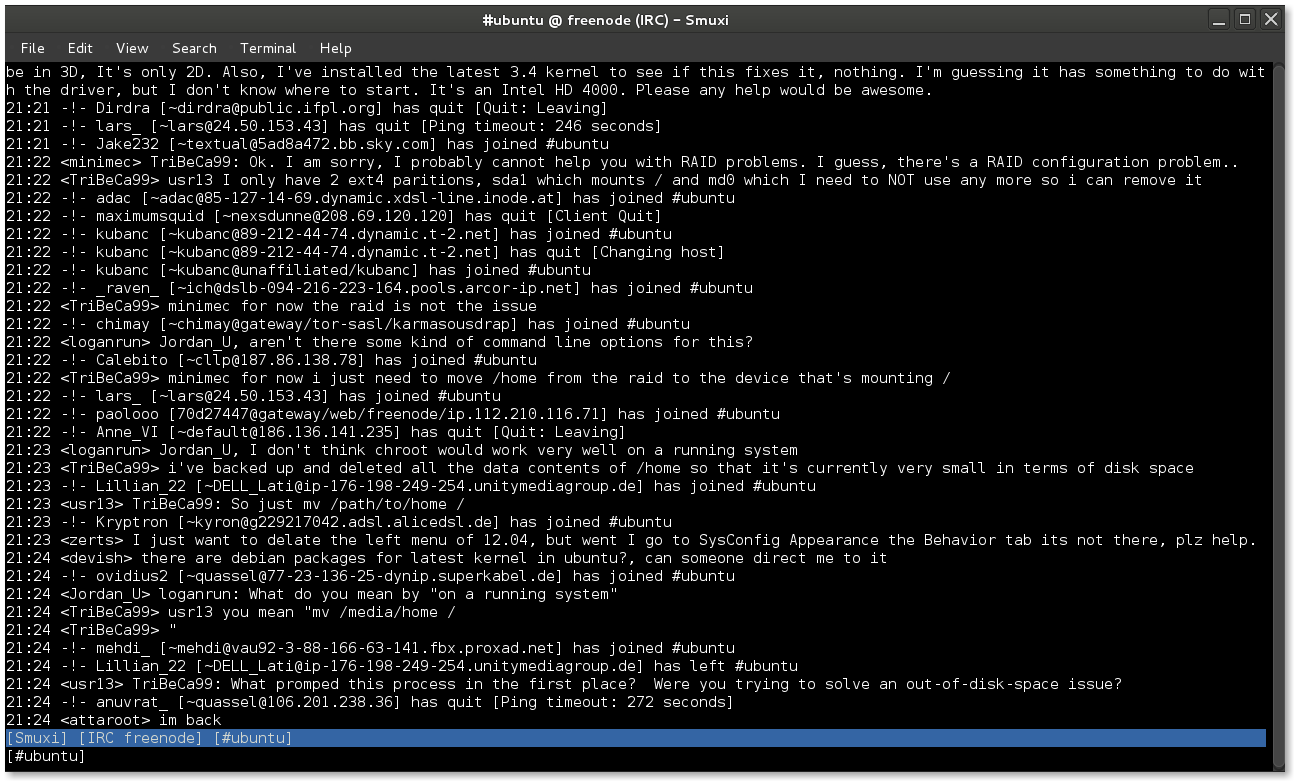
Indention of multi-line messages
Messages on IRC and also Twitter are often longer than a single line in Smuxi
can show, thus it has to be split into a second line or more. The issue here is
that the continuation line looks cluttered because it doesn't align with the
first line. Here you can see an example for this issue:
 Ewww, that looks ugly, doesn't it? I will make this one short, here is the cure
with indented multi-line messages:
 Enhanced Text Frontend
The text frontend which is still in alpha state has received the following
enhancements: new /exit command, new /help command, regular and xterm window
title, and, several fixed crashes.
 Enhanced Commands
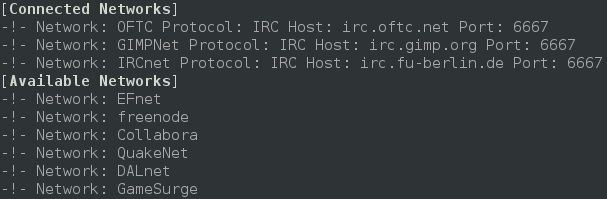
The /network command by default shows now all connected and also
available networks:
 The /connect command now allows you to connect by network name like
this:
/connect freenode
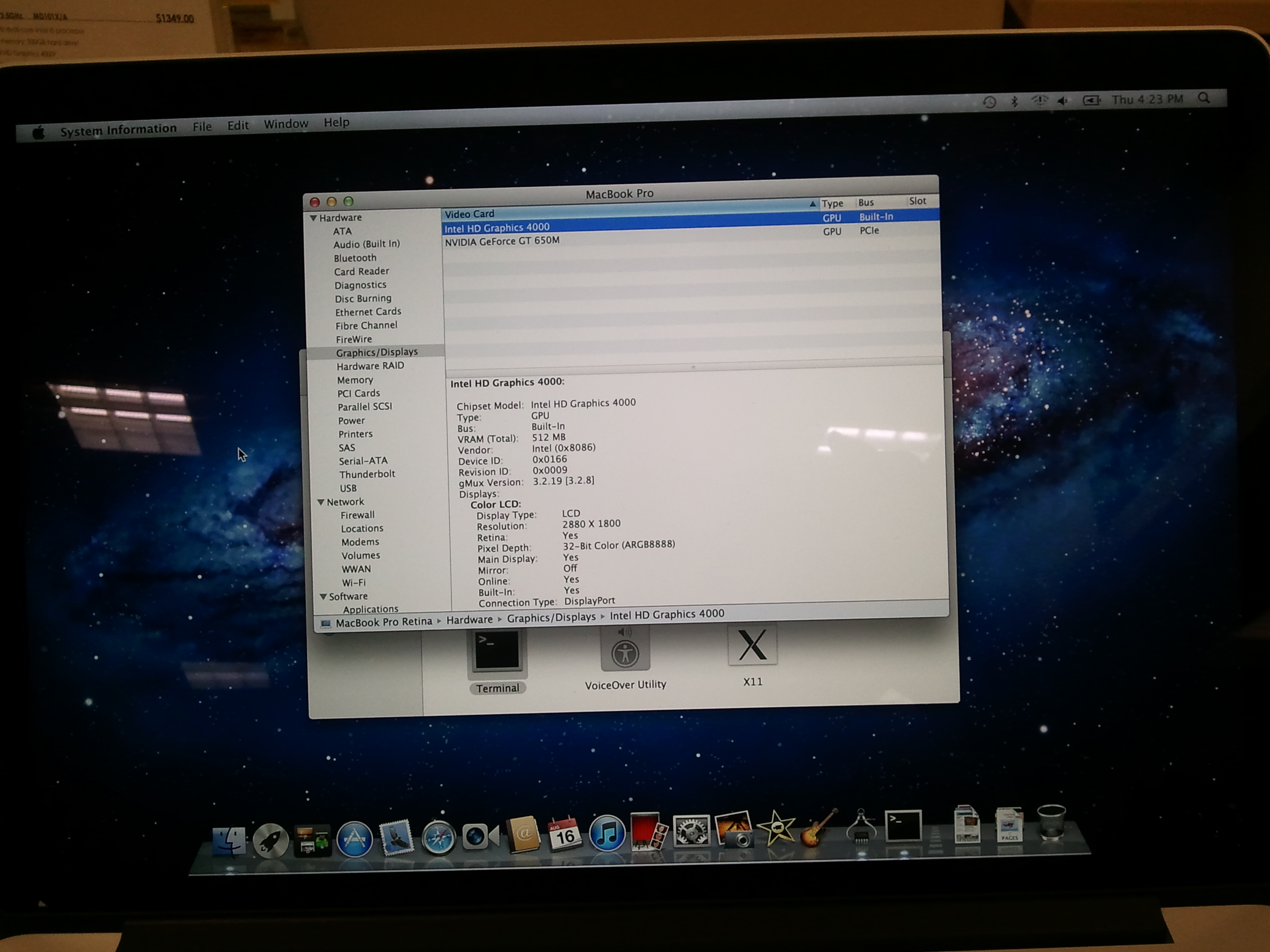 When I previously wrote about the Retina display in the new Macbook Pro I was so excited that I forgot to even check whether the display reflects light [1]. A TFT display with a mirrored surface apparently permits more intense color which is generally a good thing. It also makes it easier to clean the surface which is really important for phones and tablets. The down-side of a mirrored surface on a display is that it can reflect whatever else is in the area.
This generally isn t a problem in an office as you can usually adjust the angle of the monitor and the background lighting to avoid the worst problems. It s also not a serious problem for a hand-held device as it s usually easy to hold it at an angle such that you don t have light from anything particularly bright reflecting.
But my experience of laptop use includes using them anywhere at any time. I ve done a lot of coding on all forms of public transport in all weather conditions. Doing that with a Thinkpad which has a matte surface on it s screen is often difficult but almost always possible. Doing that on a system with a mirrored display really isn t possible. The above photo of a 15 Macbook Pro model MD103X/A was taken at a Myer store which was specifically designed to make the computers look their best. The overall lighting wasn t particularly bright so that the background didn t reflect too much and the individual lights were diffuse to avoid dazzling point reflections. But even so the lights can be clearly seen. Note that the photo was taken with a Samsung Galaxy S, far from the best possible camera.
If I was buying a laptop that would only ever be used in the more northern parts of Europe or if I was buying a laptop to use only at home and at the office then I might consider a mirror display. But as I mostly use my laptop in mainland Australia including trips to tropical parts of Australia and I use it in all manner of locations a mirror display isn t going to work for me.
This isn t necessarily a bad decision by Apple designers. My observation of Macbook use includes lots of people using them only in offices and homes. Of the serious geeks who describe their laptop as My Precious hardly anyone has a Macbook while Thinkpads seem quite popular in that market segment. I don t think that it s just the matte screen that attracts serious geeks to the Thinkpad, but it does seem like part of a series of design decisions (which include the past tradition of supporting hard drive removal without tools and the option of a second hard drive for RAID-1) that make Thinkpads more suitable for geeks than Macbooks. While the new tradition in Apple design of gluing things together so they can never be repaired, recycled, or even have their battery replaced seems part of a pattern that goes against geek use. Even when Apple products are technically superior in some ways their catering to the less technical buyers makes them unsuitable to people like me.
Maybe the ability to use a Macbook as a shaving mirror could be handy, but I d rather grow a beard and use a Thinkpad.
Related posts:
 It is rare that I use social networks, but usually I do not decline
invitations to connect when they come from people I know. This said, I had
doubts when accepting invitations from other Debian Developers, most of whom
I never met in person: how can I be sure that the account really belongs to
the person ? Luckily, we have a tool to solve that problem, our GPG key
ring. I have signed the
URLs of my pages on some networks, and from now I
decided to only accept invitations to connect that are certified by this way
or another, when they originate from somebody having a key.
Paradoxically, although most social networks do not redistribute the source
code of their systems, the only time I really used one was for Free
software, by contacting a former developer whose email address was not
available anymore, in order to clarify the license of one piece of code he
wrote long time ago, that way saving one of my packages from being exiled in
the non-free area.
 Today I'm in bed, because I have le sniffles, and a painful headache. I'm using epiphany to write this post, via VNC to my main desktop, but I'm hating it as I've somehow evolved into a state where the following crashes my browser:
Program received signal SIGSEGV, Segmentation fault.
0x0000000000000000 in ?? ()
(gdb) bt
#0  0x0000000000000000 in ?? ()
#1  0x00007ffff51a0a46 in ?? () from /usr/lib/libwebkit-1.0.so.2
#2  0x00007ffff3d8f79d in ?? () from /usr/lib/libsoup-2.4.so.1
#3  0x00007ffff2a4947e in g_closure_invoke () from /usr/lib/libgobject-2.0.so.0
#4  0x00007ffff2a5f7f4 in ?? () from /usr/lib/libgobject-2.0.so.0
...
To get more detail I ran "apt-get install epiphany-browser-dbg" - this narrows down the crash, but not in a useful way:
Program received signal SIGSEGV, Segmentation fault.
0x0000000000000000 in ?? ()
(gdb) bt
#0  0x0000000000000000 in ?? ()
#1  0x00007ffff51a0a46 in finishedCallback (session=<value optimized out>, msg=0x7fffd801d9c0, data=<value optimized="optimized" out="out">) at ../WebCore/platform/network/soup/ResourceHandleSoup.cpp:329
#2  0x00007ffff3d8f79d in ?? () from /usr/lib/libsoup-2.4.so.1
#3  0x00007ffff2a4947e in g_closure_invoke () from /usr/lib/libgobject-2.0.so.0
#4  0x00007ffff2a5f7f4 in ?? () from /usr/lib/libgobject-2.0.so.0
..
So this crash happens in ResourceHandleSoup.cpp. Slowly I realized that this came from the webkit package. We see that the last call by name is to the function in line ResourceHandleSoup.cpp:329, that puts us at the last line of this function:
// Called at the end of the message, with all the necessary about the last informations.
// Doesn't get called for redirects.
static void finishedCallback(SoupSession *session, SoupMessage* msg, gpointer data)

    RefPtr<ResourceHandle> handle = adoptRef(static_cast<ResourceHandle*>(data));
    // TODO: maybe we should run this code even if there's no client?
    if (!handle)
        return;
    ResourceHandleInternal* d = handle->getInternal();
    ResourceHandleClient* client = handle->client();
    if (!client)
       return;
..
..
    client->didFinishLoading(handle.get());
So we see there is some validation that happens, then a call to "didFinishLoading" and somewhere shortly after that it dies. didFinishLoading looks trivial:
void WebCoreSynchronousLoader::didFinishLoading(ResourceHandle*)

      g_main_loop_quit(m_mainLoop);
      m_finished = true;
So my mental-debugging is stymied. I blame my headache. It looks like there is no obvious NULL-pointer deference, if we pretend client cannot be NULL. So the next step is to get the source, the build-dependencies and then build a debug version of webkit. I ran "apt-get source webkit", then editted the file ./debian/rules to add --enable-debug and rebuilt it:
skx@precious:~/Debian/epiphany/webkit-1.2.7$ DEB_BUILD_OPTIONS="nostrip noopt" debuild -sa*time passes* The build fails:
  CXX    WebCore/svg/libwebkit_1_0_la-SVGUseElement.lo
../WebCore/svg/SVGUseElement.cpp: In member function  virtual void WebCore::SVGUseElement::insertedIntoDocument() :
../WebCore/svg/SVGUseElement.cpp:125: error:  class WebCore::Document  has no member named  isXHTMLDocument
../WebCore/svg/SVGUseElement.cpp:125: error:  class WebCore::Document  has no member named  parser
make[2]: *** [WebCore/svg/libwebkit_1_0_la-SVGUseElement.lo] Error 1
Ugh. So I guess we disable that "--enable-debug", and hope that "nostrip noopt" helps instead. *Thorin sits down and starts singing about gold* Finally the debugging build has finished and I've woken up again. Let us do this thing. I'd looked over the webkit tracker and the crashing bugs list in the meantime, but nothing jumped out at me as being similar to my issue. Anyway without the --enable-debug flag present in the call to ../configure the Debian webkit packages were built, eventually, and installed:
skx@precious:~/Debian/epiphany$ mv libwebkit-dev_1.2.7-0+squeeze2_amd64.deb x.deb
skx@precious:~/Debian/epiphany$ sudo dpkg --install libweb*deb
[sudo] password for skx:
(Reading database ... 173767 files and directories currently installed.)
Preparing to replace libwebkit-1.0-2 1.2.7-0+squeeze2 (using libwebkit-1.0-2_1.2.7-0+squeeze2_amd64.deb) ...
Unpacking replacement libwebkit-1.0-2 ...
Preparing to replace libwebkit-1.0-2-dbg 1.2.7-0+squeeze2 (using libwebkit-1.0-2-dbg_1.2.7-0+squeeze2_amd64.deb) ...
Unpacking replacement libwebkit-1.0-2-dbg ...
Preparing to replace libwebkit-1.0-common 1.2.7-0+squeeze2 (using libwebkit-1.0-common_1.2.7-0+squeeze2_all.deb) ...
Unpacking replacement libwebkit-1.0-common ...
Setting up libwebkit-1.0-common (1.2.7-0+squeeze2) ...
Setting up libwebkit-1.0-2 (1.2.7-0+squeeze2) ...
Setting up libwebkit-1.0-2-dbg (1.2.7-0+squeeze2) ...
skx@precious:~/Debian/epiphany$
Good news everybody: The crash still happens! Firing up GDB should hopefully reveal more details - but sadly it didn't.
Program received signal SIGSEGV, Segmentation fault.
0x0000000000000000 in ?? ()
(gdb) bt
#0  0x0000000000000000 in ?? ()
#1  0x00007ffff51a0a46 in finishedCallback (session=<value optimized="optimized" out="out">, msg=0xb03420, data=<value optimized="optimized" out="out">) at ../WebCore/platform/network/soup/ResourceHandleSoup.cpp:329
..
(gdb) up
#1  0x00007ffff51a0a46 in finishedCallback (session=<value optimized="optimized" out="out">, msg=0xb03420, data=<value optimized="optimized" out="out">) at ../WebCore/platform/network/soup/ResourceHandleSoup.cpp:329
329     client->didFinishLoading(handle.get());
(gdb) p client
$1 = <value optimized out>
At this point my head hurts too much, and I'm stuck. No quote today, I cannot be bothered.
 it's sunday evening again, & again, here comes my report about
activities around RC bugs:

 The number of strings to translate increase as I insert the index
entries into the docbook. They were missing with the docbook version
I initially started with. There are still quite a few index entries
missing, but everyone starting with A, B, O, Z and Y are done. I
currently focus on completing the index entries, to get a complete
english version of the docbook source.
There is still need for translators and people with docbook
knowledge, to be able to get a good looking book (I still struggle
with dblatex, xmlto and docbook-xsl) as well as to do the draft
translation and proof reading. And I would like the figures to be
redrawn as SVGs to make it easy to translate them. Any SVG master
around? I am sure there are some legal terms that are unfamiliar to
me. If you want to help, please get in touch, and check out the
project files currently available from github.
If you are curious what the translated book currently look like,
the updated
PDF
and
EPUB
are published on github. The HTML version is published as well, but
github hand it out with MIME type text/plain, confusing browsers, so I
saw no point in linking to that version.


 The biggest objection that most people have to UEFI Secure Boot as embodied in the Windows 8 certification requirements is the position of Microsoft as the root of trust. But we can go further than that - putting any third party in a position of trust means that there's the risk that your machine will end up trusting code that you don't want it to trust. Can we avoid that?
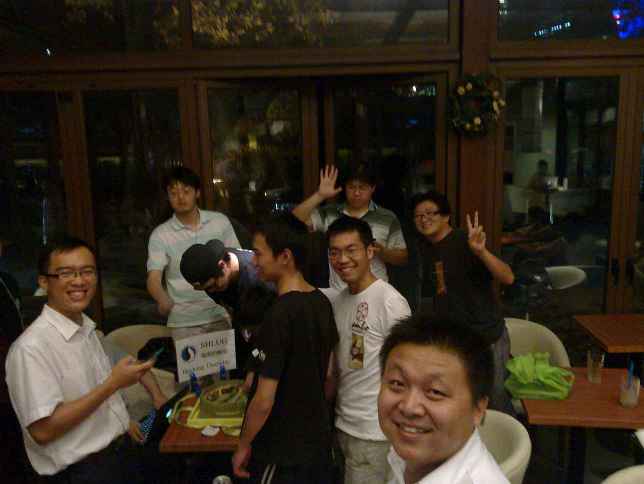
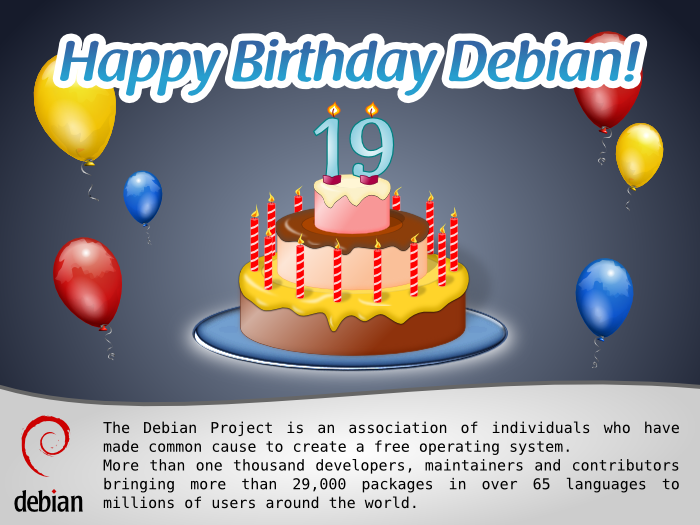
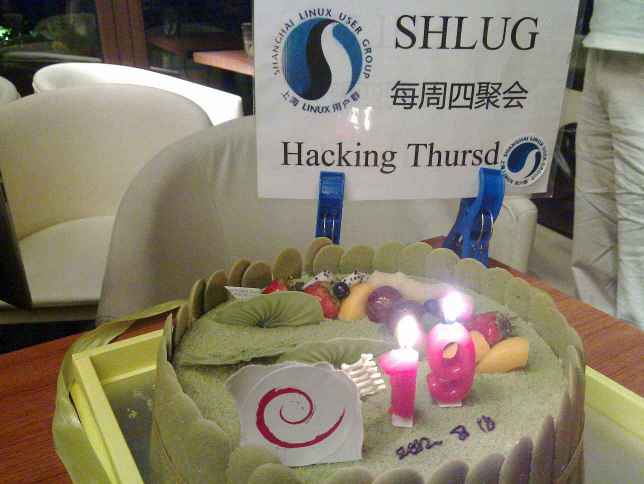 We were nearly 20 people from the Shanghai Linux User Group this evening, at JA cafe (near JinAn temple), celebrating Debian s 19th birthday. As the only DD present at that event (Li Daobing was busy somewhere else), I was honored by my friends to be the one cutting the cake. Above the (very nice) cake before sharing it, below, a few SHLUG members present that evening.
 For Debian s birthday, Francesca Ciceri of the Debian Publicity team suggested that developers blog about their first experiences with Debian . I found this a good idea so I m going to share my own early experience. It s quite different from what happens nowadays
 Before speaking of my early Debian experience, I have to set some context. In my youth, I have always been a Windows user and a fan of Bill Gates. That is until I got Internet at home at that point, I got involved in Usenet and made some friends there. One of those made me discover Perl and it has been somewhat of a revelation for me who had only been programming in Visual Basic, Delphi or ObjectPal. Later the same friend explained me that Perl was working much better on Linux and that Debian Linux installs it by default so I should try this one.
I had no idea of what Linux was, but given how I loved Perl, I was eager to try his advice. So I got myself a Tri-Linux CD with Debian/RedHat/Slackware on it and started the installation process (which involved preparing boot floppies). But I did not manage to get the graphical interface working despite lots of fiddling with Xfree86 s configuration file. So I ended up installing RedHat and used it for a few months. But since many of the smart guys in my Usenet community were Debian users, I persisted and finally managed to get it to work!
After a few months of usage, I was amazed at everything that was available for free and I wanted to give back. I filed my first bug report in July 1998, I created my first Debian packages in August 1998 and I got accepted as an official Debian developer in September 1998 (after a quick chat over the phone with Martin Schulze or James Troup I never understood the name of my interlocutor on the phone and I was so embarassed to have to use my rusty English over the phone that I never asked). That s right, it took me less than 3 months to become a Debian developer (I was 19 years old back then).
I learned a lot during those months by reading and interacting with other Debian developers. Many of those went away from Debian in the mean time but some of them are still involved (Joey Hess, Manoj Srivastava, Ian Jackson, Martin Schulze, Steve McIntyre, Bdale Garbee, Adam Heath, John Goerzen, Marco D Itri, Phil Hands, Lars Wirzenius, Santiago Vila, Matthias Klose, Dan Jacobowitz, Michael Meskes, ).
My initial Debian work was centered around Perl: I adopted dpkg-ftp (the FTP method for dselect) because it was written in Perl and had lots of outstanding bug reports. But I also got involved in more generic Quality Assurance work and tried to organize the nascent QA team. It was all really a lot of fun, I could take initiatives and it was clear to me that my work was appreciated.
I don t know if you find this story interesting but I had some fun time digging through archives to find out the precise dates if you want to learn more about what I did over the following years, I maintain a webpage for this purpose.
One comment Liked this article? Click here. My blog is Flattr-enabled.
| Publisher: | O'Reilly |
| Copyright: | May 2012 |
| ISBN: | 1-4493-1494-5 |
| Format: | Trade paperback |
| Pages: | 219 |
 A recent post by Steve Yegge has made quite a splash. The main thesis of his post is:
Software engineering has its own political axis, ranging from conservative to liberal.

 It seems that the UK government
But it s worse than that. Much worse. You re not going to be sent to jail for refusal to give up encryption keys. You re going to be sent to jail for an inability to unlock something that the police think is encrypted. Yes, this is where the hairs rise on our arms: if you have a recorded file with radio noise from the local telescope that you use for generation of random numbers, and the police asks you to produce the decryption key to show them the three documents inside the encrypted container that your radio noise looks like, you will be sent to jail for up to five years for your inability to produce the imagined documents.This is just insane. Edit: The law was created several years ago, but the blog post somehow made me think it was more recent.
Next.