Search Results: "tin"

6 February 2016

Neil Williams: lava.debian.net

With thanks to Iain Learmonth for the hardware, there is now a Debian instance of LAVA available for use and the Debian wiki page has been updated. LAVA is a continuous integration system for deploying operating systems onto physical and virtual hardware for running tests. Tests can be simple boot testing, bootloader testing and system level testing. Extra hardware may be required for some system tests. Results are tracked over time and data can be exported for further analysis. LAVA has a long history of supporting continuous integration of the Linux kernel on ARM devices (ARMv7 & ARMv8). So if you are testing a Linux kernel image on armhf or arm64 devices, you will find a lot of similar tests already running on the other LAVA instances. The Debian LAVA instance seeks to widen that testing in a couple of ways: This instance relies on the latest changes in lava-server and lava-dispatcher. The 2016.2 release has now deprecated the old, complex dispatcher and a whole new pipeline design is available. The Debian LAVA instance is running 2015.12 at the moment, I ll upgrade to 2016.2 once the packages migrate into testing in a few days and I can do a backport to jessie. What can LAVA do for Debian? ARMMP kernel testing Unreleased builds, experimental initramfs testing this is the core of what LAVA is already doing behind the scenes of sites like http://kernelci.org/. U-Boot ARM testing This is what fully automated LAVA labs have not been able to deliver in the past, at least without a usable SD Mux What s next LOTS. This post actually got published early (distracted by the rugby) I ll update things more in a later post. Contact me if you want to get involved, I ll provide more information on how to use the instance and how to contribute to the testing in due course.

Hideki Yamane: playing to update package (failed)


I thought to build gnome-todo package 3.19 branch.

Once tried to do that, it seems to need gtk+3.0 (>= 3.19.5), however Debian doesn't have it yet (of course, it's development branch). Then tried to build gtk+3, it needs wayland 1.90 1.9.90 that has not been in Debian yet, too. So, update local package to wayland 1.9.91, found tiny bug and sent patch, and build it (package diff was sent to maintainer - and merged), easy task.

Build again, gtk+3.0 needs "wayland-protocols" that has not been packaged in Debian, yet. Okay... (20 min work...) done! Make wayland-protocols package (not ITPed yet since who should be maintainer, under same umbrella as wayland?), not difficult.

Build newest gtk+3.0 source as 3.19.8 with cowbuilder chroot with those package (cowbuilder --login --save-after-exec --inputfile foo.deb --inputfile bar.deb), ...and failed with testsuite ;) I don't have enough knowledge to investigate it.

Back to older gtk+3.0 source, build 3.19.1 is fine (diff), but 3.19.2 was failed to build, 3.19.3 to 3.19.8 were failed with testsuite.


Time is up, "You lose!"... that's one of typical days.

Julien Danjou: FOSDEM 2016, recap

Last week-end, I was in Brussels, Belgium for the FOSDEM, one of the greatest open source developer conference. I was not sure to go there this year (I already skipped it in 2015), but it turned out I was requested to do a talk in the shared Lua & GNU Guile devroom. As a long time Lua user and developer, and a follower of GNU Guile for several years, the organizer asked me to run a talk that would be a link between the two languages. I've entitled my talk "How awesome ended up with Lua and not Guile" and gave it to a room full of interested users of the awesome window manager . We continued with a panel discussion entitled "The future of small languages Experience of Lua and Guile" composed of Andy Wingo, Christopher Webber, Ludovic Court s, Etiene Dalcol, Hisham Muhammaad and myself. It was a pretty interesting discussion, where both language shared their views on the state of their languages. It was a bit awkward to talk about Lua & Guile whereas most of my knowledge was year old, but it turns out many things didn't change. I hope I was able to provide interesting hindsight to both community. Finally, it was a pretty interesting FOSDEM to me, and it was a long time I didn't give talk here, so I really enjoyed it. See you next year!

5 February 2016

Daniel Pocock: Giving up democracy to get it back

Do services like Facebook and Twitter really help worthwhile participation in democracy, or are they the most sinister and efficient mechanism ever invented to control people while giving the illusion that they empower us? Over the last few years, groups on the left and right of the political spectrum have spoken more and more loudly about the problems in the European Union. Some advocate breaking up the EU, while behind the scenes milking it for every handout they can get. Others seek to reform it from within. Yanis Varoufakis on motorbike Most recently, former Greek finance minister Yanis Varoufakis has announced plans to found a movement (not a political party) that claims to "democratise" the EU by 2025. Ironically, one of his first steps has been to create a web site directing supporters to Facebook and Twitter. A groundbreaking effort to put citizens back in charge? Or further entangling activism in the false hope of platforms that are run for profit by their Silicon Valley overlords? A Greek tragedy indeed, in the classical sense. Varoufakis rails against authoritarian establishment figures who don't put the citizens' interests first. Ironically, big data and the cloud are a far bigger threat than Brussels. The privacy and independence of each citizen is fundamental to a healthy democracy. Companies like Facebook are obliged - by law and by contract - to service the needs of their shareholders and advertisers paying to study and influence the poor user. If "Facebook privacy" settings were actually credible, who would want to buy their shares any more? Facebook is more akin to an activism placebo: people sitting in their armchair clicking to "Like" whales or trees are having hardly any impact at all. Maintaining democracy requires a sufficient number of people to be actively involved, whether it is raising funds for worthwhile causes, scrutinizing the work of our public institutions or even writing blogs like this. Keeping them busy on Facebook and Twitter renders them impotent in the real world (but please feel free to alert your friends with a tweet) Big data is one of the areas that requires the greatest scrutiny. Many of the professionals working in the field are actually selling out their own friends and neighbours, their own families and even themselves. The general public and the policy makers who claim to represent us are oblivious or reckless about the consequences of this all-you-can-eat feeding frenzy on humanity. Pretending to be democratic is all part of the illusion. Facebook's recent announcement to deviate from their real-name policy is about as effective as using sunscreen to treat HIV. By subjecting themselves to the laws of Facebook, activists have simply given Facebook more status and power. Data means power. Those who are accumulating it from us, collecting billions of tiny details about our behavior, every hour of every day, are fortifying a position of great strength with which they can personalize messages to condition anybody, anywhere, to think the way they want us to. Does that sound like the route to democracy? I would encourage Mr Varoufakis to get up to speed with Free Software and come down to Zurich next week to hear Richard Stallman explain it the day before launching his DiEM25 project in Berlin. Will the DiEM25 movement invite participation from experts on big data and digital freedom and make these issues a core element of their promised manifesto? Is there any credible way they can achieve their goal of democracy by 2025 without addressing such issues head-on? Or put that the other way around: what will be left of democracy in 2025 if big data continues to run rampant? Will it be as distant as the gods of Greek mythology? Still not convinced? Read about Amazon secretly removing George Orwell's 1984 and Animal Farm from Kindles while people were reading them, Apple filtering the availability of apps with a pro-Life bias and Facebook using algorithms to identify homosexual users.

Bernd Zeimetz: bzed-letsencrypt puppet module

With the announcement of the Let s Encrypt dns-01 challenge support we finally had a way to retrieve certificates for those hosts where http challenges won t work. Also it allows to centralize the signing procedure to avoid the installation and maintenance of letsencrypt clients on all hosts. For an implementation I had the following requirements in my mind: After reading trough the source code of various letsencrypt client implementations I decided to use letsencrypt.sh. Mainly because its dependencies are available pretty much everywhere and adding the necessary hook is as simple as writing some lines of code in your favourite (scripting) language. My second favourite was lego, but I wanted to avoid shipping binaries with puppet, so golang was not an option. It took me some days to find enough spare time to write the necessary puppet code, but finally I managed to release a working module today. It is still not perfect, but the basic tasks are implemented and the whole key/csr/signing chain works pretty well. And if your hook can handle it, http-01 challenges are possible, too! Please give the module a try and send patches if you would like to help to improve it!

Ben Hutchings: Debian LTS work, January 2016

In January I carried over 10 hours from December and was assigned another 15 hours of work by Freexian's Debian LTS initiative. I worked a total of 15 hours. I had a few days on 'front desk' at the start of the month, as my week in that role spanned the new year. I fixed a regression in the kernel that was introduced to all stable suites in December. I uploaded this along with some minor security fixes, and issued DLA 378-1. I finished backporting and testing fixes to sudo for CVE-2015-5602. I uploaded an update and issued DLA 382-1, which was followed by DSA 3440-1 for wheezy and jessie. I finished backporting and testing fixes to Claws Mail for CVE-2015-8614 and CVE-2015-8708. I uploaded an update and issued DLA 383-1. This was followed by DSA 3452-1 for wheezy and jessie, although the issues are less serious there. I also apent a little time on InspIRCd, though this isn't a package that Freexian's customers care about and it seems to have been broken in squeeze for several years due to a latent bug in the build system. I had already backported the security fix by the time I discovered this, so I went ahead with an update fixing that regression as well, and issued DLA 384-1. Finally, I diagnosed the regression in the update to isc-dhcp in DLA 385-1.

Enrico Zini: debtags-cleanup

debtags.debian.org cleaned up Since the Debtags consolidation announcement there are some more news: No more anonymous submissions Official recognition as Debian Contributors Mailing lists closed We can just use debian-devel instead of debtags-devel. Autotagging of trivial packages Miscellaneous other changes

Michal Čihař: Bug squashing in Gammu

I've not really spent much time on Gammu in past months and it was about time to do some basic housekeeping. It's not that there would be too much of new development, I rather wanted to go through the issue tracker, properly tag issues, close questions without response and resolve the ones which are simple to fix. This lead to few code and documentation improvements. Overall the list of closed issues is quite huge: Do you want more development to happen on Gammu? You can support it by money.

Filed under: English Gammu python-gammu Wammu 0 comments

4 February 2016

Petter Reinholdtsen: Using appstream in Debian to locate packages with firmware and mime type support

The appstream system is taking shape in Debian, and one provided feature is a very convenient way to tell you which package to install to make a given firmware file available when the kernel is looking for it. This can be done using apt-file too, but that is for someone else to blog about. :) Here is a small recipe to find the package with a given firmware file, in this example I am looking for ctfw-3.2.3.0.bin, randomly picked from the set of firmware announced using appstream in Debian unstable. In general you would be looking for the firmware requested by the kernel during kernel module loading. To find the package providing the example file, do like this:
% apt install appstream
[...]
% apt update
[...]
% appstreamcli what-provides firmware:runtime ctfw-3.2.3.0.bin   \
  awk '/Package:/  print $2 '
firmware-qlogic
%
See the appstream wiki page to learn how to embed the package metadata in a way appstream can use. This same approach can be used to find any package supporting a given MIME type. This is very useful when you get a file you do not know how to handle. First find the mime type using file --mime-type, and next look up the package providing support for it. Lets say you got an SVG file. Its MIME type is image/svg+xml, and you can find all packages handling this type like this:
% apt install appstream
[...]
% apt update
[...]
% appstreamcli what-provides mimetype image/svg+xml   \
  awk '/Package:/  print $2 '
bkchem
phototonic
inkscape
shutter
tetzle
geeqie
xia
pinta
gthumb
karbon
comix
mirage
viewnior
postr
ristretto
kolourpaint4
eog
eom
gimagereader
midori
%
I believe the MIME types are fetched from the desktop file for packages providing appstream metadata.

Ritesh Raj Sarraf: Lenovo Yoga 2 13 running Debian with GNOME Converged Interface

I've wanted to blog about this for a while. So, though I'm terrible at creating video reviews, I'm still going to do it, rather than procrastinate every day. In this video, the emphasis is on using Free Software (GNOME in particular) tools, with which soon you should be able serve the needs for Desktop/Laptop, and as well as a Tablet. The video also touches a bit on Touchpad Gestures.

Categories:

Keywords:

Like:

Martin-Éric Racine: xf86-video-geode 2.11.18

Yesterday, I pushed out version 2.11.18 of the Geode X.Org driver. This is the driver used by the OLPC XO-1 and by a plethora of low-power desktops, micro notebooks and thin clients. This release mostly includes maintenance fixes of all sorts. Of noticeable interest is a fix for the long-standing issue that switching between X and a VT would result in a blank screen (this should probably be cherry-picked for distributions running earlier releases of this driver). Many thanks to Connor Behan for the fix!
Unfortunately, this driver still doesn't work with GNOME. On my testing host, launching GDM produces a blank screen. 'ps' and other tools show that GDM is running but there's no screen content; the screen remains pitch black. This issue doesn't happen with other display managers e.g. LightDM. Bug reports have been filed, additional information was provided, but the issue still hasn't been resolved.
Additionally, X server flat out crashes on Geode hosts running Linux kernels 4.2 or newer. 'xkbcomp' repeatedly fails to launch and X exits with a fatal error. Bug reports have been filed, but not reacted to. However, interestingly enough, X launches fine if my testing host is booted with earliers kernels, which might suggest what the actual cause of this particular bug might be:
Since kernel 4.2 entered Debian, the base level i386 kernel on Debian is now compiled for i686 (without PAE). Until now, the base level was i586. This essentially makes it pointless to build the Geode driver with GX2 support. It also means that older GX1 hardware won't be able to run Debian either, starting with the next stable release.

Russell Coker: Unikernels

At LCA I attended a talk about Unikernels. Here are the reasons why I think that they are a bad idea: Single Address Space According to the Unikernel Wikipedia page [1] a significant criteria for a Unikernel system is that it has a single address space. This gives performance benefits as there is no need to change CPU memory mappings when making system calls. But the disadvantage is that any code in the application/kernel can access any other code directly. In a typical modern OS (Linux, BSD, Windows, etc) every application has a separate address space and there are separate memory regions for code and data. While an application can request the ability to modify it s own executable code in some situations (if the OS is configured to allow that) it won t happen by default. In MS-DOS and in a Unikernel system all code has read/write/execute access to all memory. MS-DOS was the least reliable OS that I ever used. It was unreliable because it performed tasks that were more complex than CP/M but had no memory protection so any bug in any code was likely to cause a system crash. The crash could be delayed by some time (EG corrupting data structures that are only rarely accessed) which would make it very difficult to fix. It would be possible to have a Unikernel system with non-modifyable executable areas and non-executable data areas and it is conceivable that a virtual machine system like Xen could enforce that. But that still wouldn t solve the problem of all code being able to write to all data. On a Linux system when an application writes to the wrong address there is a reasonable probability that it will not have write access and you will immediately get a SEGV which is logged and informs the sysadmin of the address of the crash. When Linux applications have bugs that are difficult to diagnose (EG buffer overruns that happen in production and can t be reproduced in a test environment) there are a variety of ways of debugging them. Tools such as Valgrind can analyse memory access and tell the developers which code had a bug and what the bug does. It s theoretically possible to link something like Valgrind into a Unikernel, but the lack of multiple processes would make it difficult to manage. Debugging A full Unix environment has a rich array of debugging tools, strace, ltrace, gdb, valgrind and more. If there are performance problems then tools like sysstat, sar, iostat, top, iotop, and more. I don t know which of those tools I might need to debug problems at some future time. I don t think that any Internet facing service can be expected to be reliable enough that it will never need any sort of debugging. Service Complexity It s very rare for a server to have only a single process performing the essential tasks. It s not uncommon to have a web server running CGI-BIN scripts or calling shell scripts from PHP code as part of the essential service. Also many Unix daemons are not written to run as a single process, at least threading is required and many daemons require multiple processes. It s also very common for the design of a daemon to rely on a cron job to clean up temporary files etc. It is possible to build the functionality of cron into a Unikernel, but that means more potential bugs and more time spent not actually developing the core application. One could argue that there are design benefits to writing simple servers that don t require multiple programs. But most programmers aren t used to doing that and in many cases it would result in a less efficient result. One can also argue that a Finite State Machine design is the best way to deal with many problems that are usually solved by multi-threading or multiple processes. But most programmers are better at writing threaded code so forcing programmers to use a FSM design doesn t seem like a good idea for security. Management The typical server programs rely on cron jobs to rotate log files and monitoring software to inspect the state of the system for the purposes of graphing performance and flagging potential problems. It would be possible to compile the functionality of something like the Nagios NRPE into a Unikernel if you want to have your monitoring code running in the kernel. I ve seen something very similar implemented in the past, the CA Unicenter monitoring system on Solaris used to have a kernel module for monitoring (I don t know why). My experience was that Unicenter caused many kernel panics and more downtime than all other problems combined. It would not be difficult to write better code than the typical CA employee, but writing code that is good enough to have a monitoring system running in the kernel on a single-threaded system is asking a lot. One of the claimed benefits of a Unikernel was that it s supposedly risky to allow ssh access. The recent ssh security issue was an attack against the ssh client if it connected to a hostile server. If you had a ssh server only accepting connections from management workstations (a reasonably common configuration for running servers) and only allowed the ssh clients to connect to servers related to work (an uncommon configuration that s not difficult to implement) then there wouldn t be any problems in this regard. I think that I m a good programmer, but I don t think that I can write server code that s likely to be more secure than sshd. On Designing It Yourself One thing that everyone who has any experience in security has witnessed is that people who design their own encryption inevitably do it badly. The people who are experts in cryptology don t design their own custom algorithm because they know that encryption algorithms need significant review before they can be trusted. The people who know how to do it well know that they can t do it well on their own. The people who know little just go ahead and do it. I think that the same thing applies to operating systems. I ve contributed a few patches to the Linux kernel and spent a lot of time working on SE Linux (including maintaining out of tree kernel patches) and know how hard it is to do it properly. Even though I m a good programmer I know better than to think I could just build my own kernel and expect it to be secure. I think that the Unikernel people haven t learned this.

Iustin Pop: X cursor theme

There's not much to talk about X cursor themes, except when they change behind your back :) A while back, after a firefox upgrade, it and only it showed a different cursor theme: basically double the size, and (IMHO) uglier. Searched for a while, but couldn't figure what makes firefox special, except that it is a GTK application. After another round of dist-upgrades, now everything except xterms were showing the big cursors. This annoyed me to no end as I don't use a high-DPI display, the new cursors are just too damn big. Only to find out two things: Sigh, Gnome.

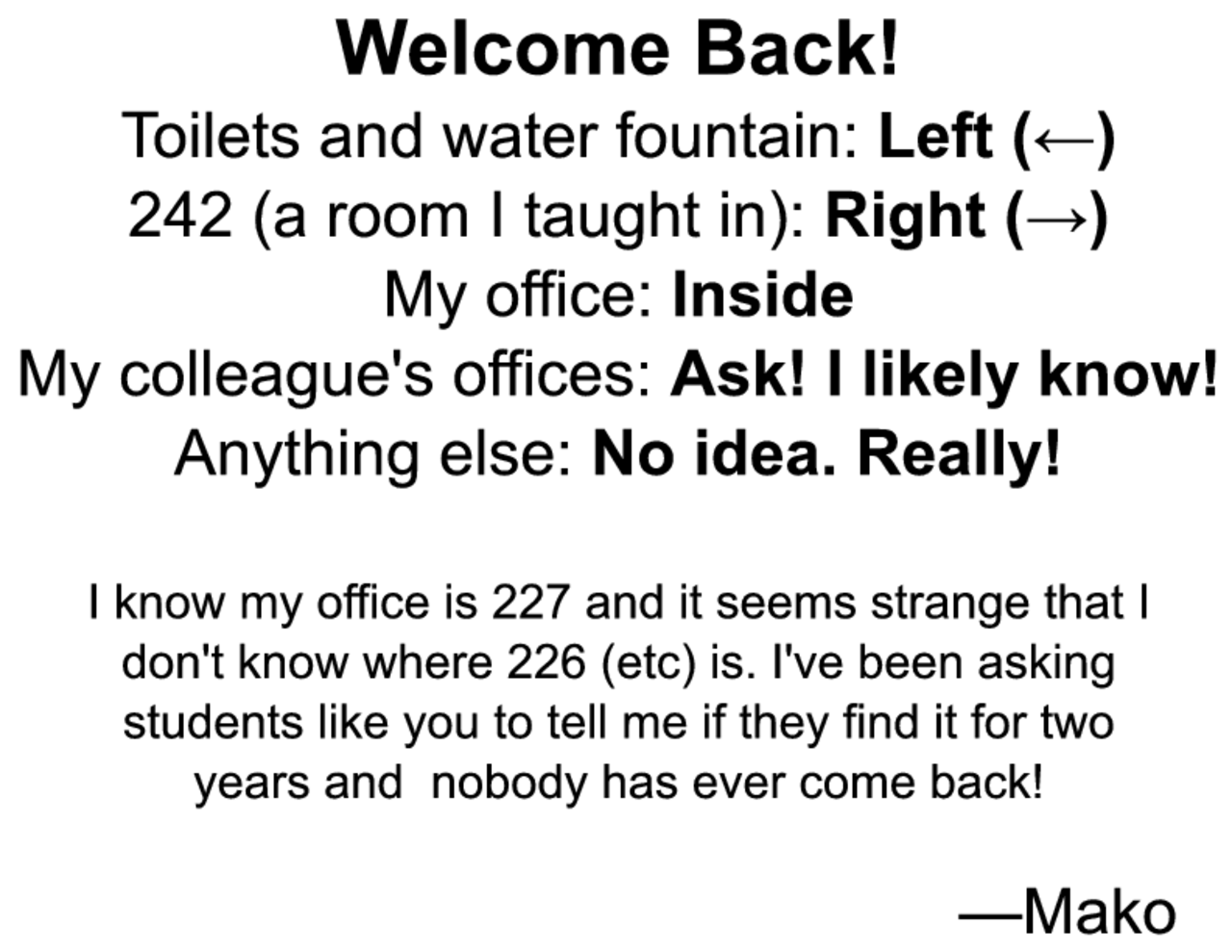
Benjamin Mako Hill: Welcome Back Poster

My office door is on the second floor in front the major staircase in my building. I work with my door open so that my colleagues and my students know when I m in. The only time I consider deviating from this policy is the first week of the quarter when I m faced with a stream of students, usually lost on their way to class and that, embarrassingly, I am usually unable to help. I made this poster so that these conversations can, in a way, continue even when I am not in the office. early_quarter_doors_sign

3 February 2016

Michal Čihař: Gammu 1.37.0

Today, Gammu 1.37.0 has been released. As usual it collects bug fixes. This time there is another important change as well - improver error reporting from SMSD. This means that when SMSD fails to connect to the database, you should get a bit more detailed error than "Unknown error". Full list of changes: Would you like to see more features in Gammu? You an support further Gammu development at Bountysource salt or by direct donation.

Filed under: English Gammu 0 comments

Michal Čihař: New projects on Hosted Weblate

I had some pile of hosting requests in queue since half of January and my recent talk on FOSDEM had some impact on requests for hosting translations as well, so it's about time to process them. New kids on the block are: Second round includes: Unfortunately I had to reject some projects as well mostly due to lack of file format support. This is still the same topic - when translating project, please stick with some standard format. Preferably what is usual on your platform. If you like this service, you can support it on Bountysource salt or Gratipay. There is also option for hosting translations of commercial products.

Filed under: English Weblate 0 comments

2 February 2016

Rhonda D'Vine: Moby

Today is one of these moods. And sometimes one needs certain artists/music to foster it. Music is powerful. There are certain bands I know that I have to stay away from when feeling down to not get too deep into it. Knowing that already helps a lot. The following is an artist that is not completely in that area, but he got powerful songs and powerful messages nevertheless; and there was this situation today that one of his songs came to my mind. That's the reason why I present you today Moby. These are the songs: Hope you like the selection; and like always: enjoy!

/music permanent link Comments: 2 Flattr this

Sune Vuorela: Compilers and error messages

So. I typo ed up some template code the other day. And once again I learned the importance of using several c++ compilers. Here is a very reduced version of my code:
#include <utility>
template <typename T> auto foo(const T& t) -> decltype(x.first)

return t.first;

int main()

foo(std::make_pair(1,2));
return 0;
And let s start with the compiler I was testing with first. MSVC (2013 and 2015)
main.cpp(8): error C2672: foo : no matching overloaded function found
main.cpp(8): error C2893: Failed to specialize function template unknown-type foo(const T &)
It is not completely clear from that error message what s going on, so let s try some other compilers: GCC (4.9-5.3)
2 : error: x was not declared in this scope
template <typename T> auto foo(const T& t) -> decltype(x.first)
That s pretty clear. More compilers: Clang (3.3-3.7)
2 : error: use of undeclared identifier x
template <typename T> auto foo(const T& t) -> decltype(x.first)
ICC (13)
example.cpp(2): error: identifier x is undefined
template <typename T> auto foo(const T& t) -> decltype(x.first)
(Yes. I mistyped the variable name used for decltype. Replacing the x with t makes it build). Thanks to http://gcc.godbolt.org/ and http://webcompiler.cloudapp.net/ for testing with various compilers.

Dirk Eddelbuettel: Like peanut butter and jelly: x13binary and seasonal

This post was written by Dirk Eddelbuettel and Christoph Sax and will be posted on both author's respective blogs. The seasonal package by Christoph Sax brings a very featureful and expressive interface for working with seasonal data to the R environment. It uses the standard tool of the trade: X-13ARIMA-SEATS. This powerful program is provided by the statisticians of the US Census Bureau based on their earlier work (named X-11 and X-12-ARIMA) as well as the TRAMO/SEATS program by the Bank of Spain. X-13ARIMA-SEATS is probably the best known tool for de-seasonalization of timeseries, and used by statistical offices around the world. Sadly, it also has a steep learning curve. One interacts with a basic command-line tool which users have to download, install and properly reference (by environment variables or related means). Each model specification has to be prepared in a special 'spec' file that uses its own, cumbersome syntax. As seasonal provides all the required functionality to use X-13ARIMA-SEATS from R --- see the very nice seasonal demo site --- it still required the user to manually deal with the X-13ARIMA-SEATS installation. So we decided to do something about this. A pair of GitHub repositories provide both the underlying binary in a per-operating system form (see x13prebuilt) as well as a ready-to- use R package (see x13binary) which uses the former to provide binaries for R. And the latter is now on CRAN as package x13binary ready to be used on Windows, OS-X or Linux. And the seasonal package (in version 1.2.0 -- now on CRAN -- or later) automatically makes use of it. Installing seasaonal and x13binary in R is now as easy as:

install.packages("seasonal")
which opens the door for effortless deployment of powerful deasonalization. By default, the principal function of the package employs a number of automated techniques that work well in most circumstances. For example, the following code produces a seasonal adjustment of the latest data of US retail sales (by the Census Bureau) downloaded from Quandl:
library(seasonal) 
library(Quandl)   ## not needed for seasonal but has some niceties for Quandl data
rs <- Quandl(code="USCENSUS/BI_MARTS_44000_SM", type="ts")/1e3
m1 <- seas(rs)
plot(m1, main = "Retail Trade: U.S. Total Sales", ylab = "USD (in Billions)")
This tests for log-transformation, performs an automated ARIMA model search, applies outlier detection, tests and adjusts for trading day and easter effects, and invokes the SEATS method to perform seasonal adjustment. And this is how the adjusted series looks like:
Of course, you can access all available options of X-13ARIMA-SEATS as well. Here is an example where we adjust the latest data for Chinese exports (as tallied by the US FED), taking into account the different effects of Chinese New Year before, during and after the holiday:
xp <- Quandl(code="FRED/VALEXPCNM052N", type="ts")/1e9
m2 <- seas(window(xp, start = 2000),
          xreg = cbind(genhol(cny, start = -7, end = -1, center = "calendar"), 
                       genhol(cny, start = 0, end = 7, center = "calendar"), 
                       genhol(cny, start = 8, end = 21, center = "calendar")
          ),
          regression.aictest = c("td", "user"),
          regression.usertype = "holiday")
plot(m2, main = "Goods, Value of Exports for China", ylab = "USD (in Billions)")
which generates the following chart demonstrating a recent flattening in export activity measured in USD.
We hope this simple examples illustrates both how powerful a tool X-13ARIMA-SEATS is, but also just how easy it is to use X-13ARIMA-SEATS from R now that we provide the x13binary package automating its installation.

This post by Dirk Eddelbuettel originated on his Thinking inside the box blog. Please report excessive re-aggregation in third-party for-profit settings.

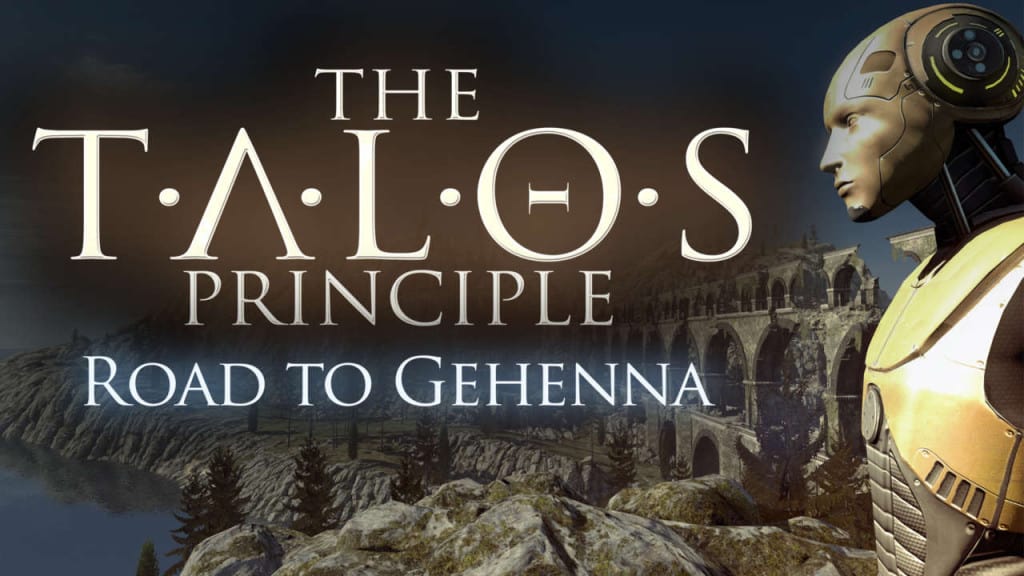
Norbert Preining: Gaming: The Talos Principle Road to Gehenna

After finishing the Talos Principle I immediately started to play the extension Road to Gehenna, but was derailed near completion by the incredible Portal Stories: Mel. Now that I finally managed to escape from the test chambers my attention returned to the Road to Gehenna. As with the pair Portal 2 and Portal Stories: Mel, the challenges are going up considerably from the original Talos Principle to the Road to Gehenna. Checking the hours of game play it took me about 24h through all the riddles in Road to Gehenna, but I have to admit, I had some riddles where I needed to cheat. road-to-gehenna.jpg The Road to Gehenna does not bring much new game play elements, but loads of new riddles. And the best of all, playable on Linux! And as with the original game, the graphics are really well done, while still be playable on my Vaio Pro laptop with Intel integrated graphic card a plus that is rare in the world of computer games where everyone is expected to have a high-end nVidia or Radeon card. Ok, there is not much action going on where quick graphic computations are necessary, still the impression of the game is great.
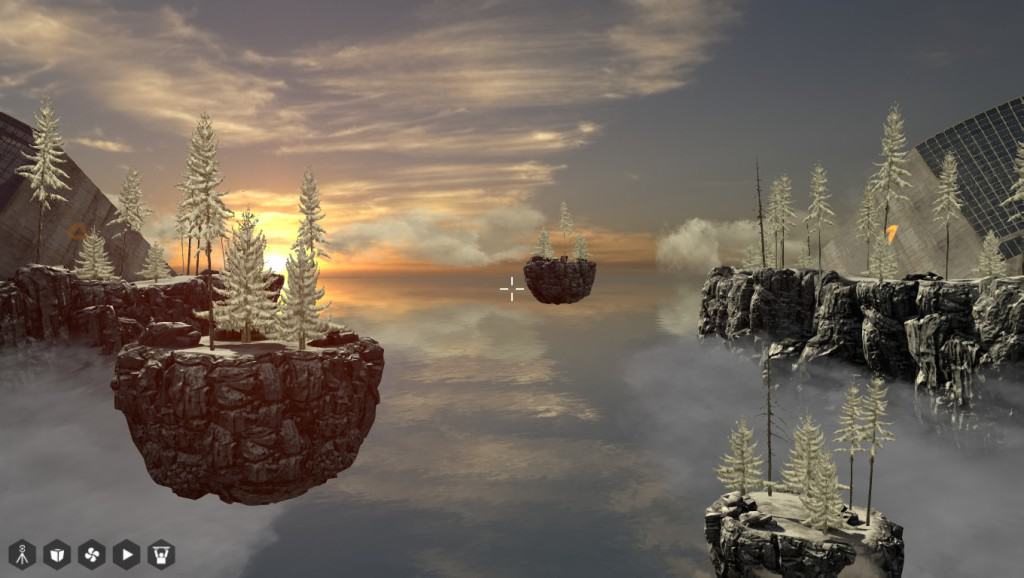
gehenna1 The riddles contain the well known elements (connectors, boxes, jammer, etc), but the settings are often spectacular, sometimes very small and narrow, just a few moves if done in the right order, sometimes like wide open fields with lots of space to explore. Transportation between various islands suspended in the air is with vents, giving you a lot of nice flight time!

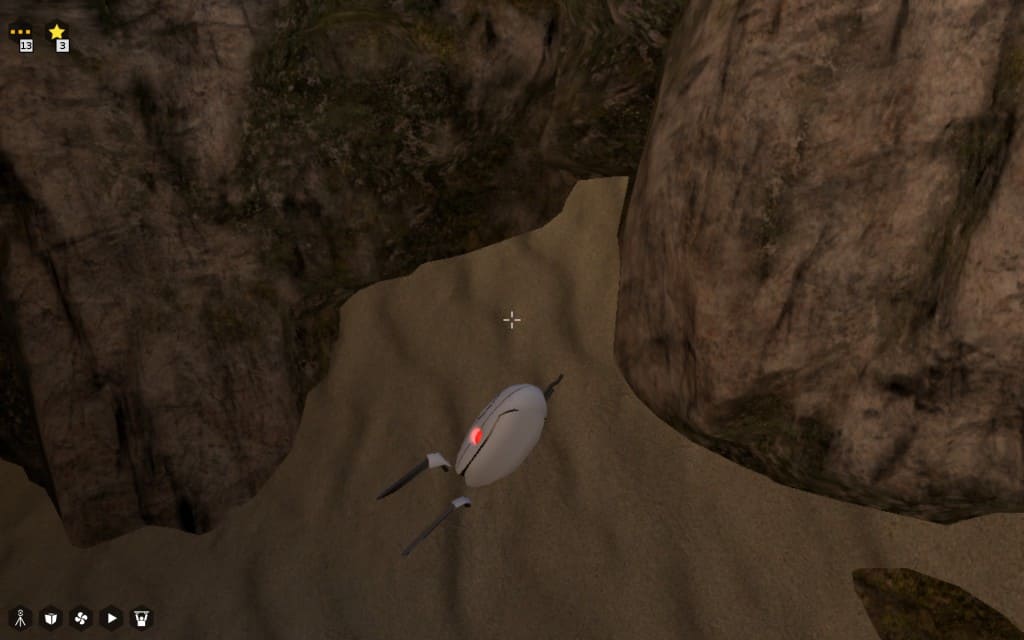
gehenna2 If one searches a lot, or uses a bit of cheating, one can find good old friends from the Portal series, burried in the sand in one of the world. This is not the only easter egg hidden in the game, there are actually a lot, some of which I have not seen but only read about afterwards. Guess I need to replay the whole game.
gehenna3 Coming back to the riddles, I really believe that the makers have been ingenious in using the few items at hand to create challenging and surprising riddles. As it is so often, many of the riddles look completely impossible at first glance, and often even after staring at them for tens and tens of minutes. Until (and if) one has the the a-ha effect and understands the trick. This often still needs a lot of handwork and trial-error rounds, but all in all the game is well balanced. What is a bit a pain similar to the original game are collecting the stars to reach the hidden world and free the admin. There the developers overdid it in my opinion, with some rather absurd and complicated stars.

gehenna4 The end of the game, ascension of the messengers, is rather unspectacular. A short discussion on who remains and then a big closing scene with the messenger being beamed up a la Starship Enterprise, and a closing black screen. But well, the fun was with the riddles.
gehenna5 All in all an extension that is well worth the investment if one enjoyed the original Talos, and is looking for rather challenging riddles. Now that I have finished all the Portal and Talos titles, I am hard thinking of what is next looking into Braid Enjoy!

Next.

Previous.