Search Results: "tim"

15 February 2014

Tim Retout: Backporting some Perl modules

I've started backporting some Perl modules to wheezy-backports - for starters, libbread-board-perl, which is now waiting in BACKPORTS-NEW. At work I've recently been trying to automate the deployment of our platform, and was originally trying to use Carton to manage the CPAN dependencies for us. It seems like it ought to be possible to make this work using CPAN-only tools. However, in practice, I've seen two strong negatives with this approach: Consider, when you spin up a fresh VM, you need to build Perl from source, and then compile every CPAN module you depend on. This includes all the modules needed to run all the test suites. That's not going to be fast. All that, and you still need a solution that works with the distro's package management, because you still need to install all the build dependencies. So, I'm trying a new approach - if someone else benefits from the packages I backport, even better.

Gunnar Wolf: Like a Lord and Lady, with my dearest passions...

Like a Lord and Lady, with my dearest passions...
For those of you who didn't yet know it: My mother is a painter. A serious, professional, respected painter. But she sometimes goes to the funny side as well Of course, with all due professionalism! So, she gave us this great gift: She took one of our pictures from DebConf12 (from the "Conference Dinner" night), and painted it. Real size even! So, next time you come to our house, even if we are not around to greet you, we will be glad to welcome you to the Residence!

Thomas Goirand: OpenStack 2013.2.2 uploaded

This is the 2nd point release of OpenStack Havana (this is the name of the current stable release of OpenStack). It was out on Thursday (US time), and I uploaded it on Friday (Chinese time). Unfortunately, I realized that the latest python-keystoneclient didn t support the token and endpoint command line options, effectively breaking Keystone itself, and all automated endpoint registration in all core packages. So after fixing Keystone and openstack-pkg-tools, I had to re-upload a 2nd Debian release. However, after this glitch, the packages passed successfully our CI testing suite: my friends at eNovance and I run the tempest functional test suite each time there s this kind of major update, so that we can validate the packages are working as expected. And all went well after the new keystone command line options were fixed in the postinst scripts. As a side note, I fail to see consistency on deprecating these interfaces. While we still have the old glance index thing in the Glance client (this is really old), keystoneclient just broke backward compatibility, when keystone is quite recent. So, it looks to me that it wasn t a great idea to just remove token and endpoint this way (though I can understand the need of consistency). Hopefully, this will all be fixed anyway, when we move to the unified python-openstackclient command lines instead of per-project clients. I realized today that the pkg-openstack team now maintains more than 100 packages. This of course includes general purpose Python modules, which probably will move to the Python module team if it one day supports Git (life is too short: I do not wish to learn such a deprecated technology as SVN). Though this is still a lot of packages, and some more are coming: as per the OpenStack TODO list wiki page, Ironic (a replacement for nova-baremetal), TripleO (OpenStack on OpenStack), Tuskar (contols where things are deployed with TripleO) and Designate (DNS as a Service) are already packaged, and I am waiting for the Icehouse (this is the name of the next stable release) beta3 to be out to upload them to Experimental. This is scheduled for the 6th of March. I believe I am currently nearly up-to-date with the current global-requirements.txt (eg: python dependencies of OpenStack), pending a few Python module upgrades, so hopefully, packaging OpenStack Icehouse beta3 will smooth.

14 February 2014

Andrew Pollock: [life] Day 17, Dentist, Goldie Blox, Yum Cha and more Kinetic Sand

Today was another busy day. Zoe had a check up at her dentist first thing this morning. This dentist was such a good find, and although it's a trek (it's over an hour round trip for a 15 minute appointment) I think it's well worth it to instill a positive view of dentists into Zoe, and it's all covered by insurance, so really the only expense is time and petrol. After we got home, Zoe was a bit sick of being in the car, and wanted to watch TV. I'm trying to restrict TV to just the late afternoon, while I'm preparing dinner, so I thought this was a good opportunity to break out the Goldie Blox set that I haven't introduced her to yet. That went pretty well, but Mum and Dad (aka Grandma and Grandpa) arrived early for lunch, so we didn't finish working our way through the book. I think it was more of a hit than Robot Turtles is at the moment. We all jumped in the car, and drove down to Bulimba, and caught the cross river ferry over to the CityGlider bus and had Yum Cha for lunch. That went pretty well, and we returned the same way. Zoe had a little play in the park at Bulimba with her grandparents while I popped over to the florist, and then we came home and Zoe gave them a demonstration of the kinetic sand and then Grandma and Grandpa went home and I managed to convince Zoe to take a late nap. We didn't get much of an opportunity for something Science Friday-related today, with all of the other activities. Zoe didn't wake up from her nap until close to 5pm, just after my girlfriend arrived for dinner. Zoe watched a bit of TV and then the three of us walked down to collect pizza for dinner, and that was pretty much how the evening ended. I let Zoe stay up a little bit later, because she'd napped so late.

Rudy Godoy: Getting Movistar Peru ZTE MF193 work in Debian

After so many attempts to have my shiny Movistar Peru (Internet M vil) 3G ZTE MF193 modem to work out-of-the-box in Debian jessie (unstable) with NetworkManager, the word frustration was hitting on my head. Even trying to do the right thing, led me to craziness. I gave up on fanzines and decided to take the old-school route. Release wvdial and friends! Trying different combinations for wvdial.conf was no heaven for sure, but I ve found this wonderful guide from Christian Ams ss from Vienna, Austria! that really made a difference. Of course he s talking about the MF180 model but you get the idea. So I m sharing what was different for the MF193. Basically, I ve done the eject and disable CD-ROM thing already, but still no progress. I ve also tried using wvdial to send AT commands to the evasive /dev/ttyUSBX device. Starting from scratch confirmed that I ve done such things properly indeed. I was amused by the fact that I could use screen to talk to the modem! (yo, all the time wasted trying to have minicom and friends play nice) So, let s get to the point. After following this procedure, you should be able to use NetworkManager to connect to the Interwebs using the 3G data service from Movistar Peru.
  1. Step 1 follow the guide
  2. Step 2 Here I had to use /dev/ttyUSB4
  3. Step 3 follow the guide
  4. Unplug your USB modem
  5. Plug your USB modem. This time you should see only /dev/ttyUSB 0,1,2 and /dev/gsmmodem should be missing (not sure if this is a bug). Now /dev/ttyUSB2 is your guy.
  6. Step 4 use /dev/ttyUSB2
  7. Run wvdial from CLI it should connect successfully.
  8. Stop wvdial
  9. Select the Network icon on GNOME3, click on the Mobile Broadband configuration you have, if not create one.
  10. Voil . Happy surfing!
I m pasting my wvdial.conf, just in case.
[Dialer Defaults]
Modem = /dev/ttyUSB2
Username = movistar@datos
Password = movistar
APN = movistar.pe
Phone = *99#
Stupid Mode = 1
Init2 = AT+CGDCONT=4,"IP","movistar.pe"

13 February 2014

Erich Schubert: Google Summer of Code 2014 - not participating

Google Summer of Code 2014 is currently open for mentoring organizations to register. I've decided to not apply for GSoC with my data mining open source project ELKI anymore.

Enrico Zini: habits

Habits Beware of habits. I've seen them turn into expectations over time, without any kind of negotiation.

12 February 2014

Andrew Pollock: [life] Day 16, BJJ, wood working and kinetic sand

It's been quite a busy, varied day today. Lot's of fun as usual. Zoe has a dentist appointment tomorrow morning, so we went to the Thursday offering of her Brazilian Jiu-Jitsu class instead, and skipped Playgroup. We biked over extra early this morning, to make sure we were on time. There were two other kids in the class today, a 3 year old boy and a 2 and a half year old girl. The class went really well. We biked home the scenic way again, and grabbed a BBQ chicken for lunch along the way. The box of kinetic sand that I'd ordered was sitting on the doorstep. That still left us with about 45 minutes to kill before lunch, so I thought I'd start on making a second miniature clothes line with Zoe. Bunnings were selling these little kids safety sets at half price because they were a deleted product, and the set came with proper fitting eye protection, hearing protection and some gloves. The gloves are currently too big, but the glasses and hearing protection is great. I introduced her to the power drill and the hand saw. She liked drilling, and marking, but mostly was happy just watching. We managed to make most of the top of the clothes line before lunch, and then I whipped up some chicken quesadillas for lunch. We had a few disruptions during quiet time, so Zoe didn't nap. After quiet time, we did a mix of cleaning up the house a bit, some more wood working, and some self-directed play. After that, Zoe's friend Mackensie and her little sister came over for a play date after her Kindergarten class. She goes to the same Kindergarten as Zoe, but in the second half of the week. Mackensie's mum brought me a coffee, and we had some afternoon tea, and then I busted out the kinetic sand. It was a real hit with all the girls, as well as the adults. A very good product. That kept them occupied for a while. Zoe had found a Wallace and Gromit DVD while we were cleaning up, and she hasn't watched it for a while, so she was very keen to watch it. I told her she could watch it after Mackensie went home, and so we've kicked back on the couch to watch that while we wait for Sarah to arrive.

Matthias Klumpp: AppStream/Listaller FOSDEM slides

FOSDEM is over, and it has been a great time! I talked to many people (thanks to full devrooms ;-) Graph Databases and Config management was crazy, JavaScript as well ) and there might be some cool new things to come soon, which we discussed there :-)
I also got some good and positive feedback on the projects I work on, and met many people from Debian, Kubuntu, KDE and GNOME (haven t seen some of them for almost 3 years) one of the best things of being at FOSDEM is, that you not only see people of your own kind for example, for me as Debian developer it was great to see Fedora people and discuss things with them, something which rarely happens at Debian conferences. Also, having GNOME and KDE closely together again (litterally, their stands were next to each other ) is something I missed since the last Desktop Summit in 2011. My talks were also good, except for the beamer-slides-technical-error at the beginning, which took quite some time (I blame KScreen ;-) ). In case you re interested in the slides, here they are: slides for FOSDEM 14 AppStream/Listaller talks. The slides can likely be understood without the talk, they are way too detailed (usually I only show images on slides, but that doesn t help people who can t see the talk ^^) I hope I can make it to FOSDEM 15 as well I ve been there only once, but it already is my favourite FOSS-conference (and I love Belgian waffles) ;-)

Mario Lang: Roughly 1500 source packages have possibly broken links in debian/control

There are currently roughly 1500 source packages in Debian which possibly (very likely actually) do have broken URLs in debian/control. While it is quite useful that we have VCS information and Homepage URLs in the Packages file these days, we also created a rather big source of bitrot. These URLs are typically paste-and-forget. Sure, people occasionally catch the fact that a homepage or VCS has moved, especially if they are active and in good contact with their upstreams. However, there are also other cases...
DUCK to the rescue! My coworker Simon Kainz has worked on a service that helps at least to track which URLs are currently broken. We've initially discussed some way to make this a part of Lintian, which is what I would have prefered. However, for good reasons, Lintian doesn't want to call out to the net by default, so these checks would likely not get run by many developers anyway. So Simon ended up creating DUCK - the Debian Url ChecKer which actually goes out to the net and verifies that all the Vcs-* and Homepage fields of debian/control are actually reachable. The frontend allows developers to search for packages they maintain, to quickly see if they have any URLs which are possibly broken. There is a slight chance of temporary network problems of course, so what DUCK does is to show the status of checks in the last few days, so that you quickly see if you are dealing with a typical false positive. First of all, thanks to Simon! I think DUCK is an excellent project for a future NM candidate. I actually already wanted to advocate him for DD, but we ended up on a website which suggested that new contributors should start by applying for DM these days, and only later go for DD. I find that actually quite strange, especially in Simons case, but well, we did not feel like argueing. Secondly, and thats also very important: whats needed to improve the overall quality of URLs in the package system is your attention! You can easily search for email addresses of maintainers or uploaders. Team members can create a bookmark entry that checks for problems in all packages maintained by the teams they are a member of. You just need to actually visit these pages from time to time. It would probably not be well received if we filed all these bugs at once :-). So we need you to care, since we don't want to generate too much noise regarding "just these broken URLs". Or are they? If your vcs fields are broken, debcheckout will not work properly. Which defeats the purpose of debcheckout. If your homepage URL is broken, packages.d.o will also have a wrong link. 1500 packages with broken URLs. Don't you think we can do better then that?

Andrew Pollock: [life] Day 15, Wet 'n' Wild

I'm reserving the Wednesdays that Zoe doesn't have Kindergarten for longer excursions. Yesterday, we used it to go to Wet 'n' Wild. Zoe loves the place. She's been asking to go since last week. We've been three times now, the first time with friends, and twice by ourselves. I bought discounted VIP Passes for Zoe and I last year when they became available, so it makes going to Seaworld, Wet 'n' Wild or Movie World a no-brainer. So far Zoe's been to Seaworld twice too, once with me and once with Sarah. I'm saving Movie World for when it's too cold to go to Wet 'n' Wild any more. I've shifted my weekly chiropractic adjustment to 8am to help keep the day clear. Zoe came with me for that, and then we jumped in the car and headed down, running a couple of errands along the way, since the theme park doesn't open until 10am. We got there a little before it opened, so I used the extra time to apply sunscreen to Zoe and get her changed, and we got into the park pretty quickly. Zoe's only currently tall enough for Buccaneer Bay, the kid's play area, which is a shallow pool with a bunch of small slides in it, the giant wave pool, and Calypso Beach, which just involves floating around on an inflatable tube. We started, as usual, at Bucanneer Bay, then moved onto the wave pool for a bit, and then had some lunch and then lazed around at Calypso Beach. This was the first time we'd been in the wave pool for a wave cycle. I hadn't realised that they did it on a cycle. Last time and this time, when we jumped in, it was right at the end of a cycle, and it takes a while before they start it up again. Zoe thought jumping over the waves was pretty cool. This time at Calypso Beach, Zoe was quite confident fooling around in a kids tube by herself. She also figured out the water was only 0.8m deep, and was happy standing up and spinning around in her tube. We did about 3 laps of the course there. My cousin lives about 12 minutes from Wet 'n' Wild, and we usually drop in to visit her and her four kids on the way back. We've often stayed the night for a sleepover when it's a weekend. We hung out at their place for a little while afterwards, and then headed home. Zoe had a good nap in the car on the way home, and we were home slightly late for Sarah to pick her up.

11 February 2014

Jonathan McDowell: Choosing a new laptop

Recently I've been thinking about getting a new laptop. I have this rule that a laptop should last me at least 3 years (ideally more) and my old laptop was bought in September 2010. So for the past few months I've been trying to work out if there's something suitable on the market that is a good replacement (last time I didn't manage to find something that ticked all the boxes, but did pretty well for the price I paid). To start with I decided to track my laptops over time - largely because one of my concerns was about the size of a replacement, because I have a significant leaning towards subnotebooks. In the end the reason I decided to upgrade was for some extra CPU grunt; my old machine had a tendency to get pretty hot under any sort of load.
DateModelCPUScreenRAMStorageW (mm)H (mm)D (mm)WeightCost
1991Amstrad PPC 640DNEC V30 8MHz9" 640x200 non-backlit green LCD640k2 x 3.5" FDD45023010010kg???
August 1997Compaq Aero 4/33c486sx337.8" 640x480 CSTN LCD4MB80MB260190431.6kg???
July 2002Compaq Evo N200P-III 700MHz10.4" 1024x768 TFT192MB20GB251198201.1kg 939.99
August 2005Toshiba Portege R200Pentium M 753 1.2GHz12.1" 1024x768 TFT1280MB60GB286229201.29kg 1313.58
September 2008Asus EEE 901Atom N270 1.6GHz8.9" 1024x600 TFT2GB4GB + 16GB SSD248175231.1kg 299.99
September 2010Acer Aspire 1830TCore-i5 470UM 1.33GHz11.6" 1366x768 TFT8GB500GB284203281.4kg$699.99 (~ 480)
The EEE didn't actually replace the Toshiba, but I mention it for completeness. It was actually the only machine I moved to the US with, but after about a month of it as my primary machine I realized it wasn't an option for day to day use - though it was fantastic as a machine to throw in an overnight bag, especially when coupled with a 3G dongle. I wasn't keen on significantly increasing the size of my laptop. There are a number of decent 13" Ultrabook options out there, and I looked at a few of them, but nothing grabbed me as being worth the increase in size. Also I wanted something better than the Acer - one of the major problems was finding something smaller than 13" that had 8G RAM, let alone more. There's a significant trend towards everything soldered in for the smaller/slimmer notebooks, which makes some sense but means that the base spec had better be right. Much to my surprise the Microsoft Surface Pro 2 looked like an option. It comes with an i5-4300U processor (at least since around Christmas 2013), and the 256/512G SSD models have 8G RAM. Screen resolution is an attractive true HD (1920x1080) and the 10" display means it's smaller than the Aspire. Unfortunately the keyboard lets it down. It's fine given a flat surface, but not great if you want to support the whole thing on your lap. Which is something I tend to do with my laptop, whether that's on the sofa, or in bed, or on a bus/train. Another option was the Sony Vaio Pro 11. This is a pretty sweet laptop (I managed to get to play with one at a Sony store in the US). Super slim and light. 8GB RAM. True HD screen. However I have bad memories of the build quality of the older Vaios and the fact that there was /no/ user replaceable parts put me off - it's a safe bet that a laptop battery is going to need replaced in a 3 year lifespan. What I managed to find, and purchase, was a Dell Latitude E7240. I admit that the Dell brand made me wary - while I've not had any issue with their desktops I didn't associated their laptops as being particularly high quality. Mind you, I could say the same for Acer and I've been very pleased with the Aspire (if they'd had a more up to date model I'd have bought it). I bought the E7240 with the Core-i5 4300U (so the same as the Surface Pro 2) and True HD touch screen. It has a replaceable battery, expandable RAM (up to 16G) and the storage is an mSATA SSD. It also came with a built in 3G card. At 12.5" it's a little bigger than my old machine, but I decided that was a reasonable idea given the higher resolution. I'm typing this article on it now, having finally completed the setup and migration of the data from the old laptop to it this evening. More details once I've been using it for a little bit I think.

Enrico Zini: an-absolute-truth

An absolute truth Every time people phrase their own opinions as absolute truths, they look grotesque and they incite violence. If you now feel like stabbing me, then you may be seeing my point.

Sylvestre Ledru: Hello Planet Mozilla

Hello Planet Mozilla I started as a new employee a few weeks ago. I am working as Release Manager for the next releases of Firefox (both on desktop + android).
As a start, Lukas and I will be working on Firefox 29 (no pressure at all to start with Australis + Firefox account).
I grew up with the first versions of Netscape, followed the Phoenix/Firebird adventures and I have been a supporter of Firefox since then.
I am glad to join such an important project, especially in the perspective of the recent privacy scandals. I think that Mozilla is in the best position to communicate to the public, to denounce certain activities and provides technologies to bypass them. Besides that, let me introduce myself. I have been in free software for almost a decade.
My previous work as working on Scilab (from Inria to Scilab Enterprises) where I stayed for almost 8 years. Over the years, I worked on various development (C, C++, Java, Python, Scilab, etc), user experience, roadmap definition, release management, R and D / customer project management, management, board member, etc. During this period, I learnt tons of things from coding, release and product management, QA, etc. In parallel, I worked part time at IRILL, a free software research center (hosted by Inria). I was involved as community management ie organizing event like GNU Hacker meeting, FOSDEM, Euro LLVM, etc and recording them. I had the chance to meet plenty of people from the FLOSS world (including folks from Mozilla who suggested me to join the adventure). I am also involved in two communities: Debian and LLVM. The first one is Debian. I started to contribute in Debian to get Scilab properly packaged. 7 years
after, I am now maintaining
important packages
like LLVM, Clang, libedit, emscripten (!) or BLAS/LAPACK, treasurer of the French representative association and organizing the French mini Debian Conference (Debconf) / Meetup. For the last couple of years, I contributed to LLVM, Clang and LLDB. I participated to the release 3.3 and 3.4. My technical contributions were mainly driven by the packaging, the nightly Debian/Ubuntu packages and also by the rebuild of the Debian archive using Clang (instead of gcc). And when I am not behind my laptop, I am teaching scuba diving with my girlfriend or hiking, mountaineering, ski touring, climbing, etc. Yeh, I am a bit hyperactive.

Andrew Pollock: [life] Day 14, Kindergarten and a make up swim class

Zoe woke up pretty early today, at around 5:30am. I also officially became a Xoogler at some point overnight. I used this transition as the opportunity to move from my Nexus 4 to my Nexus 5, so I could have a clean start on a phone that had never had work credentials on it. I started that process before breakfast, and mostly had a usable phone by the time we biked to Kindergarten. Zoe was a bit more like her usual clingy self at drop off today, so I spent a bit longer getting her settled. I got home and pretty much spent the rest of the day sorting out my phone. I can say many good things about Android, but seamless device migration isn't one of them. I'll probably factory reset my Nexus 4 tomorrow. I biked back to Kindergarten to pick up Zoe, and sure enough, she was fast asleep again. It turned out that she'd gone down about 30 minutes later today, so she was deeply asleep, and didn't take too kindly to being woken up. She was very sad, and it took forever just to leave the Kindergarten. We were well and truly the last ones out. Then she saw Megan having a trial tennis lesson at the tennis courts on the way to the bike, and wanted to do that too, and we burned some more time, while I tried to talk her out of that. Zoe had a make up swim class today to cover the one she'd missed on Saturday when she went down to Canberra with Sarah. That was at 3:15pm. We were a tad late for it. Weekday swim classes are much quieter than the weekend ones, so I used the opportunity to talk to one of the swim school staff about progressing Zoe to the next level. They conducted an assessment on the spot, and graduated her! She's moving from "Platypus" to "Octopus", starting next week. The class time options were pretty crappy though, something like 11:45am on Saturday, or a late afternoon weekday. We've opted for a weekday class after Kindergarten for the rest of this quarter and will try and get an earlier Saturday class next quarter. There's a reasonable gap between the end of Kindergarten and the start of swim class, so I'll have to figure out how best to use that time. I might make our library visit in between, even though it means a bit of back and forth. The upside is Saturday mornings are now wide open. We had a celebratory ice cream when we got home from swim class, and went out for a babyccino after dinner. I think it's important to celebrate achievements. I managed to get Zoe to bed slightly early tonight in light of her reduced nap time, but she just woke up briefly at 10:30pm. She seems to be particularly sensitive to mosquitoes, and has a bite on her forehead, right at the hairline, and it was giving her some grief. I gave her some antihistamine and she's gone back to bed fairly easily. Fingers crossed she sleeps okay for the rest of the night.

10 February 2014

Bits from Debian: skyrocketing how-can-i-help popcon count

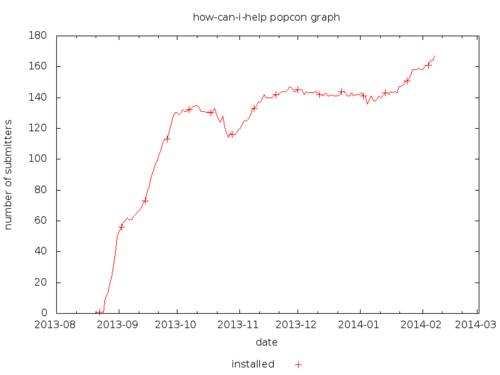
This is a repost from Stefano Zacchiroli's post how-can-i-help by Lucas Nussbaum is one of the best things that happened in the area of attracting contributions to Debian in quite a while. It can be used both as a standalone tool to list opportunities for contributing to Debian which are related to your installed packages, and as an APT hook (which is also the default configuration) that at each upgrade will inform you of new contribution opportunities. how-can-i-help is great for newbies who are looking for ways to give back to Debian which are a good match for their skills: among other things, how-can-i-help shows bugs tagged "gift" related to packages you use. how-can-i-help is also great for experienced developers, as it allows them to find out, in a timely manner, that packages they use are in dire need of help: RC bugs, pending removals, adoptions needed, requests for sponsor, etc. (As highly unscientific evidence: I've noticed a rather quick turnover of RFA/O/ITA bugs on packages installed on my machine. I suspect how-can-i-help is somehow responsible for that, due to the fact that it increases awareness of ongoing package issues directly with the people using them.) So, if you haven't yet, please apt-get install how-can-i-help RIGHT NOW. I daresay that we should aim at installing how-can-i-help by default on all Debian machines, but that might be an ambitious initial goal. In the meantime I'll settle for making how-can-i-help's popcon count skyrocket. As of today, it looks like this: Alt how-can-i-help popularity contest graph 10/02/2014 which is definitely too low for my taste. Please spread the word about how-can-i-help. And let's see what we can collectively do to that graph. how-can-i-help is just a tiny teeny helper, but I'm convinced it can do wonders in liberating dormant contributions to the Debian Project.

Matthew Garrett: IBM's remote firmware configuration protocol

I spent last week looking into the firmware configuration protocol used on current IBM system X servers. IBM provide a tool called ASU for configuring firmware settings, either in-band (ie, running on the machine you want to reconfigure) or out of band (ie, running on a remote computer and communicating with the baseboard management controller - IMM in IBM-speak). I'm not a fan of using vendor binaries for this kind of thing. They tend to be large (ASU is a 20MB executable) and difficult to script, so I'm gradually reimplementing them in Python. Doing that was fairly straightforward for Dell and Cisco, both of whom document their configuration protocol. IBM, on the other hand, don't. My first plan was to just look at the wire protocol, but it turns out that it's using IPMI 2.0 to communicate and that means that the traffic is encrypted. So, obviously, time to spend a while in gdb.

The most important lesson I learned last time I did this was "Check whether the vendor tool has a debug option". ASU didn't mention one in its help text and there was no sign of a getopt string, so this took a little longer - but nm helpfully showed a function called DebugLog and setting a breakpoint on that in gdb showed it being called a bunch of the time, so woo. Stepping through the function revealed that it was checking the value of a variable, and looking for other references to that variable in objdump revealed a -l argument. Setting that to 255 gave me rather a lot of output. Nearby was a reference to --showsptraffic, and passing that as well gave me output like:

BMC Sent: 2e 90 4d 4f 00 06 63 6f 6e 66 69 67 2e 65 66 69
BMC Recv: 00 4d 4f 00 21 9e 00 00

which was extremely promising. 2e is IPMI-speak for an OEM specific command, which seemed pretty plausible. 4d 4f 00 is 20301 in decimal, which is the IANA enterprise number for IBM's system X division (this is required by the IPMI spec, it wasn't an inspired piece of deduction on my behalf). 63 6f 6e 66 69 67 2e 65 66 69 is ASCII for config.xml. That left 90 and 06 to figure out. 90 appeared in all of the traces, so it appears to be the command to indicate that the remaining data is destined for the IMM. The prior debug output indicated that we were in the QuerySize function, so 06 presumably means query the size. And this is supported by the response - 00 (a status code), 4d 4f 00 (the IANA enterprise number again, to indicate that the responding device is speaking the same protocol as you) and 21 9e 00 00 - or, in rational endianness, 40481, an entirely plausible size.

Once I'd got that far the rest started falling into place fairly quickly. 01 rather than 06 indicated a file open request, returning a four byte file handle of some description. 02 was read, 03 was write and 05 was close. Hacking this together with pyghmi meant I could open a file and read it. Success!

Well, kind of. I was getting back a large blob of binary. The debug trace showed calls to an EfiDecompress function, so on a whim I tried just decompressing it using the standard UEFI compression format. Shockingly, it worked and now I had a 345K XML blob and presumably many more problems than I'd previously had. Parsing the XML was fairly straightforward, and now I could retrieve the full set of config options, along with the default, current and possible values for them.

Making changes was pretty much just the reverse of this. A small XML blob containing the new values is compressed and written to asu_update.efi. One of the elements is a random identifier, which will then appear in another file called config_log along with a status. Just keep re-reading this until the value changes to CM_DONE and we're good.

The in-band configuration appears to be identical, but rather than sending commands over the wire they're send through the system's IPMI controller directly. Yes, this does mean that it's sending compressed XML through a single io port. Yes, I'd rather be drinking.

I've documented the protocol here and hope to be able to release this code before too long - right now I'm trying to nail down the interface a little, but it's broadly working.

comment count unavailable comments

Mario Lang: Neurofunkcasts

I have always loved Drum and Bass. In 2013 I rediscovered my love for Darkstep and Neurofunk, and found that these genres have developed quite a lot in the recent years. Some labels like Black Sun Empire and Evol Intent produce mixes/sets on a regular basis as podcasts these days. This article aggregates some neurofunk podcasts I like a lot, most recent first. Enjoy 33 hours and 57 minutes of fun with dark and energizing beats. Thanks to BSE Contrax and Evol Intent for providing such high quality sets. You can also see the Python source for the program that was used to generate this page.

Stefano Zacchiroli: apt-get install how-can-i-help

skyrocketing how-can-i-help popcon count how-can-i-help by Lucas Nussbaum is one of the best things that happened in the area of attracting contributions to Debian in quite a while. It can be used both as a standalone tool to list opportunities for contributing to Debian which are related to your installed packages, and as an APT hook (which is also the default configuration) that at each upgrade will inform you of new contribution opportunities. how-can-i-help is great for newbies who are looking for ways to give back to Debian which are a good match for their skills: among other things, how-can-i-help shows bugs tagged "gift" related to packages you use. how-can-i-help is also great for experienced developers, as it allows them to find out, in a timely manner, that packages they use are in dire need of help: RC bugs, pending removals, adoptions needed, requests for sponsor, etc. (As highly unscientific evidence: I've noticed a rather quick turnover of RFA/O/ITA bugs on packages installed on my machine. I suspect how-can-i-help is somehow responsible for that, due to the fact that it increases awareness of ongoing package issues directly with the people using them.) So, if you haven't yet, please apt-get install how-can-i-help RIGHT NOW. I daresay that we should aim at installing how-can-i-help by default on all Debian machines, but that might be an ambitious initial goal. In the meantime I'll settle for making how-can-i-help's popcon count skyrocket. As of today, it looks like this:
how-can-i-help popularity contest graph, 10/02/2014
which is definitely too low for my taste. Please spread the word about how-can-i-help. And let's see what we can collectively do to that graph. how-can-i-help is just a tiny teeny helper, but I'm convinced it can do wonders in liberating dormant contributions to the Debian Project.

Steve Kemp: Sad times

There are times when I'm very proud of the Debian project, the developers, the contributors, the bug-reporters, even the users. There are times when I'm less impressed. These days I guess I'm not qualified to comment, being an ex-developer, but I still am disappointed. Part of me wants to rejoin the project, to see if I can help. The other part is thinking there are other choices, maybe I should look at them. Conflict is bad. Being conflicted is worse.

Next.

Previous.