Search Results: "tar"

17 December 2012

Vincent Sanders: In fact, we started off with two or three different shells and the shell had life of its own.

With apologies to Ken Thompson, this is a list derived from the wafflings residents of a certain UK IRC channel. The conversation happened several years ago but I was reminded of it again today from a conversation on that same channel.

No names have been kept to project the guilty.


/bin/bush - a shell that steals and lies?
/bin/cash - displays adverts before each prompt
/bin/crash - Microsoft shell
/bin/mash - requires libsausage.so
/bin/hush - terse output
/bin/irish - only shell that finds jerkcity funny
/bin/rush - ber-optimised for speed, but might not actually work correctly
/bin/flash - proprietary shell that displays adverts and cartoons and hangs periodically
/bin/welsh - whinges about people not using it, but then steals features from other shells in order to actually make sense
/bin/rehash - never actually runs any program, just uses markov chains to construct output from stuff it has seen before.
/bin/wash - will remove lint in your scripts if you let it
/bin/parish - prays for the successful exit of every command
/bin/punish - symlink to /bin/csh
/bin/sheepish - apologises when $? is not zero
/bin/diminsh - decrements all result codes by one
/bin/lavish - and you thought bashisms were bad...
/bin/brainwash - once you've tried it, you'll believe it's the only shell in existence
/bin/hoggish - written in Java
/bin/reversepolish - arguments order different in go must
/bin/ganesh - no subprocess dares exit zero for fear of being removed from the system
/bin/roguish - every day is April 1st as far as it is concerned
/bin/macintosh - it's shiny, has *loads* of things you think you can poke at, yet it only actually responds to a single key on the keyboard and has no useful features for fear of confusing the user
/bin/lush - garbles output from processes like a drunkard
/bin/snobbish - you're not good enough to use it
/bin/thrush - it itches
/bin/vanquish - kills processes mercilessly
/bin/tush - pert
/bin/fetish -> /bin/zsh
/bin/skirmish - multi-user shell
/bin/whiplash - gets invoked if you break too hard
/bin/newsflash - BREAKING NEWS pid 1234 terminated
/bin/mulish - DJB does Shell
/bin/hsilop - arguments order different in go must
/bin/whitewash - government approved
/bin/trish - for tri-state hardware
/bin/jdsh - it sucks...
/bin/flesh - optimised for viewing p0rn

Ian Campbell: Foreign Chroots with schroot and qemu

Since I've been working on qcontrol I've had need of a way to build packages in an ARM environment. Since all my native ARM hardware is "production" (at least so far as something can be production in a home environment) I prefer to avoid installing development tools on them. When I started looking into this all my ARM systems ran from relatively small flash devices which also ruled out the possibility of a development chroot. After search the web a bit I discovered that it is possible to use qemu-user-static together with [[!binfmt-support ]] to create cross architecture chroots which can be entered mostly transparently. It is also possible to combine this with schroot and sbuild which makes the day to day use pretty much the same as a native or biarch chroot. Since I've now had to rediscover how to do this twice (once for Sid and then again when I realized I also needed a Wheezy environment) I thought I should write it down for the benefit of my future self. First things first lets install the various packages which we need. As well as debootstrap to create the chroot we need qemu-user-static and binfmt-support to allow us to run ARM binaries:
$ sudo apt-get install debootstrap qemu-user-static binfmt-support
I'm using schroot's lvm-snapshot mode so we need an LVM volume, formatted with a filesystem and mounted in a temporary location:
$ sudo lvcreate -L8G -n sbuild-wheezy-armel /dev/VG
$ sudo mkfs.ext3 /dev/VG/sbuild-wheezy-armel
$ sudo mount /dev/VG/sbuild-wheezy-armel /mnt/
Next we need to create the chroot. For this we use debootstrap in foreign mode which does a 2 stage setup, firstly by using the --foreign option:
$ sudo debootstrap --variant=buildd --include=fakeroot,build-essential \
        --arch=armel --foreign \
        wheezy /mnt http://<DEBIAN-MIRROR>/debian/
Now we (temporarily) copy the qemu-arm-static binary into the chroot (at the place where binfmt-support expects it), change into the chroot and run debootstrap's second stage to finish the basic chroot setup:
$ sudo cp /usr/bin/qemu-arm-static /mnt/usr/bin/
$ sudo chroot /mnt
(chroot)# ./debootstrap/debootstrap --second-stage
(chroot)# exit
Now that we have a basic chroot in place it needs a little bit of tailoring. I've found the easiest way to do this is to use sbuild-createchroot and then tweak the result:
$ sudo sbuild-createchroot --arch=armel --foreign --setup-only \
    wheezy /mnt http://<DEBIAN-MIRROR>/debian/
If we were building a native chroot then we could have skipped the debootstrap stuff and let sbuild-createchroot handle things. Unfortunately this doesn't seem to play nicely with --foreign. Now we can remove the qemu-arm-static binary from the chroot. schroot will automatically bind mount the version from the host into the chroot which ensures it remains up to date. We can also unmount the chroot since we will let schroot manage that from here on:
$ sudo rm /mnt/usr/bin/qemu-arm-static
$ sudo umount /mnt
Next we need to tweak the resulting schroot/sbuild configuration since sbuild-createchroot assumes the use of schroot's directory mode. First remove the symlink to /mnt which it created:
$ sudo rm /etc/sbuild/chroot/wheezy-armel-sbuild
Lastly we need to edit /etc/schroot/chroot.d/wheezy-armel-sbuild-<SUFFIX> (where is randomly generated) and reconfigure it to use lvm-snapshot mode, by apply the following changes:
 [wheezy-armel-sbuild]
-type=directory
-directory=/mnt
+type=lvm-snapshot
+device=/dev/VG/sbuild-wheezy-armel
+lvm-snapshot-options=--size 2G
 description=Debian wheezy/armel autobuilder
 groups=root,sbuild
 root-groups=root,sbuild
 profile=sbuild
That's it, we now have a chroot which we can trivially invoke via sbuild to build armel packages:
$ sbuild --arch=armel --dist=wheezy <... other options...>
We can also use sbuild-update to keep the chroot up to date:
$ sudo sbuild-update -udcar wheezy-armel
You can also use schroot to login to the chroot directly, although for that case you'll likely want to create a different chroot using schroot's directory or block-device mode instead lvm-snapshot and drop some of the sbuild specific setup. I expect I'll blog about this configuration in some more detail at some point in the future since I'll want to document it to give a more convenient build environment for Xen on ARM than the build farm which we have at work.

Russell Coker: Using BTRFS

I ve just installed BTRFS on some systems that matter to me. It is still regarded as experimental but Oracle supports it with their kernel so it can t be too bad and it s almost guaranteed that anything other than BTRFS or ZFS will lose data if you run as many systems as I do and I run lots of systems that don t have enough RAM for ZFS (4G isn t enough in my tests). So I have to use BTRFS. BTRFS and Virtual Machines I m running BTRFS for the DomUs on a virtual server which has 4G of RAM (and thus can t run ZFS). The way I have done this is to use ext4 on Linux software RAID-1 for the root filesystem on the Dom0 and use BTRFS for the rest. For BTRFS and virtual machines there seem to be two good options given that I want BTRFS to use it s own RAID-1 so that it can correct errors from a corrupted disk. One is to use a single BTRFS filesystem with RAID-1 for all the storage and then have each VM use a file on that big BTRFS filesystem for all it s storage. The other option is to have each virtual machine run BTRFS RAID-1. I ve created two LVM Volume Groups (VGs) named diska and diskb, each DomU has a Logical Volume (LV) from each VG and runs BTRFS. So if a disk becomes corrupt the DomU will have to figure out what the problem is and fix it. #!/bin/bash
for n in $(xm list cut -f1 -d\ egrep -v ^Name\ ^Domain-0) ; do
echo $n
ssh $n "btrfs scrub start -B -d /"
done I use the above script in a cron job from the Dom0 to scrub the BTRFS filesystems in the DomUs. I use the -B option so that I will receive email about any errors and so that there won t be multiple DomUs scrubbing at the same time (which would be really bad for performance). BTRFS and Workstations The first workstation installs of BTRFS that I did were similar to installations of Ext3/4 in that I had multiple filesystems on LVM block devices. This caused all the usual problems of filesystem sizes and also significantly hurt performance (sync seems to perform very badly on a BTRFS filesystem and it gets really bad with lots of BTRFS filesystems). BTRFS allows using subvolumes for snapshots and it s designed to handle large filesystems so there s no reason to have more than one filesystem IMHO. It seems to me that the only benefit in using multiple BTRFS filesystems on a system is if you want to use different RAID options. I presume that eventually the BTRFS developers will support different RAID options on a per-subvolume basis (they seem to want to copy all ZFS features). I would like to be able to configure /home to use 3 copies of all data and metadata on a workstation that only has a single disk. Currently I have some workstations using BTRFS with a BTRFS RAID-1 configuration for /home and a regular non-RAID configuration for everything else. But now it seems that this is a bad idea, I would be better off just using a single copy of all data on workstations (as I did for everything on workstations for the previous 15 years of running Linux desktop systems) and make backups that are frequent enough to not have a great risk. BTRFS and Servers One server that I run is primarily used as an NFS server and as a workstation. I have a pair of 3TB SATA disks in a BTRFS RAID-1 configuration mounted as /big and with subvolumes under /big for the various NFS exports. The system also has a 120G Intel SSD for /boot (Ext4) and the root filesystem which is BTRFS and also includes /home. The SSD gives really good read performance which is largely independent of what is done with the disks so booting and workstation use are very fast even when cron jobs are hitting the file server hard. The system has used a RAID-1 array of 1TB SATA disks for all it s storage ever since 1TB disks were big. So moving to a single storage device for /home is a decrease in theoretical reliability (in addition to the fact that a SSD might be less reliable than a traditional disk). The next thing that I am going to do is to install cron jobs that backup the root filesystem to something under /big. The server in question isn t used for anything that requires high uptime, so if the SSD dies entirely and I need to replace it with another boot device then it will be really annoying but it won t be a great problem. Snapshot Backups One of the most important uses of backups is to recover from basic user mistakes such as deleting the wrong file. To deal with this I wrote some scripts to create backups from a cron job. I put the snapshots of a subvolume under a subvolume named backup . A common use is to have everything on the root filesystem, /home as a subvolume, /home/backup as another subvolume, and then subvolumes for backups such as /home/backup/2012-12-17, /home/backup/2012-12-17:00:15, and /home/backup/2012-12-17:00:30. I make /home/backup world readable so every user can access their own backups without involving me, of course this means that if they make a mistake related to security then I would have to help them correct it but I don t expect my users to deal with security issues, if they accidentally grant inappropriate access to their files then I will be the one to notice and correct it. Here is a script I name btrfs-make-snapshot which has an optional first parameter -d to cause it do just display the btrfs commands it would run and not actually do anything. The second parameter is either minutes or days depending on whether you want to create a snapshot on a short interval (I use 15 minutes) or a daily snapshot. All other parameters are paths for subvolumes that are to be backed up: #!/bin/bash
set -e

# usage:
# btrfs-make-snapshot [-d] minutes days paths
# example:
# btrfs-make-snapshot minutes /home /mail

if [ "$1" == "-d" ]; then
BTRFS="echo btrfs"
shift
else
BTRFS=/sbin/btrfs
fi

if [ "$1" == "minutes" ]; then
DATE=$(date +%Y-%m-%d:%H:%M)
else
DATE=$(date +%Y-%m-%d)
fi
shift

for n in $* ; do
$BTRFS subvol snapshot -r $n $n/backup/$DATE
done Here is a script I name btrfs-remove-snapshots which removes old snapshots to free space. It has an optional first parameter -d to cause it do just display the btrfs commands it would run and not actually do anything. The next parameters are the number of minute based and day based snapshots to keep (I am currently experimenting with 100 100 for /home to keep 15 minute snapshots for 25 hours and daily snapshots for 100 days). After that is a list of filesystems to remove snapshots from. The removal will be from under the backup subvolume of the path in question. #!/bin/bash
set -e

# usage:
# btrfs-remove-snapshots [-d] MINSNAPS DAYSNAPS paths
# example:
# btrfs-remove-snapshots 100 100 /home /mail

if [ "$1" == "-d" ]; then
BTRFS="echo btrfs"
shift
else
BTRFS=/sbin/btrfs
fi

MINSNAPS=$1
shift
DAYSNAPS=$1
shift

for DIR in $* ; do
BASE=$(echo $DIR cut -c 2-200)
for n in $(btrfs subvol list $DIR grep $BASE/backup/.*: head -n -$MINSNAPS sed -e "s/^.* //"); do
$BTRFS subvol delete /$n
done
for n in $(btrfs subvol list $DIR grep $BASE/backup/ grep -v : head -n -$MINSNAPS sed -e "s/^.* //"); do
$BTRFS subvol delete /$n
done
done A Warning The Debian/Wheezy kernel (based on the upstream kernel 3.2.32) doesn t seem to cope well when you run out of space by making snapshots. I have a filesystem that I am still trying to recover after doing that. I ve just been buying larger storage devices for systems while migrating them to BTRFS, so I should be able to avoid running out of disk space again until I can upgrade to a kernel that fixes such bugs.

16 December 2012

Joey Hess: </yurt>

I haven't used my yurt much at all lately. It was an excellent getaway when I needed to get away; these days I don't. Or, perhaps, some would say, I've gotten away... blue circle of sky seen through the center of the yurt So yesterday, since I happened to be over there, and after we'd played board games to our hearts content, we decided to take it down. This had been on the todo list since last fall, so it was not entirely spur of the moment. Still, the days are short this near to solstice and this one only had a few hours of light left. skinning the yurt It'd been up for well over 4 years, in a wet environment. The roof is pretty well shot and will need to be replaced, but the canvas walls are still in good shape. There was a surprise; it seems a mouse or something started nibbling on all the wood of the walls recently, and even the center ring is pitted and worn by rodent teeth. It all seems still structurally sound. And looking back at my setup pictures, I'm not bothered by the yurt having aged, it just makes it seem more real. We left the bones of the yurt standing on its hill, seeming very appropriate under the bare winter trees. Will return soon and finish taking it down. And perhaps in some years I'll find a need for it again. (Pictures by my sister, who will be annoyed at me linking to this not-yet-formally published post about the yurt from her POV: Decline and fall of the yurt)

Joachim Breitner: Circle Packing

For an upcoming introductory Haskell talk of mine (next Tuesday in Karlsruhe please come and join if you will) I was looking into data visualization as a example application. With libraries like gloss, getting some nice vector graphics up and running within one talk is quite possible. For some reason, I want to arrange multiple circles of varying size so that they do not overlap and use as little space as possible. My first approach was to use general purpose optimizers such as cmaes, Numeric.GSL.Minimization from the hmatrix package and force-layout. I especially liked the interface of cmaes, which is able to minimize a function of, say, type [(String, Double, Double)] -> Double by automatically finding the values of type Double in the input, as described by Takayuki Muranushi. That would have looked great in the talk. Unfortunately, none of these libraries gave sufficient good results in a reasonable amount of time for this problem. I then reviewed some of the academic literature on the circle packing problem and there were some algorithms proposed, but no simple one and none of the papers had a concise pseudo-code description that I could transfer to Haskell. So eventually I set out to implement a relatively dump and slow greedy algorithm myself: I place one circle after another, starting with the largest, and among the valid positions where a new circle touches two already placed circles, I choose the positions closest to the center of mass. The result, available in the circle-packing package, looks surprisingly well, here visualized using the diagrams library (See the documentation of Optimisation.CirclePacking for the code used to generate that image):
Now showing just this image is not a very good way to demonstrate my code. A few years ago, I might have created a CGI script that would dynamically generate images based on your input. But not in 2012: Since my code is pure Haskell without fancy features like type classes, I can use the fay compiler to generate JavaScript code from it. Add a little Haskell code to interact with the HTML5 canvas and now you can interactively try out circle-packing in your browser. Oh, and while I am talking about neat tricks: You can put vector graphics in your haddock documentation, as I have done for Optimisation.CirclePacking, using the syntax <<<data:image/svg+xml;base64,PD94bWwgdmV...c3ZnPg==>>.

Steve Kemp: Is there a ACL system for "all" revision control systems?

Once upon a time a company started using distributed version control, and setup several project repositories using darcs. Over time people became more sane and new projects were created in mercurial. Later still Git became available, and was used by a few of the brave. Sadly each of these projects is hosted on the same host, and in the home directory of the same user. This means these two commands work:
hg clone ssh://projects@dev.host/foo
git clone ssh://projects@dev.host/bar
I'm now wanting to setup per-repository ACLs and have hit a problem... There are several git-wrappers such as gitolite and gitosis. There is also the excellent hg-gateway and mercurial-server for dealing with mercurial. However I've yet to find a wrapper which will handle both git & mercurial repositories, under the same UID. (+ Darcs too, of course). So my question - is there such a beast out there, or do we need to write it? I expect such a thing would be useful for many people, so I'm surprised I've not yet found it.

15 December 2012

Martin Pitt: Running a script with unshared mount namespace

When writing system integration tests it often happens that I want to mount some tmpfses over directories like /etc/postgresql/ or /home, and run the whole script with an unshared mount namespace so that (1) it does not interfere with the real system, and (2) is guaranteed to clean up after itself (unmounting etc.) after it ends in any possible way (including SIGKILL, which breaks usual cleanup methods like trap , finally , def tearDown() , atexit() and so on). In gvfs and postgresql-common s tests, which both have been around for a while, I prepare a set of shell commands in a variable and pipe that into unshare -m sh, but that has some major problems: It doesn t scale well to large programs, looks rather ugly, breaks syntax highlighting in editors, and it destroys the real stdin, so you cannot e. g. call a bash -i in your test for interactively debugging a failed test. I just changed postgresql-common s test runner to use unshare/tmpfses as well, and needed a better approach. What I eventually figured out preserves stdin, $0, and $@, and still looks like a normal script (i. e. not just a single big string). It still looks a bit hackish, but I can live with that:
#!/bin/sh
set -e
# call ourselves through unshare in a way that keeps normal stdin, $0, and CLI args
unshare -uim sh -- -c " tail -n +7 $0 " "$0" "$@"
exit $?
# unshared program starts here
set -e
echo "args: $@"
echo "mounting tmpfs"
mount -n -t tmpfs tmpfs /etc
grep /etc /proc/mounts
echo "done"
As Unix/Linux shebang parsing is rather limited, I didn t find a way to do something like
#!/usr/bin/env unshare -m sh
If anyone knows a trick which avoids the tail -n +7 hack and having to pay attention to passing around $@ , I d appreciate a comment how to simplify this.

Jose Luis Rivas: Switched to Jekyll

After long-time without updating my blog, I decided to give it life again, but this time I wanted it to look different and started to make a new theme. Remembering the good-bad old days with WordPress was not an option, so I started prototyping right away with jekyll and things were fast, considering my 30-minutes a day approach since 3 days ago. Of course, is yet a work-in-progress, and in the meantime I wrote 320Stylus so things could came up faster working mobile-first. But I will write more about that later.

14 December 2012

Benjamin Mako Hill: Heading West

University of Washington Quad in Cherry Blossom Season This week, I accepted a job on the faculty of at the University of Washington Department of Communication. I've arranged for a post-doc during the 2013-2014 academic year which I will spend at UW as an Acting Assistant Professor. I'll start the tenure-track Assistant Professor position in September 2014. The hire is part of a "big data" push across UW. I will be setting up a lab and research projects, as well as easing into a teaching program, over the next couple years. I'm not going to try to list all the great people in the department, but UW Communication has an incredible faculty with a strong background in studying the effect of communication technology on society, looking at political communication, enagement, and collective action, and tracing out the implications of new communication technologies in addition to very strong work in other areas. Years ago, I nearly joined the department as a graduate student. I am unbelievably happy that their faculty has invited me to join as a colleague. Outside of my new department, the University of Washington has a superb group of folks working across the school on issues of quantitative and computational social science, human-computer interaction, and computer-supported cooperative work. They are hiring a whole bunch of folks, across the university, who specialize in data-driven social science. I already have a bunch of relationships with UW faculty and students and am looking forward to expanding and deepening those. On a personal level, Mika and I are also very excited to return to Seattle. I grew up in the city and I've missed it, deeply, since I left now nearly half my lifetime ago! It will be wonderful to be much closer to many of my family members. But I know that I will miss the community of friends and colleagues that I've built in Boston over the last 7+ years just as deeply. I'm going to miss the intellectual resources, and the intellectual community, that folks in Cambridge get to take for granted. That said, I plan to maintain affiliations and collaborations with folks at Harvard and MIT and will have resources that let me spend time in Boston doing that. If you are curious what I'm going to be up to and what the future is likely to hold in terms of my research you should check the material I've put online as part of the job market this year. I've posted just about everything on my academic website. This includes a little four page research statement which describes the work I've done and the directions I've been thinking about taking it. The academic job market is challenging and confusing. But it's given me a lot of opportunity to reflect, at length, on both the substance of my research and the academy and its structures and processes. I've got a list of blog topics queued up based on that thinking. I'll be posting them here on my blog over the next few months.

Roland Mas: Back to space

A long time ago, I spent many many hours playing Frontier (Elite 2) on the family Atari ST. It was nice-looking (oh, those sunrises on distant planets!), playable, varied, had ample room for progression, very different possible roles, a huge universe of which nobody could ever hope of exploring more than a tiny fraction, and it was basically the first game I encountered with no set goals. You are a spaceship pilot in a galaxy colonised left and right, and it's up to you to decide what you want the game to be. Pirate, headhunter, mercenary, trader, taxi, explorer, there's no end goal to achieve except what you fix for yourself. That was, for me as a youngster, a mind-opening experience, which I never felt as strongly since (with the possible exception of the Creatures game, but I barely tried it). Then came modernity, the PC, and the First Encounters sequel (Elite 3). It added moderate complexity to the gameplay, some sort of political evolution among the factions and a kind of plot so the galaxy was no longer quite so static, but the end results were still a bit disappointing. It felt like Frontier with a few not-exactly-overwhelming textures stuck onto the ships, a loose plot arc, and a third faction, the Alliance of Independent Systems, beyond the Federation and the Empire. Not that exciting, although the name of the Alliance's capital star system stayed in my mind. So, like many others, I came to wait for Elite 4. That wait started in 1995, more than seventeen years ago. During that time, Duke Nukem Forever was announced, promised, developed, postponed, abandoned, found again, developed again, and it was even actually released in 2011, while Elite 4 went into the same kind of hell only without the actual release (yet). At some point I started trying various substitutes to help pass time. There was Parsec which was a nice-looking space combat simulator, multiplayer and all, but never felt like finished. Development slowed down to a thin trickle, and it seems like it only recently started again as Open Parsec. Hopefully it won't wither off again, but since it's only focused on combat, it's not exactly the same spirit as Elite. There's Oolite, but it looks and feels very much like a lightly-modernised Frontier. Better textures, sure, but the UI still looks like it got taken from the times where games mentioned they required an EGA/VGA video card. There's Vega Strike. It's very promising too, and I did try it at some point, but it was crashing too often for my tastes. Development seems to have slowed down, but not stopped; maybe it's time I gave it another go. I just recently found out about Pioneer, and I admit I'm excited. Really excited. It feels like like Frontier felt at the time. It's not finished yet (the on-planet cities in particular look a bit weird), but from the alpha I tried and the videos on the website it's really impressive. I'm going to keep an eye on that, knowing I could spend quite some time in there even before it's quite finished, if only to fly a spaceship in the canyons of Europa with Jupiter rising in the distance. I'll let you know if I find a black monolith. But the main event triggering this blog post is that apparently Elite 4 is not dead (yet). Much better, it's under heavy development, under the Elite Dangerous name, and the current state seems to be rather good already. And Frontier Developments, the company behind it, opened a Kickstarter campaign to fund the project. The screenshots and the videos look impressive, and the interviews of the lead developer imply that the gameplay will be awesome. The galaxy will apparently be really dynamic, and the player's actions could really influence its geopolitical (galactopolitical?) evolution, the profitability of trade routes, the prevalence and repartition of space pirates in various sectors, and so on. Combine with a multi-player mode, and this could become the greatest game ever made (for my personal taste at least). So I'm very much hoping the funding campaign reaches its target. The release date is set to March 2014. It's going to be a long wait, fraught with incertitudes. But then again, Duke Nukem Forever was eventually released, wasn't it? [No, I never played the original Elite. I'm not that old.]

Gunnar Wolf: Goodbye, LastFM - Again

I started using LastFM probably around 6 years ago, and loved its offering. I discovered a huge amount of music I would have never found otherwise. Then, some time later, it changed its terms of use, and those of us not in some selected countries lost the ability to stream them for free. Bummer. About one year ago, I decided to purchase a subscription. After all, getting to know new music is always good And listening to recommendations for friends with interesting music tastes is fun as well! Of my last music purchases, both in CD and as MP3 downloads (not a spectacular volume, probably some 15 albums in the last year), I can only point to two that I knew the interpreter beforehand. So, we could say I have bought approx. 1 album per month completely thanks to LastFM. But, as of January 15, they are changing their licensing terms, and LastFM streaming service will no longer be available in Mexico. All it will continue to give me is recommendations based on my listening habits, given I continue "scrobbling" - Much less useful, not to say completely useless given my usual patterns. So, I'm sadly cancelling my subscription, and quite probably will stop using the service altogether. And yes, this will make me reevaluate freely licensed music services. But while I know of several free music distribution sites such as Jamendo, I will long for this LastFM abililty to deliver me music that is aligned to my current tastes (instead of looking them up by myself) Any suggestions on where to look for a similar service?

Paul Tagliamonte: Scripting Python in Clojure

Yeah, wait, what? No, really! I took a look through clojure-py, and found out something pretty rad. In order to get clojurepy scripts to load other clojurepy, it had to shim out and add a new importer for clojure scripts. What this really means, is that you can import Clojure from Python, which is pretty sweet. I abused the internals here, and added it to dput-ng as a quick hack. Basically, I just had to import clojure.main, and let the main function set up the sys shim. I would set it up in dput, but I d have to import that module anyway. Remember, when doing this, the namespace ((ns ...)) needs to match the filename. So, I present the first Clojure hook for dput-ng:

; Copyright (c) Paul R. Tagliamonte <paultag@debian.org>, 2012, under the
; terms of dput-ng itsself.
(ns clojtest
  (:require dput.core
            dput.exceptions))
(defn log [x]  ; for debug output
  (.debug dput.core/logger x))
(defn dput-checker [changes profile interface]
  (cond (>= (-> changes (.get "maintainer") (.find "arno@debian.org")) 0)
    (throw (dput.exceptions/HookException. "Maintainer's Arno. Aborting upload"))
  :else
    (log "Nah, it's not arno, we're good")))
This, of course, checks if the maintainer is Arno, and throws a fit if it is. Gist is over on gist.github. After, Algernon added his own checker, which throws a fit if you have a package in the B-Ds that you aught to not use (such as dpatch)
; Copyright (c) Gergely Nagy <algernon@debian.org>, 2012, under the
; terms of dput-ng itself.
(ns bd-blacklist
  (:require dput.core
            dput.exceptions
            dput.dsc))
(defn prune-build-deps
  "Prune a string representation of the build-depends so that only a
  list of packages remain."
  [bd-string]
  (map #(first (-> % (.strip) (.split " "))) (.. bd-string (split ","))))
(defn has-blacklisted?
  "Given a dsc file and a blacklist, check if any of the
  build-depencencies are in that list. Throws an error if there are
  matches."
  [dsc-file blacklist]
  (let [dsc (dput.dsc/parse_dsc_file dsc-file)
        build-deps (prune-build-deps (.. dsc (get "build-depends")))]
    (if-let [bad-bd (some blacklist build-deps)]
      (throw (dput.exceptions/HookException. (str "Blacklisted build-dependency found: " bad-bd)))
      (-> dput.core/logger (.trace "Build-Dependencies do not have anything on the blacklist")))))
(defn blacklist-checker
  "Checks whether the dsc has blacklisted build-dependencies, ignores
  the check when no dsc is to be found."
  [changes profile interface]
  (if-let [dsc-file (.. changes (get_dsc))]
    (has-blacklisted? dsc-file (set (get profile "bd-blacklist")))
    (-> dput.core/logger (.trace "No .dsc found, build-dependencies cannot be checked"))))
You can check that out in the git tree Hacks welcome!

13 December 2012

Andrea Veri: The future is Cloudy

Have you ever heard someone talking extensively about Cloud Computing or generally Clouds? and have you ever noticed the fact many people (even the ones who present themselves as experts) don t really understand what a Cloud is at all? That happened to me multiple times and one of the most common misunderstandings is many see the Cloud as something being on the internet. Many companies add a little logo representing a cloud on their frontpage and without a single change on their infrastructure (but surely with a price increment) they start calling their products as being on the Cloud. Given the lack of knowledge about this specific topic people tend to buy the product presented as being on the Cloud without understanding what they really bought. But what Cloud Computing really means? it took several years and more than fifteen drafts to the National Institute of Standards and Technology s (NIST) to find a definition. The final accepted proposal:
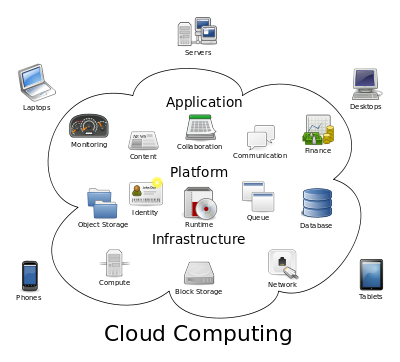
Cloud computing is a model for enabling ubiquitous, convenient, on-demand network access to a shared pool of configurable computing resources (e.g., networks, servers, storage, applications and services) that can be rapidly provisioned and released with minimal management effort or service provider interaction.

The above definition requires a few more clarifications specifically when it comes to understand where should we focus on while checking for a Cloud Computing solution. A few key points:
  1. On-demand self-service: every consumer will be able to unilaterally provision multiple computing capabilities like server time, storage, bandwidth, dedicated RAM or CPU without requiring any sort of human interaction from their respective Cloud providers.
  2. Rapid elasticity and scalability: all the computing capabilities outlined above can be elastically provisioned and released depending on how much demand my company will have in a specific period of time. Suppose the X company is launching a new product today and it expects a very large number of customers. The X company will add more resources to their Cloud for the very first days (where they suppose the load to be very high) and then it ll scale the resources back as they were before. Elasticity and scalability permit the X company to improve and enhance their infrastructure when they need it with an huge saving in monetary terms.
  3. Broad network access: capabilities are available over the network and accessed through standard mechanisms that promote use by heterogeneous thin or thick client platforms (e.g., mobile phones, tablets, laptops, and workstations).
  4. Measured service: Cloud systems allow maximum transparency between the provider and the consumer, the usage of all the resources is monitored, controlled, and reported. The consumer knows how much will spend, when and in how long.
  5. Resource pooling: each provider s computing resources are pooled to serve multiple consumers at the same time. The consumer has no control or knownledge over the exact location of the provided resources but may be able to specify location at a higher level of abstraction (e.g., country, state, or datacenter).
  6. Resources price: when buying a Cloud service make sure the cost for two units of RAM, storage, CPU, bandwidth, server time is exactly the double of the price of one unit of the same capability. An example, if a provider offers you one hour of bandwitdh for 1 Euro, the price of two hours will have to be 2 Euros.
Another common error I usually hear is people feeling Cloud Computing just as a place to put their files online as a backup or for sharing them with co-workers and friends. That is just one of the available Cloud features , specifically the Cloud Storage , where typical examples are companies like Dropbox, Spideroak, Google Drive, iCloud and so on. But let s make a little note about the other three features :
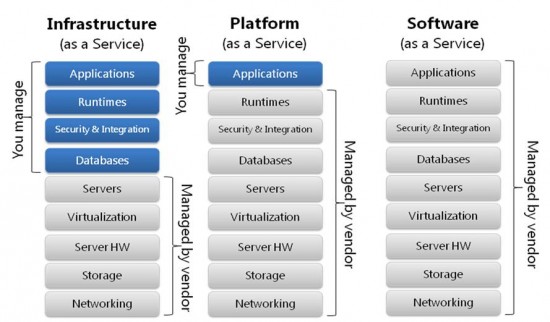
  1. Infrastructure as a Service (IaaS): the capability provided to the consumer is to provision processing, storage, networks, and other fundamental computing resources where the consumer is able to deploy and run arbitrary software, which can include operating systems and applications. In this specific case the consumer has still no control or management over the underlying Cloud infrastructure but has control over operating systems, storage, and deployed applications. A customer will be able to add and destroy virtual machines (VMs), install an operating system on them based on custom kickstart files and eventually manage selected networking components like firewalls, hosted domains, accounts.
  2. Platform as a Service (PaaS). the capability provided to the consumer is to deploy onto the cloud infrastructure consumer-created or acquired applications created using programming languages, libraries, services, and tools (like Mysql + PHP + PhpMyAdmin or Ruby on Rails) supported by the provider. In this specific case the consumer has still no control or management over the Cloud infrastructure itself (servers, OSs, storage, bandiwitdh etc.) but has control over the deployed applications and configuration settings for the application-hosting environment.
  3. Software as a Service (SaaS): the capability provided to the consumer is to use the provider s applications running on a Cloud infrastructure. The applications are accessible through various client devices, such as a browser, a mobile phone or a program interface. The consumer doesn t not manage nor control the Cloud infrastructure (servers, OSs, storage, bandwidth, etc.) that allows the applications to run. Even the provided applications aren t customizable by the consumer, which should rely on limited configuration settings.
The Cloud Computing technology is reasonably the future but can we trust Cloud providers? Are we sure that no one will ever have access to our files except us? and what about governments interested in acquiring a specific customer data hosted on the Cloud? I always suggest to read deeply both the Privacy Policy and Terms of Use of a certain service before signing in especially when it comes to choose a Cloud storage provider. Many providers have the same aspect, they seem to provide the same resources, the same amount of storage for the same price but legally they may present different problems, and that is the case of Spideroak vs Dropbox. Quoting from the Dropbox s Privacy Policy:
Compliance with Laws and Law Enforcement Requests; Protection of DropBox s Rights. We may disclose to parties outside Dropbox files stored in your Dropbox and information about you that we collect when we have a good faith belief that disclosure is reasonably necessary to (a) comply with a law, regulation or compulsory legal request; (b) protect the safety of any person from death or serious bodily injury; (c) prevent fraud or abuse of DropBox or its users; or (d) to protect Dropbox s property rights. If we provide your Dropbox files to a law enforcement agency as set forth above, we will remove Dropbox s encryption from the files before providing them to law enforcement. However, Dropbox will not be able to decrypt any files that you encrypted prior to storing them on Dropbox.
It s evident that Dropbox employees can access your data or be forced by legal process to turn over your data unencrypted. On the other side, Spideroak on its latest update to its Privacy Policy states that data stored on their Cloud is encrypted and inaccessible without user s key, which is stored locally on user s computers. And what about the latest research paper, titled Cloud Computing in Higher Education and Research Institutions and the USA Patriot Act written by the legal experts of the University of Amsterdam s Institute for Information Law stating the anti-terror Patriot Act could be theoretically used by U.S. law enforcement to bypass strict European privacy laws to acquire citizen data within the European Union without their consensus? The only requirement for the data acquisition is the provider being an U.S company or an European company conducting systematic business in the U.S. For example an Italian company storing their documents (protected by the European privacy laws and under the general Italian jurisdiction) on a provider based in Europe but conducting systematic business in the United States, could be forced by U.S. law enforcement to transfer data to the U.S. territory for inspection by law enforcement agencies. Does someone really care about the privacy of companies, consumers and users at all? or better does privacy exists at all for the millions of the people that connect to the internet every day?

Patrick Matth i: otrs 3.1.12 in Debian experimental

Heyho, I have just uploaded otrs2 version 3.1.12+dfsg1-1 to Debian experimental yesterday! It includes many bugfixes, for a full list have a look at [0]. I also would welcome help for two important tasks:
#690306: Upgrade to Wheezy fails, if InnoDB is used in (some) tables
#695664: Embedded JavaScript code copies. As usual problematic with a package which is as big as otrs.. I also will backport otrs 3.1.x to Wheezy backports, if it is released. After this step, work on the 3.2.x packaging will begin. [0]: otrs changelog

12 December 2012

Vincent Sanders: What man's mind can create, man's character can control.

I have a project that required me to programmatically control power to several devices. I have done this before using a Velleman vm8090 board which is relatively easy to control. However they are relatively expensive.

I turned to ebay and found a similar module at a substantially reduced cost. Upon receipt however I discovered that instead of being a simple serial USB interface it presented USB HID and the Debian system I was running it on has loaded the hiddev driver for me but it did not implement any of the standard HID Usage Pages leaving me with no way to control the device.
I did the obligatory
sudo lsusb -d 12bf:ff03 -vvv

Bus 003 Device 019: ID 12bf:ff03  
Device Descriptor:
bLength 18
bDescriptorType 1
bcdUSB 1.10
bDeviceClass 0 (Defined at Interface level)
bDeviceSubClass 0
bDeviceProtocol 0
bMaxPacketSize0 8
idVendor 0x12bf
idProduct 0xff03
bcdDevice 1.00
iManufacturer 1 Matrix Multimedia Ltd.
iProduct 2 Flowcode USB HID
iSerial 0
bNumConfigurations 1
Configuration Descriptor:
bLength 9
bDescriptorType 2
wTotalLength 41
bNumInterfaces 1
bConfigurationValue 1
iConfiguration 0
bmAttributes 0x80
(Bus Powered)
MaxPower 50mA
Interface Descriptor:
bLength 9
bDescriptorType 4
bInterfaceNumber 0
bAlternateSetting 0
bNumEndpoints 2
bInterfaceClass 3 Human Interface Device
bInterfaceSubClass 0 No Subclass
bInterfaceProtocol 0 None
iInterface 0
HID Device Descriptor:
bLength 9
bDescriptorType 33
bcdHID 1.10
bCountryCode 0 Not supported
bNumDescriptors 1
bDescriptorType 34 Report
wDescriptorLength 54
Report Descriptors:
** UNAVAILABLE **
Endpoint Descriptor:
bLength 7
bDescriptorType 5
bEndpointAddress 0x81 EP 1 IN
bmAttributes 3
Transfer Type Interrupt
Synch Type None
Usage Type Data
wMaxPacketSize 0x0008 1x 8 bytes
bInterval 5
Endpoint Descriptor:
bLength 7
bDescriptorType 5
bEndpointAddress 0x01 EP 1 OUT
bmAttributes 3
Transfer Type Interrupt
Synch Type None
Usage Type Data
wMaxPacketSize 0x0008 1x 8 bytes
bInterval 5
Device Status: 0x0980
(Bus Powered)
This simply showed me what I already knew and surprised me that lsusb did not dump HID report descriptor items. Some searching revealed that teh device had to be unbound so lussb could access the descriptor.

Thus a simple
echo -n 3-1.1.4:1.0   sudo dd of=/sys/bus/usb/drivers/usbhid/unbind
resulted in lussb dumping the descriptor items:

Item(Global): Usage Page, data= [ 0xa0 0xff ] 65440
(null)
Item(Local ): Usage, data= [ 0x01 ] 1
(null)
Item(Main ): Collection, data= [ 0x01 ] 1
Application
Item(Local ): Usage, data= [ 0x02 ] 2
(null)
Item(Main ): Collection, data= [ 0x00 ] 0
Physical
Item(Global): Usage Page, data= [ 0xa1 0xff ] 65441
(null)
Item(Local ): Usage, data= [ 0x03 ] 3
(null)
Item(Local ): Usage, data= [ 0x04 ] 4
(null)
Item(Global): Logical Minimum, data= [ 0x00 ] 0
Item(Global): Logical Maximum, data= [ 0xff 0x00 ] 255
Item(Global): Physical Minimum, data= [ 0x00 ] 0
Item(Global): Physical Maximum, data= [ 0xff ] 255
Item(Global): Report Size, data= [ 0x08 ] 8
Item(Global): Report Count, data= [ 0x08 ] 8
Item(Main ): Input, data= [ 0x02 ] 2
Data Variable Absolute No_Wrap Linear
Preferred_State No_Null_Position Non_Volatile Bitfield
Item(Local ): Usage, data= [ 0x05 ] 5
(null)
Item(Local ): Usage, data= [ 0x06 ] 6
(null)
Item(Global): Logical Minimum, data= [ 0x00 ] 0
Item(Global): Logical Maximum, data= [ 0xff 0x00 ] 255
Item(Global): Physical Minimum, data= [ 0x00 ] 0
Item(Global): Physical Maximum, data= [ 0xff ] 255
Item(Global): Report Size, data= [ 0x08 ] 8
Item(Global): Report Count, data= [ 0x08 ] 8
Item(Main ): Output, data= [ 0x02 ] 2
Data Variable Absolute No_Wrap Linear
Preferred_State No_Null_Position Non_Volatile Bitfield
Item(Main ): End Collection, data=none

By consulting the device class definitions document I determined the device was using the "Vendor defined" Usage page (0xff00 to 0xffff) so I would definitely have to write a program to control the device.

Linux provides a really easy interface to deal with HID devices called hiddev (gosh, such adventurous naming) which I already had to unbind to get my descriptors decoded so I am fairly sure it works ;-)

The kernel documentation and header for hiddev provide the absolute basic mechanics of the interface but no example code or guidance. The obligatory web search turned up very little and even that had to be retrieved from the internet archive. So It seems I would be forced to work it through myself.

It seems the hiddev interface is orientated around HID devices generating reports which the program is expected to read. Numerous ioctl() are provided so the program can obtain the descriptor information necessary to control and process the received reports.

However in this case we need to be able to send reports to the device, all the descriptor information revealed was that there were eight (Item Report Count = 8) values with eight bits each (Item Report Size = 8) with logical and physical values representing the whole range of the octets.

Fortunately the seller provided a website with some control programs and even source. After some time rummaging through the Visual Basic program I finally found (in FrmMain.vb:2989) that the eight bytes were largely unused and the first was simply a bitmask of the eight relays coil status, set for energised clear for off. With bit 0 controlling relay labelled 1 through to bit 7 for relay 8.

To send a report to a HID device the hiddev interface uses the HIDIOCSREPORT ioctl where the report data is first set using HIDIOCSUSAGE .

The HIDIOCSUSAGE ioctl is passed a hiddev_usage_ref structure which must be initialised with information about the report descriptor identifier (constructed from the Usage Page and Usage as set by the items in the descriptor), the index of the item (named usage) we wish to set in the report (in this case the first which is 0) and the value we actually want to set.

After a great deal of debugging the final program is very short indeed but does the job, my main problem now is that if I switch too many (more than one) relays at once the whole device resets. The scope says the supply rails are behaving very badly when this happens, looks like I need to add a load of capacitance to the power well to stabilise it during the switching events.

Oh and add in the fact Relay 1 LED doest work unless you push on it and I do wonder about the wisdom of the economy in this case. Though yet again Linux makes the software side easy.

Sylvestre Ledru: Mini Debconf 2012 - videos and feedbacks

A bit more than two weeks after the Mini Debconf in Paris, I am glad to say that the videos of the event are finally published (the sound is not very good for the 4 first presentations, sorry about that).
They will be also available on the new IRILL website with a video player when ready.
All slides are also available on the page of the event. I believe that there is a consensus about the quality of the event. We had around 150 people attending to the event, many interesting and various talks.
As usual, it was nice to meet some old and new friends from Debian. Mini debconf - group picture
Group picture by Frederic Lehobey
For those who wonder, I am confident there will be a 2013 Parisian Mini Debconf. Various feedbacks about the event:
Lucas Nussbaum
Stefano Zacchiroli
Vincent Untz
Raphael Hertzog
Pietro Abate
Logilab (Julien Cristau)
The 'official' Debian news And, once more, many thanks to the sponsors!
Logilab SmartJog
Bearstech Evolix
IRILL

11 December 2012

Christian Perrier: Celebrate Samba!

Samba 4 is out. That's just it. 21 years (same age than the Linux kernel, 2 years older than Debian) after a crazy australian student started it, Samba 4 is out. Doh.

Francesca Ciceri: Welcome Malatesta, Goodbye Kasbah!

Kasbah, my old laptop, is almost dead. It was my first laptop, an Asus X50C, which worked like a charm and was robust like a tank. But then the screen hinges broke. Time for a new one. So, ladies and gentlemen, I'm glad to present you malatesta. Malatesta is a Lenovo Thinkpad E335. Sadly, while kasbah worked with free drivers, malatesta requires proprietary drivers both for the video card and the wifi. Which sounds a bit ironic for a laptop named after a famous anarchist. The only two problems I encountered with it were related to the video card (00:01.0 VGA compatible controller: Advanced Micro Devices [AMD] nee ATI Device 9808) and the special keys. Malatesta worked well with the kernel of Squeeze, but freezed during the boot with Wheezy. Thankfully, I stumbled upon this blogpost by Blars Blarson suggesting to use the fglrx-driver with Sid. And that solved the problem. Another little odissey was the brightness of the monitor. With kernels < 3.2.0-4-amd64 the thinkpad_acpi didn't recognize my model and I was stuck with a brightness level probably visible from the outer space. Neither xrandr nor xbacklight could help, and I was seriously considering to use sunglasses to work (a slight unusual approach to the brightness problem, I know, but I suffer of migraines and couldn't bear an hyper-bright monitor), when the upgrade to Sid solved the problem. On the bright side (pun intended) this laptop was born without Windows. (Both malatesta and kasbah were shipped with FreeDOS). Now, if you're wondering about the names: my first namescheme was "references to songs by the Clash" (and kasbah is obviously for "Rock the Casbah", with a typo). But it wasn't really scalable. Since last year, I've decided to name my systems after famous anarchists. The server is named after one of my all time favourite anarchists, Buenaventura Durruti.
madamezou@durruti:~$ cat /etc/motd
%%%%%%%%%%%%%%%%%%%%%%%%%%%%%%%%%%%%%%%%%%%%%%%%%%%%%%%%%%%%%%%%%%%%%
Llevamos un mundo nuevo en nuestros corazones;
y ese mundo est  creciendo en este instante
                        Buenaventura Durruti
%%%%%%%%%%%%%%%%%%%%%%%%%%%%%%%%%%%%%%%%%%%%%%%%%%%%%%%%%%%%%%%%%%%%%
While the new laptop's name comes from Errico Malatesta.
madamezou@malatesta:~$ cat /etc/motd 
%%%%%%%%%%%%%%%%%%%%%%%%%%%%%%%%%%%%%%%%%%%%%%%%%%%%%%%%%%%%%%%%%%%%%
We anarchists do not want to emancipate the people;
We want the people to emancipate themselves.
            Errico Malatesta, L'Agitazione (18 June 1897)
%%%%%%%%%%%%%%%%%%%%%%%%%%%%%%%%%%%%%%%%%%%%%%%%%%%%%%%%%%%%%%%%%%%%%

Michal &#268;iha&#345;: Translate toolkit supports Android resources

After several months, my patches for Android resources support in translate-toolkit has been merged. All this originally started as question on stack overflow and after some playing, I've managed to integrate it to Weblate. Right now, this is already actively used by several projects, the biggest one probably being OsmAnd.

Filed under: English Weblate 0 comments Flattr this!

Russell Coker: Links December 2012

Steven Johnson gave an interesting TED talk about where good ideas come from [1]. He starts by attributing coffee replacing alcohol as a standard drink for some good ideas and then moves on to how ideas develop. Erez Lieberman Aiden and Jean-Baptiste Michel gave an interesting and amusing TED talk about the ngram analysis of books that Google scanned [2]. Here is the link for the Google Books ngram search [3]. Clay Shirky gave an insightful TED talk about how the Internet is changing the world [4]. He cites Open Source programmers as the modern day equivalent to the Invisible College based on our supposed great ability to get along with other people on the Internet. If we really are so much better than the rest of the Internet then things must be bad out there. He ends with ways of using Git to draft legislation. Hans Rosling gave an interesting TED talk about religion and the number of babies that women have [5]. His conclusion is that it s more about income and social stability and that the world s population can stabilise at 10 billion if we provide family planning to everyone. Alexis C. Madrigal wrote an interesting interview with Genevieve Bell about her work at Intel and the way people use technology [6]. Indigogo is raising funds for the Cuddle Mattress , it s a mattress with foam slats and a special fitted sheet to allow your arm to slide between the slats [7]. So you could have your arm underneath your SO for an extended period of time without risking nerve damage. They also show that when sleeping on your side your shoulder can go between the slats to avoid back problems. Nate Silver (who is famous for predicting US elections gave an interesting TED talk about racism and politics [8]. One of his main points is to show the correlation between racism and lack of contact of members of other races. Sociological Images has an interesting article by Lisa Wade about whether marriage is a universal human value [9]. In regard to historical marriage she says women were human property, equivalent to children, slaves, servants, and employees . The general trend in the comments seems to be that there are so many types of marriage that it s difficult to make any specific claims to traditional marriage unless you count a tradition of a short period in a single geographic region. Plurality is an excellent sci-fi short movie on youtube [10]. TED has an interesting interview with Hakeem Oluseyi about his research about astrophysics and how he achieved a successful career after being a gangster as a teenager [11]. He has some good ideas about helping other children from disadvantaged environments become successful. Paul Dwerryhouse wrote an interesting blog post about his work in designing and implementing a filesystem based on a Cassandra data store with FUSE [12]. Paul also wrote a post about using Apache Zookeeper to lock metadata to permit atomic operations [13]. The documentary Monumental Myths provides an interesting and insightful analysis of the processes of creating, maintaining, and explaining monuments [14]. It focusses on some significant monuments in the US and explains both sides to each story. Howard Zinn makes the insightful point that when people present a certain point of view of history it s not controversial, as soon as you present the other side they call it controversial . That happens even in debates about current issues. Howard also says to criticise whatever the government does is not anti-America, it s anti-government, it s pro-America, it s pro the people, it s pro the country . The song that plays during the closing credits is interesting too. The music video Same Love is one of the best presentations of the argument for marriage equality [15]. Chris Samuel wrote an interesting post about systems locked down for Windows 8 and options for purchasing PCs for running Linux [16]. His solution is to buy from ZaReason. I saw his laptop in action at the last LUV meeting and it looks really nice. Unfortunately a byproduct of the extremely thin form factor is the fact that it lacks a VGA port, this meant that Chris had to use my Thinkpad T61 (which is rather clunky by comparison) for his presentation.

Next.

Previous.