Search Results: "ms"

11 September 2013

Jan Wagner: ownCloud for Debian wheezy

Unfortunately ownCloud is not available in Debian wheezy. Even if it was promised to provide a package via backports, this seems never to happen. As I don't like the idea of adding source lists of testing/unstable/experimental to production systems, I walked the long and painfull path of backporting all (build-)dependencies and pushed them into our wheezy-backports repository. If you want to give it a try on Debian wheezy, you could install the packages from our wheezy-backports repository:

    # wget "http://ftp.cyconet.org/debian/sources.list.d/wheezy-backports-cyconet.list" \
        -O /etc/apt/sources.list.d/wheezy-backports-cyconet.list
    # aptitude update
    # aptitude -t wheezy-backports install owncloud owncloud-mysql
For adding our archive key, you can just install the package "debian-cyconet-archive-keyring"

10 September 2013

Steve Kemp: node.js is kicking me

Today I started hacking on a re-implementation of my BlogSpam service - which tests that incoming comments are SPAM/HAM - in node.js (blogspam.js) The current API uses XML::RPC and a perl server, along with a list of plugins, to do the work. Having had some fun and success with the HTTP+JSON mstore toy I figured I'd have a stab at making BlogSpam more modern: In theory this is easy, I've hacked up a couple of plugins, and a Perl client to make a submission. But sadly the async-stuff is causing me .. pain. This is my current status:
shelob ~/git/blogspam.js $ node blogspam.js
Loaded plugin: ./plugins/10-example.js
Loaded plugin: ./plugins/20-ip.js
Loaded plugin: ./plugins/80-sfs.js
Loaded plugin: ./plugins/99-last.js
Received submission:  "body":"This is my body ..","ip":"109.194.111.184","name":"Steve Kemp" 
	plugin 10-example.js said next :next
	plugin 20-ip.js said next :next
	plugin 99-last.js said spam SPAM: Listed in StopForumSpam.com
So we've loaded plugins, and each has been called. But the end result was "SPAM: Listed .." and yet the caller didn't get that result. Instead the caller go this:
shelob ~/git/blogspam.js $ ./client.pl
200 OK 99-last.js
The specific issue is that I iterate over every loaded-plugin, and wait for them to complete. Because they complete asynchronously the plugin which should be last, and just return "OK" , has executed befure the 80-sfs.js plugin. (Which makes an outgoing HTTP request). I've looked at async, I've looked at promises, but right now I can't get anything working. Meh. Surprise me with a pull request ;)

Julien Danjou: OpenStack Ceilometer Havana-3 milestone released

Last week, the third and last milestone of the Havana development branch of Ceilometer has been released and is now available for testing and download. This means the end of the OpenStack Havana development time is coming, and that the features are now frozen. New features
Eleven blueprints have been implemented as you can see on the release page. That's one more than during Havana-2, but it's less than was planned initially, though we had a pretty high score considering the size of our contributors team. I'm going to talk through some of them here, that are the most interesting for users. Bug fixes Fifty-six bugs were fixed, though most of them might not interest you so I won't elaborate too much on that. Go read the list if you are curious. Toward our final Havana release With the feature freeze in place, we're now focusing on fixing bugs and improving documentation. I'll try to make sure we'll get there without too much trouble for the 17th October 2013. Stay tuned!

Petter Reinholdtsen: Recipe to test the Freedombox project on amd64 or Raspberry Pi

I was introduced to the Freedombox project in 2010, when Eben Moglen presented his vision about serving the need of non-technical people to keep their personal information private and within the legal protection of their own homes. The idea is to give people back the power over their network and machines, and return Internet back to its intended peer-to-peer architecture. Instead of depending on a central service, the Freedombox will give everyone control over their own basic infrastructure. I've intended to join the effort since then, but other tasks have taken priority. But this summers nasty news about the misuse of trust and privilege exercised by the "western" intelligence gathering communities increased my eagerness to contribute to a point where I actually started working on the project a while back. The initial Debian initiative based on the vision from Eben Moglen, is to create a simple and cheap Debian based appliance that anyone can hook up in their home and get access to secure and private services and communication. The initial deployment platform have been the Dreamplug, which is a piece of hardware I do not own. So to be able to test what the current Freedombox setup look like, I had to come up with a way to install it on some hardware I do have access to. I have rewritten the freedom-maker image build framework to use .deb packages instead of only copying setup into the boot images, and thanks to this rewrite I am able to set up any machine supported by Debian Wheezy as a Freedombox, using the previously mentioned deb (and a few support debs for packages missing in Debian). The current Freedombox setup consist of a set of bootstrapping scripts (freedombox-setup), and a administrative web interface (plinth + exmachina + withsqlite), as well as a privacy enhancing proxy based on privoxy (freedombox-privoxy). There is also a web/javascript based XMPP client (jwchat) trying (unsuccessfully so far) to talk to the XMPP server (ejabberd). The web interface is pluggable, and the goal is to use it to enable OpenID services, mesh network connectivity, use of TOR, etc, etc. Not much of this is really working yet, see the project TODO for links to GIT repositories. Most of the code is on github at the moment. The HTTP proxy is operational out of the box, and the admin web interface can be used to add/remove plinth users. I've not been able to do anything else with it so far, but know there are several branches spread around github and other places with lots of half baked features. Anyway, if you want to have a look at the current state, the following recipes should work to give you a test machine to poke at. Debian Wheezy amd64
  1. Fetch normal Debian Wheezy installation ISO.
  2. Boot from it, either as CD or USB stick.
  3. Press [tab] on the boot prompt and add this as a boot argument to the Debian installer:
    url=http://www.reinholdtsen.name/freedombox/preseed-wheezy.dat
  4. Answer the few language/region/password questions and pick disk to install on.
  5. When the installation is finished and the machine have rebooted a few times, your Freedombox is ready for testing.
Raspberry Pi Raspbian
  1. Fetch a Raspbian SD card image, create SD card.
  2. Boot from SD card, extend file system to fill the card completely.
  3. Log in and add this to /etc/sources.list:
    deb http://www.reinholdtsen.name/freedombox wheezy main
    
  4. Run this as root:
    wget -O - http://www.reinholdtsen.name/freedombox/BE1A583D.asc   \
       apt-key add -
    apt-get update
    apt-get install freedombox-setup
    /usr/lib/freedombox/setup
    
  5. Reboot into your freshly created Freedombox.
You can test it on other architectures too, but because the freedombox-privoxy package is binary, it will only work as intended on the architectures where I have had time to build the binary and put it in my APT repository. But do not let this stop you. It is only a short "apt-get source -b freedombox-privoxy" away. :) Note that by default Freedombox is a DHCP server on the 192.168.1.0/24 subnet, so if this is your subnet be careful and turn off the DHCP server by running "update-rc.d isc-dhcp-server disable" as root. Please let me know if this works for you, or if you have any problems. We gather on the IRC channel #freedombox on irc.debian.org and the project mailing list. Once you get your freedombox operational, you can visit http://your-host-name:8001/ to see the state of the plint welcome screen (dead end - do not be surprised if you are unable to get past it), and next visit http://your-host-name:8001/help/ to look at the rest of plinth. The default user is 'admin' and the default password is 'secret'.

9 September 2013

Kurt Roeckx: State of encryption

With all the articles about the NSA going around it seems to be hard to follow what is still safe. After reading various things it boils down to:
I don't think this should really surprise anybody. There is also speculation that maybe the NSA has better algorithms for reducing the complexity of public key cryptography or that maybe RC4 might be broken. Those things clearly are possible, but it's not clear. Nobody has suggested that AES has any problems, and I think that's still safe to use. One of the question becomes what does properly done encryption mean. There are various factors to this and many applications using various protocols. SSL/TLS is the most used, so I'm going to concentrate on the parts in that. Bit sizes As far as I understand it, 80 bit of security is around what is currently the upper practical limit of a brute force attack. In 2003 NIST said to stop using 80 bit by 2015, in 2005 they said to stop using it by 2010. When using something like SSL/TLS you using various things each having it's own size. So it's important to known which is the weakest part. Public key encryption (RSA, DSA, DH) doesn't offer the same amount of security per bit than symmetric keys. The equivalent sizes I find are:
Symmetric Public
80 1024
112 2048
128 3072
256 15360
There are other sources that have other numbers, but they're similar So this basically means you really should stop using 80 bit symmetric and 1024 bit public keys and that your public key really should be at least 2048 bit, and should maybe even consider going to 3072 bit. There seems to be a push to moving Diffie-Hellman (DH) to provide Perfect Forward Secrecy (PFS). There are many variants to this. We want to use ephemeral (temporary) keys. But it basically boils down to 2 variants:
With DHE you first negotiate a temporary DH key for this session (hopefully) using a random number on both sides, and then using that DH key to exchange a normal symmetric key for the session. This temporary DH key is what provides the PFS, assuming that this temporary key is thrown away. The drawback of this is that creating a sessions takes a lot more CPU time. The standard DH has the same security as other public key encryption. So we really also want to stop using 1024 keys for that. With ECDHE the key size needs to be the double of the symmetric size. This is also faster than DHE, so people want to move to this. There are various curves that can be used for this, and some of them are generated the the NSA and people have no trust in them. Some people even don't trust any of the curves. Most people seem to think that ECDH is the way forward, but then limit the curves they support. There are also hashes used for various things including signatures and MACs. Depending on how it's used the properties of the hash are important. They have 2 important properties collision resistance and preimage resistance. For a collision attack the upper limit is a little more than the output size over 2. But there are attacks that are known to give worst results. I found those numbers:
MD5 2^20
SHA-1 2^60
SHA-2 No known attack (so SHA-256 would have 1.2 * 2^128)
For preimage attacks I found:
MD5 2^123
SHA-1 No known attack (2^160)
SHA-256 No known attack (2^256)
So I think that MD5 is still safe when a collision attack isn't possible, but should really be avoided for anything else and SHA-1 should probably be considered the same. So you want to avoid them in things like certificates. SSL/TLS also use MD5 / SHA-1, but as part of a HMAC. I understand that those are not vulnerable to the collision attack but preimage resistance is important then and so are still considered safe. Randomness A lot of the algorithms depend on good random numbers. That is that the attacker can't guess what a (likely) random number you've selected. There have been many cases of bad RNG that then resulted in things getting broken. It's hard to tell from the output of most random number generators that they are secure or not. One important thing is that the RNGs gets seeded with random information (entropy) to begin with. If it gets no random information, very limited amount of possible inputs or information that is guessable as input it can appear to give random numbers, but they end up being predictable There have been many cases where this was broken. Ciphers There are various encryption algorithms. But since the public key algorithms take a lot of time we usually want to limit the amount we do with them and do most with a symmetric key encryption. There are basically 2 types of symmetric ciphers: stream and block ciphers. For block ciphers there are various ways of combining the blocks. The most popular was CBC. But in combination with TLS 1.0 it was vulnerable to the BEAST attack, but there is a workaround for this. An other mode is GCM but it's not yet widely deployed. This resulted in the stream cipher RC4 suddenly getting popular again. Some ciphers have known weaknesses. For instance triple DES has 3*56=168 bits, but only provides for 2*56=112 bits of security. Other attacks make this even less. The algorithms them self might be secure, but they might be attacked by other mechanism known as sidechannel attacks. The most important of that is timing attacks. If the algorithm has branches they might result in different amount of time taking in each branch. This might result in an attacker finding out some information about the secret key that is being used. It's important that the difference should be reduced as much as possible. This is usually not a problem if it's implemented in hardware. SSL/TLS Session A typical SSL/TLS session uses those things:
Important aspects of using certificates:
The client sends it's list of supported ciphers to the server and the server will then pick one. This is usually the first from that list that is supported by the server, but it might also be the order that is configured on the server that is used. Current status in software If you go looking at all of those things, you find problems in most if not all software. Some of that is to be compatible with old clients or servers, but most of it is not. If you want to test web servers for various of those properties you can do that at ssllabs. Based on that there are stats available at SSL-pulse. Apache only supports 1024 bit DHE keys and they don't want to apply a patch to support other bit size. Apache 2.2 doesn't offer ECDHE but 2.4 does. I don't know of any good site has lists which browser supports which ciphers, but you can test your own browser here. It lacks information about EC curves that your client offers. You can of course as look at this with wireshark. Mozilla currently has a proposal to change it's list of supported ciphers here. They currently don't have TLS 1.1 or 1.2 enabled yet, but as far as I understand the NSS library should support it. They should now have support for GCM, but they still have an open bug for a constant time patch. In general Mozilla seems to be moving very slowly with adopting things. Last I heard Apple still didn't patch Safari for the BEAST attack. For XMPP see client to server, server to server, clients.

For TOR see here.

Bastian Blank: Setting up Ceph the hard way

Components Ceph consists of two main daemons. One is the monitoring daemon, which monitors the health of the cluster and provides location information. The second is the storage daemon, which maintains the actual storage. Both are needed in a minimal setup.
Monitor The monitor daemons are the heart of the cluster. They maintain quorum within the cluster to check if everything can be used. They provide referrals to clients, to allow them to find the data they seek. Without a majority of monitors nothing will work within the cluster.
Storage The storage daemons maintain the actual storage. One daemon maintains one backend storage device.
Configuration The default config is understandable, but several things will just not work with it.
Monitor on localhost By default the monitor daemon will not work on localhost. There is an (undocumented) override to force it to work on localhost:
[mon.noname-admin]
 mon addr = [::1]:6789
The monitor will be renamed to mon.admin internaly.
IPv6 Ceph supports IP (IPv6) or legacy-IP (IPv4), but never both. I don't really use legacy-IP any longer, so I have to configure Ceph accordingly:
[global]
  ms bind ipv6 = true
One-OSD clusters For testing purposes I wanted to create a cluster with exactly one OSD. It never got into a clean state. So I asked and found the answer in #ceph:
[global]
 osd crush chooseleaf type = 0
Disable authentication While deprecated, the following seems to work:
[global]
 auth supported = none
Complete configuration
[global]
 auth supported = none
 log file = $name.log
 run dir =  
 osd pool default size = 1
 osd crush chooseleaf type = 0
 ms bind ipv6 = true
[mon]
 mon data =  /$name
[mon.noname-admin]
 mon addr = [::1]:6789
[osd]
 osd data =  /$name
 osd journal =  /$name/journal
 osd journal size = 100
[osd.0]
 host = devel
Installation This is currently based on my updated packages. And they are still pretty unclean from my point of view.
Setup All the documentation tells only about ceph-deploy and ceph-disk. This tools are abstractions that need root to mount stuff and do all the work. Here I show how to do a minimal setup without needing root.
Keyring setup For some reason even with no authentication the monitor setup wants a keyring. So just set one up:
$ ceph-authtool --create-keyring keyring --gen-key -n mon.
$ ceph-authtool keyring --gen-key -n client.admin
Monitor setup Monitor setup by hand is easy:
$ mkdir $mon_data
$ ceph-mon -c ceph.conf --mkfs --fsid $(uuidgen) --keyring keyring
After that just start it:
$ ceph-mon -c ceph.conf
$
OSD setup First properly add the new OSD to the internal state:
$ ceph -c ceph.conf osd create
$ ceph -c ceph.conf osd crush set osd.0 1.0 root=default
Then setup the OSD itself:
$ mkdir $osd_data
$ ceph-osd -c ceph.conf -i 0 --mkfs --mkkey --keyring keyring
And start it:
$ ceph-osd -c ceph.conf -i 0
starting osd.0 at :/0 osd_data $osd_data $osd_data/journal
$
Health check The health check should return ok after some time:
$ ceph -c ceph.conf health
HEALTH_OK
$

7 September 2013

Daniel Pocock: Evacuating Australia

With the news that Australia's 100mbit (and potentially gigabit) fibre to the home is to be abolished and replaced with a cheap 25mbps service using Europe's ADSL hand-me-downs (which will be obsolete in 5 years when the deployment is finished), I've had quite a few emails from people asking just how easy it is to move abroad.
The acoustic modem has a nice retro look Word has got out that I've been spending some time in Switzerland enjoying the world-beating rate of IPv6 deployment. That is not the only reason to leave Australia of course, nor is it the only criteria for people choosing which country will give them a better deal than either of the two non-choices we had in Australia's elections. A free $20,000 for leaving Australia The first good news is that any recent graduate with a big bad ugly HECS bill is only obliged to pay this extra tax when they earn a salary from an Australian employer and file an Australian tax return. Australians who live abroad are not automatically obliged to file tax returns and are not slogged with this extra tax for having attended university. If somebody just graduated and has this hanging over their head, or if they've just started working and seen how much is being deducted on the payslip, moving abroad could make a lot of sense financially. If you have any moral qualms about this, just reflect on the fact that while the Government intimidates students with the feeling that they have to "pay" for fulfilling an education that makes them into a productive member of society, thousands of would-be athletes are given money with no obligation to repay it. The easiest route: a second passport One in four Australians has a parent born abroad. Most of those people qualify for a passport from their parent's country of birth. In some cases this also applies to people with grandparents born abroad. With the European Union now spanning 28 countries and guaranteeing the rights of any citizen from any country to live, work and study in any of the other 27 countries, a passport from any of the EU countries gives a lot of choices, including places where I have lived myself such as the UK, Ireland, France and Switzerland. Europe's citizen-friendly immigration In other words, an Australian with an Italian parent can go up to the Italian embassy in Canberra, collect an Italian passport and immediately fly into London and start working there with no bureaucratic delays, invasive and degrading medical checks or other Government interference in their life.
London's nightlife is popular for Australians. The UK started rolling out their high speed 21CN many years before Australia started the NBN. The rights also transfer automatically to all family members (spouse and children) - an Australian with a second passport is not restricted to living in Australia simply because they are married to somebody who does not have a second passport. As long as they arrive together at a European airport, they can simply show a marriage/birth certificate (in any language) and cross the border immediately, enjoy the same rights as a citizen, including work, study, healthcare and better broadband. No paperwork is necessary, no cottage industry for otherwise unemployable immigration agents, these are basic human rights for those living in Europe.
Eiffel tower: potentially part of the wireless network for France's new 4G internet, potentially two to four times the fixed-line speed planned for Australia's crippled broadband Uncle Sam wants more Australians Although it is not widely known, the US has a fast lane for immigration from Australia. The regular programs for skilled visas in the US are usually exhausted every year, whereas 10,000 "E3" class visas for Australians are never fully taken in any year. Surely it's not that easy to go to the US? It is. To qualify, an Australian only needs a university degree and a suitable job offer. Although the visa is for 2 years, it can be renewed and Australians who meet and marry an American have in various cases have gained full residence or citizenship. Anything is possible, you could even end up becoming a NASA Astronaut.

San Francisco, home to leading technology professionals and innovators from many countries. Some US cities such as Austin and Kansas City have let Google install fibre to the home, San Francisco could follow Working holiday schemes are not just for Britain Most Australians know somebody who went to London on a "working holiday" visa. These visas are not just for the UK and Australia has similar reciprocal programs with many other countries too. These rules for these schemes are rooted in the industrial age concept of workers with punch cards. Participants are typically limited to work 20 hours per week. Of particular interest for those in IT, such rules are hard to quantify for freelancers, web designers or creative people who earn their living charging fees per-project or undertaking management work without specified working hours. Although the visas are limited to 4 years, I've heard of Australians benefiting from the open borders of mainland Europe, spending 4 years in one country and then obtaining another 4 year visa for an adjacent country and travelling freely back and forth, building up a business and lifestyle of their own design. Singapore and Hong Kong Singapore and Hong Kong have become enormously popular destinations for Australians, particularly those with special skills in IT, finance, engineering and international business.
Singapore is respected as one of the cleanest and most orderly cities in Asia while embracing significant diversity in dining, shopping, leisure and lifestyle possibilities. They have recently boosted speeds to help people get a full 100MBit over fibre. A SIM card with high speed broadband charges SGD 7 (about $5) for 1 Gigabyte. These are not necessarily destinations that a graduate can easily move to. People are measured by their salary and the Government simply assumes that anybody earning a high salary is going to make a valuable contribution to society and they are given a visa in 1 or 2 weeks. Usually 3-5 years employment experience is required before making a move to one of these countries. The Not Ordinarily Resident (NOR) scheme gives some hints about the minimum salary level that ex-pats aim for, many earn significantly more with bonuses, stock programs and properly engineered tax-free offshore pension arrangements. These countries offer particularly low taxes (around 10%) and great technology. They have some rough edges too: like Europe, spouses are automatically given a visa too, but in contrast, their visa does not permit them to work unless they also work in a profession that is highly paid. Visas are issued quickly but they are also canceled very quickly if the job is terminated or the company goes bust. There have been various stories of people paying the typical 2-month deposit on an appartment in Singapore and then finding that it is forfeited when their job and visa are canceled and they have 4 weeks to leave. The bottom line is that people moving to these locations usually have a wide professional network and confidence to change their job quickly if necessary. Freestyle immigration and the visa run Not too long ago I was at a house party in Prague, Czech Republic, which is like a Paris of eastern Europe. Somebody introduced me to some Americans who I was told had similar interests in technology. They were operating an offshore web site and living very well. They had spent 10 years in Prague living on tourist visas. Authorities seemed quite happy for them to remain as long as they left every 3 months and spent 1 night abroad, a typical visa run. That could be as simple as a train journey to Vienna, Austria and an overnight stay.
Making a visa run in comfort and style with European railways. The Railjet train pictured includes free wifi, a lot cheaper than the $20 billion Tony Abbott plans to spend rolling out yesterday's technology in Australia When European countries abolished border controls, this system became much more convoluted for those who depend on the visa run. However, it remains common in many Asian and Latin American countries and many ex-pats live this way. Officials in many of these medium sized economies recognise the value of people bringing in money from offshore business (such as web sites) and using it to pay rent, food and local services. To make this effective, the ex-pats typically need to have an international private health insurance policy (high quality offshore policies can be found quickly with a search engine) and not aspire to work in a normal 9-5 job. Conclusion Young Australians might not want to just consider travel, it may even become unavoidable. The reality is, by 2020, one in three Australians will be a retired baby boomer and one way or another, whichever Government is in office will be unable to avoid taxing those of working age to pay for the health care and pension promises made to older generations. Serious expenditure on public infrastructure such as broadband or high speed rail appears to remain a pipe dream. Moving abroad, however, is just so much fun. Look at the way multinational companies make countries compete to attract their new factories and other projects: why should any individual citizen be any less demanding in choosing where they work, play and get the best value for whatever taxes they have to pay? Some people raise questions of patriotism or responsibility to the nation. Think again. The 200,000 Australians who live abroad or travel extensively make a significant contribution to Australia's international profile, engage in new trade initiatives, bring skills back to Australia and generally represent what our country is really about much better than some of those who are paid to do so.

Julian Andres Klode: Review: ThinkPad X230

This week, a few hours after Lenovo announced the X240, I bought an X230. Normally, the X230 model I bought comes with a Core i5-3320M CPU, 4GB RAM, 500GB HDD. My model was a special set including a second 4GB RAM stick and a 128 GB mSATA Plextor SSD. It came without Windows; and the ThinkVantage button is black instead of blue and has no label. I put a fresh installation of unstable on it and tweaked it to save more power when on battery (enabled RC6++, and enabled autosuspend and other powertop suggestions with a script in /etc/pm/power.d); and configured hdparm.conf to put my hard disk into standby after 5 seconds (it s only used for big data anyway, so most of the time it is unused). It now consumes 5W in idle with minimum brightness, and 8-10W with brightness 13 of 15. Consumption when surfing is 10 15 watts. Booting from grub to gdm is fast, I did not measure it, but it probably took about 5 seconds. The IPS screen looks really good. Much much much better than the screen in my 2010 Edge 15 (I reviewed that one in 2010). It seems a bit more glossy than that one, but still matte. Keyboard is good as well. The touch pad is crap however. All hardware seems to work. Comparison to the X240 for others who think about buying one of them: The X240 is lighter and thinner (it s an Ultrabook) and has an optional FullHD 12.5 inch screen. It also offers a much larger touchpad and palm rest. But compared to the X230, the X240 lacks many things: No dedicated buttons for the trackpoint (you need to use the click-pad), it s limited at 8GB RAM, uses a slower low-voltage Haswell CPU, and it uses the new M.2 connector (probably supporting only the shortest cards) instead of mini-PCIe, so it s not really possible to add an additional SSD currently; as M.2 SSDs do not seem to be available yet. I also do not know whether the X240 offers ThinkLight or LEDs for hard drive activity and similar.
Filed under: General

Ben Armstrong: Wifi roaming on the move redux

It has been nearly six years with a netbook and five since I last wrote about wifi roaming from the bus to stay on irc without a costly celluar link during the daily commute. Since then, some readers have asked me to share my refinements to the method in a followup post. So here it is. The software On the server: On the client: Putting it together: on the client Make sure if you have a wireless manager installed (such as NetworkManager) it is configured to skip your wireless interface, disabled entirely, or if possible, removed. Set up /etc/wpa_supplicant/wpa_supplicant.conf and /etc/network/interfaces for roaming, as per the instructions in /usr/share/doc/wpasupplicant/README.modes.gz. Don t forget to add yourself to the netdev group if you are not in it already. In /etc/wpa_supplicant/wpa_supplicant.conf, list common names of open networks. Normally the catch-all network that associates with any essid, i.e. the first stanza below, works well. However, occasionally the strongest signal is neither one of the common networks nor an easily accessible network (e.g. web portals), so having a list of common open networks helps to quickly select from among those instead. The more you travel, the more of these will discover and add. Just use reconfigure from wpa_cli to reload your edited list each time you add a new one.
ctrl_interface=DIR=/var/run/wpa_supplicant GROUP=netdev
network= 
        key_mgmt=NONE
 
network= 
        ssid="default"
        key_mgmt=NONE
 
network= 
        ssid="linksys"
        key_mgmt=NONE
 
...
Since you ll be using ssh repeatedly to connect and it has to be fast, make sure your server is set up to accept your key and use ssh-add so that you only have to enter your ssh key password once. You can tweak isc-dhcp-client to make connections faster. In /etc/dhcp/dhclient.conf, use:
backoff-cutoff 1;
initial-interval 1;
Here are a few scripts I wrote to facilitate quick roaming from one open AP to another and reconnect to irssi running in screen, to break a connection and try the next one, and to recover from occasional lockups (more about that later). ~/bin/screen_reconnect This is a script to reconnect continuously via ssh to a screen session:
#!/bin/sh
reset
while ! ssh -t 10.9.8.7 'screen -UDr' 2>/dev/null ; do echo -n "." ; sleep .1 ; done
Just substitute the IP of your own server here. Using an IP instead of domain name makes the connection faster because a DNS lookup is not required. ~/bin/wifi_reassociate This script closes any open ssh sessions and informs wpa_supplicant to attempt to connect again.
#/bin/sh
/sbin/wpa_cli rea
killall ssh >/dev/null 2>&1
~/bin/wifi_killall This optional, somewhat ugly script addresses an issue I hope you never have. On my ASUS Eee PC 1001PX, occasionally scanning stops. When this happens, and I have never figured out why, apparently ACPI events are blocked. At this point wifi becomes unusable and ACPI sleep is inhibited. By trial and error I found that if you bring down the interface, kill all network-related processes, and bring it up again, ACPI events are unblocked and wifi is usable once more (and any pending request to sleep will finally happen). The script requires sudo, and to use the openbox key binding, gksudo.
#/bin/sh
sudo ifdown wlan0
# in case any of these are hung
sudo killall dhclient3
sudo killall wpa_cli
sudo killall wpa_action
sudo killall wpa_supplicant
# in case any of these are *really* hung
sleep 1
sudo killall -9 dhclient3
sudo killall -9 wpa_cli
sudo killall -9 wpa_action
sudo killall -9 wpa_supplicant
sudo dhclient -r
sudo ifup wlan0
Openbox Since certain actions need to be performed repeatedly and quickly, it is useful to have hotkeys bound in your window manager to the scripts. In ~/.config/openbox/rc.xml, key bindings for <alt>-r to reassociate and <alt>-d to disconnect a hung connection would look like:
  
<keyboard>
  <!-- My keybindings -->
  <keybind key="A-R">
    <action name="Execute">
        <execute>/home/synrg/bin/wifi_reassociate</execute>
    </action>
  </keybind>
  <keybind key="A-D">
    <action name="Execute">
        <execute>gksudo /home/synrg/bin/wifi_killall</execute>
    </action>
  </keybind>
</keyboard>
Putting it together: on the server There is very little to do here. Just start screen, and start irssi in screen. Running screen on the client as well as the server means you should either bind the screen meta keys to a different key sequence on each system, or else learn to press meta twice to pass through meta to the server screen as needed. I use the latter approach. Alternatively, you could use a tabbed terminal on the client, or separate terminals per client process instead of screen. This is a matter of personal taste. Ready to roam Here is a typical setup for roaming on the bus: In a terminal (I use urxvt), first ssh-add, then start screen with these three processes running in separate virtual terminals: March of the dots Most of the commute, just enjoy watching the dots march by, waiting for a new connection. If you estimate a connection is unusable, press <alt>-r to reassociate immediately, giving the next network a chance. If the connection is already firmly established, this might not work on the first try. If the dots don t resume immediately, wait a bit and press it again. This might take a few tries. Changing selected networks on the fly Use wpa_cli when you need to do some fine-tuning of network selections on the fly. While normally you can just watch the march of the dots until a connection is acquired, sometimes you can improve your chances of connecting to a good network by manually controlling the selected candidate networks here. For example, by watching the speed of the bus relative to known good APs, you can predict which networks are more likely to succeed. Rather than connect to any arbitrary network, you might select a specific one by id, and then later when it goes out of range, revert to the original configuration, e.g.
> select_network 5
...
> reconfigure
You can use tab-completion in wpa_cli to type these commands quickly or else just abbreviate the commands. Another common scenario is when you pass through a business area with many captive portal hotspots. These rarely make good choices because they either require a password not known to you or else you can t click through I agree in time before the bus moves on. In this case, you might just disable the catch-all stanza and let the common open network stanzas you listed ( default , linksys , etc.) do the work:
> disable_network 1
Become a type ahead wizard While running, a continuous stream of periods fills the screen, which provides you with a highly visible cue that no available APs are in range. When the movement stops, you know a connection is being attempted. While waiting to connect, you can type ahead any comments you want to make in the current irssi window (taking care to remember which one you are in!) While having periods interspersed in what you type may be disorienting at first, you get used to it. There is a point when a connection is first established and ssh is accepting input, but anything you type can no longer be seen while you re typing. Depending on whether the connection was completely successful or not, what you type now may or may not finally be sent. For best results, only type ahead before the dots stop moving. Eventually you can become skilled enough at this to type ahead a comment in one channel, switch channels with /win # and continue typing ahead in the new channel, all buffered until the next few seconds (or even fraction of a second) of connection time. Fine-tune antenna direction with wavemon When the bus has come to a standstill, you may find wavemon useful to pull in a weak signal. Because wavemon has continuously updated signal level and link quality bars, you can use it to fine-tune the antenna position. Just turn your laptop until the bars are at their maximum. Captive portals I have not figured out how to do any automation for this, so it really is a crapshoot, as it is likely the bus has moved on by the time you ve managed to manually navigate the login through a captive portal. But in rush hour, you may have the luxury of time to connect to these as you pass them. I have recently learned about the CoovaFX Firefox plugin which automates logins to captive portals. I m going to give it a try to see if it helps. Update: I can t recommend this plugin, as it is not compatible with Iceweasel >= 23.0. Also, the standard it is based on, WISPr, appears to have an uncertain future. That, coupled with the fact that the plugin appears to not be open source means I m still looking for alternatives. Summary If all of this sounds a bit nuts to you, well, it probably is. But after half a decade enjoying free access to irc from the bus, it all seems perfectly natural to me! If you try this method and like it, please let me know in the comments. Likewise, if you have any improvements to the process or scripts, please share them!

6 September 2013

Daniel Pocock: Latest NSA revelations no surprise, but...

The latest NSA revelations confirm the systematic manner in which the NSA exploits known and potentially unknown backdoors to work around cryptography. This is not surprising, I speculated briefly about the OpenBSD and Windows NSA key incidents when Snowden originally came into view. Even two days ago, a detailed piece in Wired Magazine predicted many of the things that are in today's headlines., although Schneier indicates in The Guardian he had seen some of the material before publication. What we really need to know If the NSA and CIA have had these capabilities, just how much did they really know before and during the financial crisis that kicked off in 2007? Could the crisis have been averted? It was already known that the Greek parliament was wired, was the NSA involved in similar shenanigans? This could well be part of the Snowden revelations that we are yet to see. In fact, it is this last issue that could be the most damaging for "US interests". If countries (or their citizens) receive such undeniable evidence of a CIA conspiracy exposed by Snowden in broad daylight and they refuse to pay debts then it could lead to major re-alignment of international politics, alliances and treaties. Syria would be just the tip of the iceberg.

Tanguy Ortolo: WebPG, a PGP addon for web browsers

WebPG logo, i.e. GnuPG logo with a web over a spider web One problem with PGP, at least with GnuPG, is that it does not interact with the web. There used to be a Firefox addon for that, called FirePGP, but its development was stopped. So, good news, a new addon has come to fill the gap it left: WebPG, an addons for Firefox and Chrome. I am using it since a while, and it seems to work fine, being able to encrypt, sign, decrypt and check text blocks. Of course, it cannot handle PGP/MIME unless explicitly adapted to the webmail you use, but there seem to be some experimental support for GMail.

Sylvestre Ledru: About optimization flags in software

Following a thread on the Clang mailing list, I did a quick analysis of the optimization flags used to build C or C++ code. I used a rebuild result from last mid July of all Debian native packages (meaning that I don't have the log of full Java, Python or other packages without native code) and wrote a small script to count all their occurrences.
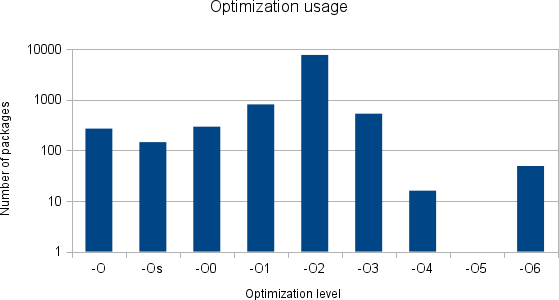
By default, deb packages uses the command "dpkg-buildflags --get CFLAGS" which will set the optimization level to -O2. However, many packages and upstream build systems do not respect such flags. On 10320 binary-only packages (in total, Debian has around 19000), the results are the following:
Optimization levelNumber of occurrencesNumber of packages
-O35597269
-Os30849145
-O013993294
-O125494809
-O29958037685
-O3106048531
-O4140216
-O500
-O6693549
Since a graphic talks more than numbers (note that the Y axis is logarithmic):
Disclaimer:
Some packages are using several optimization flags during the same build.
Some packages are not showing the full command line (see jessie release goal: verbose build logs)
The results might be approximate since I am basically grepping "-OX " on the log files.

Justus Winter: cgroupfs keeps track of processes

Tl;dr!!elfel1 Screenshot (slightly edited and annotated shell trace):
+ settrans -ca /cgroup /hurd/cgroupfs
+ mkdir /cgroup/init /cgroup/rootfs
+ echo $$ >> /cgroup/init/tasks  # $$ is 6
+ echo 3 >> /cgroup/rootfs/tasks # pid 3 is the root filesystem
+ sleep 1m & echo sleep has pid $!
sleep has pid 16
+ cat /proc/cmdline > /dev/null
+ tail /cgroup/init/tasks /cgroup/rootfs/tasks
==> /cgroup/init/tasks <==
6
16
20
==> /cgroup/rootfs/tasks <==
3
19
17
+ pstree -p
init(1)-+-auth(5)
         -cgroupfs(14)
         -ext2fs(3)-+-exec(4)
                     -null(17)
                     -pflocal(8)
                     -procfs(19)
                     -term(7)
         -mach-defpager(10)
         -root=device:hd0s1(2)
         -sh(6)-+-pstree(21)
                 -sleep(16)
Isn't she a beauty? So we bind the cgroupfs translator to /cgroup, create two cgroups, init and rootfs, move the currently executing shell script (that later execs sysvinit) into the former and the root filesystem translator into the latter cgroup. We then spawn a sleep process and cat the content of /proc/cmdline into /dev/null which will make the root filesystem start the /hurd/procfs and the /hurd/null translator. We then inspect /cgroup/ init,rootfs /tasks and find indeed all the newly spawned processes in the cgroup their parent process was in. This is accomplished by: I also filed a bug report containing my patches for the sysvinit package (#721917). This is the second bug report I filed during my gsoc, the first one was for the ifupdown package (#720531) which Andrew Shadura improved and merged on the very next day, thanks Andrew! Next week I'll continue to improve the cgroupfs translator, work on the notification prototype (hopefully fixing non-root subhurds in the process, this requires a similar notification mechanism for newly created tasks and making /hurd/proc just a little subhurd aware) and trying to get my gnumach patch into a working shape (currently the parental relation of processes is a Hurd-only concept and relies upon processes telling the /hurd/proc server that a newly created process is their child. This is automatically done if the process uses fork(2) of course, but not if it uses task_create to start a new Mach task).

Steve Kemp: Dynamically discovering settings for a cluster?

Pretend I run a cluster, for hosting a site. Pretend that I have three-six web-nodes, and each one needs to know which database host to contact. How do I control that? Right now I have a /etc/settings.conf file, more or less, deployed by Slaughter. That works. Another common pattern is to use a hostname - for example pmaster.example.org. However failover isn't considered here. If I wanted to update to point to a secondary database I'd need to either: In short I'm imagining there are several situations where you want to abstract away the configuration in a cluster-wide manner. (A real solution is obviously floating per-service IPs. Via HAProxy, Keepalived, ucarp, etc. People do that quite often for database specifically, but not for redis-servers, etc.) So I'm pondering what is essentially a multi-cast accessible key-value storage system. Have a deamon on the VLAN which will respond to multicast questions like "get db", or "get cache", with a hostname/IP/result. Suddenly your code would read: To me that seems like it should be genuinely useful. But I'm unsure if I'm trading one set of problems for another. I can't find any examples of existing tools/deamons in this area, which either means I'm being novel, innovate, and interesting. Or I'm over thinking...

5 September 2013

Vincent Sanders: Strive for continuous improvement, instead of perfection.


Kim Collins was perhaps thinking more about physical improvement but his advice holds well for software.

A lot has been written about the problems around software engineers wanting to rewrite a codebase because of "legacy" issues. Experience has taught me that refactoring is a generally better solution than rewriting because you always have something that works and can be released if necessary.

Although that observation applies to the whole of a project, sometimes the technical debt in component modules means they need reimplementing. Within NetSurf we have historically had problems when such a change was done because of the large number of supported platforms and configurations.
HistoryA year ago I implemented a Continuous Integration (CI) solution for NetSurf which, combined with our switch to GIT for revision control, has transformed our process. Making several important refactor and rewrites possible while being confident about the overall project stability.

I know it has been a year because the VPS hosting bill from Mythic turned up and we are still a very happy customer. We have taken the opportunity to extend the infrastructure to add additional build systems which is still within the NetSurf projects means.

Over the last twelve months the CI system has attempted over 100,000 builds including the projects libraries and browser. Each commit causes an attempt to build for eight platforms, in multiple configurations with multiple compilers. Because of this the response time to a commit is dependant on the slowest build slave (the mac mini OS X leopard system).

Currently this means a browser build, not including the support libraries, completes in around 450 seconds. The eleven support libraries range from 30 to 330 seconds each. This gives a reasonable response time for most operations. The worst case involves changing the core buildsystem which causes everything to be rebuilt from scratch taking some 40 minutes.

The CI system has gained capability since it was first set up, there are now jobs that:
DownsidesIt has not all been positive though, the administration required to keep the builds running has been more than expected and it has highlighted just how costly supporting all our platforms is. When I say costly I do not just refer to the physical requirements of providing build slaves but more importantly the time required.

Some examples include:
  • Procuring the hardware, installing the operating system and configuring the build environment for the OS X slaves
  • Getting the toolchain built and installed for cross compilation
  • Dealing with software upgrades and updates on the systems
  • Solving version issues with interacting parts, especially limiting is the lack of JAVA 1.6 on PPC OS X preventing jenkins updates
This administration is not interesting to me and consumes time which could otherwise be spent improving the browser. Though the benefits of having the system are considered by the development team to outweigh the disadvantages.

The highlighting of the costs of supporting so many platforms has lead us to reevaluate their future viability. Certainly the PPC mac os X port is in gravest danger of being imminently dropped and was only saved when the build slaves drive failed because there were actual users.

There is also the question of the BeOS platform which we are currently unable to even build with the CI system at all as it cannot be targeted for cross compilation and cannot run a sufficiently complete JAVA implementation to run a jenkins slave.

An unexpected side effect of publishing every CI build has been that many non developer user are directly downloading and using these builds. In some cases we get messages to the mailing list about a specific build while the rest of the job is still ongoing.

Despite the prominent warning on the download area and clear explanation on the mailing lists we still get complaints and opinions about what we should be "allowing" in terms of stability and features with these builds. For anyone else considering allowing general access to CI builds I would recommend a very clear statement of intent and to have a policy prepared for when when users ignore the statement.
Tools
Using jenkins has also been a learning experience. It is generally great but there are some issues I have which, while not insurmountable, are troubling:
Configuration and history cannot easily be stored in a revision control system.
This means our system has to be restored from a backup in case of failure and I cannot simply redeploy it from scratch.

Job filtering, especially for matrix jobs with many combinations, is unnecessarily complicated.
This requires the use of a single text line "combination filter" which is a java expression limiting which combinations are built. An interface allowing the user to graphically select from a grid similar to the output tables showing success would be preferable. Such a tool could even generate the textural combination filter if thats easier.

This is especially problematic of the main browser job which has options for label (platform that can compile the build), javascript enablement, compiler and frontend (the windowing toolkit if you prefer e.g. linux label can build both gtk and framebuffer). The filter for this job is several kilobytes of text which due to the first issue has to be cut and pasted by hand.

Handling of simple makefile based projects is rudimentary.
This has been worked around mainly by creating shell scripts to perform the builds. These scripts are checked into the repositories so they are readily modified. Initially we had the text in each job but that quickly became unmanageable.

Output parsing is limited.
Fortunately several plugins are available which mitigate this issue but I cannot help feeling that they ought to be integrated by default.

Website output is not readily modifiable.
Instead of perhaps providing a default css file and all generated content using that styling someone with knowledge of JAVA must write a plugin to change any of the look and feel of the jenkins tool. I understand this helps all jenkins instances look like the same program but it means integrating jenkins into the rest of our projects web site is not straightforward.
ConclusionIn conclusion I think the CI system is an invaluable tool for almost any non trivial software project but the implementation costs with current tools should not be underestimated.

Gergely Nagy: What's cooking in syslog-ng 3.5?

The first alpha of syslog-ng 3.4 was released more than a year ago, and the first stable release earlier this year, development on syslog-ng 3.5 has been going on steadlily since then, with a lot of interesting features and changes pouring in. While the 3.5 release will not bring as many overwhelming changes as the previous two releases did, the sheer number of improvements is still substantial. Our focus was on smaller developments all over the place this time, instead of big sweeping changes. In this post, we will go over most of these features, with use-cases, examples and a few words about why they are so useful and awesome.Multi-line support, new destinations, new template functions, type hinting, unit suffixes, and other things. Read on, and be amazed!These are only bigger features, there has been a lot of small tweaking going on, and of course, all of the fixes that went into prior versions will also be in 3.5 too, and there's still a chance that something else may find its way in before the feature freeze.Multi-line supportOne of the major new features in the 3.5 release will be support for multi-line messages, a feature that has been available in syslog-ng PE for a good while, and which has been ported to and improved upon to the open source edition. Two variants of multi-line are supported, which will be detailed below. Both of them are available for the file() and pipe() sources only.Indented multi-lineThe easiest variant is indented multi-line, where each line can be followed by others, indented by whitespace, and the message continues until the first non-indented line. This is the format used by the Linux kernel too, from version 3.5, for /dev/log. This type of multi-line can be used as follows:
source s_multiline   file("/path/to/file" multi-line-mode(indented));  ;
Consider that /path/to/file has the following content:
First line
 Continuation 1;
 Continuation 2;
Second line
With the indented multi-line-mode() setting, this would turn into two log messages:
First line\n Continuation 1;\n Continuation 2;
Second line
Regexp-based multilineIf multi-line input is not based on indentation, one can use the regexp multi-line-mode() instead, which makes two new settings available: multi-line-prefix() and multi-line-garbage(). These can be used to define the start and the end of a log message: any string between a the beginning matching prefix and a matching garbage will be considered a single message. That is, the prefix will be included, the garbage will not be: it will be discarded.To illustrate:
source s_multiline  
 file("/path/to/file" multi-line-mode(regexp)
                      multi-line-prefix("^prefix")
                      multi-line-garbage(" garbage$"));
 ;
If the source contains these lines:
prefix message
continuing garbage
This will turn into the following log message:
prefix message\ncontinuing
New destinationsIt would be pretty hard to do a syslog-ng release without new destinations, and with 3.5, we will have three of them!STOMPWhile we had AMQP before, we now have a STOMP destination too, so we can stream logs to any STOMP server, with a few simple lines:
stomp(
 host("localhost")
 port(61613)
 destination("/topic/syslog")
 routing_key("")
 persistent(yes)
 ack(no)
 username("someone")
 password("something")
 body("This is the body! YAY! Here's a message: $MESSAGE!\n")
 value-pairs(scope(nv-pairs, syslog-proto, selected-macros))
)
Of course, none of these settings need to be set, you can just use the defaults, and it will just work!RiemannDid you know that syslog-ng is far more than a log collector and processor? No? You do now. When you have access to a lot of logs, and a tremendous amount of power in parsing them, you can use these tools for monitoring easily! And when we're talking monitoring, riemann is a great asset in our toolbox, and with the new destination, we can easily forward metrics to it:
riemann(
 server("localhost")
 port(5555)
 host("$HOST")
 service("$PROGRAM")
 description("$PROGRAM pids")
 metric(int("$PID"))
 ttl(300)
);
Of course, the above is a very silly example, it would make much more sense to extract data from a log message instead, but this will serve as an example.New template functions
$(upper-case TEXT...), $(lower-case TEXT...)
To turn some text into *upper-* or *lower-case*, these two template functions come in handy. They simply turn all their arguments into the respecitve case.
$(delimit DELIMITERS NEW-DELIMITER TEXT)
Sometimes one has a delimited string, where one wishes to replace the delimiters. This function does just that: give it a list of delimiters (you may need to quote it, if it contains whitespace), a replacement, and a text to replace delimiters in, and it does the rest. For example, to replace tabs and spaces with a vertical bar, one could write a template like this:
template("$(delimit \"\t \" \" \" $MESSAGE)\n")
$(env VARIABLE...)
Have you ever felt the need to check an environment variable from within syslog-ng? I did, and now I can.
Type hintingWhile syslog-ng supported sending log messages into various data stores and message queues for a while (SQL at first, MongoDB, JSON and AMQP later), even when those supported different types of data than strings, we could not do anything else. Until now. It is now possible - at places where it makes sense - to annotate templates with type hints, which the destination driver can optionally use. Type hinting is implemented for the mongodb() destination and the $(format-json) template function for now. When no type hint is specified, syslog-ng defaults to string.To add type hints, simply wrap the respective template with the hinted type, like this:
mongodb(
 value-pairs(pair("date", datetime("$UNIXDATE"))
             pair("pid", int64("$PID")))
);
Currently the following type hints exist: boolean (anything that begins with a t or 1 is true, anything that begins with f or 0 is false, everything else is an error), string, literal (same as string, but not quoted if it would be quoted otherwise), int32 (int is an alias for this), int64, and datetime. Only UNIX timestamps can be type-hinted to datetime, anything else will likely result in a casting error.It is also possible to control what happens when type casting fails: syslog-ng can drop the whole message, drop the property, or fall back to string. It can also do all of these silently:
options  
 typecast(on-error(silently-drop-property));
 ;
Using this feature with $(format-json) is very similary too:
$(format-json date=datetime("$UNIXDATE") pid=int64("$PID"))
With this feature in place, you can now store your non-string values with their proper types!Unit suffixesUnit suffixes make it considerably easier to set limits and describe numbers within the syslog-ng configuration. We no longer need to spell out sizes to the byte precious, it is now enough to write: log-fifo-size(200MiB). Now, syslog-ng will understand suffixes for kilo-, mega-, and giga-bytes, (K, M, G, respectively) either in base-10 or base-2 (with an extra i after the suffix). One can also omit the trailing b from the end.So, to set the log-fifo-size() to 2097152 bytes, one can simply use 2MiB. Or, to set it to 2000000, 2Mb. That's a whole lot easier, isn't it? No more counting zeros, no more silly typos in a ten-digit number, no more pain, but easily readable units!Miscellaneous featuresApart from the features above, there have been a lot of other changes and improvements in the code base:

Tanguy Ortolo: PluXml, a file-based, database-free blog

The blog engine PluXml is now available as a Debian package:
Package: pluxml
Version: 5.2-2
Description-en: Light blog engine using XML files
 PluXml is a light and simple blog and CMS engine that uses simple XML
 files to store its data and requires no database. It has all the usual
 features (static pages, comments, categories, tags, medias, RSS
 feed...) and supports multiple users, customizable themes and plugins.
Homepage: http://www.pluxml.org/
Section: web
Priority: extra
PluXml logo: a leaf with its petiole used as one bar of the word  Xml
PluXml is a French blog engine that uses XML files to store its data, thus avoiding the need for an external database system as most blogs do. The name PluXml is a French portmanteau between plume (feather, evoking something light) and XML. Apart from that, although it was started in French only and its official website is still in French, it was internationalized about a year ago. It is designed to be easy enough to use, targeting regular users, but not too fancy: for instance, it provides a web-based administration interface, but content editing uses HTML code unless you install a graphical content editor plugin. That package may be of interest to people like me, that consider the almost systematic use of relational database systems in many web applications as a disease, and more generally to self-hosted people that would rather avoid running an additional database server on their small home servers. The package includes an interactive configuration, that allows to choose the blog language, title, description, admin login and password. Unless debconf was configured not to ask questions, in which case nothing is asked and the blog is left in an barely unusable state, of course.

Daniel Pocock: Will Baby Boomers strangle Australia's Internet?

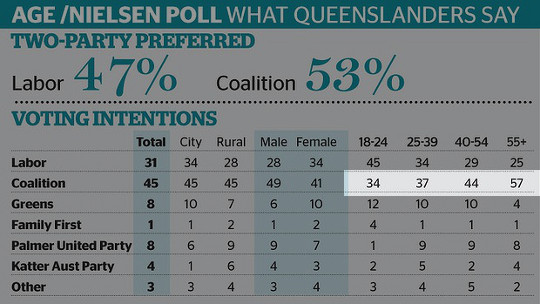
When Labor's Communications Minister Stephen Conroy won the title Internet villain of the year most educated people realised it wasn't something to celebrate. So it might be surprising for some that the title could potentially be returning to Australia so soon... Australia's main opposition party, the deceptively named Liberals (who actually lurk at the Marine Le Pen grade of conservatism) have just announced plans to resurrect the plan by implanting filtering technology in all modems, routers and smartphones. Whether they do or don't, there are serious concerns that they have described Australia's still-under-construction national broadband network as a wasteful project (which is potentially true) but failed to provide any credible alternative: who really thinks the conservative's proposed 25MBps will be a serious technology when they finish deploying it in 2019?. It is interesting to look at the bigger picture to see where this stupidity comes from. A political poll released early this week gives us half the story: Big bad baby boomers It is obvious that older voters prefer the conservative "coalition" parties, 57% of over-55s in particular. It is a huge jump from the 44% of voters in the age group below them. What this table doesn't tell us is that Australia's population is top-heavy with Baby Boomers. In other words, there are actually quite a lot of those over-55-year-old voters. In fact, it is estimated that close to 1 in 3 Australians will be in this category within the next 10 years. People who want the world to be the way it was in the 60s: many have already paid off a mortgage on a home in the suburbs with no access to things like public transport. They grew up under the white Australia policy and are frustrated at the presence of educated hard working foreigners from countries like India and China. Retired, no longer working, expecting the state to provide roads to their poorly located McMansions and free health care but little concern for broadband or anything that smells new. As they are no longer working, many have no commercial demand for broadband but will happily vote for a policy to censor it even if they don't use it themselves, simply because they want to see a Government that is blocking change. Sadly, they are shooting themselves in the foot: younger generations of Australians need to work and pay tax if there is to be any hope of keeping the dream alive for older Australians. However, with the conservatives cutting education to fund an over-dramatised response to immigration that costs billions of dollars every year, cutting corners and dumbing-down essential technology like the Internet, it seems that working-age Australians will struggle to compete in the global marketplace.

Keith Packard: Airfest-altimeter-testing

Altimeter Testing at Airfest Bdale and I, along with AJ Towns and Mike Beattie, spent last weekend in Argonia, Kansas, flying rockets with our Kloudbusters friends at Airfest 19. We had a great time! AJ and Mike both arrived a week early at Bdale s to build L3 project airframes, and both flew successful cert flights at Airfest! Airfest was an opportunity for us to test fly prototypes of new flight electronics Bdale and I have spent the last few weeks developing, and I thought I d take a few minutes today to write some notes about what we built and flew. TeleMega We ve been working on TeleMega for quite a while. It s a huge step up in complexity from our original TeleMetrum, as it has a raft of external sensors and six pyro circuits. Bdale flew TeleMega in his new fiberglass 4 airframe on a Loki 75mm blue M demo motor. GPS tracking was excellent; you can see here that GPS altitude tracked the barometric sensor timing exactly: GPS lost lock when the motor lit, but about 3 seconds after motor burnout, it re-acquired the satellite signals and was reporting usable altitude data right away. The GPS reported altitude was higher than the baro sensor, but that can be explained by our approximation of an atmospheric model used to convert pressure into altitude. The rest of the flight was also nominal; TeleMega deployed drogue and main chutes just fine. TeleMetrum We ve redesigned TeleMetrum. The new version uses better sensors (MS5607 baro sensor, MMA6555 accelerometer) and a higher power radio (CC1120 40mW). The board is the same size, all the connectors are in the same places so it s a drop-in replacement, and it s still got two pyro channels and USB for configuration, data download and battery charging. I loaded up my Candy-Cane airframe with a small 5 grain 38mm CTI classic: The flight computer worked perfectly, but GPS reception was not as good as we d like to see: Given how well TeleMega was receiving GPS signals, I m hopeful that we ll be able to tweak TeleMetrum to improve performance. TeleMini We ve also redesigned TeleMini. It s still a two-channel flight computer with logging and telemetry, but we ve replaced the baro sensor with the MS5607, added on-board flash for increased logging space and added on-board screw terminals for an external battery and power switch. You can still use one of our 3.7V batteries, but you can also use another battery providing from 3.7 to 15V. I was hoping to finish up the firmware and fly it, but I ran out of time before the launch. The good news is that all of the components of the board have been tested and work correctly, and the firmware is feature complete , meaning we ve gotten all of the features coded, it s just not quite working yet. EasyMini EasyMini is a new product for us. It s essentially the same as a TeleMini, but without a radio. Two channels, baro-only, with logging. Like TeleMini, it includes an on-board USB connector and can use either one of our 3.7V batteries, or an external battery from 3.7V to 15V. EasyMini and TeleMini are the same size, and have holes in the same places, so you can swap between them easily. I flew EasyMini in my Koala airframe with a 29mm 3 grain CTI blue-streak motor. EasyMini successfully deployed the main chute and logged flight data: We also sent a couple of boards home with Kevin Trojanowski and Greg Rothman for them to play with. TeleGPS TeleGPS is a GPS tracker, incorporating a u-blox Max receiver and a 70cm transmitter. It can send position information via APRS or our usual digital telemetry formats. I was also hoping to have the TeleGPS firmware working, and I spent a couple of nights in the motel coding, but didn t manage to finish up. So, no data from this board either. Production Plans Given the success of the latest TeleMega prototype, we re hoping to have it into production first. We ll do some more RF testing on the bench with the boards to make sure it meets our standards before sending it out for the first production run. The goal is to have TeleMega ready to sell by the end of October. TeleMetrum clearly needs work on the layout to improve GPS RF performance. With the testing equipment that Bdale is in the midst of re-acquiring, it should be possible to finish this up fairly soon. However, the flight firmware looks great, so we re hoping to get these done in time to sell by the end of November. TeleMini is looking great from a hardware perspective, but the firmware needs work. Once the firmware is running, we ll need to make enough test flights to shake out any remaining issues before moving forward with it. EasyMini is also looking finished; I ve got a stack of prototypes and will be getting people to fly them at my local launch in another couple of weeks. The plan here is to build a small batch by hand and get them into the store once we re finished testing, using those to gauge interest before we pay for a larger production run.

4 September 2013

Raphael Geissert: A bashism a week: tilde expansion

Did you know that you can get a user's home directory with the "~username" tilde expansion? You probably do, but how about other tilde expansions?

Thanks to a few bashisms you can make your script even more difficult to read by using "~+" to get $PWD, and "~-" to get $OLDPWD.

Are you using bash and want to access the directories stack created when using the pushd and popd bashisms? The ~i (where i is an integer) expansion can give you that. It gives you forward (~+i) and backward (~-i) access to the directories stack.

But beware, if the directories stack is smaller than the number you used, there won't be any expansion.

When using tildes in shell scripts, make sure you quote to avoid unwanted expansions. Note that the posh shell in wheezy and older do support those non-POSIX expansions.

in the first examples the tilde is quoted for easier reading; the expansion doesn't occur if the tilde is quoted.

Next.

Previous.