Search Results: "mak"

5 April 2012

Dominique Dumont: My activities during Perl/QA hackathon in Paris

Hello Last week-end, I ve participated Perl/QA hackathon in Paris. Here s a short summary of the main activities during this week-end. I was not in the best of shape due to a nasty (biological) bug that wore me down before the hackathon. First of all, I discussed with rjbs about the bunch of debian patches I ve written for Software::License. These patches (and hacks) are used in Debian to provide licenses summaries in Debian::Dpkg::Copyright model to help write Debian copyright files. License management is boring but necessary. cme and Software::License help in making this task slightly less boring. Ricardo kindly suggested some modifications and agreed to include my patches. I implemented these modifications directly during the hackathon. The other tasks during this week-end were (not necessarily in that order): Many thanks to FreeSide who sponsored my travel, to the hackathons organisers and to all the participants for their welcome. All the best

MJ Ray: Debian Project Leader Election 2012

Voting is open in the Debian Project Leader Elections 2012 So now I need to figure out who to vote for. This year I didn t take part in the discussions (all my spare time was bought, basically). The platforms are linked from the Debian Project Leader Elections 2012 page above and the key discussions were: Thanks to everyone who asked these great questions. So, what do you think?

4 April 2012

Pietro Abate: mancoosi tools in debian testing

Finally the dose3 libraries and tools landed in testing this weekend. We solved a couple of bugs already and it seems nobody complained too loudly. If you used the edos tools in the past you might be interested to check out our new tools in the package dose-extra. Actually @mancoosi we will be delighted to ear about you experience with our tools and how to make them better and more useful. Please drop me a line ! The next major release of dose will be multi-arch aware and provide performance improvements and other minor features. If you missed it, and you are now curious, I delivered a talk at fosdem regarding our tools: A big thanks to ralf of course for packaging everything !

3 April 2012

Julien Danjou: mod_defensible 1.5 released

Apache 2.4 being out, I noticed that my good old mod_defensible did not compile anymore. The changes in the new Apache 2.4 API were small for its concern, so it was pretty easy to update this software to make it compile again. Honestly, I'm not sure that this module is really used into the wild, but I still think that it can serve as a good prototype for doing other things so I like keeping it around. :-) All this has been triggered by the Apache 2.4 arrival into Debian experimental. Therefore I've updated the mod_defensible package to use the new dh_apache2, and imported it into Git at the same time.

2 April 2012

Bartosz Feński: i18n.debian. net,org

How about switch translations to Weblate? Maybe it s time to move on some more user friendly translation system? I believe Michal iha (cheers!) is going to help us (as a community) to make changes relevant to Debian s infrastructure.

Julian Andres Klode: Currying in the presence of mutable parameters

In the language introduced yesterday, mutable parameters play the important role of representing the side effects of actions in the type system and thus ensure referential transparency. One of the questions currently unaddressed is how to handle currying in the presence of mutable parameters. In order to visualise this problem, consider a function
    printLn(mutable IO, String line)
If we bind the the first parameter, what should be the type of the function, and especially important how do we get back the mutable parameter? Consider the partially applied form printLn1:
    printLn1(String line)
The mutability parameter would be lost and we could not do any further I/O (and the curried form would appear as a pure function, so a good compiler would not even emit a call to it) An answer might be to put the thing into the result when currying:
    printLn2(String line) -> mutable IO
But how can we explain this? In the end result, do we maybe have to use a signature like:
    printLn(String, mutable in IO io1, mutable out IO io2)
We could then introduce syntax to call that as
    printLn(string, mutable io)
Where as the mutable io argument basically expands to io and io1 for the first call, and for later calls to io1, io2 , and so on. It can also be easily curried by allowing currying to take place on variables not declared as output parameters. We can then curry the function as:
    printLn3(mutable in IO io1, mutable out IO io2)
    printLn4(mutable out IO io2)
If so, we can rename mutable back to unique and make that easier by introducing the unary operator & for two locations, just like Mercury uses ! for it. We could then write calls looking like this:
    printLn("Hello", &io);
    printLn("Hello", io, io1);
How out parameters are explained is a different topic; we could probably say that an out parameter defines a new variable. Another option is to forbid currying of mutable parameters entirely. This would have the advantage of maintaining the somewhat simple one parameter style. The programming language Clean does not provide any special syntactic sugar for having mutable variables. In Clean, the function gets a unique object and returns a unique object (noted by *). For example, the main entry point in a Clean program (with state) looks like this:
    Start:: *World -> *World
In short, the function Start gets a abstract world passed that is unique and at the end returns a new unique world. In Clean syntax, our example function would most likely have the signature:
    printLn :: String *IO -> *IO
You know have to either maintain one additional variable for the new unique object, which gets a bit complicated with time. On the other hand, you can do function composition on this (if you have a function composition operator that preserves uniqueness when available, as should be possible in Clean):
    printTwoLines :: *IO -> *IO
    printTwoLines = (printLn "World") o (printLn "Hello")
Function composition on mutable things however, does not seem like it is needed often enough in a functional programming language with a C syntax. People might also ask why monads are not used instead. Simon L Peyton Jones and Philip Wadler described monadic I/O in their paper Imperative Functional Programming (http://research.microsoft.com/en-us/um/people/simonpj/papers/imperative.ps.Z) in 1993, and it is used in Haskell (the paper was about the implementation in Haskell anyway), one of the world s most popular and successful functional programming languages. While monadic I/O works for the Haskell crowd, and surely some other people, the use of Monads also limits the expressiveness of code, at least as far as I can tell. At least as soon as you want to combine multiple monads, you will have to start lifting stuff from one monad to another (liftIO and friends), or perform all operations in the IO monad, which prevents obvious optimizations (such as parallelizing the creation of two arrays) in short dependencies between actions are more strict than they have to be. For a functional language targeting imperative programmers, the lifting part seems a bit too complicated. One of the big advantages of monads is that they are much easier to implement, as they do not require extensions to the type system and the Hindley-Milner type inference algorithm used by the cool functional programming languages. If you want uniqueness typing however, you need to modify the algorithm or infer the basic types first and then infer uniqueness in a second pass (as Clean seems to do it).
Filed under: General

1 April 2012

Raphaël Hertzog: My Debian Activities in March 2012

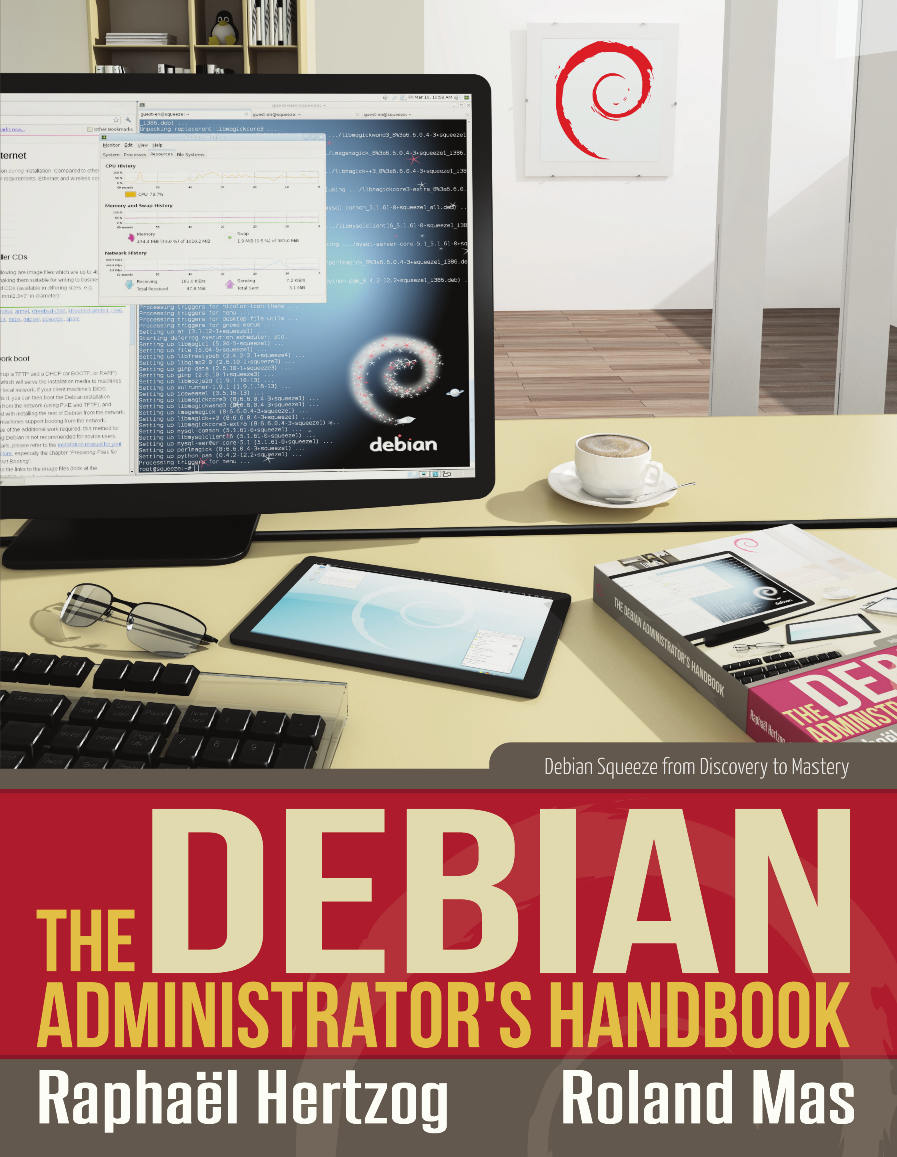
This is my monthly summary of my Debian related activities. If you re among the people who made a donation to support my work (227.83 , thanks everybody!), then you can learn how I spent your money. Otherwise it s just an interesting status update on my various projects. Dpkg Thanks to Guillem, dpkg with multiarch support is now available in Debian sid. The road has been bumpy, and it has again been delayed multiple times even after Guillem announced it on debian-devel-announce. Finally, the upload happened on March 19th. I did not appreciate his announce because it was not coordinated at all, and had I been involved from the start, we could have drafted it in a way that sounded less scary for people. In the end, I provided a script so that people can verify whether they were affected by one of the potential problems that Guillem pointed out. While real, most of them are rather unlikely for typical multiarch usage. Bernhard R. Link submitted a patch to add a new status command to dpkg-buildflags. This command would print all the information required to understand which flags are activated and why. It would typically be called during the build process by debian/rules to keep a trace of the build flags configuration. The goal is to help debugging and also to make it possible to extract that information automatically from build logs. I reviewed his patch and we made several iterations, it s mostly ready to be merged but there s one detail where Bernhard and I disagree and I solicited Guillem s opinion to try to take a decision. Unfortunately neither Guillem nor anyone else chimed in. On request of Alexander Wirt, I uploaded a new backport of dpkg where I dropped the DEB_HOST_MULTIARCH variable from dpkg-architecture to ensure multi-arch is never accidentally enabled in other backports. One last thing that I did not mention publicly at all yet, is that I contacted Lennart Poettering to suggest an improvement to the /etc/os-release file that he s trying to standardize across distributions. It occurred to me that this file could also replace our /etc/dpkg/origins/default file (and not only /etc/debian_version) provided that it could store ancestry information. After some discussions, he documented new official fields for that file (ID_LIKE, HOME_URL, SUPPORT_URL, BUG_REPORT_URL). Next step for me is to improve dpkg-vendor to support this file (as a fallback or as default, I don t know yet). Packaging I packaged quilt 0.60 (we re now down to 9 Debian-specific patches, from a whopping 26 in version 0.48!) and zim 0.55. In prevision of the next upstream version of Publican, I asked the Perl team to package a few Perl modules that Publican now requires. Less than two weeks after, all of them were in Debian Unstable. Congrats and many thanks to the Perl team (and Salvatore Bonaccorso in particular, which I happen to know because we were on the same plane during last Debconf!). On a side note, being the maintainer of nautilus-dropbox became progressively less fun over the last months, in particular because the upstream authors tried to override some of the (IMO correct) packaging decisions that I made and got in touch with Ubuntu community managers to try to have their way. Last but not least, I keep getting duplicates of a bug that is not in my package but in the official package and that Dropbox did not respond to my query. Book update The translation is finished and we re now reviewing the whole book. It takes a bit more time than expected because we re trying to harmonize the style and because it s difficult to coordinate the work of several volunteer reviewers. The book cover is now almost finalized (click on it to view it in higher definitions): We also made some progress on the interior design for the paperback. Unfortunately, I have nothing to show you yet. But it will be very nice and made with just a LaTeX stylesheet tailored for use with dblatex. The liberation fundraising slowed down with only 41 new supporters this month but it made a nice bump anyway thanks to a generous donation of 1000 EUR by Offensive security, the company behind Backtrack Linux. They will soon communicate on this, hopefully it will boost the operation. It would be really nice if we managed to raise the remaining 3000 EUR in the few weeks left until the official release of the book! The work on my book dominated the month and explains my relative inactivity on other fronts. I worked much more than usual, and my wife keeps telling me that I look tired and that I should go in bed earlier but I see the end of the tunnel: if everything goes well, the book should be released in a few weeks and I will be able to switch back to a saner lifestyle. Thanks See you next month for a new summary of my activities.

One comment Liked this article? Click here. My blog is Flattr-enabled.

Jamie McClelland: Property is Theft

I've recently been making my way through the Proudhon Reader, a collection of writings by Pierre-Joseph Proudhon recently published by AK Press. Proudhon, known as the father of Anarchism is most famous for his declaration: "Property is theft." The simple declaration is based on pages of explanation which, simplistically, can be boiled down to the idea that workers should all equally share in the fruits of their labor. While Proudhon's influence on Marx is hotly debated, this idea is fundamental to Marx's idea around the alienation of labor. If we are working to produce a product that is then owned by the proprietor, rather than the worker, we are alienated from our labor. Many May First/People Link members, such as Palante Tech, Openflows, Union Web Services, and Agaric Design are all committed to fighting this alienation by organizing as worker-run cooperatives. Nobody is the boss, all workers share in all profits. However, Proudhon got me thinking about free software shops that aren't worker-run cooperatives. If you are employed by a for-profit corporation as a worker and your only job is to write code that is released under a free software license, are you alienated from your labor in the Marxist sense? The fruits of your labor might be owned by your company, but they are freely licensed to the world (which, of course, includes you). There is still surplus value accrued to your company (if you do good work for your company, you will be contributing to their reputation from which they will profit). However, if you are primarily writing code, the vast majority of your labor is producing a product that you are fundamentally not alienated from. Proudhon, while sprinkling the word revolution throughout his writings, was notably not particularly revolutionary in his calls for action. He was reformist. Rather than calling for a direct confrontation with capitalism, he called for worker-run collectives to be formed throughout the world to make capitalism irrelevant. While many people point to corporate use of free software as an argument for why free software and capitalism are perfectly compatible, the truth may be more complicated. Fundamentally, and in a non-confrontational way, free software seems to undermine one of the basic tenants of capitalist: worker alienation. Now we just need to work on all the other ways corporate work places are alienating...

Joey Hess: ls: the missing options

I'm honored and pleased to be the person who gets to complete ls. This project, begun around when I was born, was slow to turn into anything more than a simple for loop over a dirent. It really took off in the mid and late 80's, when Richard Stallman added numerous features, and the growth has been steady ever since. But, a glance at the man page shows that ls has never quite been complete. It fell to me to finish the job, and I have produced several handy patches to this end: The only obvious lack now is a -z option, which should make output filenames be NULL terminated for consuption by other programs. I think this would be easy to write, but I've been extermely busy IRL (moving lots of furniture) and didn't get to it. Any takers to write it? Due to the nature of these patches, they conflict with each other. Here's a combined patch suitable to be applied and tested.
diff -ur orig/coreutils-8.13/src/ls.c coreutils-8.13/src/ls.c
--- orig/coreutils-8.13/src/ls.c    2011-07-28 06:38:27.000000000 -0400
+++ coreutils-8.13/src/ls.c 2012-04-01 12:41:56.835106346 -0400
@@ -270,6 +270,7 @@
 static int format_group_width (gid_t g);
 static void print_long_format (const struct fileinfo *f);
 static void print_many_per_line (void);
+static void print_jam (void);
 static size_t print_name_with_quoting (const struct fileinfo *f,
                                        bool symlink_target,
                                        struct obstack *stack,
@@ -382,6 +383,7 @@
    many_per_line for just names, many per line, sorted vertically.
    horizontal for just names, many per line, sorted horizontally.
    with_commas for just names, many per line, separated by commas.
+   jam to fit in the most information possible.
 
    -l (and other options that imply -l), -1, -C, -x and -m control
    this parameter.  */
@@ -392,7 +394,8 @@
     one_per_line,      /* -1 */
     many_per_line,     /* -C */
     horizontal,            /* -x */
-    with_commas            /* -m */
+    with_commas,       /* -m */
+    jam            /* -j */
    ;
 
 static enum format format;
@@ -630,6 +633,11 @@
 
 static bool immediate_dirs;
 
+/* True means when multiple directories are being displayed, combine
+ * their contents as if all in one directory. -e */
+
+static bool entangle_dirs;
+
 /* True means that directories are grouped before files. */
 
 static bool directories_first;
@@ -705,6 +713,10 @@
 
 static bool format_needs_type;
 
+/* Answer "yes" to all prompts. */
+
+static bool yes;
+
 /* An arbitrary limit on the number of bytes in a printed time stamp.
    This is set to a relatively small value to avoid the need to worry
    about denial-of-service attacks on servers that run "ls" on behalf
@@ -804,6 +816,7 @@
    "escape", no_argument, NULL, 'b' ,
    "directory", no_argument, NULL, 'd' ,
    "dired", no_argument, NULL, 'D' ,
+   "entangle", no_argument, NULL, 'e' ,
    "full-time", no_argument, NULL, FULL_TIME_OPTION ,
    "group-directories-first", no_argument, NULL,
    GROUP_DIRECTORIES_FIRST_OPTION ,
@@ -849,12 +862,12 @@
 static char const *const format_args[] =
  
   "verbose", "long", "commas", "horizontal", "across",
-  "vertical", "single-column", NULL
+  "vertical", "single-column", "jam", NULL
  ;
 static enum format const format_types[] =
  
   long_format, long_format, with_commas, horizontal, horizontal,
-  many_per_line, one_per_line
+  many_per_line, one_per_line, jam
  ;
 ARGMATCH_VERIFY (format_args, format_types);
 
@@ -1448,6 +1461,9 @@
       print_dir_name = true;
      
 
+  if (entangle_dirs)
+      print_current_files ();
+
   if (print_with_color)
      
       int j;
@@ -1559,6 +1575,7 @@
   print_block_size = false;
   indicator_style = none;
   print_inode = false;
+  yes = false;
   dereference = DEREF_UNDEFINED;
   recursive = false;
   immediate_dirs = false;
@@ -1644,7 +1661,7 @@
      
       int oi = -1;
       int c = getopt_long (argc, argv,
-                           "abcdfghiklmnopqrstuvw:xABCDFGHI:LNQRST:UXZ1",
+                           "abcdefghijklmnopqrstuvw:xyABCDFGHI:LNQRST:UXZ1",
                            long_options, &oi);
       if (c == -1)
         break;
@@ -1667,6 +1684,10 @@
           immediate_dirs = true;
           break;
 
+   case 'e':
+          entangle_dirs = true;
+     break;
+
         case 'f':
           /* Same as enabling -a -U and disabling -l -s.  */
           ignore_mode = IGNORE_MINIMAL;
@@ -1697,6 +1718,10 @@
           print_inode = true;
           break;
 
+   case 'j':
+     format = jam;
+     break;
+
         case 'k':
           human_output_opts = 0;
           file_output_block_size = output_block_size = 1024;
@@ -1765,6 +1790,10 @@
           format = horizontal;
           break;
 
+   case 'y':
+     yes = true;
+     break;
+
         case 'A':
           if (ignore_mode == IGNORE_DEFAULT)
             ignore_mode = IGNORE_DOT_AND_DOTDOT;
@@ -2510,7 +2539,7 @@
       DEV_INO_PUSH (dir_stat.st_dev, dir_stat.st_ino);
      
 
-  if (recursive   print_dir_name)
+  if ((recursive   print_dir_name) && ! entangle_dirs)
      
       if (!first)
         DIRED_PUTCHAR ('\n');
@@ -2526,7 +2555,8 @@
   /* Read the directory entries, and insert the subfiles into the  cwd_file'
      table.  */
 
-  clear_files ();
+  if (! entangle_dirs)
+     clear_files ();
 
   while (1)
      
@@ -2615,7 +2645,7 @@
       DIRED_PUTCHAR ('\n');
      
 
-  if (cwd_n_used)
+  if (cwd_n_used && ! entangle_dirs)
     print_current_files ();
  
 
@@ -3464,6 +3494,10 @@
       print_with_commas ();
       break;
 
+    case jam:
+      print_jam ();
+      break;
+
     case long_format:
       for (i = 0; i < cwd_n_used; i++)
          
@@ -4418,6 +4452,24 @@
   putchar ('\n');
  
 
+static void
+print_jam (void)
+ 
+  size_t filesno;
+  size_t pos = 0;
+
+  for (filesno = 0; filesno < cwd_n_used; filesno++)
+     
+      struct fileinfo const *f = sorted_file[filesno];
+      size_t len = length_of_file_name_and_frills (f);
+
+      print_file_name_and_frills (f, pos);
+      pos += len;
+     
+  putchar ('\n');
+ 
+
+
 /* Assuming cursor is at position FROM, indent up to position TO.
    Use a TAB character instead of two or more spaces whenever possible.  */
 
@@ -4627,11 +4679,13 @@
   -D, --dired                generate output designed for Emacs' dired mode\n\
 "), stdout);
       fputs (_("\
+  -e, --entangle             display multiple directory contents as one\n\
   -f                         do not sort, enable -aU, disable -ls --color\n\
   -F, --classify             append indicator (one of */=>@ ) to entries\n\
       --file-type            likewise, except do not append  *'\n\
       --format=WORD          across -x, commas -m, horizontal -x, long -l,\n\
                                single-column -1, verbose -l, vertical -C\n\
+                               jam -j\n\
       --full-time            like -l --time-style=full-iso\n\
 "), stdout);
       fputs (_("\
@@ -4667,6 +4721,8 @@
   -i, --inode                print the index number of each file\n\
   -I, --ignore=PATTERN       do not list implied entries matching shell PATTERN\
 \n\
+  -j                         jam output together, makes the most of limited\n\
+                             space on modern systems (cell phones, twitter)\n\
   -k                         like --block-size=1K\n\
 "), stdout);
       fputs (_("\
@@ -4733,6 +4789,7 @@
   -w, --width=COLS           assume screen width instead of current value\n\
   -x                         list entries by lines instead of by columns\n\
   -X                         sort alphabetically by entry extension\n\
+  -y                         answer all questions with \"yes\"\n\
   -Z, --context              print any SELinux security context of each file\n\
   -1                         list one file per line\n\
 "), stdout);
It remains to be seen if multi-option enabled coreutils will be accepted into Debian in time for the next release. Due to some disagreements with the coreutils maintainer, the matter has been referred to the Technical Committee (Flattr me) Traditionally new ls contributors stop once enough options have been added that they can spell their name, in the best traditions of yellow snow. Once ls -richard -stallman worked, I'm sure RMS moved on other other more pressing concerns. The current maintainer, David MacKenzie, was clearly not done yet, since only ls -david -mack worked. But he was being slow to add these last few features, and ls was very deficient in the realm of spelling my name (ls -o -hss .. srsly?), so I took matter into my own hands in the best tradition of free software.

Russ Allbery: Review: Agile Project Management with Scrum

Review: Agile Project Management with Scrum, by Ken Schwaber
Publisher: Microsoft
Copyright: 2004
ISBN: 0-7356-1993-X
Format: Trade paperback
Pages: 153
Ken Schwaber is one of the two original developers of Scrum and one of the signatories to the Agile Manifesto. Agile Project Management with Scrum is an introduction to Scrum by him that feels aimed primarily at business people (project managers, executives, line managers) rather than at technical people. There's very little about agile software development in general; the emphasis is on business process, team organization, and how the Scrum process looks to the rest of the organization. After an introductory chapter laying out the basics of Scrum, the remainder of the book is primarily case studies. Schwaber presents some principle and then discuss an anonymized case study that illustrates the principle. Each major Scrum role (ScrumMaster, Product Owner, and Team Member) gets their own chapter, interspersed with chapters on planning, reporting, and scaling. Finally, there are some concluding appendices laying out the rules of Scrum in more detail, adding a brief (and very disappointing) discussion of fixed-term, fixed-price contracts, and providing some other supplemental information. This is only the second regular book that I've read about Scrum, but my reading has been a bit out of order. We've been using Scrum for various projects for about a year and a half, I've played both team member and product owner roles, and we've been thinking hard about how to integrate Scrum more into the way we do development. My impression of this book is that it's intended as more of an introduction for people who aren't yet comfortable with Scrum or who are still struggling to make the pieces fit together. I'm therefore possibly not the target audience. Much of this book is a rehash of things someone who has studied Scrum will already know. I'm of two minds about the case study presentation style of this book. On one hand, it does help to make the points Schwaber discusses more concrete, and it's difficult to talk about business process in any other way. They're also more interesting and engaging than Schwaber's straight rule descriptions. But I had difficulty digging into most of the ones here. They're very simple and a little shallow, and I had trouble applying many of them to practical situations I might be in. I would have liked somewhat more detailed stories with more analysis and possible alternatives within the situation, rather than simple illustrations of how Scrum solves the problem that Schwaber had just said it would solve. What I did like about this book is that it provides the background and theory of Scrum as empirical process control much more clearly than any material I'd previously read. Schwaber is good at explaining what empirical process control is and why it's a superior approach, and he gave me new vocabulary and basic concepts to use to talk about Scrum. I also liked the high-level look from a management perspective without getting into the details of story points and velocity estimation (Schwaber doesn't use them at all in this book, relying instead on traditional "days of work" estimates). Much of my previous experience with Scrum was tightly focused on its advantages for estimation and responsiveness to changes, and it's nice to see some of the other advantages of Scrum (developer job satisfaction, improved focus, incremental deployment) highlighted more. Another part of this book I appreciated was the discussion of sprint length. Schwaber doesn't go into the possible alternatives, largely assuming that a month is the best interval, but the discussion of the impact and implications of a month sprint length helped me see the advantages of longer sprints. (To date, we've been doing either one week or two week sprints.) I came away with the feeling that a hybrid model where longer sprints are used for business purposes and then subdivided into shorter sprints for developer coordination might be particularly effective, although that's not an idea that Schwaber presents. This is not a particularly compelling read, particularly if, like me, you're not a huge fan of genericized case studies. Schwaber's writing is clear, but wooden and occasionally awkward, and the book is often dry. But it talks about Scrum from a management angle instead of a developer angle, which is an additional perspective that I found valuable. Possibly worth taking a look if you want more detail about Scrum from a high-level management perspective, although I don't think you're missing a lot by not reading it. Rating: 6 out of 10

31 March 2012

Craig Sanders: rsync and .zfs snapshot directories

zfsonlinux recently added support for visible .zfs snapshot directories, so you no longer have to mount a snapshot to browse/view/recover files from it. This is good, but has caused my rsync backup to zfs script to complain about being unable to delete files in the .zfs directory (which is in the backup but not in the source). e.g.
sending incremental file list
rsync: delete_file: unlink(.zfs/snapshot/2012-03-31/vmlinuz.old) failed: Read-only file system (30)
rsync: delete_file: unlink(.zfs/snapshot/2012-03-31/vmlinuz) failed: Read-only file system (30)
[...]
cannot delete non-empty directory: .zfs/snapshot/2012-03-31
rsync: delete_file: rmdir(.zfs/snapshot/2012-03-31) failed: Device or resource busy (16)
rsync: delete_file: unlink(.zfs/snapshot/2012-03-30/vmlinuz.old) failed: Read-only file system (30)
rsync: delete_file: unlink(.zfs/snapshot/2012-03-30/vmlinuz) failed: Read-only file system (30)
[...]
The solution is to tell rsync to ignore .zfs directories on the destination. 1. use the -F option to make rsync use /.rsync-filter
2. create or add the following line to /.rsync-filter
-r .zfs/***
-s .zfs/***
On the first line, the - makes it an exclude rule, and the r indicates that the rule applies to the receiving side. Together, -r prevents rsync from attempting to delete the .zfs directories On the second line, the -s indicates that the rule applies to the sending side, preventing rsync from trying to backup any .zfs snapshot directories. This is only useful when backing up a ZFS filesystem. rsync and .zfs snapshot directories is a post from: Errata

Bartosz Fe&#324;ski: note to self

If you want to connect to some device by wire make sure it has this wire plugged in.

30 March 2012

Andreas Barth: Traveling to DebConf 11 - back to Zagreb and M nchen

Back from Banja Luka was the DebConf bus trip to Zagreb. Even though the train connection should allow to catch the night train to M nchen, the time in Zagreb was too short to be sure (as with the other Bosnian track, two trains per day - taking a earlier train was not possible if I wanted to get at least a bit of sleep). So, I went on the DebConf-bus to Zagreb, and arrived there on time. Border checks into Hrvatska were a bit more time consuming then in the other direction - too much traffic but nothing else. In Zagreb, I dropped off my luggage at the train station again, and then went by tram to the parts of the city I hadn't been before (and which were more normal parts, and not the tourist-areas). Incidently I also experienced tram track works, and so had to switch to the bus; however, information was so bad that not only I didn't notice it (which wasn't too bad and unexpected - I plan with enough time as tourist) but also locals were taken by surprise. (Many parts of) Zagreb appears to have many too wide roads, with pedestrians pushed away. Not too uncommon for some cities here as well. But sad to see if public space is not created with humans in mind. This used to be modern in the 60ies, whereas it should have now advanced to center around humans again. If one compares the situation how one feels while standing in a too far road (where the wind blows easily cold) with a decent road in any city center, one could see the difference. But as said, many german cities make the same mistake. After arriving back at the train station, this was in time for taking the night train. Obviously there were many DDs on board. Passport checks in Hravatska went smooth but with many boarder guards. The train had an extra stop not in the official timetable so that they didn't leave their territory armed. On arriving in Slovenija the train had to stop some time. Border checks were quite strict (as this was entering the european union) and time consuming, e.g. partly cover sheets of the train were removed. After entering Slovenija the reminder of the trip was uneventful (or at least: ignored while sleeping), so the trip ended in M nchen as planned. Summarising it was an interesting and nice trip. I had no problem using public transport in spite of the warnings before. Of course, as always while traveling in foreign countries one should expect the country to be more different to home than just temperature and language - i.e. one should expect a bit of the unexpected, and be able to cope with. But that's true for any place one is going to. And these areas are worth another visit another time. I also learned more about "local" history (whereas local covers everything within 1000 kilometers around M nchen). However, the really bad thing is when comparing Hrvatska and Bosna i Hercegovina to see how much more Bosna i Hercegovina could have advanced within the last 16 years, but didn't due to incompetent management. Thinking that the same ways of obstructing decision-making happens in this country (and the european union as a whole) as well (but isn't as visible - we hadn't had a war, but also not much advances in our infrastructure) makes me more sad. Having said this, I still enjoyed the tour quite much - it was a good decision to have done it.

Russell Coker: The Security Benefits of Automation

Some Random WTFs The Daily WTF is an educational and amusing site that recounts anecdotes about failed computer projects. One of their stories titled Remotely Incompetent concerns someone who breaks networking on a server and is then granted administrative access to someone else s server by the Data Center staff [1]! In one of the discussions about that I saw people make various claims about Data Center security, such as claiming that having their own locked room helps. My experience indicates that such things don t do much good, I have often been granted access to server rooms without appropriate checks. My experience is that security guards on site generally don t directly do any good. I once had a guard hold a door for me when I was removing a server from a DC without even bothering to ask for ID! On another occasion in the Netherlands I had a security guard who didn t speak English unlock the wrong server room for me, I used hand gestures to inform him that I needed access to the room with the big computers and he gave me the access I needed! It seems that the benefit of security guards is solely based on scaring people who don t have the confidence needed to bluff their way in. Preventing children from thieving is a good thing, On another occasion I showed ID and signed in for access to a DC owned by my employer and I used my security key to go through a locked door with a sign that promised many bad consequences if I failed to lock the door behind me. Then I discovered that the back door was wide open for the benefit of some electricians who were working in the building. Presumably the electricians who had no security training were expected to act as ad-hoc security guards if someone tried to enter through the back door presumably they would not have been good at it. When a company uses part of their own office for a server room then many of these problems disappear. But a common issue in such ad-hoc DCs is the lack of planning and procedures, I have lost count of the number of times I ve seen doors (and even windows) propped open to allow ventilation because there were too many servers for the air-conditioning to cope. The most ironic example of this is the company that had a walk-in safe (think of a small bank vault with concrete walls and thick solid steel door) used for storing servers but with it s door propped open to allow cooling. The advantage of a serious hosting company is that they will have procedures for cooling etc and will be very unlikely to do strange and silly things. Having a locked room in a DC makes some sense, but if security guards have the master keys and are allowed to use them then it might not do much good. The one time I locked my keys in such a room I had a guard let me in without verifying my ID or the claim that there were actually keys locked in the room. Presumably anyone could just claim to have forgotten their keys and get the door unlocked just like a cheap hotel. Locking a rack sounds like a good idea, but the racks I ve seen have had locks which are quite easy to pick. On the one occasion when I had to pick a lock on a rack (due to keys being too difficult to manage for the relevant people) the security guards didn t investigate, so either the security cameras were not supervised or they just didn t care about people picking locks in a shared server room. Also if you allow people to do things freely in a shared server room they could install devices to monitor network traffic. A locked cage in a server room should work well. In the one case where I worked for a company that used such a cage I found it to mostly work well apart from the few weeks when the lock was broken. One company that I worked for had scales before the door between a server room and the car-park to prevent people from stealing heavy servers. Of course that wouldn t stop people stealing hard drives full of data which is worth more than the servers! Also an over-weight colleague had to have the scales disabled for him (as they were based on absolute mass not unexpected changes in an individual s mass) which presumably means that any skinny employee could steal a 2RU server and still be below the mass threshold. How to Solve some of these Problems Computers are subject to all manner of security problems. But they tend not to do arbitrary things for no apparent reason and they will never give in to someone who is charming, attractive, or aggressive unlike humans. I have servers running on Hetzner, Linode, and the Rackspace Cloud. I am always concerned about possible security compromises. But I am not worried about someone climbing in a window of a server room or convincing a security guard to let them in through the door. All three of those hosting companies have the vast majority of interactions automated. I can change many aspects of the servers without involving ANY human interaction. Out of the three of those companies I have had some human interaction with Hetzner (who provide managed servers) when a hard drive needed to be replaced obviously replacing a disk in the wrong server would have been a significant system integrity issue even though everyone would be running RAID-1 and if Hetzner improperly disposed of the broken disk then there could be security issues but this is an unlikely mistake in the face of a rare occurrence. With Linode and the Rackspace Cloud (and the previous Slicehost hosting that was purchased by Rackspace) the most common interactions I have with employees of those companies are when my clients don t pay their bills on time and that s an administrative not a technical issue. When I do have to contact the support people about a technical issue it s usually something that s not immediately connected to the virtual server (EG a loss of routing to the DC). It seems most likely that there are a fairly small number of people who are allowed in the DCs for companies like Hetzner, Linode, and Rackspace. Those people would probably be recognised by the security guards and their work would be restricted to replacing failing hardware and not involve granting access requests. There are some unusual requests that they can process (EG one of my clients recently transferred a virtual server between business units) but even in those cases the administrative software controls who gets access. This is much better than just handing hardware access to what seems to be the correct physical server to a client. If you have software running a few computers and operating correctly then you can probably scale it up to run thousands of computers and have it still work correctly. But if you have a team of people controlling access requests and want to scale it up significantly then there are huge problems in hiring skilled people and training them correctly. There is a real risk of security flaws in such administrative software, if someone managed to exploit the automated management system for one of those three companies then they could probably gain access to the private data of any of their customers. But the risk of this seems a lot less than the risk of general incompetence among humans who perform routine and boring tasks which have the potential for great errors. Related posts:
  1. The Security Benefits of Being Unimportant A recent news item is the hacking of the Yahoo...
  2. Security Lessons from a Ferry On Saturday I traveled from Victoria to Tasmania via the...
  3. Public Security Cameras There is ongoing debate about the issue of security cameras,...

29 March 2012

Kurt Roeckx: Getting frustrated by Google

I recently started working on a webshop called e-webshops which mainly sells e-books. If I want to attract customers there are various things to do so that people can actually find you. So I started using various services from Google, looking at my results in queries and things like that, and noticed that some queries didn't return the expected results. One of the problems is that I can spell and a lot people can't, and Google doesn't consider the words to be synonyms. The proper way to spell e-book in Dutch is either e-boek (preferred) or e-book, but lots of people write it as ebook (or eBook). I of course use the preferred spelling everywhere. So what do I do? I contact Google asking them to make them synonyms. Almost 2 weeks later I get a mail back from someone that doesn't seem to be getting what I'm asking for, so I reply back. Finally after an other month I get a mail back pointing me to a blog post, which suggest posting it to a forum or tweeting about it. I don't think either form is good way to contact a company about such a thing, which is why I contacted them by email in the first place. I have strong doubts that the right people would actually read all the forum posts. How hard can it be to forward an email to the right people? At the same time I have various other problems with Google, like things that don't work as advertised, broken documentation links, incorrect documentation, no way to contact them about the topic you want and you need to select a random other one, asking me to rate a help page I visited that day and then give an obviously broken URL, and a whole bunch more.

28 March 2012

Andrew Pollock: [life/americania] Four days in New Orleans

Sarah's Mum had accrued too much annual leave and had to take some time off work, so Sarah did some (very mild) arm twisting and convinced her to come over for 3 weeks, and do a 5 day cruise to Mexico out of New Orleans. Unfortunately, my annual leave situation wasn't quite so abundant, and I had a lot going on at work, so regretfully I didn't join them on the cruise, and instead went to New Orleans for a four day weekend when they returned. From all reports, the cruise was very good. Zoe handled it well, although she did say "home" a lot. One of the two stops in Mexico was to check out some Mayan ruins, which looked awesome from the photos. The other stop involved a dolphin encounter. I was incredibly envious of all that they got to do, and would have loved to have gone with them, as I've never been on a cruise ship either. I can also report that no cats were lost during this bachelor stint. I had a night flight on the Wednesday evening to get there, which was scheduled to get in at around midnight, and I'd booked a motel room near the airport for that night, and we'd booked a vacation rental home for Thursday to Sunday nights. Unfortunately, my flight ended being delayed something like 2.5 hours, so I didn't get into New Orleans until around 2am. The house we rented did the trick nicely. It was a small "shotgun" duplex in what looked like a nice neighbourhood. It was advertised as being close to the street car line, but they were doing some work on the tracks, so the street car didn't seem to be running as far down the line as it usually did, so it ended up being a bit more of a trek to get to it. It was also extremely slow, and there was a marathon on the Sunday, which closed everything down for a long time, making it a generally pretty unreliable form the transport. We ended up renting a car for Saturday and Sunday, which was something of a saga in itself, as Enterprise didn't have any cars at the location we'd booked one, so after a couple of hours cooling our heels there (Zoe was incredibly well-behaved, all things considered), they shuttled us over to another location and we ended up with a minivan instead of a compact, which for the same price, allayed our concerns about being able to transport all of our luggage to the airport on Monday morning. We had a very early morning flight on Monday morning to come back, which got into SFO at around 9am, and I went directly to work from there. Thursday We all arrived at the house, separately. It ended up taking them 2 hours to disembark the ship when it came back into port, with Customs taking an eternity to process everyone. I think we went exploring the local area that afternoon, and took a street car into the city to check out Bourbon Street, having a Cajun dinner at Remoulade. Friday In the morning, we went to check out Lafayette Cemetery Number 2. Sarah took Zoe back to the house for a nap, and Sarah's Mum and I continued back to explore the French Quarter some more, walking down the length of Royal Street (which was vastly different from Bourbon Street, just one block over). We had lunch at the French Market. The cemetery was interesting, as pretty much all of the graves were these huge above ground tombs, that seemed to have multiple family members interred in them. Apparently the cemetery filled up quite quickly courtesy of a Yellow Fever outbreak. After lunch, Sarah's Mum and I continued wandering around the French Quarter. We went and took a look at the Mississippi River, and I had an encounter with a grifter who was so good at his job I couldn't bring myself to argue with him over the $20 he diddled me out of. We tried to get to the Civil War Museum, but it closed at 4pm. We looked at the Robert E. Lee Monument, which seemed to be draped in drunks, and then I think we rendezvoused with Sarah and Zoe back on Canal Street for dinner at The Court of Two Sisters (which apparently we were under-dressed for, as Sarah and her Mum said we were getting a lot of dirty looks from other patrons). Saturday On Saturday morning, we had the aforementioned car rental experience from hell, and by the time we had the car it was lunchtime, so Zoe napped in the car after lunch on the way out to Oak Alley Plantation, where we were introduced to the delightful beverage known as the mint julep, and took a tour of the house and wandered the grounds. Sunday On Sunday, Sarah and her Mum did a swamp tour, and Zoe and I went to the zoo. As I said earlier, there was a marathon that completely closed down Saint Charles Avenue, which is where the street cars run, so after walking down to where the street cars started operating (which ended up being most of the way down South Carrollton Avenue), the driver informed me that the street cars were queuing up at the corner of South Carrollton and Saint Charles, and I should get off her street car and get on the one at the front of the queue. I did this, but the driver of the front street car informed me that she wouldn't be leaving for an hour and half. At this point, I started considering a bus instead. Zoe and I went to check out the Mississippi River, which was quite close to where we were, and then I went back, and despite a street car having left (without any passengers) the driver of the current street car couldn't tell me when she'd be leaving, so I started walking down Saint Charles Avenue. Unfortunately, Zoe's going through a phase where she wants to be carried everywhere, so I was lugging her all over the place on my hip. Sarah didn't take a stroller with her, and instantly regretted it. Lesson learned. Eventually we managed to get onto a bus, which dropped us off at Audubon Park, which had Audubon Zoo at the other end of it. There was a playground near the Saint Charles Avenue end of the park, so Zoe had a bit of a play on that, and then we continued through the park to the zoo. Mercifully, the zoo had dodgy strollers for rent, and there was no way in the world I wasn't going to rent one of them, so that made getting around with Zoe a lot easier on my back. We had a really good time at the zoo. There was some sort of a music festival on in the parklands within the zoo grounds, and that included a jumping castle, which Zoe expressed a desire to have a go on. She had a fabulous time on it. I think she probably spent about 15 minutes in there, without any tears. I was very impressed. I took a brief video of some of her antics. It was getting close to Zoe's nap time, and she was getting tired, but fortunately Sarah and her Mum were able to pick us up from the zoo after their swamp tour and Zoe got to nap back at the house. Monday We had a very early start. Unfortunately, our flight (with United) was a couple of days after United and Continental officially merged, and despite having checked in online, we had to queue up with everyone else (for an extended period of time) to drop off our checked luggage. Then there was a 45 minute line for security screening. We pulled the "toddler going to melt down" card and jumped to the head of the line, but Sarah's Mum had to wait. The flight ended up being delayed because people were stuck in the security line. Overall impressions of New Orleans Fabulous architecture. There were so many gorgeous houses on Saint Charles Avenue and the surrounding area. I'd have loved to do an architecture tour. Crap (but cheap) public transport. $3 gets you a day pass. The street cars are cute, but slow and unpredictable. The drivers were remarkably unhelpful. The buses were okay. Great food. Zoe seemed to have a liking for the spicy stuff. I gave her some fresh alligator jerky, and after some initial coughing and spluttering at the spiciness of it, she came back for more. Post-Katrina recovery. We really only saw a very small part of the city, but there were still some houses with boarded up windows, and some vacant blocks where buildings had been demolished, but largely you'd not have been able to tell that large parts of the city had been underwater, from casual inspection. I really enjoyed the trip, even though it was brief, I feel like I got a good feel for the place. We were there just after Mardi Gras, and there were still beads everywhere. Draped all over fences. Over power lines. Trees on the parade route were absolutely covered in beads. I'd have loved to have been there for Mardi Gras. My friend Brandon, who is an excellent street photographer, took some great photos that capture some of it. Photos from Sarah's cruise and our time in New Orleans are here.

Dirk Eddelbuettel: RcppArmadillo 0.2.37 and 0.2.38 released, but not on CRAN

Conrad is readying his fabulous Armadillo C++ template library for linear algebra for a new 3.0.0 release, and started to make pre-releases. His version 2.99.1 came about a good week ago, it took us a few days to make a small required change in RcppArmadillo (which is our R package providing Armadillo to R via Rcpp) but our release 0.2.37 was ready last weekend. But then the good folks at CRAN did not want it. That is at the same time disappointing to us as developers / maintainers: work we do will not get pushed to largest number of users immediately. On the other hand, we do understand that CRAN is under a lot of strain. Years ago John Fox demonstrated exponential growth of packages at CRAN, the rate was then around 40% per year. Right now the number of packages exceeds 3600, and there are often several dozen daily updates (which you can follow with the CRANberries service for html and rss I had set up years ago). And the three CRAN maintainers all have full-time jobs as academics, and they also happen to be busy R Core members. Plus the new R version 2.15.0 is to be released at the end of the week, and this usually entails a number of package changes, putting extra strain on CRAN right now. For more on new or updated CRAN policies, see this long thread. Now, as I wrote on the rcpp-devel list, there is of course always install.packages("RcppArmadillo", repos="http://R-Forge.R-project.org") for a direct installation from R-Forge. But as I just put 0.2.38 there, it may take the running of the batch updates on the site so if you want it now, follow this link to my local Rcpp archive. All that said, here are the NEWS entries for these two last releases:
0.2.38  2012-03-28
    o   Upgraded to Armadillo release 2.99.2 "Antarctic Chilli Ranch (Beta 2)"
          * added .i()
          * much faster handling of .col() and .row()
          * expressions X=A.i()*B and X=inv(A)*B are automatically converted
            to X=solve(A,B) 
0.2.37  2012-03-19
    o   Upgraded to Armadillo release 2.99.1 "Antarctic Chilli Ranch (Beta 1)"
          * added non-contiguous submatrix views
          * added hist() and histc()
          * faster handling of submatrix views
          * faster generation of random numbers
          * faster element access in fixed size matrices
          * better detection of vector expressions by sum(), cumsum(),
            prod(), min(), max(), mean(), median(), stddev(), var() 
As always, more detailed information is on the RcppArmadillo page. Questions, comments etc should go to the rcpp-devel mailing list off the R-Forge page.

Roland Mas: FusionForge news, March 2012

The winter has been busy everywhere, and not much happened in FusionForge land. However, this is over, and we've started pushing again, with a focus on making our next 5.2 release ready. We've started a stabilisation branch and set up Jenkins jobs to run our various testsuites on it. Packages built from that branch have also been uploaded to the "experimental" suite in Debian (they need a manual approval before they actually appear there, but that shouldn't take too long). They should be installable and working even on Debian Squeeze (stable), although they focus mostly on Wheezy (testing). My personal goal is to have a solid 5.2 release and include it in Wheezy so it can be part of an official Debian system. What this all means is that we welcome tests and reports of breakage; users of 5.1 or earlier versions in particular are encouraged to test upgrades (in virtual machines or development environments, obviously, if the production server is sensitive). We also welcome translators; there are many new plugins, which means many new translatable strings. We'll probably do release candidates before the final release; I'll announce them here (in addition to the fusionforge.org website). Stay tuned!

27 March 2012

Wouter Verhelst: Bjorn Monnens on Debian

If this were twitter (and if I had a twitter account, which I don't), this post would start with "RT". As it is, you'll have to make do with this link: Bjorn Monnens on why he chose Debian testing over Fedora.
This weekend I switched again to Debian 6 testing as this is also Gnome 3. I had to do the same stuff as for Fedora but I noticed already that it s much more stable and it is also much faster than Fedora. Boot is really a difference of +30 seconds.
Go team! (with apologies to those who read this blog through Planet Grep, as Bjorn is there too)

Diego Escalante Urrelo: All the new cool stuff in Epiphany, alias, Web

Today we released Epiphany 3.4. It includes all the fixes, enhancements and new cool features that we build since September 2011. That is 6 months of cool stuff! Xan already explained the bigger picture but I want to highlight some details in the spirit of Every Detail Matters. Improved location bar, and the new history backend The location bar suggestions now load extra-extra-fast, thanks to our new SQLite backend. Besides being extra fast, SQLite allows us to make complex queries to offer better results in the completion. Goal for 3.6: to successfully handle searches like that page, with the dog, you know, that one with the funny one . This also makes possible to have a cool Overview start page for 3.6. Much like Chrome or Opera do. An awesome UI: cleaner toolbar, loading progress That is all the chrome you are getting, kid! Less distractions, more web! All the usual tools are still available in the gear menu: Oh, and this other one is a pretty one. Check out the new load progress indicator: You might have already noticed the combined stop/reload button. Some other niceties like the new link tooltips are all over the place. I will not ruin the surprise :-) . Reliable download icons This is my friend Juanjo:
He is always happy. One day he said: Diego, my PDF documents are shown as boxes while downloading. It makes me mad! I want Juanjo to keep that happy hacker smile. So I decided to fix this. Downloads now have a better idea of the icon they should show: Page icons, now a WebKitGTK+ feature Do you notice something? Yeah, icons for every of the loaded pages. The support for this is now in WebKitGTK+, available to other applications. This means it is better supported and maintained! Redesigned about: pages For a time now we have had some geeky about: pages. One for memory (about:memory), one for plugins (about:plugins), and perhaps the most useful one, one to manage applications (about:applications): And, last but not least Less lines:
$ git diff --shortstat 3.2.0..3.4.0
328 files changed, 73211 insertions(+), 104528 deletions(-)
Unlike other browsers, Epiphany does not have dozens of engineers behind the project. This means that the more code we have to maintain, the less time we have to develop new features and to even maintain that code! Also, this makes Xan happy. But luckily Igalia has hackers like Martin Robinson who are willing to show us how hacking should be done: Epiphany 3.4.0, alias, Web. Is an awesome release. It will soon be in your distro of choice. Thanks Allan for the screenshot help!

Next.

Previous.