Search Results: "ina"

2 September 2012

Jose Luis Rivas Contreras: Finally a workaround for htop drawing issue inside tmux!

I was tired that htop didn t showed up the info as is, and started to google about it. Aparently there s an issue with the drawing stuff for bold and not-bold fonts, and most workarounds consists on making htop showing things on black and white. Then, lazyness came to my mind and used:
TERM=screen htop
Wala! It worked, and showed htop with colors! 12 colors of course, but I don t need more!! So after that I just echoed that line to my ~/.bash_aliases and is pretty much done for a while, at least for me. It works!

Emanuele Rocca: Story of a bug in Ubuntu

Some months ago I have run into a pretty interesting bug while working on a Ubuntu-based remote desktop system. The whole OS was installed on a server somewhere and users could access their desktop remotely. Some call this stuff Desktop-as-a-Service. The operating system we chose was Ubuntu Oneiric (11.10) and the remote access part was implemented with x2go, which uses nxagent to provide NX transport of X sessions. Users could access their Ubuntu machines remotely, with sound, video, youtube, and all you would expect from a desktop machine. The whole thing was working quite well. Now, as I said that was in May. Ubuntu 12.04 LTS was available, and the choice of upgrading to it sounded pretty much obvious. So we upgraded our test system to Precise and everything seemed to work smoothly. Till we tried to open a PDF document, actually. It took evince about 50 seconds to display a relatively small document. Same story with images opened with the default image viewer, eog. The fix delivered to our users was simple: we have set shotwell-viewer as the default image viewer, and epdfview as the default PDF viewer. Everybody happy. In the meantime, obviously, I was interested in this issue so I ve tried to run run evince from a terminal, getting the following output:
(evince:15833): GRIP-WARNING **: Failed to initialize gesture manager.
Funny. On another test system running Debian Sid (unstable) everything was working smoothly. The diff between Ubuntu s version of evince and Debian s is a 6MB monster. Among other changes, I noticed that Ubuntu s version build-depends on libgrip-dev, which depends on libutouch-geis. Multitouch stuff. Why should multitouch support break my remote session? So on May the 10th I filed a bug on launchpad. How this issue got handled is in my opinion one of the many fine examples of the inherent superiority of free software, coupled with a we won t hide problems mindset. For an example of how bad is the proprietary approach, just check a random bug in Adobe s bug tracking system. But let s go back to the evince bug. Other users reported that their VNC sessions were also affected by the same problem. After a few days it was clear that the culprit was utouch-geis, and a patch appeared. Unfortunately it did not actually address the issue. Somebody else reported that RDP sessions were broken too. At the beginning of June Precise was still affected. Finally, on August the 6th a working patch was submitted by Bradley M. Froehle and included by Chase Douglas (thank you guys). End of August, fixed version of geis accepted into precise-updates, case closed. Now for some considerations. The problem was clearly of a certain importance. A Long Term Support, stable version of Ubuntu shipped with broken PDF and image viewing functionalities. It got fixed properly, even though 3 good months are quite a long time for such a bug to get solved. However, the issue only affected a pretty limited number of users, also certainly not Ubuntu s main target audience. This bug never affected Debian, simply because utouch-geis has not made its way into the archive yet. It takes longer to make changes like this in Debian, but for some categories of users stability is more important than new, cool features. Choice is a good thing.

Erich Schubert: ELKI call for contributions

ELKI is a data mining software project that I have been working on for the last years as part of my PhD research. It is open source (AGPL-3 licensed) and avilable as both a Debian package and Ubuntu package in the official repositories. So a simple aptitude install elki should get you going and give you a menu entry for ELKI. These packages come with the scripts elki to launch the MiniGUI and elki-cli to run from command line. The key feature that sets ELKI apart from existing open source tools used in data mining (e.g. Weka and R) is that it has support for index structures to speed up algorithms, and a very modular architecture that allows various combinations of data types, distance functions, index structures and algorithms. When looking for performance regressions and optimization potential in ELKI, I recently ran some benchmarks on a data set with 110250 images described by 8 dimensional color histograms. This is a decently sized dataset: it takes long enough (usually in the range of 1-10 minutes) to measure true hotspots. When including Weka and R in the comarison I was quite surprised: our k-means implementation runs at the same speed as Rs implementation in C (and around twice that of the more flexible "flexclus" version). For some of the key agorithms (DBSCAN, OPTICS, LOF) we are an order of magnitude faster than Weka and R, and adding index support speeds up the computation by another factor of 5-10x. In the most extreme case - DBSCAN in Weka vs. DBSCAN with R-tree in ELKI - the speedup was a factor of 330x, or 2 minutes (ELKI) as opposed to 11 hours (Weka).
The reason why I was suprised is that I expected ELKI to perform much worse. It is written in Java (as opposed to R's kmeans, which is in C), uses a very flexible architecture which for example does not assume distances to be of type double and just has a lot of glue code inbetween. However, obviously, the Java Hotspot compiler actually lives up to its expectations and manages to inline the whole distance computations into k-means, and then compiles it at a level comparable to C. R executes vectorized operations quite fast, but on non-native code as in the LOF example it can become quite slow, too. (I would not take Weka as reference, in particular with DBSCAN and OPTICS there seems to be something seriously broken. Judging from a quick look at it, the OPTICS implementation actually is not even complete, and both implementations actually copy all data out of Weka into a custom linear database, process it there, then feed back the result into Weka. They should just drop that "extension" altogether. The much newer and Weka-like LOF module is much more comparable.) Note that we also have a different focus than Weka. Weka is really popular for machine learning, in particular for classification. In ELKI, we do not have a single classification algorithm because there is Weka for that. Instead, ELKI focuses on cluster analysis and outlier detection. And ELKI has a lot of algorithms in this domain, I dare to say the largest collection. In particular, they are all in the same framework, so they can be easily compared. R does of course have an impressive collection in CRAN, but in the end they do not really fit together. Anyway, ELKI is a cool research project. It keeps on growing, we have a number of students writing extensions as part of their thesis. It has been extremely helpful for me in my own research, as I could quickly prototype some algorithms, then try different combinations and use my existing evaluation and benchmarking. You need some time to get started (largely because of the modular architecture, Java generics and such hurdles), but then it is a very powerful research tool. But there are just many more algorithms, published sometime, somewhere, but barely with source code available. We'd love to get all these published algorithms into ELKI, so researchers can try them out. And enhance them. And use them for their actual data. So far, ELKI was mostly used for algorithmic research, but it's starting to move out into the "real" world. More and more people that are not computer scientists start using ELKI to analyze their data. Because it has algorithms that no other tools have. I tried to get ELKI into the "Google Summer of Code", but it was not accepted. But I'd really like to see it gain more traction outside the university world. There are a number of cool projects associated with ELKI that I will not be able to do myself the next years, unfortunately. If you are a researcher in cluster analysis or outlier detection, consider contributing your algorithms to ELKI. Spend some time optimizing them, adding some documentation. Because, if ELKI keeps on growing and gaining popularity, it will be the future benchmark platform. And this can give you citations, which are somewhat the currency of science these days. Algorithms available in the major toolkits just do get cited more, because people compare to them. See this list for an overview of work cited by ELKI - scientific work that we reimplemented at least to some extend for ELKI. It is one of the services that we provide with ELKI for researchers: not only the algorithm, but also the appropriate citation.

1 September 2012

Lars Wirzenius: Dabbling in diplomacy

For about the past three months I've been conducting a small experiment. When I've seen people misbehave on the Debian development mailing list, I've sent a private e-mail to them suggesting they should avoid some specific behavior, in the hope of getting them to stop. My success has been varied. A few have thanked me, and changed their behavior. A couple have taken offense. Some have ignored me. I've noticed a correlation between how much effort I put into the letter and how successful it. Broadly speaking, if I send anything earlier than the sixth version, it fails. Getting the message exactly right is not easy, for me, and takes quite some effort and time. I'm happy about my successes, but on the whole, I fear my experiment is a failure. It's too much effort to do this in the long term, and it's too chancy. Someone else might be able to do it better, but this is not something I can keep on doing. I think we need some better solution to keep discussions in Debian on track and not have them blow up. We have a systemic problem where contentious issues, such as choice of init system, is quite hard for us to deal with. We're also not very good at dealing with situations where a few individuals are dominating the discussion by being loud, insistent, and unwilling to budge or to give any credence to opposing views. I don't know what to do about that, but we clearly need social and possibly technical tools for this.

31 August 2012

Roland Mas: Integrating FWbuilder with fail2ban and port-knocking

This article documents how I'm currently building my firewalls. It builds on netfilter-based-port-knocking, and tries to integrate several components of a firewall as gracefully as possible. For some context: I'm getting involved with servers where the firewall policy goes beyond a handful of SSH from my home and my other servers rules. There are many different network streams that need to be policed, some of them are common across several (potentially many) servers, and so on. So I'm gradually giving up on my hand-made scripts, and trying out higher-level tools. I settled on FWbuilder, which seems nice. However, it only allows static policies, and I still want to keep dynamic policies such as what fail2ban provides, as well as my own port-knocking system. The problem I had was that fail2ban isn't really made to play nice as part of a complex firewalling setup, my port-knocking system was too tightly integrated within my firewall script, and FWbuilder wasn't too flexible when it came to delegating part of the firewall policy to something external. Fortunately, this was only a perceived problem (or a real problem in my understanding), because it is actually possible to have all three blocks playing nicely together. More context: as usual, I'm focusing on Debian-like systems. More precisely, on those with a Linux kernel; it may be that FreeBSD's firewalling subsystem has a feature comparable to Linux's recent module, but I don't know. Let's start with FWbuilder. This is not the place for a manual, the official documentation is rather complete. I'll assume you have defined most relevant blocks in there: firewall, hosts, IP addresses, services, and so on. You define your static policy with the standard rules. From then on, we want to integrate the external tools for dynamic rules. Step 1: Integrating fail2ban We want fail2ban to have its own playground, so that it doesn't overwrite anything in the standard policy. The trick is to define a new policy rule set named fail2ban. Leave it empty in FWbuilder. So far so good, but fail2ban (the daemon) still operates on the INPUT chain in the firewall, and could therefore still mangle the static rules. Fortunately, starting with fail2ban 0.8.5 (available from Debian Wheezy, or in the backports for Squeeze), you can define what chain to operate on: with a configuration item such as chain = fail2ban, fail2ban (the daemon) will now only add its rules to fail2ban (the firewall chain), and won't be able do damage the other chains. The missing part is to send some of the traffic to it using the standard policy: i defined a rule sending the incoming SSH connections to the fail2ban policy ( branching in FWbuilder jargon). Voil : the static policy delegates part of the decision-making to a sub-policy controlled by the fail2ban daemon. Step 2: Integrating port-knocking This is a bit trickier, but we'll use a similar method. First, the traffic used for port-knocking needs to be directed to the chain that does the listening. Define a policy rule set named portknocking, and leave it empty in FWbuilder. It'll be used by the dynamic rules to track progression of source IP addresses through the port-knocking sequence, so you'll need to send ( branch ) incoming traffic there, probably after the rules allowing incoming connections from known hosts. The dynamic part of this will only concern the refreshing of this listening chain , which we assume will do its work and mark IP addresses with PK_ESTABLISHED once the sequence is completed. What we do with these marked IP addresses will still be defined within the FWbuilder policy. We're going to need some complex rules since we want to filter according to this PK_ESTABLISHED bit and according to destination port, for instance; unfortunately FWbuilder doesn't allow combining filter criteria with and, so we define a new policy rule set called accept_if_pk_ok. This ruleset has two rules: the second is an ACCEPT and should be easy to understand. The first rule needs to ensure the ACCEPT is only reached for connections coming from PK_ESTABLISHED addresses, so it's going to be a bit tricky. (Explanation: the first rule matches packets coming from IP addresses not marked as PK_ESTABLISHED, and returns them to the calling policy. Packets remaining after this rule are those coming from the appropriate addresses, and they go on to the ACCEPT. We could have had the first rule match on IP addresses that are marked, and branch to yet another ruleset with the ACCEPT part, but that would make it harder to read, I feel.) Now let's get back to the main policy and add rules concerning what kind of traffic we want to allow once the port-knocking sequence completed. For instance, we define a rule matching on the SSH service , where the action is to branch to accept_if_pk_ok. When an incoming packet tries to establish a connection to the SSH port, it's passed to the accept_if_pk_ok ruleset. If it comes from the same IP as a recent port-knocking sequence, it goes on to be ACCEPTed. If not, it returns to the main policy. Maybe static rules further on will allow it to go through. Step 3: tying it all together Now that we have all the pieces, the rest is plumbing. With this setup, at boot time, the $hostname.fw script creates the static policy and the extra playgrounds; then the port-knocking script implements the listening for the magic sequence; then fail2ban inserts its own rules. And there we are: three different parts for the firewall policy, all integrating nicely. Mission accomplished! Note: (Mostly copy-and-pasted from the previous article) This article is deliberately short on details and ready-to-run scripts. Firstly because firewall scripts vary wildly so any script would have to be adapted anyway, but mostly because security is best handled with one's brain switched on. Fiddling with a firewall can easily open gaping holes or lock everyone out. So please make sure you understand what goes on before blindly pasting stuff into your own setup. Some bits are left as an exercise to the reader.

Russell Coker: Links August 2012

Google are providing some really good employee benefits including benefits to a life partner of a deceased employee [1]. It s not known if all those benefits are available outside the US, in any case the US is the first world country with the least social security so they need it most there. A recent Australian legal case had a father petitioning the court to have his kids take his family name [2]. According to the news report no good reason was given for renaming the kids, merely tradition. The mother won. GlassDoor.com is a site for reviewing companies [3]. It also has job adverts, it seems that they get people in to read the reviews and then advertise jobs. Sarah Resnick interviewed Jacob Appelbaum (of Tor fame) about privacy issues and published the article as Leave Your Cellphone at Home [4]. It s very interesting and references some resources such as riseup.net that I have to try using. Systemd in Fedora 17 has multi-seat support [5]. They support plugging USB terminals in at run-time to dynamically add new consoles for GNOME sessions. The Coding Horror blog has an amusing and informative post about why people shouldn t learn to code [6]. Related posts:
  1. Links June 2012 This Youtube video is an amusing satire of EULAs and...
  2. Links January 2012 Cops in Tennessee routinely steal cash from citizens [1]. They...
  3. Links August 2008 Michael Janke is writing a series of posts about estimating...

29 August 2012

Russell Coker: Woolworths Maths Fail

picture of discount from $3.99 to $3.00 advertised as 20% off The above is a picture of the chocolate display at Woolworths, an Australian supermarket that was formerly known as Safeway it had the same logo as the US Safeway so there s probably a connection. This is actually a 24.81% discount. It s possible that some people might consider it a legal issue to advertise something as a 25% discount when it s 1 cent short of that (even though we haven t had a coin smaller than 5 cents in Australia since 1991). But then if they wanted to advertise a discount percentage that s a multiple of 5% they could have made the discount price $2.99, presumably whatever factors made them make the original price $3.99 instead of $4.00 would also apply when choosing a discount price. So the question is, do Woolworths have a strict policy of rounding down discount rates to the nearest 5% or do they just employ people who failed maths in high school? Sometimes when discussing education people ask rhetorical questions such as when would someone use calculus in real life , I think that the best answer is people who have studied calculus probably won t write such stupid signs . Sure the claimed discount is technically correct as they don t say no more than 20% off and not misleading in a legal sense (it s OK to claim less than you provide), but it s annoyingly wrong. Well educated people don t do that sort of thing. As an aside, the chocolate in question is Green and Black, that s a premium chocolate line that is Fair Trade, Organic, and very tasty. If you are in Australia then I recommend buying some because $3.00 is a good price. Related posts:
  1. fair trade is the Linux way I have recently purchased a large quantity of fair trade...
  2. LUG Meetings etc Recently I was talking to an employee at Safeway (an...
  3. The Sad State of Shopping in Australia Paul Wayper has written a blog post criticising the main...

28 August 2012

Russell Coker: SSD for a Workstation

SSDs have been dropping in price recently so I just bought four Intel 120G devices for $115 each. I installed the first one for my mother in law who had been complaining about system performance. Her system boot time went from 90 seconds to 20 seconds and a KDE login went from about 35 seconds to about 10 seconds. The real problem that she had reported was occasional excessive application delay, while it wasn t possible to diagnose that properly I think it was a combination of her MUA doing synchronous writes while other programs such as Chromium were doing things. To avoid the possibility of a CPU performance problem I replaced her 1.8GHz E4300 system with a 2.66GHz E7300 that I got from a junk pile (it s amazing what s discarded nowadays). I also installed a SSD in my own workstation (a 2.4GHz E4600). The boot time went down from 45s on Ext4 without an encrypted root to 27s with root on BTRFS including the time taken to enter the encryption password (maybe about 23s excluding my typing time). The improvement wasn t as great, but that s because my workstation does some things on bootup that aren t dependent on disk IO such as enabling a bridge with STP (making every workstation a bridge is quieter than using switches). KDE login went from about 27s to about 12s and the time taken to start Chromium and have it be usable (rather than blocking on disk IO) went from 30 seconds to an almost instant response (maybe a few seconds)! Tests on another system indicates that Chromium startup could be improved a lot by purging history, but I don t want to do that. It s unfortunate that Chromium only supports deleting recent history (to remove incriminating entries) but doesn t support deleting ancient history that just isn t useful. I didn t try to seriously benchmark the SSD (changing from Ext4 to BTRFS on my system would significantly reduce the accuracy of the results), I have plans for doing that on more important workloads in the near future. For the moment the most casual tests have shown a significant performance benefit so it s clear that an SSD is the correct storage option for any new workstation which doesn t need more than 120G of storage space. $115 for SSD vs $35 for HDD is a fairly easy choice for a new system. For larger storage the price of hard drives increases more slowly than that of SSD. In spite of the performance benefits I doubt that I will gain a real benefit from this in the next year. The time taken to install the SSD equates to dozens of boot cycles which given a typical workstation uptime in excess of a month is unlikely to happen soon. One minor benefit is that deleting messages in Kmail is an instant operation which saves a little annoyance and there will be other occasional benefits. One significant extra benefit is that an SSD is quiet and dissipates less heat which might allow the system cooling fans to run more slowly. As noisy computers annoy me an SSD is a luxury feature. Also it s good to test new technologies that my clients may need. The next thing on my todo list is to do some tests of ZFS with SSD for L2ARC and ZIL. Related posts:
  1. How I Partition Disks Having had a number of hard drives fail over the...
  2. Xen and Swap The way Xen works is that the RAM used by...
  3. big and cheap USB flash devices It s often the case with technology that serious changes occur...

Theppitak Karoonboonyanan: Pango-HarfBuzz Merge and The Effects on Thai Module

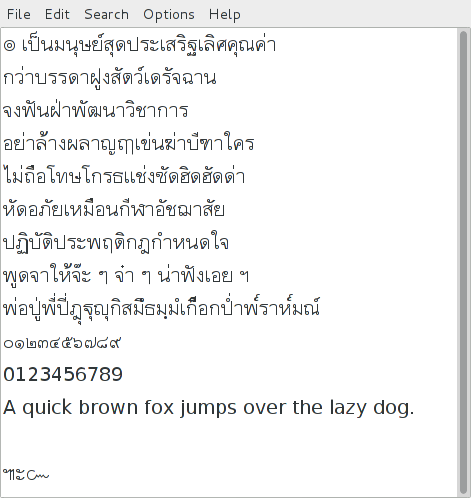
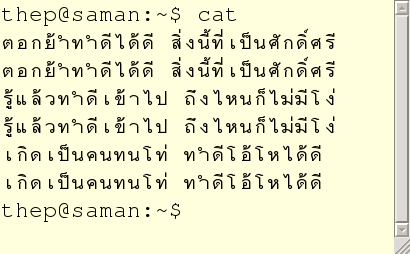
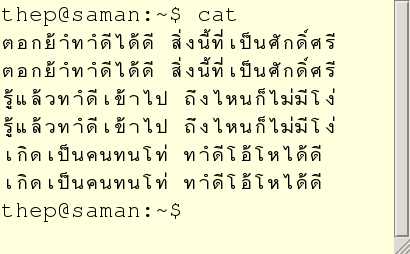
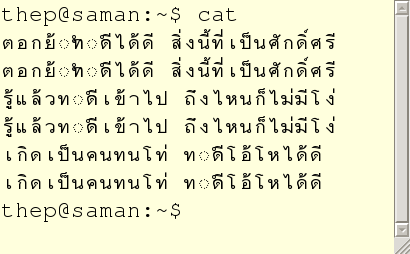
One major change in GNOME 3.6 is Pango s shaper engines replacement with HarfBuzz. Only language engines (for word break analysis, for example) are retained. So, I m checking how this affects Thai/Lao rendering and what to do next. Over all, Behdad has put a good effort to make it right. Most Uniscribe behaviors have been achieved for compatibility. He even cares enough to cover some widespread Thai fonts in which the language tag 'latn' is used instead of 'thai', as seen in Mozilla #719366. Unfortunately, this font set has been declared as standard fonts in official documents. The workaround seems inevitable. Supported Fonts In my experiments with some existing Thai OpenType fonts, the new Pango still renders well without regression. Loma font from fonts-tlwg (glyph positioning with GPOS, rearrangement with GSUB): Loma on new Pango Arundina Sans font from Fonts-SIPA-Arundina (positioning by substitution, only GSUB, no GPOS): Arundina Sans on new Pango But for legacy fonts without OpenType features, it renders badly: Non-OpenType on new Pango In addition, according to Behdad, PUA glyphs in legacy fonts are not supported yet. This means there will be regression on fonts designed for Windows XP or below. But modern fonts designed for Windows 7 should be fine. Changes on Bugs The engine replacement from scratch certainly affects existing bugs. Some become obsolete, some still remain. Here are the summary for Thai/Lao engine, as resolved upstream: Closed bugs: Questionable bugs: Remaining bugs:

27 August 2012

Simon Josefsson: Using OATH Toolkit with Dropbox

Today there was an announcement that Dropbox supports two-factor authentication. On their page with detailed instructions there is (at the bottom) a link to the man page of the OATH Toolkit command line utility oathtool. OATH Toolkit is available in Ubuntu 12.04 and Debian Wheezy. (Note that the 1.10.4 version in Ubuntu does not support the base32 features.) There is not a lot of details in the documentation on Dropbox s site on how to use oathtool, but I have experimented a bit with the setup and I d like to share my findings. I assume you are somewhat familiar with the OATH Toolkit; if not I suggest reading my earlier introduction to OATH Toolkit. To use OATH Toolkit s command line utility to generate OTPs that are accepted by Dropbox, here is how you proceed. When you enable two-factor authentication on Dropbox s site, you must select Use a mobile app and on the next screen with the QR code image, click the enter your secret key manually link. You will then be presented with a code that looks like this: gr6d 5br7 25s6 vnck v4vl hlao re Now this code is actually space-delimitted base32 encoded data, without any padding. Since version 1.12.0, oathtool can read base32 encoded keys. However, parsing the raw string fails, so to make it work, you need to remove the spaces and add padding characters. I have yet to see any documentation on the Dropbox implementation, but I assume they always generate 16 binary octets that are base32 encoded into 26 characters like the codes that I have seen. The code is the cryptographic key used for the HMAC-SHA1 computation described in the RFC 6238 that specify OATH TOTP. If you study the base32 encoding you discover that 26 characters needs six pad characters. So converted into proper base32, the string would be gr6d5br725s6vnckv4vlhlaore======. Now generating OTPs are easy, see below.
jas@latte:~$ oathtool --verbose --totp --base32 "gr6d5br725s6vnckv4vlhlaore======"
Hex secret: 347c3e863fd765eab44aaf2ab3ac0e89
Base32 secret: GR6D5BR725S6VNCKV4VLHLAORE======
Digits: 6
Window size: 0
Step size (seconds): 30
Start time: 1970-01-01 00:00:00 UTC (0)
Current time: 2012-08-27 21:22:54 UTC (1346102574)
Counter: 0x2ACA9C5 (44870085)
125860
jas@latte:~$
Dropbox s implementation is robust in that it requests a valid OTP from me, generated using the secret they just displayed, before proceeding. This verifies that the user was able to import the key correctly, and that the users OATH TOTP implementation appears to work. If I type in the OTP generated from oathtool this way, it allowed me to enable two-factor authentication and I agreed. From that point, signing into the Dropbox service will require an OTP. I invoke the tool, using the same arguments as above, and the tool will use the current time to compute a fresh OTP. Reflecting on how things could work smoother, I suppose oathtool could be more permissive when it performs the base32 decoding so that the user doesn t have to fix the base32 spacing/padding manually. I ll consider this for future releases.

flattr this!

Michael Prokop: jenkins-debian-glue: Continuous Integration for Debian and Ubuntu made easy

jenkins-debian-glue is an open source project of mine which recently celebrated its first birthday and it s time to finally write about it. jenkins-debian-glue allows you to build Debian and Ubuntu packages directly from the Jenkins continuous integration system. It retrieves package sources from a version control repository, adjusts debian/changelog (handle version number + mention changes that took place) and builds according source and binary packages out of it. Its lintitan integration provides Q/A reports about the resulting source and binary Debian packages. It started as a small pet project of mine to get integration of Debian packaging inside Jenkins. I mainly had the needs for the Grml project in mind and starting with Grml 2011.12 every release (including also all the daily builds) was built using Jenkins since then. It turned out that my project would also be a perfect match for one of my customers, Sipwise GmbH. In December 2011 the sip:provider 2.4 was the first stable release that was built 100% through Jenkins and featuring jenkins-debian-glue. Thanks to special needs and the open source friendliness of Sipwise I could invest further time into the project. Recently the project got even some further drive thanks to interest by some fellow Debian Developers, most notably are the icinga, nagios-plugins, packages and the PostgreSQL in Debian Hackathon. Now if you re also interested in it: there s an automated deployment procedure available for your service to get started with the whole jenkins-debian-glue and Jenkins stack in less than 10 minutes, working just fine on Debian as well as Ubuntu. For further details please head over to jenkins-debian-glue.org or check out this 6:36min screencast (safe for work, no audio :) ): <iframe allowfullscreen="allowfullscreen" frameborder="0" height="315" src="http://www.youtube.com/embed/9asp2ZvH90A?autohide=1&amp;showinfo=0" width="560"></iframe> This embedded video doesn t work for you? Try heading over to YouTube.

Christoph Berg: PostgreSQL in Debian Hackathon

Almost a year has passed since my talk at pgconf.eu 2011 in Amsterdam on Connecting the Debian and PostgreSQL worlds, and unfortunately little has happened on that front, mostly due to my limited spare time between family and job. pgapt.debian.net is up and running, but got few updates and is lagging behind on PostgreSQL releases. Luckily, we got the project moving. Dimitri Fontaine and Magnus Hagander suggested to do a face-to-face meeting, so we got together at my house for two days last week and discussed ideas, repository layouts, build scripts, and whatnot to get all of us aligned for pushing the project ahead. My employer sponsored my time off work for that. We almost finished moving the repository to postgresql.org infrastructure, barring some questions of how to hook the repository into the existing mirror infrastructure; this should get resolved this week. The build server running Jenkins is still located on my laptop, but moving this to a proper host will also happen really soon now. We are using Mika Prokop's jenkins-debian-glue scripts for driving the package build from Jenkins. The big plus point about Jenkins is that it makes executing jobs on different distributions and architectures in parallel much easier than a bunch of homemade shell scripts could get us with reasonable effort. Here's a list of random points we discussed: We really aim at using unmodified packages from Debian as much as possible, and in fact this project doesn't mean to replace Debian's PostgreSQL packaging work, but to extend it beyond the number of server versions (and Debian and Ubuntu versions covered) supported. The people behind the Debian and Ubuntu packages, and this repository are mostly the same, so we will claim that "our" packages will be the same quality as the "original" ones. Big thanks go to Martin Pitt for maintaining the postgresql-common testsuite that really covers every aspect of running PostgreSQL servers on Debian/Ubuntu systems. Stay tuned for updates! :)

Robert Collins: Why platform specific package systems exist and won t go away

A while back mdz blogged about challenges facing Ubuntu and other Linux distributions. He raises the point that runtime libraries for Python / Ruby etc have a unique set of issues because they tend to have their own packaging systems. Merely a month later he attended Debconf 2010 where a presentation was given on the issues that Java packages have on Dpkg based systems. Since then the conversation seems to have dried up. I ve been reminded of it recently in discussions within Canonical looking at how we deploy web services. Matt suggested some ways forward, including: I think its time we revisit and expand on those points. Nothing much has changed in how Ubuntu or other distributions approach integration with other packaging systems but the world has kept evolving. Internet access is growing ever more ubiquitous, more platforms are building packaging systems clojure, scala, node.js, to name but three, and a substantial and ever growing number of products expect to operate in a hybrid fashion with an evolving web service plus a local client which is kept up to date via package updates. Twitter, Facebook and Google Plus are three such products. Android has demonstrated a large scale app store on top of Linux, with its own custom packaging format. In order to expand them, we need some background context on the use cases that these different packaging systems need to support. Platforms such as antivirus scanners, node.js, Python, Clojure and so forth care a great deal about getting their software out to their users. They care about making it extremely easy to get the latest and greatest versions of their libraries. I say this because the evidence is all around us: every successful development community / product has built a targeted package management system which layers on top of Windows, and Mac OSX, and *nux. The only rational explanation I can come up for this behaviour is that the lower level operating system package management tools don t deliver what they need. E.g. this isn t as shallow as wanting a packaging system written in their own language, which would be easy to write off as parochialism rather than a thoughtful solution to their problems. In general packaging systems provide a language for shipping source or binary form, from one or more repositories, to users machines. They may support replications, and they may support multiple operating systems. They generally end up as graph traversal engines, pulling in dependencies of various sorts you can see the DOAP specification for an attempt at generic modelling of this. One problem that turns up rapidly when dealing with Linux distribution package managers is that the versions upstream packages have, and the versions a package has in e.g. Debian, differ. They differ because at some stage, someone will need to do a new package for the distribution when no upstream change has been made. This might be to apply a local patch, or it might be to correct a defect caused by a broken build server. Whatever the cause, there is a many to one relationship between the package versions that end users see via dpkg / rpm etc, and those that upstream ship. It is a near certainty that once this happens to a library package, that comparing package versions across different distribution packages becomes hard. You cannot reliably infer whether a given package version is sufficient as a dependency or not, when comparing binary packages between Red Hat and Debian. Or Debian and Ubuntu. The result of this is that even when the software (e.g. rpm) is available on multiple distributions (say Ubuntu and RHEL), or even on multiple operating systems (say Ubuntu and Windows), that many packages will /have/ to be targeted specifically to build and execute properly. (Obviously, compilation has to proceed separately for different architectures, its more the depedency metadata that says and build with version X of dependency Y that has to be customised). The result of this is that there is to the best of my knowledge no distribution of binary packages that targets Debian/Ubuntu and RHEL and Suse and Windows and Mac OS X, although there are vibrant communities building distributions of and for each in isolation. Some of the ports systems come close, but they are still focused on delivering to a small number of platforms. There s nothing that gives 99% coverage of users. And that means that to reach all their users, they have to write or adopt a new system. For any platform X, there is a strong pressure to have the platform be maintainable by folk that primarily work with X itself, or with the language that X is written in. Consider Python there is strong pressure to use C, or Python, and nothing else, for any tools that is somewhat parochial, but also just good engineering reducing variables and making the system more likely to be well maintained. The closest system I know of Steam is just now porting to Ubuntu (and perhaps Linux in general), and has reached its massive popularity by focusing entirely on applications for Windows, with Mac OSX a recent addition. Systems like pypi which have multi platform eggs do target the wide range of platforms I listed above, but they do so both narrowly and haphazardly: whether a binary or source package is available for a given platform is up to the maintainer of the package, and the packages themselves are dealing with a very narrow subset of the platforms complexity: Python provides compilation logic, they don t create generic C libraries with stable ABI s for use by other programs, they don t have turing complete scripts for dealing with configuration file management and so forth. Anti virus updaters similarly narrow the problem they deal with, and add constraints on latency- updates of anti virus signatures are time sensitive when a new rapidly spreading threat is detected. A minor point, but it adds to the friction of considering a single packaging tool for all needs is the different use cases of low level package management tools like dpkg or rpm vs the use cases that e.g. pypi has. A primary use case for packages on pypi is for them to be used by people that are not machine administrators. They don t have root, and don t want it. Contrast that with dpkg or rpm where the primary use case (to date) is the installation of system wide libraries and tools. Things like man page installation don t make any sense for non-system-wide package systems, whereas they are a primary feature for e.g. dpkg. In short, the per-platform/language tools are (generally):
  1. Written in languages that are familiar to the consumers of the tools.
  2. Targeted at use on top of existing platforms, by non-privileged users, and where temporary breakage is fine.
  3. Intended to get the software packaged in them onto widely disparate operating systems.
  4. Very narrow they make huge assumptions about how things can fit together, which their specific language/toolchain permits, and don t generalise beyond that.
  5. Don t provide for security updates in any specific form: that is left up to folk that ship individual things within the manager.
operating system package managers:
  1. Are written in languages which are very easy to bootstrap onto an architecture, and to deploy onto bare metal (as part of installation).
  2. Designed for delivering system components, and to avoid be able to upgrade the toolchain itself safely.
  3. Originally built to install onto one operating system, ports to other operating systems are usually fragile and only adopted in niche.
  4. Are hugely broad they install data, scripts, binaries, and need to know about late binding, system caches etc for every binary and runtime format the operating system supports
  5. Make special provision to allow security updates to be installed in a low latency fashion, without requiring anything consuming the package that is updated to change [but usually force-uninstalling anything that is super-tightly coupled to a library version].
Anti virus package managers:
  1. Exist to update daemons that run with system wide escalated privileges, or even file system layer drivers.
  2. Update datasets in realtime.
  3. Without permitting updates that are produced by third parties.
Given that, lets look at the routes Matt suggested Decoupling applications from the core as a strategy makes an assumption that the core and applications are partitionable. If they are not, then applications and the core will share common elements that need to be updated together. Consider, for instance, a Python application. If you run with a system installed Python, and it is built without zlib for some reason, but the Python application requires zlib, you have a problem. A classic example of this problem is facing Ubuntu today, with all the system provided tools moving to Python 3, but vast swathes of Python applications still being unported to Python 3 at all. Currently, the Python packaging system virtualenv/buildout + distribute don t provide a way to install the Python runtime itself, but will happily install their own components for everything up the stack from the runtime. Ubuntu makes extensive use of Python for its own tools, so the system Python has a lot of packages installed which buildout etc cannot ignore this often leads to issues with e.g. buildout, when the bootstrap environment has (say) zope.interfaces, but its then not accessible from the built-out environment that disables the standard sys.path (to achieve more robust separation). If we want to pursue decoupling, whether we build a new package manager or use e.g. virtualenv (or gem or npm or ), we ll need to be aware of this issue and perhaps offer, for an extended time, a dedicated no-frills, no-distro-packages install, to avoid it, and to allow an extended supported period for application authors without committing to a massive, distro sponsored porting effort. While its tempting to say we should install pip/npm/lein/maven and other external package systems, this is actually risky: they often evolve sufficiently fast that Ubuntu will be delivering an old, incompatible version of the tool to users well before Ubuntu goes out of support, or even befor the next release of Ubuntu. Treating data as a service. All the cases I ve seen so far of applications grabbing datasets from the web have depended on web infrastructure for validating the dataset. E.g. SSL certificates, or SSL + content checksums. Basically, small self-rolled distribution systems. I m likely ignorant of details here, and I depend on you, dear reader, to edumacate me. There is potential value in having data repackaged, when our packaging system has behind-firewall support, and the adhoc system that (for instance) a virus scanner system has does not. In this case, I specifically mean the problem of updated a machine which has no internet access, not even via a proxy. The challenge I see it is again the cross platform issue: The vendor will be supporting Ubuntu + Debian + RHEL + Suse, and from their perspective its probably cheaper to roll their own solution than to directly support dpkg + rpm + whatever Apple offer + Windows the skills to roll an adhoc distribution tool are more common than the skills to integrate closely with dpkg or rpm What about creating a set of interfaces for talking to dpkg / rpm / the system packagers on Windows and Mac OSX ? Here I think there is some promise, but it needs as Matt said careful thought. PackageKit isn t sufficient, at least today. There are, I think, two specific cases to cater to:
  1. The anti-virus / fresh data set case.
  2. The egg/gem/npm/ specific case.
For the egg/gem/npm case, we would need to support a pretty large set of common functionality, on Windows/Mac OSX / *nux (because otherwise upstream won t adopt what we create: losing 90% of their users (windows) or 5% (mac) isn t going to be well accepted :) . We d need to support multiple installations (because of mutually incompatible dependencies between applications), and we d need to support multiple language bindings in some fashion some approachable fashion where the upstream will feel capable of fixing and tweaking what we offer. We re going to need to support offline updates, replication, local builds, local repositories, and various signing strategies to match the various tradeoffs made by the upstream tools. For the anti-virus / fresh data case, we d need to support a similar set of operating systems, though I strongly suspect that there would be more tolerance for limited support in that most things in that space either have very platform specific code, or they are just a large-scale form of the egg/gem/npm problem, which also wants easy updates. What next? We should validate this discussion with at least two or three upstreams. Find out whats missing I suspect a lot and whats wrong I hope not much :) . Then we ll be in a position to decide if there is a tractable, widespread solution *possible*. Separately, we should stop fighting with upstreams that have their own packaging systems. They are satisfying different use cases than our core distro packaging systems are designed to solve. We should stop mindlessly repackaging things from e.g. eggs to debs, unless we need that specific thing as part of the transitive runtime or buildtime dependencies for the distribution itself. In particular, if us folk that build system packaging tools adopt and use the upstream application packaging tools, we can learn in a deep way the (real) advantages they have, and become more able to reason about how to unify the various engineering efforts going into them and perhaps even eventually satisfy them using dpkg/rpm on our machines.

26 August 2012

Gregor Herrmann: RC bugs 2012/34

good news: I'm seeing more & more people contributing to RC bugs in the BTS. here are my own contributions for the past week:

24 August 2012

Eddy Petri&#537;or: HOWTO: Things to remember about cowbuilder

Here are a few things to remember about cowbuilder:

If you run cowbuilder through sudo, and you want to build a source package whose result should be available to the user who initiated the build, then

  • you should have "BUILDRESULTUID=the_user's_id" in ~/.pbuilderrc, and
  • you might want to invoke cowbuilder with

'sudo cowbuilder --build the_pack_to_build.dsc --buildresult destination_dir_for_build_results'

If you want to login into a chroot environment in which you'd like to see part of your directory alongside the unpacked source tree of your package, then invoke cowbuilder with

sudo cowbuilder --login --bindmounts /path/to/the/dir/you/want

Your base.cow directory can be updated/changed manually with

sudo cowbuilder --login --save-after-login

You can update the base.cow directory with

sudo cowbuilder --update

That's about it.

Also, noteworthy tip: ccache might not work correctly in the cowbuilder chroot.

Olivier Berger: Generating RDF description of Debian package sources with ADMS.SW

Edit : I ve now managed to roll out my contribution which is now in production on packages.qa.debian.org. See a later post I ve made on the subject, and beware that the generated RDF has changed a bit also. ADMS.SW proposes specifications for description of software present in software catalogues. I ve tried and apply it to the contents of the Debian Package Tracking System (PTS), using transformation of the information known by the PTS to RDF+XML. The result is not yet in production, but here s an example of what can be done, using the Turtle syntax (more readable) :
<style type="text/css"> .T1 color:#000000; font-size:14pt; font-weight:bold; .T2 color:#000000; font-size:12pt; .T3 color:#000000; font-size:8.5pt; .T4 color:#0000ff; font-size:8.5pt; .T5 color:#a020f0; font-size:8.5pt; .T6 color:#228b22; font-size:8.5pt; .T7 color:#b22222; font-size:8.5pt; .T8 color:#008b8b; font-size:8.5pt; .T9 color:#8b2252; font-size:8.5pt; .dp1 .dp2 </style> @base <http://packages.qa.debian.org/> .
@prefix rdf: <http://www.w3.org/1999/02/22 rdf syntax ns#> .
@prefix admssw: <http://purl.org/adms/sw/> .
@prefix doap: <http://usefulinc.com/ns/doap#> .
@prefix dcterms: <http://purl.org/dc/terms/> .
@prefix rdfs: <http://www.w3.org/2000/01/rdf schema#> .
@prefix foaf: <http://xmlns.com/foaf/0.1/> .
@prefix schema: <http://schema.org/> .
@prefix spdx: <http://www.spdx.org/rdf/terms#> .
@prefix : <http://www.w3.org/1999/xhtml> .
@prefix str: <http://exslt.org/strings> . #
# First the packaging project for apache2 in Debian
#
# <http://packages.qa.debian.org/apache2> resource :
<apache2>
a admssw:SoftwareProject ;
doap:name "apache2" ;
doap:description "Debian apache2 source packaging" ;
doap:homepage "http://packages.debian.org/src:apache2" ;
schema:contributor [
a foaf:OnlineAccount ;
foaf:accountName "Debian Apache Maintainers" ;
foaf:accountServiceHomepage <http://qa.debian.org/developer.php?login=debian apache@lists.debian.org>
], [
a foaf:OnlineAccount ;
foaf:accountName "Stefan Fritsch" ;
foaf:accountServiceHomepage <http://qa.debian.org/developer.php?login=sf@debian.org>
], [
a foaf:OnlineAccount ;
foaf:accountName "Steinar H. Gunderson" ;
foaf:accountServiceHomepage <http://qa.debian.org/developer.php?login=sesse@debian.org>
], [
a foaf:OnlineAccount ;
foaf:accountName "Arno T ll" ;
foaf:accountServiceHomepage <http://qa.debian.org/developer.php?login=arno@debian.org>
] ;
# pointer to the release in the different suites :
doap:release <apache2_2.2.16 6+squeeze7>, <apache2_2.2.22 11>, <apache2_2.4.2 2>. #
# Now the different debian package source releases
#
# <http://packages.qa.debian.org/apache2_2.2.16 6+squeeze7> resource
<apache2_2.2.16 6+squeeze7>
a admssw:SoftwareRelease ;
rdfs:label "apache2 2.2.16 6+squeeze7" ;
admssw:project <apache2> ;
dcterms:description "Debian apache2 source package version 2.2.16 6+squeeze7" ;
doap:revision "2.2.16 6+squeeze7" . # This one is the reference version for the PTS as in unstable, so
# contains more details than the others
<apache2_2.2.22 11>
a admssw:SoftwareRelease ;
rdfs:label "apache2 2.2.22 11" ;
admssw:project <apache2> ;
dcterms:description "Debian apache2 source package version 2.2.22 11" ;
doap:revision "2.2.22 11" ;
# this release contains two components
admssw:includedAsset <apache2/apache2_2.2.22 11_debian>, <apache2/apache2_2.2.22_orig>
;
# this release can be downloaded as one package (with dget)
admssw:package <apache2/apache2_2.2.22 11.dsc> ;
# it also has a related release somewhere else
dcterms:relation <https://launchpad.net/ubuntu/+source/apache2/2.2.22 6ubuntu2> .
<apache2_2.4.2 2>
a admssw:SoftwareRelease ;
rdfs:label "apache2 2.4.2 2" ;
dcterms:description "Debian apache2 source package version 2.4.2 2" ; admssw:project <apache2> ;
doap:revision "2.4.2 2" . # Then the .dsc file for the current unstable version
<apache2/apache2_2.2.22 11.dsc>
a admssw:SoftwarePackage ;
dcterms:description "Debian source package descriptor file for apache2 version 2.2.22 11";
schema:downloadUrl "http://cdn.debian.net/debian/pool/main/a/apache2/apache2_2.2.22 11.dsc";
schema:fileSize "2885" ;
spdx:checksum [
a spdx:Checksum ;
spdx:algorithm <apache2#checksumAlgorithm_md5sum> ;
spdx:checksumValue "d7d03719b9f6432beeecd3aa04f7b22c"
] . #
# Then the upstream project
#
<apache2/apache2_orig>
a admssw:SoftwareProject ;
doap:description "The apache2 upstream project" ;
# either its name or homepage can be matched against other ADMS.SW
# or DOAP descriptors
doap:name "apache2" ;
doap:homepage "http://httpd.apache.org/" . # And a upstream release 2.2.22
<apache2/apache2_2.2.22_orig>
a admssw:SoftwareRelease ;
rdfs:label "Upstream apache2 release 2.2.22" ;
dcterms:description "Upstream source release for apache2 version 2.2.22" ;
doap:revision "2.2.22" ;
admssw:project <apache2/apache2_orig> ;
# and a link to the upstream source tarball s description
admssw:package <apache2/apache2_2.2.22.orig.tar.gz> . # now the (potentially re archived) upstream source archive for that release
<apache2/apache2_2.2.22.orig.tar.gz>
a admssw:SoftwarePackage ;
dcterms:description "Upstream source archive for apache2 version 2.2.22 11 (potentially re archived by Debian)";
schema:downloadUrl "http://cdn.debian.net/debian/pool/main/a/apache2/apache2_2.2.22.orig.tar.gz";
# Those 2 bits should help match packagings of the same tarball if needed
schema:fileSize "7200529" ;
spdx:checksum [
a spdx:Checksum ;
spdx:algorithm <apache2#checksumAlgorithm_md5sum> ;
spdx:checksumValue "d77fa5af23df96a8af68ea8114fa6ce1"
] . #
# Now, document specific details of the second component : Debian
# packaging files archive
#
<apache2/apache2_2.2.22 11_debian>
a admssw:SoftwareRelease ;
rdfs:label "Package sources apache2_2.2.22 11" ;
dcterms:description "Debian packaging sources for apache2 version 2.2.22 11" ;
doap:revision "2.2.22 11" ;
admssw:package <apache2/apache2_2.2.22 11.debian.tar.gz> . <apache2/apache2_2.2.22 11.debian.tar.gz>
a admssw:SoftwarePackage ;
dcterms:description "Debian source package files archive for apache2 version 2.2.22 11" ;
schema:downloadUrl "http://cdn.debian.net/debian/pool/main/a/apache2/apache2_2.2.22 11.debian.tar.gz";
schema:fileSize "195980" ;
spdx:checksum [
a spdx:Checksum ;
spdx:algorithm <apache2#checksumAlgorithm_md5sum> ;
spdx:checksumValue "d3d4146ccad51129636b7dbff284a110"
] . #
# Now, we also weave links with the Ubuntu counterparts
#
<https://launchpad.net/ubuntu/+source/apache2>
a admssw:SoftwareProject ;
doap:description "\"apache2\" source package in Ubuntu" ;
# this one promises some trolls and flames
admssw:forkOf <apache2> ;
doap:homepage "https://launchpad.net/ubuntu/+source/apache2" ;
doap:release <https://launchpad.net/ubuntu/+source/apache2/2.2.22 6ubuntu2> . # and its release known by the PTS
<https://launchpad.net/ubuntu/+source/apache2/2.2.22 6ubuntu2>
a admssw:SoftwareRelease ;
rdfs:label "apache2 2.2.22 6ubuntu2" ;
dcterms:description "\"apache2\" 2.2.22 6ubuntu2 source package in Ubuntu" ;
doap:revision "2.2.22 6ubuntu2" ;
admssw:project <https://launchpad.net/ubuntu/+source/apache2> .

Steve McIntyre: Even more progress on EFI Debian CDs

Continuing on from my second EFI progress report... My second alpha release of a Wheezy netinst CD for amd64 EFI seemed to work OK for me and a few others, but it wasn't 100% good, with (at least) two issues:
  • It didn't work as a hybrid (CD or USB) image, just working from CD for EFI
  • It didn't work for BIOS booting due to a silly bug
In the couple of days since then, I've fixed both of these issues. Yay! Hybrid boot was easier than I expected - I've just added a tiny FAT partition to the image containing the grub EFI bootloader and that seems to work fine. I also found that I made a mistake in the ordering of the El Torito boot records in the last image. BIOS boot seems to be limited to just the first image available on the machines I've tested with, wherease EFI will happily work as a secondary image. I've swapped them around in my code, and things look much better now. So, time for another CD alpha release for testing. Grab the image from http://cdimage.debian.org/cdimage/unofficial/efi-development/upload3/ if you'd like to help test it. Please do, and let me know via debian-boot/debian-cd how you get on. As previously, the "bits" subdirectory contains all the tweaked d-i packages I've played with, in both source and binary form. My debian-cd changes are still in my branch but are just about ready for merging I think. I've posted my full set of d-i patches to the debian-boot list for review now, and hopefully we'll be able to get those changes merged in after the Wheezy d-i beta 2 build is done. Full speed ahead for EFI in beta 3!

23 August 2012

Neil McGovern: How not to be a jerk online chauvinism

Do you remember at school, when the teachers mentioned that something would be on your "permanent record"? The big secret is that there isn't one. Apologies to all teachers, but it's not likely this blog's demographic will reach your students. However, since the advent of the internet, a permanent record does exist. Everywhere from the Wayback Machine to Google's cache contains copies of all public activity you post online. At Collabora, we hire some of the best open source software engineers to work for our clients. It should be no surprise that a quick Ohloh and search for someone's name is a standard part of the hiring process. This normally comes up with all sorts of exciting things which people have done, both with software and further abroad. A tricky situation will occur if you have lost your temper online, as Patrick Ryan has done recently. He made a comment on #node.js on the Freenode network that:
[20.16.34] < TheEmpath> anyone else have a hot programmer girl in their office? o____O
This was quite rightly called out as being inappropriate for the channel, and quickly decided to have a large and abusive rant about this. This was then continued with him opening a number of bugs against the projects owned by the person who called him out, with titles such as "Hyperactive Leftist Power Trip not included" and "Not anti-Republican enough". This then gets worse. Once the log is posted (link above) there is yet more abuse and unfounded accusations by Mr Ryan in the comments. So, what happens when you search for his name? You get a log with someone being entirely inappropriate and then large rants. Not the best move for a software consultant.

Paul Tagliamonte: dpu, debian.js and other random hax

In this choc-filled post, I ve got a few things I d love to share. debian.js First, a quick side-hack called debian.js. It s not entirely a serious project, but it s interesting. Here s some example code (and output from the terminal) Here s some of the client code (but slightly modified for clarity)
debian.on('bug', function(bug)  
    console.log(bug);
 );
which produces the following:
  sender: 'John Johansen <john.johansen@canonical.com>',
  package: 'vidalia',
  id: '<503577E5.2080502@canonical.com>',
  bugno: '682431',
  action: 'followup',
  class: 'bug',
  description: 'Bug#682431: [apparmor] Factorize Qt and GTK themes abstractions?'  
(and later, after I filed for unblock of desktop-base (more on that later))
  sender: 'Paul Tagliamonte <paultag@debian.org>',
  package: 'release.debian.org',
  id: '<20120823011639.GA8561@leliel.localdomain>',
  bugno: '685657',
  action: 'report',
  class: 'bug',
  description: 'Bug#685657: unblock: desktop-base/7.0.3'  
Legit. Anyway, hopefully more hax on this later. I d love to see Debian and Node.js get along better. dpu Nextly, I ve been working on something called dpu , with the (epic) Niels Thykier which will be a replacement for Lintian s test-runner. Progress is good, but not feature-complete yet. The end goal is to allow all projects which deal with the process of generating a debian package to start testing their code. If you have requirements, let me know! desktop-base I ve uploaded version 7.0.3, which features a switch to xz, and slight changes to existing theme elements. Mad props to Eshat Cakar for some slick KDE updates, and to Jo Carter for the Plymouth updates. Props!

22 August 2012

Gunnar Wolf: An industry commits suicide and blames us

[ once again, I am translating somebody else's material In this case, my good Costa Rican friend Carolina Flores. Please excuse my stylistic mistakes My English is far from native as you well know. But this material is worth sharing, and worth investing some tens of minutes doing a quick translation. If you can read Spanish, go read Caro's original entry ] Have you been to a music record store lately? I did so last Saturday, as a mere excercise. I was not planning on buying anything but I wanted to monitor things and confirm my suspicions. What was I suspicious of? First, that I would only find old records. And so it was: The only recent record I found was ...little broken hearts by Norah Jones. the second, that I would only find music for over 50 year old people. so it was: Were I there to look for a present for my father, I would have walked out with 10 good records. Third, that in the store nothing worth commenting would happen. About that last point, I should point out it was around 10 AM and the store had just opened its doors. Lets concede the benefit of doubt. I don't think many of you will remember, but in Barrio La California (where there is now a beauty parlour, almost in front of AM.PM) there was Auco Disco. In Auco Disco there was a guy specialized in rock (Mauricio Alice) and another one specialized in jazz (I don't remember his name). In that record you could always find rare records, but if they were not there, at least you were sure to find somebody to say: "No, we don't have that, but that's an excellent record, it's the best that [insert group here] have ever recorded because just afterwards they switched their guitar player, they had gone a bit south but with that record they are flying. But no, we don't have it; I can recommend you this record by [insert another group] because it has a guitar solo in track six that is amazing". It would happen more or less like that, which means, one would arrive to Auco Disco at 10 AM and leave around 5 PM with three new records, after having listened to a spectacular music selection. What happened to those stores? Were they killed by The Pirate Bay? That's the simplistic answer from the recording industry! The answer is that those stores never got anything from the industry but an invoice. The industry specially in prescindible markets such as ours was limited to hiring artists, taking care of them recording a sellable product, producing the object called record, and that's it. The more commercial radio stations were paid to program those songs as it cannot be casual that "Mosa, mosa" is the summer hit in all of Latin America, can it? but, record stores? Nothing. Lets carry on with that idea: Radio stations are paid to program said music. This idea should not lead us to believe that recording companies are to blame for bad taste. I won't reveal my sources, but I know the success of the "Locura autom tica" song by La Secta was a real example. Nobody paid for it. That song got to the number one because of its own merits(?) (you don't know the effort it took to find that thing, I cannot recommend it to you). Same thing happens with other stations that don't program reggaet n, that try to save the species, and where they play what we do like. But the thing is, everything we like is not available in any record store in this country. Then, even if we wanted to buy a record or give it as a gift to somebody, it is plain impossible. And don't tell me it's the same to present as a gift a link or a CD full of downloaded MP3 as it is to give a record with cover and booklet, wrapped in gift paper. I might be old-school, but the fetish object record still exists, not only because of its cover, but because of its sound. A 3MB MP3 is akin to drinking coffee dripping from a bag that has been used eight times with the same coffee beans. That format is the worst that has ever happened to music, and if we had any bit dignity we would never purchase digital files in Amazon or iTunes safe for MP3 with an acceptable compression level. That, if we could buy them, because not only that is allowed to us. As the musical industry has no interest in resolving ITS problem (that is not our problem, it is those companies') it has not even been resolved how to charge for a MP3 download that includes import fees (well, if downloading from here a MP3 from a USA-based file server can be considered importing goods into Costa Rica!!!) so we don't have to get dizzy entering into the nineties to Titi Online to discover there is nothing by Muse, Andrew Bird, The Killers, Death Cab for Cutie, Paramore, Bj rk... (believe me, I looked them all up, even Norah jones and La Secta. They also were not there). This all leads me to the question, which I present with all due respect (NOT): What the fuck do they expect us to do??? It is outrageous; above all because in the best case they will sell us a watery coffee download that won't allow us to get all the details a vinyl or less compression would give us. In the worst case, post-MP3 groups will end up recording music with no harmonics or hidden sounds, because, what for? Nobody will hear it. They even admit it: "Some musicians and audio engineers say the MP3 format is changing the way studios mix their recordings. They say the MP3 format "flattens" dynamics differences in tone and volume in a song. As a result, a great deal of new music sounds very much alike, and there is nothing as focusing to create a dynamic listening experience. Why working so hard in creating complex sound if nobody can detect it?" (Rolling Stone, The Death of High fidelity, December 26 2007, taken from here). That's why I am not surprised by Adri n's post regarding the sales of old records. The price has nothing to do with it. The causes are related to the fetish object record and what it means or does not mean for people that have never purchased one. Adri n also asks if somebody here keeps buying records. I answered that I would if the stores sold anything I like. I do it even after the nausea I feel while reading "This phonogram is an intellectual work protected in favor of its producer COPYING IT IN WHOLE OR PARTIALLY IS FORBIDDEN " (like that, uppercased, yelling to whoever is only guilty of having bought a record and defending the producer, not the artist). But I am sure that almost nobody buys records because doing so is no longer a gratifying experience; because if buying a record is clicking to wait 15 days for it to reach the mailbox, we prefer clicking on the download link. But there is another reason for people not to buy records anymore. In one of my talks regarding the dictatorship of the all rights reserved, I asked the 30 twenty-something-year-old students if any of them had ever bought a record. One answered he had, because he is an author and performer (cantautor in Spanish) and understands the effort that producing a record entails. The rest of them had never done so. Is it possible that said young people have never listened to real music? Is it possible that, were it not for concerts, what they consider music is a set of washed-out MP3 that are about to fill up 1TB of their computer? Does people no longer buy records because they cannot differentiate one sound from the other? It is not very clear for me where do I want to get to. The recording industry is despicable. An industry that instead of innovating sets its energy on suing adolescents for downloading songs, trying to pass laws restricting our freedoms in Internet, putting up DRMs making us hostages to our devices* and forcing us to listen just the aroma of music, deserves my whole contempt. If we add ot this that said industry won't allow us to legally download their breadcrumbs because it has not understood that Internet does not need a van crossing borders, besides my contempt they deserve my pity and my heartfelt condolence. But the condolence is also for music, real music, that which is not compressed under the shoe using a terrible format. It is also for independent musicians that have not realized that begging for a bit of space to that industry they just add to themselves the "despicable" tag, given they deserve the fruits of their work to enter their bank account. However, there are good things that have come out of this absurdity. Be it for those that have joined projects such as Aut mata (even if it is in MP3) and for dreams come true such as Musopen (that have achieved that the music that's in theory Public Domain becomes so in practice as well). Good for the Electronic Frontier Foundation and the list of lawyers willing to defend people accused of ilegally downloading music in the USA. Good for the Creative Commons licenses that allow free sharing. All those are growing solutions, although none of them allows me to buy the Panamanian Carlos M ndez's record. Thankfully, a friend of mine who knows I will never give a dime to Apple, bought the files for me in iTunes. I thank him deeply, although I would have prefered to go to Auco Disco and have Mauricio tell me that the 2007 EP I have from Carlos is better than the record he did on 2009. * My devices don't have DRM because I use free software. I also use the ogg file format. Image by verbeeldingskr8

Next.

Previous.