Search Results: freedom

20 December 2008

Biella Coleman: What to make of the other half?

Many people ask me why there are such few female hackers. While I think this is an important/interesting question (that is also extraordinarily hard to answer), there is another one which has captivated me for much longer, which is the followingL why are there such few females represented in the academic/activist world of free software/free culture, etc.? It seems like every turn I take, there are books galore, talks galore, essays galore being written by men with females sprinkled on top, like some confectionery after thought. Take for example Joi Ito s recent photograph collection, Free Souls (women are represented in the beautiful array of photographs) but in the essays which reflect on freedom/free culture/the souls of freedom, there is (I think, correct me if I am wrong), not a single female voice, despite the fact that there were clearly females authors/activists that could have potentially contributed.
Essays 1. Lawrence Lessig
Foreword by Lawrence Lessig
2. Christopher Adams
Share this book
3. Joi Ito
Just another free soul
4. Howard Rheingold
Participative Pedagogy for a Literacy of Literacies
5. Lawrence Liang
Free as in Soul: The Anti-image Politics of Copyright
6. Cory Doctorow
You Can t Own Knowledge
7. Yochai Benkler
Complexity and Humanity
8. Isaac Mao
Sharism: A Mind Revolution
9. Marko Ahtisaari
Intelligent Travel
Now, am I overreacting here; or is this reason for worry?

16 December 2008

Biella Coleman: Do Not Eat the Laundry


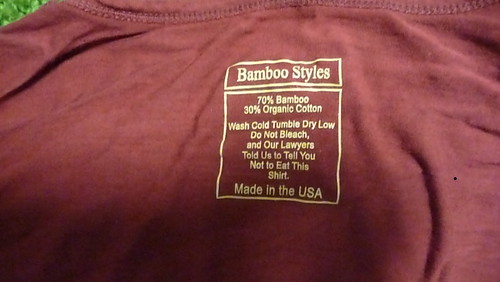
do-not-eat, originally uploaded by the biella.
America is a land brimming with paradoxes, one of them being our simultaneous obsession with freedom and rules. We purport to be the land of the free (and while this is and may not be true, we do hold steadfast to this idea). But we also love rules rules and rules, and wait there are more and more and more rules, too many rules, which often come in the form of the form of a sign, this one being one of my favorites. (shall not produce grease laden fumes?! yes, I think it was written by an academic). So I appreciate small reminders that poke fun of and holes in our love of rules and warnings, such as the one I found on my new bamboo-based shirt, pictured above. I have taken a huge liking for bamboo shirts as of late (I am obsessed with the tactile and can only stand soft cloth, which is why I love bamboo-based cloth) and I ordered a few shirts of the Internet. I only noticed the warning when I pulled the shirt out of the dryer late the other night and it was by far one of the only times I smiled from left to right at 1 am when doing laundry. More people should take the time to plant these easter-egg type jokes as they are, I am sure, much appreciated.

7 December 2008

Chris Lamb: Taking Liberties

On Saturday I went to the British Library's Taking Liberties exhibition on "the 900-year struggle for Britain's freedoms and rights". The majority of the items on display were truly iconic, including a copy of the Magna Carta, Ms Davidson's return ticket from Epsom as well as Charles I's death warrant - with Cromwell's signature easily identifiable in third position. In contrast, the video interviews that were scattered around were rather distracting at best (isn't it a library?) and embarrasingly biased at worst. I wonder how many visitors need convicing that detaining suspects without charge for forty-two days isn't a good idea. Near the exit was a wonderfully lo-fi anonymous commenting system based on a wall of bulldog clips and postcard-sized bits of paper. Fascinating in itself.

19 November 2008

David Watson: Happy Birthday ORG!

The Open Rights Group is 3, and now has reached over 1000 fivers a month. To celebrate ORG have issued each of the first 1000 members with web badges, I have added my ORG badges into the sidebar. If you care about any of these: * Automatic Vehicle Tracking
* Copyright
* Creative Commons
* Data Protection
* DRM
* e-Voting
* Freedom of Information
* Identity
* Intellectual Property
* Net Neutrality
* Open Geodata
* Open Source
* Police Records
* Privacy
* Public Domain
* Regulation of Investigatory Powers Act
* Release The Music
* RFID visit the site and sign up to help reach them target of 1500 fivers a month by December.

17 November 2008

Russell Coker: Other Reasons for not Censoring the Net

Currently there is a debate about censoring the Internet in Australia. Although debate might not be the correct word for a dispute where one party provides no facts and refuses to talk to any experts (Senator Conroy persistently refuses all requests to talk to anyone who knows anything about the technology or to have his office address any such questions). The failures of the technology are obvious to anyone who has worked with computers, here is an article in the Sydney Morning Herald about it [1] (one of many similar articles in the MSM). I don’t plan to mention the technological failures again because I believe that the only people who read my blog and don’t understand the technology are a small number of my relatives - I gave up on teaching my parents about IP protocols a long time ago. One of the fundamental problems with the current censorship idea is that they don’t seem to have decided what they want to filter and who they want to filter it from. The actions taken to stop pedophiles from exchanging files are quite different from what would be taken to stop children accidentally accessing porn on the net. I get the impression that they just want censorship and will say whatever they think will impress people. I have previously written about the safety issues related to mobile phones [2]. In that document I raised the issue of teenagers making their own porn (including videos of sexual assault). About four months after writing it a DVD movie was produced showing a gang of teenagers sexually assaulting a girl (they sold copies at their school). It seems that the incidence of teenagers making porn using mobile phones is only going to increase, while no-one has any plans to address the problem. The blog www.somebodythinkofthechildren.com has some interesting information on this issue. Two final reasons for opposing net censorship have been provided by the Sydney Anglicans [3]. They are:

  1. Given anti-vilification laws, could religious content be deemed illegal and be filtered out? Could Sydneyanglicans.net be blocked as illegal if it carries material deemed at some point now or in the future as vilifying other religions? If it s illegal in Vic say, and there isn t state-based filtering (there wont be), will the govt be inclined to ban it nation wide?

  2. Given anti-discrimination laws, if Sydneyanglicans.net runs an article with the orthodox line on homosexuality, will that be deemed illegal, and the site blocked? You can imagine it wouldn t be too hard for someone to lobby Labor via the Greens, for instance.

So the Sydney Anglicans seem afraid that their religious rights to discriminate against others (seriously - religious organisations do have such rights) will be under threat if filtering is imposed. I was a bit surprised when I saw this article, the Anglican church in Melbourne seems reasonably liberal and I had expected the Anglican church in the rest of Australia to be similar. But according to this article Peter Jensen (Sydney’s Anglican Archbishop) regards himself as one of the “true keepers of the authority of the Bible” [4]. It seems that the Anglican church is splitting over the issues related to the treatment of homosexuals and women (Peter believes that women should not be appointed to leadership positions in the church to avoid “disenfranchising” men who can’t accept them [5]). It will be interesting to see the fundamentalist Christians who want to protect their current legal rights to vilify other religions and discriminate against people on the basis of gender and sexual preference fighting the other fundamentalist Christians who want to prevent anyone from seeing porn. But not as interesting as it will be if the Anglican church finally splits and then has a fight over who owns the cathedrals. ;) A comment on my previous post about the national cost of slow net access suggests that Germany (where my blog is now hosted) has better protections for individual freedom than most countries [6]. If you want unrestricted net access then it is worth considering the options for running a VPN to another country (I have previously written a brief description of how to set up a basic OpenVPN link [7]).

16 November 2008

Biella Coleman: The Quality of Time, Timeless Quality

I love collecting quotes but I file most of them away in some file on my computer or distribute them in class. I thought I might start sharing some of my favorite passages/quotes. This one, which I read 3 years ago, reminded me of the craft-like spirit in Debian and Free Software in general. I like how the author brings together the themes of labor, time, quality, mistakes, intimacy and tools all in one swoop.
I refuse to be in such a hurry that I squeeze the aesthetic value out of everything just to gain a few minutes of time time which will then just be filled with more rushing and more mass-produced, soulless junk. In the drive to achieve instant gratification, we have spent a century trying to shorten the learning curve and eliminate the chance of error in every human activity. There is much good in this, but something has been lost in the process. The Galoots are the guardians of that which was almost lost: the challenge of trying to master a skill that can never be fully mastered, the creative freedom that comes from intimacy with a medium as complex as wood, the sense of self-sufficiency that comes with knowing that you can make a useful object with tools so simple that you can make the tools too, and the peaceful mediation of trying to bring eye, hand, and wood together into harmony through finesse and understanding rather than brute force.
Quoted from Hohn (2005), The Romance with Rust, a Harper’s article on tool collectors. A Galoot is a person with a deep passion for old hand tools, their ways, workings, and their history.

11 November 2008

Biella Coleman: Would Barack ever Use Linux?

I am not holding my breath but I think the B-man could in theory at least be convinced of running freedom on his laptop.

Biella Coleman: Would Barack ever Use Linux?

I am not holding my breath but I think the B-man could in theory at least be convinced of running freedom on his laptop.

10 November 2008

Riku Voipio: When Linux doesn't mean freedom

I actually think it's a bit of an insult if people think of Motorola's EZX or MAGX (and now Android) phones as "Linux phones". Because all the freedoms of Linux (writing native applications against native Linux APIs that Linux developers know and love, being able to do Linux [kernel] development) are stripped.
-
http://laforge.gnumonks.org/weblog/2008/10/23/#20081023-android">
http://laforge.gnumonks.org/weblog/2008/10/23/#20081023-android">Harald Welte


This is something that has worried me too for quite a while. For years we have now had Linux phones available in form or another (well, mostly in far away countries you happen not to be at). Yet with the exception of openmoko none of them allow native application development. Yet all the same time you can go to the nearest phone shop and grab HTC windows CE phone or a Nokia Symbian phone, which actually give you the freedom to writing and running your own software on them.

Now we have the situation that HTC's most locked device* is their only Linux device - The Android G1.

Incidentally, you can install Debian/armel on T-mobile G1, but only until Google engineers manage to fix the hole that gives you r00t.

*The only one that doesn't allow native app development.

Benjamin Mako Hill: Wikimedia and GFDL 1.3

I spent more time than I would like to admit massaging the process that ultimately led to the release of the the GNU Free Documentation License 1.3 (GFDL) by the Free Software Foundation (FSF). Hours counted, it was probably one of my biggest personal projects this year. The effect is to allow wikis under the GFDL to migrate to the Creative Commons BY-SA license or, as Wikimedia's Erik M ller has proposed, to some sort of dual-license arrangement. There are many reasons for this change but the most important is that the move reduces very real barriers to collaboration between wikis and free culture projects due to license compatibility. BY-SA has become the GPL of the free culture world and Wikimedia wikis were basically locked out from sharing with a larger community, and vice-versa; projects will no longer have to choose between sharing with Wikipedia and sharing with essentially everyone else. The GFDL has done a wonderful job of helping get Wikimedia projects to where they are today and M ller's proposed switch seems, in my opinion, the best option to continue that work going forward. The FSF gets a lot of credit (and a lot of flack) for what it does. Offering to "let go" of Wikipedia -- without question the crown jewel of the free culture world -- represents a real relinquishing of a type of political control and power for the FSF. Doing so was not done lightly. But giving communities the choice to increase compatibility and collaboration by switching to a fundamentally similar license was and is, in my opinion, the right thing to do. Everyone who has worked hard to make this happen deserves the free culture movement's thanks. This list includes Richard Stallman, Brett Smith and Peter Brown of the FSF; James Vasile and Eben Moglen of the SFLC; Erik M ller, Mike Godwin and Shunling Chen of the Wikimedia Foundation. The FSF in general, and RMS in particular, deserves a huge amount of credit for what it has decided to not do in this case and for giving up control in a way that was responsible and accountable to its principles and to GFDL authors and in the interest of free culture movement more generally. It has not been easy or quick. If you support or appreciate work like this, please support the FSF and express this while doing so. Doing so is an important way to support these essential and almost inherently underappreciated efforts.

Biella Coleman: Epic Lulz will be had (aka: I am giving a talk)


Screenshot-coleman-scientology-slides - OpenOffice.org Impress -1, originally uploaded by the biella.
“Old and New Net Wars over Free Speech, Freedom and Secrecy or How to Understand the Lulz battle against the C0$ Gabriella Coleman, Assistant Professor, New York University Thursday November 13: noon - 2:00pm
Columbia University Communications Colloquium
270B IAB (International Affairs Building update Open the public! You may need ID to get into the building but I am not sure. This is the case with NYU…

8 November 2008

Steve McIntyre: 3rd Free Software Congress in Valencia

I spent much of this week in Alicante. It was wonderful to have a few days away from the beginnings of Winter in Cambridge - Alicante's in South West Spain, right on the Mediterranean. It's a lovely city, although it was very quiet due to the time of year. I was invited down to Alicante by organisers of the Congr s de Programari Lliure, Comunitat Valenciana, to present a talk about Debian. That I did, and as always my slides and photos are available in case people are interested. I wasn't too sure about what level to aim the talk, so I deliberately went for a general introduction to Debian. That seems to have been the correct level - nobody threw anything at me, and nobody was visibly falling asleep. *grin* It's also the first time I've ever given a talk with official translators, which is a weird experience! The main topic for the conference was the new release of Lliurex, Valencia's own GNU/Linux distribution targeted primarily at use in schools. The conference was massive; I was told there were about 1500 attendees in all, most of whom were teachers who wanted to come and learn more about Free Software. There was a good spread of talks and workshops, covering topics from development through to deployment in the classroom. The level of enthusiasm for Free Software here was immense - lots of people were keen to learn more about it and get involved. I was told that out of the 15 regions/states of Spain, 11 of them have now started their own distributions to use in schools! Extremadura were the first region to experiment with Free Software like this, and their success with LinEx was a clear inspiration to their neighbours elsewhere in Spain. As well as the obvious cost advantages of moving from proprietary to Free Software, the local governments also love the freedom to use and modify their software however they like - including the ability to provide their own translations. Conference welcome I met up with a lot of cool people at the conference too. The local education minister (Alejandro Font de Mora) was keen to talk with all the speakers and very enthusiastic about the future of Free Software in his schools. As is increasingly common at FS events around the world, there were of course quite a few Debian people around too. Luciano and Miriam were also giving talks, and I bumped into Rene and Miguel and a whole bunch of others whose names I'm too crap to remember - sorry! I also spoke a lot with Kurt Gramlich, the mega-enthusiastic Skolelinux developer who was also happy to push Debian to everybody he spoke to *grin*. Jon "Maddog" Hall had some excellent ideas that I'm sure we'll all hear more about soon, and his talk was excellent. He did a very good job of explaining how Free Software makes such a difference, including how it helps people to make money. He also explained that due to travel he had missed Halloween at home and he wanted to share the experience of scary masks with the people at the conference: Maddog Bush I had a great time in Alicante, and I'm very grateful for the invitation to go there. I wish that the UK was as far as advanced as Spain in the use of Free Software in education - they've done a huge amount of good work in this area and I'm glad we can help them.

1 November 2008

Biella Coleman: FBI Etiquette

I am waiting in great anticipation for Phil Lapsley to publish his History of Phone Phreaking book. In the mean time, I get to enjoy tasty and funny morsels that emerge out of his research blog. Apparently, the FBI, even while invading privacy, also protect, I guess when some exceptional circumstances arise.

27 October 2008

Decklin Foster: We could customer care less

(And now, a cathartic "I hate this company and I am never patronizing them again, please don't either" post. I should have done ones for at least Speakeasy/Covad and IBM's server division last year. Ah well.) I went to go register a new domain yesterday (announcement soon! Probably this weekend). I've been using Joker for a while, IIRC on the principle that the cooks were using it so it must be decent enough. While registering, I had a bunch of problems with the horrid, useless "Verified by Visa" popup [1] that you see everywhere these days, and eventually this must have looked like suspicious activity to the bank so my card was declined. I only actually found this out when I got mail saying my order was canceled. Okay, sure. I wrote back and explained what I thought was going on and that I'd like to resolve it. Another half hour later, I got this response:
Hello,
please use
   https://joker.com/goto/support/
for all support inquiries.
Regards, your Joker.com team
This is complete and utter bullshit [2]. If a company is going to mail me, I expect to be able to mail them. I have a mail client; it manages communication the way I want it to, and runs my preferred editor to compose messages (which is, in fact, how I am writing this very blog post). I am sick of dicking around on JavaScript-requiring web forms that all work differently and typing in postage-stamp-sized little textareas. Anything I do type in them is lost, because unlike my email client, web forms don't save sent messages unless the authors feel like letting you have a Cc:. When a company forces me to do this, I take it as a sign of disrespect. I tolerate a web browser [3] for reading pages; "applications" are universally painful [4]. One of the things I used to like about Joker was the PGP mail interface. AFAIK, they have not killed it (I didn't bother to check), but with automatic "we don't want to listen to you unless you inconvenience yourself" bounces like this, what's the point? I surmise that there is, or was, some smart person there who understood how (and more to the point, why) to hook a pseudo-mailbox up to a software system, and that they have been overridden by someone in management who realized it's much easier to have dime-a-dozen webmonkeys hook a form up to the same system since 90% of users just don't care (and even people who do notice and dislike this, but are not as inflamed as I, have come to expect it because everyone else refuses mail, so, y'know, pick yr battles son, etc.). Not the sort of culture I put faith my in. The irony of it all was that I was registering this domain to run a service I had decided to create specifically because of another site refusing mail and directing me to an even lamer web form. That would take incoming mail and, you know... process it with software. Suffice it to say, I am no longer going to be their customer. In deciding who to use instead, I figured I'd do a survey of where the domains in that "Subscription" column [5] on Planet Debian were registered, but... WHOIS is basically useless. Every server just returns free text, formatted differently by (apparently) every implementation under the sun. Cheaply parsing something out from .com/.org/.net is possible, but InterNIC kindly blacklists your IP after making more than a few requests in a few minutes. I guess I'm just gonna go with Gandi (but other suggestions would be welcome). In somewhat unrelated developments, I went to nic.at to update my nameservers for Where the Bus At? last week. There was no authentication or anything on the request form, so I just filled it in and sent it off. I got some automatic mail saying I need to print out a PDF, sign it, and fax it internationally. Annoying, and hardly as secure as mailing them with PGP, but whatever. But then, also yesterday, I got another mail saying the update was complete (lo and behold, it was). I am now somewhat concerned about the security of my domain: it seems like anyone can come by and put something in the form and if I'm not around to notice the courtesy mail and ask that they stop the request, it'll eventually go through, no questions asked. I have not yet written them to figure out what the deal is, though. Kinda burned out. I guess I didn't really have high hopes for dealing directly with a ccTLD registrar (this was the first time I've done it... I can't believe I blew 60 on a cutesy domain name) rather than a reseller who competes in a market, but then, I go and google "domain registrar" and look at all the AdWords dollars spent trying to compete with GoDaddy [6] and just kind of want to put my head in my hands. On DJB's DNS pages there's this bit about setting up a domain. It doesn't say "How to (buy register whatever) a domain name". It says, "How to receive a delegation from .com". Which is of course, how it works. And what I want to buy. I don't want "parking" or even gratis nameservers. Just a delegation from .com. Please. No AdWords came up when I googled for that phrase to copy the link. Sometimes I guess markets just sink to the bottom. Anyway. I feel like there's a free-software angle here. My continuing irrational hatred of using other people's forms, web-based mailing-list substitutes, nameservers, etc. stems not so much from their suckage but from the fact that there is no longer any software there, in front of me, for the four freedoms to possibly apply to. Being able to run your mail reader for any purpose doesn't win you much if no one uses mail. I don't really know what to do about this.
[1]It was only twelve dollars! If I go to hipster market or some other place with brand-new POS systems they don't even make me sign a paper slip for less than $20 or so. But this is the sort of thing dreamed up by people who think good security is setting a cookie to denote that I've answered "what was your first dog's name" or whatever. IF YOU WANT TO BREAK INTO MY BANK ACCOUNTS: I've set the answer to every single one of these questions to "security theater". Easy to remember.
[2]Not to mention a glaringly RESTless URI.
[3]Also, as a rule I normally try not to have anything up on my desktop that I can't close and re-open at any time, thanks to screen, MPD, emacsclient, actually using my browser's bookmark function and resisting the lure of tab-bar.js, etc. Web browsers are supposed to suck at preserving state; HTTP is stateless. See also here (and for further reading on that in the Haskell world, check out Yi. I'm hoping to switch to it someday).
[4]Debbugs, for example, may not have the slickest interface, but if I want to do flags, labels, archiving, threading, or whatever, I can; I'm not at the mercy of some front-end web developer. But we've all heard this litany before.
[5]Thanks, Hpricot!
[6]Even if GoDaddy's customer service were completely hacker-friendly, I would not use them, because their president Hates America.

Mark Brown: Getting kernel support

[This is a slight modification of something I posted to the alsa-devel list earlier today.] One of the biggest surprises that people starting to use Linux seem to run into is that you can’t rely on any particular support level from the community - everything is done on a voluntary basis and the responses will depend on a range of factors, including things like how busy the people involved are. People moving to Linux for reasons other than freedom, particularly those using it commercially, often don’t seem to notice this distinction. You can normally help getting a response by providing as much information as possible about your problem and the steps you have taken to resolve it - this makes it very much easier for people to reply since, for example, it’s more likely that something will jump out at them. These web pages contain some suggestions on the sorts of thing to do in your e-mail to help get the best response: How to ask questions the smart way
How to report bugs effectively (this is targeted at end users more than developers). With the kernel community it can also help to send direct copies of your mail to people who have worked on the relevant code since people may either miss postings on mailing lists (there is often a lot of traffic) or in some cases not be subscribed to the lists at all. This doesn’t apply to all free software projects - you should check the normal standards for a given project before doing this. If you need guaranteed responses or more detailed responses than you are able to obtain from the community the usual approach is to work with people with whom you have a commercial relationship - for example, your chip or software vendors, or consultants you have employed.

23 October 2008

Miriam Ruiz: Power, decisions and cowards

While I don’t really have a strong opinion on the suggestions in Ganneff’s announcement in d-d-a, as I haven’t had time to think deeply about the consequences that they would have, but which I foresee to be very important (they could have strong implications in the Debian Project), and making use of my freedom of speech, I must say that I agree with Joey and Julien. I don’t like how the whole proposal has been done, and I also fear the accumulation of power that slowly seems to be going along in Debian. I believe that spread power usually is much better and healthier than the opposite, and if it’s true that decisions are being increasingly taken in cabals, we’re going in the wrong direction. About Julien’s post on people being too coward to say what they think, a long time ago I posted about NM process saying that “If you want to finish university, you should take care about getting on with the teachers. The result are submissive citizens that won t face authority even if they know they re right, in order to avoid problems“, and “What should be taken care about is that the NM process don t filter side (lateral) thinking, creativeness, confrontation with authority or the will to make a better world. I wouldn t like an NM process that promoted the same submissive values that the educational system does“. I hope this is all a misunderstanding and things aren’t changing for worse. In any case I’m not afraid of sharing my thoughts on the matter.

Julien Blache: On Debian, backroom decisions, unilateral decisions and cowards

Over the past four years (since the infamous Vancouver meeting, roughly), it seems it has slowly become an acceptable practice in this project to come up with backroom decisions instead of coming up with ideas and proposals and building a consensus before moving forward. A number of projects and changes have been brought forward this way since then. No need to make a list, I think everybody remembers the flamewars pretty well. Fact is that Vancouver and dunc-tank (only to name those two) have changed the Project in some ways. People resigned, others changed their level of involvement, but more than anything else, there’s been a split in the Developer body. Something broke at some point, and the spirit just isn’t there anymore. So, we’ll never recover to a state comparable to what Debian was before Vancouver. When you thought things were bad enough already, they just got worse. We now have people coming up with decisions all by themselves. No asking anyone about it, even in backroom meetings, or only to fake it and ignore their opinions on the matter. It looks bad, and it is. Talk about communication problems. Talk about power-hungry people. But let’s talk about cowards, too. The cowards that are bitching about what’s happening but won’t raise their voices on the lists because they’re afraid of looking bad if they disagree with the “big boys”. We are a free software project. Free as in freedom, free as in speech. If you’re not making use of this freedom, you’re just going to lose it; just like in the “real world”. Actually, you’ve lost some of this freedom already. If you’re not voicing your opinion, why do you have one in the first place?

MJ Ray: Firmware and the Shape of Debian Lenny

Lenny is the codename for the next release of debian, which will be debian 5.0 formally. For the first time that I can remember, debian will fit on one disk. OK, so it’s a blu-ray disk (BD), but I’m sure it will be a selling point to some people. The announcement goes into some more detail about the implications for data transfer and mirror sizes, as well as noting that it stresses genisoimage beyond breaking point. Before the release, there’s the small matter of about 200 bugs which we need to fix. If you can help, please do. One prickly problem in some of the bugs is that a second debian release in a row is looking like it will allow violations of the Debian Free Software Guidelines into the release. (I don’t think all of the listed example bugs are violations, but some are). My main question about the firmware ones remains the same as two years ago:-
“I think the idea that refusing to ship non-free firmware in main will strengthen demand for free firmware is worthy of consideration. Debian helps users to take control of their operating system. Increasing the demand for free firmware might also help users to take control of their hardware, or at least highlight that there’s this crap which their operating system uses to support their hardware but doesn’t have its normal freedoms.” “However, I’m undecided whether it’s a good idea to exclude them from the distribution CDs and so on. How big is the problem of vital hardware which won’t work without firmware being copied to it? Should we split non-free into non-free-hardware and non-free, allowing non-free-hardware packages onto the CDs?”
Ben’s technical blog: For those who care about firmware is tracking some of the hardware, but I don’t own any of the untested ones. That’s not surprising: I’ve been trying to avoid closed firmware for a few years now. Debian bug #502959 discusses how one of the key debian project machines is affected. There’s a nice suggestion of using some of the project’s $64,000 to buy some hardware that’s fully supported by free software, but the bug has been closed by Peter Palfrader with the message “go screw yourselves and do something useful, like find a bridge”. Yikes. Is there less vital hardware now than two years ago? Can the patches provided really not be included?

Next.

Previous.