Search Results: "uli"

4 March 2013

Julien Danjou: Ceilometer bug squash day #2

The Ceilometer team is pleased to announce that tomorrow Tuesday 5th March 2013 will be the second bug squash day for Ceilometer. We wrote an extensive page about how you can contribute to Ceilometer, from updating the documentation, to fixing bugs. There's a lot you can do. We've good support for Ceilometer built into Devstack, so installing a development platform is really easy. The main goal for this bug day will be to put Ceilometer in the best possible shape before the grizzly-rc1 release arrives (14th March 2013). This version of Ceilometer should be the last one before the final Grizzly release, so it's a pretty important one. We'll be hanging out on the #openstack-metering IRC channel on Freenode, as usual, so feel free to come by and join us!

27 February 2013

Julien Danjou: OpenStack Ceilometer and Heat projects graduated

The OpenStack Technical Committee have voted these last weeks about graduation of Heat and Ceilometer, to change their status from incubation to integrated. The details of the discussion can be found in the TC IRC meetings logs for the brave. The results are:
Approve graduation of Heat (to be integrated in common Havana release)?
yes: 10, abstain: 1, no: 1
Approve graduation of Ceilometer (to be integrated in common Havana release)?
yes: 11, abstain: 1
Therefore both projects have been graduated from Incubation to Integrated status. That means that Heat and Ceilometer will be released as part as OpenStack for the next release cycle Havana, due in Autumn 2013. For people being curious, we the Ceilometer team put up a nice wiki page about our status and what we think we were ready to jump. For the curious, The OpenStack Technical Committee charter has some explanations about the incubation and integration process. What about Grizzly? Both projects will be released with Grizzly too, obviously, since they already follow the release process of OpenStack. What about core?
The question that has been raised several times to me is if that means the projects are becoming Core projects. The answer is no, because how to become a Core project is still under discussion and is more a matter for the Board of Directors than the Technical Committee. But this is definitely a step in this direction. Anyway, from a technical point of view, this means both projects are now onboard with other OpenStack components so you can enjoy them!

18 February 2013

John Sullivan: SCALE

I will be speaking at the Southern California Linux Expo (and yes, given the topics covered, it's missing a GNU). My talk, "Four Freedoms for Freedom," is on Sunday, February 24, 2013 from 16:30 to 17:30.
The most obvious people affected by all four of the freedoms that define free software are the programmers. They are the ones who will likely want to -- and are able to -- modify software running on their computers. But free software is a movement to advance and defend freedom for anyone and everyone using any computing device, not just programmers. In many countries now, given the ubiquity of tablets, phones, laptops and desktops, "anyone and everyone using any computing device" means nearly all citizens. But new technological innovations in these areas keep coming with new restrictions, frustrating and controlling users even while creating a perception of empowerment. The Free Software Foundation wants to gain the support and protect the interests of everyone, not just programmers. How do we reach people who have no intention of ever modifying a program, and how do we help them?
Other presentations on my list to check out (in chronological order, some conflicting): If you will be there and want to meet up, drop me a line.

14 February 2013

Robert Collins: Time to revise the subunit protocol

Subunit is seven and a half years old now Conrad Parker and I first sketched it up at a CodeCon camping and coding, a brilliant combination in mid 2005.
revno: 1
committer: Robert Collins <robertc@robertcollins.net>
timestamp: Sat 2005-08-27 15:01:20 +1000
message:  design up a protocol with kfish
It has proved remarkably resilient as a protocol the basic nature hasn t changed at all, even though we ve added tags, timestamps, support for attachments of arbitrary size. However a growing number of irritations have been building up with it. I think it is time to design another iteration of the protocol, one that will retain the positive qualities of the current protocol, while helping it become suitable for the next 7 years. Ideally we can keep compatibility and make it possible for a single stream to be represented in any format. Existing design The existing design is a mostly human readable line orientated protocol that can be sniffed out from the regular output of make or other build systems. Binary attachments are done using HTTP chunking, and the parser has to maintain state about the current test, tags, timing data and test progression [a simple stack of progress counters]. How to arrange subunit output is undefined, how to select tests to run is undefined. This makes writing a parser quite easy, and the tagging and timestamp facility allow multiplexing streams from two or more concurrent test runs into one with good fidelity but also requires that state be buffered until the end of a test, as two tests cannot be executing at once. Dealing with debuggers The initial protocol was intended to support dropping into a debugger just pass each line read through to stdout, and connect stdin to the test process, and voila, you have a working debugger connection. This works, but the current line based parsers make using it tedious the line buffered nature of it makes feedback on what has been typed fiddly, and stdout tends to be buffered, leading to an inability to see print statements and the like. All in-principle fixable, right ? When running two or more test processes, which test process should stdin be connected to? What if two or more drop into a debugger at once? What is being typed to which process is more luck than anything else. We ve added some idioms in testrepository that control test execution by a similar but different format one test per line to list tests, and have runners permit listing and selecting by a list. This works well, but the inconsistency with subunit itself is a little annoying you need two parsers, and two output formats. Good points The current protocol is extremely easy to implement for emitters, and the arbitrary attachments and tagging features have worked extremely well. There is a comprehensive Python parser which maps everything into Python unittest API calls (an extended version of the standard, with good backwards compatibility). Pain points The debugging support was a total failure, and the way the parser depraminates it s toys when a test process corrupts an outcome line is extremely frustrating. (other tests execute but the parser sees them as non-subunit chatter and passes the lines on through stdout). Dealing with concurrency The original design didn t cater for concurrency. There are three concurrency issues the corruption issue (see below for more detail) and multiplexing. Consider two levels of nested concurrency: A supervisor process such as testrepository starts 2 (or more but 2 is sufficient to reason about the issue) subsidiary worker processes (I1 and I2), each of which starts 2 subsidiary processes of their own (W1, W2, W3, W4). Each of the 4 leaf processes is outputting subunit which gets multiplexed in the 2 intermediary processes, and then again in the supervisor. Why would there be two layers? A concrete example is using testrepository to coordinate test runs on multiple machines at once, with each machine running a local testrepository to broker tests amongst the local CPUs. This could be done with 4 separate ssh sessions and no intermediaries, but that only removes a fraction of the issues. What issues? Well, consider some stdout chatter that W1 outputs. That will get passed to I1 and from there to the supervisor and captured. But there is nothing marking the chatter as belonging to W1: there is no way to tell where it came from. If W1 happened to fail, and there was a diagnostic message printed, we ve lost information. Or at best muddled it all up. Secondly, buffering imagine that a test on W1 hangs. I1 will know that W1 is running a test, but has no way to tell the supervisor (and thus the user) that this is the case, without writing to stdout [and causing a *lot* of noise if that happens a lot]. We could have I1 write to stdout only if W1 s test is taking more than 5 seconds or something but this is a workaround for a limitation of the protocol. Adding to the confusion, the clock on W1 and W3 may be very skewed, so timestamps for everything have to be carefully synchronised by the multiplexer. Thirdly, scheduling if W1/W2 are on a faster machine than W3/W4 then a partition of equal-timed tests onto each machine will lead one idle before the other finishes. It would be nice to be able to pass tests to run to the faster machine when it goes idle, rather than having to start a new runner each time. Lastly, what to do when W1 and W2 both wait for user input on stdin (e.g. passphrases, debugger input, $other). Naively connecting stdin to all processes doesn t work well. A GUI supervisor could connect a separate fd to each of I1 and I2, but that doesn t help when it is W1 and W2 reading from stdin. So additional requirement over baseline subunit:
  1. make it possible for stdout and stderr output to be captured from W1 and routed through I1 to the supervisor without losing its origin. It might be chatter from a noisy test, or it might be build output. Either way, the user probably will benefit if we can capture it and show it to them later when they review the test run. The supervisor should probably show it immediately as well the protocol doesn t need to care about that, just make it possible.
  2. make it possible to pass information about tests that have not completed through one subunit stream while they are still incomplete.
  3. make it possible (but optional) to pass tests to run to a running process that accepts subunit.
  4. make it possible to route stdin to a specific currently process like W1. This and point 3 suggest that we need a bidirectional protocol rather than the solely unidirectional protocol we have today. I don t know of a reliable portable way to tell when some process is seeking such input, so that will be up to the user I think. (e.g. printing (pdb) to stdout might be a sufficiently good indicator.)
Dealing with corruption Consider the following subunit fragment:
test: foo
starting serversuccess:foo
This is a classic example of corruption: the test foo started a server and helpfully wrote to stdout explaining that it did that, but missed the newline. As a result the success message for the test wasn t printed on a line of its own, and the subunit parser will believe that foo never completed. Every subsequent test is then ignored. This is usually easy to identify and fix, but its a head-scratcher when it happens. Another way it can happen is when a build tool like make runs tests in parallel, and they output subunit onto the same stdout file handle. A third way is when a build tool like make runs two separate test scripts serially, and the first one starts a test but errors hard and doesn t finish it. That looks like:
test: foo
test: bar
success: bar
One way that this sort of corruption can be mitigated is to put subunit on it s own file descriptor, but this has several caveats: it is harder to tunnel through things like ssh and it doesn t solve the failing test script case. I think it is unreasonable to require a protocol where arbitrary interleaving of bytes between different test runner streams will work so the make -j2 case can be ignored at the wire level though we should create a simple way to safely mux the output from such tests when the execute. The root of the issue is that a dropped update leaves bad state in the parser and it never recovers. So some way to recover, or less state to carry in the parser, would neatly solve things. I favour reducing parser state as that should shift stateful complexity onto end nodes / complex processors, rather than being carried by every node in the transmission path. Dependencies Various suggestions have been made JSON, Protobufs, etc A key design goal of the first subunit was a low barrier to entry. We keep that by being backward compatible, but being easy to work with for the new revision is also a worthy goal. High level proposal A packetised length prefixed binary protocol, with each packet containing a small signature, length, routing code, a binary timestamp in UTC, a set of UTF8 tags (active only, no negative tags), a content tag one of (estimate + number, stdin, stdout, stderr, test- + test id), test status (one of exists/inprogress/xfail/xsuccess/success/fail/skip), an attachment name, mime type, a last-block marker and a block of bytes. The content tags: Test status values are pretty ordinary. Exists is used to indicate a test that can be run when listing tests, and inprogress is used to report a test that has started but not necessarily completed. Attachment names must be unique per routing code + testid. So how does this line up? Interleaving and recovery We could dispense with interleaving and say the streams are wholly binary, or we can say that packets can start either after a \n or directly after another packet. If we say that binary-only is the approach to take, it would be possible to write a filter that would apply the newline heuristic (or even look for packet headers at every byte offset. I think mandating adjacent to a packet or after \n is a small concession to make and will avoid tools like testrepository forcing users to always configure a heuristic filter. Non-subunit content can be wrapped in subunit for forwarding (the I1 in W1->I1->Supervisor chain would do the wrapping). This won t eliminate corruption but it will localise it and permit the stream to recover: the test that was corrupted will show up as incomplete, or with incomplete attachment data. listing Test listing would emit many small non-timestamped packets. It may be useful to have a wrapper packet for bulk amounts of fine grained data like listing is, or for multiplexers with many input streams that will often have multiple data packets available to write at once. Selecting tests to run Same as for listing while passing regexes down to the test runner to select groups of tests is a valid use case, thats not something subunit needs to worry about : if the selection is not the result of the supervisor selecting by test id, then it is known at the start of the test run and can just be a command line parameter to the backend : subunit is relevant for passing instructions to a runner mid-execution. Because the supervisor cannot just hand out some tests and wait for the thing it ran to report that it can accept incremental tests on stdin, supervisor processes will need to be informed about that out of band. Debugging Debugging is straight forward . The parser can read the first 4 or so bytes of a packet one at a time to determine if it is a packet or a line of stdout/stderr, and then either read to end of line, or the binary length of the packet. So, we combine a few things; non-subunit output should be wrapped and presented to the user. Subunit that is being multiplexed and forwarded should prepend a routing code to the packet (e.g. I1 would append 1 or 2 to select which of W1/W2 the content came from, and then forward the packet. S would append 1 or 2 to indicate I1/I2 the routing code is a path through the tree of forwarding processes). The UI the user is using needs to supply some means to switch where stdin is attached. And stdin input should be routed via stdin packets. When there is no routing code left, the packet should be entirely unwrapped and presented as raw bytes to the process in question. Multiplexing Very straight forward unwrap the outer layer of the packet, add or adjust the routing code, serialise a header + adjusted length + rest of packet as-is. No buffering is needed, so the supervisor can show in-progress tests (and how long they have been running for). Parsing / representation in Python or other languages The parser should be very simple to write. Once parsed, this will be fundamentally different to the existing Python TestCase->TestResult API that is in used today. However it should be easy to write two adapters: old-style <-> this new-style. old-style -> new-style is useful for running existing tests suites and generating subunit, because thats way the subunit generation is transparent. new-style->old-style is useful for using existing test reporting facilities (such as junitxml or html TestResult objects) with subunit streams. Importantly though, a new TestResult style that supports the features of this protocol would enable some useful features for regular Python test suites: The API might be something like:
class StreamingResult(object):
    def startTestRun(self):
        pass
    def stopTestRun(self):
        pass
    def estimate(self, count, route_code=None):
        pass
    def stdin(self, bytes, route_code=None):
        pass
    def stdout(self, bytes, route_code=None):
        pass
    def test(self, test_id, status, attachment_name=None, attachment_mime=None, attachment_eof=None, attachment_bytes=None):
        pass
This would support just-in-time debugging by wiring up pdb to the stdin/stdout handlers of the result object, rather than actual stdin/stdout of the process a simple matter once written. Alternatively, the test runner could replace sys.stdin/stdout etc with thunk file-like objects, which might be a good idea anyway to capture spurious output happening during a test run. That would permit pdb to Just Work (even if the test process is internally running concurrent tests.. until it has two pdb objects running concurrently :) Generation new streams Should be very easy in anything except shell. For shell, we can have a command line tool that when invoked outputs a subunit stream for one instruction. E.g. test foo completed + some attachments or test foo starting .

13 February 2013

Julien Danjou: Cloud tools for Debian

Recently, I've worked on the cloud utilities that are provided as standard in Ubuntu, and I ported them to Debian. Let's see how that brings Debian to the cloud! Basics of a cloud image When starting an instance on a IaaS platform, your instance image is raw, un-configured. Therefore, you need to have a way to configure it automagically at boot time, based on what you want to do with it. Usually, IaaS platforms provides for this a metadata server, like Amazon EC2 does. It's a special HTTP server listening on a special and hard-coded IP address that your instance can request to know basic information about itself, like its hostname, and retrieve basic user metadata to auto-configure itself. You can check the documentation about the OpenStack metadata service for more information. Also, image have a predefined size at upload time. So when you run it on a platform, the disk size you request is usually bigger than the size of your image disk: you mayneed to resize and grow your image to use the full disk space that is allocated to your instance. Needed tools
To run a cloud platform, and especially Amazon EC2 or OpenStack, you need to configure and update your image based on the context you're started in. This also includes extending your template image disk to use the full available disk size provided to the running instance. Ubuntu provides a set of cloud utils, which is actually composed of different source packages (cloud-init, cloud-utils and clout-initiramfs-tools). Combined, these 3 packages will allow you to run a number of step, from disk resize at boot time to Puppet configuration handling. So Ubuntu got this working right a long time ago, but unfortunately, Debian was really late on that. Until now. I've worked on getting these into Debian, and you can now find these 3 packages adapted and uploaded to Debian sid. All you need to do, is to build a Debian image and then run:
apt-get install cloud-init cloud-tools cloud-initiramfs-growroot

And voil : at the next reboot, your instance will extend its root partition size to the full available disk size, and ask the metadata server to configure things like its hostname. The packages sources are available on Debian's git server for cloud-utils and cloud-initramfs-tools and you can build them yourself until the packages are processed by ftp-master and get out of the NEW queue. cloud-init on the other hand is directly available in sid. One of next steps would probably be to build or enhance a tool like vmbuilder to be able to build cloud-compatible Debian images with a simple command line.

8 February 2013

Jelmer Vernooij: OpenChange 2.0 released

Apparently 'tis the season for major software releases. Julien has just announced the release of OpenChange 2.0, codenamed quadrant. This release fixes a number of important bugs and enables integration with SOGo. With the SOGo backend, it is now possible to set up an Exchange-compatible groupware server that can be accessed from Outlook without the need to connect any connectors. See the release notes for more details.

6 February 2013

Thomas Goirand: Openstack Folsom fully uploaded to Experimental

It s been a long time I wanted to blog about my recent work on the Openstack packaging. I finally can find a bit of time to do it. For those who don t know yet Openstack, it s a fairly recent (less than 3 years) cloud computing suite, which is becoming quite huge. If you plan on deploying a private cloud, you should definitively have a look into it. When the Openstack project started, I immediately was interested. I started packaging the Cactus release (that is, the 3rd version of Openstack), created the Alioth group (at the exact moment when Alioth was migrated to new hardware which added some fun so lucky I was!), and began to work on the Debian version (Openstack used to be an Ubuntu only project). After some success in integrating some Debian specific patches into the Ubuntu packages, I left it a bit aside, and skipped completely the Diablo release (which was never uploaded in Debian). Then, I worked a bit on the Essex release before the freeze of Wheezy last June, together with other DDs (big up to Julien, Loic, Ghe, Sileth!). I (re-)started serious packaging work for Openstack just right after Folsom (eg: version 2012.2) was released early last October. I literally worked days and nights on it, in order to provide more automation so that it could become more easy to install. Indeed, it used to be very complicated and painful, with lots of manual tasks to perform on the shell. It s hopefully a lot easier now, with most of the manual boring shell work replaced by debconf and scripts. But I m sure there s more that can be done still. After 4 months of effort, I finally pressed the red button and uploaded everything at once to Debian Experimental since Openstack Essex (version 2012.1) is in Wheezy, I can t of course upload to SID unless Wheezy is out -. This represent 32 sources packages in total (some of them are already uploaded and approved by the FTP masters: sorry to give you so much more work guys ), and 104 binary packages (and counting ). So this isn t exactly small And I already have some fixes for what s currently waiting in the NEW queue: CVE fixes, missing build-depends which we ve found using the Jenkins server of eNovance who sponsors the packaging work, etc. I probably will post again here to announce when Folsom is completely approved by the FTP masters and reaches Debian experimental. In the mean while, it s available on GPLHost non-official repositories (see the howto linked bellow). If you would like to test the latest Openstack release (called Folsom, or 2012.2, if you are following well ), you can read the quite verbose howto I wrote here: https://wiki.debian.org/OpenStackHowto/Folsom If you do test it (don t be afraid, it s not that hard ), I will be very happy to hear from you, and receive any feedback / critics you may have. Note that I would strongly recommend to use the Folsom release, rather than what is currently in Wheezy, for many reasons which would be too long to list in this blog post (let me still drop a few reasons here: less bugs, more automations and it s more easy to install). Now, Openstack is a constantly evolving software, with so many companies and developers involved. I don t think my work on this beast will ever be finished. But it doesn t mater, as it s been quite some fun, and I will enjoy to do more. The next release of Openstack is schedule for next April (they release at the same time as Ubuntu). I hope to be able to join the Portland summit, and see all the persons I have worked with over IRC and mailing list. This time, I hope to be able to release Openstack packages at the same time as the upstream source code is released (Debian packages have historically been lagging a few months behind). The pre-version is by the way already in Alioth. Last, a (private) message for our famous cheese-master: please wait until everything leaves the NEW queue before bugging everyone with translations. We probably should have a serious talk about how to make it less redundant, easier to translate, and probably find a way to avoid duplication of messages across all packages.

5 February 2013

DebConf team: DebConf13 venue and dates (Posted by Moray Allan, Didier Raboud and the DebConf team)

This post is a quick status update on DebConf13, for those who aren t following the debconf-team mailing list. As you may know, this year s DebConf will be held at Le Camp, in Vaumarcus, Switzerland. Our concept for this DebConf is to hold it in a natural environment, away from distractions. We hope you will enjoy spending time together with other Debian collaborators in this beautiful part of Switzerland, on the shore of Lake Neuch tel. Dates DebConf13 will take place from Sunday 11. August 2013 to Sunday 18. August 2013. (We will use Saturday 10. August 2013 to prepare the venue for the conference.) You may notice that the dates don t cover two weeks like in the last few years (there is no separate DebCamp week). For budget reasons, current plans are to merge the two weeks activities into an 8 day period. If you think that s a pity, it s not too late to change it just join the fundraising team and start working quickly! Travel If you want to start arranging your travel to attend DebConf, some initial travel suggestions may be useful: The DebConf13 map shows the venue and the bus line (with some stops). Registration We expect to open registration around the start of March. Currently we are still evaluating some possible new conference management systems, which we hope might avoid the frustrations some attendees have had in the past with Pentabarf. Help welcome As always, the DebConf team is looking for volunteers. Some jobs need technical skills (e.g. testing conference management system setups, working on the website), but many DebConf tasks are about working to deadlines on non-technical issues (e.g. fundraising, budgeting, talk scheduling). You can see more information about some of the jobs to be done on the DebConf wiki. Please do think about getting involved and sharing your ideas with us, to help us make DebConf an even more useful event for Debian in the future. We look forward to welcoming you to Vaumarcus!

4 February 2013

Antoine Beaupr : Live radio streaming with MPD, part 2: multicast RTP

The previous article was introducing basic streaming principles based on Icecast. The issue with this, of course, is lag and overhead of HTTP-based connexions. In this article we introduce RTP-based streaming system, (unfortunately) based on Pulseaudio and multicast. (Update: there was a rant here about Pulseaudio (PA) that I have moved out of this post because it's not what I was aiming to talk about. Those wanting to answer that troll are welcome to join the flamewar here.)

A word on multicast I took the opportunity of trying out Multicast (it's actually IP multicast, to be more precise), since I wanted to have only minimal configuration to perform on the client side. Plus, since the RTP frames are raw 44khz 16 bit audio, the traffic is actually quite heavy, 1.4mbps, to be more precise (punch in 44kHz * 16bit/Hz * 2 in the excellent Qalculate to see why), so I didn't want bandwidth to explode as more listeners joined in. As a comparison, also note that the Icecast Vorbis stream is around 64 or 128kbps depending on quality. Multicast allows packets to be sent only once for multiple listeners on the same network. It's actually quite cool, but doesn't work very well over the wider internet, for reasons that are still unclear to me. I presume that the fact there is virtual monopoly over traditional broadcasting systems (e.g. television and radio) means that multicast hasn't really kicked in yet... I hope this will make sense over the Montreal mesh, although the quality would probably need to be dialed down, or the audio streamed encoded instead of be sent as raw samples.

So why PA? VLC/pipe failures That aside, it seems that to stream through RTP, I have no choice. I have tried to use VLC as a pipe to stream data out of MPD as RTP, but somehow this config snippet just failed:
audio_output  
   type            "pipe"
   name            "RTP"
   command         "cvlc -q - --sout '#rtp dst=239.72.72.144,port=5004 '"
   encoder         "vorbis"                # optional, vorbis or lame
   format          "44100:16:2"
 
I don't know why - the multicast port wouldn't open properly and MPD would even hang when restarting. It seems the pipe plugin is somewhat broken. Note that the vlc command above actually works fine to stream audio content out through multicast, which is a good way to test if multicast works in the first place...

Shoving PA down MPD's throat Instead, I had to go to the clunky PA-way (also know as "my way or the highway"). The first step was to configure the default.pa to enable RTP streaming. I copied over the default /etc/pulse/default.pa file into ~mpd/.pulse/default.pa and uncommented the following lines:
# just to get the PA announced
load-module module-zeroconf-publish
# we need a null sink, no clue why, but without this glue, it fails
load-module module-null-sink sink_name=rtp format=s16be channels=2 rate=44100 sink_properties="device.description='RTP Multicast Sink'"
# port is specified otherwise it is random (?!)
# loop=1 is to broadcast locally too
# other useful setting: destination (defaults to 224.0.0.56)
load-module module-rtp-send source=rtp.monitor port=5004 loop=1
See the rtp-send module documentation for more information here. Then we need MPD to connect to that sink:
audio_output  
    type            "pulse"
    name            "Pulsaudio RTP"
    sink            "rtp"
 
Also, now that we got into the PA kitchen sink, we are kind of forced to use it for the local sound card output too, so we'll add this as a sink to:
audio_output  
    type            "pulse"
    name            "Pulseaudio sound card"
    sink            "alsa_output.pci-0000_00_1b.0.analog-stereo"
 
(Take a moment to admire the nice sink name. Yours may be different, have fun finding it in the output of pacmd list-sinks, but that works only once PA is started!) So now you need to restart MPD for those changes to take effect. Note that if the mpd user has already started PA, you're in luck: it won't restart it by itself, and you need to:
service mpd stop
killall pulseaudio
service mpd start
... yep. Basically because pulseaudio just detaches completely from the parent process when spawned automatically. Lots of fun.

Testing and listening Of course, you can listen to the stream using... Pulseaudio. I assume this would magically show up on the network thanks to avahi, if you run Pulseaudio on (say) your laptop. Since I still want to stay away from it, I would rather use a straight commandline tool to listen to the stream. According to this page, there aren't that many clients that could listen to such a funky stream. I chose VLC, since its commandline options actually make sense. Here's the magic mantra to repeat every night before you go to bed:
cvlc rtp://@224.0.0.56:5004
Yes, that's all. Drop the c if you want a GUI. With mplayer, it's more complicated - you need to specify a bitmask using a hexadecimal string (fun stuff):
mplayer -demuxer rawaudio -rawaudio format=0x20776172 rtp://224.0.0.56:5004
Yes, good old 0x20776172...

Results! We want results! All this work reduced the lag from 15 seconds to around 1 second. It's still present, and confusing to listen to, but maybe more acceptable. It seems most of the lag is in the vlc client buffering, when I enable debugging, I see:
[0x963c7bc] main input debug: Stream buffering done (1001 ms in 976 ms)
I was able to reduce that delay significantly by using the --rtp-caching option of vlc, as such:
cvlc --rtp-caching=48  rtp://@224.0.0.56:5004
The value is in miliseconds. Anything below 48ms introduces audible artifacts (probably buffer underruns). With that setting, there's still a noticeable delay, especially with isolated sounds that are naturally more noticeable. With more harmonious music, it sounds more like an echo. I have also tried to fiddle with similar settings with mplayer and simply failed to get any results. --no-cache simply drops samples like crazy. --cache 64 is the lowest I could push it down to, and it still has noticeable delay, which I couldn't measure, but I would assume would be around 400ms at least. Also note that contrarily to the previous setup I had, based on Icecast, VLC will automatically resume streaming from the RTP stream as it is stopped or started, which is also very nice - as it allows me to disable remote RTP streams easily and harmlessly.

Troubled areas Speaking of insane nonsense, here are a few pitfalls to avoid. Take care to disable the ALSA output, if it's not yet commented out, because MPD will freak out with the following error message:
Feb 03 20:25 : output: "Sound card" [alsa] failed to play: Resource temporarily unavailable
I have not been able to find a way to make PA let go of the audio sound card. I would have prefered MPD to open ALSA directly if PA wasn't needed (I need it only for RTP streaming), but it seems that PA assumes you'll want to play stuff locally. I have tried commenting out the following in default.pa:
load-module module-udev-detect
Seems like it's not enough. Also note that PA is designed with "dumb users" in mind (read: you need a GUI to operate it), so in the context of MPD, it's really annoying to debug things unless you can actually fire up a X11 session as the MPD user (which strikes me as a crazy idea) to configure PA properly with paprefs and all the graphical gizmos. I just gave up and went with PA all the way, and just added the RTP sink through the commandlines. Other guides can show you screenshots to clikety your way through inane graphical interfaces to do the above, if you are into that kind of stuff. With PA, you will want to get familiar with the pacmd and pactl commands. Why there are two different commands to basically do the same thing is completely beyond me.

Reference and more reading I got a lot of information in the Pulseaudio MPD wiki page and the Pulseaudio user documentation. The VLC manual about RTP streaming (server) (client) was also useful for debugging. The Pulseaudio Network documentation has a set of recipes for using pulseaudio for everything. This Ask Ubuntu question explains how to clikety your way through paprefs to essentially do the above.

2 February 2013

Russ Allbery: First 2013 Powell's haul

I lost my will roll against placing another book order a couple of weeks ago. There are just too many people writing too many fascinating things that I want to read! Elizabeth Bear Shoggoths in Bloom (collection)
David Graeber Debt: The First 5,000 Years (non-fiction)
Eric Hobsbawm The Age of Revolution 1789 1848 (non-fiction)
China Mi ville Kraken (sff)
John McPhee Annals of the Former World (non-fiction)
C.E. Murphy The Queen's Bastard (sff)
C.E. Murphy The Pretender's Crown (sff)
Steven Pinker Words and Rules (non-fiction)
David Roodman Due Diligence (non-fiction)
Rebecca Skloot The Immortal Life of Henrietta Lacks (non-fiction)
Richard G. Wilkinson & Kate Pickett The Spirit Level (non-fiction)
Fumi Yoshinaga oku: The Inner Chambers #1 (graphic novel) As you can see, mostly non-fiction. Which is, of course, the type of book that takes the longest to read. I'm so smart about managing a backlog. The Pinker was recommended by one of my favorite Teaching Company courses (Myths, Lies, and Half-Truths of Language Usage by John McWhorter), and I was interested enough in linguistics to want to read something a bit more intensive. John McPhee's Annals of the Former World is about geology, something I've wanted to know more about for a while, and won the Pulitzer for general non-fiction. It's also huge. It might take me a while to get to that. Of the fiction, I read the first Murphy a long time back, but it was a borrowed copy, and I want to re-read it before reading the second volume in the duology. I remember really enjoying it, but don't remember anything about what happened. oku is manga that won the Tiptree award, so that sounded too interesting to pass up. And since I own just about everything else Elizabeth Bear has published, I figured I should keep the streak alive, even if I'm a bit behind on reading it.

31 January 2013

Joachim Breitner: Going to FOSDEM after all

Earlier this week, things were looking different, and I did have to cancel a Haskell talk in Freiburg on Monday due to illness. But I m back on track and will be travelling to Brussels tomorrow. I ll be holding a talk on how we package Haskell in Debian, on Suday at 15:30. I hope it will be useful to Debian users (who will better understand the packaging), other Debian Developers (who ll learn about the peculiarities of Haskell and the implications for the Debian infrastructure), other distro s maintainers (to compare best practices) and Haskell developers (to learn about the needs and worries of downstream packages). The talk will be based on my DebConf 11 talk on the same topic. I m also happy to answer questions about Haskell, Haskell in Debian or any other topic that you want to hear my opinion about, so just talk to me during FOSDEM.
In related news: GHC 7.6.2 was uploaded to Debian experimental the day it was released; the rebuilding of all libraries is still in progress (~370 of ~570 done).

29 January 2013

Julien Danjou: Going to FOSDEM 2013

For the first time, I'll be at FOSDEM 2013 in Brussels on Sunday 2nd February 2013. You'll find me probably hanging out in the cloud devroom where I'll talk about Ceilometer with my fellow developers Nick Barcet and Eoghan Glynn. I also hope I'll find time to take a peek at some other talks, like PostgreSQL's ones that Dimitri Fontaine will handle. See you there!

28 January 2013

Russ Allbery: Management and the problem stream

Well, today was another day of sleeping, zoning, and having no brain for programming (and no willpower for that or exercise, which is even more frustrating), so you all get more musing about missions and work. Tomorrow, I will re-engage my normal schedule and turn the television off again, because seriously, two days of recovery should be enough even for a whole afternoon of meetings. Perhaps the best concept in the scrum methodology for agile project management is the concept of the product backlog and the product owner. For those who aren't familiar, a scrum project has, as one of its inputs, a prioritized list of stories that the team will implement. During each planning session (generally between once a week and once a month), the development team estimates and takes from the front of the product backlog the top-priority stories that can be completed during that period of time. The product owner is responsible for building the list of pending development stories based on business needs and keeping them sorted in priority order so that the work of the team follows the goals of the larger organization. But the product owner does not get to say how difficult the stories are; the development team estimates the stories, and the product owner may change order based on those estimates (to do simpler things earlier, for example). We've been doing scrum to some extent or another for quite some time now, and while there are a variety of things that I like about it, I think this is the best part. And I think it has very useful concepts for management in general. The product backlog is effectively a problem stream of the sort that I talked about in my last couple of posts. It's a set of problems that need to be solved, that matter to other people. And, if the team is doing scrum properly, the problems are presented in a form that describe a complete unit of desired functionality with its requirements and constraints, but without assuming any sort of implementation. The problem is the domain of the product owner; the solution is the domain of the development team. I am increasingly convinced that my quality of life at work, and that of many other people doing similar sorts of development and project work, would be drastically improved if managers considered this role the core of their jobs. (Ironically, at least in our initial experiences with scrum, it was quite rare for regular managers to be product owners; instead, individual line staff or project managers act as product owners. I think this speaks to how confused a lot of managers are about their roles in a technical development organization. This seems to be improving.) The core of the sort of work that I do is a combination of ongoing maintenance and solving new problems. Both of those can be viewed as a sequence of (possibly recurring) stories; I know this because that's largely how I do my own time management. Apart from HR and staffing, the core role of a manager is almost exactly what scrum calls "backlog grooming": communicating with everyone who has input into what their group is doing, finding out what their problems are, translating that into a list of things that the organization needs to have done, prioritizing them, breaking them into manageable chunks, ensuring they are fully specified and actionable (read: well-written stories), and communicating their completion back to other stakeholders (and then possibly iterating). This lept out at me when I started thinking about our larger strategic vision. That strategic vision is a sort of product backlog: a set of development stories (or, in this case, epics that would be broken down into a large number of smaller stories). But most strategic plans have glaring flaws if they're evaluated by the standards of scrum product backlogs. They're normally written as marketing statements and aimed at the clients or customers rather than at the staff. From the staff perspective, they're often hopelessly vague, not concrete, actionable epics. Often, they are almost entirely composed of grand, conceptual epics that any scrum team would immediately reject as too large and nebulous to even discuss. And often they're undefined but still scheduled: statements that the organization will definitely complete some underspecified thing within the next year or two. Scrum rightfully rejects any form of scheduling for unspecified stories and epics. Additional vagueness and sketchiness is tolerated the farther the story is from the current iteration, so they can be put into the future backlog, but scrum makes no guarantees about when they'll get done until they've been sized and you can apply a reasonable velocity estimate. If you want to put a date on something, you have to make it concrete. This is exactly the problem that I have with long-range strategic plans. We already know this about technology development: long-range strategic plans are feel-good guesses, half-truths, and lies that we tell other people because we're expected to do so, but which no one really believes. The chance that we can predict anything about the shape of projects and rate of delivery of those projects three years from now is laughable, and certainly none of the work that would be required to make real estimates has normally been done for those sorts of long-term strategic projects. There are a lot of scrum advocates who would go farther than I in asking for a complete revolution of how technical projects are planned. I'm not sure how realistic that is, or how well the whole scrum process would work when rolling up work across dozens, if not hundreds, of scrum-sized teams. But in the specific area of the role of managers in a development organization, I think we could learn a lot from this product backlog concept. Right now, there is a constant tension between managers who feel like they need to provide some sort of visionary leadership and guidance (the cult of Steve Jobs) and line staff who feel like managers don't understand enough about specific technology to lead or guide anything. But if you ask a technical developer whether, instead, it would be useful for managers to provide a well-structured, priority-ordered, and clean problem stream from the larger organization so that the developer can trust the problem stream (and not have to go talk to everyone themselves) but have control over the choice of implementation within the described constraints, I think you would find a great deal of enthusiasm. As a further bonus, scrum has a lot of advice about what that problem stream should look like. I think some of the story structuring is overblown (for example, I can't stand the story phrasing structures, the "AS A... I WANT TO... SO THAT..." shackles), but one thing it does correctly emphasize is the difference between problem and solution. The purpose of the story is to describe the outcome from the perspective of the person who will use the resulting technology. Describing the constraints on the solution, in terms of cost or integrations, is actively encouraged. Describing the implementation is verboten; it's up to the project team to choose the implementation that satisfies the constraints. If managers in general would pick up even that simple distinction, I think it would greatly improve the engagement, excitement, and joy that developers could take in their work. There's very little that's more frustrating than to be given an interesting problem in the guise of a half-designed solution and be told that one is not permitted to apply any of one's expertise in elegance, robustness, or durability to replacing the half-baked partial solution. Or even be allowed to know the actual motivating problem, instead of the half-digested form that the manager is willing to pass on.

26 January 2013

Ben Hutchings: What's in the Linux kernel for Debian 7.0 'wheezy', part 4

The Debian package of the Linux kernel is based on Linux 3.2, but has some additional features. This continues from parts 1, 2 and 3, and covers new and improved hardware support. DRM drivers from Linux 3.4 (proposed) Some recent Intel and AMD graphics chips were not supported well or at all by the DRM (Direct Rendering Manager) drivers in Linux 3.2. Although many bug fixes have been included in 3.2.y stable updates, we are considering updating them to the versions found in Linux 3.4. (We did something similar for Debian 6.0 'squeeze'.) Julien Cristau has been working on this and has prepared binary packages. To install, run as root:
gpg --no-default-keyring --keyring /usr/share/keyrings/debian-keyring.gpg --export 310180050905E40C   apt-key add -
echo deb http://people.debian.org/~jcristau/wheezy-drm34/ ./ > /etc/apt/sources.list.d/jcristau-wheezy-drm34.list
apt-get update
apt-get install linux-image-3.2.0-4.drm-amd64  # or -486, or -686-pae
Please test these and report your results to bug #687442. I would suggest testing suspend/resume (if applicable), use of internal and external displays on laptops, and 3D accelerated graphics (games and compositing window managers such as GNOME Shell). Remember that AMD/ATI graphics chips require the firmware from the firmware-linux-nonfree package for 3D acceleration and many other features. amilo-rfkill driver I wrote a standard rfkill driver for the Fujitsu-Siemens Amilo A1655 and M7440, based on the out-of-tree fsaa1655g and fsam7440 drivers. Unlike those, it should work with the rfkill command, Network Manager, etc. ALPS touchpads Newer touchpads made by ALPS use different protocols for reporting scroll and pinch gestures. Jonathan Nieder backported the changes to support these. Wacom tablets Jonathan Nieder updated the wacom driver to the version in Linux 3.5, adding support for the Intuos5, Bamboo Connect, Bamboo 16FG and various other models. Emulex OneConnect 'Skyhawk' Sarveshwar Bandi at Emulex contributed a backport of the be2net driver from Linux 3.5, adding support for their 'Skyhawk' chip. Marvell Kirkwood Marvell's Kirkwood SoCs have been supported upstream for some time and in Debian since release 6.0 'squeeze'. However new models and boards generally require specific support. Arnaud Patard backported support for the 6282 rev A1 chip found in QNAP TS-x19P II models, and for the Marvell Dreamplug and Iomega Iconnect. Miscellaneous More to come Missing hardware support is an important bug that can be fixed by kernel updates during a freeze and throughout the lifetime of a stable release. If you know that new hardware isn't supported by the Debian kernel, please open a bug report. I can't promise that it will be fixed, but we need to know what's missing. Hardware vendors that maintain their own drivers upstream (not out-of-tree) are especially welcome to contribute tested backports that add support for the latest hardware. Send mail to debian-kernel@lists.debian.org if you have any questions about this.

25 January 2013

Johannes Schauer: Bootstrappable Debian - New Milestone

This post is about the port bootstrap build ordering tool (naming suggestions welcome) which was started as a Debian Google Summer of Code project in 2012 and continued to be developed afterwards. Sources are available through gitorious. In the end of November 2012, I managed to put down an approximation algorithm to the feedback arc set problem which allowed to break the dependency graph into a directed acyclic graph with only few removed build dependencies. I wrote about this effort on our mailinglist but didnt mention it here because it was still too much of a proof-of-concept. Later, in January 2013, I mentioned the result of this algorithm in an email wookey and me wrote to debian-devel mailinglist. Many things happened since November 2012:

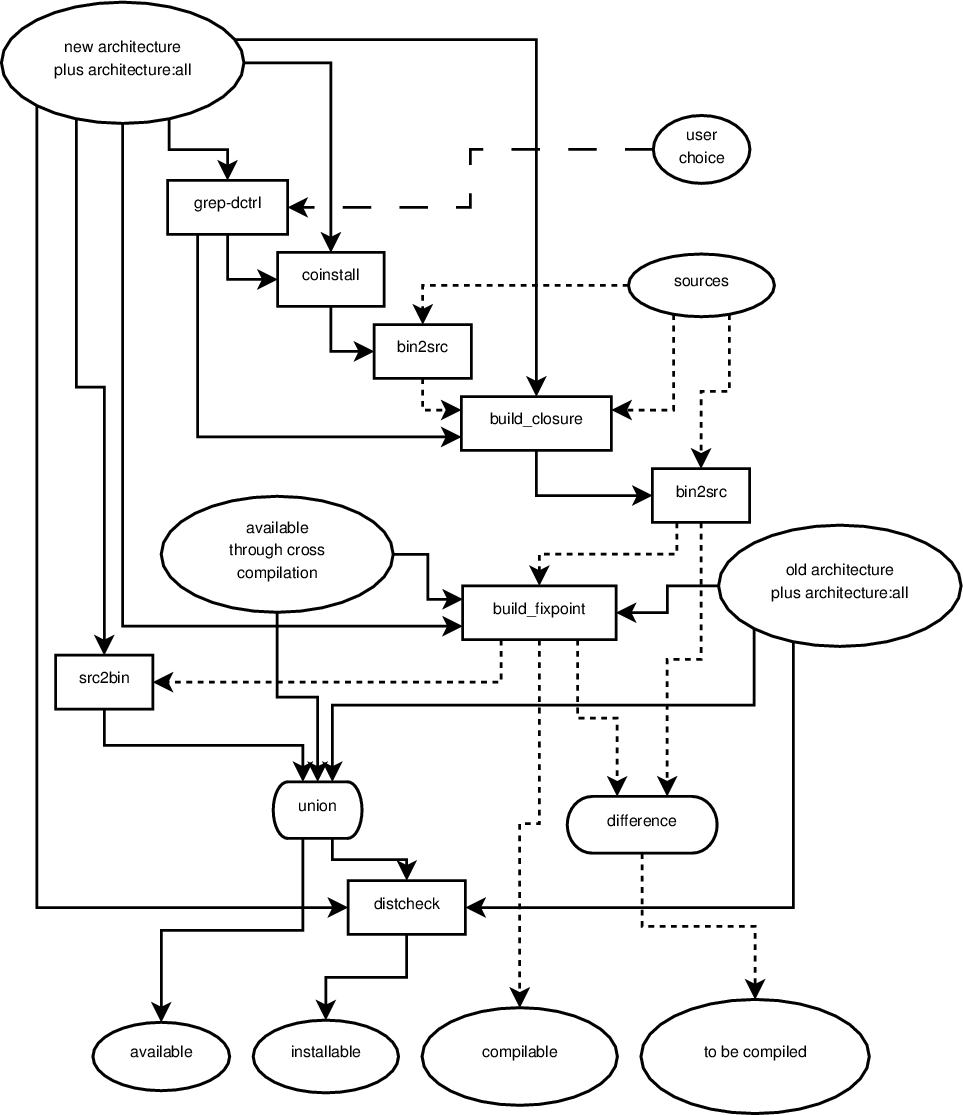
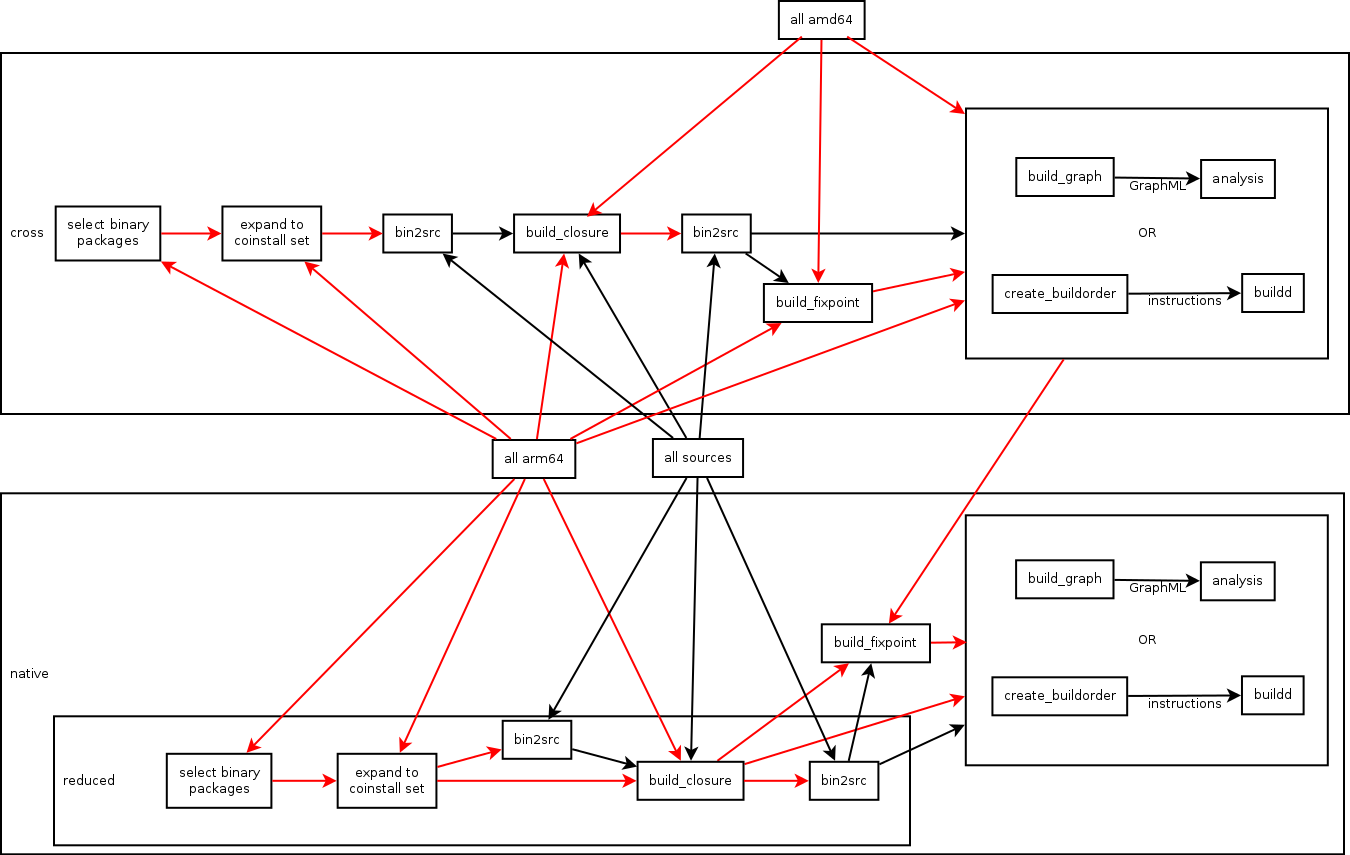
Processing pipeline instead of monolithic tools The tools I developed so far tried to accomplish everything by themselves, reusing functionality implemented in a central library. Therefor, if one wanted to try out even trivial new things, it mostly meant to hack some OCaml code. Pietro Abate suggested to instead develop smaller tools which could work independently of each other, would only execute one algorithm each and could easily be connected together in different ways to achieve different effects. This switch is now done and all functionality from the old tools is moved into a new toolset. The exchange format between the tools is either plain text files in deb822 control format (Packages/Sources files) or a dependency graph. The dependency graph is currently marshalled by OCaml but future versions should work with just passing a GraphML (an XML graph format) representation around. This new way of doing things seems close to the UNIX philosophy (each program does one thing well, data is stored as text, every program is a filter). For example the deb822 control output can easily be manipulated using grep-dctrl(1) and there exist many tools which can read, analyze and manipulate GraphML. It is a big improvement over the old, monolithic tools which did not allow to manipulate any intermediate result by external, existing tools. Currently, a shell script (native.sh) will execute all tools in a meaningful order, connecting them together correctly. The same tools will be used for a future cross.sh but they will be connected differently. I wrote about a first proposal of what the individual tools should do and how they should be connected in this email from which I also linked a confusing overview of the pipeline. This overview has recently been improved to be even more confusing and the current version of the lower half (the native part) now looks like this: native reduced Solid arrows represent a flow of binary packages, dottend arrows represent a flow of source packages, ovals represent a set of packages, boxes with rounded corners represent set operations, rectangular boxes represent filters. There is only one input to a filter, which is the arrow connected to the top of the box. Outgoing arrows from the bottom represent the filtered input. Ingoing arrows to either side are arguments to the filter and control how the filter behaves depending on the algorithm. I will explain this better once the pipeline proved to be less in flux. The pipeline is currently executed like this by native.sh.

Two new ways to break dependency cycles have been discovered So far, we knew of three ways to formally break dependency cycles:
  • remove build dependencies through build profiles
  • find out that the build dependency is only used to build arch:all packages and therefor put it into Build-Depends-Indep
  • cross compile some source packages
Two new methods can be added to the above:

Dependency graph definition changed Back in September when I was visiting irill, Pietro found a flaw in how the dependency graph used to be generated. He supplied a new definition of the dependency graph which does away with the problem he found. After fixing some small issues with his code, I changed all the existing algorithms to use the new graph definition. The old graph is as of today removed from the repository. Thanks to Pietro for supplying the new graph definition - I must still admit that my OCaml foo is not strong enough to have come up with his code.

Added complexity for profile built source packages As mentioned in the introduction, wookey and me addressed the debian-devel list with a proposal on necessary changes for an automated bootstrapping of Debian. During the discussiong, two important things came up which are to be considered by the dependency graph algorithms:
  • profile built source packages may not create all binary packages
  • profile built source packages may need additional build dependencies
Both things make it necessary to alter the dependency graph during the generation of a feedback arc set and feedback vertex set beyond the simple removal of edges. Luckily, the developed approximation algorithms can be extended to support such changes in the graph.

Different feedback arc set algorithms The initially developed feedback arc set algorithm is well suited to discover build dependency edges which should be dropped. It performs far worse when creating the final build order because it only considers edges by itself and not how many edges of a source package can be dropped by profile building it. The adjusted algorithm for generating a build order is more of a feedback vertex set algorithm because instead of greedily finding the edge with most cycles through it, it greedily finds the source package which would break most cycles if it was profile built.

Generating a build order with less profile built source packages After implementing all the features above I now feel more confident to publish the current status of the tools to a wider audience. The following test shows a run of the aforementioned ./native.sh shell script. Its final output is a list of source packages which have to be profile built and a build order. Using the resulting build order, starting from a minimal build system (essential:yes, build-essential and debhelper), all source packages will be compiled which are needed to compile all binary packages in the system. The result will therefor be a list of source and binary packages which fulfill the following property:
  • all binary packages can be built from the available source packages
  • all source packages can be built with the available binary packages
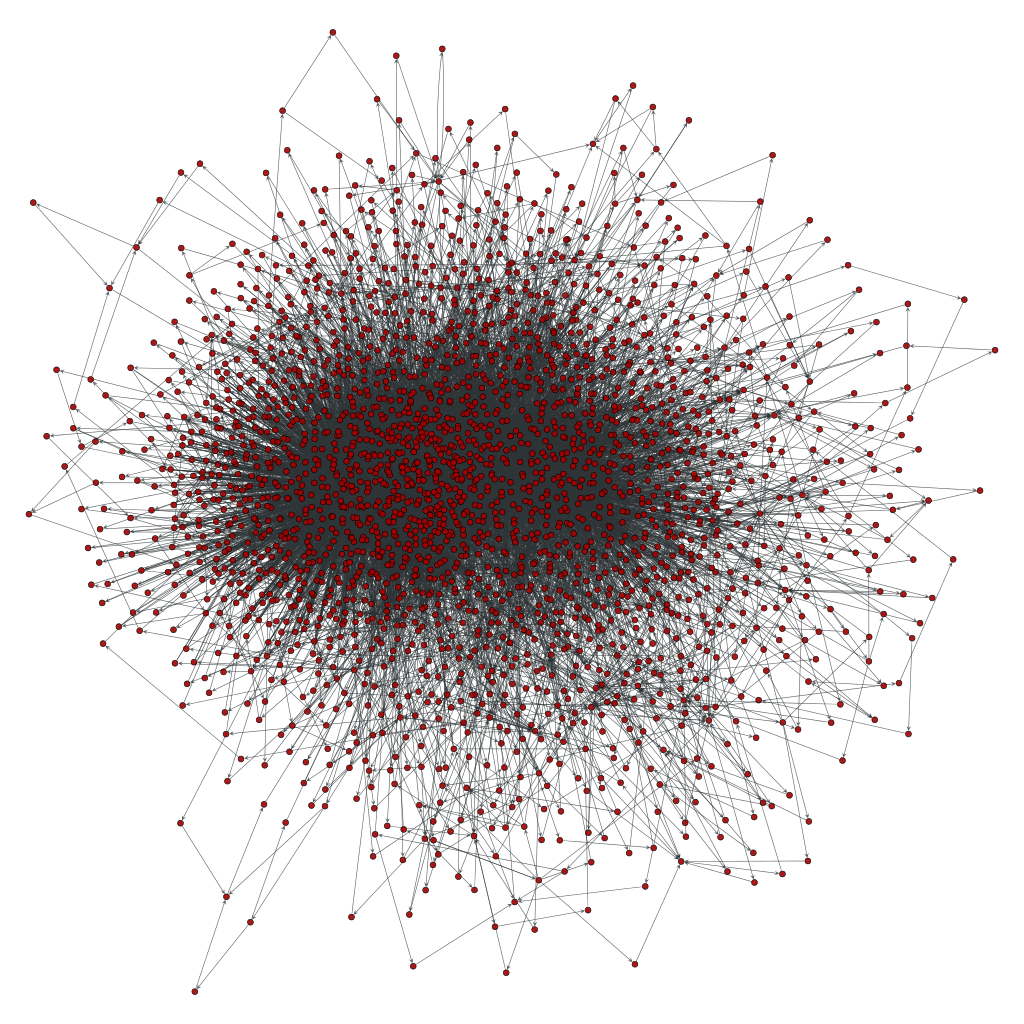
I called this a "reduceded distribution" in earlier posts. The interesting property of this specific selection is, that it contains the biggest problem set of Debian when bootstrapping it: a 900 to 1000 nodes big strongly connected component. Here is a visualization of the problem: hideous mess Source packages do not yet come with build profiles and the cross build situation can not yet be analyzed, so the following assumptions were made: The last point is about 14 build dependencies which were decided to be broken by the feedback arc set algorithm but for which other data sources did not indicate that they are actually breakable. Those 14 are dynamically generated by native.sh. If above assumptions should not be too far from the actual situation, then not more than 73 source packages have to be modified to bootstrap a reduced distribution. This reduced distribution even includes dependency-wise "big" packages like webkit, metacity, iceweasel, network-manager, tracker, gnome-panel, evolution-data-server, kde-runtime, libav and nautilus. By changing one line in native.sh one could easily develop a build order which generates gnome-desktop or really any given (meta-)package selection. All of native.sh takes only 80 seconds to execute on my system (Core i5, 2.5 GHz, singlethreaded). Here is the final build order which creates 2044 binary packages from 613 source packages.
  1. nspr, libio-pty-perl, libmcrypt, unzip, libdbi-perl, cdparanoia, libelf, c-ares, liblocale-gettext-perl, libibverbs, numactl, ilmbase, tbb, check, libogg, libatomic-ops, libnl($), orc($), libaio, tcl8.4, kmod, libgsm, lame, opencore-amr, tcl8.5, exuberant-ctags, mhash, libtext-iconv-perl, libutempter, pciutils, gperf, hspell, recode, tcp-wrappers, fdupes, chrpath, libbsd, zip, procps, wireless-tools, cpufrequtils, ed, libjpeg8, hesiod, pax, less, dietlibc, netkit-telnet, psmisc, docbook-to-man, libhtml-parser-perl, libonig, opensp($), libterm-size-perl, linux86, libxmltok, db-defaults, java-common, sharutils, libgpg-error, hardening-wrapper, cvsps, p11-kit, libyaml, diffstat, m4
  2. openexr, enca, help2man, speex, libvorbis, libid3tag, patch, openjade1.3, openjade, expat, fakeroot, libgcrypt11($), ustr, sysvinit, netcat, libirman, html2text, libmad, pth, clucene-core, libdaemon($), texinfo, popt, net-tools, tar, libsigsegv, gmp, patchutils($), dirac, cunit, bridge-utils, expect, libgc, nettle, elfutils, jade, bison
  3. sed, indent, findutils, fastjar, cpio, chicken, bzip2, aspell, realpath, dctrl-tools, rsync, ctdb, pkg-config($), libarchive, gpgme1.0, exempi, pump, re2c, klibc, gzip, gawk, flex-old, original-awk, mawk, libtasn1-3($), flex($), libtool
  4. libcap2, mksh, readline6, libcdio, libpipeline, libcroco, schroedinger, desktop-file-utils, eina, fribidi, libusb, binfmt-support, silgraphite2.0, atk1.0($), perl, gnutls26($), netcat-openbsd, ossp-uuid, gsl, libnfnetlink, sg3-utils, jbigkit, lua5.1, unixodbc, sqlite, wayland, radvd, open-iscsi, libpcap, linux-atm, gdbm, id3lib3.8.3, vo-aacenc, vo-amrwbenc, fam, faad2, hunspell, dpkg, tslib, libart-lgpl, libidl, dh-exec, giflib, openslp-dfsg, ppl($), xutils-dev, blcr, bc, time, libdatrie, libpthread-stubs, guile-1.8, libev, attr, libsigc++-2.0, pixman, libpng, libssh2, sqlite3, acpica-unix, acl, a52dec
  5. json-c, cloog-ppl, libverto, glibmm2.4, rtmpdump, libdbd-sqlite3-perl, nss, freetds, slang2, libpciaccess, iptables, e2fsprogs, libnetfilter-conntrack, bash, libthai, python2.6($), libice($), libpaper, libfontenc($), libxau, libxdmcp($), openldap($), cyrus-sasl2($), openssl, python2.7($)
  6. psutils, libevent, stunnel4, libnet-ssleay-perl, libffi, readline5, file, libvoikko, gamin, libieee1284, build-essential, libcap-ng($), lcms($), keyutils, libxml2, libxml++2.6, gcc-4.6($), binutils, dbus($), libsm($), libxslt, doxygen($)
  7. liblqr, rarian, xmlto, policykit-1($), libxml-parser-perl, tdb, devscripts, eet, libasyncns, libusbx, icu, linux, libmng, shadow, xmlstarlet, tidy, gavl, flac, dbus-glib($), libxcb, apr, krb5, alsa-lib
  8. usbutils, enchant, neon27, uw-imap, libsndfile, yasm, xcb-util, gconf($), shared-mime-info($), audiofile, ijs($), jbig2dec, libx11($)
  9. esound, freetype, libxkbfile, xvidcore, xcb-util-image, udev($), libxfixes, libxext($), libxt, libxrender
  10. tk8.4, startup-notification, libatasmart, fontconfig, libxp, libdmx, libvdpau, libdrm, libxres, directfb, libxv, libxxf86dga, libxxf86vm, pcsc-lite, libxss, libxcomposite, libxcursor, libxdamage, libxi($), libxinerama, libxrandr, libxmu($), libxpm, libxfont($)
  11. xfonts-utils, libxvmc, xauth, libxtst($), libxaw($)
  12. pmake, corosync, x11-xserver-utils, x11-xkb-utils, coreutils, xft, nas, cairo
  13. libedit, cairomm, tk8.5, openais, pango1.0($)
  14. ocaml, blt, ruby1.8, firebird2.5, heimdal, lvm2($)
  15. cvs($), python-stdlib-extensions, parted, llvm-2.9, ruby1.9.1, findlib, qt4-x11($)
  16. xen, mesa, audit($), avahi($)
  17. x11-utils, xorg-server, freeglut, libva
  18. jasper, tiff3, python3.2($)
  19. openjpeg, qt-assistant-compat, v4l-utils, qca2, jinja2, markupsafe, lcms2, sip4, imlib2, netpbm-free, cracklib2, cups($), postgresql-9.1
  20. py3cairo, pycairo, pam, libgnomecups, gobject-introspection($)
  21. gdk-pixbuf, libgnomeprint, gnome-menus, gsettings-desktop-schemas, pangomm, consolekit, vala-0.16($), colord($), atkmm1.6
  22. libgee, gtk+3.0($), gtk+2.0($)
  23. gtkmm2.4, poppler($), openssh, libglade2, libiodbc2, gcr($), libwmf, systemd($), gcj-4.7, java-atk-wrapper($)
  24. torque, ecj($), vala-0.14, gnome-keyring($), gcc-defaults, gnome-vfs($)
  25. libidn, libgnome-keyring($), openmpi
  26. mpi-defaults, dnsmasq, wget, lynx-cur, ghostscript, curl
  27. fftw3, gnupg, libquvi, xmlrpc-c, raptor, liboauth, groff, fftw, boost1.49, apt
  28. boost-defaults, libsamplerate, cmake, python-apt
  29. qjson, qtzeitgeist, libssh, qimageblitz, pkg-kde-tools, libical, dwarves-dfsg, automoc, attica, yajl, source-highlight, pygobject, pygobject-2, mysql-5.5($)
  30. libdbd-mysql-perl, polkit-qt-1, libdbusmenu-qt, raptor2, dbus-python, apr-util
  31. rasqal, serf, subversion($), apache2
  32. git, redland
  33. xz-utils, util-linux, rpm, man-db, make-dfsg, libvisual, cryptsetup, libgd2, gstreamer0.10
  34. mscgen, texlive-bin
  35. dvipng, luatex
  36. libconfig, transfig, augeas, blas, libcaca, autogen, libdbi, linuxdoc-tools, gdb, gpm
  37. ncurses, python-numpy($), rrdtool, w3m, iproute, gcc-4.7, libtheora($), gcc-4.4
  38. libraw1394, base-passwd, lm-sensors, netcf, eglibc, gst-plugins-base0.10
  39. libiec61883, qtwebkit, libvirt, libdc1394-22, net-snmp, jack-audio-connection-kit($), bluez
  40. redhat-cluster, gvfs($), pulseaudio($)
  41. phonon, libsdl1.2, openjdk-6($)
  42. phonon-backend-gstreamer($), gettext, libbluray, db, swi-prolog, qdbm, swig2.0($)
  43. highlight, libselinux, talloc, libhdate, libftdi, libplist, python-qt4, libprelude, libsemanage, php5
  44. samba, usbmuxd, libvpx, lirc, bsdmainutils, libiptcdata, libgtop2, libgsf, telepathy-glib, libwnck3, libnotify, libunique3, gnome-desktop3, gmime, glib2.0, json-glib, libgnomecanvas, libcanberra, orbit2, udisks, d-conf, libgusb
  45. libgnomeprintui, libimobiledevice, nautilus($), libbonobo, librsvg
  46. evas, wxwidgets2.8, upower, gnome-disk-utility, libgnome
  47. ecore, libbonoboui
  48. libgnomeui
  49. graphviz
  50. exiv2, libexif, lapack, soprano, libnl3, dbus-c++
  51. atlas, libffado, graphicsmagick, libgphoto2, network-manager
  52. pygtk, jackd2, sane-backends, djvulibre
  53. libav($), gpac($), ntrack, python-imaging, imagemagick, dia
  54. x264($), matplotlib, iceweasel
  55. strigi, opencv, libproxy($), ffms2
  56. kde4libs, frei0r, glib-networking
  57. kde-baseapps, kate, libsoup2.4
  58. geoclue, kde-runtime, totem-pl-parser, libgweather, librest, libgdata
  59. webkit
  60. zenity, gnome-online-accounts
  61. metacity, evolution-data-server
  62. gnome-panel
  63. tracker
The final recompilation of profile built source packages is omitted. Source packages marked with a ($) are selected to be profile built. All source packages listed in the same line can be built in parallel as they do not depend upon each other. This order looks convincing as it first compiles a multitude of source packages which have no or only few build dependencies lacking. Later steps allow fewer source packages to be compiled in parallel. The amount of needed build dependencies is highest in the source packages that are built last.

22 January 2013

Julien Danjou: Extending Swift with middleware: example with ClamAV

In this article, I'm going to explain you how you can extend Swift, the OpenStack Object Storage project, so it performs extra action on files at upload or at download time. We're going to build an anti-virus filter inside Swift. The goal is to refuse uploaded data if they contain a virus. To help us with virus analyses, we'll use ClamAV. WSGI, paste and middleware
In a pipeline, a black cat can become a white cat with the help of some middleware.
To do our content analysis, the best place to hook in the Swift architecture is at the beginning of every request, on swift-proxy, before the file is actually stored on the cluster. Swift proxy uses, like many other OpenStack projects, paste to build his HTTP architecture. Paste uses WSGI and provides an architecture based on a pipeline. The pipeline is composed of a succession of middleware, ending with one application. Each middleware has the chance to look at the request or at the response, can modify it, and then pass it to the following middleware. The latest component of the pipeline is the real application, and in this case, the Swift proxy server. If you've already deployed Swift, you encountered a default pipeline in the swift-proxy.conf configuration file:
[pipeline:main]
pipeline = catch_errors healthcheck cache ratelimit tempauth proxy-logging proxy-server

This is a really basic pipeline with a few middleware. The first one catches error, the second one is in charge to return 200 OK response if you send a GET /healthcheck request on your proxy server. The third one is in charge of caching, the fourth one is used for rate limiting, the fifth for authentication, the sixth one for logging, and the final one is the actual proxy server, in charge of proxying the request to the account, container, or object servers (the others components of Swift). Of course, we could remove or add any of the middleware here at our convenience. Be aware that the order matters: for example, if you put healthcheck after tempauth, you won't be able to access the /healthcheck URL without being authenticated! ClamAV
If you don't know ClamAV, it's an antivirus engine designed for detecting trojans, viruses, malware and other malicious threats. Wwe're going to use it to scan every incoming file. To build the middleware, we'll use the Python binding pyclamd. The API is quite simple, see:
>>> import pyclamd
>>> pyclamd.init_unix_socket('/var/run/clamav/clamd.ctl')
>>> print pyclamd.scan_stream(pyclamd.EICAR)
'stream': 'Eicar-Test-Signature(44d88612fea8a8f36de82e1278abb02f:68)'
>>> print pyclamd.scan_stream("safe!")
None

Anatomy of a WSGI middleware Your WSGI middleware should consist of a callable object. Usually this is done with a class implementing the __call__ method. Here's a basic boilerplate:
class SwiftClamavMiddleware(object):
"""Middleware doing virus scan for Swift."""

def __init__(self, app, conf):
# app is the final application
self.app = app

def __call__(self, env, start_response):
return self.app(env, start_response)


def filter_factory(global_conf, **local_conf):
conf = global_conf.copy()
conf.update(local_conf)

def clamav_filter(app):
return SwiftClamavMiddleware(app, conf)
return clamav_filter

I'm not going to expand more on why this is built this way, but if you want to have more info on this kind of filter middleware, you can read their documentation on Paste. This middleware will just do nothing as it is. It's going to simply pass all requests it receives to the final application, and returns the result. Testing our basic middleware
Now is a really good time to add unit tests. I hope you didn't think we were going to write code without some tests, right? It's really easy to test a middleware, as we're going to use WebOb for that.
import unittest
from webob import Request


class FakeApp(object):
def __call__(self, env, start_response):
return Response(body="FAKE APP")(env, start_response)


class TestSwiftClamavMiddleware(unittest.TestCase):

def setUp(self):
self.app = SwiftClamavMiddleware(FakeApp(), )

def test_simple_request(self):
resp = Request.blank('/',
environ=
'REQUEST_METHOD': 'GET',
).get_response(self.app)
self.assertEqual(resp.body, "FAKE APP")

We create a FakeApp class, that represents a fake WSGI application. You could also use a real application, or write a fake application looking like the one you want to test. It'll require more time, but your tests will be closer to the reality. Here we write the simplest test we can for our middleware. We're just sending a GET / request to it, so it passes the request to the final application and returns the result. It is transparent, it does nothing. Now, with that solid base we'll able to add more features and test these features incrementally. Plugging ClamAV in With our base ready, we can start thinking about how to plug ClamAV in. What we want to check here, is the content of the file when it's uploaded. If we refer to the OpenStack object storage API , a file upload is done via a PUT request, so we're going to limit the check to that kind of requests. Obviously, more checks could be added, but we'll keep things simple here for the sake of comprehensibility. With WSGI, the content of the request is available in env['wsgi.input'] as an object implementing a file interface. We'll scan that stream with ClamAV to check for viruses.
import pyclamd
from webob import Response


class SwiftClamavMiddleware(object):
"""Middleware doing virus scan for Swift."""

def __init__(self, app, conf):
pyclamd.init_unix_socket('/var/run/clamav/clamd.ctl')
# app is the final application
self.app = app

def __call__(self, env, start_response):
if env['REQUEST_METHOD'] == "PUT":
# We have to read the whole content in memory because pyclamd
# forces us to, but this is a bad idea if the file is huge.
scan = pyclamd.scan_stream(env['wsgi.input'].read())
if scan:
return Response(status=403,
body="Virus %s detected" % scan['stream'],
content_type="text/plain")(env, start_response)
return self.app(env, start_response)


def filter_factory(global_conf, **local_conf):
conf = global_conf.copy()
conf.update(local_conf)

def clamav_filter(app):
return SwiftClamavMiddleware(app, conf)
return clamav_filter

That's it. We only check for PUT requests and if there's a virus in the file, we return a 403 Forbidden error with the name of the detected virus, bypassing entirely the rest of the middleware chain and the application handling. Then, we can simply test it.
import unittest
from cStringIO import StringIO
from webob import Request, Response


class FakeApp(object):
def __call__(self, env, start_response):
return Response(body="FAKE APP")(env, start_response)


class TestSwiftClamavMiddleware(unittest.TestCase):
def setUp(self):
self.app = SwiftClamavMiddleware(FakeApp(), )

def test_put_empty(self):
resp = Request.blank('/v1/account/container/object',
environ=
'REQUEST_METHOD': 'PUT',
).get_response(self.app)
self.assertEqual(resp.body, "FAKE APP")

def test_put_no_virus(self):
resp = Request.blank('/v1/account/container/object',
environ=
'REQUEST_METHOD': 'PUT',
'wsgi.input': StringIO('foobar')
).get_response(self.app)
self.assertEqual(resp.body, "FAKE APP")

def test_put_virus(self):
resp = Request.blank('/v1/account/container/object',
environ=
'REQUEST_METHOD': 'PUT',
'wsgi.input': StringIO(pyclamd.EICAR)
).get_response(self.app)
self.assertEqual(resp.status_code, 403)

The first test test_put_empty simulates an empty PUT request. The second one, test_put_no_virus simulates a regular PUT request but with a simple file containing no virus. Finally, the third and last test simulates the upload of a virus using the EICAR test file. This is a special test file that is recognized as a virus, even if it's not real one. Very handy for testing virus detection software! Configuring Swift proxy Our middleware is ready! We can configure Swift's proxy server to use it. We need to add the following lines to our swift-proxy.conf to teach it how to load the filter:
[filter:clamav]
paste.filter_factory = swiftclamav:clamav_filter

We'll assume that our Python modules is named swiftclamava here. Now that we've defined our filter and how to load it, we can use it in our pipeline:
[pipeline:main]
pipeline = catch_errors healthcheck cache ratelimit tempauth clamav proxy-logging proxy-server

Just before reaching the proxy-server, and after the user being authenticated, the content will be scanned for viruses. It's important here to put this after authentication for example, because otherwise we may scan content that will get rejected by the authtemp module, thus scanning for nothing! Beyond scanning And voil , we now have a simple middleware testing uploaded content and refusing infected files. We could enhance it with various other things, like configuration handling, but I'll let that as an exercise for the interested readers. We didn't exploited it here, but note that you can also manipulate request headers and modify them if needed. For example, we could have added a header X-Object-Meta-Scanned-By: ClamAV to indicates that the file has been scanned by ClamAV. You should now be able to build your own middleware doing whatever you want with uploaded data. Happy hacking!

18 January 2013

Ian Campbell: Using Valgrind to Debug Xen Toolstacks

What is Valgrind? Valgrind is a framework for building dynamic analysis tools. Several useful tools are included in the Valgrind distribution including tools to check dynamic memory usage (memcheck), a cache profiler (cachegrind), heap profiler (massif) and thread debugger (helgrind) among others. Valgrind also provides a framework which can be used to build other tools. The Valgrind tool which I find most useful and the one which I have most experience with is memcheck. This tool can detect all manner of memory management problems, including use after free, using uninitialized data, memory leaks, double free. Between them these can result in savings of many hours of staring a core dumps and gdb backtraces. How Does memcheck Work? At its core Valgrind is a dynamic binary translation engine, which is used to instrument the code at runtime. In the case of memcheck this is used to track properties of the memory in a process, including aspects such as whether each bit (yes, bit) of memory has been initialized since it was allocated. It also tracks this information as data is loaded into registers, so it can know if a given register is currently tainted with uninitialized data or not. As well as instrumentation through binary translation Valgrind also includes instrumented versions of the C dynamic memory allocation functions which are used to track whether a each bit of memory is currently considered free or allocated, as well as tainting registers when they contain a pointer to memory which has been freed. A large part of memcheck's functionality is built upon Valgrind's ability to determine when memory has been initialized. However although binary translation can be used to instrument when the application itself has initialized some memory it is not currently possible to instrument the behaviour of system calls, in other words Valgrind cannot automatically determine when memory has been initialised e.g. after a read(2) system call. For this reason Valgrind has baked in knowledge about the behaviour of system calls on various platforms. For example lets consider the read(2) system call. The prototype of read(2) is:
    ssize_t read(int fd, void *buf, size_t count);
This system call reads up to count bytes from the file descriptor fd into the memory pointed to by buf and returns the number of bytes read. Here is the code within Valgrind which handles this system call (found in coregrind/m_syswrap/syswrap-generic.c):
PRE(sys_read)
 
   *flags  = SfMayBlock;
   PRINT("sys_read ( %ld, %#lx, %llu )", ARG1, ARG2, (ULong)ARG3);
   PRE_REG_READ3(ssize_t, "read",
                 unsigned int, fd, char *, buf, vki_size_t, count);
   if (!ML_(fd_allowed)(ARG1, "read", tid, False))
      SET_STATUS_Failure( VKI_EBADF );
   else
      PRE_MEM_WRITE( "read(buf)", ARG2, ARG3 );
 
POST(sys_read)
 
   vg_assert(SUCCESS);
   POST_MEM_WRITE( ARG2, RES );
 
These two functions are called before and after the system call respectively. The main piece of functionality is the calls to PRE_MEM_WRITE and POST_MEM_WRITE. In this case PRE_MEM_WRITE is used to check that the memory starting at ARG2 (recall that this is the supplied buffer) and extending for ARG3 bytes (the system calls count argument) consists of allocated memory. After the system call in complete the post function calls POST_MEM_WRITE to indicate to Valgrind that RES bytes of the buffer have know been initialized. The above is a relatively simple case, but the above two hooks must be supplied for each system call on each platform which Valgrind wishes to support. One of the most problematic system calls is the ioctl(2) system call. The ioctl call takes a file descriptor, a request number and a pointer to a per-ioctl argument structure and implements per-device control requests. There are literally dozens of devices many with their own specific ioctls. For this reason a sizable portion of Valgrind code is dedicate to decoding the behaviour of the myriad of potential ioctls and providing pre- and post-call instrumentation for them. Interacting with the Hypervisor from Userspace Under Xen the toolstack is a normal userspace process running in the control domain (typically domain 0). As part of its operation the toolstack needs to communicate with the hypervisor and to do this it uses hypercalls. However a userspace process cannot simply make hypercalls on its own, instead it must request that the OS kernel make the hypercall for it. This prevents just any userspace process making a hypercall, since the kernel will first check the privilege of the process making the request. Under Linux a userspace process makes hypercalls by using the ioctl(2) system call on a special "Privileged Command" (privcmd) device. In this case the toolstack uses the IOCTL_PRIVCMD_HYPERCALL ioctl request which takes a hypercall number and the hypercall arguments as its argument. Other OSes which can be used as a control domain posses similar interfaces. Making memcheck Work With Xen Toolstacks? As might be expected the majority of the work to allow Valgrind to work on Xen toolstack processes was teaching it about the IOCTL_PRIVCMD_HYPERCALL ioctl. Fortunately it was not necessary to teach Valgrind about every hypercall but only about those which are used by toolstacks. This is a smallish subset of all hypercalls including the domctl interfaces and a handful of others. The initial batch of patches cover all of the system calls needed to start new domains, shut them down and migrate them using the XL toolstack. New hypercalls will be added as they are discovered to be missing. Getting and Using This Functionality The initial set of patches were accepted into Valgrind's Subversion repository trunk revision 13081 in October 2012 and are expected to be part of the 3.9.0 release. Until 3.9.0 is released it will be necessary to get this functionality from SVN. Fortunately this is relatively simple and follows the usual autofoo dance. Although the usual caveats regarding running unreleased software apply.
  $ svn co svn://svn.valgrind.org/valgrind/trunk valgrind
  $ cd valgrind
  $ ./autogen.sh
  $ ./configure
  $ make
  $ sudo make install
Once Valgrind is built and installed simply call it passing the command to be debugged as an option:
  # valgrind xl list
  ==16186== Memcheck, a memory error detector
  ==16186== Copyright (C) 2002-2012, and GNU GPL'd, by Julian Seward et al.
  ==16186== Using Valgrind-3.9.0.SVN and LibVEX; rerun with -h for copyright info
  ==16186== Command: xl list
  ==16186== 
  Name                                        ID   Mem VCPUs    State   Time(s)
  Domain-0                                     0   512     4     r-----     332.5
  ==16186== 
  ==16186== HEAP SUMMARY:
  ==16186==     in use at exit: 0 bytes in 0 blocks
  ==16186==   total heap usage: 16 allocs, 16 frees, 93,529 bytes allocated
  ==16186== 
  ==16186== All heap blocks were freed -- no leaks are possible
  ==16186== 
  ==16186== For counts of detected and suppressed errors, rerun with: -v
  ==16186== ERROR SUMMARY: 0 errors from 0 contexts (suppressed: 39 from 6)
Here we see that xl list has no leaks! However if I comment out the call to libxl_dominfo_list_free in tools/libxl/xl_cmdimpl.c:main_list() then instead Valgrind reports:
[...]
  ==16203== HEAP SUMMARY:
  ==16203==     in use at exit: 90,112 bytes in 1 blocks
  ==16203==   total heap usage: 16 allocs, 15 frees, 93,529 bytes allocated
  ==16203== 
  ==16203== LEAK SUMMARY:
  ==16203==    definitely lost: 0 bytes in 0 blocks
  ==16203==    indirectly lost: 0 bytes in 0 blocks
  ==16203==      possibly lost: 90,112 bytes in 1 blocks
  ==16203==    still reachable: 0 bytes in 0 blocks
  ==16203==         suppressed: 0 bytes in 0 blocks
  ==16203== Rerun with --leak-check=full to see details of leaked memory
  ==16203== 
  ==16203== For counts of detected and suppressed errors, rerun with: -v
  ==16203== ERROR SUMMARY: 0 errors from 0 contexts (suppressed: 39 from 6)
[...]
So it has caught the memory leak! Rerunning with the suggests --leak-check=full goes even further and tells me where the leaked memory was allocated:
[...]
  ==16204== 90,112 bytes in 1 blocks are possibly lost in loss record 1 of 1
  ==16204==    at 0x4024480: calloc (vg_replace_malloc.c:593)
  ==16204==    by 0x4050CE4: libxl_list_domain (libxl.c:548)
  ==16204==    by 0x805EEC7: main_list (xl_cmdimpl.c:3931)
  ==16204==    by 0x804D6DD: main (xl.c:285)
[...]
To ease debugging of domain creation I find it useful to use the -F option to xl create to stop xl from forking and daemonising. Most xl subcommands do not daemonize and so need no special treatment. For more information on running Valgrind see the Valgrind Documentation. Conclusion Valgrind is a powerful tool in the arsenal of the C programmer, and can be used to catch a large number of hard to debug and common issues before they happen can save many hours of tedious debugging. The ability to use tools such as this on Xen toolstack processes is of enormous benefit and has already found several bugs in the XL toolstack.

16 January 2013

Olivier Berger: Scheduling appointments with capture template from org-agenda view

I've been frustrated by my inability to schedule appointments directly from the org-agenda view, for quite some time, but I think I've found a way. If like me you're using org-mode to manage your appointments, you're probably using SCHEDULED TODO items that can be entered in your system using org-capture templates. A typical scenario is I'm asked by a colleague (face to face or on the phone) when I'm available to schedule a meeting or some other activity. I'm then firing an agenda view, and browse through the dates available... then agreeing on an empty slot, I'm capturing the meeting... but then I have to C-c C-s to add the SCHEDULED marker and set the correct date, although I was previously on that exact date in the org-agenda view :-/ The solution seems to be with the 'k c' command, i.e. the capture org-agenda-action in the agenda view. From the docs :
k runs the command org-agenda-action, which is an interactive compiled
c     Call  org-capture' with cursor date as the default date
Exactly what I need : it will prompt me for a capture template, which I just have to set to a template containing "SCHEDULED: %t". Excerpt from my .emacs :
(custom-set-variables
...
'(org-capture-templates (quote (("t" "Todo" entry (file+headline "~/org/newgtd.org" "TACHES") "* TODO %^ Brief description  %^g
 %?   
    Added: %U
%i
%a") ("n" "Notes" entry (file+datetree "~/org/journal.org") "* %^ topic  %T %^g
%i%?
%a") ("d" "Scheduled appointment" entry (file+headline "~/org/newgtd.org" "TACHES") "* TODO %^ Brief description  %^g
 %?   
    SCHEDULED: %t
%i
%a"))))
Tadaaa ! it works :-)

Raphael Geissert: A bashism a week: ulimit

Setting resource limits from a shell script is commonly done with the ulimit command.
Shells provide it as a built-in, if they provide it at all. As far as I know, there is no non-built-in ulimit command. One could be implemented with the Linux-specific prlimit system call, but even that requires a fairly "recent" kernel version (circa 2010).

Depending on the kind of resource you want to limit, you may get away with what some shells such as dash provide: CPU, FSIZE, DATA, STACK, CORE, RSS, MEMLOCK, NPROC, NOFILE, AS, LOCKS. I.e. options tfdscmlpnvw, plus H for the hard limit, S for the soft limit, and a for all. Bash allows other resources to be limited.

Remember, if you rely on any non-standard behaviour or feature make sure you document it and, if feasible, check for it at run-time. ulimit is not required by POSIX:2001 to be implemented for the shell.

14 January 2013

Ben Hutchings: What's in the Linux kernel for Debian 7.0 'wheezy', part 3

The Debian package of the Linux kernel has some additional features not present in mainline Linux 3.2. This continues from part 1 and part 2. Real-time scheduling The 'PREEMPT_RT' aka 'linux-rt' patchset provides true real-time scheduling under Linux. This can allow applications to respond to I/O with very low latency and jitter, although the results depend on application design and on the hardware and firmware used. Real-time scheduling is commonly used in industrial control, live audio/video applications, and high-frequency trading systems; it can also be useful for tightly-coupled cluster computing. However, most applications will run more slowly under these kernels, and may not be any more responsive. The Linux 3.2-rt stable series maintained by Steven Rostedt is used to build alternate kernels for amd64 and i386. You can install these using the metapackage linux-image-rt-amd64 or linux-image-rt-686-pae. Hyper-V guest drivers Like most VM hypervisors, Microsoft Hyper-V supports paravirtualised drivers which can provide much better performance than emulation of old hardware devices. Linux 3.2 had quite early versions of these drivers that were relegated to the 'staging' area, but we've updated them to the much improved versions found in Linux 3.4. I hoped we would also be able to package the userland daemon that supports management of Hyper-V guests, but this also needed many fixes and wasn't ready in time.

Next.

Previous.