Search Results: "tats"

12 September 2010

Francois Marier: Setting up your own DNSSEC-aware resolver using Unbound

Now that the root DNS servers are signed, I thought it was time I started using DNSSEC on my own PC. However, not wanting to wait for my ISP to enable it, I decided to setup a private recursive DNS resolver for myself using Unbound.

Installing UnboundBeing already packaged in Debian and Ubuntu, unbound is only an apt-get away:
apt-get install unbound
though if you are running lenny, I suggest you grab the latest backport.

Once unbound is installed, follow these instructions to enable DNSSEC.

Optional settingsIn my /etc/unbound/unbound.conf, I enabled the following security options:
harden-referral-path: yes
use-caps-for-id: yes
and turned on prefetching to hopefully keep in cache the sites I visit regularly:
prefetch: yes
prefetch-key: yes
Finally, I also enabled statistics:
extended-statistics: yes
control-enable: yes
control-interface: 127.0.0.1
and ran sudo unbound-control-setup to generate the necessary keys.

Once unbound is restarted (sudo /etc/init.d/unbound restart) stats can be queried to make sure that the DNS resolver is working:
unbound-control stats

Overriding DHCP settingsIn order to use my own unbound server for DNS lookups and not the one received via DHCP, I added this line to /etc/dhcp/dhclient.conf:
supersede domain-name-servers 127.0.0.1;
and restarted dhclient:
sudo killall dhclient
sudo /etc/init.d/network-manager restart
If you're not using DHCP, then you simply need to put this in your /etc/resolv.conf:
nameserver 127.0.0.1

Testing DNSSEC resolutionOnce everything is configured properly, the best way I found to test that this setup was actually working is to use a web browser to visit these sites:
and using dig:
$ dig +dnssec A www.dnssec.cz   grep ad
;; flags: qr rd ra ad; QUERY: 1, ANSWER: 2, AUTHORITY: 3, ADDITIONAL: 1

Are there any other ways of making sure that DNSSEC is fully functional?

10 September 2010

Alexander Reichle-Schmehl: Release Critical Bug report for Week 36

The unofficial rc bug tracker currently knows about the following bugs:
In Total:420
Affecting Squeeze:301
Squeeze only:66
Remaining to be fixed in Squeeze:235
Of these 235 bugs, the following tags are set:
Pending in Squeeze:16
Patched in Squeeze:53
Duplicates in Squeeze:26
Contrib or non-free in Squeeze:10
Claimed in Squeeze:2
Delayed in Squeeze:8
Can fixed in a security Update:15
Otherwise fixed in Squeeze:19
Ignoring all the above (multiple tags possible), 133 bugs need to be fixed by Debian Contributers to get Debian 6.0 Squeeze released. However, with the view of the Release Managers, 254 need to be dealt with for the release to happen. Please see my older post for an explanation of the different numbers.

Lior Kaplan: Hebrew translation and Bidi issues in Openoffice 3.3 (beta)

In the last few years the Israeli government founded some work on openoffice.org by Tk Open Systems Ltd. During the years, the work has resulted with an Israeli version , released after the official release and includes a lot of patches to improve support for Bidi and Hebrew specifically. Although most patches were submitted to the hamburg , a lot of them weren t used and are still waiting for inclusion. The funding the that projects stopped a year ago (9/2009), and the last release of the Israeli version is 3.1.1. Since then we had a quiet period in which 3.2 and 3.2.1 were released. While still enjoying the fruits of the projects in these version, it seems that it s time for the community to take over, as we lost hopes for yet another funds from the government. In may Netanel and I started talking about taking over the Hebrew translation, and in June we got Hebrew added to the openoffice.org pootle server. We started with about 80%, and got to 86% in time to get to the list of languages getting a language pack built for. This was a first achievement as Hebrew didn t have a language pack since early on the 2.x versions. I believe that working as part of the openoffice.org l10n group and with openoffice.org release schedule will only benefit for the Hebrew translation process. We used the language pack to test the translation and improve it. We also were able to get to 89% with the help of more volunteers.I believe it s now much more consistent than before. In the process with manually checked Writer thoroughly, while Calc and Impress got less attention due to the time frame. But we fixed some major translation issues in all of the three components. While testing the translation we also started to report Bidi issues we saw in 3.3 beta, hoping they will be fixed for the final release. For example, the main openoffice.org screen on windows has is getting repainted wrongly when moving the mouse over the options (text, spreadsheet..). This looks very badly as this is the main screen! See issue #97556 for details
Openoffice.org main screen in RTL UI

In RTL UI the main screen doesn't get repaited properly.

In addition to report new issues, we also started to keep track of the already opened issues regarding Bidi and Hebrew. I m following the issue system for a few years now, but seeing the list of issues organized in the wiki gave me a better orientation in the problems we have. E.g. finding some related or similar issues and mention each other in the comments, when someone goes to first one, he could also fixed the other as the problem is similar and probably comes from the same code. Organizing also the already closed bugs in 3.x, gave me a some kind of a changelog for the Bidi and Hebrew related issues. In that manner, version 3.1 was a very good for Bidi, thanks for a lot of efforts and work with the Bidi meta issue #79434. The wiki page is in Hebrew, but looks quite OK with Google translate (see here). Hoping to have 3.4 a major release (Bidi wise), I ve opened issue #114236 as another meta issue for Bidi related issues. I ve kept Hebrew specific issues out, as to get it more general and also relevant for Bidi users in other languages. Any help of those issues will be more than welcome (starting with votes and ending with patches).
Filed under: i18n & l10n, Israeli Community, Openoffice.org

9 September 2010

Kartik Mistry: non-free (web) services

* I was thinking to move out of as many as non-free (FaiF) web services after reading mako s this post and now zack wrote about it with good explanations and reasons. What things I m using? And its replacement: - GMail [and related stuffs] (I don t own server/email setup, may be next year s plan?)
- Facebook (Big question here how will I keep touch with my wife?)
- LinkedIn (My profile there is crap, half baked. Can leave it without worry)
- Twitter (Identi.ca)
- Orkut (Already not using much)
- Github (Gitorious) Thank God. WordPress is amazing and free. I can keep in touch with this amazing blue pill virtual world with blog posts at least. Starting acting on the list from bottom-up. Lets see how far I can go.

Raphaël Hertzog: Can Debian achieve world domination without being on Facebook?

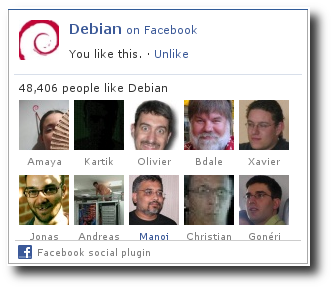
Debian Developers who like Debian on FacebookFacebook is not very popular among free software hackers. When I announced my Facebook page on identi.ca (see here) I got a few replies suggesting it was odd for me to use Facebook. Indeed there are many good reasons why Facebook should be avoided: it is a centralized and proprietary service that is not very privacy-friendly. But the truth is that lots of people are using it (even Debian developers, can you recognize them on the picture?) and some are using their Facebook news feed as their main source of news. You might wonder how many persons that represents, so here are the figures: the Debian Facebook page has 48,361 fans and the Ubuntu one has 247,932 fans. That s right, an announce put on the Debian facebook page would reach more persons than the most popular announce list that Debian is currently running (debian-announce@lists.debian.org has about 29,000 subscribers). Unfortunately that Debian Facebook page is empty and I don t even know who the administrator is. The Ubuntu page on the contrary is properly configured to relay news from The Fridge and Jono Bacon is posting some custom updates from time to time. Debian contributors regularly mention world domination as the ultimate goal of the universal operating system (I even feature this in my blog header banner! :-) ). But working towards world domination means in my opinion that we should communicate our ideals of freedom to as many people as possible, even if they are using a service that we don t want to promote. The Debian social contract acknowledges that some users have to use non-free software and we provide the non-free section for them. In the same spirit, I believe we must have a presence on Facebook. That does not mean that we endorse Facebook, and we should surely promote Joindiaspora once it s usable. But in the mean time we should reach out to Facebook users and allow them to follow us with the platform of their choice. That s the choice I recently made when I decided to setup a public facebook page featuring my free software work, my blog and my book. So if you are a Facebook user, click here to visit my page and click on Like if you want to follow this blog in your Facebook news feed. I also share interesting Debian or Ubuntu related articles that I discover while reading my RSS subscriptions. Below are the usual facebook widgets for the 3 pages quoted in this article (they might not show up if you read this article through an RSS feed):
<iframe allowtransparency="true" frameborder="0" scrolling="no" src="http://www.facebook.com/plugins/likebox.php?id=103161013077063&amp;width=292&amp;connections=0&amp;stream=false&amp;header=false&amp;height=62" style="border:none; overflow:hidden; width:292px; height:62px;"></iframe>
<iframe allowtransparency="true" frameborder="0" scrolling="no" src="http://www.facebook.com/plugins/likebox.php?id=9801962186&amp;width=292&amp;connections=0&amp;stream=false&amp;header=false&amp;height=62" style="border:none; overflow:hidden; width:292px; height:62px;"></iframe>
<iframe allowtransparency="true" frameborder="0" scrolling="no" src="http://www.facebook.com/plugins/likebox.php?id=6723083591&amp;width=292&amp;connections=0&amp;stream=false&amp;header=false&amp;height=62" style="border:none; overflow:hidden; width:292px; height:62px;"></iframe> Flattr this Share/Bookmark 14 comments Support my work

6 September 2010

Robert Millan: Debian Installer with ZFS

Long time no see Not much hacking in the last few months. Not much ranting either (some of you I m sure will appreciate ;-). Anyway, I recently grew excited to learn that ZFS is coming to Debian. I decided to bite the bullet, patched the missing bits in GRUB and Parted, a few small changes in D-I and there s now a modified Debian Installer with ZFS support for you to play with. Enjoy! Note1: I didn t have time or interest in warping D-I into the N:1:M model used in ZFS. Instead, this installer assumes each zpool has exactly one device and exactly one filesystem. However, you can later add more devices ( zpool attach ) or create new filesystems in the same pool ( zfs create ). Note2: Don t ask for i386, it was intentionally left out. ZFS is designed with modern CPUs in mind. It can work on i386 with special tuning but I don t want to encourage users to do this unless they re well aware of what they re doing.

5 September 2010

Kartik Mistry: Updates: Life and more

* It is same old life, apart from: + Guitar is going good. Learning first thing apart from computer in life ;) + Learning C++ and openFrameworks for helping friend for project. More details later.. * Packages: + I ve uploaded Gwibber 2 after waiting for ages to experimental now. Now, OAuth sucked life from all previous version of Gwibber stable version will not have twitter working. I m thinking what can be best solution for that. + Code::Blocks is with me now. I m talking to upstream to do better things with license issues. It will not make to stable, but backport version is planned. * Kavin: + Arr. He can reach to my any books, gadgets and even laptop.

3 September 2010

Alexander Reichle-Schmehl: Release Critical Bug report for Week 35

The unofficial rc bug tracker currently knows about the following bugs:
In Total:379
Affecting Squeeze:291
Squeeze only:65
Remaining to be fixed in Squeeze:226
Of these 226 bugs, the following tags are set:
Pending in Squeeze:14
Patched in Squeeze:43
Duplicates in Squeeze:21
Contrib or non-free in Squeeze:13
Claimed in Squeeze:2
Delayed in Squeeze:8
Can fixed in a security Update:14
Otherwise fixed in Squeeze:16
Ignoring all the above (multiple tags possible), 129 bugs need to be fixed by Debian Contributers to get Debian 6.0 Squeeze released. However, with the view of the Release Managers, 244 need to be dealt with for the release to happen. Please see my older post for an explanation of the different numbers.

31 August 2010

Dominique Dumont: Improve config upgrade Ep 03 GSoC results

Hello Thanks to Google, Debian and more importantly Krzysztof Tyszecki, the accept feature discussed in episode 2 is now implemented and tested in Config::Model 1.206 and Config::Model::Itself 1.216. Next task is to create a minimal model to enable upgrades for cupsd.conf. This minimal model will heavily use the new accept feature coded during this GSoC. Cups configuration is an interesting use case because: Next episode should provide more details on the work required to provide this minimal model. All the best

30 August 2010

Matt Zimmerman: Traveling at home

For me, the most enjoyable part of traveling is the inspiration that I derive from visiting different places, talking to people, and generally being outside of my normal environment. This bank holiday weekend, when so many Londoners visit faraway lands, my partner and I stayed in London instead, and my sought inspiration closer to home. The city has been delightfully quiet, and in contrast to the preceding week, the weather was mostly pleasant, apart from the sudden downpours the BBC described as squally showers .
Photo of deer in Richmond Park

Photo credit: M rcio Cabral de Moura


We spent Saturday afternoon in Richmond Park, a 2500-acre nature preserve easily accessible via public transport from London. The plentiful oak trees, fallow deer, and various species of water fowl made it easy to forget the city for a while. Having visited a few times on foot, I think it would be fun to cycle next time, and see different areas of the park. Afterward, we had dinner at a tapas restaurant in Parsons Green which offered notably excellent service as well as good food. By this time, it was nearly 7:00pm, and we took a chance on getting last-minute theatre tickets to see Jeff Goldblum and Mercedes Ruehl in Neil Simon s The Prisoner of Second Avenue. We arrived at the theatre just in time for the show, which was not sold out, and in fact had quite reasonable seats available. The show had several good laughs, holding up fairly well after nearly 40 years since the original Broadway production.
Photo of the exhibition at the Design Museum

Photo credit: Gary Bembridge


On Sunday, we visited the Design Museum for the first time. Having been disappointed by the nearby Fashion and Textile Museum, our expectations were not too high, but it turned out to be very worthwhile. The Brit Insurance Designs of the Year exhibition showcased designs from architecture, fashion, furniture, transport and more. Some of my favorites were: I was delighted to see that there were a half dozen or so exhibits which related to open source software. Even including the theatre tickets, it was a very inexpensive holiday compared to traveling overseas, and generated a lot less CO2. I was more than satisfied with the inspiration available within a relatively small radius. I don t think I ll give up traveling, as I really enjoy seeing friends who live far away, but I think I ll be more inclined to stay home during peak travel times and enjoy local activities.

Julian Andres Klode: Google Public DNS blocks wikileaks.org (Update: No, they don t)

It seems that Google is blocking wikileaks.org in its Public DNS servers (8.8.8.8 and 8.8.4.4):
; <<>> DiG 9.7.1-P2 <<>> @8.8.8.8 wikileaks.org ; (1 server found) ;; global options: +cmd ;; Got answer: ;; ->>HEADER<<- opcode: QUERY, status: SERVFAIL, id: 50227 ;; flags: qr rd ra; QUERY: 1, ANSWER: 0, AUTHORITY: 0, ADDITIONAL: 0 ;; QUESTION SECTION: ;wikileaks.org. IN A ;; Query time: 2457 msec ;; SERVER: 8.8.8.8#53(8.8.8.8) ;; WHEN: Fri Aug 27 18:10:43 2010 ;; MSG SIZE rcvd: 31
Update: Sorry Google, for me doubting you. As it turns out, you did no evil, you were just a bit slower than the others.
Filed under: General

29 August 2010

Luca Bruno: Too many gurus spoil the plug

Being a rather patient and peaceful guy, I acknowledge that perfection is a difficult goal and I rarely rant publicly about troubles I ve stumbled upon.
Today however, I feel I have to wholeheartedly agree with Bernd about Guruplug: it has been a waste of money. I received mine in May, with the order placed and payed in February. First thing noticed is the issue with the power supply: I really think they forgot QA testing on these machines, as my PSU (and many others, just skim through the official forum) blew up just an hour after power-up. I wasn t lucky enough to admire over-heating and internal (mis-)cooling, as it went immediately through GlobalScale sales department for a RMA under warranty. And then I waited for GlobalScale, for an actually working unit. And still I am, it s almost September now. Patiently waiting (hoping, I d say) for some answers. I m not sure who to blame here, Marvell, GlobalScale or both, for this issues with regards to QA, design and sales. But I m quite sure the final result has been already perfectly described: a major fail.

27 August 2010

Julian Andres Klode: Google Public DNS blocks wikileaks.org

It seems that Google is blocking wikileaks.org in its Public DNS servers (8.8.8.8 and 8.8.4.4):
; <<>> DiG 9.7.1-P2 <<>> @8.8.8.8 wikileaks.org ; (1 server found) ;; global options: +cmd ;; Got answer: ;; ->>HEADER<<- opcode: QUERY, status: SERVFAIL, id: 50227 ;; flags: qr rd ra; QUERY: 1, ANSWER: 0, AUTHORITY: 0, ADDITIONAL: 0 ;; QUESTION SECTION: ;wikileaks.org. IN A ;; Query time: 2457 msec ;; SERVER: 8.8.8.8#53(8.8.8.8) ;; WHEN: Fri Aug 27 18:10:43 2010 ;; MSG SIZE rcvd: 31

Filed under: General

Alexander Reichle-Schmehl: Release Critical Bug report for Week 34

The unofficial rc bug tracker currently knows about the following bugs:
In Total:390
Affecting Squeeze:299
Squeeze only:82
Remaining to be fixed in Squeeze:217
Of these 217 bugs, the following tags are set:
Pending in Squeeze:18
Patched in Squeeze:35
Duplicates in Squeeze:21
Contrib or non-free in Squeeze:14
Claimed in Squeeze:3
Delayed in Squeeze:10
Can fixed in a security Update:13
Otherwise fixed in Squeeze:17
Ignoring all the above (multiple tags possible), 126 bugs need to be fixed by Debian Contributers to get Debian 6.0 Squeeze released. However, with the view of the Release Managers, 245 need to be dealt with for the release to happen. Please see my older post for an explanation of the different numbers.

25 August 2010

Matt Zimmerman: DebConf 10: Last day and retrospective

DebConf continued until Saturday, but Friday the 6th was my last day as I left New York that evening. I m a bit late in getting this summary written up. Making Debian Rule, Again (Margarita Manterola) Marga took a bold look at the challenges facing Debian today. She says that Debian is perceived to be less innovative, out of date, difficult to use, and shrinking as a community. She called out Ubuntu as the elephant in the room , which is taking away from Debian. She insists that she is not opposed to Ubuntu, but that nonetheless Ubuntu is to some extent displacing Debian as a focal point for newcomers (both users and contributors). Marga points out that Debian s work is still meaningful, because many users still prefer Debian, and it is perceived to be of higher quality, as well as being the essential basis for derivatives like Ubuntu. She conducted a survey (about 40 respondents) to ask what Debian s problems are, and grouped them into categories like motivation and communication (tied for the #1 spot), visibility (#3, meaning public awareness and perception of Debian) and so on. She went on to make some suggestions about how to address these problems. On the topic of communication, she proposed changing Debian culture by: This stimulated a lot of discussion, and most of the remaining time was taken up by comments from the audience. The video has been published, and offers a lot of insight into how Debian developers perceive each other and the project. She also made suggestions for the problems of visibility and motivation. These are crucial issues for Debian devotees to be considering, and I applaud Marga for her fortitude in drawing attention to them. This session was one of the highlights of this DebConf, and catalyzed a lot of discussion of vital issues in Debian. Following her talk, there was a further discussion in the hallway which included many of the people who commented during the session, mostly about how to deal with problematic behavior in Debian. Although I agreed with much of what was said, I found it a bit painful to watch, because (ironically) this discussion displayed several of the characteristic people problems that Debian seems to have: These same patterns are easily observed on Debian mailing lists for the past 10+ years. I exhibited them myself when I was active on these lists. This kind of cultural norm, once established, is difficult to intentionally change. It requires a fairly radical approach, which will inevitably mean coping with loss. In the case of a community, this can mean losing volunteer contributors cannot let go of this norm, and that is an emotionally difficult experience. However, it is nonetheless necessary to move forward, and I think that Debian as a community is capable of moving beyond it. Juxtaposition Given my history with both Debian and Ubuntu, I couldn t help but take a comparative view of some of this. These problems are not new to Debian, and indeed they inspired many of the key decisions we made when founding the Ubuntu project in 2004. We particularly wanted to foster a culture which was supportive, encouraging and welcoming to potential contributors, something Debian has struggled with. Ubuntu has been, quite deliberately, an experiment in finding solutions to problems such as these. We ve learned a lot from this experiment, and I ve always hoped that this would help to find solutions for Debian as well. Unfortunately, I don t think Debian has benefited from these Ubuntu experiments as much as we might have hoped. A common example of this is the Ubuntu Code of Conduct. The idea of a project code of conduct predates Ubuntu, of course, but we did help to popularize it within the free software community, and this is now a common (and successful) practice used by many free software projects. The idea of behavioral standards for Debian has been raised in various forms for years now, but never seems to get traction. Hearing people talk about it at DebConf, it sometimes seemed almost as if the idea was dismissed out of hand because it was too closely associated with Ubuntu. I learned from Marga s talk that Enrico Zini drafted a set of Debian Community Guidelines over four years ago in 2006. It is perhaps a bit longand structured, but is basically excellent. Enrico has done a great job of compiling best practices for participating in an open community project. However, his document seems to be purely informational, without any official standing in the Debian project, and Debian community leaders have hesitated to make it something more. Perhaps Ubuntu leaders (myself included) could have done more to nurture these ideas in Debian. At least in my experience, though, I found that my affiliation with Ubuntu almost immediately labeled me an outsider in Debian, even when I was still active as a developer, and this made it very difficult to make such proposals. Perhaps this is because Debian is proud of its independence, and does not want to be unduly influenced by external forces. Perhaps the initial growing pains of the Debian/Ubuntu relationship got in the way. Nonetheless, I think that Debian could be stronger by learning from Ubuntu, just as Ubuntu has learned so much from Debian. Closing thoughts I enjoyed this DebConf very much. This was the first DebConf to be hosted in the US, and there were many familiar faces that I hadn t seen in some time. Columbia University offered an excellent location, and the presentation content was thought-provoking. There seemed to be a positive attitude toward Ubuntu, which was very good to see. Although there is always more work to do, it feels like we re making progress in improving cooperation between Debian and Ubuntu. I was a bit sad to leave, but was fortunate enough to meet up with Debian folk during my subsequent stay in the Boston area as well. It felt good to reconnect with this circle of friends again, and I hope to see you again soon. Looking forward to next year s DebConf in Bosnia

20 August 2010

Marco T&uacute;lio Gontijo e Silva: Immix on GHC Summer of Code final report

My project. This part of this post assumes that the reader has read my last post. The Summer of Code is over. It was great to spend time working on GHC and getting money for it. Although the implementation is not mature enough to be included in the repository, I m happy with the state it is now. I think it s a good start, and I plan to keep working on it. It s good to see how my motivation increased now that the program is over, and that I m free to not work on it if I want to. So I m going to take a look at it again, as soon as I do the stuff I was postergating during the program. I ve created a wiki page for it, and my plans are to implement and measure the Remove partial lists patch, and then to debug Allocate in lines in minor GCs . Any help is very welcome.

Alexander Reichle-Schmehl: Release Critical Bug report for Week 33

The unofficial rc bug tracker currently knows about the following bugs:
In Total:401
Affecting Squeeze:302
Squeeze only:83
Remaining to be fixed in Squeeze:219
Of these 219 bugs, the following tags are set:
Pending in Squeeze:18
Patched in Squeeze:43
Duplicates in Squeeze:21
Contrib or non-free in Squeeze:15
Claimed in Squeeze:2
Delayed in Squeeze:13
Can fixed in a security Update:10
Otherwise fixed in Squeeze:19
Ignoring all the above (multiple tags possible), 128 bugs need to be fixed by Debian Contributers to get Debian 6.0 Squeeze released. However, with the view of the Release Managers, 243 need to be dealt with for the release to happen. Please see my older post for an explanation of the different numbers.

19 August 2010

Marco T&uacute;lio Gontijo e Silva: Using dnsmasq with NetworkManager

I ve decided to try using local DNS caching again, using the simple dnsmasq. The problem is that, even including
prepend domain-name-servers 127.0.0.1;
in /etc/dhcp3/dhclient.conf, NetworkManager will overwrite /etc/resolv.conf, and remove
nameserver 127.0.0.1
from there. I found out in a comment here, that I could create a script in /etc/NetworkManager/dispatcher.d/ to make this line be included in the file. The script is simple
#!/bin/sh
set -e
cp /etc/resolv.conf /etc/resolv.conf.tmp
echo nameserver 127.0.0.1 > /etc/resolv.conf
cat /etc/resolv.conf.tmp >> /etc/resolv.conf
rm /etc/resolv.conf.tmp
and it s working .

13 August 2010

Marco T&uacute;lio Gontijo e Silva: Immix on GHC Summer of Code report #12 / DebConf / Debian Day BH

My project. This part of this post assumes that the reader has read my last post. This post contains embarassing news: In my effort to organize the patches to make it easier to run a script that benchmarks each change to see how it affects performance, I made a very simple mistake, which mostly would disable Immix. This was done in the first patch of the stack, so all patches were compromised. I noticed this while I was attending Simon Marlow s request of measuring how many lines are being freed and allocated, and notice that it was none. My error was simply to set two different constants with the same value: BF_MEDIUM and BF_SWEPT. After the correction, I noticed two more errors that were introduced in this period, and that were not corrected because, as Immix was not activated, they were not causing any harm. Now, with everything in the stage I was before: a memory corruption that happens ocasionaly only in the nofib/real/maillist benchmark. As described in this link, I ve tried already a lot of different techniques to debug this one, but it s being hard. In the mean time, I m measuring again the stack of patches, in a lab using the complete nofib (except for nofib/real/maillist) and nofib/gc, and in my laptop only fibheaps, fulsom and constraints, from nofib/gc, which were used in my last post.
Debconf was great. I ve stayed in New York with my family doing tourism for some days before it, and New York city is fantastic. A very diverse architecture and people from all around the world. It s really impressive. I arrived in DebCamp on Friday and it was not easy for me to find where to check-in, and where to go after unpacking my stuff. I assume I haven t paid much attention to the e-mails explaining this, but I tried to search them when I got there, without success. It was good, on the other hand, to walk on Columbia searching: it s a very nice campus, not comparable to anything we have here in Brazil. During DebConf I tried to help the organization as much as I could, being Talk-meister in some talks, helping a little bit with food organization and participating in the video team. All of this was very fun. There were some talks that I couldn t attend to, and I watched the videos, or part of them, here on Monday: Making Debian rule again, FreeBSD, Anti-features I still want to watch some, like the Analysis of Debian mailling lists using machine learning, and there are others that I wanted to see but are not recorded, like the one about notmuch. I got my key signed by a lot of people, which certainly was not the case before, and it the GPG best practices BoF was great. And there was the proposal to host DebConf12 in Brazil, maybe in my city, Belo Horizonte. Which reminds me: Tomorrow Betim will host the Debian Day BH, in parallel to another event: FSL-BH. A BoF related to the organization of DebConf12 in Belo Horizonte is scheduled. See you there.

Julian Andres Klode: APT2 is now UPS

APT2 is now called UPS (Universal Package System). The name is inspired by the company that delivers packages in those brown trucks and from the Image Packaging System (IPS) of OpenSolaris; and mvo writing ups after I proposed upt ( ber package tool) in IRC. It s definitely better than my first thought which was moo (and libmoo). Update: OK, let s cancel this rename insanity.
Filed under: APT2

Next.

Previous.