Search Results: "ron"

14 September 2024

Evgeni Golov: Fixing the volume control in an Alesis M1Active 330 USB Speaker System

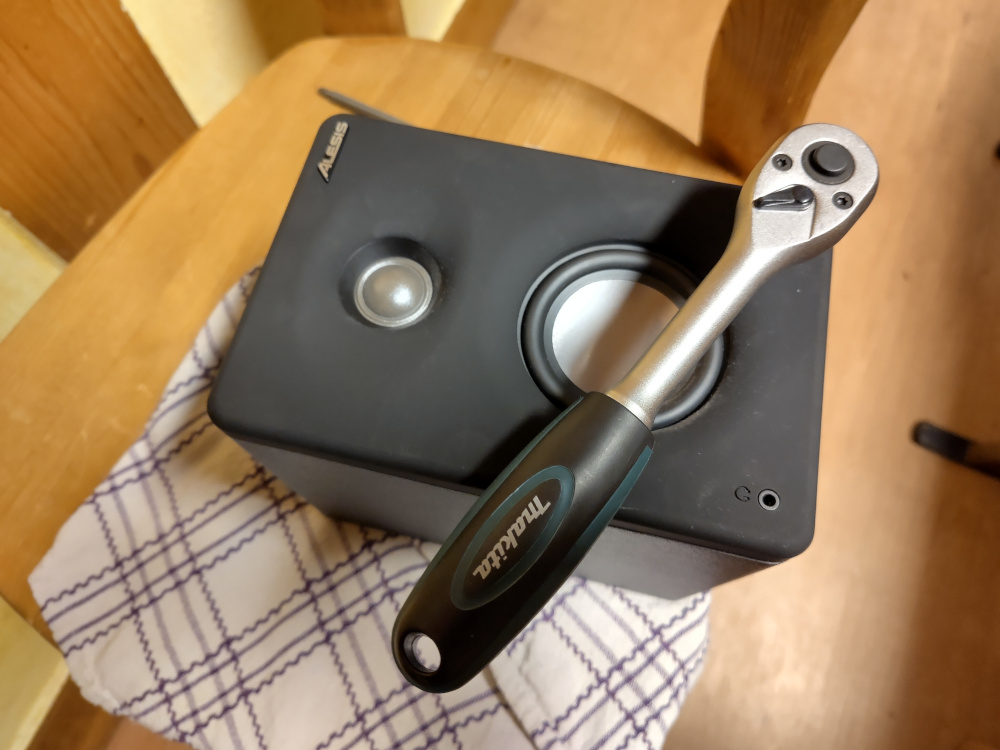
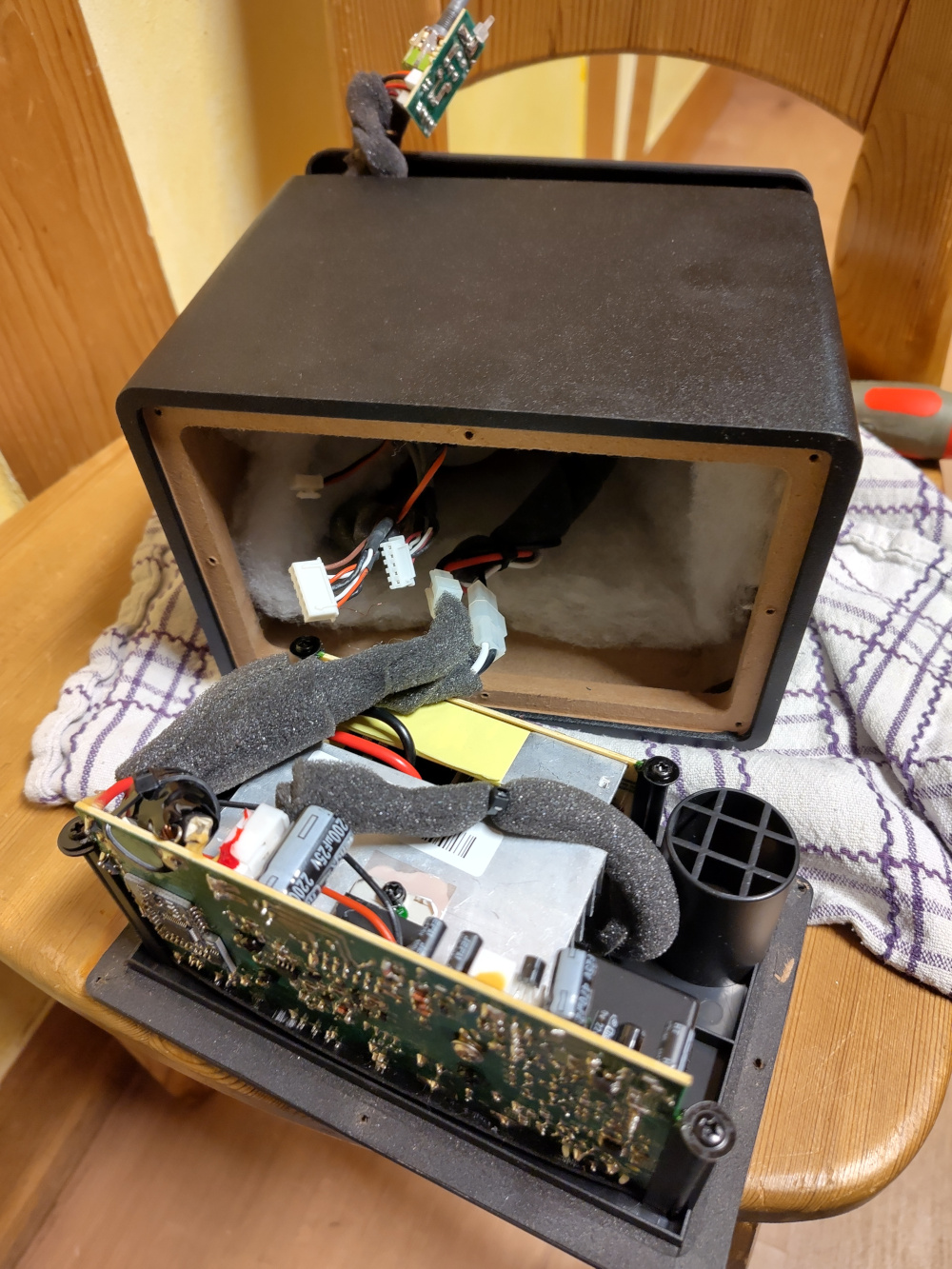
I've a set of Alesis M1Active 330 USB on my desk to listen to music. They were relatively inexpensive (~100 ), have USB and sound pretty good for their size/price. They were also sitting on my desk unused for a while, because the left speaker didn't produce any sound. Well, almost any. If you'd move the volume knob long enough you might have found a position where the left speaker would work a bit, but it'd be quieter than the right one and stop working again after some time. Pretty unacceptable when you want to listen to music. Given the right speaker was working just fine and the left would work a bit when the volume knob is moved, I was quite certain which part was to blame: the potentiometer. So just open the right speaker (it contains all the logic boards, power supply, etc), take out the broken potentiometer, buy a new one, replace, done. Sounds easy? Well, to open the speaker you gotta loosen 8 (!) screws on the back. At least it's not glued, right? Once the screws are removed you can pull out the back plate, which will bring the power supply, USB controller, sound amplifier and cables, lots of cables: two pairs of thick cables, one to each driver, one thin pair for the power switch and two sets of "WTF is this, I am not going to trace pinouts today", one with a 6 pin plug, one with a 5 pin one. Unplug all of these! Yes, they are plugged, nice. Nope, still no friggin' idea how to get to the potentiometer. If you trace the "thin pair" and "WTF1" cables, you see they go inside a small wooden box structure. So we have to pull the thing from the front? Okay, let's remove the plastic part of the knob Right, this looks like a potentiometer. Unscrew it. No, no need for a Makita wrench, I just didn't have anything else in the right size (10mm). right Alesis M1Active 330 USB speaker with a Makita wrench where the volume knob is Still, no movement. Let's look again from the inside! Oh ffs, there are six more screws inside, holding the front. Away with them! Just need a very long PH1 screwdriver. Now you can slowly remove the part of the front where the potentiometer is. Be careful, the top tweeter is mounted to the front, not the main case and so is the headphone jack, without an obvious way to detach it. But you can move away the front far enough to remove the small PCB with the potentiometer and the LED. right Alesis M1Active 330 USB speaker open Great, this was the easy part! The only thing printed on the potentiometer is "A10K". 10K is easy -- 10kOhm. A?! Wikipedia says "A" means "logarithmic", but only if made in the US or Asia. In Europe that'd be "linear". "B" in US/Asia means "linear", in Europe "logarithmic". Do I need to tap the sign again? (The sign is a print of XKCD#927.) My multimeter says in this case it's something like logarithmic. On the right channel anyway, the left one is more like a chopping board. And what's this green box at the end? Oh right, this thing also turns the power on and off. So it's a power switch. Where the fuck do I get a logarithmic 10kOhm stereo potentiometer with a power switch? And then in the exact right size too?! Of course not at any of the big German electronics pharmacies. But AliExpress saves the day, again. It's even the same color! Soldering without pulling out the cable out of the case was a bit challenging, but I've managed it and now have stereo sound again. Yay! PS: Don't operate this thing open to try it out. 230V are dangerous!

12 September 2024

Dirk Eddelbuettel: RcppArmadillo 14.0.2-1 on CRAN: Updates

armadillo image Armadillo is a powerful and expressive C++ template library for linear algebra and scientific computing. It aims towards a good balance between speed and ease of use, has a syntax deliberately close to Matlab, and is useful for algorithm development directly in C++, or quick conversion of research code into production environments. RcppArmadillo integrates this library with the R environment and language and is widely used by (currently) 1164 other packages on CRAN, downloaded 36.1 million times (per the partial logs from the cloud mirrors of CRAN), and the CSDA paper (preprint / vignette) by Conrad and myself has been cited 595 times according to Google Scholar. Conrad released two small incremental releases to version 14.0.0. We did not immediately bring these to CRAN as we have to be mindful of the desired upload cadence of once every one or two months . But as 14.0.2 has been stable for a few weeks, we now decided to bring it to CRAN. Changes since the last CRAN release are summarised below, and overall fairly minimal. On the package side, we reorder what citation() returns, and now follow CRAN requirements via Authors@R.

Changes in RcppArmadillo version 14.0.2-1 (2024-09-11)
  • Upgraded to Armadillo release 14.0.2 (Stochastic Parrot)
    • Optionally use C++20 memory alignment
    • Minor corrections for several corner-cases
  • The order of items displayed by citation() is reversed (Conrad in #449)
  • The DESCRIPTION file now uses an Authors@R field with ORCID IDs

Courtesy of my CRANberries, there is a diffstat report relative to previous release. More detailed information is on the RcppArmadillo page. Questions, comments etc should go to the rcpp-devel mailing list off the Rcpp R-Forge page. If you like this or other open-source work I do, you can sponsor me at GitHub.

This post by Dirk Eddelbuettel originated on his Thinking inside the box blog. Please report excessive re-aggregation in third-party for-profit settings.

11 September 2024

Jamie McClelland: MariaDB mystery

I keep getting an error in our backup logs:
Sep 11 05:08:03 Warning: mysqldump: Error 2013: Lost connection to server during query when dumping table  1C4Uonkwhe_options  at row: 1402
Sep 11 05:08:03 Warning: Failed to dump mysql databases ic_wp
It s a WordPress database having trouble dumping the options table. The error log has a corresponding message:
Sep 11 13:50:11 mysql007 mariadbd[580]: 2024-09-11 13:50:11 69577 [Warning] Aborted connection 69577 to db: 'ic_wp' user: 'root' host: 'localhost' (Got an error writing communication packets)
The Internet is full of suggestions, almost all of which either focus on the network connection between the client and the server or the FEDERATED plugin. We aren t using the federated plugin and this error happens when conneting via the socket. Check it out - what is better than a consistently reproducible problem! It happens if I try to select all the values in the table:
root@mysql007:~# mysql --protocol=socket -e 'select * from 1C4Uonkwhe_options' ic_wp > /dev/null
ERROR 2013 (HY000) at line 1: Lost connection to server during query
root@mysql007:~#
It happens when I specifiy one specific offset:
root@mysql007:~# mysql --protocol=socket -e 'select * from 1C4Uonkwhe_options limit 1 offset 1402' ic_wp
ERROR 2013 (HY000) at line 1: Lost connection to server during query
root@mysql007:~#
It happens if I specify the field name explicitly:
root@mysql007:~# mysql --protocol=socket -e 'select option_id,option_name,option_value,autoload from 1C4Uonkwhe_options limit 1 offset 1402' ic_wp
ERROR 2013 (HY000) at line 1: Lost connection to server during query
root@mysql007:~#
It doesn t happen if I specify the key field:
root@mysql007:~# mysql --protocol=socket -e 'select option_id from 1C4Uonkwhe_options limit 1 offset 1402' ic_wp
+-----------+
  option_id  
+-----------+
   16296351  
+-----------+
root@mysql007:~#
It does happen if I specify the value field:
root@mysql007:~# mysql --protocol=socket -e 'select option_value from 1C4Uonkwhe_options limit 1 offset 1402' ic_wp
ERROR 2013 (HY000) at line 1: Lost connection to server during query
root@mysql007:~#
It doesn t happen if I query the specific row by key field:
root@mysql007:~# mysql --protocol=socket -e 'select * from 1C4Uonkwhe_options where option_id = 16296351' ic_wp
+-----------+----------------------+--------------+----------+
  option_id   option_name            option_value   autoload  
+-----------+----------------------+--------------+----------+
   16296351   z_taxonomy_image8905                  yes       
+-----------+----------------------+--------------+----------+
root@mysql007:~#
Hm. Surely there is some funky non-printing character in that option_value right?
root@mysql007:~# mysql --protocol=socket -e 'select CHAR_LENGTH(option_value) from 1C4Uonkwhe_options where option_id = 16296351' ic_wp
+---------------------------+
  CHAR_LENGTH(option_value)  
+---------------------------+
                          0  
+---------------------------+
root@mysql007:~# mysql --protocol=socket -e 'select HEX(option_value) from 1C4Uonkwhe_options where option_id = 16296351' ic_wp
+-------------------+
  HEX(option_value)  
+-------------------+
                     
+-------------------+
root@mysql007:~#
Resetting the value to an empty value doesn t make a difference:
root@mysql007:~# mysql --protocol=socket -e 'update 1C4Uonkwhe_options set option_value = "" where option_id = 16296351' ic_wp
root@mysql007:~# mysql --protocol=socket -e 'select * from 1C4Uonkwhe_options' ic_wp > /dev/null
ERROR 2013 (HY000) at line 1: Lost connection to server during query
root@mysql007:~#
Deleting the row in question causes the error to specify a new offset:
root@mysql007:~# mysql --protocol=socket -e 'delete from 1C4Uonkwhe_options where option_id = 16296351' ic_wp
root@mysql007:~# mysql --protocol=socket -e 'select * from 1C4Uonkwhe_options' ic_wp > /dev/null
ERROR 2013 (HY000) at line 1: Lost connection to server during query
root@mysql007:~# mysqldump ic_wp > /dev/null
mysqldump: Error 2013: Lost connection to server during query when dumping table  1C4Uonkwhe_options  at row: 1401
root@mysql007:~#
If I put the record I deleted back in, we return to the old offset:
root@mysql007:~# mysql --protocol=socket -e 'insert into 1C4Uonkwhe_options VALUES(16296351,"z_taxonomy_image8905","","yes");' ic_wp 
root@mysql007:~# mysqldump ic_wp > /dev/null
mysqldump: Error 2013: Lost connection to server during query when dumping table  1C4Uonkwhe_options  at row: 1402
root@mysql007:~#
I m losing my little mind. Let s get drastic and create a whole new table, copy over the data delicately working around the deadly offset:
oot@mysql007:~# mysql --protocol=socket -e 'create table 1C4Uonkwhe_new_options like 1C4Uonkwhe_options;' ic_wp 
root@mysql007:~# mysql --protocol=socket -e 'insert into 1C4Uonkwhe_new_options select * from 1C4Uonkwhe_options limit 1402 offset 0;' ic_wp 
--- There is only 33 more records, not sure how to specify unlimited limit but 100 does the trick.
root@mysql007:~# mysql --protocol=socket -e 'insert into 1C4Uonkwhe_new_options select * from 1C4Uonkwhe_options limit 100 offset 1403;' ic_wp 
Now let s make sure all is working properly:
root@mysql007:~# mysql --protocol=socket -e 'select * from 1C4Uonkwhe_new_options' ic_wp >/dev/null;
Now let s examine which row we are missing:
root@mysql007:~# mysql --protocol=socket -e 'select option_id from 1C4Uonkwhe_options where option_id not in (select option_id from 1C4Uonkwhe_new_options) ;' ic_wp 
+-----------+
  option_id  
+-----------+
   18405297  
+-----------+
root@mysql007:~#
Wait, what? I was expecting option_id 16296351. Oh, now we are getting somewhere. And I see my mistake: when using offsets, you need to use ORDER BY or you won t get consistent results.
root@mysql007:~# mysql --protocol=socket -e 'select option_id from 1C4Uonkwhe_options order by option_id limit 1 offset 1402' ic_wp ;
+-----------+
  option_id  
+-----------+
   18405297  
+-----------+
root@mysql007:~#
Now that I have the correct row what is in it:
root@mysql007:~# mysql --protocol=socket -e 'select * from 1C4Uonkwhe_options where option_id = 18405297' ic_wp ;
ERROR 2013 (HY000) at line 1: Lost connection to server during query
root@mysql007:~#
Well, that makes a lot more sense. Let s start over with examining the value:
root@mysql007:~# mysql --protocol=socket -e 'select CHAR_LENGTH(option_value) from 1C4Uonkwhe_options where option_id = 18405297' ic_wp ;
+---------------------------+
  CHAR_LENGTH(option_value)  
+---------------------------+
                   50814767  
+---------------------------+
root@mysql007:~#
Wow, that s a lot of characters. If it were a book, it would be 35,000 pages long (I just discovered this site). It s a LONGTEXT field so it should be able to handle it. But now I have a better idea of what could be going wrong. The name of the option is rewrite_rules so it seems like something is going wrong with the generation of that option. I imagine there is some tweak I can make to allow MariaDB to cough up the value (read_buffer_size? tmp_table_size?). But I ll start with checking in with the database owner because I don t think 35,000 pages of rewrite rules is appropriate for any site.

Dirk Eddelbuettel: RcppSpdlog 0.0.18 on CRAN: Updates

Version 0.0.18 of RcppSpdlog arrived on CRAN today and has been uploaded to Debian. RcppSpdlog bundles spdlog, a wonderful header-only C++ logging library with all the bells and whistles you would want that was written by Gabi Melman, and also includes fmt by Victor Zverovich. You can learn more at the nice package documention site. This releases updates the code to the version 1.14.1 of spdlog which was released as an incremental fix to 1.14.0, and adds the ability to set log levels via the environment variable SPDLOG_LEVEL. The NEWS entry for this release follows.

Changes in RcppSpdlog version 0.0.18 (2024-09-10)
  • Upgraded to upstream release spdlog 1.14.1
  • Minor packaging upgrades
  • Allow logging levels to be set via environment variable SPDLOG_LEVEL

Courtesy of my CRANberries, there is also a diffstat report. More detailed information is on the RcppSpdlog page, or the package documention site. If you like this or other open-source work I do, you can sponsor me at GitHub.

This post by Dirk Eddelbuettel originated on his Thinking inside the box blog. Please report excessive re-aggregation in third-party for-profit settings.

Valhalla's Things: Two Linen Hoods

Posted on September 11, 2024
Tags: madeof:atoms, craft:sewing, FreeSoftWear
A woman wearing a white hood with a deep shoulder covering that ends in a point at about waist height.  The hood is not fitted, has a slight point because of the rectangular construction, and on the torso part one can see the big square gusset that gives it fullness. I ve been influenced again into feeling the need for a garment. It was again a case of multiple sources conspiring in the same direction for unrelated reasons, but I decided I absolutely needed a linen hood, made from the heavy white linen I knew I had in my stash. Why? I don t know. I do like the feeling of wearing a hood, and the white linen should give a decent protection from the sun, but I don t know how often I m going to wear these instead of just a hat. On the other hand the linen was already there and I needed something small to sew. A woman wearing a hood in the same shape, but made in tartan-print flannel.  It looks slightly smaller than the linen one. My first idea was to make a square hood: some time ago I had already made one out of some leftovers of duvet cover, vaguely inspired by the S , because I have a long-term plan of making one a bit more from scratch1. I like the fact that this pattern is completely made out of squares and rectangles, and while the flannel one is quite fitting, as suitable for a warm garment, I felt that by making it just a cm or two wider it would have worked nicely for a warm weather one, and indeed it did. A woman wearing some sort of white veil that covers the head and has two scarf-like appendages, one wrapped around the shoulders and falling on the back, and one falling on the front side, kept in place with one arm. Except, before I even started on the square hood, I started to think that the same square top would also be good for a hood-scarf, one of those long flowy garments that sit on the head, wrap around the neck and fall down, moving with the wind and the movements of the person. Because, let s be honest. worn in a way that look like a veil they feel nice, it s true. But with the help of a couple of pins then you can do this. A woman wearing what looks like a deep hood over some sort of fabric face mask, showing only the eyes, in a way that resembles characters in a video game.  There are again two scarf-like edges that fall on the front and back. And no, I ve never played that game2, and I m not even 100% sure what it is about, other than killing people, climbing buildings and petting cats3, but that s not really an issue when making a bit of casual cosplay of something, right? Anyway, should anybody feel the need to make themselves a hood or ten, the patterns have been released as usual as #FreeSoftWear: square hood and hood scarf.

  1. I m not going to raise the sheep :D I m actually not even going to wash and comb the wool, I ll start from the step just after those :D
  2. because proprietary software, because somewhat underpowered computers and other related reasons that are somewhat incidental to the game itself.
  3. at least two out of three things that make it look like a perfectly enjoyable activity.

Freexian Collaborators: Monthly report about Debian Long Term Support, August 2024 (by Roberto C. S nchez)

Like each month, have a look at the work funded by Freexian s Debian LTS offering.

Debian LTS contributors In August, 16 contributors have been paid to work on Debian LTS, their reports are available:
  • Adrian Bunk did 44.5h (out of 46.5h assigned and 53.5h from previous period), thus carrying over 55.5h to the next month.
  • Bastien Roucari s did 20.0h (out of 20.0h assigned).
  • Ben Hutchings did 9.0h (out of 0.0h assigned and 21.0h from previous period), thus carrying over 12.0h to the next month.
  • Chris Lamb did 18.0h (out of 18.0h assigned).
  • Daniel Leidert did 12.0h (out of 7.0h assigned and 5.0h from previous period).
  • Emilio Pozuelo Monfort did 22.25h (out of 6.5h assigned and 53.5h from previous period), thus carrying over 37.75h to the next month.
  • Guilhem Moulin did 17.5h (out of 8.75h assigned and 11.25h from previous period), thus carrying over 2.5h to the next month.
  • Lee Garrett did 11.5h (out of 58.0h assigned and 2.0h from previous period), thus carrying over 48.5h to the next month.
  • Markus Koschany did 40.0h (out of 40.0h assigned).
  • Ola Lundqvist did 14.5h (out of 4.0h assigned and 20.0h from previous period), thus carrying over 9.5h to the next month.
  • Roberto C. S nchez did 8.25h (out of 5.0h assigned and 7.0h from previous period), thus carrying over 3.75h to the next month.
  • Santiago Ruano Rinc n did 21.5h (out of 11.5h assigned and 10.0h from previous period).
  • Sean Whitton did 4.0h (out of 2.25h assigned and 3.75h from previous period), thus carrying over 2.0h to the next month.
  • Sylvain Beucler did 42.0h (out of 46.0h assigned and 14.0h from previous period), thus carrying over 18.0h to the next month.
  • Thorsten Alteholz did 11.0h (out of 11.0h assigned).
  • Tobias Frost did 2.5h (out of 7.75h assigned and 4.25h from previous period), thus carrying over 9.5h to the next month.

Evolution of the situation In August, we have released 1 DLAs. During the month of August Debian 11 "bullseye" officially transitioned to the responsibility of the LTS team (on 2024-08-15). However, because the final point release (11.11) was not made until 2024-08-31, LTS contributors were prevented from uploading packages to bullseye until after the point release had been made. That said, the team was not at all idle, and was busy at work on a variety of tasks which impacted both LTS and the broader Debian community, as well as preparing uploads which will be released during the month of September. Of particular note, LTS contributor Bastien Roucari s prepared updates of the putty and cacti packages for bookworm (1 2) and bullseye (1 2), which were accepted by the old-stable release managers for the August point releases. He also analysed several security regressions in the apache2 package. LTS contributor Emilio Pozuelo Monfort worked on the Rust toolchain in bookworm and bullseye, which will be needed to support the upcoming Firefox ESR and Thunderbird ESR releases from the Mozilla project. Additionally, LTS contributor Thorsten Alteholz prepared bookworm and bullseye updates of the cups package (1 2), which were accepted by the old-stable release managers for the August point releases. LTS contributor Markus Koschany collaborated with Emmanuel Bourg, co-maintainer of the tomcat packages in Debian. Regressions in a proposed security fix necessitated the updating of the tomcat10 package in Debian to the latest upstream release. LTS contributors Bastien and Santiago Ruano Rinc n collaborated with the upstream developers and the Debian maintainer (Bernhard Schmidt) of the FreeRADIUS project towards addressing the BlastRADIUS vulnerability in the bookworm and bullseye versions of the freeradius package. If you use FreeRADIUS in Debian bookworm or bullseye, we encourage you to test the packages following the instructions found in the call for testers to help identifying any possible regression that could be introduced with these updates. Testing is an important part of the work the LTS Team does, and in that vein LTS contributor Sean Whitton worked on improving the documentation and tooling around creating test filesystems which can be used for testing a variety of package update scenarios.

Thanks to our sponsors Sponsors that joined recently are in bold.

10 September 2024

Freexian Collaborators: Debian Contributions: Python 3 patches, OpenSSH GSS-API split, rebootstrap, salsa CI, etc. (by Anupa Ann Joseph)

Debian Contributions: 2024-08 Contributing to Debian is part of Freexian s mission. This article covers the latest achievements of Freexian and their collaborators. All of this is made possible by organizations subscribing to our Long Term Support contracts and consulting services.

Debian Python 3 patch review, by Stefano Rivera Last month, at DebConf, Stefano reviewed the current patch set of Debian s cPython packages with Matthias Klose, the primary maintainer until now. As a result of that review, Stefano re-reviewed the patchset, updating descriptions, etc. A few patches were able to be dropped, and a few others were forwarded upstream. One finds all sorts of skeletons doing reviews like this. One of the patches had been inactive (fortunately, because it was buggy) since the day it was applied, 13 years ago. One is a cleanup that probably only fixes a bug on HPUX, and is a result of copying code from xfree86 into Python 25 years ago. It was fixed in xfree86 a year later. Others support just Debian-specific functionality and probably never seemed worth forwarding. Or good cleanup that only really applies to Debian. A trivial new patch would allow Debian to multiarch co-install Python stable ABI dynamic extensions (like we can with regular dynamic extensions). Performance concerns are stalling it in review, at the moment.

DebConf 24 Organization, by Stefano Rivera Stefano helped organize DebConf 24, which concluded in early August. The event is run by a large entirely volunteer team. The work involved in making this happen is far too varied to describe here. While Freexian provides funding for 20% of collaborator time to spend on Debian-related work, it only covers a small fraction of contributions to time-intensive tasks like this. Since the end of the event, Stefano has been doing some work on the conference finances, and initiated the reimbursement process for travel bursaries.

Archive rebuilds on Debusine, by Stefano Rivera The recent setuptools 73 upload to Debian unstable removed the test subcommand, breaking many packages that were using python3 setup.py test in their Debian packaging. Stefano did a partial archive-rebuild using debusine.debian.net to find the regressions and file bugs. Debusine will be a powerful tool to do QA work like this for Debian in the future, but it doesn t have all the features needed to coordinate rebuild-testing, yet. They are planned to be fleshed out in the next year. In the meantime, Debusine has the building blocks to work through a queue of package building tasks and store the results, it just needs to be driven from outside the system. So, Stefano started working on a set of tools using the Debusine client API to perform archive rebuilds, found and tagged existing bugs, and filed many more.

OpenSSH GSS-API split, by Colin Watson Colin landed the first stage of the planned split of GSS-API authentication and key exchange support in Debian s OpenSSH packaging. In order to allow for smooth upgrades, the second stage will have to wait until after the Debian 13 (trixie) release; but once that s done, as upstream puts it, this substantially reduces the amount of pre-authentication attack surface exposed on your users sshd by default .

OpenSSL vs. cryptography, by Colin Watson Colin facilitated a discussion between Debian s OpenSSL team and the upstream maintainers of Python cryptography about a new incompatibility between Debian s OpenSSL packaging and cryptography s handling of OpenSSL s legacy provider, which was causing a number of build and test failures. While the issue remains open, the Debian OpenSSL maintainers have effectively reverted the change now, so it s no longer a pressing problem.

/usr-move, by Helmut Grohne There are less than 40 source packages left to move files to /usr, so what we re left with is the long tail of the transition. Rather than fix all of them, Helmut started a discussion on removing packages from unstable and filed a first batch. As libvirt is being restructured in experimental, we re handling the fallout in collaboration with its maintainer Andrea Bolognani. Since base-files validates the aliasing symlinks before upgrading, it was discovered that systemd has its own ideas with no solution as of yet. Helmut also proposed that dash checks for ineffective diversions of /bin/sh and that lintian warns about aliased files.

rebootstrap by Helmut Grohne Bootstrapping Debian for a new or existing CPU architecture still is a quite manual process. The rebootstrap project attempts to automate part of the early stage, but it still is very sensitive to changes in unstable. We had a number of fairly intrusive changes this year already. August included a little more fallout from the earlier gcc-for-host work where the C++ include search path would end up being wrong in the generated cross toolchain. A number of packages such as util-linux (twice), libxml2, libcap-ng or systemd had their stage profiles broken. e2fsprogs gained a cycle with libarchive-dev due to having gained support for creating an ext4 filesystem from a tar archive. The restructuring of glib2.0 remains an unsolved problem for now, but libxt and cdebconf should be buildable without glib2.0.

Salsa CI, by Santiago Ruano Rinc n Santiago completed the initial RISC-V support (!523) in the Salsa CI s pipeline. The main work started in July, but it was required to take into account some comments in the review (thanks to Ahmed!) and some final details in [!534]. riscv64 is the most recently supported port in Debian, which will be part of trixie. As its name suggests, the new build-riscv64 job makes it possible to test that a package successfully builds in the riscv64 architecture. The RISC-V runner (salsaci riscv64 runner 01) runs in a couple of machines generously provided by lab.rvperf.org. Debian Developers interested in running this job in their projects should enable the runner (salsaci riscv64 runner 01) in Settings / CI / Runners, and follow the instructions available at https://salsa.debian.org/salsa-ci-team/pipeline/#build-job-on-risc-v. Santiago also took part in discussions about how to optimize the build jobs and reviewed !537 to make the build-source job to only satisfy the Build-Depends and Build-Conflicts fields by Andrea Pappacoda. Thanks a lot to him!

Miscellaneous contributions
  • Stefano submitted patches for BeautifulSoup to support the latest soupsieve and lxml.
  • Stefano uploaded pypy3 7.3.17, upgrading the cPython compatibility from 3.9 to 3.10. Then ran into a GCC-14-related regression, which had to be ignored for now as it s proving hard to fix.
  • Colin released libpipeline 1.5.8 and man-db 2.13.0; the latter included foundations allowing adding an autopkgtest for man-db.
  • Colin upgraded 19 Python packages to new upstream versions (fixing 5 CVEs), fixed several other build failures, fixed a Python 3.12 compatibility issue in zope.security, and made python-nacl build reproducibly.
  • Colin tracked down test failures in python-asyncssh and Ruby resulting from certain odd /etc/hosts configurations.
  • Carles upgraded the packages python-ring-doorbell and simplemonitor to new upstream versions.
  • Carles started discussions and implementation of a tool (still in early days) named po-debconf-manager : a way for translators and reviewers to collaborate using git as a backend instead of mailing list; and submit the translations using salsa MR. More information next month.
  • Carles (dog-fooding po-debconf-manager ) reviewed debconf templates translated by a collaborator.
  • Carles reviewed and submitted the translation of apt .
  • Helmut sent 19 patches for improving cross building.
  • Helmut implemented the cross-exe-wrapper proposed by Simon McVittie for use with glib2.0.
  • Helmut detailed what it takes to make Perl s ExtUtils::PkgConfig suitable for cross building.
  • Helmut made the deletion of the root password work in debvm in all situations and implemented a test case using expect.
  • Anupa attended Debian Publicity team meeting and is moderating and posting on Debian Administrators LinkedIn group.
  • Thorsten uploaded package gutenprint to fix a FTBFS with gcc14 and package ipp-usb to fix a /usr-merge issue.
  • Santiago updated bzip2 to fix a long-standing bug that requested to include a pkg-config file. An important impact of this change is that it makes it possible to use Rust bindings for libbz2 by Sequoia, an implementation of OpenPGP.

9 September 2024

Ben Hutchings: FOSS activity in July 2024

8 September 2024

Thorsten Alteholz: My Debian Activities in August 2024

FTP master This month I accepted 441 and rejected 15 packages. The overall number of packages that got accepted was 442. I am ashamed of some occurrences that happened this month and I apologize for this. Unfortunately I have no idea how to prevent this in the future without becoming a solo entertainer. Debian LTS This was my hundred-twenty-second month that I did some work for the Debian LTS initiative, started by Raphael Hertzog at Freexian. Unfortunately Bullseye was not handed over to LTS in August. So I only prepared new packages of asterisk, libvirt and tinyproxy and will upload them next month. Last but not least I did a week of FD this month. Debian ELTS This month was the seventy-third ELTS month. During my allocated time I uploaded or worked on: I also did a week of FD. Debian Printing This month I uploaded This work is generously funded by Freexian! Debian Astro This month I uploaded a new upstream or bugfix version of: Debian Mobcom The following packages have been prepared by the GSoC student Nathan: It was so much fun working with Nathan. Unfortunately GSoC is over now, but Nathan will continue working in Debian and become a Debian Maintainer. misc This month I uploaded new upstream or bugfix versions of: I also filed an RM bug against meep-openmpi. As Adrian made me ware, this package is no longer needed.

Antonio Terceiro: gotcha: using ccache in Debian package builds

Before I upload packages to Debian, I always do a full build from source under sbuild. This ensures that the package can build from source on a clean environment, implying that the set of build dependencies is complete. But when iterating on a non-trivial package locally, I will usually build the package directly on my Debian testing system, and I want to take advantage of ccache to cache native (C/C++) code compilation to speed things up. In Debian, the easiest way to enable ccache is to add /usr/lib/ccache to your $PATH. I do this by doing something similar to the following in my ~/.bashrc:
export PATH=/usr/lib/ccache:$PATH
I noticed, however, that my Debian package builds were not using the cache. When building the same small package manually using make, the cache was used, but not when the build was wrapped with dpkg-buildpackage. I tracked it down to the fact that in compatibility level 13+, debhelper will set $HOME to a temporary directory. For what's it worth, I think that's a good thing: you don't want package builds reaching for your home directory as that makes it harder to make builds reproducible, among other things. This behavior, however, breaks ccache. The default cache directory is $HOME/.ccache, but that only gets resolved when ccache is actually used. So we end up starting with an empty cache on each build, get a 100% cache miss rate, and still pay for the overhead of populating the cache. The fix is to explicitly set $CCACHE_DIR upfront, so that by the time $HOME gets overriden, it doesn't matter anymore for ccache. I did this in my ~/.bashrc:
export CCACHE_DIR=$HOME/.ccache
This way, $HOME will be expanded right there when the shell starts, and by the time ccache is called, it will use the persistent cache in my home directory even though $HOME will, at that point, refer to a temporary directory.

Jacob Adams: Linux's Bedtime Routine

How does Linux move from an awake machine to a hibernating one? How does it then manage to restore all state? These questions led me to read way too much C in trying to figure out how this particular hardware/software boundary is navigated. This investigation will be split into a few parts, with the first one going from invocation of hibernation to synchronizing all filesystems to disk. This article has been written using Linux version 6.9.9, the source of which can be found in many places, but can be navigated easily through the Bootlin Elixir Cross-Referencer: https://elixir.bootlin.com/linux/v6.9.9/source Each code snippet will begin with a link to the above giving the file path and the line number of the beginning of the snippet.

A Starting Point for Investigation: /sys/power/state and /sys/power/disk These two system files exist to allow debugging of hibernation, and thus control the exact state used directly. Writing specific values to the state file controls the exact sleep mode used and disk controls the specific hibernation mode1. This is extremely handy as an entry point to understand how these systems work, since we can just follow what happens when they are written to.

Show and Store Functions These two files are defined using the power_attr macro: kernel/power/power.h:80
#define power_attr(_name) \
static struct kobj_attribute _name##_attr =     \
    .attr   =               \
        .name = __stringify(_name), \
        .mode = 0644,           \
     ,                  \
    .show   = _name##_show,         \
    .store  = _name##_store,        \
 
show is called on reads and store on writes. state_show is a little boring for our purposes, as it just prints all the available sleep states. kernel/power/main.c:657
/*
 * state - control system sleep states.
 *
 * show() returns available sleep state labels, which may be "mem", "standby",
 * "freeze" and "disk" (hibernation).
 * See Documentation/admin-guide/pm/sleep-states.rst for a description of
 * what they mean.
 *
 * store() accepts one of those strings, translates it into the proper
 * enumerated value, and initiates a suspend transition.
 */
static ssize_t state_show(struct kobject *kobj, struct kobj_attribute *attr,
			  char *buf)
 
	char *s = buf;
#ifdef CONFIG_SUSPEND
	suspend_state_t i;
	for (i = PM_SUSPEND_MIN; i < PM_SUSPEND_MAX; i++)
		if (pm_states[i])
			s += sprintf(s,"%s ", pm_states[i]);
#endif
	if (hibernation_available())
		s += sprintf(s, "disk ");
	if (s != buf)
		/* convert the last space to a newline */
		*(s-1) = '\n';
	return (s - buf);
 
state_store, however, provides our entry point. If the string disk is written to the state file, it calls hibernate(). This is our entry point. kernel/power/main.c:715
static ssize_t state_store(struct kobject *kobj, struct kobj_attribute *attr,
			   const char *buf, size_t n)
 
	suspend_state_t state;
	int error;
	error = pm_autosleep_lock();
	if (error)
		return error;
	if (pm_autosleep_state() > PM_SUSPEND_ON)  
		error = -EBUSY;
		goto out;
	 
	state = decode_state(buf, n);
	if (state < PM_SUSPEND_MAX)  
		if (state == PM_SUSPEND_MEM)
			state = mem_sleep_current;
		error = pm_suspend(state);
	  else if (state == PM_SUSPEND_MAX)  
		error = hibernate();
	  else  
		error = -EINVAL;
	 
 out:
	pm_autosleep_unlock();
	return error ? error : n;
 
kernel/power/main.c:688
static suspend_state_t decode_state(const char *buf, size_t n)
 
#ifdef CONFIG_SUSPEND
	suspend_state_t state;
#endif
	char *p;
	int len;
	p = memchr(buf, '\n', n);
	len = p ? p - buf : n;
	/* Check hibernation first. */
	if (len == 4 && str_has_prefix(buf, "disk"))
		return PM_SUSPEND_MAX;
#ifdef CONFIG_SUSPEND
	for (state = PM_SUSPEND_MIN; state < PM_SUSPEND_MAX; state++)  
		const char *label = pm_states[state];
		if (label && len == strlen(label) && !strncmp(buf, label, len))
			return state;
	 
#endif
	return PM_SUSPEND_ON;
 
Could we have figured this out just via function names? Sure, but this way we know for sure that nothing else is happening before this function is called.

Autosleep Our first detour is into the autosleep system. When checking the state above, you may notice that the kernel grabs the pm_autosleep_lock before checking the current state. autosleep is a mechanism originally from Android that sends the entire system to either suspend or hibernate whenever it is not actively working on anything. This is not enabled for most desktop configurations, since it s primarily for mobile systems and inverts the standard suspend and hibernate interactions. This system is implemented as a workqueue2 that checks the current number of wakeup events, processes and drivers that need to run3, and if there aren t any, then the system is put into the autosleep state, typically suspend. However, it could be hibernate if configured that way via /sys/power/autosleep in a similar manner to using /sys/power/state to manually enable hibernation. kernel/power/main.c:841
static ssize_t autosleep_store(struct kobject *kobj,
			       struct kobj_attribute *attr,
			       const char *buf, size_t n)
 
	suspend_state_t state = decode_state(buf, n);
	int error;
	if (state == PM_SUSPEND_ON
	    && strcmp(buf, "off") && strcmp(buf, "off\n"))
		return -EINVAL;
	if (state == PM_SUSPEND_MEM)
		state = mem_sleep_current;
	error = pm_autosleep_set_state(state);
	return error ? error : n;
 
power_attr(autosleep);
#endif /* CONFIG_PM_AUTOSLEEP */
kernel/power/autosleep.c:24
static DEFINE_MUTEX(autosleep_lock);
static struct wakeup_source *autosleep_ws;
static void try_to_suspend(struct work_struct *work)
 
	unsigned int initial_count, final_count;
	if (!pm_get_wakeup_count(&initial_count, true))
		goto out;
	mutex_lock(&autosleep_lock);
	if (!pm_save_wakeup_count(initial_count)  
		system_state != SYSTEM_RUNNING)  
		mutex_unlock(&autosleep_lock);
		goto out;
	 
	if (autosleep_state == PM_SUSPEND_ON)  
		mutex_unlock(&autosleep_lock);
		return;
	 
	if (autosleep_state >= PM_SUSPEND_MAX)
		hibernate();
	else
		pm_suspend(autosleep_state);
	mutex_unlock(&autosleep_lock);
	if (!pm_get_wakeup_count(&final_count, false))
		goto out;
	/*
	 * If the wakeup occurred for an unknown reason, wait to prevent the
	 * system from trying to suspend and waking up in a tight loop.
	 */
	if (final_count == initial_count)
		schedule_timeout_uninterruptible(HZ / 2);
 out:
	queue_up_suspend_work();
 
static DECLARE_WORK(suspend_work, try_to_suspend);
void queue_up_suspend_work(void)
 
	if (autosleep_state > PM_SUSPEND_ON)
		queue_work(autosleep_wq, &suspend_work);
 

The Steps of Hibernation

Hibernation Kernel Config It s important to note that most of the hibernate-specific functions below do nothing unless you ve defined CONFIG_HIBERNATION in your Kconfig4. As an example, hibernate itself is defined as the following if CONFIG_HIBERNATE is not set. include/linux/suspend.h:407
static inline int hibernate(void)   return -ENOSYS;  

Check if Hibernation is Available We begin by confirming that we actually can perform hibernation, via the hibernation_available function. kernel/power/hibernate.c:742
if (!hibernation_available())  
	pm_pr_dbg("Hibernation not available.\n");
	return -EPERM;
 
kernel/power/hibernate.c:92
bool hibernation_available(void)
 
	return nohibernate == 0 &&
		!security_locked_down(LOCKDOWN_HIBERNATION) &&
		!secretmem_active() && !cxl_mem_active();
 
nohibernate is controlled by the kernel command line, it s set via either nohibernate or hibernate=no. security_locked_down is a hook for Linux Security Modules to prevent hibernation. This is used to prevent hibernating to an unencrypted storage device, as specified in the manual page kernel_lockdown(7). Interestingly, either level of lockdown, integrity or confidentiality, locks down hibernation because with the ability to hibernate you can extract bascially anything from memory and even reboot into a modified kernel image. secretmem_active checks whether there is any active use of memfd_secret, and if so it prevents hibernation. memfd_secret returns a file descriptor that can be mapped into a process but is specifically unmapped from the kernel s memory space. Hibernating with memory that not even the kernel is supposed to access would expose that memory to whoever could access the hibernation image. This particular feature of secret memory was apparently controversial, though not as controversial as performance concerns around fragmentation when unmapping kernel memory (which did not end up being a real problem). cxl_mem_active just checks whether any CXL memory is active. A full explanation is provided in the commit introducing this check but there s also a shortened explanation from cxl_mem_probe that sets the relevant flag when initializing a CXL memory device. drivers/cxl/mem.c:186
* The kernel may be operating out of CXL memory on this device,
* there is no spec defined way to determine whether this device
* preserves contents over suspend, and there is no simple way
* to arrange for the suspend image to avoid CXL memory which
* would setup a circular dependency between PCI resume and save
* state restoration.

Check Compression The next check is for whether compression support is enabled, and if so whether the requested algorithm is enabled. kernel/power/hibernate.c:747
/*
 * Query for the compression algorithm support if compression is enabled.
 */
if (!nocompress)  
	strscpy(hib_comp_algo, hibernate_compressor, sizeof(hib_comp_algo));
	if (crypto_has_comp(hib_comp_algo, 0, 0) != 1)  
		pr_err("%s compression is not available\n", hib_comp_algo);
		return -EOPNOTSUPP;
	 
 
The nocompress flag is set via the hibernate command line parameter, setting hibernate=nocompress. If compression is enabled, then hibernate_compressor is copied to hib_comp_algo. This synchronizes the current requested compression setting (hibernate_compressor) with the current compression setting (hib_comp_algo). Both values are character arrays of size CRYPTO_MAX_ALG_NAME (128 in this kernel). kernel/power/hibernate.c:50
static char hibernate_compressor[CRYPTO_MAX_ALG_NAME] = CONFIG_HIBERNATION_DEF_COMP;
/*
 * Compression/decompression algorithm to be used while saving/loading
 * image to/from disk. This would later be used in 'kernel/power/swap.c'
 * to allocate comp streams.
 */
char hib_comp_algo[CRYPTO_MAX_ALG_NAME];
hibernate_compressor defaults to lzo if that algorithm is enabled, otherwise to lz4 if enabled5. It can be overwritten using the hibernate.compressor setting to either lzo or lz4. kernel/power/Kconfig:95
choice
	prompt "Default compressor"
	default HIBERNATION_COMP_LZO
	depends on HIBERNATION
config HIBERNATION_COMP_LZO
	bool "lzo"
	depends on CRYPTO_LZO
config HIBERNATION_COMP_LZ4
	bool "lz4"
	depends on CRYPTO_LZ4
endchoice
config HIBERNATION_DEF_COMP
	string
	default "lzo" if HIBERNATION_COMP_LZO
	default "lz4" if HIBERNATION_COMP_LZ4
	help
	  Default compressor to be used for hibernation.
kernel/power/hibernate.c:1425
static const char * const comp_alg_enabled[] =  
#if IS_ENABLED(CONFIG_CRYPTO_LZO)
	COMPRESSION_ALGO_LZO,
#endif
#if IS_ENABLED(CONFIG_CRYPTO_LZ4)
	COMPRESSION_ALGO_LZ4,
#endif
 ;
static int hibernate_compressor_param_set(const char *compressor,
		const struct kernel_param *kp)
 
	unsigned int sleep_flags;
	int index, ret;
	sleep_flags = lock_system_sleep();
	index = sysfs_match_string(comp_alg_enabled, compressor);
	if (index >= 0)  
		ret = param_set_copystring(comp_alg_enabled[index], kp);
		if (!ret)
			strscpy(hib_comp_algo, comp_alg_enabled[index],
				sizeof(hib_comp_algo));
	  else  
		ret = index;
	 
	unlock_system_sleep(sleep_flags);
	if (ret)
		pr_debug("Cannot set specified compressor %s\n",
			 compressor);
	return ret;
 
static const struct kernel_param_ops hibernate_compressor_param_ops =  
	.set    = hibernate_compressor_param_set,
	.get    = param_get_string,
 ;
static struct kparam_string hibernate_compressor_param_string =  
	.maxlen = sizeof(hibernate_compressor),
	.string = hibernate_compressor,
 ;
We then check whether the requested algorithm is supported via crypto_has_comp. If not, we bail out of the whole operation with EOPNOTSUPP. As part of crypto_has_comp we perform any needed initialization of the algorithm, loading kernel modules and running initialization code as needed6.

Grab Locks The next step is to grab the sleep and hibernation locks via lock_system_sleep and hibernate_acquire. kernel/power/hibernate.c:758
sleep_flags = lock_system_sleep();
/* The snapshot device should not be opened while we're running */
if (!hibernate_acquire())  
	error = -EBUSY;
	goto Unlock;
 
First, lock_system_sleep marks the current thread as not freezable, which will be important later7. It then grabs the system_transistion_mutex, which locks taking snapshots or modifying how they are taken, resuming from a hibernation image, entering any suspend state, or rebooting.

The GFP Mask The kernel also issues a warning if the gfp mask is changed via either pm_restore_gfp_mask or pm_restrict_gfp_mask without holding the system_transistion_mutex. GFP flags tell the kernel how it is permitted to handle a request for memory. include/linux/gfp_types.h:12
 * GFP flags are commonly used throughout Linux to indicate how memory
 * should be allocated.  The GFP acronym stands for get_free_pages(),
 * the underlying memory allocation function.  Not every GFP flag is
 * supported by every function which may allocate memory.
In the case of hibernation specifically we care about the IO and FS flags, which are reclaim operators, ways the system is permitted to attempt to free up memory in order to satisfy a specific request for memory. include/linux/gfp_types.h:176
 * Reclaim modifiers
 * -----------------
 * Please note that all the following flags are only applicable to sleepable
 * allocations (e.g. %GFP_NOWAIT and %GFP_ATOMIC will ignore them).
 *
 * %__GFP_IO can start physical IO.
 *
 * %__GFP_FS can call down to the low-level FS. Clearing the flag avoids the
 * allocator recursing into the filesystem which might already be holding
 * locks.
gfp_allowed_mask sets which flags are permitted to be set at the current time. As the comment below outlines, preventing these flags from being set avoids situations where the kernel needs to do I/O to allocate memory (e.g. read/writing swap8) but the devices it needs to read/write to/from are not currently available. kernel/power/main.c:24
/*
 * The following functions are used by the suspend/hibernate code to temporarily
 * change gfp_allowed_mask in order to avoid using I/O during memory allocations
 * while devices are suspended.  To avoid races with the suspend/hibernate code,
 * they should always be called with system_transition_mutex held
 * (gfp_allowed_mask also should only be modified with system_transition_mutex
 * held, unless the suspend/hibernate code is guaranteed not to run in parallel
 * with that modification).
 */
static gfp_t saved_gfp_mask;
void pm_restore_gfp_mask(void)
 
	WARN_ON(!mutex_is_locked(&system_transition_mutex));
	if (saved_gfp_mask)  
		gfp_allowed_mask = saved_gfp_mask;
		saved_gfp_mask = 0;
	 
 
void pm_restrict_gfp_mask(void)
 
	WARN_ON(!mutex_is_locked(&system_transition_mutex));
	WARN_ON(saved_gfp_mask);
	saved_gfp_mask = gfp_allowed_mask;
	gfp_allowed_mask &= ~(__GFP_IO   __GFP_FS);
 

Sleep Flags After grabbing the system_transition_mutex the kernel then returns and captures the previous state of the threads flags in sleep_flags. This is used later to remove PF_NOFREEZE if it wasn t previously set on the current thread. kernel/power/main.c:52
unsigned int lock_system_sleep(void)
 
	unsigned int flags = current->flags;
	current->flags  = PF_NOFREEZE;
	mutex_lock(&system_transition_mutex);
	return flags;
 
EXPORT_SYMBOL_GPL(lock_system_sleep);
include/linux/sched.h:1633
#define PF_NOFREEZE		0x00008000	/* This thread should not be frozen */
Then we grab the hibernate-specific semaphore to ensure no one can open a snapshot or resume from it while we perform hibernation. Additionally this lock is used to prevent hibernate_quiet_exec, which is used by the nvdimm driver to active its firmware with all processes and devices frozen, ensuring it is the only thing running at that time9. kernel/power/hibernate.c:82
bool hibernate_acquire(void)
 
	return atomic_add_unless(&hibernate_atomic, -1, 0);
 

Prepare Console The kernel next calls pm_prepare_console. This function only does anything if CONFIG_VT_CONSOLE_SLEEP has been set. This prepares the virtual terminal for a suspend state, switching away to a console used only for the suspend state if needed. kernel/power/console.c:130
void pm_prepare_console(void)
 
	if (!pm_vt_switch())
		return;
	orig_fgconsole = vt_move_to_console(SUSPEND_CONSOLE, 1);
	if (orig_fgconsole < 0)
		return;
	orig_kmsg = vt_kmsg_redirect(SUSPEND_CONSOLE);
	return;
 
The first thing is to check whether we actually need to switch the VT kernel/power/console.c:94
/*
 * There are three cases when a VT switch on suspend/resume are required:
 *   1) no driver has indicated a requirement one way or another, so preserve
 *      the old behavior
 *   2) console suspend is disabled, we want to see debug messages across
 *      suspend/resume
 *   3) any registered driver indicates it needs a VT switch
 *
 * If none of these conditions is present, meaning we have at least one driver
 * that doesn't need the switch, and none that do, we can avoid it to make
 * resume look a little prettier (and suspend too, but that's usually hidden,
 * e.g. when closing the lid on a laptop).
 */
static bool pm_vt_switch(void)
 
	struct pm_vt_switch *entry;
	bool ret = true;
	mutex_lock(&vt_switch_mutex);
	if (list_empty(&pm_vt_switch_list))
		goto out;
	if (!console_suspend_enabled)
		goto out;
	list_for_each_entry(entry, &pm_vt_switch_list, head)  
		if (entry->required)
			goto out;
	 
	ret = false;
out:
	mutex_unlock(&vt_switch_mutex);
	return ret;
 
There is an explanation of the conditions under which a switch is performed in the comment above the function, but we ll also walk through the steps here. Firstly we grab the vt_switch_mutex to ensure nothing will modify the list while we re looking at it. We then examine the pm_vt_switch_list. This list is used to indicate the drivers that require a switch during suspend. They register this requirement, or the lack thereof, via pm_vt_switch_required. kernel/power/console.c:31
/**
 * pm_vt_switch_required - indicate VT switch at suspend requirements
 * @dev: device
 * @required: if true, caller needs VT switch at suspend/resume time
 *
 * The different console drivers may or may not require VT switches across
 * suspend/resume, depending on how they handle restoring video state and
 * what may be running.
 *
 * Drivers can indicate support for switchless suspend/resume, which can
 * save time and flicker, by using this routine and passing 'false' as
 * the argument.  If any loaded driver needs VT switching, or the
 * no_console_suspend argument has been passed on the command line, VT
 * switches will occur.
 */
void pm_vt_switch_required(struct device *dev, bool required)
Next, we check console_suspend_enabled. This is set to false by the kernel parameter no_console_suspend, but defaults to true. Finally, if there are any entries in the pm_vt_switch_list, then we check to see if any of them require a VT switch. Only if none of these conditions apply, then we return false. If a VT switch is in fact required, then we move first the currently active virtual terminal/console10 (vt_move_to_console) and then the current location of kernel messages (vt_kmsg_redirect) to the SUSPEND_CONSOLE. The SUSPEND_CONSOLE is the last entry in the list of possible consoles, and appears to just be a black hole to throw away messages. kernel/power/console.c:16
#define SUSPEND_CONSOLE	(MAX_NR_CONSOLES-1)
Interestingly, these are separate functions because you can use TIOCL_SETKMSGREDIRECT (an ioctl11) to send kernel messages to a specific virtual terminal, but by default its the same as the currently active console. The locations of the previously active console and the previous kernel messages location are stored in orig_fgconsole and orig_kmsg, to restore the state of the console and kernel messages after the machine wakes up again. Interestingly, this means orig_fgconsole also ends up storing any errors, so has to be checked to ensure it s not less than zero before we try to do anything with the kernel messages on both suspend and resume. drivers/tty/vt/vt_ioctl.c:1268
/* Perform a kernel triggered VT switch for suspend/resume */
static int disable_vt_switch;
int vt_move_to_console(unsigned int vt, int alloc)
 
	int prev;
	console_lock();
	/* Graphics mode - up to X */
	if (disable_vt_switch)  
		console_unlock();
		return 0;
	 
	prev = fg_console;
	if (alloc && vc_allocate(vt))  
		/* we can't have a free VC for now. Too bad,
		 * we don't want to mess the screen for now. */
		console_unlock();
		return -ENOSPC;
	 
	if (set_console(vt))  
		/*
		 * We're unable to switch to the SUSPEND_CONSOLE.
		 * Let the calling function know so it can decide
		 * what to do.
		 */
		console_unlock();
		return -EIO;
	 
	console_unlock();
	if (vt_waitactive(vt + 1))  
		pr_debug("Suspend: Can't switch VCs.");
		return -EINTR;
	 
	return prev;
 
Unlike most other locking functions we ve seen so far, console_lock needs to be careful to ensure nothing else is panicking and needs to dump to the console before grabbing the semaphore for the console and setting a couple flags.

Panics Panics are tracked via an atomic integer set to the id of the processor currently panicking. kernel/printk/printk.c:2649
/**
 * console_lock - block the console subsystem from printing
 *
 * Acquires a lock which guarantees that no consoles will
 * be in or enter their write() callback.
 *
 * Can sleep, returns nothing.
 */
void console_lock(void)
 
	might_sleep();
	/* On panic, the console_lock must be left to the panic cpu. */
	while (other_cpu_in_panic())
		msleep(1000);
	down_console_sem();
	console_locked = 1;
	console_may_schedule = 1;
 
EXPORT_SYMBOL(console_lock);
kernel/printk/printk.c:362
/*
 * Return true if a panic is in progress on a remote CPU.
 *
 * On true, the local CPU should immediately release any printing resources
 * that may be needed by the panic CPU.
 */
bool other_cpu_in_panic(void)
 
	return (panic_in_progress() && !this_cpu_in_panic());
 
kernel/printk/printk.c:345
static bool panic_in_progress(void)
 
	return unlikely(atomic_read(&panic_cpu) != PANIC_CPU_INVALID);
 
kernel/printk/printk.c:350
/* Return true if a panic is in progress on the current CPU. */
bool this_cpu_in_panic(void)
 
	/*
	 * We can use raw_smp_processor_id() here because it is impossible for
	 * the task to be migrated to the panic_cpu, or away from it. If
	 * panic_cpu has already been set, and we're not currently executing on
	 * that CPU, then we never will be.
	 */
	return unlikely(atomic_read(&panic_cpu) == raw_smp_processor_id());
 
console_locked is a debug value, used to indicate that the lock should be held, and our first indication that this whole virtual terminal system is more complex than might initially be expected. kernel/printk/printk.c:373
/*
 * This is used for debugging the mess that is the VT code by
 * keeping track if we have the console semaphore held. It's
 * definitely not the perfect debug tool (we don't know if _WE_
 * hold it and are racing, but it helps tracking those weird code
 * paths in the console code where we end up in places I want
 * locked without the console semaphore held).
 */
static int console_locked;
console_may_schedule is used to see if we are permitted to sleep and schedule other work while we hold this lock. As we ll see later, the virtual terminal subsystem is not re-entrant, so there s all sorts of hacks in here to ensure we don t leave important code sections that can t be safely resumed.

Disable VT Switch As the comment below lays out, when another program is handling graphical display anyway, there s no need to do any of this, so the kernel provides a switch to turn the whole thing off. Interestingly, this appears to only be used by three drivers, so the specific hardware support required must not be particularly common.
drivers/gpu/drm/omapdrm/dss
drivers/video/fbdev/geode
drivers/video/fbdev/omap2
drivers/tty/vt/vt_ioctl.c:1308
/*
 * Normally during a suspend, we allocate a new console and switch to it.
 * When we resume, we switch back to the original console.  This switch
 * can be slow, so on systems where the framebuffer can handle restoration
 * of video registers anyways, there's little point in doing the console
 * switch.  This function allows you to disable it by passing it '0'.
 */
void pm_set_vt_switch(int do_switch)
 
	console_lock();
	disable_vt_switch = !do_switch;
	console_unlock();
 
EXPORT_SYMBOL(pm_set_vt_switch);
The rest of the vt_switch_console function is pretty normal, however, simply allocating space if needed to create the requested virtual terminal and then setting the current virtual terminal via set_console.

Virtual Terminal Set Console With set_console, we begin (as if we haven t been already) to enter the madness that is the virtual terminal subsystem. As mentioned previously, modifications to its state must be made very carefully, as other stuff happening at the same time could create complete messes. All this to say, calling set_console does not actually perform any work to change the state of the current console. Instead it indicates what changes it wants and then schedules that work. drivers/tty/vt/vt.c:3153
int set_console(int nr)
 
	struct vc_data *vc = vc_cons[fg_console].d;
	if (!vc_cons_allocated(nr)   vt_dont_switch  
		(vc->vt_mode.mode == VT_AUTO && vc->vc_mode == KD_GRAPHICS))  
		/*
		 * Console switch will fail in console_callback() or
		 * change_console() so there is no point scheduling
		 * the callback
		 *
		 * Existing set_console() users don't check the return
		 * value so this shouldn't break anything
		 */
		return -EINVAL;
	 
	want_console = nr;
	schedule_console_callback();
	return 0;
 
The check for vc->vc_mode == KD_GRAPHICS is where most end-user graphical desktops will bail out of this change, as they re in graphics mode and don t need to switch away to the suspend console. vt_dont_switch is a flag used by the ioctls11 VT_LOCKSWITCH and VT_UNLOCKSWITCH to prevent the system from switching virtual terminal devices when the user has explicitly locked it. VT_AUTO is a flag indicating that automatic virtual terminal switching is enabled12, and thus deliberate switching to a suspend terminal is not required. However, if you do run your machine from a virtual terminal, then we indicate to the system that we want to change to the requested virtual terminal via the want_console variable and schedule a callback via schedule_console_callback. drivers/tty/vt/vt.c:315
void schedule_console_callback(void)
 
	schedule_work(&console_work);
 
console_work is a workqueue2 that will execute the given task asynchronously.

Console Callback drivers/tty/vt/vt.c:3109
/*
 * This is the console switching callback.
 *
 * Doing console switching in a process context allows
 * us to do the switches asynchronously (needed when we want
 * to switch due to a keyboard interrupt).  Synchronization
 * with other console code and prevention of re-entrancy is
 * ensured with console_lock.
 */
static void console_callback(struct work_struct *ignored)
 
	console_lock();
	if (want_console >= 0)  
		if (want_console != fg_console &&
		    vc_cons_allocated(want_console))  
			hide_cursor(vc_cons[fg_console].d);
			change_console(vc_cons[want_console].d);
			/* we only changed when the console had already
			   been allocated - a new console is not created
			   in an interrupt routine */
		 
		want_console = -1;
	 
...
console_callback first looks to see if there is a console change wanted via want_console and then changes to it if it s not the current console and has been allocated already. We do first remove any cursor state with hide_cursor. drivers/tty/vt/vt.c:841
static void hide_cursor(struct vc_data *vc)
 
	if (vc_is_sel(vc))
		clear_selection();
	vc->vc_sw->con_cursor(vc, false);
	hide_softcursor(vc);
 
A full dive into the tty driver is a task for another time, but this should give a general sense of how this system interacts with hibernation.

Notify Power Management Call Chain kernel/power/hibernate.c:767
pm_notifier_call_chain_robust(PM_HIBERNATION_PREPARE, PM_POST_HIBERNATION)
This will call a chain of power management callbacks, passing first PM_HIBERNATION_PREPARE and then PM_POST_HIBERNATION on startup or on error with another callback. kernel/power/main.c:98
int pm_notifier_call_chain_robust(unsigned long val_up, unsigned long val_down)
 
	int ret;
	ret = blocking_notifier_call_chain_robust(&pm_chain_head, val_up, val_down, NULL);
	return notifier_to_errno(ret);
 
The power management notifier is a blocking notifier chain, which means it has the following properties. include/linux/notifier.h:23
 *	Blocking notifier chains: Chain callbacks run in process context.
 *		Callouts are allowed to block.
The callback chain is a linked list with each entry containing a priority and a function to call. The function technically takes in a data value, but it is always NULL for the power management chain. include/linux/notifier.h:49
struct notifier_block;
typedef	int (*notifier_fn_t)(struct notifier_block *nb,
			unsigned long action, void *data);
struct notifier_block  
	notifier_fn_t notifier_call;
	struct notifier_block __rcu *next;
	int priority;
 ;
The head of the linked list is protected by a read-write semaphore. include/linux/notifier.h:65
struct blocking_notifier_head  
	struct rw_semaphore rwsem;
	struct notifier_block __rcu *head;
 ;
Because it is prioritized, appending to the list requires walking it until an item with lower13 priority is found to insert the current item before. kernel/notifier.c:252
/*
 *	Blocking notifier chain routines.  All access to the chain is
 *	synchronized by an rwsem.
 */
static int __blocking_notifier_chain_register(struct blocking_notifier_head *nh,
					      struct notifier_block *n,
					      bool unique_priority)
 
	int ret;
	/*
	 * This code gets used during boot-up, when task switching is
	 * not yet working and interrupts must remain disabled.  At
	 * such times we must not call down_write().
	 */
	if (unlikely(system_state == SYSTEM_BOOTING))
		return notifier_chain_register(&nh->head, n, unique_priority);
	down_write(&nh->rwsem);
	ret = notifier_chain_register(&nh->head, n, unique_priority);
	up_write(&nh->rwsem);
	return ret;
 
kernel/notifier.c:20
/*
 *	Notifier chain core routines.  The exported routines below
 *	are layered on top of these, with appropriate locking added.
 */
static int notifier_chain_register(struct notifier_block **nl,
				   struct notifier_block *n,
				   bool unique_priority)
 
	while ((*nl) != NULL)  
		if (unlikely((*nl) == n))  
			WARN(1, "notifier callback %ps already registered",
			     n->notifier_call);
			return -EEXIST;
		 
		if (n->priority > (*nl)->priority)
			break;
		if (n->priority == (*nl)->priority && unique_priority)
			return -EBUSY;
		nl = &((*nl)->next);
	 
	n->next = *nl;
	rcu_assign_pointer(*nl, n);
	trace_notifier_register((void *)n->notifier_call);
	return 0;
 
Each callback can return one of a series of options. include/linux/notifier.h:18
#define NOTIFY_DONE		0x0000		/* Don't care */
#define NOTIFY_OK		0x0001		/* Suits me */
#define NOTIFY_STOP_MASK	0x8000		/* Don't call further */
#define NOTIFY_BAD		(NOTIFY_STOP_MASK 0x0002)
						/* Bad/Veto action */
When notifying the chain, if a function returns STOP or BAD then the previous parts of the chain are called again with PM_POST_HIBERNATION14 and an error is returned. kernel/notifier.c:107
/**
 * notifier_call_chain_robust - Inform the registered notifiers about an event
 *                              and rollback on error.
 * @nl:		Pointer to head of the blocking notifier chain
 * @val_up:	Value passed unmodified to the notifier function
 * @val_down:	Value passed unmodified to the notifier function when recovering
 *              from an error on @val_up
 * @v:		Pointer passed unmodified to the notifier function
 *
 * NOTE:	It is important the @nl chain doesn't change between the two
 *		invocations of notifier_call_chain() such that we visit the
 *		exact same notifier callbacks; this rules out any RCU usage.
 *
 * Return:	the return value of the @val_up call.
 */
static int notifier_call_chain_robust(struct notifier_block **nl,
				     unsigned long val_up, unsigned long val_down,
				     void *v)
 
	int ret, nr = 0;
	ret = notifier_call_chain(nl, val_up, v, -1, &nr);
	if (ret & NOTIFY_STOP_MASK)
		notifier_call_chain(nl, val_down, v, nr-1, NULL);
	return ret;
 
Each of these callbacks tends to be quite driver-specific, so we ll cease discussion of this here.

Sync Filesystems The next step is to ensure all filesystems have been synchronized to disk. This is performed via a simple helper function that times how long the full synchronize operation, ksys_sync takes. kernel/power/main.c:69
void ksys_sync_helper(void)
 
	ktime_t start;
	long elapsed_msecs;
	start = ktime_get();
	ksys_sync();
	elapsed_msecs = ktime_to_ms(ktime_sub(ktime_get(), start));
	pr_info("Filesystems sync: %ld.%03ld seconds\n",
		elapsed_msecs / MSEC_PER_SEC, elapsed_msecs % MSEC_PER_SEC);
 
EXPORT_SYMBOL_GPL(ksys_sync_helper);
ksys_sync wakes and instructs a set of flusher threads to write out every filesystem, first their inodes15, then the full filesystem, and then finally all block devices, to ensure all pages are written out to disk. fs/sync.c:87
/*
 * Sync everything. We start by waking flusher threads so that most of
 * writeback runs on all devices in parallel. Then we sync all inodes reliably
 * which effectively also waits for all flusher threads to finish doing
 * writeback. At this point all data is on disk so metadata should be stable
 * and we tell filesystems to sync their metadata via ->sync_fs() calls.
 * Finally, we writeout all block devices because some filesystems (e.g. ext2)
 * just write metadata (such as inodes or bitmaps) to block device page cache
 * and do not sync it on their own in ->sync_fs().
 */
void ksys_sync(void)
 
	int nowait = 0, wait = 1;
	wakeup_flusher_threads(WB_REASON_SYNC);
	iterate_supers(sync_inodes_one_sb, NULL);
	iterate_supers(sync_fs_one_sb, &nowait);
	iterate_supers(sync_fs_one_sb, &wait);
	sync_bdevs(false);
	sync_bdevs(true);
	if (unlikely(laptop_mode))
		laptop_sync_completion();
 
It follows an interesting pattern of using iterate_supers to run both sync_inodes_one_sb and then sync_fs_one_sb on each known filesystem16. It also calls both sync_fs_one_sb and sync_bdevs twice, first without waiting for any operations to complete and then again waiting for completion17. When laptop_mode is enabled the system runs additional filesystem synchronization operations after the specified delay without any writes. mm/page-writeback.c:111
/*
 * Flag that puts the machine in "laptop mode". Doubles as a timeout in jiffies:
 * a full sync is triggered after this time elapses without any disk activity.
 */
int laptop_mode;
EXPORT_SYMBOL(laptop_mode);
However, when running a filesystem synchronization operation, the system will add an additional timer to schedule more writes after the laptop_mode delay. We don t want the state of the system to change at all while performing hibernation, so we cancel those timers. mm/page-writeback.c:2198
/*
 * We're in laptop mode and we've just synced. The sync's writes will have
 * caused another writeback to be scheduled by laptop_io_completion.
 * Nothing needs to be written back anymore, so we unschedule the writeback.
 */
void laptop_sync_completion(void)
 
	struct backing_dev_info *bdi;
	rcu_read_lock();
	list_for_each_entry_rcu(bdi, &bdi_list, bdi_list)
		del_timer(&bdi->laptop_mode_wb_timer);
	rcu_read_unlock();
 
As a side note, the ksys_sync function is simply called when the system call sync is used. fs/sync.c:111
SYSCALL_DEFINE0(sync)
 
	ksys_sync();
	return 0;
 

The End of Preparation With that the system has finished preparations for hibernation. This is a somewhat arbitrary cutoff, but next the system will begin a full freeze of userspace to then dump memory out to an image and finally to perform hibernation. All this will be covered in future articles!
  1. Hibernation modes are outside of scope for this article, see the previous article for a high-level description of the different types of hibernation.
  2. Workqueues are a mechanism for running asynchronous tasks. A full description of them is a task for another time, but the kernel documentation on them is available here: https://www.kernel.org/doc/html/v6.9/core-api/workqueue.html 2
  3. This is a bit of an oversimplification, but since this isn t the main focus of this article this description has been kept to a higher level.
  4. Kconfig is Linux s build configuration system that sets many different macros to enable/disable various features.
  5. Kconfig defaults to the first default found
  6. Including checking whether the algorithm is larval? Which appears to indicate that it requires additional setup, but is an interesting choice of name for such a state.
  7. Specifically when we get to process freezing, which we ll get to in the next article in this series.
  8. Swap space is outside the scope of this article, but in short it is a buffer on disk that the kernel uses to store memory not current in use to free up space for other things. See Swap Management for more details.
  9. The code for this is lengthy and tangential, thus it has not been included here. If you re curious about the details of this, see kernel/power/hibernate.c:858 for the details of hibernate_quiet_exec, and drivers/nvdimm/core.c:451 for how it is used in nvdimm.
  10. Annoyingly this code appears to use the terms console and virtual terminal interchangeably.
  11. ioctls are special device-specific I/O operations that permit performing actions outside of the standard file interactions of read/write/seek/etc. 2
  12. I m not entirely clear on how this flag works, this subsystem is particularly complex.
  13. In this case a higher number is higher priority.
  14. Or whatever the caller passes as val_down, but in this case we re specifically looking at how this is used in hibernation.
  15. An inode refers to a particular file or directory within the filesystem. See Wikipedia for more details.
  16. Each active filesystem is registed with the kernel through a structure known as a superblock, which contains references to all the inodes contained within the filesystem, as well as function pointers to perform the various required operations, like sync.
  17. I m including minimal code in this section, as I m not looking to deep dive into the filesystem code at this time.

4 September 2024

Reproducible Builds: Reproducible Builds in August 2024

Welcome to the August 2024 report from the Reproducible Builds project! Our reports attempt to outline what we ve been up to over the past month, highlighting news items from elsewhere in tech where they are related. As ever, if you are interested in contributing to the project, please visit our Contribute page on our website. Table of contents:
  1. LWN: The history, status, and plans for reproducible builds
  2. Intermediate Autotools build artifacts removed from PostgreSQL distribution tarballs
  3. Distribution news
  4. Mailing list news
  5. diffoscope
  6. Website updates
  7. Upstream patches
  8. Reproducibility testing framework

LWN: The history, status, and plans for reproducible builds The free software newspaper of record, Linux Weekly News, published an in-depth article based on Holger Levsen s talk, Reproducible Builds: The First Eleven Years which was presented at the recent DebConf24 conference in Busan, South Korea. Titled The history, status, and plans for reproducible builds and written by Jake Edge, LWN s article not only summarises Holger s talk and clarifies its message but it links to external information as well. Holger s original talk can also be watched on the DebConf24 webpage (direct .webm link and his HTML slides are available also). There are also a significant number of comments on LWN s page as well. Holger Levsen also headed a scheduled discussion session at DebConf24 on Preserving *other* build artifacts addressing a topic where a number of Debian packages are (or would like to) produce results that are neither the .deb files, the build logs nor the logs of CI tests. This is an issue for reproducible builds as this 4th type of build artifact are typically shipped within the binary .deb packages, and are invariably non-deterministic; thus making the .deb files unreproducible. (A direct .webm link and HTML slides are available).

Intermediate Autotools build artifacts removed from PostgreSQL distribution tarballs Peter Eisentraut wrote a detailed blog post on the subject of The new PostgreSQL 17 make dist . Like many projects, the PostgreSQL database has previously pre-built parts of its GNU Autotools build system: the reason for this is a mix of convenience and traditional practice . Peter astutely notes that this arrangement in the build system is quite tricky as:
You need to carefully maintain the different states of clean source code , partially built source code , and fully built source code , and the commands to transition between them.
However, Peter goes on to mention that:
a lot more attention is nowadays paid to the software supply chain. There are security and legal reasons for this. When users install software, they want to know where it came from, and they want to be sure that they got the right thing, not some fake version or some version of dubious legal provenance.
And cites the XZ Utils backdoor as a reason to care about transparent and reproducible ways of distributing and communicating a source tarball and provenance. Because of this, intermediate build artifacts are now henceforth essentially disallowed from PostgreSQL distribution tarballs.

Distribution news In Debian this month, 30 reviews of Debian packages were added, 17 were updated and 10 were removed this month adding to our knowledge about identified issues. One issue type was added by Chris Lamb, too. [ ] In addition, an issue was filed to update the Salsa CI pipeline (used by 1,000s of Debian packages) to no longer test for reproducibility with reprotest s build_path variation. Holger Levsen provided a rationale for this change in the issue, which has already been made to the tests being performed by tests.reproducible-builds.org.
In Arch Linux this month, Jelle van der Waa published a short blog post on the topic of Investigating creating reproducible images with mkosi, motivated by the desire to make it possible for anyone to re-recreate the official Arch cloud image bit-by-bit identical on their own machine as per [the] reproducible builds definition. In addition, Jelle filed a patch for pacman, the Arch Linux package manager, to respect the SOURCE_DATE_EPOCH environment variable when installing a package.
In openSUSE news, Bernhard M. Wiedemann published another report for that distribution.
In Android news, the IzzyOnDroid project added 49 new rebuilder recipes and now features 256 total reproducible applications representing 21% of the total offerings in the repository. IzzyOnDroid is an F-Droid style repository for Android apps[:] applications in this repository are official binaries built by the original application developers, taken from their resp. repositories (mostly GitHub).

Mailing list news From our mailing list this month:
  • Bernhard M. Wiedemann posted a brief message to the list with some helpful information regarding nondeterminism within Rust binaries, positing the use of the codegen-units = 16 default and resulting in a bug being filed in the Rust issue tracker. [ ]
  • Bernhard also wrote to the list, following up to a thread in November 2023, on attempts to make the LibreOffice suite of office applications build reproducibly. In the thread from this month, Bernhard could announce that the four patches previously mentioned have landed in LibreOffice upstream.
  • Fay Stegerman linked the mailing list to a thread she made on the Signal issue tracker regarding whether device-specific binaries [can] ever be considered meaningfully reproducible . In particular: the whole part about allow[ing] multiple third parties to come to a consensus on a correct result breaks down completely when correct is device-specific and not something everyone can agree on. [ ]
  • Developer kpcyrd posted an update for source code indexing project, whatsrc.org. Announcing that it now importing packages from live-bootstrap ( a usable Linux system [that is] created with only human-auditable, and wherever possible, human-written, source code ) into its database of provenance data.
  • Lastly, Mechtilde Stehmann posted an update to an earlier thread about how Java builds are not reproducible on the armhf architecture, enquiring how they might gain temporary access to such a machine in order to perform some deeper testing. [ ]

diffoscope diffoscope is our in-depth and content-aware diff utility that can locate and diagnose reproducibility issues. This month, Chris Lamb released versions 274, 275, 276 and 277, uploaded these to Debian, and made the following changes as well:
  • New features:
    • Strip ANSI escapes usually colour codes from the output of the Procyon Java decompiler. [ ]
    • Factor out a method for stripping ANSI escapes. [ ]
    • Append output from dumppdf(1) in more cases, avoiding situations where we fallback to a binary diff. [ ]
    • Add support for versions of Perl s IO::Compress::Zip version 2.212. [ ]
  • Bug fixes:
    • Also catch RuntimeError exceptions when importing the PyPDF library so that it, or, crucially, its transitive dependencies, cannot not cause diffoscope to traceback at runtime and build time. [ ]
    • Do not call marshal.load( ) of precompiled Python bytecode as it, alas, inherently unsafe. Replace for now with a brief summary of the code section of .pyc. [ ][ ]
    • Don t include excessive debug output when calling dumppdf(1). [ ]
  • Testsuite-related changes:
    • Don t bother to check version number in test_python.py: the fixture for this test is fixed. [ ][ ]
    • Update test_zip text fixtures and definitions to support new changes to the Perl IO::Compress library. [ ]
In addition, Mattia Rizzolo updated the available architectures for a number of test dependencies [ ] and Sergei Trofimovich fixed an issue to avoid diffoscope crashing when hashing directory symlinks [ ] and Vagrant Cascadian proposed GNU Guix updates for diffoscope versions 275 and 276 and 277.

Website updates There were a rather substantial number of improvements made to our website this month, including:
  • Alba Herrerias:
    • Substantially extend the guidance on the Contribute page. [ ]
  • Chris Lamb:
    • Set the future: true configuration value so we render all files and documents in the website, regardless of whether they have a date property in the future. After all, we don t re-generate the website on a timer, and have other ways of making unpublished, draft posts. [ ][ ]
  • Fay Stegerman:
  • hulkoba:
  • kpcyrd:
  • Mattia Rizzolo:
  • Pol Dellaiera:

Upstream patches The Reproducible Builds project detects, dissects and attempts to fix as many currently-unreproducible packages as possible. We endeavour to send all of our patches upstream where appropriate. This month, we wrote a large number of such patches, including:

Reproducibility testing framework The Reproducible Builds project operates a comprehensive testing framework running primarily at tests.reproducible-builds.org in order to check packages and other artifacts for reproducibility. In August, a number of changes were made by Holger Levsen, including:
  • Temporarily install the openssl-provider-legacy package for the Debian unstable environments for running diffoscope due to Debian bug #1078944. [ ][ ][ ][ ]
  • Mark Debian armhf architecture nodes as being down due to proxy down. [ ][ ]
  • Detect proxy failures. [ ][ ][ ]
  • Run the index-buildinfo for the builtin-pho script with the -q switch. [ ]
  • Disable all Arch Linux reproducible jobs. [ ]
In addition, Mattia Rizzolo updated the website configuration to install the ruby-jekyll-sitemap package as it is now used in the website [ ], Roland Clobus updated the script to build Debian live images to treat openQA issues as warnings [ ], and Vagrant Cascadian marked the cbxi4b node as down [ ].

If you are interested in contributing to the Reproducible Builds project, please visit our Contribute page on our website. However, you can get in touch with us via:

Jonathan Dowland: loading (unintended consequences?)

For their 30th anniversary (ish; the Covid pandemic pushed the date out a bit) British electronic music duo Orbital released the compilation 30 something. The track list mostly looks like a best hits list, which given their prior compilation celebrating 20 years looks much the same would appear superfluous. However, they ve rearranged and re-recorded all their songs for 30, to reflect their live arrangements. The reworkings are sufficiently distinct from the original versions (in some cases I prefer them) and elevate the release. The couple of new tracks are also fun, and many of the remixes on the second disc are worth a listen too.
cover art from Orbital - 30 Something
But what I actually sat down to write about was the cover artwork. They often have designs which riff on the notion of a circle (given their name) and the 30-something art (both for the album and single takes from it) adapts a loading spinner-like device from computing (I suppose it mostly closely resembles the spinner from macOS). A possibly unintended effect of the pattern occurs when you view it on a display which is adjusting its brightness, such as if you re listening to it on a phone, the screen is off, and you pick it up. The brightest part of the spinner is visible first, and the rest fade into visibility in sequence. The first time you see this is unexpected and very cool. (I've tried to recreate it in the picture below, but I don't think it's worked.) Although I've suffixed the titled of this post unintended consequences?, It's quite possible this was deliberate.
screenshot of the artwork displayed on my phone
I ve got the pattern on a t-shirt and my kids love to call out Daddy s loading! In my convalescence it s taken on a special sort of resonance because at times I ve felt I m in a holding state: waiting for an appointment to be made; waiting a polite interval before chasing an appointment; waiting for treatment to start after attending an appointment. Thankfully I m at the end of that now, I hope.

2 September 2024

Gunnar Wolf: Free and open source software and other market failures

This post is a review for Computing Reviews for Free and open source software and other market failures , a article published in Communications of the ACM
Understanding the free and open-source software (FOSS) movement has, since its beginning, implied crossing many disciplinary boundaries. This article describes FOSS s history, explaining its undeniable success throughout the 1990s, and why the movement today feels in a way as if it were on autopilot, lacking the steam it once had. The author presents several examples of different industries where, as it happened with FOSS in computing, fundamental innovations happened not because the leading companies of each field are attentive to customers needs, but to a certain degree, despite them not even considering those needs, it is typically due to the hubris that comes from being a market leader. Kemp exemplifies his hypothesis by presenting the messy landscape of the commercial, mutually incompatible systems of Unix in the 1980s. Different companies had set out to implement their particular flavor of open Unix computers, but with clear examples of vendor lock-in techniques. He speculates that, if we had been able to buy a reasonably priced and solid Unix for our 32-bit PCs nobody would be running FreeBSD or Linux today, except possibly as an obscure hobby. He states that the FOSS movement was born out of the utter market failure of the different Unix vendors. The focus of the article shifts then to the FOSS movement itself: 25 years ago, as FOSS systems slowly gained acceptance and then adoption in the serious market and at the center of the dot-com boom of the early 2000s, Linux user groups (LUGs) with tens of thousands of members bloomed throughout the world; knowing this history, why have all but a few of them vanished into oblivion? Kemp suggests that the strength and vitality that LUGs had ultimately reflects the anger that prompted technical users to take the situation into their own hands and fix it; once the software industry was forced to change, the strongly cohesive FOSS movement diluted. The frustrations and anger of [information technology, IT] in 2024, Kamp writes, are entirely different from those of 1991. As an example, the author closes by citing the difficulty of maintaining despite having the resources to do so an aging legacy codebase that needs to continue working year after year.

1 September 2024

Colin Watson: Free software activity in August 2024

All but about four hours of my Debian contributions this month were sponsored by Freexian. (I ended up going a bit over my 20% billing limit this month.) You can also support my work directly via Liberapay. man-db and friends I released libpipeline 1.5.8 and man-db 2.13.0. Since autopkgtests are great for making sure we spot regressions caused by changes in dependencies, I added one to man-db that runs the upstream tests against the installed package. This required some preparatory work upstream, but otherwise was surprisingly easy to do. OpenSSH I fixed the various 9.8 regressions I mentioned last month: socket activation, libssh2, and Twisted. There were a few other regressions reported too: TCP wrappers support, openssh-server-udeb, and xinetd were all broken by changes related to the listener/per-session binary split, and I fixed all of those. Once all that had made it through to testing, I finally uploaded the first stage of my plan to split out GSS-API support: there are now openssh-client-gssapi and openssh-server-gssapi packages in unstable, and if you use either GSS-API authentication or key exchange then you should install the corresponding package in order for upgrades to trixie+1 to work correctly. I ll write a release note once this has reached testing. Multiple identical results from getaddrinfo I expect this is really a bug in a chroot creation script somewhere, but I haven t been able to track down what s causing it yet. My sbuild chroots, and apparently Lucas Nussbaum s as well, have an /etc/hosts that looks like this:
$ cat /var/lib/schroot/chroots/sid-amd64/etc/hosts
127.0.0.1       localhost
127.0.1.1       [...]
127.0.0.1       localhost ip6-localhost ip6-loopback
The last line clearly ought to be ::1 rather than 127.0.0.1; but things mostly work anyway, since most code doesn t really care which protocol it uses to talk to localhost. However, a few things try to set up test listeners by calling getaddrinfo("localhost", ...) and binding a socket for each result. This goes wrong if there are duplicates in the resulting list, and the test output is typically very confusing: it looks just like what you d see if a test isn t tearing down its resources correctly, which is a much more common thing for a test suite to get wrong, so it took me a while to spot the problem. I ran into this in both python-asyncssh (#1052788, upstream PR) and Ruby (ruby3.1/#1069399, ruby3.2/#1064685, ruby3.3/#1077462, upstream PR). The latter took a while since Ruby isn t one of my languages, but hey, I ve tackled much harder side quests. I NMUed ruby3.1 for this since it was showing up as a blocker for openssl testing migration, but haven t done the other active versions (yet, anyway). OpenSSL vs. cryptography I tend to care about openssl migrating to testing promptly, since openssh uploads have a habit of getting stuck on it otherwise. Debian s OpenSSL packaging recently split out some legacy code (cryptography that s no longer considered a good idea to use, but that s sometimes needed for compatibility) to an openssl-legacy-provider package, and added a Recommends on it. Most users install Recommends, but package build processes don t; and the Python cryptography package requires this code unless you set the CRYPTOGRAPHY_OPENSSL_NO_LEGACY=1 environment variable, which caused a bunch of packages that build-depend on it to fail to build. After playing whack-a-mole setting that environment variable in a few packages build process, I decided I didn t want to be caught in the middle here and filed an upstream issue to see if I could get Debian s OpenSSL team and cryptography s upstream talking to each other directly. There was some moderately spirited discussion and the issue remains open, but for the time being the OpenSSL team has effectively reverted the change so it s no longer a pressing problem. GCC 14 regressions Continuing from last month, I fixed build failures in pccts (NMU) and trn4. Python team I upgraded alembic, automat, gunicorn, incremental, referencing, pympler (fixing compatibility with Python >= 3.10), python-aiohttp, python-asyncssh (fixing CVE-2023-46445, CVE-2023-46446, and CVE-2023-48795), python-avro, python-multidict (fixing a build failure with GCC 14), python-tokenize-rt, python-zipp, pyupgrade, twisted (fixing CVE-2024-41671 and CVE-2024-41810), zope.exceptions, zope.interface, zope.proxy, zope.security, and zope.testrunner to new upstream versions. In the process, I added myself to Uploaders for zope.interface; I m reasonably comfortable with the Zope Toolkit and I seem to be gradually picking up much of its maintenance in Debian. A few of these required their own bits of yak-shaving: I improved some Multi-Arch: foreign tagging (python-importlib-metadata, python-typing-extensions, python-zipp). I fixed build failures in pipenv, python-stdlib-list, psycopg3, and sen, and fixed autopkgtest failures in autoimport (upstream PR), python-semantic-release and rstcheck. Upstream for zope.file (not in Debian) filed an issue about a test failure with Python 3.12, which I tracked down to a Python 3.12 compatibility PR in zope.security. I made python-nacl build reproducibly (upstream PR). I moved aliased files from / to /usr in timekpr-next (#1073722). Installer team I applied a patch from Ubuntu to make os-prober support building with the noudeb profile (#983325).

Russ Allbery: Review: Reasons Not to Worry

Review: Reasons Not to Worry, by Brigid Delaney
Publisher: Harper
Copyright: 2022
Printing: October 2023
ISBN: 0-06-331484-3
Format: Kindle
Pages: 295
Reasons Not to Worry is a self-help non-fiction book about stoicism, focusing specifically on quotes from Seneca, Epictetus, and Marcus Aurelius. Brigid Delaney is a long-time Guardian columnist who has written on a huge variety of topics, including (somewhat relevantly to this book) her personal experiences trying weird fads. Stoicism is having a moment among the sort of men who give people life advice in podcast form. Ryan Holiday, a former marketing executive, has made a career out of being the face of stoicism in everyone's podcast feed (and, of course, hosting his own). He is far from alone. If you pay attention to anyone in the male self-help space right now (Cal Newport, in my case), you have probably heard something vague about the "wisdom of the stoics." Given that the core of stoicism is easily interpreted as a strategy for overcoming your emotions with logic, this isn't surprising. Philosophies that lean heavily on college dorm room logic, discount emotion, and argue that society is full of obvious flaws that can be analyzed and debunked by one dude with some blog software and a free afternoon have been very popular in tech circles for the past ten to fifteen years, and have spread to some extent into popular culture. Intriguingly, though, stoicism is a system of virtue ethics, which means it is historically in opposition to consequentialist philosophies like utilitarianism, the ethical philosophy behind effective altruism and other related Silicon Valley fads. I am pretty exhausted with the whole genre of men talking to each other about how to live a better life Cal Newport by himself more than satisfies the amount of that I want to absorb but I was still mildly curious about stoicism. My education didn't provide me with a satisfying grounding in major historical philosophical movements, so I occasionally look around for good introductions. Stoicism also has some reputation as an anxiety-reduction technique, and I could use more of those. When I saw a Discord recommendation for Reasons Not to Worry that specifically mentioned its lack of bro perspective, I figured I'd give it a shot. Reasons Not to Worry is indeed not a bro book, although I would have preferred fewer appearances of the author's friend Andrew, whose opinions on stoicism I could not possibly care less about. What it is, though, is a shallow and credulous book that falls squarely in the middle of the lightweight self-help genre. Delaney is here to explain why stoicism is awesome and to convince you that a school of Greek and Roman philosophers knew exactly how you should think about your life today. If this sounds quasi-religious, well, I'll get to that. Delaney does provide a solid introduction to stoicism that I think is a bit more approachable than reading the relevant Wikipedia article. In her presentation, the core of stoicism is the practice of four virtues: wisdom, courage, moderation, and justice. The modern definition of "stoic" as someone who is impassive in the presence of pleasure or pain is somewhat misleading, but Delaney does emphasize a goal of ataraxia, or tranquility of mind. By making that the goal rather than joy or pleasure, stoicism tries to avoid the trap of the hedonic treadmill in favor of a more achievable persistent contentment. As an aside, some quick Internet research makes me doubt Delaney's summary here. Other material about stoicism I found focuses on apatheia and associates ataraxia with Epicureanism instead. But I won't start quibbling with Delaney's definitions; I'm not qualified and this review is already too long. The key to ataraxia, in Delaney's summary of stoicism, is to focus only on those parts of life we can control. She summarizes those as our character, how we treat others, and our actions and reactions. Everything else wealth, the esteem of our colleagues, good health, good fortune is at least partly outside of our control, and therefore we should enjoy it when we have it but try to be indifferent to whether it will last. Attempting to control things that are outside of our control is doomed to failure and will disturb our tranquility. Essentially all of this book is elaborations and variations on this theme, specialized to some specific area of life like social media, anxiety, or grief and written in the style of a breezy memoir. If you're familiar with modern psychological treatment frameworks like cognitive behavioral therapy or acceptance and commitment therapy, this summary of stoicism may sound familiar. (Apparently this is not an accident; the predecessor to CBT used stoicism as a philosophical basis.) Stoicism, like those treatment approaches, tries to refocus your attention on the things that you can improve and de-emphasizes the things outside of your control. This is a lot of the appeal, at least to me (and I think to Delaney as well). Hearing that definition, you may have some questions. Why those virtues specifically? They sound good, but all virtues sound good almost by definition. Is there any measure of your success in following those virtues outside your subjective feeling of ataraxia? Does the focus on only things you can control lead to ignoring problems only mostly outside of your control, where your actions would matter but only to a small degree? Doesn't this whole philosophy sound a little self-centered? What do non-stoic virtue ethics look like, and why do they differ from stoicism? What is the consequentialist critique of stoicism? This is where the shortcomings of this book become clear: Delaney is not very interested in questions like this. There are sections on some of those topics, particularly the relationship between stoicism and social justice, but her treatment is highly unsatisfying. She raises the question, talks about her doubts about stoicism's applicability, and then says that, after further thought, she decided stoicism is entirely consistent with social justice and the stoics were right after all. There is a little bit more explanation than that, but not much. Stoicism can apparently never be wrong; it can only be incompletely understood. Self-help books often fall short here, and I suspect this may be what the audience wants. Part of the appeal of the self-help genre is artificial certainty. Becoming a better manager, starting a business, becoming more productive, or working out an entire life philosophy are not problems amenable to a highly approachable and undemanding book. We all know that at some level, but the seductive allure of the self-help genre is the promise of simplifying complex problems down to a few approachable bullet points. Here is a life philosophy in a neatly packaged form, and if you just think deeply about its core principles, you will find they can be applied to any situation and any doubts you were harboring will turn out to be incorrect. I am all too familiar with this pattern because it's also how fundamentalist Christianity works. The second time Delaney talked about her doubts about the applicability of stoicism and then claimed a few pages later that those doubts disappeared with additional thought and discussion, my radar went off. This book was sounding less like a thoughtful examination of one specific philosophy out of many and more like the soothing adoption of religious certainty by a convert. I was therefore entirely unsurprised when Delaney all but says outright in the epilogue that she's adopted stoicism as her religion and approaches it with the same dedicated practice that she used to bring to Catholicism. I think this is where a lot of self-help books end up, although most of them don't admit it. There's nothing wrong with this, to be clear. It sounds like she was looking for a non-theistic religion, found one that she liked, and is excited to tell other people about it. But it's a profound mismatch with what I was looking for in an introduction to stoicism. I wanted context, history, and a frank discussion of the problems with adopting philosophy to everyday issues. I also wanted some acknowledgment that it is highly unlikely that a few men who lived 2000 years ago in a wildly different social context, and with drastically limited information about cultures other than their own, figured out a foolproof recipe for how to approach life. The subsequent two millennia of philosophical debates prove that stoicism didn't end the argument, and that a lot of other philosophers thought that stoicism got a few things wrong. You would never know that from this book. What I wanted is outside the scope of this sort of undemanding self-help book, though, and this is the problem that I keep having with philosophy. The books I happen across are either nigh-incomprehensibly dense and academic, or they're simplified into catechism. This was the latter. That's probably more the fault of my reading selection than it is the fault of the book, but it was still annoying. What I will say for this book, and what I suspect may be the most useful property of self-help books in general, is that it prompts you to think about basic stoic principles without getting in the way of your thoughts. It's like background music for the brain: nothing Delaney wrote was very thorny or engaging, but she kept quietly and persistently repeating the basic stoic formula and turning my thoughts back to it. Some of those thoughts may have been useful? As a source of prompts for me to ponder, Reasons Not to Worry was therefore somewhat successful. The concept of not trying to control things outside of my control is simple but valid, and it probably didn't hurt me to spend a week thinking about it. "It kind of works as an undemanding meditation aid" is not a good enough reason for me to recommend this book, but maybe that's what someone else is looking for. Rating: 5 out of 10

31 August 2024

Vincent Bernat: Fixing layout shifts caused by web fonts

In 2020, Google introduced Core Web Vitals metrics to measure some aspects of real-world user experience on the web. This blog has consistently achieved good scores for two of these metrics: Largest Contentful Paint and Interaction to Next Paint. However, optimizing the third metric, Cumulative Layout Shift, which measures unexpected layout changes, has been more challenging. Let s face it: optimizing for this metric is not really useful for a site like this one. But getting a better score is always a good distraction. To prevent the flash of invisible text when using web fonts, developers should set the font-display property to swap in @font-face rules. This method allows browsers to initially render text using a fallback font, then replace it with the web font after loading. While this improves the LCP score, it causes content reflow and layout shifts if the fallback and web fonts are not metrically compatible. These shifts negatively affect the CLS score. CSS provides properties to address this issue by overriding font metrics when using fallback fonts: size-adjust, ascent-override, descent-override, and line-gap-override. Two comprehensive articles explain each property and their computation methods in detail: Creating Perfect Font Fallbacks in CSS and Improved font fallbacks.

Interactive tuning tool Instead of computing each property from font average metrics, I put together a tool for interactively tuning fallback fonts.1

Instructions
  1. Load your custom font.
  2. Select a fallback font to tune.
  3. Adjust the size-adjust property to match the width of your custom font with the fallback font. With a proportional font, it is not possible to achieve a perfect match.
  4. Fine-tune the ascent-override property. Aim to align the final dot of the last paragraph while monitoring the font s baseline. For more precise adjustment, disable the option.
  5. Modify the descent-override property. The goal is to make the two boxes match. You may need to alternate between this and the previous property for optimal results.
  6. If necessary, adjust the line-gap-override property. This step is typically not required.
The process needs to be repeated for each fallback font. Some platforms may not include certain fonts. Notably, Android lacks most fonts found in other operating systems. It replaces Georgia with Noto Serif, which is not metrically-compatible.

Tool

This tool is not available from the Atom feed.

Results For the body text of this blog, I get the following CSS definition:
@font-face  
  font-family: Merriweather;
  font-style: normal;
  font-weight: 400;
  src: url("../fonts/merriweather.woff2") format("woff2");
  font-display: swap;
 
@font-face  
  font-family: "Fallback for Merriweather";
  src: local("Noto Serif"), local("Droid Serif");
  size-adjust: 98.3%;
  ascent-override: 99%;
  descent-override: 27%;
 
@font-face  
  font-family: "Fallback for Merriweather";
  src: local("Georgia");
  size-adjust: 106%;
  ascent-override: 90.4%;
  descent-override: 27.3%;
 
font-family: Merriweather, "Fallback for Merriweather", serif;
After a month, the CLS metric improved to 0:
Core Web Vitals scores for vincent.bernat.ch showing all 6 metrics as green. Notably the Cumulative Layout Shift is 0.
Recent Core Web Vitals scores for vincent.bernat.ch

About custom fonts Using safe web fonts or a modern font stack is often simpler. However, I prefer custom web fonts. Merriweather and Iosevka, which are used in this blog, enhance the reading experience. An alternative approach could be to use Georgia as a serif option. Unfortunately, most default monospace fonts are ugly. Furthermore, paragraphs that combine proportional and monospace fonts can create visual disruption. This occurs due to mismatched vertical metrics or weights. To address this issue, I adjust Iosevka s metrics and weight to align with Merriweather s characteristics.

  1. Similar tools already exist, like the Fallback Font Generator, but they were missing a few features, such as the ability to load the fallback font or to have decimals for the CSS properties. And no source code.

30 August 2024

Sahil Dhiman: Debconf24 Busan

DebConf24 was held in Busan, South Korea, from July 28th to August 4th 2024 and preceded by DebCamp from July 21st to July 27th. This was my second IRL DebConf (DC) and fourth one in total. I started in Debian with a DebConf, so its always an occasion when one happens. This year again, I worked in fundraising team, working to raise funds from International sponsors. We did manage to raise good enough funding, albeit less than budgeted. Though, the local Korean team was able to connect and gather many Governmental sponsors, which was quite surprising for me. I wasn t seriously considering attending DebConf until I discussed this with Nilesh. More or less, his efforts helped push me through the whole process. Thanks, Nilesh, for this. In March, I got my passport and started preparing documents for South Korean visa. It did require quite a lot of paper work but seeing South Korea s s fresh passport visa rejection rate, I had doubts about visa acceptance. The visa finally got approved, which could be attributed to great documentation and help from DebConf visa team. This was also my first trip outside India, and this being to DebConf made many things easy. Most stuff were documented on DebConf website and wiki. Asking some query got immediate responses from someone in the DebConf channels. We then booked a direct flight from Delhi, reaching Seoul in the morning. With good directions from Sourab TK who had reached Seoul a few hours earlier, we quickly got Korean Won, local SIM and T Money card (transportation card) and headed towards Seoul by AREX, airport metro. We spent the next two days exploring Seoul, which is huge. It probably has the highest number of skyscrapers I have ever seen. The city has a good mix of modern and ancient culture. We explored various places in Seoul including Gyeongbokgung Palace, Statue of King Sejong, Bukchon Hanok village, N Seoul Tower and various food markets which were amazing. A Street in Seoul
A Street in Seoul
Next, we headed to Busan for DebConf using KTX (Korean high speed rail). (Fun fact, slogan for City of Busan is Busan is Good .) South Korea has a good network of frequently running high speed trains. We had pre-booked our tickets because, despite the frequency, trains were sold out most of the time. KTX ride was quite smooth, despite travelling at 300 Kmph at times through Korean countryside and long mountain tunnels. View from Dorm Room
PKNU Entrance
The venue for DebConf was Pukyong National University (PKNU), Daeyeon Campus. PKNU had two campuses in the Busan and some folks ended up in wrong campus too. With good help and guidance from the front desk, we got our dormitory rooms assigned. Dorms here were quite different, ie: View from Dorm Room
View from Dorm Room
Settling in was easy. We started meeting familiar folks after almost a year. The long conversations started again. Everyone was excited for DebConf. Like everytime, the first day was full of action (and chaos). Meet and greet, volunteers check in, video team running around and fixing stuff and things working (or not). There were some interesting talks and sponsors stalls. After day one, things more or less settled down. I again volunteered for video team stuff and helped in camera operations and talk directions, which is always fun. As the tradition applies, saw few talks live on stream too sitting in the dorm room during the conf, which is always fun, when too tired to get ready and go out. From Talk Director's chair
From Talk Director's chair
DebConf takes care of food needs for vegan/vegetarianism folks well, of which I m one. I got to try different food items, which was quite an experience. Tried using chopsticks again which didn t work, which I later figured that handling metal ones were more difficult. We had late night ramens and wooden chopsticks worked perfectly. One of the days, we even went out to an Indian restaurant to have some desi aloo paratha, paneer dishes, samosas and chai (milk tea). I wasn t particularly craving desi food but wasn t able to get something according to my taste so went there. As usual Bits from DPL talk was packed
As usual Bits from DPL talk was packed
For day trip, I went to Ulsan. San means mountains in Korean. Ulsan is a port city with many industries including Hyundai car factory, petrochemical industry, paint industry, ship building etc. We saw bamboo forest, Ulsan tower (quite a view towards Ulsan port), whale village, Ulsan Onggi Museum and the sea (which was beautiful). The beautiful sea
The beautiful sea

View from Ulsan Bridge Observatory
Amongst the sponsors, I was most interested in our network sponsors, folks who were National research and education networks (NREN) here. We had two network sponsors, KOREN and KREONET, thanks to efforts by local team. Initially it was discussed that they ll provide 20G uplink each, so 40G in total, which was whopping but by the time the closing talk happened, we got to know we had 200G uplink to the Internet. This was a massive update to last year when we had 1G main and 100M backup link. 200G wasn t what is required, but it was massive capacity and IIRC from the talk, we peaked at around 500M in usage, but it s always fun to have astronomical amount of bandwidth for bragging rights ;) Various mascots in attendance
Various mascots in attendance

Video and Network stats. Screengrab from closing ceremony
Now let s talk about things I found interesting about South Korea in general: Gyeongbokgung Palace Entrance Gyeongbokgung Palace Entrance Gyeongbokgung Palace Entrance
Grand Gyeongbokgung Palace, Seoul

Starfield Library
Starfield Library, Seoul
If one has to get the whole DebConf experience, it s better to attend DebCamp as well because that s when you can sit and interact with everyone better. As DebConf starts, everyone gets busy in various talks and events and things take a pace. DebConf days literally fly. This year, attending DebConf in person was a different experience. Attending DebConf without any organizational work/stress so was better, and I was able to understand working of different Debian team and workflows better while also identified a few where I would like to join and help. A general conclusion was that almost all Debian teams needs more folks to help out. So if someone want to join, they can probably reach out to the team, and would be able to onboard new folks. Though this would require some patience. Kudos to the Korean team who were able to pull off this event under this tight timeline and thanks for all the hospitality. DebConf24 Group Photo

DebConf24 Group Photo. Click to enlarge.
Credits - Aigars Mahinovs
This whole experience expanded my world view. There s so much to see and explore and understand. Looking forward to DebConf25 in Brest, France. PS - Shoutout to abbyck (aka hamCK)!

29 August 2024

Michael Ablassmeier: proxmox backup S3 proxy

A few weeks ago Tiziano Bacocco started a small project to implement a (golang) proxy that allows to store proxmox backups on S3 compatible storage: pmoxs3backuproxy, a feature which the current backup server does not have. I wanted to have a look at the Proxmox Backup Server implementation for a while, so i jumped on the wagon and helped with adding most of the API endpoints required to seamlessly use it as drop-in replacement in PVE. The current version can be configured as storage backend in PVE. You can then schedule your backups to the S3 storage likewise. It now supports both the Fixed index format required to create virtual machine backups and the Dynamic index format, used by the regular proxmox-backup-client for file and container backups. (full and incremental) The other endpoints like adding notes, removing or protecting backups, mounting images using the PVE frontend (or proxmox-backup-client) work too. It comes with a garbage collector that does prune the backup storage if snapshots expire and runs integrity checks on the data. You can also configure it as so called remote storage in the Proxmox Backup server itself and pull back complete buckets using proxmox-backup-manager pull , if your local datastore crashes. I think it will become more interesting if future proxmox versions will allow to push backups to other stores, too.

27 August 2024

Russ Allbery: Review: Dark Horse

Review: Dark Horse, by Michelle Diener
Series: Class 5 #1
Publisher: Eclipse
Copyright: June 2015
ISBN: 0-9924559-3-6
Format: Kindle
Pages: 366
Dark Horse is a science fiction romance novel, the first of a five book series as of this writing. It is self-published, although it is sufficiently well-edited and packaged that I had to do some searching to confirm that. Rose was abducted by aliens. The Tecrans picked her up along with a selection of Earth animals, kept her in a cell in their starship, and experimented on her. As the book opens, she has managed to make her escape with the aid of an AI named Sazo who was also imprisoned on the Tecran ship. Sazo dealt with the Tecrans, dropped the ship in the middle of Grih territory, and then got Rose and most of the animals on shuttles to a nearby planet. Dav Jallan is the commander of the ship the Grih sent to investigate the unexplained appearance of a Class 5 Tecran warship in the middle of their territory. The Grih and the Tecran, along with three other species, are members of the United Council, which means in theory they're all at peace. With the Tecran, that theory is often strained. Dav is not going to turn down one of their highly-advanced Class 5 warships delivered to him on a silver platter. There is only the matter of the unexpected cargo, the first orange dots (indicating unknown life forms) that most of the Grih have ever seen. There is a romance. That romance did not work for me. I thought it was highly unprofessional on Dav's part and a bit too obviously constructed on the author's part. It also leans on the subgenre convention that aliens can be remarkably physically similar and sexually compatible, which always causes problems for my suspension of disbelief even though I know it's no less plausible than faster-than-light travel. Despite that, I had so much fun with this book! It was absolutely delightful and weirdly grabby in a way that caught me by surprise. I was skimming some parts of it to write this review and found myself re-reading multiple pages before I dragged myself back on task. I think the most charming part of this book is that the United Council has a law called the Sentient Beings Agreement that makes what the Tecran were doing extremely illegal, and the Grih and the other non-Tecran aliens take this very seriously and with a refreshing lack of cynicism. Rose has a typical human reaction to ending up in a place where she doesn't know the rules and isn't entirely an expected guest. She almost reflexively smoothes over miscommunications and tensions, trying to adapt to their expectations. And then, repeatedly, the Grih realize how much work she's doing to adapt to them, feel enraged at the Tecran and upset that they didn't understand or properly explain something, and find some way to make Rose feel more comfortable. It's surprisingly soothing and comforting to read. It occurred to me in several places that Dark Horse could be read as a wish-fulfillment fantasy of what life as a woman could be like if men took their fair share of the mental load. (This concept is usually applied to housework, but I think it generalizes to other social and communication contexts.) I suspect this was not an accident. There is a lot of wish fulfillment in this book. The Grih are very human-like but hunky, which is convenient for the romance subplot. They struggle to sing, value music exceptionally highly, and consider Rose's speaking voice beautifully musical. Her typical human habit of singing to herself is a source of immediate and almost overwhelming fascination. The supplies Rose takes from the Tecran ship when she flees just happen to be absurdly expensive scented shampoo and equally expensive luxury adaptable clothing. The world she lands on, and the Grih ship, are low-gravity compared to Earth, so Rose is unusually strong for her size. Grih military camouflage has no effect on her human vision. The book is set up to make Rose special. If that type of wish fulfillment is going to grate, wait on this book until you're more in the mood for it. But I like wish fulfillment books when they're done well. Part of why I like to read is to imagine a better world. And Rose isn't doted on; despite their hospitality, she's constantly underestimated by the Grih. Even with their deep belief in the Sentient Beings Agreement, they find it hard to believe that an unknown sentient, even an advanced sentient, is really their equal. Their concern at the start is somewhat patronizing, so watching Rose constantly surprise them delighted the part of my brain that likes both competence porn and deserved reversals, even though the competence here is often due to accidents of biology. It helps that Diener tells the story in alternating perspectives, so the reader first watches Rose do something practical and straightforward from her perspective and then gets to enjoy the profound surprise and chagrin of the aliens. There is a plot beneath this first contact story, and beyond the political problem of figuring out what to do with Rose and the Tecran. Sazo, Rose's AI friend, does not want the Grih to know he exists. He has a history that Rose does not know about and may not be entirely safe. As the political situation with the Tecran escalates, Sazo is pursuing goals of his own, and Rose has a firm opinion about where her loyalties should lie. The resolution is nothing ground-breaking as far as SF goes, but I thought it was satisfyingly tense and complex. Dark Horse leaves obvious room for a sequel, but it comes to a satisfying conclusion. The writing is serviceable, particularly once you get into the story. I would not call it great, and it's not going to win any literary awards, but it didn't interfere with my enjoyment of the story. This is not the sort of book that will make anyone's award list, but it is easily in the top five of books I had the most fun reading this year. Maybe save it for when you're looking for something light and wholesome and don't mind some rather obvious tropes, but if you're in the mood for imagining people who take laws seriously and sincerely try to help other people, I found this an utterly delightful way to pass the time. I immediately bought the sequel. Recommended. Followed by Dark Deeds. Rating: 8 out of 10

Next.

Previous.