Search Results: "phil"

2 October 2009

Biella Coleman: Memefactory @ NYU


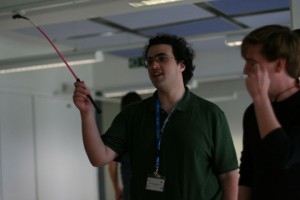
Memefactory @ NYU, originally uploaded by the biella.
At this point in my career, I can t really see myself organizing much of anything as it is time I don t seem to have. But after I saw Memefactory, I decided that it was well worth my time to get these guys and their computers to NYU. With help from a string of organizations at NYU, Memefactory will be performing a souped up, updated version of their masterful performance tour of Internet memes on October 9th. It is SO worth checking out. (ps, we remixed this poster though we did not get much of the bling)

******************
If one were to assume there might be any kind of end to the meaningless drivel on the web, one would be wrong. For this very reason, we present MemeFactory NYU. We re lucky enough to have been invited by NYU to present our second, full-length MemeFactory during which we wax philosorapsophical about the state of popular (and some unpopular and some berpopular) internet media. That means about one and one half of one hours of 3 projectors, 3 gentlemen, more pictures of cats, videos of fails and power ratings over 9000 than any previous MemeFactory. We d call it bang-for-your-buck, but damn this shindig is $Free! So don your pancake hat - or your furry suit, we wont judge - and get ready to Get Down, get WeeGee d and of course Crank That. http://wwksf.com/nyu To recap: WHEN: October 9 7:30-9:00. WHERE: Warren Weaver Hall RM 109, http://cs.nyu.edu/web/Location/directions.html (Free and Open to the Public) WHO: What We Know So Far http://www.whatweknowsofar.com/NYU WHY: Because it is not another academic lecture but lively performance filled with nothing but insight and humor for die-hard Internet memeologists and newbies alike. Take the plunge with the memefactory! SPONSORED: NYU @ Free Culture, Council on Culture and Media, Center for Religion and Media, NYU ACM s Chapter

27 September 2009

Zak B. Elep: Help Ondoy Victims

Hey $WORLD, Philippines needs your help! We just got hit by ondoy, and there seems to be a couple more storms coming in. You can help out via donations to the Red Cross/Red Crescent. If you have friends or family in Manila, you can check the RescueHub and Sahana lists for persons missing and in distress. And lastly, pray to your $DEITY for us (or do what works best for you.) UPDATE: Google is helping out too. The local Red Cross is also accepting donations. UPDATE 2: There's a new site up with additional info on the relief efforts.

Zak B. Elep: (Not) Moving to Manila

So, I'm moving back to Manila tomorrow. I hope the flood's subsided by then. UPDATE: Delaying this, after hearing some more news. I hope it gets better and not worse, as I hear there are a couple more storms coming in.

16 September 2009

Pete Nuttall: Fun in the Afternoon

Fun in the afternoon is a designed to be a relaxed programming semair, and being bored I went along. It was pretty good, with all the talks being quite relaxed and interesting. Phil Wadler's Talk was of some interest, since I hate PHP and the other web programming things I have tried, including haskell-html and Kaya arent quite ready yet. The other three talks were quite good. All discussed new things, and there was a lot of "I don't quite know" in reply to the tough questions. The Metatheory stuff was fun, though I haven't done anything like enough type theory to need it. The Version Control stuff was quite cool, and it would be nice to see that become a real tool, similar to darcs. Andrew Kennedy's take on C# was interesting, though he admitted beforehand that he didn't quite belive it himself. It lead to a lot of muttering between Edwin and Myself as to what a functional langauge really was. Its interesting how all the academics revert back to their undergrad days: reading the paper, talking, playing on laptops, being late, sitting at the back and eating. It was also nice to put some faces to names, including Neil Mitchell and Conor McBride Its also nice to see how many people were there, and that people wanted to go have a drink afterwards. That evening I caught up with Dan, and its nice to see he is settling into his new job well. I caught the train home in the morning, getting in at three, and managed to watch the rugby before sleeping for 15 hours, a result of not sleeping week for 8 days before that.

11 September 2009

Sune Vuorela: Matthew Rosewarne

Over the last months, I have been asking people in KDE irc channels and in Debian KDE channels wether they have heard from Matthew Rosewarne, on irc known as Mukidohime. No one had. Very recently, I uploaded one of his packages with the following changelog entry:
* Switch Maintainer field to krap team and remove Matthew, he seems absent.
We hope he comes back.
Apparantly he was absent. Permanently. Elizabeth Krumbach writes some nice words in his memory. I remember Matthew for his work on several KDE related packages in Debian, always doing a job that was better than I expected. And I especially remember him at Akademy 2008 where he to much joy brought a black horse whip for the chairman of a talkroom. And he even brouht a spare pink horse whip for when the black one broke. Especially Adriaan had a good use of that. And at last, I will bring a image of Matthew showing off his equipment to Aaron Seigo.
Matthew Rosewarne

Matthew Rosewarne

Condolences to his family. Matthew will be missed.

9 September 2009

Francois Marier: Twitter tracking clicks to external sites

Lately, while using the Twitter web interface with Javascript turned on, I've been redirected to a Privoxy error page whenever I click on an external link:
Request for blocked URL

Your request for http://twitter.com/link_click_count?url=http%3A%2F%2Fexample.com&linkType=web&tweetId=1234567890&userId=12345678&authenticity_token=f5920ebf56bfa111c54bb9f86814cafa76de00fa was blocked.

Block reason: Path matches generic block pattern.
Looking a little closer at the blocked URL, I noticed that for every external link you click, Twitter logs the destination URL, the originating tweet and your user ID.

So what can you do to opt out of this tracking?
Disable JavascriptThis is by far the easiest solution. You can simply install an extension like Noscript and use Twitter with Javascript turned off. That's what I do most of the time since the website is mostly usable without it.

A very fortunate side-effect of using Twitter without Javascript is that you can avoid a number of the worms which propagate through that service from time to time.
Use Privoxy to disable the link counterFor those times when I have to enable Javascript on the site, I use Privoxy, a great privacy-enhancing web proxy, to alter the Javascript code executed when clicking on external links. This effectively disables the extra tracking and takes me directly to the intended URL.

First of all, make sure you have this line in your /etc/privoxy/config:
filterfile user.filter
then, add this filter to /etc/privoxy/user.filter:
FILTER: twitter-link-count Disable the Twitter link tracker
s@twttr\.countClick=function@twttr.dsbldCountClick=function@Uig
and finally turn this filter on for the affected URLs (/etc/privoxy/user.action):
  +force-text-mode +filter twitter-link-count   
.twimg.com/.*/javascripts/twitter.js
Switch to IdenticaIf you want to avoid similar privacy problems in the future, you can also switch to an Open platform which respects your basic freedoms.

The main contestant in this space is Identica. It's a great alternative to Twitter and has a lot of interesting features (like groups and XMPP integration) which are not yet available on Twitter.

The StatusNet developers have kindly released their source code under the AGPL and their goal is to build the most open micro-blogging system out there.

So go over there now and claim your username!

1 June 2009

Cyril Brulebois: Early June update

Random bits: Blender 2.49 - splash screen

30 May 2009

Stefano Zacchiroli: kick-starting turbogears 2 packaging

TurboGears 2 in debian ... soon ! After a long incubation, a few days ago TurboGears 2 has been released. Historically, I've been preferring TurboGears over Django for being closer to the open source philosophy of reusing existing components. Since the long 2.0 release was marking a gap with Django, I was eager to test the 2.0, and I was delighted to find it in Debian. Unfortunately, it doesn't seem to be in good shape yet. In particular it lacks several dependencies before it can even be used to quickstart a project, in spite of its presence in unstable. To give an idea of the needed work, after having installed it manually (via easy_install), my virgin /usr/local/lib/python2.5/site-packages/ has been polluted by 26 egg-thingies. I decided to spend some week-end time to start closing the gap, because we cannot lack such an important web framework in Debian (and ... erm, yes, also because I need it :-) ). Here is the current status of what has been ITP-ed / packaged already (by yours truly): Where to Considering, foolishly, the last package as being already done, the way to go is still long:
    zack@usha:~$ ls /usr/local/lib/python2.5/site-packages/ grep -v repoze.what
    AddOns-0.6-py2.5.egg
    BytecodeAssembler-0.3-py2.5.egg
    Catwalk-2.0.2-py2.5.egg
    easy-install.pth
    Extremes-1.1-py2.5.egg
    PEAK_Rules-0.5a1.dev_r2582-py2.5.egg
    prioritized_methods-0.2.1-py2.5.egg
    sprox-0.5.5-py2.5.egg
    sqlalchemy_migrate-0.5.2-py2.5.egg
    SymbolType-1.0-py2.5.egg
    tg.devtools-2.0-py2.5.egg
    tgext.admin-0.2.4-py2.5.egg
    tgext.crud-0.2.4-py2.5.egg
    TurboGears2-2.0-py2.5.egg
    tw.forms-0.9.3-py2.5.egg
    WebFlash-0.1a9-py2.5.egg
    zope.sqlalchemy-0.4-py2.5.egg

Possibly, some of them are already in Debian hidden somewhere, but sure there is still work to be done. If you want to help, you are more then welcome. The rules are simple: all packages will be maintained under the umbrella of the Python Modules Team, but you should be willing to take responsibility as the primary maintainer. Please get in touch with if you are interested, as I'm in turn already in touch with some other very kind volunteers (thanks Enrico and Federico2!) to coordinate who-is-doing-what. Preview packages available What has already been packaged, including a temporary workaround for python-transaction, will be available in experimental after NEW processing. The idea is that nothing will go to unstable until TurboGears 2 will be (proven to be) fully functional. In the meantime, packages are available from my personal APT repository (signed by my key), here are the friendly /etc/apt/sources.list :
    deb http://people.debian.org/~zack/debian zack-unstable/
    deb-src http://people.debian.org/~zack/debian zack-unstable/

Versions are tilde-friendly and shouldn't get in your way when the official packages will hit unstable. Packaging multiple-egg / multiple-upstream packages In all this, I've faced an interesting problem with the python-repoze. who,what -plugins packages. They correspond to a handful of plugins, each of which is about 20/30 Kb. I didn't consider appropriate to prepare 5 different packages, due to archive bloat potential. Hence, you get the usual problems of multiple-upstream packages. To counter some of them, as well as some egg-specific packaging annoyances with multiple upstream, I wrote a couple of very simple helpers: I'm no Python-packaging-guru so, lazyweb, if you spot in this choice something I utterly overlooked, or if you have improvements to suggest, please let me know. Repacking eggs An interesting problem will be faced in trying to integrate the above approach with Python modules that are shipped only as .egg files (i.e., no tarballs, ... yes there are such horrifying things out there). To preserve uniformity, we would need uscan to support --repack ing of .egg files as they were simple .zip archives. Since eggs are .zip archives ... why not?

27 May 2009

Adeodato Sim : Meritocracy and entitlement

Via Planet Bazaar, this paragraph from a post by Paul Hummer caught my attention (emphasis mine):
Finally, I wrote an open ended question to myself to think about, and thought that maybe I d throw it out here as well. For context, Jono Bacon was talking about community (y know, plugging his book and all that :), and I wrote Open source thrives on a meritocracy - how can we prevent feelings of entitlement? I see this a lot in open source communities: people earn their commit rights and then start behaving like everyone owes them something. Collaboration is about peers, not about hierarchies.
Now I m reposting that here because, although I m not very keen on philosophizing myself, something in that thought was of immediate appeal to me.

22 May 2009

Martin F. Krafft: Django: a beautiful and truly thin web development framework

Take the following URL:
http://my.server.tld/wow/summary/2009/05/21/?style=boxed

and imagine the following Python function:
def summary(request, year, month, day):
    response = HttpResponse()
    // do something
    return response

If you see a relation between the two, then Django is for you. The missing part is a URL mapping, a list of regular expressions, which transforms a URL into a keyword list, and maps it to a function (a HTTP view, as it s called):
(r'^wow/summary/(?P<year>\d 4 )/(?P<month>\d 2 )/(?P<day>\d 2 )/$',
    mysite.wow.summary,  'additional':'information' )

You do not have to use keyword arguments, positional parameters will work as well, and you can do anything you like within the powers of regular expressions, but the result is always along the same lines: When someone visits the above URL, Django calls the above summary( ) function (defined in the modules mysite/wow.py) and passes an object encapsulating the request, along with the components from the URL as parameters:
summary(request, 2009, 05, 21,  'additional':'information' )

It then renders the return value. The function can also throw an exception if it need to communicate e.g. a 404 error. Very clean, and there are even generic views if your data doesn t need any massaging, of if you just want to do standard things like generate PDFs. This is the core idea of Django, which I ve gathered from one talk and four hours of invested time. It s a truly thin layer, and its elegance made me bouncey. The QUERY STRING of the request will be passed in the request object, along with all the other CGI variables you re familiar with. Django provides a large number of helpers and shortcuts to save you from having to do the ugly work, including topics such as internationalisation, syndication, authentication, file uploads, and caching. In addition, Django gives you an object-relational_mapper to map the data into, and manage the data definition within your favourite RDBMS, a templating language designed to fit in with the whole philosophy, and widgets to work with forms. You do not have to use any of those. You are free to use any other Python module for the task, just as you can use all of the other features of and modules written for Python. This is particularly powerful in the context of the middleware layer. There s also a large number of pluggable applications and snippets for re-use. The only concern I have at this point is whether features like tagging are going to find their way into the framework, because tracking numerous external plugins for a site and keeping them working across versions reminds me of the nightmares I had with Zope and Plone (I stopped working with (and on) those before I had a chance to dive into version 3 of each). The fact that Django leaves data storage to other tools (in fact, it s entirely up to you) makes those nightmares seem further distant. All in all, I am excited to have had a chance to take a brief glance at the software, and I am looking forward to doing more with it. Unfortunately, it looks like it will take quite some time to wade through existing plugins and design the rest of an application that can finally replace the horrific dung-pile that is my homepage.

19 May 2009

Biella Coleman: Chain-reaction of ideas

One day, I would love to teach a class on the culture and politics of technology and ditch all of the academic pieces and replace with a string of novels and fictional short stories. Though it may be a few years before I can pull this off, I am already compiling my list and there is naturally a healthy serving of science fiction (along with Kurt Vonnegut, who I adore). Perhaps one my favorite science fiction authors is Philip Dick who edges his readers close to delirum and sometimes insanity and all through mere words. But one of my favorite writings by PD comes not from his fictional fun house but from a regular (and staid) letter composed of a simple and elegant description of what makes science fiction so e(special):
I think Dr. Willis McNelly at the California State University at
Fullerton put it best when he said that the true protagonist of an sf
story or novel is an idea and not a person. If it is *good* sf the
idea is new, it is stimulating, and, probably most important of all,
it sets off a chain-reaction of ramification-ideas in the mind of the
reader; it so-to-speak unlocks the reader s mind so that the mind,
like the author s, begins to create. Thus sf is creative and it
inspires creativity, which mainstream fiction by-and-large does not
do. We who read sf (I am speaking as a reader now, not a writer) read
it because we love to experience this chain-reaction of ideas being
set off in our minds by something we read, something with a new idea
in it; hence the very best since fiction ultimately winds up being a
collaboration between author and reader, in which both create and
enjoy doing it: joy is the essential and final ingredient of science
fiction, the joy of discovery of newness. Philip Dick (in a letter)
May 14, 1981
Truth be told, I don t really know much about science fiction outside of the classics but I look forward to reading more and slowly am adding a few pieces to my collection. And when I need to find out something about sci fi, I turn to Sumana who is pretty well schooled in its ways. She has recently co-edited a new anthology of science fiction stories including one on hardware hacking and faith that some of you might enjoy.

15 May 2009

Philipp Kern: Infinote-based Gobby hits Karmic

Gobby 0.5 (or to be more precise 0.4.92) just hit the Karmic Koala. Below you can see a screenshot of the new version (just click on it to get a large version). It is sadly not protocol compatible to the old version but it features local undo and redo! Furthermore it's not yet stable on-the-wire wise. The software itself is fairly stable but it could be a bit bumpy if the server protocol version goes out of date. Gobby 0.4.92 thumbnail If you want to try it out on earlier versions, I offer backports in the Infinote PPA for Intrepid and up. I hope to get to Hardy soon, sadly it needs some more backports. There is a public server available on gobby.0x539.de if you want to try it out (connections are encrypted, but all contents are public and can be deleted by everybody, wiki-like; so please be considerate and non-destructive). On local networks Gobby will look for servers through Avahi. That said Gobby is not yet able to host servers by itself, like the old version did. You have to install the infinoted server. You can do this on any computer, even on the local network and take advantage of Avahi. If you want encrypted connections you need to create certificates but if an unencrypted session is acceptable you can get an ad-hoc server by invoking infinoted --security-policy=no-tls without further configuration. It will persist content across invocations, too. Thanks to Greg Heynes, there will also be a KDE client for Gobby, called... Kobby! The first time someone actually uses the fact that the software uses a library for interoperability. Interesting that it's done now when the library's C instead of C++ (which obby was written in), with Qt being C++ anyway. I'm not yet aware of packages but I really hope that we can release with both. If you encounter problems, please report them to our Trac (preferred) or Launchpad.

1 May 2009

Chris Lamb: April 2009 in UK civil liberties

Wednesday 1st
At the G20 protests, Londoner Ian Tomlinson collapses and is attended to by the emergency services; Metropolitan Police claim "during this time a number of missiles - believed to be bottles - were being thrown at them". Tomlinson dies that evening.
Thursday 2nd
The Evening Standard reports that "police were bombarded with bricks, bottles and planks of wood" as they helped Tomlinson.
Saturday 4th
Postmortem of Tomlinson finds he died of a heart attack.
Monday 6th
The EC Data Retention Regulations 2009 comes into force requiring internet service providers to retain details of emails, internet phone calls and other web traffic.
Tuesday 7th
The Guardian publishes a video of a police officer assualting Tomlinson on 1st April.
Wednesday 8th
Twelve Pakistani students are arrested on suspicion of planning terror attacks over the Easter holiday weekend.
Thursday 9th
The Guardian publishes a second video of Tomlinson's assualt, contributing that no missiles were thrown.
Monday 13th
Police arrest 114 climate protestors on conspiracy to cause criminal damage at Nottingham power plant. [ref]
Tuesday 14th
A video of a seperate assualt at the G20 protests is published.
Thursday 16th
Police claim tourist's photography of transport-related buildings is "strictly forbidden" and demand the photos are deleted. [ref]
Friday 17th
A second postmortem of Iam Tomlinson finds the cause of death to be an abdominal haemorrhage. A policeman is interviewed under caution on suspicion of manslaughter. [ref]
Saturday 18th
The Times reveals MP Damian Green private emails were searched by the police using the keywords "Shami Chakrabarti" (director of Liberty) after his arrest last year.
Monday 20th
The Guardian reveals police intelligence was given to E.On before the Nottingham climate demonstration, including movements of protesters and their meetings.
Tuesday 21st
Another video of the Tomlinson assault is revealed showing his head hitting the pavement. The Independent Police Complaints Commission fails to obtain an injunction to prevent broadcast.
Wednesday 22nd
Nine Pakistani students arrested during anti-terror raids are released after 13 days without charge and are passed to UK Border Agency custody for deportation. [ref]
Monday 27th
Home Secretary Jacqui Smith announces that ISPs and telecoms companies will be asked to record usage "to track murderers and paedophiles" without a warrant. [ref]
Tuesday 28th
Emails are revealed of the Home Office asking Phorm, the behavioural targeted advertising service, whether they are falling outside the law. Home Office claim Phorm would be legal if consent is obtained and that "providers of goods and services need only ensure they are compliant with relevant legislation". [ref]
Wednesday 29th
The Guardian documents the friends of the 7/7 bombers were denied bail on secret evidence - "the appellant asked the judge the question: why are you sending me to prison? To which the judge replied: 'I cannot tell you that.'"

30 April 2009

Biella Coleman: On Chasing Plastic

Anyone who knew me prior to 2000, knew me as a fanatic Ultimate Frisbee player. I was (mostly) all about chasing a plastic disc on lush green fields. Ultimate Frisbee, which took my attention and soul my first year of college, commanded my attention, time, and body for years. The New York Times just ran a nice short piece piece about Ultimate Frisbee, which apparently has skyrocketed in popularity since 2003. One section of the article caught my attention:
It may be a non-contact sport according to its rules, but Ultimate is hardly free of injuries. The quick cutting and sprinting have made anterior cruciate ligament tears among women players especially common. JOY CHEN, a 33-year-old software developer in Alameda, Calif., considers herself lucky that herniated disks, a rotator cuff tear and ankle sprains have been the extent of her Ultimate injuries. We hit each other and the ground pretty hard, said Ms. Chen, who discovered Ultimate in college after years as a soccer and tennis player. She played with Stanford University s Superfly, which went on a three-year run as undefeated women s national collegiate champions.
Injury goes with the sport as hand and glove and young players tend to wear these injuries as a badge of pride. As much as I adore the sport and there are days I get pretty bummed that I no longer play I think that the UPA and older players should seriously skool the younger generation on the danger of injuries. It is an extreme sport that requires extreme care. Tournaments are usually composed of 4-7 games over the course of 2 days. If that is not demanding enough, the body gets pretty intimate with the the ground while laying out and then there are there all those sprained ankles and broken bones and ligaments from collisions. Today I suffer from bouts of knarly neck pain, for example, which is due in part from playing without taking proper precautions. One of my best friends, who was a stellar player in college, also suffers from pretty devastating back pain. It is an extreme sport that requires extreme care. I say toss out the pride in pain/injuries and in place, instill a healthy sense of fear of the injuries so that people get proper long term and sustained care for their injuries so that they can keep on playing the world s best sport. PS For those that don t know, UF also revolves around an ethical philosophy Spirit of the Game, which unfortunately the article makes no mention of, despite its centrality to the sport.

24 April 2009

Gunnar Wolf: Some prefer marathoning... I prefer going to my old workplace

I was invited to talk about Free Software at yesterday's FLISOL. Yesterday? Aren't FLISOLs organized on Saturday? Well, not this one, for various reasons which I won't quote here. And no, I am not a supporter of the installfests idea, but I went gladly to talk about what is Free Software all about - The philosophy behind Free Software. Besides, the talk was at FES Iztacala, where I worked for four happy years, 1999-2003. I have not been often to Iztacala since 2003 (probably I have visited only three or four times), partly because of the distance (~25Km from home in a straight line, but the city's Northern part is quite poorly communicated). The last time I was there, last October, I went by bike, just to test my endurance and... because I could. Yesterday, I also did, not to be outdone by my fellow Debianers Christian and Dirk. Think they are so cool because they can run for 43Km? Well, I had my 55Km yesterday, and I was not even in a competition! (yes, yes, running and biking is not the same. So sue me. I just didn't want to stand still and let them walk away with all of the fun!) I took slightly different routes (my route to get there on Nokia Sportstracker and OpenStreetMap trace, my route back on Nokia Sportstracker and OpenStreetMap trace), crossing diagonally Azcapotzalco, a region of the city (delegaci n) I hardly know... The Sourthern of it seems like a continuation of Tacuba to the North, small and not-very-well-communicated prior villages engulfed by our hungry, huge city. The Northern half is a mostly industrial area, with very sparse population, lots of trucks, and streets that are not in the best shape. You can end up feeling lonely in those regions, and I am glad not to have crossed back by night. And the trip back was interesting as well... Mexico City is home to many more bikers you would expect given its size, and it is very common to find other people doing nice long stretches. In this case, I started cycling quite close to another guy in a white bike more or less when I got to Calzada Camarones. Possibly we had passed each other over and over until after Tlatelolco, arriving to Guerrero, where I approached him at a stoplight:
Hi! Where to?
Near Vocacional 7, Iztapalapa!
Nice! I'm just going to Copilco Every now and then we crossed each other... Turns out he does this ~30Km commute daily between Iztapalapa and Azcapotzalco. Quite admirable, to be honest. I also crossed my road with Sergio Mendoza, fellow Debianer (and co-administrator of our Mexican mirror) around Centro M dico (about 7Km north from my destination), whom I had only seen before around the University. Nice surprise. And yes, getting to know the city by bike is the best way to go! Back to the conference... my first thought when I was invited was to present Qu es el Software Libre?, a talk I have given over and over since... 2002 (although, yes, with updates). I must say it's one of the best structured talks I have prepared and has almost always been very successful - But give the same talk based on the same script over and over (AFAICT, around 20 times), and you will be fed up with it. And yes, yesterday I didn't take my laptop along, and didn't put my presentation on a USB stick - I took a pen and some paper, and during the presentation prior to mine, wrote some points to go over. And yes, it was a refreshing change. The talk was as successful as expected, and it's much more refreshing to talk about the same topics bot on a different way, and without being constrained to a predefined script. I know that organizing formally your ideas makes sure you don't miss out important points and that the audience is sometimes encouraged to pay attention by having some bullet points to look at - But on the other hand, it is much easier to follow your audience's interest if you are not bound by the script. And the few times I've spoken that way, it has felt refreshing and nice.

21 April 2009

Romain Beauxis: Liquidsoap now supports AAC+ encoding.

The plot Following many user requests , we were considering adding this format to the list of supported encoders. As for mp3 encoding, this support was subject to some legal issues. These issues were indeed the initial motivation for implementing icecast2 using the patent-free ogg codecs and container for streaming data. However, it seems that many users and net-radios are still asking for these formats. There can be several motivations for that, among which I can list the following major ones:
  • These formats are supported by more players and, in particular, embedded devices, which are the main target for net-radios
  • For the case of AAC+, the codec supports a very good audio quality for low bandwidths, such as 64 and 32kb/s.

The philosophy There is a constant complain from the open source communities about the use of patent-encumbered formats. In particular, those formats are not allowed in the Wikimedia commons and the corresponding encoders, in particular mp3 encoders, are not supported by for instance the Debian distribution. In a similar intent to push for a wider usage of patent-free codecs, the icecast project reimplemented its streaming server in order to use the ogg container and codecs. All these actions are very important. In particular, the support for ogg/theora video files in firefox, and hopefully the major HTML 5 browser is mainly the result of wikipedia refusing other video formats. Indeed, wikipedia is now a major website, and it would be insane to not support the videos there. However, I for myself do not like when these actions become too restrictive to the user. For this matter, I personally prefer freedom of choice among other considerations. Also, as a matter of fact, when trying to change the situation about these issues, one has to take into account the relative importance of each actor. It is because wikipedia is already huge that it has managed to change the things. Hence, in the case of net-radios, a majority of potential users are asking for AAC+ and other patent-encumbered formats. Although this is not the ideal situation we would like to see, there comes a point were either the free-software projects have something to propose, or the users will just go for a proprietary software, which is even worse to the situation. For this purpose, I believed it was important to add such support into our software. However, as you will see later, we do not implement ourself the encoding algorithm, but only added support for external encoders. That way, we simply let the user choose what he wants to use, but remain a patent-free and open-source software.

The implementation Since mp3 was, and still is, the major target for net-radios, icecast2 still has the possibility to stream this format. In fact, this format, as well as AAC+, does not have headers, such that it is possible to decode a stream at any point in it. Hence, in this case, icecast only acts as a proxy, and the only constraint is to send it the encoded data at real rate. Hence, the main library for streaming to icecast, libshout, parses the audio data that it receives, and schedules the streaming according to real rate. Additionally, it also supports a raw mechanism, for which there would be not such mangling. In the case of liquidsoap, we did not need this feature of the libshout since the software is already working in real time. Furthermore, the source connection protocol provides a content-type header field, which allows icecast to display the correct mime for the data format that is streamed. All in all, in order to send AAC+ data to icecast, one needs to send the correct mime-type in the source connection headers, and then send audio data at the correct rate. However, the libshout did not allow to set an arbitrary content-type header. Hence, I proposed a patch. It was proposed for an inclusion into main code, since I believe it is interesting not only for our specific need, but also for any other generic data format support. Although the patch was accepted, it was never committed. So, we decided to go on: since liquidsoap need not the real rate mangling feature of the libhsout, and since the source protocol is mainly a basic HTTP, we decided it was worth a custom implementation. This implementation was quite easy, thanks to the powerful capabilities of the OCaml language, and resulted in a custom implementation, ocaml-cry, that does the same as libshout, except that it does not control the rate of the data flow sent to the icecast server. Then, we also needed to support encoding data to the AAC format. After looking at the only available open-source encoder, aacplusenc, I tried to propose some changes in order to export a library and be able to use it in liquidsoap. However, these propositions did not make it into upstream's code, so I decided to also move on and use directly the encoder binary. Hence, using only the good old unix standard input/output mechanism, it is possible to start an encoder as a child process, send it the raw PCM data to its standard input and read the encoded data from its standard output. This lead to the development of the external output operators, which include output.icecast.external. Although this implementation was not easy, it now appears to work quite well in the current SVN version. In particular, the encoder process exits correctly for the FLAC encoder, which is needed in order to stream correctly, since the ogg container needs a restart for every track. Hence, we also gained support for encoding to the FLAC audio format, which was not binded for OCaml (yet ?) because its callback-driven API makes it tricky to do. Additionally, the support for external processes as encoders allows to use the lame binary for encoding mp3 data. Hence, liquidsoap can now encode mp3 data without the need of a built-in support for it. And, as always, the idea of using external processes spread over several other operators, including the support for external file and stream decoders, enabling support for many audio format (in fact almost all supported in linux, using mplayer). In conclusion, liquidsoap now has a fairly good support for AAC+ audio streaming, as well as a many new formats for decoding files and streams. It also support arbitrary formats and encoders using a custom variant of the output.icecast.external. Hence, provided your format can be decoded from any point in the stream, you should be able to use liquidsoap to stream data to icecast as soon as you have a binary which is able to receive RAW or WAV PCM data to its standard input and send encoded data to its standard output. As an illustration, here is an implementation of the output.icecast.aacplusenc:
def output.icecast.aacplusenc(
~id="output.icecast.aacplusenc",
~start=true,
~restart=true,
~restart_delay=3,
~host="localhost",
~port=8000,
~user="source",
~password="hackme",
~genre="Misc",
~url="http://savonet.sf.net/",
~description="OCaml Radio!",
~public=true,
~dumpfile="",
~mount="Use [name]",
~name="Use [mount]",
~protocol="http",
~aacplusenc="aacplusenc",
~bitrate=64,
~restart_on_crash=false,
~restart_on_new_track=false,
~restart_encoder_delay=3600,
~headers=[],
s)
# Metadata update is set by ICY with icecast
def aacplusenc_p(m)
"# aacplusenc - - # bitrate "
end
output.icecast.external(id=id,
process=aacplusenc_p,
bitrate=bitrate,
start=start,
restart=restart,
restart_delay=restart_delay,
host=host,
port=port,
user=user,
password=password,
genre=genre,
url=url,
description=description,
public=public,
dumpfile=dumpfile,
name=name,
mount=mount,
protocol=protocol,
header=true,
restart_on_crash=restart_on_crash,
restart_on_new_track=restart_on_new_track,
headers=headers,
restart_encoder_delay=restart_encoder_delay,
format="audio/aacp",
s)
end

19 April 2009

Biella Coleman: Paris in June (and better with hackers)

/tmp/lab announces the second Hacker Space Festival
(Paris, 26-30 June 2009) Hacker Space Festival 2009 Call For Proposals HSF2009 In 2008, we organized HSF[1] on the spot, as an ad-hoc meeting for
hackerspaces-related networks, technical and artistic research emerging
from them and social questionning arising from them. This sudden
experiment proved to be a huge success, as much as on the
self-organizing level as on the participants and meetings quality, as
well as the emotionally-charged ambient, the kind of which you make
fond memories. The 2008 edition generated a strong emulation in France, from its
historical role as the first official hack meeting there, and in Europe
with the subsequent creation of the Hacker Space Brussels[2], the
rapprochement with The Fiber in Amsterdam and the hackerspaces.org[3]
network. Initiatives of hackerspace openings in Grenoble or Lille, or
the upcoming FrHack[4] conference show an actual enthusiasm in the
French hackers community that was doomed to the underground not so
long ago. We salute these initiatives and their diversity! Soon enough, we wanted to reiterate the HSF experience : however, it
was out of the question to institutionalize this temporary autonomous
zone, nor make it an ersatz of the previous edition, nor even to wrap
it into an elite or underground aura. On the opposite, we ardently
desire; and especially to explore further, in all directions some
lesser known domains (see below) et foster meeting and sharing around
experiences at the confluence of art, technology and politics. The world financial crisis, the decay of democracy in Europe, the
obscurantism, paranoia and lack of culture presiding over legislation
(Internet and Reaction Err Creation Law[5][6]) seem a fertile
environment for the sensible development of new (social ) life forms.
Quick! Let s rest for a few days in jubilation and ecstasy to take a
deep breathe of freedom under the indelicate smells of the medicine
factory nearby! For if the public space is shrinking to oblivion, where any side-step
becomes suspect, and that, from an early age (deviant behavior
detection in nursery school), where moving without a mobile phone
becomes suspect (hello you Julien Coupat[7], a French political
prisoner in France!), there s a domain that the Leviathan would have a
lot of trouble to contain, and for a reason: that of sensitivity. Even
the desperate attempts of the State to block the free and premonitory
expression of sense (hello you Demeure du Chaos![8]) cannot do anything
against a loud laughter or a knowing glance, a sensual kiss or an
explosion of colors. Sensitivity, we could say, is what is left to a human being when she
has nothing anymore, and differenciates her from the body corporate or
the institution, that are, in essence, devoid of it. Therefore, Art
definitely remains the public space to share between humans, and only
between us. And if it the last one to share, we propose to explore it
and take it over during the upcoming edition of the Hacker Space
Festival, from the 26th to 30th of June, 2009 at Vitry sur Seine[9]. ========================================================================
Keynote Speakers: Sergey Grim and Larry Fake with Eric Schmoudt
Groogle Summer of Crode, Survivor style
VLC, I vote against you because you really fucked up when ========================================================================
== W A N T E D ========================================================= Focus on solutions rather than problems. * The Final (Hardware) Frontier: Open FPGA Cores, Reverse Engineering
* Designer Religions and Creative Beliefs Systems
* WiFiDoors & WiFi System-on-Chip controllers firmware hacking,
infection & backdooring
* Telecom Core Network Equipment Reverse Engineering: MSC, STP,
Switches,
* Algebraic Attacks and Modern Cryptography Attacks
* Autonomous, Parasitic and Viral Drones
* Enhanced or Infected Reality Swarms
* Auto-Builders / Self-Fabrication
* Embedded OS breakins stories & recipes
* Actualization rather than mere concepts
* FPGA & ASIC hacking / backdooring
* Cloud+Privacy+Open Source: O Brave New World?
* Explosion-Proof clothing
* Radio Appz & Hackz: Mesh @ RF Layer 1-3
* Database & Privacy
* Problematic & Ethical Open Source/Content Licenses
* Institutional Relationships: Lobbying or Licking?
* Non Lethal Protection (anti-taser vests?)
* Survival in the Age of the Ministry of Immigration and National
Identity
* Mental asylum improvised visit
* Open Source Legacy Media(TM) Production Solutions (TV, Radio, Press,
DRM)
* Gas Sensors & Environmental Benchmarking
* Building Hackerspaces Without Money
* Milsatcomm hacking: Military satellites shots, broken birds in the
sky
* Other research topics on security and insecurity
* Academics and Hackers
* Organics and Fermentation
* Clean Food in Tainted Environment
* Low Impact Energy & Recycling
* Media Sandwich: layers of crap makes good food?
* Deconstructing Carla Sarkozy
* Knitting DIY Factory (jazzy, eh?)
* Signs of life among industrial wasteland
* Hallucinogenic & Computing: Can you Code on Acid?
* Mesh Networking (Wireless BattleMesh Royal!)
* Legal Sabotage: When Democracy Needs You And anything that does not fit. ========================================================================
== P R O P O S E ======================================================= Send you contributions to HSF2009-CFP@lists.tmplab.org + Type of the proposal: 1. conference (45min. presentation + 10min. for questions)
2. workshop / demo (30min. 2 heures)
3. installation / performance (music, plastic, sound, video) Lightning talks can be proposed and organized until the last moment,
according to available space and schedule, in the form of BarCamps or
Blitz Conferences. + Required Information: * Title of the presentation
* Type (see above)
* Language : French or English
* Name of speaker(s)
* Affiliation (organization / company)
* Short biography
* Abstract (5 to 10 lines)
* Topics / Keywords
* Includes a demo? YES NO
* Release during the festival? YES NO
* Internet connection required? YES NO + Acceptable Formats * Open Document
* PDF
* Plain Text
* RTF + Agenda * beginning of proposals : now
* end of proposals : 01 May 2009
* selection notification : 07 May 2009
* publication of program : 15 May 2009 + Evaluation criteria for proposals: 1. Innovating Topic
2. Open Technology
3. Demonstration / Live Act
4. DIY Reproducibility
5. Fun Potential The Programming Committee resembles that of last year
See : http://hackerspace.net/committee ========================================================================
== V E N U E =========================================================== /tmp/lab
6 Bis rue Leon Geffroy
94400 Vitry sur Seine
France http://hackerspace.net/directions ========================================================================
== P A R T I C I P A T E =============================================== Email : http://lists.tmplab.org/listinfo.cgi/hsf2009-talk-tmplab.org
CFPmail: HSF2009-CFP@lists.tmplab.org
IRC : irc://irc.freenode.net/frlab
Jabber : xmpp:hsf2009@space.cepheide.org?join
Wiki : http://hackerspace.net/hsf2009 ========================================================================
== L I N K S =========================================================== The CFP is available online at http://hackerspace.net/cfp [1] http://hackerspace.net/hsf2008
[2] http://hsb.wikidot.com/
[3] http://hackerspaces.org/
[4] http://www.frhack.org/
[5] http://jaimelesautistes.fr/
[6] http://laquadrature.net/
[7] http://fr.wikipedia.org/wiki/Julien_Coupat
[8] http://www.demeureduchaos.org/
[9] http://hackerspace.net/
Philippe Langlois
Email: philippelanglois@free.fr
PGP Key: 8DAEE244

14 April 2009

Biella Coleman: Paris in June (and better with hackers)

========================================================================
/tmp/lab announces the second Hacker Space Festival
(Paris, 26-30 June 2009)
======================================================================== Hacker Space Festival 2009 Call For Proposals HSF2009 In 2008, we organized HSF[1] on the spot, as an ad-hoc meeting for
hackerspaces-related networks, technical and artistic research emerging
from them and social questionning arising from them. This sudden
experiment proved to be a huge success, as much as on the
self-organizing level as on the participants and meetings quality, as
well as the emotionally-charged ambient, the kind of which you make
fond memories. The 2008 edition generated a strong emulation in France, from its
historical role as the first official hack meeting there, and in Europe
with the subsequent creation of the Hacker Space Brussels[2], the
rapprochement with The Fiber in Amsterdam and the hackerspaces.org[3]
network. Initiatives of hackerspace openings in Grenoble or Lille, or
the upcoming FrHack[4] conference show an actual enthusiasm in the
French hackers community that was doomed to the underground not so
long ago. We salute these initiatives and their diversity! Soon enough, we wanted to reiterate the HSF experience : however, it
was out of the question to institutionalize this temporary autonomous
zone, nor make it an ersatz of the previous edition, nor even to wrap
it into an elite or underground aura. On the opposite, we ardently
desire; and especially to explore further, in all directions some
lesser known domains (see below) et foster meeting and sharing around
experiences at the confluence of art, technology and politics. The world financial crisis, the decay of democracy in Europe, the
obscurantism, paranoia and lack of culture presiding over legislation
(Internet and Reaction Err Creation Law[5][6]) seem a fertile
environment for the sensible development of new (social ) life forms.
Quick! Let s rest for a few days in jubilation and ecstasy to take a
deep breathe of freedom under the indelicate smells of the medicine
factory nearby! For if the public space is shrinking to oblivion, where any side-step
becomes suspect, and that, from an early age (deviant behavior
detection in nursery school), where moving without a mobile phone
becomes suspect (hello you Julien Coupat[7], a French political
prisoner in France!), there s a domain that the Leviathan would have a
lot of trouble to contain, and for a reason: that of sensitivity. Even
the desperate attempts of the State to block the free and premonitory
expression of sense (hello you Demeure du Chaos![8]) cannot do anything
against a loud laughter or a knowing glance, a sensual kiss or an
explosion of colors. Sensitivity, we could say, is what is left to a human being when she
has nothing anymore, and differenciates her from the body corporate or
the institution, that are, in essence, devoid of it. Therefore, Art
definitely remains the public space to share between humans, and only
between us. And if it the last one to share, we propose to explore it
and take it over during the upcoming edition of the Hacker Space
Festival, from the 26th to 30th of June, 2009 at Vitry sur Seine[9]. ========================================================================
Keynote Speakers: Sergey Grim and Larry Fake with Eric Schmoudt
Groogle Summer of Crode, Survivor style
VLC, I vote against you because you really fucked up when ========================================================================
== W A N T E D ========================================================= Focus on solutions rather than problems. * The Final (Hardware) Frontier: Open FPGA Cores, Reverse Engineering
* Designer Religions and Creative Beliefs Systems
* WiFiDoors & WiFi System-on-Chip controllers firmware hacking,
infection & backdooring
* Telecom Core Network Equipment Reverse Engineering: MSC, STP,
Switches,
* Algebraic Attacks and Modern Cryptography Attacks
* Autonomous, Parasitic and Viral Drones
* Enhanced or Infected Reality Swarms
* Auto-Builders / Self-Fabrication
* Embedded OS breakins stories & recipes
* Actualization rather than mere concepts
* FPGA & ASIC hacking / backdooring
* Cloud+Privacy+Open Source: O Brave New World?
* Explosion-Proof clothing
* Radio Appz & Hackz: Mesh @ RF Layer 1-3
* Database & Privacy
* Problematic & Ethical Open Source/Content Licenses
* Institutional Relationships: Lobbying or Licking?
* Non Lethal Protection (anti-taser vests?)
* Survival in the Age of the Ministry of Immigration and National
Identity
* Mental asylum improvised visit
* Open Source Legacy Media(TM) Production Solutions (TV, Radio, Press,
DRM)
* Gas Sensors & Environmental Benchmarking
* Building Hackerspaces Without Money
* Milsatcomm hacking: Military satellites shots, broken birds in the
sky
* Other research topics on security and insecurity
* Academics and Hackers
* Organics and Fermentation
* Clean Food in Tainted Environment
* Low Impact Energy & Recycling
* Media Sandwich: layers of crap makes good food?
* Deconstructing Carla Sarkozy
* Knitting DIY Factory (jazzy, eh?)
* Signs of life among industrial wasteland
* Hallucinogenic & Computing: Can you Code on Acid?
* Mesh Networking (Wireless BattleMesh Royal!)
* Legal Sabotage: When Democracy Needs You And anything that does not fit. ========================================================================
== P R O P O S E ======================================================= Send you contributions to HSF2009-CFP@lists.tmplab.org + Type of the proposal: 1. conference (45min. presentation + 10min. for questions)
2. workshop / demo (30min. 2 heures)
3. installation / performance (music, plastic, sound, video) Lightning talks can be proposed and organized until the last moment,
according to available space and schedule, in the form of BarCamps or
Blitz Conferences. + Required Information: * Title of the presentation
* Type (see above)
* Language : French or English
* Name of speaker(s)
* Affiliation (organization / company)
* Short biography
* Abstract (5 to 10 lines)
* Topics / Keywords
* Includes a demo? YES NO
* Release during the festival? YES NO
* Internet connection required? YES NO + Acceptable Formats * Open Document
* PDF
* Plain Text
* RTF + Agenda * beginning of proposals : now
* end of proposals : 01 May 2009
* selection notification : 07 May 2009
* publication of program : 15 May 2009 + Evaluation criteria for proposals: 1. Innovating Topic
2. Open Technology
3. Demonstration / Live Act
4. DIY Reproducibility
5. Fun Potential The Programming Committee resembles that of last year
See : http://hackerspace.net/committee ========================================================================
== V E N U E =========================================================== /tmp/lab
6 Bis rue Leon Geffroy
94400 Vitry sur Seine
France http://hackerspace.net/directions ========================================================================
== P A R T I C I P A T E =============================================== Email : http://lists.tmplab.org/listinfo.cgi/hsf2009-talk-tmplab.org
CFPmail: HSF2009-CFP@lists.tmplab.org
IRC : irc://irc.freenode.net/frlab
Jabber : xmpp:hsf2009@space.cepheide.org?join
Wiki : http://hackerspace.net/hsf2009 ========================================================================
== L I N K S =========================================================== The CFP is available online at http://hackerspace.net/cfp [1] http://hackerspace.net/hsf2008
[2] http://hsb.wikidot.com/
[3] http://hackerspaces.org/
[4] http://www.frhack.org/
[5] http://jaimelesautistes.fr/
[6] http://laquadrature.net/
[7] http://fr.wikipedia.org/wiki/Julien_Coupat
[8] http://www.demeureduchaos.org/
[9] http://hackerspace.net/
Philippe Langlois
Email: philippelanglois@free.fr
PGP Key: 8DAEE244

Next.

Previous.