Search Results: "hug"

14 April 2015

Santiago Garc a Manti n: Hello Debian Planet and Jessie's question

This was just meant to say hello to the Debian Planet readers, but I'll end it with a Jessie related question, so... Intro For those who don't know me, I was born in Betanzos, A Coru a, Galicia, in the North-West of Spain and I currently live on A Coru a. I've been a Debian developer since year 2000 when I was quite more involved than currently (live changes), but I'm always expecting to be able to dedicate more time to the project, I hope this will happen when my two children grow up a little bit. I had been wanting to send my blog's Debian related posts to the planet but always failed to do so, yesterday I found the planet wiki page and I said... it's so easy that I don't have any excuse not to do it, so here I am. Oh, BTW... if I ever comment on Debian's anniversary (16th of August) that at Betanzos we are launching a really huge paper balloon, it is not to commemorate Debian's date but in honour of San Roque, even though maybe we should talk to the Pita family to have Debian's logo on it for our 25th anniversary :-) Jessie's question In Jessie we no longer have update-notifier-common which had the /etc/kernel/postinst.d/update-notifier script that allowed us to automatically reboot on a kernel update, I have apt-file searched for something similar but I haven't found it, so... who is now responsible of echoing to /var/run/reboot-required.pkgs on a kernel upgrade so that the system reboots itself if we have configured unattended-upgrades to do so? I really miss this stuff, I don't know if it should be on the kernel, on unattended-upgrades or where, but now that we have whatmaps... we need this feature to round it all. End Well, to finish I just want to say that I'm very happy to be a part of the Debian community and that I enjoy reading you guys on the planet. Thanks a lot to all the Debian folks for making Debian not only a great OS, but also a great community.

13 April 2015

Andrew Shadura: UI translation tools and version control

Today I decided to try some translation tools I could install on my laptop locally to translate Kallithea, so I d not need to be on-line to use Michal iha s wonderful Weblate. The first tool I tried was Gtranslator. I edited about 5 strings, and then wanted to commit my changes. To my surprise, the diff was huge. Apart from obvious changes in the file header, like changing the team address or X-Generator field, Gtranslator has reformatted almost every other entry in the file, adding meaningless line breaks or reflowing the strings I didn t edit.
@@ -3092,8 +3093,8 @@ msgstr ""
 
 #: kallithea/templates/admin/permissions/permissions_globals.html:72
 msgid ""
-"Write permission to a repository group allows creating repositories "
-"inside that group."
+"Write permission to a repository group allows creating repositories inside "
+"that group."
 msgstr ""
 
 #: kallithea/templates/admin/permissions/permissions_globals.html:77
Apart from that it has quite a dumb user interface, so I most probably won t ever use it again unless things improve. Well, I thought, I need to try Lokalize which I understand is a Qt4 port of KBabel, which I remember was quite a reasonable translation tool. Just as with Gtranslator, I created a project, edited one line and hit Save . As I expected, Lokalize updated the file header, and also changed the formatting of some entries, though the number of changes was significantly lower. Yet the winner of this competition is Weblate, which indeed avoids unnecessary changes as much as it can, just as advertised. Probably, I ll just stick with it, setting up a local instance.

31 March 2015

Zlatan Todori : Interviews with FLOSS developers: Francesca Ciceri

Debian and FLOSS community don't only occupy coding developers. They occupy people who write news, who talk about FLOSS, who help on booths and conferences, who create artistic forms of the community and so many others that contribute in countless ways. A lady, that is doing many of that is Francesca Ciceri, known in Debian as MadameZou. She is non-packaging Debian Developer, a fearless warrior for diversity and a zombie fan. Although it sounds intimidating, she is deep caring and great human being. So, what has MadaZou to tell us? Picture of MadameZou Who are you? My name is Francesca and I'm totally flattered by your intro. The fearless warrior part may be a bit exaggerated, though. What have you done and what are you currently working on in FLOSS world? I've been a Debian contributor since late 2009. My journey in Debian has touched several non-coding areas: from translation to publicity, from videoteam to www. I've been one of the www.debian.org webmasters for a while, a press officer for the Project as well as an editor for DPN. I've dabbled a bit in font packaging, and nowadays I'm mostly working as a Front Desk member. Setup of your main machine? Wow, that's an intimate question! Lenovo Thinkpad, Debian testing. Describe your current most memorable situation as FLOSS member? Oh, there are a few. One awesome, tiring and very satisfying moment was during the release of Squeeze: I was member of the publicity and the www teams at the time, and we had to pull a 10 hours of team work to put everything in place. It was terrible and exciting at the same time. I shudder to think at the amount of work required from ftpmaster and release team during the release. Another awesome moment was my first Debconf: I was so overwhelmed by the sense of belonging in finally meeting all these people I've been worked remotely for so long, and embarassed by my poor English skills, and overall happy for just being there... If you are a Debian contributor I really encourage you to participate to Debian events, be they small and local or as big as DebConf: it really is like finally meeting family. Some memorable moments from Debian conferences? During DC11, the late nights with the "corridor cabal" in the hotel, chatting about everything. A group expedition to watch shooting stars in the middle of nowhere, during DC13. And a very memorable videoteam session: it was my first time directing and everything that could go wrong, went wrong (including the speaker deciding to take a walk outside the room, to demonstrate something, out of the cameras range). It was a disaster, but also fun: at the end of it, all the video crew was literally in stitches. But there are many awesome moments, almost too many to recall. Each conference is precious on that regard: for me the socializing part is extremely important, it's what cements relationships and help remote work go smoothly, and gives you motivation to volunteer in tasks that sometimes are not exactly fun. You are known as Front Desk member for DebConf's - what work does it occupy and why do you enjoy doing it? I'm not really a member of the team: just one of Nattie's minions! You had been also part of DebConf Video team - care to share insights into video team work and benefits it provides to Debian Project? The video team work is extremely important: it makes possible for people not attending to follow the conference, providing both live streaming and recording of all talks. I may be biased, but I think that DebConf video coverage and the high quality of the final recordings are unrivaled among FLOSS conferences - especially since it's all volunteer work and most of us aren't professional in the field. During the conference we take shifts in filming the various talks - for each talk we need approximately 4 volunteers: two camera operators, a sound mixer and the director. After the recording, comes the boring part: reviewing, cutting and sometimes editing the videos. It's a long process and during the conference, you can sometimes spot the videoteam members doing it at night in the hacklab, exhausted after a full day of filming. And then, the videos are finally ready to be uploaded, for your viewing pleasure. During the last years this process has become faster thanks to the commitment of many volunteers, so that now you have to wait only few days, sometimes a week, after the end of the conference to be able to watch the videos. I personally love to contribute to the videoteam: you get to play with all that awesome gear and you actually make a difference for all the people who cannot attend in person. You are also non-packaging Debian Developer - how does that feel like? Feels awesome! The mere fact that the Debian Project decided - in 2009 via a GR - to recognize the many volunteers who contribute without doing packaging work is a great show of inclusiveness, in my opinion. In a big project like Debian just packaging software is not enough: the final result relies heavily on translators, sysadmins, webmasters, publicity people, event organizers and volunteers, graphic artists, etc. It's only fair that these contributions are deemed as valuable as the packaging, and to give an official status to those people. I was one of the firsts non-uploading DD, four years ago, and for a long time it was just really an handful of us. In the last year I've seen many others applying for the role and that makes me really happy: it means that finally the contributors have realized that they deserve to be an official part of Debian and to have "citizenship rights" in the project. You were the leading energy on Debian's diversity statement - what gave you the energy to drive into it? It seemed the logical conclusion of the extremely important work that Debian Women had done in the past. When I first joined Debian, in 2009, as a contributor, I was really surprised to find a friendly community and to not be discriminated on account of my gender or my lack of coding skills. I may have been just lucky, landing in particularly friendly teams, but my impression is that the project has been slowly but unequivocally changed by the work of Debian Women, who raised first the need for inclusiveness and the awareness about the gender problem in Debian. I don't remember exactly how I stumbled upon the fact that Debian didn't have a Diversity Statement, but at first I was very surprised by it. I asked zack (Stefano Zacchiroli), who was DPL at the time, and he encouraged me to start a public discussion about it, sending out a draft - and helped me all the way along the process. It took some back and forth in the debian-project mailing list, but the only thing needed was actually just someone to start the process and try to poke the discussion when it stalled - the main blocker was actually about the wording of the statement. I learned a great deal from that experience, and I think it changed completely my approach in things like online discussions and general communication within the project. At the end of the day, what I took from that is a deep respect for who participated and the realization that constructive criticism does require certainly a lot of work for all parts involved, but can happen. As for the statement in itself: these things are as good as you keep them alive with best practices, but I think that are better stated explicitly rather than being left unsaid. You are involved also with another Front Desk, the Debian's one which is involved with Debian's New Members process - what are tasks of that FD and how rewarding is the work on it? The Debian Front Desk is the team that runs the New Members process: we receive the applications, we assign the applicant a manager, and we verify the final report. In the last years the workflow has been simplified a lot by the re-design of the nm.debian.org website, but it's important to keep things running smoothly so that applicants don't have too lenghty processes or to wait too much before being assigned a manager. I've been doing it for a less more than a month, but it's really satisfying to usher people toward DDship! So this is how I feel everytime I send a report over to DAM for an applicant to be accepted as new Debian Developer: Crazy pic How do you see future of Debian development? Difficult to say. What I can say is that I'm pretty sure that, whatever the technical direction we'll take, Debian will remain focused on excellence and freedom. What are your future plans in Debian, what would you like to work on? Definetely bug wrangling: it's one of the thing I do best and I've not had a chance to do that extensively for Debian yet. Why should developers and users join Debian community? What makes Debian a great and happy place? We are awesome, that's why. We are strongly committed to our Social Contract and to users freedom, we are steadily improving our communication style and trying to be as inclusive as possible. Most of the people I know in Debian are perfectionists and outright brilliant in what they do. Joining Debian means working hard on something you believe, identifying with a whole project, meeting lots of wonderful people and learning new things. It ca be at times frustrating and exhausting, but it's totally worth it. You have been involved in Mozilla as part of OPW - care to share insights into Mozilla, what have you done and compare it to Debian? That has been a very good experience: it meant have the chance to peek into another community, learn about their tools and workflow and contribute in different ways. I was an intern for the Firefox QA team and their work span from setting up specific test and automated checks on the three version of Firefox (Stable, Aurora, Nightly) to general bug triaging. My main job was bug wrangling and I loved the fact that I was a sort of intermediary between developers and users, someone who spoke both languages and could help them work together. As for the comparison, Mozilla is surely more diverse than Debian: both in contributors and users. I'm not only talking demographic, here, but also what tools and systems are used, what kind of skills people have, etc. That meant reach some compromises with myself over little things: like having to install a proprietary tool used for the team meetings (and getting crazy in order to make it work with Debian) or communicating more on IRC than on mailing lists. But those are pretty much the challenges you have to face whenever you go out of your comfort zone . You are also volunteer of the Organization for Transformative Works - what is it, what work do you do and care to share some interesting stuff? OTW is a non profit organization to preserve fan history and cultures, created by fans. Its work range from legal advocacy and lobbying for fair use and copyright related issues, developing and maintaining AO3 -- a huge fanwork archive based on open-source software --, to the production of a peer-reviewed academic journal about fanworks. I'm an avid fanfiction reader and writer, and joining the OTW volunteers seemed a good way to give back to the community - in true Debian fashion . As a volunteer, I work for the Translation Committee: we are more than a hundred people - divided in several language teams - translating the OTW website, the interface of AO3 archive, newsletter, announcements and news posts. We have a orga-wide diversity statement, training for recruits, an ever growing set of procedures to smooth our workflow, monthly meetings and movie nights. It's an awesome group to work with. I'm deeply invested in this kind of work: both for the awesomeness of OTW people and for the big role that fandom and fanworks have in my life. What I find amazing is that the same concept we - as in the FLOSS ecosystem - apply to software can be applied to cultural production: taking a piece of art you love and expand, remix, explore it. Just for the fun of it. Protect and encourage the right to play in this cultural sandbox is IMO essential for our society. Most of the participants in the fandom come from marginalised group or minorities whose point of view is usually not part of the mainstream narratives. This makes the act of writing, remixing and re-interpreting a story not only a creative exercise but a revolutionary one. As Elizabeth Minkel says: "My preferred explanation is the idea that the vast majority of what we watch is from the male perspective authored, directed, and filmed by men, and mostly straight white men at that. Fan fiction gives women and other marginalised groups the chance to subvert that perspective, to fracture a story and recast it in her own way." In other words, "fandom is about putting debate and conversation back into an artistic process". On a personal side - you do a lot of DIY, handmade works. What have you done, what joy does it bring to you and share with us a picture of it? I like to think that the hacker in me morphs in a maker whenever I can actually manipulate stuff. The urge to explore ways of doing things, of create and change is probably the same. I've been blessed with curiousity and craftiness and I love to learn new DIY techniques: I cannot describe it, really, but if I don't make something for a while I actually feel antsy. I need to create stuff. Nowadays, I'm mostly designing and sewing clothes - preferably reproductions of dresses from the 40s and the 50s - and I'm trying to make a living of that. It's a nice challenge: there's a lot of research involved, as I always try to be historically accurate in design, sewing tecniques and material, and many hours of careful attention to details. I'm right in the process of make photoshoots for most of my period stuff, so I'll share with you something different: a t-shirt refashion done with the DebConf11 t-shirt! (here's the tutorial) T-shirt pic

30 March 2015

Matthias Klumpp: Limba Project: Another progress report

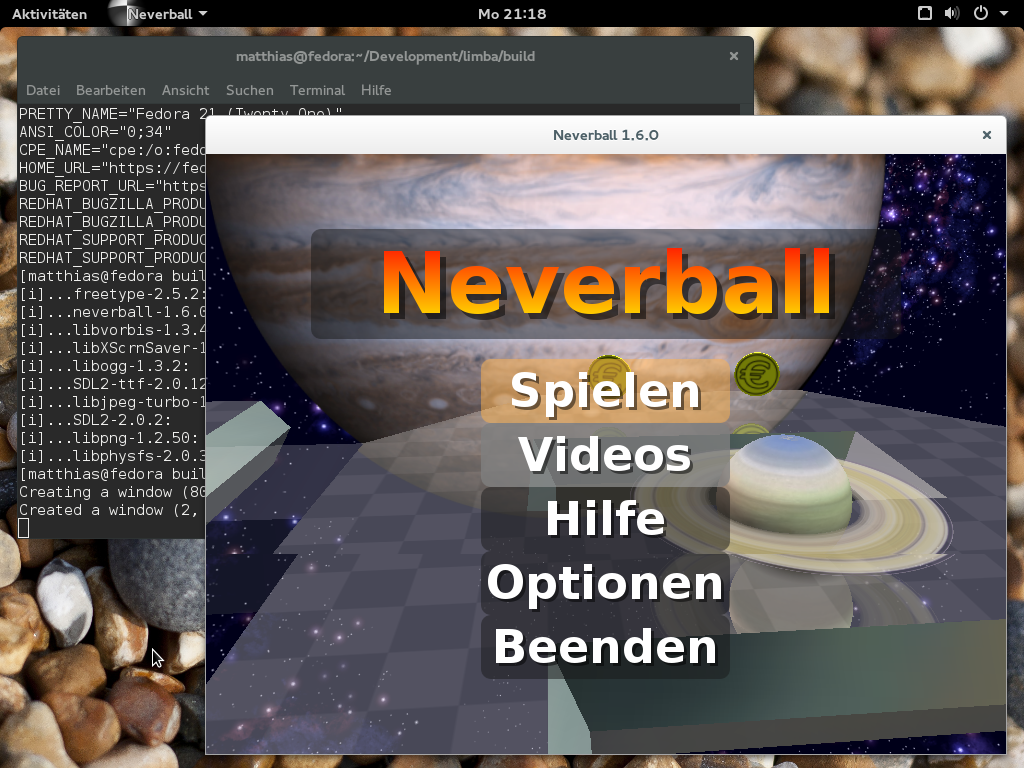
And once again, it s time for another Limba blogpost :-)limba-small Limba is a solution to install 3rd-party software on Linux, without interfering with the distribution s native package manager. It can be useful to try out different software versions, use newer software on a stable OS release or simply to obtain software which does not yet exist for your distribution. Limba works distribution-independent, so software authors only need to publish their software once for all Linux distributions. I recently released version 0.4, with which all most important features you would expect from a software manager are complete. This includes installing & removing packages, GPG-signing of packages, package repositories, package updates etc. Using Limba is still a bit rough, but most things work pretty well already. So, it s time for another progress report. Since a FAQ-like list is easier to digest. compared to a long blogpost, I go with this again. So, let s address one important general question first: How does Limba relate to the GNOME Sandboxing approach? (If you don t know about GNOMEs sandboxes, take a look at the GNOME Wiki Alexander Larsson also blogged about it recently) First of all: There is no rivalry here and no NIH syndrome involved. Limba and GNOMEs Sandboxes (XdgApp) are different concepts, which both have their place. The main difference between both projects is the handling of runtimes. A runtime is the shared libraries and other shared ressources applications use. This includes libraries like GTK+/Qt5/SDL/libpulse etc. XdgApp applications have one big runtime they can use, built with OSTree. This runtime is static and will not change, it will only receive critical security updates. A runtime in XdgApp is provided by a vendor like GNOME as a compilation of multiple single libraries. Limba, on the other hand, generates runtimes on the target system on-the-fly out of several subcomponents with dependency-relations between them. Each component can be updated independently, as long as the dependencies are satisfied. The individual components are intended to be provided by the respective upstream projects. Both projects have their individual up and downsides: While the static runtime of XdgApp projects makes testing simple, it is also harder to extend and more difficult to update. If something you need is not provided by the mega-runtime, you will have to provide it by yourself (e.g. we will have some applications ship smaller shared libraries with their binaries, as they are not part of the big runtime). Limba does not have this issue, but instead, with its dynamic runtimes, relies on upstreams behaving nice and not breaking ABIs in security updates, so existing applications continue to be working even with newer software components. Obviously, I like the Limba approach more, since it is incredibly flexible, and even allows to mimic the behaviour of GNOMEs XdgApp by using absolute dependencies on components. Do you have an example of a Limba-distributed application? Yes! I recently created a set of package for Neverball Alexander Larsson also created a XdgApp bundle for it, and due to the low amount of stuff Neverball depends on, it was a perfect test subject. One of the main things I want to achieve with Limba is to integrate it well with continuous integration systems, so you can automatically get a Limba package built for your application and have it tested with the current set of dependencies. Also, building packages should be very easy, and as failsafe as possible. You can find the current Neverball test in the Limba-Neverball repository on Github. All you need (after installing Limba and the build dependencies of all components) is to run the make_all.sh script. Later, I also want to provide helper tools to automatically build the software in a chroot environment, and to allow building against the exact version depended on in the Limba package. Creating a Limba package is trivial, it boils down to creating a simple control file describing the dependencies of the package, and to write an AppStream metadata file. If you feel adventurous, you can also add automatic build instructions as a YAML file (which uses a subset of the Travis build config schema) This is the Neverball Limba package, built on Tanglu 3, run on Fedora 21: Limba-installed Neverball Which kernel do I need to run Limba? The Limba build tools run on any Linux version, but to run applications installed with Limba, you need at least Linux 3.18 (for Limba 0.4.2). I plan to bump the minimum version requirement to Linux 4.0+ very soon, since this release contains some improvements in OverlayFS and a few other kernel features I am thinking about making use of. Linux 3.18 is included in most Linux distributions released in 2015 (and of course any rolling release distribution and Fedora have it). Building all these little Limba packages and keeping them up-to-date is annoying Yes indeed. I expect that we will see some bigger Limba packages bundling a few dependencies, but in general this is a pretty annoying property of Limba currently, since there are so few packages available you can reuse. But I plan to address this. Behind the scenes, I am working on a webservice, which will allow developers to upload Limba packages. This central ressource can then be used by other developers to obtain dependencies. We can also perform some QA on the received packages, map the available software with CVE databases to see if a component is vulnerable and publish that information, etc. All of this is currently planned, and I can t say a lot more yet. Stay tuned! (As always: If you want to help, please contact me) Are the Limba interfaces stable? Can I use it already? The Limba package format should be stable by now since Limba is still Alpha software, I will however, make breaking changes in case there is a huge flaw which makes it reasonable to break the IPK package format. I don t think that this will happen though, as the Limba packages are designed to be easily backward- and forward compatible. For the Limba repository format, I might make some more changes though (less invasive, but you might need to rebuilt the repository). tl;dr: Yes! Plase use Limba and report bugs, but keep in mind that Limba is still in an early stage of development, and we need bug reports! Will there be integration into GNOME-Software and Muon? From the GNOME-Software side, there were positive signals about that, but some technical obstancles need to be resolved first. I did not yet get in contact with the Muon crew they are just implementing AppStream, which is a prerequisite for having any support for Limba[1]. Since PackageKit dropped the support for plugins, every software manager needs to implement support for Limba.
So, thanks for reading this (again too long) blogpost :) There are some more exciting things coming soon, especially regarding AppStream on Debian/Ubuntu! [1]: And I should actually help with the AppStream support, but currently I can not allocate enough time to take that additional project as well this might change in a few weeks. Also, Muon does pretty well already!

29 March 2015

Zlatan Todori : Its all about fun

The percentage that women in Debian occupy as DDs is ~2%. Yes, just ~2% ladies that are DDs! So that means ~98% of DDs are gentelmen. some picture with rage meme I know there are more of ladies in Debian, so I firstly urge you, for love of Debian, to apply if you are contributing to this project, love its community and want to see Debian taking over the universe (okay, it seems that we conquered outer space so we need a help on Earth). So why is the number this low? Well maybe it's too precious to us currently inside that we want to prevent it being spoiled from outside. Also there seems to be not that much of younger DDs. Why is that important - well, young people like to do it and not to think about it. Many time they just break it, but many time they also do a breakthrough. Why is difference important and why should we embrace it? It's very important because it breaks a monopoly on view and behavior. It brings views not just from a larger number of people, but also from people from different backgrounds, and in constructive conversation it can put even more pluses on current workflow or it can counter it with good arguments. In a project of its size and worldwide geolocation of its developers, this is true for Debian more then any other projects I know. We need more women so we can balance our inner workings and have a better understanding of humanity and how is it moving, what and why does it need and where is it steering. That way we can produce a community which will improve quality of OS that we produce - because of sheer number of different people working on the same thing bringing to it its own personal touch. So, ladies and youth all over the world, unite and join in Debian because without diversity Debian can't grow beyond its current size. Also, no, Debian is not about code only, it needs painters, musicians, people that want to talk about Debian, people that share love and happiness, people that want to build better communities, UI/UX designers, makers, people who know how to repair a bike, athletes, homebrew beer producers, lawyers (just while world gets rid of laws, then we don't need you), actors, writters... Why, well because world and communities are made up from all that diversity and that's what makes it a better and not a monotone place. But I just use Debian. Well, do you feel love towards Debian and its work? Would you like to feel more as integral part of community? If the answer is big fat YES, then you should be a DD too. Every person that feels it's part of Debians philosophy about freedom and behaving in good manner should join Debian. Every person that feels touched and enhanced by Debian's work should become part of community and share its experience how Debian touched their soul, impacted their life. If you love Debian, you should be free to contribute to it in whatever manner and you should be free to express your love towards it. If you think lintian is sexy, or shebang is a good friends of yours, or you enjoy talking to MadameZou about Debian and zombies (yeah, we do have all kinds of here), or you like Krita, or you hate the look of default XFCE theme, or you can prove that you a more crazy developer then paultag - just hop into community and try to integrate in it. You will meet great folks, have a lot of conversation about wine and cheese, play some dangerous card games and even learn about things like bokononism (yeah I am looking at you dkg!). Now for the current Debian community - what the hell is packaging and non-packaging Debian Developer? Are one better then others? Do others stink? They don't know to hug? WHAT? Yes I know that inexperienced person shouldn't have a permission to access Debian packaging infrastructure, but I have the feeling that even that person knows that. Every person should have a place in Debian and acknowledge other fields. So yes, software developers need access to Debian packaging infrastructure, painters don't. I think we can agree on this. So lets abolish the stupid term and remove the difference in our community. Lets embrace the difference, because if someone writes a good poem about Debian heroism I could like it more then flashplugin-nonfree! Yep, I made that comparison on purpose so you can give a thought about it. Debian has excellent community regarding operating system that it's producing. And it's not going away, not at least anytime soon. But it will not go forward if we don't give additional push as human beings, as people who care about their fellow Debianites. And we do care, I know that, we just need to push it more public. We don't hide bugs, we for sure shouldn't hide features. It will probably bring bad seeds too, but we have mechanisms and will to counter that. If we, on average 10 bad seeds, get some crazy good hacker or crazy lovely positive person like this lady, we will be on right path. Debian is a better place, it should lead in effort to bring more people into FLOSS world and it should allow people to bring more of diversity into Debian. draw a picture where it says next year 3 dpl candidates should be only women and at least one of them not involved in packaging

25 March 2015

Matthew Garrett: Python for remote reconfiguration of server firmware

One project I've worked on at Nebula is a Python module for remote configuration of server hardware. You can find it here, but there's a few caveats:
  1. It's not hugely well tested on a wide range of hardware
  2. The interface is not yet guaranteed to be stable
  3. You'll also need this module if you want to deal with IBM (well, Lenovo now) servers
  4. The IBM support is based on reverse engineering rather than documentation, so who really knows how good it is

There's documentation in the README, and I'm sorry for the API being kind of awful (it suffers rather heavily from me writing Python while knowing basically no Python). Still, it ought to work. I'm interested in hearing from anybody with problems, anybody who's interested in getting it on Pypi and anybody who's willing to add support for new HP systems.

comment count unavailable comments

22 March 2015

Rhonda D'Vine: Yasmo

Friday the 13th was my day. In so many different ways. I received a package which was addressed to Rhonda D'Vine with a special hoodie in it. The person at the post office desk asked me whether it was for my partner, my response was a (cowardly) "no, it's my pseudonym" but that settled any further questions and I got my package. Later I received an email which made me hyper happy (but which I can't share right now, potentially later). In the evening there was the WortMacht FemSlam (WordMight FemSlam) poetry slam to which the host asked me to attend just the day before. I was hyper nervous about it. The room was fully packed, there were even quite some people who didn't have a place to sit and were standing at the side. I presented Mermaids because I wasn't able to write anything new on the topic. One would think I am attached enough to the poem by now to not be nervous about it, but it was the environment that made my legs shake like hell while presenting. Gladly I hope it wasn't possible to see it enough under my skirt, but given that it was the first time that I presented it in my home town instead of the "anonymous" internet made me extra anxious. In the end I ended up in place 5 of 7 attendees, which I consider a success given that it was the only text presented in English and not in typical poetry slam style.
(Small addition to the last part: I've been yesterday to the Free Hugs Vienna event at the Schloss Sch nbrunn, and one of the people I hugged told me I know you, I've seen you at the FemSlam!. That was extra sweet. :)) I'm happy that I was notified about the FemSlam on such short notice, it was a great experience. So today's entry goes out to the host of that event. This is about Yasmo. One can just be envious about what she already accomplished in her still young life. And she is definitely someone to watch out for in the years to come. I have to excuse to my readers who don't understand German yet again, but I'll get back to something English next time, I promise. :) Like always, enjoy!

/music permanent link Comments: 0 Flattr this

20 March 2015

Zlatan Todori : Interviews with FLOSS developers: Laura Arjona

One of fresh additions to Debian, that is showing Debian's commitment to diversity in all fields is Laura Arjona Reina. A helpful hand on channels and a great flux of FLOSS energy she brings with herself. Although applied for non-packaging Debian Developer status, Laura does recognize that there are still some technical aspects what must grasp on. Her dedication to FLOSS and trying to solve some of its issues is astonishing, as this woman is doing a lot of self-hosting and system administration. Yes, you read it right - she does all of that and still applied for non-packaging Debian Developer. She is perfect example how FLOSS enhances humans in many ways. Hello Laura. Picture of Laura Who are you? I am Laura Arjona, I work as IT assistant at Technic University of Madrid, I am married and I have a son, and I use and promote free (libre) software both at job and at home and with friends. I have a nice time contributing in Debian and other FLOSS projects but I always want to do more than what I manage to actually do (I hope I can improve that, as time goes by... and maybe when I get retired I am the SuperLArjona that you wrote about!). What parts of FLOSS community are you engaged? I use Debian, and CyanogenMod + F-Droid in my phone. I coordinate the translation of the Debian website into Spanish, help with FSFE website translation too, and translate some other free software (GNU MediaGoblin, F-Droid, Android apps that I use, web services that we use at work...). I use and promote some free social networks: pump.io, GNU Social, and XMPP. My work/friends environment is mostly Windows/Android so I try to find/promote libre software replacements or interesting applications for them. I give free FLOSS stickers to everybody showing interest for libre software, and a nice Debian sticker if they finally install it in their computers. Setup of your main machine? My machine is a humble Compaq Mini 110C laptop (32bits, Atom N270@1.60GHz, 1GB RAM) and I have Debian Jessie (future-stable ATM) with xfce on it. I'm not tied to particular tools, for example I use Mousepad for editing here in my xfce, Kate in my desktop at work, nano in the server. The only "tuning" that I always do is to set a dark background for terminals and text editors, but I don't even switch to a desktop dark theme... (BTW I love Jessie's theme, "Lines"!). I know there are awesome pieces of software out there (hey emacs-org-mode!), but I just don't have fun having to learn them by myself (no LUG near, I'm afraid...). Some memorable moments from Debian conferences? I've only been at Barcelona MiniDebConf Women 2014 and it was great. It was memorable that I promoted the keysigning for that MiniDebConf, and came home with lots of signatures and papers to verify and sign... and then I was not remembering my GPG main key passphrase! so I hid under my desk for two months, and then, decided to start again (created a new key and tried to meet some Debian people in Madrid...). So I guess I should go to some (Mini)DebConf again. You are currently involved in process of becoming non-packaging Debian Developer - what made you take that step? I began translating in 2011, and since then, I enjoyed contributing in Debian (women, l10n-es, website, publicity). I'm quite regular with the translation work, and applying for DD is a plan to 'force' myself to find chunks of time to contribute more in the other areas too. I also believe that applying I may help other people to also apply or get more involved or become more visible. So here I am. Although you applied for non-packaging Debian Developer you recognize that there is still a technical learning curve in Debian even for that - what are the technical aspects a non-Developer should grasp? Well, I suppose it depends on the area you are contributing. In Publicity you find repositories in git (bits.debian.org), and subversion (Debian Project News). The website uses CVS (www.debian.org)... So you need the basics of 3 different version control systems to commit your changes (or send them to the mailing list and wait somebody to commit them). We use a mail robot to coordinate the translation work, so you need to write the subject with a certain format, and some people complains when somebody send mail in HTML (plain text is preferred). There are some other tools such as IRC and GPG that I began using just for contributing to Debian. Once that you learn them a bit and you learn how Debian works, you understand they are the great tools and you get in love (hey meetbot and KGB! hey i18n.debian.org!), but I wonder how people with no technical background, or even Computer Engineering students nowadays, accostumed to instant messaging in the mobile, fancy web interfaces and so on, look at these tools and just don't even try. How do you see future of Debian development? I don't know, Debian is huge... Some areas in which I hope we, as a community, find the way to work more: packaging (or help configuring) web applications or network services, provide LTS support, and keep on improving outreach/diversity. What are your future plans in Debian, what would you like to work on? In the Spanish team area, my plan is to go on translating the website, jump more often into translating package descriptions too, and help first-time-contributors to keep themselves involved. In the website and publicity teams, I hope I manage to put some weekly time to help with pending tasks/bugs, and serve as liaison with the other areas in which I'm involved (women, l10n, contributors...). If I become DD, I would like to create/adopt some data sources for contributors.debian.org, or convince people to do it I'm not sure if I will be able to attend DebConf some year; meanwhile, at least, I'll continue trying to help with the blog and promotion (as -publicity-team member). Why should developers and users join Debian community? What makes Debian a great and happy place? For using it: the desktop experience has improved very much in the last years, there's a clear separation between free and non-free software so the Debian users always know where are we, and there is wide documentation (in English, at least. Probably in other languages too). For getting involved: I like very much that you can lurk what almost everybody does: just join some mailing lists or IRC channels, the Debian people work in the open. So you know a bit where are you jumping in. Later you learn that everything is easier than what was looking from the outside, because you make friends and with friends everything is better.
Contributions made to Debian have many chances to reach a very wide community: Debian users, upstream projects, and the hundreds of derivatives. It's a quite horizontal, decentralized organization (that has its downsides too, but I can live with them). Is there something you would change in FLOSS ecosystem? We need much more internationalization and localization efforts. People don't need English for using libre software nowadays in their desktop, it's one of our big strenghts, but they definitely need English for using libre software for Android, or solving problems with the libre software they use in your computers/devices, or to contribute to any community. I think we need more local groups for user support/outreach, more libre-software-based translation tools and online services (replacements for Google Translator, for Transifex...),and more internationalization and localization efforts (manuals, websites... not only the software itself). If we work hard in this area, we'll gain much more users and much more contributors. Why does privacy matter to you? I have a son, at our family we interchange photos, and sometimes I have private conversations using the smartphone, mail or other internet services. I want to have the chance that the day that I (or my family) need privacy, we can have it easily. And I want that the people that really need privacy today, have proper tools at their hand. So I try to use PGP, selfhost my multimedia website, use decentralized, free software based networks and XMPP mobile apps... to help those projects to thrive. I try do my part of the network effect! You are being upset with rise of Github - why is that and what would change would you like to see? I totally agree with Mako's essay "Free software needs free tools". Yes, many nonfree web services are easier and have better features right now, but the key is that only dogfooding can change that, the same like changed it with the GNU/Linux desktop and Open/LibreOffice for example...
I would like to see more people trying to selfhost, use and promote libre software based forges, so in addition to avoid vendor lock in and win consistency in our discourse, we polish the available tools and eventually win the battle also in the technical side. You are hosting yours own instances of Mediagoblin - as it is not officially packaged in Debian yet, how do you manage it and how would you encourage others to do it? I followed the MediaGoblin documentation for its last stable release, and hanged on the IRC channel when in doubts/problems. It was not so hard, because it's well documented for Debian systems, and most of the dependencies are already packaged (in stable and testing). MediaGoblin is in its way to stretch too (thanks simonft and the rest of people working on this!). I'm documenting my adventures with selfhosting in [my blog (http://larjona.wordpress.com), but I need to write more often, and put more time in my small server (now I try to selfhost my git projects with cgit, and I want to setup an XMPP server and Etherpad Lite too). You are trying to resolve with self-hosting personal issues with services such as WhatsUp and other non-free parts of our everyday lives- what issues are you hitting on during your way and how do you resolve them? "#iloveemail", but people don't love it anymore, it seems... I've researched a bit about instant messaging to try to propose alternatives to WhatsApp to my family and friends. It seems Conversations with a community XMPP server where to create multi user chat rooms can be a replacement, so my plan is to try during this year. Meanwhile, I've setup the MediaGoblin site so I upload the photos there instead of sending them with the phone, and for the 1-to-1 chat I try to move people to Kontalk (instant messaging, GPG, photos, voice notes...). For the videocalls, I promote Jitsi or just point people to meet.jit.si/FancyNameofChatRoom. I have account and owndrive.com and will try to host Owncloud too. We'll see what happens. You are interested in radio shows - what drives you into that field and will we see soon any podcasts from Laura? I like to talk and I'm not a shy person, so the few times that in any of my social groups there was a chance to "talk in the radio", I volunteered and enjoyed. This has been, in my life, 6 or 7 times (in Spanish, talking about social activism or politics. No records, though!). Some months ago the people of "El Binario" invited me to talk at "findenegro" about pump.io and free networks (in Spanish), I accepted and had a very nice time (audios in my mediagoblin). I wish I have more free time to listen to podcasts and maybe to join some other people to participate in a program in a regular basis. OTOH, my son asks for a tale almost each day... I follow one of Gianni Rodari "The grammar of fantasy"'s approach: take some day-to-day facts and add something unexpected and crazy, and tailor a short story. Maybe I could record them and publish in my MediaGoblin... Of course their literary quality is not even near to Gianni Rodari's but people that listened to them when I was storytelling (in the metro, my mother at home, some friends...) say they are fun and interesting. Who knows! Work of Laura's son

16 March 2015

Russ Allbery: Another haul post

Wow, it's been quite a long time since I've posted something here. Everything is going well -- I'm just very, very engrossed with the new job, since I'm still in exponential ramp-up mode. It's lasting for longer than I expected, although my expectations didn't have much basis since this is the first time I've started a new job in 17 years. I'm feeling more and more capable every day, but the combination of a very heavily social learning process, a lot of new technical areas to learn, and not having taken a vacation since last June means that my weekends are spent just passively watching things and zoning. Not sure yet how long that will last, and I don't want to make any predictions, although I do have my first significant vacation coming up next month. Anyway, book reading and buying has continued, although I'm again far behind on writing reviews. With luck, I'll be writing one of those (for posting later) right after writing this post. Michelle Alexander The New Jim Crow (non-fiction)
Elizabeth Bear Karen Memory (sff)
Becky Chambers The Long Way to a Small, Angry Planet (sff)
Fred Clark The Anti-Christ Handbook (non-fiction)
Charles de Lint The Very Best of Charles de Lint (sff)
S.L. Huang A Neurological Study on the Effects... (sff)
S.L. Huang Half Life (sff)
Kameron Hurley The Mirror Empire (sff)
Sophie Lack Dissonance (sff)
Sophie Lack Imbalance (sff)
Susan R. Matthews An Exchange of Hostages (sff)
Kaoru Mori A Bride's Story #1 (graphic novel)
Donald Shoup The High Cost of Free Parking (non-fiction)
Jo Walton The Just City (sff) Pretty nice variety of different stuff from a huge variety of recommendation sources. I've already read the Chambers (and can recommend it). A review will be forthcoming.

13 March 2015

Dirk Eddelbuettel: Why Drat? A Guest Post by Steven Pav

Editorial Note: The following post was kindly contributed by Steven Pav.

Why Drat? After playing around with drat for a few days now, my impressions of it are best captured by Dirk's quote:
It just works.

Demo To get some idea of what I mean by this, suppose you are a happy consumer of R packages, but want access to, say, the latest, greatest releases of my distribution package, sadist. You can simply add the following to your .Rprofile file:
drat::add("shabbychef")
After this, you instantly have access to new releases in the github/shabbychef drat store via the package tools you already know and tolerate. You can use
install.package('sadists')
to install the sadists package from the drat store, for example. Similarly, if you issue
update.packages(ask=FALSE)
all the drat stores you have added will be checked for package updates, along with their dependencies which may well come from other repositories including CRAN.

Use cases The most obvious use cases are:
  1. Micro releases. For package authors, this provides a means to get feedback from the early adopters, but also allows one to push small changes and bug fixes without burning through your CRAN karma (if you have any left). My personal drat store tends to be a few minor releases ahead of my CRAN releases.
  2. Local repositories. In my professional life, I write and maintain proprietary packages. Pushing package updates used to involve saving the package .tar.gz to a NAS, then calling something like R CMD INSTALL package_name_0.3.1.9001.tar.gz. This is not something I wanted to ask of my colleagues. With drat, they can instead add the following stanza to .Rprofile: drat:::addRepo('localRepo','file:///mnt/NAS/r/local/drat'), and then rely on update.packages to do the rest.
I suspect that in the future, drat might be (ab)used in the following ways:
  1. Rolling your own vanilla CRAN mirror, though I suspect there are better existing ways to accomplish this.
  2. Patching CRAN. Suppose you found a bug in a package on CRAN (inconceivable!). As it stands now, you email the maintainer, and wait for a fix. Maybe the patch is trivial, but suppose it is never delivered. Now, you can simply make the patch yourself, pick a higher revision number, and stash it in your drat store. The only downside is that eventually the package maintainer might bump their revision number without pushing a fix, and you are stuck in an arms race of version numbers.
  3. Forgoing CRAN altogether. While some package maintainers might find this attractive, I think I would prefer a single huge repository, warts and all, to a landscape of a million microrepos. Perhaps some enterprising group will set up a CRAN-like drat store on github, and accept packages by pull request (whether github CDN can or will support the traffic that CRAN does is another matter), but this seems a bit too futuristic for me now.

My wish list In exchange for writing this blog post, I get to lobby Dirk for some features in drat:
  1. I shudder at the thought of hundreds of tiny drat stores. Perhaps there should be a way to aggregate addRepo commands in some way. This would allow curators to publish their suggested lists of repos.
  2. Drat stores are served in the gh-pages branch of a github repo. I wish there were some way to keep the index.html file in that directory reflect the packages present in the sources. Maybe this could be achieved with some canonical RMarkdown code that most people use.

This post by Dirk Eddelbuettel originated on his Thinking inside the box blog. Please report excessive re-aggregation in third-party for-profit settings.

12 March 2015

Erich Schubert: The sad state of sysadmin in the age of containers

System administration is in a sad state. It in a mess.
I'm not complaining about old-school sysadmins. They know how to keep systems running, manage update and upgrade paths.
This rant is about containers, prebuilt VMs, and the incredible mess they cause because their concept lacks notions of "trust" and "upgrades".
Consider for example Hadoop. Nobody seems to know how to build Hadoop from scratch. It's an incredible mess of dependencies, version requirements and build tools.
None of these "fancy" tools still builds by a traditional make command. Every tool has to come up with their own, incomptaible, and non-portable "method of the day" of building.
And since nobody is still able to compile things from scratch, everybody just downloads precompiled binaries from random websites. Often without any authentication or signature.
NSA and virus heaven. You don't need to exploit any security hole anymore. Just make an "app" or "VM" or "Docker" image, and have people load your malicious binary to their network.
The Hadoop Wiki Page of Debian is a typical example. Essentially, people have given up in 2010 to be able build Hadoop from source for Debian and offer nice packages.
To build Apache Bigtop, you apparently first have to install puppet3. Let it download magic data from the internet. Then it tries to run sudo puppet to enable the NSA backdoors (for example, it will download and install an outdated precompiled JDK, because it considers you too stupid to install Java.) And then hope the gradle build doesn't throw a 200 line useless backtrace.
I am not joking. It will try to execute commands such as e.g.
/bin/bash -c "wget http://www.scala-lang.org/files/archive/scala-2.10.3.deb ; dpkg -x ./scala-2.10.3.deb /"
Note that it doesn't even install the package properly, but extracts it to your root directory. The download does not check any signature, not even SSL certificates. (Source: Bigtop puppet manifests)
Even if your build would work, it will involve Maven downloading unsigned binary code from the internet, and use that for building.
Instead of writing clean, modular architecture, everything these days morphs into a huge mess of interlocked dependencies. Last I checked, the Hadoop classpath was already over 100 jars. I bet it is now 150, without even using any of the HBaseGiraphFlumeCrunchPigHiveMahoutSolrSparkElasticsearch (or any other of the Apache chaos) mess yet.
Stack is the new term for "I have no idea what I'm actually using".
Maven, ivy and sbt are the go-to tools for having your system download unsigned binary data from the internet and run it on your computer.
And with containers, this mess gets even worse.
Ever tried to security update a container?
Essentially, the Docker approach boils down to downloading an unsigned binary, running it, and hoping it doesn't contain any backdoor into your companies network.
Feels like downloading Windows shareware in the 90s to me.
When will the first docker image appear which contains the Ask toolbar? The first internet worm spreading via flawed docker images?

Back then, years ago, Linux distributions were trying to provide you with a safe operating system. With signed packages, built from a web of trust. Some even work on reproducible builds.
But then, everything got Windows-ized. "Apps" were the rage, which you download and run, without being concerned about security, or the ability to upgrade the application to the next version. Because "you only live once".
Update: it was pointed out that this started way before Docker: Docker is the new 'curl sudo bash' . That's right, but it's now pretty much mainstream to download and run untrusted software in your "datacenter". That is bad, really bad. Before, admins would try hard to prevent security holes, now they call themselves "devops" and happily introduce them to the network themselves!

9 March 2015

Ulrike Uhlig: Final report from the Outreach Program round 9

Between december 9th 2014 and march 9th 2015 I ve been working as an intern for Debian on Improving AppArmor support in Debian. Progress Before the internship started, I had no clue about AppArmor at all. Reading the Wikipedia page and the AppArmor wiki did barely enlighten me. At least, until I got my hands dirty and installed and activated it. I was able to do this only because there was already some basic documentation on the Debian wiki on how to get AppArmor running on a Debian system. When the internship started I felt a little bit lost. I started to read the documentation and to play around with some AppArmor profiles. But the error messages I saw and the profiles I opened for reading overwhelmed me. What did all these lines mean? Then one mentor briefed me about the current status of AppArmor in Debian. I took many notes and tried to bring some order into the information I was being given. These notes became the first page of the documentation and my first blog post.
Surprise: suddenly I was in the middle of knowing what we were talking about and how the next few weeks would look like. To start with, I have set up a test environment and continued to test some of the profiles which came with the packages I had installed, namely apparmor-profiles-extra which provided me with a profile for Pidgin. I was very much interested in securing this several thousand lines long C-code application on my machine! As a Pidgin user, I noticed immediately that one of my favourite features pidgin blinklight threw an error in the logs. I tried to fix it on my test VM and eventually made it work. Now knowing that such fixes should first be done upstream, i cloned the corresponding upstream repository and sent my first patch. It was not easy at first to switch to another VCS than Git, although I had been using Bazaar and Subversion years ago. Shortly afterwards, I saw my patch showing up on the upstream mailing list, and some days later it got merged. That was a huge encouragement. I was now able to write more documentation on how to contribute upstream. In order to organize the documentation, we ve set up some User Stories. I did not know about this tool before and had quite a hard time to grasp all the details but it proved to be very useful as some pages started to become long and confusing. Writing the documentation took up a lot of time, but before being able to write anything down, I needed to work everything out! This way I incidentally learned how to interact with many parts of Debian s infrastructure: While playing around with the tools provided to inspect AppArmor status on the system, I even accidentally found a little bug in one of the upstream tools. It got fixed very quickly after I mentioned it on the AppArmor team s mailing list. Organization Although I was uncomfortable with this in the beginning, we organized public meetings every two weeks on IRC. These meetings were also attended by MeetBot who took care of taking notes and leaving a trace of our discussions.
Based on the meetings, I maintained a progress page and todo list on the Debian wiki, which helped us to know which tasks were planned for the next two weeks. Before each meeting I sent a status update to the mailing list, so the mentors could catch up with my work. During the meetings I was not only asked to provide feedback on progress but also on mentoring itself. It proved to be very useful to be able to say where I was stuck and if the mentoring process worked out well enough (it did!).
Furthermore, I got regular, detailed and pedantic (thanks for trying to push me to perfection!) feedback on the team s mailing list. The mentors had introduced me on the upstream IRC channel in the beginning, so most of the people who are active there knew about my existence, something which also proved to be handy! Future The internship time is over, but some work remains to be done. As a new member of the AppArmor Packaging team, I am committed to make it happen: Thanks I feel much more confident after these three months, technically but also personally. Thank you: Holger Levsen and intrigeri for mentoring and encouraging me on this journey and to upstream contributors Christian Boltz, Steve Beattie (and everybody else I might forget here) for providing help and feedback. The Debian community (OPW organizers, sponsors, Alioth maintainers, planet.debian.org maintainers although my posts don t show up anymore :( -and others) has been very friendly and welcoming and I am very happy to be part of it.

2 March 2015

Gergely Nagy: Distributed Version Control from another angle

I've been using distributed version control systems for a good while, started with TLA back in 2001, when it was still a bunch of shell scripts and was simply called "Arch". I jumped the Git bandwagon quite early too, sometime around May 2005, I believe, though it was only something to test and play with on the side: I didn't migrate my projects over yet. There are many reasons why I preferred these over the systems I used in the past (RCS and CVS; never considered Subversion an option), most of those reasons have been discussed at length over the years, and there's no reason to do so again.The reason for this post, is because I read a blog post about why Git and the other DVCSes fall short. There are a number of things in that article that I find... well, lets just say misinformed. I'll try to explain why.But here's the rub
I have wanted to have the full history while offline a grand total of maybe about six times. And this is merely going down over time as bandwidth gets ever more readily available. If you work as a field tech, or on a space station, or in a submarine or something, then okay, sure, this is a huge feature for you. But for the rest of us, I am going to assert that this is not the use case you need to optimize for when choosing a VCS.
I'm neither a field tech, nor do I work on a space station or a submarine. Yet, having the full history available locally has been crucial for my work for at least the past six years. Initially, I worked offline primarily, because my internet connection was incredibly limited (slow, expensive and unreliable), yet, I had a habit of committing small changes often. I needed a full clone to work effectively, and conveniently. Throw-away branches and all that - I needed them local, I didn't have the resources to push them online every time I wanted a merge.But now that I have fast and reliable internet, why do I need the full history on my own computer? I do, because I do much more research than I do development. The vast majority of my work between 2010 and 2012 involved reading histories, cherry picking and so on. About six hours a day, I was reading the past. Having the full history locally is a terrific aid when your job involves digging through it.Between 2013 and 2014, the amount of history reading dropped significantly, but I still worked with long-lived branches a lot, branches where history matters, where having easy and fast access to them is indispensable. I still had to find changes based on content (not commit message, branch, date or anything - content) on a daily basis. Hitting the network for each and every search would have wasted not only tremendous bandwidth and processing power on the server, but also a significant amount of time.If you do more maintenance and research, or follow a good number of branches (or forks), with the intent to merge and cherry-pick actively from them, having all the histories available locally is a huge improvement. I'm happy to pay the price of "wasting" disk space to have this available. I couldn't work otherwise. Without full, local history, the things I did for syslog-ng would not have been possible. No maintenance, none of the features I implemented, none of the fixes I found. Why? Because I rely on the project's history to aid me in learning the whys, not just the hows.Thank you, but - perhaps unlike others - I like to learn from the past, and prefer doing it efficiently.Say goodbye to blobs (or your sanity (and sometimes both))
You know what kind of external binary asset management system works really well? Subversion. Turns out it works tolerably for source control, too. Maybe you should take a look at it.
Sure, some systems are better at managing binary assets. Git - and usually DVCSes - are terrible at it. There's nothing stopping anyone from using two systems: one for source, another for data. Mind you, I am extremely happy with git-annex. I disagree with Subversion being tolerable for source control. I'd turn this assertion around instead: You know what kind of system works really well for source code? Git. Turns out it works tolerably as an external binary assest management system, too. Maybe you should take a look at it.But then, I rarely need to work with blobs, so I'm likely not the best person to disagree here.Say goodbye to sane version synchronizationOkay, so this part of the article is ill-titled, I believe. Large repositories and version synchronisation are two different, not necessarily related topic. Granted DVCSes may not be the best fit for large repositories, but neither are centralised version control systems, based on my past experience. I had the misfortune of working with a roughly 3-4Gb (checked out) project, with extensive history, managed with a centralised version control system, without local history. It was terrible (and blame was so slow and expensive that we were told never to use it, because it crashed the server). While the system allowed us to have a reasonable overview over the whole project, but it utterly failed at allowing us to work at the component level. How do I see which version of component X we had in project release A? Or the version of component Y we had two weeks ago? Or what if we have component M, made up from components J and K, and belonging to component Z? Good luck managing that in a single repository.With TLA, we had configs, which were a bit cumbersome to use, but captured most of the essential parts of managing component bundling and hierarchical versioning far better than any other solution I've seen so far. I've yet to find an acceptable solution, but I'm convinced it will not have anything to do with centralised systems. You can't capture the delicate relations there.Say what again, I dare you, I double dare you
All of the above might be almost tolerable if DVCSes were easier to use than traditional SCMs, but they aren t.
I'm sorry, but have you tried managing a decently sized project, with a large history, built from multiple components with a traditional SCM? Because that is a colossal pain in the backside.Does Git's UI suck? Yes. But so did CVS's and Subversion's. If you rely on the command-line tools, you're going to feel the pain. That is why you use the IDE integration you surely have, which makes the most common tasks a breeze. That may sound like a git-apology, but remember, we did the same with every other version control system, because smart people prefer integration, and want the computer to work for them.
And yet, when someone dares to say that Git is harder than other SCMs, they inevitably get yelled at, in what I can only assume is a combination of Stockholm syndrome and groupthink run amok by overdosing on five-hour energy buckets.
If you feel the need to understand the innards of Git - then yes, it is harder than traditional SCMs. It is distributed, and different than what you're used to. If you do not have prior knowledge though, the difference in learning the internal working of Git and - say - Subversion all that different. And if you do not care how it works down below (and I dare say, a lot of developers should not, and do not care), then there is nothing to learn, apart from your IDE integration, which ain't different from a traditional SCM's.Mind you, I found it both interesting, and beneficial to learn Git's inner workings. Not only because it allowed me to make better use of my VCS, but because it taught me a bunch of things I could make use of elsewhere. I learned nothing from traditional SCMs.Do you hear the people sing, singing the song of angry men
There is one last major argument that I hear all the time about why DVCSes are superior, which is that they somehow enable more democratic code development.
The reason Git and other tools make code contribution easier is not GitHub pull requests (although, for drive-by contributions those are pretty useful too). The reason they make contribution easier is because you have your own copy of the full history. You can create your own branches easily, you can work with it as if you were the owner. For one-off contributions, that is no real advantage, I'll give you that. It takes more effort to fork & do a PR on GitHub, than to send a patch, I'll also agree with that.But once you start working with a project for more than a few patches, when you want to work with its history too, once you have long-lived branches, the local copy quickly becomes a great asset. Once you want to submit more than a few changes, you won't have to repeat a all steps. And not only that: since you have the full history, merging upstream changes (or just cherry picking from them), rebasing your work, and many other tasks become simpler.That is what it buys you, that is why it makes contribution easier. GitHub pull requests are an icing over the cake at best (and there are a good number of cases where the icing is completely unnecessary, because it doesn't go well with the cake).In closingIn closing, I'd like to highlight that different projects have different requirements. For example, I understand why Facebook, Google and a number of others use a single, huge repository. I happen to hate that setup, and would find working in such an environment horrible. But luckily, I don't work for those companies, and they don't listen to me, either, so everyone's happy. That does not mean I would go out and tell them they're wrong to use such a centralised, single-repository setup. For their use, in their situation, for their requirements, that may be the better option. For mine, not so much.In the end, what we need to realise is that there is no single tool that will fit all needs. There are tasks where Git is a terrible choice, but that does not make it terrible for all cases. Similarly, there are cases where Subversion is superior (I assume - I didn't have the misfortune of meeting with such a case).Instead of bashing the DVCS world, and assuming the Big Company use cases are all that matter, and that everyone uses the tools the same way, accept that some use it to achieve things you didn't think of, jobs you didn't consider.

19 February 2015

Matthew Garrett: It has been 0 days since the last significant security failure. It always will be.

So blah blah Superfish blah blah trivial MITM everything's broken.

Lenovo deserve criticism. The level of incompetence involved here is so staggering that it wouldn't be a gross injustice for the company to go under as a result[1]. But let's not pretend that this is some sort of isolated incident. As an industry, we don't care about user security. We will gladly ship products with known security failings and no plans to update them. We will produce devices that are locked down such that it's impossible for anybody else to fix our failures. We will hide behind vague denials, we will obfuscate the impact of flaws and we will deflect criticisms with announcements of new and shinier products that will make everything better.

It'd be wonderful to say that this is limited to the proprietary software industry. I would love to be able to argue that we respect users more in the free software world. But there are too many cases that demonstrate otherwise, even where we should have the opportunity to prove the benefits of open development. An obvious example is the smartphone market. Hardware vendors will frequently fail to provide timely security updates, and will cease to update devices entirely after a very short period of time. Fortunately there's a huge community of people willing to produce updated firmware. Phone manufacturer is never going to fix the latest OpenSSL flaw? As long as your phone can be unlocked, there's a reasonable chance that there's an updated version on the internet.

But this is let down by a kind of callous disregard for any deeper level of security. Almost every single third-party Android image is either unsigned or signed with the "test keys", a set of keys distributed with the Android source code. These keys are publicly available, and as such anybody can sign anything with them. If you configure your phone to allow you to install these images, anybody with physical access to your phone can replace your operating system. You've gained some level of security at the application level by giving up any real ability to trust your operating system.

This is symptomatic of our entire ecosystem. We're happy to tell people to disable security features in order to install third-party software. We're happy to tell people to download and build source code without providing any meaningful way to verify that it hasn't been tampered with. Install methods for popular utilities often still start "curl sudo bash". This isn't good enough.

We can laugh at proprietary vendors engaging in dreadful security practices. We can feel smug about giving users the tools to choose their own level of security. But until we're actually making it straightforward for users to choose freedom without giving up security, we're not providing something meaningfully better - we're just providing the same shit sandwich on different bread.

[1] I don't see any way that they will, but it wouldn't upset me

comment count unavailable comments

14 February 2015

John Goerzen: Willis Goerzen a good reason to live in Kansas

From time to time, people ask me, with a bit of a disbelieving look on their face, Tell me again why you chose to move to Kansas? I can explain something about how people really care about their neighbors out here, how connections through time to a place are strong, how the people are hard-working, achieve great things, and would rather not talk about their achievements too much. But none of this really conveys it. This week, as I got word that my great uncle Willis Goerzen passed away, it occured to me that the reason I live in Kansas is simple: people like Willis. Willis was a man that, through and through, simply cared. For everyone. He had hugs ready anytime. When I used to see him in church every Sunday, I d usually hear his loud voice saying, Well John! Then a hug, then, How are you doing? When I was going through a tough time in life, hugs from Willis and Thelma were deeply meaningful. I could see how deeply he cared in his moist eyes, the way he sought me out to offer words of comfort, reassurance, compassion, and strength. Willis didn t just defy the stereotypes on men having to hide their emotions; he also did so by being just gut-honest. Americans often ask, in sort of a greeting, How are you? and usually get an answer like fine . If I asked Willis How are you? , I might hear great! or it s hard or pretty terrible. In a place where old-fashioned stoicism is still so common, this was so refreshing. Willis and I could have deep, heart-to-heart conversations or friendly ones. Willis also loved to work. He worked on a farm, in construction, and then for many years doing plumbing and heating work. When he retired, he just kept on doing it. Not for the money, but because he wanted to. I remember calling him up one time about 10 years ago, asking if he was interested in helping me with a heating project. His response: I ll hitch up the horses and be right there! (Of course, he had no horses anymore.) When I had a project to renovate what had been my grandpa s farmhouse (that was Willis s brother), he did all the plumbing work. He told me, John, it s great to be retired. I can still do what I love to do, but since I m so cheap, I don t have to be fast. My old knees can move at their own speed. He did everything so precisely, built it so sturdy, that I used to joke that if a tornado struck the house, the house would be a pile of rubble but the ductwork would still be fine. One of his biggest frustrations about ill health was being unable to work, and in fact he had a project going before cancer started to get the best of him. He was quite distraught that, for the first time in his life, he didn t properly finish a job. Willis installed a three-zone system (using automated dampers to send heat or cool from a single furnace/AC into only the parts of the house where it was needed) for me. He had never done that before. The night Willis and his friend Bob came over to finish the setup was one to remember. The two guys, both in their 70s, were figuring it all out, and their excitement was catching. By the time the evening was over, I certainly was more excited about thermostats than I ever had been in my life. I heard a story about him once he was removing some sort of noxious substance from someone s house. I forget what it was whatever it was, it had pretty bad long-term health effects. His comment: Look, I m old. It s not going to be this that does me in. And he was right. In his last few years, Willis started up a project that only Willis would dream up. He invited people to bring him all their old and broken down appliances and metal junk air conditioners, dehumidifiers, you name it. He carefully took them apart, stripped them down, and took the metals into a metal salvage yard. He then donated all the money he got to a charity that helped the poor, and it was nearly $5000. Willis had a sense of humor about him that he somehow deployed at those perfect moments when you least expected it. Back in 2006, before I had moved into the house that had been grandpa s, there was a fire there. I lost two barns (one was the big old red one with lots of character) and a chicken house. When I got out there to see what had happened, Willis was already there. It was quite the disappointment for me. Willis asked me if grandpa s old manure spreader was still in the chicken house. (Cattle manure is sometimes used as a fertilizer.) This old manure spreader was horse-drawn. I told him it was, and so it had burned up. So Willis put his arm around me, and said, John, do you know what we always used to call a manure spreader? Nope. Shit-slinger! That was so surprising I couldn t help but break out laughing. Willis was the only person that got me to laugh that day. In his last few years, Willis battled several health ailments. When he was in a nursing home for a while due to complications from knee surgery, I d drop by to visit. And lately as he was declining, I tried to drop in at his house to visit with Willis and Thelma as much as possible. Willis was always so appreciative of those visits. He always tried to get in a hug if he could, even if Thelma and I had to hold on to him when he stood up. He would say sometimes, John, you are so good to come here and visit with me. And he d add, I love you. As did I. Sometimes when Willis was felling down about not being able to work more, or not finish a project, I told him how he was an inspiration to me, and to many others. And I reminded him that I visited with him because I wanted do, and being able to do that meant as much to me as it did to him. I m not sure if he ever could quite believe how deeply true that was, because his humble nature was a part of who he was. My last visit earlier this week was mostly with Thelma. Willis was not able to be very alert, but I held his hand and made sure to tell him that I love and care for him that time. I m not sure if he was able to hear, but I am sure that he didn t need to. Willis left behind a community of hundreds of people that love him and had their lives touched by his kind and inspirational presence.

12 February 2015

Sven Hoexter: Comparing apples and oranges: IPv6 adoption vs HTTP/2 adoption

I did not yet read the HTTP/2 draft but I've read the SPDY draft about 2.5 years ago. So I might be wrong here with my assumptions. We're now about 17 years into the IPv6 migration and still we do not have widespread IPv6 adoption on the client side. That's mostly an issue of CPE device rotation at the customer side and updating provisioning solutions. For the server side we're more or less done. Operating system support is there, commercial firewall and router vendors picked it up in the last ten years, datacenter providers are ready, so we're waiting for the users to put some pressure on providing a service via IPv6. Looking at HTTP/2 it's also a different protocol. The gap might be somewhat closer than the one between IPv4 and IPv6, but it's still huge. Now I'd bet that in the case of HTTP/2 we'll also see a really slow adoption, but this time it's not the client side that's holding back the adoption. For HTTP/2 I've no doubts about a fast adoption on the client side. Google and Mozilla are nowadays providing some kind of continues delivery of new features to the end user on a monthly basis (surprisingly that also works for mobile devices!). So the web browser near you will soon have a HTTP/2 implementation. Even Microsoft is switching to a new development model of rolling updates with Windows 10 and the Internet Explorer successor. But looking at the server side I doubt we'll have widespread HTTP/2 support within the next 5 years. Maybe in 10. But I doubt even that. With all those reverse proxies, interception devices for header enrichment at mobile carriers, application servers, self written HTTP implementations, load balancers and so on I doubt we'll have a fast and smooth migration ahead. But maybe we're all lucky and I'm wrong. I'd really love to be wrong here. Maybe we can provide working IPv4-IPv6 dual-stack setups for everyone in the meantime.

27 January 2015

Matthias Klumpp: AppStream 0.8 released!

Yesterday I released version 0.8 of AppStream, the cross-distribution standard for software metadata, that is currently used by GNOME-Software, Muon and Apper in to display rich metadata about applications and other software components. What s new? The new release contains some tweaks on AppStreams documentation, and extends the specification with a few more tags and refinements. For example we now recommend sizes for screenshots. The recommended sizes are the ones GNOME-Software already uses today, and it is a good idea to ship those to make software-centers look great, as others SCs are planning to use them as well. Normal sizes as well as sizes for HiDPI displays are defined. This change affects only the distribution-generated data, the upstream metadata is unaffected by this (the distro-specific metadata generator will resize the screenshots anyway). Another addition to the spec is the introduction of an optional <source_pkgname/> tag, which holds the source package name the packages defined in <pkgname/> tags are built from. This is mainly for internal use by the distributor, e.g. it can decide to use this information to link to internal resources (like bugtrackers, package-watch etc.). It may also be used by software-center applications as additional information to group software components. Furthermore, we introduced a <bundle/> tag for future use with 3rd-party application installation solutions. The tag notifies a software-installer about the presence of a 3rd-party application bundle, and provides the necessary information on how to install it. In order to do that, the software-center needs to support the respective installation solution. Currently, the Limba project and Xdg-App bundles are supported. For software managers, it is a good idea to implement support for 3rd-party app installers, as soon as the solutions are ready. Currently, the projects are worked on heavily. The new tag is currently already used by Limba, which is the reason why it depends on the latest AppStream release. How do I get it? All AppStream libraries, libappstream, libappstream-qt and libappstream-glib, are supporting the 0.8 specification in their latest version so in case you are using one of these, you don t need to do anything. For Debian, the DEP-11 spec is being updated at time, and the changes will land in the DEP-11 tools soon. Improve your metadata! This call goes especilly to many KDE projects! Getting good data is partly a task for the distributor, since packaging issues can result in incorrect or broken data, screenshots need to be properly resized etc. However, flawed upstream data can also prevent software from being shown, since software with broken data or missing data will not be incorporated in the distro XML AppStream data file. Richard Hughes of Fedora has created a nice overview of software failing to be included. You can see the failed-list here the data can be filtered by desktop environment etc. For KDE projects, a Comment= field is often missing in their .desktop files (or a <summary/> tag needs to be added to their AppStream upstream XML file). Keep in mind that you are not only helping Fedora by fixing these issues, but also all other distributions cosuming the metadata you ship upstream. For Debian, we will have a similar overview soon, since it is also a very helpful tool to find packaging issues. If you want to get more information on how to improve your upstream metadata, and how new metadata should look like, take a look at the quickstart guide in the AppStream documentation.

24 January 2015

Diego Escalante Urrelo: Link Pack #05

Lever Rukhin Photographs Los Angeles From His Car
Lever Rukhin shoots the sketchiest parts of Los Angeles from his car, taking a really unique perspective that helps you perceive what LA looks like, if you were in a car An experience that is apparently common to all LA people. People drive too much in the US :-). It s a very interesting interview that goes well with his full site: Lev Rukhin. What I love about this, besides the whole premise, is that Lev went the extra mile and actually hacked his car to make the images he wanted:
Phoblographer: It looks like many of these images have artificial lighting in them. What s your gear setup, and how do you introduce so much light into the scene from your car? Lever: About 9 months ago, I affixed a Mola beauty dish onto the roof rack of my 75 Volvo and juice it with a profoto bi-tube. This takes a bit of practice, as making a turn changes the light completely, which I always try to keep balanced. The Canon 5D3 with a 24mm f1.4 is set up on a tripod. The strobe has allowed me to capture more detail as well as creating a somewhat surreal feel to the sets.
Lev Rukhin Lev Rukhin http://www.levrukhin.com/
The Invisible Woman: A conversation with Bj rk
Bj rk is that Icelandic singer we all hear about but never really pay much attention to because her music is too smart for our simple ears. In this interview she goes over how her latest album is a very personal work, and unexpectedly (?) ends talking about how problematic it s been to be a female auteur in her generation. I have seen the same problem she denounces about people assuming that the male members of a team did all the work while the women just sticked to making coffee and sandwiches. I ve worked with exceptional women that don t get enough credit, but I ve also worked with potentially exceptional women who don t give themselves enough credit. It s a very interesting read, specially since it comes from someone who couldn t be higher in the art food chain. Bj rk is god-damn Bj rk. Only thing that bugs me is that Pitchfork decided to hold back most of the interview for publishing next month. I ll try to go back and read it in full, but I wonder if the technique works for them or if perhaps they are missing the opportunity for a bigger impact. But I digress.
Pitchfork: The world has a difficult time with the female auteur. B: I have nothing against Kanye West. Help me with this I m not dissing him this is about how people talk about him. With the last album he did, he got all the best beatmakers on the planet at the time to make beats for him. A lot of the time, he wasn t even there. Yet no one would question his authorship for a second. If whatever I m saying to you now helps women, I m up for saying it. For example, I did 80% of the beats on Vespertine and it took me three years to work on that album, because it was all microbeats it was like doing a huge embroidery piece. Matmos came in the last two weeks and added percussion on top of the songs, but they didn t do any of the main parts, and they are credited everywhere as having done the whole album. [Matmos ] Drew [Daniel] is a close friend of mine, and in every single interview he did, he corrected it. And they don t even listen to him. It really is strange.
In Defense of the Selfie Stick
Miguel proposes a different take on the consequences of the selfies stick:
When you ask someone to take a picture of you, technically, they are the photographer, and they own the copyright of your picture. ( ) All of a sudden, your backpacking adventure in Europe requires you to pack a stack of legal contracts. Now your exchange goes from Can you take a picture of us? to Can you take a picture of us, making sure that the church is on the top right corner, and also, I am going to need you to sign this paper .
I don t know what s with the selfie stick hate. Let people have fun, it doesn t hurt. If anything, it prevents them from asking you to take their photo, and if we already established you are the kind of people not a big fan of strangers, all the better, right? Why Top Tech CEOs Want Employees With Liberal Arts Degrees
Here s a small extra. When I decided to pursue a humanities/art formal training, I got many naysayers telling me that I was screwing up not specializing even more as a formal (titled) engineer. I argued then, and now, that if I was gonna pay for training, I might as well pay for training outside my comfort zone. The result resonates perfectly with this article. Of course, it s not like the thing is settled, but I can back the various quotes in there. Working with purely technical/engineering types can be an echo chamber, and having trained myself in the humanities and arts I have become incredibly much more sensitive to the human factor of things. I used to think I was already good at this (because we hacker types have lots of confidence), but studying humanities like human communication, social conflict and development, film language, etc; it all has made me a much more capable hacker of things. There s also a nice argument to be made about joining the arts when you are already highly skilled on technical matters. Like Robert Rodr guez s teacher (mentioned in his diary/book Rebel Without a Cause, which I also have to review soon) used to say (generous paraphrasing here): the world is of those who can be their own creative and their own technician.
Both Yi and Sheer recognize that the scientific method is valuable, with its emphasis on logic and reason, especially when dealing with data or engineering problems. But they believe this approach can sometimes be limiting. When I collaborate with people who have a strictly technical background, says Yi, the perspective I find most lacking is an understanding of what motivates people and how to balance multiple factors that are at work outside the realm of technology.
Interesting food for thought, specially if you know an engineer that ditches the arts as of little value for personal growth in their careers/life.
Read more Link Pack, you ll love it

21 January 2015

Jonathan McDowell: Moving to Jekyll

I ve been meaning to move away from Movable Type for a while; they no longer provide the Open Source variant, I ve had some issues with the commenting side of things (more the fault of spammers than Movable Type itself) and there are a few minor niggles that I wanted to resolve. Nothing has been particularly pressing me to move and I haven t been blogging as much so while I ve been keeping an eye open for a replacement I haven t exerted a lot of energy into the process. I have a little bit of time at present so I asked around on IRC for suggestions. One was ikiwiki, which I use as part of helping maintain the SPI website (and think is fantastic for that), the other was Jekyll. Both are available as part of Debian Jessie. Jekyll looked a bit fancier out of the box (I m no web designer so pre-canned themes help me a lot), so I decided to spend some time investigating it a bit more. I d found a Movable Type to ikiwiki converter which provided a starting point for exporting from the SQLite3 DB I was using for MT. Most of my posts are in markdown, the rest (mostly from my Blosxom days) are plain HTML, so there wasn t any need to do any conversion on the actual content. A minor amount of poking convinced Jekyll to use the same URL format (permalink: /:year/:month/:title.html in the _config.yml did what I wanted) and I had to do a few bits of fix up for some images that had been uploaded into MT, but overall fairly simple stuff. Next I had to think about comments. My initial thought was to just ignore them for the moment; they weren t really working on the MT install that well so it s not a huge loss. I then decided I should at least see what the options were. Google+ has the ability to embed in your site, so I had a play with that. It worked well enough but I didn t really want to force commenters into the Google ecosystem. Next up was Disqus, which I ve seen used in various places. It seems to allow logins via various 3rd parties, can cope with threading and deals with the despamming. It was easy enough to integrate to play with, and while I was doing so I discovered that it could cope with importing comments. So I tweaked my conversion script to generate a WXR based file of the comments. This then imported easily into Disqus (and also I double checked that the export system worked). I m sure the use of a third party to handle comments will put some people off, but given the ability to export I m confident if I really feel like dealing with despamming comments again at some point I can switch to something locally hosted. I do wish it didn t require Javascript, but again it s a trade off I m willing to make at present. Anyway. Thanks to Tollef for the pointer (and others who made various suggestions). Hopefully I haven t broken (or produced a slew of new posts for) any of the feed readers pointed at my site (but you should update to use feed.xml rather than any of the others - I may remove them in the future once I see usage has died down). (On the off chance it s useful to someone else the conversion script I ended up with is available. There s a built in Jekyll importer that may be a better move, but I liked ending up with a git repository containing a commit for each post.)
18 January 2015

Andreas Metzler: Another new toy

Given that snow is yet a little bit sparse for snowboarding and the weather could be improved on I have made myself a late christmas present: Torggler TS 120 Tourenrodel Spezial It is a rather sporty rodel (Torggler TS 120 Tourenrodel Spezial 2014/15, 9kg weight, with fast (non stainless) "racing rails" and 22 angle of the runners) but not a competition model. I wish I had bought this years ago. It is a lot more comfortable than a classic sled ("Davoser Schlitten"), since one is sitting in instead of on top of the sled somehow like in a hammock. Being able to steer without putting a foot into the snow has the nice side effect that the snow stays on the ground instead of ending up in my face. Obviously it is also faster which is a huge improvement even for recreational riding, since it makes the difference between riding the sledge or pulling it on flattish stretches. Strongly recommended. FWIW I ordered this via rodelfuehrer.de (they started with a guidebook of luge tracks, which translates to "Rodelf hrer"), where I would happily order again.

Next.

Previous.