Search Results: "beh"

31 October 2020

Chris Lamb: Free software activities in October 2020

Here is my monthly update covering what I have been doing in the free software world during October 2020 (previous month): For Lintian, the static analysis tool for Debian packages, I uploaded versions 2.97.0, 2.98.0, 2.99.0 & 2.100.0 as well as updated the declares-possibly-conflicting-debhelper-compat-versions tag as we may specify the Debhelper compatibility level in debian/rules or debian/control (#972464) and dropped a reference to missing manual page [...].

Reproducible Builds One of the original promises of open source software is that distributed peer review and transparency of process results in enhanced end-user security. However, whilst anyone may inspect the source code of free and open source software for malicious flaws, almost all software today is distributed as pre-compiled binaries. This allows nefarious third-parties to compromise systems by injecting malicious code into ostensibly secure software during the various compilation and distribution processes. The motivation behind the Reproducible Builds effort is to ensure no flaws have been introduced during this compilation process by promising identical results are always generated from a given source, thus allowing multiple third-parties to come to a consensus on whether a build was compromised. The project is proud to be a member project of the Software Freedom Conservancy. Conservancy acts as a corporate umbrella allowing projects to operate as non-profit initiatives without managing their own corporate structure. If you like the work of the Conservancy or the Reproducible Builds project, please consider becoming an official supporter. This month, I: I also updated the main Reproducible Builds website and documentation:
Lastly, I made the following changes to diffoscope, including preparing and uploading version 161 to Debian: trydiffoscope is the web-based version of diffoscope. This month, I made the following changes:

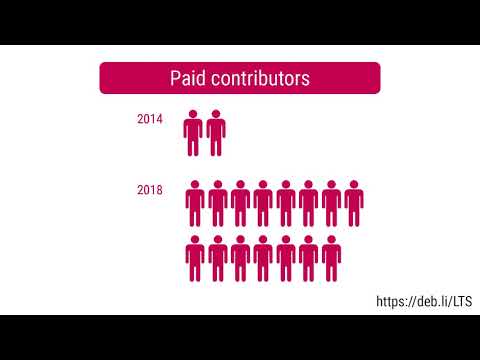
Debian Debian LTS This month I have worked 18 hours on Debian Long Term Support (LTS) and 12 hours on its sister Extended LTS project. You can find out more about the project via the following video:

Uploads Bugs filed

27 October 2020

Noah Meyerhans: Debian STS: Short Term Support

In another of my frequent late-night bouts with insomnia, I started thinking about the intersection of a number of different issues facing Debian today, both from a user point of view and a developer point of view. Debian has a reputation for shipping stale software. Versions in the stable branch are often significantly behind the latest development upstream. Debian s policy here has been that this is fine, our goal is to ship something stable, not something bleeding edge. Unofficially, our response to users is: If you need bleeding edge software, Debian may not be for you. Officially, we have no response to users who want fresher software. Debian also has a problem with a lack of manpower. I believe that part of why we have a hard time attracting contributors is our reputation for stale software. It might be worth it for us to consider changes to our approach to releases.

What about running testing? People who want newer software often look to Debian s testing branch as a possible solution. It s tempting, as it s a dynamically generated release based on unstable, so it should be quite current. In practice, it s not at all uncommon to find people running testing, and in fact I m running it right now on the ThinkPad on which this is being typed. However, testing comes with a glaring issue: a lack of timely security support. Security updates must still propagate through unstable, and this can take some time. They can be held up by dependencies, library transitions, or other factors. Nearly every list of best practices for computer security lists keeping software up-to-date at or near the top of most important steps to take to safely use networked computer. Debian s testing branch makes this very difficult, especially when faced with a zero-day with potential for real-world exploit.

What about stable-backports? Stable backports is both better and worse than testing. It s better in that it allows you to run a system comprised mainly of packages from the stable branch, which receive updates from the security team in a timely manner. However, it s worse in that the packages from the backports repository incur an additional delay. The expectation around backports is that a package migrates naturally from unstable to testing, and then requires a maintainer to upload a new package based on the version in testing specifically targeted at stable backports. The migration can potentially be bypassed, and we used to have a mechanism for announcing the availability of security updates for the stable backports archive, but it has gone unused for several years now. The documentation describes a workflow for posting security updates that involves creating a ticket in Debian s RT system, which is going to be quite foreign to most people. News from mid 2019 suggests that this process might change, but nothing appears to have come of this in over a year, and we still haven t seen a proper security advisory for stable backports in years.

Looking to LTS for ideas The Long-Term Support project is an alternative branch of Debian, maintained outside the normal stable release infrastructure. It s stable, and expected to behave that way, but it s not supported by the stable security team or release team. LTS provides a framework for providing security updates via targeted uploads by a team of interested individuals working outside the structure of the existing stable releases. This project seems to be quite active (how much of this is because at least some members are being paid?), and as of this writing has actually published more security advisories in the past month than the stable security team has published for the current stable branch. This is also interesting in that the software in LTS is quite old, first appearing in a Debian stable release in 2017. LTS is particularly interesting here as it s an example an initiative within the Debian community taken specifically to address user needs. For some of our users, remaining on an old release is a perfectly valid thing for them to do, and we recognize this and support them in doing so.

Debian Short-Term Support So, what would it take to create an LTS-like initiative in the other direction? Instead of providing ongoing support for ancient versions of software that previously comprised a stable release, could we build a distribution branch based on something that hasn t yet reached stable? What would that look like? How would it fit in the existing unstable testing migration process? What impact would it have on the size of the archive? Would we want a rolling release, or discrete releases? If the latter, how many would we want between proper stable releases? The security tracker already tracks outstanding issues in unstable and testing, and can even show issues that have been fixed in unstable but haven t yet propagated to testing. If we want a rolling release, maybe we could just open up the testing-security repository more broadly? There was once a testing security team, which IIRC was chartered to publish updated packages directly to testing security, along with associated security advisory. Based on the mailing list history, that effort seems to have shut down around the time of the squeeze (Debian 6.0) release in early 2011. Would it be worth resurrecting it? We ve probably got much of the infrastructure required in place already, since it previously existed. Personally I m not really a fan of a pure rolling release. I d rather see a light-weight release. Maybe a snapshot of testing that gets just a date, not a Toy Story codename. Probably skip building a dedicated installer for it. Upgrade from stable or use a d-i snapshot from testing if needed. This mini release is supported until the next one comes out, maybe 6 or 8 months later. By supported, I mean that the Short Term Release team is responsible for it. They can upload security or other critical bug fixes directly to a dedicated repository. When the next STS snapshot is released, packages in the updates repository are either archived, if they re a lower version than the one in the new mini release, or rebuilt against the new mini release and preserved. Using some of the same mechanisms as the LTS release, we d need
  1. Something to take the place of oldstable, that is the base release against which updates are released. This could be something that effectively maps to a date snapshot served by http://snapshot.debian.org/. (Snapshot itself could not currently handle the increased load, as I understand it, but conceptually it s similar.)
  2. Something to take the place of the dist/updates apt repository that hosts the packages that are updated.
In theory, if the infrastructure could support hose things, then we could in effect generate a mini release at any time based on a snapshot. I wonder if this could start as something totally unofficial; mirror an arbitrary testing snapshot and provide a place for interested people to publish package updates.

Not a proposal, nor a criticism To be clear, I don t really intend this as a proposal; It s really half-baked. Maybe these ideas have already been considered and dismissed. I don t know if people would be interested in working on such a project, and I m not nearly familiar enough with the Debian archive tooling to even make a guess as to how hard it would be to implement much of it. I m just posting some ideas that I came up with while pondering something that, from my perspective, is an area where Debian is clearly failing to meet the needs of some of our users. We know Debian is a popular and respected Linux distribution, and we know people value our stability. However, we also know that people like running Fedora and Ubuntu s non-LTS releases. People like Arch Linux. Not just end-users , but also the people developing the software shipped by the distros themselves. There are a lot of potential contributors to Debian who are kept away by our unwillingness to provide a distro offering both fresh software and security support. I think that we could attract more people to the Debian community if we could provide a solution for these people, and that would ultimately be good for everybody. Also, please don t interpret this as being critical of the release team, the stable security team, or any other team or individual in Debian. I m sharing this because I think there are opportunities for Debian to improve how we serve our users, not because I think anybody is doing anything wrong. With all that said, though, let me know if you find the ideas interesting. If you think they re crazy, you can tell me that, too. I ll probably agree with you.

23 October 2020

Enrico Zini: Hetzner build machine

This is part of a series of posts on compiling a custom version of Qt5 in order to develop for both amd64 and a Raspberry Pi. Building Qt5 takes a long time. The build server I was using had CPUs and RAM, but was very slow on I/O. I was very frustrated by that, and I started evaluating alternatives. I ended up setting up scripts to automatically provision a throwaway cloud server at Hetzner. Initial setup I got an API key from my customer's Hetzner account. I installed hcloud-cli, currently only in testing and unstable:
apt install hcloud-cli
Then I configured hcloud with the API key:
hcloud context create
Spin up I wrote a quick and dirty script to spin up a new machine, which grew a bit with little tweaks:
#!/bin/sh
# Create the server
hcloud server create --name buildqt --ssh-key   --start-after-create \
                     --type cpx51 --image debian-10 --datacenter  
# Query server IP
IP="$(hcloud server describe buildqt -o json   jq -r .public_net.ipv4.ip)"
# Update ansible host file
echo "buildqt ansible_user=root ansible_host=$IP" > hosts
# Remove old host key
ssh-keygen -f ~/.ssh/known_hosts -R "$IP"
# Update login script
echo "#!/bin/sh" > login
echo "ssh root@$IP" >> login
chmod 0755 login
I picked a datacenter in the same location as where we have other servers, to get quicker data transfers. I like that CLI tools have JSON output that I can cleanly pick at with jq. Sadly, my ISP doesn't do IPv6 yet. Since the server just got regenerated, I remove a possibly cached host key. Provisioning the machine One git server I need is behind HTTP authentication. Here's a quick hack to pass the relevant .netrc credentials to ansible before provisioning:
#!/usr/bin/python3
import subprocess
import netrc
import tempfile
import json
login, account, password = netrc.netrc().authenticators(" ")
with tempfile.NamedTemporaryFile(mode="wt", suffix=".json") as fd:
    json.dump( 
        "repo_user": login,
        "repo_password": password,
     , fd)
    fd.flush()
    subprocess.run([
        "ansible-playbook",
        "-i", "hosts",
        "-l", "buildqt",
        "--extra-vars", f"@ fd.name ",
        "provision.yml",
        ], check=True)
And here's the ansible playbook:
#!/usr/bin/env ansible-playbook
- name: Install and configure buildqt
  hosts: all
  tasks:
   - name: Update apt cache
     apt:
        update_cache: yes
        cache_valid_time: 86400
   - name: Create build user
     user:
        name: build
        comment: QT5 Build User
        shell: /bin/bash
   - name: Create sources directory
     become: yes
     become_user: build
     file:
        path: ~/sources
        state: directory
        mode: 0755
   - name: Download sources
     become: yes
     become_user: build
     get_url:
        url: "https:// / item "
        dest: "~/sources/ item "
        mode: 0644
     with_items:
      - "qt-everywhere-src-5.15.1.tar.xz"
      - "qt-creator-enterprise-src-4.13.2.tar.gz"
   - name: Populate home directory
     become: yes
     become_user: build
     copy:
        src: build
        dest: ~/
        mode: preserve
   - name: Write .netrc
     become: yes
     become_user: build
     copy:
        dest: ~/.netrc
        mode: 0600
        content:  
           machine  
           login  repo_user 
           password  repo_password 
   - name: Write .screenrc
     become: yes
     become_user: build
     copy:
        dest: ~/.screenrc
        mode: 0644
        content:  
           hardstatus alwayslastline
           hardstatus string '% = cw %-Lw% = KW %50>%n%f* %t% = cw %+Lw%< % = kK %-=%D %Y-%m-%d %c% - '
           startup_message off
           defutf8 on
           defscrollback 10240
   - name: Install base packages
     apt:
        name: git,mc,ncdu,neovim,eatmydata,devscripts,equivs,screen
        state: present
   - name: Clone git repo
     become: yes
     become_user: build
     git:
        repo: https:// @ / .git
        dest: ~/ 
   - name: Copy Qt license
     become: yes
     become_user: build
     copy:
        src: qt-license.txt
        dest: ~/.qt-license
        mode: 0600
Now everything is ready for a 16 core, 32Gb ram build on SSD storage. Tear down When done:
#!/bin/sh
hcloud server delete buildqt
The whole spin up plus provisioning takes around a minute, so I can do it when I start a work day, and take it down at the end. The build machine wasn't that expensive to begin with, and this way it will even be billed by the hour. A first try on a CPX51 machine has just built the full Qt5 Everywhere Enterprise including QtWebEngine and all its frills, for amd64, in under 1 hour and 40 minutes.

20 October 2020

Dirk Eddelbuettel: RcppArmadillo 0.10.1.0.0

armadillo image Armadillo is a powerful and expressive C++ template library for linear algebra aiming towards a good balance between speed and ease of use with a syntax deliberately close to a Matlab. RcppArmadillo integrates this library with the R environment and language and is widely used by (currently) 786 other packages on CRAN. A little while ago, Conrad released version 10.1.0 of Armadillo, a a new major release. As before, given his initial heads-up we ran two full reverse-depends checks, and as a consequence contacted four packages authors (two by email, two via PR) about a miniscule required change (as Armadillo now defaults to C++11, an old existing setting of avoiding C++11 lead to an error). Our thanks to those who promptly update their packages truly appreciated. As it turns out, Conrad also softened the error by the time the release ran around. But despite our best efforts, the release was delayed considerably by CRAN. We had made several Windows test builds but luck had it that on the uploaded package CRAN got itself a (completely spurious segfault which can happen on a busy machine building machine things at once). Sadly it took three or four days for CRAN to reply our email. After which it took another number of days for them to ponder the behaviour of a few new deprecated messaged tickled by at the most ten or so (out of 786) packages. Oh well. So here we are, eleven days after I emailed the rcpp-devel list about the new package being on CRAN but possibly delayed (due to that seg.fault). But during all that time the package was of course available via the Rcpp drat. The changes in this release are summarized below as usual and are mostly upstream along with an improved Travis CI setup due to the aforementioned use of the bspm package for binaries at Travis.

Changes in RcppArmadillo version 0.10.1.0.0 (2020-10-09)
  • Upgraded to Armadillo release 10.1.0 (Orchid Ambush)
    • C++11 is now the minimum required C++ standard
    • faster handling of compound expressions by trimatu() and trimatl()
    • faster sparse matrix addition, subtraction and element-wise multiplication
    • expanded sparse submatrix views to handle the non-contiguous form of X.cols(vector_of_column_indices)
    • expanded eigs_sym() and eigs_gen() with optional fine-grained parameters (subspace dimension, number of iterations, eigenvalues closest to specified value)
    • deprecated form of reshape() removed from Cube and SpMat classes
    • ignore and warn on use of the ARMA_DONT_USE_CXX11 macro
  • Switch Travis CI testing to focal and BSPM

Courtesy of my CRANberries, there is a diffstat report relative to previous release. More detailed information is on the RcppArmadillo page. Questions, comments etc should go to the rcpp-devel mailing list off the R-Forge page. If you like this or other open-source work I do, you can now sponsor me at GitHub. For the first year, GitHub will match your contributions.

This post by Dirk Eddelbuettel originated on his Thinking inside the box blog. Please report excessive re-aggregation in third-party for-profit settings.

19 October 2020

Louis-Philippe V ronneau: Musings on long-term software support and economic incentives

Although I still read a lot, during my college sophomore years my reading habits shifted from novels to more academic works. Indeed, reading dry textbooks and economic papers for classes often kept me from reading anything else substantial. Nowadays, I tend to binge read novels: I won't touch a book for months on end, and suddenly, I'll read 10 novels back to back1. At the start of a novel binge, I always follow the same ritual: I take out my e-reader from its storage box, marvel at the fact the battery is still pretty full, turn on the WiFi and check if there are OS updates. And I have to admit, Kobo Inc. (now Rakuten Kobo) has done a stellar job of keeping my e-reader up to date. I've owned this model (a Kobo Aura 1st generation) for 7 years now and I'm still running the latest version of Kobo's Linux-based OS. Having recently had trouble updating my Nexus 5 (also manufactured 7 years ago) to Android 102, I asked myself:
Why is my e-reader still getting regular OS updates, while Google stopped issuing security patches for my smartphone four years ago?
To try to answer this, let us turn to economic incentives theory. Although not the be-all and end-all some think it is3, incentives theory is not a bad tool to analyse this particular problem. Executives at Google most likely followed a very business-centric logic when they decided to drop support for the Nexus 5. Likewise, Rakuten Kobo's decision to continue updating older devices certainly had very little to do with ethics or loyalty to their user base. So, what are the incentives that keep Kobo updating devices and why are they different than smartphone manufacturers'? A portrait of the current long-term software support offerings for smartphones and e-readers Before delving deeper in economic theory, let's talk data. I'll be focusing on 2 brands of e-readers, Amazon's Kindle and Rakuten's Kobo. Although the e-reader market is highly segmented and differs a lot based on geography, Amazon was in 2015 the clear worldwide leader with 53% of the worldwide e-reader sales, followed by Rakuten Kobo at 13%4. On the smartphone side, I'll be differentiating between Apple's iPhones and Android devices, taking Google as the barometer for that ecosystem. As mentioned below, Google is sadly the leader in long-term Android software support. Rakuten Kobo According to their website and to this Wikipedia table, the only e-readers Kobo has deprecated are the original Kobo eReader and the Kobo WiFi N289, both released in 2010. This makes their oldest still supported device the Kobo Touch, released in 2011. In my book, that's a pretty good track record. Long-term software support does not seem to be advertised or to be a clear selling point in their marketing. Amazon According to their website, Amazon has dropped support for all 8 devices produced before the Kindle Paperwhite 2nd generation, first sold in 2013. To put things in perspective, the first Kindle came out in 2007, 3 years before Kobo started selling devices. Like Rakuten Kobo, Amazon does not make promises of long-term software support as part of their marketing. Apple Apple has a very clear software support policy for all their devices:
Owners of iPhone, iPad, iPod or Mac products may obtain a service and parts from Apple or Apple service providers for five years after the product is no longer sold or longer, where required by law.
This means in the worst-case scenario of buying an iPhone model just as it is discontinued, one would get a minimum of 5 years of software support. Android Google's policy for their Android devices is to provide software support for 3 years after the launch date. If you buy a Pixel device just before the new one launches, you could theoretically only get 2 years of support. In 2018, Google decided OEMs would have to provide security updates for at least 2 years after launch, threatening not to license Google Apps and the Play Store if they didn't comply. A question of cost structure From the previous section, we can conclude that in general, e-readers seem to be supported longer than smartphones, and that Apple does a better job than Android OEMs, providing support for about twice as long. Even Fairphone, who's entire business is to build phones designed to last and to be repaired was not able to keep the Fairphone 1 (2013) updated for more than a couple years and seems to be struggling to keep the Fairphone 2 (2015) running an up to date version of Android. Anyone who has ever worked in IT will tell you: maintaining software over time is hard work and hard work by specialised workers is expensive. Most commercial electronic devices are sold and developed by for-profit enterprises and software support all comes down to a question of cost structure. If companies like Google or Fairphone are to be expected to provide long-term support for the devices they manufacture, they have to be able to fund their work somehow. In a perfect world, people would be paying for the cost of said long-term support, as it would likely be cheaper then buying new devices every few years and would certainly be better for the planet. Problem is, manufacturers aren't making them pay for it. Economists call this type of problem externalities: things that should be part of the cost of a good, but aren't for one a reason or another. A classic example of an externality is pollution. Clearly pollution is bad and leads to horrendous consequences, like climate change. Sane people agree we should drastically cut our greenhouse gas emissions, and yet, we aren't. Neo-classical economic theory argues the way to fix externalities like pollution is to internalise these costs, in other words, to make people pay for the "real price" of the goods they buy. In the case of climate change and pollution, neo-classical economic theory is plain wrong (spoiler alert: it often is), but this is where band-aids like the carbon tax comes from. Still, coming back to long-term software support, let's see what would happen if we were to try to internalise software maintenance costs. We can do this multiple ways. 1 - Include the price of software maintenance in the cost of the device This is the choice Fairphone makes. This might somewhat work out for them since they are a very small company, but it cannot scale for the following reasons:
  1. This strategy relies on you giving your money to an enterprise now, and trusting them to "Do the right thing" years later. As the years go by, they will eventually look at their books, see how much ongoing maintenance is costing them, drop support for the device, apologise and move on. That is to say, enterprises have a clear economic incentive to promise long-term support and not deliver. One could argue a company's reputation would suffer from this kind of behaviour. Maybe sometime it does, but most often people forget. Political promises are a great example of this.
  2. Enterprises go bankrupt all the time. Even if company X promises 15 years of software support for their devices, if they cease to exist, your device will stop getting updates. The internet is full of stories of IoT devices getting bricked when the parent company goes bankrupt and their servers disappear. This is related to point number 1: to some degree, you have a disincentive to pay for long-term support in advance, as the future is uncertain and there are chances you won't get the support you paid for.
  3. Selling your devices at a higher price to cover maintenance costs does not necessarily mean you will make more money overall raising more money to fund maintenance costs being the goal here. To a certain point, smartphone models are substitute goods and prices higher than market prices will tend to drive consumers to buy cheaper ones. There is thus a disincentive to include the price of software maintenance in the cost of the device.
  4. People tend to be bad at rationalising the total cost of ownership over a long period of time. Economists call this phenomenon hyperbolic discounting. In our case, it means people are far more likely to buy a 500$ phone each 3 years than a 1000$ phone each 10 years. Again, this means OEMs have a clear disincentive to include the price of long-term software maintenance in their devices.
Clearly, life is more complex than how I portrayed it: enterprises are not perfect rational agents, altruism exists, not all enterprises aim solely for profit maximisation, etc. Still, in a capitalist economy, enterprises wanting to charge for software maintenance upfront have to overcome these hurdles one way or another if they want to avoid failing. 2 - The subscription model Another way companies can try to internalise support costs is to rely on a subscription-based revenue model. This has multiple advantages over the previous option, mainly:
  1. It does not affect the initial purchase price of the device, making it easier to sell them at a competitive price.
  2. It provides a stable source of income, something that is very valuable to enterprises, as it reduces overall risks. This in return creates an incentive to continue providing software support as long as people are paying.
If this model is so interesting from an economic incentives point of view, why isn't any smartphone manufacturer offering that kind of program? The answer is, they are, but not explicitly5. Apple and Google can fund part of their smartphone software support via the 30% cut they take out of their respective app stores. A report from Sensor Tower shows that in 2019, Apple made an estimated US$ 16 billion from the App Store, while Google raked in US$ 9 billion from the Google Play Store. Although the Fortune 500 ranking tells us this respectively is "only" 5.6% and 6.5% of their gross annual revenue for 2019, the profit margins in this category are certainly higher than any of their other products. This means Google and Apple have an important incentive to keep your device updated for some time: if your device works well and is updated, you are more likely to keep buying apps from their store. When software support for a device stops, there is a risk paying customers will buy a competitor device and leave their ecosystem. This also explains why OEMs who don't own app stores tend not to provide software support for very long periods of time. Most of them only make money when you buy a new phone. Providing long-term software support thus becomes a disincentive, as it directly reduces their sale revenues. Same goes for Kindles and Kobos: the longer your device works, the more money they make with their electronic book stores. In my opinion, it's likely Amazon and Rakuten Kobo produce quarterly cost-benefit reports to decide when to drop support for older devices, based on ongoing support costs and the recurring revenues these devices bring in. Rakuten Kobo is also in a more precarious situation than Amazon is: considering Amazon's very important market share, if your device stops getting new updates, there is a greater chance people will replace their old Kobo with a Kindle. Again, they have an important economic incentive to keep devices running as long as they are profitable. Can Free Software fix this? Yes and no. Free Software certainly isn't a magic wand one can wave to make everything better, but does provide major advantages in terms of security, user freedom and sometimes costs. The last piece of the puzzle explaining why Rakuten Kobo's software support is better than Google's is technological choices. Smartphones are incredibly complex devices and have become the main computing platform of many. Similar to the web, there is a race for features and complexity that tends to create bloat and make older devices slow and painful to use. On the other hand, e-readers are simpler devices built for a single task: display electronic books. Control over the platform is also a key aspect of the cost structure of providing software updates. Whereas Apple controls both the software and hardware side of iPhones, Android is a sad mess of drivers and SoCs, all providing different levels of support over time6. If you take a look at the platforms the Kindle and Kobo are built on, you'll quickly see they both use Freescale I.MX SoCs. These processors are well known for their excellent upstream support in the Linux kernel and their relative longevity, chips being produced for either 10 or 15 years. This in turn makes updates much easier and less expensive to provide. So clearly, open architectures, free drivers and open hardware helps tremendously, but aren't enough on their own. One of the lessons we must learn from the (amazing) LineageOS project is how lack of funding hurts everyone. If there is no one to do the volunteer work required to maintain a version of LOS for your device, it won't be supported. Worse, when purchasing a new device, users cannot know in advance how many years of LOS support they will get. This makes buying new devices a frustrating hit-and-miss experience. If you are lucky, you will get many years of support. Otherwise, you risk your device becoming an expensive insecure paperweight. So how do we fix this? Anyone with a brain understands throwing away perfectly good devices each 2 years is not sustainable. Government regulations enforcing a minimum support life would be a step in the right direction, but at the end of the day, Capitalism is to blame. Like the aforementioned carbon tax, band-aid solutions can make things somewhat better, but won't fix our current economic system's underlying problems. For now though, I'll leave fixing the problem of Capitalism to someone else.

  1. My most recent novel binge has been focused on re-reading the Dune franchise. I first read the 6 novels written by Frank Herbert when I was 13 years old and only had vague and pleasant memories of his work. Great stuff.
  2. I'm back on LineageOS! Nice folks released an unofficial LOS 17.1 port for the Nexus 5 last January and have kept it updated since then. If you are to use it, I would also recommend updating TWRP to this version specifically patched for the Nexus 5.
  3. Very few serious economists actually believe neo-classical rational agent theory is a satisfactory explanation of human behavior. In my opinion, it's merely a (mostly flawed) lens to try to interpret certain behaviors, a tool amongst others that needs to be used carefully, preferably as part of a pluralism of approaches.
  4. Good data on the e-reader market is hard to come by and is mainly produced by specialised market research companies selling their findings at very high prices. Those particular statistics come from a MarketWatch analysis.
  5. If they were to tell people: You need to pay us 5$/month if you want to receive software updates, I'm sure most people would not pay. Would you?
  6. Coming back to Fairphones, if they had so much problems providing an Android 9 build for the Fairphone 2, it's because Qualcomm never provided Android 7+ support for the Snapdragon 801 SoC it uses.

6 October 2020

Iustin Pop: Late report for Nationalpark Bike Marathon 2020

I don t have to mention that 2020 is a special year, so all the normal race plan was out the window, and I was very happy and fortunate to be able to do even one race. And only delayed 3 weeks to write this race report :/ So, here s the story

Preparing for the race Because it was a special year, and everything was crazy, I actually managed to do more sports than usual, at least up to end of July. So my fitness, and even body weight, was relatively fine, so I subscribed to the mid-distance race (official numbers: 78km distance, 1570 meters altitude), and then off it went to a proper summer vacation in a hotel, even. And while I did do some bike rides during that vacation, from then on my training regime went just off? I did train, I did ride, I did get significant PRs, but it didn t click anymore. Plus, due to well, actually not sure what, work or coffee or something my sleep regime also got completely ruined On top of that, I didn t think about the fact that the race was going to be mid-September, and that high up in the mountains, the weather could have be bad enough (I mean, in 2018 the weather was really bad even in August ) such that I d need to seriously think about clothing.

Race week I arrive in Scuol two days before the race, very tired (I think I got only 6 hours of sleep the night before), and definitely not in a good shape. I was feeling bad enough that I was not quite sure I was going to race. At least weather was OK, such that normal summer clothing would suffice. But the race info was mentioning dangerous segments, to be very careful, etc. etc. so I was quite anxious. Note 1: my wife says, this was not the first time, and likely not the last time that two days before the race I feel like quitting. And as I m currently on-and-off reading the interesting The Brave Athlete: Calm the Fuck Down and Rise to the Occasion book (by Lesley Paterson and Simon Marshall; it s an interesting book, not sure if I recommend it or not), I am beginning to think that this is my reaction to races where I have overshot my usual distance. Or, in general, races where I fear the altitude gain. Not quite sure, but I think it is indeed the actual cause. So I spend Thursday evening feeling unwell, and thinking I ll see how Friday goes. Friday comes, and having slept reasonably well entire night, I pick up my race number, then I take another nap in the afternoon - in total, I ve slept around 13 hours that day. So I felt much better, and was looking forward to the race. Saturday morning comes, I manage to wake up early, and get ready in time; almost didn t panic at all that I m going to be late. Note 2: my wife also says that this is the usual way I behave. Hence, it must be most of it a mental issue, rather than real physical one

Race I reach the train station in time, I get on the train, and by the time the train reached Zernez, I fully calm down. There was am entire hour wait though before the race, and it was quite chilly. Of course I didn t bring anything beside what I was wearing, relying on temperature getting better later in the day. During the wait, there were two interesting things happening. First, we actually got there (in Zernez) before the first people from the long distance passed by, both men and women. Seeing them pass by was cool, thinking they already had ~1 200m altitude in just 30-ish kilometres. The second thing was, as this was the middle and not the shortest distance, the people in the group looked differently than in previous years. More precisely, they were looking very fit, and I was feeling fat. Well, I am overweight, so it was expected, but I was feeling it even more than usual. I think only one or two in ten people were looking as fit as me or less And of course, the pictures post-race show me even less fit-looking than I thought. Ah, self-deception is a sweet thing And yes, we all had to wear masks, up until the last minute. It was interesting, but not actually annoying - and small enough price for being able to race! Then the race starts, and as opposed to many other years, it starts slow. I didn t feel that rush of people starting fast, it was reasonable?

First part of the race (good) Thus started the first part of the race, on a new route that I was unfamiliar with. There was not too much climbing, to be honest, and there was some tricky single-trail through the woods, with lots of the roots. I actually had to get off the bike and push it, since it was too difficult to pedal uphill on that path. Other than that, I was managing so far to adjust my efforts well enough that my usual problems related to climbing (lower back pain) didn t yet appear, even as the overall climbed meters were increasing. I was quite happy at that, and had lots of reserves. To my (pleasant) surprise, two positive things happened:
  • I was never alone, a sign that I wasn t too far back.
  • I was passing/being passed by people, both on climbs but also on descents! It s rare, but I did overtake a few people on a difficult trail downhill.
With all the back and forth, a few people became familiar (or at least their kit), and it was fun seeing who is better uphill vs. downhill.

And second part (not so good) I finally get to (around) S-chanf, on a very nice but small descent, and on flat roads, and start the normal route for the short race. Something was off though - I knew from past years that these last ~47km have around 700-800m altitude, but I had already done around 1000m. So the promised 1571m were likely to be off, by at least 100-150m. I set myself a new target of 1700m, and adjust my efforts based on that. And then, like clockwork on the 3:00:00 mark, the route exited the forest, the sun got out of the clouds, and the temperature started to increase from 16-17 C to 26 +, with peaks of 31 C. I m not joking: at 2:58:43, temp was 16 , at 3:00:00, it was 18 , at 3:05:45, it was 26 . Heat and climbing are my two nemeses, and after having a pretty good race for the first 3 hours and almost exactly 1200m of climbing, I started feeling quite miserable. Well, it was not all bad. There were some nice stretches of flat, where I knew I can pedal strongly and keep up with other people, until my chain dropped, so I had to stop, re-set it, and lose 2 minutes. Sigh. But, at least, I was familiar with this race, or so I thought. I completely mis-remembered the last ~20km as a two-punch climb, Guarda and Ftan, whereas it is actually a three-punch one: Guarda, Ardez, and only then Ftan. Doesn t help that Ardez has the nice ruins that I was remembering and which threw me off. The saddest part of the day was here, on one of the last climbs - not sure if to Guarda or to Arddez, where a guy overtakes me, and tells me he s glad he finally caught up with me, he almost got me five or six times (!), but I always managed to break off. Always, until now. Now, this was sad (I was huffing and puffing like a steam locomotive now), but also positive, as I never had that before. One good, one bad? And of course, it was more than 1 700m altitude, it was 1 816m. And the descent to Scuol shorter and it didn t end as usual with the small but sharp climb which I just love, due to Covid changes. But, I finished, and without any actual issues, and no dangerous segments as far as I saw. I was anxious for no good reason

Conclusion (or confusion?) So this race was interesting: three hours (to the minute) in which I went 43.5km, climbed 1200m, felt great, and was able to push and push. And then the second part, only ~32km, climbed only 600m, but which felt quite miserable. I don t know if it was mainly heat, mainly my body giving up after that much climbing (or time?), or both. But it s clear that I can t reliably race for more than around these numbers: 3 hours, ~1000+m altitude, in >20 C temperature. One thing that I managed to achieve though: except due to the technically complex trail at the beginning where I pushed the bike, I did not ever stop and push the bike uphill because I was too tired. Instead, I managed (badly) to do the switch sitting/standing as much as I could motivate myself, and thus continue pushing uphill. This is an achievement for me, since mentally it s oh so easy to stop and push the bike, so I was quite glad. As to the race results, they were quite atrocious:
  • age category (men), 38 out of 52 finishers, 4h54m, with first finisher doing 3h09m, so 50% slower (!)
  • overall (men), 138 out of 173 finishers, with first finisher 2h53m.
These results clearly don t align with my feeling of a good first half of the race, so either it was purely subjective, or maybe in this special year, only really strong people registered for the race, or something else One positive aspect though, compared to most other years, was the consistency of my placement (age and overall):
  • Zuoz: 38 / 141
  • S-Chanf: 39 / 141
  • Zernez: 39 / 141
  • Guarda: 38 / 138
  • Ftan: 38 / 138
  • ( next - whatever this is): 38 / 138
  • Finish: 38 / 138
So despite all my ranting above, and all the stats I m pulling out of my own race, it looks like my position in the race was fully settled in the really first part, and I didn t gain nor lose practically anything afterwards. I did dip one place but then gained it back (on the climb to Guarda, even). The split times (per-segment rankings) are a bit more variable, and show that I was actually fast on the climbs but losing speed on the descents, which I really don t understand anymore:
  • Zernez-Zuoz (unclear type): 38 / 141
  • Zuoz-S-Chanf (unclear type): 40 / 141
  • S-Chanf-Zernez (mostly downhill): 39 / 143
  • Zernez-Guarda (mostly uphill): 37 / 136
  • Guarda-Ftan (mostly uphill): 37 / 131
  • Ftan-Scuol (mostly downhill): 43 / 156
The difference at the end is striking. I m visually matching the map positions to km and then use VeloViewer for computing the altitude gain, but Zernez to Guarda is 420m altitude, and Guarda to Ftan is 200m altitude gain, and yet on both, I was faster than my final place, and by quite a few places on overall, only to lose that on the descent (Ftan-Scuol), and by a large margin. So, amongst all the confusion here, I think the story overall is:
  • indeed I was quite fit for me, so the climbs were better than my place in the race (if that makes sense).
  • however, I m not actually good at climbing nor fit (watts/kg), so I m still way back in the pack (oops!).
  • and I do suck at descending, both me (skills) and possible my bike setup as well (too high tyre pressure, etc.) so I lose even more time here
As usual, the final take-away points are: lose the extra weight that is not needed, get better skills, get better core to be better at climbing. I ll finish here with one pic, taken in Guarda (4 hours into the race, more or less):
Climbing in Guarda Climbing in Guarda
Until next year!

3 October 2020

Julian Andres Klode: Google Pixel 4a: Initial Impressions

Yesterday I got a fresh new Pixel 4a, to replace my dying OnePlus 6. The OnePlus had developed some faults over time: It repeatedly loses connection to the AP and the network, and it got a bunch of scratches and scuffs from falling on various surfaces without any protection over the past year.

Why get a Pixel? Camera: OnePlus focuses on stuffing as many sensors as it can into a phone, rather than a good main sensor, resulting in pictures that are mediocre blurry messes - the dreaded oil painting effect. Pixel have some of the best camera in the smartphone world. Sure, other hardware is far more capable, but the Pixels manage consistent results, so you need to take less pictures because they don t come out blurry half the time, and the post processing is so good that the pictures you get are just great. Other phones can shoot better pictures, sure - on a tripod. Security updates: Pixels provide 3 years of monthly updates, with security updates being published on the 5th of each month. OnePlus only provides updates every 2 months, and then the updates they do release are almost a month out of date, not counting that they are only 1st-of-month patches, meaning vendor blob updates included in the 5th-of-month updates are even a month older. Given that all my banking runs on the phone, I don t want it to be constantly behind. Feature updates: Of course, Pixels also get Beta Android releases and the newest Android release faster than any other phone, which is advantageous for Android development and being nerdy. Size and weight: OnePlus phones keep getting bigger and bigger. By today s standards, the OnePlus 6 at 6.18" and 177g is a small an lightweight device. Their latest phone, the Nord, has 6.44" and weighs 184g, the OnePlus 8 comes in at 180g with a 6.55" display. This is becoming unwieldy. Eschewing glass and aluminium for plastic, the Pixel 4a comes in at 144g.

First impressions

Accessories The Pixel 4a comes in a small box with a charger, USB-C to USB-C cable, a USB-OTG adapter, sim tray ejector. No pre-installed screen protector or bumper are provided, as we ve grown accustomed to from Chinese manufacturers like OnePlus or Xiaomi. The sim tray ejector has a circular end instead of the standard oval one - I assume so it looks like the o in Google? Google sells you fabric cases for 45 . That seems a bit excessive, although I like that a lot of it is recycled.

Haptics Coming from a 6.18" phablet, the Pixel 4a with its 5.81" feels tiny. In fact, it s so tiny my thumb and my index finger can touch while holding it. Cute! Bezels are a bit bigger, resulting in slightly less screen to body. The bottom chin is probably impracticably small, this was already a problem on the OnePlus 6, but this one is even smaller. Oh well, form over function. The buttons on the side are very loud and clicky. As is the vibration motor. I wonder if this Pixel thinks it s a Model M. It just feels great. The plastic back feels really good, it s that sort of high quality smooth plastic you used to see on those high-end Nokia devices. The finger print reader, is super fast. Setup just takes a few seconds per finger, and it works reliably. Other phones (OnePlus 6, Mi A1/A2) take like half a minute or a minute to set up.

Software The software - stock Android 11 - is fairly similar to OnePlus' OxygenOS. It s a clean experience, without a ton of added bloatware (even OnePlus now ships Facebook out of box, eww). It s cleaner than OxygenOS in some way - there are no duplicate photos apps, for example. On the other hand, it also has quite a bunch of Google stuff I could not care less about like YT Music. To be fair, those are minor noise once all 130 apps were transferred from the old phone. There are various things I miss coming from OnePlus such as off-screen gestures, network transfer rate indicator in quick settings, or a circular battery icon. But the Pixel has an always on display, which is kind of nice. Most of the cool Pixel features, like call screening or live transcriptions are unfortunately not available in Germany. The display is set to display the same amount of content as my 6.18" OnePlus 6 did, so everything is a bit tinier. This usually takes me a week or two to adjust too, and then when I look at the OnePlus again I ll be like Oh the font is huge , but right now, it feels a bit small on the Pixel. You can configure three colour profiles for the Pixel 4a: Natural, Boosted, and Adaptive. I have mine set to adaptive. I d love to see stock Android learn what OnePlus has here: the ability to adjust the colour temperature manually, as I prefer to keep my devices closer to 5500K than 6500K, as I feel it s a bit easier on the eyes. Or well, just give me the ability to load a ICM profile (though, I d need to calibrate the screen then - work!).

Migration experience Restoring the apps from my old phone only restore settings for a few handful out of 130, which is disappointing. I had to spent an hour or two logging in to all the other apps, and I had to fiddle far too long with openScale to get it to take its data over. It s a mystery to me why people do not allow their apps to be backed up, especially something innocent like a weight tracking app. One of my banking apps restored its logins, which I did not really like. KeePass2Android settings were restored as well, but at least the key file was not restored. I did not opt in to restoring my device settings, as I feel that restoring device settings when changing manufactures is bound to mess up some things. For example, I remember people migrating to OnePlus phones and getting their old DND schedule without any way to change it, because OnePlus had hidden the DND stuff. I assume that s the reason some accounts, like my work GSuite account were not migrated (it said it would migrate accounts during setup). I ve setup Bitwarden as my auto-fill service, so I could login into most of my apps and websites using the stored credentials. I found that often that did not work. Like Chrome does autofill fine once, but if I then want to autofill again, I have to kill and restart it, otherwise I don t get the auto-fill menu. Other apps did not allow any auto-fill at all, and only gave me the option to copy and paste. Yikes - auto-fill on Android still needs a lot of work.

Performance It hangs a bit sometimes, but this was likely due to me having set 2 million iterations on my Bitwarden KDF and using Bitwarden a lot, and then opening up all 130 apps to log into them which overwhelmed the phone a bit. Apart from that, it does not feel worse than the OnePlus 6 which was to be expected, given that the benchmarks only show a slight loss in performance. Photos do take a few seconds to process after taking them, which is annoying, but understandable given how much Google relies on computation to provide decent pictures.

Audio The Pixel has dual speakers, with the earpiece delivering a tiny sound and the bottom firing speaker doing most of the work. Still, it s better than just having the bottom firing speaker, as it does provide a more immersive experience. Bass makes this thing vibrate a lot. It does not feel like a resonance sort of thing, but you can feel the bass in your hands. I ve never had this before, and it will take some time getting used to.

Final thoughts This is a boring phone. There s no wow factor at all. It s neither huge, nor does it have high-res 48 or 64 MP cameras, nor does it have a ton of sensors. But everything it does, it does well. It does not pretend to be a flagship like its competition, it doesn t want to wow you, it just wants to be the perfect phone for you. The build is solid, the buttons make you think of a Model M, the camera is one of the best in any smartphone, and you of course get the latest updates before anyone else. It does not feel like a only 350 phone, but yet it is. 128GB storage is plenty, 1080p resolution is plenty, 12.2MP is you guessed it, plenty. The same applies to the other two Pixel phones - the 4a 5G and 5. Neither are particularly exciting phones, and I personally find it hard to justify spending 620 on the Pixel 5 when the Pixel 4a does job for me, but the 4a 5G might appeal to users looking for larger phones. As to 5G, I wouldn t get much use out of it, seeing as its not available anywhere I am. Because I m on Vodafone. If you have a Telekom contract or live outside of Germany, you might just have good 5G coverage already and it might make sense to get a 5G phone rather than sticking to the budget choice.

Outlook The big question for me is whether I ll be able to adjust to the smaller display. I now have a tablet, so I m less often using the phone (which my hands thank me for), which means that a smaller phone is probably a good call. Oh while we re talking about calls - I only have a data-only SIM in it, so I could not test calling. I m transferring to a new phone contract this month, and I ll give it a go then. This will be the first time I get VoLTE and WiFi calling, although it is Vodafone, so quality might just be worse than Telekom on 2G, who knows. A big shoutout to congstar for letting me cancel with a simple button click, and to @vodafoneservice on twitter for quickly setting up my benefits of additional 5GB per month and 10 discount for being an existing cable customer. I m also looking forward to playing around with the camera (especially night sight), and eSIM. And I m getting a case from China, which was handed over to the Airline on Sep 17 according to Aliexpress, so I guess it should arrive in the next weeks. Oh, and screen protector is not here yet, so I can t really judge the screen quality much, as I still have the factory protection film on it, and that s just a blurry mess - but good enough for setting it up. Please Google, pre-apply a screen protector on future phones and include a simple bumper case. I might report back in two weeks when I have spent some more time with the device.

2 October 2020

Ian Jackson: Mailman vs DKIM - a novel solution

tl;dr: Do not configure Mailman to replace the mail domains in From: headers. Instead, try out my small new program which can make your Mailman transparent, so that DKIM signatures survive. Background and narrative DKIM NB: This explanation is going to be somewhat simplified. I am going to gloss over some details and make some slightly approximate statements. DKIM is a new anti-spoofing mechanism for Internet email, intended to help fight spam. DKIM, paired with the DMARC policy system, has been remarkably successful at stemming the flood of joe-job spams. As usually deployed, DKIM works like this: When a message is originally sent, the author's MUA sends it to the MTA for their From: domain for outward delivery. The From: domain mailserver calculates a cryptographic signature of the message, and puts the signature in the headers of the message. Obviously not the whole message can be signed, since at the very least additional headers need to be added in transit, and sometimes headers need to be modified too. The signing MTA gets to decide what parts of the message are covered by the signature: they nominate the header fields that are covered by the signature, and specify how to handle the body. A recipient MTA looks up the public key for the From: domain in the DNS, and checks the signature. If the signature doesn't match, depending on policy (originator's policy, in the DNS, and recipient's policy of course), typically the message will be treated as spam. The originating site has a lot of control over what happens in practice. They get to publish a formal (DMARC) policy in the DNS which advises recipients what they should do with mails claiming to be from their site. As mentioned, they can say which headers are covered by the signature - including the ability to sign the absence of a particular headers - so they can control which headers downstreams can get away with adding or modifying. And they can set a normalisation policy, which controls how precisely the message must match the one that they sent. Mailman Mailman is, of course, the extremely popular mailing list manager. There are a lot of things to like about it. I choose to run it myself not just because it's popular but also because it provides a relatively competent web UI and a relatively competent email (un)subscription interfaces, decent bounce handling, and a pretty good set of moderation and posting access controls. The Xen Project mailing lists also run on mailman. Recently we had some difficulties with messages sent by Citrix staff (including myself), to Xen mailing lists, being treated as spam. Recipient mail systems were saying the DKIM signatures were invalid. This was in fact true. Citrix has chosen a fairly strict DKIM policy; in particular, they have chosen "simple" normalisation - meaning that signed message headers must precisely match in syntax as well as in a semantic sense. Examining the the failing-DKIM messages showed that this was definitely a factor. Applying my Opinions about email My Bayesian priors tend to suggest that a mail problem involving corporate email is the fault of the corporate email. However in this case that doesn't seem true to me. My starting point is that I think mail systems should not not modify messages unnecessarily. None of the DKIM-breaking modifications made by Mailman seemed necessary to me. I have on previous occasions gone to corporate IT and requested quite firmly that things I felt were broken should be changed. But it seemed wrong to go to corporate IT and ask them to change their published DKIM/DMARC policy to accomodate a behaviour in Mailman which I didn't agree with myself. I felt that instead I shoud put (with my Xen Project hat on) my own house in order. Getting Mailman not to modify messages So, I needed our Mailman to stop modifying the headers. I needed it to not even reformat them. A brief look at the source code to Mailman showed that this was not going to be so easy. Mailman has a lot of features whose very purpose is to modify messages. Personally, as I say, I don't much like these features. I think the subject line tags, CC list manipulations, and so on, are a nuisance and not really Proper. But they are definitely part of why Mailman has become so popular and I can definitely see why the Mailman authors have done things this way. But these features mean Mailman has to disassemble incoming messages, and then reassemble them again on output. It is very difficult to do that and still faithfully reassemble the original headers byte-for-byte in the case where nothing actually wanted to modify them. There are existing bug reports[1] [2] [3] [4]; I can see why they are still open. Rejected approach: From:-mangling This situation is hardly unique to the Xen lists. Many other have struggled with it. The best that seems to have been come up with so far is to turn on a new Mailman feature which rewrites the From: header of the messages that go through it, to contain the list's domain name instead of the originator's. I think this is really pretty nasty. It breaks normal use of email, such as reply-to-author. It is having Mailman do additional mangling of the message in order to solve the problems caused by other undesirable manglings! Solution! As you can see, I asked myself: I want Mailman not modify messages at all; how can I get it to do that? Given the existing structure of Mailman - with a lot of message-modifying functionality - that would really mean adding a bypass mode. It would have to spot, presumably depending on config settings, that messages were not to be edited; and then, it would avoid disassembling and reassembling the message at at all, and bypass the message modification stages. The message would still have to be parsed of course - it's just that the copy send out ought to be pretty much the incoming message. When I put it to myself like that I had a thought: couldn't I implement this outside Mailman? What if I took a copy of every incoming message, and then post-process Mailman's output to restore the original? It turns out that this is quite easy and works rather well! outflank-mailman outflank-mailman is a 233-line script, plus documentation, installation instructions, etc. It is designed to run from your MTA, on all messages going into, and coming from, Mailman. On input, it saves a copy of the message in a sqlite database, and leaves a note in a new Outflank-Mailman-Id header. On output, it does some checks, finds the original message, and then combines the original incoming message with carefully-selected headers from the version that Mailman decided should be sent. This was deployed for the Xen Project lists on Tuesday morning and it seems to be working well so far. If you administer Mailman lists, and fancy some new software to address this problem, please do try it out. Matters arising - Mail filtering, DKIM Overall I think DKIM is a helpful contribution to the fight against spam (unlike SPF, which is fundamentally misdirected and also broken). Spam is an extremely serious problem; most receiving mail servers experience more attempts to deliver spam than real mail, by orders of magnitude. But DKIM is not without downsides. Inherent in the design of anything like DKIM is that arbitrary modification of messages by list servers is no longer possible. In principle it might be possible to design a system which tolerated modifications reasonable for mailing lists but it would be quite complicated and have to somehow not tolerate similar modifications in other contexts. So DKIM means that lists can no longer add those unsubscribe footers to mailing list messages. The "new way" (RFC2369, July 1998), to do this is with the List-Unsubscribe header. Hopefully a good MUA will be able to deal with unsubscription semiautomatically, and I think by now an adequate MUA should at least display these headers by default. Sender: There are implications for recipient-side filtering too. The "traditional" correct way to spot mailing list mail was to look for Resent-To:, which can be added without breaking DKIM; the "new" (RFC2919, March 2001) correct way is List-Id:, likewise fine. But during the initial deployment of outflank-mailman I discovered that many subscribers were detecting that a message was list traffic by looking at the Sender: header. I'm told that some mail systems (apparently Microsoft's included) make it inconvenient to filter on List-Id. Really, I think a mailing list ought not to be modifying Sender:. Given Sender:'s original definition and semantics, there might well be reasonable reasons for a mailing list posting to have different From: and and then the original Sender: ought not to be lost. And a mailing list's operation does not fit well into the original definition of Sender:. I suspect that list software likes to put in Sender mostly for historical reasons; notably, a long time ago it was not uncommon for broken mail systems to send bounces to the Sender: header rather than the envelope sender (SMTP MAIL FROM). DKIM makes this more of a problem. Unfortunately the DKIM specifications are vague about what headers one should sign, but they pretty much definitely include Sender: if it is present, and some materials encourage signing the absence of Sender:. The latter is Exim's default configuration when DKIM-signing is enabled. Franky there seems little excuse for systems to not readily support and encourage filtering on List-Id, 20 years later, but I don't want to make life hard for my users. For now we are running a compromise configuration: if there wasn't a Sender: in the original, take Mailman's added one. This will result in (i) misfiltering for some messages whose poster put in a Sender:, and (ii) DKIM failures for messages whose originating system signed the absence of a Sender:. I'm going to mine the db for some stats after it's been deployed for a week or so, to see which of these problems is worst and decide what to do about it. Mail routing For DKIM to work, messages being sent From: a particular mail domain must go through a system trusted by that domain, so they can be signed. Most users tend to do this anyway: their mail provider gives them an IMAP server and an authenticated SMTP submission server, and they configure those details in their MUA. The MUA has a notion of "accounts" and according to the user's selection for an outgoing message, connects to the authenticated submission service (usually using TLS over the global internet). Trad unix systems where messages are sent using the local sendmail or localhost SMTP submission (perhaps by automated systems, or perhaps by human users) are fine too. The smarthost can do the DKIM signing. But this solution is awkward for a user of a trad MUA in what I'll call "alias account" setups: where a user has an address at a mail domain belonging to different people to the system on which they run their MUA (perhaps even several such aliases for different hats). Traditionally this worked by the mail domain forwarding incoming the mail, and the user simply self-declaring their identity at the alias domain. Without DKIM there is nothing stopping anyone self-declaring their own From: line. If DKIM is to be enabled for such a user (preventing people forging mail as that user), the user will have to somehow arrange that their trad unix MUA's outbound mail stream goes via their mail alias provider. For a single-user sending unix system this can be done with tolerably complex configuration in an MTA like Exim. For shared systems this gets more awkward and might require some hairy shell scripting etc.
edited 2020-10-01 21:22 and 21:35 and -02 10:50 +0100 to fix typos and 21:28 to linkify "my small program" in the tl;dr


comment count unavailable comments

30 September 2020

Chris Lamb: Free software activities in September 2020

Here is my monthly update covering what I have been doing in the free software world during September 2020 (previous month):

Reproducible Builds One of the original promises of open source software is that distributed peer review and transparency of process results in enhanced end-user security. However, whilst anyone may inspect the source code of free and open source software for malicious flaws, almost all software today is distributed as pre-compiled binaries. This allows nefarious third-parties to compromise systems by injecting malicious code into ostensibly secure software during the various compilation and distribution processes. The motivation behind the Reproducible Builds effort is to ensure no flaws have been introduced during this compilation process by promising identical results are always generated from a given source, thus allowing multiple third-parties to come to a consensus on whether a build was compromised. The project is proud to be a member project of the Software Freedom Conservancy. Conservancy acts as a corporate umbrella allowing projects to operate as non-profit initiatives without managing their own corporate structure. If you like the work of the Conservancy or the Reproducible Builds project, please consider becoming an official supporter. This month, I:

diffoscope I made the following changes to diffoscope, including preparing and uploading versions 159 and 160 to Debian:

Debian Lintian For Lintian, the static analysis tool for Debian packages, I uploaded versions 2.93.0, 2.94.0, 2.95.0 & 2.96.0 (not counting uploads to the backports repositories), as well as: Debian LTS This month I've worked 18 hours on Debian Long Term Support (LTS) and 12 hours on its sister Extended LTS project. You can find out more about the project via the following video:
Uploads Bugs filed

26 September 2020

Dirk Eddelbuettel: #30: Easy, Reliable, Fast and Portable Linux and macOS Continuous Integration

Welcome to the 30th post in the rarified R recommendation resources series or R4 for short. The last post introduced BSPM. In the four weeks since, we have worked some more on BSPM to bring it to the point where it is ready for use with continuous integration. Building on this, it is now used inside the run.sh script that driven our CI use for many years (via the r-travis repo). Which we actually use right now on three different platforms: All three use the exact same script facilitating this, and run a matrix over Linux and macOS. You read this right: one CI setup that is portable and which you can take to your CI provider of choice. No lock-in or tie-in. Use what works, change at will. Or run on all three if you like burning extra cycles. This is already used by handful of my repos as well as by at least two repos of friends also deploying r-travis. How does it work? In a nutshell we are There are several customizations that are possible via environment variables We find this setup compelling. The scheme is simple: there really is just one shell script behind it which can also be downloaded and altered. The scheme is also portable as we can (as shown) rotate between CI provides. The scheme is also more flexible: in case of debugging needs one can simply run the script on a local Docker or VM instance. Lastly, the scheme moves away from single points of failure or breakage. Currently the script uses only BSPM as I had the hunch that it would a) work and b) be compelling. Adding support for RSPM would be equally easy, but I have no immediate need to do so. Adding BioConductor installation may be next. That is easy when BioConductor uses r-release; it may be little more challenging under r-devel to but it should work too. Stay tuned. In the meantime, if the above sounds compelling, give run.sh from r-travis a go! If you like this or other open-source work I do, you can now sponsor me at GitHub. For the first year, GitHub will match your contributions.

This post by Dirk Eddelbuettel originated on his Thinking inside the box blog. Please report excessive re-aggregation in third-party for-profit settings.

25 September 2020

Colin Watson: Porting Launchpad to Python 3: progress report

Launchpad still requires Python 2, which in 2020 is a bit of a problem. Unlike a lot of the rest of 2020, though, there s good reason to be optimistic about progress. I ve been porting Python 2 code to Python 3 on and off for a long time, from back when I was on the Ubuntu Foundations team and maintaining things like the Ubiquity installer. When I moved to Launchpad in 2015 it was certainly on my mind that this was a large body of code still stuck on Python 2. One option would have been to just accept that and leave it as it is, maybe doing more backporting work over time as support for Python 2 fades away. I ve long been of the opinion that this would doom Launchpad to being unmaintainable in the long run, and since I genuinely love working on Launchpad - I find it an incredibly rewarding project - this wasn t something I was willing to accept. We re already seeing some of our important dependencies dropping support for Python 2, which is perfectly reasonable on their terms but which is starting to become a genuine obstacle to delivering important features when we need new features from newer versions of those dependencies. It also looks as though it may be difficult for us to run on Ubuntu 20.04 LTS (we re currently on 16.04, with an upgrade to 18.04 in progress) as long as we still require Python 2, since we have some system dependencies that 20.04 no longer provides. And then there are exciting new features like type hints and async/await that we d like to be able to use. However, until last year there were so many blockers that even considering a port was barely conceivable. What changed in 2019 was sorting out a trifecta of core dependencies. We ported our database layer, Storm. We upgraded to modern versions of our Zope Toolkit dependencies (after contributing various fixes upstream, including some substantial changes to Zope s test runner that we d carried as local patches for some years). And we ported our Bazaar code hosting infrastructure to Breezy. With all that in place, a port seemed more of a realistic possibility. Still, even with this, it was never going to be a matter of just following some standard porting advice and calling it good. Launchpad has almost a million lines of Python code in its main git tree, and around 250 dependencies of which a number are quite Launchpad-specific. In a project that size, not only is following standard porting advice an extremely time-consuming task in its own right, but just about every strange corner case is going to show up somewhere. (Did you know that StringIO.StringIO(None) and io.StringIO(None) do different things even after you account for the native string vs. Unicode text difference? How about the behaviour of .union() on a subclass of frozenset?) Launchpad s test suite is fortunately extremely thorough, but even just starting up the test suite involves importing most of the data model code, so before you can start taking advantage of it you have to make a large fraction of the codebase be at least syntactically-correct Python 3 code and use only modules that exist in Python 3 while still working in Python 2; in a project this size that turns out to be a large effort on its own, and can be quite risky in places. Canonical s product engineering teams work on a six-month cycle, but it just isn t possible to cram this sort of thing into six months unless you do literally nothing else, and please can we put all feature development on hold while we run to stand still is a pretty tough sell to even the most understanding management. Fortunately, we ve been able to grow the Launchpad team in the last year or so, and so it s been possible to put Python 3 on our roadmap on the understanding that we aren t going to get all the way there in one cycle, while still being able to do other substantial feature development work as well. So, with all that preamble, what have we done this cycle? We ve taken a two-pronged approach. From one end, we identified 147 classes that needed to be ported away from some compatibility code in our database layer that was substantially less friendly to Python 3: we ve ported 38 of those, so there s clearly a fair bit more to do, but we were able to distribute this work out among the team quite effectively. From the other end, it was clear that it would be very inefficient to do general porting work when any attempt to even run the test suite would run straight into the same crashes in the same order, so I set myself a target of getting the test suite to start up, and started hacking on an enormous git branch that I never expected to try to land directly: instead, I felt free to commit just about anything that looked reasonable and moved things forward even if it was very rough, and every so often went back to tidy things up and cherry-pick individual commits into a form that included some kind of explanation and passed existing tests so that I could propose them for review. This strategy has been dramatically more successful than anything I ve tried before at this scale. So far this cycle, considering only Launchpad s main git tree, we ve landed 137 Python-3-relevant merge proposals for a total of 39552 lines of git diff output, keeping our existing tests passing along the way and deploying incrementally to production. We have about 27000 more lines of patch at varying degrees of quality to tidy up and merge. Our main development branch is only perhaps 10 or 20 more patches away from the test suite being able to start up, at which point we ll be able to get a buildbot running so that multiple developers can work on this much more easily and see the effect of their work. With the full unlanded patch stack, about 75% of the test suite passes on Python 3! This still leaves a long tail of several thousand tests to figure out and fix, but it s a much more incrementally-tractable kind of problem than where we started. Finally: the funniest (to me) bug I ve encountered in this effort was the one I encountered in the test runner and fixed in zopefoundation/zope.testrunner#106: IDs of failing tests were written to a pipe, so if you have a test suite that s large enough and broken enough then eventually that pipe would reach its capacity and your test runner would just give up and hang. Pretty annoying when it meant an overnight test run didn t give useful results, but also eloquent commentary of sorts.

23 September 2020

Vincent Fourmond: Tutorial: analyze Km data of CODHs

This is the first post of a series in which we will provide the readers with simple tutorial approaches to reproduce the data analysis of some of our published papers. All our data analysis is performed using QSoas. Today, we will show you how to analyze the experiments we used to characterize the behaviour of an enzyme, the Nickel-Iron CO dehydrogenase IV from Carboxytothermus hydrogenoformans. The experiments we analyze here are described in much more details in the original publication, Domnik et al, Angewandte Chemie, 2017. The only things you need to know for now are the following: This means that we expect a response of the type: $$i(t) = \frac i_m 1 + \frac K_m [\mathrm CO ](t) $$ in which $$[\mathrm CO ](t) = \begin cases 0, & \text for t < t_0 \\ C_0 \exp \frac t_0 - t \tau , & \text for t\geq t_0 %> \end cases $$ To begin this tutorial, first download the files from the github repository (direct links: data, parameter file and ruby script). Start QSoas, go to the directory where you saved the files, load the data file, and remove spikes in the data using the following commands:
QSoas> cd
QSoas> l Km-CODH-IV.dat
QSoas> R
First fitThen, to fit the above equation to the data, the simplest is to take advantage of the time-dependent parameters features of QSoas. Run simply:
QSoas> fit-arb im/(1+km/s) /with=s:1,exp
This simply launches the fit interface to fit the exact equations above. The im/(1+km/s) is simply the translation of the Michaelis-Menten equation above, and the /with=s:1,exp specifies that s is the result of the sum of 1 exponential like for the definition of above. Then, load the Km-CODH-IV.params parameter files (using the "Parameters.../Load from file" action at the bottom, or the Ctrl+L keyboard shortcut). Your window should now look like this:
To fit the data, just hit the "Fit" button ! (or Ctrl+F). Including an offset The fit is not bad, but not perfect. In particular, it is easy to see why: the current predicted by the fit goes to 0 at large times, but the actual current is below 0. We need therefore to include an offset to take this into consideration. Close the fit window, and re-run a fit, but now with this command:
QSoas> fit-arb im/(1+km/s)+io /with=s:1,exp
Notice the +io bit that corresponds to the addition of an offset current. Load again the base parameters, run the fit again... Your fit window show now look like:
See how the offset current is now much better taken into account. Let's talk a bit more about the parameters: Taking into account mass-transport limitations However, the fit is still unsatisfactory: the predicted curve fails to reproduce the curvature at the beginning and at the end of the decrease. This is due to issues linked to mass-transport limitations, which are discussed in details in Merrouch et al, Electrochimica Acta, 2017. In short, what you need to do is to close the fit window again, load the transport.rb Ruby file that contains the definition of the itrpt function, and re-launch the fit window using:
QSoas> ruby-run transport.rb
QSoas> fit-arb itrprt(s,km,nFAm,nFAmu)+io /with=s:1,exp
Load again the parameter file... but this time you'll have to play a bit more with the starting parameters for QSoas to find the right values when you fit. Here are some tips: A successful fit should look like this:
Here you are ! I hope you enjoyed analyzing our data, and that it will help you analyze yours ! Feel free to comment and ask for clarifications.

About QSoasQSoas is a powerful open source data analysis program that focuses on flexibility and powerful fitting capacities. It is released under the GNU General Public License. It is described in Fourmond, Anal. Chem., 2016, 88 (10), pp 5050 5052. Current version is 2.2. You can download its source code or buy precompiled versions for MacOS and Windows there.

21 September 2020

Kees Cook: security things in Linux v5.7

Previously: v5.6 Linux v5.7 was released at the end of May. Here s my summary of various security things that caught my attention: arm64 kernel pointer authentication
While the ARMv8.3 CPU Pointer Authentication (PAC) feature landed for userspace already, Kristina Martsenko has now landed PAC support in kernel mode. The current implementation uses PACIASP which protects the saved stack pointer, similar to the existing CONFIG_STACKPROTECTOR feature, only faster. This also paves the way to sign and check pointers stored in the heap, as a way to defeat function pointer overwrites in those memory regions too. Since the behavior is different from the traditional stack protector, Amit Daniel Kachhap added an LKDTM test for PAC as well. BPF LSM
The kernel s Linux Security Module (LSM) API provide a way to write security modules that have traditionally implemented various Mandatory Access Control (MAC) systems like SELinux, AppArmor, etc. The LSM hooks are numerous and no one LSM uses them all, as some hooks are much more specialized (like those used by IMA, Yama, LoadPin, etc). There was not, however, any way to externally attach to these hooks (not even through a regular loadable kernel module) nor build fully dynamic security policy, until KP Singh landed the API for building LSM policy using BPF. With this, it is possible (for a privileged process) to write kernel LSM hooks in BPF, allowing for totally custom security policy (and reporting). execve() deadlock refactoring
There have been a number of long-standing races in the kernel s process launching code where ptrace could deadlock. Fixing these has been attempted several times over the last many years, but Eric W. Biederman and Ernd Edlinger decided to dive in, and successfully landed the a series of refactorings, splitting up the problematic locking and refactoring their uses to remove the deadlocks. While he was at it, Eric also extended the exec_id counter to 64 bits to avoid the possibility of the counter wrapping and allowing an attacker to send arbitrary signals to processes they normally shouldn t be able to. slub freelist obfuscation improvements
After Silvio Cesare observed some weaknesses in the implementation of CONFIG_SLAB_FREELIST_HARDENED s freelist pointer content obfuscation, I improved their bit diffusion, which makes attacks require significantly more memory content exposures to defeat the obfuscation. As part of the conversation, Vitaly Nikolenko pointed out that the freelist pointer s location made it relatively easy to target too (for either disclosures or overwrites), so I moved it away from the edge of the slab, making it harder to reach through small-sized overflows (which usually target the freelist pointer). As it turns out, there were a few assumptions in the kernel about the location of the freelist pointer, which had to also get cleaned up. RISCV page table dumping
Following v5.6 s generic page table dumping work, Zong Li landed the RISCV page dumping code. This means it s much easier to examine the kernel s page table layout when running a debug kernel (built with PTDUMP_DEBUGFS), visible in /sys/kernel/debug/kernel_page_tables. array index bounds checking
This is a pretty large area of work that touches a lot of overlapping elements (and history) in the Linux kernel. The short version is: C is bad at noticing when it uses an array index beyond the bounds of the declared array, and we need to fix that. For example, don t do this:
int foo[5];
...
foo[8] = bar;
The long version gets complicated by the evolution of flexible array structure members, so we ll pause for a moment and skim the surface of this topic. While things like CONFIG_FORTIFY_SOURCE try to catch these kinds of cases in the memcpy() and strcpy() family of functions, it doesn t catch it in open-coded array indexing, as seen in the code above. GCC has a warning (-Warray-bounds) for these cases, but it was disabled by Linus because of all the false positives seen due to fake flexible array members. Before flexible arrays were standardized, GNU C supported zero sized array members. And before that, C code would use a 1-element array. These were all designed so that some structure could be the header in front of some data blob that could be addressable through the last structure member:
/* 1-element array */
struct foo  
    ...
    char contents[1];
 ;
/* GNU C extension: 0-element array */
struct foo  
    ...
    char contents[0];
 ;
/* C standard: flexible array */
struct foo  
    ...
    char contents[];
 ;
instance = kmalloc(sizeof(struct foo) + content_size);
Converting all the zero- and one-element array members to flexible arrays is one of Gustavo A. R. Silva s goals, and hundreds of these changes started landing. Once fixed, -Warray-bounds can be re-enabled. Much more detail can be found in the kernel s deprecation docs. However, that will only catch the visible at compile time cases. For runtime checking, the Undefined Behavior Sanitizer has an option for adding runtime array bounds checking for catching things like this where the compiler cannot perform a static analysis of the index values:
int foo[5];
...
for (i = 0; i < some_argument; i++)  
    ...
    foo[i] = bar;
    ...
 
It was, however, not separate (via kernel Kconfig) until Elena Petrova and I split it out into CONFIG_UBSAN_BOUNDS, which is fast enough for production kernel use. With this enabled, it's now possible to instrument the kernel to catch these conditions, which seem to come up with some regularity in Wi-Fi and Bluetooth drivers for some reason. Since UBSAN (and the other Sanitizers) only WARN() by default, system owners need to set panic_on_warn=1 too if they want to defend against attacks targeting these kinds of flaws. Because of this, and to avoid bloating the kernel image with all the warning messages, I introduced CONFIG_UBSAN_TRAP which effectively turns these conditions into a BUG() without needing additional sysctl settings. Fixing "additive" snprintf() usage
A common idiom in C for building up strings is to use sprintf()'s return value to increment a pointer into a string, and build a string with more sprintf() calls:
/* safe if strlen(foo) + 1 < sizeof(string) */
wrote  = sprintf(string, "Foo: %s\n", foo);
/* overflows if strlen(foo) + strlen(bar) > sizeof(string) */
wrote += sprintf(string + wrote, "Bar: %s\n", bar);
/* writing way beyond the end of "string" now ... */
wrote += sprintf(string + wrote, "Baz: %s\n", baz);
The risk is that if these calls eventually walk off the end of the string buffer, it will start writing into other memory and create some bad situations. Switching these to snprintf() does not, however, make anything safer, since snprintf() returns how much it would have written:
/* safe, assuming available <= sizeof(string), and for this example
 * assume strlen(foo) < sizeof(string) */
wrote  = snprintf(string, available, "Foo: %s\n", foo);
/* if (strlen(bar) > available - wrote), this is still safe since the
 * write into "string" will be truncated, but now "wrote" has been
 * incremented by how much snprintf() *would* have written, so "wrote"
 * is now larger than "available". */
wrote += snprintf(string + wrote, available - wrote, "Bar: %s\n", bar);
/* string + wrote is beyond the end of string, and availabe - wrote wraps
 * around to a giant positive value, making the write effectively 
 * unbounded. */
wrote += snprintf(string + wrote, available - wrote, "Baz: %s\n", baz);
So while the first overflowing call would be safe, the next one would be targeting beyond the end of the array and the size calculation will have wrapped around to a giant limit. Replacing this idiom with scnprintf() solves the issue because it only reports what was actually written. To this end, Takashi Iwai has been landing a bunch scnprintf() fixes. That's it for now! Let me know if there is anything else you think I should mention here. Next up: Linux v5.8.

2020, Kees Cook. This work is licensed under a Creative Commons Attribution-ShareAlike 4.0 License.
CC BY-SA 4.0

Antoine Beaupr : PSA: Mailman used to harrass people

It seems that Mailman instances are being abused to harrass people with subscribe spam. If some random people complain to you that they "never wanted to subscribe to your mailing list", you may be a victim to that attack, even if you run the latest Mailman 2.

TL;DR: IKR! HOW DO I FIX THIS!? Make sure you have SUBSCRIBE_FORM_SECRET set in your mailman configuration:
SECRET=$(tr -dc 'A-Za-z0-9' < /dev/urandom   head -c 30)'
echo "SUBSCRIBE_FORM_SECRET = '$SECRET'" >> /etc/mailman/mm.cfg
This will add a magic token to all forms in the Mailman web forms that will force the attacker to at least get a token before asking for registration. There are, of course, other ways of performing the attack then, but it's more expensive than a single request for the attacker and keeps most of the junk out.

Other solutions I originally deployed a different fix, using referrer checks and an IP block list:
RewriteMap hosts-deny  txt:/etc/apache2/blocklist.txt
RewriteCond $ hosts-deny:% REMOTE_ADDR NOT-FOUND  !=NOT-FOUND [OR]
RewriteCond $ hosts-deny:% REMOTE_HOST NOT-FOUND  !=NOT-FOUND [OR]
RewriteCond % HTTP_REFERER  !^https://lists.torproject.org/$ [NC]
RewriteRule ^/cgi-bin/mailman/subscribe/ - [F]
# see also https://www.w3.org/TR/referrer-policy/#referrer-policy-origin
Header always set Referrer-Policy "origin"
I kept those restrictions in place because it keeps the spammers from even hitting the Mailman CGI, which is useful to preserve our server resources. But if "they" escalate with smarter crawlers, the block list will still be useful. You can use this query to extract the top 10 IP addresses used for subscription attempts:
awk '  print $NF  ' /var/log/mailman/subscribe   sort   uniq -c   sort -n   tail -10    awk '  print $2 " " $1  '
Note that this might include email-based registration, but in our logs those are extremely rare: only two in three weeks, out of over 73,000 requests. I also use this to keep an eye on the logs:
tail -f  /var/log/mailman/subscribe /var/log/apache2/lists.torproject.org-access.log   grep -v 'GET /pipermail/'
The server-side mitigations might also be useful if you happen to run an extremely old version of Mailman, that is pre-2.1.18, but it's now over 6 years old and part of every supported Debian release out there (all the way back to Debian 8 jessie).

Why does that attack work? Because Mailman 2 doesn't have CSRF tokens in its forms by default, anyone can send a POST request to /mailman/subscribe/LISTNAME to have Mailman send an email to the user. In the old "Internet is for nice people" universe, that wasn't a problem: all it does is ask the victim if they want to subscribe to LISTNAME. Innocuous, right? But in the brave, new, post-Eternal-September, "Internet is for stupid" universe, some assholes think it's a good idea to make a form that collects hundreds of mailing list URLs and spam them through an iframe. To see what that looks like, you can look at the rendered source code behind samedyfreeday.co.uk (not linking to avoid promoting it). That site does what is basically a distributed cross-site scripting attack against Mailman servers. Obviously, CSRF protection should be enabled by default in Mailman, but there you go. Hopefully this will help some folks... (The latest Mailman 3 release doesn't suffer from such idiotic defaults and ships with proper CSRF protection out of the box.)

20 September 2020

Dirk Eddelbuettel: RcppSpdlog 0.0.2: New upstream, awesome new stopwatch

Following up on the initial RcppSpdlog 0.0.1 release earlier this week, we are pumped to announce release 0.0.2. It contains upstream version 1.8.0 for spdlog which utilizes (among other things) a new feature in the embedded fmt library, namely completely automated formatting of high resolution time stamps which allows for gems like this (taken from this file in the package and edited down for brevity):
    spdlog::stopwatch sw;                                   // instantiate a stop watch

    // some other code

    sp->info("Elapsed time:  ", sw);
What we see is all there is: One instantiates a stopwatch object, and simply references it. The rest, as they say, is magic. And we get tic / toc alike behaviour in modern C++ at essentially no cost us (as code authors). So nice. Output from the (included in the package) function exampleRsink() (again edited down just a little):
R> RcppSpdlog::exampleRsink()
[13:03:23.845114] [fromR] [I] [thread 793264] Welcome to spdlog!
[...]
[13:03:23.845205] [fromR] [I] [thread 793264] Elapsed time: 0.000103611
[...]
[13:03:23.845281] [fromR] [I] [thread 793264] Elapsed time: 0.00018203
R> 
We see that the two simple logging instances come 10 and 18 microseconds into the call. RcppSpdlog bundles spdlog, a wonderful header-only C++ logging library with all the bells and whistles you would want that was written by Gabi Melman, and also includes fmt by Victor Zverovic. The NEWS entry for this release follows.

Changes in RcppSpdlog version 0.0.2 (2020-09-17)
  • Upgraded to upstream release 1.8.0
  • Switched Travis CI to using BSPM, also test on macOS
  • Added 'stopwatch' use to main R sink example

Courtesy of my CRANberries, there is a diffstat report relative to previous release. More detailed information is on the RcppSpdlog page. The only sour grapes, again, are once more over the CRAN processing. And just how 0.0.1 was delayed for no good reason for three weeks, 0.0.2 was delayed by three days just because well that is how CRAN rules sometimes. I d be even more mad if I had an alternative but I don t. We remain grateful for all they do but they really could have let this one through even at one-day update delta. Ah well, now we re three days wiser and of course nothing changed in the package. If you like this or other open-source work I do, you can now sponsor me at GitHub. For the first year, GitHub will match your contributions.

This post by Dirk Eddelbuettel originated on his Thinking inside the box blog. Please report excessive re-aggregation in third-party for-profit settings.

Andy Simpkins: Using an IP camera in conference calls

My webcam has broken, something that I have been using a lot during the last few months for some reason. A friend of mine suggested that I use the mic and camera on my mobile phone instead. There is a simple app droidcam that makes the phone behave as a simple webcam, it also has a client application to run on your PC to capture the web-stream and present it as a video device. All well and good but I would like to keep propitiatory software off my PCs (I have a hard enough time accepting it on a phone but I have to draw a line somewhere). I decided that there had to be a simple way to ingest that stream and present it as a local video device on a Linux box. It turns out that it is a lot simpler than I thought it would be. I had it working within 10 minutes! Packages needed: ffmpeg, v4l2loopback-utils

sudo apt-get install ffmpeg v4l2loopback-utils
Start the loop-back device:
sudo modprobe v4l2loopback
Ingest video and present on loop-back device:
ffmpeg -re -i <URL_VideoStream> -vcodec rawvideo -pix_fmt yuv420p -f v4l2 /dev/video0
Where

-re
Read input at native frame rate. Mainly used to simulate a grab
device, or live input stream (e.g. when reading from a file). Should
not be used with actual grab devices or live input streams (where it
can cause packet loss). By default ffmpeg attempts to read the
input(s) as fast as possible. This option will slow down the reading
of the input(s) to the native frame rate of the input(s). It is
useful for real-time output (e.g. live streaming).
-i <source>
In this case my phone running droidcam http://10.14.1.100:4747/video
-vcodec rawvideo
Select the output video codec to raw video (as expected for /dev/video#)
-pix_fmt yuv420p
Set pixel format. in this example tell ffmpeg that the video will
be yuv colour space at 420p resolution
-f v4l2 /dev/video0
Force the output to be in video for Linux 2 (v4l2) format bound to
device /dev/video0

19 September 2020

Vincent Bernat: Syncing NetBox with a custom Ansible module

The netbox.netbox collection from Ansible Galaxy provides several modules to update NetBox objects:
- name: create a device in NetBox
  netbox_device:
    netbox_url: http://netbox.local
    netbox_token: s3cret
    data:
      name: to3-p14.sfo1.example.com
      device_type: QFX5110-48S
      device_role: Compute Switch
      site: SFO1
However, if NetBox is not your source of truth, you may want to ensure it stays in sync with your configuration management database1 by removing outdated devices or IP addresses. While it should be possible to glue together a playbook with a query, a loop and some filtering to delete unwanted elements, it feels clunky, inefficient and an abuse of YAML as a programming language. A specific Ansible module solves this issue and is likely more flexible.

Notice I recommend that you read Writing a custom Ansible module as an introduction, as well as Syncing MySQL tables for a first simpler example.

Code The module has the following signature and it syncs NetBox with the content of the provided YAML file:
netbox_sync:
  source: netbox.yaml
  api: https://netbox.example.com
  token: s3cret
The synchronized objects are:
  • sites,
  • manufacturers,
  • device types,
  • device roles,
  • devices, and
  • IP addresses.
In our environment, the YAML file is generated from our configuration management database and contains a set of devices and a list of IP addresses:
devices:
  ad2-p6.sfo1.example.com:
     datacenter: sfo1
     manufacturer: Cisco
     model: Catalyst 2960G-48TC-L
     role: net_tor_oob_switch
  to1-p6.sfo1.example.com:
     datacenter: sfo1
     manufacturer: Juniper
     model: QFX5110-48S
     role: net_tor_gpu_switch
# [ ]
ips:
  - device: ad2-p6.example.com
    ip: 172.31.115.18/21
    interface: oob
  - device: to1-p6.example.com
    ip: 172.31.115.33/21
    interface: oob
  - device: to1-p6.example.com
    ip: 172.31.254.33/32
    interface: lo0.0
# [ ]
The network team is not the sole tenant in NetBox. While adding new objects or modifying existing ones should be relatively safe, deleting unwanted objects can be risky. The module only deletes objects it did create or modify. To identify them, it marks them with a specific tag, cmdb. Most objects in NetBox accept tags.

Module definition Starting from the skeleton described in the previous article, we define the module:
module_args = dict(
    source=dict(type='path', required=True),
    api=dict(type='str', required=True),
    token=dict(type='str', required=True, no_log=True),
    max_workers=dict(type='int', required=False, default=10)
)
result = dict(
    changed=False
)
module = AnsibleModule(
    argument_spec=module_args,
    supports_check_mode=True
)
It contains an additional optional arguments defining the number of workers to talk to NetBox and query the existing objects in parallel to speedup the execution.

Abstracting synchronization We need to synchronize different object types, but once we have a list of objects we want in NetBox, the grunt work is always the same:
  • check if the objects already exist,
  • retrieve them and put them in a form suitable for comparison,
  • retrieve the extra objects we don t want anymore,
  • compare the two sets, and
  • add missing objects, update existing ones, delete extra ones.
We code these behaviours into a Synchronizer abstract class. For each kind of object, a concrete class is built with the appropriate class attributes to tune its behaviour and a wanted() method to provide the objects we want. I am not explaining the abstract class code here. Have a look at the source if you want.

Synchronizing tags and tenants As a starter, here is how we define the class synchronizing the tags:
class SyncTags(Synchronizer):
    app = "extras"
    table = "tags"
    key = "name"
    def wanted(self):
        return  "cmdb": dict(
            slug="cmdb",
            color="8bc34a",
            description="synced by network CMDB") 
The app and table attributes defines the NetBox objects we want to manipulate. The key attribute is used to determine how to lookup for existing objects. In this example, we want to lookup tags using their names. The wanted() method is expected to return a dictionary mapping object keys to the list of wanted attributes. Here, the keys are tag names and we create only one tag, cmdb, with the provided slug, color and description. This is the tag we will use to mark the objects we create or modify. If the tag does not exist, it is created. If it exists, the provided attributes are updated. Other attributes are left untouched. We also want to create a specific tenant for objects accepting such an attribute (devices and IP addresses):
class SyncTenants(Synchronizer):
    app = "tenancy"
    table = "tenants"
    key = "name"
    def wanted(self):
        return  "Network": dict(slug="network",
                                description="Network team") 

Synchronizing sites We also need to synchronize the list of sites. This time, the wanted() method uses the information provided in the YAML file: it walks the devices and builds a set of datacenter names.
class SyncSites(Synchronizer):
    app = "dcim"
    table = "sites"
    key = "name"
    only_on_create = ("status", "slug")
    def wanted(self):
        result = set(details["datacenter"]
                     for details in self.source['devices'].values()
                     if "datacenter" in details)
        return  k: dict(slug=k,
                        status="planned")
                for k in result 
Thanks to the use of the only_on_create attribute, the specified attributes are not updated if they are different. The goal of this synchronizer is mostly to collect the references to the different sites for other objects.
>>> pprint(SyncSites(**sync_args).wanted())
 'sfo1':  'slug': 'sfo1', 'status': 'planned' ,
 'chi1':  'slug': 'chi1', 'status': 'planned' ,
 'nyc1':  'slug': 'nyc1', 'status': 'planned' 

Synchronizing manufacturers, device types and device roles The synchronization of manufacturers is pretty similar, except we do not use the only_on_create attribute:
class SyncManufacturers(Synchronizer):
    app = "dcim"
    table = "manufacturers"
    key = "name"
    def wanted(self):
        result = set(details["manufacturer"]
                     for details in self.source['devices'].values()
                     if "manufacturer" in details)
        return  k:  "slug": slugify(k) 
                for k in result 
Regarding the device types, we use the foreign attribute linking a NetBox attribute to the synchronizer handling it.
class SyncDeviceTypes(Synchronizer):
    app = "dcim"
    table = "device_types"
    key = "model"
    foreign =  "manufacturer": SyncManufacturers 
    def wanted(self):
        result = set((details["manufacturer"], details["model"])
                     for details in self.source['devices'].values()
                     if "model" in details)
        return  k[1]: dict(manufacturer=k[0],
                           slug=slugify(k[1]))
                for k in result 
The wanted() method refers to the manufacturer using its key attribute. In this case, this is the manufacturer name.
>>> pprint(SyncManufacturers(**sync_args).wanted())
 'Cisco':  'slug': 'cisco' ,
 'Dell':  'slug': 'dell' ,
 'Juniper':  'slug': 'juniper' 
>>> pprint(SyncDeviceTypes(**sync_args).wanted())
 'ASR 9001':  'manufacturer': 'Cisco', 'slug': 'asr-9001' ,
 'Catalyst 2960G-48TC-L':  'manufacturer': 'Cisco',
                           'slug': 'catalyst-2960g-48tc-l' ,
 'MX10003':  'manufacturer': 'Juniper', 'slug': 'mx10003' ,
 'QFX10002-36Q':  'manufacturer': 'Juniper', 'slug': 'qfx10002-36q' ,
 'QFX10002-72Q':  'manufacturer': 'Juniper', 'slug': 'qfx10002-72q' ,
 'QFX5110-32Q':  'manufacturer': 'Juniper', 'slug': 'qfx5110-32q' ,
 'QFX5110-48S':  'manufacturer': 'Juniper', 'slug': 'qfx5110-48s' ,
 'QFX5200-32C':  'manufacturer': 'Juniper', 'slug': 'qfx5200-32c' ,
 'S4048-ON':  'manufacturer': 'Dell', 'slug': 's4048-on' ,
 'S6010-ON':  'manufacturer': 'Dell', 'slug': 's6010-on' 
The device roles are defined like this:
class SyncDeviceRoles(Synchronizer):
    app = "dcim"
    table = "device_roles"
    key = "name"
    def wanted(self):
        result = set(details["role"]
                     for details in self.source['devices'].values()
                     if "role" in details)
        return  k: dict(slug=slugify(k),
                        color="8bc34a")
                for k in result 

Synchronizing devices A device is mostly a name with references to a role, a model, a datacenter and a tenant. These references are declared as foreign keys using the synchronizers defined previously.
class SyncDevices(Synchronizer):
    app = "dcim"
    table = "devices"
    key = "name"
    foreign =  "device_role": SyncDeviceRoles,
               "device_type": SyncDeviceTypes,
               "site": SyncSites,
               "tenant": SyncTenants 
    remove_unused = 10
    def wanted(self):
        return  name: dict(device_role=details["role"],
                           device_type=details["model"],
                           site=details["datacenter"],
                           tenant="Network")
                for name, details in self.source['devices'].items()
                if  "datacenter", "model", "role"  <= set(details.keys()) 
The remove_unused attribute is a safety implemented to fail if we have to delete more than 10 devices: this may be the indication there is a bug somewhere, unless one of your datacenter suddenly caught fire.
>>> pprint(SyncDevices(**sync_args).wanted())
 'ad2-p6.sfo1.example.com':  'device_role': 'net_tor_oob_switch',
                             'device_type': 'Catalyst 2960G-48TC-L',
                             'site': 'sfo1',
                             'tenant': 'Network' ,
 'to1-p6.sfo1.example.com':  'device_role': 'net_tor_gpu_switch',
                             'device_type': 'QFX5110-48S',
                             'site': 'sfo1',
                             'tenant': 'Network' ,
[ ]

Synchronizing IP addresses The last step is to synchronize IP addresses. We do not attach them to a device.2 Instead, we specify the device names in the description of the IP address:
class SyncIPs(Synchronizer):
    app = "ipam"
    table = "ip-addresses"
    key = "address"
    foreign =  "tenant": SyncTenants 
    remove_unused = 1000
    def wanted(self):
        wanted =  
        for details in self.source['ips']:
            if details['ip'] in wanted:
                wanted[details['ip']]['description'] = \
                    f" details['device']  (and others)"
            else:
                wanted[details['ip']] = dict(
                    tenant="Network",
                    status="active",
                    dns_name="",        # information is present in DNS
                    description=f" details['device'] :  details['interface'] ",
                    role=None,
                    vrf=None)
        return wanted
There is a slight difficulty: NetBox allows duplicate IP addresses, so a simple lookup is not enough. In case of multiple matches, we choose the best by preferring those tagged with cmdb, then those already attached to an interface:
def get(self, key):
    """Grab IP address from NetBox."""
    # There may be duplicate. We need to grab the "best".
    results = super(Synchronizer, self).get(key)
    if len(results) == 0:
        return None
    if len(results) == 1:
        return results[0]
    scores = [0]*len(results)
    for idx, result in enumerate(results):
        if "cmdb" in result.tags:
            scores[idx] += 10
        if result.interface is not None:
            scores[idx] += 5
    return sorted(zip(scores, results),
                  reverse=True, key=lambda k: k[0])[0][1]

Getting the current and wanted states Each synchronizer is initialized with a reference to the Ansible module, a reference to a pynetbox s API object, the data contained in the provided YAML file and two empty dictionaries for the current and expected states:
source = yaml.safe_load(open(module.params['source']))
netbox = pynetbox.api(module.params['api'],
                      token=module.params['token'])
sync_args = dict(
    module=module,
    netbox=netbox,
    source=source,
    before= ,
    after= 
)
synchronizers = [synchronizer(**sync_args) for synchronizer in [
    SyncTags,
    SyncTenants,
    SyncSites,
    SyncManufacturers,
    SyncDeviceTypes,
    SyncDeviceRoles,
    SyncDevices,
    SyncIPs
]]
Each synchronizer has a prepare() method whose goal is to compute the current and wanted states. It returns True in case of a difference:
# Check what needs to be synchronized
try:
    for synchronizer in synchronizers:
        result['changed']  = synchronizer.prepare()
except AnsibleError as e:
    result['msg'] = e.message
    module.fail_json(**result)

Applying changes Back to the skeleton described in the previous article, the last step is to apply the changes if there is a difference between these states. Each synchronizer registers the current and wanted states in sync_args["before"][table] and sync_args["after"][table] where table is the name of the table for a given NetBox object type. The diff object is a bit elaborate as it is built table by table. This enables Ansible to display the name of each table before the diff representation:
# Compute the diff
if module._diff and result['changed']:
    result['diff'] = [
        dict(
            before_header=table,
            after_header=table,
            before=yaml.safe_dump(sync_args["before"][table]),
            after=yaml.safe_dump(sync_args["after"][table]))
        for table in sync_args["after"]
        if sync_args["before"][table] != sync_args["after"][table]
    ]
# Stop here if check mode is enabled or if no change
if module.check_mode or not result['changed']:
    module.exit_json(**result)
Each synchronizer also exposes a synchronize() method to apply changes and a cleanup() method to delete unwanted objects. Order is important due to the relation between the objects.
# Synchronize
for synchronizer in synchronizers:
    synchronizer.synchronize()
for synchronizer in synchronizers[::-1]:
    synchronizer.cleanup()
module.exit_json(**result)

The complete code is available on GitHub. Compared to using netbox.netbox collection, the logic is written in Python instead of trying to glue Ansible tasks together. I believe this is both more flexible and easier to read, notably when trying to delete outdated objects. While I did not test it, it should also be faster. An alternative would have been to reuse code from the netbox.netbox collection, as it contains similar primitives. Unfortunately, I didn t think of it until now.

  1. In my opinion, a good option for a source of truth is to use YAML files in a Git repository. You get versioning for free and people can get started with a text editor.
  2. This limitation is mostly due to laziness: we do not really care about this information. Our main motivation for putting IP addresses in NetBox is to keep track of the used IP addresses. However, if an IP address is already attached to an interface, we leave this association untouched.

14 September 2020

Russ Allbery: Review: Who Do You Serve, Who Do You Protect?

Review: Who Do You Serve, Who Do You Protect?, edited by Maya Schenwar, et al.
Editor: Maya Schenwar
Editor: Joe Macar
Editor: Alana Yu-lan Price
Publisher: Haymarket Books
Copyright: June 2016
ISBN: 1-60846-684-1
Format: Kindle
Pages: 250
Who Do You Serve, Who Do You Protect? is an anthology of essays about policing in the United States. It's divided into two sections: one that enumerates ways that police are failing to serve or protect communities, and one that describes how communities are building resistance and alternatives. Haymarket Books (a progressive press in Chicago) has made it available for free in the aftermath of the George Floyd killing and resulting protests in the United States. I'm going to be a bit unfair to this book, so let me start by admitting that the mismatch between it and the book I was looking for is not entirely its fault. My primary goal was to orient myself in the discussion on the left about alternatives to policing. I also wanted to sample something from Haymarket Books; a free book was a good way to do that. I was hoping for a collection of short introductions to current lines of thinking that I could selectively follow in longer writing, and an essay collection seemed ideal for that. What I had not realized (which was my fault for not doing simple research) is that this is a compilation of articles previously published by Truthout, a non-profit progressive journalism site, in 2014 and 2015. The essays are a mix of reporting and opinion but lean towards reporting. The earliest pieces in this book date from shortly after the police killing of Michael Brown, when racist police violence was (again) reaching national white attention. The first half of the book is therefore devoted to providing evidence of police abuse and violence. This is important to do, but it's sadly no longer as revelatory in 2020, when most of us have seen similar things on video, as it was to white America in 2014. If you live in the United States today, while you may not be aware of the specific events described here, you're unlikely to be surprised that Detroit police paid off jailhouse informants to provide false testimony ("Ring of Snitches" by Aaron Miguel Cant ), or that Chicago police routinely use excessive deadly force with no consequences ("Amid Shootings, Chicago Police Department Upholds Culture of Impunity" by Sarah Macaraeg and Alison Flowers), or that there is a long history of police abuse and degradation of pregnant women ("Your Pregnancy May Subject You to Even More Law Enforcement Violence" by Victoria Law). There are about eight essays along those lines. Unfortunately, the people who excuse or disbelieve these stories are rarely willing to seek out new evidence, let alone read a book like this. That raises the question of intended audience for the catalog of horrors part of this book. The answer to that question may also be the publication date; in 2014, the base of evidence and example for discussion had not been fully constructed. This sort of reporting is also obviously relevant in the original publication context of web-based journalism, where people may encounter these accounts individually through social media or other news coverage. In 2020, they offer reinforcement and rhetorical evidence, but I'm dubious that the people who would benefit from this knowledge will ever see it in this form. Those of us who will are already sickened, angry, and depressed. My primary interest was therefore in the second half of the book: the section on how communities are building resistance and alternatives. This is where I'm going to be somewhat unfair because the state of that conversation may have been different in 2015 than it is now in 2020. But these essays were lacking the depth of analysis that I was looking for. There is a human tendency, when one becomes aware of an obvious wrong, to simply publicize the horrible thing that is happening and expect someone to do something about it. It's obviously and egregiously wrong, so if more people knew about it, certainly it would be stopped! That has happened repeatedly with racial violence in the United States. It's also part of the common (and school-taught) understanding of the Civil Rights movement in the 1960s: activists succeeded in getting the violence on the cover of newspapers and on television, people were shocked and appalled, and the backlash against the violence created political change. Putting aside the fact that this is too simplistic of a picture of the Civil Rights era, it's abundantly clear at this point in 2020 that publicizing racist and violent policing isn't going to stop it. We're going to have to do something more than draw attention to the problem. Deciding what to do requires political and social analysis, not just of the better world that we want to see but of how our current world can become that world. There is very little in that direction in this book. Who Do You Serve, Who Do You Protect? does not answer the question of its title beyond "not us" and "white supremacy." While those answers are not exactly wrong, they're also not pushing the analysis in the direction that I wanted to read. For example (and this is a long-standing pet peeve of mine in US political writing), it would be hard to tell from most of the essays in this book that any country besides the United States exists. One essay ("Killing Africa" by William C. Anderson) talks about colonialism and draws comparisons between police violence in the United States and international treatment of African and other majority-Black countries. One essay talks about US military behavior oversees ("Beyond Homan Square" by Adam Hudson). That's about it for international perspective. Notably, there is no analysis here of what other countries might be doing better. Police violence against out-groups is not unique to the United States. No one has entirely solved this problem, but versions of this problem have been handled with far more success than here. The US has a comparatively appalling record; many countries in the world, particularly among comparable liberal democracies in Europe, are doing far better on metrics of racial oppression by agents of the government and of law enforcement violence. And yet it's common to approach these problems as if we have to develop a solution de novo, rather than ask what other countries are doing differently and if we could do some of those things. The US has some unique challenges, both historical and with the nature of endemic violence in the country, so perhaps such an analysis would turn up too many US-specific factors to copy other people's solutions. But we need to do the analysis, not give up before we start. Novel solutions can lead to novel new problems; other countries have tested, working improvements that could provide a starting framework and some map of potential pitfalls. More fundamentally, only the last two essays of this book propose solutions more complex than "stop." The authors are very clear about what the police are doing, seem less interested in why, and are nearly silent on how to change it. I suspect I am largely in political agreement with most of the authors, but obviously a substantial portion of the country (let alone its power structures) is not, and therefore nothing is changing. Part of the project of ending police violence is understanding why the violence exists, picking apart the motives and potential fracture lines in the political forces supporting the status quo, and building a strategy to change the politics. That isn't even attempted here. For example, the "who do you serve?" question of the book's title is more interesting than the essays give it credit. Police are not a monolith. Why do Black people become police officers? What are their experiences? Are there police forces in the United States that are doing better than others? What makes them different? Why do police act with violence in the moment? What set of cultural expectations, training experiences, anxieties, and fears lead to that outcome? How do we change those factors? Or, to take another tack, why are police not held accountable even when there is substantial public outrage? What political coalition supports that immunity from consequences, what are its fault lines and internal frictions, and what portions of that coalition could be broken off, pealed away, or removed from power? To whom, institutionally, are police forces accountable? What public offices can aspiring candidates run for that would give them oversight capability? This varies wildly throughout the United States; political approaches that work in large cities may not work in small towns, or with county sheriffs, or with the FBI, or with prison guards. To treat these organizations as a monolith and their motives as uniform is bad political tactics. It gives up points of leverage. I thought the best essays of this collection were the last two. "Community Groups Work to Provide Emergency Medical Alternatives, Separate from Police," by Candice Bernd, is a profile of several local emergency response systems that divert emergency calls from the police to paramedics, mental health experts, or social workers. This is an idea that's now relatively mainstream, and it seems to be finding modest success where it has been tried. It's more of a harm mitigation strategy than an attempt to deal with the root problem, but we're going to need both. The last essay, "Building Community Safety" by Ejeris Dixon, is the only essay in this book that is pushing in the direction that I was hoping to read. Dixon describes building an alternative system that can intervene in violent situations without using the police. This is fascinating and I'm glad that I read it. It's also frustrating in context because Dixon's essay should be part of a discussion. Dixon describes spending years learning de-escalation techniques, doing hard work of community discussion and collective decision-making, and making deep investment in the skills required to handle violence without calling in a dangerous outside force. I greatly admire this approach (also common in parts of the anarchist community) and the people who are willing to commit to it. But it's an immense amount of work, and as Dixon points out, that work often falls on the people who are least able to afford it. Marginalized communities, for whom the police are often dangerous, are also likely to lack both time and energy to invest in this type of skill training. And many people simply will not do this work even if they do have the resources to do it. More fundamentally, this approach conflicts somewhat with division of labor. De-escalation and social work are both professional skills that require significant time and practice to hone, and as much as I too would love to live in a world where everyone knows how to do some amount of this work, I find it hard to imagine scaling this approach without trained professionals. The point of paying someone to do this work as their job is that the money frees up their time to focus on learning those skills at a level that is difficult to do in one's free time. But once you have an organized group of professionals who do this work, you have to find a way to keep them from falling prey to the problems that plague the police, which requires understanding the origins of those problems. And that's putting aside the question of how large the residual of dangerous crime that cannot be addressed through any form of de-escalation might be, and what organization we should use to address it. Dixon's essay is great; I wouldn't change anything about it. But I wanted to see the next essay engaging with Dixon's perspective and looking for weaknesses and scaling concerns, and then the next essay that attempts to shore up those weaknesses, and yet another essay that grapples with the challenging philosophical question of a government monopoly on force and how that can and should come into play in violent crime. And then essays on grass-roots organizing in the context of police reform or abolition, and on restorative justice, and on the experience of attempting police reform from the inside, and on how to support public defenders, and on the merits and weaknesses of focusing on electing reform-minded district attorneys. Unfortunately, none of those are here. Overall, Who Do You Serve, Who Do You Protect? was a disappointment. It was free, so I suppose I got what I paid for, and I may have had a different reaction if I read it in 2015. But if you're looking for a deep discussion on the trade-offs and challenges of stopping police violence in 2020, I don't think this is the place to start. Rating: 3 out of 10

9 September 2020

Reproducible Builds: Reproducible Builds in August 2020

Welcome to the August 2020 report from the Reproducible Builds project. In our monthly reports, we summarise the things that we have been up to over the past month. The motivation behind the Reproducible Builds effort is to ensure no flaws have been introduced from the original free software source code to the pre-compiled binaries we install on our systems. If you re interested in contributing to the project, please visit our main website.


This month, Jennifer Helsby launched a new reproduciblewheels.com website to address the lack of reproducibility of Python wheels. To quote Jennifer s accompanying explanatory blog post:
One hiccup we ve encountered in SecureDrop development is that not all Python wheels can be built reproducibly. We ship multiple (Python) projects in Debian packages, with Python dependencies included in those packages as wheels. In order for our Debian packages to be reproducible, we need that wheel build process to also be reproducible
Parallel to this, transparencylog.com was also launched, a service that verifies the contents of URLs against a publicly recorded cryptographic log. It keeps an append-only log of the cryptographic digests of all URLs it has seen. (GitHub repo) On 18th September, Bernhard M. Wiedemann will give a presentation in German, titled Wie reproducible builds Software sicherer machen ( How reproducible builds make software more secure ) at the Internet Security Digital Days 2020 conference.

Reproducible builds at DebConf20 There were a number of talks at the recent online-only DebConf20 conference on the topic of reproducible builds. Holger gave a talk titled Reproducing Bullseye in practice , focusing on independently verifying that the binaries distributed from ftp.debian.org are made from their claimed sources. It also served as a general update on the status of reproducible builds within Debian. The video (145 MB) and slides are available. There were also a number of other talks that involved Reproducible Builds too. For example, the Malayalam language mini-conference had a talk titled , ? ( I want to join Debian, what should I do? ) presented by Praveen Arimbrathodiyil, the Clojure Packaging Team BoF session led by Elana Hashman, as well as Where is Salsa CI right now? that was on the topic of Salsa, the collaborative development server that Debian uses to provide the necessary tools for package maintainers, packaging teams and so on. Jonathan Bustillos (Jathan) also gave a talk in Spanish titled Un camino verificable desde el origen hasta el binario ( A verifiable path from source to binary ). (Video, 88MB)

Development work After many years of development work, the compiler for the Rust programming language now generates reproducible binary code. This generated some general discussion on Reddit on the topic of reproducibility in general. Paul Spooren posted a request for comments to OpenWrt s openwrt-devel mailing list asking for clarification on when to raise the PKG_RELEASE identifier of a package. This is needed in order to successfully perform rebuilds in a reproducible builds context. In openSUSE, Bernhard M. Wiedemann published his monthly Reproducible Builds status update. Chris Lamb provided some comments and pointers on an upstream issue regarding the reproducibility of a Snap / SquashFS archive file. [ ]

Debian Holger Levsen identified that a large number of Debian .buildinfo build certificates have been tainted on the official Debian build servers, as these environments have files underneath the /usr/local/sbin directory [ ]. He also filed against bug for debrebuild after spotting that it can fail to download packages from snapshot.debian.org [ ]. This month, several issues were uncovered (or assisted) due to the efforts of reproducible builds. For instance, Debian bug #968710 was filed by Simon McVittie, which describes a problem with detached debug symbol files (required to generate a traceback) that is unlikely to have been discovered without reproducible builds. In addition, Jelmer Vernooij called attention that the new Debian Janitor tool is using the property of reproducibility (as well as diffoscope when applying archive-wide changes to Debian:
New merge proposals also include a link to the diffoscope diff between a vanilla build and the build with changes. Unfortunately these can be a bit noisy for packages that are not reproducible yet, due to the difference in build environment between the two builds. [ ]
56 reviews of Debian packages were added, 38 were updated and 24 were removed this month adding to our knowledge about identified issues. Specifically, Chris Lamb added and categorised the nondeterministic_version_generated_by_python_param and the lessc_nondeterministic_keys toolchain issues. [ ][ ] Holger Levsen sponsored Lukas Puehringer s upload of the python-securesystemslib pacage, which is a dependency of in-toto, a framework to secure the integrity of software supply chains. [ ] Lastly, Chris Lamb further refined his merge request against the debian-installer component to allow all arguments from sources.list files (such as [check-valid-until=no]) in order that we can test the reproducibility of the installer images on the Reproducible Builds own testing infrastructure and sent a ping to the team that maintains that code.

Upstream patches The Reproducible Builds project detects, dissects and attempts to fix as many currently-unreproducible packages as possible. We endeavour to send all of our patches upstream where appropriate. This month, we wrote a large number of these patches, including:

diffoscope diffoscope is our in-depth and content-aware diff utility that can not only locate and diagnose reproducibility issues, it provides human-readable diffs of all kinds. In August, Chris Lamb made the following changes to diffoscope, including preparing and uploading versions 155, 156, 157 and 158 to Debian:
  • New features:
    • Support extracting data of PGP signed data. (#214)
    • Try files named .pgp against pgpdump(1) to determine whether they are Pretty Good Privacy (PGP) files. (#211)
    • Support multiple options for all file extension matching. [ ]
  • Bug fixes:
    • Don t raise an exception when we encounter XML files with <!ENTITY> declarations inside the Document Type Definition (DTD), or when a DTD or entity references an external resource. (#212)
    • pgpdump(1) can successfully parse some binary files, so check that the parsed output contains something sensible before accepting it. [ ]
    • Temporarily drop gnumeric from the Debian build-dependencies as it has been removed from the testing distribution. (#968742)
    • Correctly use fallback_recognises to prevent matching .xsb binary XML files.
    • Correct identify signed PGP files as file(1) returns data . (#211)
  • Logging improvements:
    • Emit a message when ppudump version does not match our file header. [ ]
    • Don t use Python s repr(object) output in Calling external command messages. [ ]
    • Include the filename in the not identified by any comparator message. [ ]
  • Codebase improvements:
    • Bump Python requirement from 3.6 to 3.7. Most distributions are either shipping with Python 3.5 or 3.7, so supporting 3.6 is not only somewhat unnecessary but also cumbersome to test locally. [ ]
    • Drop some unused imports [ ], drop an unnecessary dictionary comprehensions [ ] and some unnecessary control flow [ ].
    • Correct typo of output in a comment. [ ]
  • Release process:
    • Move generation of debian/tests/control to an external script. [ ]
    • Add some URLs for the site that will appear on PyPI.org. [ ]
    • Update author and author email in setup.py for PyPI.org and similar. [ ]
  • Testsuite improvements:
    • Update PPU tests for compatibility with Free Pascal versions 3.2.0 or greater. (#968124)
    • Mark that our identification test for .ppu files requires ppudump version 3.2.0 or higher. [ ]
    • Add an assert_diff helper that loads and compares a fixture output. [ ][ ][ ][ ]
  • Misc:
In addition, Mattia Rizzolo documented in setup.py that diffoscope works with Python version 3.8 [ ] and Frazer Clews applied some Pylint suggestions [ ] and removed some deprecated methods [ ].

Website This month, Chris Lamb updated the main Reproducible Builds website and documentation to:
  • Clarify & fix a few entries on the who page [ ][ ] and ensure that images do not get to large on some viewports [ ].
  • Clarify use of a pronoun re. Conservancy. [ ]
  • Use View all our monthly reports over View all monthly reports . [ ]
  • Move a is a suffix out of the link target on the SOURCE_DATE_EPOCH age. [ ]
In addition, Javier Jard n added the freedesktop-sdk project [ ] and Kushal Das added SecureDrop project [ ] to our projects page. Lastly, Michael P hn added internationalisation and translation support with help from Hans-Christoph Steiner [ ].

Testing framework The Reproducible Builds project operate a Jenkins-based testing framework to power tests.reproducible-builds.org. This month, Holger Levsen made the following changes:
  • System health checks:
    • Improve explanation how the status and scores are calculated. [ ][ ]
    • Update and condense view of detected issues. [ ][ ]
    • Query the canonical configuration file to determine whether a job is disabled instead of duplicating/hardcoding this. [ ]
    • Detect several problems when updating the status of reporting-oriented metapackage sets. [ ]
    • Detect when diffoscope is not installable [ ] and failures in DNS resolution [ ].
  • Debian:
    • Update the URL to the Debian security team bug tracker s Git repository. [ ]
    • Reschedule the unstable and bullseye distributions often for the arm64 architecture. [ ]
    • Schedule buster less often for armhf. [ ][ ][ ]
    • Force the build of certain packages in the work-in-progress package rebuilder. [ ][ ]
    • Only update the stretch and buster base build images when necessary. [ ]
  • Other distributions:
    • For F-Droid, trigger jobs by commits, not by a timer. [ ]
    • Disable the Archlinux HTML page generation job as it has never worked. [ ]
    • Disable the alternative OpenWrt rebuilder jobs. [ ]
  • Misc;
Many other changes were made too, including:
  • Chris Lamb:
    • Use <pre> HTML tags when dumping fixed-width debugging data in the self-serve package scheduler. [ ]
  • Mattia Rizzolo:
  • Vagrant Cascadian:
    • Mark that the u-boot Universal Boot Loader should not build architecture independent packages on the arm64 architecture anymore. [ ]
Finally, build node maintenance was performed by Holger Levsen [ ], Mattia Rizzolo [ ][ ] and Vagrant Cascadian [ ][ ][ ][ ]

Mailing list On our mailing list this month, Leo Wandersleb sent a message to the list after he was wondering how to expand his WalletScrutiny.com project (which aims to improve the security of Bitcoin wallets) from Android wallets to also monitor Linux wallets as well:
If you think you know how to spread the word about reproducibility in the context of Bitcoin wallets through WalletScrutiny, your contributions are highly welcome on this PR [ ]
Julien Lepiller posted to the list linking to a blog post by Tavis Ormandy titled You don t need reproducible builds. Morten Linderud (foxboron) responded with a clear rebuttal that Tavis was only considering the narrow use-case of proprietary vendors and closed-source software. He additionally noted that the criticism that reproducible builds cannot prevent against backdoors being deliberately introduced into the upstream source ( bugdoors ) are decidedly (and deliberately) outside the scope of reproducible builds to begin with. Chris Lamb included the Reproducible Builds mailing list in a wider discussion regarding a tentative proposal to include .buildinfo files in .deb packages, adding his remarks regarding requiring a custom tool in order to determine whether generated build artifacts are identical in a reproducible context. [ ] Jonathan Bustillos (Jathan) posted a quick email to the list requesting whether there was a list of To do tasks in Reproducible Builds. Lastly, Chris Lamb responded at length to a query regarding the status of reproducible builds for Debian ISO or installation images. He noted that most of the technical work has been performed but there are at least four issues until they can be generally advertised as such . He pointed that the privacy-oriented Tails operation system, which is based directly on Debian, has had reproducible builds for a number of years now. [ ]

If you are interested in contributing to the Reproducible Builds project, please visit our Contribute page on our website. However, you can get in touch with us via:

6 September 2020

Thorsten Alteholz: My Debian Activities in August 2020

FTP master This month I accepted 159 packages and rejected 16. The overall number of packages that got accepted was 172. Debian LTS This was my seventy-fourth month that I did some work for the Debian LTS initiative, started by Raphael Hertzog at Freexian. This month my all in all workload has been 21.75h. During that time I did LTS uploads of:
  • [DLA 2336-1] firejail security update for two CVEs
  • [DLA 2337-1] python2.7 security update for nine CVEs
  • [DLA 2353-1] bacula security update for one CVE
  • [DLA 2354-1] ndpi security update for one CVE
  • [DLA 2355-1] bind9 security update for two CVEs
  • [DLA 2359-1] xorg-server security update for five CVEs
I also started to work on curl but did not upload a fixed version yet. As usual, testing the package takes up some time. Last but not least I did some days of frontdesk duties. Debian ELTS This month was the twenty sixth ELTS month. During my allocated time I uploaded:
  • ELA-265-1 for python2.7
  • ELA-270-1 for bind9
  • ELA-272-1 for xorg-server
Like in LTS, I also started to work on curl and encountered the same problems as in LTS above. Last but not least I did some days of frontdesk duties. Other stuff This month I found again some time for other Debian work and uploaded packages to fix bugs, mainly around gcc10: I also uploaded new upstream versions of: All package called *osmo* are developed by the Osmocom project, that is about Open Source MObile COMmunication. They are really doing a great job and I apologize that my uploads of new versions are mostly far behind their development. Some of the uploads are related to new packages:

Next.

Previous.