Search Results: "bab"

19 July 2022

Craig Small: Linux Memory Statistics

Pretty much everyone who has spent some time on a command line in Linux would have looked at the free command. This command provides some overall statistics on the memory and how it is used. Typical output looks something like this:
             total        used        free      shared  buff/cache  available
Mem:      32717924     3101156    26950016      143608     2666752  29011928
Swap:      1000444           0     1000444
Memory sits in the first row after the headers then we have the swap statistics. Most of the numbers are directly fetched from the procfs file /proc/meminfo which are scaled and presented to the user. A good example of a simple stat is total, which is just the MemTotal row located in that file. For the rest of this post, I ll make the rows from /proc/meminfo have an amber background. What is Free, and what is Used? While you could say that the free value is also merely the MemFree row, this is where Linux memory statistics start to get odd. While that value is indeed what is found for MemFree and not a calculated field, it can be misleading. Most people would assume that Free means free to use, with the implication that only this amount of memory is free to use and nothing more. That would also mean the used value is really used by something and nothing else can use it. In the early days of free and Linux statistics in general that was how it looked. Used is a calculated field (there is no MemUsed row) and was, initially, Total - Free. The problem was, Used also included Buffers and Cached values. This meant that it looked like Linux was using a lot of memory for something. If you read old messages before 2002 that are talking about excessive memory use, they quite likely are looking at the values printed by free. The thing was, under memory pressure the kernel could release Buffers and Cached for use. Not all of the storage but some of it so it wasn t all used. To counter this, free showed a row between Memory and Swap with Used having Buffers and Cached removed and Free having the same values added:
             total       used       free     shared    buffers     cached
Mem:      32717924    6063648   26654276          0     313552    2234436
-/+ buffers/cache:    3515660   29202264
Swap:      1000444          0    1000444
You might notice that this older version of free from around 2001 shows buffers and cached separately and there s no available column (we ll get to Available later.) Shared appears as zero because the old row was labelled MemShared and not Shmem which was changed in Linux 2.6 and I m running a system way past that version. It s not ideal, you can say that the amount of free memory is something above 26654276 and below 29202264 KiB but nothing more accurate. buffers and cached are almost never all-used or all-unused so the real figure is not either of those numbers but something in-between. Cached, just not for Caches That appeared to be an uneasy truce within the Linux memory statistics world for a while. By 2014 we realised that there was a problem with Cached. This field used to have the memory used for a cache for files read from storage. While this value still has that component, it was also being used for tmpfs storage and the use of tmpfs went from an interesting idea to being everywhere. Cheaper memory meant larger tmpfs partitions went from a luxury to something everyone was doing. The problem is with large files put into a tmpfs partition the Free would decrease, but so would Cached meaning the free column in the -/+ row would not change much and understate the impact of files in tmpfs. Lucky enough in Linux 2.6.32 the developers added a Shmem row which was the amount of memory used for shmem and tmpfs. Subtracting that value from Cached gave you the real cached value which we call main_cache and very briefly this is what the cached value would show in free. However, this caused further problems because not all Shem can be reclaimed and reused and probably swapped one set of problematic values for another. It did however prompt the Linux kernel community to have a look at the problem. Enter Available There was increasing awareness of the issues with working out how much memory a system has free within the kernel community. It wasn t just the output of free or the percentage values in top, but load balancer or workload placing systems would have their own view of this value. As memory management and use within the Linux kernel evolved, what was or wasn t free changed and all the userland programs were expected somehow to keep up. The kernel developers realised the best place to get an estimate of the memory not used was in the kernel and they created a new memory statistic called Available. That way if how the memory is used or set to be unreclaimable they could change it and userland programs would go along with it. procps has a fallback for this value and it s a pretty complicated setup.
  1. Find the min_free_kybtes setting in sysfs which is the minimum amount of free memory the kernel will handle
  2. Add a 25% to this value (e.g. if it was 4000 make it 5000), this is the low watermark
  3. To find available, start with MemFree and subtract the low watermark
  4. If half of both Inactive(file) and Active(file) values are greater than the low watermark, add that half value otherwise add the sum of the values minus the low watermark
  5. If half of Slab Claimable is greater than the low watermark, add that half value otherwise add Slab Claimable minus the low watermark
  6. If what you get is less than zero, make available zero
  7. Or, just look at Available in /proc/meminfo
For the free program, we added the Available value and the +/- line was removed. The main_cache value was Cached + Slab while Used was calculated as Total - Free - main_cache - Buffers. This was very close to what the Used column in the +/- line used to show. What s on the Slab? The next issue that came across was the use of slabs. At this point, main_cache was Cached + Slab, but Slab consists of reclaimable and unreclaimable components. One part of Slab can be used elsewhere if needed and the other cannot but the procps tools treated them the same. The Used calculation should not subtract SUnreclaim from the Total because it is actually being used. So in 2015 main_cache was changed to be Cached + SReclaimable. This meant that Used memory was calculated as Total - Free - Cached - SReclaimable - Buffers. Revenge of tmpfs and the return of Available The tmpfs impacting Cached was still an issue. If you added a 10MB file into a tmpfs partition, then Free would reduce by 10MB and Cached would increase by 10MB meaning Used stayed unchanged even though 10MB had gone somewhere. It was time to retire the complex calculation of Used. For procps 4.0.1 onwards, Used now means not available . We take the Total memory and subtract the Available memory. This is not a perfect setup but it is probably going to be the best one we have and testing is giving us much more sensible results. It s also easier for people to understand (take the total value you see in free, then subtract the available value). What does that mean for main_cache which is part of the buff/cache value you see? As this value is no longer in the used memory calculation, it is less important. Should it also be reverted to simply Cached without the reclaimable Slabs? The calculated fields In summary, what this means for the calculated fields in procps at least is: Almost everything else, with the exception of some bounds checking, is what you get out of /proc/meminfo which is straight from the kernel.

17 July 2022

Russ Allbery: Review: Trang

Review: Trang, by Mary Sisson
Series: Trang #1
Publisher: Mary Sisson
Copyright: 2011
Printing: December 2013
ASIN: B004I6DAQ8
Format: Kindle
Pages: 374
In 2113, a radio mapping satellite near the Titan station disappeared. It then reappeared five days later, apparently damaged and broadcasting a signal that made computers crash. The satellite was immediately sent back to the Space Authority base in Beijing for careful examination, but the techs on the station were able to decode the transmission: a request for the contents of databases. The general manager of the station sent a probe to the same location and it too vanished, returning two days later with a picture of a portal, followed shortly by an alien probe. Five years later, Philippe Trang has been assigned as the first human diplomat to an alien space station in intergalactic space at the nexus of multiple portals. Humans will apparently be the eighth type of intelligent life to send a representative to the station. He'll have a translation system, a security detail, and the groundwork of five years of audiovisual communications with the aliens, including one that was able to learn English. But he'll be the first official diplomatic representative physically there. The current style in SF might lead you to expect a tense thriller full of nearly incomprehensible aliens, unexplained devices, and creepy mysteries. This is not that sort of book. The best comparison point I could think of is James White's Sector General novels, except with a diplomat rather than a doctor. The aliens are moderately strange (not just humans in prosthetic makeup), but are mostly earnest, well-meaning, and welcoming. Trang's security escort is more military than he expects, but that becomes a satisfying negotiation rather than an ongoing problem. There is confusion, misunderstandings, and even violence, but most of it is sorted out by earnest discussion and attempts at mutual understanding. This is, in other words, diplomat competence porn (albeit written by someone who is not a diplomat, so I wouldn't expect too much realism). Trang defuses rather than confronts, patiently sorts through the nuances of a pre-existing complex dynamic between aliens without prematurely picking sides, and has the presence of mind to realize that the special forces troops assigned to him are another culture he needs to approach with the same skills. Most of the book is low-stakes confusion, curiosity, and careful exploration, which could have been boring but wasn't. It helps that Sisson packs a lot of complexity into the station dynamics and reveals it in ways that I found enjoyably unpredictable. Some caveats: This is a self-published first novel (albeit by an experienced reporter and editor) and it shows. The book has a sort of plastic Technicolor feel that I sometimes see in self-published novels, where the details aren't quite deep enough, the writing isn't quite polished, and the dialog isn't quite as tight as I'm used to. It also meanders in a way that few commercial novels do, including slice-of-life moments and small asides that don't go anywhere. This can be either a bug or a feature depending on what you're in the mood for. I found it relaxing and stress-relieving, which is what I was looking for, but you may have a different experience. I will warn that the climax features a sudden escalation of stakes that I don't think was sufficiently signaled by the tone of the writing, and thus felt a bit unreal. Sisson also includes a couple deus ex machina twists that felt a bit predictable and easy, and I didn't find the implied recent history of one of the alien civilizations that believable. The conclusion is therefore not the strongest part of the book; if you're not enjoying the journey, it probably won't get better. But, all that said, this was fun, and I've already bought the second book in the series. It's low-stakes, gentle SF with a core of discovery and exploration rather than social dynamics, and I haven't run across much of that recently. The worst thing in the book is some dream glimpses at a horrific event in Trang's past that's never entirely on camera. It's not as pacifist as James White, but it's close. Recommended, especially if you liked Sector General. White's series is so singular that I previously would have struggled to find a suggestion for someone who wanted more exactly like that (but without the Bewitched-era sexism). Now I have an answer. Score another one for Susan Stepney, who is also how I found Julie Czerneda. Trang is also currently free for Kindle, so you can't beat the price. Followed by Trust. Rating: 8 out of 10

13 July 2022

Reproducible Builds: Reproducible Builds in June 2022

Welcome to the June 2022 report from the Reproducible Builds project. In these reports, we outline the most important things that we have been up to over the past month. As a quick recap, whilst anyone may inspect the source code of free software for malicious flaws, almost all software is distributed to end users as pre-compiled binaries.

Save the date! Despite several delays, we are pleased to announce dates for our in-person summit this year: November 1st 2022 November 3rd 2022
The event will happen in/around Venice (Italy), and we intend to pick a venue reachable via the train station and an international airport. However, the precise venue will depend on the number of attendees. Please see the announcement mail from Mattia Rizzolo, and do keep an eye on the mailing list for further announcements as it will hopefully include registration instructions.

News David Wheeler filed an issue against the Rust programming language to report that builds are not reproducible because full path to the source code is in the panic and debug strings . Luckily, as one of the responses mentions: the --remap-path-prefix solves this problem and has been used to great effect in build systems that rely on reproducibility (Bazel, Nix) to work at all and that there are efforts to teach cargo about it here .
The Python Security team announced that:
The ctx hosted project on PyPI was taken over via user account compromise and replaced with a malicious project which contained runtime code which collected the content of os.environ.items() when instantiating Ctx objects. The captured environment variables were sent as a base64 encoded query parameter to a Heroku application [ ]
As their announcement later goes onto state, version-pinning using hash-checking mode can prevent this attack, although this does depend on specific installations using this mode, rather than a prevention that can be applied systematically.
Developer vanitasvitae published an interesting and entertaining blog post detailing the blow-by-blow steps of debugging a reproducibility issue in PGPainless, a library which aims to make using OpenPGP in Java projects as simple as possible . Whilst their in-depth research into the internals of the .jar may have been unnecessary given that diffoscope would have identified the, it must be said that there is something to be said with occasionally delving into seemingly low-level details, as well describing any debugging process. Indeed, as vanitasvitae writes:
Yes, this would have spared me from 3h of debugging But I probably would also not have gone onto this little dive into the JAR/ZIP format, so in the end I m not mad.

Kees Cook published a short and practical blog post detailing how he uses reproducibility properties to aid work to replace one-element arrays in the Linux kernel. Kees approach is based on the principle that if a (small) proposed change is considered equivalent by the compiler, then the generated output will be identical but only if no other arbitrary or unrelated changes are introduced. Kees mentions the fantastic diffoscope tool, as well as various kernel-specific build options (eg. KBUILD_BUILD_TIMESTAMP) in order to prepare my build with the known to disrupt code layout options disabled .
Stefano Zacchiroli gave a presentation at GDR S curit Informatique based in part on a paper co-written with Chris Lamb titled Increasing the Integrity of Software Supply Chains. (Tweet)

Debian In Debian in this month, 28 reviews of Debian packages were added, 35 were updated and 27 were removed this month adding to our knowledge about identified issues. Two issue types were added: nondeterministic_checksum_generated_by_coq and nondetermistic_js_output_from_webpack. After Holger Levsen found hundreds of packages in the bookworm distribution that lack .buildinfo files, he uploaded 404 source packages to the archive (with no meaningful source changes). Currently bookworm now shows only 8 packages without .buildinfo files, and those 8 are fixed in unstable and should migrate shortly. By contrast, Debian unstable will always have packages without .buildinfo files, as this is how they come through the NEW queue. However, as these packages were not built on the official build servers (ie. they were uploaded by the maintainer) they will never migrate to Debian testing. In the future, therefore, testing should never have packages without .buildinfo files again. Roland Clobus posted yet another in-depth status report about his progress making the Debian Live images build reproducibly to our mailing list. In this update, Roland mentions that all major desktops build reproducibly with bullseye, bookworm and sid but also goes on to outline the progress made with automated testing of the generated images using openQA.

GNU Guix Vagrant Cascadian made a significant number of contributions to GNU Guix: Elsewhere in GNU Guix, Ludovic Court s published a paper in the journal The Art, Science, and Engineering of Programming called Building a Secure Software Supply Chain with GNU Guix:
This paper focuses on one research question: how can [Guix]((https://www.gnu.org/software/guix/) and similar systems allow users to securely update their software? [ ] Our main contribution is a model and tool to authenticate new Git revisions. We further show how, building on Git semantics, we build protections against downgrade attacks and related threats. We explain implementation choices. This work has been deployed in production two years ago, giving us insight on its actual use at scale every day. The Git checkout authentication at its core is applicable beyond the specific use case of Guix, and we think it could benefit to developer teams that use Git.
A full PDF of the text is available.

openSUSE In the world of openSUSE, SUSE announced at SUSECon that they are preparing to meet SLSA level 4. (SLSA (Supply chain Levels for Software Artifacts) is a new industry-led standardisation effort that aims to protect the integrity of the software supply chain.) However, at the time of writing, timestamps within RPM archives are not normalised, so bit-for-bit identical reproducible builds are not possible. Some in-toto provenance files published for SUSE s SLE-15-SP4 as one result of the SLSA level 4 effort. Old binaries are not rebuilt, so only new builds (e.g. maintenance updates) have this metadata added. Lastly, Bernhard M. Wiedemann posted his usual monthly openSUSE reproducible builds status report.

diffoscope diffoscope is our in-depth and content-aware diff utility. Not only can it locate and diagnose reproducibility issues, it can provide human-readable diffs from many kinds of binary formats. This month, Chris Lamb prepared and uploaded versions 215, 216 and 217 to Debian unstable. Chris Lamb also made the following changes:
  • New features:
    • Print profile output if we were called with --profile and we were killed via a TERM signal. This should help in situations where diffoscope is terminated due to some sort of timeout. [ ]
    • Support both PyPDF 1.x and 2.x. [ ]
  • Bug fixes:
    • Also catch IndexError exceptions (in addition to ValueError) when parsing .pyc files. (#1012258)
    • Correct the logic for supporting different versions of the argcomplete module. [ ]
  • Output improvements:
    • Don t leak the (likely-temporary) pathname when comparing PDF documents. [ ]
  • Logging improvements:
    • Update test fixtures for GNU readelf 2.38 (now in Debian unstable). [ ][ ]
    • Be more specific about the minimum required version of readelf (ie. binutils), as it appears that this patch level version change resulted in a change of output, not the minor version. [ ]
    • Use our @skip_unless_tool_is_at_least decorator (NB. at_least) over @skip_if_tool_version_is (NB. is) to fix tests under Debian stable. [ ]
    • Emit a warning if/when we are handling a UNIX TERM signal. [ ]
  • Codebase improvements:
    • Clarify in what situations the main finally block gets called with respect to TERM signal handling. [ ]
    • Clarify control flow in the diffoscope.profiling module. [ ]
    • Correctly package the scripts/ directory. [ ]
In addition, Edward Betts updated a broken link to the RSS on the diffoscope homepage and Vagrant Cascadian updated the diffoscope package in GNU Guix [ ][ ][ ].

Upstream patches The Reproducible Builds project detects, dissects and attempts to fix as many currently-unreproducible packages as possible. We endeavour to send all of our patches upstream where appropriate. This month, we wrote a large number of such patches, including:

Testing framework The Reproducible Builds project runs a significant testing framework at tests.reproducible-builds.org, to check packages and other artifacts for reproducibility. This month, the following changes were made:
  • Holger Levsen:
    • Add a package set for packages that use the R programming language [ ] as well as one for Rust [ ].
    • Improve package set matching for Python [ ] and font-related [ ] packages.
    • Install the lz4, lzop and xz-utils packages on all nodes in order to detect running kernels. [ ]
    • Improve the cleanup mechanisms when testing the reproducibility of Debian Live images. [ ][ ]
    • In the automated node health checks, deprioritise the generic kernel warning . [ ]
  • Roland Clobus (Debian Live image reproducibility):
    • Add various maintenance jobs to the Jenkins view. [ ]
    • Cleanup old workspaces after 24 hours. [ ]
    • Cleanup temporary workspace and resulting directories. [ ]
    • Implement a number of fixes and improvements around publishing files. [ ][ ][ ]
    • Don t attempt to preserve the file timestamps when copying artifacts. [ ]
And finally, node maintenance was also performed by Mattia Rizzolo [ ].

Mailing list and website On our mailing list this month: Lastly, Chris Lamb updated the main Reproducible Builds website and documentation in a number of small ways, but primarily published an interview with Hans-Christoph Steiner of the F-Droid project. Chris Lamb also added a Coffeescript example for parsing and using the SOURCE_DATE_EPOCH environment variable [ ]. In addition, Sebastian Crane very-helpfully updated the screenshot of salsa.debian.org s request access button on the How to join the Salsa group. [ ]

Contact If you are interested in contributing to the Reproducible Builds project, please visit our Contribute page on our website. However, you can get in touch with us via:

5 July 2022

Alberto Garc a: Running the Steam Deck s OS in a virtual machine using QEMU

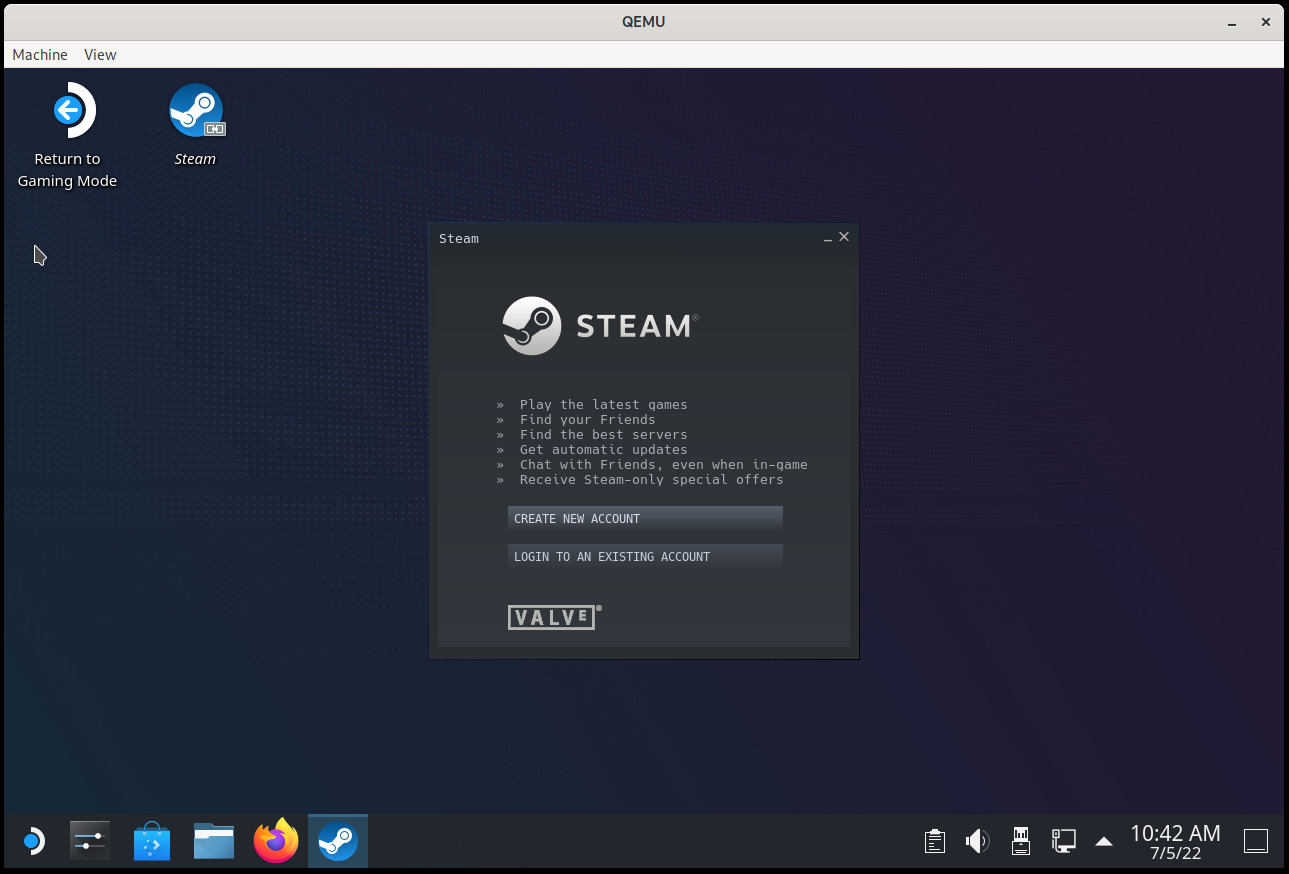
SteamOS desktop Introduction The Steam Deck is a handheld gaming computer that runs a Linux-based operating system called SteamOS. The machine comes with SteamOS 3 (code name holo ), which is in turn based on Arch Linux. Although there is no SteamOS 3 installer for a generic PC (yet), it is very easy to install on a virtual machine using QEMU. This post explains how to do it. The goal of this VM is not to play games (you can already install Steam on your computer after all) but to use SteamOS in desktop mode. The Gamescope mode (the console-like interface you normally see when you use the machine) requires additional development to make it work with QEMU and will not work with these instructions. A SteamOS VM can be useful for debugging, development, and generally playing and tinkering with the OS without risking breaking the Steam Deck. Running the SteamOS desktop in a virtual machine only requires QEMU and the OVMF UEFI firmware and should work in any relatively recent distribution. In this post I m using QEMU directly, but you can also use virt-manager or some other tool if you prefer, we re emulating a standard x86_64 machine here. General concepts SteamOS is a single-user operating system and it uses an A/B partition scheme, which means that there are two sets of partitions and two copies of the operating system. The root filesystem is read-only and system updates happen on the partition set that is not active. This allows for safer updates, among other things. There is one single /home partition, shared by both partition sets. It contains the games, user files, and anything that the user wants to install there. Although the user can trivially become root, make the root filesystem read-write and install or change anything (the pacman package manager is available), this is not recommended because A simple way for the user to install additional software that survives OS updates and doesn t touch the root filesystem is Flatpak. It comes preinstalled with the OS and is integrated with the KDE Discover app. Preparing all necessary files The first thing that we need is the installer. For that we have to download the Steam Deck recovery image from here: https://store.steampowered.com/steamos/download/?ver=steamdeck&snr= Once the file has been downloaded, we can uncompress it and we ll get a raw disk image called steamdeck-recovery-4.img (the number may vary). Note that the recovery image is already SteamOS (just not the most up-to-date version). If you simply want to have a quick look you can play a bit with it and skip the installation step. In this case I recommend that you extend the image before using it, for example with truncate -s 64G steamdeck-recovery-4.img or, better, create a qcow2 overlay file and leave the original raw image unmodified: qemu-img create -f qcow2 -F raw -b steamdeck-recovery-4.img steamdeck-recovery-extended.qcow2 64G But here we want to perform the actual installation, so we need a destination image. Let s create one: $ qemu-img create -f qcow2 steamos.qcow2 64G Installing SteamOS Now that we have all files we can start the virtual machine:
$ qemu-system-x86_64 -enable-kvm -smp cores=4 -m 8G \
    -device usb-ehci -device usb-tablet \
    -device intel-hda -device hda-duplex \
    -device VGA,xres=1280,yres=800 \
    -drive if=pflash,format=raw,readonly=on,file=/usr/share/ovmf/OVMF.fd \
    -drive if=virtio,file=steamdeck-recovery-4.img,driver=raw \
    -device nvme,drive=drive0,serial=badbeef \
    -drive if=none,id=drive0,file=steamos.qcow2
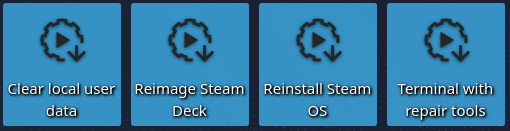
Note that we re emulating an NVMe drive for steamos.qcow2 because that s what the installer script expects. This is not strictly necessary but it makes things a bit easier. If you don t want to do that you ll have to edit ~/tools/repair_device.sh and change DISK and DISK_SUFFIX. SteamOS installer shortcuts Once the system has booted we ll see a KDE Plasma session with a few tools on the desktop. If we select Reimage Steam Deck and click Proceed on the confirmation dialog then SteamOS will be installed on the destination drive. This process should not take a long time. Now, once the operation finishes a new confirmation dialog will ask if we want to reboot the Steam Deck, but here we have to choose Cancel . We cannot use the new image yet because it would try to boot into the Gamescope session, which won t work, so we need to change the default desktop session. SteamOS comes with a helper script that allows us to enter a chroot after automatically mounting all SteamOS partitions, so let s open a Konsole and make the Plasma session the default one in both partition sets:
$ sudo steamos-chroot --disk /dev/nvme0n1 --partset A
# steamos-readonly disable
# echo '[Autologin]' > /etc/sddm.conf.d/zz-steamos-autologin.conf
# echo 'Session=plasma.desktop' >> /etc/sddm.conf.d/zz-steamos-autologin.conf
# steamos-readonly enable
# exit
$ sudo steamos-chroot --disk /dev/nvme0n1 --partset B
# steamos-readonly disable
# echo '[Autologin]' > /etc/sddm.conf.d/zz-steamos-autologin.conf
# echo 'Session=plasma.desktop' >> /etc/sddm.conf.d/zz-steamos-autologin.conf
# steamos-readonly enable
# exit
After this we can shut down the virtual machine. Our new SteamOS drive is ready to be used. We can discard the recovery image now if we want. Booting SteamOS and first steps To boot SteamOS we can use a QEMU line similar to the one used during the installation. This time we re not emulating an NVMe drive because it s no longer necessary.
$ cp /usr/share/OVMF/OVMF_VARS.fd .
$ qemu-system-x86_64 -enable-kvm -smp cores=4 -m 8G \
   -device usb-ehci -device usb-tablet \
   -device intel-hda -device hda-duplex \
   -device VGA,xres=1280,yres=800 \
   -drive if=pflash,format=raw,readonly=on,file=/usr/share/ovmf/OVMF.fd \
   -drive if=pflash,format=raw,file=OVMF_VARS.fd \
   -drive if=virtio,file=steamos.qcow2 \
   -device virtio-net-pci,netdev=net0 \
   -netdev user,id=net0,hostfwd=tcp::2222-:22
(the last two lines redirect tcp port 2222 to port 22 of the guest to be able to SSH into the VM. If you don t want to do that you can omit them) If everything went fine, you should see KDE Plasma again, this time with a desktop icon to launch Steam and another one to Return to Gaming Mode (which we should not use because it won t work). See the screenshot that opens this post. Congratulations, you re running SteamOS now. Here are some things that you probably want to do: Updating the OS to the latest version The Steam Deck recovery image doesn t install the most recent version of SteamOS, so now we should probably do a software update. Note: if the last step fails after reaching 100% with a post-install handler error then go to Connections in the system settings, rename Wired Connection 1 to something else (anything, the name doesn t matter), click Apply and run steamos-update again. This works around a bug in the update process. Recent images fix this and this workaround is not necessary with them. As we did with the recovery image, before rebooting we should ensure that the new update boots into the Plasma session, otherwise it won t work:
$ sudo steamos-chroot --partset other
# steamos-readonly disable
# echo '[Autologin]' > /etc/sddm.conf.d/zz-steamos-autologin.conf
# echo 'Session=plasma.desktop' >> /etc/sddm.conf.d/zz-steamos-autologin.conf
# steamos-readonly enable
# exit
After this we can restart the system. If everything went fine we should be running the latest SteamOS release. Enjoy! Reporting bugs SteamOS is under active development. If you find problems or want to request improvements please go to the SteamOS community tracker. Edit 06 Jul 2022: Small fixes, mention how to install the OS without using NVMe.

3 July 2022

Martin-Éric Racine: Refactoring Debian's dhcpcd packaging

Given news that ISC's DHCP suite is getting deprecated by upstream and seeing how dhclient has never worked properly for DHCPv6, I decided to look into alternatives. ISC itself recommends Roy Maple's dhcpcd as a migration path. Sadly, Debian's package had been left unattended for a good 2 years. After refactoring the packaging, updating to the latest upstream and performing one NMU, I decided to adopt the package. Numerous issues were exposed in the process: The key advantage of dhcpcd over dhclient is that works as a dual-stack DHCP client by design. With privilege separation enabled, this means separate child processes handling IPv4 and IPv6 configuration and passing the received information to the parent process to configure networking and update /etc/resolv.conf with nameservers for both stacks. Additionally, /etc/network/interfaces no longer needs separate inet and inet6 lines for each DHCP interface, which makes for much cleaner configuration files. A secondary advantage is that the dual-stack includes built-in fallback to Bonjour for IPv4 and SLAAC for IPv6. Basically, unless the interface needs a static IP address, this client handles network configuration in a smart and transparent way. A third advantage is built-in support for DHCPv6 Prefix Delegation. Enabling this requires just two lines in the configuration file. In the long run, I feel that dhcpcd-base should probably replace isc-dhcp-client as the default DHCP client with priority Important. Adequate IPv6 support should come out of the box on a standard Debian installation, yet dhclient never got around implementing that properly.

29 June 2022

Russell Coker: Philips 438P1 43 4K Monitor

I have just returned a Philips 438P1 43 4K Monitor [1] and gone back to my Samsung 28 4K monitor model LU28E590DS/XY AKA UE590. The main listed differences are the size and the fact that the Samsung is TN but the Philips is IPS. Here s a comparison of TN and IPS technologies [2]. Generally I think that TN is probably best for a monitor but in theory IPS shouldn t be far behind. The Philips monitor has a screen with a shiny surface which may be good for a TV but isn t good for a monitor. Also it seemed to blur the pixels a bit which again is probably OK for a TV that is trying to emulate curved images but not good for a monitor where it s all artificial straight lines. The most important thing for me in a monitor is how well it displays text in small fonts, for that I don t really want the round parts of the letters to look genuinely round as a clear octagon or rectangle is better than a fuzzy circle. There is some controversy about the ideal size for monitors. Some people think that nothing larger than 28 is needed and some people think that a 43 is totally usable. After testing I determined that 43 is really too big, I had to move to see it all. Also for my use it s convenient to be able to turn a monitor slightly to allow someone else to get a good view and a 43 monitor is too large to move much (maybe future technology for lighter monitors will change this). Previously I had been unable to get my Samsung monitor to work at 4K resolution with 60Hz and had believed it was due to cheap video cards. I got the Philips monitor to work with HDMI so it s apparent that the Samsung monitor doesn t do 4K@60Hz on HDMI. This isn t a real problem as the Samsung monitor doesn t have built in speakers. The Philips monitor has built in speakers for HDMI sound which means one less cable to my PC and no desk space taken by speakers. I bought the Philips monitor on eBay in opened unused condition. Inside the box was a sheet with a printout stating that the monitor blanks the screen periodically, so the seller knew that it wasn t in unused condition, it was tested and failed the test. If the Philips monitor had been as minimally broken as described then I might have kept it. However it seems that certain patterns of input caused it to reboot. For example I could be watching Netflix and have it drop out, I would press the left arrow to watch that bit again and have it drop out again. On one occasion I did a test and found that a 5 second section of Netflix content caused the monitor to reboot on 6/8 times I viewed it. The workaround I discovered was to switch between maximised window and full-screen mode when it had a dropout. So I just press left-arrow and then F and I can keep watching. That s not what I expect from a $700 monitor! I considered checking for Philips firmware updates but decided against it because I didn t want to risk voiding the warranty if it didn t work correctly and I decided I just didn t like the monitor that much. Ideally for my next monitor I ll get a 4K screen of about 35 , TN, and a screen that s not shiny. At the moment there doesn t seem to be many monitors between 32 and 43 in size, so 32 may do. I am quite happy with the Samsung monitor so getting the same but slightly larger is fine. It s a pity they stopped making 5K displays.

28 June 2022

Dima Kogan: vnlog 1.33 released

This is a minor release to the vnlog toolkit that adds a few convenience options to the vnl-filter tool. The new options are

vnl-filter -l
Prints out the existing columns, and exits. I've been low-level wanting this for years, but never acutely-enough to actually write it. Today I finally did it.

vnl-filter --sub-abs
Defines an absolute-value abs() function in the default awk mode. I've been low-level wanting this for years as well. Previously I'd use --perl just to get abs(), or I'd explicitly define it: = sub 'abs(x) return x>0?x:-x; '=. Typing all that out was becoming tiresome, and now I don't need to anymore.

vnl-filter --begin ... and vnl-filter --end ...
Theses add BEGIN and END clauses. They're useful to, for instance, use a perl module in BEGIN, or to print out some final output in END. Previously you'd add these inside the --eval block, but that was awkward because BEGIN and END would then appear inside the while(<>) loop. And there was no clear was to do it in the normal -p mode (no --eval). Clearly these are all minor, since the toolkit is now mature. It does everything I want it to, that doesn't require lots of work to implement. The big missing features that I want would patch the underlying GNU coreutils instead of vnlog:
  • The sort tool can select different sorting modes, but join works only with alphanumeric sorting. join should have similarly selectable sorting modes. In the vnlog wrappe I can currently do something like vnl-join --vnl-sort n. This would pre-sort the input alphanumerically, and then post-sort it numerically. That is slow for big datasets. If join could handle numerically-sorted data directly, neither the pre- or post-sorts would be needed
  • When joining on a numerical field, join should be able to do some sort of interpolation when given fields that don't match exactly.
Both of these probably wouldn't take a ton of work to implement, and I'll look into it someday.

26 June 2022

Russ Allbery: Review: Feet of Clay

Review: Feet of Clay, by Terry Pratchett
Series: Discworld #19
Publisher: Harper
Copyright: October 1996
Printing: February 2014
ISBN: 0-06-227551-8
Format: Mass market
Pages: 392
Feet of Clay is the 19th Discworld novel, the third Watch novel, and probably not the best place to start. You could read only Guards! Guards! and Men at Arms before this one, though, if you wanted. This story opens with a golem selling another golem to a factory owner, obviously not caring about the price. This is followed by two murders: an elderly priest, and the curator of a dwarven bread museum. (Dwarf bread is a much-feared weapon of war.) Meanwhile, assassins are still trying to kill Watch Commander Vimes, who has an appointment to get a coat of arms. A dwarf named Cheery Littlebottom is joining the Watch. And Lord Vetinari, the ruler of Ankh-Morpork, has been poisoned. There's a lot going on in this book, and while it's all in some sense related, it's more interwoven than part of a single story. The result felt to me like a day-in-the-life episode of a cop show: a lot of character development, a few largely separate plot lines so that the characters have something to do, and the development of a few long-running themes that are neither started nor concluded in this book. We check in on all the individual Watch members we've met to date, add new ones, and at the end of the book everyone is roughly back to where they were when the book started. This is, to be clear, not a bad thing for a book to do. It relies on the reader already caring about the characters and being invested in the long arc of the series, but both of those are true of me, so it worked. Cheery is a good addition, giving Pratchett an opportunity to explore gender nonconformity with a twist (all dwarfs are expected to act the same way regardless of gender, which doesn't work for Cheery) and, even better, giving Angua more scenes. Angua is among my favorite Watch characters, although I wish she'd gotten more of a resolution for her relationship anxiety in this book. The primary plot is about golems, which on Discworld are used in factories because they work nonstop, have no other needs, and do whatever they're told. Nearly everyone in Ankh-Morpork considers them machinery. If you've read any Discworld books before, you will find it unsurprising that Pratchett calls that belief into question, but the ways he gets there, and the links between the golem plot and the other plot threads, have a few good twists and turns. Reading this, I was reminded vividly of Orwell's discussion of Charles Dickens:
It seems that in every attack Dickens makes upon society he is always pointing to a change of spirit rather than a change of structure. It is hopeless to try and pin him down to any definite remedy, still more to any political doctrine. His approach is always along the moral plane, and his attitude is sufficiently summed up in that remark about Strong's school being as different from Creakle's "as good is from evil." Two things can be very much alike and yet abysmally different. Heaven and Hell are in the same place. Useless to change institutions without a "change of heart" that, essentially, is what he is always saying. If that were all, he might be no more than a cheer-up writer, a reactionary humbug. A "change of heart" is in fact the alibi of people who do not wish to endanger the status quo. But Dickens is not a humbug, except in minor matters, and the strongest single impression one carries away from his books is that of a hatred of tyranny.
and later:
His radicalism is of the vaguest kind, and yet one always knows that it is there. That is the difference between being a moralist and a politician. He has no constructive suggestions, not even a clear grasp of the nature of the society he is attacking, only an emotional perception that something is wrong, all he can finally say is, "Behave decently," which, as I suggested earlier, is not necessarily so shallow as it sounds. Most revolutionaries are potential Tories, because they imagine that everything can be put right by altering the shape of society; once that change is effected, as it sometimes is, they see no need for any other. Dickens has not this kind of mental coarseness. The vagueness of his discontent is the mark of its permanence. What he is out against is not this or that institution, but, as Chesterton put it, "an expression on the human face."
I think Pratchett is, in that sense, a Dickensian writer, and it shows all through Discworld. He does write political crises (there is one in this book), but the crises are moral or personal, not ideological or structural. The Watch novels are often concerned with systems of government, but focus primarily on the popular appeal of kings, the skill of the Patrician, and the greed of those who would maneuver for power. Pratchett does not write (at least so far) about the proper role of government, the impact of Vetinari's policies (or even what those policies may be), or political theory in any deep sense. What he does write about, at great length, is morality, fairness, and a deeply generous humanism, all of which are central to the golem plot. Vimes is a great protagonist for this type of story. He's grumpy, cynical, stubborn, and prejudiced, and we learn in this book that he's a descendant of the Discworld version of Oliver Cromwell. He can be reflexively self-centered, and he has no clear idea how to use his newfound resources. But he behaves decently towards people, in both big and small things, for reasons that the reader feels he could never adequately explain, but which are rooted in empathy and an instinctual sense of fairness. It's fun to watch him grumble his way through the plot while making snide comments about mysteries and detectives. I do have to complain a bit about one of those mysteries, though. I would have enjoyed the plot around Vetinari's poisoning more if Pratchett hadn't mercilessly teased readers who know a bit about French history. An allusion or two would have been fun, but he kept dropping references while having Vimes ignore them, and I found the overall effect both frustrating and irritating. That and a few other bits, like Angua's uncommunicative angst, fell flat for me. Thankfully, several other excellent scenes made up for them, such as Nobby's high society party and everything about the College of Heralds. Also, Vimes's impish PDA (smartphone without the phone, for those younger than I am) remains absurdly good commentary on the annoyances of portable digital devices despite an original publication date of 1996. Feet of Clay is less focused than the previous Watch novels and more of a series book than most Discworld novels. You're reading about characters introduced in previous books with problems that will continue into subsequent books. The plot and the mysteries are there to drive the story but seem relatively incidental to the characterization. This isn't a complaint; at this point in the series, I'm in it for the long haul, and I liked the variation. As usual, Pratchett is stronger for me when he's not overly focused on parody. His own characters are as good as the material he's been parodying, and I'm happy to see them get a book that's not overshadowed by another material. If you've read this far in the series, or even in just the Watch novels, recommended. Followed by Hogfather in publication order and, thematically, by Jingo. Rating: 8 out of 10

24 June 2022

Reproducible Builds: Supporter spotlight: Hans-Christoph Steiner of the F-Droid project

The Reproducible Builds project relies on several projects, supporters and sponsors for financial support, but they are also valued as ambassadors who spread the word about our project and the work that we do. This is the fifth instalment in a series featuring the projects, companies and individuals who support the Reproducible Builds project. We started this series by featuring the Civil Infrastructure Platform project and followed this up with a post about the Ford Foundation as well as a recent ones about ARDC, the Google Open Source Security Team (GOSST) and Jan Nieuwenhuizen on Bootstrappable Builds, GNU Mes and GNU Guix. Today, however, we will be talking with Hans-Christoph Steiner from the F-Droid project.

Chris: Welcome, Hans! Could you briefly tell me about yourself? Hans: Sure. I spend most of my time trying to private communications software usable by everyone, designing interactive software with a focus on human perceptual capabilities and building networks with free software. I ve been involved in Debian since approximately 2008 and became an official Debian developer in 2011. In the little time left over from that, I sometimes compose music with computers from my home in Austria.
Chris: For those who have not heard of it before, what is the F-Droid project? Hans: F-Droid is a community-run app store that provides free software applications for Android phones. First and foremost our goal is to represent our users. In particular, we review all of the apps that we distribute, and these reviews not only check for whether something is definitely free software or not, we additionally look for ethical problems with applications as well issues that we call Anti-Features . Since the project began in 2010, F-Droid now offers almost 4,000 free-software applications. F-Droid is also a app store kit as well, providing all the tools that are needed to operate an free app store of your own. It also includes complete build and release tools for managing the process of turning app source code into published builds.
Chris: How exactly does F-Droid differ from the Google Play store? Why might someone use F-Droid over Google Play? Hans: One key difference to the Google Play Store is that F-Droid does not ship proprietary software by default. All apps shipped from f-droid.org are built from source on our own builders. This is partly because F-Droid is backed by the free software community; that is, people who have engaged in the free software community long before Android was conceived, and, in particular, share many if not all of its values. Using F-Droid will therefore feel very familiar to anyone familiar with a modern Linux distribution.
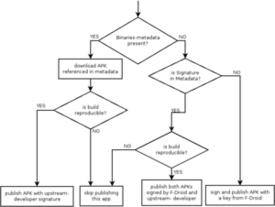
Chris: How do you describe reproducibility from the F-Droid point of view? Hans: All centralised software repositories are extremely tempting targets for exploitation by malicious third parties, and the kinds of personal or otherwise sensitive data on our phones only increase this risk. In F-Droid s case, not only could the software we distribute be theoretically replaced with nefarious copies, the build infrastructure that generates that software could be compromised as well. F-Droid having reproducible builds is extremely important as it allows us to verify that our build systems have not been compromised and distributing malware to our users. In particular, if an independent build infrastructure can produce precisely the same results from a build, then we can be reasonably sure that they haven t been compromised. Technically-minded users can also validate their builds on their own systems too, further increasing trust in our build infrastructure. (This can be performed using fdroid verify command.) Our signature & trust scheme means that F-Droid can verify that an app is 100% free software whilst still using the developer s original .APK file. More details about this may be found in our reproducibility documentation and on the page about our Verification Server.
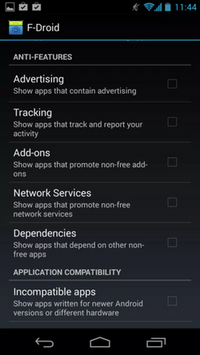
Chris: How do you see F-Droid fitting into the rest of the modern security ecosystem? Hans: Whilst F-Droid inherits all of the social benefits of free software, F-Droid takes special care to respect your privacy as well we don t attempt to track your device in any way. In particular, you don t need an account to use the F-Droid client, and F-Droid doesn t send any device-identifying information to our servers other than its own version number. What is more, we mark all apps in our repository that track you, and users can choose to hide any apps that has been tagged with a specific Anti-Feature in the F-Droid settings. Furthermore, any personal data you decide to give us (such as your email address when registering for a forum account) goes no further than us as well, and we pledge that it will never be used for anything beyond merely maintaining your account.
Chris: What would fully reproducible mean to F-Droid? What it would look like if reproducibility was a solved problem ? Or, rather, what would be your ultimate reproducibility goals? Hans: In an ideal world, every application submitted to F-Droid would not only build reproducibly, but would come with a cryptographically-signed signature from the developer as well. Then we would only distribute an compiled application after a build had received a number of matching signatures from multiple, independent third parties. This would mean that our users were not placing their trust solely in software developers machines, and wouldn t be trusting our centralised build servers as well.
Chris: What are the biggest blockers to reaching this state? Are there any key steps or milestones to get there? Hans: Time is probably the main constraint to reaching this goal. Not only do we need system administrators on an ongoing basis but we also need to incorporate reproducibly checks into our Continuous Integration (CI) system. We are always looking for new developers to join our effort, as well as learning about how to better bring them up to speed. Separate to this, we often experience blockers with reproducibility-related bugs in the Android build tooling. Luckily, upstreams do ultimately address these issues, but in some cases this has taken three or four years to reach end-users and developers. Unfortunately, upstream is not chiefly concerned with the security aspects of reproducibility builds; they care more about how it can minimise and optimise download size and speed.
Chris: Are you tracking any statistics about reproducibility in F-Droid over time? If so, can you share them? Does F-Droid track statistics about its own usage? Hans: To underline a topic touched on above, F-Droid is dedicated to preserving the privacy of its users; we therefore do not record usage statistics. This is, of course, in contrast to other application stores. However, we are in a position to track whether packages in F-Droid are reproducible or not. As in: what proportion of APKs in F-Droid have been independently verified over time? Unfortunately, due to time constraints, we do not yet automatically publish charts for this. We do publish some raw data that is related, though, and we naturally welcome contributions of visualizations based on any and all of our data. The All our APIs page on our wiki is a good place to start for someone wanting to contribute, everything about reproducible F-Droid apps is available in JSON format, what s missing are apps or dashboards making use of the available raw data.
Chris: Many thanks for this interview, Hans, and for all of your work on F-Droid and elsewhere. If someone wanted to get in touch or learn more about the project, where might someone go? Hans: The best way to find out about F-Droid is, of course, the main F-Droid homepage, but we are also on Twitter @fdroidorg. We have many avenues to participate and to learn more! We have an About page on our website and a thriving forum. We also have part of our documentation specifically dedicated to reproducible builds.


For more information about the Reproducible Builds project, please see our website at reproducible-builds.org. If you are interested in ensuring the ongoing security of the software that underpins our civilisation and wish to sponsor the Reproducible Builds project, please reach out to the project by emailing contact@reproducible-builds.org.

23 June 2022

Rapha&#235;l Hertzog: Freexian s report about Debian Long Term Support, May 2022

A Debian LTS logo
Like each month, have a look at the work funded by Freexian s Debian LTS offering. Debian project funding Two [1, 2] projects are in the pipeline now. Tryton project is in a final phase. Gradle projects is fighting with technical difficulties. In May, we put aside 2233 EUR to fund Debian projects. We re looking forward to receive more projects from various Debian teams! Learn more about the rationale behind this initiative in this article. Debian LTS contributors In May, 14 contributors have been paid to work on Debian LTS, their reports are available: Evolution of the situation In May we released 49 DLAs. The security tracker currently lists 71 packages with a known CVE and the dla-needed.txt file has 65 packages needing an update. The number of paid contributors increased significantly, we are pleased to welcome our latest team members: Andreas R nnquist, Dominik George, Enrico Zini and Stefano Rivera. It is worth pointing out that we are getting close to the end of the LTS period for Debian 9. After June 30th, no new security updates will be made available on security.debian.org. We are preparing to overtake Debian 10 Buster for the next two years and to make this process as smooth as possible. But Freexian and its team of paid Debian contributors will continue to maintain Debian 9 going forward for the customers of the Extended LTS offer. If you have Debian 9 servers to keep secure, it s time to subscribe! You might not have noticed, but Freexian formalized a mission statement where we explain that our purpose is to help improve Debian. For this, we want to fund work time for the Debian developers that recently joined Freexian as collaborators. The Extended LTS and the PHP LTS offers are built following a model that will help us to achieve this if we manage to have enough customers for those offers. So consider subscribing: you help your organization but you also help Debian! Thanks to our sponsors Sponsors that joined recently are in bold.

21 June 2022

Steve Kemp: Writing a simple TCL interpreter in golang

Recently I was reading Antirez's piece TCL the Misunderstood again, which is a nice defense of the utility and value of the TCL language. TCL is one of those scripting languages which used to be used a hell of a lot in the past, for scripting routers, creating GUIs, and more. These days it quietly lives on, but doesn't get much love. That said it's a remarkably simple language to learn, and experiment with. Using TCL always reminds me of FORTH, in the sense that the syntax consists of "words" with "arguments", and everything is a string (well, not really, but almost. Some things are lists too of course). A simple overview of TCL would probably begin by saying that everything is a command, and that the syntax is very free. There are just a couple of clever rules which are applied consistently to give you a remarkably flexible environment. To get started we'll set a string value to a variable:

  set name "Steve Kemp"
  => "Steve Kemp"
Now you can output that variable:
  puts "Hello, my name is $name"
  => "Hello, my name is Steve Kemp"
OK, it looks a little verbose due to the use of set, and puts is less pleasant than print or echo, but it works. It is readable. Next up? Interpolation. We saw how $name expanded to "Steve Kemp" within the string. That's true more generally, so we can do this:
 set print pu
 set me    ts
 $print$me "Hello, World"
 => "Hello, World"
There "$print" and "$me" expanded to "pu" and "ts" respectively. Resulting in:
 puts "Hello, World"
That expansion happened before the input was executed, and works as you'd expect. There's another form of expansion too, which involves the [ and ] characters. Anything within the square-brackets is replaced with the contents of evaluating that body. So we can do this:
 puts "1 + 1 = [expr 1 + 1]"
 => "1 + 1 = 2"
Perhaps enough detail there, except to say that we can use and to enclose things that are NOT expanded, or executed, at parse time. This facility lets us evaluate those blocks later, so you can write a while-loop like so:
 set cur 1
 set max 10
 while   expr $cur <= $max    
       puts "Loop $cur of $max"
       incr cur
  
Anyway that's enough detail. Much like writing a FORTH interpreter the key to implementing something like this is to provide the bare minimum of primitives, then write the rest of the language in itself. You can get a usable scripting language with only a small number of the primitives, and then evolve the rest yourself. Antirez also did this, he put together a small TCL interpreter in C named picol: Other people have done similar things, recently I saw this writeup which follows the same approach: So of course I had to do the same thing, in golang: My code runs the original code from Antirez with only minor changes, and was a fair bit of fun to put together. Because the syntax is so fluid there's no complicated parsing involved, and the core interpreter was written in only a few hours then improved step by step. Of course to make a language more useful you need I/O, beyond just writing to the console - and being able to run the list-operations would make it much more useful to TCL users, but that said I had fun writing it, it seems to work, and once again I added fuzz-testers to the lexer and parser to satisfy myself it was at least somewhat robust. Feedback welcome, but even in quiet isolation it's fun to look back at these "legacy" languages and recognize their simplicity lead to a lot of flexibility.

18 June 2022

Bastian Venthur: blag is now available in Debian

Last year, I wrote my own blog-aware static site generator in Python. I called it blag named after the blag of the webcomic xkcd. Now I finally got around packaging- and uploading blag to Debian. It passed the NEW queue and is now part of the distribution. That means if you re using Debian, you can install it via:
sudo aptitude install blag
Ubuntu will probably follow soon. For every other system, blag is also available on PyPI:
pip install blag
To get started, you can
mkdir blog && cd blog
blag quickstart                        # fill out some info
nvim content/hello-world.md            # write some content
blag build                             # build the website
Blag is aware of articles and pages: the difference is that articles are part of the blog and will be added to the atom feed, the archive and aggregated in the tag pages. Pages are just rendered out to HTML. Articles and pages can be freely mixed in the content directory, what differentiates an article from a page is the existence of the dade metadata element:
title: My first article
description: Short description of the article
date: 2022-06-18 23:00
tags: blogging, markdown
## Hello World!
Lorem ipsum.
[...]
blag also comes with a dev-server that rebuilds the website automatically on every change detected, you can start it using:
blag serve
The default theme looks quite ugly, and you probably want to create your own styling to make it more beautiful. The process is not very difficult if you re familiar with jinja templating. Help on that can be found in the Templating section of the online documentation, the offline version in the blag-doc package, or the man page, respectively. Speaking of the blag-doc package: packaging it was surprisingly tricky, and it also took me a lot of trial and error to realize that dh_sphinxdocs alone does not automatically put the generated html output into the appropriate package, you rather have to list them in the package.docs-file (i.e. blag-doc.docs) so dh_installdocs can install them properly.

17 June 2022

Antoine Beaupr : Matrix notes

I have some concerns about Matrix (the protocol, not the movie that came out recently, although I do have concerns about that as well). I've been watching the project for a long time, and it seems more a promising alternative to many protocols like IRC, XMPP, and Signal. This review may sound a bit negative, because it focuses on those concerns. I am the operator of an IRC network and people keep asking me to bridge it with Matrix. I have myself considered just giving up on IRC and converting to Matrix. This space is a living document exploring my research of that problem space. The TL;DR: is that no, I'm not setting up a bridge just yet, and I'm still on IRC. This article was written over the course of the last three months, but I have been watching the Matrix project for years (my logs seem to say 2016 at least). The article is rather long. It will likely take you half an hour to read, so copy this over to your ebook reader, your tablet, or dead trees, and lean back and relax as I show you around the Matrix. Or, alternatively, just jump to a section that interest you, most likely the conclusion.

Introduction to Matrix Matrix is an "open standard for interoperable, decentralised, real-time communication over IP. It can be used to power Instant Messaging, VoIP/WebRTC signalling, Internet of Things communication - or anywhere you need a standard HTTP API for publishing and subscribing to data whilst tracking the conversation history". It's also (when compared with XMPP) "an eventually consistent global JSON database with an HTTP API and pubsub semantics - whilst XMPP can be thought of as a message passing protocol." According to their FAQ, the project started in 2014, has about 20,000 servers, and millions of users. Matrix works over HTTPS but over a special port: 8448.

Security and privacy I have some concerns about the security promises of Matrix. It's advertised as a "secure" with "E2E [end-to-end] encryption", but how does it actually work?

Data retention defaults One of my main concerns with Matrix is data retention, which is a key part of security in a threat model where (for example) an hostile state actor wants to surveil your communications and can seize your devices. On IRC, servers don't actually keep messages all that long: they pass them along to other servers and clients as fast as they can, only keep them in memory, and move on to the next message. There are no concerns about data retention on messages (and their metadata) other than the network layer. (I'm ignoring the issues with user registration, which is a separate, if valid, concern.) Obviously, an hostile server could log everything passing through it, but IRC federations are normally tightly controlled. So, if you trust your IRC operators, you should be fairly safe. Obviously, clients can (and often do, even if OTR is configured!) log all messages, but this is generally not the default. Irssi, for example, does not log by default. IRC bouncers are more likely to log to disk, of course, to be able to do what they do. Compare this to Matrix: when you send a message to a Matrix homeserver, that server first stores it in its internal SQL database. Then it will transmit that message to all clients connected to that server and room, and to all other servers that have clients connected to that room. Those remote servers, in turn, will keep a copy of that message and all its metadata in their own database, by default forever. On encrypted rooms those messages are encrypted, but not their metadata. There is a mechanism to expire entries in Synapse, but it is not enabled by default. So one should generally assume that a message sent on Matrix is never expired.

GDPR in the federation But even if that setting was enabled by default, how do you control it? This is a fundamental problem of the federation: if any user is allowed to join a room (which is the default), those user's servers will log all content and metadata from that room. That includes private, one-on-one conversations, since those are essentially rooms as well. In the context of the GDPR, this is really tricky: who is the responsible party (known as the "data controller") here? It's basically any yahoo who fires up a home server and joins a room. In a federated network, one has to wonder whether GDPR enforcement is even possible at all. But in Matrix in particular, if you want to enforce your right to be forgotten in a given room, you would have to:
  1. enumerate all the users that ever joined the room while you were there
  2. discover all their home servers
  3. start a GDPR procedure against all those servers
I recognize this is a hard problem to solve while still keeping an open ecosystem. But I believe that Matrix should have much stricter defaults towards data retention than right now. Message expiry should be enforced by default, for example. (Note that there are also redaction policies that could be used to implement part of the GDPR automatically, see the privacy policy discussion below on that.) Also keep in mind that, in the brave new peer-to-peer world that Matrix is heading towards, the boundary between server and client is likely to be fuzzier, which would make applying the GDPR even more difficult. Update: this comment links to this post (in german) which apparently studied the question and concluded that Matrix is not GDPR-compliant. In fact, maybe Synapse should be designed so that there's no configurable flag to turn off data retention. A bit like how most system loggers in UNIX (e.g. syslog) come with a log retention system that typically rotate logs after a few weeks or month. Historically, this was designed to keep hard drives from filling up, but it also has the added benefit of limiting the amount of personal information kept on disk in this modern day. (Arguably, syslog doesn't rotate logs on its own, but, say, Debian GNU/Linux, as an installed system, does have log retention policies well defined for installed packages, and those can be discussed. And "no expiry" is definitely a bug.

Matrix.org privacy policy When I first looked at Matrix, five years ago, Element.io was called Riot.im and had a rather dubious privacy policy:
We currently use cookies to support our use of Google Analytics on the Website and Service. Google Analytics collects information about how you use the Website and Service. [...] This helps us to provide you with a good experience when you browse our Website and use our Service and also allows us to improve our Website and our Service.
When I asked Matrix people about why they were using Google Analytics, they explained this was for development purposes and they were aiming for velocity at the time, not privacy (paraphrasing here). They also included a "free to snitch" clause:
If we are or believe that we are under a duty to disclose or share your personal data, we will do so in order to comply with any legal obligation, the instructions or requests of a governmental authority or regulator, including those outside of the UK.
Those are really broad terms, above and beyond what is typically expected legally. Like the current retention policies, such user tracking and ... "liberal" collaboration practices with the state set a bad precedent for other home servers. Thankfully, since the above policy was published (2017), the GDPR was "implemented" (2018) and it seems like both the Element.io privacy policy and the Matrix.org privacy policy have been somewhat improved since. Notable points of the new privacy policies:
  • 2.3.1.1: the "federation" section actually outlines that "Federated homeservers and Matrix clients which respect the Matrix protocol are expected to honour these controls and redaction/erasure requests, but other federated homeservers are outside of the span of control of Element, and we cannot guarantee how this data will be processed"
  • 2.6: users under the age of 16 should not use the matrix.org service
  • 2.10: Upcloud, Mythic Beast, Amazon, and CloudFlare possibly have access to your data (it's nice to at least mention this in the privacy policy: many providers don't even bother admitting to this kind of delegation)
  • Element 2.2.1: mentions many more third parties (Twilio, Stripe, Quaderno, LinkedIn, Twitter, Google, Outplay, PipeDrive, HubSpot, Posthog, Sentry, and Matomo (phew!) used when you are paying Matrix.org for hosting
I'm not super happy with all the trackers they have on the Element platform, but then again you don't have to use that service. Your favorite homeserver (assuming you are not on Matrix.org) probably has their own Element deployment, hopefully without all that garbage. Overall, this is all a huge improvement over the previous privacy policy, so hats off to the Matrix people for figuring out a reasonable policy in such a tricky context. I particularly like this bit:
We will forget your copy of your data upon your request. We will also forward your request to be forgotten onto federated homeservers. However - these homeservers are outside our span of control, so we cannot guarantee they will forget your data.
It's great they implemented those mechanisms and, after all, if there's an hostile party in there, nothing can prevent them from using screenshots to just exfiltrate your data away from the client side anyways, even with services typically seen as more secure, like Signal. As an aside, I also appreciate that Matrix.org has a fairly decent code of conduct, based on the TODO CoC which checks all the boxes in the geekfeminism wiki.

Metadata handling Overall, privacy protections in Matrix mostly concern message contents, not metadata. In other words, who's talking with who, when and from where is not well protected. Compared to a tool like Signal, which goes through great lengths to anonymize that data with features like private contact discovery, disappearing messages, sealed senders, and private groups, Matrix is definitely behind. (Note: there is an issue open about message lifetimes in Element since 2020, but it's not at even at the MSC stage yet.) This is a known issue (opened in 2019) in Synapse, but this is not just an implementation issue, it's a flaw in the protocol itself. Home servers keep join/leave of all rooms, which gives clear text information about who is talking to. Synapse logs may also contain privately identifiable information that home server admins might not be aware of in the first place. Those log rotation policies are separate from the server-level retention policy, which may be confusing for a novice sysadmin. Combine this with the federation: even if you trust your home server to do the right thing, the second you join a public room with third-party home servers, those ideas kind of get thrown out because those servers can do whatever they want with that information. Again, a problem that is hard to solve in any federation. To be fair, IRC doesn't have a great story here either: any client knows not only who's talking to who in a room, but also typically their client IP address. Servers can (and often do) obfuscate this, but often that obfuscation is trivial to reverse. Some servers do provide "cloaks" (sometimes automatically), but that's kind of a "slap-on" solution that actually moves the problem elsewhere: now the server knows a little more about the user. Overall, I would worry much more about a Matrix home server seizure than a IRC or Signal server seizure. Signal does get subpoenas, and they can only give out a tiny bit of information about their users: their phone number, and their registration, and last connection date. Matrix carries a lot more information in its database.

Amplification attacks on URL previews I (still!) run an Icecast server and sometimes share links to it on IRC which, obviously, also ends up on (more than one!) Matrix home servers because some people connect to IRC using Matrix. This, in turn, means that Matrix will connect to that URL to generate a link preview. I feel this outlines a security issue, especially because those sockets would be kept open seemingly forever. I tried to warn the Matrix security team but somehow, I don't think this issue was taken very seriously. Here's the disclosure timeline:
  • January 18: contacted Matrix security
  • January 19: response: already reported as a bug
  • January 20: response: can't reproduce
  • January 31: timeout added, considered solved
  • January 31: I respond that I believe the security issue is underestimated, ask for clearance to disclose
  • February 1: response: asking for two weeks delay after the next release (1.53.0) including another patch, presumably in two weeks' time
  • February 22: Matrix 1.53.0 released
  • April 14: I notice the release, ask for clearance again
  • April 14: response: referred to the public disclosure
There are a couple of problems here:
  1. the bug was publicly disclosed in September 2020, and not considered a security issue until I notified them, and even then, I had to insist
  2. no clear disclosure policy timeline was proposed or seems established in the project (there is a security disclosure policy but it doesn't include any predefined timeline)
  3. I wasn't informed of the disclosure
  4. the actual solution is a size limit (10MB, already implemented), a time limit (30 seconds, implemented in PR 11784), and a content type allow list (HTML, "media" or JSON, implemented in PR 11936), and I'm not sure it's adequate
  5. (pure vanity:) I did not make it to their Hall of fame
I'm not sure those solutions are adequate because they all seem to assume a single home server will pull that one URL for a little while then stop. But in a federated network, many (possibly thousands) home servers may be connected in a single room at once. If an attacker drops a link into such a room, all those servers would connect to that link all at once. This is an amplification attack: a small amount of traffic will generate a lot more traffic to a single target. It doesn't matter there are size or time limits: the amplification is what matters here. It should also be noted that clients that generate link previews have more amplification because they are more numerous than servers. And of course, the default Matrix client (Element) does generate link previews as well. That said, this is possibly not a problem specific to Matrix: any federated service that generates link previews may suffer from this. I'm honestly not sure what the solution is here. Maybe moderation? Maybe link previews are just evil? All I know is there was this weird bug in my Icecast server and I tried to ring the bell about it, and it feels it was swept under the rug. Somehow I feel this is bound to blow up again in the future, even with the current mitigation.

Moderation In Matrix like elsewhere, Moderation is a hard problem. There is a detailed moderation guide and much of this problem space is actively worked on in Matrix right now. A fundamental problem with moderating a federated space is that a user banned from a room can rejoin the room from another server. This is why spam is such a problem in Email, and why IRC networks have stopped federating ages ago (see the IRC history for that fascinating story).

The mjolnir bot The mjolnir moderation bot is designed to help with some of those things. It can kick and ban users, redact all of a user's message (as opposed to one by one), all of this across multiple rooms. It can also subscribe to a federated block list published by matrix.org to block known abusers (users or servers). Bans are pretty flexible and can operate at the user, room, or server level. Matrix people suggest making the bot admin of your channels, because you can't take back admin from a user once given.

The command-line tool There's also a new command line tool designed to do things like:
  • System notify users (all users/users from a list, specific user)
  • delete sessions/devices not seen for X days
  • purge the remote media cache
  • select rooms with various criteria (external/local/empty/created by/encrypted/cleartext)
  • purge history of theses rooms
  • shutdown rooms
This tool and Mjolnir are based on the admin API built into Synapse.

Rate limiting Synapse has pretty good built-in rate-limiting which blocks repeated login, registration, joining, or messaging attempts. It may also end up throttling servers on the federation based on those settings.

Fundamental federation problems Because users joining a room may come from another server, room moderators are at the mercy of the registration and moderation policies of those servers. Matrix is like IRC's +R mode ("only registered users can join") by default, except that anyone can register their own homeserver, which makes this limited. Server admins can block IP addresses and home servers, but those tools are not easily available to room admins. There is an API (m.room.server_acl in /devtools) but it is not reliable (thanks Austin Huang for the clarification). Matrix has the concept of guest accounts, but it is not used very much, and virtually no client or homeserver supports it. This contrasts with the way IRC works: by default, anyone can join an IRC network even without authentication. Some channels require registration, but in general you are free to join and look around (until you get blocked, of course). I have seen anecdotal evidence (CW: Twitter, nitter link) that "moderating bridges is hell", and I can imagine why. Moderation is already hard enough on one federation, when you bridge a room with another network, you inherit all the problems from that network but without the entire abuse control tools from the original network's API...

Room admins Matrix, in particular, has the problem that room administrators (which have the power to redact messages, ban users, and promote other users) are bound to their Matrix ID which is, in turn, bound to their home servers. This implies that a home server administrators could (1) impersonate a given user and (2) use that to hijack the room. So in practice, the home server is the trust anchor for rooms, not the user themselves. That said, if server B administrator hijack user joe on server B, they will hijack that room on that specific server. This will not (necessarily) affect users on the other servers, as servers could refuse parts of the updates or ban the compromised account (or server). It does seem like a major flaw that room credentials are bound to Matrix identifiers, as opposed to the E2E encryption credentials. In an encrypted room even with fully verified members, a compromised or hostile home server can still take over the room by impersonating an admin. That admin (or even a newly minted user) can then send events or listen on the conversations. This is even more frustrating when you consider that Matrix events are actually signed and therefore have some authentication attached to them, acting like some sort of Merkle tree (as it contains a link to previous events). That signature, however, is made from the homeserver PKI keys, not the client's E2E keys, which makes E2E feel like it has been "bolted on" later.

Availability While Matrix has a strong advantage over Signal in that it's decentralized (so anyone can run their own homeserver,), I couldn't find an easy way to run a "multi-primary" setup, or even a "redundant" setup (even if with a single primary backend), short of going full-on "replicate PostgreSQL and Redis data", which is not typically for the faint of heart.

How this works in IRC On IRC, it's quite easy to setup redundant nodes. All you need is:
  1. a new machine (with it's own public address with an open port)
  2. a shared secret (or certificate) between that machine and an existing one on the network
  3. a connect block on both servers
That's it: the node will join the network and people can connect to it as usual and share the same user/namespace as the rest of the network. The servers take care of synchronizing state: you do not need to worry about replicating a database server. (Now, experienced IRC people will know there's a catch here: IRC doesn't have authentication built in, and relies on "services" which are basically bots that authenticate users (I'm simplifying, don't nitpick). If that service goes down, the network still works, but then people can't authenticate, and they can start doing nasty things like steal people's identity if they get knocked offline. But still: basic functionality still works: you can talk in rooms and with users that are on the reachable network.)

User identities Matrix is more complicated. Each "home server" has its own identity namespace: a specific user (say @anarcat:matrix.org) is bound to that specific home server. If that server goes down, that user is completely disconnected. They could register a new account elsewhere and reconnect, but then they basically lose all their configuration: contacts, joined channels are all lost. (Also notice how the Matrix IDs don't look like a typical user address like an email in XMPP. They at least did their homework and got the allocation for the scheme.)

Rooms Users talk to each other in "rooms", even in one-to-one communications. (Rooms are also used for other things like "spaces", they're basically used for everything, think "everything is a file" kind of tool.) For rooms, home servers act more like IRC nodes in that they keep a local state of the chat room and synchronize it with other servers. Users can keep talking inside a room if the server that originally hosts the room goes down. Rooms can have a local, server-specific "alias" so that, say, #room:matrix.org is also visible as #room:example.com on the example.com home server. Both addresses refer to the same room underlying room. (Finding this in the Element settings is not obvious though, because that "alias" are actually called a "local address" there. So to create such an alias (in Element), you need to go in the room settings' "General" section, "Show more" in "Local address", then add the alias name (e.g. foo), and then that room will be available on your example.com homeserver as #foo:example.com.) So a room doesn't belong to a server, it belongs to the federation, and anyone can join the room from any serer (if the room is public, or if invited otherwise). You can create a room on server A and when a user from server B joins, the room will be replicated on server B as well. If server A fails, server B will keep relaying traffic to connected users and servers. A room is therefore not fundamentally addressed with the above alias, instead ,it has a internal Matrix ID, which basically a random string. It has a server name attached to it, but that was made just to avoid collisions. That can get a little confusing. For example, the #fractal:gnome.org room is an alias on the gnome.org server, but the room ID is !hwiGbsdSTZIwSRfybq:matrix.org. That's because the room was created on matrix.org, but the preferred branding is gnome.org now. As an aside, rooms, by default, live forever, even after the last user quits. There's an admin API to delete rooms and a tombstone event to redirect to another one, but neither have a GUI yet. The latter is part of MSC1501 ("Room version upgrades") which allows a room admin to close a room, with a message and a pointer to another room.

Spaces Discovering rooms can be tricky: there is a per-server room directory, but Matrix.org people are trying to deprecate it in favor of "Spaces". Room directories were ripe for abuse: anyone can create a room, so anyone can show up in there. It's possible to restrict who can add aliases, but anyways directories were seen as too limited. In contrast, a "Space" is basically a room that's an index of other rooms (including other spaces), so existing moderation and administration mechanism that work in rooms can (somewhat) work in spaces as well. This enables a room directory that works across federation, regardless on which server they were originally created. New users can be added to a space or room automatically in Synapse. (Existing users can be told about the space with a server notice.) This gives admins a way to pre-populate a list of rooms on a server, which is useful to build clusters of related home servers, providing some sort of redundancy, at the room -- not user -- level.

Home servers So while you can workaround a home server going down at the room level, there's no such thing at the home server level, for user identities. So if you want those identities to be stable in the long term, you need to think about high availability. One limitation is that the domain name (e.g. matrix.example.com) must never change in the future, as renaming home servers is not supported. The documentation used to say you could "run a hot spare" but that has been removed. Last I heard, it was not possible to run a high-availability setup where multiple, separate locations could replace each other automatically. You can have high performance setups where the load gets distributed among workers, but those are based on a shared database (Redis and PostgreSQL) backend. So my guess is it would be possible to create a "warm" spare server of a matrix home server with regular PostgreSQL replication, but that is not documented in the Synapse manual. This sort of setup would also not be useful to deal with networking issues or denial of service attacks, as you will not be able to spread the load over multiple network locations easily. Redis and PostgreSQL heroes are welcome to provide their multi-primary solution in the comments. In the meantime, I'll just point out this is a solution that's handled somewhat more gracefully in IRC, by having the possibility of delegating the authentication layer.

Delegations If you do not want to run a Matrix server yourself, it's possible to delegate the entire thing to another server. There's a server discovery API which uses the .well-known pattern (or SRV records, but that's "not recommended" and a bit confusing) to delegate that service to another server. Be warned that the server still needs to be explicitly configured for your domain. You can't just put:
  "m.server": "matrix.org:443"  
... on https://example.com/.well-known/matrix/server and start using @you:example.com as a Matrix ID. That's because Matrix doesn't support "virtual hosting" and you'd still be connecting to rooms and people with your matrix.org identity, not example.com as you would normally expect. This is also why you cannot rename your home server. The server discovery API is what allows servers to find each other. Clients, on the other hand, use the client-server discovery API: this is what allows a given client to find your home server when you type your Matrix ID on login.

Performance The high availability discussion brushed over the performance of Matrix itself, but let's now dig into that.

Horizontal scalability There were serious scalability issues of the main Matrix server, Synapse, in the past. So the Matrix team has been working hard to improve its design. Since Synapse 1.22 the home server can horizontally scale to multiple workers (see this blog post for details) which can make it easier to scale large servers.

Other implementations There are other promising home servers implementations from a performance standpoint (dendrite, Golang, entered beta in late 2020; conduit, Rust, beta; others), but none of those are feature-complete so there's a trade-off to be made there. Synapse is also adding a lot of feature fast, so it's an open question whether the others will ever catch up. (I have heard that Dendrite might actually surpass Synapse in features within a few years, which would put Synapse in a more "LTS" situation.)

Latency Matrix can feel slow sometimes. For example, joining the "Matrix HQ" room in Element (from matrix.debian.social) takes a few minutes and then fails. That is because the home server has to sync the entire room state when you join the room. There was promising work on this announced in the lengthy 2021 retrospective, and some of that work landed (partial sync) in the 1.53 release already. Other improvements coming include sliding sync, lazy loading over federation, and fast room joins. So that's actually something that could be fixed in the fairly short term. But in general, communication in Matrix doesn't feel as "snappy" as on IRC or even Signal. It's hard to quantify this without instrumenting a full latency test bed (for example the tools I used in the terminal emulators latency tests), but even just typing in a web browser feels slower than typing in a xterm or Emacs for me. Even in conversations, I "feel" people don't immediately respond as fast. In fact, this could be an interesting double-blind experiment to make: have people guess whether they are talking to a person on Matrix, XMPP, or IRC, for example. My theory would be that people could notice that Matrix users are slower, if only because of the TCP round-trip time each message has to take.

Transport Some courageous person actually made some tests of various messaging platforms on a congested network. His evaluation was basically:
  • Briar: uses Tor, so unusable except locally
  • Matrix: "struggled to send and receive messages", joining a room takes forever as it has to sync all history, "took 20-30 seconds for my messages to be sent and another 20 seconds for further responses"
  • XMPP: "worked in real-time, full encryption, with nearly zero lag"
So that was interesting. I suspect IRC would have also fared better, but that's just a feeling. Other improvements to the transport layer include support for websocket and the CoAP proxy work from 2019 (targeting 100bps links), but both seem stalled at the time of writing. The Matrix people have also announced the pinecone p2p overlay network which aims at solving large, internet-scale routing problems. See also this talk at FOSDEM 2022.

Usability

Onboarding and workflow The workflow for joining a room, when you use Element web, is not great:
  1. click on a link in a web browser
  2. land on (say) https://matrix.to/#/#matrix-dev:matrix.org
  3. offers "Element", yeah that's sounds great, let's click "Continue"
  4. land on https://app.element.io/#/room%2F%23matrix-dev%3Amatrix.org and then you need to register, aaargh
As you might have guessed by now, there is a specification to solve this, but web browsers need to adopt it as well, so that's far from actually being solved. At least browsers generally know about the matrix: scheme, it's just not exactly clear what they should do with it, especially when the handler is just another web page (e.g. Element web). In general, when compared with tools like Signal or WhatsApp, Matrix doesn't fare so well in terms of user discovery. I probably have some of my normal contacts that have a Matrix account as well, but there's really no way to know. It's kind of creepy when Signal tells you "this person is on Signal!" but it's also pretty cool that it works, and they actually implemented it pretty well. Registration is also less obvious: in Signal, the app confirms your phone number automatically. It's friction-less and quick. In Matrix, you need to learn about home servers, pick one, register (with a password! aargh!), and then setup encryption keys (not default), etc. It's a lot more friction. And look, I understand: giving away your phone number is a huge trade-off. I don't like it either. But it solves a real problem and makes encryption accessible to a ton more people. Matrix does have "identity servers" that can serve that purpose, but I don't feel confident sharing my phone number there. It doesn't help that the identity servers don't have private contact discovery: giving them your phone number is a more serious security compromise than with Signal. There's a catch-22 here too: because no one feels like giving away their phone numbers, no one does, and everyone assumes that stuff doesn't work anyways. Like it or not, Signal forcing people to divulge their phone number actually gives them critical mass that means actually a lot of my relatives are on Signal and I don't have to install crap like WhatsApp to talk with them.

5 minute clients evaluation Throughout all my tests I evaluated a handful of Matrix clients, mostly from Flathub because almost none of them are packaged in Debian. Right now I'm using Element, the flagship client from Matrix.org, in a web browser window, with the PopUp Window extension. This makes it look almost like a native app, and opens links in my main browser window (instead of a new tab in that separate window), which is nice. But I'm tired of buying memory to feed my web browser, so this indirection has to stop. Furthermore, I'm often getting completely logged off from Element, which means re-logging in, recovering my security keys, and reconfiguring my settings. That is extremely annoying. Coming from Irssi, Element is really "GUI-y" (pronounced "gooey"). Lots of clickety happening. To mark conversations as read, in particular, I need to click-click-click on all the tabs that have some activity. There's no "jump to latest message" or "mark all as read" functionality as far as I could tell. In Irssi the former is built-in (alt-a) and I made a custom /READ command for the latter:
/ALIAS READ script exec \$_->activity(0) for Irssi::windows
And yes, that's a Perl script in my IRC client. I am not aware of any Matrix client that does stuff like that, except maybe Weechat, if we can call it a Matrix client, or Irssi itself, now that it has a Matrix plugin (!). As for other clients, I have looked through the Matrix Client Matrix (confusing right?) to try to figure out which one to try, and, even after selecting Linux as a filter, the chart is just too wide to figure out anything. So I tried those, kind of randomly:
  • Fractal
  • Mirage
  • Nheko
  • Quaternion
Unfortunately, I lost my notes on those, I don't actually remember which one did what. I still have a session open with Mirage, so I guess that means it's the one I preferred, but I remember they were also all very GUI-y. Maybe I need to look at weechat-matrix or gomuks. At least Weechat is scriptable so I could continue playing the power-user. Right now my strategy with messaging (and that includes microblogging like Twitter or Mastodon) is that everything goes through my IRC client, so Weechat could actually fit well in there. Going with gomuks, on the other hand, would mean running it in parallel with Irssi or ... ditching IRC, which is a leap I'm not quite ready to take just yet. Oh, and basically none of those clients (except Nheko and Element) support VoIP, which is still kind of a second-class citizen in Matrix. It does not support large multimedia rooms, for example: Jitsi was used for FOSDEM instead of the native videoconferencing system.

Bots This falls a little aside the "usability" section, but I didn't know where to put this... There's a few Matrix bots out there, and you are likely going to be able to replace your existing bots with Matrix bots. It's true that IRC has a long and impressive history with lots of various bots doing various things, but given how young Matrix is, there's still a good variety:
  • maubot: generic bot with tons of usual plugins like sed, dice, karma, xkcd, echo, rss, reminder, translate, react, exec, gitlab/github webhook receivers, weather, etc
  • opsdroid: framework to implement "chat ops" in Matrix, connects with Matrix, GitHub, GitLab, Shell commands, Slack, etc
  • matrix-nio: another framework, used to build lots more bots like:
    • hemppa: generic bot with various functionality like weather, RSS feeds, calendars, cron jobs, OpenStreetmaps lookups, URL title snarfing, wolfram alpha, astronomy pic of the day, Mastodon bridge, room bridging, oh dear
    • devops: ping, curl, etc
    • podbot: play podcast episodes from AntennaPod
    • cody: Python, Ruby, Javascript REPL
    • eno: generic bot, "personal assistant"
  • mjolnir: moderation bot
  • hookshot: bridge with GitLab/GitHub
  • matrix-monitor-bot: latency monitor
One thing I haven't found an equivalent for is Debian's MeetBot. There's an archive bot but it doesn't have topics or a meeting chair, or HTML logs.

Working on Matrix As a developer, I find Matrix kind of intimidating. The specification is huge. The official specification itself looks somewhat digestable: it's only 6 APIs so that looks, at first, kind of reasonable. But whenever you start asking complicated questions about Matrix, you quickly fall into the Matrix Spec Change specification (which, yes, is a separate specification). And there are literally hundreds of MSCs flying around. It's hard to tell what's been adopted and what hasn't, and even harder to figure out if your specific client has implemented it. (One trendy answer to this problem is to "rewrite it in rust": Matrix are working on implementing a lot of those specifications in a matrix-rust-sdk that's designed to take the implementation details away from users.) Just taking the latest weekly Matrix report, you find that three new MSCs proposed, just last week! There's even a graph that shows the number of MSCs is progressing steadily, at 600+ proposals total, with the majority (300+) "new". I would guess the "merged" ones are at about 150. That's a lot of text which includes stuff like 3D worlds which, frankly, I don't think you should be working on when you have such important security and usability problems. (The internet as a whole, arguably, doesn't fare much better. RFC600 is a really obscure discussion about "INTERFACING AN ILLINOIS PLASMA TERMINAL TO THE ARPANET". Maybe that's how many MSCs will end up as well, left forgotten in the pits of history.) And that's the thing: maybe the Matrix people have a different objective than I have. They want to connect everything to everything, and make Matrix a generic transport for all sorts of applications, including virtual reality, collaborative editors, and so on. I just want secure, simple messaging. Possibly with good file transfers, and video calls. That it works with existing stuff is good, and it should be federated to remove the "Signal point of failure". So I'm a bit worried with the direction all those MSCs are taking, especially when you consider that clients other than Element are still struggling to keep up with basic features like end-to-end encryption or room discovery, never mind voice or spaces...

Conclusion Overall, Matrix is somehow in the space XMPP was a few years ago. It has a ton of features, pretty good clients, and a large community. It seems to have gained some of the momentum that XMPP has lost. It may have the most potential to replace Signal if something bad would happen to it (like, I don't know, getting banned or going nuts with cryptocurrency)... But it's really not there yet, and I don't see Matrix trying to get there either, which is a bit worrisome.

Looking back at history I'm also worried that we are repeating the errors of the past. The history of federated services is really fascinating:. IRC, FTP, HTTP, and SMTP were all created in the early days of the internet, and are all still around (except, arguably, FTP, which was removed from major browsers recently). All of them had to face serious challenges in growing their federation. IRC had numerous conflicts and forks, both at the technical level but also at the political level. The history of IRC is really something that anyone working on a federated system should study in detail, because they are bound to make the same mistakes if they are not familiar with it. The "short" version is:
  • 1988: Finnish researcher publishes first IRC source code
  • 1989: 40 servers worldwide, mostly universities
  • 1990: EFnet ("eris-free network") fork which blocks the "open relay", named Eris - followers of Eris form the A-net, which promptly dissolves itself, with only EFnet remaining
  • 1992: Undernet fork, which offered authentication ("services"), routing improvements and timestamp-based channel synchronisation
  • 1994: DALnet fork, from Undernet, again on a technical disagreement
  • 1995: Freenode founded
  • 1996: IRCnet forks from EFnet, following a flame war of historical proportion, splitting the network between Europe and the Americas
  • 1997: Quakenet founded
  • 1999: (XMPP founded)
  • 2001: 6 million users, OFTC founded
  • 2002: DALnet peaks at 136,000 users
  • 2003: IRC as a whole peaks at 10 million users, EFnet peaks at 141,000 users
  • 2004: (Facebook founded), Undernet peaks at 159,000 users
  • 2005: Quakenet peaks at 242,000 users, IRCnet peaks at 136,000 (Youtube founded)
  • 2006: (Twitter founded)
  • 2009: (WhatsApp, Pinterest founded)
  • 2010: (TextSecure AKA Signal, Instagram founded)
  • 2011: (Snapchat founded)
  • ~2013: Freenode peaks at ~100,000 users
  • 2016: IRCv3 standardisation effort started (TikTok founded)
  • 2021: Freenode self-destructs, Libera chat founded
  • 2022: Libera peaks at 50,000 users, OFTC peaks at 30,000 users
(The numbers were taken from the Wikipedia page and Netsplit.de. Note that I also include other networks launch in parenthesis for context.) Pretty dramatic, don't you think? Eventually, somehow, IRC became irrelevant for most people: few people are even aware of it now. With less than a million users active, it's smaller than Mastodon, XMPP, or Matrix at this point.1 If I were to venture a guess, I'd say that infighting, lack of a standardization body, and a somewhat annoying protocol meant the network could not grow. It's also possible that the decentralised yet centralised structure of IRC networks limited their reliability and growth. But large social media companies have also taken over the space: observe how IRC numbers peak around the time the wave of large social media companies emerge, especially Facebook (2.9B users!!) and Twitter (400M users).

Where the federated services are in history Right now, Matrix, and Mastodon (and email!) are at the "pre-EFnet" stage: anyone can join the federation. Mastodon has started working on a global block list of fascist servers which is interesting, but it's still an open federation. Right now, Matrix is totally open, but matrix.org publishes a (federated) block list of hostile servers (#matrix-org-coc-bl:matrix.org, yes, of course it's a room). Interestingly, Email is also in that stage, where there are block lists of spammers, and it's a race between those blockers and spammers. Large email providers, obviously, are getting closer to the EFnet stage: you could consider they only accept email from themselves or between themselves. It's getting increasingly hard to deliver mail to Outlook and Gmail for example, partly because of bias against small providers, but also because they are including more and more machine-learning tools to sort through email and those systems are, fundamentally, unknowable. It's not quite the same as splitting the federation the way EFnet did, but the effect is similar. HTTP has somehow managed to live in a parallel universe, as it's technically still completely federated: anyone can start a web server if they have a public IP address and anyone can connect to it. The catch, of course, is how you find the darn thing. Which is how Google became one of the most powerful corporations on earth, and how they became the gatekeepers of human knowledge online. I have only briefly mentioned XMPP here, and my XMPP fans will undoubtedly comment on that, but I think it's somewhere in the middle of all of this. It was co-opted by Facebook and Google, and both corporations have abandoned it to its fate. I remember fondly the days where I could do instant messaging with my contacts who had a Gmail account. Those days are gone, and I don't talk to anyone over Jabber anymore, unfortunately. And this is a threat that Matrix still has to face. It's also the threat Email is currently facing. On the one hand corporations like Facebook want to completely destroy it and have mostly succeeded: many people just have an email account to register on things and talk to their friends over Instagram or (lately) TikTok (which, I know, is not Facebook, but they started that fire). On the other hand, you have corporations like Microsoft and Google who are still using and providing email services because, frankly, you still do need email for stuff, just like fax is still around but they are more and more isolated in their own silo. At this point, it's only a matter of time they reach critical mass and just decide that the risk of allowing external mail coming in is not worth the cost. They'll simply flip the switch and work on an allow-list principle. Then we'll have closed the loop and email will be dead, just like IRC is "dead" now. I wonder which path Matrix will take. Could it liberate us from these vicious cycles? Update: this generated some discussions on lobste.rs.

  1. According to Wikipedia, there are currently about 500 distinct IRC networks operating, on about 1,000 servers, serving over 250,000 users. In contrast, Mastodon seems to be around 5 million users, Matrix.org claimed at FOSDEM 2021 to have about 28 million globally visible accounts, and Signal lays claim to over 40 million souls. XMPP claims to have "millions" of users on the xmpp.org homepage but the FAQ says they don't actually know. On the proprietary silo side of the fence, this page says
    • Facebook: 2.9 billion users
    • WhatsApp: 2B
    • Instagram: 1.4B
    • TikTok: 1B
    • Snapchat: 500M
    • Pinterest: 480M
    • Twitter: 397M
    Notable omission from that list: Youtube, with its mind-boggling 2.6 billion users... Those are not the kind of numbers you just "need to convince a brother or sister" to grow the network...

13 June 2022

Edward Betts: Fixing spelling in GitHub repos using codespell

Codespell is a spell checker specifically designed for finding misspellings in source code. I've been using it to correct spelling mistakes in GitHub repos sine 2016. Most spell checkers use a list of valid words and highlighting any word in a document that is not in the word list. This method doesn't work for source code because code contains abbreviations and words joined together without spaces, a spell checker will generate too many false positives. Codespell uses a different approach, instead of a list of valid words it has a dictionary of common misspellings. Currently the codespell dictionary includes 34,466 known misspellings. I've contributed 300 misspellings to the dictionary. Whenever I find an interesting open source project I run codespell to check for spelling mistakes. Most projects have spelling mistakes and I can send a pull request to fix them. In 2019 Microsoft made the Windows calculator open source and uploaded it to GitHub. I used codespell to find some spelling mistakes, sent them a pull request and they accepted it. A great source for GitHub repos to spell check is Hacker News. Let's have a look.
Hacker News has a link to forum software called Flarum. I can use codespell to look for spelling mistakes. When I'm looking for errors in a GitHub repo I don't fork the project until I know there is a spelling mistake to fix.
edward@x1c9 ~/spelling> git clone git@github.com:flarum/flarum.git
Cloning into &aposflarum&apos...
remote: Enumerating objects: 1338, done.
remote: Counting objects: 100% (42/42), done.
remote: Compressing objects: 100% (23/23), done.
remote: Total 1338 (delta 21), reused 36 (delta 19), pack-reused 1296
Receiving objects: 100% (1338/1338), 725.02 KiB   1.09 MiB/s, done.
Resolving deltas: 100% (720/720), done.
edward@x1c9 ~/spelling> cd flarum/
edward@x1c9 ~/spelling/flarum (master)> codespell -q3
./public/web.config:13: sensitve ==> sensitive
edward@x1c9 ~/spelling/flarum (master)> gh repo fork
  Created fork EdwardBetts/flarum
? Would you like to add a remote for the fork? Yes
  Added remote origin
edward@x1c9 ~/spelling/flarum (master)> git checkout -b spelling
Switched to a new branch &aposspelling&apos
edward@x1c9 ~/spelling/flarum (spelling)> codespell -q3
./public/web.config:13: sensitve ==> sensitive
edward@x1c9 ~/spelling/flarum (spelling)> codespell -q3 -w
FIXED: ./public/web.config
edward@x1c9 ~/spelling/flarum (spelling)> git commit -am "Correct spelling mistakes"
[spelling bbb04c7] Correct spelling mistakes
 1 file changed, 1 insertion(+), 1 deletion(-)
edward@x1c9 ~/spelling/flarum (spelling)> git push -u origin
Enumerating objects: 7, done.
Counting objects: 100% (7/7), done.
Delta compression using up to 8 threads
Compressing objects: 100% (4/4), done.
Writing objects: 100% (4/4), 360 bytes   360.00 KiB/s, done.
Total 4 (delta 3), reused 0 (delta 0), pack-reused 0
remote: Resolving deltas: 100% (3/3), completed with 3 local objects.
remote: 
remote: Create a pull request for &aposspelling&apos on GitHub by visiting:
remote:      https://github.com/EdwardBetts/flarum/pull/new/spelling
remote: 
To github.com:EdwardBetts/flarum.git
 * [new branch]      spelling -> spelling
branch &aposspelling&apos set up to track &aposorigin/spelling&apos.
edward@x1c9 ~/spelling/flarum (spelling)> gh pr create 
Creating pull request for EdwardBetts:spelling into master in flarum/flarum
? Title Correct spelling mistakes
? Choose a template Open a blank pull request
? Body <Received>
? What&aposs next? Submit
https://github.com/flarum/flarum/pull/81
edward@x1c9 ~/spelling/flarum (spelling)> 
That worked. I found one spelling mistake, the word "sensitive" was spelled wrong. I forked the repo, fixed the spelling mistake and submitted the fix as a pull request.
The maintainer of Flarum accepted my pull request. Fixing spelling mistakes in Bootstrap helped me unlocked the Mars 2020 Contributor achievements on GitHub.
Why not try running codespell on your own codebase? You'll probably find some spelling mistakes to fix.

3 June 2022

Rapha&#235;l Hertzog: Freexian s report about Debian Long Term Support, April 2022

A Debian LTS logo
Like each month, have a look at the work funded by Freexian s Debian LTS offering. Debian project funding Two projects are currently in the pipeline: Gradle enterprise and Tryton update. Progress is quite slow on the Gradle one, there are technical difficulties. The tryton one was stalled because the developer had not enough time but seems to progress smoothly in the last weeks. In April, we put aside 2635 EUR to fund Debian projects. We re looking forward to receive more projects from various Debian teams! Learn more about the rationale behind this initiative in this article. Debian LTS contributors In April, 11 contributors have been paid to work on Debian LTS, their reports are available: Evolution of the situation In April we released 30 DLAs and we were glad to welcome a new customer with Alter Way. The security tracker currently lists 72 packages with a known CVE and the dla-needed.txt file has 71 packages needing an update. It is worth pointing out that we are getting close to the end of the LTS period for Debian 9. After June 30th, no new security updates will be made available on security.debian.org. But Freexian and its team of paid Debian contributors will continue to maintain Debian 9 going forward for the customers of the Extended LTS offer. If you have Debian 9 servers to keep secure, it s time to subscribe! You might not have noticed, but Freexian formalized a mission statement where we explain that our purpose is to help improve Debian. For this, we want to fund work time for the Debian developers that recently joined Freexian as collaborators. The Extended LTS and the PHP LTS offers are built following a model that will help us to achieve this if we manage to have enough customers for those offers. So consider subscribing: you help your organization but you also help Debian! Thanks to our sponsors Sponsors that joined recently are in bold.

1 June 2022

Daniel Lange: Get Youtube Channel ID from username

Youtube has a really nice RSS feature that is extremely well hidden. If you postfix a Channel ID to

https://www.youtube.com/feeds/videos.xml?channel_id=<id goes here>
you get a really nice Atom 1.0 (~RSS) feed for your feedreader. Unfortunately the Channel ID is hard to find while you are navigating Youtube with usernames in the URL. E.g. https://www.youtube.com/c/TED is TED's channel, full of interesting and worth-to-watch content (and some assorted horse toppings, of course). But you have to read a lot of ugly HTML / JSON in that page to find and combine https://www.youtube.com/feeds/videos.xml?channel_id=UCAuUUnT6oDeKwE6v1NGQxug which is the related RSS feed. Jeff Keeling wrote a simple Youtube RSS Extractor that does well if you have a ../playlist?... or a .../channel/... URL but it will (currently) fail on user name channels or Youtube landing pages. So how do we get the Channel ID for a Youtube user we are interested to follow? Youtube has a great API but that is gated by API keys even for the most simple calls (that came only with v3 of the API but the previous version is depreciated since 2015)1:
dl@laptop:~$ curl 'https://www.googleapis.com/youtube/v3/channels?part=contentDetails&forUsername=DebConfVideos'

"error":
"code": 403,
"message": "The request is missing a valid API key.",
"errors": [

"message": "The request is missing a valid API key.",
"domain": "global",
"reason": "forbidden"

],
"status": "PERMISSION_DENIED"

Luckily we can throw the same (example) user name DebConfVideos at curl and grep:
dl@laptop:~$ curl -s "https://www.youtube.com/c/DebConfVideos/videos" grep -Po '"channelId":".+?"'
"channelId":"UC7SbfAPZf8SMvAxp8t51qtQ"
So https://www.youtube.com/feeds/videos.xml?channel_id=UC7SbfAPZf8SMvAxp8t51qtQ is the RSS feed for DebConfVideos. We can use individual Youtube video URLs as well. With the hack above, it'll work to find us the Chanel ID from a Youtube video URL: Working around the Youtube API restrictions to still make use of their RSS feed Now, some user pages may have multiple valid RSS feeds because they contain multiple channels. Remember the TED page from above? Well run:
dl@laptop:~$ curl -s "https://www.youtube.com/c/TED" grep -Po '"channelId":".+?"' cut -d \" -f 4 while read -r YTID ; do echo -n "Youtube-ID: $YTID " ; curl -s "https://www.youtube.com/feeds/videos.xml?channel_id=$YTID" grep -m 1 -P -o "(?<=<title>).+(?=</title>)" ; done
This will iterate through the Channel IDs found and show you the titles. That way you can assess which one you want to add to your feedreader. screenshot of the above You probably want the last Channel ID listed above, the non-selective "TED" one. And that's the one from the example above. Update 02.06.2022: smpl wrote in and has the much better solution for the most frequent use cases:
You can also use get a feed directly with a username:
https://www.youtube.com/feeds/videos.xml?user=<username>
The one I use most is the one for playlists (if creators remember to
use them).
https://www.youtube.com/feeds/videos.xml?playlist_id=<playlist id>
For the common case you don't even need the channel ID that way. But it is also conveniently given in a <yt:channelId> tag (or the topmost <id> tag) within the Atom XML document. Thanks, smpl!

  1. Actually it is even more complicated as some channels, like our DebConfVideos example, will only get you an incomplete result, cf. this StackOverflow entry. I.e. the forUsername iterator may not even work and the "best practice" seems to be mucking around with the search call.

Russ Allbery: Review: The Seeress of Kell

Review: The Seeress of Kell, by David Eddings
Series: The Malloreon #5
Publisher: Del Rey
Copyright: May 1991
Printing: May 1992
ISBN: 0-345-37759-1
Format: Mass market
Pages: 374
The Seeress of Kell is the conclusion of the five-book Malloreon series and a direct sequel to Sorceress of Darshiva. You do not want to begin the series here (or, to be honest, at all). We have finally finished the relaxed tour of Mallorea, the second continent of Eddings's remarkably small two-continent world. The heroes have gathered all of their required companions and are headed for Kell, where the seeress Cyradis awaits. From there, they and the new Child of Dark must find their way to the Place Which Is No More for the final confrontation. By "find," I mean please remain seated with your hands, arms, feet, and legs inside the vehicle. The protagonists have about as much to do with the conclusion of this series as the passengers of a roller coaster have control over its steering. I am laughing at my younger self, who quite enjoyed this series (although as I recall found it a bit repetitive) and compared it favorably to the earlier Belgariad series. My memory kept telling me that the conclusion of the series was lots of fun. Reader, it was not. It was hilariously bad. Both of Eddings's first two series, but particularly this one, take place in a fantasy world full of true prophecy. The conceit of the Malloreon in particular (this is a minor spoiler for the early books, but not one that I think interferes with enjoyment) is that there are two competing prophecies that agree on most events but are in conflict over a critical outcome. True prophecy creates an agency problem: why have protagonists if everything they do is fixed in prophecy? The normal way to avoid that is to make the prophecy sufficiently confusing and the mechanism by which it comes true sufficiently subtle that everyone has to act as if there is no prophecy, thus reducing the role of the prophecy to foreshadowing and a game the author plays with the reader. What makes the Malloreon interesting (and I mean this sincerely) is that Eddings instead leans into the idea of a prophecy as an active agent leading the protagonists around by the nose. As a meta-story commentary on fantasy stories, this can be quite entertaining, and it helps that the prophecy appears as a likable character of sorts in the book. The trap that Eddings had mostly avoided before now is that this structure can make the choices of the protagonists entirely pointless. In The Seeress of Kell, he dives head-first into the trap and then pulls it shut behind him. The worst part is Ce'Nedra, who once again spends an entire book either carping at Garion in ways that are supposed to be endearing (but aren't) or being actively useless. The low point is when she is manipulated into betraying the heroes, costing them a significant advantage. We're then told that, rather than being a horrific disaster, this is her important and vital role in the story, and indeed the whole reason why she was in the story at all. The heroes were too far ahead of the villains and were in danger of causing the prophecy to fail. At that point, one might reasonably ask why one is bothering reading a novel instead of a summary of the invented history that Eddings is going to tell whether his characters cooperate or not. The whole middle section of the book is like this: nothing any of the characters do matters because everything is explicitly destined. That includes an extended series of interludes following the other main characters from the Belgariad, who are racing to catch up with the main party but who will turn out to have no role of significance whatsoever. I wouldn't mind this as much if the prophecy were more active in the story, given that it's the actual protagonist. But it mostly disappears. Instead, the characters blunder around doing whatever seems like a good idea at the time, while Cyradis acts like a bizarre sort of referee with a Calvinball rule set and every random action turns out to be the fulfillment of prophecy in the most ham-handed possible way. Zandramas, meanwhile, is trying to break the prophecy, which would have been a moderately interesting story hook if anyone (Eddings included) thought she were potentially capable of doing so. Since no one truly believes there's any peril, this turns into a series of pointless battles the reader has no reason to care about. All of this sets up what has been advertised since the start of the series as a decision between good and evil. Now, at the least minute, Eddings (through various character mouthpieces) tries to claim that the decision is not actually between good and evil, but is somehow beyond morality. No one believes this, including the narrator and the reader, making all of the philosophizing a tedious exercise in page-turning. To pull off a contention like that, the author has to lay some sort of foundation to allow the reader to see the supposed villain in multiple lights. Eddings does none of that, instead emphasizing how evil she is at every opportunity. On top of that, this supposed free choice on which the entire universe rests and for which all of history was pointed depends on someone with astonishing conflicts of interest. While the book is going on about how carefully the prophecy is ensuring that everyone is in the right place at the right time so that no side has an advantage, one side is accruing an absurdly powerful advantage. And the characters don't even seem to realize it! The less said about the climax, the better. Unsurprisingly, it was completely predictable. Also, while I am complaining, I could never get past how this entire series starts off with and revolves around an incredibly traumatic and ongoing event that has no impact whatsoever on the person to whom the trauma happens. Other people are intermittently upset or sad, but not only is that person not harmed, they act, at the end of this book, as if the entire series had never happened. There is one bright spot in this book, and ironically it's the one plot element that Eddings didn't make blatantly obvious in advance and therefore I don't want to spoil it. All I'll say is that one of the companions the heroes pick up along the way turns out to be my favorite character of the series, plays a significant role in the interpersonal dynamics between the heroes, and steals every scene that she's in by being more sensible than any of the other characters in the story. Her story, and backstory, is emotional and moving and is the best part of this book. Otherwise, not only is the plot a mess and the story structure a failure, but this is also Eddings at his most sexist and socially conservative. There is an extended epilogue after the plot resolution that serves primarily as a showcase of stereotypes: baffled men having their habits and preferences rewritten by their wives, cast-iron gender roles inside marriage, cringeworthy jokes, and of course loads and loads of children because that obviously should be everyone's happily ever after. All of this happens to the characters rather than being planned or actively desired, continuing the theme of prophecy and lack of agency, although of course they're all happy about it (shown mostly via grumbling). One could write an entire academic paper on the tension between this series and the concept of consent. There were bits of the Malloreon that I enjoyed, but they were generally in spite of the plot rather than because of it. I do like several of Eddings's characters, and in places I liked the lack of urgency and the sense of safety. But I think endings still have to deliver some twist or punch or, at the very least, some clear need for the protagonists to take an action other than stand in the right room at the right time. Eddings probably tried to supply that (I can make a few guesses about where), but it failed miserably for me, making this the worst book of the series. Unless like me you're revisiting this out of curiosity for your teenage reading habits (and even then, consider not), avoid. Rating: 3 out of 10

31 May 2022

Russ Allbery: Review: Maskerade

Review: Maskerade, by Terry Pratchett
Series: Discworld #18
Publisher: Harper
Copyright: 1995
Printing: February 2014
ISBN: 0-06-227552-6
Format: Mass market
Pages: 360
Maskerade is the 18th book of the Discworld series, but you probably could start here. You'd miss the introduction of Granny Weatherwax and Nanny Ogg, which might be a bit confusing, but I suspect you could pick it up as you went if you wanted. This is a sequel of sorts to Lords and Ladies, but not in a very immediate sense. Granny is getting distracted and less interested in day-to-day witching in Lancre. This is not good; Granny is incredibly powerful, and bored and distracted witches can go to dark places. Nanny is concerned. Granny needs something to do, and their coven needs a third. It's not been the same since they lost their maiden member. Nanny's solution to this problem is two-pronged. First, they'd had their eye on a local girl named Agnes, who had magic but who wasn't interested in being a witch. Perhaps it was time to recruit her anyway, even though she'd left Lancre for Ankh-Morpork. And second, Granny needs something to light a fire under her, something that will get her outraged and ready to engage with the world. Something like a cookbook of aphrodisiac recipes attributed to the Witch of Lancre. Agnes, meanwhile, is auditioning for the opera. She's a sensible person, cursed her whole life by having a wonderful personality, but a part of her deep inside wants to be called Perdita X. Dream and have a dramatic life. Having a wonderful personality can be very frustrating, but no one in Lancre took either that desire or her name seriously. Perhaps the opera is somewhere where she can find the life she's looking for, along with another opportunity to try on the Perdita name. One thing she can do is sing; that's where all of her magic went. The Ankh-Morpork opera is indeed dramatic. It's also losing an astounding amount of money for its new owner, who foolishly thought owning an opera would be a good retirement project after running a cheese business. And it's haunted by a ghost, a very tangible ghost who has started killing people. I think this is my favorite Discworld novel to date (although with a caveat about the ending that I'll get to in a moment). It's certainly the one that had me laughing out loud the most. Agnes (including her Perdita personality aspect) shot to the top of my list of favorite Discworld characters, in part because I found her sensible personality so utterly relatable. She is fascinated by drama, she wants to be in the middle of it and let her inner Perdita goth character revel in it, and yet she cannot help being practical and unflappable even when surrounded by people who use far too many exclamation points. It's one thing to want drama in the abstract; it's quite another to be heedlessly dramatic in the moment, when there's an obviously reasonable thing to do instead. Pratchett writes this wonderfully. The other half of the story follows Granny and Nanny, who are unstoppable forces of nature and a wonderful team. They have the sort of long-standing, unshakable adult friendship between very unlike people that's full of banter and minor irritations layered on top of a deep mutual understanding and respect. Once they decide to start investigating this supposed opera ghost, they divvy up the investigative work with hardly a word exchanged. Planning isn't necessary; they both know each other's strengths. We've gotten a lot of Granny's skills in previous books. Maskerade gives Nanny a chance to show off her skills, and it's a delight. She effortlessly becomes the sort of friendly grandmother who blends in so well that no one questions why she's there, and thus manages to be in the middle of every important event. Granny watches and thinks and theorizes; Nanny simply gets into the middle of everything and talks to everyone until people tell her what she wants to know. There's no real doubt that the two of them are going to get to the bottom of anything they want to get to the bottom of, but watching how they get there is a delight. I love how Pratchett handles that sort of magical power from a world-building perspective. Ankh-Morpork is the Big City, the center of political power in most of the Discworld books, and Granny and Nanny are from the boondocks. By convention, that means they should either be awed or confused by the city, or gain power in the city by transforming it in some way to match their area of power. This isn't how Pratchett writes witches at all. Their magic is in understanding people, and the people in Ankh-Morpork are just as much people as the people in Lancre. The differences of the city may warrant an occasional grumpy aside, but the witches are fully as capable of navigating the city as they are their home town. Maskerade is, of course, a parody of opera and musicals, with Phantom of the Opera playing the central role in much the same way that Macbeth did in Wyrd Sisters. Agnes ends up doing the singing for a beautiful, thin actress named Christine, who can't sing at all despite being an opera star, uses a truly astonishing excess of exclamation points, and strategically faints at the first sign of danger. (And, despite all of this, is still likable in that way that it's impossible to be really upset at a puppy.) She is the special chosen focus of the ghost, whose murderous taunting is a direct parody of the Phantom. That was a sufficiently obvious reference that even I picked up on it, despite being familiar with Phantom of the Opera only via the soundtrack. Apart from that, though, the references were lost on me, since I'm neither a musical nor an opera fan. That didn't hurt my enjoyment of the book in the slightest; in fact, I suspect it's part of why it's in my top tier of Discworld books. One of my complaints about Discworld to date is that Pratchett often overdoes the parody to the extent that it gets in the way of his own (excellent) characters and story. Maybe it's better to read Discworld novels where one doesn't recognize the material being parodied and thus doesn't keep getting distracted by references. It's probably worth mentioning that Agnes is a large woman and there are several jokes about her weight in Maskerade. I think they're the good sort of jokes, about how absurd human bodies can be, not the mean sort? Pratchett never implies her weight is any sort of moral failing or something she should change; quite the contrary, Nanny considers it a sign of solid Lancre genes. But there is some fat discrimination in the opera itself, since one of the things Pratchett is commenting on is the switch from full-bodied female opera singers to thin actresses matching an idealized beauty standard. Christine is the latter, but she can't sing, and the solution is for Agnes to sing for her from behind, something that was also done in real opera. I'm not a good judge of how well this plot line was handled; be aware, going in, if this may bother you. What did bother me was the ending, and more generally the degree to which Granny and Nanny felt comfortable making decisions about Agnes's life without consulting her or appearing to care what she thought of their conclusions. Pratchett seemed to be on their side, emphasizing how well they know people. But Agnes left Lancre and avoided the witches for a reason, and that reason is not honored in much the same way that Lancre refused to honor her desire to go by Perdita. This doesn't seem to be malicious, and Agnes herself is a little uncertain about her choice of identity, but it still rubbed me the wrong way. I felt like Agnes got steamrolled by both the other characters and by Pratchett, and it's the one thing about this book that I didn't like. Hopefully future Discworld books about these characters revisit Agnes's agency. Overall, though, this was great, and a huge improvement over Interesting Times. I'm excited for the next witches book. Followed in publication order by Feet of Clay, and later by Carpe Jugulum in the thematic sense. Rating: 8 out of 10

28 May 2022

kpcyrd: auth-tarball-from-git: Verifying tarballs with signed git tags

I noticed there s a common anti-pattern in some PKGBUILDs, the short scripts that are used to build Arch Linux packages. Specifically we re looking at the part that references the source code used when building a package:
source=("git+https://github.com/alacritty/alacritty.git#tag=v$ pkgver ?signed")
validpgpkeys=('4DAA67A9EA8B91FCC15B699C85CDAE3C164BA7B4'
              'A56EF308A9F1256C25ACA3807EA8F8B94622A6A9')
sha256sums=('SKIP')
This does: In contrast consider this PKGBUILD:
source=($pkgname-$pkgver.tar.gz::https://github.com/alacritty/alacritty/archive/refs/tags/v$pkgver.tar.gz)
sha256sums=('e48d4b10762c2707bb17fd8f89bd98f0dcccc450d223cade706fdd9cfaefb308')
Personally - if I had to decide between these two - I d prefer the later because I can always try to authenticate the pinned tarball later on, but it s impossible to know for sure which source code has been used if all I know is something that had a valid signature on it . This set could be infinitely large for all we know! But is there a way to get both? Consider this PKGBUILD:
makedepends=('auth-tarball-from-git')
source=($pkgname-$pkgver.tar.gz::https://github.com/alacritty/alacritty/archive/refs/tags/v$pkgver.tar.gz
        chrisduerr.pgp
        kchibisov.pgp)
sha256sums=('e48d4b10762c2707bb17fd8f89bd98f0dcccc450d223cade706fdd9cfaefb308'
            '19573dc0ba7a2f003377dc49986867f749235ecb45fe15eb923a74b2ab421d74'
            '5b866e6cb791c58cba2e7fc60f647588699b08abc2ad6b18ba82470f0fd3db3b')
prepare()  
  cd "$pkgname-$pkgver"
  auth-tarball-from-git --keyring ../chrisduerr.pgp --keyring ../kchibisov.pgp \
    --tag v$pkgver --prefix $pkgname-$pkgver \
    https://github.com/alacritty/alacritty.git ../$pkgname-$pkgver.tar.gz
 
In this case sha256sums= is the primary line of defense against tampering with build inputs and the git tag is only used to document authorship. For more infos on how this works you can have a look at the auth-tarball-from-git repo, there s also a section about attacks on signed git tags that you should probably know about.

Thanks This work is currently crowd-funded on github sponsors. I d like to thank @SantiagoTorres, @repi and @rgacogne for their support in particular.

26 May 2022

Sergio Talens-Oliag: New Blog Config

As promised, on this post I m going to explain how I ve configured this blog using hugo, asciidoctor and the papermod theme, how I publish it using nginx, how I ve integrated the remark42 comment system and how I ve automated its publication using gitea and json2file-go. It is a long post, but I hope that at least parts of it can be interesting for some, feel free to ignore it if that is not your case

Hugo Configuration

Theme settingsThe site is using the PaperMod theme and as I m using asciidoctor to publish my content I ve adjusted the settings to improve how things are shown with it. The current config.yml file is the one shown below (probably some of the settings are not required nor being used right now, but I m including the current file, so this post will have always the latest version of it):
config.yml
baseURL: https://blogops.mixinet.net/
title: Mixinet BlogOps
paginate: 5
theme: PaperMod
destination: public/
enableInlineShortcodes: true
enableRobotsTXT: true
buildDrafts: false
buildFuture: false
buildExpired: false
enableEmoji: true
pygmentsUseClasses: true
minify:
  disableXML: true
  minifyOutput: true
languages:
  en:
    languageName: "English"
    description: "Mixinet BlogOps - https://blogops.mixinet.net/"
    author: "Sergio Talens-Oliag"
    weight: 1
    title: Mixinet BlogOps
    homeInfoParams:
      Title: "Sergio Talens-Oliag Technical Blog"
      Content: >
        ![Mixinet BlogOps](/images/mixinet-blogops.png)
    taxonomies:
      category: categories
      tag: tags
      series: series
    menu:
      main:
        - name: Archive
          url: archives
          weight: 5
        - name: Categories
          url: categories/
          weight: 10
        - name: Tags
          url: tags/
          weight: 10
        - name: Search
          url: search/
          weight: 15
outputs:
  home:
    - HTML
    - RSS
    - JSON
params:
  env: production
  defaultTheme: light
  disableThemeToggle: false
  ShowShareButtons: true
  ShowReadingTime: true
  disableSpecial1stPost: true
  disableHLJS: true
  displayFullLangName: true
  ShowPostNavLinks: true
  ShowBreadCrumbs: true
  ShowCodeCopyButtons: true
  ShowRssButtonInSectionTermList: true
  ShowFullTextinRSS: true
  ShowToc: true
  TocOpen: false
  comments: true
  remark42SiteID: "blogops"
  remark42Url: "/remark42"
  profileMode:
    enabled: false
    title: Sergio Talens-Oliag Technical Blog
    imageUrl: "/images/mixinet-blogops.png"
    imageTitle: Mixinet BlogOps
    buttons:
      - name: Archives
        url: archives
      - name: Categories
        url: categories
      - name: Tags
        url: tags
  socialIcons:
    - name: CV
      url: "https://www.uv.es/~sto/cv/"
    - name: Debian
      url: "https://people.debian.org/~sto/"
    - name: GitHub
      url: "https://github.com/sto/"
    - name: GitLab
      url: "https://gitlab.com/stalens/"
    - name: Linkedin
      url: "https://www.linkedin.com/in/sergio-talens-oliag/"
    - name: RSS
      url: "index.xml"
  assets:
    disableHLJS: true
    favicon: "/favicon.ico"
    favicon16x16:  "/favicon-16x16.png"
    favicon32x32:  "/favicon-32x32.png"
    apple_touch_icon:  "/apple-touch-icon.png"
    safari_pinned_tab:  "/safari-pinned-tab.svg"
  fuseOpts:
    isCaseSensitive: false
    shouldSort: true
    location: 0
    distance: 1000
    threshold: 0.4
    minMatchCharLength: 0
    keys: ["title", "permalink", "summary", "content"]
markup:
  asciidocExt:
    attributes:  
    backend: html5s
    extensions: ['asciidoctor-html5s','asciidoctor-diagram']
    failureLevel: fatal
    noHeaderOrFooter: true
    preserveTOC: false
    safeMode: unsafe
    sectionNumbers: false
    trace: false
    verbose: false
    workingFolderCurrent: true
privacy:
  vimeo:
    disabled: false
    simple: true
  twitter:
    disabled: false
    enableDNT: true
    simple: true
  instagram:
    disabled: false
    simple: true
  youtube:
    disabled: false
    privacyEnhanced: true
services:
  instagram:
    disableInlineCSS: true
  twitter:
    disableInlineCSS: true
security:
  exec:
    allow:
      - '^asciidoctor$'
      - '^dart-sass-embedded$'
      - '^go$'
      - '^npx$'
      - '^postcss$'
Some notes about the settings:
  • disableHLJS and assets.disableHLJS are set to true; we plan to use rouge on adoc and the inclusion of the hljs assets adds styles that collide with the ones used by rouge.
  • ShowToc is set to true and the TocOpen setting is set to false to make the ToC appear collapsed initially. My plan was to use the asciidoctor ToC, but after trying I believe that the theme one looks nice and I don t need to adjust styles, although it has some issues with the html5s processor (the admonition titles use <h6> and they are shown on the ToC, which is weird), to fix it I ve copied the layouts/partial/toc.html to my site repository and replaced the range of headings to end at 5 instead of 6 (in fact 5 still seems a lot, but as I don t think I ll use that heading level on the posts it doesn t really matter).
  • params.profileMode values are adjusted, but for now I ve left it disabled setting params.profileMode.enabled to false and I ve set the homeInfoParams to show more or less the same content with the latest posts under it (I ve added some styles to my custom.css style sheet to center the text and image of the first post to match the look and feel of the profile).
  • On the asciidocExt section I ve adjusted the backend to use html5s, I ve added the asciidoctor-html5s and asciidoctor-diagram extensions to asciidoctor and adjusted the workingFolderCurrent to true to make asciidoctor-diagram work right (haven t tested it yet).

Theme customisationsTo write in asciidoctor using the html5s processor I ve added some files to the assets/css/extended directory:
  1. As said before, I ve added the file assets/css/extended/custom.css to make the homeInfoParams look like the profile page and I ve also changed a little bit some theme styles to make things look better with the html5s output:
    custom.css
    /* Fix first entry alignment to make it look like the profile */
    .first-entry   text-align: center;  
    .first-entry img   display: inline;  
    /**
     * Remove margin for .post-content code and reduce padding to make it look
     * better with the asciidoctor html5s output.
     **/
    .post-content code   margin: auto 0; padding: 4px;  
  2. I ve also added the file assets/css/extended/adoc.css with some styles taken from the asciidoctor-default.css, see this blog post about the original file; mine is the same after formatting it with css-beautify and editing it to use variables for the colors to support light and dark themes:
    adoc.css
    /* AsciiDoctor*/
    table  
        border-collapse: collapse;
        border-spacing: 0
     
    .admonitionblock>table  
        border-collapse: separate;
        border: 0;
        background: none;
        width: 100%
     
    .admonitionblock>table td.icon  
        text-align: center;
        width: 80px
     
    .admonitionblock>table td.icon img  
        max-width: none
     
    .admonitionblock>table td.icon .title  
        font-weight: bold;
        font-family: "Open Sans", "DejaVu Sans", sans-serif;
        text-transform: uppercase
     
    .admonitionblock>table td.content  
        padding-left: 1.125em;
        padding-right: 1.25em;
        border-left: 1px solid #ddddd8;
        color: var(--primary)
     
    .admonitionblock>table td.content>:last-child>:last-child  
        margin-bottom: 0
     
    .admonitionblock td.icon [class^="fa icon-"]  
        font-size: 2.5em;
        text-shadow: 1px 1px 2px var(--secondary);
        cursor: default
     
    .admonitionblock td.icon .icon-note::before  
        content: "\f05a";
        color: var(--icon-note-color)
     
    .admonitionblock td.icon .icon-tip::before  
        content: "\f0eb";
        color: var(--icon-tip-color)
     
    .admonitionblock td.icon .icon-warning::before  
        content: "\f071";
        color: var(--icon-warning-color)
     
    .admonitionblock td.icon .icon-caution::before  
        content: "\f06d";
        color: var(--icon-caution-color)
     
    .admonitionblock td.icon .icon-important::before  
        content: "\f06a";
        color: var(--icon-important-color)
     
    .conum[data-value]  
        display: inline-block;
        color: #fff !important;
        background-color: rgba(100, 100, 0, .8);
        -webkit-border-radius: 100px;
        border-radius: 100px;
        text-align: center;
        font-size: .75em;
        width: 1.67em;
        height: 1.67em;
        line-height: 1.67em;
        font-family: "Open Sans", "DejaVu Sans", sans-serif;
        font-style: normal;
        font-weight: bold
     
    .conum[data-value] *  
        color: #fff !important
     
    .conum[data-value]+b  
        display: none
     
    .conum[data-value]::after  
        content: attr(data-value)
     
    pre .conum[data-value]  
        position: relative;
        top: -.125em
     
    b.conum *  
        color: inherit !important
     
    .conum:not([data-value]):empty  
        display: none
     
  3. The previous file uses variables from a partial copy of the theme-vars.css file that changes the highlighted code background color and adds the color definitions used by the admonitions:
    theme-vars.css
    :root  
        /* Solarized base2 */
        /* --hljs-bg: rgb(238, 232, 213); */
        /* Solarized base3 */
        /* --hljs-bg: rgb(253, 246, 227); */
        /* Solarized base02 */
        --hljs-bg: rgb(7, 54, 66);
        /* Solarized base03 */
        /* --hljs-bg: rgb(0, 43, 54); */
        /* Default asciidoctor theme colors */
        --icon-note-color: #19407c;
        --icon-tip-color: var(--primary);
        --icon-warning-color: #bf6900;
        --icon-caution-color: #bf3400;
        --icon-important-color: #bf0000
     
    .dark  
        --hljs-bg: rgb(7, 54, 66);
        /* Asciidoctor theme colors with tint for dark background */
        --icon-note-color: #3e7bd7;
        --icon-tip-color: var(--primary);
        --icon-warning-color: #ff8d03;
        --icon-caution-color: #ff7847;
        --icon-important-color: #ff3030
     
  4. The previous styles use font-awesome, so I ve downloaded its resources for version 4.7.0 (the one used by asciidoctor) storing the font-awesome.css into on the assets/css/extended dir (that way it is merged with the rest of .css files) and copying the fonts to the static/assets/fonts/ dir (will be served directly):
    FA_BASE_URL="https://cdnjs.cloudflare.com/ajax/libs/font-awesome/4.7.0"
    curl "$FA_BASE_URL/css/font-awesome.css" \
      > assets/css/extended/font-awesome.css
    for f in FontAwesome.otf fontawesome-webfont.eot \
      fontawesome-webfont.svg fontawesome-webfont.ttf \
      fontawesome-webfont.woff fontawesome-webfont.woff2; do
        curl "$FA_BASE_URL/fonts/$f" > "static/assets/fonts/$f"
    done
  5. As already said the default highlighter is disabled (it provided a css compatible with rouge) so we need a css to do the highlight styling; as rouge provides a way to export them, I ve created the assets/css/extended/rouge.css file with the thankful_eyes theme:
    rougify style thankful_eyes > assets/css/extended/rouge.css
  6. To support the use of the html5s backend with admonitions I ve added a variation of the example found on this blog post to assets/js/adoc-admonitions.js:
    adoc-admonitions.js
    // replace the default admonitions block with a table that uses a format
    // similar to the standard asciidoctor ... as we are using fa-icons here there
    // is no need to add the icons: font entry on the document.
    window.addEventListener('load', function ()  
      const admonitions = document.getElementsByClassName('admonition-block')
      for (let i = admonitions.length - 1; i >= 0; i--)  
        const elm = admonitions[i]
        const type = elm.classList[1]
        const title = elm.getElementsByClassName('block-title')[0];
    	const label = title.getElementsByClassName('title-label')[0]
    		.innerHTML.slice(0, -1);
        elm.removeChild(elm.getElementsByClassName('block-title')[0]);
        const text = elm.innerHTML
        const parent = elm.parentNode
        const tempDiv = document.createElement('div')
        tempDiv.innerHTML =  <div class="admonitionblock $ type ">
        <table>
          <tbody>
            <tr>
              <td class="icon">
                <i class="fa icon-$ type " title="$ label "></i>
              </td>
              <td class="content">
                $ text 
              </td>
            </tr>
          </tbody>
        </table>
      </div> 
        const input = tempDiv.childNodes[0]
        parent.replaceChild(input, elm)
       
     )
    and enabled its minified use on the layouts/partials/extend_footer.html file adding the following lines to it:
     - $admonitions := slice (resources.Get "js/adoc-admonitions.js")
        resources.Concat "assets/js/adoc-admonitions.js"   minify   fingerprint  
    <script defer crossorigin="anonymous" src="  $admonitions.RelPermalink  "
      integrity="  $admonitions.Data.Integrity  "></script>

Remark42 configurationTo integrate Remark42 with the PaperMod theme I ve created the file layouts/partials/comments.html with the following content based on the remark42 documentation, including extra code to sync the dark/light setting with the one set on the site:
comments.html
<div id="remark42"></div>
<script>
  var remark_config =  
    host:   .Site.Params.remark42Url  ,
    site_id:   .Site.Params.remark42SiteID  ,
    url:   .Permalink  ,
    locale:   .Site.Language.Lang  
   ;
  (function(c)  
    /* Adjust the theme using the local-storage pref-theme if set */
    if (localStorage.getItem("pref-theme") === "dark")  
      remark_config.theme = "dark";
      else if (localStorage.getItem("pref-theme") === "light")  
      remark_config.theme = "light";
     
    /* Add remark42 widget */
    for(var i = 0; i < c.length; i++) 
      var d = document, s = d.createElement('script');
      s.src = remark_config.host + '/web/' + c[i] +'.js';
      s.defer = true;
      (d.head   d.body).appendChild(s);
     
   )(remark_config.components   ['embed']);
</script>
In development I use it with anonymous comments enabled, but to avoid SPAM the production site uses social logins (for now I ve only enabled Github & Google, if someone requests additional services I ll check them, but those were the easy ones for me initially). To support theme switching with remark42 I ve also added the following inside the layouts/partials/extend_footer.html file:
 - if (not site.Params.disableThemeToggle)  
<script>
/* Function to change theme when the toggle button is pressed */
document.getElementById("theme-toggle").addEventListener("click", () =>  
  if (typeof window.REMARK42 != "undefined")  
    if (document.body.className.includes('dark'))  
      window.REMARK42.changeTheme('light');
      else  
      window.REMARK42.changeTheme('dark');
     
   
 );
</script>
 - end  
With this code if the theme-toggle button is pressed we change the remark42 theme before the PaperMod one (that s needed here only, on page loads the remark42 theme is synced with the main one using the code from the layouts/partials/comments.html shown earlier).

Development setupTo preview the site on my laptop I m using docker-compose with the following configuration:
docker-compose.yaml
version: "2"
services:
  hugo:
    build:
      context: ./docker/hugo-adoc
      dockerfile: ./Dockerfile
    image: sto/hugo-adoc
    container_name: hugo-adoc-blogops
    restart: always
    volumes:
      - .:/documents
    command: server --bind 0.0.0.0 -D -F
    user: $ APP_UID :$ APP_GID 
  nginx:
    image: nginx:latest
    container_name: nginx-blogops
    restart: always
    volumes:
      - ./nginx/default.conf:/etc/nginx/conf.d/default.conf
    ports:
      -  1313:1313
  remark42:
    build:
      context: ./docker/remark42
      dockerfile: ./Dockerfile
    image: sto/remark42
    container_name: remark42-blogops
    restart: always
    env_file:
      - ./.env
      - ./remark42/env.dev
    volumes:
      - ./remark42/var.dev:/srv/var
To run it properly we have to create the .env file with the current user ID and GID on the variables APP_UID and APP_GID (if we don t do it the files can end up being owned by a user that is not the same as the one running the services):
$ echo "APP_UID=$(id -u)\nAPP_GID=$(id -g)" > .env
The Dockerfile used to generate the sto/hugo-adoc is:
Dockerfile
FROM asciidoctor/docker-asciidoctor:latest
RUN gem install --no-document asciidoctor-html5s &&\
 apk update && apk add --no-cache curl libc6-compat &&\
 repo_path="gohugoio/hugo" &&\
 api_url="https://api.github.com/repos/$repo_path/releases/latest" &&\
 download_url="$(\
  curl -sL "$api_url"  \
  sed -n "s/^.*download_url\": \"\\(.*.extended.*Linux-64bit.tar.gz\)\"/\1/p"\
 )" &&\
 curl -sL "$download_url" -o /tmp/hugo.tgz &&\
 tar xf /tmp/hugo.tgz hugo &&\
 install hugo /usr/bin/ &&\
 rm -f hugo /tmp/hugo.tgz &&\
 /usr/bin/hugo version &&\
 apk del curl && rm -rf /var/cache/apk/*
# Expose port for live server
EXPOSE 1313
ENTRYPOINT ["/usr/bin/hugo"]
CMD [""]
If you review it you will see that I m using the docker-asciidoctor image as the base; the idea is that this image has all I need to work with asciidoctor and to use hugo I only need to download the binary from their latest release at github (as we are using an image based on alpine we also need to install the libc6-compat package, but once that is done things are working fine for me so far). The image does not launch the server by default because I don t want it to; in fact I use the same docker-compose.yml file to publish the site in production simply calling the container without the arguments passed on the docker-compose.yml file (see later). When running the containers with docker-compose up (or docker compose up if you have the docker-compose-plugin package installed) we also launch a nginx container and the remark42 service so we can test everything together. The Dockerfile for the remark42 image is the original one with an updated version of the init.sh script:
Dockerfile
FROM umputun/remark42:latest
COPY init.sh /init.sh
The updated init.sh is similar to the original, but allows us to use an APP_GID variable and updates the /etc/group file of the container so the files get the right user and group (with the original script the group is always 1001):
init.sh
#!/sbin/dinit /bin/sh
uid="$(id -u)"
if [ "$ uid " -eq "0" ]; then
  echo "init container"
  # set container's time zone
  cp "/usr/share/zoneinfo/$ TIME_ZONE " /etc/localtime
  echo "$ TIME_ZONE " >/etc/timezone
  echo "set timezone $ TIME_ZONE  ($(date))"
  # set UID & GID for the app
  if [ "$ APP_UID " ]   [ "$ APP_GID " ]; then
    [ "$ APP_UID " ]   APP_UID="1001"
    [ "$ APP_GID " ]   APP_GID="$ APP_UID "
    echo "set custom APP_UID=$ APP_UID  & APP_GID=$ APP_GID "
    sed -i "s/^app:x:1001:1001:/app:x:$ APP_UID :$ APP_GID :/" /etc/passwd
    sed -i "s/^app:x:1001:/app:x:$ APP_GID :/" /etc/group
  else
    echo "custom APP_UID and/or APP_GID not defined, using 1001:1001"
  fi
  chown -R app:app /srv /home/app
fi
echo "prepare environment"
# replace  % REMARK_URL %  by content of REMARK_URL variable
find /srv -regex '.*\.\(html\ js\ mjs\)$' -print \
  -exec sed -i "s % REMARK_URL % $ REMARK_URL  g"   \;
if [ -n "$ SITE_ID " ]; then
  #replace "site_id: 'remark'" by SITE_ID
  sed -i "s 'remark' '$ SITE_ID ' g" /srv/web/*.html
fi
echo "execute \"$*\""
if [ "$ uid " -eq "0" ]; then
  exec su-exec app "$@"
else
  exec "$@"
fi
The environment file used with remark42 for development is quite minimal:
env.dev
TIME_ZONE=Europe/Madrid
REMARK_URL=http://localhost:1313/remark42
SITE=blogops
SECRET=123456
ADMIN_SHARED_ID=sto
AUTH_ANON=true
EMOJI=true
And the nginx/default.conf file used to publish the service locally is simple too:
default.conf
server   
 listen 1313;
 server_name localhost;
 location /  
    proxy_pass http://hugo:1313;
    proxy_set_header Host $http_host;
    proxy_set_header X-Real-IP $remote_addr;
    proxy_set_header X-Forwarded-For $proxy_add_x_forwarded_for;
    proxy_set_header X-Forwarded-Proto $scheme;
    proxy_set_header Upgrade $http_upgrade;
    proxy_set_header Connection "upgrade";
  
 location /remark42/  
    rewrite /remark42/(.*) /$1 break;
    proxy_pass http://remark42:8080/;
    proxy_set_header Host $http_host;
    proxy_set_header X-Real-IP $remote_addr;
    proxy_set_header X-Forwarded-For $proxy_add_x_forwarded_for;
    proxy_set_header X-Forwarded-Proto $scheme;


Production setupThe VM where I m publishing the blog runs Debian GNU/Linux and uses binaries from local packages and applications packaged inside containers. To run the containers I m using docker-ce (I could have used podman instead, but I already had it installed on the machine, so I stayed with it). The binaries used on this project are included on the following packages from the main Debian repository:
  • git to clone & pull the repository,
  • jq to parse json files from shell scripts,
  • json2file-go to save the webhook messages to files,
  • inotify-tools to detect when new files are stored by json2file-go and launch scripts to process them,
  • nginx to publish the site using HTTPS and work as proxy for json2file-go and remark42 (I run it using a container),
  • task-spool to queue the scripts that update the deployment.
And I m using docker and docker compose from the debian packages on the docker repository:
  • docker-ce to run the containers,
  • docker-compose-plugin to run docker compose (it is a plugin, so no - in the name).

Repository checkoutTo manage the git repository I ve created a deploy key, added it to gitea and cloned the project on the /srv/blogops PATH (that route is owned by a regular user that has permissions to run docker, as I said before).

Compiling the site with hugoTo compile the site we are using the docker-compose.yml file seen before, to be able to run it first we build the container images and once we have them we launch hugo using docker compose run:
$ cd /srv/blogops
$ git pull
$ docker compose build
$ if [ -d "./public" ]; then rm -rf ./public; fi
$ docker compose run hugo --
The compilation leaves the static HTML on /srv/blogops/public (we remove the directory first because hugo does not clean the destination folder as jekyll does). The deploy script re-generates the site as described and moves the public directory to its final place for publishing.

Running remark42 with dockerOn the /srv/blogops/remark42 folder I have the following docker-compose.yml:
docker-compose.yml
version: "2"
services:
  remark42:
    build:
      context: ../docker/remark42
      dockerfile: ./Dockerfile
    image: sto/remark42
    env_file:
      - ../.env
      - ./env.prod
    container_name: remark42
    restart: always
    volumes:
      - ./var.prod:/srv/var
    ports:
      - 127.0.0.1:8042:8080
The ../.env file is loaded to get the APP_UID and APP_GID variables that are used by my version of the init.sh script to adjust file permissions and the env.prod file contains the rest of the settings for remark42, including the social network tokens (see the remark42 documentation for the available parameters, I don t include my configuration here because some of them are secrets).

Nginx configurationThe nginx configuration for the blogops.mixinet.net site is as simple as:
server  
  listen 443 ssl http2;
  server_name blogops.mixinet.net;
  ssl_certificate /etc/letsencrypt/live/blogops.mixinet.net/fullchain.pem;
  ssl_certificate_key /etc/letsencrypt/live/blogops.mixinet.net/privkey.pem;
  include /etc/letsencrypt/options-ssl-nginx.conf;
  ssl_dhparam /etc/letsencrypt/ssl-dhparams.pem;
  access_log /var/log/nginx/blogops.mixinet.net-443.access.log;
  error_log  /var/log/nginx/blogops.mixinet.net-443.error.log;
  root /srv/blogops/nginx/public_html;
  location /  
    try_files $uri $uri/ =404;
   
  include /srv/blogops/nginx/remark42.conf;
 
server  
  listen 80 ;
  listen [::]:80 ;
  server_name blogops.mixinet.net;
  access_log /var/log/nginx/blogops.mixinet.net-80.access.log;
  error_log  /var/log/nginx/blogops.mixinet.net-80.error.log;
  if ($host = blogops.mixinet.net)  
    return 301 https://$host$request_uri;
   
  return 404;
 
On this configuration the certificates are managed by certbot and the server root directory is on /srv/blogops/nginx/public_html and not on /srv/blogops/public; the reason for that is that I want to be able to compile without affecting the running site, the deployment script generates the site on /srv/blogops/public and if all works well we rename folders to do the switch, making the change feel almost atomic.

json2file-go configurationAs I have a working WireGuard VPN between the machine running gitea at my home and the VM where the blog is served, I m going to configure the json2file-go to listen for connections on a high port using a self signed certificate and listening on IP addresses only reachable through the VPN. To do it we create a systemd socket to run json2file-go and adjust its configuration to listen on a private IP (we use the FreeBind option on its definition to be able to launch the service even when the IP is not available, that is, when the VPN is down). The following script can be used to set up the json2file-go configuration:
setup-json2file.sh
#!/bin/sh
set -e
# ---------
# VARIABLES
# ---------
BASE_DIR="/srv/blogops/webhook"
J2F_DIR="$BASE_DIR/json2file"
TLS_DIR="$BASE_DIR/tls"
J2F_SERVICE_NAME="json2file-go"
J2F_SERVICE_DIR="/etc/systemd/system/json2file-go.service.d"
J2F_SERVICE_OVERRIDE="$J2F_SERVICE_DIR/override.conf"
J2F_SOCKET_DIR="/etc/systemd/system/json2file-go.socket.d"
J2F_SOCKET_OVERRIDE="$J2F_SOCKET_DIR/override.conf"
J2F_BASEDIR_FILE="/etc/json2file-go/basedir"
J2F_DIRLIST_FILE="/etc/json2file-go/dirlist"
J2F_CRT_FILE="/etc/json2file-go/certfile"
J2F_KEY_FILE="/etc/json2file-go/keyfile"
J2F_CRT_PATH="$TLS_DIR/crt.pem"
J2F_KEY_PATH="$TLS_DIR/key.pem"
# ----
# MAIN
# ----
# Install packages used with json2file for the blogops site
sudo apt update
sudo apt install -y json2file-go uuid
if [ -z "$(type mkcert)" ]; then
  sudo apt install -y mkcert
fi
sudo apt clean
# Configuration file values
J2F_USER="$(id -u)"
J2F_GROUP="$(id -g)"
J2F_DIRLIST="blogops:$(uuid)"
J2F_LISTEN_STREAM="172.31.31.1:4443"
# Configure json2file
[ -d "$J2F_DIR" ]   mkdir "$J2F_DIR"
sudo sh -c "echo '$J2F_DIR' >'$J2F_BASEDIR_FILE'"
[ -d "$TLS_DIR" ]   mkdir "$TLS_DIR"
if [ ! -f "$J2F_CRT_PATH" ]   [ ! -f "$J2F_KEY_PATH" ]; then
  mkcert -cert-file "$J2F_CRT_PATH" -key-file "$J2F_KEY_PATH" "$(hostname -f)"
fi
sudo sh -c "echo '$J2F_CRT_PATH' >'$J2F_CRT_FILE'"
sudo sh -c "echo '$J2F_KEY_PATH' >'$J2F_KEY_FILE'"
sudo sh -c "cat >'$J2F_DIRLIST_FILE'" <<EOF
$(echo "$J2F_DIRLIST"   tr ';' '\n')
EOF
# Service override
[ -d "$J2F_SERVICE_DIR" ]   sudo mkdir "$J2F_SERVICE_DIR"
sudo sh -c "cat >'$J2F_SERVICE_OVERRIDE'" <<EOF
[Service]
User=$J2F_USER
Group=$J2F_GROUP
EOF
# Socket override
[ -d "$J2F_SOCKET_DIR" ]   sudo mkdir "$J2F_SOCKET_DIR"
sudo sh -c "cat >'$J2F_SOCKET_OVERRIDE'" <<EOF
[Socket]
# Set FreeBind to listen on missing addresses (the VPN can be down sometimes)
FreeBind=true
# Set ListenStream to nothing to clear its value and add the new value later
ListenStream=
ListenStream=$J2F_LISTEN_STREAM
EOF
# Restart and enable service
sudo systemctl daemon-reload
sudo systemctl stop "$J2F_SERVICE_NAME"
sudo systemctl start "$J2F_SERVICE_NAME"
sudo systemctl enable "$J2F_SERVICE_NAME"
# ----
# vim: ts=2:sw=2:et:ai:sts=2
Warning: The script uses mkcert to create the temporary certificates, to install the package on bullseye the backports repository must be available.

Gitea configurationTo make gitea use our json2file-go server we go to the project and enter into the hooks/gitea/new page, once there we create a new webhook of type gitea and set the target URL to https://172.31.31.1:4443/blogops and on the secret field we put the token generated with uuid by the setup script:
sed -n -e 's/blogops://p' /etc/json2file-go/dirlist
The rest of the settings can be left as they are:
  • Trigger on: Push events
  • Branch filter: *
Warning: We are using an internal IP and a self signed certificate, that means that we have to review that the webhook section of the app.ini of our gitea server allows us to call the IP and skips the TLS verification (you can see the available options on the gitea documentation). The [webhook] section of my server looks like this:
[webhook]
ALLOWED_HOST_LIST=private
SKIP_TLS_VERIFY=true
Once we have the webhook configured we can try it and if it works our json2file server will store the file on the /srv/blogops/webhook/json2file/blogops/ folder.

The json2file spooler scriptWith the previous configuration our system is ready to receive webhook calls from gitea and store the messages on files, but we have to do something to process those files once they are saved in our machine. An option could be to use a cronjob to look for new files, but we can do better on Linux using inotify we will use the inotifywait command from inotify-tools to watch the json2file output directory and execute a script each time a new file is moved inside it or closed after writing (IN_CLOSE_WRITE and IN_MOVED_TO events). To avoid concurrency problems we are going to use task-spooler to launch the scripts that process the webhooks using a queue of length 1, so they are executed one by one in a FIFO queue. The spooler script is this:
blogops-spooler.sh
#!/bin/sh
set -e
# ---------
# VARIABLES
# ---------
BASE_DIR="/srv/blogops/webhook"
BIN_DIR="$BASE_DIR/bin"
TSP_DIR="$BASE_DIR/tsp"
WEBHOOK_COMMAND="$BIN_DIR/blogops-webhook.sh"
# ---------
# FUNCTIONS
# ---------
queue_job()  
  echo "Queuing job to process file '$1'"
  TMPDIR="$TSP_DIR" TS_SLOTS="1" TS_MAXFINISHED="10" \
    tsp -n "$WEBHOOK_COMMAND" "$1"
 
# ----
# MAIN
# ----
INPUT_DIR="$1"
if [ ! -d "$INPUT_DIR" ]; then
  echo "Input directory '$INPUT_DIR' does not exist, aborting!"
  exit 1
fi
[ -d "$TSP_DIR" ]   mkdir "$TSP_DIR"
echo "Processing existing files under '$INPUT_DIR'"
find "$INPUT_DIR" -type f   sort   while read -r _filename; do
  queue_job "$_filename"
done
# Use inotifywatch to process new files
echo "Watching for new files under '$INPUT_DIR'"
inotifywait -q -m -e close_write,moved_to --format "%w%f" -r "$INPUT_DIR"  
  while read -r _filename; do
    queue_job "$_filename"
  done
# ----
# vim: ts=2:sw=2:et:ai:sts=2
To run it as a daemon we install it as a systemd service using the following script:
setup-spooler.sh
#!/bin/sh
set -e
# ---------
# VARIABLES
# ---------
BASE_DIR="/srv/blogops/webhook"
BIN_DIR="$BASE_DIR/bin"
J2F_DIR="$BASE_DIR/json2file"
SPOOLER_COMMAND="$BIN_DIR/blogops-spooler.sh '$J2F_DIR'"
SPOOLER_SERVICE_NAME="blogops-j2f-spooler"
SPOOLER_SERVICE_FILE="/etc/systemd/system/$SPOOLER_SERVICE_NAME.service"
# Configuration file values
J2F_USER="$(id -u)"
J2F_GROUP="$(id -g)"
# ----
# MAIN
# ----
# Install packages used with the webhook processor
sudo apt update
sudo apt install -y inotify-tools jq task-spooler
sudo apt clean
# Configure process service
sudo sh -c "cat > $SPOOLER_SERVICE_FILE" <<EOF
[Install]
WantedBy=multi-user.target
[Unit]
Description=json2file processor for $J2F_USER
After=docker.service
[Service]
Type=simple
User=$J2F_USER
Group=$J2F_GROUP
ExecStart=$SPOOLER_COMMAND
EOF
# Restart and enable service
sudo systemctl daemon-reload
sudo systemctl stop "$SPOOLER_SERVICE_NAME"   true
sudo systemctl start "$SPOOLER_SERVICE_NAME"
sudo systemctl enable "$SPOOLER_SERVICE_NAME"
# ----
# vim: ts=2:sw=2:et:ai:sts=2

The gitea webhook processorFinally, the script that processes the JSON files does the following:
  1. First, it checks if the repository and branch are right,
  2. Then, it fetches and checks out the commit referenced on the JSON file,
  3. Once the files are updated, compiles the site using hugo with docker compose,
  4. If the compilation succeeds the script renames directories to swap the old version of the site by the new one.
If there is a failure the script aborts but before doing it or if the swap succeeded the system sends an email to the configured address and/or the user that pushed updates to the repository with a log of what happened. The current script is this one:
blogops-webhook.sh
#!/bin/sh
set -e
# ---------
# VARIABLES
# ---------
# Values
REPO_REF="refs/heads/main"
REPO_CLONE_URL="https://gitea.mixinet.net/mixinet/blogops.git"
MAIL_PREFIX="[BLOGOPS-WEBHOOK] "
# Address that gets all messages, leave it empty if not wanted
MAIL_TO_ADDR="blogops@mixinet.net"
# If the following variable is set to 'true' the pusher gets mail on failures
MAIL_ERRFILE="false"
# If the following variable is set to 'true' the pusher gets mail on success
MAIL_LOGFILE="false"
# gitea's conf/app.ini value of NO_REPLY_ADDRESS, it is used for email domains
# when the KeepEmailPrivate option is enabled for a user
NO_REPLY_ADDRESS="noreply.example.org"
# Directories
BASE_DIR="/srv/blogops"
PUBLIC_DIR="$BASE_DIR/public"
NGINX_BASE_DIR="$BASE_DIR/nginx"
PUBLIC_HTML_DIR="$NGINX_BASE_DIR/public_html"
WEBHOOK_BASE_DIR="$BASE_DIR/webhook"
WEBHOOK_SPOOL_DIR="$WEBHOOK_BASE_DIR/spool"
WEBHOOK_ACCEPTED="$WEBHOOK_SPOOL_DIR/accepted"
WEBHOOK_DEPLOYED="$WEBHOOK_SPOOL_DIR/deployed"
WEBHOOK_REJECTED="$WEBHOOK_SPOOL_DIR/rejected"
WEBHOOK_TROUBLED="$WEBHOOK_SPOOL_DIR/troubled"
WEBHOOK_LOG_DIR="$WEBHOOK_SPOOL_DIR/log"
# Files
TODAY="$(date +%Y%m%d)"
OUTPUT_BASENAME="$(date +%Y%m%d-%H%M%S.%N)"
WEBHOOK_LOGFILE_PATH="$WEBHOOK_LOG_DIR/$OUTPUT_BASENAME.log"
WEBHOOK_ACCEPTED_JSON="$WEBHOOK_ACCEPTED/$OUTPUT_BASENAME.json"
WEBHOOK_ACCEPTED_LOGF="$WEBHOOK_ACCEPTED/$OUTPUT_BASENAME.log"
WEBHOOK_REJECTED_TODAY="$WEBHOOK_REJECTED/$TODAY"
WEBHOOK_REJECTED_JSON="$WEBHOOK_REJECTED_TODAY/$OUTPUT_BASENAME.json"
WEBHOOK_REJECTED_LOGF="$WEBHOOK_REJECTED_TODAY/$OUTPUT_BASENAME.log"
WEBHOOK_DEPLOYED_TODAY="$WEBHOOK_DEPLOYED/$TODAY"
WEBHOOK_DEPLOYED_JSON="$WEBHOOK_DEPLOYED_TODAY/$OUTPUT_BASENAME.json"
WEBHOOK_DEPLOYED_LOGF="$WEBHOOK_DEPLOYED_TODAY/$OUTPUT_BASENAME.log"
WEBHOOK_TROUBLED_TODAY="$WEBHOOK_TROUBLED/$TODAY"
WEBHOOK_TROUBLED_JSON="$WEBHOOK_TROUBLED_TODAY/$OUTPUT_BASENAME.json"
WEBHOOK_TROUBLED_LOGF="$WEBHOOK_TROUBLED_TODAY/$OUTPUT_BASENAME.log"
# Query to get variables from a gitea webhook json
ENV_VARS_QUERY="$(
  printf "%s" \
    '(.             @sh "gt_ref=\(.ref);"),' \
    '(.             @sh "gt_after=\(.after);"),' \
    '(.repository   @sh "gt_repo_clone_url=\(.clone_url);"),' \
    '(.repository   @sh "gt_repo_name=\(.name);"),' \
    '(.pusher       @sh "gt_pusher_full_name=\(.full_name);"),' \
    '(.pusher       @sh "gt_pusher_email=\(.email);")'
)"
# ---------
# Functions
# ---------
webhook_log()  
  echo "$(date -R) $*" >>"$WEBHOOK_LOGFILE_PATH"
 
webhook_check_directories()  
  for _d in "$WEBHOOK_SPOOL_DIR" "$WEBHOOK_ACCEPTED" "$WEBHOOK_DEPLOYED" \
    "$WEBHOOK_REJECTED" "$WEBHOOK_TROUBLED" "$WEBHOOK_LOG_DIR"; do
    [ -d "$_d" ]   mkdir "$_d"
  done
 
webhook_clean_directories()  
  # Try to remove empty dirs
  for _d in "$WEBHOOK_ACCEPTED" "$WEBHOOK_DEPLOYED" "$WEBHOOK_REJECTED" \
    "$WEBHOOK_TROUBLED" "$WEBHOOK_LOG_DIR" "$WEBHOOK_SPOOL_DIR"; do
    if [ -d "$_d" ]; then
      rmdir "$_d" 2>/dev/null   true
    fi
  done
 
webhook_accept()  
  webhook_log "Accepted: $*"
  mv "$WEBHOOK_JSON_INPUT_FILE" "$WEBHOOK_ACCEPTED_JSON"
  mv "$WEBHOOK_LOGFILE_PATH" "$WEBHOOK_ACCEPTED_LOGF"
  WEBHOOK_LOGFILE_PATH="$WEBHOOK_ACCEPTED_LOGF"
 
webhook_reject()  
  [ -d "$WEBHOOK_REJECTED_TODAY" ]   mkdir "$WEBHOOK_REJECTED_TODAY"
  webhook_log "Rejected: $*"
  if [ -f "$WEBHOOK_JSON_INPUT_FILE" ]; then
    mv "$WEBHOOK_JSON_INPUT_FILE" "$WEBHOOK_REJECTED_JSON"
  fi
  mv "$WEBHOOK_LOGFILE_PATH" "$WEBHOOK_REJECTED_LOGF"
  exit 0
 
webhook_deployed()  
  [ -d "$WEBHOOK_DEPLOYED_TODAY" ]   mkdir "$WEBHOOK_DEPLOYED_TODAY"
  webhook_log "Deployed: $*"
  mv "$WEBHOOK_ACCEPTED_JSON" "$WEBHOOK_DEPLOYED_JSON"
  mv "$WEBHOOK_ACCEPTED_LOGF" "$WEBHOOK_DEPLOYED_LOGF"
  WEBHOOK_LOGFILE_PATH="$WEBHOOK_DEPLOYED_LOGF"
 
webhook_troubled()  
  [ -d "$WEBHOOK_TROUBLED_TODAY" ]   mkdir "$WEBHOOK_TROUBLED_TODAY"
  webhook_log "Troubled: $*"
  mv "$WEBHOOK_ACCEPTED_JSON" "$WEBHOOK_TROUBLED_JSON"
  mv "$WEBHOOK_ACCEPTED_LOGF" "$WEBHOOK_TROUBLED_LOGF"
  WEBHOOK_LOGFILE_PATH="$WEBHOOK_TROUBLED_LOGF"
 
print_mailto()  
  _addr="$1"
  _user_email=""
  # Add the pusher email address unless it is from the domain NO_REPLY_ADDRESS,
  # which should match the value of that variable on the gitea 'app.ini' (it
  # is the domain used for emails when the user hides it).
  # shellcheck disable=SC2154
  if [ -n "$ gt_pusher_email##*@"$ NO_REPLY_ADDRESS " " ] &&
    [ -z "$ gt_pusher_email##*@* " ]; then
    _user_email="\"$gt_pusher_full_name <$gt_pusher_email>\""
  fi
  if [ "$_addr" ] && [ "$_user_email" ]; then
    echo "$_addr,$_user_email"
  elif [ "$_user_email" ]; then
    echo "$_user_email"
  elif [ "$_addr" ]; then
    echo "$_addr"
  fi
 
mail_success()  
  to_addr="$MAIL_TO_ADDR"
  if [ "$MAIL_LOGFILE" = "true" ]; then
    to_addr="$(print_mailto "$to_addr")"
  fi
  if [ "$to_addr" ]; then
    # shellcheck disable=SC2154
    subject="OK - $gt_repo_name updated to commit '$gt_after'"
    mail -s "$ MAIL_PREFIX $ subject " "$to_addr" \
      <"$WEBHOOK_LOGFILE_PATH"
  fi
 
mail_failure()  
  to_addr="$MAIL_TO_ADDR"
  if [ "$MAIL_ERRFILE" = true ]; then
    to_addr="$(print_mailto "$to_addr")"
  fi
  if [ "$to_addr" ]; then
    # shellcheck disable=SC2154
    subject="KO - $gt_repo_name update FAILED for commit '$gt_after'"
    mail -s "$ MAIL_PREFIX $ subject " "$to_addr" \
      <"$WEBHOOK_LOGFILE_PATH"
  fi
 
# ----
# MAIN
# ----
# Check directories
webhook_check_directories
# Go to the base directory
cd "$BASE_DIR"
# Check if the file exists
WEBHOOK_JSON_INPUT_FILE="$1"
if [ ! -f "$WEBHOOK_JSON_INPUT_FILE" ]; then
  webhook_reject "Input arg '$1' is not a file, aborting"
fi
# Parse the file
webhook_log "Processing file '$WEBHOOK_JSON_INPUT_FILE'"
eval "$(jq -r "$ENV_VARS_QUERY" "$WEBHOOK_JSON_INPUT_FILE")"
# Check that the repository clone url is right
# shellcheck disable=SC2154
if [ "$gt_repo_clone_url" != "$REPO_CLONE_URL" ]; then
  webhook_reject "Wrong repository: '$gt_clone_url'"
fi
# Check that the branch is the right one
# shellcheck disable=SC2154
if [ "$gt_ref" != "$REPO_REF" ]; then
  webhook_reject "Wrong repository ref: '$gt_ref'"
fi
# Accept the file
# shellcheck disable=SC2154
webhook_accept "Processing '$gt_repo_name'"
# Update the checkout
ret="0"
git fetch >>"$WEBHOOK_LOGFILE_PATH" 2>&1   ret="$?"
if [ "$ret" -ne "0" ]; then
  webhook_troubled "Repository fetch failed"
  mail_failure
fi
# shellcheck disable=SC2154
git checkout "$gt_after" >>"$WEBHOOK_LOGFILE_PATH" 2>&1   ret="$?"
if [ "$ret" -ne "0" ]; then
  webhook_troubled "Repository checkout failed"
  mail_failure
fi
# Remove the build dir if present
if [ -d "$PUBLIC_DIR" ]; then
  rm -rf "$PUBLIC_DIR"
fi
# Build site
docker compose run hugo -- >>"$WEBHOOK_LOGFILE_PATH" 2>&1   ret="$?"
# go back to the main branch
git switch main && git pull
# Fail if public dir was missing
if [ "$ret" -ne "0" ]   [ ! -d "$PUBLIC_DIR" ]; then
  webhook_troubled "Site build failed"
  mail_failure
fi
# Remove old public_html copies
webhook_log 'Removing old site versions, if present'
find $NGINX_BASE_DIR -mindepth 1 -maxdepth 1 -name 'public_html-*' -type d \
  -exec rm -rf   \; >>"$WEBHOOK_LOGFILE_PATH" 2>&1   ret="$?"
if [ "$ret" -ne "0" ]; then
  webhook_troubled "Removal of old site versions failed"
  mail_failure
fi
# Switch site directory
TS="$(date +%Y%m%d-%H%M%S)"
if [ -d "$PUBLIC_HTML_DIR" ]; then
  webhook_log "Moving '$PUBLIC_HTML_DIR' to '$PUBLIC_HTML_DIR-$TS'"
  mv "$PUBLIC_HTML_DIR" "$PUBLIC_HTML_DIR-$TS" >>"$WEBHOOK_LOGFILE_PATH" 2>&1  
    ret="$?"
fi
if [ "$ret" -eq "0" ]; then
  webhook_log "Moving '$PUBLIC_DIR' to '$PUBLIC_HTML_DIR'"
  mv "$PUBLIC_DIR" "$PUBLIC_HTML_DIR" >>"$WEBHOOK_LOGFILE_PATH" 2>&1  
    ret="$?"
fi
if [ "$ret" -ne "0" ]; then
  webhook_troubled "Site switch failed"
  mail_failure
else
  webhook_deployed "Site deployed successfully"
  mail_success
fi
# ----
# vim: ts=2:sw=2:et:ai:sts=2

Next.

Previous.